HAL Id: hal-01420849
https://hal.sorbonne-universite.fr/hal-01420849
Submitted on 21 Dec 2016
HAL is a multi-disciplinary open access
archive for the deposit and dissemination of
sci-entific research documents, whether they are
pub-lished or not. The documents may come from
teaching and research institutions in France or
abroad, or from public or private research centers.
L’archive ouverte pluridisciplinaire HAL, est
destinée au dépôt et à la diffusion de documents
scientifiques de niveau recherche, publiés ou non,
émanant des établissements d’enseignement et de
recherche français ou étrangers, des laboratoires
publics ou privés.
Distributed under a Creative Commons Attribution| 4.0 International License
interactions between an alien tunicate and its native
congener?
Sarah Bouchemousse, Laurent Lévêque, Frédérique Viard
To cite this version:
Sarah Bouchemousse, Laurent Lévêque, Frédérique Viard. Do settlement dynamics influence
compet-itive interactions between an alien tunicate and its native congener?. Ecology and Evolution, Wiley
Open Access, 2016, pp.1 - 14. �10.1002/ece3.2655�. �hal-01420849�
Ecology and Evolution 2016; 1–14 www.ecolevol.org
|
1O R I G I N A L R E S E A R C H
Do settlement dynamics influence competitive interactions
between an alien tunicate and its native congener?
Sarah Bouchemousse
1,2| Laurent Lévêque
1,3| Frédérique Viard
1,2This is an open access article under the terms of the Creative Commons Attribution License, which permits use, distribution and reproduction in any medium, provided the original work is properly cited.
© 2016 The Authors. Ecology and Evolution published by John Wiley & Sons Ltd.
1Sorbonne Universités, UPMC Univ Paris 6, Station Biologique de Roscoff, 29680 Roscoff, France 2CNRS, UMR7144, Adaptation et Diversité en Milieu Marin, Equipe DIVCO, Station Biologique de Roscoff, 29680 Roscoff, France 3CNRS, FR2424, Station Biologique de Roscoff, 29680 Roscoff, France Correspondence Frédérique Viard, UMR7144, Equipe Diversité et Connectivité dans le paysage marin Côtier (Div&Co), CNRS-UPMC, Station Biologique de Roscoff, Place Georges Teissier, Roscoff, France. Email: [email protected] Funding information ANR (project HYSEA), Grant/Award Number: ANR-12-BSV7-0011; Interreg IVa Marinexus project.
Abstract
Variation in density of early stages, that is, larvae and juveniles, is a major determinant of the distribution and abundance of the adult population of most marine inverte-brates. These early stages thus play a key role in competitive interactions, and, more specifically, in invasion dynamics when biologically similar native and non- native spe- cies (NNS) come into contact in the same habitat. We examined the settlement dynam-ics and settlement rate of two important members of the fouling community that are common on human- made infrastructures around the world: Ciona robusta (formerly known as Ciona intestinalis type A) and C. intestinalis (formerly known as C. intestinalis type B). In the western English Channel, the two species live in close syntopy following the recent introduction of C. robusta in the native European range of C. intestinalis. Using settlement panels replaced monthly over 2 years in four marinas (including one studied over 4 years) and species- diagnostic molecular markers to distinguish between juveniles of both species (N = 1,650), we documented similar settlement dynamics of both species, with two settlement periods within a calendar year. With one exception, settlement times were highly similar in the congeners. Although the NNS showed lower settlement density than that of the native congener, its juvenile recruitment was high during the second settlement period that occurs after the warm season, a pattern also observed in adult populations. Altogether, our results suggest that species’ settle-ment dynamics do not lead to the dominance of one species over the other through space monopolization. In addition, we showed that changes over time are more pro- nounced in the NNS than in the native species. This is possibly due to a higher sensitiv-ity of the NNS to changes of environmental factors such as temperature and salinity. Environmental changes may thus eventually modify the strength of competitive inter-actions between the two species as well as species dominance. K E Y W O R D S Ciona spp., congeneric species, long-term coexistence, marine invaders, settlement1 | INTRODUCTION
Coastal man- made infrastructures, such as harbors, marinas, or aqua-culture facilities, are growing in number and in size and are modifying marine coastal landscapes at an unprecedented rate around the world (Airoldi & Beck, 2007; Bulleri & Chapman, 2010). Ballast waters and hull fouling are major introduction vectors of non- native species (NNS) in marine systems, making coastal man- made infrastructures the maingateways and bridgeheads for biological invasions in marine ecosys-tems (Airoldi, Turon, Perkol- Finkel, & Rius, 2015; Briggs, 2012; Lopez- Legentil, Legentil, Erwin, & Turon, 2015). Many NNS have become established in these artificial habitats (Lambert & Lambert, 1998; Ruiz, Freestone, Fofonoff, & Simkanin, 2009; Tyrrell & Byers, 2007). In the English Channel, NNS may represent up to 25% of the sessile fauna in marinas (Arenas et al., 2006), with new arrivals recorded as recently as last year (Bishop, Wood, Leveque, Yunnie, & Viard, 2015).
One important consequence of biological introductions is that they disrupt the natural (spatial) barriers that prevent competi-tive interactions between closely related taxa, including congeners. Anthropogenic secondary contacts between congeners have been described for several important members of the fouling community observed on human- made infrastructures. Tunicates are one notable example with the coexistence of the NNS Botrylloides violaceus with its native congener Botrylloides diegensis or three non- native congeners of Styela (i.e., Styela clava, Styela plicata, and Styela canopus) along the western coast of North America (Lambert & Lambert, 1998, 2003). When congeners display similar biological traits and ecological niches, competitive processes are expected to be intensified (e.g., in the ma-rine environment, between Idotea species, Franke, Gutow, & Janke, 2007, for a review, see Branch, 1984). Competitive interactions can rapidly modify the distribution of both native and NNS in the newly colonized environment (Fridley et al., 2007; Stachowicz, Whitlatch, & Osman, 1999). Strong competitive interactions between conge-ners, leading to species exclusion, have been demonstrated in marine systems, for example, in the Mytilus species complex in California for which there has been a range shift of the native mollusk species M. trossolus, directly attributable to the introduction of M. galloprovin-cialis (Lockwood & Somero, 2011). Many marine NNS are invertebrates (Molnar, Gamboa, Revenga, & Spalding, 2008), most of which have a bentho- pelagic life cycle (i.e., a dispersing pelagic larval stage alternating with an adult sessile stage). As emphasized by the supply- side ecology (Gaines & Roughgarden, 1985; Lewin, 1986), the supply of larvae and the recruitment suc-cess of postsettlement stages (juveniles) are key factors influencing adult abundance and distribution (e.g., Edwards & Stachowicz, 2011, 2012; Hunt & Scheibling, 1997; Pechenik, Li, & Cochrane, 2002; Roughgarden, Gaines, & Possingham, 1988). As major components of the propagule pressure, these larval and juvenile stages are also criti-cal for the invasion success or failure (Simberloff, 2009). For example, larval supply of the invasive slipper limpet Crepidula fornicata may limit its local proliferation (Rigal, Viard, Ayata, & Comtet, 2010). The timing of settlement may also facilitate a shift in dominance, favoring NNS at the community scale (Stachowicz, Terwin, Whitlatch, & Osman, 2002). The presence of juveniles can in addition prevent settlement or increase postsettlement mortality in closely related species (e.g., be-tween native and non- native tunicates; Rius, Turon, & Marshall, 2009). Variation in settlement rate can thus be critical in determining the type and intensity of the interactions between biologically similar conge-ners living in the same locations and habitats (i.e., syntopy). We here compared the settlement dynamics of two emblematic tunicate species, for which the taxonomic status has been recently
re- evaluated (Brunetti et al., 2015): Ciona robusta and Ciona intestinalis (formerly named C. intestinalis type A and C. intestinalis type B, respec-tively). The two species are important members of fouling communities and well established in artificial habitats including marinas and harbors worldwide (Aldred & Clare, 2014; Bouchemousse, Lévêque, Dubois, & Viard, 2016; Lambert & Lambert, 1998; Ramsay, Davidson, Landry, & Arsenault, 2008; Tracy & Reyns, 2014). They live in syntopy in several marinas in the western English Channel and southern Brittany in the Northeast Atlantic (Bouchemousse, Lévêque, et al., 2016; Nydam & Harrison, 2011). This is, so far, the only confirmed region where both species coexist (Bouchemousse, Bishop, & Viard, 2016; Caputi et al., 2007; Zhan, Macisaac, & Cristescu, 2010). Their coexistence in this region is due to the recent introduction of C. robusta in the native European range of C. intestinalis (ca. 15–20 years ago; Bishop, Wood, Yunnie, & Griffiths, 2015; Nydam & Harrison, 2011). In this region,
C.
robusta has never been reported outside marinas (L.L., personal ob-servation). In the English Channel, C. intestinalis is occasionally found in natural habitats (L.L. and F.V., personal observation) although its oc-currence and abundance in natural habitats is very low as compared with marinas where flourishing populations develop—and often be-come dominant in the fouling communities.
Interestingly, the two species are interfertile in laboratory condi-tions (Bouchemousse, Lévêque, et al., 2016; Suzuki, Nishikawa, & Bird, 2005), but only a few F1 hybrids have been observed in the wild and there is so far no convincing evidence of contemporary introgressions between the two species (Bouchemousse, Haag- Liautard, Bierne, & Viard, 2016; Bouchemousse, Lévêque, et al., 2016; Nydam & Harrison, 2011). These results suggest the existence of efficient reproductive isolation mechanisms in the wild. Competitive interactions may thus be more important than evolutionary interactions (e.g., adaptive intro-gression) in determining the fate of these two congeneric species in their sympatric range. However, due to their recent taxonomic revision (Brunetti et al., 2015), their specific life cycle, environmental prefer-ences, and population dynamics have yet to be examined in detail.
In a previous study (Bouchemousse, Lévêque, et al., 2016), we documented substantial seasonal variation in the relative abundance of adult populations of the NNS C. robusta compared with its conge- ner, in the English Channel and Atlantic coasts of Brittany. In particu-lar, we showed a very low relative abundance of C. robusta in spring compared with autumn. This variation can be attributed to differential settlement success and/or postsettlement competition according to temperature conditions, favoring C. robusta during the warmer sea-son and the native species C. intestinalis during the colder season. However, data are scarce on the life cycle and settlement dynamics of the two Ciona species in Brittany. Ciona species usually display a short life cycle, as documented for the two targeted species in other re-gions (e.g., one or two generations per year for C. intestinalis in Sweden (Dybern, 1965), and at least two generations per year for C. robusta in the Mediterranean Sea; Caputi, Crocetta, Toscano, Sordino, & Cirino, 2015). Based on the literature, we hypothesized that one to two set-tlement events per year occur in Brittany. Thus, considering putative environmental preferences and the observed variation in adult abun-dances of the two species (Bouchemousse, Lévêque, et al., 2016), the
timing and intensity of settlement may differ between the two species during a year. The existence of a phenological shift may ultimately lead to an increase in competition between the two species, giving the ad-vantage to the species settling first. To test for differential postsettlement patterns, we gathered data monthly on the settlement dynamics of the two Ciona species in four marinas over 2 years (over 4 years in one of them) on settlement pan- els. Species- diagnostic molecular markers were used to reliably iden-tify species at the juvenile stage.
2 | MATERIALS AND METHODS
2.1 | Experimental design and Ciona spp. counts
The settlement dynamics of Ciona spp. were investigated in four marinas located along the northern coasts of Brittany and the Bay of Brest (Figure 1a). Previous observations in 2012 (see Table S1 for details) showed that the four marinas harbor various propor-tions of adult- stage C. robusta relative to C. intestinalis: The Roscoff and Château marinas are characterized by low to moderate relative proportions of C. robusta, and Trébeurden and Moulin Blanc marinas are characterized by moderate to high relative proportions of C. ro-busta (Bouchemousse, Lévêque, et al., 2016; Table S1 for details). In each marina, three panels (Figure 1b), located at 2- m intervals from each other, were placed at 1.5 m depth under a pontoon, close to the local Ciona spp. adult population. Each panel had a horizontal sur-face (15 × 15 cm, Figure 1b) to provide a substrate orientated in the same direction as the pontoons. They were deployed without precon-ditioning, that is, not soaked in sea water, to allow natural biofilm to develop. They were replaced every month; therefore, settled juveniles were at most 4 weeks old. Note that with such monthly replacement, we did not examine properly the very early postsettlement stages (e.g., a few days old) during which several processes can occur (e.g., preda-tion, competition). The panels were secured and transported back to the laboratory in a cooler filled with seawater taken from the marina. In all marinas, panels were retrieved and brought back to the labora-tory for treatment each month between March 2013 and March 2015 (i.e., a 25- month dataset). In Moulin Blanc, the experimental design started much earlier, with the first panel series set up in November 2010 (and retrieved in December 2010) and the last one retrieved in F I G U R E 1 (a) Location of the study sites. Map was downloaded from http://d-maps.com/carte.php?num_car=2,765&lang=fr. (b) Settlement panels employed for the experiment. Juveniles of Ciona spp. were counted and sampled on the horizontal panel (indicated by the white arrow). The dotted arrow indicates a temperature data logger (TidbiT®v2). Photograph credit: Laurent Lévêque. (c) Counts were carried out on a grid of 11 × 11 cells. Hatched cells along the border of the panel were not considered to avoid edge effects 1.21 cm2 Support of the grid Cell not considered Cell considered (b) (c) (a)March 2015. In this marina, the settlement dynamics were thus inves-tigated over 52 months labeled from 0 (December 2010) to 51 (March 2015). In the laboratory, for each panel, the number of juveniles was recorded under a stereomicroscope using a grid composed of 11 × 11 cells of 1.21 cm2 each (1.1 × 1.1 cm, Figure 1c). To avoid edge effects, the first row of cells along the edges was excluded; thus, only 81 cells were used for juvenile counts (Figure 1c). Panels were counted on the day or the day after their collection in the field.
To compare the density of the two species between juvenile and adult stages, samples of adult Ciona spp. populations were car-ried out in all four marinas in spring and autumn 2014 (i.e., May and October). These adult populations likely correspond to two different generations and to parents of the juveniles that settled during the year. Sampling was carried out by scuba- diving under two adjacent pontoons, close to the settlement panels using 10 quadrats of 0.1 m2 (40 × 25 cm) per pontoon along a 50- m- long transect with one quad-rat every 5 m. Individuals sampled were identified at the species level using the morphological criteria described in Sato, Satoh, and Bishop (2012).
2.2 | Sampling and molecular species
identification of the juveniles
Due to their small size and large numbers, the juveniles of C. robusta and C. intestinalis cannot be reliably discriminated morphologically. A species- diagnostic marker was thus used on a subsample of juveniles collected on the panels in 2013 and 2014 to estimate the proportion of the two species settled on the panels. When Ciona spp. was suf-ficiently abundant, up to 30 juveniles were sampled on each panel and preserved in 100% ethanol. To optimize DNA extraction success, the largest juvenile in the cell was sampled, and successive adjacent cells were sampled until the maximum number of 30 cells was reached. DNA extraction was performed with the NucleoSpin® 96 Tissue Kit according to the manufacturer’s protocol (Macherey- Nagel, Germany) with an additional treatment for removing RNA (10 μl of a stock solu-tion of 25 mg/ml of RNase was added for 20 min after the tissue lysis step). For juveniles sampled in 2013, we used the degenerate primers developed by Nydam and Harrison (2007) that have been shown to be reliable for distinguishing the two species in the study popula-tions (Bouchemousse, Lévêque, et al., 2016). Species identification is based on a PCR- RFLP protocol (i.e., enzymatic digestion of the PCR product) detailed in Nydam and Harrison (2011). Because amplifica-tion success was low for juveniles sampled in 2014, we developed species- specific primers that increased the barcoding success sig-nificantly. These species- specific primer pairs each amplify mtDNA of only one of the two species. The PCR fragment includes the re-gion with the restriction site targeted with the degenerate nonspe-cific primers previously used. Thus, both PCR- RFLP and direct PCR essays can be carried out with these primers. The forward and re-verse primer sequences for amplifying C. robusta are, respectively, CiA- mtCOIshort- F: 5′- ACAGTTTATCCTCCTTTATCTGCA- 3′ and CiA- mtCOIshort- R: 5′- TGGATCTCTTCTCCCATTCGG- 3′. The forward
and reverse primer sequences specific to C. intestinalis are, respec-tively, CiB- mtCOIshort- F: 5′- CTTTGCATTTAGCTGGGGTTTC- 3′, CiB- mtCOIshort- R: 5′- AGGATCCCTTCTTCTGTTAGGA- 3′. The am-plifications with these primers were carried out in a total reaction volume of 20 μl, with 5 μl of template DNA diluted to 1:10, 1× buf-fer (Thermoprime, ABGene®), 0.2 mmol/L of each dNTP, 1.5 mmol/L of MgCl2, 0.05 μg/μl of bovine serum albumin, 0.05 μmol/L of each primer, and 0.2 U of Taq Polymerase (Thermoprime, ABGene®). A touchdown PCR program was used, starting with 5 min at 95°C followed by 5 cycles with 30 s at 95°C, 30 s at an initial temperature of 56°C (then decreasing by 1°C per cycle), 30 s at 72°C and then 30 cy- cles at 95°C for 30 s, 52°C for 30 s, 72°C for 30 s, and a final elonga-tion step at 72°C for 10 min. Species determination was easily carried out on an agarose gel (2%) because CiA- mtCOIshort primers amplify a fragment of 306 base pairs (bp) in C. robusta and CiB- mtCOIshort primers amplify a fragment of 239 bp in C. intestinalis. Both nonam-plification and the PCR product size can be used to determine the species. Note that every individual was amplified using the two PCR primer pairs to check for consistency of the results.
2.3 | Statistical analyses
We analyzed the number of juveniles settled per dm2 (i.e., juvenile
density). We first investigated the annual settlement dynamics of
Ciona spp. in each marina (i.e., from March of year y to March of
year y + 1). Assuming that each major settlement event follows a Gaussian distribution, the number and characteristics (e.g., time of settlement) of discrete settlement events of juveniles were esti-mated using a modal decomposition analysis carried out with the R package MIXDIST (Green & Macdonald, 1985; R Development Core Team, 2014). This package contains maximum- likelihood- based meth-ods to find the best fit between the observed data and a mixture of Gaussian distributions (Green & Macdonald, 1985). The density data were smoothed using a weighted moving average at the third order to rule out irregularities (Frontier & Pichod- Viale, 1991). Prior to the modal decomposition analysis, the normality of each dataset modified by the weighted moving average was tested using a Shapiro test in R (the shapiro.test function). A significant deviation from normality is a prerequisite before attempting to find the best mixture of Gaussian curves explaining the data. To compare the settlement rate among marinas and settlement pe-riods, we used a two- way analysis of variance (ANOVA) on the average density value computed across the month showing the highest density of juveniles (m) and the preceding and following months (m − 1 and m + 1). For months characterized by an overlap between two settle-ments events within a calendar year, density values were divided by two. “Marinas” (n = 4) and “settlement periods” (n = 4) were consid-ered as random factors. Prior to the ANOVA, the values of density were transformed using the square root function to meet the normal-ity and homoskedasticity conditions (i.e., using the Shapiro and Levene tests, respectively). For factors showing a significant effect, pairwise comparisons were carried out with Student–Newman–Keuls (SNK) post hoc tests.
Following the DNA- based species identification, except in Roscoff, where only C. intestinalis was found during the 2013–2014 survey, the same analyses were carried out for each species separately (i.e., modal decomposition, comparison of the intensity of settlement among sites, and settlement periods). The density of each of study species was computed for each panel and each month by multiplying the density value of Ciona spp. by the relative proportion of C. robusta (or C.
intes-tinalis) obtained with the DNA- based species identification.
3 | RESULTS
3.1 | Settlement analyses of Ciona spp. reveal two
settlement periods within a year
The settlement surveys carried out over 52 months in the Moulin Blanc marina, and over 25 months in the three other marinas, showed important changes in the number of juveniles observed monthly over the study period (Figure 2; Tables S2 and S3 for de-tails). In all marinas, juveniles were generally observed from May to June until November–December. Practically, no juveniles were ob-served from January to March. In addition, regardless of the year or the marina, the distribution of the density of Ciona spp. juveniles differed significantly from a normal distribution (Fig. S1). For each study year, modal decomposition analyses clearly identified two
Gaussian curves corresponding to two major periods of settlement with a short overlap. The average time of each settlement period (i.e., determined by the mode of the Gaussian curve) is provided in Table 1. Observed distribution and Gaussian curves for Ciona spp. are shown in Fig. S1, with parameters characterizing the Gaussian curves detailed in Table S4. Over a given study year, the first set-tlement period covers juveniles settled between April and August (spring–summer) and the second settlement period corresponds to juveniles settled between August and December (late summer–au-tumn; Figure 2, Table 1).
3.2 | Variations in Ciona spp. settlement patterns
among sites
Density data in Figure 2 show that settlement density varied among sites, with much higher values in the Château and Moulin Blanc ma-rinas than in the Roscoff and Trébeurden marinas. For instance, in Château, the highest mean density values observed during the four settlement periods observed across the survey were 586.5 (±248.5
SD), 763.2 (±136.1 SD), 677.8 (±62.3 SD), and 1,259.4 (±229.2 SD) ju-veniles/dm2 in July 2013, October 2013, August 2014, and October
2014, respectively (Table S2). In comparison, in Roscoff, the density values were always lower, with a maximum mean density value of
54.4 (±20.1 SD) juv/dm2 for June 2013. F I G U R E 2 Monthly variation (mean ± standard error, n = 3) in the density of juveniles of Ciona spp. recorded on settlement panels (solid line) and of the daily average sea surface temperature (dotted line) recorded using a temperature data logger (TidbiT®v2) in the four study marinas (a) in the Bay of Brest (Château and Moulin Blanc marinas) and (b) along the northern coast of Brittany (Roscoff and Trébeurden marinas). Note the difference in scale for the Y- axis between (a) and (b) 2012 2013 2014 2015 2011 November January Marc h Ma y July
September November January
Marc
h
Ma
y
July
September November Januar
y Marc h Ma y July September November Januar y Marc h Ma y July
September November Januar
y Marc h Januar y Marc h Ma y July September November Januar y Marc h Ma y July
September November Januar
y
Marc
h
Number of juveniles settled per dm
2 0 200 400 600 800 1000 1200 1400
1600 Château Moulin Blanc
Sea surface temperature (°C)
8 10 12 14 16 18 20
Number of juveniles settled per dm
2 0 50 100 150 200 250 RoscoffTrébeurden 2013 2014 2015
Sea surface temperature (°C)
8 10 12 14 16 18 20 (a) (b)
From March 2013 to March 2014, settlement density was not sig-nificantly different between settlement periods within sites (Table 2a) with the exception of the Moulin Blanc marina. There was however a highly significant difference between sites (p < .001; Table 2a). Pairwise comparisons (i.e., SNK post hoc tests) indicated that most of the differences were explained by higher values in the Château ma-rina compared with the other marinas (Table 2a, Figure 2), particularly Trébeurden and Roscoff.
The variations among settlement periods for a given site ap-peared to be moderate except for Moulin Blanc: There was a significant settlement period effect (1) for the 2013–2014 sur-vey (Table 2a), attributed to the lower density values during the second settlement period in 2013 (i.e., always below 39.4 (±15.4
SD) juv/dm2 [mean density value for June 2013]) compared with
the other surveys (Figure 2, Table S3); (2) and over a longer time se-ries encompassing the density values from 2011 to 2014 (one- way ANOVA: F = 4.17, df = 7, p < .001). This result can be attributed to the particularly low settlement rates during spring 2012 compared with other periods (SNK post hoc interpretations: 2nd- 11 = 1st- 12 = 2nd- 12 = 2nd- 13 < 1st- 11 = 1st- 13 = 1st- 14 = 2nd- 14). After the low densities observed in spring 2011 and 2012 (Table
S2), the intensity of spring settlement steadily increased in 2013 and 2014.
3.3 | Comparison of settlement patterns between
C. robusta and C. intestinalis
A total of 1,650 juveniles were successfully barcoded in 2013 and 2014 with ca. 17% of them identified as C. robusta according to the mtCOI diagnostic marker. Details of the number of juveniles success-fully barcoded and the relative abundance of C. robusta per month and per marina are given in Table S3. Throughout the survey, juveniles of C. robusta were recorded in three of the four marinas surveyed, namely Trébeurden, Château, and Moulin Blanc, but surprisingly ab-sent in Roscoff (over 272 juveniles barcoded). Adults of C. robusta were reported in 2012 in the Roscoff marina before starting the set-tlement panel experiment (Bouchemousse, Lévêque, et al., 2016). Figure 3 displays the juvenile density of the two species in the three marinas where they are in syntopy.
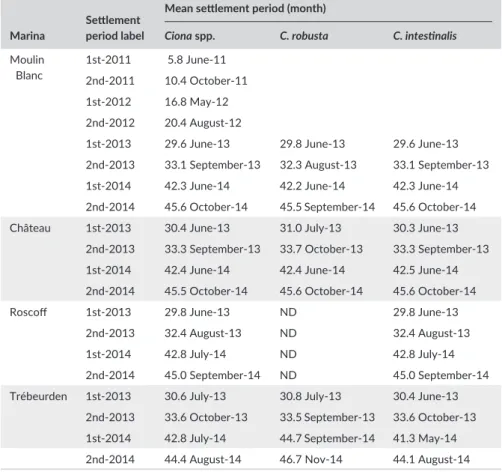
Modal decomposition analyses carried out for each species sepa-rately showed the same results as those for Ciona spp. Two settlement periods were observed in 2013 and 2014, for both study species: mainly Marina Settlement period label
Mean settlement period (month)
Ciona spp. C. robusta C. intestinalis
Moulin Blanc 1st- 2011 5.8 June- 11 2nd- 2011 10.4 October- 11 1st- 2012 16.8 May- 12 2nd- 2012 20.4 August- 12
1st- 2013 29.6 June- 13 29.8 June- 13 29.6 June- 13 2nd- 2013 33.1 September- 13 32.3 August- 13 33.1 September- 13 1st- 2014 42.3 June- 14 42.2 June- 14 42.3 June- 14 2nd- 2014 45.6 October- 14 45.5 September- 14 45.6 October- 14 Château 1st- 2013 30.4 June- 13 31.0 July- 13 30.3 June- 13
2nd- 2013 33.3 September- 13 33.7 October- 13 33.3 September- 13 1st- 2014 42.4 June- 14 42.4 June- 14 42.5 June- 14 2nd- 2014 45.5 October- 14 45.6 October- 14 45.6 October- 14
Roscoff 1st- 2013 29.8 June- 13 ND 29.8 June- 13
2nd- 2013 32.4 August- 13 ND 32.4 August- 13 1st- 2014 42.8 July- 14 ND 42.8 July- 14 2nd- 2014 45.0 September- 14 ND 45.0 September- 14 Trébeurden 1st- 2013 30.6 July- 13 30.8 July- 13 30.4 June- 13
2nd- 2013 33.6 October- 13 33.5 September- 13 33.6 October- 13 1st- 2014 42.8 July- 14 44.7 September- 14 41.3 May- 14 2nd- 2014 44.4 August- 14 46.7 Nov- 14 44.1 August- 14 The unit for the settlement period is the month, with values ranging thus from 0 (December 2010) to 51 (March 2015). Settlement periods were identified using modal decomposition analyses carried out separately for each year on the monthly distribution of the mean juvenile density on panels (n = 3). The settlement period indicated is the modal value of each identified Gaussian curve. Details of the results of the modal decomposition analyses are given in Figure S1 and Table S4 for Ciona spp. and in Figure S2 and Table S5 for the two species separately. Note that no Ciona robusta juveniles were identified in the Roscoff marina. T A B L E 1 Mean settlement period for each settlement event identified over the course of the study (i.e., 52 months) for Ciona spp. and for Ciona robusta and Ciona intestinalis separately
during spring and early summer for the first settlement period and during end of summer and autumn for the second one (Figure 4). The average settlement time per settlement period and marina is provided in Table 1 for C. intestinalis and C. robusta. Details on the parameters of the modal decomposition outcomes are given in Table S5. Interestingly, the settlement timing of the two species was very similar regardless of the settlement period (Table 1, Figure 4). There was however one ex-ception in Trébeurden in 2014: C. robusta settlement was delayed for at least 4 months, with mode values of the first and second settlement periods of 2014 being in September and November 2014, respectively, for C. robusta, but in May and August 2014, respectively, for C. intestinalis (Figure 4).
Throughout the 2013–2014 survey and regardless of the ma-rina, the density of juveniles of C. intestinalis was much higher than those recorded for C. robusta (Figure 3). For example, in 2014 in Château (i.e., the marina showing the highest density values of
C. robusta, Table S3), the average density value during the two
settlement periods ranged from 11.5 (±19.9 SD) in July to 361.7
(±114.9 SD) juv/dm2 in October for C. robusta, but from 17.3 (±2.8
SD) in December to 897.7 (±197.5 SD) juv/dm2 in October for C.
in-testinalis. Result of the ANOVA on the settlement rate (i.e.,
den-sity values of the month showing the highest density of juveniles and the preceding and following month) over 2013 and 2014 for
C. intestinalis was comparable to those obtained for Ciona spp. T A B L E 2 Result of the two- way ANOVA testing the effect of the settlement period (n = 4, 1st- 13: first settlement period in 2013, etc., see Table 1) and marina (n = 4 or 3, MBl: Moulin Blanc, Cha: Château, Ros: Roscoff, Treb: Trébeurden) on the density values corresponding to the month showing the highest density of juveniles and the preceding and following month (see Section 2), for (a) Ciona spp., (b) Ciona robusta, and (c) Ciona intestinalis
(a) Density of Ciona spp. (b) Density of C. robusta
Source of variance df SS F p- Value Source of variance df SS F p- Value
Settlement period 3 6.1 0.02 .995 Settlement period 3 198.6 6.77 .003 Marina 3 5,094.9 18.02 <.001 Marina 2 249.0 12.74 <.001 Interaction 9 848.1 2.76 .015 Interaction 6 327.4 5.58 <.001 Residuals 128 2,363.3 Residuals 96 238.3 SNK interpretations SNK interpretations Within settlement
period 1st- 132nd- 13 Ros = Treb < MBl = ChaRos = Treb = MBl < Cha Within settlement period 1st- 132nd- 13 MBl = Cha = TrebMBl < Cha = Treb 1st- 14 Ros = Treb < MBl = Cha 1st- 14 MBl = Cha = Treb 2nd- 14 Ros = Treb = MBl < Cha 2nd- 14 MBl = Treb < Cha Within marina MBl 2nd- 13 < 1st- 13 = 1st- 14 = 2nd- 14 Within marina MBl All equal
Cha All equal Cha 1st- 13 = 2nd- 13 = 1st- 14 < 2nd- 14
Ros All equal Tre 1st- 13 < 2nd- 13 = 1st- 14 = 2nd- 14
Tre All equal
(c) Density of C. intestinalis
Source of variance df SS F p- Value
Settlement period 3 7.8 0.08 .969 Marina 3 4,533.7 48.84 <.001 Interaction 9 857.0 3.08 .005 Residuals 128 1,960.4 SNK interpretations Within settlement
period 1st- 132nd- 13 Ros = Treb < MBl = ChaRos = Treb = MBl < Cha 1st- 14 Ros = Treb < MBl = Cha 2nd- 14 Ros = Treb < MBl < Cha Within marina MBl 2nd- 13 < 1st- 13 = 1st- 14 = 2nd- 14 Cha All equal Ros All equal Tre All equal Degrees of freedom (df), sums of squares (SS), values of the statistic (F), and probability value (p- value) are given. Significant p- values are shown in bold. For significant factors, pairwise comparisons are provided (i.e., SNK post hoc tests).
(Table 2b, Figure 3): a strong and significant site effect explained by the extremely high density values in Château compared with the other marinas and an absence of significant effect of settlement period (except for Moulin Blanc). For C. robusta, different results were obtained: A significant settlement period effect was observed in addition to a significant site effect (Table 2c, Figure 3). These results are due to the higher densities of C. robusta juveniles (1) in Château, in particular, during the second settlement period of 2014
(average density value of 361.7 juv/dm2 (±114.9 SD) in October
2014) and (2) in Trébeurden where the settlement density was sig-nificantly higher during the last three settlement periods compared with the first one.
3.4 | Comparison of density patterns at adult stages
between C. robusta and C. intestinalis
Throughout the study, the same trend observed for juveniles was observed between adults of the two species sampled in 2014 in the three marinas where both species were present (Figure 5), that is, (1) a higher density for both species in autumn compared to spring gen-eration, (2) a higher density for C. intestinalis compared to C. robusta whatever the season, and (3) an higher increase of C. robusta abun-dance within a year than that of C. intestinalis. For instance, in Château in autumn 2014, the average density of adults was 11 times higher
(1,338 ind/m2 ±491 SD) for C. intestinalis compared with C. robusta
F I G U R E 3 Monthly variation (mean ± standard error, n = 3) in the density of juveniles of Ciona robusta (black circles) and Ciona intestinalis (white circles) in the three marinas where the two species were found living in syntopy. The three graphs have different scales for the Y- axis
Number of juveniles settled per dm
2 0 20 40 60 80 100 120 140 160 Februar y Februar y Apri l June August October Decembe r Februar y Apri l June August October Decembe r 0 100 200 300 400 500 600 700
Number of juveniles settled per dm
2 0 200 400 600 800 1000 1200 2013 2014 2015 February February Apri l June Augus t October Decembe r February Apri l June Augus t October Decembe r 2013 2014 2015 February February Apri l June Augus t October Decembe r February Apri l June Augus t October Decembe r 2013 2014 2015
Number of juveniles settled per dm
2
Trébeurden
Moulin blanc
Château
C. robusta
C. intestinalis
(120 ind/m2 ±112 SD) and the increase in C. robusta density within a
year was up to 100 times in autumn 2014 compared with spring 2014 while only seven times for C. intestinalis.
4 | DISCUSSION
4.1 | Similar timing of settlement for the non- native
and native congeners in syntopic localities
In all marinas, except Roscoff, both C. robusta and C. intestinalis re-cruited on the settlement panels that we set out. When both species were present in a given marina and month, the juveniles of both species were found on each panel without any evidence of spatial clustering (i.e., relative proportions of the two species were similar on all three panels). That the two species are well mixed on experimental substrates reflects observations of adults growing under pontoons (see figure 1 in Bouchemousse, Lévêque, et al., 2016) and the density survey of adults in 2014. For instance, in autumn 2014, both species were identified in all of the quadrats sampled in Château (Figure 5). In the study area, the two species live in very tight syntopy at the juvenile and adult stages.
Based on modal decomposition analyses, in the three marinas where juveniles of both species settled, we identified two similar F I G U R E 4 Graphical outcomes of the modal decomposition analysis for determining the number and properties of each major settlement events of Ciona robusta and Ciona intestinalis in 2013 and 2014 in the three marinas where the two species were found living in syntopy (i.e., Moulin Blanc, Château, and Trébeurden). The blue line (histogram) corresponds to the observed dataset (i.e., distribution of the density of juveniles for each month). The values were averaged per panels (n = 3 replicates) and smoothed using a running average over three classes (i.e., 3 months). Result of Shapiro–Wilk tests (W: value of the statistic, p, probability) on the deviation of the observed data from a normal distribution are provided: All distributions are significantly different from a normal distribution. Red and green curves show the outcome of the modal decomposition analysis and correspond to the Gaussian curves and the final adjusted curve, respectively. Characteristics of each Gaussian curve are detailed in Table S5
2013
2014
C. robusta C. intestinalis C. robusta C. intestinalis
W = 0.652 p < 0.001 W = 0.648p < 0.001 W = 0.751p < 0.001 W = 0.780 p = 0.002 W = 0.796p = 0.003 W = 0.668p < 0.001 Château W = 0.677 p < 0.001 W = 0.751p < 0.001 W = 0.730p < 0.001 W = 0.791 p = 0.003 W = 0.803 p = 0.004 W = 0.715 p < 0.001 Moulin Blan c Trébeurden Probability Densit y Probability Densit y Probability Densit y
Months Months Months Months
F I G U R E 5 Density (mean ± standard error, n = 20) of Ciona robusta (black bars) and Ciona intestinalis (white bars) at the adult stage recorded in spring and autumn 2014 in the four marinas studied. Arrows indicate the presence of C. robusta (the relatively low values are difficult to discern on the large Y- axis). The percentage of quadrats in which the two species were identified is indicated above the bar plots
for each marina Moulin Blanc Château Roscoff Trébeurden
Number of adults per
m 2 0 200 400 600 800 1000 1200 1400
Moulin Blanc Château Roscoff Trébeurden
40% 5% 50% 100% 90% Spring 2014 Autumn 2014 C. robusta C. intestinalis
settlement periods for each species in each study year: One settle-ment period was observed at the end of spring–early summer and a second one in late summer–early fall. This result corroborates obser-vations of simultaneous gamete production by the adults during spring and autumn for both Ciona species in syntopic localities in the English Channel (Bouchemousse, Lévêque, et al., 2016).
Previous studies of these two Ciona species have reported ju-venile settlement dynamics for one or the other of the two species independently. Although these studies use the names “Ciona
intesti-nalis” or “C. intestinalis type B” and “C. intestinalis type A” (Nydam &
Harrison, 2007), we were able to determine the identity of the spe-cies examined according to the geographical location of the study (see Supplementary Note in Bouchemousse, Bishop, et al., 2016 for a detailed map). For C. intestinalis, our findings are in agreement with results obtained in Nova Scotia and Prince Edward Island (Carver, Chisholm, & Mallet, 2003; Howes, Herbinger, Darnell, & Vercaemer, 2007; Vercaemer, Sephton, Nicolas, Howes, & Keays, 2011), in Sweden (Dybern, 1965), and in a Danish fjord (Petersen & Svane, 1995), where two settlement periods were identified and are similar to those found in our study. In the English Channel, information is available on adults only (i.e., in Plymouth, Orton, 1914, 1920), but also fit with the as-sumption of two generations, and thus two settlement periods, per year. For C. robusta, our study is the first to document settlement pat-terns in the NE Atlantic. There are however data available for San Francisco Bay, another region where the species has been presumably introduced: Two settlement periods are also observed, one occurring in August and one in October–November (Blum et al., 2007). Other data documenting the life cycle of C. robusta are based on temporal surveys of adults in the Mediterranean Sea: Caputi et al. (2015) sug-gested the existence of more than two generations with reproductive adults present throughout the year, including during winter months. Similarly, three or four generations have been documented for dif-ferent regions of the Mediterranean Sea (i.e., Adriatic Sea, eastern and western Mediterranean Sea, see Dybern, 1965 and references therein). Altogether, our results and data from the literature suggest that, regardless of the geographical region, at least two generations occur over a calendar year for both Ciona species, with variation in the settlement period for C. robusta probably explained by different environmental conditions (e.g., temperature).
Our data clearly indicate a similar number of generations per year and settlement periods in the English Channel for the two congeneric species, indicating no major shift in the phenology of the two species. Consequently, competitive interactions for space may occur during juvenile growth in localities where the recruitment is intense for both species, such as the Château marina (Figure 3). Such early competition may influence adult abundance because recruitment success is a key feature in space monopolization for sessile organisms (e.g., between ascidian species; Rius, Potter, Aguirre, & Stachowicz, 2014). There is however one exception to the general pattern observed, in Trébeurden in 2014 (Table 1, Figure 3), where recruitment of C. robusta juveniles was delayed by at least 4 months compared with their native conge- ners. We have no clear explanation for this singularity, especially con-sidering that we did not observe any obvious differences in gamete production in either species in this marina (Bouchemousse, Lévêque, et al., 2016). However, this finding may indicate the onset of a pheno-logical shift between the two species in this marina, which is also one of the few marinas where the NNS C. robusta can have higher rela-tive abundance than C. intestinalis at the adult stage (Bouchemousse, Lévêque, et al., 2016). In any case, we conclude that phenological shifts are not driving any potential competitive exclusion between the NNS C. robusta and its native congener in situations of syntopy.
4.2 | Can larval supply or environmental conditions
explain variation in settlement success between
marinas?
The overall settlement timing was similar for the two species, but we observed important differences in settlement rate of juveniles at dif-ferent levels, in particular between marinas. For C. intestinalis, a much higher number of juveniles were observed in the marinas of the Bay of Brest (i.e., Château and Moulin Blanc) than in the two marinas lo-cated on the northern coast of Brittany (i.e., Roscoff and Trébeurden). This trend for a site effect was not observed for C. robusta, despite the higher numbers of juveniles in the Château marina compared with the other marinas. Similar observations were also found at the adult stage during surveys carried out in spring and autumn 2014 (Figure 5): Higher densities for C. intestinalis were observed in the two marinas in the Bay of Brest, and for C. robusta in Château. Local hydrodynamic features can have a strong impact on the den-sity and the aggregation of Ciona spp. juveniles (Havenhand & Svane, 1991), and more generally on marine invertebrates with a bentho- pelagic life cycle (Hunt & Scheibling, 1997). Both the Château and Moulin Blanc marinas are located in the Bay of Brest, a semiclosed system, which may contribute to retaining larvae close to the sites where they have been released and thus enhance larval supply near resident adult populations (Gaines & Bertness, 1992). Moreover, close to estuaries of important rivers (i.e., Aulne and Elorn, Figure 1a), food supply is also likely to be higher in the marinas of the Bay of Brest com-pared with Trébeurden and Roscoff. Conversely, the Roscoff marina is an open marina located in the Bay of Morlaix in which tidal currents are important, thereby potentially preventing local larval retention and settlement events. Significant larval exports out of this bay have been demonstrated using an analytical hydrodynamic model for the mollusk C. fornicata, another NNS in the Bay of Morlaix (Rigal et al., 2010). Larval export was suggested as a possible explanation for the low proliferation of this NNS in the bay. Similar processes may occur for Ciona species, although their larval stage is short and their ability to settle quickly (within 12–24 hr under laboratory conditions) following fertilization. Fine- scale hydrodynamic models covering the study mari-nas and ports are unfortunately not available. Dedicated models need to be developed to examine in further detail the role of larval supply/ larval export to/from urban marine environments.In contrast to C. intestinalis, we found a significant settlement period effect on the density of juveniles for C. robusta (Table 2b). As pictured in Figure 3, the abundance of settled C. robusta juveniles in-creased over time within a year in two of the three study marinas where
this species was present (i.e., Trébeurden and Château). This increase in C. robusta abundance within a year was also documented for adults (Figure 5) with up to a 10- fold increase in the density of C. robusta in autumn 2014 compared with spring 2014. This increase is most likely due to warmer conditions from July to September (Figure 2), that are more favorable to C. robusta recruitment, considered to be a warm- temperate species compared with the cold- temperate species C.
in-testinalis (Bouchemousse, Lévêque, et al., 2016; Procaccini, Affinito,
Toscano, & Sordino, 2011). This presumed difference in temperature preferences may also explain the disappearance of C. robusta in the Roscoff marina after 2012 (i.e., 1 year after its building). Adult individ-uals of C. robusta have indeed been observed in 2012 in this marina (Table S1) but have completely disappeared in 2013 and 2014 (Table S1, Figure 5). Note that more recent surveys (July 2016) confirmed the absence of C. robusta in this locality (L. Leveque & F. Viard, unpub-lished data). This marina is located in the coldest part of the Brittany coastline (Gallon et al., 2014), and its maximal temperatures are below 17°C (Figure 2). These temperature conditions may favor reproduction and sustainable population establishment of C. intestinalis at the ex-pense of C. robusta (Bouchemousse, Lévêque, et al., 2016). Other abiotic factors such as large changes in surface salinity due to rainfall and river inputs are known to influence the dynamics of ascidian communities established under pontoons and floating docks (Lambert & Lambert, 1998, 2003). In our study, we observed dramatic changes in the density of Ciona spp. juveniles in Moulin Blanc over the 4 years survey (Figure 2): The settlement rate in 2012 was particularly low compared with other years. This is most likely due to the almost complete collapse of adult Ciona populations in this marina (L.L., per- sonal diving observations) following the exceptional rainfalls that oc-curred in April (i.e., 211.4 mm during April 2012, compared to average of 91.9 ± 35.2 mm (April 1981–April 2010, source: http://www.me- teo-bretagne.fr/climatologie-normales-Brest-Guipavas). Ciona popula-tions have progressively recovered since then, despite other episodes of high rainfall and collapse of adult populations in winters 2013 and 2014 (Bouchemousse, Lévêque, et al., 2016). Similar population col-lapses notably due to rainfall events have been recently documented in another introduced ascidian, S. plicata (Pineda, Turon, Perez- Portela, & Lopez- Legentil, 2016 and references therein). Although located close by (5 km), the Château marina seems less exposed to such events, perhaps because it is further away from the estuaries of two important rivers (i.e., Aulne and Elorn, Figure 1a) than Moulin Blanc. Similarly, Trébeurden and Roscoff being located in fully marine parts of the Brittany coastline are even less affected by rainfall. Apart from sto-chastic events, whose effects may have an impact over several years, juvenile populations of Ciona spp. in Moulin Blanc seem to be compa-rable to Château in terms of density as shown by the recruitment peak in spring 2013 and 2014. Altogether, the site and settlement effects documented here for juveniles are similar to those observed for adults, indicating a positive feedback loop between the density of adults and of juveniles in Ciona spp.—for the two species together and independently. The changes over time (i.e., between seasons) are however more pronounced in C. robusta, suggesting that warmer conditions may facilitate the
settlement of the NNS and subsequently increase its recruitment suc-cess compared with its native congener.
4.3 | Does competition with its native congener
limit the invasiveness of C. robusta?
Despite its advantage during the warmer season, we documented a consistently low recruitment success in C. robusta than in C.
intes-tinalis. For example, the maximum value observed over the whole
dataset was in Château in October 2014, with a density value of
361.6 juv/dm2, a value more than two times lower than for C.
intesti-nalis (898.7 juv/dm2) at the same place and date. The same result was observed for the adult stage in all sampling periods (Figure 5). Inhibition of settlement and subsequent growth by a superior com-petitor can strongly influence the abundance of species, as shown in numerous cases for marine invertebrates (Davis, Butler, & Vanaltena, 1991; Grosberg, 1981), including in ascidians (Rius et al., 2009; Svane & Young, 1989). For example, using ex situ experiments, Rius et al. (2009) showed that the presence of S. plicata juveniles, a non- native ascidian in Australia, increased juvenile mortality and reduced the growth of the native ascidian Microcomus squamiger, probably via com-petition for food. The opposite situation, that is, negative influence of native species on the settlement of NNS, has also been reported. For example, in Spain (Mediterranean Sea), predation of larvae by juve-niles of the native mussel M. galloprovincialis was shown to stimulate settlement avoidance close to mussels of two non- native ascidians
S. plicata and Microcomus squamiger (Ordonez et al., 2013). Under the competition hypothesis, marinas with the highest density of one Ciona species should have the lowest density of the other species. However, the exact opposite was observed in our study, that is, the Château ma-rina showed the highest density values for juveniles and adults of both species. This suggests that competitive interactions are not major driv-ers of the population dynamics in these two species (i.e., food or space are not limiting) and that environmental and/or biotic factors in this site favor the population expansion of both species. Moreover, similar values of the density of juveniles have been observed for C. robusta in another region, the San Francisco Bay, where it has been introduced but does not coexist with C. intestinalis, with a maximum density of ca.
300 juveniles/dm2 (Blum et al., 2007). Our density data for C.
intesti-nalis are also similar to those documented for C. intestinalis in Nova
Scotia (e.g., up to 1,450/dm2; Vercaemer et al., 2011) and in Prince
Edward Island (e.g., up to 4,800 individuals/dm2; Ramsay, Davidson,
Bourque, & Stryhn, 2009), two localities in which C. intestinalis is con-sidered as a NNS.
Considering that competition between the two species at the settlement stage does not currently appear to be a significant driv-ing factor of population abundance, and because C. robusta settle-ment and adult density both increase in autumn, the abundance of this species is expected to increase from year to year. However, the exact opposite trend is observed, with a particularly low adult density and juvenile settlement rate of this species in spring. For instance, in Trébeurden, the highest density value for C. robusta during the second settlement event of 2013 was twice as low as that of C. intestinalis,
but the adult density value was 27 times lower for C. robusta com-pared with C. intestinalis in spring 2014. We suggest that the autumn settlement of C. robusta is successful, but subsequent growth and/or survival is limited. The NNS seems to suffer from unfavorable environ-mental conditions during the winter season (i.e., coldest temperatures and strong variation of salinity, as explained above for Ciona spp.), which may either reduce juvenile growth and/or cause adult mortality before the onset of their reproductive period in spring. This finding is consistent with known differences in environmental preferences between the two species (i.e., C. robusta is considered to be a warm- temperate species and C. intestinalis is a more cold- temperate species, as mentioned before). Thus, the winter season seems to have a lesser impact on the mortality of C. intestinalis populations than on those of
C. robusta and may therefore explain the much lower adult density and
thus settlement density of C. robusta than C. intestinalis in the spring. Altogether, our results suggest that competitive exclusion at early stages between the NNS C. robusta and its native congener in situ-ation of syntopy is unlikely to play a major role in determining their patterns of coexistence in the wild. Regarding the density of adults recorded in 2014, variations in settlement rate between marinas and settlement period indicate a positive feedback loop between adult and juveniles for both Ciona species. The observed annual density variations, more pronounced for C. robusta, suggest that environmen-tal variations in abiotic parameters (i.e., temperature and salinity) play a critical role in the population dynamics of the NNS: Warmer seasons seem to facilitate the settlement of C. robusta, and conversely, winter seasons limit its expansion by inducing higher mortality rate than the native species. However, biological invasions are dynamic processes in which “boom and bust” dynamics are often documented, and which require long- term surveys to be properly examined (Strayer, Eviner, Jeschke, & Pace, 2006). Considering the documented warming of seawater in the English Channel (Gallon et al., 2014), mortality and/ or reduced growth of C. robusta may be lowered and its competitive ability over C. intestinalis may increase. Long- term field monitoring associated with experimental studies investigating the influence of environmental conditions on the survival and growth of both Ciona species are needed to determine the fate of the NNS C. robusta in the English Channel.
ACKNOWLEDGMENTS
The authors are very grateful to G. Dubois, the divers of the Marine Operations department (Service Mer & Observation) at the Roscoff Biological Station, and all of the people that accompanied us in the field to retrieve the panels monthly over the 4 years of the study. We are thankful to A. Yunnie for her help on the experimental work and for collecting part of the 2011 juvenile dataset and to A. Courteille for assistance with DNA extraction and determination of juveniles sam- pled in 2013. We also thank the marina operators for their permis-sion to conduct the experiment. The authors are grateful to Xavier Turon for his suggestions to improve the manuscript. This work was supported by funding from the ANR project HYSEA (no. ANR- 12- BSV7- 0011) and the Interreg IVa Marinexus project. CONFLICT OF INTEREST None declared. REFERENCES Airoldi, L., & Beck, M. W. (2007). Loss, status and trends for coastal marine habitats of Europe. In R. N. Gibson, R. J. A. Atkinson & J. D. M. Gordon (Eds.), Oceanography and marine biology (Vol. 45, pp. 345–405). Taylor and Francis Group: Bocq Raton, US.
Airoldi, L., Turon, X., Perkol-Finkel, S., & Rius, M. (2015). Corridors for aliens but not for natives: Effects of marine urban sprawl at a regional scale.
Diversity and Distributions, 21, 755–768.
Aldred, N., & Clare, A. S. (2014). Mini- review: Impact and dynamics of surface fouling by solitary and compound ascidians. Biofouling, 30, 259–270.
Arenas, F., Bishop, J. D. D., Carlton, J. T., Dyrynda, P. J., Farnham, W. F., Gonzalez, D. J., … Wood, C. A. (2006). Allen species and other notable records from a rapid assessment survey of marinas on the south coast of England. Journal of the Marine Biological Association of the United
Kingdom, 86, 1329–1337.
Bishop, J. D. D., Wood, C. A., Leveque, L., Yunnie, A. L. E., & Viard, F. (2015). Repeated rapid assessment surveys reveal contrasting trends in occu-pancy of marinas by non- indigenous species on opposite sides of the western English Channel. Marine Pollution Bulletin, 95, 699–706. Bishop, J. D. D., Wood, C. A., Yunnie, A. L. E., & Griffiths, C. A. (2015).
Unheralded arrivals: Non- native sessile invertebrates in marinas on the English coast. Aquatic Invasions, 10, 249–264.
Blum, J. C., Chang, A. L., Liljesthrom, M., Schenk, M. E., Steinberg, M. K., Ruiz, G. M. (2007). The non- native solitary ascidian Ciona intestinalis (L.) depresses species richness. Journal of Experimental Marine Biology
and Ecology, 342, 5–14.
Bouchemousse, S., Bishop, J. D. D., & Viard, F. (2016). Contrasting global genetic patterns in two biologically similar, widespread and invasive
Ciona species (Tunicata, Ascidiacea). Scientific Reports, 6, 24875.
Bouchemousse, S., Haag-Liautard, C., Bierne, N., & Viard, F. (2016). Distinguishing contemporary hybridization from past introgression with post- genomic ancestry- informative SNPs in strongly differentiated Ciona species. Molecular Ecology, 25, 5527–5542. doi:10.1111/mec.13854 Bouchemousse, S., Lévêque, L., Dubois, G., & Viard, F. (2016). Co- occurrence and reproductive synchrony do not ensure hybridization between an alien tunicate and its interfertile native congener. Evolutionary Ecology, 30, 69–87. Branch, G. M. (1984). Competition between marine organisms: Ecological and evolutionary implications. Oceanography and Marine Biology, 22, 429–593.
Briggs, J. C. (2012). Marine species invasions in estuaries and harbors.
Marine Ecology Progress Series, 449, 297–302.
Brunetti, R., Gissi, C., Pennati, R., Caicci, F., Gasparini, F., Manni, L. (2015). Morphological evidence that the molecularly determined Ciona intestinalis type A and type B are different species: Ciona robusta and Ciona intestinalis.
Journal of Zoological Systematics and Evolutionary Research, 53, 186–193.
Bulleri, F., & Chapman, M. G. (2010). The introduction of coastal infrastruc-ture as a driver of change in marine environments. Journal of Applied
Ecology, 47, 26–35.
Caputi, L., Andreakis, N., Mastrototaro, F., Cirino, P., Vassillo, M., Sordino, P. (2007). Cryptic speciation in a model invertebrate chordate. Proceedings
of the National Academy of Sciences of the United States of America, 104,
9364–9369.
Caputi, L., Crocetta, F., Toscano, F., Sordino, P., & Cirino, P. (2015). Long- term demographic and reproductive trends in Ciona intestinalis sp. A.
Marine Ecology, 36, 118–128.
Carver, C. E., Chisholm, A., & Mallet, A. L. (2003). Strategies to mitigate the impact of Ciona intestinalis (L.) biofouling on shellfish production.
Davis, A. R., Butler, A. J., & Vanaltena, I. (1991). Settlement behavior of as- cidian larvae: Preliminary evidence for inhibition by sponge allelochem-icals. Marine Ecology Progress Series, 72, 117–123.
Dybern, B. I. (1965). The life cycle of Ciona intestinalis (L.) f. typica in relation to the environmental temperature. Oikos, 16, 109–131. Edwards, K. F., & Stachowicz, J. J. (2011). Spatially stochastic settlement and the coexistence of benthic marine animals. Ecology, 92, 1094–1103. Edwards, K. F., & Stachowicz, J. J. (2012). Temporally varying larval settle- ment, competition, and coexistence in a sessile invertebrate commu-nity. Marine Ecology Progress Series, 462, 93–102.
Franke, H. D., Gutow, L., & Janke, M. (2007). Flexible habitat selection and in-teractive habitat segregation in the marine congeners Idotea baltica and
Idotea emarginata (Crustacea, Isopoda). Marine Biology, 150, 929–939.
Fridley, J. D., Stachowicz, J. J., Naeem, S., Sax, D. F., Seabloom, E. W., Smith, M. D., … Von Holle, B. (2007). The invasion paradox: Reconciling pat-tern and process in species invasions. Ecology, 88, 3–17.
Frontier, S., & Pichod-Viale, D. (1991). Ecosystèmes: Structure,
fonctionne-ment, évolution. Paris, France: Masson.
Gaines, S. D., & Bertness, M. D. (1992). Dispersal of juveniles and variable recruitment in sessile marine species. Nature, 360, 579–580.
Gaines, S., & Roughgarden, J. (1985). Larval settlement rate: A leading de- terminant of structure in an ecological community of the marine inter-tidal zone. Proceedings of the National Academy of Sciences of the United
States of America, 82, 3707–3711.
Gallon, R. K., Robuchon, M., Leroy, B., Le Gall, L., Valero, M., Feunteun, E. (2014). Twenty years of observed and predicted changes in subtidal red seaweed assemblages along a biogeographical transition zone: Inferring potential causes from environmental data. Journal of Biogeography, 41, 2293–2306. Green, P. E. J., & Macdonald, P. D. M. (1985). User’s guide to program MIX: An
interactive program for fiing mixtures of distributions. Hamilton, Ontario,
Canada: Ichthus Data Systems.
Grosberg, R. K. (1981). Competitive ability influences habitat choice in ma-rine invertebrates. Nature, 290, 700–702.
Havenhand, J. N., & Svane, I. (1991). Roles of hydrodynamics and larval behavior in determining spatial aggregation in the tunicate Ciona
intes-tinalis. Marine Ecology Progress Series, 68, 271–276.
Howes, S., Herbinger, C. M., Darnell, P., & Vercaemer, B. (2007). Spatial and temporal patterns of recruitment of the tunicate Ciona intestinalis on a mussel farm in Nova Scotia, Canada. Journal of Experimental Marine
Biology and Ecology, 342, 85–92.
Hunt, H. L., & Scheibling, R. E. (1997). Role of early post- settlement mor-tality in recruitment of benthic marine invertebrates. Marine Ecology
Progress Series, 155, 269–301.
Lambert, C. C., & Lambert, G. (1998). Non- indigenous ascidians in southern California harbors and marinas. Marine Biology, 130, 675–688.
Lambert, C. C., & Lambert, G. (2003). Persistence and differential distribu-tion of nonindigenous ascidians in harbors of the Southern California Bight. Marine Ecology Progress Series, 259, 145–161.
Lewin, R. (1986). Supply- side ecology. Science, 234, 25–27.
Lockwood, B. L., & Somero, G. N. (2011). Invasive and native blue mus-sels (genus Mytilus) on the California coast: The role of physiology in a biological invasion. Journal of Experimental Marine Biology and Ecology,
400, 167–174. Lopez-Legentil, S., Legentil, M. L., Erwin, P. M., & Turon, X. (2015). Harbor networks as introduction gateways: Contrasting distribution patterns of native and introduced ascidians. Biological Invasions, 17, 1623–1638. Molnar, J. L., Gamboa, R. L., Revenga, C., & Spalding, M. D. (2008). Assessing the global threat of invasive species to marine biodiversity. Frontiers in
Ecology and the Environment, 6, 485–492.
Nydam, M. L., & Harrison, R. G. (2007). Genealogical relationships within and among shallow- water Ciona species (Ascidiacea). Marine Biology,
151, 1839–1847.
Nydam, M. L., & Harrison, R. G. (2011). Introgression despite substantial divergence in a broadcast spawning marine invertebrate. Evolution, 65, 429–442.
Ordonez, V., Rius, M., McQuaid, C. D., Carmen Pineda, M., Pascual, M., Turon, X. (2013). Early biotic interactions among introduced and native benthic species reveal cryptic predation and shifts in larval behaviour.
Marine Ecology Progress Series, 488, 65–79.
Orton, J. H. (1914). Preliminary account of a contribution to an evaluation of the sea. Journal of Marine Biological Association, 10, 312–326. Orton, J. H. (1920). Sea- temperature, breeding and distribution in marine
animals. Journal of Marine Biological Association, 12, 339–366. Pechenik, J. A., Li, W., & Cochrane, D. E. (2002). Timing is everything: The
effects of putative dopamine antagonists on metamorphosis vary with larval age and experimental duration in the prosobranch gastropod
Crepidula fornicata. Biological Bulletin, 202, 137–147.
Petersen, J. K., & Svane, I. (1995). Larval dispersal in the ascidian Ciona
intestinalis (L). Evidence for a closed population. Journal of Experimental Marine Biology and Ecology, 186, 89–102.
Pineda, M. C., Turon, X., Perez-Portela, R., & Lopez-Legentil, S. (2016). Stable populations in unstable habitats: Temporal genetic structure of the introduced ascidian Styela plicata in North Carolina. Marine Biology,
163, 59. doi:10.3354/meps09560
Procaccini, G., Affinito, O., Toscano, F., & Sordino, P. (2011). A new an-imal model for merging ecology and evolution. In P. Pontarotti (Ed.),
Evolutionary Biology: Concepts, biodiversity, macroevolution and genome evolution (pp. 91–106). Berlin Heidelberg, Germany: Springer.
R Development Core Team (2014). R v.3.1.3.: A language and environment
for statistical computing. Vienne, Austria: R Foundation for Statistical
Computing. http://www.R-project.org.
Ramsay, A., Davidson, J., Bourque, D., & Stryhn, H. (2009). Recruitment pat-terns and population development of the invasive ascidian Ciona
intes-tinalis in Prince Edward Island, Canada. Aquatic Invasions, 4, 169–176.
Ramsay, A., Davidson, J., Landry, T., & Arsenault, G. (2008). Process of in-vasiveness among exotic tunicates in Prince Edward Island, Canada.
Biological Invasions, 10, 1311–1316.
Rigal, F., Viard, F., Ayata, S. D., & Comtet, T. (2010). Does larval supply ex-plain the low proliferation of the invasive gastropod Crepidula fornicata in a tidal estuary? Biological Invasions, 12, 3171–3186.
Rius, M., Potter, E. E., Aguirre, J. D., & Stachowicz, J. J. (2014). Mechanisms of biotic resistance across complex life cycles. Journal of Animal Ecology,
83, 296–305. Rius, M., Turon, X., & Marshall, D. J. (2009). Non- lethal effects of an invasive species in the marine environment: The importance of early life- history stages. Oecologia, 159, 873–882. Roughgarden, J., Gaines, S., & Possingham, H. P. (1988). Recruitment dy-namics in complex life cycles. Science, 241, 1460–1466. Ruiz, G. M., Freestone, A., Fofonoff, P. W., & Simkanin, C. (2009). Habitat distribution and heterogeneity in marine invasion dynamics: The impor-tance of hard substrate and artificial structure. In M. Whal (Ed.), Marine
hard bottom communities (pp. 321–332). Berlin, Germany: Springer.
Sato, A., Satoh, N., & Bishop, J. D. D. (2012). Field identification of ‘types’ A and B of the ascidian Ciona intestinalis in a region of sympatry. Marine
Biology, 159, 1611–1619.
Simberloff, D. (2009). The role of propagule pressure in biological invasions.
Annual Review of Ecology Evolution and Systematics, 40, 81–102.
Stachowicz, J. J., Terwin, J. R., Whitlatch, R. B., & Osman, R. W. (2002). Linking climate change and biological invasions: Ocean warming fa-cilitates nonindigenous species invasions. Proceedings of the National
Academy of Sciences of the United States of America, 99, 15497–15500.
Stachowicz, J. J., Whitlatch, R. B., & Osman, R. W. (1999). Species di-versity and invasion resistance in a marine ecosystem. Science, 286, 1577–1579.
Strayer, D. L., Eviner, V. T., Jeschke, J. M., & Pace, M. L. (2006). Understanding the long- term effects of species invasions. Trends in Ecology & Evolution,
21, 645–651.
Suzuki, M. M., Nishikawa, T., & Bird, A. (2005). Genomic approaches re-veal unexpected genetic divergence within Ciona intestinalis. Journal of