Publisher’s version / Version de l'éditeur:
National Builder, 8, 11, pp. 38-40, 51, 1959-12-01
READ THESE TERMS AND CONDITIONS CAREFULLY BEFORE USING THIS WEBSITE. https://nrc-publications.canada.ca/eng/copyright
Vous avez des questions? Nous pouvons vous aider. Pour communiquer directement avec un auteur, consultez la première page de la revue dans laquelle son article a été publié afin de trouver ses coordonnées. Si vous n’arrivez pas à les repérer, communiquez avec nous à [email protected].
Questions? Contact the NRC Publications Archive team at
[email protected]. If you wish to email the authors directly, please see the first page of the publication for their contact information.
NRC Publications Archive
Archives des publications du CNRC
This publication could be one of several versions: author’s original, accepted manuscript or the publisher’s version. / La version de cette publication peut être l’une des suivantes : la version prépublication de l’auteur, la version acceptée du manuscrit ou la version de l’éditeur.
Access and use of this website and the material on it are subject to the Terms and Conditions set forth at
Lightweight trusses bear up better than conventional roofs
Hansen, A. T.
https://publications-cnrc.canada.ca/fra/droits
L’accès à ce site Web et l’utilisation de son contenu sont assujettis aux conditions présentées dans le site LISEZ CES CONDITIONS ATTENTIVEMENT AVANT D’UTILISER CE SITE WEB.
NRC Publications Record / Notice d'Archives des publications de CNRC:
https://nrc-publications.canada.ca/eng/view/object/?id=be39da0d-b918-4887-9a58-db5acb709028
https://publications-cnrc.canada.ca/fra/voir/objet/?id=be39da0d-b918-4887-9a58-db5acb709028
LIGHTWEIGHT TRUSSES
BEAR UP BETTER THAN
CONVENTIONAL ROOFS
B Y A.
T. HANSEN
REPRINTED F R O M
NATIONAL BUILDER
VOL. 8, NO. 11, NOVEMBER 1959, Pp. 38-40, 51.RESEARCH PAPER NO.
88
OF
THE DIVISION OF BUILDING \RESEARCH
Division o f Building Research o f th
original publisher. The Division would be of assistance in obtaining such p
Money Order or a cheque made payable at p in Ottawa, to the Receiver General of Canada,
Research Council, Ottawa. Stamps are
acceptable.
A coupon system has been introduced t o make payments for publications relatively simple. Coupons are available in denominations o f 5, 2 5
and 5 0 cents, and may be obtained by making a
remittance as indicated above. These coupons
may be used for the purchase of all National Research Council publications including specifica- tions of the Canadian Government Specifications Board.
Building Research finds
weight trusses bear up bett
onventional roofs
Builders have long appreciated the advantages of truss roof construction,
but found it too expensive to meet accepted standards. Now, scientific
tests by the Division of Building Research find lightweight nailed W-
trusses stronger than the strongest conventional roofs and make possible
CMHC acceptance of much more economical types of trusses.
The use of wood roof trusses in house construction offers many advantages over conventional roof framing systems. When trusses are used, much of the work involved in the roof framing is done either on the ground or in a shop, under safer and more satisfactory work- ing conditions.
With trusses, the house may be en- closed more rapidly, enabling further construction to proceed independent of weather conditions.
Truss construction allows design the plan of the house, i of bearing partitions.
In recent years, the u
es has become more popular. As t use increased, there was need f o r m information on the con
quate trusses. Sufficient
isted to enable the safe design o f tr but it was found that trusses des according t o accepted engineering tice were in general much stronger an
-
By A. T. HANSEN Since it is possible to enclose the more expensive t o build than conve
Research Officer, house without first erecting the parti- a1 roof frames. There is a n inconsis Building Practice (Housing) Section, tions, the finish flooring, ceiling and per- in the strength requirements of the tw Division of Building Research imeter wall cladding may be installed types of systems. However there National Research Council
without having to cut and fit around appear t o be n o partitions o r manipulate materials struction t o be st
satisfactory performance. But, while the strength of conventional constructions can be calculated approximately, only limited test records exist on the actual strength of such structures.
In recognition of the need for further information the Division of Building Re- search, in co-operation with the Forests Products Laboratory of the Department of Northern Affairs and National Re- sources, undertook a n extensive testing program to investigate the strength of conventional joist and rafter construc- tions with a view to developing truss designs with strength and deflection haracteristics equal to those of good onventional construction.
DBR Tested Two Basic Types of
onventional Roof Frames
Two basic types of conventional roof rames were load tested, with various after sizes and different types of end upports. The rafters and joists were paced I 6 inches apart and collar ties laced across each pair of rafters. Table shows the different types that were ested, the types of end supports, and e average failure loads for each type.
cause the magnitude of the failure varied so greatly, no average value the tests that
would be representative of conventional construction in general. And since it was necessary to have a representative value to use as a basis for assessing the ade- quacy of truss construction, it was decid- ed to select the most commonly used construction. This is the type in which the rafters and joists bear on a common wall plate. The most common rafter
size is 2 by 6 inches. Table 1 shows that this construction failed at roof loads of from 62 to 108 lb. per sq. ft., depending on the type of end support. (The roller support and fixed support used repre- sent the two extremes of lateral resist- ance that might exist in house walls.) I t was decided that if trussed construction had failure loads of a t least 100 lb./sq.
TABLE 1
-
Failure loads for various types of conventional constructions with different end supports-
2 4 " span, 5 / 1 2 slope, space at 16" O.C. (Pounds per square foot of horizontal projection of roof area)Rafter Size 2 x 4 2 x 6 2 x 8 18
-
46 18-
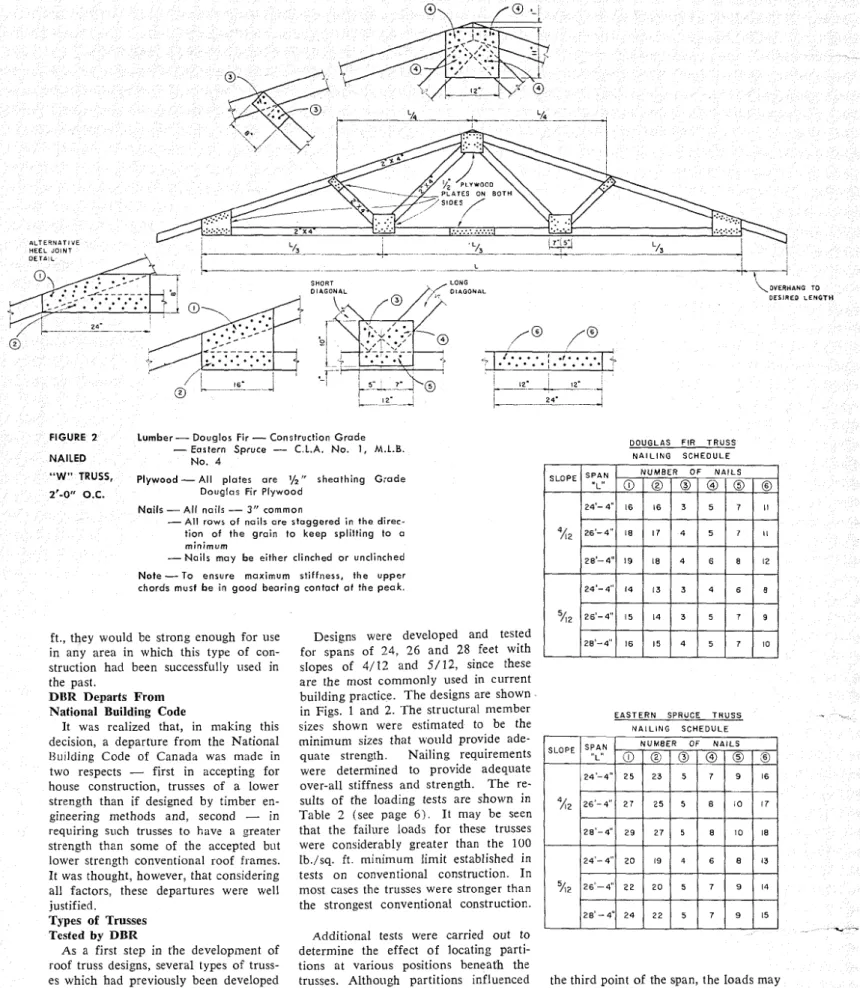
4 6 56 6 2 89 72 1 0 8 125FIGURE 2 Lumber- Douglos Fir
-
Construction G r a d e-
Eastern Spruce-
C.L.A. N o . 1 , M.L.B.NAILED N o . 4
"W" Plywood-All plates are I/*'' sheathing G:ade
2'-0" O.C. Douglas Fir Plywood Nails
-
A l l nails-
3" common- A l l rows o f nails are staggered in the direc- tion of the groin to keep splitting to o minimum
- N a i l s may be either clinched o r unclinched N o t e - T o ensure maximum stiffness, the upper chords must b e in g o o d bearing contact a t the p e a k .
ft., they would be strong enough for use Designs were developed and tested in any area in which this type of con- for spans of 24, 26 and 28 feet with struction had been successfully used in slopes of 4/12 and 5/12, since these the past. are the most commonly used in current
DUR Departs From building practice. The designs are shown
National Building Code in Figs. 1 and 2. The structural member It was realized that, in making this size:: shown were estimated to be the decision, a departure from the National minimum sizes that nould provide ade- 13~11lcling Code of Canada was made in quate strength. Nailing requirements two respects
-
first in accepting for were determined to provide adequate house construction, trusses of a lower over-all stiffness and strength. The re- strength than if designed by timber en- sults of the loading tests are shown in gineering methods and, second-
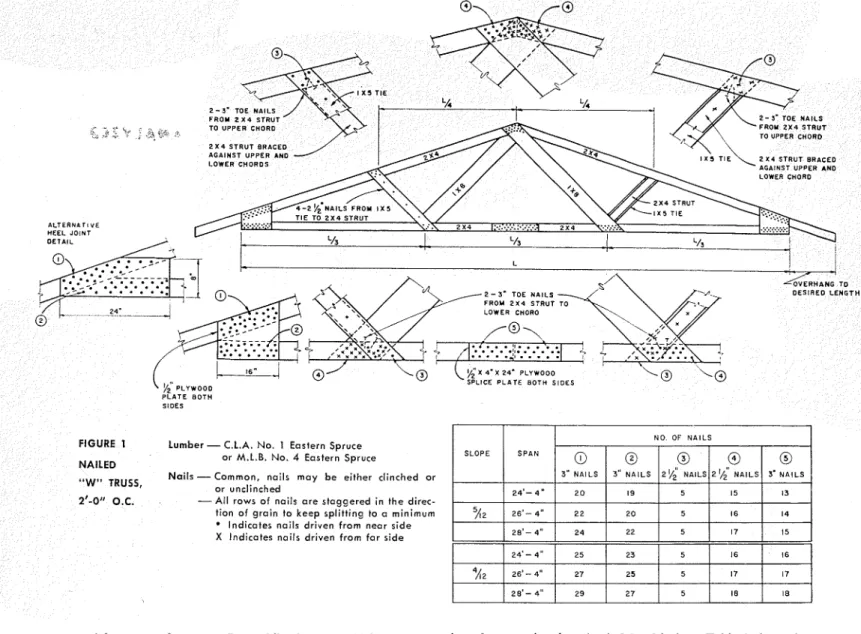
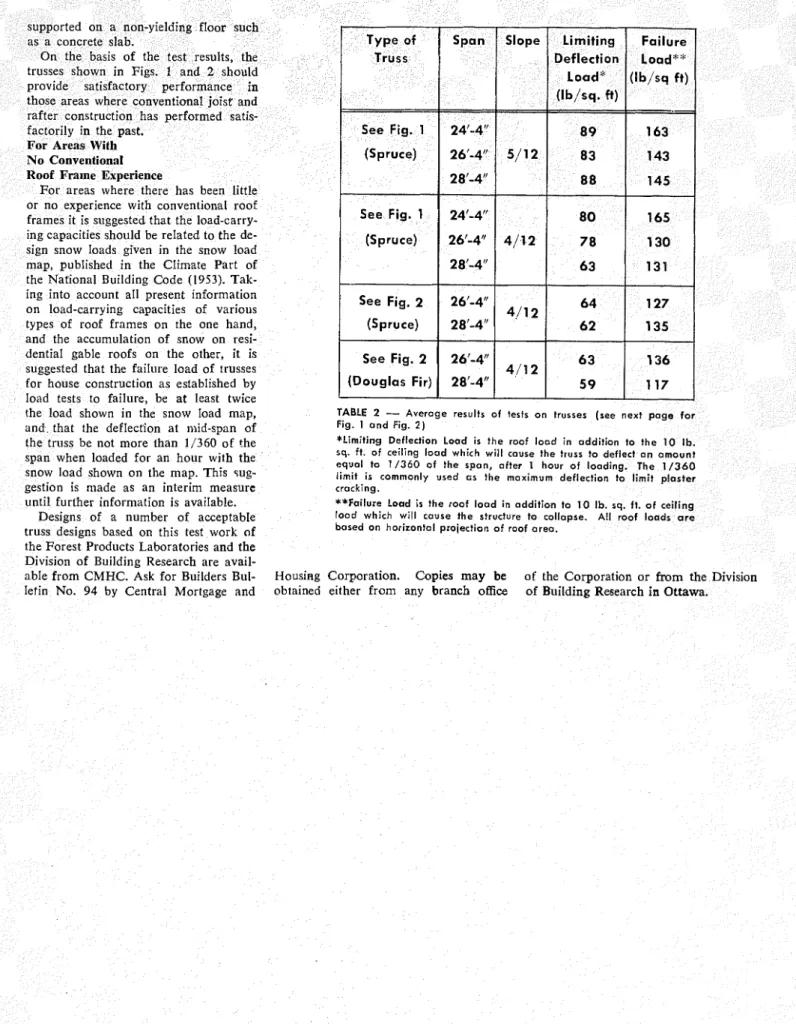
in Table 2 (see page 6 ) . It may be seen requiring such trusses to have a greater that the failure loads for these trusses strength than some of the accepted but were considerably greater than the 100lower strength conventional roof flames. lb./sq. ft minimum limit established in It was thought, however, that considering tests on conventional construction. In all factors, these departures were well most cases the trusses were stronger than justified. the strongest conventional construction.
Types of Trusses
Tested by DBR Additional tests were carried out to
As a first step in the developinent of roof truss designs, several types of truss- es which had previously been developed in the United States were built and test- ed. This was done to determine which type offered the most promise from the standpoint of strength, economy of con- struction, and ease of fabrication by those not experienced in truss construc- tion. Nailed W-trusses were selected for test.
determine the effect of locating parti- tions at various positions beneath the trusses. Although partitions influenced the over-all deflection characteristics of the trusses, their presence did nos have any significant adverse effect on the truss performance. It was found, however, that the magnitude of loads carried by these partitions might be quite large, depending on where the partitions are lo- cated. When the partition is located at
E A S T E R N SPRUCE T R U S S N A I L I N G S C H E D U L E
the third point of the span, the loads may amount to 2/3 of the total load on the roof and ceiling. This is considerably more than the loads that are carried on bearing partitions under conventional roofs and would suggest that partitions at this location under trusses should be designed as load bearing. This would be especially important if the partition is
TABLE 2
-
Average results of tests on trusses ( s flection at mid-span ofmore than 1/360 of the
equol to 1/360 of the span, ofter 1 hour of loo limit is commonly used es the maximum deflection
atories and the arch are avail-
r Builders Bul- Housing Corporation. Copies may be Mortgage and obtained either from any branch office