HAL Id: hal-00297530
https://hal.archives-ouvertes.fr/hal-00297530
Submitted on 24 Nov 2005
HAL is a multi-disciplinary open access
archive for the deposit and dissemination of
sci-entific research documents, whether they are
pub-lished or not. The documents may come from
teaching and research institutions in France or
abroad, or from public or private research centers.
L’archive ouverte pluridisciplinaire HAL, est
destinée au dépôt et à la diffusion de documents
scientifiques de niveau recherche, publiés ou non,
émanant des établissements d’enseignement et de
recherche français ou étrangers, des laboratoires
publics ou privés.
seep (Tommeliten area)
H. Niemann, M. Elvert, M. Hovland, B. Orcutt, A. Judd, I. Suck, J. Gutt, S.
Joye, E. Damm, K. Finster, et al.
To cite this version:
H. Niemann, M. Elvert, M. Hovland, B. Orcutt, A. Judd, et al.. Methane emission and consumption
at a North Sea gas seep (Tommeliten area). Biogeosciences, European Geosciences Union, 2005, 2 (4),
pp.335-351. �hal-00297530�
www.biogeosciences.net/bg/2/335/ SRef-ID: 1726-4189/bg/2005-2-335 European Geosciences Union
Biogeosciences
Methane emission and consumption at a North Sea gas seep
(Tommeliten area)
H. Niemann1,2, M. Elvert3, M. Hovland4, B. Orcutt5, A. Judd6, I. Suck2,7, J. Gutt2, S. Joye5, E. Damm2, K. Finster8,
and A. Boetius1,9
1Max Planck Institute for Marine Microbiology, 28 359 Bremen, Germany
2Alfred Wegener Institute for Polar and Marine Research, 27 515 Bremerhaven, Germany 3Research Center Ocean Margins, University of Bremen, 28 359 Bremen, Germany 4Statoil, 4001 Stavanger, Norway
5University of Georgia, Athens, Georgia 30602-3636, USA
6Wilderspool House, High Mickley, Stocksfield, Northumberland, NE43 7LU, UK
7FILAX Gesellschaft f¨ur Wissenschaftliche Datenverarbeitung mbH, 27 568 Bremerhaven, Germany 8University of Aarhus, 8000 Aarhus, Denmark
9International University Bremen, 28 759 Bremen, Germany
Received: 1 August 2005 – Published in Biogeosciences Discussions: 30 August 2005 Revised: 26 October 2005 – Accepted: 11 November 2005 – Published: 24 November 2005
Abstract. The Tommeliten seepage area is part of the
Greater Ekofisk area, which is situated above the Tommeliten Delta salt diapir in the central North Sea (56◦29.900N, 2◦59.800E, Norwegian Block 1/9, 75 m water depth). Here,
cracks in a buried marl horizon allow methane to migrate into overlying clay-silt and sandy sediments. Hydroacoustic sedi-ment echosounding showed several venting spots coinciding with the apex of marl domes where methane is released into the water column and potentially to the atmosphere. In the vicinity of the gas seeps, sea floor observations showed small mats of giant sulphide-oxidizing bacteria above patches of black sediments as well as carbonate crusts, which are ex-posed 10 to 50 cm above seafloor forming small reefs. These Methane-Derived Authigenic Carbonates (MDACs) contain
13C-depleted, archaeal lipids indicating previous gas seepage
and AOM activity. High amounts of sn2-hydroxyarchaeol relative to archaeol and low abundances of biphytanes in the crusts give evidence that ANaerobic MEthane-oxidising ar-chaea (ANME) of the phylogenetic cluster ANME-2 were the potential mediators of Anaerobic Oxidation of Methane (AOM) at the time of carbonate formation. Small pieces of MDACs were also found subsurface at about 1.7 m sed-iment depth, associated with the AOM zone. This zone is characterized by elevated AOM and Sulphate Reduction (SR) rates, increased concentrations of13C-depleted tetraether de-rived biphytanes, and specific bacterial Fatty Acids (FA). Further biomarker and 16S rDNA based analyses of this hori-zon give evidence that AOM is mediated by archaea
belong-Correspondence to: H. Niemann ([email protected])
ing to the ANME-1b group and Sulphate Reducing Bacte-ria (SRB) most likely belonging to the Seep-SRB1 cluster. The zone of active methane consumption was restricted to a distinct horizon of about 20 cm. Concentrations of13 C-depleted lipid biomarkers (e.g. 500 ng g-dw−1biphythanes,
140 ng g-dw−1 fatty acid ai-C
15:0), cell numbers (1.5×10⁸
cells cm−3), AOM and SR rates (3 nmol cm−3d−1) in the Tommeliten AOM zone are 2–3 orders of magnitude lower compared to AOM zones of highly active deep water cold seeps such as Hydrate Ridge or the Gulf of Mexico.
1 Introduction
Upwelling of hydrocarbon-rich geofluids from subsurface reservoirs to the hydro- and atmosphere could be a rele-vant process with regard to emissions of the greenhouse gas methane. In temperate, shallow shelf seas, gas seep-age is likely to contribute to methane emissions to the at-mosphere, because of the seasonal deep mixing of the water column, which may intersect the gas plumes above active seeps. Whereas biogeochemical processes and related mi-croorganisms reducing methane efflux have been studied at various cold seep systems in the deep sea and on the conti-nental slope, very little knowledge on cold seeps situated on the continental shelf is available. As part of the OMARC cluster (Ocean Margin Deep-Water Research Consortium) of the 5th framework program of the European Commis-sion, the project METROL (Methane flux control in ocean margin sediments) has been investigating methane fluxes from seep systems of the central and northern North Sea.
5
10
Figure 1
Fig. 1. A chart of the North Sea and the survey area at Tommeliten showing sampling positions of vibrocoring, sea floor and hydroacoustic observations.
Here we present results from biogeochemical and microbi-ological investigations of the Tommeliten seep area (Fig. 1; 56◦29.900N, 2◦59.800E) in the central North Sea. This and
other active cold seeps have been detected during pipeline route and site surveys by oil companies (Hovland and Som-merville, 1985; Hovland and Judd, 1988). Cold seeps have been reported from various geographic and geological set-tings (Judd, 2003). Once initiated, cold seeps may con-tinuously emit gas, but they become inactive if subsurface gas and fluids are depleted, or undergo phases of dormancy where the shallow reservoir is recharged and none or lit-tle seepage occurs (C¸ ifc¸i et al., 2003; Hovland and Judd, 1988). In the particular case of the central North Sea, thermo-genic methane is produced in Jurassic sediments (Hovland and Judd, 1988). In the Tommeliten area, the enclosing sed-imentary rocks have been pierced by a buried salt diapir, the so called Delta Structure, at about 1 km depth below sea floor (b.s.f.). As a result, the methane reservoir lacks a proper seal and disturbances on seismic profiles indicate that free gas migrates in sediments above the diapir to the sea floor (Hov-land, 2002; Hovland and Judd, 1988). Previous expeditions to the Tommeliten seepage area with remotely operated
vehi-cles (ROVs) documented streams of single methane bubbles of a thermogenic origin (−45.6‰ vs. Pee Dee Belemnite), small patches of filamentous, microbial mats and MDACs that outcrop on the sea floor (Hovland and Judd, 1988; Hov-land and Sommerville, 1985; Thrasher et al., 1996). Such observations are typical for active seep systems, which have been found at passive and active continental margins.
High fluxes of methane usually lead to the development of methanotrophic microbial communities. Anaerobic methan-otrophic archaea dominate submarine seep communities, be-cause they profit from the abundance of sulphate, which is utilised as the electron acceptor for AOM (Hinrichs and Boetius, 2002; Reeburgh, 1996). High AOM activities lead to high fluxes of sulphide and the development of micro-bial mats of giant sulphide-oxidizing bacteria (e.g. Beggia-toa sp.) and other thiotrophic organisms (Boetius and Suess, 2004 and literature therein). Furthermore, methane venting at various cold seeps is associated with the precipitation of MDACs which often contain lipid biomarkers of AOM com-munities (Bohrmann et al., 1998; Diaz-del-Rio et al., 2003; Hovland et al., 1985, 1987; Michaelis et al., 2002; Peck-mann et al., 1999; Roberts and Aharon, 1994; Thiel et al.,
2001). The phylogenetic origin of methanotrophic commu-nities has been determined using combinations of lipid anal-ysis and 16S rDNA methods in several methane seep envi-ronments (Boetius et al., 2000; Elvert et al., 1999; Hinrichs et al., 1999; Hoehler and Alperin, 1996; Knittel et al., 2003, 2005; Michaelis et al., 2002; Orphan et al., 2001b). Previ-ous works identified two groups of ANME, which are phy-logenetically related to methanogens (Methanosarcina sp.). Both ANME-1 and ANME-2 occur in consortia with rel-atives of a SRB cluster (Seep-SRB1) within the Desulfos-arcina/Desulfococcus branch (Knittel et al., 2003). Although the geology and biology of a variety of shallow water cold seeps have been well investigated, there is still very little known on the biogeochemistry and relevance of microbial methane consumption (Barry et al., 1996, 1997; Bian et al., 2001; Bussmann et al., 1999; Dando and Hovland, 1992; Garcia-Garcia et al., 2003; Thomsen et al., 2001). The aim of this investigation was to study microbial processes related to methane seepage in shelf sediments. The main tasks were to reveal the distribution and identity of methanotrophic mi-croorganisms, the zonation and magnitude of methane oxida-tion and to analyse the impact of methane venting on a sandy benthic habitat of the North Sea.
2 Materials and methods
2.1 Water column and seafloor observations
Visual observations of the Tommeliten sea floor were carried out with a Remotely Operated Vehicle (ROV “Sprint 103” of the Alfred Wegener Institute of Polar and Marine Research) during a cruise with R/V Heincke in June 2002 (HE-169) and with a towed video camera in October 2002 (HE-180). Gas flares in the water column were detected with a SES-2000 echosounder operated at different frequencies in the range of 10 to 100 kHz. The same parametric echosounder was used for high-resolution sub-bottom profiling at frequencies between 8 and 15 kHz. Video and echosounder images were used to select positions for sediment sampling.
2.2 Sample collection and storage
Sediment samples were collected with a vibrocorer (4 m length; Institute of Baltic Sea Research) during the cruise HE-180 in October 2002. Three cores were recovered from seep areas (core 1860, 1866, 1904, Fig. 1) and one from a reference station (core 1867). Upon recovery, cores were sectioned in 1 m pieces and kept in their plastic bags during subsampling of porewater constituents (methane, sulphate, sulphide) and turnover rate measurements of methane and sulphate. Replicate subsamples were obtained from a 10 cm section every 10 (cores 1866 and 1904) or 20 cm (core 1860). Samples for lipid biomarkers, cell counts and DNA were col-lected from the same 10 cm sections of core 1904. Sediment samples for lipid analysis were transferred into pre-cleaned
glass vials and stored at −25◦C until extraction. Sediments
for microbiological analysis were fixed for fluorescent in situ hybridisation (FISH) or frozen for DNA extraction. Pieces of MDACs were collected from the SMTZ at station 1904 and stored at −25◦C until extraction. MDACs from the surface of the sea floor were collected earlier during a ROV expedition in 1998 (Hovland, 2002). Detailed protocols for the follow-ing methods can be obtained from http://www.metrol.org.
2.3 Methane concentrations
Methane concentrations from selected sediment horizons were determined according to the “head space” method from 5 ml sediment fixed with 25 ml NaOH (2.5%, w/v) in gas-tight glass vials as described previously (Treude et al., 2003). Immediately after sub-sampling, methane concentra-tions were determined on board using a gas chromatograph (Treude et al., 2003).
2.4 Sulphate concentrations
5 ml of wet sediment were fixed in 50 ml corning vials with 25 ml zinc acetate solution (20%, w/v). After vigorous shak-ing, sediment particles were separated by centrifugation and filtration. Sulphate concentrations were determined from an aliquot of the supernatant using a Waters HPLC system (Waters 512 HPLC pump, I.C.-Pak anion-column (Waters; WAT007355) 4.6×50 mm, Waters 730 conductivity detec-tor). Isophtalic acid (1 mM) was used as a solvent at a con-stant flow rate of 1 ml min−1. Sulphate concentrations were corrected for porosity, which was determined according to Treude et al. (2003).
2.5 Sulphide concentrations
Total sulphide concentrations were determined using a com-bination of a WTW Multiline P4 multi meter equipped with a WTW pH/ION 340i ion meter with two coupled electrodes (WTW Ag 500/WTW Ag/S 5001) for sulphide concentra-tion measurements and a WTW SenTix 41-3 electrode for pH measurements. The sulphide measuring section was cal-ibrated against sulphide standards at pHs of 6, 7, 8 and 9.
2.6 Ex situ AOM and SR rate measurements
Subsamples for turnover rate measurements were collected from core 1904 by plugging glass tubes (1×6 cm) into a de-fined sediment horizon of ca 10 cm (n=5 for AOM and SR, respectively) as described previously (Treude et al., 2005 and references therein). To prevent gas exchange, the tubes were sealed with butyl rubber stoppers and only briefly opened for radiotracer injection, i.e., 50 µl14C-labelled methane and 5 µl35S-labelled sulphate (tracer dissolved in water, 10 kBq and 50 kBq, respectively). Sediment samples were incubated on board at in situ temperature (4◦C) for 24 h in the dark.
After incubation, samples for AOM and SR rate (SRR) mea-surements were fixed like the methane and sulphate samples (see above). Further processing of AOM and SR rate sam-ples was performed according to Treude et al. (2003) and references therein. Turnover rates were calculated according to the following formulas:
AOM rate = 14CO 2 14CH 4+14CO2 × conc. CH4 incubat. T ime (1) SRR = TRI 35S 35SO2− 4 +TRI 35S× conc. SO2−4 incubat. T ime (2)
Here,14CO2,35SO2−4 and TRI35S are the activities (Bq) of
carbon dioxide, sulphate and total reduced sulphur species, respectively, whereas conc. CH4and conc. SO2−4 are the
con-centrations of methane and sulphate at the beginning of the incubation.
2.7 In vitro potential rates
The subsampling techniques applied here have been proven successful for muddy sediments (Treude et al., 2003). To test the suitability for sandy sediments, we compared short-term AOM and SR rate measurements with long-short-term in vitro measurements (1 wk) of sediments collected from three hori-zons (surface, at the sulphide peak, and deep horihori-zons) ac-cording to a modified method of Nauhaus et al. (2002). For this study, 20 ml sediment slurries were incubated with radio-labelled methane and sulphate (n=5 for AOM and SR rates, respectively). The slurries consisted of 1 cm3fresh sediment and methane saturated (1.4 mM), artificial sea water media with 28 mM sulphate (Widdel and Bak, 1992). As a control, slurries from one horizon (100–150 cm, core 1904) were in-cubated without methane. After incubation, sediment slur-ries were processed like those from short-term incubations.
2.8 Extraction of sediment and MDAC samples and prepa-ration of derivatives
The extraction procedure and preparation of Fatty Acid Methyl Esters (FAMES) was carried out using proven meth-ods (Elvert at al., 2003). Briefly, Total Lipid Extracts (TLE) were obtained from ca. 25 g of wet sediment collected from core 1904 and from two MDAC pieces (one collected from the surface of the sea floor and one from the SMTZ in core 1904). Prior to extraction, the MDAC pieces were disinte-grated with HCL (2M). The TLE was extracted by subse-quent ultrasonification using organic solvents of decreasing polarity. Internal standards of known concentration and car-bon isotopic compositions were added prior to extraction. Esterified Fatty Acids (FAs) present in glyco- and phospho-lipids were cleaved by saponification with methanolic KOH-solution. After extraction of the neutral lipid fraction from this mixture, FAs were methylated for analysis with BF3 in
methanol yielding FAMES.
Neutral lipids were further separated into hydrobons, ketones and alcohols on a SPE silica glass car-tridge (0.5 g packing). Prior to separation, the column was rinsed with 15 ml n-hexane/dichloromethane (95:5, v/v). After application of the neutral fraction, sol-vent mixtures of increasing polarity were subsequently added: (I) 5 ml n-hexane/dichloromethane (95:5, v/v), (II) 5 ml n-hexane/dichloromethane (2:1, v/v) and (III) 5 ml dichloromethane/acetone (9:1, v/v). Neutral lipid fractions (hydrocarbons (I), ketones (II) and alcohols (III), respec-tively) were collected and concentrated to 100 µl using ro-tary evaporation. Finally, neutral lipid fractions were stored at −20◦C until further processing and/or analysis. Alcohols were analysed as trimethylsilyl (TMS) ethers. Shortly be-fore analysis (<1 wk), aliquots from selected alcohol frac-tions were dried under a stream of nitrogen. 100 µl pyri-dine and 50 µl bis(trimethylsilyl)triflouracetamid were added and the reaction was carried out for 1 h at 70◦C. After
cool-ing, excess solvent was evaporated and the remaining TMS adducts were re-suspended in 50 µl of n-hexane. TMS adducts were stored at −20◦C until Gas Chromatography (GC), Gas Chromatography-Mass Spectrometry (GC-MS) and Gas Chromatography-Isotope Ratio Mass Spectrometry (GC-IRMS) analysis.
Sediments and the two MDAC pieces were additionally analysed for the content of tetraether lipids. Tetraether lipids, which are contained in the alcohol fractions, were subjected to ether cleavage through HI treatment as reported previ-ously yielding phytanes and biphytanes which can be anal-ysed by GC, GC-MS and GC-IRMS analysis (Blumenberg et al., 2004; Kohnen et al., 1992). Briefly, 500 µl HI (57%) and 500 µl acetic acid (100%) were added to a dried alcohol fraction and iodisation of ether bonds was promoted at 110◦C for 4 h. After cooling, alkyl iodides were extracted with
n−hexane. Excess iodine was removed by adding sodium thiosulphate solution (5%, w/v in water). Subsequently, the hexane phase was removed and dried. Alkyl iodides were reduced to alkanes in 0.5 ml of tetrahydrofurane (THF) by adding lithium-aluminium hydride (2 spatula tips). Reduc-tion of iodides was carried out at 110◦C for 3 h. After cool-ing, excess lithium-aluminium hydride was deactivated by the addition of deionised water. The supernatant solvent phase was removed, dried and stored at −20◦C.
2.9 Preparation of Dimethyl Disulphide (DMDS) adducts
Double bond positions of monoenoic FAs were determined by analysis as DMDS adducts according to previously re-ported methods (Moss and Lambert-Fair, 1989; Nichols et al., 1986). Briefly, an aliquot of a selected sample (dissolved in 50 µl n−hexane) was treated with DMDS (100 µl) and iodine-diethyl ether solution (20 µl, 6% w/v). Formation of DMDS adducts was carried out at 50◦C for 48 h. After cool-ing, excess iodine was reduced with sodium thiosulphate (5%
w/v in water). The organic phase was removed, dried and stored at −20◦C.
2.10 Gas Chromatography, Gas Chromatography-Mass Spectrometry, Gas Chromatography-Isotope Ratio Mass Spectrometry
Concentrations, identities and stable carbon isotope ratios of individual compounds were determined by GC, GC-MS and GC-IRMS analyses, respectively. Instrument specifications and operation modes of the GC, GC-MS and GC-IRMS sys-tems were set according to Elvert and co-workers (2003). Concentrations were calculated against internal standards. Identities of acquired mass spectra were compared to known standards and published data. The chemical structure of bi-phytanes are reviewed in Schouten et al. (1998): monocyclic biphytane reported here equals compound IV and bicyclic bi-phytane compound V. Stable carbon isotope ratios are given in the δ-notation against PDB. δ13C-values of FAs and alco-hols were corrected for the introduction of additional carbon atoms during derivatisation. Internal standards were used to monitor precision and reproducibility during measurements. Reported δ13C-values have an analytical error of 1–2‰. 2.11 Cell counts and fluorescence in situ hybridisation
Selected sediment samples from core 1904 were fixed with 2% formaldehyde and stored at 4◦C until further analysis. Total cell numbers were quantified with the aid of epifluo-rescence microscopy after staining the cells with Acridine Orange according to Knittel et al. (2003). Sediments from above, below and within the AOM zone were analysed for the presence of archaea and bacteria by FISH with Horseradish Peroxidase (HRP)-labelled oligonucleotide probes and tyra-mide signal amplification (CARD-FISH) according to the method of Pernthaler et al. (2002). The CARD-FISH probes used in this study were EUB338, ARCH915 and ANME1-350, purchased from biomers.net GmbH, Ulm, Germany. Oligonucleotide probes and instrument specification are pre-sented in Knittel et al. (2005). Briefly, after 2 h fixa-tion at 4◦C, formaldehyde fixed sediments were washed with 1×PBS (10 mM sodium phosphate, 130 mM NaCl) and stored in 1×PBS/EtOH (1:1, v/v) at −20◦C. These sam-ples were diluted 1:10, treated by sonification and filtered on 0.2 µm GTTP polycarbonate filters. Prior to filtration, fil-ters were coated with agarose to prevent cell loss. In addition to ultrasonification, cells were permeabilised with lysozyme solution for 1 h at 37◦C and subsequently hybridised with
HRP labelled probe for 2 h at 35◦C. Finally, filters were
in-cubated for 15 min. in tyramide solution labelled with the fluorochrome Cy-3.
2.12 DNA extraction and clone library construction
Total community DNA was directly extracted from ca. 5 g of wet sediment (Zhou et al., 1996) from the AOM zone of
core 1904. Crude DNA was purified with the Wizard DNA Clean-Up Kit (Promega, Madison, WI). Almost full-length archaeal and bacterial 16S rRNA genes from the extracted chromosomal DNAs were amplified using primers 20f (Mas-sana et al., 1997) and Uni1392R (Lane et al., 1985) for ar-chaea and GM3F (Muyzer et al., 1995) and GM4R (Kane et al., 1993) for bacteria. Polymerase chain reactions (PCRs) were performed with a Mastercycler Gradient (Eppendorf, Hamburg, Germany) as described previously (Ravenschlag et al., 1999), except that the annealing temperature was 58◦C and 42◦C for archaea and bacteria, respectively. PCR prod-ucts of several reactions were combined and purified with the QiaQuick PCR Purification Kit (Qiagen, Hilden, Germany). DNA was ligated in the pGEM T-Easy vector (Promega, Madison, WI) and transformed into E. coli TOP10 cells (In-vitrogen, Carlsbad, CA) according to the manufacturer’s rec-ommendations. Sequencing was performed by Taq cycle se-quencing with a model ABI1377 sequencer (Applied Biosys-tems) with insert-specific and vector primers. The absence of chimeric sequences in the clone libraries was verified with the CHIMERA CHECK program of the Ribosomal Database Project II. A total of 57 archaeal and 54 bacterial clones were partially sequenced (∼0.5 kb). Using the ARB soft-ware package, these sequences were calculated into existing phylogenetic trees by parsimony without allowing changes in the tree topology. Representative sequences of each clus-ter were then fully sequenced (∼1.3 kb) and matched against the NCBI data base (http://www.ncbi.nlm.nih.gov/BLAST). The sequence data reported here will appear in the EMBL, GenBank, and DDBJ nucleotide sequence databases under the accession numbers DQ007532 to DQ007540.
3 Results
The data presented in this study can be obtained from http: //www.wdc-mare.org/PangaVista?query=@Ref26689.
3.1 Water column and seafloor observations
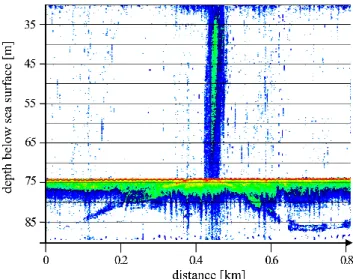
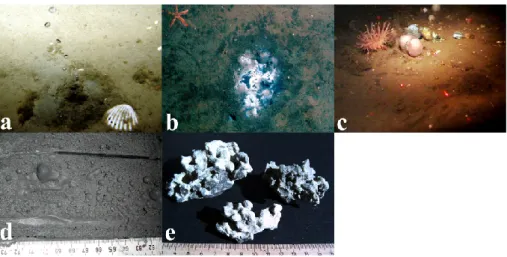
Echosounder transects revealed several gas flares reaching from the sea floor to the sea surface (transducer depth) at 6◦29.920N, 2◦59.800E in an area of ca. 3500 m2 (Figs. 1, 2). A small area with 4 single plumes was also found at 6◦29.560N, 2◦59.250E. No plumes were detected outside of the seep areas within a larger area of 12 km2. Echosounder guided sampling of the gas flares and subsequent gas ex-traction showed high concentrations of methane within the plumes (500 nM), which were up to 2 orders of magnitude above the background concentration (5 nM, data not shown). Similar to earlier findings (Hovland, 2002; Hovland and Judd, 1988), sea bottom observations with the ROV and the towed camera showed the presence of bubble streams em-anating from small point sources of a few cm in diameter (Fig. 3a). White bacterial mats, most likely formed by giant
Fig. 2. Hydro acoustic image of a methane plume reaching from the sea floor to the sea surface. Ascending sub-surface horizons forming dome-like structures are visible. The image was recorded with a SES-2000 echosounder operated at 8 to 100 kHz.
sulphide oxidizing bacteria with a patch size of some decime-tres were found in the same area (Figs. 1, 3b). No bubble emission was observed directly from bacterial mats. At vari-ous locations mostly situated north of the plume cluster, car-bonate crusts with diameters ranging from decimetres to me-tres were exposed 10–50 cm above the sea floor (Figs. 1, 3c). These crusts were densely covered by several species of an-thozoa and other sessile macrofauna typical of hard grounds (Fig. 3c). These animals were not found in the surrounding area characterized by sandy sediments. Furthermore, a com-parably high density of demersal fish was observed in the vicinity of the crusts.
3.2 Sediment layers and geochemical profiles
The echosounder profiles showed several dome like struc-tures in the seep area with a distinct sequence of layers narrowing towards the apex of each dome where the gas plumes were situated (Fig. 2). Station 1904 was furthest away from the plume, and station 1860 was closest. All cores obtained from the Tommeliten seep area (1904, 1866 and 1860, Fig. 1) contained four different horizons of sed-iments (Figs. 4a–6a): (1) the lowest (350–240 cm b.s.f. in core 1904; 300–200 cm b.s.f. in core 1860) consisted of stiff marl followed by (2) a gassy layer of clay-silt (Fig. 3d) (240– 175 cm b.s.f. in core 1904; 230–160 cm b.s.f. in core 1866; 200–125 cm b.s.f. in core 1860). (3) 10 to 40 cm of sand com-prising MDACs (Fig. 3e) were overlying the clay-silt in cores 1904 and 1860. The presence of gas bubbles of ca 0.1–1 cm in diameter in the clay-silt (2), MDAC bearing sediments (3) and the first 10 to 20 cm just above the carbonate bearing sec-tions gave the sediments a spongy appearance (Fig. 3d). (4) The upper most sediment layer consisted of carbonate-free
sand (165–0 cm b.s.f. in core 1904; 85–0 cm b.s.f. in core 1860). Hence, the narrowing of layers towards the apex of the dome visualized by echosounder images (Fig. 2) was re-flected in the sedimentology (Figs. 4a, 6a). The sediment layering at station 1866 was different from station 1904 and 1860 as the (3) horizon containing MDACs was found at ca 75 to 85 cm b.s.f. within the (4) sandy sediments (Fig. 5a). No (1) marl section was recovered from core 1866, which was 230 cm long. Sediments at the reference station (recov-ered ca. 5 km away from the seep area) consisted of (4) a sandy surface horizon (0 to 100 cm b.s.f.) and an underlying (3) clay-silt horizon (100–400 cm b.s.f.). No gas bubbles or carbonates were observed at this station (data not shown).
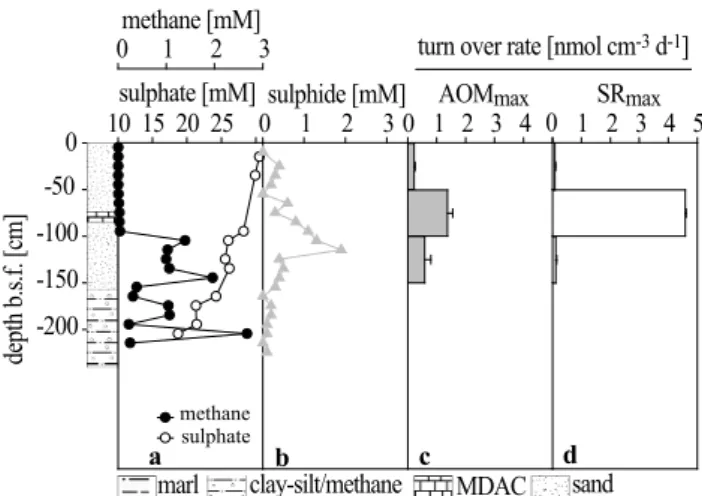
The methane, sulphate and sulphide gradients in the cores from the Tommeliten seep area were influenced by their proximity to the gas plume and by the sediment layering. Because of the artefacts introduced by vibrocoring and sub-sequent sampling of the gassy and sandy sediments, fluxes of methane and sulphate cannot be calculated from the pro-files. Nevertheless, the data indicate a distinct zonation of the processes of anaerobic methane consumption and asso-ciated sulphide production. At the reference station away from the seep, sediments contained methane concentrations
<0.1 µM throughout the core. In contrast, within the seep area, methane concentrations reached supersaturation in the (2) clay horizon and the (3) MDAC-bearing sediments (core 1860=2.5, 1866=1.4, 1904=1.6 mM). Within the stiff marl sediments (1), the methane concentration was comparably low (<0.2 mM) (Figs. 4a–6a). The AOM zone is defined here as the horizon with a distinct dip in methane and sul-phate concentrations as well as a peak in sulphide concentra-tions. This was located between the (3) MDAC-bearing sed-iments and (4) the overlying sandy sedsed-iments in cores 1904 and 1860, and in the lower sand section in core 1866. In con-trast to a typical sulphate-methane transition zone (SMTZ), sulphate was not depleted in the methane-rich zone. An ad-vective influx of sulphate rich seawater into the sediment probably driven by gas ebullition has been observed at Hy-drate Ridge (Tryon et al., 1999) and proposed for mud vol-canoes at the Barbados Trench (Henry et al., 1996; Martin et al., 1996). However, these systems differ substantially from the Tommeliten seeps as they are characterised by vigorous gas venting and/or high heat flux. At Tommeliten, an ad-vective influx of sulphate rich seawater down to some metres sediment depth appears very unlikely as only single bubbles emanating from the sea floor were observed. The distribution of methane and sulphate may be related to the sedimentology of the area. If methane is transported along vertical and hor-izontal gas bubble pathways, sulphate may be depleted lo-cally, but not necessarily everywhere below a certain depth horizon. The methane profiles indicate that the gas front is limited to the sandy horizon above the clay-silt, coinciding with the sulphide peak and locally depleted sulphate concen-trations. The marl below this layer contained rather low con-centrations of methane, in contrast to typical SMTZ zones,
Fig. 3. Images of the seafloor observations showing (a) a stream of methane bubbles, (b) bacterial mats and (c) sessile macro fauna on exposed carbonates. (d) A lower section of core 1904 comprising methane-rich, clay-silt sediments and (e) MDACs recovered at the interface between methane-rich, clay-silt and overlying sandy sediments.
0 1 2 3
10 15 20 25 0 1 2 3
cells [108 cm-3]
0 1 2 5 15 0 turn over rate [nmol cm-3 d-1]
AOMmax sulphide [mM] methane [mM] a b c d e f g h i SRmax AOM, SR 0 1 2 3 4 0 1 2 3 4 0 1 2 3 4 -50 -40 -30 0 bact. FA
[µg g-dw-1] bact. FA [δ13C] arch. biphytanes [µg g-dw-1]
0.2 0.4 0.2 0.4 sulphate [mM] AOM SRR i-Cai-C15:015:0 i-C15:0 ai-C15:0 monocycl. biphyt. -66‰ -69‰ bicycl. biphyt.
marl clay-silt/methane MDAC sand
de pth b. s.f . [ cm ] -350 -300 -250 -200 -150 -100 -50 0 methane sulphate
Fig. 4. Station 1904. (a) Methane and sulphate concentrations decline at depth of MDAC bearing sediments (150 cm b.s.f.). (b) Note that sulphide concentrations, (c) potential methane oxidation and (d) sulphate reduction rates, (e) ex situ measured methane oxidation and sulphate reduction rates, (f) cell counts, (g) concentrations and (h) stable carbon isotope values of selected, bacterial fatty acids and (i) concentrations of cleaved, archaeal tetraether lipids peak at the methane-sulphate transition zone. Errors are given as standard errors.
where methane concentration increase with depth below the sulphate penetration due to methanogenesis, or upward dif-fusing methane.
However, we cannot exclude that the sulphate concentra-tions below the AOM zone result from sampling artefacts. The sulphate profiles were probably disturbed by the sub-sampling of the sandy sediments. Porous sediments loose their porewater when a core is opened. Hence it is possi-ble that bottom- and pore water from the top sediment sec-tion intruded deeper sediment layers after opening the core. Methane and sulphide concentrations were probably less dis-turbed, because subsamples for methane concentration mea-surements were taken first, and sulphide concentrations were measured with a macroelectrode, which was stuck into the middle of the core.
Above the AOM zone, methane concentrations declined to values <0.04 mM. In core 1860, methane concentrations remained comparably high above the carbonate-bearing hori-zon (>0.25 mM) but declined to <0.04 mM in the top sedi-ment horizon. At station 1904 and 1866, methane concen-trations were below 0.01 mM in the top 40 cm of the seabed (Figs. 4a, 5a). Sulphate concentrations declined slightly in the AOM zone from seawater values (28 mM) to values be-tween 23 (core 1904, 1866; Figs. 4a, 5a) and 15 mM (core 1860; Fig. 6a). In each core, a distinct sulphide peak was measured just above the horizon in which methane declined with concentrations of 3.1 mM (core 1904, 135 cm b.s.f.), 1.9 mM (core 1866, 115 cm b.s.f.) and 2.1 mM (core 1860, 55 cm b.s.f.), respectively (Figs. 4b–6b). Sulphide concen-trations declined to values below detection limit in surface
0 1 2 3 de pth b. s.f . [ cm ] -200 -150 -100 -50 0 sulphide [mM] a b c d 10 15 20 25 0 1 2 3
turn over rate [nmol cm-3 d-1]
AOMmax
methane [mM]
SRmax
0 1 2 3 4 0 1 2 3 4 5 sulphate [mM]
marl clay-silt/methane MDAC sand
methane sulphate
Fig. 5. Station 1866. (a) Methane and sulphate concentrations de-cline below carbonate bearing sediments (100 cm b.s.f.). Homolo-gous to core 1904, (b) sulphide concentrations and potential rates of (c) methane oxidation and (d) sulphate reduction are highest at the sulphate-methane transition zone. Errors are given as standard errors.
and bottom horizons. Sediments of the reference station did not show any detectable sulphide concentrations (data not shown).
3.3 Ex situ AOM and SR
In short-term ex situ incubations, AOM reached a maxi-mum rate of 2.4 nmol cm−3d−1at 170 cm b.s.f. in core 1904 within the AOM zone. SR rates were also elevated in this horizon reaching 2 nmol cm−3d−1. Unfortunately, no SR rates could be measured below this horizon due to sample loss. Rates in overlying horizons decreased to values ranging between 0.8 and 0.1 nmol cm−3(Fig. 4e). Highest SR rates were detected in the surface horizon (3.5 nmol cm−3d−1). AOM and SR rates were highly variable between replicate subsamples within one horizon leading to standard errors of up to 83% of the mean (Fig. 4e). If sulphate concentrations were artificially increased by subsampling artefacts in sands (see Sect. 3.2), this could lead to an overestimation of AOM and SR rates. However, most marine SRB have half satura-tion constants (Km) of 70 to 200 µM (Canfield et al., 2005 and reference therein), thus we do not expect a large effect on AOM and SR rates from this potential artefact.
3.4 In vitro rates at methane saturation
In vitro AOM and SR rates (AOMmax, SRmax)measured in
long-term incubations were in the same range as shipboard ex situ rate measurements. In vitro AOM and SR were high-est in sediments collected from the AOM zone with 1.4 to 3 and 2.9 to 4.6 nmol cm−3d−1, respectively (Figs. 4c, d– 6c, d). In these incubations, the ratio of AOM to SR was 1:1 in core 1904, 0.3:1 in core 1866 and 0.5:1 core 1860.
0
sulphide [mM] 0 1 2 3
10 15 20 25 0 1 2 3
turn over rate [nmol cm-3 d-1]
AOMmax methane [mM] SRmax 0 1 2 3 4 0 1 2 3 4 5 sulphate [mM] de pth b. s.f . [ cm ] -300 -250 -200 -150 -100 -50 a b c d
marl clay-silt/methane MDAC sand
methane sulphate
Fig. 6. Station 1860. (a) Methane and sulphate concentrations de-cline at depth of carbonate bearing sediments (70 cm b.s.f.). Homol-ogous to core 1904, (b) sulphide concentrations and potential rates of (c) methane oxidation and (d) sulphate reduction are highest in the AOM zone. Errors are given as standard errors.
The overall AOM and SR rates (in vitro as well ex situ) are very small and close to the detection limit of the ap-plied methods (∼0.1–0.5 nmol cm−3d−1). Hence, small dif-ferences in incubation conditions may lead to the observed deviation from a 1:1 ratio. The sampling horizons for the in vitro rate measurements were rather broad (i.e., 20–50 cm), whereas the active AOM horizon was narrower. Hence, it ap-pears very likely that the subsampling procedure as well as the subsequent slurry preparation mobilising substrates for SR introduces this variability. In sediment slurries from the AOM zone at station 1904, SR without methane was 70% lower compared to incubations with methane. This indicates a close coupling between AOM and SR. AOMmaxand SRmax
were substantially lower in slurries obtained from horizons above and below the AOM zone (Figs. 4c, d–6c, d).
3.5 Biomarker signatures
3.5.1 Sediments
Concentration measurements of single lipid compounds showed maxima of specific bacterial FAs and archaeal iso-prenoidal lipids in sediments from the AOM zone of core 1904 (150–180 cm b.s.f.; Figs. 4g, i, Table 1). At this horizon, stable carbon isotope analysis revealed the high-est depletion in13C with minimum values of −79‰ (sn2-hydroxyarchaeol) in archaeal diether lipids (Fig. 7) and
−50‰ (ai-C15:0) in bacterial FAs (Figs. 4h, 9). The
concentration of both archaeal and bacterial lipids decreased just above and below the AOM zone where these biomarkers were also less depleted. Archaeal lipids found in the AOM zone were dominated by the glycerol diether archaeol and the decomposition products of both diether and tetraether
p h yta n e bi phy ta ne m onocy c li c bi phy ta ne bi cy cl ic bi phy ta ne crenarchaeol archaeol sn2-hydroxy- archaeol
abundance [norm. to archaeol]
δ 13 C sn3-hydroxy- archaeol 0.0 0.5 1.0 1.5 2.0 2.5 -120 -100 -80 -60 -40 -20 sediment subsurface MDAC exposed MDAC
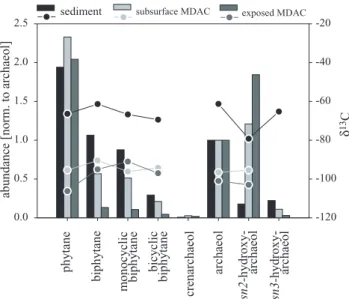
Fig. 7. Abundance (bars) and stable carbon isotope composition (circles) of cleaved, archaeal tetraether and whole diether lipids ex-tracted from sediments and MDACs at the sulphate-methane transi-tion zone (155 cm b.s.f.) of core 1904 and from surface MDACs re-covered by a ROV. Abundances were normalised to archaeol. Note the constant offset in δ13C-values between sediments and MDACs.
Table 1. Lipid biomarker concentrations extracted from sediments at the sulphate-methane transition zone (155 cm b.s.f.) of core 1904.
Tables
Table 1. Lipid biomarker concentrations extracted from sediments at the sulphate-methane transition zone (155 cm bsf) of core 1904.
5
10
15
lipids, i.e. phytane and biphytanes with δ13C-values rang-ing from −60‰ to −70‰ (Table 1, Fig. 7). sn2- and sn3-hydroxyarchaeol (6hydroxyarchaeol) were less abun-dant relative to archaeol with a ratio of 0.4:1. Concentrations of the biphytanes decreased with increasing degree of cycli-sation (Fig. 7). Compared to the di- and tetraethers, archaeal isoprenoidal hydrocarbons were approximately one order of
0.0 0.5 1.0 1.5 2.0 2.5 3.0 -120 -100 -80 -60 -40 -20
abundance [norm. to PMI:0]
δ
13
C
sediment subsurface MDAC exposed MDAC
crocet ane PMI :0 Σ PMI:1 Σ PMI:3 Σ PMI:2 PMI :4
Fig. 8. Abundance (bars) and stable carbon isotope composition (circles) of archaeal, isoprenoid hydrocarbon lipids extracted from sediments and MDACs of the AOM zone (155 cm b.s.f.) of core 1904 and from surface MDACs recovered by a ROV. Abundances were normalised to PMI:0. Note that concentrations of crocetane are ca. 7.5-fold increased in surface MDACs. Low concentrations prohibited δ13C-measurements of hydrocarbons in the sediment.
magnitude lower in concentration (Table 1). As a result, the stable carbon isotope composition of these compounds could not be measured (required minimum concentration:
∼100 ng g-dw−1). Isoprenoidal hydrocarbons were domi-nated by 2,6,10,15,19-pentamethylicosenes with two double bonds (6PMI:2; 3 isomers) followed by PMI:0 and PMI:1 (Fig. 8).
The FA fraction in sediments of the AOM zone was dominated by C16:0, followed by C18:1ω9, C18:0, C14:0 and
C18:2. FAs that are putatively specific for SRB involved
in AOM such as C16:1ω5, i-C15:0 and ai-C15:0 (Blumenberg
et al., 2004; Elvert et al., 2003), were approximately 5 to 50 times lower in concentration compared to C16:0 in
Tom-meliten sediments (Table 1). However, in contrast to abun-dant FAs, stable carbon isotope compositions of i-C15:0 and
ai-C15:0 showed a depletion in13C (−46.5 and −47‰,
re-spectively; Figs. 4h, 9). The high abundances of C16:1ω9and
C18:2are uncommon, however, the δ13C-values (−33‰ and
ca. −30‰, respectively) give evidence that the source organ-isms are not involved- or heterotrophically feeding on AOM derived biomass. C18:2FAs are commonly found in
eukary-otes. However, high concentrations of C18:2 and low
con-centrations of cholesterol in the AOM zone, in contrast to a reversed pattern of these lipids in the top sediment section (data not shown), indicate that the C18:2 FA is not of
eu-karyotic origin. Multiple sources of allochthonous and au-tochthonous bio- and necromass are to be expected for the Tommeliten area. Hence, a further assignment of these lipids to potential source organisms remains speculative.
52 5
10
15
Figure 9
Fig. 9. Abundance (bars) and stable carbon isotope composition (circles) of fatty acids extracted from sediments and MDACs of the AOM zone (155 cm b.s.f.) of core 1904 and from surface MDACs recovered by a ROV. Abundances were normalised to i-C15:0. i-C15:0, ai-C15:0and C16:1ω5, are among the most depleted
fatty acids. Note the offset in δ13C-values between sediments and MDACs.
3.5.2 Methane derived authigenic carbonates
Lipid analysis revealed that MDACs from the Tommeliten seep contained specific archaeal and bacterial lipids. δ13 C-values of these compounds were 20–30‰-lower in compar-ison to those extracted from sediment of the AOM zone of station 1904 (Figs. 7–9). In contrast to the AOM zone, the di- and tetraether fraction in the subsurface MDACs was dominated by sn2-hydroxyarchaeol, which was slightly more abundant than archaeol (archaeol:6hydroxyarchaeol=1:1.6). The surface MDACs even reached a ratio of archaeol to
6hydroxyarchaeol of 1:1.9 (Fig. 7). The suite of biphy-tanes found in sediments of the AOM zone was also present in the subsurface and surface MDACs. Furthermore, the bi-phytanes in the MDACs and in sediments of the AOM zone showed a similar abundance pattern. I.e., concentrations of the biphytanes decreased with higher degrees of cyclisation. However, in contrast to sediments of the AOM zone, the abundance of biphytanes relative to archaeol and phytane was lower in the subsurface MDACs and lowest in surface MDACs (Fig. 7). Furthermore, PMIs in the MDACs showed higher degrees of saturation (Fig. 8) and a higher number of isomers compared to sediments of the AOM zone. 6PMI:1 comprised 4, 6PMI:2 5 and 6PMI:3 2 isomers. Notably, surface MDACs contained very high amounts of crocetane. Stable carbon isotope compositions of diethers, tetraethers and isoprenoid hydrocarbons were uniformly <−90‰, both in the subsurface and the surface MDACs. An exception was crocetane showing δ13C-values of –70 and –55‰ in the sub-surface and the sub-surface MDACs, respectively (Fig. 8).
Vari-ations in δ13C-values among the PMI isomers were small with a maximum of ±2‰. As with the biphytanes, the FA abundance pattern of the subsurface MDACs showed com-parably high similarities to the pattern found in sediments of the AOM zone, whereas the abundance pattern of the sur-face MDACs showed lower similarities (Fig. 9). Subsursur-face MDACs contained roughly twice as much i-C15:0 than
ai-C15:0 while this ratio was almost 1:1 in surface carbonates.
In the subsurface MDACs, i-C15:0and ai-C15:0were the most 13C-depleted FAs with values down to −62‰. In contrast,
the most13C-depleted FA found in the surface MDACs was C16:1ω5with a δ13C-value of –80‰ while i-C15:0and ai-C15:0
showed values of −67‰ and −65‰, respectively (Fig. 9).
3.6 Archaeal and bacterial clone libraries
One archaeal and one bacterial clone library were con-structed from a sediment sample from the AOM zone of station 1904 to study the microbial diversity in the AOM zone. A total of 57 archaeal and 54 bacterial clones were par-tially sequenced (∼0.5 kb). From each phylogenetic group, one representative sequence was almost fully (∼1.5 kb) se-quenced. The obtained 16S rDNA archaeal clone library showed a low diversity in comparison to previous publica-tions of methane seep systems (Mills et al., 2003; Orphan et al., 2002; Teske et al., 2002). Two different phylogentic groups of archaea were detected (Table 2). The ANME-1b cluster (Methanosarcinales) accounted for 98% of obtained sequences. The second group comprised a single clone se-quence, which belongs to the Marine Benthic Group D (Ther-moplamatales). Other ANME groups or methanogens were not detected.
The bacterial clone library consisted of seven uncultivated, methane seep-related lineages. The next relatives to all se-quences obtained are commonly found in marine cold seep sediments (Table 2). Most abundant were clones of the δ-Proteobacteria comprising sequences of the putative bacterial partner for AOM (26% of bacterial clone sequences), i.e. the Seep-SRB1 cluster (Knittel et al., 2003). One other abun-dant group among the δ-Proteobacteria were the Desulfoar-culaceae (26%). 38% of bacterial sequences were distantly related to the Haloanaerobiales, which belong to the Firmi-cutes.
3.7 Total cell counts and ANME-1 abundance
Direct cell counts showed highest numbers in surface sedi-ment horizons (23.2×10⁸cells cm−3 at 30 cm b.s.f.). Cell
counts decreased below this horizon to values <0.2×10⁸ cells cm−3 at 130 cm b.s.f. but showed an increase in sedi-ments of the AOM zone (1.1–1.3×10⁸ cells cm−3at 150– 170 cm b.s.f.). In this horizon, probing with CARD-FISH targeting ANME-1 cells resulted in positive signals (Fig. 10). Only single cells or chains of up to three cells were observed. Bacterial partners physically attached to ANME-1 were not
Table 2. Archaeal and bacterial 16S rDNA clone libraries obtained from sediments at the methane transition zone (155 cm b.s.f.) of core 1904.
40
Table 2. Archaeal and bacterial 16S rDNA clone libraries obtained from sediments at the methane transition zone (155 cm bsf) of core 1904.
observed. Specific CARD-FISH counts resulted in 1.45×10⁷ ANME-1 cells cm−3 sediment. The overlying horizon (110 cm b.s.f.) contained very low numbers of ANME-1 cells (<3×10⁵ cells cm−3), whereas ANME-1 could not be de-tected in an underlying horizon (190 cm b.s.f.).
4 Discussion
4.1 Methane emission from the Tommeliten seep area
Two decades after the discovery of gas seeps in the Tom-meliten area by Hovland and Judd (1988), we revisited this area for video and biogeochemical surveys. The Tom-meliten area is located in the central North Sea (56◦29.900N, 2◦59.800E) above three salt diapiers. Here, the so-called Delta structure has pierced the enclosing sedimentary rocks allowing methane to migrate to surface sediments. Dur-ing ROV surveys, Hovland and Judd (1988) identified sev-eral small gas vents emitting single streams of methane bub-bles from the sandy seabed into the hydrosphere. High re-flective, small patches (<5 m across, ∼0.5 m deep) noted on short-range side-scan sonar records, which the authors termed “eyed pockmarks”, were found to comprise MDAC crusts serving as a hard substrate for a variety of anthozoa such as sea-anemones and sea pens. Furthermore, it was estimated that the flux of gas from the wider seep area of 6500 m2was 47 g CH4m−2yr−1(Hovland and Judd, 1992;
Hovland et al., 1993). Two decades later, our observations provide evidence that the Tommeliten seep area is still ac-tive. Here, several gas flares reaching almost to the sea sur-face were recorded by hydroacoustic profiling (Fig. 2) and video surveys provided evidence for bubble streams being emitted from the sandy sea floor (Fig. 3a). Hence, deep mix-ing of North Sea waters likely enhances the contribution to atmospheric methane from the Tommeliten seep area. Video
observations also showed microbial mats of filamentous, pre-sumably thiotrophic bacteria (Fig. 3b) and reef like structures of MDACs as already described by Hovland and Judd (1988). Such features as observed at Tommeliten are typical for active cold seeps on continental margins and generally in-dicate high methane fluxes and turnover rates (Boetius and Suess, 2004; Joye et al., 2004; Michaelis et al., 2002; Or-phan et al., 2004; Treude et al., 2003). However, we found only few highly focused point sources in the sandy seabed and very patchy, small microbial mats pointing to very re-stricted AOM zones close to the sea floor.
4.2 Control of methane efflux from seep sediments
Our study provides evidence that methane flux at the Tom-meliten seeps is controlled by a combination of geological and microbial processes as illustrated in Fig. 11. The shal-low seismic profiles show strong, ascending reflectors in the sediment (Fig. 2). Moreover, ascending and discontinuous reflectors on seismic plots of deep sediment layers (Hovland, 2002; Hovland and Judd, 1988) indicate that the process of local gas venting may have occurred several times in the his-tory of Tommeliten. At present, the position of the methane plumes together with direct observations of methane bubbles (Figs. 1, 3a) give evidence for seepage pathways at the crest of the marl domes that allow for emission of free gas, cir-cumventing microbial consumption (Fig. 11-II). Our obser-vations from vibrocorer sampling indicate that the marl sed-iments represent a barrier to gas flow. A shallower depth and narrowing of the marl boundary in the vicinity of plumes as observed previously (Hovland and Judd, 1988) and in this study (Figs. 4a, 6a) suggests that subsurface gas pressure lifts sediments (Fig. 11-I). As a consequence, the marl may lo-cally crack, allowing an advection of methane into and within the overlying clay-silt sediments. At the station 1860 closest to the gas plume, the marl horizon was missing. It is possible
Fig. 10. Individual cells of ANME-1 archaea from sediments of the AOM zone (155 cm) of core 1904 (a) visualised with 40,60 -diamidino-2-phenylindole (DAPI), (b) cy-3 horseradish peroxidase-labeled oligonucleotide probe ANME1-350 and tyramide signal amplification (CARD-FISH) and (c) an overlay of both images. The red scale bar represents 2 µm.
that the position of the gas vents is connected to the distribu-tion of sands, which facilitate the passage of free gas bubbles compared to clays.
Within the sediments, methane is most likely advecting horizontally in the clay-silt layer above the marl. Here, it is partially consumed in a very distinct subsurface horizon of no more than 20 cm between the MDACs (horizon 3) and the sandy sediments (horizon 4) (Fig. 11-III). The decline of methane concentrations in this AOM zone coincided with increased concentrations of13C-depleted lipid biomarkers, cell abundances as well as with relatively elevated rates of AOM and SR measured by in vitro and ex situ incubations.
The ex situ and in vitro AOM and SR rates at the Tom-meliten seep AOM zone are 2 to 3 orders of magnitude lower in comparison to highly active cold seeps such as Hydrate Ridge and the Gulf of Mexico (Boetius et al., 2000; Joye et al., 2004; Treude et al., 2003). Nevertheless, AOM ap-parently consumes all the methane diffusing into the sands. With respect to the abundance of ANME-1 cells (1.5×10⁷ cells cm−3)and the average AOM rate in sediments of the
AOM zone (2.4 nmol cm−3d−1), the cell-specific AOM rate
at Tommeliten was ∼0.17 fmol d−1. This value is compa-rable to highly active seeps. At Hydrate Ridge, ex situ measurements of AOM showed near surface peaks with av-erage values of 1.1 and 1.3 µmol cm−3d−1, respectively (Treude et al., 2003; study site Beggiatoa field 2 at 2.5 and 6.5 cm b.s.f.). In these horizons, ca. 0.9×10⁸and 0.6×10⁸ ANME-2/Seep-SRB1 aggregates per cm3were detected,
re-Fig. 11. Schematic overview of seepage and related processes at Tommeliten modified from Hovland and Judd (1988). The differ-ent sedimdiffer-ent horizons are indicated. (I) methane migrates through cracks in the uplifted marl into overlying, clay-silt sediments. (II) sedimentary pathways at the crest of the marl dome permit the es-cape of free gas, circumventing microbial consumption. (III) sub-surface, AOM depletes uprising methane at the interface between clay silt and sandy sediments where MDACs precipitate. With time and/or reduced methane fluxes, seepage at Tommeliten is sealed of as indicated by (IV) patches of thiotrophic, bacterial mats on the seafloor. These are commonly associated to high AOM rates in shal-low surface sediments consuming uprising methane. (V) MDACs are precipitated in near-surface sediments. These provide a hard substrate for sessile macro fauna after exposure.
spectively (Treude et al., 2003). An average aggregate at Hydrate Ridge was found to consist of ca. 100 archaeal and 200 SRB cells (Boetius et al., 2000). Hence, cell-specific AOM rates are ranging between 0.13 and 0.21 fmol d−1.
These values are in good agreement with in vitro measure-ments from Hydrate Ridge. Nauhaus et al. (2005) mea-sured in vitro AOM rates of 2.5 µmol g-dw−1d−1 in sedi-ments from a Beggiatoa site, which contained 0.9×10⁸ ag-gregates g-dw−1. This corresponds to a cell specific rate of 0.28 fmol d−1. Other AOM systems such as the ANME-1 dominated microbial mats from the Black Sea were found to contain ca. 4×10¹⁰ ANME-1 cells cm−3 (Knittel et al., 2005). Corrected for porosity (∼87%, Treude personal com-munication), in vitro AOM at the Black Sea microbial mats was ca. 5.3 µmol cm−3d−1(Nauhaus et al., 2005) which cor-responds to a cell-specific rate of 0.13 fmol d−1. In conclu-sion, the capacity for AOM at methane seep systems appears to be mainly related to the biomass and distribution of the AOM community, which is in turn regulated by the availabil-ity of methane and sulphate.
The sea floor observations of patches of presum-ably thiotrophic mats, above blackish, reduced sediments (Figs. 6b, 11-IV), give evidence for another type of patchy hot spot of microbial activity just beneath the sea floor,
possibly AOM as indicated by previous observations of free methane trapped below microbial mats (Hovland, 2002). However, we were not able to sample these sediments with our tools during the R/V Heincke expeditions. The imprint of13C-depleted archaeal and bacterial lipids in MDACs ex-posed at the sea floor also provide evidence of AOM activity and carbonate precipitation in near surface sediments at Tom-meliten. This may have occurred just below the oxic inter-face in the sediment at times of higher gas flux. It is possible that the precipitation of carbonates in the AOM zone leads to a self-sealing of gas leakage pathways (Hovland, 2002). Subsequently to precipitation, the surface MDAC crusts may have been exposed due to sediment erosion. However, at present, no seepage was observed at the crusts (Hovland, 2002; Hovland and Judd 1988; this work). Today the ex-posed MDAC crusts are providing a niche for sessile hard substrate fauna, which is unusual for the sandy seabed of the central North Sea (Figs. 3c, 11-V). Furthermore, the crusts also attract demersal fish. Hence, these observations indicate that seepage related carbonates, which outcrop the seafloor, attract mega fauna organisms.
4.3 Distribution and identity of methanotrophic communi-ties
Specific lipid biomarkers with typically low δ13C-values in sediments and MDACs of the Tommeliten seep area provide evidence for anaerobic methanotrophic communities asso-ciated with gas seepage. The differences in the biomarker patterns in sediments of the AOM zone and in the surface and subsurface MDACs indicate the presence of different groups of methanotrophs. Sediments of the AOM zone host a methanotrophic community dominated by ANME-1. MDAC pieces from that zone show a lipid pattern indicative of a mixed ANME-1/ANME-2 community whereas the ex-posed MDAC crusts contain a biomarker signature typical of ANME-2 communities, as discussed in the following:
4.3.1 ANME-1 community in sediments of the AOM zone
13C-depleted acyclic and cyclic biphytanes were found in
relatively high abundances in sediments of the AOM zone (Fig. 7). Biphytanes are present in various methanogenic archaea and planktonic crenarchaeota (De Rosa and Gam-bacorta, 1988; Koga et al., 1993; Schouten et al., 2002). However, a substantial δ13C-depletion as observed here and in other seep environments points to methanotrophic organ-isms. A similar lipid pattern as in the Tommeliten AOM zone was found in microbial mats from the Black Sea. These mats were dominated by ANME-1, as shown by microscopic ob-servation based on FISH (Blumenberg et al., 2004; Knittel et al., 2005; Michaelis et al., 2002). Blumenberg et al. (2004) also showed that biphytanes are absent or rare in ANME-2 dominated microbial mats and proposed to use biphytanes as specific indicators for ANME-1 communities.
Further-more, in sediments of the AOM zone, the low ratio of sn2-hydroxyarchaeol relative to archaeol (0.2:1, Fig. 7), both of which are13C-depleted, matches typical ANME-1 signatures known from other cold seep sediments and MDACs (Aloisi et al., 2002; Blumenberg et al., 2004; Hinrichs et al., 1999, 2000; Teske et al., 2002). In contrast, a ratio of 2:1 or higher was found in ANME-2 dominated systems (Blumenberg et al., 2004; Elvert et al., 2005; Hinrichs et al., 2000; Orphan et al., 2001a). The predominance of ANME-1 in the AOM zone of Tommeliten seeps is confirmed by 16S rDNA and FISH analysis. We found a very low diversity of archaeal 16S rDNA clone sequences, which belonged almost entirely to the ANME-1b sub-cluster (98% of the retrieved archaeal sequences, Table 2). Epifluorescence microscopy of CARD-FISH targeted cells detected ANME-1 in the AOM zone (Fig. 10). In contrast, probes targeting 2a, ANME-2c or ANME-3 gave no positive results in sediments from the AOM zone or around it.
Usually, ANME cells are found physically associated with SRB in samples from AOM zones of most seep systems. It is generally assumed that these SRB are syntrophic partners of ANME, however, so far, the mechanistic nature of their inter-action remains unknown (Boetius et al., 2000; Hoehler et al., 1994; Nauhaus et al., 2002; Orphan et al., 2001b). Finger-prints of13C-depleted bacterial FAs and microscopic obser-vations using FISH showed, that the most common partners of ANME-1 and ANME-2 communities are SRB of the Seep-SRB1 cluster (Blumenberg et al., 2004; Elvert et al., 2003; Knittel et al., 2003). Accordingly, the 16S rDNA clone li-brary from sediments of the AOM zone contained high abun-dances of Seep-SRB1 sequences. Although sequences of the Seep-SRB1 in ANME-1 and ANME-2 dominated habitats form one cluster, FA lipid patterns suggest the existence of two distinct ecotypes of Seep-SRB1 with different FA fin-gerprints when associated to ANME-1 or ANME-2 (Blumen-berg et al., 2004; Elvert et al., 2003). In the Tommeliten Aom zone, the high content of ai-C15:0relative to i-C15:0 and the
lack of abundant amounts of C16:1ω5suggest the presence of
the Seep-SRB1 type associated to ANME-1 (Blumenberg et al. 2004).
4.3.2 ANME-1/ANME-2 communities in MDACs
Previous investigations showed that biomarker patterns in MDACs may be derived from living biomass or represent fossilized materials, or a mixture of both (Aloisi et al., 2002; Peckmann et al., 2002; Thiel et al., 2001). The presence of 13C-depleted archaeal lipids in subsurface and exposed MDACs indicate that carbonate precipitation at Tommeliten is associated with processes of seepage and AOM. The shapes of subsurface MDACs suggest that these were pre-cipitated in pore spaces and channels formed by gas bub-ble streams. It is interesting to note that the subsurface and exposed MDACs contained different biomarker patterns. The subsurface MDACs were found to contain archaeal
lipids, which indicate a mixed ANME-1/ANME-2 commu-nity. Compared to sediments of the AOM zone, the relative abundance of ANME-1 specific biphytanes was low (Fig. 7). The ratio of sn2-hydroxyarchaeol relative to archaeol was comparable to available values from settings comprising a mixed community consisting of ANME-1/ANME-2 or dom-inated by ANME-2 (Blumenberg et al., 2004; Elvert et al., 2005; Hinrichs et al., 1999, 2000; Orphan et al., 2001a). Diagnostic, archaeal lipids in ANME-2 dominated habitats were found to be more depleted in13C than those in ANME-1 dominated habitats (Orphan et al., 2002). Hence, the lower δ13C-values of archaeal lipids in the subsurface and ex-posed carbonates compared to the sediment (1δ13C=∼25‰, Fig. 7) further points to a higher contribution of ANME-2 to the archaeal biomass. In contrast to the subsurface MDACs, the MDACs exposed at the seafloor contained a biomarker signature typical for ANME-2 communities. Low amounts of biphytanes and high amounts of sn2-hydroxyarchaeol rel-ative to archaeol (1:1.9, Fig. 7), substantial amounts of13 C-depleted crocetane (Fig. 8) as well as lower δ13C-values of archaeal lipids in comparison to sediments of the AOM zone are in good agreement with published data for ANME-2 dominated systems (Blumenberg et al., 2004; Elvert et al., 2001, 2005, 1999; Orphan et al., 2001a, 2002). The sub-surface as well as the exposed MDACs also contained lipid signatures typical of the Seep-SRB1 cluster commonly asso-ciated with ANME-1 or ANME-2. High amounts of ai-C15:0
relative to i-C15:0 (2.1:1, Fig. 9) in subsurface MDACs are
indicative of Seep-SRB1 associated with ANME-1, whereas in exposed MDACs, a ratio of nearly 1:1 and substantial amounts of C16:1ω5 point to the Seep-SRB1 ecotype
asso-ciated to ANME-2 (Blumenberg et al., 2004; Elvert et al., 2003). It is possible that the MDACs found at Tommeliten preserve signatures of previous ANME-2 communities once populating the surface sediments of this seep. At present, such a niche could exist in the reduced patches covered by bacterial mats, which we unfortunately were not able to sam-ple because of their small size and patchy distribution. Previ-ous studies at the cold seep systems of Hydrate Ridge showed a similar trend in the distribution of 1 and ANME-2 communities. Here, surface sediments are dominated by ANME-2 whereas the abundance of ANME-1 was found to increase subsurface (Knittel et al., 2003, 2005). However, the environmental factors selecting for these different phylo-genetic groups and their bacterial partner remain unknown.
5 Conclusions
So far, only very little is known on the identity, activity and distribution of AOM communities of shallow water cold seeps. In this investigation we revisited the Tommeliten area, a seepage site of the central North Sea. Here, an impermeable horizon of stiff marl sediments represents a natural barrier for methane rising from a deep gas reservoir. Methane pressure
lifts this horizon forming dome-like subsurface structures. As a consequence, the marl may crack, allowing methane to advect into overlying, sediments of clay-silt. At the inter-face between silty and sandy sediments, methane is oxidised anaerobically by a community of ANME-1 archaea and SRB of the Seep-SRB1 group in a defined subsurface horizon of ca. 20 cm. This horizon also bears methane-derived authi-genic carbonates and shows the highest AOM activity. AOM and SR rates are several orders of magnitude lower in com-parison to AOM zones of highly active cold seeps. Neverthe-less, the specific activity of methanotrophic cells detected in the sediments is comparable to AOM hot spots at cold seeps. All uprising methane is consumed within the sediments, ex-cept for a few locations with active gas venting to the hydro-sphere. Here, at the crest of the marl domes, the ebullition of free gas circumvents microbial consumption most likely due to the presence of gas channels through sandy sediments. Thiotrophic bacterial mats as well as methane-derived authi-genic carbonates exposed at the sea floor also indicate the presence of local gas escape routes.
Acknowledgements. This study was conducted as part of the
METROL project (http://www.metrol.org) of the 5th framework program of the European Commission (EVK-3-CT-2002-00080). We thank captain, crew and shipboard scientists of R/V Heincke cruise HE-169 and HE-180 for their excellent support with work at sea. We thank G. Wendt and J. Wunderlich from Rostock University and Innomar Technologie GmbH for providing and operating the echosounder SES-2000. We thank W. Dimmler and R. Usbeck from FIELAX for ROV maintenance and operation, as well as support with mapping and geo-referencing, I. Busse, V. Beyer and T. Wilkop for laboratory analyses and G. Bening for handling the vibrocorer of the Institute for Baltic Sea Re-search (IOW). This study would not have been possible without the technical support by the Geology Department of the IOW. R. Rendle-B¨uhring, J. Schwarz and S. Steinke of the University Bremen are acknowledged for their help with sedimentological descriptions. We also thank T. Pape of the University Hamburg for the provision of analytical protocols.
Edited by: J. Middelburg
References
Aloisi, G., Bouloubassi I., Heijs S. K., Pancost R. D., Pierre C., Damste J. S. S., Gottschal J. C., Forney L. J., and Rouchy J. M.: CH4-consuming microorganisms and the formation of carbonate crusts at cold seeps, Earth and Planetary Science Letters, 203(1), 195–203, 2002.
Barry, J. P., Greene H. G., Orange D. L., Baxter C. H., Robison B. H., Kochevar R. E., Nybakken J. W., Reed D. L., and McHugh C. M.: Biologic and geologic characteristics of cold seeps in Mon-terey bay, California, Deep-Sea Research Part I, Oceanographic Research Papers, 43(11–12), 1739–1762, 1996.
Barry, J. P., Kochevar R. E., and Baxter C. H.: The influence of pore-water chemistry and physiology on the distribution of vesicomyid clams at cold seeps in Monterey Bay: Implications
for patterns of chemosynthetic community organization, Limnol. Oceanogr., 42(2), 318–328, 1997.
Bian, L. Q., Hinrichs, K. U., Xie, T. M., Brassell, S. C., Iversen, H., Fossing, H., Jorgensen, B. B., and Hayes, J. M.: Algal and archaeal polyisoprenoids in a recent marine sediment: Molecular isotopic evidence for anaerobic oxidation of methane, Geochem. Geophys. Geosyst., 2 U1–U22, 2001.
Blumenberg, M., Seifert R., Reitner J., Pape T., and Michaelis W.: Membrane lipid patterns typify distinct anaerobic methan-otrophic consortia, Proc. Natl. Acad. Sci. U. S. A., 101(30), 11 111–11 116, 2004.
Boetius, A., Ravenschlag, K., Schubert, C., Rickert, D., Widdel, F., Gieseke, A., Amann, R., Jørgensen, B. B., Witte U., and Pfannkuche O.: A marine microbial consortium apparently me-diating anaerobic methane of oxidation, Nature, 407, 623–626, 2000.
Boetius, A. and Suess, E.: Hydrate Ridge: a natural laboratory for the study of microbial life fueled by methane from near-surface gas hydrates, Chemical Geology, 205(3–4), 291–310, 2004. Bohrmann, G., Greinert, J., Suess, E., and Torres, M.: Authigenic
carbonates from the Cascadia subduction zone and their relation to gas hydrate stability, Geology, 26(7), 647–650, 1998. Bussmann, I., Dando, P. R., Niven, S. J., and Suess, E.:
Groundwa-ter seepage in the marine environment: role for mass flux and bacterial activity, Marine Ecology-Progress Series, 178, 169– 177, 1999.
Canfield, D., Kristensen, E., and Thamdrup, B.: Aquatic Geomicro-biology, Elsevier, 2005.
C¸ ifc¸i, G., Dondurur, D., and Erg¨un, M.: Deep and shallow struc-tures of large pockmarks in the Turkish shelf, Eastern Black Sea, Geo-Marine Lett., 23(3–4), 311–322, 2003.
Dando, P. R. and Hovland, M.: Environmental-Effects of Subma-rine Seeping Natural-Gas, Continental Shelf Research, 12(10), 1197–1207, 1992.
De Rosa, M. and Gambacorta, A.: The lipids of archaebacteria, Prog. Lipid Res., 27, 153–175, 1988.
Diaz-del-Rio, V., Somoza L., Martinez-Frias, J., Mata, M. P., Delgado, A., Hernandez-Molina, F. J., Lunar, R., Martin-Rubi, J. A., Maestro, A., Fernandez-Puga, M. C., Leon, R., Llave, E., Medialdea, T., and Vazquez, J. T.: Vast fields of hydrocarbon-derived carbonate chimneys related to the accre-tionary wedge/olistostrome of the Gulf of Cadiz, Marine Geol-ogy, 195(1–4), 177–200, 2003.
Elvert, M., Suess, E., and Whiticar, M. J.: Anaerobic methane oxidation associated with marine gas hydrates: superlight C-isotopes from saturated and unsaturated C20 and C25 irregular
isoprenoids, Naturwissenschaften, 86(6), 295–300, 1999. Elvert, M., Greinert, J., Suess, E., and Whiticar, M. J.: Carbon
iso-topes of biomarkers derived from methane-oxidizing microbes at Hydrate Ridge, Cascadia convergent margin, in: Natural gas hy-drates: Occurrence, distribution, and dynamics, vol. 124, edited by: Paull, C. K. and Dillon, W. P., American Geophysical Union, pp. 115–129, 2001.
Elvert, M., Boetius, A., Knittel, K., and Jorgensen, B. B.: Charac-terization of specific membrane fatty acids as chemotaxonomic markers for sulfate-reducing bacteria involved in anaerobic oxi-dation of methane, Geomicrobiol. J., 20(4), 403–419, 2003. Elvert, M., Hopmans, E. C., Treude, D., Boetius, A., and Suess, E.:
Spatial variatons of methanotrophic consortia at cold methane
seeps: Implications from a high-resolution molecular and iso-topic approach, Geobiology 3, in press, 2005.
Garcia-Garcia, A., Garcia-Gil, S., and Vilas, F.: Monitoring the Spanish gas fields in the Ria de Vigo (1991–2001), Geo-Marine Letters, 23(3–4), 200–206, 2003.
Henry, P., LePichon, X., Lallemant, S., Lance, S., Martin, J. B., Foucher, J. P., FialaMedioni, A., Rostek, F., Guilhaumou, N., Pranal, V., and Castrec, M.: Fluid flow in and around a mud volcano field seaward of the Barbados accretionary wedge: Re-sults from Manon cruise, J. Geophys. Res.-Solid Earth, 101(B9), 20 297–20 323, 1996.
Hinrichs, K.-U. and Boetius, A.: The anaerobic oxidation of methane: New insights in microbial ecology and biogeochem-istry, in: Ocean Margin Systems, edited by: Wefer, G., Billett, D., and Hebbeln, D., Springer-Verlag, Berlin, pp. 457–477, 2002. Hinrichs, K.-U., Hayes, J. M., Sylva, S. P., Brewer, P. G., and De-Long, E. F.: Methane-consuming archaebacteria in marine sedi-ments, Nature, 398, 802–805, 1999.
Hinrichs, K. U., Summons, R. E., Orphan, V., Sylva, S. P., and Hayes, J. M.: Molecular and isotopic analysis of anaerobic methane-oxidizing communities in marine sediments, Organic Geochemistry, 31(12), 1685–1701, 2000.
Hoehler, T. M. and Alperin, M. J.: Anaerobic methane oxidation by a methanogen-sulfate reducer consortium: geochemical evi-dence and biogeochemical considerations, in: Microbial Growth on C1Compounds, edited by: Lidstrom, M. E. and Tabita, F. R., Kluwer Academic Publishers, pp. 326–333, 1996.
Hoehler, T. M., Alperin, M. J., Albert, D. B., and Martens, C. S.: Field and laboratory studies of methane oxidation in an anoxic marine sediment: Evidence for a methanogenic-sulfate reducer consortium, Global Biogeochem. Cycles, 8(4), 451–463, 1994. Hovland, M.: On the self-sealing nature of marine seeps,
Continen-tal Shelf Research, 22(16), 2387–2394, 2002.
Hovland, M. and Judd, A. G.: Seabed Pockmarks and Seepages: Impact on Geology, Biology and the Marine Environment, Gra-ham & Trotman, 1988.
Hovland, M. and Sommerville, J. H.: Characteristics of two natural gas seepages in the North Sea, Marine and Petroleum Geology, 2(4), 319–326, 1985.
Hovland, M., Talbot, M., Olaussen, S., and Aasberg, L.: Recently formed methane-derived carbonates from the North Sea floor, in: Petroleum Geochemistry in Exploration of the Norwegian Shelf, edited by: Thomas, B. M., Norwegian Petroleum Soc., Graham & Trotman, pp. 263–266, 1985.
Hovland, M., Talbot, M. R., Qvale, H., Olaussen, S., and Aasberg, L.: Methane-Related Carbonate Cements in Pockmarks of the North-Sea, J. Sedimentary Petrology, 57(5), 881–892, 1987. Joye, S. B., Boetius, A., Orcutt, B. N., Montoya, J. P., Schulz, H.
N., Erickson, M. J., and Lugo, S. K.: The anaerobic oxidation of methane and sulfate reduction in sediments from Gulf of Mexico cold seeps, Chemical Geology, 205(3–4), 219–238, 2004. Judd, A. G.: The global importance and context of methane escape
from the seabed, Geo-Marine Lett., 23(3–4), 147–154, 2003. Kane, M. D., Poulsen, L. K., and Stahl, D. A.: Monitoring the
En-richment and Isolation of Sulfate-Reducing Bacteria by Using Oligonucleotide Hybridization Probes Designed from Environ-mentally Derived 16s Ribosomal-Rna Sequences, Appl. Environ. Microbiol., 59(3), 682–686, 1993.