HAL Id: hal-02108350
https://hal.archives-ouvertes.fr/hal-02108350
Submitted on 13 Oct 2020
HAL is a multi-disciplinary open access
archive for the deposit and dissemination of
sci-entific research documents, whether they are
pub-lished or not. The documents may come from
teaching and research institutions in France or
abroad, or from public or private research centers.
L’archive ouverte pluridisciplinaire HAL, est
destinée au dépôt et à la diffusion de documents
scientifiques de niveau recherche, publiés ou non,
émanant des établissements d’enseignement et de
recherche français ou étrangers, des laboratoires
publics ou privés.
Search for hydrogen-helium molecular species in space
E. Zicler, O. Parisel, F. Pauzat, Y. Ellinger, Marie-Christine
Bacchus-Montabonel, J.-P. Maillard
To cite this version:
E. Zicler, O. Parisel, F. Pauzat, Y. Ellinger, Marie-Christine Bacchus-Montabonel, et al.. Search
for hydrogen-helium molecular species in space. Astronomy and Astrophysics - A&A, EDP Sciences,
2017, 607, pp.A61. �10.1051/0004-6361/201731441�. �hal-02108350�
A&A 607, A61 (2017) DOI:10.1051/0004-6361/201731441 c ESO 2017
Astronomy
&
Astrophysics
Search for hydrogen-helium molecular species in space
E. Zicler
1, O. Parisel
1, F. Pauzat
1, Y. Ellinger
1, M.-C. Bacchus-Montabonel
2, and J.-P. Maillard
31 Sorbonne Universités, UPMC Univ. Paris 06, UMR – CNRS 7616, Laboratoire de Chimie Théorique, 75005 Paris, France
e-mail: [email protected]
2 Univ. Lyon, Université Claude Bernard Lyon 1, CNRS, Institut Lumière Matière, 69622 Villeurbanne, France
e-mail: [email protected]
3 Sorbonne Universités, UPMC Univ. Paris 06 et CNRS, UMR 7095, Institut d’Astrophysique de Paris, 75014 Paris, France
e-mail: [email protected] Received 25 June 2017/ Accepted 27 July 2017
ABSTRACT
Context.Helium, the second most abundant element in the Universe, with a relative abundance of He/H ∼ 1/10, has never been observed in any other form than that of a neutral atom (He) or an ion (He+) in the interstellar medium. Since He is a noble gas its non-observation as part of neutral molecular systems is understandable, but it is very surprising for a positively charged species such as HeH+that is a stable diatomic ion whose spectral signatures are well known in the laboratory.
Aims.This non-observation, even in hydrogen rich regions, could imply that HeH+is not a proper target and that alternatives have to be considered, such as small HeH+n clusters. The present study aims at finding whether the leading term HeH+3 fulfills the conditions required.
Methods.We addressed the question with state-of-the-art numerical simulations. We determined a two-dimension ab initio potential energy surface (PES) of the HeH+3 cluster along the He...H+3 and HeH+...H2reaction coordinates. The calculations rely on complete
active space configuration interaction followed by a second order perturbation treatment (CAS-PT2). This surface was used for the evaluation of the two radiative associations rate constants by means of a quantum treatment of the collision between the interacting fragments.
Results.These calculations show unambiguously that HeH+3 is the most stable point on the corresponding global PES. Then, we determined the rate constants of the radiative associations HeH++ H2and He+ H+3 leading to HeH+3.
Conclusions.Significative values were obtained that reach up to 2 × 10⁻¹⁸cm3s−1, which should stimulate new tentatives to detect
molecular helium in astrophysical objects.
Key words. ISM: molecules – ISM: abundances
1. Introduction
HeH+ is composed of the two most abundant elements of the Universe and is the simplest heteronuclear ion that can exist. It is also believed to be the first molecular compound that ap-pears in the Universe (Lepp et al. 2002). Moreover, the stars formed from the primordial material, when no heavy element exists (Hirasawa1969; Dalgarno & Lepp1987), should contain HeH+, which would obviously play a role in their formation and, later, in their evolution. But despite all the attention focused on this element, HeH+has never been detected unambiguously af-ter 30 years of fruitless attempts, although its spectral signatures are well known in the laboratory since Hogness & Lunn (1925). Dabrowski & Herzberg (1978) were the first to conjure up the idea of a possible detection of HeH+in astrophysical envi-ronments. From the calculation of the vibrational and rotational energy levels of the ground electronic state of HeH+, these au-thors deduced that it could have been formed by radiative associ-ation. At about the same time Black (1978) and Flower & Roueff (1979) calculated the abundance of HeH+together with its emis-sion line intensities in gaseous nebulae, which highlighted the difficulty of its detection.
In 1982, Roberge & Dalgarno (1982) listed the formation and destruction mechanisms of HeH+in physical plasmas. Those calculations showed that, in principle, HeH+could be detected,
in planetary nebulae (PN) and in dense molecular clouds sub-ject to X-ray and extreme UV ionization. Later, Harris et al. (2004) thought it was possible to find HeH+in the atmospheres of helium-rich white dwarfs and stated that it should be the domi-nant positive ion among such stars, and this, over a wide range of temperatures and densities. Then, Engel et al. (2005), by calcu-lating the spectra of HeH+and opacity data, proposed that HeH+ could be detected in cold helium stars. Recent chemical models, such as that developed by Bovino et al. (2011,2012) have also predicted that HeH+could be the most abundant molecule of the post-recombination era and could survive so as to be observed at low redshifts.
There has been several attempts at detecting HeH+ in the interstellar medium, but in vain, contrary to ArH+recently ob-served (Barlow et al.2013). The first attempt was carried out by Moorhead et al. (1988) who tried to detect HeH+ in PN NGC 7027; this PN is known for having one of the hottest cen-tral stars (Gruenwald & Péquignot1989; Middlemass1990) sur-rounded by an envelope of ionized gas that is rich in atomic hy-drogen and helium. Theoretically, this situation would ensure a sufficient formation rate of the ion. However, the detection at-tempts were never conclusive. Miller et al. (1992) searched again by looking at the spectra of supernova 1987A. But, to the best of our knowledge, the observation has never been confirmed and neither has that by Liu et al. (1997) carried out again towards PN
A&A 607, A61 (2017)
NGC 7027. Lately, Zinchenko et al. (2011) searched for HeH+ in the dense ionized gas of high-redshift quasi-stellar objects where HeH+ production could be increased by local energetic processes, such as collisional excitations or even X-rays excita-tions, but it was not conclusive either.
It should be stressed that the non-observation of HeH+ is similarly true of the giant planets, a medium in which hydro-gen and helium are also abundant with the presence of a strong source of ionization due to the solar wind. No HeH+ has ever been detected even in the ionosphere, auroral ring, and polar haze of Jupiter, whereas H+3 is found to be a major component (Drossart et al.1989; Maillard et al.1990). Regarding a system like the PN NGC 7027 the non-detection might be explained by its rapid destruction in contact with H2 (Orient1977). The
ex-panding ionized shell developed around the central white dwarf where HeH+could form, remains surrounded in this young PN by a molecular envelope, which starts at a distance from the very hot star where H2 is no longer dissociated. This structure has
been well shown by the observations of NGC 7027 in the Brγ line and the 1−0 S(1) line of H2by Cox et al (2002).
This non-observation, even in hydrogen rich regions, could imply that HeH+is not a proper target and that alternatives have to be considered, for example small HeH+n clusters. In other words, the question of the search of hydrogen-helium ions, orig-inally focused on HeH+, might be reconsidered as the search for HeH+3 the simpler cluster. The question is more current than ever since the synthesis of this complex in a 3.7 K ion trap by Savi´c et al (2015).
In this work, we reconsider the question at a level of the-ory using highly correlated wave functions, which we believe to be necessary. The method employed for the electronic calcula-tions is briefly presented in Sect. 2. The different steps of the approach leading to the determination of the potential energy surface (PES) are shown in Sect. 3, followed by the calculation of the rate constants for the associated radiative association reac-tions leading to the HeH+3 complex (Sect. 4). The possible con-sequences of this study are discussed in Sect. 5.
2. Computational background
All the electronic calculations were performed using a CASPT2 approach (Andersson et al. 1990,1992). This two-step proce-dure starts with a complete active space self-consistent calcula-tion (CAS) in which all possible configuracalcula-tions that satisfy the spin and symmetry constraints are included in the orbitals opti-mization. This first step is carried out to include the chemically important part of the electron correlation energy. The second step is a second order perturbation treatment (PT2) of the CAS wave function designed to recover the larger part of the dynamic correlation energy missing after the first step of the procedure. The atomic basis set is the ANO-L-VQZP (Widmark et al.1990; Widmark et al. 1991; Pou-Amérigo et al.1995; Pierloot et al.
1995), which includes relativistic effects. All calculations were performed by means of the MOLCAS program (Aquilante et al.
2010).
A series of test calculations was first carried out around the equilibrium geometry of H+3 to determine the dimension of the active space to be used. All active spaces were generated by dis-tributing the four active electrons, all possible ways, in a set of orbitals of increasing dimension (Table1).
We found that active space 3 was necessary for a steady de-scription of the1A
1 ground state. Consequently, active space 3
was employed in subsequent calculations performed within C2v
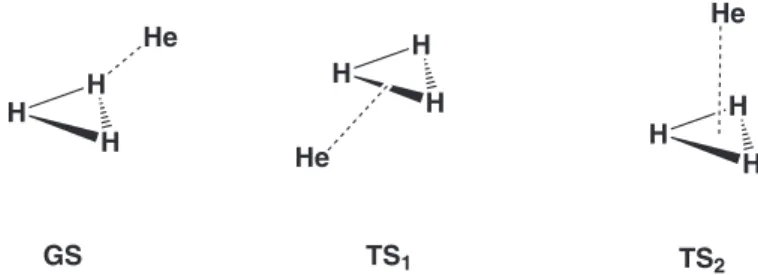
symmetry. H H H He H H H H H H He He S T S G 1 TS2
Fig. 1.Stationary points on the He–H+3 potential energy surface.
Table 1. Definition of active spaces for the [HeH3]+system.
Active He H Dimension
space orbitals orbitals
1 1s 1s 4
2 1s 2s 2px2py2pz 1s 8
3 1s 2s 2px2py2pz 1s 2s 2px2py2pz 20
Table 2. Relative energies (eV) and geometric parameters (Å) for the [HeH3]+complex and constitutive fragments.
GS TS1 TS2 HeH+ H+3
∆E 0.0 0.017 0.026
d(He-H) 1.789 2.213 2.509 0.776
d(H-H)H+3 0.874 0.873 0.874 0.873
3. Potential energy surface of [HeH3
]
+Several studies have already examined the geometry and stabil-ity of HeH+3 (Funke et al.1967; Benson & McLaughlin 1972; Poshusta1969,1973). The accurate investigations by Raynor & Herschbach (1983) yield a C2v structure with a very low
bind-ing energy (0.04 eV) with respect to the He+ H+3 fragments. However, not all of the aforementioned studies gave this result; some of these works suggested that the complex would not even be stable. Seeing these contradictions and the spread of the re-ported results, high level calculations were deemed necessary to obtain a conclusive answer as to the stability and geometry of this complex.
Three geometries were found to be stationary points, two of which belonging to C2vand one to C3vsymmetries (Fig.1).
There is only one stable structure, GS, one transition state, TS1, implying the in-plane rotation of He from one apex of the
triangle to another, and one long distance out-of-plane transition state TS2. The values obtained at the CASPT2/ANO-L-VQZP
level are given in Table2, where d(H-H)H+
3 is the average over
the three distances defining the H+3 triangle. This result shows that He-H+3 falls in line with all X-H+3 (X= Ne, Ar, Kr, and Xe) investigated in previous studies (Pauzat & Ellinger2007; Pauzat et al.2009).
Comparison with the values obtained for HeH+and H+3 in isolation (Table 2) shows that the H+3 cycle is practically the same as in isolation, while the He-H bond is considerably longer than for isolated HeH+. This allows us to state that the com-plex formed corresponds to a very weak interaction between He and H+3 contrary to the strong bond in HeH+. There is no hydro-gen transfer from H+3 to He, which is confirmed by a topologi-cal analysis (Silvi & Savin1994) of the electronic structure. As shown in Fig.2, there is no bonding between the two fragments of the complex whereas a strong interaction (a single electronic
Fig. 2.View of the electron localization function (ELF= 0.85) isosur-faces for HeH+and He-H+3.
HeH
3+He + H
2+ H
+He + H
2++ H
He
++ H
2+ H
He + H
3+HeH
2++ H
8.81HeH
++ H
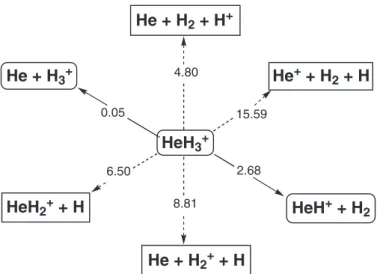
2 6.50 2.68 0.05 4.80 15.59Fig. 3.Energetics (eV) of the fragmentations He-H+3.
domain) is seen for the diatomic ion. Full details on the method and comparison with other noble gases complexes with H+3 can be found in Pauzat & Ellinger (2007).
Because the geometry of the complex is known, the reaction network representing all the possible constructions and fragmen-tations of HeH+3 was investigated. The results reported in Fig.3
confirm that the HeH+3 complex is the lowest energy point on the PES, where all possible destructions of the complex are en-dothermic.
At the same time, this schematic representation highlights the pivotal role of HeH+3 and points to the lowest energy reaction paths (plain arrows between rounded rectangles). However, more complete calculations are necessary than this only energetic pro-file to conclude whether HeH+3 can be effectively reached or not. This leads us to study two cuts of the PES, corresponding to re-action paths (1) and (2) as follows:
He+ H+3 → HeH+3 (1)
HeH++ H2 → HeH+3. (2)
Reaction (1) amounts to scanning the distance d1 between He
and the closest apex H and for reaction (2) to scanning the dis-tance d2 between the closest apex H and the middle of the H2
fragment (assuming C2vsymmetry; cf. Fig.4(top)). The overall
result mapped in Fig.4(bottom) shows unambiguously that reac-tion (1) leads to the formareac-tion of He+ H+3 without any activation barrier. Indeed, it is clearly visible that a start from the entrance
Fig. 4.Top: two dimensions defining the potential energy surface ex-plored. Bottom: CASPT2 potential energy surface; Zone 1: HeH++ H2;
Zone 2: He++ H + H2; Zone 3: HeH+3; Zone 4: He+ H+3.
channel considered, namely HeH++ H2corresponding to zone 1
leads to a steep descent towards zone 3. In the same way, starting from zone 4, where the system is under the form He+ H+3, the association also proceeds without activation barrier.
4. Formation of HeH+
3 by radiative association Since no low-lying excited electronic states are accessible, each mechanism for these radiative associations implies the forma-tion of a complex situated in the vibraforma-tional quasi-continuum of the ground electronic state; this complex is then stabilized by radiative decay towards the bound rovibrational levels of the ground state, which releases the excess energy through spontaneous emission. The calculations were carried out here in a reduced dimension quantum approach used previously by Bacchus-Montabonel et al. (2000). In the original approach of atom-atom collision (Zygelman & Dalgarno1990; Stancil et al.
1993), the quantum expression of the cross section at a given relative collision energy E of the colliding fragments is given by σ(E) =X J σJ(E) (3) where σJ(E)= X v0J0 64 3 π5 c3 g 2µEν 3 E,v0J0SJ J0ME J,v2 0J0, (4)
where µ is the reduced mass of the system, g is a parameter ac-counting for the degeneracy of the electronic state (here g= 1),
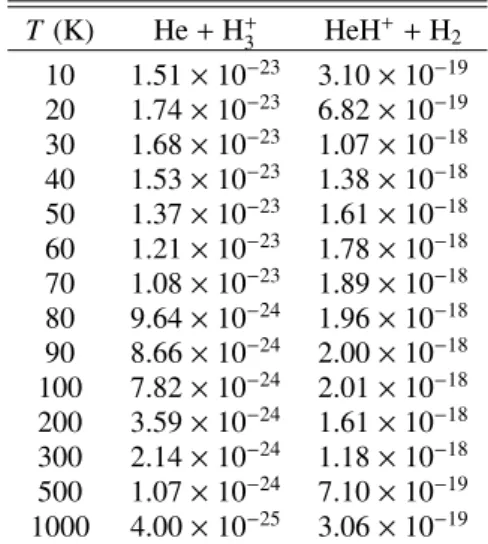
A&A 607, A61 (2017) Table 3. Radiative association rate coefficients (cm3s−1) for He+ H+
3
→ HeH+3 and HeH++ H2→ HeH+3.
T(K) He+ H+3 HeH++ H2 10 1.51 × 10⁻²³ 3.10 × 10⁻¹⁹ 20 1.74 × 10⁻²³ 6.82 × 10⁻¹⁹ 30 1.68 × 10⁻²³ 1.07 × 10⁻¹⁸ 40 1.53 × 10⁻²³ 1.38 × 10⁻¹⁸ 50 1.37 × 10⁻²³ 1.61 × 10⁻¹⁸ 60 1.21 × 10⁻²³ 1.78 × 10⁻¹⁸ 70 1.08 × 10⁻²³ 1.89 × 10⁻¹⁸ 80 9.64 × 10⁻²⁴ 1.96 × 10⁻¹⁸ 90 8.66 × 10⁻²⁴ 2.00 × 10⁻¹⁸ 100 7.82 × 10⁻²⁴ 2.01 × 10⁻¹⁸ 200 3.59 × 10⁻²⁴ 1.61 × 10⁻¹⁸ 300 2.14 × 10⁻²⁴ 1.18 × 10⁻¹⁸ 500 1.07 × 10⁻²⁴ 7.10 × 10⁻¹⁹ 1000 4.00 × 10⁻²⁵ 3.06 × 10⁻¹⁹
SJ J0 is the Höln-London coefficients characteristic of the J and
J0pair of rotational levels, and ME J,v2 0J0 is the free-bound
transi-tion moment matrix element of the dipole moment between the energy normalized function fE Jof the continuum and the bound
rovibrational function φv0J0. The frequency of the photon
emit-ted, νE,v0J0, corresponding to the energy difference between the
continuum level of energy E and the rovibrational bound state of energy Ev0J0is given by
∆E = hνv0J0 = E − Ev0J0. (5)
Finally, the rate constants are calculated as the average over the cross sections weighted with a Maxwellian velocity distribution at temperature T (Stancil et al.1993; Ju˘rek et al.1995; Gianturco & Gori-Giorgi1997), i.e.
k(T )= hσ(E)vi. (6)
For diatomic systems, it is possible to determine both the rovi-brational bound states and the corresponding free-bound dipole transition moments so that a rigorous quantum chemical treat-ment can be carried out as presented recently for the forma-tion of CHe++by radiative association (Zicler et al.2016). Fol-lowing Bates (1987) and Herbst & Bates (1988) this treatment was adapted in a reduced dimension via a one-dimensional reac-tion coordinate approximareac-tion. In this context, the HeH+3 excited complex is formed along the d1and d2for reactions (1) and (2),
respectively.
The energy curve necessary to the calculation of the rate con-stant for the He-H+3 association is obtained by the cut of the global PES along d1 shown in Fig.4. The geometry is relaxed
for every value of the reaction coordinate to account for the re-arrangement of the H+3 fragment when approaching the helium atom. In that case the potential energy curve presents a very small well, only 0.051 eV (i.e. 1.17 kcal mol−1) deep, with three
vibrational levels (v = 0 to 2). Thus the radiative association rate constants obtained (Table3) remain very weak in the whole temperature domain, reaching 1.7 × 10⁻²³cm3s−1at most. The stabilization of the HeH+3complex through the rovibrational lev-els cascade would thus be very unlikely.
In the same way, the cut according to d2 (Fig.4) with both
HeH+and H2 fragments relaxed to account for their
rearrange-ments is used for the calculation of the HeH+-H2 association.
In this reaction, the stabilization of the HeH+3 complex would
be much more likely. The depth of the potential energy well is 2.62 eV (i.e. 60.3 kcal mol−1) and up to 28 vibrational levels
(v = 0 to 27) are found in this case. The radiative association cross sections (Table3) have been summed over all the rovibra-tional levels up to J= 12 and the corresponding rate coefficients reach up to 2.0 × 10⁻¹⁸cm3s−1meaning, obviously, a more e ffi-cient process.
5. Concluding remarks
As already stated in the introduction, the non-observation of HeH+in various hydrogen-rich media has drawn much attention. Recently, Loreau et al. (2013) revisited this fact by considering an alternative approach through excited states of HeH+and pro-posed that this ion could be detected in its metastable3Σ+state. Evaluation of the rate constant of its possible formation by ra-diative association between metastable helium and a proton gave values in the range of ∼10−16cm3s−1. This evaluation, however,
was penalized by the short live times and low abundances of the excited states. On the basis of these results, these authors esti-mated the abundance of the HeH+excited triplet and found it to be much lower than that of the ground state.
By contrast, all our developments are concerned with ground electronic states for all reactants and products. Even if the ge-ometry of the fragments is allowed to adjust along the reaction paths, the calculations still suffer the consequences of the re-duced dimension model, although they are performed in a quan-tum framework. This formulation is not able, indeed, to account for all the degrees of freedom that could help in dissipating the energy via the radiative emission. In other words, the associ-ation energy cannot spread over all the internal rotassoci-ational and vibrational modes associated with the remaining HeH+and H+3 bonds, such that the radiative rates in Table3 should be some-how underestimated. Nevertheless, the present treatment offers a first approach to the vibrational relaxation in the HeH+3 formation processes considering the effect of the directly coupled motions on the interaction potential along the reaction coordinate, which is reasonable according previous work (Kunc 1998; Bacchus-Montabonel et al.2000; Patuwo et al.2013). In the end, our cal-culated rate coefficients that reach up to 2.0 × 10⁻¹⁸cm3s−1 sug-gest that the formation of HeH+3 should not be a priori discarded, meaning that it is worth searching for this molecular ion.
The question raised now is where to look for these ionic species in space since both are known to exist in the labora-tory. The detection of HeH+seems to be rather unlikely, taking into consideration its straightforward destruction by H2(Orient 1977). The planetary nebula in which HeH+has been looked for (NGC 7027) has a rich H2 envelope, which does not make it a
good environment for HeH+to be preserved and observed. Thus, maybe PNs that are old and evolved enough to have lost their H2
envelope, such as the Ring Nebula (M57), might be better tar-gets. However, this observation has never been tried owing to the lack of N appropriate instrument. It would require a wide ( 1 arcmin), integral field spectrometer in the 3 µm spectral re-gion which, so far, does not exist. However, this last test should be kept in mind before a final conclusion.
As suggested in this paper, another chance to find a molecu-lar ion with He, would be to look for HeH+3. In such a case, the first point is to reference the places where H+3 has been observed. Indeed, H+3 was first detected in the auroral zones of Jupiter (Drossart et al.1989) and then, in those of Saturn and Uranus (Maillard & Miller2011). This fundamental ion is formed there by the particle flux of the solar wind on H2 reaching the upper
atmosphere of the polar regions. It will be destroyed deeper by
reaction with H2, but its lifetime is long enough to survive in
sufficient quantity to be detectable in emission, as the signature of an auroral activity on the giant planets. However, the chance of having the formation of the complex with He seems unlikely, as the helium atoms, submitted to the gravity effect, sink into the lower atmosphere of these planets, making He depleted in the upper atmosphere where H+3 forms.
The central molecular zone (CMZ) represents another site to consider. Recent papers by Goto (2015a) and Oka et al. (2016) have pointed out that the central 300 pc of the Galaxy exhibit a diffuse emission of H+3 all over the region. Another paper (Goto et al.2013) is devoted to the H+3 spectroscopy of the cen-tral few parsecs. On the other hand, a few years before, evi-dence for a cluster of helium-rich stars (Paumard et al. 2001) and flows of helium coming from the abundant mass loss of these stars (Paumard et al. 2004) have been found in the inner parsecs. Could the conditions for having there an efficient for-mation of HeH+3 be satisfied? Helium is abundant in the inner region, while H+3 forms in the surrounding molecular zone; this forms the CMZ, which is submitted to the ionization of the cos-mic rays. The detection of H+3 in this region is made in absorp-tion, on the line of sight of the bright stars concentrated in the vicinity of the central black hole, in particular the helium-rich stars (Paumard et al.2001). The H+3 spectra presented in Goto et al. (2013) show five or six weak broad line profiles, about 200 km s−1 wide, marks of gas flows within the CMZ, with a maximum depth of 10%. The search for potential HeH+3 lines should be carried out with the same method. The very likely small production rate of HeH+3 leads to foresee lines that are too weak to be easily detectable. In addition, the temperature of this area, close to the central black hole, might be too high for HeH+3 to survive durably, when considering the experimental results obtained by Savi´c et al. (2015).
Few star-forming regions are the other sites where H+3 has been detected. The first reported detection goes back to a paper of Geballe & Oka (1996). A more recent work is from Goto et al. (2015b). The method of detection is exactly the same as that used for the CMZ, which consists of looking for the most intense in-frared lines of the ion in absorption towards young massive stars embedded in the molecular clouds. The same considerations ap-plied to the CMZ, casting some doubt on the possibility of de-tecting a signature of HeH+3 on the same line of sight.
Nevertheless, it could be challenging to try to observe this compound with the most sensitive high-resolution infrared spec-trometers behind a large telescope. In order to help, we tenta-tively computed the IR spectrum and the rotational constants (Appendix A) of this intriguing positive ion.
Acknowledgements. This work was supported by CNRS national program PCMI (Physics and Chemistry of the Interstellar Medium) and by COST Actions CM 805, “The Chemical Cosmos” and CM 1401, “Our astrochemical history”. We acknowledge computational resources from the CCIN2P3 in Villeurbanne.
References
Andersson, K., Malmqvist, P.-A., Roos, B. O., Sadlej, A. J., & Wolinski, K. 1990,
J. Phys. Chem., 94, 5483
Andersson, K., Malmqvist, P.-A., & Roos, B. O. 1992,J. Chem. Phys., 96, 1218
Aquilante, F., De Vico, L., Ferré, N., et al. 2010,J. Comput. Chem., 31, 224
Bacchus-Montabonel, M. C., Talbi, D., & Persico, M. 2000,J. Phys. B, 33, 955
Barlow, M. J., Swinyard, B. M., & Owen, P. J. 2013,Science, 342, 1343
Bates, D. R. 1987,ApJ, 312, 363
Benson, M. J., & McLaughlin, D. R. 1972,J. Chem. Phys., 56, 1322
Black, J. H. 1978,ApJ, 222, 125
Bovino, S., Tacconi, M., Gianturco, F. A., & Galli, D. 2011,A&A, 529, A140
Bovino, S., Gianturco, F. A., & Tacconi, M. 2012,Chem. Phys. Lett., 554, 47
Cox, P., Huggins, P. J., Maillard, J. P., et al. 2002,A&A, 384, 603
Dabrowski, I., & Herzberg, G. 1978,Ann. N. Y. Acad. Sci., 38, 14
Dalgarno, A., & Lepp, S. 1987, in Astrochemistry, eds. M. S. Vardya, & S. P. Tarafdar (Dordrecht, Holland: Reidel), 109
Drossart, P., Maillard, J. P., Caldwell, J., et al. 1989,Nature, 340, 539
Engel, E. A., Doss, N., Harris, G. J., & Tennyson, J. 2005,MNRAS, 357, 471
Flower, D. R., & Roueff, E. 1979,A&A, 72, 361
Frisch, M., Trucks, G. W., Schlegel, H. B., et al. 2009,Gaussian 09 (Wallingford, CT: Gaussian, Inc.), 227
Funke, I., Preuss, H., & Diercksen, G. 1967,Mol. Phys., 13, 517
Geballe, T. R., & Oka, T. 1996,Nature, 384, 334
Gianturco, F., & Gori-Giorgi, P. 1997,ApJ, 479, 560
Goto, M., Indriolo, N., Geballe, T. R., & Usuda, T. 2013,J. Phys. Chem. A, 117, 9919
Goto, M., Geballe, T. R., & Usuda, T. 2015a,ApJ, 806, 57
Goto, M., Geballe, T. R., Usuda, T., et al. 2015b,AIP Conf. Proc., 1642, 377
Gruenwald, R. B., & Péquignot, D. 1989, Planetary Nebulae, ed. S. Torres-Peimbert (Dordrecht, Holland: Kluwer), 224
Harris, G. J., Lynas-Gray, A. E., Miller, S., & Tennyson, J. 2004,ApJ, 617, L143
Herbst, E., & Bates, D. R. 1988,ApJ, 329, 410
Hirasawa, T. 1969,Prog. Theor. Phys., 42, 523
Hogness, T. R., & Lunn, E. G. 1925, Phys. Rev., 26, 44
Ju˘rek, M., Spirko, V., & Kraemer, W. P. 1995,Chem. Phys., 193, 287
Kunc, J. A. 1998,Phys. Rev. E, 58, 4960
Lepp, S., Stancil, P. C., & Dalgarno, A. 2002,J. Phys. B, 35, R57
Loreau, J., Vranckx, S., Desouter-Lecomte, M., Vaeck, N., & Dalgarno, A. 2013,
J. Chem. Phys., 117, 9486
Liu, X.-W., Barlow, M. J., Tennyson, J., et al. 1997,MNRAS, 290, L71
Maillard, J. P., & Miller, S. 2011, Molecules in the Atmospheres of Extrasolar Planets, eds. J.-P. Beaulieu, S. Dieters, & G. Tinetti,ASP Conf. Ser., 450, 19
Maillard, J. P., Drossart, P., Watson, J. K. G., Kim, S. J., & Caldwell, J. 1990,
ApJ, 363, L37
Middlemass, D. 1990,MNRAS, 244, 294
Miller, S., Tennyson, J., Lepp, S., & Dalgarno, A. 1992,Nature, 355, 420
Moorhead, J. M., Lowe, R. P., Wehlau, W. H., Maillard, J. P., & Bernath, P. F. 1988,ApJ, 326, 899
Oka, T., Geballe, T. R., Goto, M., et al. 2016, 71st Int. Symp. on Mol. Spec.,
http://hdl.handle.net/2142/91152
Orient, O. J. 1977,Chem. Phys. Lett., 52, 264
Patuwo, M. Y., Lim, M. B., & Bettens, R. P. A. 2013,Chem. Phys. Lett., 555, 247
Paumard, T., Maillard, J. P., Morris, M., & Rigaut, F. 2001,A&A, 366, 466
Paumard, T., Maillard, J. P., & Morris, M. 2004,A&A, 426, 81
Pauzat, F., & Ellinger, Y. 2007,J. Chem. Phys., 127, 014308
Pauzat, F., Ellinger, Y., Pilmé, J., & Mousis, O. 2009,J. Chem. Phys., 130, 174313
Pierloot, K., Dumez, B., Widmark, P. O., & Roos, B. O. 1995,Theor. Chim. Acta, 90, 87
Poshusta, R. D. 1969,J. Chem. Phys., 51, 3343
Poshusta, R. D. 1973,J. Chem. Phys., 59, 2477
Pou-Amérigo, R., Merchan, M., Nebot-Gil, I., Widmark, P.-O., & Roos, B. O. 1995,Theor. Chim. Acta, 92, 149
Raynor, S., & Herschbach, D. R. 1983,J. Chem. Phys., 87, 289
Roberge, W., & Dalgarno, A. 1982,ApJ, 255, 489
Savi´c, I., Gerlich, D., Asvany, O., Jusko, P., & Schlemmer, S. 2015,Mol. Phys., 113, 2320
Silvi, B., & Savin, A. 1994,Nature, 371, 683
Stancil, P C., Babb, J. F., & Dalgarno, A. 1993,ApJ, 414, 672
Widmark, P.-O., Malmqvist, P.-A., & Roos, B. O. 1990,Theor. Chim. Acta, 77, 291
Widmark, P.-O., Joakim, B., Persson, & Roos, B. O. 1991,Theor. Chim. Acta, 79, 419
Zicler, E., Bacchus-Montabonnel, M. C., Pauzat, F., Chaquin, P., & Ellinger, Y. 2016,J. Chem. Phys., 144, 111103
Zinchenko, I., Dubrovich, V., & Henkel, C. 2011,MNRAS, 415, L78
A&A 607, A61 (2017)
Appendix A
The harmonic and anharmonic frequencies and associated ab-solute intensities are reported in Table A.1, as computed us-ing second-order perturbation theory (MP2) accordus-ing to Frisch et al. (2009). The IR spectrum (Fig.A.1) is dominated by three intense bands. Two of these bands appear at high frequencies, associated with the A1 and B2 modes of the H+3 fragment that
would be degenerated in absence of the He atom. The third band is at low frequency corresponding to the elongation of the weak bond He. . .H+3.
The anharmonic contribution is important as expected for a weakly bound system composed of two fragments of similar masses. The calculated shift amounts to ∼9% in the average for the high frequencies of the H+3 fragment. The relative motion be-tween He and H+3 is even more affected by anharmonicity with shifts of more than 50% of the harmonic value towards lower frequencies. Intensities implying the v= 0 level follow the same pattern whereas those of overtones and combination bands in-crease significantly.
In the same way, anharmonicity brings important changes to the rotational constants between those calculated at the equilibrium geometry, i.e.
Ae= 1346.8; Be= 54.337; Ce= 52.230 (GHz)
Fig. A.1.Portion of the synthetic spectrum of HeH+3 from TableA.1in which the most intense lines are concentrated, mainly from the funda-mental bands associated with the A1and B2modes of H+3. The spectral
region between 3.45 and 4.00 µm should be a top priority for a detection of this ion.
and those obtained when taking into account the vibrational con-tribution and the centrifugation distortion
A0= 1363.0; B0= 46.582; C0= 44.196 (GHz).
The large corrections on the spectroscopic signatures are an il-lustration of a very complicated and flat potential surface. It points clearly to the necessity for the evaluation of a proper multi-dimensional potential surface and a full treatment of rovi-brational interactions.
Table A.1. Anharmonic infrared spectroscopy of He. . .H+3 (C2v symmetry): energies (frequencies (cm−1) and absolute intensities (km mol−1)
calculated at the MP2 level with aug-cc-pVQZ basis set.
.
Fundamental bands
Mode(Quanta) E(harm) E(anharm) I(harm) I(anharm)
1A1(1) 3488.7 3226.6 0.6 0.2 2A1(1) 2814.7 2535.4 281.7 92.3 1B2(1) 2797.5 2541.7 186.4 133.8 1B1(1) 287.5 103.5 6.0 4.6 3A1(1) 249.2 103.7 245.3 124.4 2B2(1) 200.9 95.6 12.8 10.1 Overtone bands∗
Mode(Quanta) E(harm) E(anharm) I(anharm)
2A1(2) 5629.5 4915.4 27.4
1B2(2) 5595.1 4912.2 33.2
3A1(2) 498.4 125.9 13.0
2B2(2) 401.9 115.3 2.9
Combination bands∗
Mode(Quanta) E(harm) E(anharm) I(anharm)
2B2(1) | 1B2(1) 2998.5 2677.2 112.2 2A1(1) | 1B2(1) 5612.3 4993.9 49.3 2A1(1) | 2B2(1) 3015.7 2618.7 48.3 2A1(1) | 1A1(1) 6303.4 5582.3 1.4 1B1(1) | 2A1(1) 3102.3 2666.8 30.6 Notes.∗
Only bands with I ≥ 1 are reported.