READ THESE TERMS AND CONDITIONS CAREFULLY BEFORE USING THIS WEBSITE. https://nrc-publications.canada.ca/eng/copyright
Vous avez des questions? Nous pouvons vous aider. Pour communiquer directement avec un auteur, consultez la première page de la revue dans laquelle son article a été publié afin de trouver ses coordonnées. Si vous n’arrivez pas à les repérer, communiquez avec nous à [email protected].
Questions? Contact the NRC Publications Archive team at
[email protected]. If you wish to email the authors directly, please see the first page of the publication for their contact information.
NRC Publications Archive
Archives des publications du CNRC
This publication could be one of several versions: author’s original, accepted manuscript or the publisher’s version. / La version de cette publication peut être l’une des suivantes : la version prépublication de l’auteur, la version acceptée du manuscrit ou la version de l’éditeur.
Access and use of this website and the material on it are subject to the Terms and Conditions set forth at
Experimental pavement structures insulated with a polyurethane and
extruded polystyrene foam
Penner, E.
https://publications-cnrc.canada.ca/fra/droits
L’accès à ce site Web et l’utilisation de son contenu sont assujettis aux conditions présentées dans le site LISEZ CES CONDITIONS ATTENTIVEMENT AVANT D’UTILISER CE SITE WEB.
NRC Publications Record / Notice d'Archives des publications de CNRC:
https://nrc-publications.canada.ca/eng/view/object/?id=a56ba54a-e954-4976-96da-5c422553f1c1
https://publications-cnrc.canada.ca/fra/voir/objet/?id=a56ba54a-e954-4976-96da-5c422553f1c1
n t rirduit l a p g n i r t r a t i o n d u g e l d e 17. 5 p o u c e s p a r p o u c e ( s o i t 1 7 . 5 c m p a r cm)J L e s d g v i a t i o n s indiquBes p a r p e u p l u s f o r t e s , m a i s l e g o n f l e m e n t Btait c o n s i d B r a b l e - inuC. Au c o u r s d e 1'CtB 1 9 6 5 , d e u x s e c t i o n s s u p p l C m e n -
FROM
Physics
of Snow and
Ice
I
1
Proceedings of the International Conference on Low Temperature Science, 1966
VOLUME I
Part
2
Edited
by
Hirobumi ~ U R A
THE INSTITUTE OF LOW TEMPERATURE SCIENCE
HOKKAIDO UNIVERSITY
Experimental Pavement Structures Insulated with a Polyurethane and Extruded Polystyrene Foain
Abstract
,
.
1 he liurpose of insulating roatls in areas of seasonal frost is to attenuate frost penetration ant\ thus permit the design ~ i a \ ~ e r n c n ~ thicltness to be recluced. F o r satisfactory operation the require- nlents a r c that tlie insulating nlalerial must retain a high thermal resistance during tlie lifetime of the installation clespi~e a varying moisture regirnc in the surrountling material. Also, it should not interfere significantly with tlic s ~ a b i l i t y of the p;iveinen~ s t r u c t u r e either because of he flesil~le nature of the insulation o r by creating a n u n f a v o u r a l ~ l e \voter coliclition in the ollier components of the road betl. Early inclica~ions fr o m actual use a r e that polystyrene insulation \vill meet these requirements.
T w o 100-ft (32.8-mj sections of street were constructetl in S u d b u r y , Ontario, Canatla, in Sep- tember 1964 using 2 - l ~ y 4-ft. by ?-in. (0.610-by 1.220-111 1)y 5.08-cin) sheets of e x ~ r u d e c l polystyrene insulation in the pavement s t r u c t u r e a~ a tlepth of l ( j in. (0.40(5 in),> During t h e first winter of operation (196.1-1965) tlie air frceziilg index was 2(i00 clcg.day below 32"I.' ( I 4/14 deg.day below P C ) . ,
.
1 he maximum frost penetration was 65 in. (1.65 111) in tlie centre of t h e road in the control area, ant1 30 in. (0.76 111) in the insulatetl area, that is, he insulation attenuated i r o s t 1,enetraLion by 17.5 in. per inch (17.5 cm!cm) of insulation. Dcnkclman beam deflections were some\i~hat higher in the i n s u l a ~ e t l areas but the alnounl of heaving was consitlcrably retartletl. _&n the s u m m e r of 1965 two adtli~ional insulated roatl s c c ~ i o n s urcre c o n s t r u c ~ e t l in Otlawa, Ontario, Canatla. T \ r o types o i insulation atitl mctliocls were used. Estrutletl polystyrene boartls \\.ere l ~ l a c e d by liantl (the s a m e a s at S u d b u r . ) at tlie tlesirctl elevation. Polyurethane was foamccl in place by spraying tlic chemi- cals on tlie roatl becl with a specially consrructecl self-prol)clletl spraying macliine.
,
.
I his paper tliscusscs t h e relative merits of tlic tliifercnt mctliods of i n s u l a ~ i n g roatls and, in a l~roaclcr contcxt, the p r o t e c ~ i o n against freezing of untlerground utilities, such as water mains ant1 sewers.
I. Introduction
T h e performance of pavement structures in regions of seasonal frost is dependent to a large extent on the ability of these structures to resist the detrimental effects of freezing and thawing. A n undesirable feature resulting from frost action is the differ- ential distortion of the road surface during the freezing period caused by ice lensing which reduces the riding quality of the road. Equally serious is the loss of subgrade support during and immediately after the thawing period.
It is also well ltnown that surface deflection in flexible pavements d u e to traffic loads is at a maximum after thawing occurs and is at a minimum in the period preced- ing the next winter. This characteristic deflection rhythm is repeated each year although it is not well understood whcn no frost heaving occurs. When deflection is excessive, characteristic pavement cracking and surface deterioration result which emphasizes the
destructive phenomena associated with seasonal freezing and thawing.
T h e r e is a trend toward thiclcer pavements in present highway design to accom- modate heavier loads on a year-round basis. Complete snow removal and thiclcer granular bases cause deeper frost penetration. It would seem, therefore, that the reduction of frost penetration with a thermal barrier in the pavement structure is an approach worthy of study in road research. In some areas of Canada and the U.S.A. shortages of good granular material are developing and this has further stimulated the interest of design- ers in considering alternative methods of constructing roads in areas where cold winters are experienced.
Frost-susceptible subgrades in Norway have been protected from freezing and heaving by a high water-content organic layer above the subgrade. This has been used exten- sively in railway construction (Slcaven-I-Iaug, 1959) and to a lesser degree on roads. T h e use of mineral wool for preventing frost penetration in roads has been described (Rengmark, 1965). A small thermal study using cellular glass was reported by Quin and Lobacz (1962). Several full-scale road installations using factory-produced boards of extruded polystyrene foam have been reported (Oosterbaan and Leonards, 1965; Young, 1965; Penner et nl., 1966).
T h e use of insulation in a permanent road structure requires that the insulating material has a predictable thermal and structural performance for the lifetime expectancy of the road. Loss of thermal performance, which may occur either by moisture absorp-
tion, physical crushing, or other deterioration, cannot be tolerated. Such insulating
layers are partial moisture barriers and may cause unfavourable moisture accumulations which can result in excessive deflections in the road. Further, the flexibility of the insulation itself should not induce undesirable pavement deflections d u e to trafic loads. Experiments using extruded polystyrene foam as a thermal barrier are showing promising results although most installations have only had a few years of service.
T h e r e are several aspects of both street and highway design where the use of an insulaling layer appears practicable. In the first place, the desirability of decreasing frost penetration with a thermal barrier arises where the design pavement thickness based strictly on the load-carrying capacity is less than the thiclcness required to prevent frost penetration into the subgrade and subsequent frost heaving. Secondly, an insula- ting layer may provide thermal protection to structures such as culverts in rural areas, and water and sewer mains in urban areas. Thirdly, insulation may prove to be useful in remedial construction of sections of roads which have heaved excessively owing to unsatisfactory subgrade conditions.
It is now standard practice in some areas of Canada to inslall an insulating laycr under structures such as curling rinlcs, skating rinlcs, and cold storage buildings in order to prevent destructive heaving. Where poor subgrade conditions exist in the freezing zone it is usually more economical to use insulation than to use deep excavations and non-frost-susceptible backfill.
Alternatives to the use of factory-produced insulation boards are now also being studied in order to arrive at the most economical method of installation. One alterna-
tive technique involves spraying the basic constituents on the re pared subgrade and
I N S U L f l T E D P A V E M E N T S 1313
produced in this way. Although the placement method has obvious advantages, the first installation has not been completely successful.
11. Installation at Sudbury, Ontario
T h e Division of Building Research, National Research Council installed a 100-ft
section of insulated pavements on two suburban streets in Sudbury, Ontario during the
summer of 1964 in co-operation with Dow Chemical of Canada Ltd. and the City of
Sudbury. T h e insulation used was extruded polystyrene foam boards 2 by 4 f t by 2 in.
(0.61 by 1.22 m by 5.08 cm) produced by Dow Chemical of Canada Ltd. T h e insulation was hand placed on specially prepared subgrades during reconstruction of the streets. T h e pavement design used in the insulated section on the Antwerp Street site is shown
in Fig. 1. T h e design of the adjacent control area, which is standard for the City of
Sudbury, consisted of 3-11:! in. (8.9 cm) asphaltic concrete, 3 in. (7.62 cm) of selected
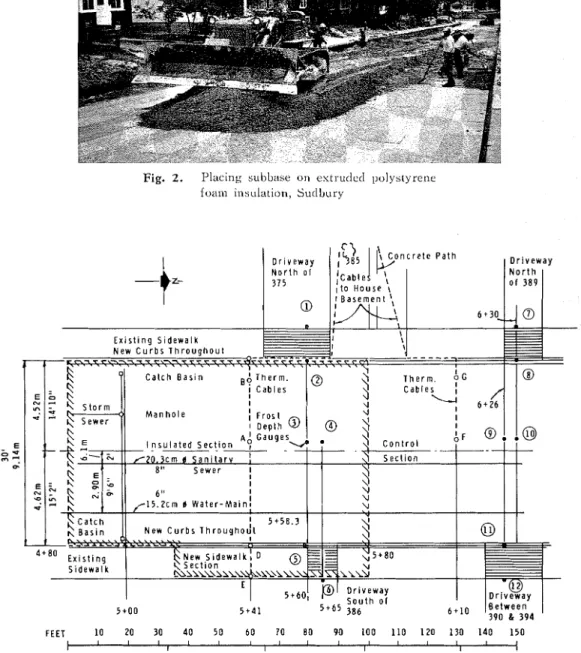
base course and 18 in. (0.46 nl) of subbase. Figure 2 shows a view during construction
of the insulated section on Antwerp Street.
T h e performance of the street in Sudbury containing a thermal barrier was assessed on the basis of the thermal changes below the insulating layer, amount of frost heave,
and pavement deflection characteristics as measured with the Benkelman beam. All
3 0 '
8"
2 0 . 3 2 ~ 1 1 1 S a n i t a r y S e w e r a t 3.66111 D e p t h
1 2 '
Fig. 1. PaverneritTcles~gn ancl thern~ocouple locations of insulated aection at Station 5+41, Antwerp St., Sudbury, Ontario, Canada
Fig. 2. Placing subbase on extruclccl I,olystyrene loam insulation, Suclbury
FEET 10 20 30 40 50 60 70 80 90 100 110 120 130 140 150 I I I I I I I I I I I I I I I 1 10 20 30 40 METERS
Fig. 3. Plan of insulated and control sections o n A n t w c r p S t . with locations of thermocouples ant1 f r o s t d e p t h guagcs
were compared with the adjacent control sections. T h e A n t w e r p S t r e e t site was instru- mented with thermocuples and methylene-blue frost d e p t h gauges as sholvn in the plan view in Fig. 3. Soil exploration studics revealed a variety of subgrade materials but all were highly frost-susceptible.
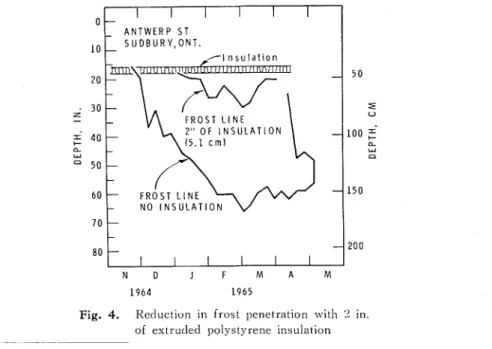
F i g u r e 4 shows a comparison between thc frost line attenuation in t h e centre of
t h e insulated section based o n t h e 32'F (O'C) isotherm and that of a similar position in
the uninsulated area. D u r i n g t h e winter of 1964165 t h e freezing index* was
2
600 d e g . d a ybelow 32°F (1 444 d e g , d a y below 0°C) and under these conditions the reduction in
frost penetration was 35 in. (0.89 111) for this particular subgrade. T h e amount of heave
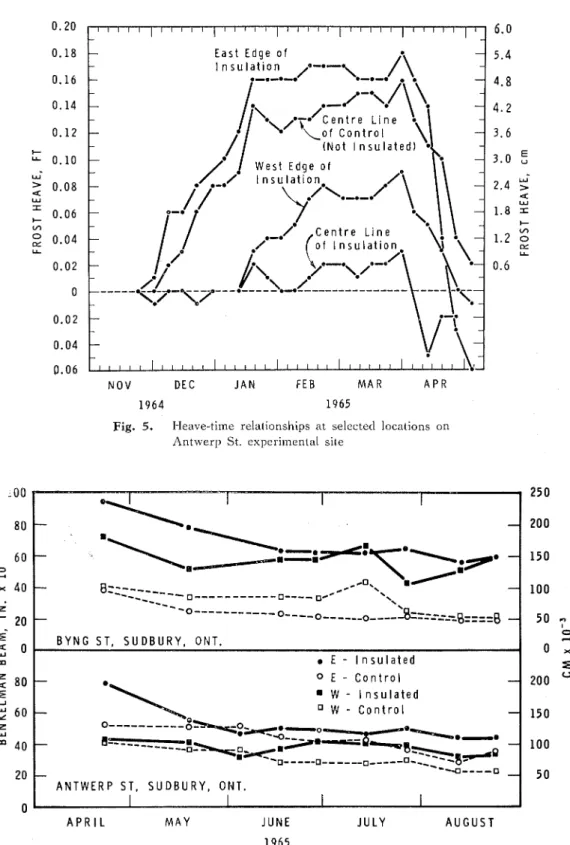
that occurred as t h e winter progressed is shown in F i g . 5 for various locations o n t h e
A n t w e r p Street experimental site. Only a small amount of heaving occurred in the
insulated area, but, as expected, collsiderable h e a v i ~ l g took place at both edges of insu- lation. T h e extreme heave a t t h e east side resulted f r o m poor drainage conditions which were linown to exist.
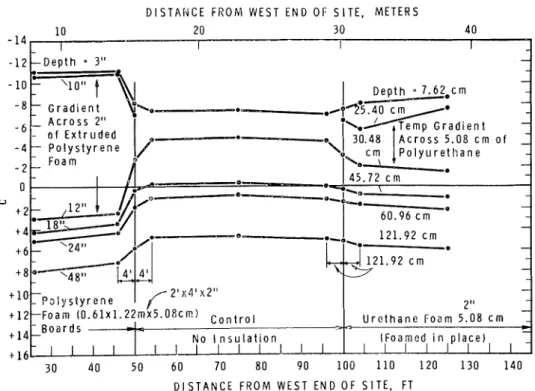
Benkelman beam rebound m e a s u r e m e ~ l t s under 18 000-1b (8 172-lig) single-axle loads
were made by the Ontario Ijepartment of I-Iighways d u r i n g the spring and s u m m e r of
1965. Each value plotted in F i g . 6 for a given d a t e is the average of five measurements along t h e insulated or control areas. T h e rebound values a r c also s h o w n f o r t h e other site in Sudbury (Byng Street) where apparently excessive rebound occurred over the insulated area. T h e values measured o n A n t w e r p Street a r e considered to be acceptable. T h e differences between t h e east and west side a r e consistent with the frost heave results. Neither illsulated street section has s h o w n any s i g n of distress and the mini- m u m fall rebound values, shown in Fig. 6, a r e not considered excessive.
A N T W E R P ST S U D B U R Y , O N T . F R O S T L l N E 2" O F I N S U L A T I O N 0. Y 5 0 6 0 F R O S T L I N E
'01
,
,
, ,
I4200
8 0 N D J F M A MFig. 4. Rccluction in frost penetration with 2 in. o l extrutled polystyrene insulation
: V ~ ; i - e c z i / r g i/rtlc.c as used in North America is thc summation o l the cliffercnce betwccn 32"12 (1 cleg.clay below 32'1; is equivalent to 519 cleg.clay below 0%) and the avcragc daily tcmpcraturc for the winter pcriocl.
0.04 0.06
N O V D E C J A N F E B M A R A P R
1964 1965
Fig. 5. I-Ieave-time relationships a t selected locations on ~ l n t w c r p St. experimental sile
-
0--
-
-
-
--
--
- -
.
w
- l n s u l a t e d W-
C o n t r o l A P R I L M A Y J U N E J U L Y A U G U S T 1 9 6 5111. Installation at Ottawa, Ontario
T w o experimental road sections on the property of the National Research Council, Montreal Road, Ottawa were insulated with two kinds of insulation during the summer of 1965. Only one experimental section is described in this paper. T h e pavement design used on the insulated areas, for which performance results are given, is shown in Fig. 7.
i T h e control section consisted of 3 in. (7.62 cm) of asphaltic concrete and 9 in. (22.86 cm)
of good quality base course on a silty clay subgrade. ?'he insulated sections were each 50 ft (15.25 m) long with a 50-ft (15.25-m) control section in between.
O n one section, extruded polystyrene foam boards 2 f t by 4 f t by 2 in. (0.61 m by
1.22 m by 5.08 cm) were placed by hand on the fine-graded subgrade. 011 the other
section, polyurethane was placed by foaming the insulation 011 the subgrade with a self-
S l o p e .3OU1f1 2 . 5 c m l m . 3 0 " 1 f t 2 . 5 c m l m 3.05111
L
lot 4 . 2 7 m 1 2 ' 1 4 'E
Fig. 7. Pavement clcslyn anel thermocoupie locatiolls for insulateel scclior~s at lhc Ottawa sitc
I:. PENNER D l S T A l d C E FROM W E S T E N D 01: S I T E , M E T E R S 10 20 3 0 4 0 - - - - - - - 2" - - Urethane F o a m 5.08 c m - - 30 40 5 0 60 70 80 90 100 1 1 0 120 1 3 0 140 D l S T A N C E FROM W E S T E N D O F S I T E . FT
?.
Fig. 9. 1empc.raturc l)rofiles in longituclinal section on centre line of snon-cleared csperimcntal roacl, Ott;txva, 28 Ilcccmher, l Y ( i ( i
r
y
r
r
r
l
l
C o n t r o l - no i n s u l a t i o n --
F r o s t e n t e r e d s u b g r a d e *-*-e s e c t i o n\*
N 0 V D E C JAN FEB MAR APR
1 9 6 5 1 9 6 6
TIME, DAYS
Fig. 10. Frost heave vs. time o n centre line ol
5 1
54
t,.,.,,,,dYWLY
NOV OEC JAN FEO MAR APR
1 9 6 5 1 9 6 6
TIME
l a o o l f l l l l 1 1 1 ~ 1
NOV OEC JAN F E E MAR APR
1 9 6 5 1 9 6 6
TIME
BOO
900
1000
Fig. 11. (a) Frost ~ ~ c n e l r a t i o n on centre line o l anow-clearccl road, 1965, Ottarva (b) J)eg.clay curve, 19(i5-(i(i, 0ttaw:l (hasis "I2j
propelled machine constructed and operated by Allied Chemical Canada Ltd., for t h e particular experiment described. Barrels containing the chemicals were mounted directly
o n the machine. O n e barrel contained a prcmix of the resin, t h e catalysts, t h e emulsi-
7.
fier and b l o w i ~ ~ g agent ; t h e o t h c r barrel contained t h e diisocyanate. I he chemicals w e r e
metered in a predetermined ratio t o a mixing nozzle and then sprayed as a liquid o n
the subgrade by a 4-ft (1.22-m) traversing jig. F o a m rise (average 2 in. (5.08 c m ) ) was
complete in seconds and in a few minutes the foam was sufficiently rigid to carry t h e
weight of a man. A view of the n ~ a c h i n ~ in operation is sho\vn in Fig. 8 . T h e mn-
chine travelled a t 3 to 5 ft (0.91 to 1.52 m) n minute :mcl operated satisfactorily d u r i n g
t h e e x p e r i ~ n e n t a l installations f o r which it was intended.
A s will be shown later the required foam quality was not achieved because soil particles were incorporated d u r i n g the blowing process. A f u r t h e r installation is planned f o r 1966 where this difficulty will be overcome. T h e method, however, is sufficiently unique and promising to warrant brief clescription in this paper.
If good quality urethane can be shown to perform satisfactorily thermally a n d structurally, this method of placement has obvious advantages of versatility f o r various kinds of installations, sucll as over lvatcr ancl sclver mains, arouncl buried structures such a s culverts, manholes and catch basins. A further advantage of foaming the insu- lation o n the site involves the lower costs in shipping the basic chemicals to the site
as compared with the cost of shipping rnanufact~~recl insulation.
T e m p e r a t u r e profiles for a particular day (28 December, 1965) a r e sho\vn in F i g . 9 at t h e centre line of the road f o r both types of insulation ancl the uninsulated control
7.
area. I h e superiority of the it1 sit11 quality of t h e polystyrene foam boards (left side)
is clearly demonstrated.
Figure 1 0 shows t h e small amount of frost heave a t t h e centre line of the poly-
styrene foam section as compared with t h e control section \ v l ~ i c l ~ heaved a b o u t 3.5 in.
(8.9 cm). All areas, as in Suclbury, were lcept free of sno\v. T h c sno\v around the perimeter, ho\vever, nlodified the thermal picture to s o m e extent a t the edges.
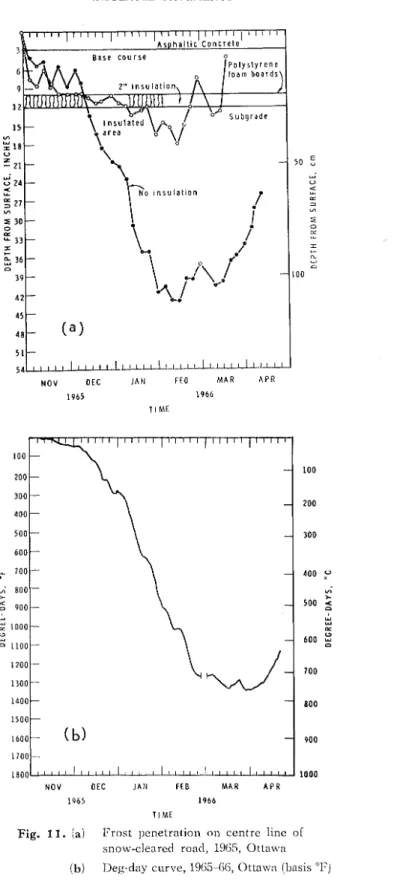
F r o s t line pcnetration is s l ~ o \ v n in F i g . 11 together wit11 the degree-day curve.
Frost pcnetration of the subgrade was retarclcd by a m o n t h by using insulation (see
also Fig. 4). T h e m a x i ~ n u m frost penetration by 1 5 February, 1966 was 43-11;? in. (1.1 m)
in the control area as opposecl to 18 in. (45.7 111) in the insu1:ited area which gives a
frostline attenuation of about 1 3 in. pcr inch (13 cm per cm) of insulation.
IV. Discussion
D u r i n g t h e spring of 1965 several sections of the insulation installed the previous September a t S u d b u r y were removed by excavation, in order to undertalce thermal con- ductivity (K) and moisture absorption measurements. T h e K values of these samples,
which had been buried f o r s o m e 9 months, ranged f r o m 0.23 (Btu in.)/(ft2/1lr/deg F) t o
0.25 (0.29 to 0.31 cal/hr.cm.deg C) wllicl~ was t h e same as f o r the original material. Moisture contents by volunle were 0.77, 0.43 a n d 0.16%. In o n e test, the 2-in. (5.08-cm) board had a moisturc content of 0.16% but when the outside 114 in. (0.635 cm) of material was r e ~ n o v e d f r o m each face, the centre 11/,-in. (3.81 cm) thickness had only 0.092%
INSUL>\TED P A V E M E N T S
Fig. 12. SIIV\V remains on insulatetl surface ax cvitlcnce that after a cold period, surface tcmperaturcs on insulated area are colder than on non-insula~ed area
moisture which shows greater moisture concentrations in the surface layers. It was concluded that t h e 9 months of exposure to t h e high moisture regime of the road had not affected the insulating properties of extruded polystyrene foam boards. Visual examination showed no physical deterioration of t h e boards under traffic loads but some small stone indentations were observed.
Insulation in the pavement structure causes rapid cooling in t h e layers above the insulation at t h e onset of the winter period. T h i s is caused by the reduced heat flow f r o m the underlying soil. A photograph was taken of t h e experimental sections after
a light sl~owfall at the Ottawa site (Fig. 12). T h e road section in t h e foreground, cov- ered with snow, is underlain with extruded polystyrene foam a t a depth of 1 0 in. (25.4 cm), the area adjacent with no snow is not insulated and the area next to the parking lot wit11 patches of s n o w was underlain by polyurethane. T h e possibility of surface icing similar to that experienced on exposed bridge decks should not be overlooked.
I t is recognizecl that t h e long-term behaviour (structurally ant1 thermally) of poly- styrene insulation in the pavement structure has still not been established, but these short-term experiments suggest the method shows p r o n ~ i s e . Assuming satisfactory be- haviour, its general use in road building will clepend on savings in subgrade excavation and granular subbase as compared with t h e cost of the installed insulation. Obviously this will depend on the design of the pavement structure, the nature of the subgrade, and availability of materials in any particular area. Numerous short sections have been built already or a r e planned as a remedial measure on an experimental basis but as yet no fullscale road constructio~l using insulation has been proposed.
Structural stability of t h e insulation after many years of flexing is not lcnown a n d its influence on t h e brealdown of t h e closed cell system neecls to be established. A
insulation should be placed and the thickness required. T h e r e is also the suggestion that some frost penetration of the subgrade may be permissible wit!lout losing stability in the asphaltic concrete surfacing. T h e experiments described herein and in the liter- ature indicate that some penetration may not be llarn~ful.
In these studies the insulation thickness was determined by reference to the expected freezing index for the area. It is hoped that design values call be predicted after the present installations have been in service for a longer period.
Acknowledgments
T h e author wishes to express his appreciation to his many colleagues in the Divi- sion ol Building Research for helpful suggestions and assistance in carrying out the studies. T h e assistance of Dow Chemical of Canada Ltd. and Allied Chemical Canada Ltd. is p a t e f u l l y acknowledged. 'I'his paper is a contril~ution of the Divisioil of Build- ing Research, National Research Council, and is published 1vit11 the approval of the Director of the Ilivision.
References
1) OOSTF.RRA:\N, M. I). ant1 [,EON!\RDS. (;. A. 1965 I J s e of insulating layer to attenuate frost action in l>ighvvay pavelnents. I l i g l ~ z i ~ r . ) ~ Ii~,.\.i,lr~r.lr Iic,c:o~.tl, No. 101, 11-27.
2) PENNI.:R, I:.. ( ~ O S ~ ' E R I ~ ~ \ ; \ N , M. 11. ant[ RODMAX, I<. W. 1966 Performance of city pavement structures containing foameel plastic insulation. I-Ilk/~zc'trj' Ii('.s~tll.(./~ Iiecol-d, No. 1 2 8 , 1--17.
3) QUIN, W. I". ancl LOU.-\C%, E. F. 1962 Frost penetration bcneatli concrete slabs maintained f r e e of snow anel ice, wit11 ancl without insulation. I-liiql~?iv~-v Iiesetrl-ch I ~ L I - c l I<1111., Nat.
Acacl. Sci. N. R. C.. Washington. I). C., 331, 98-115.
d l ) ~ < E X C ; R ~ I : \ R I ~ , 1:. 1965 I!sc ol mineral wool for pre\,enting f r o s t pcnctration in roads. Proc.
S i s t h ln~crnationnl Conf. on Sc~il Mechanics m c l l;ouncl;~tion Icngineering, 2. 179-183. 5) SI~;\VEN-~I.-\UC, SV. 1959 l'rotcction against irost hea\'ing o n the Nor~vegian railroads.
G~;oterll~liqlrr. IX, No. 3. 87-106.
6 ) YOUXG, F. D. 1965 Esperimental f o a ~ n e d plastic base course. l-ligl~zuny Iil,secz~-~./~ X t r o ~ - d ,