A new theta-type thermosensitive replicon from Lactoccocus lactis
as an integration vector for Enterococcus faecalis
Jacques Freére
a;*, Abdellah Benachour
b, Jean-Christophe Giard
c,
Jean-Marie Laplace
a, Sigrid Flahaut
d, Yanick Au¡ray
aaLaboratoire de Microbiologie de l'Environnement, IRBA, Universiteè de Caen, F-14032 Caen cedex, France b Institut de Biochimie, rue du Museèe, 5, Universiteè de Fribourg, CH-1700 Fribourg, Suisse c Department of Microbiology and Immunology, University of South Alabama, MSB 2096, Mobile, AL, USA d Laboratoire de Biologie Cellulaire et Moleèculaire, Universiteè du Littoral - Coête d'Opale, BP 299, F-62228 Calais cedex, France
Received 26 November 1997; revised 29 January 1998; accepted 3 February 1998
Abstract
We isolated a replication thermosensitive mutant of the theta-type lactococcal pUCL22 replicon. An improved version of this thermosensitive replicon was obtained by fusioning the replication repA gene with the downstream repB gene. The resulting plasmid was named pUCB3522Ts. It is highly instable at 42³C in Enterococcus faecalis. Integration into the chromosome via homologous recombination was monitored using the npr gene of E. faecalis JH2-2 as a target. A 513 bp PCR amplification product from an internal region of this npr gene was cloned into pUCB3522Ts. Integration of this construction into the JH2-2 npr gene was selected by shift temperature, from 30³C to 42³C. 85% of the analysed clones showed integration into the npr gene, demonstrating the practicality of this thermosensitive replicon as a genetic integrative tool for E. faecalis. z 1998 Published by Elsevier Science B.V.
Keywords: Thermosensitive replicon; Lactococcus lactis; Enterococcus faecalis; Theta replication; Integration vector
1. Introduction
In lactic acid bacteria (LAB), genetic tools to pro-vide integration into the chromosome, either by ho-mologous recombination, by transposition or by bacteriophage integrase already exist [1,2]. Such sys-tems are based upon two main delivery syssys-tems. The
¢rst one makes use of replicons which are non-func-tional in Gram-positive bacteria, such as pBR322 derivatives [3], or non-replicative deleted plasmids which need a speci¢c host providing the essential replicative element encoded by its chromosome for propagation [4]. More often, these plasmids harbour genetic markers which encode antibiotic resistance. Plasmid integration into the chromosome is easily detected since the sole resistant bacteria are those carrying the resistant gene integrated into their ge-nome. Limitation of this technique is the need of an
* Corresponding author. Tel.: +33 (2) 31 56 55 23; Fax: +33 (2) 31 56 53 11; E-mail: [email protected]
e¤cient transformation procedure to select in the same step bacterial transformation and plasmid inte-gration.
The second delivery integration system is based on thermosensitive (Ts) replicons. The general proce-dure in this case progresses in two steps. The ¢rst one is the establishment of the plasmid in the target strain at the permissive temperature. The second step is the cure of replicative plasmids by growing cells at non-permissive temperature without plasmid selec-tion pressure, followed by screening integrated plas-mid using the selection pressure on plates. The ad-vantage of this procedure is that it works even when transformation e¤ciency is low. The two most used thermosensitive replicons derivatives from short roll-ing circle replicatroll-ing (RCR) plasmids, namely pE194 [5], an erythromycin resistance plasmid from Staph-ylococcus aureus, and pWV01 [6], a cryptic plasmid from Lactococcus lactis. The corresponding thermo-sensitive replicons have given a widely used profuse progeny [1,7].
Some natural plasmids exhibit replicative thermo-sensitivity in particular contexts. The closely related pWV01 and pE194 plasmids are instable at 45³C or 51³C in Bacillus subtilis [7]. The lactococcal theta-type pSK11L replicon from L. lactis subsp. cremo-ris SK11 is thermosensitive at 39³C when intro-duced into some other lactococcal strains [8]. This plasmid have allowed construction of thermosensi-tive derivathermosensi-tive for genomic integration, but integra-tion occurs only in fracintegra-tion of the lactococcal pop-ulation and an average of 44% or 96% of the cells, depending on the strain, still contain free plasmids [9].
RCR plasmids are generally considered as poor vectors compared to theta-type because of their seg-regational and structural instabilities and because of the better capacity of theta-type replicon to carry and stably maintain very large cloned DNA frag-ments [10]. Lack of a useful theta-type thermosensi-tive replicon for LAB conducts us to develop such a tool using the Rep22 replicon [11] as a starting point. Rep22 from the lactose-proteinase plasmid pUCL22 of L. lactis subsp. lactis CNRZ270 is a member of a theta-type replicon family widely spread in LAB [12] which includes the conditional thermosensitive pSK11L plasmid, suggesting the feasibility of our project.
2. Materials and methods
2.1. Bacterial strains, plasmids and media
Escherichia coli XL1-Blue (Stratagene) was used for plasmid construction. Enterococcus faecalis JH2-2 (D. Clewell, University of Michigan) was used for thermosensitive plasmid screening, genomic integration assays and plasmid segregational analy-sis, as well as L. lactis subsp. lactis MG1614 [13].
pBlue-Script SK(+) and pCR-Script plasmids are supplied by Stratagene. pUCB3522 [11], a pGEM3Zf(+) (Promega) based plasmid contains the replicative region of pUCL22, the theta-type lac-tose protease plasmid of L. lactis subsp. lactis CNRZ270 and the erythromycin rRNA methylase (erm) gene of pAT110 [14]. pUCB3529 [11], pUCB3530 and pUCB3531 are pUCB3522 deriva-tives harbouring NcoI fragments of the V phage DNA [15].
pUCB3522Hy4 is a pUCB3522 thermosensitive derivative obtained by hydroxylamine mutagenesis, and pUCB3522Ts was obtained from pUCB3522-Hy4 by removing its NcoI restriction site using S1 nuclease after NcoI digestion followed by ligation.
pUCB3522Ts-npr is a pUCB3522Ts derivative harbouring 513 bp of the E. faecalis JH2-2 npr gene obtained by PCR ampli¢cation cloned into the SrfI site of the pCR-Script and then transferred as a EcoRI/SalI fragment into the EcoRI/SalI sites of pUCB3522Ts.
E. faecalis was grown in M17 medium [16] con-taining 0.5% (w/v) glucose (GM17) at 37³C, or at speci¢c temperatures as required. E. coli was grown at 37³C in 2TY medium [17]. Ampicillin (Am, 100 Wg/ml, Sigma) for E. coli and erythromycin (Em, 10 Wg/ml for E. faecalis and 300 Wg/ml for E. coli, Sig-ma) were added to the media as required.
2.2. DNA manipulations and genetic transformations Plasmid DNA was isolated from E. coli and E. faecalis cells by the alcalin lysis method [17]. RNase A (100 Wg/ml) was added in the ¢rst step of plasmid DNA extraction. Restriction and modi¢cation en-zymes were purchased from Boehringer-Mannheim, Amersham and Stratagene and used as recom-mended by the suppliers. Polymerase chain reaction
(PCR) ampli¢cation of a 513 bp fragment of the E. faecalis npr gene (EMBL accession number X62755 [18]) was realised using the following synthetic oligo-nucleotides: from the nucleotide position 1071 to 1094 of the deposited sequence, 5P-GTTATATTGG-GATTGAAGCTGCCG-3P (oligonucleotide npr-DIR), and from 1584 to 1562, 5P-AAGCCAGAA-GATCCTTGAACACC-3P (oligonucleotide npr-REV), with a Progene apparatus (Techne). PCR products were puri¢ed and DNA fragments were recovered from agarose gels using the Sephaglas BandPrep Kit of Pharmacia. PCR puri¢ed products were cloned into the SrfI site of pCR-Script using the pCR-Script Amp cloning kit (Stratagene). Bacte-ria were transformed by electroporation as previ-ously described [19]. Other standard techniques were those of Sambrook et al. [17].
2.3. DNA sequencing
DNA was sequenced using the dideoxynucleotide chain termination method [20] with [K-35S]dATP (Amersham) using the T7 Sequencing kit of Pharma-cia. Cloned PCR product was sequenced after clon-ing into pCR-Script usclon-ing M13 Reverse and M13 Universal primers (Pharmacia). The pUCL22 repli-cation region of the pUCB3522 derivatives was quenced using synthetic oligonucleotides. DNA se-quences were analysed using the MacVector software (Kodak).
2.4. Plasmid mutagenesis
Hydroxylamine mutagenesis was performed on pUCB3522 plasmid DNA according to the instruc-tions of Thomas [21]. Twenty Wg of DNA in 40 Wl of sterile water were mixed with 580 Wl of a solution of sodium phosphate bu¡er 0.1 M, EDTA 1 mM, pH 6 and with 400 Wl of hydroxylamine 1 M, EDTA 1 mM, pH 6. The mixture was then incubated at 70³C, and aliquots were removed after 0, 120, 180 and 240 min. Samples were twice dialysed for 2 h against a solution of Tris-HCl 20 mM, NaCl 20 mM, EDTA 1 mM, pH 8.4 at 4³C and DNA was precipitated with ethanol. To determine plasmid via-bility these DNA preparations were used to trans-form E. coli by the method of Nishimura et al. [22]. This method was preferred to the
electropora-tion procedure since it gives a better transformaelectropora-tion reproducibility although its level is usually lower. 2.5. Plasmid segregational stability assays
Plasmid stability was determined as previously de-scribed [23]. To determine plasmid stability during continuous exponential growth phase, an overnight culture in GM17 supplemented with erythromycin (10 Wg/ml) (Em-GM17) of a strain harbouring the analysed plasmid was diluted 1:200 in Em-GM17, and grown to an optical density (OD) at 660 nm of 0.6. This culture was plated on medium with or without erythromycin at 30³C to determine the per-centage of erythromycin resistant bacteria in the population, and thus the plasmid segregational stability at the onset of the experiment. One ml of the 1035 dilution was used to inoculate one liter of preincubated GM17 which was grown until an OD660 of 0.6. The segregational stability was deter-mined at this step, corresponding to a growth of about 25 generations without selection pressure. The culture was used to incubate a new liter of pre-warmed GM17 following the same procedure.
To determine plasmid stability during discontinu-ous exponential growth phase, an overnight culture of a strain harbouring the analysed plasmid grown in Em-GM17 medium was diluted 1:100 in GM17 me-dium and allowed to grow 12 h to the stationary phase at the chosen temperature. This culture was diluted 1:100 in GM17 and allowed again to grow 12 h. This procedure was repeated and plasmid stability was determined by testing 100 colonies formed on Em-free media on media containing Em at 30³C.
2.6. Copy number determination of integrated pUCB3522Ts-npr plasmid
The copy number of the integrated form of pUCB3522Ts-npr into the E. faecalis JH2-2 npr gene was estimated on hybridised membranes by comparison of the hybridisation response of the EcoRI linearised plasmid and that of the EcoRI chromosomal fragments containing the npr fragment used as a probe, with the use of the Packard Cyclone Storage Phosphor System and the OptiQuant Image Analysis software (Packard instrument, USA).
3. Results and discussion 3.1. pUCB3522 mutagenesis
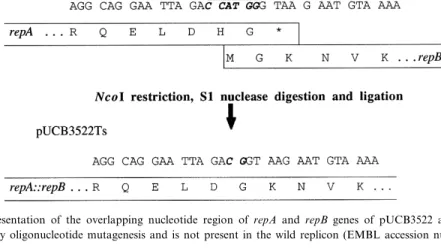
pUCB3522 (Fig. 1) harbours 2904 bp from the lactococcal plasmid pUCL22 which surrounds its replication region. It is composed by a non-coding region, the replication origin bearing DnaA box-like sequences and a stretch of direct repeats (iterons) which interacts with the replication protein RepA [11]. Following the replication origin is a coding re-gion composed by two overlapping ORFs. The ¢rst encodes RepA, and the second, which overlaps the previous one by eight nucleotides encodes RepB for which until now no function was known in Lacto-coccus. Implication of a RepB homologous protein in the copy control of the pediococcal pUCL287 plasmid was recently demonstrated [19]. A NcoI site was introduced by oligonucleotide mutagenesis in the lactococcal sequence by changing one nucleo-tide located in the penultimate repA codon and the second codon of repB [11].
pUCB3522 DNA was mutagenised in vitro by droxylamine and samples obtained after various hy-droxylamine length treatments were used to
trans-form E. coli. Mutagenesis e¤ciency was estimated by the decrease of plasmid viability. After 3 h and 4 h of treatment, an average of 2% and 0.2% of the plasmid DNA still retains ability to transform E. coli to ampicillin resistance, respectively. These hydroxyl-amine treatment conditions were chosen to prepare mutagenised plasmid DNA to search for Ts plasmids in E. faecalis by selecting for erythromycin resistance (Emr) at 30³C, and replica plating at 42³C. In this host, transformation e¤ciency of the mutated DNA preparations was from 0.6 to 0.1% compared to that of untreated DNA.
Fig. 1. pUCB3522 map. erm, erythromycin resistance rRNA methylase gene; bla, L-lactamase gene. Abbreviations for restriction enzymes are as follows: E, EcoRI; H, HindIII; N, NcoI; P, PstI; S, SphI; Sa, SacI.
Table 1
Segregational stability of pUCB3522, pUCB3529, pUCB3530 and pUCB3531 into MG1614 during discontinuous exponential growth at 30³C
Subculture number Plasmid-containing cells (%)
3 6
pUCB3522 100 86
pUCB3529 100 88
pUCB3530 18 6 1a
pUCB3531 57 22
aNo Emrcolony was detected from more than three hundred tested
Ten potential mutants were obtained after screen-ing of 11 000 clones. These mutants failed to form colonies at 42³C in presence of Em. Segregational stability analysis at 30³C and 42³C of these mutants led us to determine three clusters. The ¢rst group (three clones) corresponds to mutants which have a high segregational stability, independent on the growth temperature. Since Em was added to media only during the numeration step at 30³C, and not during stability test, this ¢rst group corresponds most probably to erm thermosensitive mutants. Members of the second group (two clones) exhibit a thermosensitive replication, but this character was highly unstable and revertants were frequently ob-served. The third group consists of ¢ve members with di¡erent thermosensitivities, ranging from 80% to 30% of Emr after 25 generations at 42³C. The most thermosensitive one, pUCB3522Hy4 was re-tained for further investigations. The entire lactococ-cal region was sequenced (data not shown). Surpris-ingly, the sole di¡erence observed between pUCB3522 and pUCB3522Hy4 in this region is a nucleotide substitution in the repA gene resulting in the presence of a Lysin, instead of a glutamic acid residue at the codon 216 (the EMBL accession num-ber of the wild-type is X60454). Comparison between the putative structure of the mutant protein and of the native protein does not permit us to explain the thermosensitivity of pUCB3522Hy4 (data not shown). Although we have retained the most ther-mosensitive mutant in our collection, its instability at
the non-permissive temperature is not su¤cient for construction of integration vectors.
3.2. Enhancing pUCB3522Hy4 segregational instability
Cloning of the 3967 bp NcoI DNA fragments of the V phage in the NcoI site of pUCB3522 led to the construction of pUCB3529 [11] and in the opposite direction of pUCB3531. Cloning of the 4572 bp NcoI DNA fragments of the V phage permit the construc-tion of pUCB3530. Segregaconstruc-tional stability analysis of these plasmids in MG1614 at 30³C is given in Table 1. Sequence analysis of these plasmids could explain their segregational stability. Into pUCB3529, the V DNA fragment is inserted in the opposite direction of the phage coordinate (from 27868 to 23901 [15]). RepA is lengthened by four residues, -ITVS. Into
Fig. 2. Schematic representation of the overlapping nucleotide region of repA and repB genes of pUCB3522 and of pUCB3522Ts. The NcoI site was created by oligonucleotide mutagenesis and is not present in the wild replicon (EMBL accession number X60454).
Table 2
Segregational analysis of pUCB3522Ts into JH2-2 during expo-nential growth phase
Generations Plasmid-containing cells (%)
25 50
30³Ca 3 0.04
37³Ca 0.1 4.6U1035
42³Ca 0.01 0b
aFrom 71% to 81% of the cells harbour the plasmid at the onset of
the experiment.
bFrom 0 to 7 cells ml31harbour the plasmid into a population of
pUCB3531, the V DNA fragment is in the opposite direction, and RepA is lengthened by 19 residues (-FLVIKLSILIGCMLDADIF). In pUCB3530, the V DNA fragment is inserted in the opposite direction of the phage coordinate (from 23901 to 19329 [15]), and RepA is lengthened by 25 residues (-KEDL-KIYRTCSNAALIHILTLNYFA). The additional
groups of amino acid residues in pUCB3530 and pUCB3531 RepA proteins are mainly hydrophobic. It seems that the segregational instability increases by increasing the length of the RepA protein.
Supported by these results, we tried to improve the instability of pUCB3522Hy4 by lengthening Rep-AK216. For this purpose, the most convenient way
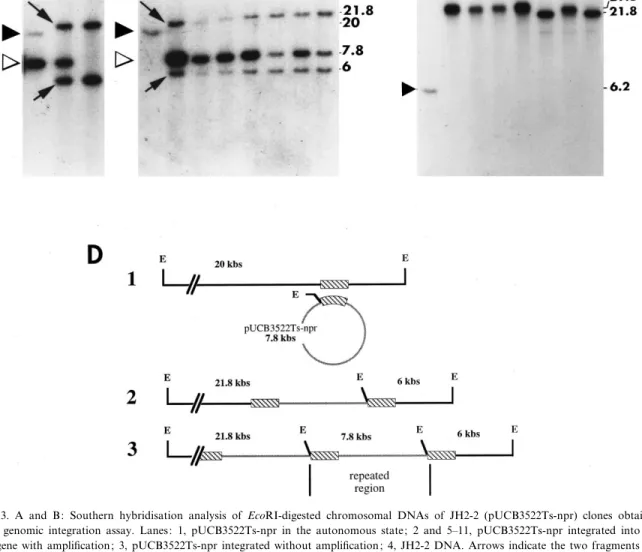
Fig. 3. A and B: Southern hybridisation analysis of EcoRI-digested chromosomal DNAs of JH2-2 (pUCB3522Ts-npr) clones obtained after genomic integration assay. Lanes: 1, pUCB3522Ts-npr in the autonomous state; 2 and 5^11, pUCB3522Ts-npr integrated into the npr gene with ampli¢cation; 3, pUCB3522Ts-npr integrated without ampli¢cation; 4, JH2-2 DNA. Arrows indicate the two fragments ob-tained after recombination via the npr gene. C: Southern hybridisation analysis of the chromosomal DNAs of panel B digested by ClaI. Closed and open triangles indicate the chromosome fragment bearing the npr gene and linearised pUCB3522Ts-npr DNA, respectively. Labeled npr 513 pb fragment was used as a probe. D: Schematic representation of the JH2-2 chromosome EcoRI fragment bearing the 513 bp npr fragment (hachured box) (1), and the expected structures after pUCB3522Ts-npr integration via homologous recombination (2), and ampli¢cation (3).
was to remove the NcoI site by treating the plasmid DNA after NcoI digestion by S1 nuclease, removing 4 bp and the NcoI site, followed by a ligation by the T4 DNA ligase. This treatment conducts to the fu-sion of the repA and repB genes (Fig. 2), and then to the lengthening of RepAK216by 118 residues. Such a clone was obtained and named pUCB3522Ts. Segre-gational stability assays into JH2-2 are shown in Table 2. Enumerations on GM17 and Em-GM17 of JH2-2 (pUCB3522Ts) cultures grown to OD660 of 0.6 on Em-GM17 broth at 30³C, 37³C and 42³C showed that elevation of growth temperature con-ducted to an increase of Em sensitive cells in the population of 71%, 51% and 45%, respectively (aver-age of three enumerations) corresponding to the loss of the plasmid despite the presence of erythromycin in the growth medium.
pUCB3522Ts propagated into E. faecalis JH2-2 shows thermosensitive replication. Thus, this Ts rep-licon seems to be a good candidate for construction of chromosome integration delivery systems. 3.3. Genomic integration assays
In order to test the ability to deliver genomic in-tegration, we have introduced into pUCB3522Ts a JH2-2 chromosomal fragment for monitoring ho-mologous recombination. We have chosen arbitrarily the npr gene as an integration target. An internal gene fragment of npr was obtained by PCR ampli¢-cation, using the synthetic nprDIR and nprREV oli-gonucleotides. The resulting 513 bp product was cloned into the SrfI site of the pCR-Script after pu-ri¢cation and polishing. One of the resulting plasmid was chosen for the next steps. In order to check the cloned DNA, about one hundred bases of each ex-tremity were sequenced, con¢rming the presence of the expected fragment of the JH2-2 npr gene (data not shown; EMBL accession number X62755 [18]). The npr gene fragment was then transferred as an EcoRI/SacI fragment into the EcoRI/SacI sites of pUCB3522Ts. The resulting plasmid was named pUCB3522Ts-npr.
This plasmid was introduced by electroporation into JH2-2 and propagated at 30³C. Genomic inte-gration was conducted as follows. JH2-2 (pUCB3522Ts-npr) was inoculated into Em-GM17 and the culture was grown overnight at 30³C. The
culture was then diluted and 0.1 ml of the 1033 di-lution was inoculated into 100 ml of GM17 and in-cubated at 42³C overnight. The culture was then diluted and plated on Em-GM17 plates and incu-bated at 42³C. After 18 h of growth, individual col-onies (early colcol-onies) appeared on plates correspond-ing to dilutions 1032 or 1033 as well as some micro-colonies (late micro-colonies) easily distinguishable from the previous ones. Nevertheless, if plates were further incubated at room temperature or more than 24 h at 42³C, micro-colonies grew and were no longer dis-tinguishable from the early colonies. Thirty ¢ve early colonies were inoculated in Em-GM17 and cultures were grown at 42³C. Further cultivations were con-ducted under the same conditions. pUCB3522Ts-npr contains one EcoRI site but no ClaI site. Total DNA was prepared, digested by EcoRI or ClaI and probed with the npr PRC 513 bp fragment. Results indicate that 15% of the early clones contained free copy of the plasmid (Fig. 3, lane 1), and that 85% contained integrated plasmid into the npr gene, sometimes with one copy of the plasmid (Fig. 3, lane 3), but most often together with an ampli¢cation (two copies of the plasmid, Fig. 3, lanes 9 and 11; three copies of the plasmid, Fig. 3, lane 10; four copies of the plas-mid, Fig. 3, lane 8; ¢ve copies of the plasplas-mid, Fig. 3, lane 5). When pUCB3522Ts-npr was in the inte-grated form, free plasmid was not detected (Fig. 3, panel C). Analysis of clones grown at 30³C from ten late colonies showed the presence of free pUCB3522Ts-npr plasmid (data not shown).
We demonstrate here the capacity of this new ther-mosensitive replicon to be used as a genetic tool in E. faecalis. Since it is a theta-type plasmid, and since this replicon supports maintenance of large DNA fragments [12], it is a promising tool for the intro-duction of large DNA fragments into the chromo-some of LAB as a delivery vector.
Acknowledgments
This study was partly ¢nanced by the Agence de l'Eau Seine-Normandie. We thanks Lisa Lefreére, Marie-Jeanne Pigny, Beèatrice Cheval and Annick Blandin for their technical assistance. Pr. A. Hartke is gratefully acknowledged for helpful discussions and for critically reading the manuscript.
References
[1] Biswas, I., Gruss, A., Ehrlich, D. and Maguin, E. (1993) High-e¤ciency gene inactivation and replacement system for gram-positive bacteria. J. Bacteriol. 175, 3628^3635. [2] Lillehaug, D., Nes, I.F. and Birkeland, N.K. (1997) A highly
e¤cient and stable system for site-speci¢c integration of genes and plasmids into the phage phiLC3 attachment site (attB) of the Lactococcus lactis chromosome. Gene 188, 129^136. [3] Leenhouts, K., Kok, J. and Venema, G. (1989) Campbell-like
integration of heterologous plasmid DNA into the chromo-some of Lactococcus lactis subsp. lactis. Appl. Environ. Mi-crobiol. 55, 394^400.
[4] Leenhouts, K.J., Buist, G., Bolhuis, A., ten Berge, A., Kiel, J., Mierau, I., Dabrowska, M., Venema, G. and Kok, J. (1996) A general system for generating unlabelled gene replacements in bacterial chromosomes. Mol. Gen. Genet. 253, 217^224. [5] Horinouchi, S. and Weisblumn, B. (1982) Nucleotide sequence
and functional map of pE194, a plasmid that speci¢es induc-ible resistance to macrolide, lincosamide, and streptogramin type B antibodies. J. Bacteriol. 150, 804^814.
[6] Leenhouts, K., Tolner, B., Bron, S., Kok, J., Venema, G. and Seegers, J. (1991) Nucleotide sequence and characterization of the broad-host-range Lactococcal plasmid pWV01. Plasmid 26, 55^66.
[7] Yougman, P., Poth, H., Green, B., York, K., Olmedo, G. and Smith, K. (1989) Methods for genetic manipulation, cloning, and functional analysis of sprorulation genes in Bacillus sub-tilis. In: Regulation of Prokaryotic Development (Smith, I., Slepecky, R.A. and Setlow, P., Eds.), pp. 65^87. American Society for Microbiology, Washington, DC.
[8] Feirtag, J., Petzel, J., Pasalodos, E., Baldwin, K. and McKay, L.L. (1991) Thermosensitive plasmid replication, temperature-sensitive host growth, and chromosomal plasmid integration conferred by Lactococcus lactis subsp. cremoris lactose plas-mids in Lactococcus lactis subsp. lactis. Appl. Environ. Micro-biol. 57, 539^548.
[9] Polzin, K.M. and McKay, L.L. (1992) Development of a lac-tococcal integration vector by using IS981 and a temperature-sensitive lactococcal replication region. Appl. Environ. Micro-biol. 58, 476^484.
[10] Jannieére, L., Bruand, C. and Ehrlich, S. (1990) Structurally stable Bacillus subtilis cloning vectors. Gene 87, 53^61. [11] Freére, J., Novel, M. and Novel, G. (1993) Molecular analysis
of the Lactococcus lactis subspecies lactis CNRZ270
bidirec-tional theta replicating lactose plasmid pUCL22. Mol. Micro-biol. 10, 1113^1124.
[12] Freére, J., Benachour, A., Novel, M. and Novel, G. (1993) Identi¢cation of the theta-type minimal replicon of the Lacto-coccus lactis subsp. lactis CNRZ270 lactose protease plasmid pUCL22. Curr. Microbiol. 27, 97^102.
[13] Gasson, M. (1983) Plasmid complements of Streptococcus lac-tis NCDO 712 and other lactic streptococci after protoplast-induced curing. J. Bacteriol. 154, 1^9.
[14] Trieu-Cuot, P., Poyart-Salmeron, C., Carlier, C. and Courva-lin, P. (1990) Nucleotide sequence of the erythromycin resist-ance gene of the conjugative transposon Tn1545. Nucleic Acids Res. 18, 3660.
[15] Sanger, F., Coulson, A.R., Hong, G.F., Hill, D.F. and Peter-sen, G.B. (1982) Nucleotide sequence of bacteriophage lambda DNA. J. Mol. Biol. 162, 729^773.
[16] Terzaghi, B.E. and Sandine, W.E. (1975) Improved medium for lactic streptococci and their bacteriophage. Appl. Micro-biol. 29, 807^813.
[17] Sambrook, J., Fritsch, E.F. and Maniatis, T. (1989) Molecular Cloning: A Laboratory Manual, 2nd Edn. Cold Spring Har-bor LaHar-boratory Press, Cold Spring HarHar-bor, NY.
[18] Ross, R.P. and Claiborne, A. (1991) Cloning, sequence and overexpression of NADH peroxidase from Streptococcus fae-calis 10C1. Structural relationship with the £avoprotein disul-¢de reductases. J. Mol. Biol. 221, 857^871.
[19] Benachour, A., Freére, J., Flahaut, S., Novel, G. and Au¡ray, Y. (1997) Molecular analysis of the replication region of the theta-replicating plasmid pUCL287 from Tetragenococcus (Pediococcus) halophilus ATCC33315. Mol. Gen. Genet. 255, 504^513.
[20] Sanger, F., Nicklen, S. and Coulson, A.R. (1977) DNA se-quencing with chain-terminating inhibitors. Proc. Natl. Acad. Sci. USA 74, 5463^5467.
[21] Thomas, C.M. (1987) Plasmid replication. In: Plasmids: A Practical Approach (Hardy, K.G., Ed.), pp. 7^36. IRL Press, Oxford.
[22] Nishimura, A., Morita, M., Nishimura, Y. and Sugino, Y. (1990) A rapid and highly e¤cient method for preparation of competent Escherichia coli cells. Nucleic Acids Res. 18, 6169.
[23] Freére, J., Herreman, C., Boutibonnes, P., Novel, M. and Nov-el, G. (1995) Segregational stability and copy number of the theta-type lactococcal replicon Rep22 in Lactococcus. Current Microbiol. 29, 1^5.