Value of a specific bradycardic agent in cardiac
surgery compared to placebo
K. SKARVAN
Department of Anesthesia, University of Basel/Kantonsspital, CH-4031 Basel, Switzerland
KEY WORDS: Alinidine, open heart surgery, systemic, pulmonary haemodynamics, heart rate, electro-cardiogram, plasma levels.
The effects of alinidine on systemic and pulmonary haemodynamics and the ECG were studied in 8 patients early after open heart surgery as a double-blind cross-over comparison between alinidine and placebo. Placebo had no effect on any of the measured variables. Alinidine given as an i. v. bolus (10 mg) followed by an infusion (10 mgh~') was associated with alinidine plasma levels of 172 ± 17 and 114 ± 13, respectively, (±SE, ngml~') and decreased heart rate (-12%) and rate-pressure product (-14%) in all patients. While stroke volume index tended to increase, there were no changes in arterial, pulmonary and atrial pressures, cardiac index, and systemic and pulmonary vascular resistances. PR and QRS intervals of the ECG remained unaffected, and the QTC interval transiently decreased. Alinidine appears to be a suitable drug for control of inappropriate sinus tachycardia in patients with heart disease undergoing surgery.
Introduction
Heart rate (HR) is one of the major determinants of myocardial oxygen balance'''. The control of HR is an important part of the perioperative haemodyna-mic management of patients with heart disease, undergoing cardiac or non-cardiac surgery. Patients with aortic or mitral stenosis and patients with coro-nary artery disease are particularly vulnerable to the adverse effects of sinus tachycardia occurring intra-operatively of during the postoperative period'2'. Beta-receptor blocking agents and parasympa-thomimetic drugs effectively reduce the sinus node rate, but their use in surgical patients may be limited by untoward side-effects. Alinidine appears to be a suitable drug for control on inappropriate sinus tac-hycardia induced by surgery in patients with heart disease.
However, there are no data on the efficacy and safety of alinidine in this clinical setting. Therefore, we investigated the effects of intravenous (i. v.) alini-dine on systemic and pulmonary haemodynamics and the electrocardiogram (ECG) in patients recovering from open heart surgery.
Address for correspondence: Karl Skarvan, MD, Department of
Anesthesia, University of Basel/Kantonsspiial CH-4031 Basel. Switzerland.
0195-668X/87/08L123 + 07 $02.00/0
Methods STUDY PATIENTS
Patients undergoing elective cardiac surgery (aor-tocoronary bypass operation or valve replacement) who gave written informed consent for the study, which was approved by the institutional human stu-dies committee, were eligible for the study.
The study was carried out in the early postopera-tive hours. The patients entered the study when the following criteria were fulfilled: (1) sinus rhythm with a rate exceeding 90 beats min~', (2) functioning atrial and ventricular pacing electrodes in situ, and (3) stable postoperative course. The latter was defined by stable haemodynamics, absence of arrhythmias, urine output >0-5 ml kg"1, PaO2 > 120 mmHg, PaCO2 < 45 mmHg, blood haemoglobin > 10 g 100 ml"1 rectal temperature >36-5°C and blood loss from chest drains <1 ml kg"1 h"1. Patients who received beta-blocking agents and/or calcium entry blockers perioperatively, patients with reduced renal function, and patients with atrioventricular conduc-tion abnormalities were excluded.
Seven patients (6 male) after an uneventful aorto-coronary bypass operation and one patient after aortic valve replacement fulfilled the entry criteria and were included in the study. Their age was 49 ± 3 SE, body weight 80 ± 14 kg, and height 171 ± lcm. © 1987 The European Society of Cardiology
124 K. Skarvan
The study was started on the average 6 h 50 min (range 5 h 10 min-11 h 30 min) after the end of operation. One patient was extubated prior to the study, the remaining 7 patients were intubated and ventilated throughout. They were sedated by diaze-pam (2-5 mg h~') and morphine (2-5 mg h"1). Their rectal temperature was 37-9 ± 0-9°C at the beginning and 38-2 ± 0-8°C at the end of the study.
During the study 3 patients were receiving a con-stant rate infusion of nitroglycerin (33, 80, and 80 ng min"1, respectively) 1 patient was receiving nitro-glycerin (120 u.g min"1), adrenaline (1-2 ug min"1) and lidocaine (2 mg min"1). All eight patients com-pleted the study and there were no drop outs.
HAEMODYNAMIC MEASUREMENTS
Arterial pressure (AP) was measured by means of a 20 gTeflon® cannula inserted into the radial artery. Right atrial and pulmonary artery pressures (RAP, PAP) were measured by a balloon directed triple lumen Swan-Ganz catheter inserted through the right jugular internal vein into the pulmonary artery. Left atrial pressure (LAP) was measured by a cath-eter inserted into the left atrium through the right upper pulmonary vein following pericardiotomy. All catheters were connected to pressure transducers (COBE 41-500, COBE Laboratories, Lakewood, CO) with 150 cm stiff polyethylene tubing. The zero level was adjusted at mid-chest level. The transduc-ers were calibrated with a mercury manometer. A multiple channel recorder (Hellige. Freiburg i. Br., F.R.G.) was used for recording the pressures along with (ECG). Mean pressures (APm, PAPm, RAP, LAP) were obtained by electronic integration.
Edwards Lab Cardiac Output Computer (Santa Ana, CA. model 93-132-5F) was used for cardiac output (CO) measurements. At end-expiration. 10 ml of iced 5% dextrose solution were injected into the proximal port of the triple lumen thermodilution catheter. During the first 10 min after each bolus injection of the study drug CO was determined in duplicate, whereas triplicate measurements were performed thereafter.
Cardiac index (CI), stroke volume index (SVI), systemic and pulmonary vascular resistances (SVR. PVR), left ventricular stroke work index (LVSWI) and right ventricular stroke work index (RVSWI) were calculated according to standard formulae'3'.
Heart rate (HR) was derived from the ECG. Rate-pressure product was calculated as the product of heart rate and peak arterial systolic pressure.
ELECTROCARDIOGRAM
Leads II and V5 of the ECG were recorded simul-taneously with the pressures (chart speed 50 mm s"1) and analyzed for RR, PR, QRS and QT intervals. Each value represents the mean of 5 heart cycles recorded at end-expiration. The rate corrected QTC interval was calculated accordingly to the Bazett formula : QTC = QT/VRR. In addition both ECG leads were analyzed for significant (5=1 mm) shifts of the ST segment and changes in the configuration of the T waves. A standard 12-lead ECG was recorded before and after the study.
ALINIDINE PLASMA LEVELS
Blood samples for alinidine concentration were taken from the indwelling radial artery cannula at the end of both control periods, 2 min after the end of each bolus injection and at the end of each infusion period. The blood samples were immediately hepari-nized using 0025 ml Heparin NOVO®.
Plasma samples were prepared by centrifugation (10 min at 3000 x g) and kept frozen (-20°C) until analyzed. The concentration of alinidine in the plasma samples were determined by a radioimmu-noassay method'4'.
EXPERIMENTAL PROTOCOL
The study design was a randomized double-blind cross over comparison between alinidine and placebo (Fig. 1).
The first control period of 1 hour served to assess the stability of the haemodynamics and the persis-tence of the entry criteria. Then 10 ml of saline containing either 10 mg of alinidine or placebo were injected into a separate central venous catheter over 30 s and an alinidine (10 mg h"1) or placebo infusion was started. The infusion was terminated 60 minutes after the end of the bolus and 60 minutes were allowed for wash out. Then the second bolus dose was injected and the second infusion of alinidine/ placebo was started.
Plocebo Placebo
Alinidme Wosh-out Anriid;ne
Figure I Diagram of the cross-over design of the present
Haemodynamic and ECG measurements were used to deliver the study drug at a constant infusion performed at the end of each control period and 2, 4, rate of 1-7 ml min"1.
6, 8, 10. 20, 30 and 60 min after each bolus dose.
The test drugs were provided in ampuls containing Results
10 mg in 2 ml of solvent. Immediately before each HAEMODYNAMIC (TABLES I AND 2)
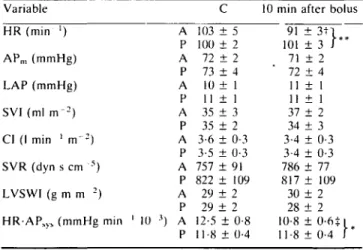
experiment the bolus injection and the infusion were The control haemodynamics were characterized by prepared by adding 0-9% NaCl solution to the con- low SVR and increased HR and CI. There were no tent of the original ampul to yield a final concentra- differences in control values between the alinidine tion of 1 mg ml"1 and 0 1 mg ml"1 for the bolus and placebo phase.
injection and the infusion, respectively. An infusion Placebo had no effects on any of the measured pump (Diginfusa, Schoch, Zurich, Switzerland) was haemodynamic variables. Alinidine in contrast
Table 1 The effects of alinidinel placebo on systemic haemodynamics Variable HR (min ') APm (mmHg) LAP (mmHg) SVI (ml r r r2) CI (1 min ' m ' - ) SVR (dyn s cm s) LVSWI (g m m 2) H R A PS ), (mmHg min ' 10 A P A P A P A P A P A P A P 3) A P C 103 ± 5 100 ± 2 72 ± 2 73 ± 4 10 ± 1 11 ± 1 35 + 3 35 ± 2 3-6 ± 0-3 3-5 + 0-3 757 ± 91 822 ± 109 29 ± 2 29 + 2 12-5 ± 0-8 11-8 ± 0-4
10 min after bolus 91 ± 3 t 1 101 ±3 I " 71 ± 2 72 + 4 11 ± 1 11 ± 1 37 ± 2 34 ± 3 3-4 ± 0-3 3-4 ± 0-3 786 ± 77 817 ± 109 30 ± 2 28 + 2 10-8 ± O-6+i 11-8 ± 0-4 I * The values are means ± SE. C = c o n t r o l . A = alinidine. P = placebo. HR = heart rate. AP sys = systolic arterial pressure. APm = mean arterial pressure. LAP = mean left atrial pressure. SVI = stroke volume index, CI = cardiac index, SVR = systemic vascular resistance, LVSWI = left ventricular stroke work index. H R - A P , , ! = r a t e - p r e s s u r e p r o d u c t , 1 mmHg = 0 1 3 3 k P a . * = P < 0 0 5 compared to placebo, " = P < 0 0 1 compared to placebo, t = P<00] compared to control, % = P < 0 0 5 compared to control.
Table 2 The effects of alinidinel placebo on pulmonary haemodyna-mics and right ventricular pump function
Variable RAP (mmHg) PAPm (mmHg) PVR (dyn s c m5) RVSWI (g m m~2) A P A P A P A P C 10 ± 1 10 ± 1 19 ± 2 19 ± 1 107 ± 9 102 ± 15 5 ± 1 5 ± 1
10 min after bolus 10 ± 1 10 ± 1 19 ± 2 19 ± 1 102 ± 11 106 ± 6 4 ± 1 4 ± 1 RAP = mean right atrial pressure, PAP = mean pulmonary artery pressure, PVR = pulmonary vascular resistance, RVSWI = right ventricular stroke work index. The values are means ± SE, C = con-trol, A = alinidine, P = placebo.
126 K. Skarvan
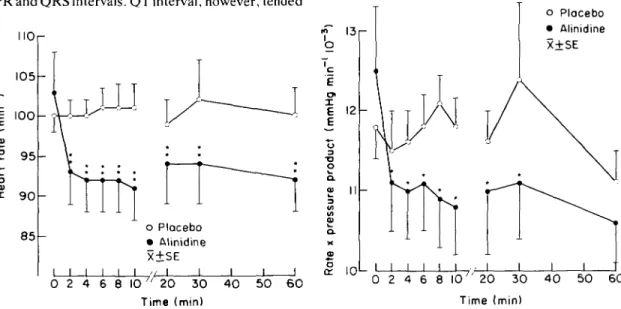
caused a consistent decrease in HR in all patients (Fig. 2). The effect was already present 2 min after the bolus and was maintained during alinidine infusion ( - 9 % to -12%). There was a significant correlation between the decrease in HR (AHR) and the control value of HR (r = -0-72, P < 005) (Fig. 3). The decrease in HR was associated with a slight increase in SVI. At 2 min and 20 min after the bolus the changes in SVI were significant, at the other measurements, however, only an upward trend (P < 0-07-0-1) was present. The other haemodyna-mic variables remained uneffected.
The rate-pressure product decreased by 11% and 14% 2 and 60 minutes after the bolus, respectively (Fig. 4).
ELECTROCARDIOGRAPHIC INTERVALS (TABLE 3)
Neither placebo nor alinidine had any effects on PR and QRS intervals. QTinterval, however, tended
MOr 105 I • | 1 0 0 9 5 9 0 8 5 - 5 r o Placebo • Alinidine X±SE J 1 1 1 1 II I 0 2 4 6 8 _L _L _L J 10 " 20 30 40 50 60 Time (min)
Figure 2 Effects of placebo and alinidine on heart rate. it = P < 0-01 compared to control and placebo.
S -10
-15
r---0-72
70 80 90 100 MO
Control heorl rote (min"')
120 130
Figure 3 Relation between control heart rate and change in heart rate (A) after 1 h infusion of (10 mgh"1) alinidine. There is a slight correlation between both variables (r = -0-72). I3 c 'e 3 95 O « II V oP I OL o Placebo • Alinidine X + SE Time (min)
Figure 4 Effects of placebo and alinidine on rate-pressure product (•& = P < 005 compared to placebo).
Table 3 The effects of alinidinelplacebo on ECC intervals Variable PR (ms) QRS (ms) QT (ms) QTC (ms) A P A P A P A P C 164 ± 7 163 ± 7 83 ± 7 81 ± 7 324 ± 6 325 ± 5 424 ± 12 420 ± 9
10 min after bolus 164 ± 7 164 ± 7 82 ± 6 84 ± 6 333 ± 3 330 ± 3 411 + lOt 428 ± 8 Values are means ± SE. A = alinidine, P = placebo, C = control.
Table 4 Plasma levels of alinidine
Time after bolus
2 min 60 min 120 min 180 min (wash-out)
(N = 7) (A' = 8) (N = 4) (;V = 4)
Plasma level (ng m l~' ) 172 ± 17 114 ± 14 40 ± 8 32 ± 9 Values are means ± SE.
to increase during the first 6 min after the alinidine bolus (P < 0-055). The rate corrected QTC interval decreased 2, 4 and 10 min after alinidine. No changes in the ST segments were detected and the T-wave morphology also did not change.
ALINIDINE PLASMA LEVELS (TABLE 4)
Alinidine plasma level 2 min after the bolus was 171 ± 17 ngmP1 and decreased to 114 ± 13ngml~' at the end of the alinidine infusion. At 1 h and 2 h after the cessation of the infusion, alinidine was still present in plasma.
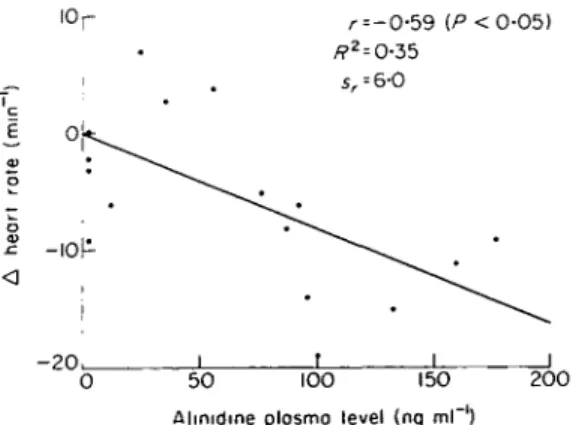
Alinidine plasma levels correlated significantly with the maximal decrease in HR (AHR) both dur-ing the first 10 min after injection (r = —0-76, P < 001) and at the end of the alinidine infusion (r = -0-59, P < 005) (Fig. 5). The decrease in plasma level during the following wash-out corre-sponds to a plasma elimination half-time of 5 h.
There were no side-effects related to alinidine administration. All patients had an uneventful post-operative recovery.
r = -0-59 {P <O-O5)
- 2 0 u. J
50 100 150 200 Alinidine plosmo level (nq ml"')
Figure 5 Relation between change in heart rate (A) and alinidine plasma levels after infusion of alinidine. There is a slight correlation between both variables (r = -0-59).
Discussion
In this study alinidine administered to patients recovering from open heart surgery consistently decreased HR without causing any adverse haemo-dynamic effects. Placebo, in contrast, had no effects on the haemodynamics. This documents the haemo-dynamic stability of our patients during the experi-ment. According to the randomization order, half of the patients were given placebo following an incom-plete wash-out of alinidine. The presence of subclini-cal alinidine levels in these patients had no apparent effect on their response to placebo.
In the early postoperative period the haemodyna-mic pattern changes with time and, consequently, the effects of alinidine might have been modified by the actual haemodynamic function at the time of its administration.
Prior to administration of alinidine our patients exhibited an uniform haemodynamic pattern of peri-pheral vasodilation, characterized by low SVR, normal atrial pressures, and increased Cl associated with a mild sinus tachycardia. Heart failure can, therefore, be excluded as a cause of the tachycardia. Moreover, there were no signs of hypovolaemia, anaemia, cardiac tamponade, or perioperative myo-cardial infarction, all conditions which may also be responsible for tachycardia. However, all patients had an increased body temperature.
Thus, the increased HR in our patients can be best explained by the combined effects of fever, and high postoperative sympathetic tone with increased levels of circulating catecholamines'5'.
The fact that the decrease in HR after alinidine was not accompanied by any deterioration in the cardiac pump function confirms that the tachycardia was not essential for the maintenance of an adequate flow.
On the other hand, the question arises whether in these patients the reduction in HR due to alinidine was beneficial.
When in a similar group of patients early after aortocoronary bypass operations the HR was
128 K. Skarvan
increased from 87 to 112 beats min ' by atrial pacing, signs of anaerobic metabolism and decrease in myo-cardial compliance suggestive of myomyo-cardial ischemia occurred'6'. In patients after cardiac valve replace-ment atrial pacing at 128 beats min"1 similarly de-teriorated the myocardial oxygen balance'7'. Conse-quently, tachycardia appears to have an unfavorable effect in the early postoperative period and may interfere with the recovery of the ventricular func-tion. This may be particularly important in patients with incomplete revascularization, perioperative myocardial infarction and left ventricular hyper-trophy.
Experimental studies demonstrated beneficial effects of slowing the HR in the presence of reduced coronary reserve'8'. In animal models with severe coronary artery stenosis alinidine, in a dose which decreased HR by 25%, caused a marked redistri-bution of coronary flow in favor of the subendocard-ium and improved regional myocardial function in the poststenotic area'910'. Our patients, however, were successfully revascularized and no one had a manifest myocardial ischemia. The question of any benefit from alinidine therapy cannot be answered without special measurements of regional myocardial function and metabolism.
Our findings confirm the previous reports on the negative chronotropic effects of i.v. alinidine, which was found to decrease H R both at rest and exercise'''' and to reduce tachycardia due to surgery'12', acute myocardial infarction'13', and dobutamine and nitro-prusside infusion'1415'. The dose used in our study (approximately 0-125 mg kg"1) was considerably smaller than the doses of 0-3-0-6 mg kg"1 used by other authors. The negative chronotropic effect of alinidine elicited by the bolus injection could be maintained by the subsequent infusion in a dose as low as 2 /xg kg"1 min"1. The use of a lower dose can explain both the lack of adverse haemodynamic effects and the rather moderate bradycardic effect found in this study.
Although alinidine decreased HR, it had no effect on atrioventicular and intraventricular conduction. This has been previously reported even after con-siderably higher doses'16' and is of major importance in patients early after cardie surgery, who may have conduction abnormalities. The slight and transient decrease in QTC interval appears to result primarily from the slowing of the HR and may reflect a decrease in dispersion of repolarization in ventricular myocardium'17'. Such an effect would increase the electrical stability of the heart.
In conclusion the present study clearly reveals that i.v. alinidine is effective in reducing postoperative tachycardia without exhibiting any adverse effects on global pump function of the heart. Because of its specific negative chronotropic action alinidine may be preferable to other bradycardic agents for control of inappropriate sinus tachycardia in patients with heart disease undergoing surgery. Further studies, however, will be necessary to determine the optimum dose, mode of administration, and the interactions with other drugs and anethesthics used in the peri-operative setting.
1 express my appreciation to Boeringer Ingelheim GmbH for their valuable support of this study. I thank Bioscientia Institute, Ingelheim for alinidine assays, U. Kreuter of Consult AG, Bern for the statistical analysis and Joan Etlinger for excellent secretarial assistance in the prepar-ation of this manuscript.
References
[1] Marcus ML. The coronary circulation in health and disease. New York: McGraw-Hill, 1983.
[2) Chambers DA. Acquired valvular heart disease. In: Kaplan JA, ed. Cardiac anesthesia. New York: Grune & Stratton, 1979: 197-240.
[3] Kaplan JA. Hemodynamic monitoring. In Kaplan JA, ed. Cardiac anesthesia. New York: Grune & Stratton,
1979: 71-115.
[4] Arndts D, Stahle H. Development and quality control of highly sensitive radioimmunoassay for alinidine. J Pharmacol Methods 1981; 6: 109-20.
[5] Kim YD, Jones M. Hanowell ST el al. Changes in peripheral vascular and cardiac sympathetic activity before and after coronary artery bypass surgery: Inter-relationships with haemodynamic alterations. Am Heart J 1981; 102: 972-9.
[6] Weisel RD, Burns RJ. Baird RJ eial. A comparison of volume loading and atrial pacing following aortocoro-nary bypass. Ann Thorac Surg 1983; 36: 332-44. [7] Wisheart JD. Archie JP. Kirklin JW. Tracy WG.
Myo-cardial blood flow and oxygen consumption in man early after valve replacement. Circulation 1974; 49: 933-42.
[8] Gross GJ. Lamping KG, Warltier DC, Hardman HF. Effects of three bradycardiac drugs on regional myo-cardial blood flow and function in areas distal to a total or partial coronary occlusion in dogs. Circulation 1984; 69: 391-9.
[9] Schamhardt HC. Verdouw PD, Saxena PR. Improve-ment of perfusion and function of ischemic porcine myocardium after reduction of heart rate by alinidine. J. Cardiovasc Pharmaco 1981; 3: 728-38.
[10] Krumpl G. Mayer N. Schneider W, Raberger G. Effects of alinidine on exercise-induced regional contractile dysfunction in dogs. Eur J Pharmacol 1986; 130: 37-46.
[11] Lollgen H, Just H, WollschlagerH, KerstingF. Hemo-dynamic actions of alinidine during exercise in patients with coronary artery disease. Z Kardiol 1981; 70: 425-8.
[12] Fitzal S, Zimper M. Cardiovasular effects of N-allyl clonidine (ST 567, alinidine): a substance with specific bradycardiac action during neuroleptanesthesia in humans. Int J Clin Pharmacol Ther Toxicol 1982; 20: 404-7.
[13] Simoons ML, Hugenholtz PG, Haemodynamic effects of alinidine, a specific sinus node inhibitor, in patients with unstable angina or myocardial infarction. Eur Heart J 1984; 5: 227-32.
[14] Zimpfer M, Khosropour R. Lackner F. Effects of
dobutamine on cardiac function in man. Crit Care Med 1982; 10: 367-70.
[15] Zimpfer M, Fitzal S, Semsroth M. Relative roles of heart rate and ventricular stroke volume for the regula-tion of cardiac output during controlled hypotension with sodium nitroprusside in man. Eur J Clin Invest
1982; 12: 9-13.
[16] Kasper W, Meinertz T, Treese N, Kersting F, Pop T, Janchen E. Clinical electrophysiological properties of N-Allyl-clonidine (ST567) in man. J Cardiovasc Phar-macol 1981; 3: 39-47.
[17] Surawicz B, Knoebel SB. Long QT. Good, bad or indifferent? JACC 1984; 4: 398-413.