A novel multiplex PCR/RFLP assay for the identification of
Streptococcus bovis/Streptococcus equinus complex members
from dairy microbial communities based on the 16S rRNA gene
Christoph Jans, Christophe Lacroix & Leo MeileLaboratory of Food Biotechnology, Institute of Food, Nutrition and Health, ETH Zurich, Zurich, Switzerland
Correspondence: Leo Meile, Laboratory of Food Biotechnology, Institute of Food, Nutrition and Health, ETH Zurich, Schmelzbergstrasse 7, CH-8092 Zurich, Switzerland. Tel.: +41 44 632 33 62; fax: +41 44 632 14 03; e-mail: [email protected]
Received 3 August 2011; revised 12 October 2011; accepted 13 October 2011.
Final version published online 18 November 2011.
DOI: 10.1111/j.1574-6968.2011.02443.x
Editor: Robert Burne
Keywords
SBSEC; dairy streptococci; Streptococcus infantarius; Streptococcus gallolyticus; dairy fermentation; PCR/RFLP identification assay.
Abstract
The Streptococcus bovis/Streptococcus equinus complex (SBSEC) comprises path-ogenic species associated with different degrees with human infections but also spontaneously fermented dairy products. We aimed therefore at developing a specific identification assay for the SBSEC targeting the 16S rRNA gene com-prising a multiplex PCR followed by a differentiating restriction fragment length polymorphisms (RFLP). The multiplex PCR assay was positively applied on 200 SBSEC isolates including reference strains. The assay did not yield false-positive amplifications with strains of closely related bacteria and isolates of non-SBSEC streptococci, lactococci, enterococci, and other genera of dairy origin. The downstream RFLP using MseI and XbaI enabled further discrimi-nation of Streptococcus infantarius/S. bovis (biotype II.1) from Streptococcus gallolyticus (biotype I and II.2)/Streptococcus alactolyticus and S. equinus. Furthermore, the newly developed primers can be used directly for Sanger sequencing. Conclusively, this novel PCR/RFLP assay is applicable in the complex dairy microbial communities and provides an important tool to assess the prevalence of members of the SBSEC in dairy products.
Introduction
The Streptococcus bovis/Streptococcus equinus complex (SBSEC) comprises a large variety of species and subspecies of which especially Streptococcus infantarius subsp. infantarius and potentially other members of the SBSEC were reported as the predominant lactic acid bacteria (LAB) in spontaneously fermented African milk products (Abdelgadir et al., 2008; Wullschleger, 2009; Jans, 2011). Members of the SBSEC were also detected in Mexican, Greek, and Italian cheese, fermented Mexican maize drink, or fermented Bangladeshi milk (Tsakalidou et al., 1998; Dı´az-Ruiz et al., 2003; Pacini et al., 2006; Rashid et al., 2009; Renye et al., 2011). First discrimination of SBSEC has been based on phenotypic classification schemes that were greatly revised with the ability of 16S rRNA gene phy-logenetic analysis (Poyart et al., 2002; Schlegel et al., 2003). The genes sodA (Poyart et al., 1998, 2002) and groESL (Chen et al., 2008) were targeted for PCR assay in combi-nation with sequencing and restriction fragment length
polymorphism (RFLP) for the identification of members of the SBSEC. A further assay was developed specifically for Streptococcus gallolyticus subsp. macedonicus based on the 16S rRNA gene (Papadelli et al., 2003). Alternative approaches proposed the utilization of MALDI-TOF for species identification based on the sodA gene (Hinse et al., 2011). Most of these assays were developed using blood-derived clinical cultures of the SBSEC or restricted to a single species. In contrast to blood samples, raw dairy products were shown to contain a large diversity of different lactococci, enterococci, Streptococcus thermophi-lus, or Streptococcus agalactiae (Delbe`s et al., 2007; Younan & Bornstein, 2007; Franciosi et al., 2009; Giannino et al., 2009; Jans, 2011), which increases the requirements regarding specificity of the primers. Even though the genes groESL or sodA provide improved capability to dif-ferentiate between species and subspecies, the 16S rRNA gene is still regarded as the recommended target for the initial identification of novel bacteria for which the higher degree of conservation of the 16S rRNA gene can be of
MICR
advantage (Glazunova et al., 2009). This gene is one of the most important genotypic markers for bacterial taxonomy (Yarza et al., 2008), and a large number of 16S rRNA gene sequences are available for downstream comparison and further analysis (Benson et al., 2009). It therefore repre-sents an ideal target for the analysis of complex and less-studied ecological niches such as the human microbiota (Grice et al., 2008; Liu et al., 2008) or spontaneous food fermentations, e.g., the African dairy environment. The high-density and complex microbial communities in these niches could result in unexpected genetic modifications through horizontal gene transfer (HGT), which was observed for African S. infantarius subsp. infantarius as well as for S. thermophilus and other LAB (Hols et al., 2005; Makarova et al., 2006; Jans, 2011). HGT is affecting nearly all genes within prokaryotic genomes; some genes including the 16S rRNA gene are, however, hypothesized to be less affected by HGT (Jain et al., 1999).
Therefore, the objective was to utilize the high conser-vation of the 16S rRNA gene to develop an identification assay applicable to all species within the SBSEC allowing clear differentiation from other streptococci, enterococci, and lactococci regularly found in the dairy environment. The availability of large sets of nucleotide sequences from all members of the SBSEC including dairy isolates (Jans, 2011) enabled the design of a subsequent RFLP for the discrimination of SBSEC species groups. Furthermore, the primers were designed to work with Sanger sequencing for downstream sequence analysis. The assay was then evaluated against reference strains and isolated species of dairy microbial communities.
Materials and methods
Bacterial reference strains listed in Table 1 were obtained from the Culture Collection University of Gothenburg (CCUG, Gothenburg, Sweden), the German Collection of Microorganisms and Cell Cultures (DSMZ, Braunschweig, Germany), and the National Collection of Type Cultures (NCTC, Porton Down, UK). Stock cultures of all strains were stored at 80°C in 30% (v/v) glycerol. Generally, streptococci were grown anaerobically at 37°C for 16– 24 h on BHI agar (Biolife, Milan, Italy) and on M17 agar (Biolife) for SBSEC, Streptococcus salivarius, S. thermophi-lus, and Streptococcus vestibularis. Lactococcus and Leuco-nostoc strains were propagated aerobically at 30 °C for 16–24 h on M17 (Biolife) and MRS (Biolife), respectively. Lactobacilli and pediococci were incubated anaerobically at 37°C on MRS agar (Biolife) for 1–2 days. Anaerobic agar media incubation was performed with AnaeroGen packs (Oxoid, Pratteln, Switzerland) in jars. All chemicals and enzymes used in this study were obtained from Sigma-Aldrich (Buchs, Switzerland) unless otherwise noted.
Additional tests to confirm the specificity of the PCR primers were performed with isolates obtained from camel milk products, which were previously identified using species-specific PCR-based methods, 16S rRNA gene sequencing and a modified rep-PCR assay (Gevers et al., 2001; Wullschleger, 2009; Jans, 2011). They included the following number of isolates and species: six Enterococcus faecalis, 24 Enterococcus faecium, 35 Lactococ-cus lactis subsp. lactis, five S. agalactiae, 192 S. infantarius subsp. infantarius, five Streptococcus gallolyticus, and 42 S. thermophilus (Jans, 2011).
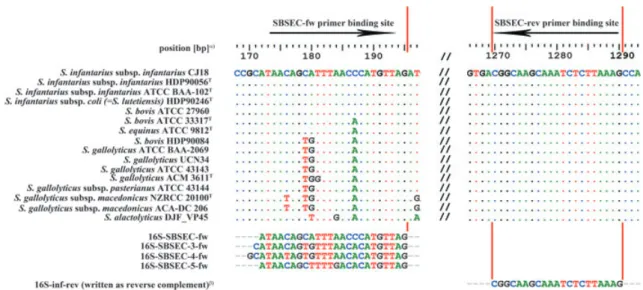
Primer design and restriction site analysis Sequences of the 16S rRNA gene of multiple strains per species of the SBSEC were obtained from GenBank (Table 1). The DNA sequences were aligned in BioEdit (Hall, 1999) using ClustalW and analyzed for conserved regions specific for SBSEC (Fig. 1). The primers were designed to amplify fragments of 1119 and 1120 bp of the 16S rRNA gene of S. bovis/Streptococcus infantarius (biotypes II.1) and S. gallolyticus (biotypes I and II.2), respectively. Four separate forward primers and one reverse primer were designed to target all members within the SBSEC (Fig. 1). The forward primers were designed in a region of the 16S rRNA gene adjacent to the primer position previously used to discriminate S. gallolyticus subsp. macedonicus (Papadelli et al., 2003).
The amplified section of the 16S rRNA gene was in silico analyzed for species-specific mutations leading to different restriction enzyme profiles in CLC Sequence Viewer ver-sion 6.0.2 (CLC bio, Aarhus, Denmark). MseI and XbaI restriction sites discriminating the S. gallolyticus (biotypes I and II.2) cluster from the S. bovis/S. infantarius (biotypes II.1) cluster were identified in silico (Fig. 2). The expected fragments were 278 and 842 bp for XbaI-digested PCR products of S. gallolyticus. The expected MseI profile for S. gallolyticus contains three fragments between 17–28 bp and single fragments of 88, 136, 196, 227, and 411 bp. The expected MseI profile for S. bovis/S. infantarius contains single fragments of 16, 17, 46, 88, 136, 152, 253, and 411 bp. Streptococcus equinus was expected to display the MseI profile of S. bovis/S. infantarius and the XbaI profile of S. gallolyticus.
DNA isolation and PCR/RFLP conditions
DNA was isolated from bacterial single colonies with a short cell lysis in 0.1 M Tris-HCl-EDTA and Triton-X100 buffer at pH 8.0 (Goldenberger et al., 1995). All PCR reactions were performed with 1lL (approximately 5–20 ng) of extracted DNA, 1 lM of each primer, 12.5 lL 29 PCR Master Mix (Fermentas, Le Mont-sur-Lausanne,
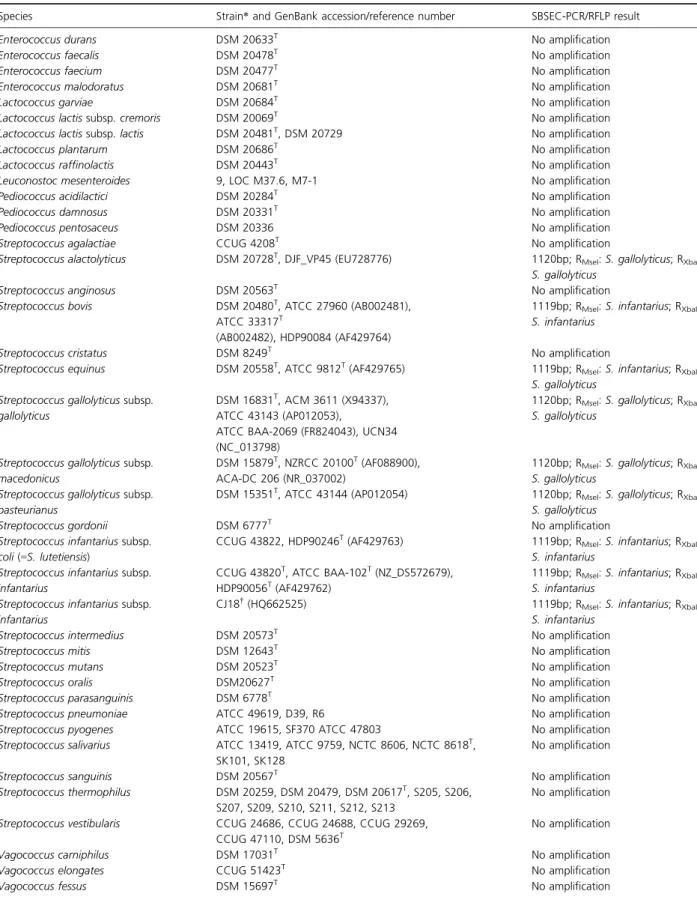
Table 1. Reference and type strains including GenBank accession numbers used for primer design and controls during the SBSEC-PCR assay targeting specifically the 16S rRNA gene of members of the SBSEC
Species Strain* and GenBank accession/reference number SBSEC-PCR/RFLP result
Enterococcus durans DSM 20633T No amplification
Enterococcus faecalis DSM 20478T No amplification
Enterococcus faecium DSM 20477T No amplification
Enterococcus malodoratus DSM 20681T No amplification
Lactococcus garviae DSM 20684T No amplification
Lactococcus lactis subsp. cremoris DSM 20069T No amplification
Lactococcus lactis subsp. lactis DSM 20481T, DSM 20729 No amplification
Lactococcus plantarum DSM 20686T No amplification
Lactococcus raffinolactis DSM 20443T No amplification
Leuconostoc mesenteroides 9, LOC M37.6, M7-1 No amplification
Pediococcus acidilactici DSM 20284T No amplification
Pediococcus damnosus DSM 20331T No amplification
Pediococcus pentosaceus DSM 20336 No amplification
Streptococcus agalactiae CCUG 4208T No amplification
Streptococcus alactolyticus DSM 20728T, DJF_VP45 (EU728776) 1120bp; R
MseI: S. gallolyticus; RXbaI:
S. gallolyticus
Streptococcus anginosus DSM 20563T No amplification
Streptococcus bovis DSM 20480T, ATCC 27960 (AB002481),
ATCC 33317T
(AB002482), HDP90084 (AF429764)
1119bp; RMseI: S. infantarius; RXbaI:
S. infantarius
Streptococcus cristatus DSM 8249T No amplification
Streptococcus equinus DSM 20558T, ATCC 9812T(AF429765) 1119bp; R
MseI: S. infantarius; RXbaI:
S. gallolyticus Streptococcus gallolyticus subsp.
gallolyticus
DSM 16831T, ACM 3611 (X94337), ATCC 43143 (AP012053),
ATCC BAA-2069 (FR824043), UCN34 (NC_013798)
1120bp; RMseI: S. gallolyticus; RXbaI:
S. gallolyticus
Streptococcus gallolyticus subsp. macedonicus
DSM 15879T, NZRCC 20100T(AF088900),
ACA-DC 206 (NR_037002)
1120bp; RMseI: S. gallolyticus; RXbaI:
S. gallolyticus Streptococcus gallolyticus subsp.
pasteurianus
DSM 15351T, ATCC 43144 (AP012054) 1120bp; R
MseI: S. gallolyticus; RXbaI:
S. gallolyticus
Streptococcus gordonii DSM 6777T No amplification
Streptococcus infantarius subsp. coli (=S. lutetiensis)
CCUG 43822, HDP90246T(AF429763) 1119bp; R
MseI: S. infantarius; RXbaI:
S. infantarius Streptococcus infantarius subsp.
infantarius
CCUG 43820T, ATCC BAA-102T(NZ_DS572679),
HDP90056T(AF429762)
1119bp; RMseI: S. infantarius; RXbaI:
S. infantarius Streptococcus infantarius subsp.
infantarius
CJ18†(HQ662525) 1119bp; RMseI: S. infantarius; RXbaI:
S. infantarius
Streptococcus intermedius DSM 20573T No amplification
Streptococcus mitis DSM 12643T No amplification
Streptococcus mutans DSM 20523T No amplification
Streptococcus oralis DSM20627T No amplification
Streptococcus parasanguinis DSM 6778T No amplification
Streptococcus pneumoniae ATCC 49619, D39, R6 No amplification
Streptococcus pyogenes ATCC 19615, SF370 ATCC 47803 No amplification
Streptococcus salivarius ATCC 13419, ATCC 9759, NCTC 8606, NCTC 8618T,
SK101, SK128
No amplification
Streptococcus sanguinis DSM 20567T No amplification
Streptococcus thermophilus DSM 20259, DSM 20479, DSM 20617T, S205, S206,
S207, S209, S210, S211, S212, S213
No amplification
Streptococcus vestibularis CCUG 24686, CCUG 24688, CCUG 29269, CCUG 47110, DSM 5636T
No amplification
Vagococcus carniphilus DSM 17031T No amplification
Vagococcus elongates CCUG 51423T No amplification
Switzerland), and distilled DNase-free H2O (Fermentas) to
a final volume of 25lL. Oligonucleotides were obtained from Microsynth (Balgach, Switzerland). The PCR assay was performed in a Biometra®TGradient Cycler (Biolabo, Chaˆtel-St-Denis, Switzerland) according to the following protocol: initial denaturation at 95°C for 3 min followed by 35 cycles of 30 s denaturation at 95°C, 30 s annealing at 62°C, and 60 s replication at 72 °C. A final replication was performed at 72°C for 7 min. The reaction was sub-sequently cooled to 4°C until analysis.
Successful PCR products were purified using the GFX DNA purification kit (GE Healthcare Europe, Glattbrugg, Switzerland). Restriction enzymes for the RFLP assay were obtained from New England Biolabs (NEB, Ipswich, MA) and used according to specifications. Reaction volumes and purified PCR products were adjusted to a final vol-ume of 11.5lL per reaction and digested at 37 °C for 2 h. Enzymes were used at a final concentration of 2 and 3 UlL 1 for XbaI and MseI, respectively. Restriction
Table 1. Continued
Species Strain* and GenBank accession/reference number SBSEC-PCR/RFLP result
Vagococcus fluvialis DSM 5731T No amplification
Vagococcus lutrae DSM 15741 No amplification
Vagococcus salmoninarum DSM 6633T No amplification
Weissella confusa DSM 20196T No amplification
Weissella paramesenteroides DSM 20288T No amplification
RMseI, MseI restriction profile; RXbaI, XbaI restriction profile.
*Source of strains: CCUG, Culture Collection University of Gothenburg; DSM/DSMZ, German Collection of Microorganisms and Cell Cultures; and NCTC, National Collection of Type Cultures.
†Strain isolated from African fermented camel milk (Jans, 2011).
Fig. 1. Forward (fw) and reverse (rev) primer binding sites for the SBSEC multiplex PCR assay on the 16S rRNA gene.a)Position relative to the 16S rRNA gene of Streptococcus infantarius subsp. infantarius CJ18 (HQ662525). b)Primer 16S-inf-rev written as reverse complement for alignment purpose, original sequence: 5′-CTT TAA GAG ATT TGC TTG CCG-3′.
Fig. 2. Restriction site analysis of the 1119 and 1120-bp SBSEC-PCR 16S rRNA gene product of Streptococcus bovis/Streptococcus infantarius cluster (biotype II.1) and Streptococcus gallolyticus cluster (biotype I and II.2), respectively. Both species harbor 8 conserved MseI restriction sites (light green). Unique restriction sites were detected for MseI at 476–479 bp for S. gallolyticus (pentagon shape) and at 946– 967 bp for S. infantarius (octagon shape). Further unique restriction by XbaI (triangle) was determined for S. gallolyticus at 841–846 bp.
digestions were performed separately for XbaI and MseI on aliquots of the original purified PCR product.
Amplified DNA and RFLP products were analyzed by 1% and 2% agarose gel electrophoresis (Euroclone, Milan, Italy), respectively. DNA fragments were visualized with ethidium bromide staining (2.5 mg L 1). A 100-bp TriDye DNA standard (BioConcept, Allschwil, Switzerland) was used as DNA size marker.
Results and discussion
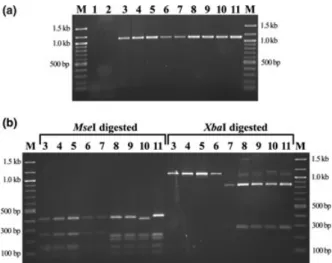
The identification of all SBSEC reference strains (Table 1) as well as 192 S. infantarius and five S. gallolyticus isolates was successfully performed using the multiplex PCR/ RFLP assay developed in this study. The specificity of the multiplex PCR assay was confirmed with various strepto-coccal species closely related to the SBSEC as well as other LAB often present in raw milk products (Table 1). The PCR assay yielded the desired 1.1-kb fragment only with DNA of SBSEC strains corresponding to the expected product of 1119–1120 bp (Fig. 3a). It did not yield false-positive amplification of non-SBSEC reference
strains or dairy isolates of closely related species com-monly detected in raw milk products, such as enterococci, lactococci, and other streptococci. Especially, S. agalactiae (group B streptococci) and group C streptococci regularly detected from milk of mastitic animals (Younan & Born-stein, 2007; Whiley & Hardie, 2009; Jans, 2011) were in silico evaluated to yield a potentially false-positive result when using other assays such as the 324-fold degenerate groESL primers (Chen et al., 2008). The clear discrimination of SBSEC from other streptococcal groups is a clear advantage of the assay developed in our study considering the potential commensal microbial communi-ties of raw dairy products. In contrast to other assays such as the general Streptococcus genus-specific assay tar-geting the sodA gene, the assay developed in this study does not require downstream sequencing for species iden-tification (Poyart et al., 1998). Nevertheless, the primers developed in our study were designed to be compatible with the emerging wide availability of sequencing technol-ogies. Primers 16S-SBSEC-fw and 16S-inf-rev were suc-cessfully used in Sanger sequencing performed on two independently obtained amplicons of strain CJ18. RFLP yields the required differentiation power and can be easily performed in-house by most laboratories. However, sequencing can provide an even higher level of detail of the entire amplicon for subsequent phylogenetic analysis, database comparisons, and potential clustering of isolates. RFLP only differentiates isolates and their amplicons based on the position of individual restriction enzyme recognition sites but does not deliver information on sequence differences possibly existing between these sites.
The RFLP assay performed in separate reactions for MseI and XbaI was consistent among the reference strains of the SBSEC used in this study. Three RFLP profile groups were distinguished (Fig. 3b): (1) the S. gallolyticus species including Streptococcus alactolyticus featured the expected specific MseI and XbaI profiles; (2) the S. bovis and S. infantarius/S. lutetiensis species were not digested by XbaI and featured the expected group-specific MseI profile; and (3) the S. equinus PCR fragment was digested by XbaI but featured the S. bovis/S. infantarius MseI pro-file (Table 1 and Fig. 3b).
The involvement of members of the SBSEC in food fermentations seems to be larger than previously expected (Tsakalidou et al., 1998; Dı´az-Ruiz et al., 2003; Abdelga-dir et al., 2008; Wullschleger, 2009; Jans, 2011). There-fore, the PCR assay developed in this study allows the rapid screening of isolates to identify members of SBSEC within the complex microbial communities of spontane-ous food fermentations. Despite a high sequence identity of 98.5% within the amplified DNA fragment, the restric-tion digesrestric-tion of PCR products yielded the important discrimination of species into three major SBSEC groups
Fig. 3. Electrophoretic separation of DNA fragments after SBSEC-specific multiplex PCR amplification (a) and RFLP assay (b). Initial PCR fragment analysis and subsequent RFLP analysis were performed on a 1% and 2% agarose gel, respectively. Amplified DNA fragments were digested using MseI and XbaI restriction enzymes in two parallel and separate reactions. M: 100-bp DNA size marker; (1) no DNA control, (2) Streptococcus thermophilus DSM 20259, (3) Streptococcus infantarius subsp. infantarius CCUG 43820T, (4) S. infantarius subsp.
coli (=Streptococcus lutetiensis) CCUG 43822, (5) S. infantarius subsp. infantarius CJ18, (6) Streptococcus bovis DSM 20480T, (7)
Streptococcus equinus DSM 20558T, (8) Streptococcus gallolyticus
subsp. gallolyticus DSM 16831T, (9) Streptococcus gallolyticus subsp.
pasteurianus DSM 15351T, (10) Streptococcus gallolyticus subsp. macedonicus DSM 15879T, and (11) Streptococcus alactolyticus DSM
and the differentiation of the S. gallolyticus cluster (for-mer biotype I and biotype II.2) from the S. bovis/S. in-fantarius cluster (biotype II.1). This separation is also of clinical relevance because of the association of different infections (Schlegel et al., 2003; Beck et al., 2008). A ben-efit of the 16S rRNA gene over the groESL is the high conservation and low variability within the 16S rRNA gene that reduces the risk of misidentifying a species, especially when investigating novel and complex micro-bial niches of previously unstudied sources such as raw dairy products, where diverse microbial communities can be found (Clarridge, 2004; Delbe`s et al., 2007; Chen et al., 2008; Giannino et al., 2009; Jans, 2011). To con-clude, a reliable assay to identify members of SBSEC from complex microbial communities such as fermented dairy products was developed and validated. The impor-tance of this novel assay is in the investigation of the increasing reports of members of the SBSEC being involved in food fermentations to assess their prevalence and role during the fermentation with respect to food safety. Furthermore, the simplicity of the assay allows the application of this method in laboratories without direct access to current sequencing technologies, such as in Africa, where members of the SBSEC seem to play a large role in dairy fermentations while still offering the optional direct Sanger sequencing.
Acknowledgements
This study was funded by the North-South Centre of the ETH Zurich, Switzerland, and the UBS Optimus Foundation, Switzerland. The authors would like to acknowledge the valuable contributions by Z. Farah, J. Wangoh, M. Younan, P. M. K. Njage, D. W. M. Kaindi, B. Bonfoh, and M. Kouame.
References
Abdelgadir W, Nielsen DS, Hamad S & Jakobsen M (2008) A traditional Sudanese fermented camel’s milk product, Gariss, as a habitat of Streptococcus infantarius subsp. infantarius. Int J Food Microbiol127: 215–219.
Beck M, Frodl R & Funke G (2008) Comprehensive study of strains previously designated Streptococcus bovis
consecutively isolated from human blood cultures and emended description of Streptococcus gallolyticus and Streptococcus infantarius subsp. coli. J Clin Microbiol46: 2966–2972.
Benson DA, Karsch-Mizrachi I, Lipman DJ, Ostell J & Sayers EW (2009) GenBank. Nucleic Acids Res37: D26–D31.
Chen H-J, Tsai J-C, Chang T-C, Hung W-C, Tseng S-P, Hsueh P-R & Teng L-J (2008) PCR-RFLP assay for species
and subspecies differentiation of the Streptococcus bovis group based on groESL sequences. J Med Microbiol57: 432–438.
Clarridge JE (2004) Impact of 16S rRNA gene sequence analysis for identification of bacteria on clinical
microbiology and infectious diseases. Clin Microbiol Rev17: 840–862.
Delbe`s C, Ali-Mandjee L & Montel M-C (2007) Monitoring bacterial communities in raw milk and cheese by culture-dependent and -inculture-dependent 16S rRNA gene-based analyses. Appl Environ Microbiol73: 1882–1891.
Dı´az-Ruiz G, Guyot JP, Ruiz-Teran F, Morlon-Guyot J & Wacher C (2003) Microbial and physiological
characterization of weakly amylolytic but fast-growing lactic acid bacteria: a functional role in supporting microbial diversity in pozol, a Mexican fermented maize beverage. Appl Environ Microbiol69: 4367–4374.
Franciosi E, Settanni L, Cavazza A & Poznanski E (2009) Biodiversity and technological potential of wild lactic acid bacteria from raw cows’ milk. Int Dairy J19: 3–11. Gevers D, Huys G & Swings J (2001) Applicability of rep-PCR
fingerprinting for identification of Lactobacillus species. FEMS Microbiol Lett205: 31–36.
Giannino ML, Marzotto M, Dellaglio F & Feligini M (2009) Study of microbial diversity in raw milk and fresh curd used for Fontina cheese production by culture-independent methods. Int J Food Microbiol130: 188–195.
Glazunova OO, Raoult D & Roux V (2009) Partial sequence comparison of the rpoB, sodA, groEL and gyrB genes within the genus Streptococcus. Int J Syst Evol Microbiol59: 2317–2322.
Goldenberger D, Perschil I, Ritzler M & Altwegg M (1995) A simple universal DNA extraction procedure using SDS and proteinase K is compatible with direct PCR amplification. PCR Methods Appl4: 368–370. Grice EA, Kong HH, Renaud G, NISC Comparative
Sequencing Program, Young AC, Bouffard GG, Blakesley RW, Wolfsberg TG, Turner ML & Segre JA (2008) A diversity profile of the human skin microbiota. Genome Res18: 1043–1050.
Hall TA (1999) BioEdit: a user-friendly biological sequence alignment editor and analysis program for Windows 95/98/ NT. Nucleic Acids Symp Ser41: 95–98.
Hinse D, Vollmer T, Erhard M, Welker M, Moore ERB, Kleesiek K & Dreier J (2011) Differentiation of species of the Streptococcus bovis/equinus-complex by MALDI-TOF Mass Spectrometry in comparison to sodA sequence analyses. Syst Appl Microbiol34: 52–57.
Hols P, Hancy F, Fontaine L et al. (2005) New insights in the molecular biology and physiology of Streptococcus thermophilus revealed by comparative genomics. FEMS Microbiol Rev29: 435–463.
Jain R, Rivera MC & Lake JA (1999) Horizontal gene transfer among genomes: the complexity hypothesis. P Natl Acad Sci USA96: 3801–3806.
Jans C (2011) Biodiversity of lactic acid bacteria in raw camel milk products of East Africa including genomic and functional characterization of predominant lactose-adapted Streptococcus infantarius subsp. infantarius. PhD Thesis No. 19835, ETH Zurich, Zurich.
Liu ZZ, DeSantis TZ, Andersen GL & Knight R (2008) Accurate taxonomy assignments from 16S rRNA sequences produced by highly parallel pyrosequencers. Nucleic Acids Res36: e120. Makarova K, Slesarev A, Wolf Y et al. (2006) Comparative
genomics of the lactic acid bacteria. P Natl Acad Sci USA 103: 15611–15616.
Pacini F, Cariolato D, Andrighetto C & Lombardi A (2006) Occurrence of Streptococcus macedonicus in Italian cheeses. FEMS Microbiol Lett261: 69–73.
Papadelli M, Manolopoulou E, Kalantzopoulos G & Tsakalidou E (2003) Rapid detection and identification of Streptococcus macedonicus by species-specific PCR and DNA hybridisation. Int J Food Microbiol81: 231–239.
Poyart C, Quesne G, Coulon S, Berche P & Trieu-Cuot P (1998) Identification of streptococci to species level by sequencing the gene encoding the manganese-dependent superoxide dismutase. J Clin Microbiol36: 41–47. Poyart C, Quesne G & Trieu-Cuot P (2002) Taxonomic
dissection of the Streptococcus bovis group by analysis of manganese-dependent superoxide dismutase gene (sodA) sequences: reclassification of ‘Streptococcus infantarius subsp. coli’ as Streptococcus lutetiensis sp. nov. and of Streptococcus bovis biotype II.2 as Streptococcus pasteurianus sp. nov. Int J Syst Evol Microbiol52: 1247–1255.
Rashid MHU, Togo K, Ueda M & Miyamoto T (2009) Characterization of bacteriocin produced by Streptococcus bovis J2 40-2 isolated from traditional fermented milk ‘Dahi’. Anim Sci J80: 70–78.
Renye JA Jr, Somkuti GA, Van Hekken DL & Guerrero Prieto VM (2011) Short communication: characterization of microflora in Mexican Chihuahua cheese. J Dairy Sci94: 3311–3315.
Schlegel L, Grimont F, Ageron E, Grimont PAD & Bouvet A (2003) Reappraisal of the taxonomy of the Streptococcus bovis/Streptococcus equinus complex and related species: description of Streptococcus gallolyticus subsp. gallolyticus subsp. nov., S. gallolyticus subsp. macedonicus subsp. nov. and S. gallolyticus subsp. pasteurianus subsp. nov. Int J Syst Evol Microbiol53: 631–645.
Tsakalidou E, Zoidou E, Pot B, Wassill L, Ludwig W, Devriese LA, Kalantzopoulos G, Schleifer KH & Kersters K (1998) Identification of streptococci from Greek Kasseri cheese and description of Streptococcus macedonicus sp. nov. Int J Syst Bacteriol48: 519–527.
Whiley RA & Hardie JM (2009) Genus I. Streptococcus. Bergey’s Manual of Systematic Bacteriology. The Firmicutes, Vol.3 (De Vos P, Garrity GM, Jones D, Krieg NR, Ludwig W, Rainey FA, Schleifer KH & Whitman WB, eds), pp. 655–711. Springer, New York, NY.
Wullschleger S (2009) Biodiversity and microbial safety of artisanal Malian sour milk fe`ne` and development of adapted starter cultures for controlled production. PhD Thesis No. 18287, ETH Zurich, Zurich.
Yarza P, Richter M, Peplies J, Euzeby J, Amann R, Schleifer KH, Ludwig W, Glo¨ckner FO & Rossello´-Mo´ra R (2008) The all-species living tree project: a 16S rRNA-based phylogenetic tree of all sequenced type strains. Syst Appl Microbiol31: 241–250.
Younan M & Bornstein S (2007) Lancefield group B and C streptococci in East African camels (Camelus dromedarius). Vet Rec160: 330–335.