HAL Id: hal-02280866
https://hal.univ-lorraine.fr/hal-02280866
Submitted on 6 Sep 2019
HAL is a multi-disciplinary open access
archive for the deposit and dissemination of
sci-entific research documents, whether they are
pub-lished or not. The documents may come from
teaching and research institutions in France or
abroad, or from public or private research centers.
L’archive ouverte pluridisciplinaire HAL, est
destinée au dépôt et à la diffusion de documents
scientifiques de niveau recherche, publiés ou non,
émanant des établissements d’enseignement et de
recherche français ou étrangers, des laboratoires
publics ou privés.
Trust in computer-supported crisis management
communication : toward a new model
Béatrice Linot, Jérôme Dinet, François Charoy, Valerie Shalin
To cite this version:
Béatrice Linot, Jérôme Dinet, François Charoy, Valerie Shalin. Trust in computer-supported crisis
management communication : toward a new model. InPACT 2019 - International Psychological
Ap-plications Conference and Trends, World Institute for Advanced Research and Science (W.I.A.R.S.),
May 2019, Porto, Portugal. pp.440-444. �hal-02280866�
TRUST
IN
COMPUTER-SUPPORTED
CRISIS
MANAGEMENT
COMMUNICATION:
TOWARD
A
NEW
MODEL
Béatrice Linot
1, Jérôme Dinet
1, François Charoy
2, Valerie L. Shalin
31Psychology and Neurosciences Lab (2LPN-EA7489), University of Lorraine (France) 2Coast Team, University of Lorraine/INRIA (France)
3Department of Psychology and Kno.e.sis, Wright State University (U.S.A.)
Abstract
This paper presents a new model, Computer-supported Crisis Management Communication (3C) to capture communication during crisis management when communication is mediated by computational tools. Different services (e.g., police, army, hospital, fire service) support crisis management with different responsibilities. Each service has unique concerns regarding the main elements of the situation, the major values, interests and objectives to be fulfilled, and the relevant alternative course of action. While the services have well-defined and distinct responsibilities, teams within and between disciplines must share information and make adjustments to meet changes in a dynamic environment. Despite recent technical advances in the area of systems support for cooperative work during crisis, there is still relatively little understanding of the communication requirements. Moreover, independent of the software, recent analyses show that trust between partners is crucial during crisis management. We draw on models of interpersonal trust, technology acceptance, situation awareness and communication to elaborate a new model integrating all these factors and to provide recommendations for computer-supported communication environments.
Keywords: Crisis management, Trust, Computer-supported communication.
1. Introduction
Different services (e.g., police, army, hospital, fire service) support crisis management with different responsibilities. Each service has unique concerns regarding the main elements of the situation, the values, interests and objectives to be fulfilled, and the relevant alternative course of action. Participants come from different organizations with different cultures and merge in a dynamic situation full of uncertainties that includes a lack of experience with specific individuals. Communication is an important part of crisis response. Indeed, communication, and information sharing in particular, is an important part of any sociotechnical system, and is threatened by more than the absence of functioning communication equipment (Linot, Dinet, Charoy & Shalin, 2018). Créton-Crazanave (2017) has identified substantial resistance to the use of the existing computational support for crisis communication, Crisorsec (see Figure 1). We argue that an integrated model of communication, in which trust is a central construct, is key to the design of computer-supported communication for sociotechnical systems such as crisis response.
Figure 1. From Créton-Cazanave, 2017.
“Participants who use Crisorsec begin to question what information should be in an application and what should pass through other means. Phone calls to a trusted contact, mail, and secure networks readily available and useful in parallel with Crisorsec, (p.89).
“Doubt about the status of information and the proper distribution channel (is problematic). Many responders raise this difficulty and the way it undermines trust and guides the usage of Crisorsec”, (p.89).
“In crisis management, it is obvious that trust in one’s interlocutors is fundamental for collaboration and coordination. In addition, mutual knowledge makes it easier to understand each other and to sort out what should be logged. Trust is therefore paramount”, (p.90).
“Virtually opening the physical center of operations to new organizations – some of whom may not be invested in issues of civil security or public order - induces a particular concern among the key players in crisis management: should we really share all of the information about a crisis with everyone?”, (p.90).
2. Theoretical background: a combination of four models
Computational tools to support information distribution promise to compensate for the organizational, spatial and temporal distance between collaborators. But poorly designed mediated communication may fail to accommodate the fundamental properties of effective human coordination: trust, founded on interpersonal experience, a shared representation and the ability to exchange tailored messages based on the assessment of recipient need. Below we examine models related to the crisis communication problem: The Trust model (Mayer, Davis and Schoorman, 1995), the Unified Theory of Adoption and Use Technology (UTAUT) model (Venkatesh et al., 2003), and the Situation Awareness model (Endsley, 1995). Each model captures relevant concepts (e.g., interpersonal trust, technology acceptance and situation awareness). Their individual limitations for the design of mediated communication resolve by combining them with a model of communication (Pickering and Garrod, 2004).
2.1. A Trust model (Mayer, Davis & Schoorman, 1995)
Trust plays a relevant role in interpersonal relationships (Ferreira, 2014). Seldom do we have just enough information to make a perfect assessment of someone’s activities or intentions. Instead, we often have too little information or too much information. This is certainly the case in large agent networks where (partial) ignorance and conflicting opinions are the rule rather than the exception. For Mayer, Davis and Schoorman (1995), three characteristics of the trustee determine the trustors reliance on a trustee: ability, benevolence, integrity. The trustor also has a propensity to trust.
Ability, competencies, and individual factors enable a party to have influence in a particular domain. Benevolence is “the extent to which a trustee is believed to want to benefit the trustor, aside from an egocentric
profit motive”, (Mayer et al. 1995, p. 718). Benevolence suggests that the trustee has some specific attachment to
the trustor (e.g., a mentor, affective relationships). Integrity refers to the extent to which the trustee adheres to a set of principles or decisions that the trustor finds acceptable. Propensity to trust is a trait leading to a generalized expectation about the trustworthiness of others independent of prior experience. People with different developmental experiences, personality types, and cultural backgrounds vary in their propensity to trust (e.g., Hofstede,1980). Propensity to trust interferes with the intention to trust and is especially prevalent in ambiguous situations (Gill, Boies, Finnegan & McNally, 2005).
The perception of risk and willingness to take on risk also contribute to a person’s trust assessment. Though certainly relevant to the problem of information exchange, this model lacks a place for tools to assist in the communication of information. The model also lacks a role for context and goals and the interaction between two agents, a trustor and a trustee, is implicit.
2.2. UTAUT model (Venkatesh et al., 2003)
The utility of technology and ease of use affect an individual’s technology acceptance (Davis et al., 1989; Davis, 1989). The widely recognized Unified Theory of Acceptance and Use of Technology (UTAUT) describes and explains user intentions to use an information system and subsequent behavior. UTAUT is derived from eight previous models of technology acceptance (Venkatesh et al., 2003): Theory of reasoned action (TRA, Fishbein et al., 1975), the Technology Acceptance Model (TAM, Davis, 1989) and extended TAM (Venkatesh and Davis, 2000), the Motivational Model (MM, Davis, et al., 1992), the Theory of Planned Behavior (TPB, Ajzen, 1991), the model combining TAM and the TPB (C-TAM-TPB, Taylor and Todd, 1995a, 1995b), the Model of PC Utilization (MPCU, Thompson et al., 1991), Innovation Diffusion Theory (IDT, Rogers, 1995) and Social Cognitive Theory (SCT, Bandura, 1986). UTAUT combined four main determinants of usage and intention (performance expectancy, effort expectancy, social factors, and facilitating conditions) and proposed four moderators (i.e., gender, age, experience, and voluntariness). Using data from four organizations with three points of measurement, Venkatesh et al. (2003) found that the eight models explained between 17 and 53% of the variance in users’ intention to use Information Systems (IS)/ Information Technology (IT). However, UTAUT outperformed all the eight models using the same data, explained about 70% of variance in behavioral intention (Venkatesh et
al., 2003) and 50% in technology use. UTAUT has been used extensively in explaining the adoption of
exchange of information between partners. There is no external world context, no distinction between data and information and no communication partner.
2.3. Situation Awareness model (Endsley, 1995)
Awareness of the situation is defined as “the perception of the elements in an environment defined in time and space, the understanding of their meaning and the projection of their evolution in the near future”. Endsley identifies three purportedly sequential levels: (i) the perception of the elements of the environment: the states, attributes, and statuses of the task environment; (ii) interpretation and understanding of the elements present in the situation that integrates perceived information and combines it with knowledge to construct a functional representation of the situation according to the objectives pursued. Both expertise founded on experience and the nature of the information can affect interpretation. (iii) projection of the states of these elements in the future, constituting prediction. The Endsley model specifies what it means to understand a situation. However, the model does not specify shared situation awareness, or even recognize multiple participants in a work effort. Hence there is no process for detecting or remediating discrepancies between participants and no role for communication.
2.4. Communication model (Pickering & Garrod, 2004)
The Pickering and Garrod model for language (2004), emphasizes the presence of multiple communicating agents. Pickering and Garrod’s model suggests a fixed, overlapping procession through stages of production and comprehension to achieve a shared understanding between conversational participants. This model explicitly includes two conversational partners. Discrepancies in immediate experience motivate the use of language to achieve some goal, for example to articulate need not readily apparent to a partner. However, their model lacks reference to a physical environment, task/context specific communication goals, a role for trust or mediating communication tools.
3. A new integrated model (Computer-supported, Communication for Crisis
Management).
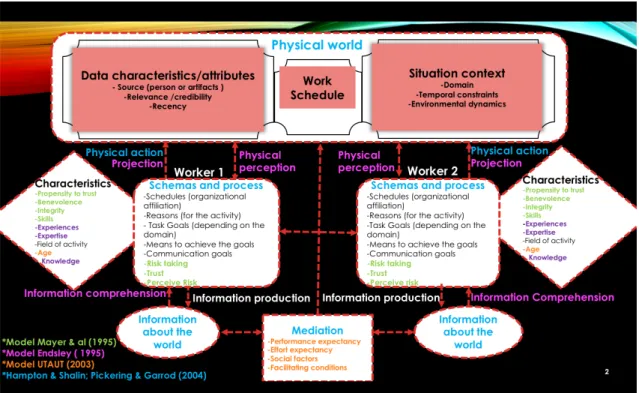
Each of these models captures dimensions relevant to computationally mediated communication during crisis management. While as noted above, the individual models are limited, they are complementary. Our new integrated model (see Figure 2) has three main components: a physical world, actors, and the information they produce and share. This model acknowledges the key role that individuals play in the interpretation of world conditions, not for passing along data, but rather for communicating information, framed by knowledge, task context and familiarity with the knowledge and task context of the recipient. A person, an observer with her characteristics, schemas and work processes, looks at the data from the world and changes this data into information. The goal of communication is to create aligned representations of the world between different collaborators.
We indicate the influences of the source models on the integrated model with color coding in Figure 1. Consistent with Endsley, there is a physical world (what she calls elements in an environment) providing data that require interpretation using knowledge and expertise. The components of interpersonal trust in the new model (integrity, benevolence, ability and propensity of trust of the trustor) come from Mayer et al. (1995). Trust plays a crucial role in at least three locations in this model: (i) trust in data from the world, (ii) trust between two collaborators and (iii) trust in the mediated information exchange that we typically call communication. Note that trust influences an observer’s interpretation of data particularly when the data result from man-made artifacts. Physical sensors can be wrong, not only due to design limitations, but also because context influences their interpretation.
Pickering and Garrod (as adapted by Hampton & Shalin, in preparation) contribute the idea of situation alignment between two collaborators who are communicating. When communicating, the trustor crafts an appropriate message with the trustee in mind, trusting him to interpret the message properly. Similarly, the trustee trusts the trustor to provide accurate information according to standard principles of message design (for example Grice, 1967). Finally, the UTAUT model specifies the main factors influencing behavioral intention and use behavior: performance and effort expectancy, social factors, facilitating conditions.
Integrating these models provides much of the missing functionality of the respective models. Integrating the models also highlights additional factors that extend the source models. These include characteristics of the data, the situation and the presence of a work schedule and work processes.
Figure 2. Our 3C Model (3C: Computer-supported, Communication for Crisis Management)
Discussion
Our long-term goal is to design computational tools for communication in the domain of crisis management. We have identified the need for a model that unifies trust with communication using computational media. The proposed integrated model clarifies the source of resistance to existing tools that Créton-Cazanave (2017) has noted.
When computational tools mediate the exchange of information they risk breaking the adaptive link between the source of information and the recipient. Sources can no longer shape their message in breadth and detail for the precise needs of the recipient. Instead, generic “information” is anonymously deposited by a trustee for anonymous retrieval by a trustor. Trust in the source is never established, follow-up queries may not be possible and the trustee is at a loss for providing more effective information. According to our model the absence of trust between participants is not bad. Being suspicious of information is an important safeguard in complex sociotechnical systems (Linot, Dinet, Charoy & Shalin, 2018), but some mechanism for follow-up is required. Note that attaching names to information sources is not the solution. The personnel in large socio-technical systems are too numerous, too transient and too ad hoc to presume that names provide effective retrieval cues. For this reason, our team is working on trust metrics that track the sufficiency of interaction between personnel over time without relying on names. Because all information has a temporal attribute, it must be included in any information exchange. For instance, information stored in a computer (e.g., a flood level) must be maintained for persisting relevance or deletion. Temporal relevance is implicit in telephone exchange, because the exchange occurs while the data are still relevant. These and other system requirements emerge from a model driven design of Computer-supported Crisis Management Communication.
While our model is intended to support the design of computational tools, it also guides our ongoing empirical work. Several constructs are poorly understood, particularly the interaction between trust and risk. In addition, organizational trust requires empirical research to understand the both its effect as a mediator on organizational processes and dynamics within an organization, and, as is so important in crisis management, between organizations. We anticipate changes to our model as the empirical work proceeds.
References
Ajzen, I. (1991). The theory of planned behavior. Organizational Behavior and Human Decision Processes. 50(2): 179– 211.
Bandura, A. (1986). Social Foundations of Thought and Action: A Social Cognitive Theory, Prentice Hall, Englewood Cliffs, NJ.
Créton-Cazanave, L. (2017). L’application Crisorsec, un dispositif numérique au cœur des enjeux de la gestion des crises en milieu métropolitain. Sociologies pratiques, 34, (1), 83-92.doi :10.3917/sopr.034.0083.
Davis, F. D. (1989). Perceived usefulness, perceived ease of use, and user acceptance of information technology, MIS
Quarterly, 13(3), 319-339.
Davis, F. D., Bagozzi, R. P., and Warshaw, P.R. (1989). User Acceptance of Computer Technology: A Comparison of Two Theoretical Models, Management Science (35:8), 1989, pp. 982-1002.
Davis, F.D., Warshaw, P.R. (1992). Extrinsic and Intrinsic Motivation to Use Computers in the Workplace, Journal of Applied Social Psychology (22:14), 1992, pp. 1111-1132.
Endsley, M.R. (1995). Toward a theory of situation awareness in dynamic systems. Human Factors, 37(1), 32-64. Ferreira, A.T. (2014). Organisational trust: Mayer, Davis and Schoorman model, a review. In M. Mokrys & S. Badura
(Eds.), QUAESTI, Psychology, Sociology and Pedagogy (pp.253-256). EDIS: University of Zilina. Slovak Republic.
Fishbein, M. & Ajzen, I. (1975). Belief, attitude, intention, and behavior: An introduction to theory and research. Reading, MA: Addison-Wesley.
Gill, H. Boies, K. Finnegan, J. & McNally, J. (2005). Antecedents of trust: Establishing a boundary condition for the relation between propensity to trust and intention to trust. Journal of Business and Psychology, 19(3), 287-302. Grice, H. P. (1967/1989). Logic and conversion, from the William James Lectures, Harvard University. In P. Grice:
Studies in the Way of Words, pp. 22–40, Harvard University Press, Cambridge Massachusetts. Hampton, A.J. & Shalin, V.L. (in preparation). Symbol grounding in social media communication. Hofstede, G. (1980). Culture’s consequences. Beverly Hills, CA: Sage.
Linot, B., Charoy F., Dinet, J., Shalin V.L. (in review): Trust, relevance and provenance in information exchange: implication in for the design of computer-supported communication in sociotechnical systems. Submitted to the 16th European Conference on Computer-Supported Cooperative Work.
Linot, L., Dinet, J., Charoy, F., Shalin, L.V., (2018). Information gain in sociotechnical systems. To appear in Proceedings of the 15th ISCRAM Conference.
Mayer, R. C., Davis, J., & Schoorman, F. (1995). An integrative model of organizational trust. The Academy of Management Review, 20(3), 709–734.
Pickering M.J., Garrod S. (2004). Toward a mechanistic psychology of dialogue. Behavioral and Brain Sciences, 27, 169–225.
Rogers, E. (1995). Diffusion of Innovations, Free Press, New York.
Taylor, S., and Todd, P. A. (1995a). Assessing IT Usage: The Role of Prior Experience, MIS Quarterly (19:2), pp. 561-570.
Taylor, S., and Todd, P. A. (1995b). Understanding Information Technology Usage: A Test of Competing Models, Information Systems Research (6:4), 1995b, pp. 144-176.
Thompson, R. L., Higgins, C. A., and Howell, J.M. (1991). Personal Computing: Toward a Conceptual Model of Utilization, MIS Quarterly (15:1), 1991, pp. 125-143.
Venkatesh, V., Davis, F. D. (2000). A Theoretical Extension of the Technology Acceptance Model: Four Longitudinal Field Studies,” Management Science (46:2), pp. 186-204.
Venkatesh, V., Morris, M.G., Davis, G.B. and Davis, F.D. (2003). User acceptance of information technology: Toward a united view. MIS Quarterly, 27(3), 425-478.