HAL Id: hal-01517373
https://hal.archives-ouvertes.fr/hal-01517373
Submitted on 3 May 2017
HAL is a multi-disciplinary open access
archive for the deposit and dissemination of
sci-entific research documents, whether they are
pub-lished or not. The documents may come from
teaching and research institutions in France or
abroad, or from public or private research centers.
L’archive ouverte pluridisciplinaire HAL, est
destinée au dépôt et à la diffusion de documents
scientifiques de niveau recherche, publiés ou non,
émanant des établissements d’enseignement et de
recherche français ou étrangers, des laboratoires
publics ou privés.
Provably correct graph transformations with small-tALC
Nadezhda Baklanova, Jon Haël Brenas, Rachid Echahed, Christian Percebois,
Martin Strecker, Hanh Nhi Tran
To cite this version:
Nadezhda Baklanova, Jon Haël Brenas, Rachid Echahed, Christian Percebois, Martin Strecker, et
al.. Provably correct graph transformations with small-tALC. 11th International Conference on ICT
in Education, Research, and Industrial Applications (ICTERI 2015), May 2015, Lviv, Ukraine. pp.
78-93. �hal-01517373�
O
pen
A
rchive
T
OULOUSE
A
rchive
O
uverte (
OATAO
)
OATAO is an open access repository that collects the work of Toulouse researchers and
makes it freely available over the web where possible.
This is an author-deposited version published in :
http://oatao.univ-toulouse.fr/
Eprints ID : 17018
The contribution was presented at ICTERI 2015 :
http://icteri.org/icteri-2015
To cite this version :
Baklanova, Nadezhda and Brenas, Jon Haël and Echahed,
Rachid and Percebois, Christian and Strecker, Martin and Tran, Hanh Nhi
Provably correct graph transformations with small-tALC. (2015) In: 11th
International Conference on ICT in Education, Research, and Industrial
Applications (ICTERI 2015), 14 May 2015 - 16 May 2015 (Lviv, Ukraine).
Any correspondence concerning this service should be sent to the repository
administrator:
[email protected]
Provably correct graph transformations
with
small-tALC
⋆Nadezhda Baklanova2, Jon Haël Brenas1, Rachid Echahed1,
Christian Percebois2, Martin Strecker2, Hanh Nhi Tran2
1 CNRS and Université de Grenoble 2 Université de Toulouse / IRIT
Abstract. We present a prototype for executing and verifying graph transformations. The transformations are written in a simple imperative programming language, and pre- and post-conditions as well as loop in-variants are specified in the Description Logic ALC (whence the name of the tool). The programming language has a precisely defined oper-ational semantics and a sound Hoare-style calculus. The tool consists of the following sub-components: a compiler to Java for executing the transformations; a verification condition generator; and a tableau prover for an extension of ALC capable of deciding the generated verification conditions. A description of these components and their interaction is the main purpose of this paper.
Keywords: Graph Transformations, Programming Language Seman-tics, Tableau Calculus, Description Logic
Key Terms: ModelBasedSoftwareDevelopmentMethodology, Formal-Method, MathematicalModel, VerificationProcess
1
Introduction
Provably correct transformations of graph structures become increasingly impor-tant, for example for pointer manipulating programs, model driven engineering (such as EMF [1]) or the Semantic Web (with representation formats such as RDF [2]).
Contributions: This paper presents a new language, calledsmall-tALC, and ac-companying programming environment for executing graph transformations and reasoning about them. Let us characterize in a few words what our work is about and what it is not about:
– The primary aim of our development is to be able to reason about graph
transformations in a pre- / post-condition style: can we ensure that any graph satisfying the pre-condition is transformed into a graph satisfying the post-condition? Essential ingredients of such a setup are a language for describing the transformations, and an assertional formalism for specifying the pre- and post-conditions.
⋆
– The transformation language is an imperative programming language with special operations for manipulating graphs. This language is endowed with traditional control flow constructs (selection and loops) and elementary state-ments for adding and deleting arcs of a graph. There is a select statement that can be understood as a generalized, non-deterministic assignment oper-ation and whose purpose is to perform matchings of rules in a target graph. After a high-level overview of small-tALC (Section 2), we will give a more detailed account of the program logic (in Section 3.1) and transformation language (in Section 3.2). Our transformation language is by no means a full-fledged programming language: for example, arithmetic operations are excluded.
– The transformation language is not graphical, but textual. We do not ques-tion the utility and appeal of a graphical notaques-tion, but this issue is orthogonal to our concerns. We can imagine to couplesmall-tALC with existing graphical editors, such as Henshin [3], in the sense of translating a graphical descrip-tion of a rule to our textual format. The usefulness of the inverse direcdescrip-tion is less evident, because the textual format is more expressive (offering, among others, nested loops and branching statements).
– The transformation language is executable, by a translation to Java (see Section4): a code generator translatessmall-tALC to Java code, which can then transform graphs specified in an appropriate format.
Altogether, we are thus primarily interested in proofs of correctness of graph transformations, for which two major approaches have emerged:
1. Model checking of graph transformations: given an initial graph and a set of transformation rules, check whether the graph can eventually evolve into a graph having certain properties, or whether specific properties can be ascer-tained to be always satisfied. This kind of reasoning is possible in principle (the initial graph can be specified by a pre-condition, invariants can be spec-ified as loop conditions, eventuality properties as post-conditions), but our approach is clearly not geared towards this activity.
2. Full correctness proofs: given an arbitrary graph satisfying the pre-condition, verify that it evolves into a graph satisfying the post-condition. This is the kind of verification we are aiming at.
Full correctness proofs are hard, and undecidability of the generated proof obligations is a major concern for rich logics [4]. We propose to use a rela-tively simple logic, ALC, belonging to the family of Description Logics (DLs). We summarize the logic in Section3.1, and the fine-tuned interplay of the logic and the transformation language (among others: branching and loop conditions are formulas of this logic) brings it about that the proof obligations extracted from programs are decidable, as argued in Section5. We are currently working on extending this approach to more expressive description logics, with the pur-pose of being able to tackle realistic problems in the areas of UML-style model transformations and RDF graph database transformations.
The work described here has reached the state of a sound prototype. In the corresponding sections, we will make precise which parts of the development are completed to which degree, and indicate which missing parts still have to be filled in. Thesmall-tALC environment is available from the following web page, where it will be regularly updated:http://www.irit.fr/~Martin.Strecker/ CLIMT/Software/smalltalc.html.
Related work:Hoare-like logics have already been used to reason on graph trans-formations (see, e.g. [5]) but, as far as we are aware, no tool has been imple-mented. small-tALC, which is also based on a Hoare-like calculus, allows one to decide the verification problem, of programs operating on graphs, when the properties are expressed in the ALC logic. Some implementations of verification environments for pointer manipulating programs exist [6], however they often impose severe restrictions on the kind of graphs that can be manipulated, such as having a clearly identified spanning tree.
Other tools dedicated to reasoning on graph transformations have been pro-posed. For example, the GROOVE [7] system implements model-checking tech-niques using LTL or CTL formulas and thus departs fromsmall-tALC techniques. The computation of weakest preconditions from a graph rewriting system is described by Habel, Pennemann and Rensink [8,9]. This work is concerned with extraction of weakest preconditions, but no proof system for the formulas is given. Pennemann [10] then describes a method of translating the extracted formulas to a resolution theorem prover. Radke [11] uses a more expressive logic: MSO. The spirit of the work described in this paper is similar, but we explicitly restrict the expressiveness of the logical framework to obtain decidable proof problems.
In a similar vein, Asztalos et al. [12] describe the verification of graph trans-formations based on category-theoretic notions and by translation to a logic for which no complete calculus is provided.
Raven3
is a tool suite designed to handle and manipulate graph automata. In some sense Raven tends to generalize model-checking techniques from word to graph processing. Therefore techniques behind Raven tool are not directly comparable tosmall-tALC.
Alloy [13] is a popular framework for specifying and exploring relational structures, and it has been used to analyze graph transformations [14] written in the AGG transformation engine. Alloy interfaces with model checkers and can display counter models in case a transformation does not satisfy its specification. For verification, Alloy uses bounded model checking: errors for graphs of a certain size are systematically detected, but has the disadvantage that graphs beyond that size are not covered. As opposed to this, the proof method presented here is exhaustive, being based on a complete, decidable calculus.
3
2
System Description
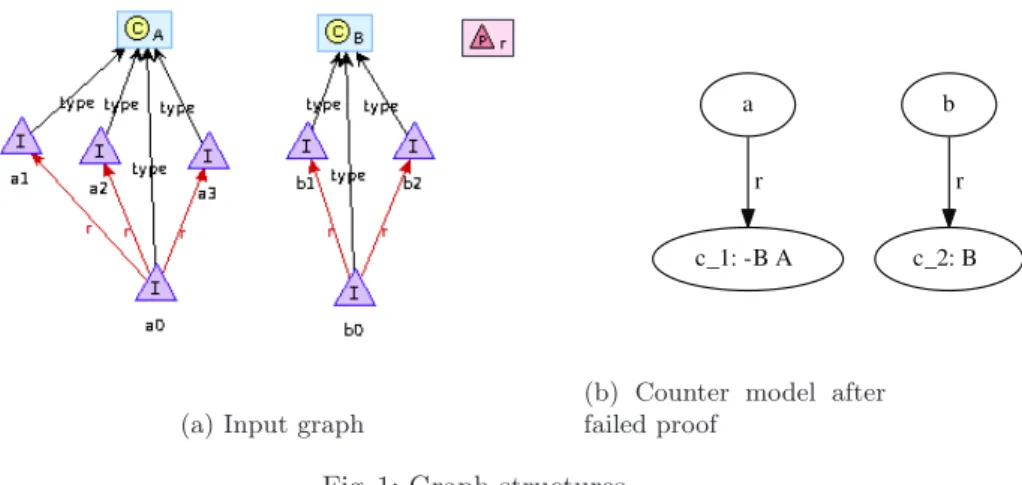
2.1 User’s ViewTo explore the perspective of a user of small-tALC, we will walk through pro-cessing a simple program, but before, let us take a look at the kind of graphs we will be transforming, such as the example graph in Figure1a(displayed with RDF-Gravity4
). We will be processing graphs in RDF [2] format. These graphs consist of nodes and typed edges. The graphs are simple: there cannot be multi-ple edges of the same type between two nodes, but several edges, each of different type. In the example, there is only one type of relation (also called role): r. Here, instance node a0 is linked with nodes a1, a2 and a3; similarly b0 with b1 and b2. Nodes can be typed. In our example, we have two types (also called concepts) Aand B. Nodes ai are of type A, and nodes bjof type B. It is a matter of display
to represent concepts as (meta-)nodes in Figure1a, and also the (meta-)relation typeas arc linking a node to its type, but these meta-entities are subject to a different treatment than object nodes and relations.
(a) Input graph
a c_1: -B A r b c_2: B r
(b) Counter model after failed proof
Fig. 1: Graph structures
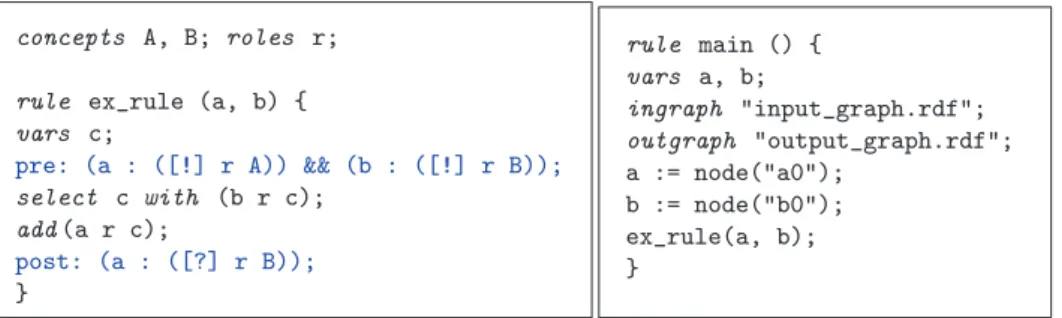
Let us now turn to transformation programs, as the one depicted in Figure2. A program is composed of one or several parameterized rules; and a parameter-less main rule whose purpose is to specify the input- and output graph to be transformed and to identify the root nodes of the input graph. Rules can be as-similated to non-recursive procedures or macros. Procedural abstraction is so far not fully developed in our framework, so the analysis presented in the following concentrates on rule bodies.
The rule ex_rule has a precondition (pre) saying that node a is only con-nected (via arcs of type r) to nodes of type A, and that b is only concon-nected to
4
concepts A, B; roles r; rule ex_rule (a, b) { vars c;
pre: (a : ([!] r A)) && (b : ([!] r B));
select c with (b r c); add (a r c); post: (a : ([?] r B)); } rule main () { vars a, b; ingraph "input_graph.rdf"; outgraph "output_graph.rdf"; a := node("a0"); b := node("b0"); ex_rule(a, b); }
Fig. 2: An example program
nodes of type B. The program now does the following: among the nodes that b is connected to, we non-deterministically pick a node c and introduce an arc r between a and c. For example, the program might introduce an arc between a0 and b1 in the graph of Figure1a(or between a0 and b2). We can now assert that after running this program, the node that variable a points to is connected via r to at least one element of type B, as expressed in the postcondition.
Suppose the example program is in file example.trans. Running the verifier as follows confirms that the program is correct, i.e. that any graph satisfying the precondition is transformed into a graph satisfying the postcondition.
> graphprover example
starting proof ...formula valid
Let us modify the post-condition, claiming that a is exclusively connected to elements of type B:post: (a : ([!] r B));
When running the verifier again, we see that the property is incorrect, and that a counter-model has been created (see Figure 1b, here displayed with Graphviz5
). This counter-model describes the state at the beginning of the pro-gram, namely a graph with four nodes, where c1 is of type A and not of type
B, and c2of type B. Clearly, when connecting a with c2, the post-condition is
violated.
We correct the post-condition, saying that a is only connected to elements of type A or B:post: (a : ([!] r (A [||] B)));Running the verifier again convinces us that this property is satisfied.
How does the verifier validate or invalidate a program? The approach is clas-sic: from the annotated program, we extract a proof obligation by computing weakest pre-conditions (see Section 3.2). This is an ALC formula that is sent to a tableau decision procedure (described in Section 5.2). A failed proof at-tempt produces a saturated tableau from which a counter-model can always be extracted.
Operational semantics Program logic Decision procedure
Code Extraction (Scala/Java)
Program prover (verified) Eclipse environment (unverified)
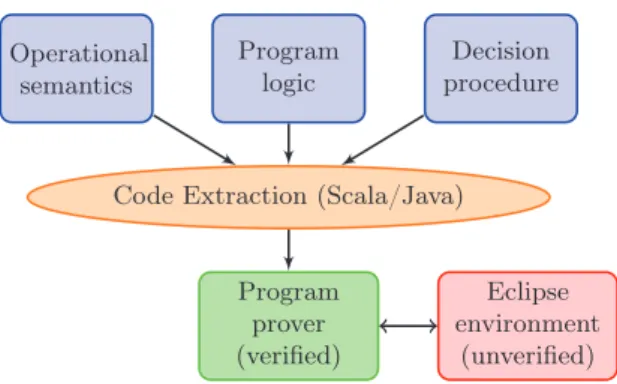
Fig. 3: Schema of formal development
2.2 Developer’s View
Major parts ofsmall-tALC have a strong formal basis and are being developed in a proof assistant. We use Isabelle [15], but the formalization is easily adaptable to related proof assistants. Essential ingredients (see Figure3) are the formal-ization of the program logic, the semantics of the programming language and a decision procedure of the extension of ALC we use (the latter has currently not been completely verified yet). This formalization (written in Isabelle’s own functional and proof language) is automatically extracted to a general-purpose programming language, which is Scala in our case. We therefore obtain a highly reliable program prover, which is coupled with interface functionality (such as parsers and viewers) provided by Eclipse / Xtext to obtain the verifier described in Section2.1. The transformation engine, described more in detail in Section4, is so far unverified, but at least the Java code generator (Section4) could be formally verified with by now standard compiler verification techniques.
3
Foundations
3.1 Logic
Our logic is a three-tier framework, the first level being Description Logic (DL)
concepts, the second level facts, the third level formulas (Boolean combinations of facts and a simple form of quantification). Formulas occur not only in assertions (such as pre- and postconditions), but also in statements (Boolean conditions and select statement).
Concepts: In this paper, we concentrate on the description logic ALC [16]. For a being atomic concept names and r role (or relation) names, the abstract syntax of concepts C can be defined by the grammar:
5
C ::= ⊥ (empty concept) | a (atomic concept) | ¬ C (complement)
| C ⊓ C (intersection) | C ⊔ C (union) | ([?] r C) (some) | ([!] r C) (all) | Cτ (explicit substitution)
The semantics of DLs is given by Kripke structures or, differently speaking, by typed graphs. Under this interpretation, concepts represent sets of individuals. The constructors ¬, ⊓, ⊔ (in Ascii notation: !,[&&],[||]) then have the obvious meaning. ([?] r C) is the set of individuals x such that there is at least one r-typed edge (x r y) between x and y, where y belongs to C. Dually, ([!] r C) is the set of individuals x all of whose r-edges go to individuals of type C.
The last constructor, explicit substitution [17], is a particularity of our frame-work, required for a gradual elimination of substitutions, as further described in Section5.5. We have three kinds of substitutions τ :
– Replacement of a variable by another variable, of the form [x := y],
– Adding a node v to / removing a node from an atomic concept a, of the form [a := a + {v}] respectively [a := a − {v}],
– Adding an edge (v1, v2) to / removing an edge from a role r, of the form
[r := r + {(v1, v2)}] respectively [r := r − {(v1, v2)}].
Facts: Facts make assertions about an instance being an element of a concept, and about being in a relation. The grammar of facts is defined as follows:
f act ::= i : C (instance of concept) | i r i (instance of role)
| i (¬r) i (instance of role complement) | i ≡ i (equality of instances) | i 6≡ i (inequality of instances)
Please note that since concepts are closed by complement, facts are closed by negation (the negation of a fact is again representable as a fact), and this is the main motivation for introducing the constructors “instance of role complement” and “inequality of instances”.
Formulas: A formula is a Boolean combination of facts. We also allow quantifi-cation over individuals i (but not over relations or concepts), and, again, have a constructor for explicit substitution. We overload the notation ⊥ for empty concepts and the Falsum.
f orm ::= ⊥ | f act | ¬f orm | f orm ∧ f orm | f orm ∨ f orm
| ∀i.f orm | ∃i.f orm | f orm τ
In Figure2, we use the Ascii notation !, &&, || for negation, conjunction and disjunction. The extension of interpretations from facts to formulas is stan-dard. As usual, a formula that is true under all interpretations is called valid.
When calculating weakest preconditions (in Section5.1), we obtain formulas which essentially contain no existential quantifiers; we keep them as constructor
because they can occur as intermediate result of computations. We say that a formula is essentially universally quantified if ∀ only occurs below an even and ∃ only below an odd number of negations. For example, ¬(∃x. x : C ∧ ¬(∀y. y : D)) is essentially universally quantified.
3.2 Programming Language
The programming language is an imperative language manipulating relational structures. Its distinctive features are conditions (in conditional statements and loops) that are restricted formulas of the logic ALC, in the sense of Section3.1. It has a non-deterministic assignment statement select ... with allowing to select an element satisfying a fact. Traditional types (numbers, arrays, inductive types) and accompanying operations are not provided; the language is thus only targeted at transformations of graphs.
Statements of our language are defined by the following grammar:
stmt ::= Skip (empty statement)
| select i with f orm (assignment)
| delete(i : C) (delete element from concept) | add(i : C) (add element to concept) | delete(i r i) (delete edge from relation) | add(i r i) (insert edge in relation)
| stmt ; stmt (sequence)
| if f orm then stmt else stmt | while f orm do stmt
Please note that the keywords add and delete are overloaded for nodes and for edges. There is no direct support for creating or deleting nodes in a graph, only for “moving” them between concepts. We intend to simulate node creation and deletion by providing a predefined concept heap such that add(n: heap) corresponds to creating node n and delete(n: heap) to deallocating node n. Details still have to be worked out.
The semantics is a big-step semantics with rules of the form (st, σ) ⇒ σ′
expressing that executing statement st in state σ produces a new state σ′.
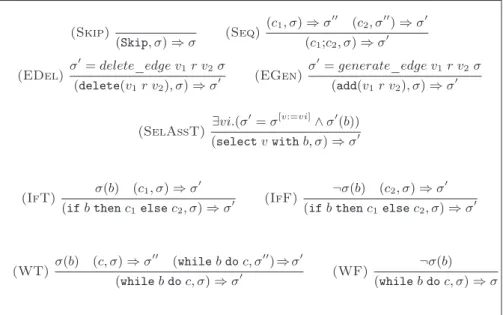
The rules of the semantics are given in the Figure4. Beware that we overload logical symbols such as ∃, ∧ and ¬ for use in the meta-syntax and as constructors of f orm.
We do not enter into the details (also see the Isabelle formalization). Intu-itively, the states σ manipulated by the operational semantics are the same as the interpretations of formulas, and they describe the current structure of a graph: which nodes are contained in each concept; which pair of nodes are contained in a role; and which variables are bound to which nodes. We write σ(b) to evaluate the condition b (a formula) in state σ.
Most of the rules are standard, apart from the fact that we do not use expres-sions, but formulas as conditions. The auxiliary function delete_edge modifies the state σ by removing an r-edge between the elements represented by v1and
v2, and similarly for generate_edge. There are analogous functions for adding /
(Skip) (Skip, σ) ⇒ σ (Seq) (c1, σ) ⇒ σ′′ (c2, σ′′) ⇒ σ′ (c1;c2, σ) ⇒ σ′ (EDel) σ ′= delete_edge v 1r v2σ (delete(v1r v2), σ) ⇒ σ′ (EGen)σ ′= generate_edge v 1r v2σ (add(v1r v2), σ) ⇒ σ′ (SelAssT) ∃vi.(σ ′= σ[v:=vi]∧ σ′(b)) (select v with b, σ) ⇒ σ′ (IfT) σ(b) (c1, σ) ⇒ σ ′ (if b then c1elsec2, σ) ⇒ σ′
(IfF) ¬σ(b) (c2, σ) ⇒ σ ′ (if b then c1elsec2, σ) ⇒ σ′
(WT) σ(b) (c, σ) ⇒ σ
′′ (while b do c, σ′′) ⇒ σ′
(while b do c, σ) ⇒ σ′ (WF)
¬σ(b) (while b do c, σ) ⇒ σ
Fig. 4: Big-step semantics rules
The statement select v with F (v) selects an element vi that satisfies formula F , and assigns it to v. For example, select a with a : A ∧ (a r b) selects an element a which is and instance of concept A and being r-related with a given element b.
selectis a generalization of a traditional assignment statement. There may be several instances that satisfy F , and the expressiveness of the logic might not suffice to distinguish them. In this case, any such element is selected, non-deterministically. Let us spell out the precondition of (SelAssT): Here, σ[v:=vi]is
an interpretation update for individuals, modifying σ for variable v and assigning it a value vi in the semantic domain. We check whether the formula b would be satisfied under this choice, and if it is the case, keep this assignment. In case no satisfying instance exists, the semantics blocks, i.e. the given state does not have a successor state, which can be considered as an error situation.
4
Executing Graph Transformations
Generating Java Code: For processing small-tALC programs such as the one in Figure2and generating Java code, we use the Eclipse environment and, in partic-ular, the Xtext6
facilities for parsing, syntax highlighting and context-dependent help. The program prover is currently not fully integrated in this framework, so
6
that the interaction with the prover is performed via shell commands as described in Section2.1.
In order to generate Java code forsmall-tALC programs, we parse the pro-gram and then traverse the syntax tree with Xtext/Xtend, issuing calls to ap-propriate Java functions that manipulate a graph (which is initially the input graph provided in the program’s main rule). Here is a glimpse at the Xtend code snippet that translates statements, in particular the add statement for roles: def statement(Stmt s){ switch s{ Add_stmt: add(s.lvar,s.role,s.rvar) ... } }
def add(String lvar,String role,String rvar)’’’ «graph».insertEdge(«lvar»,«role»,«rvar»);’’’
Thus, a small-tALC program fragment add(a r b); is translated to a Java call g.insertEdge(a, r, b);, where the graph g is the current graph.
Transforming Graphs: Once a Java program has been generated for a given
small-tALC program, it can be compiled and linked with a library that provides graph manipulating functions such as the above-mentioned insertEdge. When executing this program, it remains to read an input file containing a graph description, to perform the transformation and to output the new graph. We represent graphs in the RDF [2] format. Parsing and printing of RDF files is based on the Apache Jena framework7
.
5
Reasoning about Graph Transformations
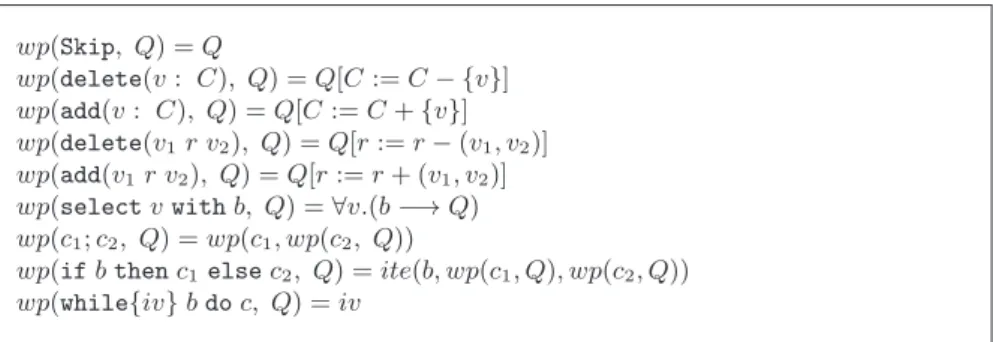
5.1 Weakest PreconditionsFor proving program correctness, we use a standard approach in program ver-ification. For proving that a program prog establishes the postcondition Q if started in a state satisfying the precondition P , we calculate the weakest pre-condition of prog with respect to Q and then show that P implies this weakest precondition.
The details are inspired by the description in [18]: we compute weakest pre-conditions wp (propagating post-pre-conditions over statements and taking loop in-variants for granted) and verification conditions vc that aim at verifying loop invariants. Both take a statement and a DL formula as argument and produce a DL formula. For this purpose, while loops have to be annotated with loop invari-ants, and the while constructor becomes: while {f orm} f orm do stmt. Here, the first formula (in braces) is the invariant, the second formula the termination condition. The two functions are defined by primitive recursion over statements, see Figure5for the definition of wp (and the Isabelle sources for vc).
7
wp(Skip, Q) = Q wp(delete(v : C), Q) = Q[C := C − {v}] wp(add(v : C), Q) = Q[C := C + {v}] wp(delete(v1r v2), Q) = Q[r := r − (v1, v2)] wp(add(v1r v2), Q) = Q[r := r + (v1, v2)] wp(select v with b, Q) = ∀v.(b −→ Q) wp(c1; c2, Q) = wp(c1, wp(c2, Q))
wp(if b then c1elsec2, Q) = ite(b, wp(c1, Q), wp(c2, Q)) wp(while{iv} b do c, Q) = iv
Fig. 5: Weakest preconditions and verification conditions
Without going further into program semantics issues, let us only state the fol-lowing soundness result that relates the operational semantics and the functions wp and vc:
Theorem 1 (Soundness). If vc(c, Q) is valid and (c, σ) ⇒ σ′, thenσ(wp(c, Q))
impliesσ′(Q).
What is more relevant for our purposes is the structure of the formulas gen-erated by wp and vc, because it has an impact on the decision procedure for the DL fragment under consideration here. Besides the notion of “essentially univer-sally quantified” introduced in Section3.1, we need the notion of quantifier-free formula: A formula not containing a quantifier. In extension, we say that a state-ment is quantifier-free if all of its formulas are quantifier-free.
By induction on c, one shows:
Lemma 1 (Universally quantified). Let Q be essentially universally
quanti-fied andc be a quantifier-free statement. Then wp(c, Q) and vc(c, Q) are
essen-tially universally quantified.
There is one major problem with the definition of function wp: the substi-tutions, such as C := C − {v} or r := r − (v1, v2). When conceiving them as a
meta-operations, as is usually done, we see that substitutions would yield syntac-tically ill-formed formulas. For example, reducing ([?] r C)[C := C − {v}] would give ([?] r (C −{v})), which is not a valid concept expression. There are two ways out of this difficulty: we could either relax our syntax and accept expressions of the form ([?] r (C − {v})). This would induce a rather heavy change on the logic. Alternatively, we can treat substitution as a constructor of our language. This is the approach we have adopted, and therefore, substitutions appear as syntactic elements in the definitions of Section3.1. It remains to be seen (in Section5.2) how substitutions can be dealt with by proof methods of ALC.
5.2 Tableau Method
The core of the decision procedure for proving the verification conditions that are obtained as described in Section 5.1is a tableau calculus which combines
the traditional logical rules of a tableau calculus [19] with rules for progressively eliminating the substitutions which are not part of the logic ALC.
As a consequence, and departing again from common practice in the DL literature, our tableau procedure does not manipulate facts (in the sense of Section 3.1), but formulas, i.e. Boolean combinations of facts. This extension becomes necessary because elimination of substitutions generates complex for-mulas. These could in principle be directly decomposed into sub-tableaux, but such a procedure obscures both the presentation and the implementation.
Preprocessing:The tableau manipulates quantifier-free formulas in negation nor-mal form (nnf ).
The formulas obtained from function vc do possibly contain quantifiers, but as mentioned before, the formulas are essentially universally quantified. To get rid of these quantifiers, we therefore perform the following steps:
– We convert the entry formula f to a prenex normal form, i.e. a form ∀x1. . . xn.b
with quantifier-free body b.
– We drop the quantifier prefix; more precisely, we replace the bound variables x1. . . xn in b by free variables. This transformation preserves validity.
– We start the tableau with nnf (¬b). The procedure is a satisfiability check that either produces an empty tableau (meaning that f is valid) or a model of ¬b that is a counter-example of f .
In negation normal form, negations only occur in front of atomic concepts (of the form ¬a, where a is an atomic concept). This invariant is maintained throughout the tableau procedure.
5.3 Tableau Rules
In the following, we present a high-level description of the tableau procedure. (The reader consulting the Isabelle theories will notice that the formalization is on two levels: a set-based, relational version, aiming at proving essential prop-erties such as soundness and completeness of the rules; and a list-based imple-mentation. The formal proofs of these theories are not yet finalized.)
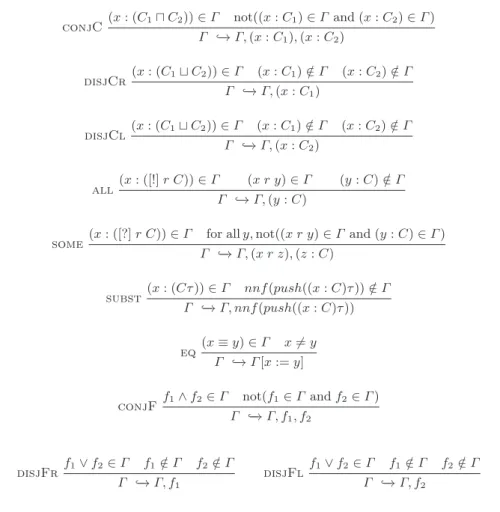
A tableau manipulates sets of branches (also called abox es - “assertional boxes” in DL terminology). Each branch Γ is a set of formulas. We first concen-trate on a set of rules aiming at decomposing formulas on a single branch. They have the form Γ ֒−→ Γ′, expressing that branch Γ is rewriten to Γ′. We write
Γ, f instead of Γ ∪ {f } for adding formula f to Γ . The rules are displayed in Figure6.
Let us comment on the rules: The structural rules conjC, disjCr, disjCl (for concepts) and conjF, disjFr, disjFl (for formulas) should be clear. The rule all allows to conclude y : C if x is only r-connected to elements of type C, and there is an arc (x r y). The rule some inserts an arc (x r z) and a membership z : C for an arbitrary z if it is known that x is r-connected to at least one element of type C. The rule eq propagates an equality x ≡ y in the branch, provided the equality is not x ≡ x.
conjC(x : (C1⊓ C2)) ∈ Γ not((x : C1) ∈ Γ and (x : C2) ∈ Γ ) Γ ֒−→ Γ, (x : C1), (x : C2) disjCr (x : (C1⊔ C2)) ∈ Γ (x : C1) /∈ Γ (x : C2) /∈ Γ Γ ֒−→ Γ, (x : C1) disjCl (x : (C1⊔ C2)) ∈ Γ (x : C1) /∈ Γ (x : C2) /∈ Γ Γ ֒−→ Γ, (x : C2) all(x : ([!] r C)) ∈ Γ (x r y) ∈ Γ (y : C) /∈ Γ Γ ֒−→ Γ, (y : C)
some(x : ([?] r C)) ∈ Γ for all y, not((x r y) ∈ Γ and (y : C) ∈ Γ ) Γ ֒−→ Γ, (x r z), (z : C)
subst(x : (Cτ )) ∈ Γ nnf (push((x : C)τ )) /∈ Γ Γ ֒−→ Γ, nnf (push((x : C)τ ))
eq (x ≡ y) ∈ Γ x 6= y Γ ֒−→ Γ [x := y]
conjFf1∧ f2∈ Γ not(f1∈ Γ and f2∈ Γ ) Γ ֒−→ Γ, f1, f2
disjFrf1∨ f2∈ Γ f1∈ Γ/ f2∈ Γ/ Γ ֒−→ Γ, f1
disjFlf1∨ f2∈ Γ f1∈ Γ/ f2∈ Γ/ Γ ֒−→ Γ, f2
Fig. 6: Tableau rules
The rule subst is applicable for concepts with substitutions. As motivated in Section5.1, substitutions cannot be eliminated at once, but they can be removed progressively, whenever the tableau prover hits on a fact of the form (x : Cτ ). Note that the variable x was possibly not present in the original tableau with which we have started the proof, but may have been introduced by a some-rule. If we encounter such a situation, we push the substitution as far as possible. We postpone the details to Section5.5.
A branch Γ contains a clash (clash(Γ )) if either of the following holds: – for x a variable, (x : ⊥) ∈ Γ
– for x a variable and a an atomic concept, (x : a) ∈ Γ and (x : ¬a) ∈ Γ – for x, y variables, (x r y) ∈ Γ and (x (¬r) y) ∈ Γ
– for x a variable, (x 6≡ x) ∈ Γ – ⊥ ∈ Γ
5.4 Tableau Procedure
We can now formulate a depth-first-search function df s exploring a tableau. The function takes a tableau (here implemented as a list of branches) and returns a list of models. Initially, the tableau is just the formula [{f }] to be proved. If the resulting list is empty, f is not satisfiable. Otherwise, the list contains an element which is a model of f .
df s[ ] = [ ] df s(Γ :: Γs) = if clash(Γ ) then df s(Γs) else ifreducible(Γ ) thendf s({Γ′|Γ ֒−→ Γ′}@Γ s) else[Γ ]
The procedure progressively eliminates all inconsistent branches (with clash(Γ )). If a branch Γ is not inconsistent, but reducible (i.e. , there exists a Γ′ with
Γ ֒−→ Γ′), then we expand the tableau and explore the new branches.
5.5 Eliminating Substitutions
The push function used in the subst rule of Figure6 pushes substitutions into formulas, “as far as possible”. The remaining tableau rules then decompose for-mulas until substitutions hidden in subforfor-mulas become apparent and the subst rule can be applied again. Intuitively speaking, this process decreases the “height” of the substitutions in a formula, until they eventually disappear.
For a formula f , we define push(f ) as the formula f′ which is the result of
the rewrite system spelled out in the following. Thus: push(f ) = f′ iff f ∗f′,
where the rewrite relation is defined in the following. There are numerous cases to consider, and we do not present all of them.
Substitution in formulas are pushed into subformulas: – ⊥τ ⊥
– (¬f )τ (¬fτ )
– (f1∧ f2)τ (f1τ ∧ f2τ )
– (f1∨ f2)τ (f1τ ∨ f2τ )
Substitution in facts: Substitutions of individual variables f [x := y] are carried out as expected. Otherwise, we procede as follows:
– (x : ¬C)τ x : (¬Cτ )
– (x : C1⊓ C2)τ x : (C1τ ⊓ C2τ )
– For substitutions τ of the form a := a − {v} or a := a + {v}:
• (x : c)[a := a − {v}] (x : c) for a 6= c, and similarly for a := a + {v} • (x : a)[a := a − {v}] (x : a) ∧ x 6= v
• (x : a)[a := a + {v}] (x : a) ∨ x = v
• (x : ([?] r C))[a := a − {v}] (x : ([?] r C[a := a − {v}])), and similarly for the other combinations involving constructor [?] or [!] and substitutions a := a + / − {v}.
– For substitutions τ of the form r := r − {(v1, v2)} or r := r + {(v1, v2)}:
• (x : c)[r := r − {(v1, v2)}] x : c, and similarly for r + {(v1, v2)}
• (x : ([!] r′C))[r := r − {(v 1, v2)}] (x : ([!] r′C)) for r 6= r′ • (x : ([!] r C))[r := r − {(v1, v2)}] ite ((x = v1) ∧ (v2: (¬C[r := r − (v1, v2)])) ∧ (v1r v2), (x : (< 2 r (¬C[r := r − (v1, v2)]))), (x : ([!] r C[r := r − (v1, v2)])))
Here, ite is for if-then-else: ite(a, b, c) = (a −→ b) ∧ (¬a −→ c).
Please note that the logic ALC cannot completely express the effect of substitution, and we have to resort to the more expressive logic ALCQ, which turns out to be complete for substitutions. Thus, the “then” branch of the ite construct expresses that x is r-connected to less than 2 elements of (¬C[r := r − (v1, v2)]). We have however not yet implemented tableau
rules for ALCQ, so we stick to the simpler logic in this presentation. • (x : ([!] r C))[r := r + {(v1, v2)]
¬((x = v1) ∧ (v2: ¬(C[r := r + (v1, v2)])) ∧ (v1(¬r) v2))
∧(x : ([!] r (C[r := r + (v1, v2)])))
• Similar rules for existential quantification (x : ([?] r C)).
6
Conclusions
We have presented small-tALC, a framework for executing graph transforma-tions and proving their correctness with a sound and complete calculus. One of the distinctive features of the approach is its formal semantic basis. We are now moving towards application, such as Sparql Query and Update in the knowl-edge representation world, and model transformations as used in model-driven engineering. The greatest challenge is the development of logics that are more expressive than ALC but remain decidable. Even though a low proof-theoretic complexity is not a major concern for program correctness proofs (these are not executed on a large knowledge base), the concern changes when wanting to execute programs efficiently on a large data set.
Acknowledgements We are grateful to María Espinoza who has helped us explore the applicability of graph transformations to the RDF world [20].
References
1. Budinsky, F., Brodsky, S.A., Merks, E.: Eclipse Modeling Framework. Pearson Education (2003)
2. Cyganiak, R., Lanthaler, M., Wood, D.: RDF 1.1 Concepts and Abstract Syntax.
http://www.w3.org/TR/rdf11-concepts(2014)
3. Arendt, T., Biermann, E., Jurack, S., Krause, C., Taentzer, G.: Henshin: Advanced concepts and tools for in-place EMF model transformations. In: Proceedings of MoDELS’10. Volume 6394 of LNCS. Springer (2010)
4. Immerman, N., Rabinovich, A., Reps, T., Sagiv, M., Yorsh, G.: The boundary be-tween decidability and undecidability for transitive-closure logics. In Marcinkowski, J., Tarlecki, A., eds.: Computer Science Logic. Volume 3210 of LNCS. Springer Berlin / Heidelberg (2004) 160–174
5. Poskitt, C.M., Plump, D.: Hoare-style verification of graph programs. Fundamenta Informaticae 118(1-2) (2012) 135–175
6. Møller, A., Schwartzbach, M.I.: The pointer assertion logic engine. In: PLDI. (2001) 221–231
7. Ghamarian, A.H., de Mol, M., Rensink, A., Zambon, E., Zimakova, M.: Modelling and analysis using GROOVE. STTT 14(1) (2012) 15–40
8. Habel, A., Pennemann, K.H., Rensink, A.: Weakest preconditions for high-level programs. In Corradini, A., Ehrig, H., Montanari, U., Ribeiro, L., Rozenberg, G., eds.: Graph Transformations (ICGT), Natal, Brazil. Volume 4178 of LNCS. Springer Verlag, Berlin (September 2006) 445–460
9. Habel, A., Pennemann, K.H.: Correctness of high-level transformation systems relative to nested conditions. MSCS 19(02) (2009) 245–296
10. Pennemann, K.H.: Resolution-like theorem proving for high-level conditions. In Ehrig, H., Heckel, R., Rozenberg, G., Taentzer, G., eds.: Graph Transformations. Volume 5214 of LNCS. Springer Berlin / Heidelberg (2008) 289–304
11. Radke, H.: HR* graph conditions between counting monadic second-order and second-order graph formulas. ECEASST 61 (2013)
12. Asztalos, M., Lengyel, L., Levendovszky, T.: Formal specification and analysis of functional properties of graph rewriting-based model transformation. Software Testing, Verification and Reliability 23(5) (2013) 405–435
13. Jackson, D.: Software Abstractions: Logic, language, and analysis. MIT Press (2012)
14. Baresi, L., Spoletini, P.: On the use of Alloy to analyze graph transformation systems. In Corradini, A., Ehrig, H., Montanari, U., Ribeiro, L., Rozenberg, G., eds.: Graph Transformations. Volume 4178 of LNCS. Springer (2006) 306–320 15. Nipkow, T., Paulson, L., Wenzel, M.: Isabelle/HOL. A Proof Assistant for
Higher-Order Logic. Volume 2283 of LNCS. Springer Berlin / Heidelberg (2002)
16. Baader, F., Sattler, U.: Expressive number restrictions in description logics. Jour-nal of Logic and Computation 9(3) (1999) 319–350
17. Abadi, M., Cardelli, L., Curien, P.L., Lévy, J.J.: Explicit substitutions. Journal of Functional Programming 1(4) (October 1991) 375–416
18. Nipkow, T., Klein, G.: Concrete Semantics. http://www21.in.tum.de/~nipkow/ Concrete-Semantics/(2014)
19. Baader, F., Sattler, U.: Tableau algorithms for description logics. In Dyckhoff, R., ed.: Automated Reasoning with Analytic Tableaux and Related Methods. Volume 1847 of LNCS. Springer (2000) 1–18
20. Espinoza, M.V.: Transformation de graphes en RDF. Master’s thesis, Université de Toulouse (2014)