Collection, Evaluation, and Diffusion of
Information in Online Communities
by
Evangelos Mamas
Submitted to the System Design and Management Program
in partial fulfillment of the requirements for the degree of
Master of Science in Engineering and Management
at the
MASSACHUSETTS INSTITUTE OF TECHNOLOGY
September 2005
L F rbLarv ?2 oo
( Evangelos Mamas, MMV. All rights reserved.
The author hereby grants to MIT permission to reproduce and
distribute publicly paper and electronic copies of this thesis document
in whole or in part. I/ // HU-i H S INS11TUT f TECHNOLOGY UN 2 1 2006 BRARIES BRARIES
Signature of Author ...
Evangelos Mamas
System Design and Management Program
September 7, 2005 LICertified
by
... ...
.
Professor, Sloan
...
\\" E'c von Hippel
ScRl of Management
Thesis Supervisor
ARCHIVES f use9s. I-
N 'Collection, Evaluation, and Diffusion of Information in
Online Communities
by
Evangelos Mamas
Submitted to the System Design and Management Program
on September 7, 2005, in partial fulfillment of the requirements for the degree of
Master of Science in Engineering and Management
Abstract
In this thesis, I study a number of online information communities to understand how open practices are currently used in supporting community functions. By examining how communities operate, I hope to provide individuals and corporations interested in creating such communities with a good starting point. The communities examined, some corporate and some user sponsored, share different types of information and have different intents. I analyzed the communities in terms of their openness in the following three major community functions: information collection, information evaluation, and information diffusion. The benefits and challenges of open practices are discussed and the tradeoffs involved in selecting the most appropriate practice for each major community function are presented.
Thesis Supervisor: Eric von Hippel
Acknowledgments
I am very grateful to Professor Eric von Hippel not only for guiding me throughout the thesis process but also for his patience and understanding during the past few terms. I would like to express my gratitude to MIT and Sloan for providing an amaz-ing learnamaz-ing opportunity. My experience here has been great and my unwillamaz-ingness to finish my thesis is a proof of that (or so I like to think!).
I would like to thank my parents and my sister for their continuing support and encouragement during the program and my stay here in Boston. Last but not least, I would like to thank Angela for being there for me throughout the past year, for
providing the motivation to continue the work, and for taking the time to proof read
Contents
1 Introduction 11
2 Information Collection 2.1 Collection Defined.
2.2 Understanding Communities.
2.2.1 Central and Peripheral Information ... 2.2.2 Community Intent and Sponsorship ... 2.2.3 Degree of Openness ...
2.2.4 Aligning Degree of Openness with Type of Sponsorship 2.3 Contribution Incentives .
2.4 Practices that support contributions ...
3 Information Evaluation 3.1 Evaluation defined.
3.1.1 Information Screening and Rating ... 3.2 Information Screening in Communities ...
3.2.1 Information Screening Practices ... 3.2.2 Screening Practices Tradeoffs Considered . 3.3 Information Rating in Communities ...
3.4 Information Rating Practices .
3.4.1 Rating Practices Tradeoffs Considered . .
4 Information Diffusion 15
... .
15
... .
16
... .
16
... .
17
... .
19
... .
21
. . . 22... .
24
27 ... ...27 ... ...28 ... ...29 ... ...31 ... ...32... . .33
... ...33 ... ...34 374.1 Diffusion Defined ... 37
4.2 Benefits of Information Diffusion ... . 38
4.3 Challenges of Information Diffusion . . . ... 39
4.4 Information Life Cycle ... 41
5 Conclusions 43 A Online Communities 45 A.1 alphaWorks "Emerging Technologies" ... . 45
A.2 developerWorks "IBM's resource for developers" ... . 47
A.3 HP Support Forums "IT resource center forums" ... . 48
A.4 Mars Clickworkers ... 50
A.5 Slashdot "News for Nerds. Stuff that matters" ... . 50
A.6 ThinkCycle "Open Collaborative Design" ... 51
List of Figures
2-1 Central and Peripheral Information Types ... 17
2-2 Community Intent and Type of Sponsorship ... 19
2-3 Type of Sponsorship vs. Degree of Openness ... 21
2-4 Information Contributors Benefits ... 23
3-1 Information Screening and Rating ... . 30
3-2 Information Screening Practices ... .. 32
3-3 Information Rating Practices . . . .. .. 35
Chapter 1
Introduction
The revolution in information and communication technologies during the past two decades has enabled a global information network known as the Internet. The Inter-net has drastically changed the boundaries of communities by enabling people from all around the world to interact in ways that were previously impractical if not im-possible. One common use of the Internet is to extend the interactions between social groups with preexisting ties such as family, friends and even corporate networks. How-ever, what is more astonishing is the amount of interaction between people without pre-existing ties. In fact, a large number of online communities (communities based on the Internet) with diverse goals have been formed between people with similar interests[3].
In recent years, many corporations have realized the business value that online communities can add and as a result have started building and supporting their own online communities. Chan and Lee report that online user communities have helped corporations leverage the creativity of customers in all phases on new product development[4]. They classify communities into five types based on the characteris-tics of the members and the interaction levels: virtual customer communities, beta testing volunteer corps, user content collaboration innovation community, user devel-opment community, user product collaboration innovation community. While they observed a significant difference between knowledge creation, sharing, and diffusion
in the various community types they also found that user product collaboration in-novation communities can help in all phases of new product development. Dahan and Srinivasan describe in their work how virtual reality tools can be used by com-panies to enable internet-based testing of new product concepts[7]. Satish describes how corporations across industries including Cisco, Bang & Olufsen, Fiat, and Mi-crosoft have established virtual customer communities to improve their new product development processes[17]. Given the potential value customers and lead users can deliver to corporations, it should come as no surprise that corporations have been actively involved in establishing online communities. Wenger's work on Communities of Practice (COP), has helped raise awareness on the business benefits of supporting "groups of people informally bound together by shared expertise and passion for a joint enterprise" [26]. In particular, he claims that COPs can add value to corpora-tions by generating new lines of business, solving problems, spreading best practices, developing people's skills, and helping to recruit talent. With the use of new infor-mation technologies, COPs become no different than online inforinfor-mation communities sponsored by corporations to help accomplish certain business objectives. Yet another way for corporations to get value from online communities is in the area of market research. According to Kozinets, internet ethnography methods can be applied on internet discussion forums and communities where people discuss the value of various products[16]. This is a non-invasive way to learn how well products are perceived and how they should be redesigned in the future. Individuals themselves also benefit by sharing information in communities. Von Hippel has studied how both online com-munities such as the Apache Open Source Software and more traditional comcom-munities like those in high performance windsurfing can be a great source of innovation[25]. He introduces the notion of "agency cost" which is the cost that manufactures have to pay in order to learn what users really want. As it turns out, users are motivated to freely reveal their innovations when their benefits outweigh their costs. He con-cludes that when the following three conditions are met user communities engaged in innovation can flourish: i) at least some users have incentives to innovate, ii) at least some users have incentives and means to reveal their innovations, and iii) user
led-diffusion can compete with commercial production and distribution. As more and more user communities equipped with valuable knowledge emerge, corporations need
to rethink not only how they develop new products but also how they collaborate with
their customers and even competitors. Chesbrough, in his work on Open Innovation, suggests that corporations use external channels to obtain ideas and to market their products[6]. The concept of using open practises in online communities sponsored by corporations and/or users in their effort to create and deliver value to their sponsors has been a major motivation for this work.
The purpose of this work is to explore and understand how online information communities can be supported by open practices. I have identified a number of online information communities that differ in the type of information they share, the
nature of their sponsorship and their intent (See Appendix A). In terms of the type
of information, I have selected online communities that share information in the form of software toolkits (alphaWorks), technical articles (developerWorks), encyclopedic entries (Wikipedia), news articles (Slashdot), design documents (ThinkCycle), online discussion forums (HPForums), and even crater recognition results from pictures of Mars (Clickworkers). The diversity in the type of information that these communities share is intentional in the hope to identify practices that hold for a broad range of online information communities. In terms of the nature of sponsorship, I make the distinction between communities that are user sponsored and communities that are corporate sponsored. While the specific intent of each of the communities is unique, I choose to differentiate between communities that serve a business objective and communities that solely serve the public good. In this broad sense intent is aligned with sponsorship. In the chapters that follow, I examine all communities in terms of the following three major community functions: Collection, Evaluation, and Diffusion. Information Collection is the function of growing the content of the community by gathering information from its members. This function focuses on the openness of the collection practice in terms of who can contribute to the community and what their incentives are. Information Evaluation is the function of screening and assessing
the quality of the information. More specifically, I consider how open the screening process and the information quality mechanisms are. Information Diffusion is the function of sharing the information with the community and considers the intellectual
Chapter 2
Information Collection
The focus of this chapter is on the information collection practices used in online user communities. Online communities are examined with respect to the intent of their sponsors and categorized according to the degree of openness they employ in collecting information from their members. The incentives to contribute are further examined in the context of each community. Finally, a number of practices that support and encourage collection of information are presented to guide community builders in growing their communities.
2.1 Collection Defined
Information collection is the most fundamental function of an online community and is essential to the existence of the community itself. In this work, information collection is defined as the set of practices that enable and support the function of informa-tion accumulainforma-tion in online communities. At the core of this definiinforma-tion is the act of contributing information relevant to the purpose of the community by members of the community, or information producers, with diverse motives. The definition goes beyond the mere act of contributing information, to include the organization of communities to enable members to contribute information, the information
pro-ducer incentives to share the information with the community, and the practices that
2.2 Understanding Communities
In this section, communities are examined with respect to the following three criteria: i) the type of information collected, ii) the intent of the sponsors who established and support the communities, and iii) the degree of openness in terms of information collection.
2.2.1 Central and Peripheral Information
When examining online communities it is frequently possible to make the distinction between central and peripheral information. Central information is any information that is at the heart of the community's intent. On the other hand, peripheral infor-mation is inforinfor-mation supporting the central inforinfor-mation. In Wikipedia for example, the central contribution comes in the form of an "encyclopedic entry" while periph-eral information comes in the form of discussion threads around the given entry. In alphaWorks, the central contribution comes in the form of software toolkits, while the peripheral contributions come in the form of questions and comments regarding the use of the toolkits. In Figure 2-1, I summarize the central and peripheral infor-mation types for each community examined in this work. It should be noted that the distinction between the central and peripheral information is not always possible. In the case of HPForums both central and peripheral information are in the form of discussion forum messages and cannot be distinguished. In other cases, such as Clickworkers, peripheral information is not collected at all.
A simple way to think about central vs. peripheral information contributions is to consider central as the information that attracts members to the community and peripheral as the information that engages people to the community. In his work on the role of peripheral members in online communities, Zhang concludes that the number of peripheral members in an online community is typically much higher than that of central members[29]. While peripheral members may appear to be free-riding, in reality they may collectively contribute as much as the central members. In some of
Figure 2-1: Central and Peripheral Information Types
the communities examined in this work, one can observe that peripheral contributions can increase the perceived value of the central information and can help grow the community. One of the key features of Slashdot for example, is that members of the community get to read not only the news stories but most importantly the reactions of other community members to these news stories.
2.2.2 Community Intent and Sponsorship
The intent of online information communities is directly linked to the type of
spon-sorship supporting the operation of the community. I choose to make the distinction
between sponsored and corporate-sponsored communities. The intent of user-sponsored communities is aligned with serving the needs of the community members.
On the other hand, the intent of corporate-sponsored communities is to support the
community and its members in order to address a business objective.
Traditionally online communities have been formed by enthusiasts with a need to share knowledge on a topic of common interest. The founders of these communities are typically individuals with the know-how required to build and operate the
tech-Community Central information Peripheral information
alphaWorks Software toolkits Discussion messages, Ratings of technologies
developerWorks Technology articles Discussion messages and feedback on product features HPForums Discussion messages Discussion messages
Clickworkers Identification of craters None
Slashdot News stories Discussion messages and ratings of news stories
ThinkCycle Problem statements and Discussion messages and design concepts feedback on concepts Wikipedia Encyclopedic entries Discussion messages
nology necessary to support the community itself. The focus of these communities can range from providing news stories for technology enthusiasts, as in Slashdot, to sharing software toolkits as in the open source communities, to collaboratively creat-ing free encyclopedia for the masses as in Wikipedia. What is common in all these cases is that these communities have been founded by users to serve users without any explicit expectation of achieving monetary benefits from the community. While the founders and users of these communities enjoy other benefits the communities themselves were founded in the spirit of enabling users to help each other.
It is important to note that as online communities grow in terms of members so do their financial needs. Depending on the community interactions, the cost associated with maintaining online communities will increase as the number of members and the amount of information grows. Some of the user-supported communities, such as Slashdot, have chosen to support their activities by introducing advertising in the content and by offering members the option to purchase subscriptions which are free of advertising. On the other hand, other communities such as Wikipedia have de-cided to grow by obtaining a not-for-profit status and seeking donation from private sources as well as grants from government sources all over the world. For the purpose of this work, these communities are considered user-sponsored communities because their intent is simply to serve the users of the community.
Corporate-sponsored online communities on the other hand, have been emerg-ing in the recent years as more corporations started realizemerg-ing their potential and understanding how to create and operate them. Typically, the intent of corporate sponsored communities is aligned with a business objective. As such, the benefits of the community sponsor need to be well understood and the appropriate funding to support the community is allocated by the sponsoring corporation. Examples of corporate-sponsored communities include alphaWorks from IBM and HPForums from Hewlett-Packard. alphaWorks is an online community used by IBM to identify the potential of emerging technologies that are developed within the company.
HPFo-rums is a user support forum that enables HP customers to support each other on using products from HP and in the process enables HP to improve its own products. It should be noted that even though corporate sponsored communities are aligned with business objectives, this does not and should not prevent them from serving the rest of the community members.
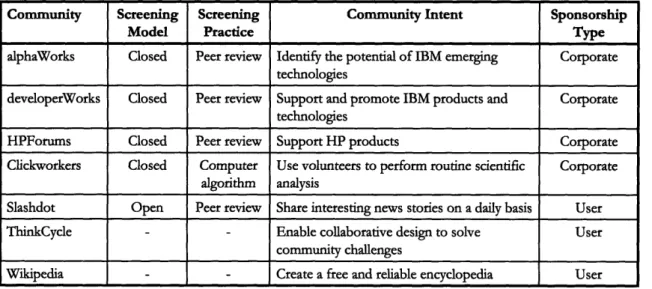
In Figure 2-2, I describe the intent of each online information community I exam-ined in this work and I indicate the type of sponsorship for each.
Figure 2-2: Community Intent and Type of Sponsorship
2.2.3 Degree of Openness
The term open community has been widely used in the management literature to en-capsulate a number of concepts. Reagle defines an open community as one that demonstrates: 1) open products, transparency, integrity, non-discrimination, and non-interference[15]. For the purpose of information collection this definition is over-determined. I shall define openness as it relates to the ease of a user to contribute to the community. In this work an open online community is one that allows anyone
Community Community Intent Sponsorship Type
alphaWorks Identify the potential of IBM Corporate emerging technologies
developerWorks Support and promote IBM products Corporate and technologies
HPForums Support HP products Corporate Clickworkers Use volunteers to perform routine Corporate
scientific analysis
Slashdot Share interesting news stories on a User
daily basis
ThinkCycle Enable collaborative design to solve User community challenges
Wikipedia Create a free and reliable User encyclopedia
to contribute central and peripheral information. On the other hand, the smaller the set of people that can contribute the less open, or more closed, an online community is. In later chapters, I will revisit the degree of openness and examine it in terms of evaluation and diffusion of information.
A community with the highest degree of openness, or an open information col-lection model, allows any user to contribute information that is both central and peripheral in nature. On the other hand, a community with a closed collection model accepts contributions from a selected group of people. It should be made clear that open collection of information does not necessarily translate to open diffusion of infor-mation due to the concerns of inforinfor-mation quality and intellectual property ownership. The process of "screening" the information applies to both open and closed commu-nities and will be discussed in depth in the following chapter.
Open communities have the potential to engage a large number of members and can grow very fast. The open nature of the community however increases the needs for sophisticated quality control mechanisms to ensure that the collected informa-tion is relevant to the community and that it does not violate community policies and copyrights. The Slashdot community for example, collects news stories from all members and each such story has the potential to become central information by becoming available on the main web pages.
On the other hand, closed communities can be used to simplify management and to control intellectual property ownership. The alphaWorks community, used to identify the emerging technologies of the future and capture economic rents from them, requires that the sponsoring company, IBM in this case, own the intellectual property related to all central contributions, or software toolkits. Closed communities may run into the problem of maintaining a critical mass of interesting information without which any online community is doomed to fail.
2.2.4 Aligning Degree of Openness with Type of Sponsorship
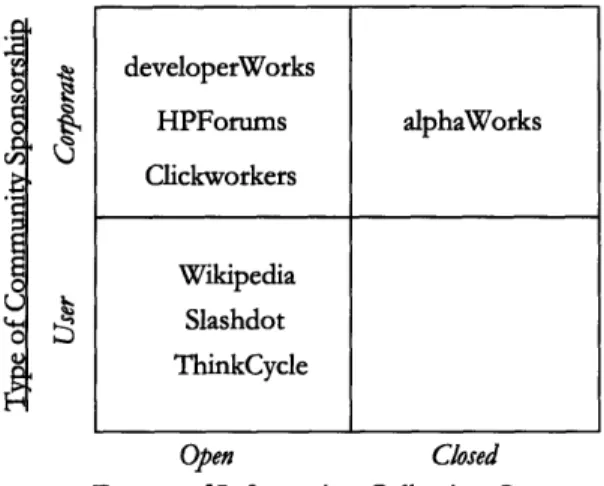
In this section, I examine communities in terms of the type of sponsorship and the degree of openness. As can be seen in Figure 2-3, it is possible for corporations to create and sponsor successful online information communities that use either open or closed collection models. In particular, communities like developerWorks, HPForums, and Clickworkers are used to share knowledge within the community and benefit greatly from allowing everyone to contribute. On the other hand, communities like alphaWorks choose to accept only the content that the sponsoring company creates because that is the only content IBM can generate value from. It should be noted that information collection is closed with respect to the central information, software toolkits in the case of alphaWorks; it remains open for peripheral information like feedback on the toolkits. As expected, all communities examined implement an open collection model for peripheral information because the feedback of the community is always valuable. Looking at the user sponsored communities, one can observe that all the ones examined use an open collection model. However, open communities with a closed collection model for central information can exist if the diffusion of information is also closed. In such a case these communities can be considered private that are supported by the users and are only accessible by the supporting members.
r 4. C C C rg V. C L. C I I I-Open Closed
Degree of Information Collection Openness
Figure 2-3: Type of Sponsorship vs. Degree of Openness
developerWorks HPForums alphaWorks Clickworkers Wikipedia Slashdot ThinkCycle
2.3 Contribution Incentives
In this section we examine what motivates people to contribute information to online communities. The motivations of individuals to contribute to online communities have been covered extensively in management research literature using a variety of underlying theories. Tzouris, in his master thesis on motivation in software com-munities, examined 36 articles and found that 33.3% used theory of comcom-munities, 27.7% used motivational psychology, 13.8% used governance structure, 13.8% used economics, and 11% used the gift economy or other theories[23]. Hemetsberger in her work on virtual communities identified a set of key elements and related con-cepts and theories to explain exchange processes in virtual communities[9]. They key elements include intrinsic motivation, extrinsic rewards, meaning of exchange, gift-giving, common goals and values, and communal relationships. Butler et al. in their work on community building define four types of benefits to explain what motivates people to participate in online communities[3]. The benefits types can be grouped into personal that benefit the contributor directly and altruistic that benefit others in the community. The personal benefits are further categorized in informational, so-cial, and visibility benefits. Informational benefits include gaining access to otherwise inaccessible information and improving ones abilities by leveraging the information they acquire. Social benefits include the building of social ties that provide friendship and support. Visibility benefits enable people to establish an online reputation that could be eventually linked to more direct economic of professional benefits. Finally, altruistic benefits include the personal satisfaction of contributing to the community, helping others and working towards a common goal.
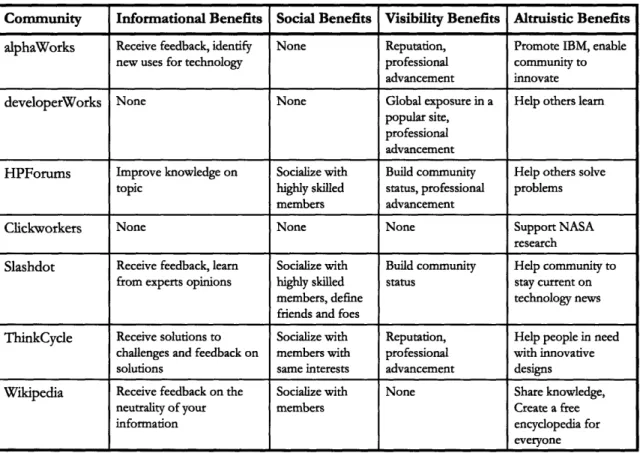
In this work, I use the four types of benefits introduced by Butler et al. and apply them to each community studied. The results presented in Figure 2-4, examine the benefits of contributors of central information. Overall, it appears that contributors of central information value highly the ability to receive feedback on their contributions
and are also motivated by visibility and altruistic benefits. Contributors of peripheral information appear to be more motivated by altruistic and visibility benefits. One
important benefit, not captured by the four types, is the direct economic and task
involvement benefits. In the case of direct economic benefits, the developerWorks community provides competitive monetary rewards to authors of published articles. When the information producers have many channels for distributing their work, corporate-sponsored communities can successfully use monetary rewards to collect information. However, using this type of motivation by itself is not recommended. It should be coupled with visibility benefits that motivate contributors to gain high visibility by contributing central information to very popular and highly respected communities. Surprisingly corporate-sponsored communities such as Clickworkers demonstrate that information collection can be motivated by task involvement ben-efits alone. In this community users are willing to play the "game" of identifying craters in digital images mainly because the activity itself is extremely enjoyable.
Figure 2-4: Information Contributors Benefits
Community Informational Benefits Social Benefits Visibility Benefits Altruistic Benefits
alphaWorks Receive feedback, identify None Reputation, Promote IBM, enable new uses for technology professional community to
advancement innovate developerWorks None None Global exposure in a Help others learn
popular site, professional
advancement
HPForums Improve knowledge on Socialize with Build community Help others solve topic highly skilled status, professional problems
members advancement
Clickworkers None None None Support NASA
research
Slashdot Receive feedback, learn Socialize with Build community Help community to from experts opinions highly skilled status stay current on
members, define technology news friends and foes
ThinkCycle Receive solutions to Socialize with Reputation, Help people in need challenges and feedback on members with professional with innovative solutions same interests advancement designs
Wikipedia Receive feedback on the Socialize with None Share knowledge, neutrality of your members Create a free
information encyclopedia for
2.4 Practices that support contributions
A number of practices that support information collection in online communities and encourage members to contribute have been observed in the communities examined. The practices listed below do not serve as a complete reference; rather they are a starting point in helping builders of both user and corporate sponsored online communities ease the task of information collection.
* Simplicity of the collection process is critical to encourage contribution. If the cost associated with contributing information is high then individuals will be less willing to contribute. Most modern information systems such as Wikis, Blogs, and phpBB forums used to support communities, enable members to easily contribute content, and provide them with instant gratification. This is true for all communities examined.
* Modularity of the contributions is another way to encourage contribution. Com-munity interactions should be designed to be highly modular to enable contrib-utors to do as much or as little as they want while enabling them to link their contributions to the rest of the information. Wikipedia, for example, allows users to create entry stubs without much content in the hope that other mem-bers will populate them. Wikipedia also allows users to update an entry by making only minor edits if they choose to do so. In open source software devel-opment high modularity enables easy division of labor among users and effective coordination of their efforts[22].
· Enjoyment of the contribution itself can be a motivating factor for contribut-ing information to the community as previously described in reference to the Clickworkers community.
All the practices mentioned above, can be used to improve the collection of both central and peripheral information. The practice of peripheral information collection itself is extremely important and should be supported by all communities. Periph-eral information collection will enable the majority of the community members, who
are peripheral in nature, to contribute in alternative ways. As previously discussed, collection of peripheral information is highly valued by contributors of central infor-mation because this is feedback on their contributions. Peripheral inforinfor-mation can be easily organized around central information by using discussion forums, online polls, rating mechanisms, and even file sharing.
Chapter 3
Information Evaluation
This chapter addresses the issue of information evaluation in online user communities. First, I define evaluation as a function comprised of the screening and rating sub-functions. I explain the differences between these two functions and I summarize the screening and rating models used in the examined communities. Each sub-function is further examined in more detail and the common practices for each are described. Fi-nally, tradeoffs in selecting the right screening and evaluation practices are presented and explained.
3.1 Evaluation defined
Evaluation of information in online communities in terms of its quality is a critical function for the success and growth of the community. Neus, in his work on man-agement of information quality in virtual communities, describes the significance of information quality and observes that most research focuses on information concepts suitable for mega-sites with millions of users[18]. However, for smaller scale virtual communities it is common to either ignore, over-control, or rely on unwieldy tools for information quality management. All of these approaches could hamper the success of an online information community because of the potentially high transaction costs incurred by the information consumers. As it turns out, low-quality information re-quires a lot of human attention and as some have observed a explosion in low-quality
information may convert our "information society" to an "attention deficit society". Herbert Simon, Turing Award winner, captures this phenomenon very elegantly in his quote:
What information consumes is rather obvious: It consumes the
atten-tion of its recipient. Hence a wealth of informaatten-tion creates a poverty of
attention.
One of the greatest challenges to implementing any type of quality policy is the diffi-culty to define quality in a way that every community member can agree with. Even if one was able to do so, it would still not work because the community itself will change its views as it acquires new members over time. Joseph Juran, author of many books on quality management, defines quality as the "fitness for use". Phil Crosby, another popular author on the topic, defines quality as "conformance to requirements". Both of these popular definitions provided by experts on the topic of product quality pro-vide us with no direct answer to the question "what is quality". They merely point us to the "right" direction of what quality may be. Juran's definition requires that we define "fit" and "use". Is there an objective way to determine what information is fit and how it will be used within a community? Crosby's definition implies that we define "conformance" and that we are aware of the "requirements". How can one know if all requirements have been gathered and how can conformance be checked?
3.1.1 Information Screening and Rating
In this work, I will not attempt to provide yet another quality definition. My goal is to understand the practices of online communities in trying to enforce what they interpret as quality. In doing so, I believe that it worth separating the information evaluation function into the two distinct sub-functions of "information screening" and "information rating".
Information screening is the function of filtering out information that is not interest-ing and relevant to the community. This is a one-time event that typically occurs at the time the information is collected and before it becomes available to everyone
in the community. The purpose of screening is aligned with the intent of each com-munity as I will describe in later sections. The degree of openness of the screening function is defined based on who can participate. If any member of the community can participate then the information screening model is considered open, otherwise it is considered closed.
Information rating is the function of associating a piece of information that is already available in the community with an "index of goodness". I use the term goodness to refer to what each community member perceives as good. Typically information rating is performed on an ongoing basis and the rating of any particular information could change at any given time. Again the degree of openness of the rating function depends on who can participate. If any member gets to participate then the informa-tion rating model is considered open, otherwise it is considered closed. In this case however, there is another dimension of openness and it relates to who can see the rating results. Open access to results means that everyone has access to the ratings, while closed results means that only a selected group of people can access the ratings. Furthermore, an additional dimension of the rating model is whether it applies to the information or the contributing member.
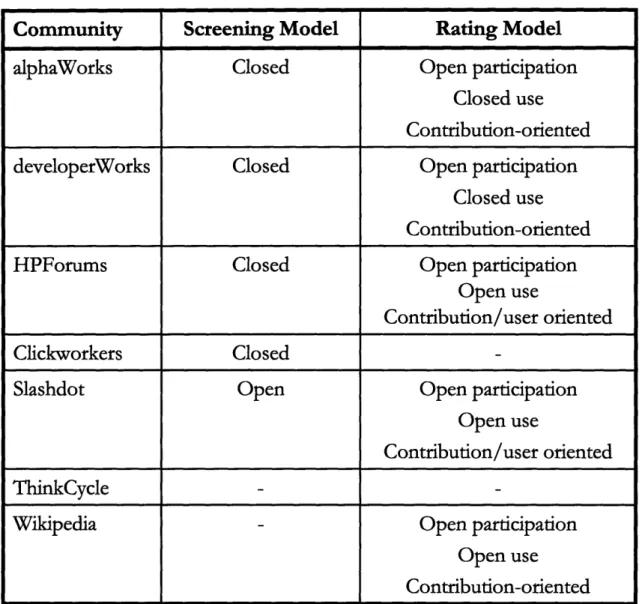
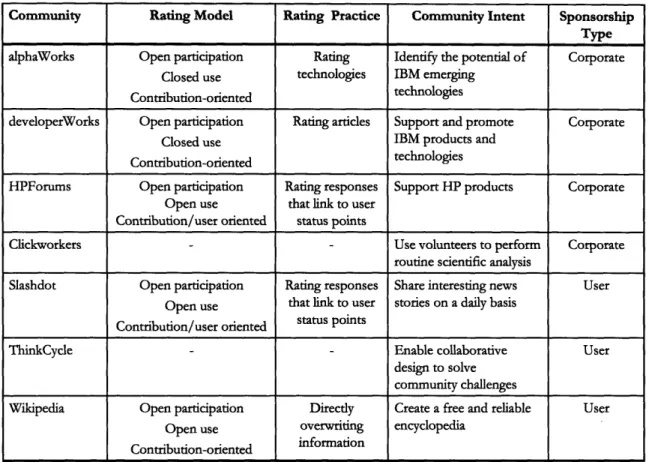
Figure 3-1, summarizes the screening and rating models used by the communities I studied. One interesting observation is that all the corporate-sponsored communities use a closed screening model while all the user-sponsored communities use either an open screening model or none at all. The screening and rating models and their relation to the intent of the communities will be examined in more depth in the sections that follow.
3.2 Information Screening in Communities
Screening is used in communities to filter information that does not align with the intent of the community. Screening is extremely important in reducing the transaction costs absorbed by the information consumers. Given that consumers have limited time
Figure 3-1: Information Screening and Rating
and attention to filter information themselves, screening at the community level can help the community maintain a healthy amount of relevant information at a minimal cost its members. A community able to effectively screen incoming information will most likely grow rapidly. However, the risk of too much screening or misalignment with the intent of the community can result in shrinking communities. Given that it is only natural for the community interests to evolve over time, the information screening practices need to be adjusted accordingly to allow for evolution of the community. As Neus observes, over-controlling of quality can result to tunnel vision[18].
Community
Screening Model
Rating Model
alphaWorks
Closed
Open participation
Closed use
Contribution-oriented
developerWorks
Closed
Open participation
Closed use
Contribution-oriented
HPForums
Closed
Open participation
Open use
Contribution/user oriented
Clickworkers Closed
Slashdot
Open
Open participation
Open use
Contribution/user oriented
ThinkCycle
Wikipedia
Open participation
Open use
3.2.1 Information Screening Practices
The screening practices of the information communities under examination are pre-sented in Figure 3-2. Most of the communities rely on a peer review practice; Click-workers however is the only exception since it relies on a computer based screening algorithm. The case of Clickworkers is a special one because the nature of the infor-mation contributions is such that screening can be performed by using a computer
algorithm; this means that quality can be objectively evaluated. More specifically, the contribution is made through a computer program which requires users to identify
a crater by clicking on four points that are on the perimeter of the circle. The fourth point, while redundant in identifying a circle, is used to screen how accurate the user is and instantly rejects badly identified circles. For the remaining communities that implement screening we need to consider their peer review practices in light of their intent. A closer look at Figure 3-2 reveals that corporate-sponsored communities rely on a closed peer review practice while user-sponsored communities rely on an open peer review practice.
In the case of alphaWorks, the intent is to assess the potential of the emerging technologies. This can only be accomplished if the technologies available in the com-munity are screened to meet the criteria of emerging, unique, well documented, and easy to use. IBM employees are appointed the task of screening the submissions to meet these criteria. In doing so, alphaWorks maintains its brand as one of the top emerging technologies sites in the software industry. developerWorks promotes and supports IBM technologies and partially relies on unique, well-written, easy to understand articles that can explain to the community how "easy and reliable" the technologies and products are. IBM, the sponsoring company, needs to screen sub-missions to meet the expected quality standards of the site and also to ensure that publications are unique and closely related to topics that promote the technologies
and products that benefit IBM. HPForums supports product users by providing them with a discussion forum to post problems and solutions to HP related issues. The
screening that takes place here is necessary to ensure that discussions are always re-lated to HP products and to filter the use of inappropriate language. Overall, the screening practice of these corporate-sponsored communities is closely aligned with the intent of sponsors and less with the expectations of the users. Slashdot on the other hand, employs an open screening policy by enabling trusted members of the community to screen the information on behalf of the community. This open peer review model requires a trust model to be in place that if well implemented can be aligned with the intent of the community users and sponsors.
Community Screening Screening Community Intent Sponsorship
Model Practice Type
alphaWorks Closed Peer review Identify the potential of IBM emerging Corporate technologies
developerWorks Closed Peer review Support and promote IBM products and Corporate technologies
HPForums Closed Peer review Support HP products Corporate Clickworkers Closed Computer Use volunteers to perform routine scientific Corporate
algorithm analysis
Slashdot Open Peer review Share interesting news stories on a daily basis User
ThinkCycle Enable collaborative design to solve User
community challenges
Wikipedia Create a free and reliable encyclopedia User
Figure 3-2: Information Screening Practices
3.2.2 Screening Practices Tradeoffs Considered
Deciding between an open vs. closed screening model requires one to consider the issues of enforceability and people selection. With respect to enforceability it is
important to understand that the intent of the sponsor is more likely to be enforced
by an individual that does so as part of their paid job. On the other hand, it is expected of people who serve the community to screen information based solely on the appropriateness for the community. This increases the risk of exposing company-sponsored communities to bad publicity. If one decides to use an open model, then a trust mechanism needs to be developed to enable any community member to screen
information. In Slashdot, this is implemented by a hierarchy of moderators that
screen news stories submission and route them to the top of the hierarchy for the
final decision. Moderators are assigned "karma" based on how well their contributions have been received by the community. The trust model itself, introduces small but measurable transaction costs to the community because it relies on constant member feedback. Another tradeoff worth considering, is that closed models do not scale well with community growth, while open models can share the work using a "divide and conquer" approach. The pace of the community is also important in deciding which model to use. Slashdot and Wikipedia are fast paced communities and can be screening information around the clock. developerWorks on the other hand, relies on a closed peer review practice which typically translates to slower screening speeds.
3.3 Information Rating in Communities
Information Rating can help rate the information that is already available in the community. Information rating is a collaborative approach to identifying how good the information is to the eyes of the community members as a whole. The cost of rating information is spread to all the community members that choose to participate
and is typically very low because the rating activity is usually simple and quick. The benefit of rated information is that when the rating results are made openly available they assist community member in consuming better information with lower transaction costs. However, excessive information rating may also lead to tunnel vision because of strong feedback loops: community members will tend to consume and rate only highly rated information.
3.4 Information Rating Practices
The rating practices of the information communities under examination are presented in Figure 3-3. Rating practices are, and should always be, optional in order to keep transaction costs low. In its simplest form, rating enables information consumers to
specify how good the information is and to provide textual feedback on the infor-mation. This approach is easy to implement and scales very well relative to the size of the community and the amount of information collected. A more complex rating approach is to use algorithms that rate the users and/or the contributions based on page views, number of downloads, and amount of activity in terms of peripheral infor-mation. alphaWorks uses a number of factors including the number of downloads and the number of licensing requests to determine which technologies are worth incorpo-rating into commercial products. An even more surprising, yet very effective, incorpo-rating practice is the lack of a rating function altogether! Wikipedia does not maintain a rating for each entry. Instead, it eliminates all transactions costs related to collabora-tion by enabling anyone to directly update the entries with minimal effort[18]. This approach has been criticized for being so open that information quality may suffer as a result of many intentional and unintentional edits of bad quality. However, a recent study reveals that vandalism and inaccuracies in popular pages are typically corrected within two minutes[24]. However, for the practice of Wikipedia to work, a very active and community is required. Not surprisingly, the practice of open rating is used in all the communities we examined (that use a rating policy). After all quality is in the eyes of the beholder and limiting feedback to only a chosen few would be artificially biasing the community.
3.4.1 Rating Practices Tradeoffs Considered
A number of tradeoffs need to be considered when selecting the appropriate rating practice. The first tradeoff comes in deciding between open and closed rating-result models. Communities like alphaWorks and developerWorks choose to collect rat-ings from all members but do not reveal them. This helps them identify the good content and make decisions that benefit IBM the most. By keeping the rating re-sults closed, they avoid any of the community information from getting tagged as "not good enough". This prevents community members from getting biased towards highly rated information and enables IBM to focus its effort on improving or replacing the less popular information. The downside of using an open rating policy, is that
Figure 3-3: Information Rating Practices
community members are less likely to participate in the feedback rating if they realize
that they do not get access to the rating results.
The second tradeoff deals with deciding among rating the information providers, the information, or both. HPForums enables members to rate other members' re-sponses to their questions. It is possible to flag answers as "magical answers" in case they solved the problem at hand. The rating of each response, by the author of the question, is used to calculate the status of each member. This approach helps the community maintain a memory of member contributions and their relative quality. Slashdot uses a similar approach in assigning karma points to members based on the popularity of their contributions. Communities that focus on rating information provide an equal opportunity and reward equally anyone who contributes good in-formation, while communities that focus on rating users favor long term dedicated
Community Rating Model Rating Practice Community Intent Sponsorship
Type alphaWorks Open participation Rating Identify the potential of Corporate
Closed use technologies IBM emerging Contribution-oriented technologies
developerWorks Open participation Rating articles Support and promote Corporate
Closed use IBM products and
Contribution-oriented technologies
HPForums Open participation Rating responses Support HP products Corporate Open use that link to user
Contribution/user oriented status points
Clickworkers - Use volunteers to perform Corporate
routine scientific analysis
Slashdot Open participation Rating responses Share interesting news User Open use that link to user stories on a daily basis
Contribution/user oriented status points
ThinkCycle - Enable collaborative User
design to solve community challenges
Wikipedia Open participation Directly Create a free and reliable User Open use overwriting encyclopedia
information Contribution-oriented
members. Extensive use of user ratings may make it extremely hard for new members
to gain sufficient status to draw attention to their contributions. Finally, user ratings
may lead to community biases towards people and away from information; this may reduce the overall information quality of the community.
The final tradeoff is centered on the means of collecting ratings from the com-munity members. One approach is to directly ask members for their ratings. An
alternative approach is to observe the member usage patterns and try to translate
them into ratings. The direct approach is likely to yield more accurate results because it is optional; only truly interested members will be inclined to provide feedback. The indirect approach relies on tracking page views, download activities, discussion
con-tribution patterns, and text mining approaches to extrapolate quality metrics on the
related information. Some of these metrics can provide a good sense of the popularity of the information. However, the results must be carefully interpreted to determine the true underlying causes. Another potential drawback of this method is that com-munity members may stop participating due to privacy concerns.
Chapter 4
Information Diffusion
The focus of this chapter is on the information diffusion practices used in online communities. The benefits a corporation can enjoy from adopting an open diffusion policy are presented and the challenges in managing costs, reaching critical mass, and
selecting the appropriate intellectual property rights practice are discussed. Finally, the life cycle of the information shared by the community and how it impacts the
diffusion process is explained.
4.1 Diffusion Defined
Information Diffusion is the last of the three fundamental community functions ad-dressed in this work. I use information diffusion to refer to the set of practices that enable and support the dissemination of information to both community members and the broader Internet audience. The definition encompasses the degree of open-ness that communities employ to allow members access to the information and make further use of it when applicable. The practices used by communities are affected by the life cycle of the information and should always be aligned with the community
4.2 Benefits of Information Diffusion
The proliferation of the Internet has not only diminished the cost of information collection in communities, but has also affected the cost of information diffusion. In the previous chapter, I discussed how the traditional mechanisms for managing information quality, namely high distributions costs, are no longer in place. This has led to an explosion in the amount of information distributed using the Internet and is contributing to what Neus refereed to as the "attention deficit society" [18]. So why should communities continue to offer their information to the Internet and how can they ensure that their information is truly diffused?
All of the communities I examined have adopted an open access policy. This means that anyone can easily access both the central and peripheral information in the community. The benefits of information diffusion using online communities are numerous. Corporate-sponsored communities, like alphaWorks can enjoy both direct and indirect benefits by spreading their technologies and growing the audience of fu-ture product customers. developerWorks and HPForums enjoy indirect benefits by supporting product users address their concerns. All of the above mentioned commu-nities are able to learn from the community members how to build better products. Furthermore, these corporations are well positioned to capture this knowledge,
incor-porate it into future products, and capture the economic rents in the process. The
Clickworkers community benefits directly from getting tasks accomplished at a much lower cost. User-sponsored communities benefit from diffusion because they rely on the users who consume information to perform some of the activities of the commu-nity such as contributing and evaluating existing information. Wikipedia for example
depends entirely on the community to make new contributions and to update and
correct existing ones. Slashdot relies on its large community of readers who submit daily news stories few of which eventually make it to the daily digest. ThinkCycle, relies on open access to encourage members to contribute solutions to the challenges posted from other community members.
4.3 Challenges of Information Diffusion
Open access to information is a necessity for communities that rely on a massive participation of members. However, open access provides no guarantee of community success. A plethora of other challenges stand in the way of communities that want to thrive and survive. The first challenge is the cost of maintaining the community. The cost includes the development of the software infrastructure to support commu-nity operation and the ongoing communication costs of hosting the site on a server connected to the Internet. In addition, the cost of maintaining the community may include salaries paid to people who devote their time to the community. In corporate-sponsored communities, a number of people are typically employed to maintain the site; their salaries comprise a big component of the cost structure. While corporate-sponsored communities appear to have plenty financial backing they are constantly under pressure to quantify the benefits of operating the community. User sponsored communities on the other hand, are more likely to rely on voluntary contributions both in time and money from members and government sources. Other approaches, like that of Slashdot, include the use of paid advertisements to subsidize the cost of operating the community. It should be made clear that using advertising increases the transaction costs of information consumers who may eventually decide to stop participating in the community. This happens because advertising can be intrusive by nature and will typically require information consumers to spend more time to access the same amount of information.
The second challenge in information diffusion is that of reaching a critical mass of information that can sustain the community. The theory of network effects suggests that a community with more available information is likely to attract more members. At the same time a community with more members is likely to collect more and better information. This feedback loop can help communities grow very fast but will also translate to stagnation for communities unable to reach critical mass of information. Communities like alphaWorks, that use a closed collection model in conjunction with an open diffusion model are under constant pressure to maintain a healthy number
of members by ensuring that relevant information is always avaialbe. Xerox, a highly innovative company, created and sponsored a community called Alphaavenue. Similar to IBM's alphaWorks, Alphaavenue showcases emerging software technologies in the hope of identifying the ones that would help Xerox capture value by offering better products. However, the Alphavenue community was finally shut down after being unable to maintain a wide offering of popular toolkits. It is important to note that a corporate-sponsored community unable to reach critical mass, is not only costly in terms of development, infrastructure, and salaries; it can become very costly if one considers the brand dilution due to negative publicity. In the case of Xerox, the reputation of an innovative company was being tainted by an unsuccessful on-line community. Another community that has not been able to reach critical mass is ThinkCycle. Limited activity in terms of challenges and solutions posted suggests that ThinkCycle has not been able to attract enough active community members. One of the reasons for this may be that the site has not been kept up to date: the homepage for example advertises a call for papers for a conference that took place 3
years ago!
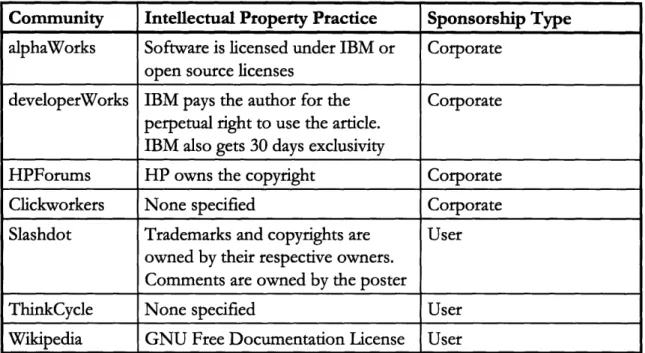
Yet another significant challenge for information diffusion is that of intellectual property rights. Open access to information is typically not synonymous with open use of information. Open use would imply that the information consumers are not limited in any way to use the information. The recent growth of open source soft-ware communities demonstrates that members are likely to contribute if they know that the whole community can enjoy the results of the collaborative efforts of the members. Deciding on the appropriate intellectual property rights approach becomes very critical; selecting the wrong approach may deter community participation. In Figure 4-1, I summarize the practices on intellectual property rights used by each of the communities. One can easily observe that corporate-sponsored communities
are more likely to retain or acquire the copyright of the information they distribute. This is mainly done to enable the sponsors to reuse the information to their benefit. User-sponsored communities on the other hand, choose to either leave the rights with
the contributor, or to adopt a more "copyleft" practice like Wikipedia with the GNU
Free Documentation License. This license is designed to guarantee attribution to
the author and to ensure that any redistribution of the information remains free and
under the same license terms.
Figure 4-1: Intellectual Property Right Practices
4.4 Information Life Cycle
One important factor in planning for information diffusion is to understand the life cy-cle of the information. By information life cycy-cle I refer to the following two attributes: i) the expected life of the information and ii) the frequency of changes to the infor-mation during its life cycle. Inforinfor-mation does not necessarily loose its value but it may become less relevant with respect to the evolving interests of the community. The expected life of information on alphaWorks, depending on the popularity of the technology, will typically be no more than a couple of years. Emerging technologies after all cannot be classified as emerging for a very long time! The approach taken by alphaWorks, is to "retire" the technologies and replace them with new emerging technologies. In general the expected life of the information in a community should
Community Intellectual Property Practice Sponsorship Type
alphaWorks Software is licensed under IBM or Corporate open source licenses
developerWorks IBM pays the author for the Corporate perpetual right to use the article.
IBM also gets 30 days exclusivity
HPForums HP owns the copyright Corporate Clickworkers None specified Corporate Slashdot Trademarks and copyrights are User
owned by their respective owners. Comments are owned by the poster
ThinkCycle None specified User Wikipedia GNU Free Documentation License User
be aligned with the community's intent. In developerWorks, articles are expected to
be accessed during the time frame that the technologies and products they address
are current. In Slashdot, news stories are archived forever but they are mainly dif-fused and commented on during the first few days since their posting. The frequency of changes is also important in understanding how the community works and is also an indicator of the expected life of the information. Frequent changes/updates in the central and peripheral information suggest that enough members are interested in it and are motivated to spend time on updating it. Wikipedia is the extreme case of frequent changes and has an infinite expected life for its entries; a constant revision practice leads to entries that are always up to date. In other communities like alphaWorks and ThinkCycle one is able to detect how relevant the information is by observing the frequency of updates from the original contributors and from the peripheral members. In communities with long information life cycles and infrequent changes, it becomes important for the community to identify the right time to bring newer information center stage.
Chapter 5
Conclusions
The major finding of this work is that corporate and user sponsored online informa-tion communities are able to grow, and become successful by using a combinainforma-tion of open and closed collection, evaluation, and diffusion practices.
In the area of information collection, it is important that one identifies the cen-tral and peripheral information in the community. Collection of cencen-tral information can use either open or closed practices depending on intellectual property rights and how the information aligns with the intent of the community sponsor. Collection of peripheral information should always be open; many approaches for submitting peripheral information should be made available. Community members can be mo-tivated to contribute information for a variety of reasons; the community sponsors
need to understand this and use it to their advantage. Finally, in designing the
com-munity interactions it is important to keep in mind that simplicity, modularity, and enjoyment can be of great help in engaging community members.
In terms of information evaluation the following two functions need to be made clear: information screening is a static approach of evaluating the information, while information rating is a dynamic and collaborative approach of determining how good the information is to the eyes of the community that consumes it. Both screening and rating can help reduce the cost of consuming information. Screening can be
done using either an open or closed model but most corporations will favor the closed model because it allows for better alignment with their intent. Rating should be open for participation and can rely on a combination of ratings of users, information, or both. If user ratings are used, mechanisms to prevent favoritism should be put in place to encourage new members to participate. Ratings can also be collected in an automated fashion by monitoring member's interactions; such an approach should be used with caution and the results should be properly interpreted.
In the area of information diffusion it appears that all communities are open in providing access to information. However, communities have different approaches in allowing information consumers to freely use the information. Community sponsors are able to use direct and indirect ways to enjoy the benefits of information diffusion. The challenges include the costs of operating and supporting the community, the ability to reach a critical mass of information and participation, and ownership of intellectual property rights. Closed diffusion models may address the ownership of rights but may also deter members from participating in the community. Finally, the life cycle of the information needs to be understood and the community interactions need to be properly designed to support it.
Appendix A
Online Communities
Each community has its own unique goals, ways to incentivize participants, and systems to support the operation of the community. The following sections provide a brief description of each community that was evaluated during this work. This chapter aims to help the reader become familiar with each community and understand how
it relates to this work.
A.1
alphaWorks
"Emerging Technologies"alphaWorks[11] is a an online community created by IBM to expose emerging software technologies to anyone outside IBM. The objective of the community is to identify the potential of various technologies that have been developed within IBM. By exposing a number of selected technologies to outsiders and monitoring their reactions IBM is able to better determine how to further develop these technologies[5]. Initially estab-lished in 1996[8], alphaWorks, has helped IBM create a community of early technology adopters that are eager to use, test, and even license the emerging technologies. Dur-ing the years some of these technologies have been incorporated into IBM products while other have been released as open source projects to the community.
The main interaction in this community is the sharing technologies in the form of a software development kit (SDK). At any given time approximately 200