HAL Id: hal-00705631
https://hal.archives-ouvertes.fr/hal-00705631
Submitted on 8 Jun 2012
HAL is a multi-disciplinary open access
archive for the deposit and dissemination of sci-entific research documents, whether they are
pub-L’archive ouverte pluridisciplinaire HAL, est destinée au dépôt et à la diffusion de documents scientifiques de niveau recherche, publiés ou non,
StratusLab Toolkit 2.0
Marc-Elian Bégin, Konstantin Skaburskas
To cite this version:
Enhancing Grid Infrastructures with
Virtualization and Cloud Technologies
StratusLab Toolkit 2.0
Deliverable D4.5 (V1.0) 28 May 2012
Abstract
The document describes StratusLab Distribution v2.0, a full “Infrastructure as a Service” (IaaS) cloud distribution. The release is composed of a set of services, user and system administrator utilities, and tools developed and integrated by the project, such that it can be used as complete cloud solution.
StratusLab is co-funded by the European Community’s Seventh Framework Programme (Capacities) Grant Agreement INFSO-RI-261552.
The information contained in this document represents the views of the copyright holders as of the date such views are published.
THE INFORMATION CONTAINED IN THIS DOCUMENT IS PROVIDED BY THE COPYRIGHT HOLDERS “AS IS” AND ANY EXPRESS OR PLIED WARRANTIES, INCLUDING, BUT NOT LIMITED TO, THE IM-PLIED WARRANTIES OF MERCHANTABILITY AND FITNESS FOR A
PARTICULAR PURPOSE ARE DISCLAIMED. IN NO EVENT SHALL
THE MEMBERS OF THE STRATUSLAB COLLABORATION, INCLUD-ING THE COPYRIGHT HOLDERS, OR THE EUROPEAN COMMISSION BE LIABLE FOR ANY DIRECT, INDIRECT, INCIDENTAL, SPECIAL, EX-EMPLARY, OR CONSEQUENTIAL DAMAGES (INCLUDING, BUT NOT LIMITED TO, PROCUREMENT OF SUBSTITUTE GOODS OR SER-VICES; LOSS OF USE, DATA, OR PROFITS; OR BUSINESS INTER-RUPTION) HOWEVER CAUSED AND ON ANY THEORY OF LIABILITY, WHETHER IN CONTRACT, STRICT LIABILITY, OR TORT (INCLUDING NEGLIGENCE OR OTHERWISE) ARISING IN ANY WAY OUT OF THE USE OF THE INFORMATION CONTAINED IN THIS DOCUMENT, EVEN IF ADVISED OF THE POSSIBILITY OF SUCH DAMAGE.
Copyright c 2012, Members of the StratusLab collaboration: Centre
Na-tional de la Recherche Scientifique, Universidad Complutense de Madrid, Greek Research and Technology Network S.A., SixSq S `arl, Telef ´onica In-vestigaci ´on y Desarrollo SA, and The Provost Fellows and Scholars of the College of the Holy and Undivided Trinity of Queen Elizabeth Near Dublin. This work is licensed under a Creative Commons
Attribution 3.0 Unported License
Contributors
Name Partner Sections
Marc-Elian B´egin SixSq All
Konstantin Skaburskas
SixSq All
Document History
Version Date Comment
0.1 23 May 2012 Initial version for comment.
1.0 28 May 2012 Integrated reviewers comments.
Contents
List of Figures 5 1 Executive Summary 6 2 Introduction 7 3 StratusLab Distribution v2.0 8 4 Conclusion 11List of Figures
3.1 StratusLab Services and Components . . . 9
1 Executive Summary
StratusLab provides a complete, open-source solution for deploying an “Infrastruc-ture as a Service” cloud infrastruc“Infrastruc-ture. The document presents the composition of the StratusLab v2.0 distribution. The distribution is presented as a set of services, the user client utilities and the system administrator tools. Concretely, the distri-bution consists of Registration Web Application, Marketplace, Persistent Storage Service, Web Monitor, OpenNebula, OpenNebula Proxy, StratusLab OpenNebula extensions and drivers, Registration Application and the Claudia service manager.
In other words, the StratusLab v2.0 distribution offers:
• System administrators the means for manual and/or automated deployment and maintenance of the StratusLab-based cloud solution
• Users the capability to instantiate machine and disk images on a private IaaS cloud, to control virtual machine instances throughout their lifecycle, and to manipulate machine and disk images.
The transition of the StratusLab to an open source project will build on this re-lease to provide more functionality and to improve further the robustness of the distribution.
2 Introduction
During the course of the two-year project, over a dozen services and client tools were developed and/or integrated to create StratusLab Distribution v2.0. This soft-ware distribution consists of a set of user client utilities for instantiation of machine and disk images (managed through OpenNebula), virtual machine instance lifecy-cle monitoring, and image manipulation (creation, signing, upload to and registra-tion to an Appliance Repository and Marketplace), as well as system administrator tools for the deployment and configuration of the services provided as part of the StratusLab distribution. The distribution consists of Registration Web Application, Marketplace, Persistent Storage Service, Web Monitor, OpenNebula, OpenNebula Proxy, StratusLab OpenNebula extensions and drivers, Registration Application and Claudia.
StratusLab v2.0 is the twelfth public release, having been field tested by a num-ber of users, inside and outside the StratusLab collaboration, which gives us the confidence that it will continue to meet the expectations for production use.
3 StratusLab Distribution v2.0
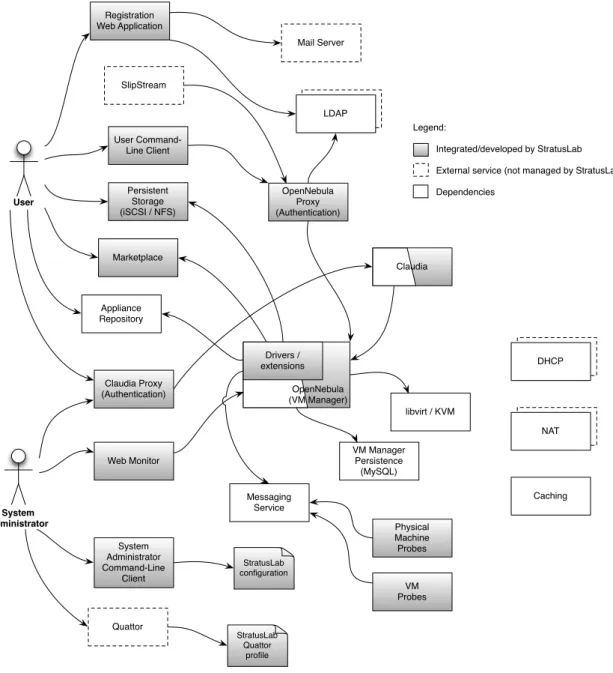
Figure 3.1 shows the services and components that compose the full StratusLab so-lution. Grey boxes show components and services developed and/or integrated by StratusLab with the specific purpose of providing a fully functional cloud service. The white boxes show runtime dependencies installed and configured by Stratus-Lab’s installation tools. The boxes with dotted lines show external services not managed by StratusLab, but required for the connected services to function cor-rectly. The configuration parameters for these external services are also managed by StratusLab’s configuration system.
No attempt in Figure 3.1 is made to show the mapping of these services to physical resources, as this is largely left to the system administrator during config-uration time.
The source code for StratusLab is available on GitHub at the following address: https://github.com/organizations/StratusLab. The binary distribution is avail-able for each release in the form of RPMs and tarballs. Instructions for accessing the binaries are available on the StratusLab website (http://www.stratuslab.eu).
The following list gives a brief description of the different services and com-ponents developed or integrated as identified in Figure 3.1:
Registration Web Application Provides on-site registration of users to the Stra-tusLab service by collecting simple identification information (name, email address, etc.) as well as requiring that the user agrees to existing Acceptable Use and Security Policies. The information is kept in an LDAP server which is compatible with the StratusLab authentication services, allowing access via username/password pairs and X.509 certificates.
Marketplace Serves as a searchable registry for shared machine and disk images. It is at the center of the image handling mechanisms in the StratusLab distri-bution. Policy enforcement is now also integrated with the virtual machine instantiation process - e.g. an image is endorsed by a trusted party and the images have not being tampered with.
User Command-Line Client Provides the means for remote instantiation of ma-chine and disk images via OpenNebula; virtual mama-chine instance lifecycle monitoring; and image manipulation (creation, signing, upload to the
Persis-OpenNebula (VM Manager) VM Manager Persistence (MySQL) OpenNebula Proxy (Authentication) Web Monitor Registration Web Application Marketplace StratusLab configuration Persistent Storage (iSCSI / NFS) libvirt / KVM Appliance Repository User System Administrator User Command-Line Client System Administrator Command-Line Client Mail Server Legend: Integrated/developed by StratusLab
External service (not managed by StratusLab)
Dependencies
Claudia
DHCP Mail ServerLDAP
NAT Quattor StratusLab Quattor profile Messaging Service Physical Machine Probes VM Probes Caching SlipStream Drivers / extensions Claudia Proxy (Authentication)
Figure 3.1: StratusLab Services and Components
Persistent Storage Service (iSCSI and/or NFS) Provides on-site management of persistent storage areas (`a la Amazon Elastic Block Store) allowing users to create disks of a given size, to launch a machine with the disks attached, and to persist the disks after their use, so that the disks are available for use by another machine instance. This service now includes the functionality pre-viously available through the Appliance Repository, via its caching feature. Web Monitor Provides live monitoring of the state of virtual images and physical
hosts in the StratusLab cloud service.
System Administrator Command-Line Client A set of utilities facilitating in-stallation and configuration of a StratusLab cloud service at a site.
StratusLab configuration Manages configuration parameters of the StratusLab cloud and external services.
StratusLab Quattor profiles A set of Quattor profiles for automated deployment and maintenance of StratusLab cloud service using Quattor.
OpenNebula OpenNebula is a virtual infrastructure manager with enhancements to address the requirements of the StratusLab project, such as integration with Ganglia, fault tolerance functionality, and virtual network improve-ments.
OpenNebula Proxy A proxy service allowing authentication of users using range of credentials, including X.509-based certificate and username/password, possibly based on an LDAP service.
StratusLab OpenNebula extensions and drivers Extend OpenNebula to allow a seamless integration of services and components developed by StratusLab, for example use of virtual appliances Marketplace IDs to refer to images to be instantiated, hooks to use on-site Persistent Storage for user appliances, and a quarantine strategy to aid forensic analysis.
Claudia The Claudia platform is an advanced service management toolkit that al-lows service providers to dynamically control the service provisioning and scalability in an IaaS cloud. Claudia manages services as a whole, con-trolling the configuration of multiple VM components, virtual networks and storage support by optimizing their usage and by dynamically scaling up or down services by applying elasticity rules, SLAs and business rules.
4 Conclusion
The StratusLab v2.0 distribution offers a set of services and components able to deliver a complete “Infrastructure as a Service” (IaaS) cloud service. A certified grid site within the European Grid Infrastructure has been deployed over a Stra-tusLab cloud, demonstrating its completeness and stability. System administrators can also use it to expose their resources as a cloud to their users; users can then remotely and seamlessly access these resources. Concretely, the StratusLab v2.0 distribution offers:
• System administrators the means for manual and/or automated deployment and maintenance of the StratusLab-based cloud solution
• Users the capability to instantiate machine and disk images on a private IaaS cloud, to control virtual machine instances throughout their lifecycle, and to manipulate machine and disk images.
The transition of the StratusLab to an open source project will build on this re-lease to provide more functionality and to improve further the robustness of the distribution.