
HAL Id: hal-01744368
https://hal.univ-grenoble-alpes.fr/hal-01744368
Submitted on 27 Mar 2018
HAL is a multi-disciplinary open access
archive for the deposit and dissemination of
sci-entific research documents, whether they are
pub-lished or not. The documents may come from
teaching and research institutions in France or
abroad, or from public or private research centers.
L’archive ouverte pluridisciplinaire HAL, est
destinée au dépôt et à la diffusion de documents
scientifiques de niveau recherche, publiés ou non,
émanant des établissements d’enseignement et de
recherche français ou étrangers, des laboratoires
publics ou privés.
An Overview of Microalgae Lipid Extraction in a
Biorefinery Framework
Jean-Maxime Roux, Hadrien Lamotte, Jean-Luc Achard
To cite this version:
Jean-Maxime Roux, Hadrien Lamotte, Jean-Luc Achard.
An Overview of Microalgae Lipid
Extraction in a Biorefinery Framework.
Energy Procedia, Elsevier, 2017, 112, pp.680 - 688.
1876-6102 © 2017 Published by Elsevier Ltd. This is an open access article under the CC BY-NC-ND license (http://creativecommons.org/licenses/by-nc-nd/4.0/).
Peer-review under responsibility of the organizing committee of the international conference on Sustainable Solutions for Energy and Environment 2016 doi: 10.1016/j.egypro.2017.03.1137
Energy Procedia 112 ( 2017 ) 680 – 688
ScienceDirect
Sustainable Solutions for Energy and Environment, EENVIRO 2016, 26-28 October 2016,
Bucharest, Romania
An Overview of Microalgae Lipid Extraction in a Biorefinery
Framework
Jean-Maxime Roux
a*, Hadrien Lamotte
a, Jean-Luc Achard
baCEA Leti, Minatec Campus, 17 rue des Martyrs, 38054 Grenoble Cedex, France bLEGI, Domaine Universitaire, CS 40700, 38058 Grenoble Cedex 9, France
Abstract
The interest in algae based biofuels has increased over the past few years because of their high potential to reduce the dependence on fossil fuels. Many methods for converting microalgae to biofuel have been proposed in the past; however, an economical and energetically feasible process for algal fuel production has not yet emerged, leading to some disappointment. To get such a process, an integrated microalgal biorefinery approach to obtain a full valorization of each raw microalgae component seems necessary. Moreover, several steps of any microalgal biorefinery model, ranging from species selection, cultivation, harvesting &dewatering and lipids extraction need still improvements to lower the global cost of the process. This review focuses on this latter step. It is shown that the wet route, skipping the drying step preceding the extraction step, seems to be the only way to produce a viable microalgae based biorefinery industry. On the other hand, an efficient cell disruption method, based on scalability, energy consumption, ability to improve lipid accessibility as well as mass transfer must be selected and in this context two promising studies are presented.
© 2017 The Authors. Published by Elsevier Ltd.
Peer-review under responsibility ofthe organizing committee of the international conference on Sustainable Solutions for Energy and Environment 2016.
Keywords: Microalgae; Lipid extraction; Biorefinery; Wet route
* Corresponding author. Tel.: +33-4-38-78-01-03.
E-mail address:[email protected]
© 2017 Published by Elsevier Ltd. This is an open access article under the CC BY-NC-ND license (http://creativecommons.org/licenses/by-nc-nd/4.0/).
Peer-review under responsibility of the organizing committee of the international conference on Sustainable Solutions for Energy and Environment 2016
Jean-Maxime Roux et al. / Energy Procedia 112 ( 2017 ) 680 – 688 681
1. Introduction
The world population continuous growth increases the primary energy consumption while unsustainable sources like fossil fuels are both contributing to global warming and declining. In this context, microalgae that have the highest photosynthetic efficiency of all plants to convert solar energy and carbon dioxide into oxygen and biomass received a large attention as an alternative fuel source [1]. Microalgae have also the advantage to grow in a wide range of waters from freshwater to seawater and even wastewater from which they can convert nitrates, phosphates and sulfate. As a result the culture of microalgae has a limited impact on the environment compared with other terrestrial sources of biomass developed for biofuel production [2].
Today, the initial enthusiasm in this environmentally friendly source of fuel seems to be diluting. Despite the potential of microalgae to serve as an alternative to fossil fuels major companies such as Shell and ExxonMobil seem to abandon their investments in this domain. They found that cultures are very expensive and contaminations can devastate them [3] while they must compete with petroleum production whose cost does not increase [2]. The recent microalgae based industrial developments still concern only high value products. The commercial viability of a microalgae based biofuel industry seems to vanish away.
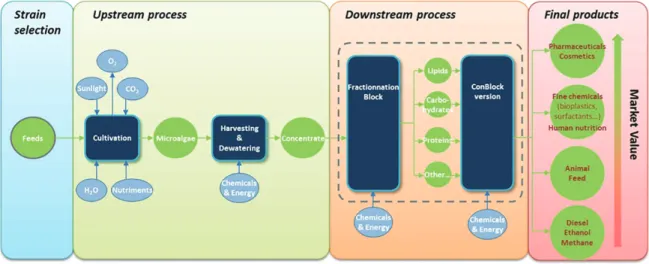
Have faith in a single biofuel option seems to be no more plausible [4-5]. Algae are like microscopic factories producing all sorts of useful compounds, not only lipids dedicated to the biodiesel industry [3]. They are composed of different lipids (7-23%) but also carbohydrates (5-23%) and proteins (6-52%) [5]. A way to improve the situation is then to obtain a full valorization of each microalgae components with products of the highest possible value [5-6]. Such an industrial process where biomass is converted in multiple end products is the biorefinery concept [5-6] (see Fig. 1). The concept derives from petroleum refineries which produce fuels but also numerous molecules for the chemical industry [7]. Such a refinery combines in a single facility the production of various products by multiple steps arranged into a cascade chain that use all the raw material components and prevent loss. But care must be taken at each step to not damage one or more of the products [6].
Fig. 1. Representation of the biorefinery concept applied to the valorization of microalgae raw materials
Moreover, several steps of any type of biorefinery need improvements to lower the global cost of the process. First, selected species must be adapted to large scale cultivation [8-9]. But above all they must grow quickly and produce a high amount of high quality lipids [9-10]. Then cultivation is a major and critical step in biorefinery; in this context, using wastewater (municipal, industrial, agricultural) for microalgal cultivation [11,12] will reduce costs. This approach allows to get an easy access to substrate, to reduce large amounts of freshwater consumption, to benefit from a lot of free nutrients for a wide variety of microalgae and to share waste management and costs [13]. It may be the only scenario to obtain biofuels able to compete with petroleum based ones [14]. But the problem of contamination is important in this approach thus resistance must be considered as fundamental when selecting
microalgal strains [11]. Harvest and dewatering represent also a very high part of the total production cost as well as the lipid extraction in the fractionation block. The main focus of this review is this latter step.
2. High value products
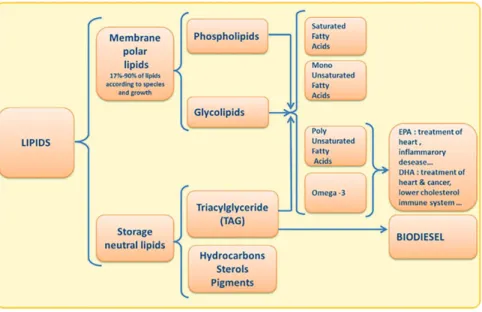
Algae produce lipids such as triacylglyceride (TAG) that can be converted into biodiesel but also numerous non-fuel lipids (see Fig. 2). Microalgaemay be used as sources of food supplements such as Omega-3 traditionally extracted from fish oil. Also they may be sources of materials such as eicosapentanoic acid (EPA) and decosahexaenoic acid (DHA)for the pharmaceutical industries [15-16].
Fig. 2. Lipids combine biofuels and some high value products.
But lipids are not the only components of micro algae leading to high value products. They produce also pigments, vitamins, proteins, enzymes, polysaccharides and also microbicides [17]. These others components should be valorized as co-products for a microalgae based biorefinery success [15].
3. Two routes
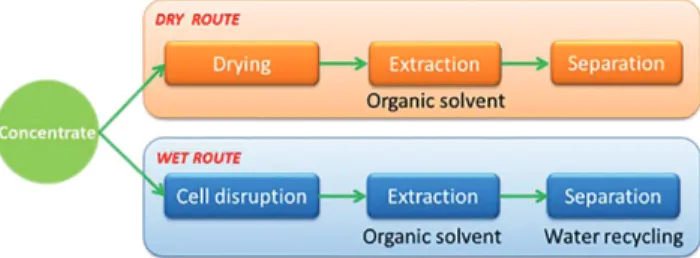
After concentration of the biomass, oil may be extracted from dried algae or extracted in the water phase (see Fig. 3). The first approach is called “dry route” and the second one is called “wet route” [18]. In both cases, lipids extraction follows a dewatering step that leads to a liquid of about 15 % dry weight by centrifugation. Next the dry route consists of a thermal drying step that produces a paste whose dry weight is higher than 85 %. This route yields a high extraction efficiency based on well-known lipid extraction methods (Folch, Blygh &Dyer, etc) and co-solvent mixtures (polar and non-polar solvents) [19]. One can observe that the disruption results from the solvents action so that a disruption step is not necessary. Unfortunately thermally drying the biomass is a very energy intensive step that may represent 85% of the total energy consumption [20]. In the second approach, namely the wet route, the dewatering step is generally followed by a disruption step that consists in breaking cells membranes. This route yields a positive energy balance by avoiding the drying step but the biomass paste has a low dry weight. However the wet route requires the disruption of cells membranes to increase lipids accessibility [21-22] and additional water recycling at the end of the fractionation block (see Fig. 1). Furthermore lipid extraction methods that are used in the dried route do not work in the wet route. Solvents should rather be immiscible with water and polar lipid extraction is more difficult than neutral lipid extraction because the former bond to debris of cells membranes. Furthermore liberated polar lipids make emulsions [22].
Jean-Maxime Roux et al. / Energy Procedia 112 ( 2017 ) 680 – 688 683
Fig. 3. Representation of the two routes after the concentration step.
Despite the simplicity of the dry route over the wet route, the drying step energy consumption does not make the dry route an economically viable option [9,18,23]. The wet route seems to be the only way to produce a viable microalgae based biorefinery industry.
4. Disruption methods
Components that are not secreted from cells must be extracted by cell disruption, also named cell breakage or cell disintegration. There are several techniques to break cell membranes which are usually classified according to their principle whether they are mechanical or non-mechanical process (see Fig. 4). Some of these are briefly presented below. Anticipating their description, the comparison of these pretreatment methods should be based on scalability, energy consumption, ability to improve lipid accessibility and to improve mass transfer; these criteria allow to identify two of them as the most promising ones [22]. They will be presented and illustrated by two specific studies in the next section.
Fig. 4. Classification of the cell disruption methods, adapted from [24]
4.1 Solid shear method: bead milling
Bead milling consists in disrupting cells membranes into a chamber filled with beads and agitated. The membrane disruption is due to grinding between beads and also collision with beads. The process efficiency depends on many parameters such as the beads diameter and amount, the microorganisms’ concentration, the movement and speed of agitators, the solution flow rate and the temperature. Furthermore water soluble protein release from the green microalgae C. vulgariswas found to be quicker than the biomass disintegration, while pigment release was found to be slower than the biomass disintegration [25]. As a consequence the energy cost of this route depends on the target product. According to Postma et al. [25] selective protein extraction may save up to
CELL DISRUPTION METHODS MECHANICAL NON-MECHANICAL Solid shear Cavitation Other
High Speed Homogenization (HSH) Beadmilling
High Pressure Homogenization (HPH)
Ultrasonication Microwave Pulsed Electric Field (PEF)
Chemical methods Enzymatichydrolysis
85% of the energy cost. Bead milling is regarded as one of the most efficient technique for membrane disruption [26] but it is energy-intensive and difficult to scale up [22].
4.2 Cavitation and collapse
Cavitation is the growth and collapse of bubbles due to a transient decrease of pressure, below the saturation vapor pressure. The collapse is a violent event that damages solids surfaces, produces shock waves and may disrupt cell membranes. Wang and Yuan showed that cumulative collapse pressure was correlated with and validated by experimental results of algal cell disruption [27]. The phenomenon arises for pressure fluctuations due to ultrasounds or high fluid velocity.
Cavitation may also be generated by ultrasounds. The range from 20 kHz to 50 kHz is often considered as the most efficient to induce cavitation [28-29]. But cavitating bubbles attenuate ultrasound transmission [30] and the suitable disruption frequencies depends on the cell’s mechanical properties [31]. The process may be employed with wet biomass without the addition of organic solvents but also in addition to solvent extraction. In a prospection of the optimal solvent based extraction method Glacio S. Araujo et al. obtained the highest amount of oil from C.
vulgaris with the Bligh and Dyer method (based on methanol, chloroform and a solution of sodium sulfate) assisted
by ultrasound results [32]. In a comparative study Prabakaran and Ravindran [33] concluded that results depend on upon algal species and extraction methods but sonication would be the most easy and efficient method for lipid extraction from microalgae. Large-scale ultrasonic devices are used in the chemical industry to break agglomerates and to homogenize solutions. But a large part of the energy is lost in heat so the process requires a good temperature control [26].
4.3 Pulsed Electric Field
Microorganisms’ membranes can be permeabilized by a transmembrane potential of about 0.2-1V [34]. Since microorganisms are very small and membranes are very thin, this requirement leads to high electric fields of about 1kV/cm to 20kV/cm, depending on the cell size and membrane structure. To avoid an important electrolysis and heating by Joule effect, electric fields are pulsed. When the intensity and duration of the electric field exposure are low and short, the pores can reseal themselves after the field is removed. With electroporation of a strong intensity and a long exposure time, the cell membrane is irreversibly compromised and this leads to cell lysis and death [35]. Holes made in membranes may enhance mass transfers making electroporation a promising pre-treatment whose efficiency is already demonstrated [36]. Electroporation may be the best industrially developed technique for biorefinery when a mild and effective cell disruption technique is required [37]. However PEF is sensitive to the medium conductivity, which may be rather non-conductive. This limits the application of PEF especially for saltwater algae; the biomass would have to be washed prior to the treatment [22].
4.4 Chemical hydrolysis
Dilute acid pretreatment can hydrolyze polysaccharides to release monomeric sugars (primarily glucose and mannose) into an aqueous phase that can be separated from solid residue rich in lipids and protein [38]. Sugars of the liquor phase may be fermented to produce high value co-products, while lipids may be extracted from the solid fraction using hexane extraction leaving a residue stream enriched in protein [38].Laurens et al. demonstrated the release of about 90% of the available glucose in the hydrolysate liquors and the extraction and recovery of up to 97% of the fatty acids from wet biomass [39]. The authors demonstrated also the production of ethanol.
4.5 Enzymatic digestion
Enzyme are be used to digest specific components of cell membranes. Enzymatic treatment can have large impacts of the permeability of the algal cell walls and may be useful in optimization, especially certainly lysozyme and certain other enzymes [40]. It has the potential to partially or fully disrupt membranes [36]. Due to the very specific activity of enzymes this technical can be considered as gentle. But it may weaken membranes rather than destroying them. Enzymatic digestion may therefore be completed by another lysis technical. Unfortunately enzymes are very expensive so a large scale deployment is limited by costs.
Jean-Maxime Roux et al. / Energy Procedia 112 ( 2017 ) 680 – 688 685
5. Two promising methods 5.1 Subcritical Water Extraction
Lipids are non-polar molecules insoluble in water at ambient conditions. However the dielectric constant of water is significantly lower at subcritical conditions, allowing greater miscibility with lipids. Hydrothermal liquefaction is a wet biomass conversion process carried out in such conditions at medium temperatures (100-374°C) and high pressures (10-25 MPa) [22,41]. The process produces liquid biocrude as main product and also gaseous, aqueous and solid phases by-products [42]. The process may be cost effective since the algae concentration should be moderate and membranes disruptions not necessary. Moreover compounds such as protein and carbohydrates are converted, in part, to oil so that hydrothermal liquefaction produces more oil from algae than other lipid extraction routes [43]. Diego Lo´pez Barreiro et al.[41] recently considered this process to be a very promising, if not the most promising conversion technology for microalgae conversion. However many questions remains and many optimizations are still required. In their review Diego Lo´pez Barreiroet al. reported that the optimal algae concentration is unknown and opposite findings can be found in the literature. As a result this process is in an early stage of development. Future analysis would benefit from data obtained in comparative studies of hydrothermal liquefaction and other lipids extraction routes based on the same algae stocks [43]. Still, the subcritical water extractiontechnology can be scaled up for industrial application [22] and so it is a very promising technique for the biorefinery industry.
Fig. 5. Process flow diagram of algal biodiesel production system, adapted from [44]
Ponnusamy et al [44]presented an algal biodiesel production system using subcritical water extraction(see Fig. 5) which may be a suitable alternative to traditional solvent extraction. Adapted to follow the mechanical dewatering step a biomass paste concentration of about 16 % Dry Weight is sufficient. The technique takes advantage of the water presence using it as both an important reactant and catalyst converting directly the biomass without an energy consuming drying step [42]. However the high pressure reactor requires a high cost as well as the large scale heat exchangers. And the method to recover polar lipids in the residues remains unclear.
5.2 High Pressure Homogenization
Cavitation may be generated by the flow of a liquid from a large area into a small constriction. The liquid velocity increases in the constriction and so the pressure drops. If the pressure falls below the saturation vapor pressure then
bubbles appear. Later, when the pressure increases theses bubbles collapse violently producing shockwaves that damage cell membranes. Shear based devices such as French press and Hughes press [45] use high pressures to force a solution containing microorganisms trough a small aperture. These two devices are operated at low temperatures, 0°C or lower. But homogenizers is probably the most widely used technic among the liquid shear disruption ones [26]. Homogenizers force the liquid to pass a valve whose design is the key point of the technique. Membranes may be destroyed by different mechanisms here such as cavitation [24] and the solution impact at high velocity on the wall surrounding the valve is necessary [46].
Fig. 6. Flow chart of the CIDES FRACTIONNATION PROCESS: Concentration, Incubation, Disruption, Extraction, Separation; adapted from [47]
Including such a disruption method a scalable biorefinery analysis suggests it is possible to achieve a positiveenergy balance using a wet extraction process when correctly designed and operated [47], that is to say accommodating a high-solids biomass with a significant TAG content, including an efficient extraction process that employs a non-polar solvent, at a low solvent: paste ratio, and a high rate of energy recovery from the vaporised solvent.
It is also demonstrated that incubation improves the efficiency of the high pressure homogenization step to rupture cells in concentrated pastes of nutrient replete Nannochloropsis sp. biomass [48]. The authors applied next the CIDES model to obtain a biorefinery and demonstrated the separation of both types of lipids with a two stages centrifugation process: a top layer is separated in a two-phase separator for a first extraction to recover neutral lipids leading to biodiesel from hexane while the emulsion layer is separated in a three-phase separator for a second extraction to recover high polar lipids containing fatty acids. The aqueous phase is recycled to cultivate microalgae and the bottom layer, rich of proteins and free of solvents, can be used to feed animals.
6. Conclusion
Microalgae should become a sustainable source of energy but only in the framework of a business biorefinery model that exploits all high value components of the biomass. In this perspective two assessments must be taken into account in defining such a model [5]. For an energy assessment perspective, the Net Energy Ratio (NER) is introduced as the ratio of the total energy produced by the process (biodiesel, ethanol, methane) to the energy required for construction and operations (electricity, heat, pressure, etc). For an economics perspective, the Cost-Effectiveness Assesment (CEA) is introduced as the ratio of the total outcomes of specific biorefinery options to the
Jean-Maxime Roux et al. / Energy Procedia 112 ( 2017 ) 680 – 688 687
total costs to produce selected products. A microalgal industry may prosper in the future, although with slow and low return of investments [49], if options and pathways are picked out and optimized via both the assessments of net energy ratio and cost-effectiveness. This involves, among other things, to take the wet extraction of lipids, leading besides to a cleaner fuel production. In this context, two interesting studies were briefly described.
Last but not least, life cycle assessment studies remain also necessary to evaluate the dependence of the process on fossil energy, resulting to more or less greenhouse gas emissions [50]. Reducing greenhouse gas emissions and finding alternatives to unsustainable resources are key points for the future world. But the development of new industries has huge costs that require the support of governmental funding [5].
References
[1] Milanoa J, Onga HC, Masjukia HH, Chonga WT, Lamb MK, Loha PK, Vellayana V.Microalgae biofuels as an alternative to fossil fuel for power generation. Renewable and Sustainable Energy Reviews 2016;58:180-197.
[2] Hannon M, Gimpel J, Tran M, Rasala B, Mayfield S. Biofuels from algae: challenges and potential. Biofuels 2010;5:763-784 [3]Ridley C. Can we save the algae biofuel industry?The Conversation 2016
[4] WilliamsPJ le B, Laurens LML. Microalgae as biodiesel & biomass feedstocks: Review & analysis of thebiochemistry, energetics & economics. Energy Environ. Sci. 2010;3:554-590
[5] Zhu L. Biorefinery as a promising approach to promote microalgaeindustry: An innovative framework. Renewable and Sustainable Energy Reviews 2015; 41:1376-1384
[6] Vanthoor-Koopmans M, Wijffels RH, Barbosa MJ, Eppink MHM. Biorefinery of microalgae for food and fuel. Bioresource Technology 2013;135:142-149
[7] Markou G, Nerantzis E. Microalgae for high-value compounds and biofuels production:A review with focus on cultivation under stress conditions. Biotechnology Advances 2013;31:1532-1542
[8] Rawat I, Kumar RR, Mutanda T, Bux F. Biodiesel from microalgae: A critical evaluation from laboratory to largescale production. Applied Energy 2013; 103:444-467
[9] Rashid N, Rehman MSU, Sadiq M, Mahmood T, Han JI. Current status, issues and developments in microalgae derivedbiodiesel production.Renewable and Sustainable Energy Reviews 2014;40:760-778
[10] Bahadar A, Khan MB. Progress in energy from microalgae: A review. Renewable and Sustainable Energy Reviews 2013;27:128-148 [11] Zhang TY, Hu HY, Wu YH, Zhuang LL, Xu XQ,Wang XX, Dao GH. RenewableandSustainableEnergyReviews2016;16:1602-1614 [12] Delrue F, Álvarez-Díaz PD, Fon-Sing S, Fleury G, Sassi JF. The Environmental Biorefinery: Using Microalgae toRemediate Wastewater,
aWin-Win Paradigm. Energies 2016;132
[13] Zhu L. Microalgal culture strategies for biofuel production: a review. Biofuels, Bioprod. Bioref. 2015;9:801-814
[14] Lundquist T, Woertz I, Quinn N, Benemann JR. A realistic technology and engineering assessment of algae biofuel production Energy Biosciences Institute, University of California, Berkeley, CA 2010
[15] Singh J, Gu S. Commercialization potential of microalgae for biofuels production. Renewable and Sustainable Energy Reviews 2010;14:2596-2610
[16] Yen HW, Hu LC, Chen CY, Ho SH, Lee DJ, Chang JS. Microalgae-based biorefinery - From biofuels to natural products.Bioresource Technology 2013;135:166–174
[17]Singh N, Dhar D. Microalgae as second generation biofuel. A review. Agronomyfor Sustainable Development, Springer Verlag/EDP Sciences/INRA 2011; 31:605-629
[18] Xu L,Brilman DWF, Withag JAM, Brem G, Kersten S. Assessment of a dry and a wet route for the production of biofuels from microalgae:Energy balance analysis .Bioresource Technology 2011;102:5113-5122
[19] Bligh EG, Dyer WJ.A rapid method of total lipid extraction and purification.Can J Biochem Physiol. 1959;37:911–7.
[20] Lardon L,Helias A, Sialve B, Steyer JP,BernardO. Life-cycle assessmentof biodiesel production from microalgae. Environ. Sci. Technol. 2009;43:6475-6481.
[21] Yap, B.H.J., et al. A mechanistic study of algal cell disruption and its effect on lipid recovery by solvent extraction. Algal Res. 2014;5:112– 120.
[22] Dong T, Knoshaug EP, Pienkos PT, Laurens MLM. Lipid recovery from wet oleaginous microbial biomass for biodiesel production : A critical review. Appl. Energy 2016;177:879–895.
[23] Zeng X, Danquah MK, Chen XD, Lu Y. Microalgae bioengineering: From CO2 fixation to biofuel production. Renewable and Sustainable Energy Reviews 2011;15:3252-3260.
[24] E. Günerken E, D'Hondt E,Eppink MHM, Garcia-Gonzalez L, Elst K, WijffelsRH. Cell disruption for microalgae biorefineries. Biotechnology Advances 2015;33:243-260.
[25] Postma PR, Mirona TL, Olivieria G, Barbosab MJ, Wijffelsa RH, Eppink MHM. Mild disintegration of the green microalgae Chlorella vulgaris using bead milling. Bioresour. Technol. 2014;184:297-304.
[27] Wang M, Yuan W. Modeling bubble dynamics and radical kinetics in ultrasound inducedmicroalgal cell disruption. Ultrasonics Sonochemistry 2016;28:7–14.
[28] Canselier JP, Delmas H, Wilhelm AM,Ablsrnail B. Ultrasound Emulsification-An Overview. Dispersion Science and Technology 2002;23:333-349.
[29] Kim J, Yoo G, Lee H, Lim J, Kim K, Kim CW, Park MS, Yang JWJW. Methods of downstream processing for the production of biodiesel from microalgae. Biotechnology Advances 2013;31:862-876.
[30] Greenly JM, Tester JW. Ultrasonic cavitation for disruption of microalgae. Bioresource Technology 2015;184:276-279.
[31] Yamamoto K, King PM, Wu X, Mason TJ, Joyce EM. Effect of ultrasonic frequency and power on the disruption of algal cells. Ultrasonics Sonochemistry 2015;24 :165-171.
[32] Araujo GS, Matos LJBL, Fernandes JO, Cartaxo SJM, Gonçalves LRB, Fernandes FAN,FariasWRL. Extraction of lipids from microalgae by ultrasound application: Prospectionof the optimal extraction method. Ultrasonics Sonochemistry 2013;20:95-98.
[33] Prabakaran P, Ravindran AD. A comparative study on effective cell disruption methodsfor lipid extraction from microalgae. Letters in Applied Microbiology 2011;53:150-154.
[34] Chen C,Smye SW, Robinson ÆMP, Evans JA.Membrane electroporation theories: a review. Med Biol Eng Comput. 2006;44:5-14. [35] Bao N, Le TT, Cheng JX, Lu C. Microfluidic electroporation of tumor and blood cells: observationof nucleus expansion and implications on
selective analysis andpurging of circulating tumor cells. Integr. Biol. 2010;2:113-120.
[36] Mercer P, Armenta RE. Developments in oil extraction from microalgae. Eur. J. Lipid Sci. Technol. 2011;113:539-547.
[37] Vanthoor-Koopmans M, Wijffels RH, Barbosa MJ, Eppink MHM. Biorefinery of microalgae for food and fuel. Bioresource Technology 2012;135:142-149.
[38] Dong T, Knoshaug EP, Davis R, LaurensLML, Van Wychen S, PienkosPT, Nagle N. Combined algal processing: A novel integrated biorefinery process toproduce algal biofuels and bioproducts. Algal Research 2016;19:316-323.
[39] Laurens LML,Nagle N, Davis R, Sweeney N, Van Wychen S, Lowell A, Pienkos PT, Acid-catalyzed algal biomass pretreatmentfor integrated lipid and carbohydrate-basedbiofuels production. Green Chem. 2015;17:1145-1158.
[40] Gerkenet HG, Donohoe B, Knoshaug EP. Enzymatic cell wall degradation of Chlorella vulgarisand other microalgae for biofuels productionPlanta (2013) 237:239–253.
[41] Barreiro DL, Prins W, Ronsse F, Brilman W, Hydrothermal liquefaction (HTL) of microalgaefor biofuel production: State of the art review andfuture prospects. Biomass and Bioenergy 2013;53:113-127.
[42] Toor SS, Rosendahl L, Rudolf A.Hydrothermal liquefaction of biomass: A reviewof subcritical water technologies. Energy 2011;36:2328-2342.
[43] Frank ED, Elgowainy A, Han J, Wang S. Life cycle comparison of hydrothermal liquefactionand lipid extraction pathways to renewable diesel
from algae. Mitig Adapt Strateg Glob Change 2013;18:137-158.
[44] Ponnusamy S, Reddy HK, Muppaneni T,Downes CM, Deng S. Life cycle assessment of biodiesel production from algal bio-crude oilsextracted under subcritical water conditions. Bioresource Technology 2014;170:454-461.
[45] Hughes DE. A press for disrupting bacteria and other micro-organism. Brit. J. Exp. Pathol. 1951;32:97-109.
[46] Engler CR, Robinson CW, Effects of organism type and growth conditions oncell disruption by impingement, Biotechnol. Lett. 1981;3:83-88.
[47]Martin GJO. Energy requirements for wet solvent extraction of lipids from microalgalBiomass. Bioresource Technology 2016;205:40-47 [48] Halim R, Webley PA, Martin GJO. The CIDES process: Fractionation of concentrated microalgal paste forco-production of biofuel,
nutraceuticals, and high-grade protein feed. Algal Research 2016;19:299-306
[49]Milano J, Ong HC, Masjuki HH, Chong WT, Lam MK,Loh PK, Vellayan V. Microalgaebiofuelsasanalternativetofossilfuelforpowergeneration. RenewableandSustainableEnergyReviews 2016;58:180-197
[50] Chaudry S, Bahri PA, Moheimani NR, Pathwaysofprocessingofwetmicroalgaeforliquidfuelproduction:A criticalreview. RenewableandSustainableEnergyReviews 2015;52:1240-1250
![Fig. 5. Process flow diagram of algal biodiesel production system, adapted from [44]](https://thumb-eu.123doks.com/thumbv2/123doknet/13397829.406030/7.816.79.731.422.714/fig-process-flow-diagram-algal-biodiesel-production-adapted.webp)
![Fig. 6. Flow chart of the CIDES FRACTIONNATION PROCESS: Concentration, Incubation, Disruption, Extraction, Separation; adapted from [47]](https://thumb-eu.123doks.com/thumbv2/123doknet/13397829.406030/8.816.105.706.238.552/fractionnation-process-concentration-incubation-disruption-extraction-separation-adapted.webp)
