HAL Id: hal-01513257
https://hal.archives-ouvertes.fr/hal-01513257
Preprint submitted on 24 Apr 2017HAL is a multi-disciplinary open access archive for the deposit and dissemination of sci-entific research documents, whether they are pub-lished or not. The documents may come from teaching and research institutions in France or abroad, or from public or private research centers.
L’archive ouverte pluridisciplinaire HAL, est destinée au dépôt et à la diffusion de documents scientifiques de niveau recherche, publiés ou non, émanant des établissements d’enseignement et de recherche français ou étrangers, des laboratoires publics ou privés.
To cite this version:
Stéphane Robert, Guillaume Segerer. Joola Keeraak : A grammatical introduction. 2016. �hal-01513257�
Joola Keeraak : A grammatical introduction
1Stéphane Robert and Guillaume Segerer CSPC, LLACAN, INALCO, CNRS
Introduction
Keeraak (also referenced as Keeraku or Her) belongs to the Joola cluster of Atlantic languages and their Bak subgroup (Pozdniakov & Segerer, this volume). Joola languages are spoken in the Lower Casamance region in South-West Senegal, and also in the neighbouring part of Guinea-Bissau. Among this group, Keeraak is solely spoken in Kabrousse (Ziguinchor region, southwest), the last village on the Senegalese coast before the Guinea border. Kabrousse was named from Portugese Cabo Roxo (designating a still existing lighthouse nowadays out of service) but its traditional name is Eer [ɛɛr]. Thus Keeraak (k(ʊ)-ɛɛr-a-ak) literally means “the (language) of Eer”. When asked about the resemblances between Keeraak and neighbouring Joola varieties, Keeraak speakers say that they globally understand the languages spoken East and South of Kabrousse, up to Youtou and Efok in Senegal and Varela and Susana in Guinea-Bissau. However, they admit that there are various differences, mostly in the lexicon and a few pronunciation features. According to the literature (Carlton & Rand 1993), the said area hosts the Ejamat (or Floupe) Joola lect.
According to Ethnologue (2006), Keeraak is estimated to be spoken by some 13 200 speakers (https://www.ethnologue.com/language/hhr). However, in 2015, there were only about 5000 inhabitants in Kabrousse according to the chief of the village. The total number of Keeraak speakers must include those living outside the village. The language use is vigorous and transmission is solid, at least for those living in the Kabrousse village. Except for old illiterate persons, Kabrousse inhabitants also know French (due to primary education), Wolof (commercial activities) and sometimes some other varieties of Joola when they have spent some time with other Joola speakers. Despite the proximity of the Bissau-Guinean border, Kriol does not seem to have penetrated the Kabrousse area.
Keeraak speakers recognise themselves as Joola people, and their culture share many features with that of other Joola communities: the traditional activities are centered around rice cultivation and fishing, as well as salt collecting and palm wine tapping. The society is patrilineal, for the name as well as for the rice fields transmission, and the community is organised around the compound in a concentric manner, defining various important solidarities for land use, farming and social or religious pratices: the individual house (ɛlʊʊfaj) is part of a sub-compound (hanasah) shared with aunts and uncles; the latter in turn is part of a compound (hulimetəh) and the compounds are grouped in bigger compounds (hʊsɩɩsah) which together form a district (kɛɛlʊmak). There are three districts in Kabrousse: when you enter the village you first find Mossor (Mɔɔsɔɔr), then Kadiakay (Kaɟaakaaj), and finally Nyalou (Ñaalʊ), the last place before the Guinea border, Kadiakay being the most ancient one out of which Mossor developed first until some of its inhabitants created Nyalou, apparently some five generations ago. The vast majority of Kabrousse inhabitants are catholic. There are also some muslims and, more recently, a few protestants. Remarkably, older regional religion based on shrine veneration practices survive harmoniously and coexist with the newer religions. Shrine owners (male or female) continue to play an important part in this society where there is no
1 This research was supported by the research program from the French Agence Nationale de la Recherche,
king or higher authority. The various districts of Kabrousse also have special friendship relationships with different districts of two neighbouring villages (Diembereng and Bouyouye).
Despite a clear common cultural identity, the Joola cluster is made of variously differenciated languages. Keeraak is probably not very different from the Ejamat variety spoken in North-Eastern Guinea-Bissau. However, while Keeraak speakers claim to understand most of the other Joola dialects, the opposite is not true: Keeraak is not understood by the speakers of other Joola languages.
This article is the first grammatical sketch of Keeraak. This language was undocumented (and wrongly referenced as Her) when the two authors started their study. This work is based on fieldwork conducted during several field trips between 2009 and 2015 in Ziguinchor and Kabrousse, with a dozen of consultants (male and female) aged from eighteen to sixty. Due to space limitations the syntax was left aside.
This article is built as follows: in section 1, the main phonological features, including vowel harmony, are presented. Sections 2 to 4 are dedicated to word categories and their morphology. This includes the noun class system and all the agreeing elements (sec. 2), verb morphology (sec. 3) and other categories such as adjectives and ideophones, a special paragraph on locatives, adverbs and prepositions (sec. 4). The whole section 5 is devoted to the very complex verbal system. After a presentation of its general organising principles (5.1) and of the personal markers (5.2), simple (5.3), complex (5.4) and negative (5.5) inflectional paradigms are analyzed and exemplified. The past suffix is given attention in 5.6. Converbs and dependent forms conclude this section (5.7).
Our corpus consists of a dictionary of 2,800 words, more than 2,500 elicited sentences, dozens of verb paradigms and 15 short texts. All examples use a phonological IPA-based transcription. Long vowels are doubled.
Occasionally, reference is made to other Joola varieties, for which we consulted the following works: Banjal: Bassène 2007, Sagna 2008, Tendeng 2007; Fonyi: Hopkins 1995, Sapir 1965, Weiss 1939; Kasa: Wintz 1909; Karon: Sambou 2007.
1 Phonology
1.1 Consonants
The consonant system has the following elements:
Table 1: Consonant phonemes
labials dentals palatals velars
voiceless stops (p) t c k voiced stops b d ɟ g fricatives f ɬ s h nasals m n ɲ ŋ sonorants w l j trill r
The two salient features of this inventory are the presence of the voiceless lateral fricative /ɬ/ and the absence of /p/: /f/, phonetically [ɸ], regularly corresponds to [p] in other Joola varieties. However [p] may still be found in a few ideophones and in the cluster mp. All consonants may occur in initial, medial or final position.
1.2 Vowels
As in all Joola languages, there are ten vowel qualities:
Table 2: Vowel qualities
i u
ɩ ʊ
e ə o
ɛ a ɔ
Vowel length is phonemic, even though true minimal pairs are not numerous: mɔɟ ‘to draw water’ / mɔɔɟ ‘watch until out of sight’; bak ‘to tighten’ / baak ‘to be high’. Long vowels do not seem to occur word-finally.
1.3 Phonotactics
1.3.1 Consonant clusters
Regardless of recent borrowings, only three kinds of consonant clusters are attested:
- NC clusters, where C is a stop and N is a homorganic nasal: gɔnt ‘to sing’, hʊ-tɔɲɟ-ah ‘heel’, mbiil ‘to play musical horn’. Two such clusters may occur in the same stem: ɟə-ndeŋgul-əw ‘bird sp. (dove)’. NC clusters are rare in stem-initial position. NC clusters never occur after a long vowel.
- LL clusters, where L is a lateral consonant (either /l/ or /ɬ/): ɛ-hʊllʊŋ-aj ‘corpse’, hʊ-ɟɩllɩŋ-ah ‘bell’, e-ɬɬu-ej ‘laughter’. There seems to be a fair amount of variation in the pronunciation of ɬɬ clusters, many of them being actually voiced. This voicing seems unpredictible and idiosyncratic and may not lead to posit a ɬ/ɮ phonological contrast. Regarding /ll/ clusters, most of them occur in words ending with a suffix, either productive or frozen. It is worth noting that for each of these words, the corresponding bare stem is not attested: ɟɔllɛn ‘explain’, ə-həlliin-əw ‘old person’. The doubling of /l/ could then originate in suffixation, as is still the case with /n/ in some cases: hɛn ‘to graze’ > hɛnnɛn ‘to feed cattle’. Only one stem shows an initial /ll/: ɲɩ-llʊh-aɲ ‘fish sp. (eel)’.
- NN clusters are rare, especially those that do not result from suffixation (see above): humməəre ‘today’, ka-nnaar-ak ‘verandah’, ɛ-nnamm-aj ‘seat’.
1.3.2 Syllables
56% of the stems are of the CVC type (where C may be a single consonant, a NC cluster or a geminate). Other common patterns include CV...C (CVCVC, CVCVCV etc., 20%) and CV...V (CVCV, CVCVCV etc., 11%). All the remaining patterns put together are marginal: they count for no more than 13%. Affixes tend to adapt to a general CVCV...C pattern: while prefixes are usually of the CV type (sometimes only V), suffixes are more of the VC type (sometimes only V).
1.3.3 Vowel harmony
Vowel harmony operates in Keeraak, as in many languages of the region. The ten vowels are divided into two sets, namely /a/, /ɛ/, /ɩ/, /ɔ/, /ʊ/ and /ə/, /e/, /i/, /o/, /u/. Within the limits of the (phonological) word, all the vowels belong to the same set. Most authors use the label ATR (Advanced Tongue Root) to refer to the articulatory nature of this contrast. So far however, no study has shown that this feature is effectively in play. Basing on auditory perception, we will therefore use the labels ‘open’ and ‘closed’ for the two sets, and present them as follows:
Table 3: Vocalic phonemes
front mid-front center mid-back back
closed i e ə o u
Keeraak has a dominant-controlled type of vowel harmony, the closed series being dominant, which means that an inherently closed vowel in a stem will cause every other vowel in the word to be closed as well, propagating towards prefixes as well as suffixes. This rule should be enough to account for vowel harmony in Keeraak:
ɟoɟ ‘bone’ > hu-ɟoɟ-əh (citation form: HU2 class pfx + stem + HU class det.)
ɟɔɟ ‘decision’ > hʊ-ɟɔɟ-ah (citation form: HU class pfx + stem + HU class det.)
However, there are a some apparent inconsistancies or exceptions, all the details of which cannot be given within the scope of this paper. A few additional information may nevertheless be of interest:
- an affix may have an inherently closed vowel:
-um ‘INSTRUMENTAL’ bʊʊt ‘to fish’ mu-buutum-əm ‘bait’ mɛr ‘to swallow’ e-mer-um-əj ‘throat’ - an open/closed alternation is sometimes used to reinforce a lexical derivation:
mɔɔm ‘to lie’ si-moom-en-əs ‘lies’ (neither the SI class prefix nor the -ɛn suffix usually triggers vowel harmony).
saaf ‘to greet’ bu-səəfoor-əb ‘greetings’ (neither the BU class prefix nor the reciprocal -ɔɔr usually triggers vowel harmony).
sɛɲa ‘to marry’ bu-seɲə-əb ‘wedding’
- an open/closed alternation is sometimes observed between words that have very similar meanings:
m-ɩɩɬ-am ‘(breast) milk’ <> m-iiɬ-əm ‘(cow) milk’ rɩɩr ‘to plait’ <> riir ‘to comb’
fʊm ‘to jump’ <> fum ‘to cross’
- the dominant status of closed vowels, combined with their relative paucity (they are 2.7 times less numerous than open vowels) make them the marked member of the open/closed opposition.
2 Morphology 1 : the noun
2.1 Noun classes
The nominal morphology of Keeraak is characterised by a rich and fully operative noun class system. This system is described is some detail in Segerer (2015), and we will only present an overview here. When the present data or analysis differs from the above source (because of the work carried out since), it will be indicated in the text with the sign (+).
The citation form of nouns minimally includes a class prefix, a stem and a suffix of the shape -ACx, where A
may be [a] or [ə] according to vowel harmony and Cx is a consonant which copies the consonant of the
class prefix. For the E and U classes Cx is [y] and [w] respectively; the A class and one of the JA classes
deviate from this model, showing an -aw suffix. In most Joola languages the class suffix has a definite value. However, in Keeraak, it has become obligatory in most contexts (and specifically in the citation form of nouns and verbs), thus loosing its original value. We call it default determiner. The 21 noun classes (including 3 locative pseudo-classes) are exemplified in Table 4:
Table 4: Keeraak noun classes
2 The labels for class prefixes (see Table 4 below) are based on the phonological shape of the prefix and written in capital letters.
A a-ɲɩl-aw ‘child’
BA ba-ɲɛr-ab ‘monkeys’
BU bu-tiin-əb ‘path’
BUK buk-an-ak ‘people’
E1 ɛ-ɲaab-aj ‘elephant’ E2 ɛ-kʊ-aj ‘thieves’ HA ha-aɟ-ah ‘bees’ HU hʊ-tɛɲaj-ah ‘banana’ JA1 ɟa-ɲɛr-aw ‘monkey’ JA2 ɟa-kaan-aɟ ‘doing’
JI ɟɩ-mɛl-aɟ ‘water (a little)’
KA ka-sɛra-ak ‘spoon’
KU kʊ-tɛɲay-ak ‘bananas’
MA ma-ɬɛgɛn-am ‘truth’
MU mʊ-mɛl-am ‘water’
ƝI ɲɩ-llʊh-aɲ ‘eel’
SI sɩ-ɲaab-as ‘elephants’
U ʊ-sɛra-aw ‘spoons’
B b-ɩn-ab ‘place (large)’
T t-ɩn-at ‘place (limited)’
D1 d-in-əd ‘place (inner)’
All these classes are called ‘noun classes’ because they are found primarily on nouns and trigger agreement, even the three locative classes B, T and D1 which appear on one noun only3. However,
there are two additional elements that behave exactly like noun classes as far as morphology is concerned, except that they are never found on nouns. These elements, which may be called (+) defective classes, are the N class and the D2 class. The N class refers to time and is used pronominally
in paradigms that usually show class agreement, as for example ʊCxaj ‘which?’: ʊnaj ‘when?’. (+) The D2 class is used for vague reference as in udu ‘this (thing) near you’ as oppposed to, say, uju ‘this class
E entity near you’ (for example ɛ-ɟagʊm-aj ‘dog’). The D2 class is distinct from the D1 class in that it
bears no locative reference and, unlike D1, it does not trigger vowel harmony. In fact, the D1 class is
the only one that triggers the closed vowel series4, as can be seen in the above table where the same
stem ɩn yields the nouns b-ɩn-ab, t-ɩn-at with classes B and T but d-in-əd with class D1. The contrast
between the two D classes may also be illustrated by the demonstratives 1 and 3: D1 : ude ‘(inside) here’ undə ‘(inside) there’
D2 : ʊdɛ ‘this thing’ ʊnda ‘that thing’
2.1.1 The scope of class agreement
The following elements are under the scope of noun class agreement:
- all the noun modifiers, including: default determiners, qualifiers (adjectives, numerals, relativisers, ‘other’, ‘same’), demonstratives (even those used pronominally), possessives, interrogatives.
- pronouns: the base is -ɔ.
3 The nouns in question (see Table 4) suggest a stem -ɩn. With CV prefixes the regular outcomes should therefore be *bɩɩnab, *tɩɩnat or *diinəd. The vowel is always short here, and since all the agreement elements are fully predictable (see 2.1.2) with the class consonant only, we cannot attribute any vowel to the class marker and we must posit the labels B, T and D.
4 This mere fact suggests that the true class marker has a closed vowel in its underlying form, but (see preceding note) this vowel cannot be recovered.
- the connective -ala.
- the verb subject prefixes (for class A, see next section) 2.1.2 Class exponents
For all the agreement paradigms, the class exponent consists either of a single consonant or of a CV element whose vowel is predictable (see below). The class consonant is selected as follows:
- For CV-shaped classes, the consonant is C (glossed AGR0): HA, HU > h, MA, MU > m, BA, BU > b etc.: bʊ-lɔ-ɛn-ab b-ala ɟa-nak-aw ‘sunset’ (CLbu-fall-CAUS-DETbu AGR0bu-CONN CLja-sun-DETja) ;
- For the E and U classes, the consonants are j- and w- respectively: ɛ-maan-aj j-umboom ‘my rice’ (CLe-rice-DETe AGR0e-1SGPOS).
- The A class, which typically includes nouns denoting human beings, is a very particular case: the possessive and connective agreement is Ø-, the pronoun is ɔɔ, the demonstratives are made with m (ʊmɛ / umu / ʊmma): a-ɲɩl-aw Ø-umboom ‘my child’ (CLa-child-DETa AGR0a-1SGPOS). The subject agreement for class A is dealt with in the section devoted to the verbal system (for third person see 5.2).
The vowel of the class exponent, when present, is selected as follows:
- The adjectives and the subject relative clauses show a CA- agreement (glossed AGR1). The class A agreement is a-.
- The numerals and the subject indices of verbs show a CU- agreement (glossed AGR2), with the following exceptions:
- if C is dental or palatal, the vowel is i-/ɩ-.
- the A and JA2 classes have a- or na-, the 3rd person singular subject marker.
- other V classes (E and U) retain their original shape : e-/ɛ- and u-/ʊ- respectively. The word for ‘other’ has the shape CaaCʊ. The A-class is different again: aahʊ.
Table 5 is a general chart of pronouns and noun modifiers for all nominal and defective classes5:
Table 5: class paradigms of noun modifiers
def.
det. pron.
6,
rel. (obj) connect. DEM1 DEM2 DEM3 ‘which?’ ‘other’ copula(+) loc. 7
structural
form -aC Cɔ C-ala ʊCɛ uCu ʊNCa ~ ʊCCa ʊCaj CaaCʊ CɔɔCʊ
A -aw ɔɔ ala ʊmɛ umu ʊmma aj aahʊ ɔɔmʊ
BA, BU, B -ab bɔ bala ʊbɛ ubu ʊmba ʊbaj baabʊ bɔɔbʊ
BUK -ak bʊkɔ kala ʊkɛ uku ʊnka ʊkaj kaakʊ kɔɔkʊ
E1 -aj~-ɛj jɔ jala ʊjɛ uju ʊjja ʊjaj jaajʊ jɔɔjʊ
E2 -aj~-ɛj jala ʊkɛ uku ʊnka ʊjaj ~ ʊkaj kaakʊ kɔɔkʊ
HA, HU -ah hɔ hala ʊhe uhu ʊŋha ʊhaj haahʊ hɔɔhʊ
JA1, JI -aɟ ɟɔ ɟala ʊɟe uɟu ʊɲɟa ʊɟaj ɟaaɟʊ ɟɔɔɟʊ
JA2 -aw ɔɔ ~ ɟɔ ala ~ ɟala ʊmɛ umu ʊmma ʊmaj ~ ʊɟaj aahʊ ɔɔmʊ
KA, KU -ak kɔ kala ʊkɛ uku ʊnka ʊkaj kaakʊ kɔɔkʊ
MA, MU -am mɔ mala ʊmɛ umu ʊmma ʊmaj maamʊ mɔɔmʊ
5 There are gaps in the table when the expected forms are absent from our data. Hyphens indicate non-existing forms.
6 The class pronouns are used as free pronouns, object clitics and relativisers. ‘Human’ classes A and BUK/KU have different object clitics, namely 3SG -ɔl and 3PL -ɩɩl respectively.
7 The final vowel in this series is a spatial deictic as the one found in the DEM series and may vary in the same way.
ƝI -aɲ ɲɔ ɲala ʊɲɛ uɲu ʊɲɲa ʊɲaj ɲaaɲu ɲɔɔɲʊ SI -as sɔ sala ʊsɛ usu ʊnsa ʊsaj saasʊ sɔɔsʊ
U -aw wɔ wala ʊwɛ uwu ɔwwa ʊwaj waawʊ wɔɔwʊ
D1 -əd dɔ dala ude udu undə udəj
T -at tɔ tala ʊtɛ utu ʊnta ʊtaj
D2 - dɔ - ʊdɛ udu ʊnda ʊdaj - dɔɔdʊ
N - nɔ - - - - ʊnaj - -
Table 6 shows agreement markers in other categories:
Table 6: other agreement markers
num
AGR2 AGR2 subj. adj, rel. (subj) AGR1 poss.
8
AGR0
A Ø- na-~a-9 a- Ø-
BA, BU, B bʊ- bʊ- ba- b-
BUK kʊ- kʊ- ka- k- E1 ɛ- ɛ- ja- j- E2 kʊ- kʊ- ka- j- HA, HU hʊ- hʊ- ha- h- JA1, JI ɟɩ- ɟɩ- ɟa- ɟ- JA2 na-~a-~ɟɩ- a- KA, KU kʊ- kʊ- ka- k- MA, MU mʊ- mʊ- ma- m- ƝI ɲɩ- ɲɩ- ɲa- SI sɩ- sɩ- sa- s- U ʊ- ʊ- wa- D1 di- ~Ø- da- T tɩ ta- D2 - - - - N - - na- -
2.1.3 Other agreeing elements
There are a few other elements that undergo class agreement, for which we do not have the whole paradigms yet:
- -man ‘such-and-such’: hʊ-nak hʊ-man ‘such-and-such day’
- Cxan-ɔɔ-Cxan ‘any’: tan-ɔɔ-tan ‘anywhere’, an-ɔɔ-an ‘anyone’, nan-ɔɔ-nan ‘anytime’, etc.
- Cxa-kɛɛl ‘of a particular kind’ (ADJ agreement): ja-lɛh-aw j-akɛɛl ‘a bird of a particular kind’,
bʊk-an ka-kɛɛl ‘some specific people’; there is an extended form for which the difference in meaning is not known: -kɛɛ mɩɲɛ (< -kɛɛl mɩɲɛ): bʊk-an-ak ka-kɛɛ mɩɲɛ ‘some (specific ?) people’.
- -amɔm ‘same’: kʊ-mɛŋgʊ-ak ka-amɔm ‘the same mangoes’.
- -ɛmɔm ‘numerical determiner’. Among other uses, it appears in the interrogative phrase -ɛmɔm bu? ‘how many?’: sɩ-ɟaagʊm-as sɩ-ɛmɔm bu? ‘how many dogs?’ (bu? ‘how?’). 2.1.4 Classes and number
Classically, noun classes are intrinsically associated with number. But besides the usual singular/plural contrast (see below), the following points are worth mentionning:
8 Possessive pronouns are presented in 5.2. The agreement markers shown here are for non-human possessees only.
- For many nominal items, two plurals can be formed: one for a limited, countable quantity of elements, and a second one for an uncountable collection of elements. Only a limited number of classes may function as collective markers:
- The BA class is the most frequent. It is a collective for pairings such as E/SI (ɛ-hɛmb-aj / sɩ-hɛmb-as ~ ba-hɛmb-ab ‘fruit sp.’), HU/KU (hʊ-ɔt-ah / kʊ-ɔt-ak ~ ba-ɔt-ab ‘star’), KA/U (kə-johəli-ək / u-johəli-əw ~ bə-johəli-əb ‘spark’).
- The BU class is a collective for the pairings A/KU (ə-kuə-əw / e-kuə-əy ~ bu-kuə-əb ‘thief’), KA/U (ka-rɩŋ-ak / ʊ-rɩŋ-aw / bʊ-rɩŋ-ab ‘thorn’).
- The E class is a collective for the pairings A/KU (ə-ɬɬum-əw / ku-ɬɬum-ək ~ e-ɬɬum-əy ‘White, European’), KA/U (ka-jahand-ak / ʊ-jahand-aw / ɛ-jahand-ay ‘palm leaf’), BU/U (bʊ-tɔɔtɔɔk-ab / ʊ-tɔɔtɔɔk-aw ~ ɛ-tɔɔtɔɔk-ay ‘shrub sp.’).
- HA is a collective for four nouns of the pairing E/SI: ‘bee’, ‘palm nut’, and two species of ants. This class has been noted as the plural for four more nouns of the E singular class and of the same semantic domain (a fruit, two species of wasps and a species of ant). Further investigation will probably show that these nouns may have a countable plural in the SI class.
For a portion of nouns, including those denoting small entities (as insects or other small animals), the collective is cited as the default plural, whereas the ‘regular’ countable plural is considered as marked.
- A small proportion of nouns have no ‘number’ counterpart, i.e. either no plural or no singular. Such nouns may be found in ‘singular’ as well as in ‘plural’ classes: ba-hɔnɔ-ab ‘thirst’, bʊ-ɲɛka-ab ‘lazyness’, hə-sim-əh ‘blood’, ɟi-boom-əɟ ‘dance’, ka-waaw-ak ‘palm-wine tapping’, etc. However, it cannot be said that number is not associated with these classes, since they are otherwise massively used within singular/plural pairings. There is apparently no dedicated class for mass nouns.
2.1.5 Singular/plural class pairings
The class pairings presented here are those that involve a singular/plural opposition. While there are a lot of such pairings, many of them are either rare or exceptional.
Figure 1 below shows all and only the singular/plural pairings and their relative frequency. Bold lines show the most frequent pairings, dotted lines show the less frequent ones. Bold class labels indicate those classes that may be associated with either singular or plural.
Figure 1: class pairings
A BA BU E JA JI HU KA MU MA ƝI BUK BA BU E KU U HA SI MU
2.1.6 Semantics of noun classes
The complex semantics of noun classes can not be presented in full detail here. Many features are familiar to Niger-Congo specialists, including the following:
- Human beings are typically in the A/KU pairing, but there are many exceptions: A/BA (‘child’, ‘maid’), A/BU (‘sibling’, ‘drummer’, ‘weaver’, ‘potter’ and agents of other habitual occupations), A/E (‘slave’, all ethnic names). Actually, it is often the case that A nouns may have their plural in more than one class: A/BA~BU, A/KU~E, A/KU~BU. This variation in the plural class may or may not be associated with a variation in meaning. As an alternate to KU, the second plural is a collective (see 2.1.4).
- There is a preferential class (MU) for nouns denoting liquids: mʊ-mɛl-am ‘water’, m-iit-əm ‘palm-oil’, mʊ-sʊr-am ‘urine’. There are of course some exceptions: hə-sim-əh ‘blood’, ɛ-gɛɛn-aj ‘sweat’, bʊ-nʊk-ab ‘palm-wine’... as stated above (2.1.4), nouns with mass semantics are not bound to a particular class.
- Trees tend to fall in the BU/U pairing, whereas their fruits are in the HU/KU pairing. - Big or familiar animals tend to fall in pairing E/SI.
- Noun class substitution is widely used to express dimensional derivation, i.e. augmentatives and diminutives. The most productive classes are: JI (pl. MU) and A (pl. BA) for diminutives, HU (pl. KU) for augmentatives. Only class JI seems to be a purely derivative class, in the sense that i) no noun seems to belong to class JI only; ii) all nouns may form a diminutive in the JI class.
- The MA class seems to be primarily associated with abstract nouns: mə-ɟub-əm ‘justice’, mə-booteni-əm ‘sadness’, ma-ɟak-am ‘beauty’, ma-ɬɛgɛn-am ‘truth’.
- While borrowings tend to be affected to pairing E/SI, there are a few exceptions in which semantics override the general principle: hʊ-pɔm-ah / kʊ-pɔm-ak10 ‘apple’ (< French pomme), mə-fiir-əm ‘jealousy’ (< Wolof fiir ‘to envy’).
2.2 Numerals
The numeral system is 5-, 10- and 20-based. Only numerals from 1 to 4 show class agreement. Their citation forms use class E for ‘one’ and class SI (the regular plural to class E) for ‘two’, ‘three’ and ‘four’. ‘five’ and ‘ten’ use classes HU and KU (regular plural to HU) respectively. In ‘ten’ one recognises the lexical stem for ‘hand’ (ka-ŋɛn / ʊ-ŋɛn) but with a different class. ə-ji ‘twenty’ also means ‘king’. This is a case of the anthropomorphic numeral system based on body parts (hand and feet) and the entire person (king) that is widespread in the entire area and also attested in Nyun (Cobbinah, this volume, Lüpke, this volume, Quint, this volume). Table 7 shows the numbers as given in isolation:
Table 7: Numerals from 1 to 10
ɛ-anɔr ‘one’ hʊ-tɔk dɩ ɛ-anɔr ‘six’ kʊ-ŋɛn dɩ si-həəɟi ‘thirteen’ si-subə ‘two’ hʊ-tɔk dɩ si-subə ‘seven’ kʊ-ŋɛn dɩ hʊ-tɔk ‘fifteen’ si-həəɟi ‘three’ hʊ-tɔk dɩ si-həəɟi ‘eight’ ə-ji ‘twenty’ sɩ-bakɩɩr ‘four’ hʊ-tɔk dɩ sɩ-bakɩɩr ‘nine’ ə-ji dɩ kʊ-ŋɛn ‘thirty’
hʊ-tɔk ‘five’ kʊ-ŋɛn ‘ten’ ku-ji ku-subə ‘forty’
Ordinal numerals are obtained through three different ways:
- a change of lexical stem: tijer ‘first’ (comp. with anɔr ‘one’). - a -t suffix: subu-t (< subə-t) ‘second’, həəɟi-t ‘third’.
- an -ɛn suffix11: bakɩɩr-ɛn ‘fourth’, tɔk-ɛn ‘fifth’.
- after five, the bare numeral may be preceded byɲɛɛmɔm
‘numbering’
2.2.1 ‘times’
(+) When combined with class HU, ordinals come to mean ‘the Xth time’: hu-subut-əh ‘the second time’, hʊ-tɔkɛn-ah ‘the fifth time’. However, ‘the first time’ is rendered with class MU: mu-tijer-əm. (+) A cardinal number of times needs class HU in the singular (hanɔr ‘once’) and a special ɲa- prefix in the plural: ɲə-subə ‘twice’, ɲə-həəɟi ‘three times’, ɲa-bakɩɩr ‘four times’. This agreement marker probably refers to a class ƝI noun meaning ‘time’ (absent from our data). Other numbersof times need the presence of the numerical determiner -ɛmɔm, still with the ɲ- agreement: ɲɛ-ɛmɔm kʊ-ŋɛn dɩ sɩ-bakɩɩr ‘fourteen times’. The same ɲa- prefix may be used with -kɛɛl ‘some, certain’ to form ɲakɛɛl ‘perhaps’.
2.3 Demonstratives and pronouns
There are three series of demonstratives (see Table 5 above for the forms): - the ʊCxɛ series: close to the speaker (DEM1)
- the uCxu series: close to the hearer (DEM2)
- the ʊNCxa ~ ʊCxCxa series: far from both the speaker and the hearer (DEM3)
With the locative pseudo-classes, the demonstratives may be used as adverbs: ʊtɛ ‘here’, udu ‘in there’, ʊmba ‘over there’.
Proximal demonstratives (DEM1 and DEM2) may be followed by maa for precise reference (typically when pointing at something). This is true for locatives as well: ʊtɛ maa ‘here exactly’.
The pronouns are made of the class consonant (AGR0) and the anaphoric morpheme -ɔ (see Table 5 above).
2.4 Genitive link
The genitive link, also called connective, is -ala, preceded by the class consonant (AGR0), as shown in the table above: ɛ-sankɛn-ɛj j-ala Ɛɛr ‘the language of Er (Kabrousse)’; hʊ-caacʊr-ah h-ala kə-loɟ-ək ka-baakʊm ‘long-tailed parrot’ (CLhu-parrot-DEThu AGR0hu-GEN CLka-tail-DETka AGR1ka-long-COMPL).
3 Morphology 2 : the verb
3.1 Bare stems
Verb roots are mostly of the CV(V)(N)C shape: gɔr ‘to touch’, faaŋ ‘to call’, kɔb ‘to wait’, nʊb ‘to rain’, nɔŋg ‘to decide’, ɬac ‘to spit’. The exceptions include short roots (lu ‘to pierce’, lɔ ‘to fall’, ɩh ‘to breathe’) as well as long ones (ɟɔlɔb ‘to follow’, ɟɩkɛr ‘to watch’, ɟaaɬʊn ‘to weep’, fɛntɛrɛɟ ‘to shell’). Many verb stems are only attested with one or more derivational suffixes, which may or may not be productive: kol-i ‘to be afraid’ (with -i ‘stative’, cf. 3.3.10), kol-i-en ‘to frighten’(with -i ‘stative’ and -ɛn ‘causative’, cf. 3.3.1), kɛl-ɛn-ɔɔr ‘to tilt the head’ (with -ɛn ‘causative’ and -ɔɔr ‘pluractional’ cf. 3.3.3)...
3.2 Infinitives
When asked to translate a verb in isolation, most Keeraak speakers give a noun-like form in the JA1
class: ɟa-fɩn-aɟ ‘to count’, ɟa-baal-aɟ ‘to forgive’, ɟə-mir-əɟ ‘to know’. However, for a few verbs, the form is given in another class: hʊ-ɲɔɔfɔ-ah ‘to eat’, ɛ-rɔŋ-aj ‘to live’, ba-hɔnɔ-ab ‘drinking’. In addition,
most verbal stems also yield a form in the KA or in the E class, which are the preferred infinitive classes in many Joola lects (see Sapir 1965, Bassène 2007, Sagna 2008): fɩn ‘to count’ > ka-fɩn-ak ‘counting’, nah ‘to cultivate’ > ɛ-nah-aj ‘cultivation, cultivating’. For some of these verbs, there is a difference between the JA and the E/KA ‘infinitive’. For example, the stem rɔŋ, when in the JA1 class,
may mean ‘to live’ or ‘to give birth’, but it only means ‘to live’ in the E class and ‘to give birth’ in the KA class. Other kind of differences may be associated with class assignment: the infinitive of the stem nah ‘to cultivate’ needs an oblique ‘object’ when in the JA1 class but not when in the E class:
ɟa-nah-aɟ (ɟ-ala X) ‘cultivation (of X)’ vs ɛ-nah-aj ‘cultivation, cultivating’. However, apparently, these cases are not frequent, and the two infinitives may generally be used in the same contexts: a-ɲɩɩl-aw na-jɛt-ɛ ɟa-fɩn-aɟ ~ ka-fin-ak ‘the child can count’ (CLa-child-DETa 3SG-can-PUNCT CLja-count-DETja ~ CLka-count-DETka). We strongly suspect a slight difference either in meaning or in usage, but this could not be demonstrated so far.
3.3 Derivational suffixes
Derivational suffixes, or verbal extensions, transform the meaning of verbs in various ways: they may increase or decrease the valency, modify the semantic roles, the relationship to time or space and even the aesthetic appreciation of the speaker.
3.3.1 -ɛn ‘causative’
This extension is very productive or, at least, very common. While ‘causative’ is the label that describes best many of its occurrences, its true value is actually more complex. The true causative derivation includes pairs of items such as fur ‘to go out’ > fur-en ‘to empty’, hɛɛf ‘to cool down’ > hɛɛf-ɛn ‘to cool sth down’, kol-i ‘to be afraid’, kol-i-en ‘to frighten’. However, many verbs that exhibit this suffix are lexicalised and may not be analysed as causatives. Instead, they seem to show some kind of unpredictable shift from the meaning of the underived verb: hɔk ‘to dig’ > hɔk-ɛn ‘to bury’, ɟal ‘to harvest (rice)’ > ɟal-ɛn ‘to prune (palm-tree)’, ɬɛmp ‘to carve’ > ɬɛmp-ɛn ‘to peel’... A fair number of verbs are only attested with -ɛn, so that it is not possible to evaluate the exact meaning of the suffix: ɬɔɔɬɛn ‘to sing (rooster)’, lʊkɛn ‘to take revenge’, naanɛn ‘to keep’, fɩsɛn ‘to think’, jaalɛn ‘to help’...
3.3.2 -ɔ ‘middle’
Verbs carrying this extension show meanings in which the agentive subject is directly affected by the process: jɔh ‘to hide (tr)’ > jɔh-ɔ ‘to hide o.s.’. -ɔ verbs apparently never convey a reflexive meaning (kiik ‘to shave (tr)’ > kiik-o ‘to get shaved’, ɬɩb ‘to cut’ > ɬɩb-ɔ ‘to get cut’). True reflexives are formed with the -ɔɔr-ɔ combination of suffixes (see below). It is often the case that instead of contrasting with its absence, the middle suffix is opposed to the -ɛn suffix: ɬaal-ɛn ‘to raise’ / ɬaal-ɔ ‘to stand up’. Many verbs are only attested with this extension: ɲɔɔfɔ ‘to eat’, hɔnɔ ‘to drink’, leego ‘to be drunk’, fatɔ ‘to keep silent’.
3.3.3 -ɔɔr ‘pluractional’, ‘reciprocal’
Verbs with this extension typically have meanings in which more than one occurrence of the process is involved. With plural subjects, and provided that the core meaning of the verb is compatible, the resulting value is ‘reciprocal’: ɟɩkɛr ‘to look at, to watch’ > ɟɩkɛr-ɔɔr ‘to look at each other’, mir ‘to know’ > mir-oor ‘to know each other’. However, -ɔɔr may occur with many verbs with no possible reciprocal reading. In such cases the resulting meanings are less predictible but very often include the idea of repetition or intensivity: ɲaaŋ ‘to go, to walk’ > ɲaaŋ-ɔɔr ‘to wander’, ɬɬaw ‘to ask’ > ɬɬaw-ɔɔr ‘to ask constantly’, ŋɔt ‘to sleep’ > ŋɔt-ɬɬaw-ɔɔr ‘to do nothing but sleep’. There are some examples of the same verb having two different readings depending on the subject being plural or singular: bʊɟ ‘to hit’ > bʊɟ-ɔɔr ‘to fight, to hit each other’ (with plural subject) ~ ‘to do nothing but fight’ (with singular subject). In a few cases (and apparently not very productively) this extension is associated
with reduplication to yield an intensive meaning: lɔlɔbɔɔr ‘to gossip, to make noise, to talk too much’12; fʊm ‘to jump’ > fʊmfʊm-ɔɔr ‘to hop’. With intransitive verbs there can be an associative
reading: rɔŋ ‘to give birth’ > rɔŋ-ɔɔr ‘to give birth at the same time as somebody else’, i.e. ‘to deliver in the hospital’; fur ‘to go out’ > fur-oor ‘to go out together’, i.e. ‘to be of the same age class’.
3.3.4 -ɔɔrɔ ‘reflexive’
This extension, apparently a combination of ‘pluractional’ and ‘middle’, is attested with transitive verbs to which it gives a reflexive reading: kɔh’ to scratch’ > kɔh-ɔɔrɔ ‘to scratch o.s.’; ɟɩkɛr ‘to look at, to watch’ > ɟɩkɛr-ɔɔrɔ ‘to look at o.s.’; hɛɟ ‘to see’ > hɛɟ-ɔɔrɔ ‘to see o.s.’. Intransitive verbs must first be transitivised with -ɛn in order to bear the reflexive extension: rɛɛm ‘to burn (intr.)’ > rɛɛm-ɛn ‘to burn (tr.)’ > rɛɛm-ɛn-ɔɔrɔ ‘to burn o.s.’. A few items in the corpus are only attested with the reflexive: wooluwooro ‘to be self-confident’, ɲɔh-ɔɔrɔ ‘to show up’. The semantic effects of -ɔɔrɔ are sometimes unpredictible, as in mirooro ‘to be proud’ < mir ‘to know’.
3.3.5 -ul ‘separative’
This suffix, often called ‘inversive’ in the literature, conveys a meaning of separation of things that had been in contact: kʊɬ ‘to lock’ > kʊɬ-ʊl ‘to unlock’; neh-ul ‘to unthatch’. In our corpus, this extension is quite infrequent and in most of the cases the bare verb is not attested: rub-ul ‘to pluck’. Instead, one may find a verb with the -ɛn extension: kɔt-ɛn ‘to stick’ / kot-ul ‘to separate’; taɲɟ-ɛn ‘to close’ / təɲɟ-ul ‘to open’.
3.3.6 -ul ‘centripetal’
This suffix is quite productive and adds to the verb a meaning of directionality towards the speaker: ɲaaŋ ‘to go’ > ɲəəŋ-ul ‘to come’; riiŋ ‘to arrive (somewhere)’ > riiŋ-ul ‘to arrive (here)’; hɔk ‘to dig’ > hok-ul ‘to uproot’; fur ‘to go out’ > fur-ul ‘to come out, to sprout’. This extension might be historically related to the preceding one.
3.3.7 -ʊlɔ ‘resultative centripetal’
This suffix is used when the process has taken place or was initiated remotely, prior to a movement towards the place of speech:
(1) bala ɩsɩɩnʊl, nɩhɔnɔhɔnɔɔlɔm bʊnʊkab siicor
bala ɩ-sɩrɛn-ʊl nɩ-hɔnɔ-hɔnɔ-ʊlɔ-m bʊnʊkab Siicor
before 1SG-come.back-CTP n1SG-drink~VFOC-CTP.RES- COMPL CLbu-palm.wine-DETbu Ziguinchor ‘Before coming home, I drank some palm-wine in Ziguinchor’
3.3.8 -əəti ‘privative’
This extension adds lexical negation to the verb: suum ‘to be good’ > suum-əəti ‘to be bad’; haafɛn ‘to be able’ > həəfen-əəti ‘to be unable, to fail’; ɟuw ‘to be healthy’ > ɟuw-əəti ‘to be unhealthy, to be ill’. It seems to apply to stative verbs only, and is probably composed of -aat + -i (see 3.3.10 below). 3.3.9 -ɩ ‘passive’
This extension seems to be lexically productive, but not frequently used. Elicited derived passives are generally accepted by speakers: nʊŋɛn ‘to build’ > nʊŋɛn-ɩ ‘to be built’, hɛɟ ‘to see’ > hɛɟ-ɩ ‘to be seen’, bʊk ‘to bear child’ > bʊk-ɩ ‘to be born’. However, we have almost never found it in spontaneous speech. The first example above shows that the passive extension is placed after the
12 -lɔb alone as a verb root is not attested in Keeraak but means ‘to talk’ in other Joola varieties, as well as in most Nyun lects.
(here frozen) causative one. Noticeably, and unlike other Joola lects (Bassène 2007), passivised stems seem incompatible with deverbal derivations, including ja- infinitives.
3.3.10 *-i ‘stative’
This ending is found on a few verbs that are not attested without it. All these verbs have a stative meaning, and all of them (except two including one Wolof loanword) use the closed vowel set. We can therefore consider this ending as a frozen suffix: leeli ‘to be sweet (palmwine)’, ɲeki ‘to be lazy’, soɲɟi ‘to suffer’, -təli ‘to be bitter’. The corresponding active verbs are not obtained by the removal of the suffix, but instead by addition of the causative -ɛn: soɲɟi ‘to suffer’ > soɲɟi-en ‘to hurt’; koli ‘to be afraid’ > koli-en ‘to frighten’. In one case the causative seems to have frozen before the stative: booteni ‘to be sad’. In our data there is one example of the suffixal nature (and of the closeness of the vowel) of -i, which involves a noun and a verb: bʊ-ʊlaat-ab ‘greed’ ~ uləəti ‘to be greedy’.
3.3.11 -əli ‘anticipative’
The meaning of this extension is that of an action carried out early, or in advance. It triggers vowel harmony: ɲɔɔfɔ ‘to eat’ > ɲoofo-əli ‘to eat early’, raagɔ ‘to die’ > rəəgo-əli ‘to die too soon, to die young’.
3.3.12 –iinəj ‘aesthetic’
This unusual extension is apparently unknown in other Joola varieties. It adds an aesthetic dimension to the basic meaning of the verb. It may be added to either active or stative verbs: ɲɔɔfɔ ‘to eat’ > ɲoof-iinəj ‘to eat in a nice manner; hɩr ‘to be salty’ > hiir-iinəj ‘to be correctly salty’. It is apparently quite productive.
3.3.13 –ikoor ‘intensive, derogatory’
This suffix has a unique property, in that its vowels are intrinsically closed but don’t trigger the closing of the preceding vowels. Yet, it is a suffix, since the nominal forms of the derived verbs take the default determiner. It adds an intensive, and somewhat derogatory value to the bare stem: lɔ ‘to fall’ (citation form jalɔaj) > lɔikoor ‘to fall heavily’ (citation form jalɔikoorəj); sonji ‘to hurt’ > sonjikoor ‘to hurt badly’; bʊj ‘to hit’ > bʊjikoor ‘to hit hard’. However, if the stem has an intrinsic positive meaning, the derived verb remains positive: hɛɛɲ ‘to smell good’ > hɛɛɲikoor ‘to smell wonderful’. This suffix is apparently productive, but the values of some derived verbs are not always easily predictible: ɲaaŋ ‘to go, to walk’ > ɲaaŋikoor ‘to limp, to walk in a strange way’. ikoor is attested in one noun whose stem does not exist as a verbal one, but still with a derogatory meaning : hʊ-basikoor-əh / kʊ-basikoor-ək ‘sheaf of rice of poor quality’.
3.3.14 -ʊnɛn ‘assistive causative’
This suffix, a probable compound of -ʊn and the causative -ɛn, is rare and has various senses, depending on both the meaning of the bare stem and cultural habits. In the few occurrences that we have found, the meanings range from purely assistive to purely causative: bɔɔm ‘to dance’ > bɔɔm-ʊnɛn ‘to help dance’ (said about adults making/helping the children dance); rɔk ‘to work’ > rɔk-bɔɔm-ʊnɛn ‘to help someone to work’ or ‘to make someone work hard’; ɲaaŋ ‘to go’ > ɲaaŋ-ʊnɛn ‘to follow, to track, to join’.
3.3.15 -um13 ‘instrumental’ and ‘applicative’
A productive deverbative suffix -um is used to form deverbal nouns denoting instruments: bʊʊt ‘to fish’ > mu-buut-um-əm ‘bait’; gəuɟ ‘to navigate, to paddle’ > e-gəuɟ-um-əj ‘paddle (noun)’. A small number of verbs, however, seem to bear this suffix too. Some of them may be held to derive from instrumental nouns which in turn come from verbs: ŋɔt ‘to sleep’ > si-ŋotum-əs ‘dream (noun)’, ŋotum ‘to dream’; ɟab ‘to start’ > bu-ɟəbum-əb ‘start (noun)’, ɟəbum ‘to start’. We found one case where the instrumental suffix is apparently attached to a noun (but there might be a verb, absent from our data): a-faal-aw ‘friend’ > bə-fəəlum-əb ‘friendship’, fəəlum ‘to be friends’.
This instrumental suffix is also used in verbal predicates as an applicative, introducing a new argument in object position with a semantic role of instrument (rɔk ‘to work’ > rɔk-ʊm ‘work with (an instrument)’) or locative complement. The locative complement may express the origin or the path but not the goal of a movement: fur ‘to go out' > fur-um ‘to go out coming from/through’, lɔ ‘to fall’ > lo-um ‘to pass by’.
3.3.16 -ɛt ‘denominative’
This is the only denominative suffix, i.e. a suffix that transforms a noun into a verb. It is quite unusual, since in the Joola languages (and in many of the languages of the region in general) it is very often the case that the same lexical stem be used either as verb or noun with no other marking than a noun class assignation: cuuk ‘to discuss’ ~ kə-cuuk-ək ‘discussion’. Here are a few examples of the -ɛt suffix: kʊ-kɔnt-ak ‘dirt’ > kɔnt-ɛt ‘be dirty’, ha-kɔɔr-ah ‘smoke’ > kɔɔr-ɛt ‘to smoke (intr)’, a-mɩɩkɛl-aw ‘servant, slave’ > mɩɩkɛl-ɛt ‘to serve s.o.’. When attached to nouns denoting useful things that are usually picked up or collected, -ɛt verbs mean ‘to go and collect X’: hʊ-mɛŋgʊ-ah ‘mango’ > mɛŋgʊ-ɛt ‘to go and collect/pick up mangoes’, hʊ-ʊɬ-ah ‘oyster’ > ʊɬ-ɛt ‘to go and collect oysters’. When suffixed to a verb (which is very rare in our data), -ɛt seems to add a meaning of remoteness: ɲɔɔfɔ ‘to eat’ > ɲɔɔfɔɛt ‘to eat away from home’ ; ɲaaŋ ‘to go’ > ɲəəŋ-et-um ‘to take away’.
3.3.17 Lexical reduplication
Within verbal derivation, total or partial reduplication is generally used in conjunction with the -ɛn extension, whose causative meaning is often hard to detect, or with the pluractional/reciprocal -ɔɔr extension, with no reciprocal meaning. Verbs derived in this way generally denote actions performed little by little, or in some kind of repetitive manner: fʊm ‘to jump over’ > fʊmfʊmɔɔr ‘to hop’. Except for the example just cited, the original CVC verb stem is not attested as such or has a quite different meaning: ɟɔɟɔgɛn ‘to stutter’ (< *ɟɔg), ɬəɬəŋgen ‘to shake’ (< *ɬəŋg), -ŋiŋiren ‘to shiver’ (< *ŋir), babakɛn ‘to shiver’ (but bak ‘to tighten a knot’), sɔsɔbɛn ‘to rain little by little’ (< *sɔb), iɬiɬoor ‘to rock, to swing’ (< *iɬ). In one case, reduplicated forms with the -ɛn suffix and with the -ɔɔr suffix are both attested: kikilen ‘to roll sth’ / kikiloor ‘to roll’ (< *kil).
4 Other categories
4.1 Adjectives
Most adjectival modifiers derive from verbs following a relative clause pattern. They are formed with the completive suffix -ʊm (see 5.3) and require the Ca- (AGR1) agreement prefix series as the subject relativisers do (see Table 6 above): al ‘to be ripe’ > -al-ʊm ‘ripe’, hɩɩt ‘to be white’ > hɩɩt-ʊm ‘white’. Thus many adjectives derive from stative verbs. For the verbs bearing the stative suffix -i or the passive suffix -ɩ, the adjectival ending is just -m, exactly as is the completive suffix -ʊm after a vowel (see Table 13): ɟoobi ‘to be cold’ > ɟoobim ‘cold’; tʊɟ ‘to break’ > tʊɟɩ ‘to be broken’ > tʊɟɩm ‘broken’.
13 Most occurrences of this suffix justify to posit a closed vowel (i.e. triggering vowel harmony), but in a few examples (see infra) the vowels remain open. This contradiction cannot be explained so far.
Beside these relative structures, there are a few intrinsically adjectival stems: ar ‘female’, in ‘male’14,
əmək ‘big’, haan ‘old’, beesum ‘youngest (child)’, ʊnkʊl ‘new’. The stem *tɩɩt ‘small’ is not attested as such but yields the forms tɩɩta ‘small’ beside the verbal form tiit-i ‘to be small’.
4.2 Ideophones
Keeraak has three kinds of ideophones, or “marked words depictive of sensory imagery” (as put by Dingemanse 2002):
(i) Quality-specific ideophones, used as intensifiers for a single notion carried by quality verbs or by adjectival stems:
cʊl with ɲan ‘to be red’ far with hɩɩt ‘to be white’ sʊf with fatɔ ‘to be silent’ cum with sʊf ‘be hot’
ɟaŋŋ with ʊnkʊl ‘new’ tɩr with ɬɛn ‘to be black’
(ii) Action-specific ideophones that accompany action verbs, adding various meanings, including, but not imited to, intensive ones:
tɩr ‘tightly’ with bak ‘to attach’ fac ‘abruptly’ with furul ‘to come out’
hah ‘unappropriately’ with hɩlɛn ‘to interfere in a conversation’
(ii) onomatopoeic, noun-specific ideophones, introduced by the quotative verb an ‘to say’ or by kaan ‘to do’:
fjʊ describes the rapid movement of an arrow
fər ∼ frʊ-frʊ describes the rapid movement of a passing bird maɟ describes the rapid movement of a cat, a child
haah very relieved
There can be variants and also homophones among ideophones (cf. above tɩr ideophone of ‘be black’ and ‘attach’) as well as vowel length contrast (cf. above hah / haah).
4.3 Locative morphemes
Keeraak has a rich system of locative morphemes (prepositions, adverbs, interrogative adverbs, relativisers) formed with (a) spatial morphemes based on the locative pseudo-classes (cf 2.1) and used to specify the nature of the referred space, and (b) a set of spatial deictic suffixes, specifying the distance from the speaker, completed by an anaphoric suffix:
(a) Spatial morphemes:
-t limited and precise space -b large or vaguer space -d inner space
The three distance deictics are also used to form the demonstratives (see Table 5 above). As with the demonstratives, the remote deictic morpheme (-a) requires the prenasalised series (i.e. -nt-/ -mb- / -nd-) of the spatial morphemes, and the distal (-u) is closed and thus triggers
14 The nouns annaraw ‘woman’ and anniinəw ‘man’ are in fact syntagms, respectively an-aw a-ar-aw ‘female person’ and an-aw ə-in-əw ‘male person’.
harmony15. Remarkably, in some cases, the spatial -d- seems to trigger the closing of surrounding
vowels.
(b) distance deictics -ɛ close to the speaker
-u close to the hearer, or remote or separate from the speaker -a far remote from speaker (and hearer)
anaphoric -ɔ
Beside their use as noun classes markers, the spatial morphemes are used to form the locative indefinite adverb (bɩn ‘somewhere (else)’), the generic and polyfunctional locative preposition (dɩ ‘in, to, at…’), a spatial preposition in a remarkable paradigm (taat, baab, daad ‘at someone’s place’), and the interrogative locatives: ʊ-t-aj? ‘where (limited space)?’, ʊ-b-aj? ‘where (large space)?’ u-d-əj? ’where (inner space)?’. The distance deictics combine with the spatial morphemes to form locative adverbs, and with the anaphoric suffix, to form locative relativisers (Table 8).
Table 8: locative adverbs and pronouns
Location in a : limited space large space inner space
here (close to the speaker ) ʊ-t-ɛ ʊ-b-ɛ u-d-e
there (close to the hearer) u-t-u u-b-u u-d-u
over there (far from speaker and hearer) ʊ-nt-a ʊ-mb-a u-nd-ə
where? ʊ-t-aj? ʊ-b-aj? u-d-əj?
there (anaphoric clitic) =t-ɔ =b-ɔ =d-ɔ
where (relative adverb) t-ɔ b-ɔ d-ɔ
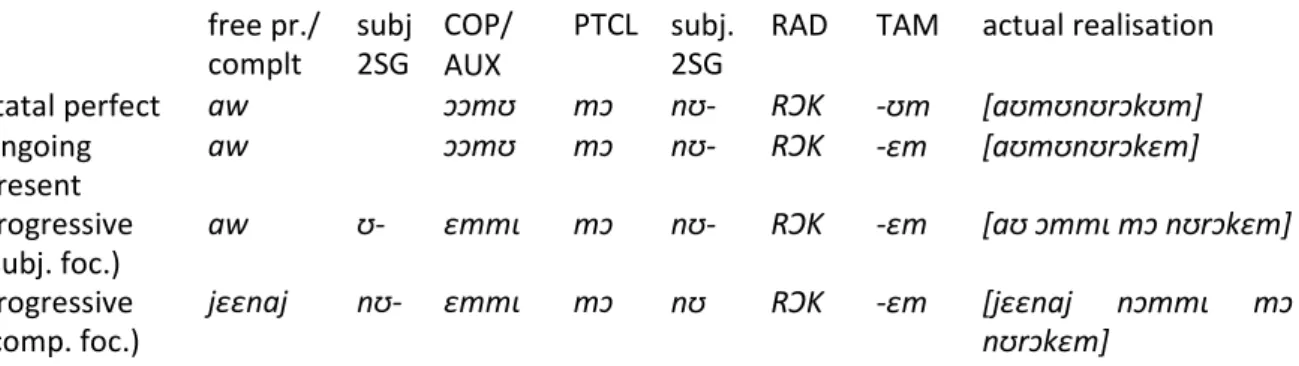
Finally, the distance deictics are used to form locative copulas (see Table 9), which are morphologically related to demonstratives but have a predicative function. They are used in non verbal locative sentences with a noun (e.g. ɛɟagʊmaj j-ɔɔ-j-ɛ ‘the dog is close to me’) or a personal pronoun as subject, and also in two complex conjugations, the Statal Perfect and the Ongoing Present (see 5.4.1). The personal markers show a -m- agreement marker for singular and a –(bʊ)k- for plural16.
Table 9: the locative copulas
close to me close to you far from you and me but visible Persons SG ɔɔm-ɛ ɔɔm-ʊ ɔmm-a PL (bʊ)kɔɔk-ɛ (bʊ)kɔɔk-ʊ kɔŋk-a Nouns CL.ɛ jɔɔj-ɛ jɔɔj-ʊ jɔjj-a CL.ka kɔɔk-ɛ kɔɔk-ʊ kɔŋk-a CL.sɩ sɔɔs-ɛ sɔɔs-ʊ sɔ̄s-a
4.4 Adverbs
Here are listed words or expressions that can be used adverbially, i.e. to add some specification to the predicate. In many temporal adverbs, one can recognise a nominal formation, involving a noun class prefix. However, these pseudo-nouns do not trigger class agreement. Table 10 lists deictic temporal adverbs referring to days and years respectively. These two sets are formed similarly, with
15 The three series of demonstratives which involve open vowels, closed vowels and prenasalised consonants evoke the origin of consonant alternation in Atlantic as postulated by J.L. Doneux (1991: 140).
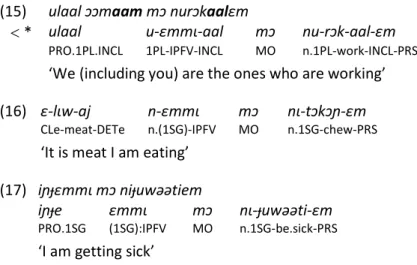
16 However, sometimes speakers give a form with an -m- marker for first plural inclusive (ulaal ɔɔm-aal-ɛ >
basic stems for elements closer to present (i.e. ‘yesterday’, ‘today’, ‘tomorrow’ and ‘last year’, ‘this year’ and ‘next year’), further elements being derived with common patterns:
Table 10: deictic temporal adverbs
DAY YEAR
-4 hukenum jaaja sunkenum jaaja
-3 hukenum sunkenum
-2 ɩntɩbarɛ hʊkɛn ɩntɩbarɛ sʊnkɛn
-1 hʊkɛn sʊnkɛn
0 humməəre kajlɛ
+1 kaɟɔm bʊlaj
+2 ɩntɩbarɛ kaɟɔm ɩntɩbarɛ bʊlaj
+3 kaɟɔmʊm bʊlajɛnʊm
+4 kaɟɔmʊm jaaja bʊlajɛnʊm jaaja
Other temporal adverbs include tʊʊtʊlar ‘during the day’, hʊɟɔnnar ‘in the afternoon / evening’, dʊʊkar ‘at night’, dʊʊrabar ‘in the morning’, lʊʊlɩ ‘never; not even’, mɩɲaa ‘now’, mɩɲɛɛ ‘now, soon’, mɛɛmɩɲɛ ‘right now, at once’, haahɛ (maa) ‘soon’, taatɛ ‘a short while ago’, nɔ ‘formerly’, naanaŋ ‘formerly, before’, nɩnnaan ‘often; next time’, ɟɔɔm ‘once again’, hʊjɔɔlɔɔmah ‘finally’ (from -jɔɔlɔm ‘last’), fɩjɔ ‘a long time’.
The following quantitative / qualitative adverbs were found: məəmək ‘very, a lot, too much’, ɟak ‘well, nicely’17, fɛ ‘all, completely’, mɩɲam ‘that way’, ɟatɩɩta ‘a few; slowly’18, bamɩɲa ‘only’. The
expression nɔɔn bəɟəm is used as an intensifier, expressing the high degree of the predicate. Sometimes noon (‘as’) may be used alone, with the same intensive meaning:
(2) sɩ-naŋ-as si-suum-e nɔɔn
CLsi-rice-DETsi AGR2si-be good-PUNCT as
‘The rice is very good’
4.5 Prepositions
The following simple prepositions were found: dɩ ‘in’, bɛ ‘till’, loh ‘close to’, ɲala ‘beside’, nɔɔn ‘as, like’. Among them, dɩ is remarkable, given its wide range of meanings and uses. Besides its original locative meaning as ‘in’, it is used as a generic locative, a comitative, an indirect object marker. It may also be part of prepositional expressions as bɛ dɩ ‘towards, to, with (things)’, baab dɩ [baabrɩ] ‘at (s.o.’s place)’19; it appears in the coordinative construction N1 PRO+dɩ N2: Asambʊ kɔ dɩ [kɔrɩ] Koko
‘Asambu and Koko’.
In addition, spatial relations may be expressed by a few particular nouns which are used without the default determiner and without any preposition, but instead require an agreeing genitive marker: (3) a-ɲɩl-aw ɔɔmʊ h-indenər h-ala bʊ-mɛŋgʊ-ab
CLa-child-DETa COPLOC CLhu-under AGR0hu-GEN CLMbu-mango-DETbu
‘The child is under the mango tree’
17 -əmək is also used as an adjective (see 4.1 above), and the -ɟak may be used as a verb or an adjective. 18 See 4.1 above.
Such ‘locative nouns’ include tʊtar ‘in the middle’, hatijar ‘on, above’, kʊɟɛŋɛnda ‘behind’ (< bʊɟɛŋɛndab ‘back’), hʊtʊtɔra ‘between’. The expression of other spatial relations requires a posture verb, such as -kagɔ (followed by dɩ + noun) ‘to lean against’, -gand-ɩ (followed by a locative noun) ‘to hang + PASS ’.
5 The verbal system
5.1 Organising principles
Keeraak has a rich verbal system with simple forms composed of subject prefixes and TAM suffixes and complex forms including auxiliaries, particles and copulas. In this paper we will present the paradigms and their semantic values, leaving aside the question of non-verbal predication and syntactic features more generally.
The overall system can be presented in two ordered levels of complexity. At a first level, simple (hereafter ‘primary’) verbal paradigms are made of TAM morphemes suffixed to the inflected root (prefixed with agreement or personal markers). At a second level, complex forms are built using inflected auxiliaries, copulas or particles, followed by the verb root, which is also inflected with the subject markers. We are going to follow this organisation for the presentation of the verbal system, and complete the picture by presenting the negative inflections, and eventually the -ɛɛn past suffix and the dependent forms. For space reasons, we will not provide here the complete table of the paradigms with their fused forms but illustrate them while providing their formation patterns, for which some morphological questions are still pending. The semantic values given here for these verbal paradigms are provisional and warrantfurther investigation about their uses.
5.2 The free pronouns and the two sets of bound subject prefixes
Beside free personal pronouns, Keeraak has two sets of personal subject prefixes, a short, vocalic one and an extended one with an additional n-. Table 11 below also includes object and possessive personal paradigms.
Table 11 : Personal markers free
pronouns subject prefixes n-subject prefixes object suffixes possessive suffixes
1.SG iɲɟe ɩ- nɩ- -ɔm -umbə ~ -umboom
2. aw ʊ- nʊ- -ɩ -ɩja
3. ɔɔ a- na- -ɔɔl -ɔɔlɔl
1.pl incl. ʊla20, ʊlaal u-…-aal nu-…-aal -ʊlal -ɔɔlɔlal
excl. ʊlɩ ʊ- nʊ- -ɔlɩ -ɔɔlɔlɩ
2. mɩjʊl ~ mʊjʊl ɟɩ- (dɩ) ɟɩ- -ʊl -ɔɔlʊl
3. bʊkɔ kʊ- (dʊ) kʊ- -ɩɩl -ɔɔlɩɩl
For 2PL and 3PL, n-forms and shortforms are identical but in some inflections, the n- morpheme is substituted by dɩ, homophone with (and probably identical to) the polyfunctional (locative) dɩ
20 ʊla is a dual, and can only be found in the free pronouns paradigm. For other paradigms the inclusive form is used.
preposition, as it is also the case for the class agreement morphemes in the same contexts. These complex forms with dɩ appear with the Consecutive and the Present negation.
Note that Keeraak has an inclusive (i.e. including the addressee) and exclusive distinction for the 1PL. For the complete list of the free class pronouns (Class consonant-ɔ) and subject agreement markers see section 2.1.2.
There are several reasons to posit real 3rd person markers, distinct from class agreement. Remarkably, the short 3rd person subject prefixes are identical to the standard noun class prefixes of nouns denoting human beings (singular A, plural KU~BUKO). These subject prefixes may also be used when referring to nouns bearing different prefixes, insofar as they denote human beings; in addition, 3rd person object and possessive forms may not be deduced from noun class markers. The important point to note is that, by contrast with personal affixes, there is only one set of subject agreement markers for noun classes.
The free pronouns can be used in isolation, after a preposition or in focus position before the verb for subject-focusing verb forms. In this latter case, for primary paradigms, a bound (agreement) subject prefix (short form) is still needed. The motivation for the distribution of the short vs. n-forms is not fully understood. So far, two rules can be stated: the n-forms never appear after the free pronouns, the short forms never appear at the beginning of an independent assertive clause, except for the negative inflections.
The short subject prefixes are used :
- for the Basic form, Imperative and Hortative
- after the free pronouns, i.e. for the subject-focusing paradigms - before the verb stem in the futures and habitual (complex forms)
- in most of the negative paradigms (except the present and progressive negatives) - with the various dependent forms, and also for the verb in subject relative clauses The n-forms are used in the remaining contexts, that is:
- For the Consecutive21 (with a dɩ variant for 2PL and 3PL as for class markers)
- For the Punctual - For the Terminative
- For the complement-focusing forms - For the Future 3auxiliary
- On the verb stem for auxiliated forms using the mɔ particle (Statal Perfect, Ongoing Present, Progressive)
- In the auxiliated form of the Present negation (with a dɩ variant for 2PL and 3PL) and that of progressive negative
- for the verb in object relative clauses
5.3 The basic TAM oppositions and primary paradigms
The affirmative Keeraak verbal system can be first described following two basic oppositions criss-crossing the simple and complex paradigms: (i) subject-focusing vs. complement- (or non subject-)
21Capitalized names are used here for language-specific morphological categories (e.g. Consecutive, Future,
Perfect) but lower case (e.g. consecutive, future, perfect) for semantic concepts or functions which may be expressed in multiple ways across languages.
focusing inflections marked by short vs. n-forms for subject markers, and (ii) inflections with the three following TAM suffixes in complementary distribution: -ʊm for completive (cf. past reading with dynamic verbs vs. present with stative ones), -ɛm for concomitance (by default with the time of speech, cf. present value for all verb types), and ∅ for irrealis or non-actualised forms, including futures, habituals (which are complex verb forms), consecutive and dependent forms but not the negative inflections which have their own suffixes. The system looks unbalanced, since in the same verbal slot (post-radical position) an aspectual marker (-ʊm) contrasts with a temporal one (-ɛm). Remarkably the present suffix -ɛm can also be used in dependent clauses as a concomitant in past contexts, which looks like a typical feature of imperfectives. Furthermore, the -ɛm forms are also compatible with the past suffix. However, the -ɛm suffix does not convey other expected values of imperfectives (such as habitual or future). There is another element, ɛmmɩ, used to form the Habitual and the Progressive (see below) that we have chosen to label ‘imperfective’. Therefore, despite the fact that -ɛm probably was once a true imperfective, today its position in the system points to a temporal rather than aspectual meaning.
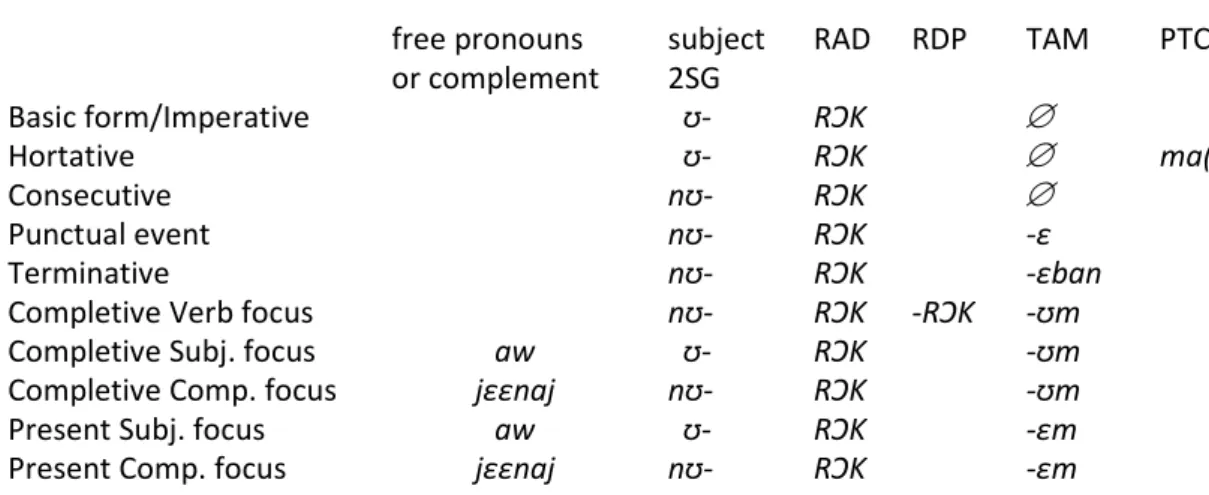
Table 12 summarises the various primary paradigms (here for the 2SG) and indicates which set of personal subject affixes is used (here nʊ- vs. ʊ-).
Table 12: the primaryparadigms (example with the root rɔk ‘work, make’, 2SG, and jɛɛnaj ‘knife’)
free pronouns
or complement subject 2SG RAD RDP TAM PTCL
Basic form/Imperative ʊ- RƆK ∅
Hortative ʊ- RƆK ∅ ma(h)
Consecutive nʊ- RƆK ∅
Punctual event nʊ- RƆK -ɛ
Terminative nʊ- RƆK -ɛban
Completive Verb focus nʊ- RƆK -RƆK -ʊm
Completive Subj. focus aw ʊ- RƆK -ʊm
Completive Comp. focus jɛɛnaj nʊ- RƆK -ʊm
Present Subj. focus aw ʊ- RƆK -ɛm
Present Comp. focus jɛɛnaj nʊ- RƆK -ɛm
Before presenting each verb form, let’s add that the completive suffix -ʊm has three possible realisations, conditioned by the phonological environment, one of them (mɩ) producing a confusing homophony with a TAM auxiliary (ɛmmɩ) in certain contexts. These three realisations are: -ʊm after sonorants except r, and after plosives except ɟ (see examples in Table 13), -mɩ after all the nasals which are in turn assimilated as bilabials, and lastly -m after vowels, and also -ɟ and -r in which case the consonant is deleted and the preceding vowel lengthened.
Table 13: The three realisations of the completive suffix -ʊm (here for Completive Subject-focus inflection)
suffix Context verb root inflected form (1SG) translation -ʊm after plosive rɔk : iɲɟe ɩ-rɔk-ʊm I have worked -mɩ after nasal nʊŋɛn : iɲɟe ɩ-nʊŋɛm-mɩ I have built -m after vowel ɲɔɔfɔ : iɲɟe ɩ-ɲɔɔfɔ-m I have eaten
after ɟ, r hɛɟ : iɲɟe ɩ-hɛɛ-m I have seen
Primary verb forms are made of a subject prefix, the verb stem and a TAM marker. Only the TAM suffixes used in main or independent clauses are presented here. Let us start with the forms falling outside the focusing opposition and that of completive (-ʊm) vs. present (-ɛm). The Basic (or unmarked) verb form includes a short subject prefix and a verb stem with no suffix (∅). This form is used in some basic questions (see ex. (23) below) and in various dependent or subordinate forms