HAL Id: tel-01940911
https://tel.archives-ouvertes.fr/tel-01940911
Submitted on 30 Nov 2018HAL is a multi-disciplinary open access archive for the deposit and dissemination of sci-entific research documents, whether they are pub-lished or not. The documents may come from teaching and research institutions in France or abroad, or from public or private research centers.
L’archive ouverte pluridisciplinaire HAL, est destinée au dépôt et à la diffusion de documents scientifiques de niveau recherche, publiés ou non, émanant des établissements d’enseignement et de recherche français ou étrangers, des laboratoires publics ou privés.
Approaches for Services in Smart Spaces
Tayeb Lemlouma
To cite this version:
Tayeb Lemlouma. Contribution to Context-Aware and Adaptive Approaches for Services in Smart Spaces. Networking and Internet Architecture [cs.NI]. Université de Rennes 1 [UR1], 2018. �tel-01940911�
Habilitation à diriger des recherches
Université de Rennes I
~
École doctorale MathSTIC
Mathématiques et STIC
Domaines Scientifique : Informatique (INFO)
Contribution to Context-Aware and Adaptive
Approaches for Services in Smart Spaces
Présentée par : Tayeb LEMLOUMA Soutenue le 26 juin 2018
devant le jury composé de:
Rapporteuse : Mme Hassnaa Moustafa, Chercheuse Séniore HDR, Intel, États-Unis
Rapporteur : M. Christoph Thümmler, Professeur, Université de Edinburgh Napier, Royaume-Uni Rapporteur : M. Rémi Bastide, Professeur, Université Fédérale de Toulouse Midi-Pyrénées, France Examinateur : M. Olivier Barais, Professeur, Université de Rennes 1, France
Foreword
This manuscript is written in total fulfillment of the requirements of the French degree
Habilitation à Diriger des Recherches (HDR). HDR is an additional academic research
accreditation after the Ph.D. degree. It is required, in the French academic system, to direct research strategies and develop an independent research activity (e.g. the official supervision of doctoral theses or the application for full professorship positions). An HDR manuscript is not supposed to be a self-contained or fully polished document like a Ph.D. manuscript. It is meant to overview the research activity and provide a clear research vision embodied by consistent contributions.
In this manuscript, I summarized a part of my research developed during the last eight years and dedicated to the application of the context-awareness concept in systems, net-work architectures, protocols, and application services. I focus the major part of my contributions to the emerging and challenging topic of e-health in smart spaces. The com-mon thread running through these contributions is the need for efficient, adaptive, and interoperable methods that consider the context in which services are used by humans with different profiles and needs. To tackle this objective, I adopted a multidisciplinary approach that allowed me to collaborate with different researchers, practitioners, and teams. I can not fail to recognize the first valuable support of the INRIA Rhône-Alpes Lab (Grenoble) and the W3C consortium in the beginning of my career during my Ph.D. and post-doctoral work. In addition, after my Ph.D. I have initiated different collabo-rations with the teams of the IRISA Lab (Dionysos, ADOPNET [ex-Atnet], TACOMA [ex-ACES], and OCIF) and other national and international Labs and companies such as LIUPPA (Anglet), LaBRI (Bordeaux), LIGM (Paris), Orange (Lannion), LSI (Alge-ria), LARATSI (Tunisia), and CRISTAL (Tunisia). All of these various collaborations, amongst others, have significantly contributed to the maturity of my research and the vision I defend in this manuscript.
Contents
1 Introduction 5
1.1 Research Context and Motivations . . . 5
1.1.1 Network architectures and protocols for pervasive services . . . 7
1.1.2 Smart spaces . . . 8
1.1.3 e-Health . . . 8
1.2 Challenges . . . 10
1.2.1 The integration of context-awareness in current heterogeneous net-work architectures and protocols . . . 10
1.2.2 Providing interoperable and adapted services . . . 11
1.2.3 Understanding the context . . . 11
1.2.4 Human-centric services in e-health . . . 12
1.2.5 The anticipation of context changes . . . 12
1.3 Contributions . . . 13
2 Architectures and Application Protocols 17 2.1 Introduction . . . 18
2.2 Architectures and Protocols for Digital Smart Homes . . . 18
2.2.1 Research context . . . 18
2.2.2 A context-aware architecture for media access . . . 19
2.2.3 An adaptive scheme for media selection . . . 22
2.2.4 Summary of results . . . 24
2.3 Toward Context-Aware Network Architectures . . . 26
2.3.1 Research context . . . 26
2.3.2 IMS model for pervasive services . . . 26
2.3.3 A global context-aware method for broadcasting services . . . 30
2.3.4 Summary of results . . . 35
2.4 A Web-based Approach for Optimized and Interoperable Services . . . 36
2.4.1 Research context . . . 36
2.4.2 Generation of adapted Web interfaces . . . 37
2.4.3 Emerging Web technologies for complex services . . . 39 1
2.4.4 Summary of results . . . 41
2.5 Conclusion of the Chapter . . . 42
3 Using the Context for Human-Centric Services 47 3.1 Introduction . . . 47
3.2 Understanding and Modeling the Context . . . 48
3.2.1 Research context . . . 48
3.2.2 Analysis of existing models . . . 49
3.2.3 Modeling the context . . . 52
3.2.4 Generation of realistic contexts for services validation and experi-mentations . . . 54
3.2.5 Summary of results . . . 56
3.3 Design of Context-Aware Services . . . 57
3.3.1 Research context . . . 57
3.3.2 Framework of context-aware services . . . 59
3.3.3 Context-aware monitoring of daily living activities . . . 60
3.3.4 Emergency situations . . . 62
3.3.5 Localization . . . 66
3.3.6 Summary of results . . . 69
3.4 Conclusion of the Chapter . . . 70
4 Anticipating the Changes of Context 73 4.1 Introduction . . . 73
4.2 Grey Model-based Approach . . . 74
4.2.1 Research context . . . 74
4.2.2 Used forecasting model . . . 75
4.2.3 Prediction for human activities and actions . . . 76
4.2.4 Prediction for critical contexts . . . 79
4.2.5 Summary of results . . . 82
4.3 Recurrent Neural Networks-based Approach . . . 83
4.3.1 Research context . . . 83
4.3.2 The ELM model . . . 83
4.3.3 The proposed recurrent model . . . 84
4.3.4 The context’s prediction using RELM . . . 87
4.3.5 Summary of results . . . 88
4.4 Conclusion of the Chapter . . . 89
5 Conclusions and Perspectives 91 5.1 Conclusions . . . 91
3 5.2.1 Combining autonomic computing and context-awareness approaches 93 5.2.2 Handling the heterogeneity in IoT networks for e-health . . . 94 5.2.3 User’s acceptability and adherence to IoT-based e-health systems . 95 5.2.4 Web of Things (WoT) . . . 95 5.2.5 5G networks and e-health evolution . . . 96
Chapter 1
Introduction
This document intends to provide a summary of my research work that I have been leading for the last eight years. The broad scope of my contributions is the consideration and application of the context-awareness concept either to improve the effectiveness of existing systems, or to make them incorporating easily new human-centric services, or to design new approaches with new services that better meet the expectations of end users. With this aim in view, we need a multidisciplinary approach that tackles different components of systems and architectures and solves the related issues under different perspectives. The key question that we address, throughout the document, is how to
take advantages of the knowledge of the user’s context in providing optimal services that are as close as possible to what the user expects? How to avoid that users are required to significantly alter their behavior to accommodate the system, rather than the system accommodating the users? To answer such questions, we will focus on three main topics:
the integration of context-aware services within existing architectures and protocols, the design of human-centric services, and the anticipation of context changes. For the last two topics, we will focus on the challenging e-health realm in smart spaces for both the definition of the context and the services that we target to provide.
1.1 Research Context and Motivations
Context-awareness represents the main key to a successful system thanks to the
con-sideration of the user’s environment, preferences, capabilities and the characteristics of the services and the surrounding environment. The context-awareness principles can be applied in numerous fields of research, as in smart spaces, when the aim is to provide services to the end user. Context-awareness consists of adding systems the capability to use information sensed from their surrounding physical environment and exploit the avail-able knowledge along with their own states, in order to adapt their behavior accordingly. Context-awareness allows an automatic provision of information, actions, and services ac-cording to the user’s current context and needs [1]. Acac-cording to [2], context-awareness
refers to applications capable of monitoring inputs from sensor devices and selecting the suitable context according to the subject’s needs or interests. In [3], a system is qualified as context-aware if it uses the context to provide relevant information and services to the subject. In contrast, from the pervasive healthcare systems perspective, context-aware computing systems consider the application’s ability to adapt to changing circumstances and respond according to the context of use [4].
In the literature, the most used definition of the context term considers the context as any information that can be used to characterize the situation of an entity. An entity
includes a person, a place or an object [5]. Two kinds of information can be distinguished: raw data and context information [6]. Raw data, also called low-level contextual data,
is unprocessed data provided directly from a source (e.g. a sensor) in a given space. Such data may represent, for instance, a person’s vital signs, environmental parameters (e.g. temperature, humidity, and sound), or personal movements. Our key idea is that acquired raw data is worthless if it is not well interpreted and understood by the underlying system. The second kind of context information is generated by processing raw data, i.e. by applying consistency validation or metadata enrichment. It refers to extracting high-level information such as behavior patterns or a human activity recognition.
Context has been broken down into various dimensions depending on the different perspectives of the application. Each context dimension is used to define a piece of in-formation. For instance, one can consider the location, environment, identity, and time when defining the context. The evaluation of the person’s context will, consequently, de-pend on the accuracy of the contextual information at a given time. For instance, a lying position in the bedroom, at night, can be interpreted as a normal situation, while the same position in the middle of the day for an extended period could indicate an abnormal situation. The primary pieces of the context should answer the following five W questions:
Who, What, Where, When, and Why. These questions were identified in the literature as
a minimal set of information necessary to understand the context and situations [7, 8]. Other related information can be used to refine the description of the context depend-ing on the targeted objectives. For example, in smart spaces and network architectures, the context can consider the used access technologies, the kind of the architecture, used protocols, available servers, data rates, available bandwidth, the capabilities of terminals, and connected objects.
Overall, context-awareness computing systems are usually designed and implemented for a specific purpose and, thus, are focused on reaching some objectives for specific problems. As a result, no standards or guidelines exist for building such systems. The core difference between each system lies in the levels of context-awareness each system possesses [9]. Context-awareness systems should define several components that are responsible for required functions including the optimal sensing, representation, management, reasoning, and analysis of context information.
1.1. Research Context and Motivations 7
1.1.1 Network architectures and protocols for pervasive services
Context-aware systems and projects rely on a set of common components and use standard or commercial sensors for the purpose of gathering contextual data of persons and their environment. The most used interconnections of pervasive and context-aware services are based on wireless sensors networks (WSN) with a limited coverage such as NFC, Blue-tooth, Zigbee, and Z-Wave. The main focus is on the personal and immediate space around the person including his own body; these are the wireless personal area/sensor networks (WPAN/WPSN) including body area/sensor networks (BAN/BSN). They run on battery power and are characterized by their limited coverage and number of interconnected de-vices, low bandwidth, and data rate. Selected sensors and devices are integrated into the user’s space and infrastructure and connected using the selected network technology. Each sensor is responsible for one or more task at the same time. In e-health services, PSNs are usually used to consider the human daily activities and measure conditions in the user’s space. BSNs are usually used to monitor vital signs and health conditions by measuring physiological parameters and detecting ambulatory activities. For more advanced oper-ations, such as remote monitoring and bandwidth-intensive applicoper-ations, other networks can be used such as wired, 5G, and WiFi. Power-line networks (PLN), that relay data over the electrical wiring, represent an interesting low-cost solution which is adapted to some settings, such as providing older houses with a healthcare IoT network.
Providing context-aware services adapted to the user’s context and needs is paramount to improve the user’s quality of experience and adoption of proposed services. However, the degree of such user’s satisfaction rely on a complex set of factors and involve many actors including the service provider, the network architecture, and the targeted user with his surrounding environment. In order to provide a global context-aware approach, it is important to consider the used network architectures and protocols and take advantages of their advanced functionalities, otherwise, determine the required modifications or im-provements to better consider the user’s context. In this manuscript, we will consider three major architectures that are carefully selected primarily because they offer an appealing environment for providing pervasive and context-aware services with the ability to use heterogeneous technologies, devices, and complex services under different contexts. These three architectures are: the Digital Living Network Alliance (DLNA) architecture [10], the IP Multimedia Subsystem-based Next Generation Network (IMS-NGN) [11], and the
Multimedia Broadcast Multicast Service (MBMS and eMBMS) architecture [12]. From the
protocol perspective, we believe that the adoption of the Web, when applicable, improves the quality of experience of users regarding the pervasive access and use of services even in complex architectures. In this context, the use of WebRTC [13] enhances the interop-erability and interactions with users in specific complex services involving two-way video and audio streams.
1.1.2 Smart spaces
Smart spaces are an integration of ubiquitous computing and communication technologies. Emerging pervasive technologies such as the Internet of Things (IoT) are giving shape to a powerful environment where it becomes easy to develop new services with a high degree of ubiquity, accessibility, autonomy, and control [14]. These services mainly rely on sensing, communication, and the processing capabilities of the system. Most existing systems involve the interaction with users using one or more types of sensors. Sensors are responsible for data acquisition and are either stationary sensors deployed in domestic settings or wearable sensors carried by the user, for instance, in the context of smart cities. Both of these two categories of sensors collect the user’s contextual information in a constant or periodic way. Sensors relay data through, for instance, an access point or a base station to a coordinator (e.g. a home server or a portable device) using the network architecture and available protocols.
Diverse parameters and heterogeneous data collected from sensors can be involved, such as from the environment (e.g. sound detection), movement and location tracking, and vital signs (e.g. heart rate, and blood pressure). This data provides a low-level view of the context of the user evolving in the space. According to the system architecture, hardware capabilities (sensors, actuators, connections, and gateways) and methods used in processing the data, the system can gain a high-level view of the context. Existing systems can be differentiated based on the following three aspects: the target application and population, the system capabilities (e.g. storage, processing, communication, bandwidth, and energy management), and deployed methods such as learning-based and reasoning-based approaches.
Smart homes represent an application of smart spaces that involves the integration of different services by using a common communication system at home. Smart home technologies promise tremendous benefits for users such as elderly and dependent per-sons living alone. The environment can provide users context-aware services like comfort, healthcare, safety, and energy conservation. Many smart home projects and architectures have been conducted over the last decades [15]. However, proposed systems are always faced with the problem of their adaptability to the user’s need. Hence, their adoption and real use by the general public remains an issue. The situation is more striking for persons with heterogeneous profiles and specific needs.
1.1.3 e-Health
There is a high proliferation of emerging technologies, such as IoT, in many areas thanks to the ability of the technology to easily address important needs and improve users lives [16]. The situation is particularly significant regarding the e-health realm with the po-tential increasing loss of autonomy of the growing aging population, the countless heavy
1.1. Research Context and Motivations 9 costs of traditional healthcare institutions, and the available technological advances, which continue to influence the global economy. For the end of 2025, we expect that e-health applications will dominate IoT with 41% of the global market, followed by manufacturing (36%), and smart grids (8%)1. Healthcare applications hold significant potential for
pro-viding continuous quality healthcare with far less expenditure. e-Health allows the use of new objects and communication means to promote a self-care such as ensuring an inde-pendent monitoring of chronic disease while minimizing the restrictions and constraints for the users. For instance, e-health services can help to manage the Alzheimer’s disease by locating patients with indoor and outdoor techniques, indicating the placement of various objects using tracking tags, reminding food and medicine, boosting the brain functions using various applications, etc. Healthcare systems are characterized by their smooth in-tegration of many components with a strong heterogeneous level of capabilities in terms of processing, hardware functionalities, and networking methods. Used objects can vary from the simple presence and localization sensors to biometric and physiological sensors, smart clothing, smart pills, implantable devices, and devices for the next-generation genomic health.
The hardware and the human-machine interface of the software are generally simple and compact in terms of architecture and functionalities. Basically, they are dedicated to a few number of specific needs such as displaying an overview of sensed ECG data (e.g. the blood glucose level), providing a medical prescription, or ensuring a remote assistance using video conferencing in more advanced healthcare systems. The optimization of hard-ware and softhard-ware results in a limited user’s ability to personalize a solution or to change it in order to meet his preferences. The lack of this ability is increasingly perceptible by users in healthcare since involved technologies, especially in the mobile health (m-Health) field, are directly engaging persons in their own healthcare.
Overall, e-health is a complex ecosystem where services require a transversal and cross-layer approach. Proposed approaches should be human-centric and context-aware to consider the user’s context, preferences and their evolutions over time. As mentioned previously, raw data provided by an isolated object become less important if they are not cross-analyzed and moderated by the global context of the system. Therefore, there is a need to develop global/distributed smart components to ensure data collection, pro-cessing, and storage. High-level abstractions can be achieved in order to identify relevant information for the application services. Smart algorithms can be designed to ensure the interoperability between heterogeneous objects and protocols and guarantee an optimal coordination of objects. Furthermore, other objectives can also be considered by services
1In our projections, as applied in the IBSG projections [17], we use the findings of [18] where it is
shown that similar to the Moore’s Law, the Internet doubles in size every 5.32 years. We combine the MGI projections for IoT applications and the United Nations projections (2015) [19]. Our results lead to estimate 100 billion of connected devices. This is a minimum value since we consider the entire population including developing nations and people not yet connected to the Internet.
such as optimizing the energy consumption or minimizing delays of data processing and network delivery. This last objective is paramount in e-health, particularly when the ap-plication should trigger quick and appropriate decisions such in emergency situations.
1.2 Challenges
The adoption of a context-aware approach, while proposing new services intended for use in different contexts, raises some key challenges to be addressed by the research community. Tremendous work has been devoted to increase the satisfaction of end users. However, with new emerging technologies, like IoT, the democratization of connected objects, and the growing complexity of systems, protocols, and networks much more efforts would need to be carried out. On the other side stand the complex expectations of humans in terms of personalized computer services especially for some profiles who count, more than others, on the system’s assistance and help in daily life.
1.2.1 The integration of context-awareness in current
heteroge-neous network architectures and protocols
Nowadays, several networks, architectures, and protocols are involved in the delivery of human-centric services. Usually, to ensure the ability to provide adaptive services, the network architectures and protocols must be either redesigned or include several modifi-cations. Indeed, architectures should address the lack of ubiquity, pervasivity, and context-awareness by providing functionalities like dynamic adaptability during execution time, flexible allocation and execution of network functions depending to: the user’s profile, services discovery by the core of the architecture, support for mobility, etc.
For instance, in digital homes, proposed systems and norms (e.g. DLNA) are designed to offer an interoperable home network that provides services in different contexts regardless existing devices, media sources, formats, location, delivery methods, and protocols. Un-fortunately, actual digital home networks do not meet the basic requirements of context-awareness and several users are still unaware of the existence of such digital technologies. From the user’s perspective, the complexity of such architecture is very high in terms of intercommunication and collaboration between different norms, the heterogeneity of application protocols and services, media formats, and devices. Overall, there is a lack of smart components that help users to find the services and resources and to use existing services in an intuitive, transparent and adaptable way.
On the other hand, there are other architectures that already holds advanced func-tionalities and components which could be exploited to run adaptive services according to the context of the end users (e.g. IMS-NGN). Unfortunately, these architectures need fundamental reviewing in order to determine the appropriate existing components and
1.2. Challenges 11 define an efficient collaboration between them in a global context-aware approach. Archi-tectures and protocols should integrate as many interoperable elements as possible. These elements must ensure a bidirectional transmission of contextual information between the user’s space and the service provider. Formats involved in the service’s delivery must sup-port a minimum level of personalization and be understood by the end user and his own platform (devices and network).
1.2.2 Providing interoperable and adapted services
Ensuring an automatic adaptation of services is a challenging task. Depending on the nature of the service, the adaptation may rely on a plethora of parameters. Such param-eters may include the user’s network access method, the protocol used to provide data, the profile of the end user, the user’s needs, the user’s behavior, preferences and interests, and the capabilities of the user’s terminal. With emerging technologies and the increasing need for a pervasive access, heterogeneous and unconventional objects are more and more involved to render the service’s data to the user. These constraints need to be overcome while designing context-aware services. The user’s quality of experience (QoE) becomes as important as the conventional quality of service (QoS) in the sense that context-aware systems need additional metrics and methods to evaluate the user’s satisfaction to avoid the non-adherence of users. It is required to strengthen the link between the user’s context and the personalization’s degree of the service. This implies that the original form of the service should support operations like decomposition, filtering, and changes of settings to meet various contexts and satisfy different constraints. For these challenges, the use of standards should be the preferred practice in the design of services. For instance, Web-related technologies (protocols and formats) present good candidates to ease the task of adaptation even for complex services.
1.2.3 Understanding the context
The foundation stone of context-aware systems is the sound knowledge of the user’s con-text and his surrounding environment. This knowledge is used to adapt a given service to a given context at any given moment. With the myriad of available information sources (e.g. with sensors), it becomes necessary to develop optimized methods that capture and handle relevant contextual dimensions that are appropriate to the provided service. The system’s capture of context should lead to a better understanding of observations and an efficient context summarization. Hence, the system becomes able to consider the user needs and provide appropriate and automatic answers. To achieve these goals, it is impor-tant to rely on an efficient and flexible context modeling with optimized operations like processing, storage, and matching. The main challenges in such modeling are to ensure a high degree of expressiveness, storage and processing optimization with the ability to
capture relevant data related to the real expectations and needs of users. Another chal-lenge is related to the ease of integration of contextual models into existing systems in addition to the ability to vary the context. The latter is crucial to test the behavior of new systems to face up to unexpected and risky contexts (e.g. emergency situations in e-health).
1.2.4 Human-centric services in e-health
e-Health is a challenging topic when we aim to provide context-aware services. Expected services can be numerous, interrelated and complex with a wide heterogeneity of users profiles and changing contexts. For e-health services in smart spaces, context plays a significant role mainly for three reasons. First, in smart environments, evaluating the users regarding their health conditions and performances in their daily lives relies on understanding the user’s surroundings. For example, changes in the person’s vital signs data should be correlated with the person’s current situation in order to achieve a better understanding of the person’s condition. For instance, the system’s interpretation of the cardio activity should be linked to the nature of the current activity, which can differ substantially for a house keeping activity compared to a watching TV activity. A high recording of sleep disorders could imply hepatitis C [20]. Second, context can be useful in making smart spaces more efficient and optimal. Data regarding the user’s context is often collected using various sensors and devices. A continuous processing and fusion of such data require a huge amount of processing. To increase the system’s effectiveness, required sensors should be appropriately selected and data should be appropriately and accurately analyzed [21]. Finally, some specific services require an accurate knowledge of the context and expect quick answers from the context-aware system. Such is the case, for instance, of services for persons with a severe degree of dependence in addition to emergency services and the monitoring of critical physiological parameters.
1.2.5 The anticipation of context changes
If the consideration of the current context is the core of context-aware approaches, tak-ing into account the future context may be particularly effective on several levels and objectives. First, it provides highly useful support for specific services like handling the emergency situations or following the context evolution and trend with critical health parameters. Second, it increases the degree of the system’s adaptability and, hence, the user’s satisfaction and confidence in the system as a whole. Finally, it enables the system to mobilize only required resources for the objectives of the provided services.
Several studies and methods have been designed to optimize the context prediction such as probabilistic techniques, fuzzy and case-based reasoning rules, support vector ma-chines, clustering approaches, and time series analysis [22, 23, 24]. The main challenge of
1.3. Contributions 13 the anticipation of contexts is to define an approach that avoids the processing of a large amount of data and to provide a short-term prediction. Another challenge, particularly perceived in smart spaces with multiple sources of contextual data, is to ensure the antic-ipation even with discrete data and incomplete or poor information. Overall, we need to define an efficient system combining an optimal cost of data collection with short training periods and an accurate prediction of the user’s context.
1.3 Contributions
Our contributions to the previous challenges are organized as follows:
Chapter 2 focuses on the study and the integration of context-awareness concept with
regards to some existing network architectures and protocols. In particular, we consider the Digital Living Network Alliance (DLNA) architecture in smart homes [25, 26, 27, 28], and the two ISP architectures: the IP Multimedia Subsystem-based Next Generation
Net-work (IMS-NGN), and the Multimedia Broadcast Multicast Service (MBMS and eMBMS)
architecture [29, 30, 31, 32, 33, 34].
In smart home environments, we propose a context-aware framework, called Universally, that aims to simplify and optimize the complexity of current home architectures. We consider limited objects and users like novice users and dependent persons that are not always aware of setting up their devices. Moreover, using a new adaptive scheme for me-dia selection, we consider the user’s behavior and preferences to adapt the digital home system when providing content and services. Using a global context-aware approach we deeply review the two ISP architectures of IMS-NG and MBMS with the aim of enabling context-aware services. For the IMS architecture, we focus on providing healthcare services by involving different elements: the heterogeneous sensor networks (at the user’s level), the IMS core network, and the application servers (AS) level. Our approach includes the services invocation, with consideration of services priorities, the ability to update the context, and the integration of e-health records. In MBMS, we focus on the proposition of a new global context-aware method that considers the heterogeneity of wireless net-works, terminals, users, and services. We propose to extend the decision of delivering broadcast-based services by the incorporation of the context of users, operators, and ser-vice providers.
On the protocol front, throughout our different propositions, we adopt a Web-based ap-proach in order to improve the interoperability of services and the quality of experience of users regarding the pervasive access and use of services even in complex architectures [35, 36, 37]. We consider any service as the union of the following three sets: inputs, advanced operations, and output results that we provide in the form of standard and adaptable Web interfaces. Different techniques were exploited to consider the variety of
targeted contexts such as content pagination, delivery size optimization, and real-time me-dia adaptation. We enrich our Web-based approach, by using the WebRTC [38, 39, 40], in order to consider the user interactions in complex services involving bidirectional video and audio streams;
Chapter 3 addresses the application of context-awareness in the design of
human-centric services with a focus on the e-health realm. We start by proposing an approach to understand and model the context [41, 42, 43, 44, 45, 26, 37, 25]. Then, we provide a generic context-aware framework for services with three main services applications: the monitoring of activities of daily living, handling emergency situations, and the localization of persons in the context of smart cities [16, 46, 47, 38, 28]. Our objective of understanding the context is to identify the degree of assistance needed by users while facilitating the fu-ture integration of adaptive services into a real-world environment. We study the overlaps and differences between the most important models used to evaluate the dependency of persons, namely AGGIR and SMAF models, and propose a matching approach between the different models with a new evaluation algorithm. Based on the lessons learned in the previous step, we propose a modeling of the context that considers three kinds of profiles: data related to the user (user profile), characteristics of objects available in the smart environment (space profile), and services that could provide or process any kind of data (service profile). We enrich our modeling of real contexts through a generation process of contexts instances. The objective is to assist the design and test of new adap-tive systems without risking the safety of persons in case of fails or runtime errors. The three investigated categories of services (activities of daily living, handling emergency situations, and the localization) are discussed using three different approaches: the first one is algorithmic with the proposition of a new adaptive algorithm, the second is based on finite states machine (FSM), and the third approach is based on the combination of localization techniques and genetic algorithms;
Chapter 4 is dedicated to the discussion of our main approaches that we have
pro-posed to anticipate and predict the changes in contexts. We focus on two main approaches: the Grey theory [48, 49, 46, 45] and Neural Networks [50, 51, 52].
In the first approach, we propose a context-aware monitoring algorithm which is able to collect relevant and contextual data, predict and detect risky contexts, and evaluate the person’s need for help while remaining effective and cost-efficient. The considered context mainly includes actions and activities of daily living with a special attention to the accu-racy with regards to critical health parameters (e.g. blood pressure and pulse). We also include the user’s own power consumption as a contextual dimension and as an efficient indicator for our system to understand the user’s behavior and predict its changes. In our second approach, we use recurrent techniques that have shown promising results
1.3. Contributions 15 when the data presents some sequential dependencies. Specifically, we improve the exist-ing Extreme Learnexist-ing Machine model by providexist-ing a temporal relationship between the observations at different time steps. The resulting model, called RELM (Recurrent Ex-treme Learning Machine), is able to learn the human behavior and ensures a right balance between the learning time and the prediction accuracy. To evaluate our approaches, sev-eral metrics are used such as the percentage of prediction’s error (PE), the forecast error (FE), forecast accuracy (FA), root means squared error (RMSE), and the mean absolute deviation (MAD);
Chapter 5 concludes this manuscript by summarizing our main achievements and
Chapter 2
Architectures and Application
Protocols
Contents
2.1 Introduction . . . 18 2.2 Architectures and Protocols for Digital Smart Homes . . . . 18 2.2.1 Research context . . . 18 2.2.2 A context-aware architecture for media access . . . 19 2.2.3 An adaptive scheme for media selection . . . 22 2.2.4 Summary of results . . . 24 2.3 Toward Context-Aware Network Architectures . . . 26 2.3.1 Research context . . . 26 2.3.2 IMS model for pervasive services . . . 26 2.3.3 A global context-aware method for broadcasting services . . . . 30 2.3.4 Summary of results . . . 35 2.4 A Web-based Approach for Optimized and Interoperable
Services . . . 36 2.4.1 Research context . . . 36 2.4.2 Generation of adapted Web interfaces . . . 37 2.4.3 Emerging Web technologies for complex services . . . 39 2.4.4 Summary of results . . . 41 2.5 Conclusion of the Chapter . . . 42
2.1 Introduction
In this chapter, we consider the problem of integrating adaptive and context-aware services using existing protocols and network architectures. How the current architectures and protocols address the context of users, their terminals, and network access technologies? What are the drawbacks of current architectures? How can we improve the interoperability and use of services in heterogeneous environments with resource-constrained connected objects? In order to answer the previous questions, we discuss some of our contributions related three topics: digital smart home architectures, the integration of context-aware services, and the use of Web technologies as a means to improve the interoperability and solve some of the main issues of heterogeneity.
In the topic of digital smart home architectures, we focus our on the Digital Living
Network Alliance (DLNA) architecture since it knows a high penetration in homes. We
propose the Universally approach with the aim of simplifying and optimizing the com-plexity of current home architectures and provide an adaptive scheme for home services [25, 26, 27, 28, 35, 37].
Regarding the integration of context-aware services topic, we contribute to the integra-tion of adaptive services in the major architectures of IP Multimedia Subsystem-based Next
Generation Network (IMS-NGN) and the Multimedia Broadcast Multicast Service (MBMS
and eMBMS). These architectures were carefully selected because they offer an appealing environment for providing pervasive applications and services with the ability to use het-erogeneous access technologies that converge to the same core [29, 30, 31, 32, 33, 34, 36]. In the topic of Web-based approaches, we first contribute with the generation of stan-dard and compatible Web interfaces that increase the quality of experience of users by enabling them to interact with services, rich content, and receive a context-aware and adapted output. Second, we focus on the interactions of users with complex services (like home emergency services) using emerging Web technologies such as the WebRTC [38, 35, 39, 40, 37]
2.2 Architectures and Protocols for Digital Smart
Homes
2.2.1 Research context
Home users, and more specifically elderly, are constantly faced with the ever-evolving technology and need appropriate support in order to satisfactorily meet the difficulties of everyday living. This becomes an increasingly important issue as IoT is increasingly being used in smart spaces. Smart homes represent an application of pervasive environments
2.2. Architectures and Protocols for Digital Smart Homes 19 that involves the integration of different services by using a common communication system. Smart home technologies promise tremendous benefits for elderly and dependent persons living alone. The environment provides user context-aware services like comfort, healthcare, safety, and energy conservation.
One of the main challenges facing smart home systems is balancing the complexity of proposed systems against their usability [15, 28]. Half of the majority of computer-based information systems related to healthcare fail due to user’s resistance and staff interference. This situation is mainly due to the fact that users were asked to significantly alter traditional workflow patterns to accommodate the system, rather than the system accommodating the users. In sum, current systems suffer from the absence of components that consider the context of the devices (software and hardware capabilities) and the context of the user (preferences and behavior) [53, 54, 55, 56, 57].
We focus our propositions on the Digital Living Network Alliance (DLNA) architecture since it knows a high penetration in homes [10]. Moreover, we consider the user’s behavior and preferences to adapt the digital home system in providing content and services.
2.2.2 A context-aware architecture for media access
In digital homes, proposed systems and norms are designed to offer an interoperable network that ensures using and sharing multimedia content in a seamless environment regardless existing terminals and media sources: formats, location, delivery methods, and protocols. Proposed systems -used mainly by non-expert users- represent an interesting means where the inhabitant can use different services, media and data coming from dif-ferent sources. Unfortunately, actual digital home networks do not meet this objective yet and several users are still unaware of the existence of such digital technologies.
Several reasons can explain this situation: the complexity of proposed technologies inside the home network, the intercommunication and collaboration between different norms, the heterogeneity of services, media formats, and devices, etc. Overall, there is a lack of smart components that help users to find resources, configure and connect devices in order to use the content and services in an intuitive, transparent and optimized way.
In this contribution, we investigated how the user’s quality of experience is negatively affected by existing digital home systems. Particularly, in heterogeneous environments where devices and networks having different capabilities. Through our propositions, we demonstrate how the use of the home network resources can be significantly improved with a better quality of user’s experience (QoE). We consider the use and access of media in different contexts and particularly in a resource-constrained context such as using limited mobile devices or connected objects through a wireless access. We focus our propositions on the Digital Living Network Alliance (DLNA) architecture since it knows a high pene-tration in homes [10]. Indeed, DLNA is integrated into at least 74% of existing consumer
electronics. Unfortunately, the DLNA norm has a low rate of users with only 6% of real users that are aware of digital functionalities and are able to use them intuitively [58].
DLNA architecture
The DLNA architecture aims to manage and distribute content from a given source to all the compatible devices [10]. The main provided functions are connectivity and networking, device discovery and control, media management, media formats and media transport. Connectivity and networking use the existing home network. Device discovery and control use the UPnP Device Architecture (DA) 1.0 specification [59]. Media management is based on the UPnP AV specification [60]. Three entities are specified: devices, services and control points (CPs). Services are functions provided by a device, found and invoked by a control point.
The main functions of a UPnP device are: IP addressing, discovery, description of services and capabilities, control in a response to CPs requests and eventing to notify registered CPs. SSDP (Simple Service Discovery Protocol) messages are sent using the HTTP Multicast (HTTPMU) over UDP in order to discover resources in the network. SOAP allows specifying available operations. For media content, three main entities are used: the media server (MS), the media renderer that plays content, and CPs that con-trol what and how contents are viewed. DLNA defines two main entities: A Digital Media Server (DMS) and Digital Media Player (DMP). Digital Media Server is a UPnP/AV Con-tent Directory Service (CDS) device that provides media resources. DMP is a UPnP/AV Content Directory Service (CDS) control point that can discover resources and render them.
Drawbacks of current architectures
Based on a theoretical analysis of current home systems, especially the DLNA architecture, and using real-world evaluations we identified a set of important drawbacks of existing architectures and provide useful lessons for optimizing the media access and network resources in heterogeneous environments with resource-constrained connected objects [25]. The impact and the performance of digital home networks is a concern with regards to the used protocols. For instance, there is a negative impact of SSDP advertisement in Per-sonal Area Networks (PAN) such as for BT power cost -when advertisements are spread-and channel’s bspread-andwidth usage especially for large SOAP messages, transfer, spread-and media streaming. When the number of devices increases1 (as is typically the case for IoT-based
home networks), the network knows negative performances regarding the discovery effec-tiveness (the percentage between announcements and real discovery), discovery latency
2.2. Architectures and Protocols for Digital Smart Homes 21 and buffer overruns. The reasons are mainly the responses loss, the explosion of response at the level of control points (CPs) and collision periods in a large network.
Overall, the number, nature (UDP and multicast) and the periodicity of UPnP ad-vertisements, used in the digital home, are inconvenient. Also, to be able to visualize one media item, several messages and steps must be achieved. Consequently, an object which joins the digital home should support the multicast functions, the UPnP
Tem-plate Language parsing [59], the SOAP protocol and the unreliable nature of the UDP
protocol, especially over a wireless access. In addition, there is no guarantee that the media item is compatible with the targeted renderer. This situation is not adapted for heterogeneous environments where rendering capabilities, access technology, bandwidth, congestion probability and power consumption are not the same for all the existing de-vices that can be connected through Ethernet, WLAN, Bluetooth, etc. The level of the provided control, using UPnP, depends on the design and implementation of each media server. The control of media items is completely specified by the media server’s vendor and is not standardized. Hence, it does not guarantee a universal access for heterogeneous devices.
Universally
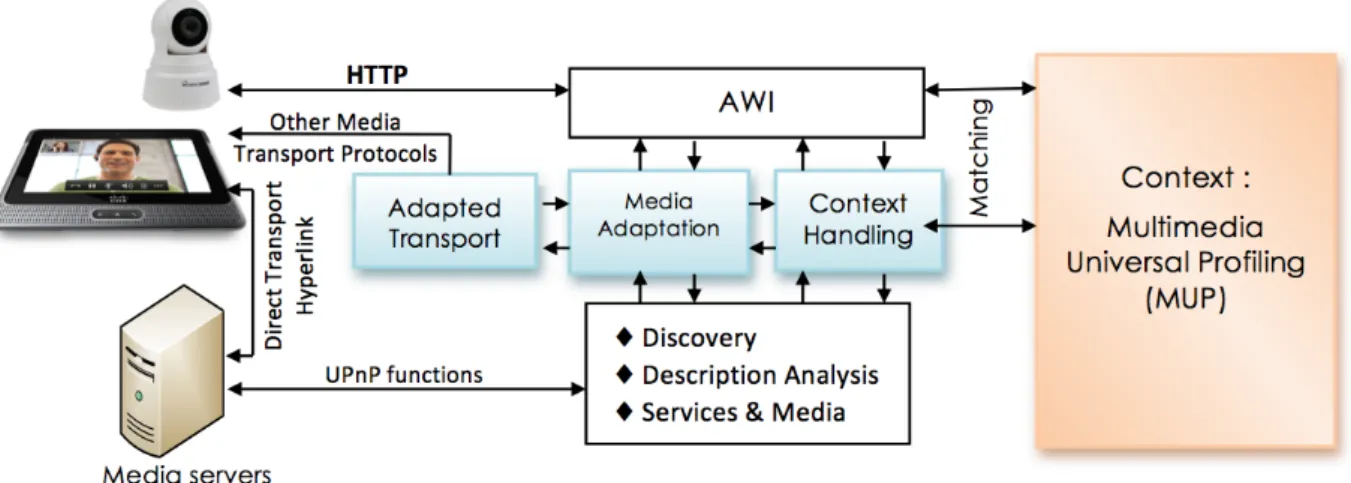
We propose Universally with the aim of simplifying and optimizing the complexity of current home architectures. We consider limited devices and objects and users like novice users and dependent persons that are not always aware of setting up their devices. From the system and network perspective, unnecessary resources and periodic traffic are avoided when no media resource is in use by the inhabitant. Here, the benefits of context awareness are the improvement of the user’s experience by, for instance, adapting the media formats and avoiding the streaming of content that will not be understood by the targeted device. The key idea of Universally is to provide an easy access to content and services only when it is needed by the user and requested by a home device. Universally adopts a client/server model and integrates 4 main modules: Advanced Web Interface (AWI) module, adaptation transport module, UPnP functions module, and the media
adaptation and context handling module (Fig. 2.1). The latter is used to describe
the hardware and software capabilities of home devices. It uses the Multimedia Universal
Profiling (MUP) schema based on the W3C RDF language that we have proposed in [37].
Thanks to the AWI interface, home devices can browse available media servers (DMS) and resources using the HTTP protocol. Once a media resource is found, the user can use it directly thanks to hyperlinks. In order to improve the media transfer, the media transport is extended to any transport protocol by including appropriate and compatible transport in the source of hyperlinks. For instance, hyperlink sources can include rtp:// or rtsp:// sources if the target device supports them. To perform media controls and actions (e.g. a stream seek) over HTTP, a Web server is implemented with a full support
Figure 2.1: Main modules of Universally architecture. of the HTTP range header.
The module dedicated to UPnP functions (discovery, control, etc.) ensures the access using limited devices such as those which do not support the multicast or are not compati-ble with DLNA. UPnP advertisements of media services are filtered and only responses to the UPnP M-SEARCH message originated by a user’s action are authorized. Unnecessary traffic is so avoided.
MUP specifies the capabilities of near to 14.000 different user agents. Based on these capabilities, if the original format of a media is not supported, it can be adapted then transferred to the device. Based on the device’s rendering capabilities, the AWI interface is also dynamically adapted by performing a pagination of discovery results when the device explores media resources of available media servers. The pagination allows to dynamically generate small HTML pages with next and previous navigation links and so only small parts of the content is sent to the user. The pagination is based on the number of discovered resources (child element of a device or a directory) which is extracted from the SOAP answer of a Browse/BrowseMetadata action (childCount attribute of the XML element DIDL-Lite/container) [59, 60].
2.2.3 An adaptive scheme for media selection
The study in [61], involving a group of 300 persons, shows that elderly are able to handle the TV sets at 99.4% while only 67.7% of them are able to use a simple wireless phone. Providing services through TV sets help users on gaining access to a personalized content adapted to their needs without complex home architectures. Familiar TV sets simplify the use of advanced technologies and make their integration in home easily accepted by elderly. It is important to note that the trends in smart spaces research show an important popularity of using middleware to integrate heterogeneous multivendor devices
2.2. Architectures and Protocols for Digital Smart Homes 23 that coexist in the same system [62, 15].
The objective of our media selection scheme is to take advantage of the increased TV viewing by elderly living alone and personalize the watched media content. The proposed automatic personalization, called also media selection, is made according to the elderly situation, preferences over the time, needs of contact and assistance. This cost-effective approach tuned towards preferences and needs of the users would accelerate the rapid adoption of the system and increases the acceptance of advanced technologies and services by elderly.
In this contribution, the main requirement of the proposed system is to be able at any given time, to display the most appropriate media content or service. This is the pri-mary scope of the context-aware media selection problem. In our media selection scheme, we focus on welfare and healthcare services by considering the user preferences, media
recommendations, alert notifications and connected media. User preferences refer to the
preferred content that the user likes to watch as expressed by him. Preferences are ex-pressed once. However, they can be changed by the system over the time depending on the user behavior. Media recommendations are intended to be advised by the referring doctor, a caregiver, or a healthcare assistant. For instance, recommendations to avoid arbitrary TV content, identify the most appropriate TV content regarding the user situation (age, health situation, and culture), and recommend the maximal time to spend in watching TV, times to take medicine, and recommended sleeping time. Alert messages are used for healthcare and safety such as the notification when it is time to take medicine. Con-nected media refer to received calls from family, friends and can be extended to assistance institutions.
The media selection is applied to available media sources: external media items and current TV channel programs. The output is a decision to either play a media item or select a TV channel program. Used metadata sets resulted primarily from the MPEG-7, ETSI TV-Anytime XMLTV, and the EPG data [63, 64]. Each media item viewed by the user is logged with the following main information: the item’s title/category/subcategory, passing (viewed) time –pt, duration of watching (watching time) –wt, duration of the item –d, and the item’s source.
Our proposed selection scheme performs 4 steps and applies a new rule-based al-gorithm. In this first step, the system identifies a set media items (S1) that fulfill the
requirements of the media recommendation profile. Essentially, it performs a best effort strategy to reach the recommended watching time for items and to keep the given propor-tion of the different item categories. In the first step, S1 is ordered using a score function
(MediaScore). In the second step, the ordered set of items, S2, is ordered again based
on the user preferences profile. The two last steps (3 and 4) are devoted to select top
2used to turn off the TV set if no user’s action or new event is detected within a fixed time value
Table 2.1: A subset of rules used in the media selection
Rules Behavior/Event System actions
R1 turn on the TV
- apply the 4 steps of media selection scheme; - display the identified item on the TV Set; - initialize the energy saving timer2;
if (time to sleep OR the maximal recommended TV time per day is exceeded) then Display an alert message every 30mn;
... ... ...
R3 flick the proposed channel/media item - accept and perform the desired user’s action;- updates the behavior patterns and preferences; R4 a media item is completely watched
- updates the wt value of the item in the behavior patterns (wt = current time - pt); - apply the media selection scheme;
- display the identified item on the TV Set;
... ... ...
R8 a call is received
- display the call on the TV set;
- pause on the current media item if it is an external media; - exclude the call interruption from the wt calculation;
items of the new set of items and update the user’s behavior log with the selected media item in the steps 1 and 2. It is worth noting that when the user performs an action (e.g. turning off the TV set or zapping a program), the system updates the behavior patterns and preferences. Newly identified preferences are updated using the MediaScore function upon new values of the pt, wt, and d variables of the last viewed items.
In our rule-based algorithm [28], we consider 3 rules for the user’s behavior (own control of media items) and 5 rules for specific events. Table 2.1 shows a subset of the defined rules. The algorithm applies a MediaScore function using Equations 2.1 and 2.2.
scorepiq “
ÿ
j ‡j ¨ wtpjq dpjq (2.1) ‡j “ –– ¨ pptpjq – w1q ¨ pptpjq – w2q (2.2)To calculate a media score of an item i, we consider the time spent by the user to watch similar items j (Equation 2.1). pt(j) returns the most recent week in which the j item was watched. However, in order to avoid boring the user with repeated selections of the same content’s category and consider that the user preferences may change over time, we define the passing time importance factor (‡). ‡ is used with a normalizing coefficient
– and a time window [w1, w2]. For a time window [w1=1 week, w2=4 weeks], the value
of – is 44.44. Hence, the ‡ factor will be positive if the item was watched recently but at least w1 weeks ago. Old items watched before the last w2 weeks will have a negative
importance factor (Figure 2.2).
2.2.4 Summary of results
Based on real-world evaluations and an architecture representing a typical home archi-tecture [25], we demonstrated how existing digital home systems and media servers affect
2.3. Architectures and Protocols for Digital Smart Homes 25
Figure 2.2: Evaluation of the media score with the window [w1=1 week, w2=4 weeks].
negatively the home resources in terms of availability of services, the performance of the home network, the integration and use of home devices (energy and processing), and the user applications. The proposed testing architecture integrated the most commonly used media servers (e.g. TVMOBiLi, PMS, TWonkyMedia and Skifta) and one media server of the ISP home-box.
The Universally architecture does not only simplify the home architecture but also enhance the user’s quality of experience when using media content and services at home. We compared the impact of existing systems with our propositions -and show significant improvements of Universally. Our experimentations show that with current systems even if the user does not perform any actions, the home network should keep all the components awake (consuming energy) and any device is requested by 3000 KB and 104 unnecessary messages per hour. This drawback is avoided thanks to the nature of the HTTP protocol and the proposed client/server model. Besides eliminating the user’s difficulties in using digital systems and improving the interoperability of heterogeneous devices with a content adapted to their profiles, the interactivity of the home system was also improved using
Universally. For instance, using existing media servers 16,11 seconds (respectively 26,17)
are required to browse 140 folders (respectively items). However, using Universally, the user action requires only 0,0282 seconds.
Our proposed context-aware media selection scheme was validated using a real-world implementation that extends the Universally system with the user control management and rules-based algorithm [27, 35, 25]. Scenarios including adaptive media selection and enabling TV-based external calls were tested within senior volunteers and show the adapt-ability of the system regarding the user’s behavior changes [28].
2.3 Toward Context-Aware Network Architectures
2.3.1 Research context
In this contribution, we adopt a global approach to provide context-aware services by considering two major network architectures: the IP Multimedia Subsystem-based Next Generation Network (IMS-NGN) [11] and the Multimedia Broadcast Multicast Service (MBMS and eMBMS) [12]. These two architectures were carefully selected primarily be-cause they offer an appealing environment for providing pervasive applications and ser-vices with the ability to use heterogeneous access technologies that converge to the same architecture. Hence, it becomes easy to design new services once (e.g. for e-health) and then deploy them to a range of users evolving in different contexts.
To ensure the ability to provide adaptive services, the network architectures must be redesigned. Indeed, architectures should address the lack of ubiquity, pervasivity, and context-awareness by providing functionalities like dynamic adaptability during execution time, flexible allocation and execution of network functions depending on the user’s profile, services discovery by the core of the architecture, and support for mobility. [65].
For the IMS architecture, we focus on providing healthcare services by considering the whole chain from the heterogeneous sensor networks (at the user’s level) to application servers (AS) level by going through the IMS core network [29]. For the MBMS architec-tures, we focus on the proposition of a new global context-aware method that considers the heterogeneity of wireless networks, terminals, users, and services. Specifically, we ex-tend the decision of delivering broadcast-based services by the integration of three entities representing the users, operators, and service provider [30, 33, 32, 31].
2.3.2 IMS model for pervasive services
We review the IMS functionalities and identify pertinent changes and extensions in order to trigger context-aware pervasive services, specifically e-health applications and services. The proposed model is based on existing third-party servers that can be selected and personalized according to the user’s context. For the IMS integration, we focused on pro-viding a road-map for a flexible selection and redirection to AS mainly using the IMS Initial Filter Criteria (iFC) [66]. Unlike existing works, such as in [67], we focus on the improvement of the IMS functionalities rather than creating new architectural compo-nents. This deliberate choice allows to make the proposal more scalable and facilitate the integration of several scattered services of e-health.
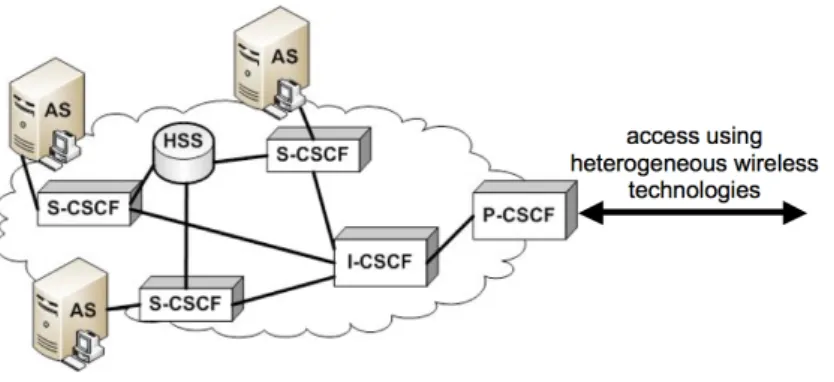
The IMS Core Network includes three main entities: the Home Subscriber Server (HSS), Call/Session Control Functions (CSCFs) and the application server (AS), see figure 2.3. HSS stores services subscription-related data. CSCFs include a proxy CSCF (P-CSCF)
2.3. Toward Context-Aware Network Architectures 27
Figure 2.3: An overview of the IMS architecture
which is the contact point of an IMS terminal; an interrogating CSCF (I-CSCF) that queries the HSS to find the user location and routes the service requests to the assigned Serving CSCF (S-CSCF). S-CSCF contacts the appropriate AS after the evaluation of filter criteria (Initial Filter Criteria – iFC) stored in the HSS. iFC is composed of an AS section (information about the server to be contacted) and zero or one instance of a
Trigger Point section that expresses logical conditions under which an AS is invoked.
Our proposed model for enabling the easy integration of context-aware e-health ser-vices into IMS architectures considers the invocation of serser-vices, priorities of serser-vices, sup-porting the changes of context, and the storage of data, specifically, the e-health records (EHR).
e-Health services invocation
In IMS, the profile of a service is processed by the S-CSCF that evaluates a set of condi-tions and invokes an application server (AS) if some condicondi-tions are met. These condicondi-tions are expressed in the IMS Initial Filter Criteria (iFC). We extend the iFC functionalities of the IMS in order to provide more flexibility and ability to integrate e-health services. Therefore, services could be invoked according to the context of the patient or monitored subjects. For a given e-health service, the conditions of e-health services invocation de-pend on the patient’s profile, data reported by sensors, e-health services priorities, and user preferences. From a conceptual point of view, iFC is extended regarding the following IMS iFC classes: Application Server (AS) and Service Point Trigger (SPT) classes. The Server Name class is extended to include not only SIP URLs but any URL of a given e-health application server. We generalize the S-CSCF processing to trigger any service (general AS or e-health AS) according to the patient’s profile. The SPT is extended by the expression of logical conditions that become related to any SIP/HTTP/SOAP messages and headers rather than the only SIP.
Received protocol methods by the IMS core are the basis of the logical conditions (evaluated by the S-CSCF) that invoke the application servers. Hence, iFC new conditions
related to headers will consequently include SIP MESSAGE Body, HTTP body, and HTTP-SOAP-ENV_Body. Therefore, sensors and the home network are enabled to use these methods to report the sensors setting, sensed data, alarms, user preferences, and requests. The AS iFC element is extended to include the invocation of any server including servers which host e-health services.
e-Health services priorities
We extend the XML semantic of the iFC priority element to indicate the priority of any e-health service according to the patient’s profile. For example, when a sensor reports an urgent alarm such as the fall or the burn, the alarm becomes a priority. We use the priority element in setting up the initial profile configuration of a given patient or monitored person according to its current needs in terms of e-health services. For example, if we focus on the dependency of monitored persons, the notification of the dependency level changes will allow providing the person with quick assistance related to his needs and allowance for new healthcare services.
Changes of context
In order to consider the context changes in IMS, stored iFC should be updated according to the patient profile. Since we have extended the support of the SPT methods, updating the iFC can be easily invoked upon the reception of a given protocol method. We use the HTTP PATCH method to invoke the updates of some parts of the patient’s iFC rather than putting a complete replacement of the service profile. The following example shows a simple new iFC that invokes the update of the e-health service profile upon the reception of the PATCH message. In this example, the service profile is enriched with the new service ../drugReminderRecorder/record.php that will be invoked by the S-CSCF upon the reception of the SIP MESSAGE method with certain headers.
PATCH / serviceProfil.xml HTTP/1.1 Host: www.myIMSeHealthServices.com Content-Type: application/xml If-Match: Public Identity matching Content-Length: 520 <InitialFilterCriteria> <Priority>0</Priority>.. <SPT><Method>MESSAGE</Method></SPT> <SPT><SIPHeader>..</SIPHeader></SPT> <ApplicationServer> <ServerName> http://192.168.1.9/drugReminderRecorder/record.php </ServerName> <DefaultHandling>0</DefaultHandling>
2.3. Toward Context-Aware Network Architectures 29 </ApplicationServer>
<InitialFilterCriteria>
Supporting e-health records
In addition to the private medical history record, we use the e-health records (EHR) to save all the e-health related information that can be useful in a context-aware e-health service (e.g. list of required actions, current health status, sensors and access network settings, etc.)
To integrate EHR, we selected the IMS HSS component as the appropriate place. This choice is driven by three main reasons. First, the HSS is contacted by the S-CSCF upon the reception of different protocol methods sent by the home network. Consequently, invoking the e-health becomes easily dependent on EHR so one can provide context-aware and personalized services. The second reason is that the IMS specification already defined an intra-operator interface, called Sh [11], that transports transparent data i.e. data where the exact representation of the information is not necessarily understood by the HSS or the transport protocol. This guarantees the privacy of the personal medical data of monitored persons and solves legal issues regarding the Telco operators’ access to data. Finally, it is necessary to add the ability to distribute EHR across different places in the IMS architecture. Indeed, e-health services are dedicated to a pervasive use with a huge amount of EHR data. Distributing transparent data across different HSS is natively supported by the IMS architecture. IMS uses the Subscription Locator Function (SLF) to identify the address of the HSS that holds the subscriber data for a given user. However, the IMS identification of the HSS is based only on the User Identity. Therefore, we propose to consider the couple: (user identity, e-health application server identity) in the identification. Hence, we distribute different EHR across different HSS. According to the e-health service required by the monitored person, the appropriate part of the EHR is used when the e-health service is invoked.
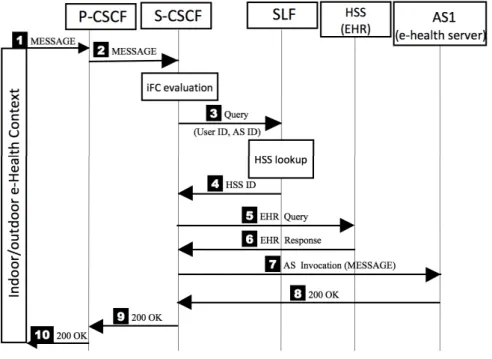
Figure 2.4 shows a general scenario that summarises our IMS extensions and modifica-tions. The e-health service is provided by the application server AS1. The indoor/outdoor monitoring network sends a SIP MESSAGE (step 1) with contextual data about the mon-itored person (health status change, alarms, etc.). The P-CSCF forwards the request to the S-CSCF (2) which knows already the set of iFC related to the person. The S-CSCF evaluates the conditions of the received data and identifies the AS to be invoked (i.e. AS1). The S-CSCF requests the SLF (3) in order to identify the location of EHR related to AS1. Then, the identified HSS (4) sends the required data in EHR (5 and 6). Now, the S-CSCF is able to invoke the service (7) with the person’s context. The person’s context is used by third-party application servers in order to provide context-aware and personalized e-Health services. In this way, the context includes contextual data sent by the monitoring network and the queried EHR.
Figure 2.4: Scenario: services integration and invocation with the proposed IMS extension
2.3.3 A global context-aware method for broadcasting services
One of the main challenges in providing a global context-aware approach is to consider the constraints of the service provider, network’s operator, and user. Regarding these three main actors, we identify six objectives, two objectives for each actor.
For the provider, the objectives are: (1) encoding the data according to available encoders and methods and (2) the selection of the wireless network offering a QoS adapted to the provided service. For the network manager: (3) reduce the consumption of the network resources by delivering the service when it is possible, and (4) select the least loaded wireless network. For the user, the objectives are: (5) reach the service in a format adapted to his context, and (6) the selection of the network with the best ratio QoS/cost. The choices of the user can be opposed to the choice of the network manager. To overcome this drawback, we defined a method allowing the three actors of the whole chain to cooperate. We implement the six objectives in the MBMS architecture (Fig. 2.5). In addition, to consider the user’s mobility, we integrate the handover of users when partitioning users in multicast subgroups (division process) depending on their context (Fig. 2.6). We use the Hierarchical and Distributed Handover (HDHO) process [68] for the handover process where the three main actors (provider, network, user) negotiate the target network according to their own objectives. HDHO is implemented for every medium used by a service and considers the mobility management process in a distributed way.

![Figure 2.2: Evaluation of the media score with the window [w 1 =1 week, w 2 =4 weeks].](https://thumb-eu.123doks.com/thumbv2/123doknet/14708984.748503/32.892.280.662.136.387/figure-evaluation-media-score-window-w-week-weeks.webp)