HAL Id: halshs-01494589
https://halshs.archives-ouvertes.fr/halshs-01494589
Submitted on 23 Mar 2017
HAL is a multi-disciplinary open access
archive for the deposit and dissemination of
sci-entific research documents, whether they are
pub-lished or not. The documents may come from
teaching and research institutions in France or
abroad, or from public or private research centers.
L’archive ouverte pluridisciplinaire HAL, est
destinée au dépôt et à la diffusion de documents
scientifiques de niveau recherche, publiés ou non,
émanant des établissements d’enseignement et de
recherche français ou étrangers, des laboratoires
publics ou privés.
Searching for patterns in how students perform
collaborative design
Kristine Lund, Guy Prudhomme
To cite this version:
Kristine Lund, Guy Prudhomme. Searching for patterns in how students perform collaborative design.
workshop “ Linking CSCL design patterns to authentic educational case studies ” at the International
Conference on Computer Supported Collaborative Learning (CSCL 2007), Jul 2007, New Brunswick,
New Jersey, United States. �halshs-01494589�
Searching for patterns in how students perform collaborative design
Kristine Lund
ICAR, CNRS, University of Lyon, 15 parvis René Descartes, BP 7000 69342 Lyon Cedex, Email [email protected]
Guy Prudhomme
G-SCOP, CNRS, University of Grenoble, BP 53 38041 Grenoble Cedex 9, France Email [email protected]
Abstract: In the research presented here, we work to discover patterns in a collaborative design task, performed
synchronously and at a distance by three university students, using the collaborative platform DREW (drew.emse.fr), developed during the European project SCALE (IST 5th framework). Our objectives are 1) to understand how participants carry out such design tasks 2) to form hypotheses about the role of resources and tools in learning or performing such tasks and 3) to test these hypotheses. Our final goal, in collaboration with industrial partners, is thus to propose ways of improving the design task either with new methods or tools that, by hypothesis, will facilitate designers’ work, thus increasing efficiency and saving time and resources. We define patterns to be recurring sequences of activities and of interactions. In our contribution to the workshop, these concepts will be defined and our theoretical framework and methodological approach will be described. Results will illustrate examples of the patterns of activities and interactions found in the corpus and finally, we will explore the relation between the two types of patterns and discuss how this can help us meet our research objectives.
Introduction
The design patterns we refer to are patterns of interaction and activity found in situations where designers work together to find a solution to a design task. Our work centers on methods for the discovery of such patterns in CSCL situations, with a view to transposing them to CSCW situations. In what follows we will briefly define our view on interaction and activity in design, present our corpus, our analytical methods and our results. We will end with concluding remarks.
We consider an interaction between human beings to be a series of actions that mutually influence each other where this mutual influence can function on physiological, epistemic, emotional and socio-relational planes (Baker, Andriessen, Lund, Amelsvoort & Quignard, under review). Considering that argumentation is at the heart of collaborative design, we are interested in argumentative interactions. Activity is considered from a particular cognitive ergonomics point of view and is defined to be the response that the individual implements in order to carry out a task (Rabardel, Carlin, Chesnais, Lang, Le Joiff & Pascal, 1998) where the task is a given goal in predetermined conditions. For these authors, both the task and the activity can be prescribed from the authority’s point of view. The task and the activity can also be expected which may differ from the prescribed task, redefined from the operator’s point of view, and actually carried out from the operator’s point of view. We use these definitions of task and activity for the individual in the collaborative learning/work situation. The above definitions of interaction and activity show that our general theoretical framework is situated and distributed cognition.
Corpus
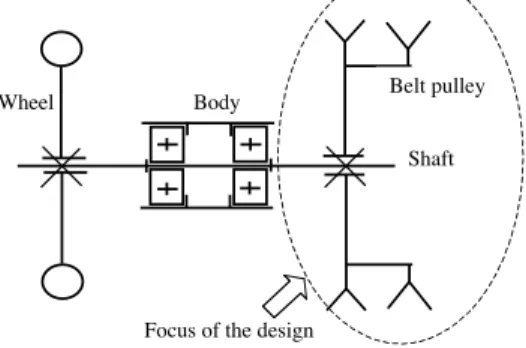
The technical problem we chose was given to the students by an initial document that presented a summarized principal scheme (cf. Figure 1). It described the mechanical, economic and functional specifications.
Belt pulley Shaft Body
Wheel
Focus of the design
The product to design consisted of an element that introduced a rotation of a wheel by the means of a double pulley that allows firstly for recuperating the mechanical power from an electric motor and secondly, for transferring part of this power to another similar system. We focus in particular on the design of the double pulley and on its liaison with the shaft (Prudhomme, Pourroy & Lund, in preparation).
Analyzing Interaction and Activity
We used the Rainbow framework (Baker, Quignard, Lund & Séjourné, 2003) to analyze the computer-mediated interactions that took place during the design task. Rainbow comprises seven principal categories, each assigned a different color, hence its name. The original objective of the analysis framework was to determine to what extent students engaged in argumentative interactions and thus attained the goal of the situations we designed during the aforementioned SCALE project: broadening and deepening understanding of the space of debate. We do not have space to present the Rainbow categories in depth (although see Figure 2); their names are 1) off-task, 2) social, 3) interaction management, 4) task management, 5) opinion, 6) argument and finally, 7) broaden and deepen argument.
Concerning activity, we used an observation grid (Metz, Renault & Cassier, 2006) in order to represent those activities we expected (based on a first empirical study and previous research in the literature) to observe in a situation of synchronous and remote co-design of an industrial product. Again, we do not have space to present the activity observation grid in depth, but the categories are cognitive and social synchronization, proposal of solutions, search for resources, evaluation, project management, coordination and social relation.
Results
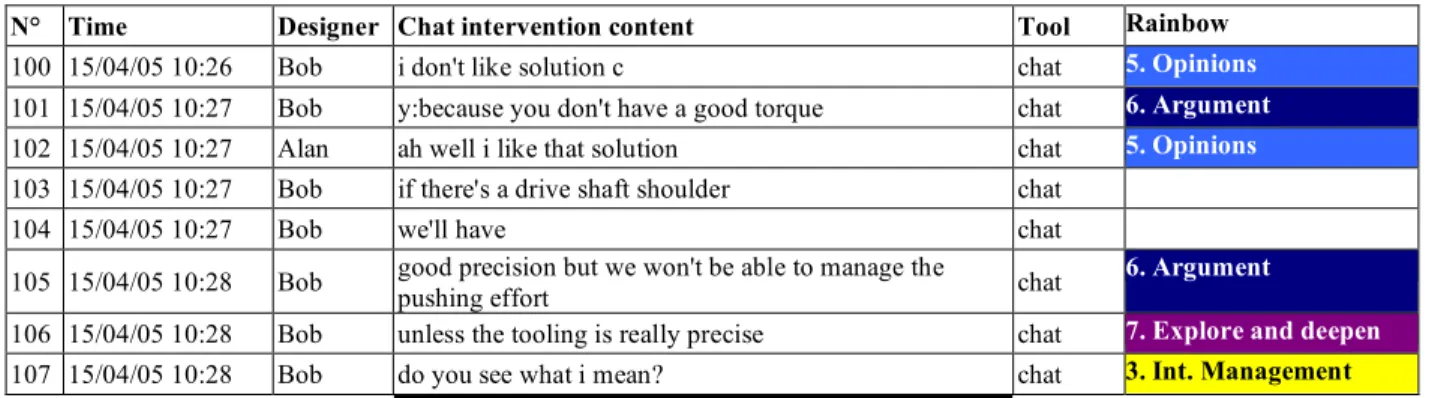
In this section we will give two examples of patterns we found in our corpus. Figure 2 shows the analysis using the Rainbow framework of an extract of our corpus produced by DREW (Corbel, Girardot, Jaillon, 2002). Due to lack of space, we only illustrate a short pattern that demonstrates how the expression of opinions (“i don’t like solution c” or “ah well i like that solution”) leads to arguments (eg. “why; because you don’t have a good torque”) and to the exploring and deepening of one of them (“unless the tooling is really precise”). Interventions 103-105 are considered to all form the argument categorized on line 105. DREW also allowed for the construction of argumentation graphs where the space of debate is represented by a thesis and arguments for and against that thesis (cf. Lund, Molinari, Séjourné & Baker (under review) for an example). Rainbow was designed to analyze both chat and graphical interventions.
N° Time Designer Chat intervention content Tool Rainbow
100 15/04/05 10:26 Bob i don't like solution c chat 5. Opinions
101 15/04/05 10:27 Bob y:because you don't have a good torque chat 6. Argument
102 15/04/05 10:27 Alan ah well i like that solution chat 5. Opinions
103 15/04/05 10:27 Bob if there's a drive shaft shoulder chat
104 15/04/05 10:27 Bob we'll have chat
105 15/04/05 10:28 Bob good precision but we won't be able to manage the pushing effort chat 6. Argument
106 15/04/05 10:28 Bob unless the tooling is really precise chat 7. Explore and deepen
107 15/04/05 10:28 Bob do you see what i mean? chat 3. Int. Management
Figure 2. An example of an interaction pattern analyzed with the Rainbow framework
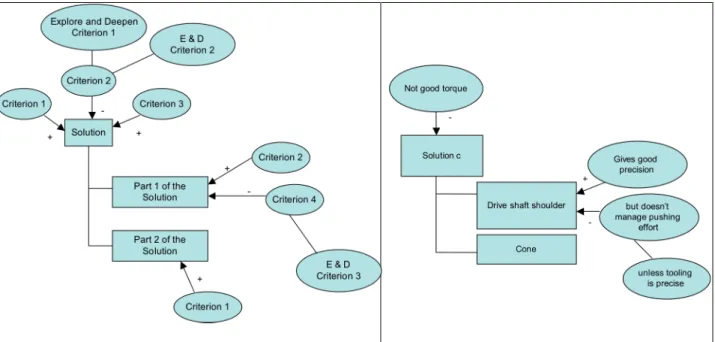
Figure 3 shows the same extract analyzed as being part of one of the patterns of activity we found based on the dynamics of the proposal of solutions and the evaluation of them in terms of different criteria. In this vision of collaborative design, similar to the QOC (question, object, criteria) model (MacLean, Young, Bellotiv, Moran, 1996), the chat interventions that we considered as arguments for or against a solution within the Rainbow framework are now seen as criteria that are mobilized to assess the solution currently being considered (here, solution c). In this activity pattern, the solution is divided into component parts (drive shaft shoulder and cone) and different criteria are put forward in relation to the separate parts (precision and pushing effort for the drive shaft shoulder). In addition, as arguments are seen as criteria, designers can explore and deepen criteria (pushing effort is not managed unless tooling is precise), but also explore and deepen solutions in terms of characteristics of component parts, for example (a different activity pattern, not shown).
Figure 3.
An example of one activity pattern partially instantiated, using the same extract as was
analyzed with the Rainbow framework
Concluding remarks
Our two different analytical approaches to collaborative design, through interaction and through activity have allowed us to discover specific patterns in the ways designers communicate and find solutions to the design task. In all, four different activity patterns were discovered (based on an initial Rainbow analysis of interactions) one of which was illustrated here. Our next goal is to redesign DREW and structure the design process in order to better support the patterns we discovered and test how designers’ work may be facilitated through its use in CSCL and CSCW situations.
References
Baker, M.J., Andriessen, J., Lund, K., Amelsvoort, M., Quignard, M. (under review). Rainbow: a framework for analysing computer-mediated pedagogical debates.
Baker M.J., Quignard M., Lund K., Séjourné A. (2003). Computer-supported collaborative learning in the space of debate. In Proceedings of The International Conference on Computer Support for Collaborative Learning, Bergen, June 2003, pp.11-20. (Kluwer Academic Publishers, Dordrecht).
Corbel, A., Girardot, J.J., Jaillon, P. (2002). DREW: A Dialogical Reasoning Web Tool, In Proceedings of
ICTE2002, International Conference on ICT's in Education. Badajoz, Espagne, November 13-16, 2002.
Lund, K., Molinari, G. Séjourné, A., Baker, M. (under review). How do argumentation diagrams compare when student pairs use them as a means for debate or as a tool for representing debate?
MacLean A., Young R. M., Belloti V., Moran T. (1996) “Question, Option, and Criteria: Elements of Design Space Analysis”, In T. Moran , J. Carroll, (eds.) Design Rationale Concepts, Techniques, and Use, Lawrence Erlbaum Associates, Mahwah, NJ, pp. 53-106
Metz S., Renaut C., Cassier J-L. (2006) Distant co-design among professionals: a proposal for existing activities classification, In proceedings of Meeting diversity in Ergonomics, 16th World Congress on Ergonomics, Maastricht the Netherlands, July 10-14.
Prudhomme, G. Pourroy, F, Lund, K (in preparation). An empirical study of engineering knowledge dynamics in a design situation.
Rabardel, P., Carlin, N., Chesnais, M., Lang, N., Le Joiff , G. & Pascal, M. (1998). Ergnomie: concepts et methods
[Ergonomics: concepts and methods]. Octares Editions: Toulouse, France.
Acknowledgements
We would like to thank Jean-Laurent Cassier for his contribution to Rainbow analyses, Franck Pourroy for discussion concerning activity patterns and all the members of the French regional projects COSMOCE and ASPIC.