RESEARCH OUTPUTS / RÉSULTATS DE RECHERCHE
Author(s) - Auteur(s) :
Publication date - Date de publication :
Permanent link - Permalien :
Rights / License - Licence de droit d’auteur :
Institutional Repository - Research Portal
Dépôt Institutionnel - Portail de la Recherche
researchportal.unamur.be
University of Namur
CUTEST: a Constrained and Unconstrained Testing Environment with safe threads
Gould, N. I. M.; Orban, Dominique; Toint, Ph Published in:
Computational Optimization and Applications
DOI:
10.1007/s10589-014-9687-3
Publication date:
2015
Document Version
Early version, also known as pre-print
Link to publication
Citation for pulished version (HARVARD):
Gould, NIM, Orban, D & Toint, P 2015, 'CUTEST: a Constrained and Unconstrained Testing Environment with safe threads', Computational Optimization and Applications, vol. 60, no. 3, pp. 545-557.
https://doi.org/10.1007/s10589-014-9687-3
General rights
Copyright and moral rights for the publications made accessible in the public portal are retained by the authors and/or other copyright owners and it is a condition of accessing publications that users recognise and abide by the legal requirements associated with these rights. • Users may download and print one copy of any publication from the public portal for the purpose of private study or research. • You may not further distribute the material or use it for any profit-making activity or commercial gain
• You may freely distribute the URL identifying the publication in the public portal ?
Take down policy
If you believe that this document breaches copyright please contact us providing details, and we will remove access to the work immediately and investigate your claim.
CUTEst: a Constrained and Unconstrained Testing Environment with safe threads
by N. I. M. Gould, D. Orban and Ph. L. Toint Report NAXYS-04-2013 6 May 2013
Ecole Polytechnique de Montreal, Montral (Canada)
Rutherford Appleton Laboratory, Chilton,(UK)
University of Namur, 61, rue de Bruxelles, Namur (Belgium)
http://www.fundp.ac.be/sciences/naxys
CUTEst: a Constrained and Unconstrained
Testing Environment with safe threads
Nick Gould, Dominique Orban and Philippe Toint
May 6, 2013
Abstract
We describe the most recent evolution of our constrained and un-constrained testing environment and its accompanying SIF decoder. Code-named SIFDecode and CUTEst, these updated versions feature dynamic memory allocation, a modern thread-safe Fortran modular design, a new Matlab interface and a revised installation procedure integrated with GALAHAD.
1
Introduction
The Constrained and Unconstrained Environment (CUTE) [3] and its associ-ated set of optimization examples have been widely adopted and used since its introduction in 1993. The test set has grown over time and now numbers approximately 1150 examples, many of them of variable dimension. In ad-dition, since both the MPS linear programming format [6] and its quadratic programming extensions [13, 16, 17] are compatible with CUTE’s Standard Input Format (SIF) [5, Ch.7], CUTE and its successor CUTEr [11] provide access to other test sets such as those from Netlib [9] and and Maros and Meszaros [16].
To set the scene, recall that a SIF file provides a portable description of group-partially separable optimization problem [4]. Such a file is trans-lated by the package SifDec to a number of Fortran subroutines that compute values and derivatives of constituent element and group functions, together with data that explains how the functions are glued together. Armed with
these components, CUTE(r) reassembles them to allow users to compute val-ues and derivatives of both the objective function and/or its constraints as required, as well as providing static information such as bounds on variables and constraints.
The core (Fortran 77) routines behind CUTE(r) have not changed signif-icantly since their original release. A main limitation of standard Fortran 77 is that it offers no mechanism for dynamic memory management, some-thing programmers of other languages (particularly C) take for granted. This defect had a significant implication for CUTE and CUTEr, namely that a one-size-fits-all set of array dimensions are set at compile time, and CUTEr and its relatives return to the user if this choice is insufficient, with a recom-mendation for recompilation with values that might be appropriate. Many CUTEr users have learned to detest this inflexibility, and it is certainly the main source of complaint we receive.
Of course, modern Fortran (90 and later) provide dynamic memory-allocation, and it has mostly been the scale of the task of rewriting CUTEr to do this that has stopped us; CUTEr (and its dependent SifDec) numbered roughly 50,000 lines of code. Now, we have done so. The new, Fortran 2003 packages CUTEst and SIFDecode both request array storage as needed. The data for any array that is not currently large enough is written to tempo-rary store (or, if there is insufficient room in memory, to disk), the array de-allocated and re-allocated with some “elbow-room” and the existing data copied back. A more general concern about the lack of freely-available re-liable modern Fortran compilers has also vanished with the arrival of both g95 and gFortran; there are of course many excellent commercial Fortran compilers available.
An additional limitation of CUTE/CUTEr was that it relied on Fortran common blocks to share data between tools. Some of this data, such as that required to describe the structure of a problem, was fixed after calling “setup” routines, while the remainder was constantly rewritten as problem function (and derivative) evaluations took place. This use of common meant that the packages were not thread safe, and could not be used in a multi-threaded (parallel) environment (for example to test branch-and-bound methods for integer programming or global optimization). This deficiency has also been addressed in CUTEst, and indeed the data is now split so that a single copy of the fixed data is available to all threads, while dynamic data is stored on a per-thread basis.
We have also taken the opportunity to revise the way the packages are 3
organised and installed. We have adopted the scheme we currently use within GALAHAD [12], and this leads to some isolation of common components that are distributed separately. Since GALAHAD was itself a major user of CUTEr, we have also updated components of GALAHAD to use CUTEst packages. In addition, we have upgraded all of CUTEr’s interfaces to external optimization packages—written in a variety of languages—that are still distributed (there have been a few casualties since 2003), and have also provided interfaces of a number of new ones. We have also considerably simplified the interface to Matlab.
This short paper is arranged as follows. We first describe how CUTEst is now organised, and how it may be used to test external packages. We then give a few details of the new features provided. A few words about the SIF decoder are followed by a description of the instalation procedure.
2
New package organisation
CUTEst is provided as a series of directories and files, all lying beneath a root directory that we shall refer to as $CUTEST. The directory structure is illustrated in Figure 2.1.
Before installation the sub-directories objects, modules, makefiles, versionsand bin/sys will all be empty. The script install_cutest prompts the user for the answers to a series of questions aimed at determining what machine type, operating system and compiler (from a large list of prede-fined possibilities encoded in a separate package, archdefs, that is distributed with CUTEst, and shared with SIFDecode and GALAHAD) to build CUTEst— we call this combination of a machine, operating system and compiler an architecture. Each architecture is assigned a simple (mnemonic) architec-ture code name, say architecarchitec-ture—for example a version for the NAG Fortran 95 compiler on a PC runing Linux is coded pc.lnx.n95, while another for the IBM Fortran 95 compiler on an PowerPC system running AIX is ppc.aix.x95. Having determined the architecture, the installa-tion script builds sub-directories of objects, modules and packages named architecture, as well as further sub-directories double and single of these to hold architecture-dependent compiled libraries, module file information and external package linking information if required. In addition, architecture-dependent makefile information and environment variables for execution scripts are placed in files named architecture in the makefiles and bin/sys
sub-$CUTEST tools algencan . . . other packages . . . matlab test src makefiles seds objects versions include modules bin sys doc pdf man man1 man3 sif packages architecture1 architecture2 . . . other architectures . . . double single double single architecture architecture2 . . . other architectures . . . double single double single defaults architecture . . . other architectures . . . double single
directories, and a file recording how the code is related to the architecture is put in versions.
The source codes for each CUTEst package interface occurs in a separate sub-directory of the src directory. The main CUTEst evaluation tools all lie in the sub-directory tools, while a set of comprehensive test programs are available in test. The remaining sub-directories contain interface pro-grams between the tools and each of the external packages supported. Each sub-directory contains the interface, a default options specification file, an example program that tests the interface without requiring the external pack-age, a README that explains what a user needs to do to make the external package work with CUTEst, and a makefile. Since the order of compilation of Fortran modules is important, and as we have seen there is a strong interde-pendency between the CUTEst packages, the makefiles have to be carefully crafted. For this reason, we have chosen not to use variants of tools such as imake to build and maintain the makefiles. A set of configuration files that provides default link details between CUTEst and each external pack-age is provided in the directory packpack-ages/defaults, and users may copy and modify these to architecture and dimension specific sub-directories of packagesto override the default choices. Man pages for CUTEst as a whole and each individual tool are provided sub-directories of the man directory, and translations are also available in PDF format in the pdf sub-directory of the documentation directory doc.
Once the correct directory structure is in place, the installation script builds a random-access library of the required precision by visiting each of the sub-directories of src and calling the Unix utility make. CUTEst package interfaces are all written in double precision, but if a user prefers to use single precision, the makefiles call suitable Unix sed scripts (stored in seds) to transform the source prior to compilation. A user may choose to install all of CUTEst with or without Matlab support or just the tools themselves; the tools for unconstrained and constrained optimization may also be installed separately. Recompilation following updates is easily performed by issuing the command make from the src directory, while make test from the same directory runs comprehensive tests of all compiled components.
3
Interfaces to the CUTEst test set
To run one of the supported packages on an example stored in EXAMPLE.SIF, say, a user needs to issue the command
runcutest -A architecture -p package -D EXAMPLE[.SIF]
where architecture is the architecture code discussed in §2, package defines the package to be used—the manual page for runcutest gives a list of current possibilities—and the suffix [.SIF] is optional. This command translates the SIF file into Fortran subroutines and related data using the decoder provided in SIFDecode, and then calls the required optimization package to solve the problem. A default architecture may be defined by setting the environment variable $MYARCH, and if so the -A flag may be avoided. Once a problem has been decoded, it may be re-used (perhaps with different options) using the auxiliary command
runcutest -A architecture -p package For Matlab use, the command
cutest2matlab EXAMPLE[.SIF]
may be used instead; since Matlab is very specific about the Fortran compilers it supports, requests for a CUTEst-Matlab installation will adjust compiler options accordingly.
A few SIF examples are given in the sif directory, while the runcutest and cutest2matlab commands are in the bin sub-directory, and have man-page descriptions in the man/man1 sub-directory.
4
Improvements
4.1
New features
As we mentioned in the introduction, CUTEst and SIFDecode both use the Fortran 2003 allocate/deallocate features to create and modify array storage. Each CUTEst tool uses a module CUTEST that provides access to two derived types CUTEST_data_type and CUTEST_work_type used to store workspace arrays. The former collects data that describes problem structure and is set prior to any problem function evaluation, and unchanged thereafter, while the
latter is used to hold data that may change at every evaluation. Data in these arrays is made available to the tools through a scalar CUTEST_data_global of type CUTEST_data_type and an allocatable array CUTEST_work_global of type CUTEST_work_type.
All evaluation tools are available as both simple (unthreaded) and threaded versions. For the latter, which may be distinguished by the suffix _threaded, CUTEST_work_globalis allocated to be large enough to hold all the threads that will be used by the setup subroutines, and each evaluation call specifies access to CUTEST_work_global(i) for the particular thread i required.
We give a list of all CUTEst tools and their functionality in Appendix A. Most are rewritten version of their CUTEr counterparts, with argument-list changes to remove redundant size parameters and occasional order changes to handle inconsistencies. An additional status argument has been added to each to report any fatal memory errors (such as array allocation/deallocation failures) and inabilities to evaluate functions at specified values; CUTEr dealt with such eventualities by terminating execution. We have added termination tools to allow users to deallocate all storage created by the setup procedure when they have no longer need for it. In addition, constraints may now be ordered so that equalities precede or follow inequalities, or so that linear constraints precede or follow nonlinear ones, and variables so that those that only appear linearly in the problem precede or follow those that appear nonlinearly. New tools have also been introduced to describe the sparsity patterns of the Hessian of the objective and Lagrangian functions. Finally, a new tool has been added to compute the sparse gradient of the objective function for constrained problems; this corrects an oversight since we already provide similar functionality for the gradients of individual constraints.
4.2
New Matlab calls
The Matlab interface has been substantially revised and simplified. It is now entirely written in C instead of Fortran to facilitate interaction with Matlab’s own API and usage of its index types. The interface merges the constrained and unconstrained tools together so users may use familiar and consistent function calls such as cutest_obj() to obtain the objective function value and possibly its gradient regardless of the presence of constraints. In this re-gard, the interface exploits Matlab’s ability to determine how many output arguments are required by the user. This allows both f = cutest_obj(x) and [f,g] = cutest_obj(x). Another example is the cuter_cons()
func-tion, which allows to evaluate all or individual constraints and/or constraint gradients.
A problem is “loaded” into Matlab by calling a simple function with no arguments: prob = cutest_setup(). The single output argument of the setup function is a Matlab structure containing problem data such as the number of variables, number of constraints, number of nonzeros in the Jacobian and Hessian, initial guess, bounds, initial multipliers, and arrays indicating which constraints are linear and which are equality constraints. Those fields may be accessed using the familiar dot notation, e.g., prob.n, prob.x, prob.cl, etc.
Help is included with all CUTEst tools, available to Matlab users by way of the familiar help call. In particular, help cutest gives an overview of the tools available.
Finally, the current interface makes it easier to decode problems and build the corresponding MEX files from inside Matlab. For instance, the commands probname = ’LUBRIFC’; unix([’cutest2matlab ’, probname])generate the MEX file corresponding to problem LUBRIFC in the current directory.
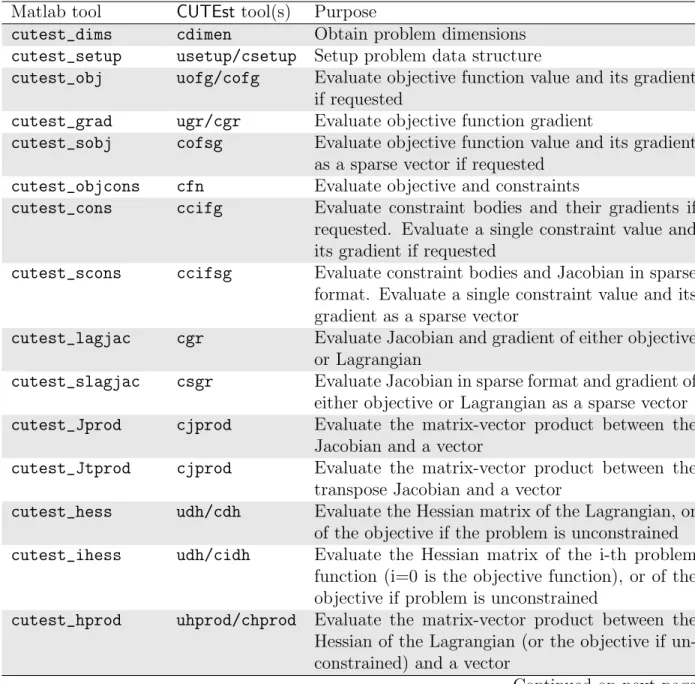
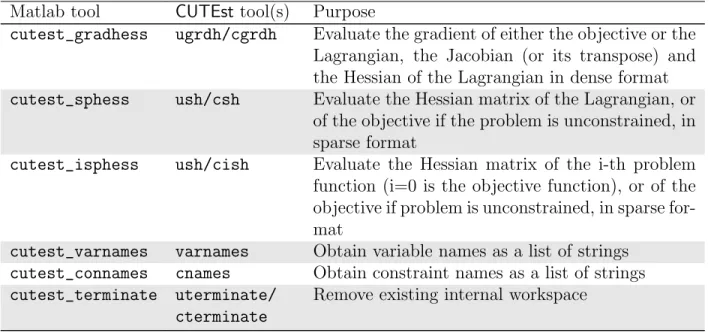
See Appendix B for a complete description of the Matlab CUTEst tools and their functionality.
4.3
New interfaces
In addition to the still-current packages supported by CUTEr, CUTEst pro-vides new interfaces to ALGENCAN [1], BOBYQA [19], Direct Search [7], filterSD [8], NEWUOA [18], NLPQLP [21], NOMAD [15], PENNLP [14], QL [20], SPG [2] and SQIC [10], as well as various new packages within GALAHAD [12].
Interfaces to the obsolete packages hsl_ve12, osl, va15, ve09 and ve14 supported in CUTEr have been withdrawn.
4.4
New test examples
Almost 200 new examples have been added to the test-problem collection since the release of CUTEr. These include large collections of problems arising from linear complementarity, and of real-life quadratic programming prob-lems.
All test problems are now under version control in the same way as the source code and users may update their local repository easily when new problems are added or changes are made to existing problems.
5
A revised SIF decoder
As we mentioned in the introduction, the lack of dynamic memory allocation affects the SIF decoding package SifDec just as severely as it does CUTEr. A new stand-alone Fortran package SIFDecode has been written to address this issue. All of the functionality of the subroutines previously in SifDec have been subsumed into a single Fortran 2003 module SIFDECODE. Since required array sizes are not known beforehand, default initial values are increased as required as the package makes a single pass through the SIF file under consideration; default initial values may be changed to make the processing more efficient, but this is not crucial.
The distributed package is organised in the same way as CUTEst (see §2), although now the src directory simply contains two source sub-directories, decodethat holds the decoder and its main program, and select containing the test-problem database interrogation tools from CUTE [3, §2.3].
Once the package has been installed, the decoder is called by issuing the command
sifdecoder -A architecture EXAMPLE[.SIF]
where architecture and EXAMPLE.SIF are as before; the -A option may be omitted when using the default architecture.
6
New installation procedures
The installation procedure has been updated to recognise that most users will need to install both SIFDecode and CUTEst, and may also wish to integrate these with GALAHAD. A single script, install_optsuite, prompts the user to describe what features are needed and which architecture is desired. An opportunity to modify default compilation flags is provided, after which the script will automatically download and install the software.
7
Obtaining the packages
All of the required and optional packages archdefs, SIFDecode, CUTEst and GALAHAD are available from the CCPForge project, funded by The Joint Information Systems Committee (http://www.jisc.ac.uk) and maintained by
the Scientific Computing Department of the Science and Technology Facilities Council (http://www.stfc.ac.uk/SCD/default.aspx) under the departmental SLA with EPSRC. See
http://ccpforge.cse.rl.ac.uk/gf/project/cutest/wiki/ for download details.
Both SIFDecode and CUTEst are distributed and made available under the terms of the GNU Lesser General Public License. See
http://www.gnu.org/licenses/lgpl-3.0.txt for details.
8
Conclusions and perspectives
We believe CUTEst is a considerable improvement over past versions because of its improved modular and thread-safe design exploiting recent additions to the Fortran standard, dynamic allocation, simplified and unified tool call-ing sequences, improved Matlab interface and, last but not least, the more user-friendly installation process. Despite the age of the standard input for-mat and the advent of more modern modeling languages, CUTE and CUTEr remained widely-used tools in the optimization community and beyond, as illustrated by the large number of user comments and request that we re-ceive and the associated problem collection remains a staple of optimization software testing and benchmarking.
Since all packages and test problems are maintained and distributed via a source code revision system, bug fixes, improvements and additions are easily available.
Acknowledgements
We are extremely grateful to Roger Fletcher, Philip Gill, Michal Koˇcvara, Michael Powell, Klaus Schittkowski and Elizabeth Wong for making their latest codes available to us so that we could build and test interfaces.
References
[1] E. G. Birgin, R. Castillo, and J. M. Martinez. Numerical comparison of augmented Lagrangian algorithms for nonconvex problems. Computa-tional Optimization and Applications, 31(1):31–56, 2005.
[2] E. G. Birgin, J. M. Martinez, and M. Raydan. Algorithm 813: SPG— software for convex-constrained optimization. ACM Transactions on Mathematical Software, 27:340–349, 2001.
[3] I. Bongartz, A. R. Conn, N. I. M. Gould, and Ph. L. Toint. CUTE: Constrained and unconstrained testing environment. ACM Transactions on Mathematical Software, 21(1):123–160, 1995.
[4] A. R. Conn, N. I. M. Gould, and Ph. L. Toint. An introduction to the structure of large scale nonlinear optimization problems and the LANCELOT project. In R. Glowinski and A. Lichnewsky, editors, Computing Methods in Applied Sciences and Engineering, pages 42–51, Philadelphia, USA, 1990. SIAM.
[5] A. R. Conn, N. I. M. Gould, and Ph. L. Toint. LANCELOT: a Fortran package for Large-scale Nonlinear Optimization (Release A). Springer Series in Computational Mathematics. Springer Verlag, Heidelberg, Berlin, New York, 1992.
[6] International Business Machine Corporation. Mathematical program-ming system/360 version 2, linear and separable programprogram-ming-user’s manual. Technical Report H20-0476-2, IBM Corporation, 1969. MPS Standard.
[7] E. D. Dolan, A. P. Gurson, P. L. Shepherd, C. M. Siefert, V. J. Torczon, and A. Yates. C++ direct searches. http://www.cs.wm.edu/eva/software/DirectSearch/direct code/, 2001. [8] R. Fletcher. A sequential linear constraint programming algorithm for
NLP. SIAM Journal on Optimization, 22(3):772–794, 2012.
[9] D. M. Gay. Electronic mail distribution of linear programming test prob-lems. Mathematical Programming Society COAL Newsletter, December 1985. See http://www.netlib.org/lp/data/.
[10] P. E. Gill and E. Wong. Methods for convex and general quadratic pro-gramming. Technical Report NA 10-1, Dept. of Mathematics, University of California, San Diego, 2013.
[11] N. I. M. Gould, D. Orban, and Ph. L. Toint. CUTEr (and SifDec), a Constrained and Unconstrained Testing Environment, revisited. ACM Transactions on Mathematical Software, 29(4):373–394, 2003.
[12] N. I. M. Gould, D. Orban, and Ph. L. Toint. GALAHAD—a library of thread-safe fortran 90 packages for large-scale nonlinear optimization. ACM Transactions on Mathematical Software, 29(4):353–372, 2003. [13] IBM Optimization Solutions and Library. QP Solutions User Guide.
IBM Corportation, 1998.
[14] M. Kocvara and M. Stingl. PENNON: A code for convex nonlinear and semidefinite programming. Optimization Methods and Software, 18(3):317–333, 2003.
[15] S. Le Digabel. Algorithm 909: NOMAD: nonlinear optimization with the MADS algorithm. ACM Transactions on Mathematical Software, 37(4):1–15, 2011.
[16] I. Maros and C. Meszaros. A repository of convex quadratic program-ming problems. Optimization Methods and Software, 11-12:671–681, 1999.
[17] D. B. Poncele´on. Barrier methods for large-scale quadratic program-ming. PhD thesis, Department of Computer Science, Stanford Univer-sity, Stanford, California, USA, 1990.
[18] M. J. D. Powell. The NEWUOA software for unconstrained optimiza-tion without derivatives. In G. Di Pillo and M. Roma, editors, Large-Scale Nonlinear Optimization, volume 83 of Nonconvex Optimization and Its Applications, pages 255–297, Heidelberg, Berlin, New York, 2006. Springer Verlag.
[19] M. J. D. Powell. The BOBYQA algorithm for bound constrained opti-mization without derivatives. Technical Report DAMTP NA2009/06, Department of Applied Mathematics and Theoretical Physics, Cam-bridge University, CamCam-bridge, UK, 2009.
[20] K. Schittkowski. QL: A Fortran code for convex quadratic programming—User’s guide, Version 2.11. Technical report, University of Bayreuth, Department of Computer Science, 2005.
[21] K. Schittkowski. NLPQLP: A Fortran implementation of a sequential quadratic programming algorithm with distributed and non-monotone line search. Technical report, University of Bayreuth, Department of Computer Science, 2010.
Appendix A: available tools
Separate evaluation tools are provided for unconstrained and constrained problems. Both unthreaded and threaded versions are available when this is relevant. See the appropriate man page for full details.
Unconstrained problems:
cutest udimen(both threaded and unthreaded) determine the number of variables.
cutest usetup(unthreaded) and cutest usetup threaded (threaded) setup internal data structures and determine variable bounds.
cutest unames (both threaded and unthreaded)
determine the names of the problem and the variables. cutest uvartype(both threaded and unthreaded)
determine whether the variables are continuous or discrete. cutest udimsh (both threaded and unthreaded)
determine the number of nonzeros in the sparse Hessian. cutest udimse (both threaded and unthreaded)
determine the number of nonzeros in the finite-element Hessian. cutest ufn(unthreaded) and cutest ufn threaded (threaded)
evaluate the objective function value.
cutest ugr(unthreaded) and cutest ugr threaded (threaded) evaluate the gradient of the objective function.
cutest uofg(unthreaded) and cutest uofg threaded (threaded) evaluate both the values and gradients of the objective function. cutest udh(unthreaded) and cutest udh threaded (threaded)
evaluate the Hessian of the objective function as a dense matrix. cutest ugrdh (unthreaded) and cutest ugrdh threaded (threaded)
cutest ushp (both threaded and unthreaded)
evaluate the sparsity pattern of the Hessian of the objective function. cutest ush (unthreaded) and cutest ush threaded (threaded)
evaluate the Hessian of the objective function as a sparse matrix. cutest ugrsh (unthreaded) and cutest ugrsh threaded (threaded)
evaluate the objective gradient and sparse Hessian.
cutest ueh (unthreaded) and cutest ueh threaded (threaded)
evaluate the Hessian of the objective function as a finite-element matrix. cutest ugreh (unthreaded) and cutest ugreh threaded (threaded)
evaluate the objective gradient and finite-element Hessian.
cutest uhprod (unthreaded) and cutest uhprod threaded (threaded) evaluate the product of the Hessian of the objective function with a vector. cutest ubandh (unthreaded) and cutest ubandh threaded (threaded)
obtain the part of the Hessian of the objective that lies within a specified band.
cutest ureport (unthreaded) and cutest ureport threaded (threaded) discover how many evaluations have occured and how long this has taken. cutest uterminate (both unthreaded and threaded)
remove internal data structures when they are no longer needed. Constrained problems:
cutest cdimen (both threaded and unthreaded) determine the number of variables and constraints.
cutest csetup (unthreaded) and cutest csetup threaded (threaded) setup internal data structures and determine variable and constraint bounds. cutest cnames (both threaded and unthreaded)
determine the names of the problem, the variables and the constraints. cutest connames (both threaded and unthreaded)
determine the names of the constraints.
cutest cvartype (both threaded and unthreaded)
determine whether the variables are continuous or discrete. cutest cdimsj (both threaded and unthreaded)
determine the number of nonzeros in sparse constraint Jacobian. cutest cdimsh (both threaded and unthreaded)
determine the number of nonzeros in the sparse Hessian. cutest cdimse (both threaded and unthreaded)
determine the number of nonzeros in the finite-element Hessian. cutest cfn (unthreaded) and cutest cfn threaded (threaded)
evaluate the objective function and constraint values.
cutest cgr(unthreaded) and cutest cgr threaded (threaded) evaluate the gradients of the objective function and constraints. cutest cofg(unthreaded) and cutest cofg threaded (threaded)
evaluate both the value and gradient of the objective function. cutest cofsg(unthreaded) and cutest cofsg threaded (threaded)
evaluate both the value and sparse gradient of the objective function. cutest csgr(unthreaded) and cutest csgr threaded (threaded)
evaluate the sparse gradients of the objective function and constraints. cutest ccfg (unthreaded) and cutest ccfg threaded (threaded)
evaluate the values and gradients of the constraints.
cutest ccfsg (unthreaded) and cutest ccfsg threaded (threaded) evaluate the values and sparse gradients of the constraints. cutest ccifg (unthreaded) and cutest ccifg threaded (threaded)
evaluate the value and gradient of an individual constraint.
cutest ccifsg (unthreaded) and cutest ccifsg threaded (threaded) evaluate the value and sparse gradient of an individual constraint. cutest cdh(unthreaded) and cutest cdh threaded (threaded)
evaluate the Hessian of the Lagrangian function as a dense matrix. cutest cidh (unthreaded) and cutest cidh threaded (threaded)
evaluate the Hessian of the objective function or an individual constraint as a dense matrix.
cutest cgrdh (unthreaded) and cutest cgrdh threaded (threaded) evaluate the constraint Jacobian and Hessian of the Lagrangian function as dense matrices.
cutest cshp(both threaded and unthreaded)
evaluate the sparsity pattern of the Hessian of the Lagrangian function. cutest csh (unthreaded) and cutest csh threaded (threaded)
evaluate the Hessian of the Lagrangian function as a sparse matrix. cutest cshc (unthreaded) and cutest cshc threaded (threaded)
evaluate the Hessian of the Lagrangian function not including the objective as a sparse matrix.
cutest cish (unthreaded) and cutest cish threaded (threaded)
evaluate the Hessian of the objective function or an individual constraint as a sparse matrix.
cutest csgrsh(unthreaded) and cutest csgrsh threaded (threaded) evaluate the constraint Jacobian and Hessian of the Lagrangian function as sparse matrices.
cutest ceh (unthreaded) and cutest ceh threaded (threaded) evaluate the Hessian of the Lagrangian function as a finite-element matrix.
cutest csgreh (unthreaded) and cutest csgreh threaded (threaded) evaluate the constraint Jacobian as a sparse matrix and the Hessian of the Lagrangian function as a finite-element matrix.
cutest chprod (unthreaded) and cutest chprod threaded (threaded) evaluate the product of the Hessian of the Lagrangian function with a vector.
cutest chcprod (unthreaded) and cutest chcprod threaded (threaded) evaluate the product of the Hessian of the Lagrangian function not including the objective with a vector.
cutest cjprod (unthreaded) and cutest cjprod threaded (threaded) evaluate the product of the constraint Jacobian or its transpose with a vector.
cutest creport (unthreaded) and cutest creport threaded (threaded) discover how many evaluations have occured and how long this has taken. cutest cterminate (both unthreaded and threaded)
remove internal data structures when they are no longer needed. Both unconstrained problems and constrained problems: cutest probname (both threaded and unthreaded)
determine the name of the problem.
cutest varnames (both threaded and unthreaded) determine the names of the variables.
A call to cutest u/csetup[ threaded] must precede calls to any other evaluation tool with the excepevaluation of cutest u/cdimen. Once cutest u/cterminate[ -threaded] has been called, no further calls should be made without first re-calling cutest u/csetup[ threaded].
Appendix B: Matlab interfaces
Table B.1: Available Matlab tools Matlab tool CUTEst tool(s) Purpose
cutest_dims cdimen Obtain problem dimensions cutest_setup usetup/csetup Setup problem data structure
cutest_obj uofg/cofg Evaluate objective function value and its gradient if requested
cutest_grad ugr/cgr Evaluate objective function gradient
cutest_sobj cofsg Evaluate objective function value and its gradient as a sparse vector if requested
cutest_objcons cfn Evaluate objective and constraints
cutest_cons ccifg Evaluate constraint bodies and their gradients if requested. Evaluate a single constraint value and its gradient if requested
cutest_scons ccifsg Evaluate constraint bodies and Jacobian in sparse format. Evaluate a single constraint value and its gradient as a sparse vector
cutest_lagjac cgr Evaluate Jacobian and gradient of either objective or Lagrangian
cutest_slagjac csgr Evaluate Jacobian in sparse format and gradient of either objective or Lagrangian as a sparse vector cutest_Jprod cjprod Evaluate the matrix-vector product between the
Jacobian and a vector
cutest_Jtprod cjprod Evaluate the matrix-vector product between the transpose Jacobian and a vector
cutest_hess udh/cdh Evaluate the Hessian matrix of the Lagrangian, or of the objective if the problem is unconstrained cutest_ihess udh/cidh Evaluate the Hessian matrix of the i-th problem
function (i=0 is the objective function), or of the objective if problem is unconstrained
cutest_hprod uhprod/chprod Evaluate the matrix-vector product between the Hessian of the Lagrangian (or the objective if un-constrained) and a vector
Table B.1: Available Matlab tools (cont.) Matlab tool CUTEst tool(s) Purpose
cutest_gradhess ugrdh/cgrdh Evaluate the gradient of either the objective or the Lagrangian, the Jacobian (or its transpose) and the Hessian of the Lagrangian in dense format cutest_sphess ush/csh Evaluate the Hessian matrix of the Lagrangian, or
of the objective if the problem is unconstrained, in sparse format
cutest_isphess ush/cish Evaluate the Hessian matrix of the i-th problem function (i=0 is the objective function), or of the objective if problem is unconstrained, in sparse for-mat
cutest_varnames varnames Obtain variable names as a list of strings cutest_connames cnames Obtain constraint names as a list of strings cutest_terminate uterminate/
cterminate
Remove existing internal workspace