HAL Id: hal-01687870
https://hal.laas.fr/hal-01687870
Submitted on 14 Apr 2018HAL is a multi-disciplinary open access
archive for the deposit and dissemination of sci-entific research documents, whether they are pub-lished or not. The documents may come from teaching and research institutions in France or abroad, or from public or private research centers.
L’archive ouverte pluridisciplinaire HAL, est destinée au dépôt et à la diffusion de documents scientifiques de niveau recherche, publiés ou non, émanant des établissements d’enseignement et de recherche français ou étrangers, des laboratoires publics ou privés.
Mass patterning of polysiloxane layers using spin coating
and photolithography techniques
Benoit Torbiero, Marie Laure Pourciel-Gouzy, Iryna Humenyuk,
Jean-Baptiste Doucet, Augustin Martinez, Pierre Temple-Boyer
To cite this version:
Benoit Torbiero, Marie Laure Pourciel-Gouzy, Iryna Humenyuk, Jean-Baptiste Doucet, Augustin Mar-tinez, et al.. Mass patterning of polysiloxane layers using spin coating and photolithography tech-niques. Microelectronics Journal, Elsevier, 2006, 37 (2), pp.133 - 136. �10.1016/j.mejo.2005.04.054�. �hal-01687870�
Mass patterning of polysiloxane layers using
spin coating and photolithography techniques
B. Torbiéro, M.L. Pourciel-Gouzy, I. Humenyuk, J.B. Doucet, A. Martinez, P. Temple-Boyer* LAAS-CNRS, 7 avenue du colonel Roche, 31077 TOULOUSE Cedex 4, France
* Corresponding author: P. Temple-Boyer,
Tel: +33 561 336 954, Fax: +33 561 336 208, E-mail: [email protected]
Abstract
Polysiloxane (PSX) containing 2,2-dimethoxy-2-phenylacetophenone (DMPA) photoinitiator has been used as a photosensitive polymer. Thus, thin PSX films have been deposited by spin coating and patterned thanks to standard ultraviolet (UV) photolithography. The influences of the different technological parameters (PSX dilution, spin speed, UV exposure time) have been studied in so as to understand the polysiloxane deposition and cross-linking phenomena. Finally, the whole process has been optimised. Results evidence the realisation of high quality PSX patterns for the development of mass-fabricated ion sensitive layers in the field of chemical microsensors.
Introduction
Within the framework of microtechnologies, polymers seem very promising materials. Indeed, their multitude gives access to a wide range of multidisciplinary properties in order to bring solutions to many technological problems. The field of chemical sensors has not been an exception to the rule. Thus, photosensitive polymers based on poly-vinyl alcohol (PVA), poly-vinyl chloride (PVC), polymethacrylate (PolyHEMA) or polysiloxane (PSX), have been used for the preparation of chemical or biochemical sensitive membranes by manual dip coating and exposure to ultraviolet (UV) radiation [1-5]. However, irrespective of the polymer chosen, such processes have not been fully reproducible or/and reliable. In order to assess the chemical sensors industrial development, mass-fabrication processes deviated from silicon microelectronics have to be carried out. Solutions involve the development of spin coating and photolithography techniques even if the spinning process is known to be responsible for the loss of large amounts of chemical products. Nevertheless, they have been successfully developed for the deposition and mass patterning of thin poly-vinyl alcohol PVA layers [6] and their use should be extended to other photosensitive polymers.
This paper deals with the development op spin coating and ultraviolet (UV) photolithography techniques applied to standard photosensitive polysiloxane (PSX) copolymer. The different technological parameters (PSX dilution, spin speed, UV exposure time) have been studied in so as to understand the photosensitive PSX copolymer deposition and UV cross-linking phenomena. Thus, the whole process has been optimised for the mass patterning of polysiloxane-based ion sensitive layers in the field of chemical microsensors.
Experiments
The polysiloxane (PSX) copolymer RMS-033 containing methacrylate groups was purchased from ABCR. The 3-(methacryloxy)propyl trimethoxysilane (MPTS), the 2,2-dimethoxy-2-phenylacetophenone (DMPA) photoinitiator, the tetrahydrofuran (THF) solvent as well as the others standard chemical products used were obtained from Sigma-Aldrich.
According to the Warsaw University of Technology [5], the photosensitive polymer was formed from 99% of PSX and 1% of DMPA, and then dissolved into THF to reach different dilutions x0. The volumic mass was of the different PSX solutions obtained was finally estimated
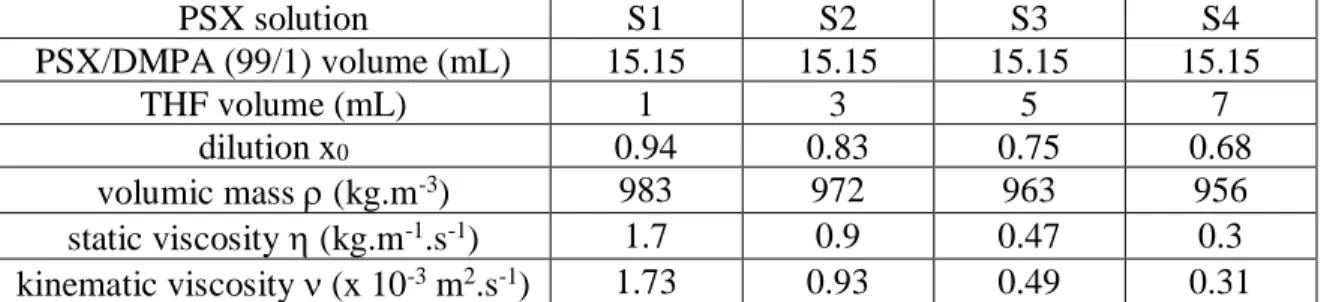
by accurate weighing while their hydrodynamics properties, and more precisely their static viscosity, were characterized using a Haake VT550 viscometer. All the data related to the different PSX solutions were finally regrouped in table 1.
The polysiloxane thin films were patterned according to the following process. After an MTPS/toluene silanisation step at 80°C to promote adherence on the silicon substrate, the PSX-based solution was deposited by spin coating using a SUSS GYRSET RC-8 spin coater. Then, after the THF solvent evaporation under nitrogen atmosphere, ultraviolet (UV) exposure was performed under a non-oxidising ambient using a Karl Suss MA-6 contact alignment system. Finally, after development into xylene, the PSX pattern thicknesses and profiles were studied using a TENCOR scan profiler. Thus, different spin speeds and UV exposure times were tested in order to understand fully the polysiloxane cross-linking phenomena and to optimize the whole technological process.
Results and discussion
In order to understand the polysiloxane cross-linking phenomena during the photolithography process, the influence of the UV exposure has been studied for different spin
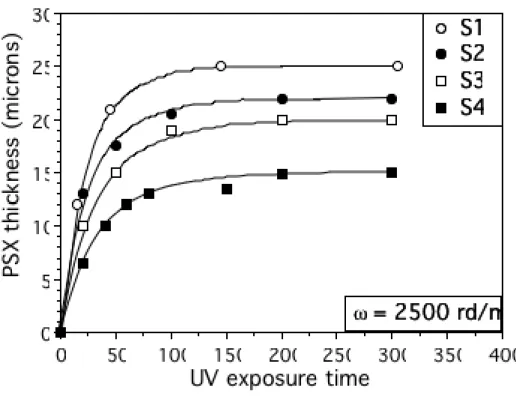
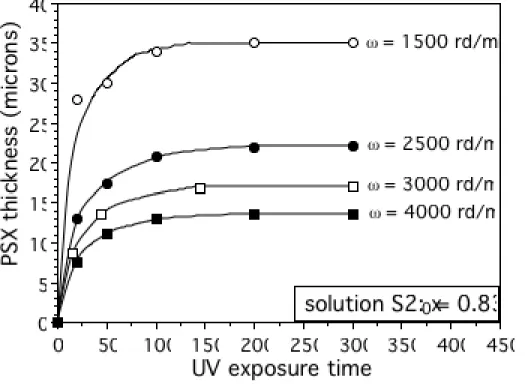
coating steps and for the different PSX solutions. Figures 1 and 2 represent respectively the variations of the polysiloxane thickness h (after the development step into xylene) as a function of the UV exposure time tUV for different spin speeds and for the different PSX solutions, i.e. for
the different dilutions into THF x0. As expected, experimental results have demonstrated that the
PSX thickness decreases with both increases of spin speed and PSX dilution whatever the UV exposure time. Furthermore, in all cases, the PSX thickness h follows exponential temporal variations according to the following equation:
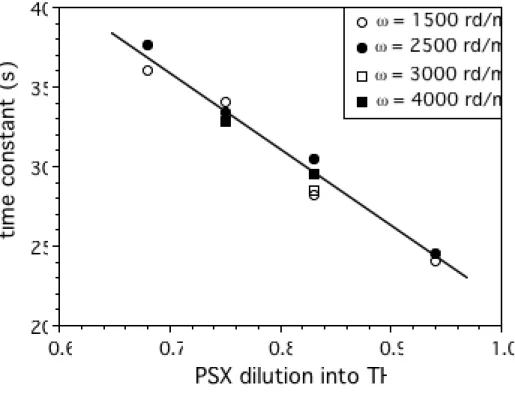
(1) The time constant has been studied as a function of the different technological parameters concerned. Thus, it appears that it does not depend on the spin speed but decreases linearly with the PSX dilution into THF x0 (figure 3). This result shows that the PSX cross-linking due to the
photolithography process depend mainly on the polymer physicochemical properties. Furthermore, such exponential variations demonstrate that these cross-linking phenomena under UV exposure goes from the substrate interface towards the film surface. Therefore, a minimal UV exposure time tmin is necessary to reach the nominal deposited PSX thickness hdep. Whatever the PSX solution and
the spin coating step, this tmin value has never been found lower than 240s.
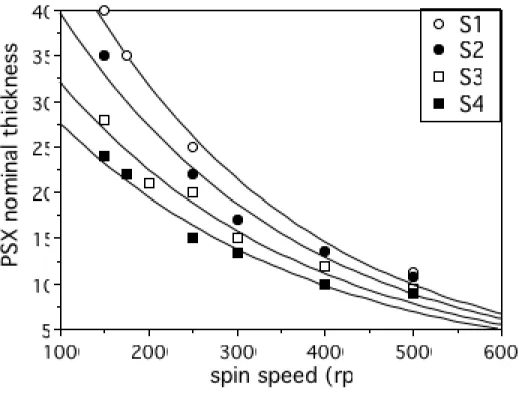
Then, the nominal deposited PSX thickness hdep has been studied as a function of the spin
speed for different polysiloxane dilution into THF x0 (figure 4). It has been ranging between 10
and 40 micrometers and, as already said, decreases with both increases of the spin speed and the PSX dilution. To have a better understanding of these variations, the hydrodynamics of the spin-coating process must be applied to the PSX/THF solution. In the case of a Newtonian polymer
solution applied to the horizontal surface of a circular substrate, Meyerhofer has demonstrated that the deposited thickness hdep is related to the spin speed according to the following relation [7]:
(2) with: 0 = 0/0
where x0 is the PSX dilution into THF, 0, 0 and 0 are the kinematic viscosity, the static viscosity
and the volumic mass of the PSX polymer solution respectively (see table 1), and e is the THF surfacic evaporation per unit time .
If agreement between Meyerhofer theory and experience was found in the case of PVA/water solutions [6], it has not been truly obtained in the case of the PSX/THF solutions. Indeed, according to figure 4, the PSX thickness varies roughly with -5/6 rather than -2/3 (equation
2). This discrepancy can be explained in different ways. Firstly, the PSX/THF solution could not be a Newtonian polymer solution. Secondly, the theoretic assumptions done by Meyerhofer in order to take account the evaporation phenomena could also not be fully adapted to the studied PSX/THF solution [7]. Thirdly, the polysiloxane copolymer RMS-033 supplied by ABCR is initially diluted in an “unknown” solvent (for confidential reasons…) which may interfere during the spin-coating process and be finally responsible for the misfit between experience and theory. Finally, this misfit could be simply related to the dependence of the THF surfacic evaporation per unit time e with the spin speed , and more precisely with -1/2.
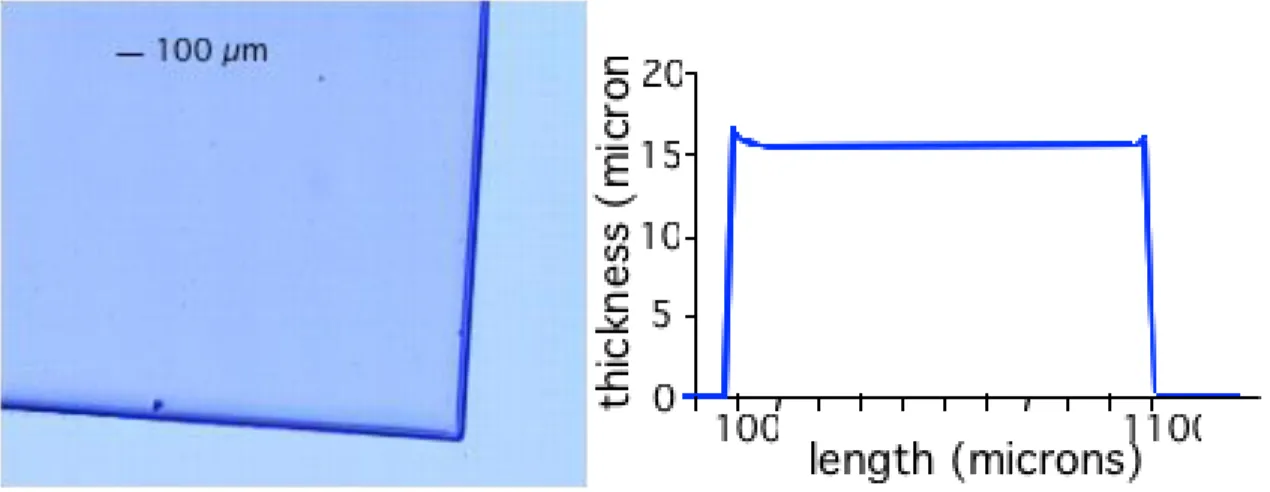
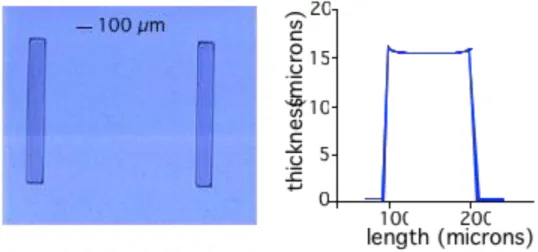
Nevertheless, the whole technological process has been optimised and validated through the mass-fabrication of micrometric polysiloxane patterns (dimensions: 1000 x 1000 x 15 m3 and
and 6). These developments have put into evidence drawbacks related to the photolithography step. For too high UV exposure time tUV, UV diffraction phenomena are responsible for the obtaining of
badly defined PSX patterns. Solution has been found by decreasing the UV exposure time while keeping the PSX deposited thickness roughly equal to its maximal value hdep (see equation 1). Thus,
after optimisation, the UV diffraction phenomena have finally been found to be responsible for a 15% dimensional increase at the pattern base as well as for a 5% thickness heterogeneity near the pattern edge (figures 5 and 6). If these results have to be still improved, they are reasonable for the development of ion sensitive layers in the field of chemical sensors.
Conclusion
The mass patterning of photosensitive polysiloxane (PSX) layers has been investigated. A technological process based on spin coating and ultraviolet photolithography techniques has been proposed. PSX deposition, cross-linking and diffraction phenomena have been studied and understood even if some discrepancies with the spin-coating deposition hydrodynamic theory have been evidenced. Finally, optimisation of the whole technological process has lead to the fabrication of high quality, micrometric, polysiloxane patterns while achieving a good homogeneity and a good reproducibility of fabrication. These technological works will be used for the development of ion sensitive layers for chemical sensors such as ion sensitive field effect transistors (ISFETs).
Acknowledgements
This work was supported by the European FP5 project “SEWING” (System for European water monitoring - contract n° IST-2000-20084).
References
[1] M. Cajlakovic M. Cajlakovic, A. Lobnik and T. Werner, Stability of new optical pH sensing material based on cross-linked poly(vinyl alcohol) copolymer, Anal. Chim. Acta, 455 (2002) 207–213
[2] N. Jaffrezic-Renault, New trends in biosensors for organophosphorus pesticides, Sensors, 1 (2001) 60-74
[3] V.K. Gupta, R. Prasad, A. Kumar, Magnesiumtetrazaporphyrin incorporated PVC matrix as a new material for fabrication of Mg2+ selective potentiometric sensor, Talanta, 63 (2004)
1027-1033
[4] A. Dybko, J. Zachara, J. Golimowski, W. Wróblewski, Miniaturized back-side contact transducer for potentiometric sensors, Analytica Chimica Acta, 485 (2003) 103-109 [5] W.Wroblewski, M. Chudy, A. Dybko, Z. Brzozka, NH4+-sensitive chemically modified
field effect transistors based on siloxane membranes for flow-cell applications, Analytica Chimica Acta, 401 (1999) 105-110
[6] M.L. Pourciel, J. Launay, W. Sant, V. Conédéra, A. Martinez, P. Temple-Boyer, Development of photo-polymerisable polyvinyl alcohol for biotechnological applications, Sensors and Actuators, B94 (2003) 330-336
[7] D. Meyerhofer, Characteristics of resist films produced by spinning, J. Appl. Phys., 49(7) (1978) 3993-3997
Tables and figures captions
Table 1: Characteristics of the different PSX solutions
Figure 1: PSX thickness h as a function of UV exposure time tUV for different PSX solutions
(spin speed: = 2500 rounds per minute)
Figure 2: PSX thickness h as a function of UV exposure time tUV for different spin speeds
(solution S2, PSX dilution into THF: x0 = 0.83)
Figure 3: time constant as a function of PSX dilution into THF x0 for different spin speeds
Figure 4: nominal PSX thickness hdep as a function of spin speed for different PSX solutions
Figure 5: optimized PSX pattern (dimensions: 1000 x 1000 x 15 m3) picture and profile
PSX solution S1 S2 S3 S4 PSX/DMPA (99/1) volume (mL) 15.15 15.15 15.15 15.15 THF volume (mL) 1 3 5 7 dilution x0 0.94 0.83 0.75 0.68 volumic mass (kg.m-3) 983 972 963 956 static viscosity (kg.m-1.s-1) 1.7 0.9 0.47 0.3 kinematic viscosity (x 10-3 m2.s-1) 1.73 0.93 0.49 0.31
Figure 1: PSX thickness h as a function of UV exposure time tUV for different PSX solutions
Figure 2: PSX thickness h as a function of UV exposure time tUV for different spin speeds