Mobile Email Devices for Knowledge Professionals
The MIT Faculty has made this article openly available.
Please share
how this access benefits you. Your story matters.
Citation
Mazmanian, Melissa et al. “The Autonomy Paradox: The
Implications of Mobile Email Devices for Knowledge Professionals.”
Organization Science 24, 5 (October 2013): 1337–1357 © 2013
Institute for Operations Research and the Management Sciences
(INFORMS)
As Published
http://dx.doi.org/10.1287/orsc.1120.0806
Publisher
Institute for Operations Research and the Management Sciences
(INFORMS)
Version
Final published version
Citable link
http://hdl.handle.net/1721.1/112333
Terms of Use
Article is made available in accordance with the publisher's
policy and may be subject to US copyright law. Please refer to the
publisher's site for terms of use.
Organization
Science
Articles in Advance, pp. 1–21
ISSN 1047-7039 (print) ISSN 1526-5455 (online) http://dx.doi.org/10.1287/orsc.1120.0806
© 2013 INFORMS
The Autonomy Paradox: The Implications of
Mobile Email Devices for Knowledge Professionals
Melissa Mazmanian
Department of Informatics, School of Information and Computer Sciences, University of California, Irvine, Irvine, California 92697, [email protected]
Wanda J. Orlikowski, JoAnne Yates
MIT Sloan School of Management, Cambridge, Massachusetts 02142 {[email protected], [email protected]}
O
ur research examines how knowledge professionals use mobile email devices to get their work done and the impli-cations of such use for their autonomy to control the location, timing, and performance of work. We found that knowledge professionals using mobile email devices to manage their communication were enacting a norm of continual connectivity and accessibility that produced a number of contradictory outcomes. Although individual use of mobile email devices offered these professionals flexibility, peace of mind, and control over interactions in the short term, it also inten-sified collective expectations of their availability, escalating their engagement and thus reducing their ability to disconnect from work. Choosing to use their mobile email devices to work anywhere/anytime—actions they framed as evidence of their personal autonomy—the professionals were ending up using it everywhere/all the time, thus diminishing their auton-omy in practice. This autonauton-omy paradox reflected professionals’ ongoing navigation of the tension between their interests in personal autonomy on the one hand and their professional commitment to colleagues and clients on the other. We further found that this dynamic has important unintended consequences—reaffirming and challenging workers’ sense of themselves as autonomous and responsible professionals while also collectively shifting the norms of how work is and should be performed in the contemporary workplace.Key words: autonomy; communication practices; escalating engagement; mobile email; information technologies; autonomy paradox
History : Published online in Articles in Advance.
Introduction
Scholars have generally understood autonomy in the workplace as the ability to exercise a degree of con-trol over the content, timing, location, and performance of activities. Autonomy is seen as particularly salient to the accomplishment of highly skilled, complex, and uncertain work (Blau 1984, Freidson 1984, Scott and Meyer 1991, Wallace 1995); as a central factor in the design of jobs (Hackman and Oldham 1976) and self-managing teams (Haas 2010; Hackman 1983; Langfred 2004, 2007); and as a defining feature of professional work (Abbott 1988, Scott 1982, Wallace 1995). It has long served as a key indicator of the success of profes-sionalization efforts (Engel 1970, Freidson 1986, Goode 1960, Hall 1968, Hughes 1963), reflecting and reinforc-ing professional workers’ high occupational status and relatively prestigious position in the social order (Alves-son et al. 2008, Lar(Alves-son 1977, Meiksins and Wat(Alves-son 1989, Nelson 1985, Scott 2008).
Autonomy in the workplace offers many advantages such as jurisdictional control over tasks, knowledge, and performance standards; the freedom to exercise judg-ment and make decisions with minimal interference; and the authority to define the temporal, physical, and practical boundaries of work (Abbott 1981, Engel 1970,
Freidson 1983, Hall 1968, Sandberg and Pinnington 2009, Sharma 1997, Wallace 1995). Despite these advan-tages, a number of studies have found that both pro-fessional and nonpropro-fessional workers will—in certain circumstances—limit their autonomy in response to the demands of a job, a team, or a changing labor market (Barker 1993, Barley and Kunda 2004, Covaleski et al. 1998, Deetz 1997, Fraser 2001, Kunda 1992, Martin et al. 1998, Perlow 1998). In these cases, workers per-ceive the restrictions on their discretion, freedom, or authority as necessary and/or appropriate in the face of pressure from management, clients, team members, or an uncertain economy. In response to diminished autonomy, workers generally express feeling frustrated and trapped by their circumstances (Barker 1993, Barley and Kunda 2004, Kunda 1992, Martin et al. 1998, Perlow 1998).
Our study of knowledge professionals using mobile email devices similarly finds workers restricting their autonomy as they choose to be technologically con-nected to work at all hours of the day and night. In contrast to prior studies, however, we find that these professionals do not experience such actions as limit-ing their discretion, freedom, or authority. Rather than feeling frustrated or trapped, they report that using the mobile email device offers them greater flexibility and
1 Cop yright: INFORMS holds cop yr ight to this Ar ticles in Adv ance version, which is made av ailab le to subscr ibers . The file ma y not be posted on an y other w ebsite , including the author’ s site . Please send an y questions regarding this policy to per missions@inf or ms .org.
capacity to perform their work, and it increases their sense of competence and being in control.
What is going on here? What might account for these counterintuitive findings? We explore this puzzle in our paper, focusing in particular on understanding two primary research questions. How and why do knowl-edge professionals use mobile email devices to willingly restrict their autonomy and yet experience these actions as enhancing their autonomy and capacity to perform as professionals? And what are the personal and col-lective consequences of such actions for the profession-als? In addressing these questions, we provide a deeper understanding of the tension between autonomy and commitment as enacted with mobile email devices in the professional workplace. Our research offers insights into how the use of mobile technologies amplifies prac-tices and capacities of communication, reinforcing pro-fessional norms on the one hand and shifting them on the other hand, to engender a new dynamic of continuous— and compulsive—connectivity. We identify how profes-sionals rationalize their diminishing autonomy, framing this outcome not as an encroachment but as indispens-able to helping them achieve flexibility and accountabil-ity in their work. Our research thus makes a theoret-ical contribution to the understanding of autonomy in the professional workplace and the influence of mobile email devices within such contexts.
In discussing our findings, we consider how knowl-edge professionals use their mobile email devices to engage in electronic communication asynchronously and ubiquitously. We find that using the devices helps profes-sionals bridge the tension between their personal auton-omy and their professional commitment to others. By so doing, these professionals are able to generate a range of valued outcomes—increased flexibility, control over information and interactions, and peace of mind— that reaffirm their authority, status, and sense of self as accomplished professionals. However, we also find that by using the devices to navigate the conflicting demands of autonomy and commitment, the professionals unwit-tingly intensify their commitment to team members, colleagues, and clients and reduce their ability to dis-connect from work. Even as these professionals view the mobile email devices as enhancing their individual autonomy by allowing them to work anywhere/anytime, we observe them becoming caught in a collective spi-ral of escalating engagement where they end up work-ing everywhere/all the time. As we discuss below, this dynamic generates an autonomy paradox—that reliance on mobile email devices both increases and diminishes professionals’ autonomy. And this produces a number of contradictory and unintended consequences for profes-sionals’ work lives.
Literature on Autonomy
Scholars have long viewed autonomy in the workplace as an important element in designing jobs and group
structures (Hackman 1976, Langfred 2005, Wageman 1995) and a constitutive aspect of professional work (Abbott 1988, Scott 1982, Wallace 1995). Whereas some studies have found that workers with more autonomy tend to increase their performance and motivation, oth-ers have suggested that increased autonomy may also increase control over workers (Ezzamel and Willmott 1998, Gladstein 1984, Haas 2010, Janz et al. 1997, Langfred 2000, Sewell 1998, Stewart and Barrick 2000, Wageman 1995). Researchers examining the influence of technology on autonomy have found similar contra-dictions, observing increased control from automation in some cases and increased autonomy in others (Attewell 1987, Barley 1988, Braverman 1974, Burawoy 1979, Burris 1998, Fraser 2001, Garson 1988, Kraft 1979, Noble 1977).
This critical tension between autonomy and control runs throughout the literature and is also present in the research on autonomy most relevant to our study: that involving workers who have some discretion in the performance of their work, such as self-managing teams, professionals, and freelance workers. Centrally, this research finds that these workers—who either have autonomy by dint of their occupational status or are granted some autonomy by management—often restrict aspects of their autonomy. And they do so at significant costs to themselves, reducing control over their work, working more hours, blurring personal and work time, and increasing strain and work–family conflict.
Research on self-managing teams highlights how teams granted more autonomy often end up increas-ing control over individual members (Barley and Kunda 1992, Ezzamel and Willmott 1998, Sewell 1998). As Sewell (1998, p. 401) explained it, the normative dis-course of participative teamwork may be less coercive rhetorically, but it is no less coercive in practice: “In effect, teams are taking on the responsibility for ratio-nalizing and intensifying their own work activities.” Barker’s (1993, 1999) noteworthy ethnographic study of the shift to autonomous, self-managing teams in a man-ufacturing plant identified how members initially used their team autonomy to reach consensus on key val-ues but how, over time, they imposed a set of morally binding values on each other. Actively negotiating the relationship between autonomy and shared responsibil-ity, team members formalized their values into stringent rules through which they exerted considerable control over their peers in ways that it came to exceed that wielded previously by management. Team members thus enacted a powerful “concertive control” that reduced their own freedom and discretion, producing fear and a sense that colleagues had become “judge, jury and exe-cutioners” (Barker 1993, p. 427). Team members per-ceived this disciplinary pressure of self-supervision to be both constraining and essential to working effectively.
Cop yright: INFORMS holds cop yr ight to this Ar ticles in Adv ance version, which is made av ailab le to subscr ibers . The file ma y not be posted on an y other w ebsite , including the author’ s site . Please send an y questions regarding this policy to per missions@inf or ms .org.
The tension between autonomy and control extends beyond the domain of teams to the workplace more gen-erally (Jermier 1998, Sewell and Barker 2006, Spector 1986). It is particularly evident in the disciplining impli-cations of strong cultures (Willmott 1993). For example, in a study of the Body Shop, Martin et al. (1998) found that the founder’s vision to create an organization that respected individual freedoms and promoted personal well-being was transformed into a culture of control where people felt pressured to conform to the normative expectations of emotional commitment and dedication to the workplace community. Likewise, Kunda’s (1992) ethnography of a high-tech corporation shows how the ideologically engineered culture—formulated as a non-hierarchical, moral collective that promotes freedom and creativity in the workplace—demanded an extreme com-mitment from its employees, prescribing their behav-iors, cognitions, and emotions. In response, employ-ees enacted a form of ironic detachment to distance themselves from the negative consequences of their engagement. Similarly, Perlow’s (1998) study of a high-tech organization highlights how engineers’ professional ethics and desire to appear committed to their job com-bined with cultural control mechanisms to restructure temporal boundaries so that engineers accepted longer workdays and unpredictable demands on their time.
Professionals are generally assumed—by virtue of their occupational status, specialized expertise, and pres-tigious social position—to have considerable autonomy to define the content, performance, timing, and loca-tion of their work. In practice, however, many find themselves in a bind similar to that of Kunda’s (1992) and Perlow’s (1998) high-tech engineers—navigating the uneasy relationship between autonomy and commitment. Von Nordenflycht (2010, p. 163) noted that this relation-ship is particularly challenging for professionals because they are bound by a dual set of interests: “a strong preference for autonomy” and “a responsibility to pro-tect the interests of clients and/or society in general.” Attending to both of these interests simultaneously is not straightforward, and the resulting tension is one that has long characterized professional work (Abbott 1981; Engel 1970; Freidson 1986; Hall 1968; Haug and Suss-man 1969; Larson 1977; Scott 1982, 2008). Further exacerbating this tension is the social status that pro-fessionals enjoy relative to other occupational groups (Abbott 1981, Scott 2008). Research has found that such status increases the degree to which professionals inter-nalize occupational norms of responsibility (Ashforth and Humphrey 1993, Bergami and Bagozzi 2000, Burke and Reitzes 1991, Carmeli 2005).
In the context of professional service firms, the tension between the promise of autonomy and the expectation of commitment is intensified. As a number of scholars have argued, when the product is information, its quality and value are often difficult to assess (Alvesson 2001,
Deetz 1997, Robertson et al. 2003). Reputations, appear-ances, and relationships become proxies for compe-tency and worth (Alvesson 2001, Alvesson and Willmott 2002, Covaleski et al. 1998). To establish and main-tain the claims of their products’ worth, professional service firms seek to recruit and retain the “best tal-ent” by promising autonomy and prestige (Alvesson and Robertson 2006), as well as generous salaries, upscale working environments, and regular opportuni-ties for advancement (Robertson et al. 2003). Once recruited, however, these individuals have to be encour-aged, cajoled, and obliged to align their preference for autonomy with the demands for commitment to the job and accountability to their employers, colleagues, and clients.
Numerous studies have documented the various mech-anisms of normative, bureaucratic, and identity control used by professional service firms to achieve increased commitment at the cost of some individual autonomy (Alvesson and Robertson 2006, Alvesson et al. 2008, Covaleski et al. 1998). For example, in her study of architectural firms, Blau (1984, p. 28) found that although the “architect-designer demands latitude for judgment and artistic freedom of expression,” the firm must ensure that this autonomy is exercised “within the limits posed by the client” and the professional require-ments of managing construction projects. And in their study of two professional service firms, Robertson et al. (2003) found that despite professionals’ ostensibly high levels of autonomy, the firms’ norms and expectations led professionals to work long hours over extended peri-ods to meet project deadlines.
Such self-imposed restrictions on autonomy also show up outside of the boundaries of the firm. In their work on freelance software contractors, Barley and Kunda (2004) found that even though these contractors—as experts in their field—had the freedom to select the jobs and hours they worked, few took advantage of the flexibility provided by their freelance position in the workforce. Instead, given the unpredictable demand for contract work, the opportunity costs of not working, and the need to promote reputations and referrals, these contractors chose to work long hours and fill any possible down-time with upgrading their skills and managing their net-works. They thus limited their autonomy in response to the demands of the marketplace and the uncertainty about future options, never feeling quite free from the relentless pressure to maintain their financial, social, and human capital.
Research has also suggested that mobile communi-cation technologies, upon which contemporary work-ers are increasingly dependent, may allow individuals increased flexibility in where, when, and how they work (Golden and Geisler 2007, Hislop and Axtell 2011, Middleton 2007). Such increased flexibility, how-ever, may be a double-edged sword. For example,
Cop yright: INFORMS holds cop yr ight to this Ar ticles in Adv ance version, which is made av ailab le to subscr ibers . The file ma y not be posted on an y other w ebsite , including the author’ s site . Please send an y questions regarding this policy to per missions@inf or ms .org.
Murray and Rostis (2007) indicated in their study of virtual workers using mobile devices that as ers began to use the technologies to monitor employ-ees, such workers were unable to reap the benefits of increased autonomy expected from working virtually. Similar findings emerged among professional workers in the Prasopoulou et al. (2006) study of service firms. They found workers frequently using cell phones for work communication during times usually devoted to private activities. Such temporal encroachment reflected these workers’ positions as mid-level executives, jobs that required extensive and ongoing coordination among colleagues, clients, and associates.
Looking across the literature on autonomy in the workplace, research suggests that self-imposed restric-tions on autonomy are strongly tied to various mechanisms—bureaucratic, concertive, cultural, market, or technological. These mechanisms exert substantial influence on workers to limit their autonomy despite the negative consequences that are generated as a result. In choosing to respond to these mechanisms, workers rec-ognize the trade-offs they are making—acknowledging the loss of discretion, freedom, or authority, as well as the personal costs of behavioral and cognitive conformity, emotion management, longer work hours, work–family conflict, frustration, and feelings of being trapped.
Such accounts, however, do not provide insight into why individuals may restrict aspects of their auton-omy and yet experience such choices as enhancing their autonomy. This is the puzzle that emerged from our study of knowledge professionals who chose to use their mobile email devices to work at all hours of the day and night. In contrast to prior studies, these workers did not perceive these self-imposed restrictions as limit-ing their discretion, freedom, or authority, nor did they report feeling trapped or frustrated. On the contrary, they reported that use of mobile email devices offered them greater flexibility and capacity to do their work, allow-ing them to perform as more competent professionals. Unpacking the dynamics of these professionals’ expe-riences allowed us to make sense of these contradic-tions and to develop an understanding of the relation-ship between professionals’ autonomy and their use of mobile email technology in the workplace.
Research Setting, Data, and Methods
We conducted multiple interviews with 48 knowledge professionals during 2004 and 2005. These interviews focused on understanding the professionals’ daily work practices and their experiences using mobile email devices. We started by interviewing five knowledge professionals (one lawyer, one private equity partner, one venture capital fund partner, and two investment bankers) from different organizations who had been
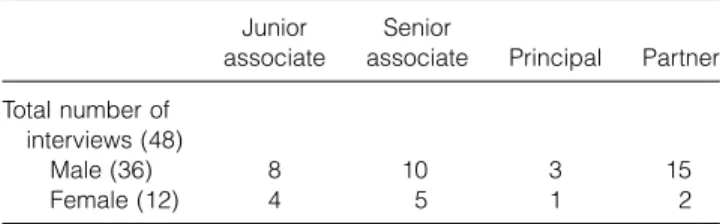
identified by our colleagues as avid BlackBerry users. Based on these contacts, we conducted further inter-views with members of a small private equity group, Plymouth Investments, where we were able to get over 90% participation (19 of 22 investment staff and 4 of 5 senior support staff). We then used a snowball sam-pling strategy to obtain the participation of an addi-tional 24 similar professionals in four firms (corporate law, venture capital, and investment banking). Out of our total sample, we were able to interview 18 profes-sionals twice (see Table 1). Although their specific jobs varied, all of our 48 participants fit the profile of high-status and autonomous knowledge professionals, and all of them were active users of mobile email devices.1Our
data set includes knowledge professionals from across internal hierarchies and reflects a gender participation that is consistent with the gender distribution of work-ers in these industries. In addition, and to obtain a fuller understanding of the knowledge professionals’ lives, we interviewed 11 administrative support staff (all but one female) and 8 spouses (all but one female) who were referred to us by the knowledge professionals.
The first round of 48 interviews consisted of open-ended conversations covering a broad and evolving set of questions. As interesting themes emerged in one inter-view, we incorporated these into our conversations in subsequent interviews. We began our interviews by ask-ing participants to describe their jobs and organiza-tional positions, as well as the nature of their work and communication practices. We then asked participants to describe in detail their activities during the prior day, from waking up to going to sleep. We were specifically interested in where, when, and why they engaged with their mobile email device to get their work done. This chronological narrative provided a structure to the inter-view, but we encouraged elaborations and digressions as people recounted and reflected on their communicative choices, actions, experiences, and outcomes.
Specific questions ranged from “When do you first check the device in the day?” to “On what occasions do you find the device to be useful/not useful? Why?” As it became clear that participants—although predomi-nantly positive about their choice to use the mobile email devices—were also claiming a sense of compulsion to use them, we began to probe more deeply for these ten-sions. For example, we asked questions such as “When you receive a message, how soon do you feel you have
Table 1 Interviews with Knowledge Professionals
Junior Senior
associate associate Principal Partner Total number of interviews (48) Male (36) 8 10 3 15 Female (12) 4 5 1 2 Cop yright: INFORMS holds cop yr ight to this Ar ticles in Adv ance version, which is made av ailab le to subscr ibers . The file ma y not be posted on an y other w ebsite , including the author’ s site . Please send an y questions regarding this policy to per missions@inf or ms .org.
to respond? Why?” and “Would you ever come to work without checking your emails from home? Why/why not?” Such questions allowed us to explore how and why using the device engendered experiences of both choice and compulsion, and with what intended and unintended consequences.
A few months later, we conducted a second round of more structured interviews with 18 of the knowledge professionals and 4 of the senior support staff members. These interviews followed up on the workers’ experi-ences with the mobile email devices and allowed us to focus more specifically on their daily email communica-tion practices and rhythms. All the interviews we con-ducted averaged 60 minutes in length (ranging from 45 to 90 minutes), and all were recorded and transcribed.
Using the techniques of grounded theory building (Charmaz 2006, Strauss and Corbin 1998), we con-ducted an iterative textual analysis of the interview transcripts in an attempt to understand the relationship between everyday patterns of communication with the mobile email devices and participants’ experiences of the devices and their jobs more broadly. We cycled through multiple readings and coding of the interview transcripts. These activities were informed by our focus on autonomy, control, technology, and outcomes, yet we strove to remain open and alert to emerging themes. Coding progressed from noting comments and obser-vations in the interviews that seemed salient to artic-ulating and refining analytic categories. We read each of the interview transcripts multiple times and aggre-gated quotes along main themes. We then discussed these themes and produced narrative memos about the associated dynamics and tensions that we saw in the data (e.g., the relative use of mobile email over cell phone conversations, the role of uncertainty reduction and pro-fessional commitment in accounts of use). These memos allowed us to identify key analytic categories (such as “perceptions of control” or “expectations of responsive-ness”). We then reviewed and refined the codes within categories, gathering the relevant data across the inter-views and comparing insights.
Observing contradictions in how people talked about their device and how and when they used it led us to look more closely at how people explained their moti-vations for using the device and how they accounted for their patterns of constant connectivity. What emerged from this analytic strategy was an understanding of how the professional workers had integrated mobile email devices into their lives and the tensions and conse-quences of these actions. In particular, we found that all the participants reported that using the device enhanced their flexibility, sense of control, and competence as professional workers. Yet all the participants reported patterns of use that indicated increased expectations of availability and responsiveness, the compulsion to be constantly accessible, and shifting norms of professional
engagement. We examine these dynamics in detail in the following section.
Autonomy and the Use of Mobile Email
Technology Among Professional Workers
In the everyday communication practices of the knowl-edge professionals we studied, the use of mobile email devices was ubiquitous. We found that use of these devices helped the professionals bridge the tension between personal autonomy and responsibility to others in ways that supported their professional commitments and aspirations, but such use also generated a number of unintended consequences.
We present these empirical findings in three sections. First, we discuss the patterns of individual use that emerged among the professionals as they integrated the mobile email device into their everyday practices. Sec-ond, we discuss the collective consequences of such use patterns, which led the professionals to engage continu-ously and compulsively with their email devices. Third, we explain how the professionals responded to the col-lective consequences in terms of their professional com-mitments and aspirations, and how the recursive cycle of individual use and collective outcomes began to shift the norms of professional work. After presenting these findings, we offer an explanation for the paradox of autonomy that we identified—how the patterns of indi-vidual use that enhanced professionals’ autonomy also produced collective consequences of escalating engage-ment that ended up diminishing their autonomy. Patterns of Individual Use
In exploring the patterns of individual use that were enacted by the professional workers, we found that they used their mobile email devices to be continually con-nected, thus managing their commitment to others by staying in touch with the flow of communication, while also buffering their availability, thus increasing their autonomy by choosing whether, when, and where to respond to the communication.
Connecting Continually. The participants in our study described their experiences with mobile email devices as expanding their use of email communication and provid-ing a way to monitor the flow of ongoprovid-ing communication occurring within their teams, firms, and industries.
Expanding use: After adopting mobile email devices, a large majority of individuals we studied began to use them as their primary means of email communication.2
These participants reported that the capabilities of the mobile email devices—portable, handheld, convenient, unobtrusive, wireless, and always connected—allowed them to perform their jobs flexibly, responsibly, and competently. They thus quickly developed the habit of repeatedly checking, and occasionally sending, email
Cop yright: INFORMS holds cop yr ight to this Ar ticles in Adv ance version, which is made av ailab le to subscr ibers . The file ma y not be posted on an y other w ebsite , including the author’ s site . Please send an y questions regarding this policy to per missions@inf or ms .org.
messages on the devices throughout the day and night. This allowed them to feel connected to and involved in whatever was happening at work. Mike, a partner at a law firm, described a usage pattern similar to that reported by most participants:
If I’m going to a meeting, it’s just an instinct for me now [to check for incoming messages]. It could be like every 30 seconds, every minute, I mean, it’s just ridiculous, but it’s like, you know, it’s just always “check time.”
Not only did participants describe habitual use of mobile email, they also reported embedding email com-munication into a range of daily activities (e.g., meet-ings, commuting, waiting, walking, eating, relaxing). Maria, a senior associate at Plymouth Investments, was representative of many when she noted that she engaged with email via the device “pretty much all the time,” and then elaborated,
I use it at home, 0 0 0 use it on the train—in and out—use it if we went away for a weekend. 0 0 0 It’s honestly the first thing I do in the morning and the last thing I do before I go to bed. 0 0 0 You just get in the habit of always knowing what’s in your email.
Gary, a partner at Plymouth Investments, noted, “And because it’s so easy to check, (a) you do it, and then (b) once you see it, you think ‘Oh, I’ve got to respond to that.’ ” He confirmed his habit by regularly responding to our email messages within five minutes and reporting his location. As an example, the following postscript was attached to one of his replies to us:
PS: I think you would appreciate knowing that I’m typing to you from orchestra rehearsal (during the rests—I can’t multitask well enough to type and blow my horn at the same time—there IS a limit).
Our data indicate that most participants carried their mobile email devices close to their persons at all times, both during work and nonwork hours. During their “non-work” hours, participants reported checking the device for incoming messages, on average, every 5 to 10 min-utes in the mornings, and every 10 to 60 minmin-utes in the evenings and throughout the weekends. They received, on average, 7 to 10 work-related emails on the mobile email device in the morning before work, and 17 to 20 work-related emails on the device on a typical week-end day.3 Such temporal and spatial shifting of
com-munication habits greatly expanded the time, effort, and attention that participants devoted to their email communication.
Monitoring flow: Although expanding the use of work-related email communication could be seen as diminishing individual autonomy, this was not what the professionals experienced. On the contrary, nearly all of the participants characterized their relationship to mobile email as one of monitoring a stream of mes-sages that they simply needed to “keep an eye on.” As
knowledge professionals, these individuals felt an obli-gation to remain involved in the work of their teams and clients and to stay “up” on the latest news and events concerning their firms, clients, and industries to understand emerging trends, anticipate issues, and seek out new business opportunities. As Barbara, a senior law associate, observed, her keeping track of her email was just a case of “me watching work.” Rick, a part-ner at Plymouth Investments, demonstrated this moni-toring practice while glancing at his BlackBerry during our interview: “I look through the names here [of emails received] and I see there’s nothing I have to jump to, there’s nothing that I care about right now.” Similarly, Jeff, a junior associate at Plymouth Investments, noted that he is “always looking at it … just in case some-thing’s changed.”
We found that over 50% of messages received by our participants on their mobile email devices were of the “FYI” variety. These messages were not directly addressed to the recipient in the “To” address field, and they typically involved copies of emails sent to other team members or broadcast bulletins sent via large email lists (e.g., industry newsletters, firm announce-ments, press releases, news updates). We further found that for every eight work-related email messages the par-ticipants received on their mobile email devices (whether during work or nonwork hours), they replied to, or initi-ated, only one email message. That one message, how-ever, was often time sensitive and particularly useful in directing or coordinating the work of others on a team. Jane, a senior associate at Plymouth Investments, high-lighted how email monitoring while she was on vacation allowed her to keep tabs on and engage with the junior members on her team:
I think you keep in the flow more if you’re able to keep in touch. If I’m on vacation and I see what’s happening with a project, I can write back and question their thoughts. I think it makes the junior people more engaged.
The experience of monitoring the communication flow to stay “up to speed” and replying only to key mes-sages was apparent across internal hierarchies. A num-ber of partners described how repeatedly checking their email when they were out of the office ensured that there would not be a “bottleneck” for decisions that needed their approval. Principals appreciated that they could send out update messages before work and know that everyone would arrive to the team meeting “on the same page.” And junior people felt obliged to be responsive to those above them, as Ned, a junior Plymouth associate, observed:
Well, it allows you to give very fast responses to senior people, which I guess, as a more junior person, you always sort of like. If you can give a partner an answer quickly, you’d rather give it to them quickly than later.
Cop yright: INFORMS holds cop yr ight to this Ar ticles in Adv ance version, which is made av ailab le to subscr ibers . The file ma y not be posted on an y other w ebsite , including the author’ s site . Please send an y questions regarding this policy to per missions@inf or ms .org.
Across the board, participants acknowledged that use of the mobile email device had expanded the amount of email communication they attended to. But all asserted that the devices allowed them to manage and monitor the ongoing stream of email communication in a man-ner that was particularly helpful, unobtrusive, and easy to do.
Buffering Availability. Participants reported that the asynchronicity of email and the capability to monitor incoming messages at any time and from anywhere allowed them to temporally distance themselves from their email communication in a way that enhanced their autonomy by increasing control and flexibility over when, where, how, and with whom they communicated. By keeping their devices within reach, and by frequently monitoring the flow of email messages, participants kept track of what was going on without feeling forced to engage immediately. They thus enacted what we refer to as a “buffered availability” with their mobile email devices—a form of engagement that allowed participants to increase their sense of individual autonomy, despite their continual connectivity, and enabled greater flexi-bility and control over email communication. Coupling continual connectivity with buffered availability allowed professionals to “be in touch without really being in touch,” as Tina, a senior support member at Plymouth Investments, put it.
Temporal distancing: In professional environments, where work was not bound to “on-the-clock” hours and communication practices centered around keeping team-mates “in the loop” and up to date on the status of a deal, case, or project, participants experienced the mobile email device as providing them with the capa-bility to actively manage their availacapa-bility on a moment-by-moment basis. In particular, the asynchronicity of email along with the mobile email devices allowed for a practice of temporal distancing, where participants could choose when, where, and how to engage, or not, with communication.4
Temporal distancing was particularly evident when participants compared the experiences of communicating via a mobile email device with that of a cell phone. Most participants pointed to the capabilities of the mobile email device that enabled easy and relatively unobtru-sive communication: discreet (when set to a “silent” mode), portable (palm-sized and mobile), convenient (email being constantly “pushed” to the device), and ubiquitous (wireless service providing extensive con-nectivity). Although cell phones resemble mobile email devices in size, portability, and connectivity, they lack the unobtrusiveness and convenience of email devices and are largely used for synchronous communication (even though asynchronous communication is possible through the use of voice mail). Although every partici-pant in our study carried a device with cell phone capa-bility (and most had a smartphone that combined cell
phone and email services), all noted that a cell phone conversation was a markedly different experience from email communication on a mobile email device.
For example, two partners at Plymouth Investments captured well the sentiments of most of our participants in describing these differences:
I hate the phone. All right, it’s a strong statement. I use the phone as an outgoing tool. I don’t really like it as an incoming tool because I can’t control when it rings. I can’t control who’s on it. So, what I do is, I desper-ately try to have communication come in to me via email on the BlackBerry. Because then I can look at it and I can deal with it when I want to deal with it, not when somebody else wants me to deal with it. (Gary)
I do think part of it is because I’m in control [of Black-Berry email] and I can figure out whether I want to respond to it immediately or blow it off for a little while. Whereas, if you get a cell phone call, you’ve got to deal with it immediately. (Rick)
Chad, a principal at Plymouth Investments, further explained how his use of a mobile email device differed from his use of cell phone:
[What you do is] keep this [the BlackBerry] on your kitchen counter or wherever it is that you circulate during the day. And if the red light’s blinking, you just pick it up, and you just say, “Is that something I need to respond to or not?” It’s easier than talking on a phone. You don’t actually have to do anything. You just have to walk by it and look at the screen and choose to participate or not participate.
Many participants perceived using a cell phone as diminishing their ability to manage their communica-tion. In contrast, the asynchronicity of email coupled with the convenience of being able to continually and unobtrusively monitor messages on the mobile email devices allowed them to buffer themselves from the stream of ongoing communication and respond in their own time. Most participants perceived such temporal distancing with the mobile email device as increasing their discretion to act only when they deemed nec-essary and enabling them to do so responsibly and appropriately.
Controlling communication: All the participants acknowledged that their attending to email communica-tion had increased with mobile email devices, but all stressed that the device had enabled a form of attention that increased their control over such communication. Marvin, a partner in a venture capital firm, explained,
People complain about feeling captive to the cell phone. You have to have it on. Maybe you give the number to your kid’s babysitter, so it has to be on. Then you get all these other calls. This [points to his BlackBerry] has no feel of that at all. It isn’t obtrusive. I think that is an advantage. It gives you more access but more control over the communication. I guess that’s really kind of it: more communication but more control over it.
Cop yright: INFORMS holds cop yr ight to this Ar ticles in Adv ance version, which is made av ailab le to subscr ibers . The file ma y not be posted on an y other w ebsite , including the author’ s site . Please send an y questions regarding this policy to per missions@inf or ms .org.
The sense of increasing control is also evident in the description offered by Monica (a partner in a law firm) of the subtle differences between checking and responding to email communication on the mobile email device:
Although my general response is that I check it all the time, that doesn’t mean I respond all the time. And if it’s a weekend and it’s not from a client, I’m not responding. I’m looking but I’m not responding, unless it’s something that I can respond to very quickly. If it’s late at night, I’m looking but I’m not responding. And that is kind of like the home thing versus the work thing, and just because you know what’s going on doesn’t mean your life is in somebody else’s hands.
A large majority of participants repeatedly empha-sized that using the mobile email device to control their communication offered benefits of both productivity and peace of mind. For example, Maria, a senior associate at Plymouth Investments, explained how her use of the mobile email device had allowed her to be more effi-cient, especially during periods of “downtime”:
It’s so convenient and it just makes it super easy to be in touch. So if you’re on a business trip … all the time in cabs on the way to the plane, all the times waiting around in the airport, it just lets you be productive. And not nec-essarily just socially productive, you can be productive for Plymouth Investments. It just lets you be, it lets you use your time. You’re not just sitting there wasting time anymore.
Gary, a Plymouth Investments partner, also reported experiencing productivity gains as a result of being able to control his communication with the mobile email device:
I kind of pride myself on my BlackBerry use. First of all, I have gotten very fast with this thing, and I can write a well-conceived message that hits the points that I want to hit to somebody quite quickly and do it when I feel like doing it. Again, I’m in control of my communications. And to me, the productivity that this thing has unleashed is huge. You could argue that in a way I’m my best self on this thing.
Many participants also noted how their increased abil-ity to control their communication translated into peace of mind. For example, Eleanor, a senior support staff member, explained, “I guess it’s probably a control thing. It allows me to always be in control, which gives a sense of comfort.” James, a senior associate at Ply-mouth Investments, described walking with his wife and just “taking my BlackBerry out of my pocket and say-ing, ‘Oh, I don’t have any emails. [Now] I can not worry for the next period of time.’ ” Mark, a principal, likewise noted,
I actually prefer to be too connected because that way I can have the peace of mind that—as most of the people I deal with know that I’m always on my BlackBerry—if
something needed my attention and I look at my Black-Berry and I see that I have no new messages or messages that I don’t need to concern myself urgently with, then I can be totally relaxed.
And Steve, a senior associate at a law firm, observed that his BlackBerry “gives me greater comfort when I’m not here. I know that there’s not something blowing up, some big crisis and people can’t reach me. I really don’t think I could practice without one now.”
Increasing flexibility: Because participants largely assumed that others in their network would also prefer email to telephone (or face-to-face) communication, they felt mobile email devices released them from an obliga-tion to be available at a certain time or place. For many, this increased their sense of temporal and physical flexi-bility. Janice, an associate at a law firm, noted, “It’s just freedom. Freedom to connect. You can connect when-ever you want and not be prevented by where you are or what you’re doing. It just feels liberating.” Participants who were involved in coordinating or directing the work of others particularly found the mobile email devices useful in helping them attend to projects or cases even when they were away from the office. Rick, a partner at Plymouth Investments, noted,
As a matter of fact, I think it gives me more freedom to leave work. Because I know I can always be in contact and I can always be reached. And a lot of things that I do [as a partner] are to react to things. And so the fact that I can answer the question that someone has [while I am] in a golf cart means I can [respond] and still be playing golf.
Similarly, when discussing his desire to “skip out” when one of his children has an event at school, Roger, a partner at Plymouth Investments, said, “For me it’s a great thing. It helps me make choices about when to work and when to do other stuff.”
Across hierarchy and throughout the organizations we studied, people described the device as enabling them to leave the office while continuing to engage with work as needed. Hillary, a law partner, explained how the use of the mobile email device allowed her to perform as a responsive and competent knowledge professional:
It allows me to just get A+++ on the response schedule, without actually having to do more work. It’s just a click, click, click. Because if I can leave the office at 5 and a client on the West Coast sends me an email at 8 p.m., I can just put a two-second, two-line, “Yep, got it, I’ll look at it tomorrow.” And they’re like, “Oh my God, how great; she checks her email at 8 p.m.” And I’m like, home, eating dinner.
And for Jennifer, a junior associate at Plymouth Investments,
I think the ability to efficiently handle communications from outside the office at all times and keep in the
Cop yright: INFORMS holds cop yr ight to this Ar ticles in Adv ance version, which is made av ailab le to subscr ibers . The file ma y not be posted on an y other w ebsite , including the author’ s site . Please send an y questions regarding this policy to per missions@inf or ms .org.
flow constantly is the most helpful thing [about having a BlackBerry]. You’ll understand what’s happening back in the office, even if you’re out of the office. And you can handle it in real time. This is really important for a junior person.
The buffering of availability enabled by mobile email was seen as increasing individual autonomy about when, where, and how to engage in work-related communica-tion. Our data suggest that the professionals were con-tinually connecting to their email even as they worked on substantive projects at home in the evenings and on weekends (e.g., financial or market analyses, legal briefs, presentations, report writing or reviewing). Mobile email provided a window that alerted them to emerging data, new issues, or shifting demands that often informed or changed the projects being worked on.
Participants overwhelmingly described deriving sub-stantial benefits from using their mobile email devices to stay connected and “in the flow.” By being able to control the timing, location, and occasion of commu-nication, participants reported that using such devices increased their peace of mind when away from the desk and gave them the flexibility to be away from the physi-cal workplace. At the same time, however, we found that the professionals were generating significant unintended consequences as a result of their continual connection to mobile email.
Collective Consequences of Use
The patterns of individual use articulated above gen-erated collective consequences for the professional workers—increased expectations of their accessibility and responsiveness—that led them to escalate their engagement with work-related emails. This outcome produced the autonomy paradox that became evident in their lives: that by individually engaging with a device that enabled them to work anywhere/anytime (thus enhancing their autonomy), the professionals enacted a collective dynamic of working everywhere/all the time (thus diminishing their autonomy).
Escalating Engagement. Across the board, partic-ipants noted that the manner in which they used their mobile email devices to engage with work-related email reflected their personal preferences to manage their time, attention, and performance. Nonetheless, communication—including mobile email communication—involves other people, and individuals’ choices and actions in enacting continual connectiv-ity and buffered availabilconnectiv-ity do not occur in isolation. Communication practices assume and entail a commu-nity of others who are engaging in similar practices with similar devices. Thus, as participants individu-ally managed their mobile email, they began produc-ing and sharproduc-ing assumptions regardproduc-ing how profession-als should be using mobile email to get their work done.
Over time, these shared assumptions were reinforced and reproduced in practice, further raising expectations about when and where participants should be engag-ing with their email communication. These heightened expectations led participants to feel increasing stress with respect to their commitments to their team mem-bers, clients, colleagues, and firms. Together, these find-ings suggest that participants experienced an overarching loss of individual autonomy over when, where, and how often they engaged with work via their mobile email devices. We further found that these collective conse-quences were experienced across hierarchy and job type within the firms we studied.
Sharing assumptions: As we were able to get almost full participation from Plymouth Investments, we were able to see the dynamic of escalating engagement across multiple levels of the firm. Specifically, Plymouth Invest-ments members knew that almost everyone at the firm carried a mobile email device, and although their use was not mandated, it was widely assumed that every-one was checking them frequently. As Maria, a senior associate, noted,
There are not many of the people here [at Plymouth Investments] who don’t check their BlackBerry every seven or eight minutes. There aren’t many people who you can email and you won’t hear back right away. Vic, a junior associate, reflected this assumption as well: “It’s a little unnerving when you’re away from your email for a really long time. You know this is the primary way that everyone communicates.” Gary, a part-ner, goes even further: “We all have BlackBerrys, so you know that everybody is seeing the traffic. 0 0 0 I suppose you could argue that the email traffic of the firm is an asset of the firm. Communication is our lifeblood.”
The employees at Plymouth Investments noted that shared assumptions about checking led people to believe that everyone was potentially reachable at all times. And given the coordination required on teams, participants found themselves monitoring their mobile email devices more frequently, responding to emails more quickly, and then presuming others would do the same. As Pat, a senior associate, explained,
In general 0 0 0 people presume that it’s fairly easy to reach you 24/7. So I think you check more and have a lesser degree of sensitivity just sending an email, right?
And once seen, messages became hard to resist, as Gary, a partner, described:
There are many messages that I could say, “Oh, I should file that away and deal with it later,” but I don’t. 0 0 0 You get touched and you want to touch back.
These choices and actions produced and reinforced shared assumptions about how others in the firm and the industry were using email, leading participants to
Cop yright: INFORMS holds cop yr ight to this Ar ticles in Adv ance version, which is made av ailab le to subscr ibers . The file ma y not be posted on an y other w ebsite , including the author’ s site . Please send an y questions regarding this policy to per missions@inf or ms .org.
increase their responsiveness on their mobile email devices and thus reflecting the responsibility they felt to their colleagues, team members, and clients.
Raising expectations: As the shift in shared assump-tions increased participants’ individual responsiveness, it also raised others’ expectations of their accessibility. Martin, a partner at a private equity group, observed,
You listen to someone’s voice mail and it says, “I’m at a board meeting all day.” Before, you would never send them an email because obviously they wouldn’t get it because they’re at a board meeting all day. But now, you’re expected to have the BlackBerry with you so of course you’re going to be checking it when someone’s going “Blah, blah, blah” [at the meeting]. Because that’s what you do. That’s what everyone does.
Gary, a partner at Plymouth Investments, acknowl-edged that his reputation as an avid BlackBerry user had changed people’s expectations of his email communication:
If I don’t respond to an email in an hour, people start to bug me, they start to wonder if something’s really wrong. I mean it’s that bad. 0 0 0 Yeah, sometimes it becomes a burden.
Similarly, Frank, a partner in an investment bank, reported,
Because they know you’re carrying the thing, it’s sort of command performance they expect, you know. I’ll get emails from people saying, “Turn on your damn Black-Berry, we need you.” It’s awful. It’s like the world is moving at Internet speed.
Most participants saw others’ heightened expectations of accessibility as reflecting the relationships of inter-dependency and accountability that existed among team members and colleagues, and with clients. For exam-ple, Matt, a principal in private equity, felt he needed to make himself generally available to the team members whose work he was coordinating:
The junior guys I was working with on the deal would email me, and I think they probably would find it odd if I didn’t get back to them very quickly. So I think people do begin to build expectations 0 0 0 of what your response time is going to be.
Mike, a partner in a corporate law firm, similarly described increasing expectations of availability and framed the BlackBerry as helping him manage these shifts in accountability:
You know, I think it’s [the BlackBerry] been strongly a positive for me. It really has. You get to a certain point where, you know, if people want to find you, they’re going to find you, and 0 0 0 if they don’t find you, it’s just going to make things worse. Like when they do find you, you’re going to start with a “where the hell have you been”-type of response. 0 0 0 It’s just letting people know where you are. People are just now accustomed to that.
Although a few participants explicitly railed against this dynamic, most had normalized it as indispensable, inevitable, and irreversible. Roger and Kurt, two part-ners at Plymouth Investments, reflected both the realiza-tion and the routinizarealiza-tion of heightened expectarealiza-tions of availability that had become the prevailing way of doing things in their firm:
The worst thing about the BlackBerry 0 0 0 [long pause] worst sounds too pejorative 0 0 0 but it’s just the expec-tation. Somebody will send out something, and 0 0 0 the expectation is that the message will be gotten. (Roger) I think the one negative piece to this is that when you do choose to get away 0 0 0 how do you tell people who do need to contact you that you’re not going to be online in an efficient sort of way? 0 0 0 That’s the worry part of it, that once you’ve created an expectation that you’re always reachable, do you therefore then always have to be reachable? (Kurt)
Increasing stress: Knowing that one’s colleagues and clients are connecting and monitoring email messages continually and expecting increased accessibility and responsiveness produced an environment where check-ing email communication at night and on weekends became the rule, not the exception. As Jeff, a junior associate at Plymouth Investments, indicated, “Certainly the BlackBerry makes everybody more available. It brings responsiveness on nights and weekends to the level of responsiveness generally during work time.” Frank, a partner in an investment bank, noted the lack of downtime that had resulted from the increased use of mobile email devices in his firm:
I think one of the great delights of traveling on business is that the phone can’t ring and you actually have time to think. And I feel like I have this prison term now as a result of this thing [points to his BlackBerry] where I’m no longer allowed to think.
Similarly, Pamela, a partner in a private equity group, bemoaned, “It speeds up the pace of everything so that sometimes you don’t even have time to think; you don’t have time to reflect because everybody wants a message constantly.” The consequences of such reduced down-time were also noted by Chad, a principal at Plymouth Investments:
So, at what point of your day does the workday end? This tool makes it difficult for that workday to end. I mean, I think, there’s no doubt about it that my day doesn’t really come to an end until I go to bed, right? 0 0 0 I think there’s kind of a long-term negative impact because I don’t think we ever get away enough if we’re constantly using this [the BlackBerry].
The shift in assumptions and expectations around availability and responsiveness blurred the boundaries between work and personal lives and led to more work being embedded within what were conventionally non-work hours. Participants reported being preoccupied
Cop yright: INFORMS holds cop yr ight to this Ar ticles in Adv ance version, which is made av ailab le to subscr ibers . The file ma y not be posted on an y other w ebsite , including the author’ s site . Please send an y questions regarding this policy to per missions@inf or ms .org.
with work concerns even in their personal time, as John, a senior associate in a law firm, noted:
I was just on it all the time. Not because I had more work to do. I was bringing my work home with me more, even if work wasn’t actual legal work. I was just on this thing more, so my brain was working more, I wouldn’t sleep as much and was have trouble sleeping.
The consequences of increasing stress produced by raised expectations of responsiveness and decreased downtime were experienced at all levels of the hierarchy, as indicated in these observations by Plymouth Invest-ments members Keith (partner), Chad (principal), Jay (senior associate), Jamie (junior associate), and Linda (senior support member):
You know, it increases stress because, when you pick it up and see stuff that’s flown [into the inbox] … you’re like, “Oh, jeez, I didn’t know until just now that I have 10 things I either have to do or answer at some point during my weekend or evening or whatever.” (Keith) It clearly increases stress because it doesn’t allow you any real downtime. And that’s what I try to manage, because if you’re looking at it, and you’re opening it, and you’re looking at something, it’s really hard to disengage. And I think we all need downtime. (Chad)
Having a BlackBerry, when I get an email, it weighs on me until I’ve responded to it. It’s sitting there … I’m thinking about it. I’m perseverating on it until such time as I can get my response off and get it off the list. (Jay) It’s a double-edged sword—it means that you’re never done. Ever. (Jamie)
[Now] there’s never an excuse for not getting something or being prepared for something. (Linda)
The complex relationship between increased expec-tations and stress were evident in the language partic-ipants used to describe their relationship with mobile email devices. A significant majority of the participants used language that reflected a compulsion to engag-ing with email on the device—for example, invokengag-ing terms such as “love–hate,” “obsession,” and “addiction.” Mark, a principal at Plymouth Investments, noted how his “addiction” materialized in practice:
Here’s what it has become. I’ll be working on a deal that we’re in the throes of, and I’ll have my BlackBerry for some reason by my bed, and my wife will wake up at 3 or 4 in the morning and I’ll be checking my BlackBerry or sending something. Yeah, it’s that sort of addictive. Descriptions of compulsive responses to and relations with mobile email devices were common among our participants and their spouses. For example, Leslie, the spouse of one of the partners at Plymouth Investments, made the following observation about her husband’s use of a BlackBerry:
It is eternal. That is a big word, but I think it’s accurate. It is addictive and it never goes away. It’s right there. It’s easy to use. It’s expected. It’s a Crackberry, that’s the way it is. It’s just like crack.
The ways in which participants explained their com-pulsion to themselves and us were strikingly similar as well. Even when they were discussing the down-sides of escalating engagement with work via the mobile email devices, they did not frame these consequences as diminishing their individual autonomy. And neither did they blame the downsides on the technology or each other. Across the board, these professionals blamed themselves.
Responses to Collective Consequences
We found that the professionals responded to the collec-tive consequences arising from their use of mobile email devices in terms of their professional commitments and aspirations. Specifically, the participants rational-ized their compulsion by invoking personality traits that they characterized as motivated, competitive, hard-working, and high achieving. Such reasoning allowed them to continue to experience a sense of being both autonomous and responsible in the face of the contin-ual connectivity and accessibility that they generated via their use of mobile email devices. In addition to rationalizing their actions, the professionals’ actions in escalating engagement with the mobile technology were shifting the norms—rhetorically in their accounts and practically in their actions—about what it means to be a competent and committed knowledge professional in their industries. Such shifts were altering the bound-aries, obligations, and practices of these knowledge pro-fessionals, with important implications for their lives and work.
Rationalizing Compulsion. None of the participants pointed to structural or cultural elements such as per-formance criteria, job demands, team pressure, cultural norms, or power relations as reasons for their escalat-ing engagement with email delivered on their mobile email devices. And none of them blamed the mobile devices for this outcome. Indeed, many had trouble ini-tially explaining why they felt compelled to engage with the device as often as they did. For example, Mark, a principal at Plymouth Investments, confessed an inabil-ity to refrain from checking his BlackBerry during meet-ings, and when pressed, stated, “I don’t know. I just do. You do. You wait. If you see an email bounce up, you have to check it. It’s kind of sick.” For Ralph, a partner at Plymouth Investments, “[I]t’s very insidious because it’s not a decision. It’s an impulse.” And Jeff, a junior associate at Plymouth Investments, similarly struggled to explain his behavior, finally suggesting, “It’s habit, I guess.”
When asked to make sense of their behavior, partici-pants cited personal preferences and personality traits to account for their compulsion. Eleanor, a senior support
Cop yright: INFORMS holds cop yr ight to this Ar ticles in Adv ance version, which is made av ailab le to subscr ibers . The file ma y not be posted on an y other w ebsite , including the author’ s site . Please send an y questions regarding this policy to per missions@inf or ms .org.
member at Plymouth Investments who works with Gary, a partner at the firm, noted,
Gary and I are of the same personality, we always like to know what’s going on. We always want to be in the loop. So, you know, because we’re able to just instantly check our email, we’re always in the loop, we always know what’s going on. So, I think that’s the addict part of it. Because if I hear it buzz, you know, vibrate in my pocketbook, I have to see what came through. 0 0 0 You know, it’s just a personality flaw, right? [laughs]
Reflecting the view of many, James, a senior asso-ciate at Plymouth Investments, explained that he used his BlackBerry to stay continually connected because “I’m a workaholic and I feel better [knowing what’s going on].” Chad, a principal the same firm, similarly framed his continual use of the BlackBerry:
It’s pretty much internal. I mean it’s just a matter of do I look at it or do I [not]. Look, I’m not that good, so, if it’s there I’m going to look at it. OK? I’ll just be really honest with you—I’ll pick up the bottle and drink [laughs]. Participants—across the occupations of law, invest-ment banking, venture capital, and private equity that we studied—described the “typical” person in their industry as “type A,”5and they invoked this as an explanation for
what they perceived as excessive use of mobile email devices (by themselves or others). Darren, a partner at a law firm, noted,
Almost everybody I work with is thinking about work nonstop. Almost everybody that I work with is an extraor-dinary type A person that just can’t let it go. You know, goes home and just thinks about work, and thinks about work, and thinks about work.
According to Kurt, a partner at Plymouth Investments, similar people populate his firm:
You’re dealing with a bunch of type A personalities that have to know everything all the time. And so it’s this massive insecurity.
Such labeling is part of the general understanding of the “type” of person required to succeed in today’s pro-fessional workplace. By using this rhetoric, participants articulated and reaffirmed their sense of what it takes to be a successful knowledge professional. Hillary, a part-ner from a law firm, offered a good example of this discursive logic in action:
I think in a sense it’s sort of a self-selecting group. You know, people who really stick it out and who become partners and who really buy into the whole client ser-vice mentality tend to be the people who are the type A people. We want to be involved in everything. We really want to be responsive. I think that other people sort of self-select out at a lot earlier age.
This logic was widely shared by all our knowledge professionals. Participants assumed that “everyone” in their industry was type A. Whether or not individuals fit the clinical definition of a type A personality was not as relevant as the fact that they perceived themselves and others as such, and acted accordingly. Nate, a law partner, articulated this self-fulfilling rationale, noting that type A people choose, and then succeed, in these professions:
We’re very driven people. I mean everyone we hire; they have this commitment in a sense. Everyone that goes into these professions, I think, you have to be a certain type. And if you’re going to put your name on something, you want it to be the best. So the idea that there might be something waiting there [email on the BlackBerry] that you might need to attend to, it’s tough [not to check the BlackBerry]. 0 0 0 There is the compulsion to just look, just in case.
Daniel, a corporate lawyer, was particularly emphatic that being a type A was a necessary, if problematic, pre-requisite of career success in the industry:
It’s not just the lawyers who are type A. Everyone I’m talking about, it’s the entire group of people—the clients, the executives, everybody. The most successful business people I know are type A crazy. I mean they legitimately have psychiatric illnesses. They are obsessive. I have met CEOs of major companies, founders who are obsessive-compulsive beyond anybody’s belief or clearly manic-depressive [laughs]. I mean, just clearly beyond a doubt. It is their psychosis and the way it has manifested itself that has made them extraordinarily successful, because they go in there and they’re obsessive-compulsive nine days a week.
Although participants described and rationalized their compulsions in personal terms, their choices enacted a collective dynamic of escalating engagement that was serving to shift the norms of how work was and should be performed in their industries.
Shifting Norms. The changing expectations about connectivity and responsiveness that were enacted locally by the knowledge professionals have broader implications for what it means and what it takes to be an effective knowledge professional. Checking, monitor-ing, and responding to messages on the mobile tech-nology allowed these participants to perform more like the professionals they strove to be. However, as they engaged with the capacities of the technology in a man-ner that combined continual connectivity with buffered availability, they were also changing the shared assump-tions and expectaassump-tions that define appropriate communi-cation practices in their respective industries. During the
Cop yright: INFORMS holds cop yr ight to this Ar ticles in Adv ance version, which is made av ailab le to subscr ibers . The file ma y not be posted on an y other w ebsite , including the author’ s site . Please send an y questions regarding this policy to per missions@inf or ms .org.