HAL Id: cea-02489479
https://hal-cea.archives-ouvertes.fr/cea-02489479
Submitted on 24 Feb 2020
HAL is a multi-disciplinary open access archive for the deposit and dissemination of sci-entific research documents, whether they are pub-lished or not. The documents may come from teaching and research institutions in France or abroad, or from public or private research centers.
L’archive ouverte pluridisciplinaire HAL, est destinée au dépôt et à la diffusion de documents scientifiques de niveau recherche, publiés ou non, émanant des établissements d’enseignement et de recherche français ou étrangers, des laboratoires publics ou privés.
reactor fuel assembly models
A. Canbakan, A. Hebert, J.-F. Vidal
To cite this version:
A. Canbakan, A. Hebert, J.-F. Vidal. Validation of a subgroup method for pressurized water reactor fuel assembly models. ANS MC2015 - Joint International Conference on Mathematics and Compu-tation (M&C), Supercomputing in Nuclear Applications (SNA) and the Monte Carlo Method, Apr 2015, Nashville, United States. �cea-02489479�
VALIDATION OF A SUBGROUP METHOD FOR PRESSURIZED WATER
REACTOR FUEL ASSEMBLY MODELS
Axel Canbakan and Alain H´ebert∗ ´
Ecole Polytechnique de Montr´eal
C.P 6079 succ. “Centre-Ville”, Montr´eal Qc. CANADA H3C 3A7 [email protected]; [email protected]
Jean-Franc¸ois Vidal CEA, DEN, DER, SPRC, LEPh
Cadarache, F-13108 Saint-Paul-lez-Durance, France [email protected]
ABSTRACT
We are investigating the accuracy of a self-shielding model based on a subgroup method for pres-surized water reactor (PWR) fuel assembly models. Until now, APOLLO2 lattice code was using the Sanchez-Coste method based on an equivalence in dilution with a 281-group Santamarina-Hfaiedh en-ergy mesh (SHEM). Here, we validate a subgroup approach with an improved 361-enen-ergy group SHEM at burnup 0 and with isotopic depletion. The aim is to show this new self-shielding technique is more precise than the current one and leads to simpler production computational schemes by avoiding compli-cated correction algorithms for the mutual resonant self-shielding effects. Compared to a Monte Carlo reference case, the new approach leads to encouraging results in almost every cases. This subgroup technique is proposed as a short-term replacement for the Sanchez-Coste method used in production computational schemes dedicated to the production of multi-parameter cross-section reactor databases.
Key Words: Reactor physics, Self-shielding, Lattice scheme, APOLLO2 code
1 INTRODUCTION
Originally, the French lattice code APOLLO2 [1] was using a self-shielding method devel-oped by Mireille Coste-Delclaux and Richard Sanchez [2] based on an equivalence in dilution. This technique is an improved version of the self-shielding method developed by Livolant and Jeanpierre [3] for the APOLLO1 code, with a better overall accuracy and introduction of a consis-tent representation of distributing self-shielding effects. With the increase of computing capacities, alternative self-shielding approaches may be valuable candidates. Instead of using a Sanchez-Coste model coupled with a 281-energy group mesh [4], we can consider using the subgroup model de-veloped by Mireille Coste-Delclaux [2] with an improved 361-group mesh [5]. So far, the subgroup model has only been used as in reference schemes with a very fine mesh (approx. 12,000 groups) or in the unresolved resonance range.
∗
The 361-energy mesh is an optimization of the 281-group Santamarina-Hfaiedh energy mesh. Below 22.5 eV , no self-shielding is necessary due to a sufficient fine mesh which correctly de-scribes resonances; both energy meshes are identical. Above this limit, a refinement has been made up to 11.14 keV . Selecting this optimized mesh permits to avoid the explicit representa-tion of single-isotope correlated slowing-down effects that can be seen with the original 281-group SHEM.
This validation process is based on three codes: APOLLO2 as a lattice code, TRIPOLI4 [6] as a burnup 0 stochastic reference and SERPENT2 [7] as an isotopic depleting stochastic code. We could have used TRIPOLI4D for burnup validation. But due to logistic problems the cluster was not available for running the burnup calculations.
Our main focus is to do a microscopic validation. Thereby, an absorption (capture + fission) rate comparison isotope by isotope is done with a 13-group energy mesh. The aim is to precisely identify which absorbing resonances have discrepancies. Concerning isotopic depletion, kef f and
concentration trends are analysed as functions of burnup. We choose only significant elements among actinides. Fission products were studied but not shown in this document. To sum up, the validation process is to compare a Sanchez-Coste (+ SHEM281) based scheme and a subgroup method (+ SHEM361) based scheme to a stochastic reference.
In the present study, we have selected an eighth PWR assembly with three type of fuel. First, a study with UOX is done, then a MOX case with three values of Plutonium content and finally an UOX assembly with UO2 cells containing Gadolinium (burnable poison) so as to compensate initial reactivity. They should represent configurations currently used in French PWRs. We have selected fuel assemblies, instead of singular pincells, in order to pinpoint errors due to hetero-geneities in presence of water holes.
A specific configuration is chosen with some reactor physics options. As part of a more con-sequent validation project, their viability is accepted. Moreover, the lattice scheme is an evolution of the French SHEM-MOC scheme [1]. The options selected as part of the new reference are the following: 361-energy group mesh (SHEM-like), a subgroup self-shielding method based on the double-P1 interface current (IC) method, a MOC flux calculation, an optimised windmill spatial
mesh, a third order Legendre’s polynomials development of the scattering sources and a linear spatial representation of the source in MOC calculation.
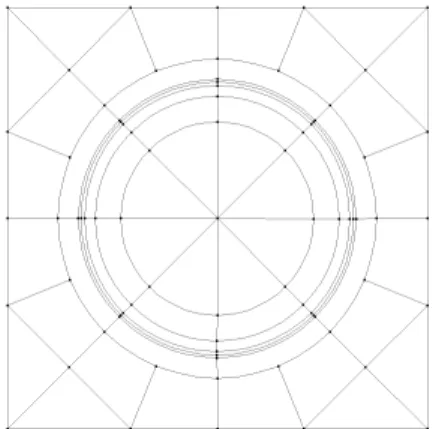
Figure 1 depicts the spatial mesh used in this study. This kind of discretization is optimised to represent the increasing thermal flux going to each corner of a single cell. Compared to REL2005 spatial mesh used in Ref. [1], quadrants are added to get more precise results (enhanced Windmill mesh). Furthermore, the fuel is split into four regions (50 %, 30 %, 15 % and 5 % of the volume) in order to represent space-dependent isotopic burnup effects in the same volumes used for the distributed self-shielding calculation.
Figure 1. Refined spatial mesh for a single PWR cell.
2 13–ENERGY GROUP VALIDATION MESH
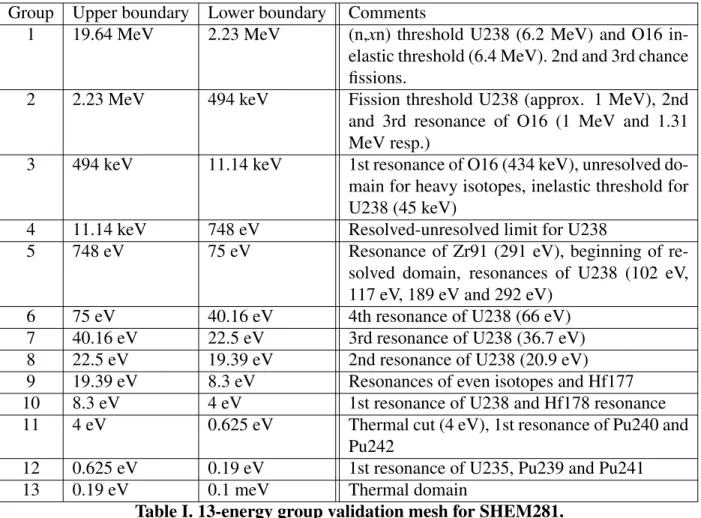
Table I describes the 13–energy group validation mesh and highlights all interesting reso-nances in each selected groups. All major absorbing resoreso-nances are isolated and some mutual self-shielding regions are also identified. The validation mesh for SHEM361 has slightly different boundaries, but these differences are not significant. This mesh is suitable to our study and can be used to identify microscopic disparities related to self-shielding.
3 THEORY 3.1 Subgroup methodology
The philosophy behind the subgroup approach is to remove the slowing-down correlation model and to avoid the equivalence in dilution. In this way, with only few hypotheses, it is possible to perform our calculation of self-shielded heavy isotopes. All of this is possible because of a sufficiently fine energy mesh. In our case based on SHEM361g, there are 118 energy groups between 22.5 eV and 11.14 keV .
Here is the theory implemented in the subgroup approach coupled with CALENDF-type prob-ability tables for APOLLO2 [1]. Basically, the self-shielding algorithm proceed in two steps:
• A first equivalence in dilution procedure or a subgroup approach leads to the calculation of the averaged reaction rate hσρφig in each resonant region and energy group of the lattice;
• A second multigroup equivalence procedure leads to the quantity hφig
µg wherehφig is the
aver-aged flux and µgis the equivalence factor.
The self-shielded cross-section is obtained as: ˜
σρ,g = µg
hσρφig
hφig
Group Upper boundary Lower boundary Comments
1 19.64 MeV 2.23 MeV (n,xn) threshold U238 (6.2 MeV) and O16 in-elastic threshold (6.4 MeV). 2nd and 3rd chance fissions.
2 2.23 MeV 494 keV Fission threshold U238 (approx. 1 MeV), 2nd and 3rd resonance of O16 (1 MeV and 1.31 MeV resp.)
3 494 keV 11.14 keV 1st resonance of O16 (434 keV), unresolved do-main for heavy isotopes, inelastic threshold for U238 (45 keV)
4 11.14 keV 748 eV Resolved-unresolved limit for U238
5 748 eV 75 eV Resonance of Zr91 (291 eV), beginning of re-solved domain, resonances of U238 (102 eV, 117 eV, 189 eV and 292 eV)
6 75 eV 40.16 eV 4th resonance of U238 (66 eV) 7 40.16 eV 22.5 eV 3rd resonance of U238 (36.7 eV) 8 22.5 eV 19.39 eV 2nd resonance of U238 (20.9 eV) 9 19.39 eV 8.3 eV Resonances of even isotopes and Hf177 10 8.3 eV 4 eV 1st resonance of U238 and Hf178 resonance 11 4 eV 0.625 eV Thermal cut (4 eV), 1st resonance of Pu240 and
Pu242
12 0.625 eV 0.19 eV 1st resonance of U235, Pu239 and Pu241 13 0.19 eV 0.1 meV Thermal domain
Table I. 13-energy group validation mesh for SHEM281.
To get the flux, we use a slowing-down equation with an external source S. One hypothesis is to neglect fission and (n,xn) reactions:
Σ(u)iViΦi(u) =
X
j
Pij(u)Vj(RjΦj(u) + Qj(u)) ∀ i (2)
where i and j are two regions.
In equation 2, the elements are Σ, the total cross sections diagonal matrix; V , the region volumes vector; Φ, the flux vector in each region; P , the collision probabilities matrix and R the slowing down operators diagonal matrix. S is the source because in this approach we use a real flux, there is no Livolant-Jeanpierre approximation.
Then, we introduce the collision density τj(u) in a region j:
τj(u) = RjΦj(u) + Qj(u) (3)
Injecting Eq. 3 in Eq. 2 leads to the two following equations: hΦiig = X j hVj Vi Pij Σi τjig = X j Vj Vi hPij Σi ighτjig (4)
and hσρ,x,iΦiig = X j hσρ,x,i Vj Vi Pij Σi τjig = X j Vj Vi hσρ,x,i Pij Σi ighτ jig (5) hPij Σii g and hσ ρ,x,i Pij Σii
g are resolved with CALENDF-type probability tables. The last element
to calculate is hτjig.
Here is the definition of the average collision density: hτjig = 1 ∆ug Z g RjΦj(u)du + hQjig (6) = 1 ∆ug Z g RxjΦj(u)du + 1 ∆ug Z g R1jΦj(u)du + hQjig (7)
We distinguish the resonant isotope slowing-down operator R1 and the moderators slowing
down operator Rx. S is known and only present in the first self-shielded group. It equals to 1 in
lethargy.
According to slowing-down operators definitions: Z g RxjΦj(u)du = X g0≤g pgx,∞,j0→g∆ug0hΣs,x,jΦjig 0 (8) Z g R1jΦj(u)du = X g0≤g Σgs1j0→g∆ug0hΦjig 0 (9)
Where p is the transfer probability for the non self-shielded isotope pre calculated in the library. Injecting Eqs. 8 and 9 in Eq. 3 gives:
hτjig = 1 ∆ug X g0≤g pgx,∞0→g∆ug0X k Vk Vj hΣs,x,j Pjk Σj ig0hτ kig 0 + 1 ∆ug X g0≤g Σgs1j0→g∆ug0X k Vk Vj hPjk Σj ig0hτ kig 0 + hQjig (10)
This system is linear and triangular, so it can be solved. hΣs,x,j Pjk Σji g0 and hPjk Σji g0 are computed from the probability tables. When hτjig is solved, equation 1 gives the desired self-shielded
cross-sections. By contrast, tests done by M. Coste-Declaux show it is unnecessary to perform a mixture self-shielding with the subgroup approach.
3.2 Quadrature
Based on orthogonal polynomials and Gauss quadratures, the CALENDF quadrature gives the possibility to integrate any function or product of a function depending on lethargy by a cross-section. It is based on a sum of weighted points.
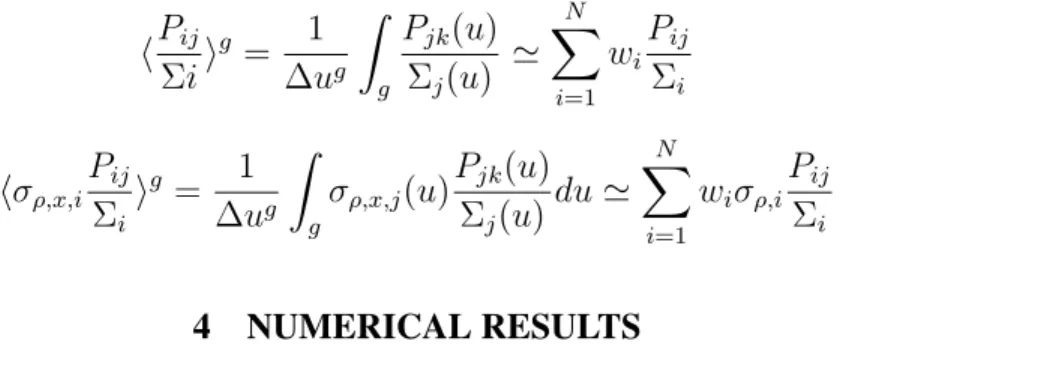
hPij Σii g = 1 ∆ug Z g Pjk(u) Σj(u) ' N X i=1 wi Pij Σi (11) hσρ,x,i Pij Σi ig = 1 ∆ug Z g σρ,x,j(u) Pjk(u) Σj(u) du ' N X i=1 wiσρ,i Pij Σi (12) 4 NUMERICAL RESULTS 4.1 Burnup 0
We have based our validation study on an eighth PWR assembly without leakage. Three types of fuel were studied, one UO2fuelled (UOX), one UPuO2 (MOX) with different isotopic contents
and one UO2 fuelled containing UO2Gd2O3. APOLLO2 is preferred as a lattice code to validate
the subgroup approach because it shares the same library with TRIPOLI4, so no discrepancies come from nuclear data. Different cases were investigated:
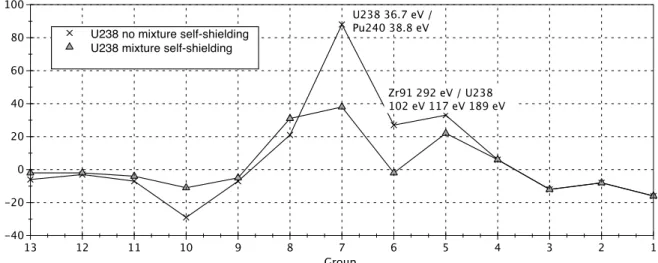
1. We first study a MOX assembly. In Fig. 2, we compare a Sanchez-Coste self-shielding with and without the mixture self-shielding model developed in Ref. [8]. The aim is to pinpoint the necessity of shielding the resonant mixtures;
2. In Fig. 3, an UOX assembly combined with a subgroup self-shielding and a classic 281-energy group SHEM is shown. Then we replace the mesh with an improved SHEM361; 3. For all considered fuels, a subgroup approach and a Sanchez-Coste method are compared
to a stochastic reference. Absorption rates are used for validation. This part is only for a burnup 0 validation.
Figure 2 shows the necessity of performing a mixture self-shielding for resonant isotopes. We choose to use a MOX assembly, so we can highlight any discrepancies related to the U/Pu mixtures. Group 7 contains majors Pu240 and U238 resonances and suggests a non negligible over-absorption of almost 90pcm when there is no mixture self-shielding. If the option is activated, group 7 discrepancy reduces up to 40 pcm. Same review for group 5 which has a Zr91 and four U238 resonances. 10 pcm are gained. So for the Sanchez-Coste approach, mutual self-shielding is essential. Few tests were done by M. Coste-Delclaux [2] and they show no mixture self-shielding is required for the subgroup approach.
Having a constant source over an energy group means a more refined mesh. As shown in Fig. 3, using a classic SHEM with 281 energy groups is not enough. Consequent underabsorptions
1 2 3 4 5 6 7 8 9 10 11 12 13 -40 -20 0 20 40 60 80 100 Group pcm
U238 no mixture self-shielding U238 mixture self-shielding
U238 36.7 eV / Pu240 38.8 eV
Zr91 292 eV / U238 102 eV 117 eV 189 eV
Figure 2. U238 absorption rate study with and without mixture self-shielding.
1 2 3 4 5 6 7 8 9 10 11 12 13 -400 -300 -200 -100 0 100 200 300 400 Group pcm Zr91 292 eV U8 189 eV 117 eV 102 eV U8 66 eV U8 36.7 eV U238 - 281g U235 - 281g U238 - 361g U235 - 361g
Figure 3. U238 absorption rate with SHEM281 and SHEM361 coupled to a subgroup method.
are seen for 36.7 eV , 66 eV , 102 eV , 117 eV and 292 eV U238 resonances. Choosing a more refined mesh between 22.5 eV and 11.4 keV helps to reduce an 800 pcm discrepancy. SHEM361 has a cost, computing time increases by 90 % compared to 281 energy groups. But if we do a comparison between SHEM361/subgroup and SHEM281/Sanchez-Coste, subgroup computing time is 27 % longer, which is worth it.
1 2 3 4 5 6 7 8 9 10 11 12 13 -20 -10 0 10 20 30 40 50 Group pcm Sanchez-Coste Subgroup U8 20.9 eV U8 36.7 eV Zr91 292 eV U8 189 eV 102 eV 117 eV
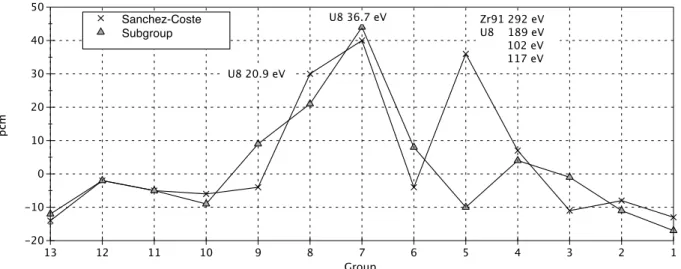
Figure 4. U238 absorption for an UOX assembly.
At burnup 0, we only show results where there are significant discrepancies. In case of an UOX assembly, Uranium 238 absorption rate significantly different according to the self-shielding model - Fig. 4 -. In non shielded groups, there are no discrepancies, which is expected. But when we look above 22.5 eV , results are significantly different. Both approaches have an overabsorption of approximately 40pcm in group 7 where there is U238 36.7eV resonance. But in group 5 containing a mixture, the subgroup method creates a −10 pcm underabsorption. Meanwhile Sanchez-Coste approach has a 35 pcm disparity. So using a subgroup method is much more precise. For Uranium 235, there are no differences.
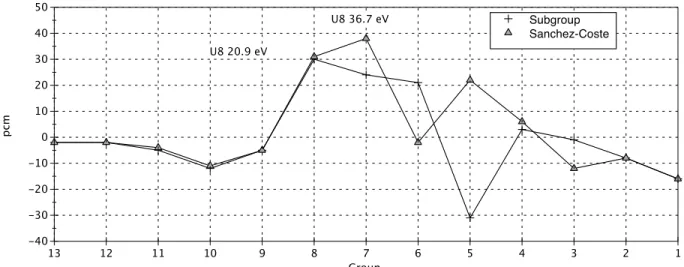
For the MOX case, results are way different compared to UOX assembly. We choose to represent only absorption rates for U238 - Fig. 5 - and Pu239 - Fig. 6 - which are the isotopes showing the most discrepancies. The first one shows better results for the subgroup approach in group 7 containing U238 36.7 eV resonance. For the rest of the energetic domain, results are still better with the subgroup method, except in groups 6 and 5. The first one contains a mixture of resonances (U238, Pu240 and Pu239). The overabsorption shown in Sanchez-Coste approach is reduced to 0pcm. For the second group - covering a mixture of Zr91 and U238 resonances - instead of an overabsorption like Sanchez-Coste, the subgroup method suggests an underabsorption with a farther result to the stochastic reference.
The Pu239 absorption rate study - Fig. 6 - shows similar results between the subgroup ap-proach and Sanchez-Coste. Except in group 7 containing U238 36.7 eV resonance, using a sub-group method gives better results. Moreover, thermal sub-group 13 shows a consequent underabsorp-tion. Its origin is the different overabsorptions encountered in intermediate groups creating a lack of thermal neutrons.
1 2 3 4 5 6 7 8 9 10 11 12 13 -40 -30 -20 -10 0 10 20 30 40 50 Group pcm Subgroup Sanchez-Coste U8 20.9 eV U8 36.7 eV
Figure 5. U238 absorption for a MOX assembly.
1 2 3 4 5 6 7 8 9 10 11 12 13 -100 -80 -60 -40 -20 0 20 40 Group pcm U8 36.7 eV Subgroup Sanchez-Coste
1 2 3 4 5 6 7 8 9 10 11 12 13 -140 -120 -100 -80 -60 -40 -20 0 20 Group pcm U8 66 eV Sanchez-Coste Subgroup
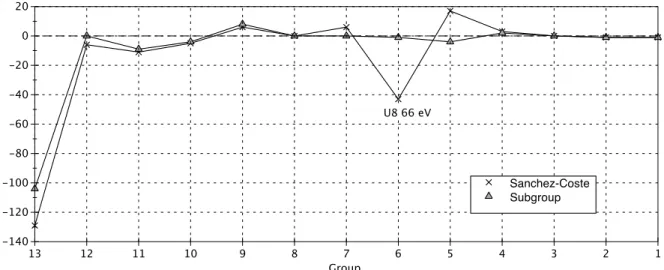
Figure 7. U235 absorption for a UO2Gd2O3assembly.
The last fuel studied is composed of a majority of UO2 rods and some with gadolinium and UO2 as a support. We decide to show only results for U235 and U238 because they are suggesting the most discrepancies. Figure 7 represents U235 absorption rate as a function of our 13-energy group mesh. Globally, a subgroup approach is much more effective than a Sanchez-Coste tech-nique. Especially for group 6, the first method shows absolutely no discrepancies whereas the second one underabsorb of approximately −40 pcm. For thermal group 13, we can draw the same conclusion as for Plutonium 239 absorption rate in the MOX study.
1 2 3 4 5 6 7 8 9 10 11 12 13 -20 -10 0 10 20 30 40 50 60 70 Group pcm Sanchez-Coste Subgroup U8 20.9 eV U8 36.7 eV U8 66 eV Zr91 292 eV U8 189 eV 117 eV 102 eV
Figure 8. U238 absorption for a UO2Gd2O3assembly.
Figure 8 shows that the subgroup method is much more precise than Sanchez-Coste. Espe-cially for groups 7 and 5 containing respectively, U238 36.7 eV resonance and Zr91/U238 reso-nances, using a subgroup technique helps to reduce the total disparity of almost 50 pcm. So even for this type of fuel, using a subgroup method helps to reduce significantly the error associated to the self-shielding.
As a conclusion, with no burnup, even if the subgroup method takes much more time than Sanchez-Coste, results are better and the extra time spent is worth it.
4.2 Isotopic depletion
The effective multiplication factor (kef f) trends in Fig. 9 show good results for each fuel.
UO2Gd2O3is the only case having a significant discrepancy before reaching its point where
Gadolin-ium is vanishing ( 13 GW d/t). Therefore, the subgroup method and Sanchez-Coste technique are similar and always underestimated compared to SERPENT2 [7]. At 40 GW d/t, APOLLO2 shows a relative error for both subgroup and Sanchez-Coste of −350 pcm for UOX case, −150 pcm for MOX case. For UO2Gd2O3, results are better with a Sanchez-Coste approach. It shows a −425pcm
relative error compared to −500 pcm with a subgroup technique. kef f trend suggests encouraging
results and pinpoint a problem when UO2Gd2O3is used.
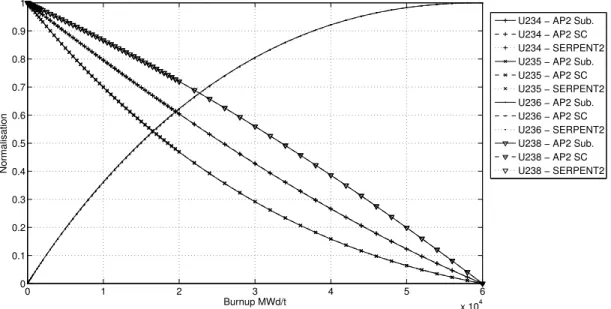
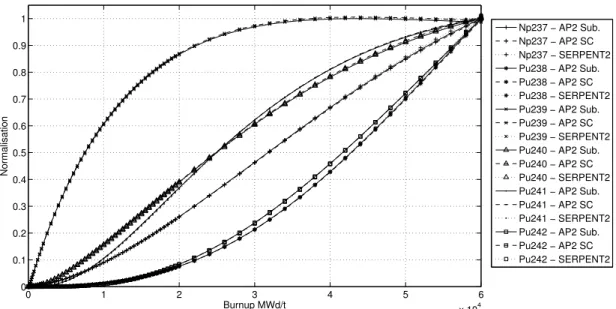
Figures 10 and 11 show that using a subgroup approach gives a perfect result, at least as good as a Sanchez-Coste method with UOX. Uraniums are well evaluated. Plutoniums and Neptunium 237 contain a minor deviation but totally negligible.
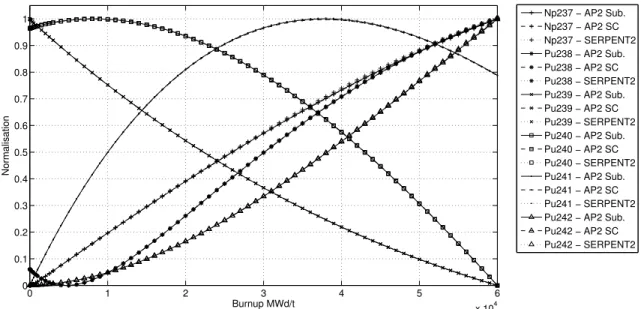
MOX study is represented in Figs. 12 and 13. Results are almost as good as UOX. No major discrepancies are observed. Only U236 shows a 2 % deviation at the end of burnup cycle. Even Plutoniums and Neptunium 237 are well evaluated with a relative error under 1 %. In order to keep a certain consistency, Curiums, Americiums and fission products are not shown in this paper. But whatever is the fuel, fission products have an error under 1 % except Sm147 and Ag109 which have a 2 % and a −8 % estimations. Concerning Cm and Am, results are slightly less good than Pu, U and Np because they are at the end of U235 radioactive decay chain, so they accumulate all errors of their parent isotopes.
The last considered fuel is particular. Three different cells are studied, two containing Gadolin-ium and the last one with only UO2. The cell not containing neutron poison shows good results similar to UOX and MOX cases. However, when there is Gadolinium, deterministic code has a real difficulty to modelize minors actinides and fission products depletion. As shown in Fig. 14, Ura-niums are correctly estimated. Table II lists relative error of subgroup, Sanchez-Coste approaches compared to a stochastic code at 60 GW d/t. Besides this fact, subgroup and Sanchez-Coste results are similar, always underestimated compared to SERPENT2. A real work has to be done to correct these discrepancies, that cannot be seen by studying only kef f. Curiums and Americiums have
discrepancies because of Pu errors. Fission products (not shown here) also present differences compared to stochastic simulations.
5 CONCLUSIONS
Although applying a subgroup self-shielding with a 361-energy group mesh causes a time increase due to the use of more energy groups, this approach is very promising. Results at bur-nup 0 and with isotopic depletion are at least as good as a classical approach (Sanchez-Coste in
0 5 10 15 20 25 30 35 40 0.9 0.95 1 1.05 1.1 1.15 1.2 1.25 1.3 Burnup GWd/t UOX − Subgroup UOX − SC UOX − SERPENT2 MOX − Subgroup MOX − SC MOX − SERPENT2 UO2Gd2O3 − Subgroup UO2Gd2O3 − SC UO2Gd2O3 − SERPENT2
Figure 9. k-effective trends as functions of burnup.
0 1 2 3 4 5 6 x 10⁴ 0 0.1 0.2 0.3 0.4 0.5 0.6 0.7 0.8 0.9 1 Burnup MWd/t Normalisation
U234 − AP2 Sub. U234 − AP2 SC U234 − SERPENT2 U235 − AP2 Sub. U235 − AP2 SC U235 − SERPENT2 U236 − AP2 Sub. U236 − AP2 SC U236 − SERPENT2 U238 − AP2 Sub. U238 − AP2 SC U238 − SERPENT2
0 1 2 3 4 5 6 x 10⁴ 0 0.1 0.2 0.3 0.4 0.5 0.6 0.7 0.8 0.9 1 Burnup MWd/t Normalisation Np237 − AP2 Sub. Np237 − AP2 SC Np237 − SERPENT2 Pu238 − AP2 Sub. Pu238 − AP2 SC Pu238 − SERPENT2 Pu239 − AP2 Sub. Pu239 − AP2 SC Pu239 − SERPENT2 Pu240 − AP2 Sub. Pu240 − AP2 SC Pu240 − SERPENT2 Pu241 − AP2 Sub. Pu241 − AP2 SC Pu241 − SERPENT2 Pu242 − AP2 Sub. Pu242 − AP2 SC Pu242 − SERPENT2
Figure 11. Plutonium and Neptunium concentrations as a function of burnup for an UOX assembly. 0 1 2 3 4 5 6 x 10⁴ 0 0.1 0.2 0.3 0.4 0.5 0.6 0.7 0.8 0.9 1 Burnup MWd/t Normalisation
U234 − AP2 Sub. U234 − AP2 SC U234 − SERPENT2 U235 − AP2 Sub. U235 − AP2 SC U235 − SERPENT2 U236 − AP2 Sub. U236 − AP2 SC U236 − SERPENT2 U238 − AP2 Sub. U238 − AP2 SC U238 − SERPENT2
0 1 2 3 4 5 6 x 10⁴ 0 0.1 0.2 0.3 0.4 0.5 0.6 0.7 0.8 0.9 1 Burnup MWd/t Normalisation Np237 − AP2 Sub. Np237 − AP2 SC Np237 − SERPENT2 Pu238 − AP2 Sub. Pu238 − AP2 SC Pu238 − SERPENT2 Pu239 − AP2 Sub. Pu239 − AP2 SC Pu239 − SERPENT2 Pu240 − AP2 Sub. Pu240 − AP2 SC Pu240 − SERPENT2 Pu241 − AP2 Sub. Pu241 − AP2 SC Pu241 − SERPENT2 Pu242 − AP2 Sub. Pu242 − AP2 SC Pu242 − SERPENT2
Figure 13. Plutonium and Neptunium concentrations as a function of burnup for a MOX assembly. 0 0.5 1 1.5 2 2.5 3 3.5 4 x 10⁴ 0 0.1 0.2 0.3 0.4 0.5 0.6 0.7 0.8 0.9 1 Burnup MWd/t Normalisation
U234 − AP2 Sub. U234 − AP2 SC U234 − SERPENT2 U235 − AP2 Sub. U235 − AP2 SC U235 − SERPENT2 U236 − AP2 Sub. U236 − AP2 SC U236 − SERPENT2 U238 − AP2 Sub. U238 − AP2 SC U238 − SERPENT2
Subgroup Sanchez-Coste % % Np237 -1.58 -1.56 Pu238 -5.2 -5.2 Pu239 -10.78 -10.09 Pu240 -8.47 -8.09 Pu241 -13.05 -12.59 Pu242 -13.96 -14.07
Table II. Relative discrepancies for minor actinides at 60 GW-d/t – UO2Gd2O3.
APOLLO2), without using corrective models related to the mutual shielding effect between dif-ferent resonant isotopes. To have satisfactory results, an improved mesh has to be used and we conclude that SHEM361 is suitable.
Another conclusion from the UO2Gd2O3study shows bad estimation in cells containing
Gado-linium, both with Sanchez-Coste and with the proposed subgroup approach. A work should be done to improve estimation and validation in presence of Gadolinium. Bernard and Santamarina [9] analyzed APOLLO2 compared to an isotopic depletion experience with satisfactory results. Some of their pins contain Gadolinium, but only are studied U234, U235 and Gd for these ones. But the real problem concerns Plutonium, Americium, Curium and fission products which are not analyzed in their paper. So a more in-depth work could be done by CEA to study the isotopes badly estimated and to find where the problem comes from.
6 ACKNOWLEDGMENTS
The authors wish to thank AREVA and ´Electricit´e de France (EDF) for their financial contri-bution in APOLLO2 development and NSERC who supported the academic part of this work. The first author want to thank CEA/SPRC/LEPh who agreed to let him working on APOLLO2, use their clusters and benefit from their researchers who gave prolific advices.
7 REFERENCES
[1] J-F. VIDAL, R. TRAN, O. LITAIZE, D. BERNARD, A. SANTAMARINA, C. VAGLIO-GAUDARD, ”New modelling of LWR assemblies using the APOLLO2 code package,” Proc. Joint Int. Top. Mtg. on Mathematics & Computation and Supercomputing in Nuclear Applications (M&C + SNA 2007), Monterey, California, USA, April 15-19, 2007.
[2] M. COSTE-DELCLAUX, Mod´elisation du ph´enom`ene d’autoprotection dans le code de transport multigroupe APOLLO2, PhD Thesis, CEA, Gif-Sur-Yvette, France (2006). [3] M. LVIOLANT and F. JEANPIERRE, ”Autoprotection des r´esonances dans les r´eacteurs
nucl´eaires. Application aux isotopes lourds,” CEA-R-4533, Commissariat `a l’ ´Energie Atom-ique, France (1974).
[4] N. HFAIEDH, ”Nouvelle M´ethodologie de Calcul de l’Absorption R´esonnante,” PhD The-sis, Universit´e Louis Pasteur, Strasbourg, France (2006).
[5] A. H ´EBERT and A. SANTAMARINA, ”Refinement of the Santamarina-Hfaiedh Energy Mesh Between 22.5 eV and 11.4 keV,” Proc. Int. Conf. Physics of Reactors, Interlaken, Switzerland, September 14-19 (2008).
[6] E. DUMONTEIL, F.X. HUGOT, C. JOUANNE, Y.L. LEE, F. MALVAGI, A. MAZZOLO, O. PETIT and J.C. TRAMA, ”An overview on the monte carlo particle transport code TRIPOLI-4,” Transactions of the American Nuclear Society, 2007, vol. 97, pp. 694-695. [7] J. LEPP ¨ANEN, ”Development of a New Monte Carlo Reactor Physics Burnup Calculation
Code,” PhD Thesis, Helsinki University of Technology, Espoo, Finland (2007).
[8] M. COSTE-DELCLAUX and S. MENGELLE, ”New resonant mixture self-shielding trat-ment in the code APOLLO2,” PHYSOR 2004 - The Physics of Fuel Cycles and Advanced Nuclear Systems: Global Developments, Chicago, Illinois, April 25-29 (2004).
[9] D. BERNARD and A. SANTAMARINA, ”Qualification of Gadolinium burnable poi-son: Interpretation of Melusine/Gedeon-II spent fuel analysis”, Annals of Nuclear Energy, (2015).