HAL Id: hal-03107514
https://hal.archives-ouvertes.fr/hal-03107514
Submitted on 12 Jan 2021HAL is a multi-disciplinary open access
archive for the deposit and dissemination of sci-entific research documents, whether they are pub-lished or not. The documents may come from
L’archive ouverte pluridisciplinaire HAL, est destinée au dépôt et à la diffusion de documents scientifiques de niveau recherche, publiés ou non, émanant des établissements d’enseignement et de
The photochemical production of aromatics in the
atmosphere of Titan
J.C. Loison, M. Dobrijevic, Kevin Hickson
To cite this version:
J.C. Loison, M. Dobrijevic, Kevin Hickson. The photochemical production of aromatics in the atmo-sphere of Titan. Icarus, Elsevier, 2019, 329, pp.55-71. �10.1016/j.icarus.2019.03.024�. �hal-03107514�
The photochemical production of aromatics in
the atmosphere of Titan
J.C. Loison
aM. Dobrijevic
bK.M. Hickson
aaInstitut des Sciences Mol´eculaires (ISM), CNRS, Univ. Bordeaux, 351 cours de la
Libration, 33400, Talence, France
bLaboratoire d’astrophysique de Bordeaux, Univ. Bordeaux, CNRS, B18N, all´ee
Geoffroy Saint-Hilaire, 33615 Pessac, France
Number of pages: 43 Number of tables: 2 Number of figures: 15
Proposed Running Head: Aromatics in Titan’s atmosphere
Please send Editorial Correspondence to:
Michel Dobrijevic
Laboratoire d’Astrophysique de Bordeaux
2 rue de l’observatoire, Floirac, F-33271, France. Email: [email protected] Phone: +33-5-5777-6124
ABSTRACT
The photochemical processes at work in the atmosphere of Titan are very com-plex and lead to a great variety of compounds with aerosols as an end-product. One of the most complex molecules detected so far is benzene (C6H6). In the
present work, we have updated and improved the chemistry of aromatics in order to better understand the main chemical pathways leading to the pro-duction of benzene and determine what other aromatics could be produced efficiently in the atmosphere. This new chemical scheme has been incorporated in our 1D photochemical model corresponding to mean conditions. We con-firm the importance of ionic chemistry for benzene production in the upper atmosphere and we have found that excited benzene is an important inter-mediate in benzene production due to the exothermicity of many production reactions. Among the 24 aromatics included in the model, neutral aromatics like toluene (C6H5CH3) and ethylbenzene (C6H5C2H5) are relatively
abun-dant, suggesting in particular that toluene could be detectable in the infrared, and eventually microwave wavelength ranges. However, we obtained large un-certainties on model results highlighting the need for more experiments and theoretical studies to improve the chemistry of aromatics.
1 Introduction
The atmosphere of Titan, the largest moon of Saturn, is a factory for or-ganic molecules on a planetary scale. Dissociation and ionisation of the major
constituents, N2 and CH4, by solar photons, magnetospheric electrons and
galactic cosmic rays lead to the production of radicals and ions that initiate a very active and complex chemistry. A diverse range of species are produced: hydrocarbons, amines, imines, oxygen compounds, etc, with aerosols as an end-product, which form haze layers in the atmosphere. A variety of molecules have been detected so far from ground-based observatories and interplanetary probes. Among these, the benzene molecule, C6H6, deserves a particular
men-tion for two main reasons: (1) Benzene is one of the more complex molecules to be detected so far. Consequently, it provides a good constraint to test pho-tochemical models and better understand the chemical pathways producing complex molecules in Titan’s atmosphere (Wilson and Atreya, 2003; Vuitton et al., 2009; Krasnopolsky, 2009, 2012, 2014; Loison et al., 2015; Frankland et al., 2016). (2) Benzene, and other aromatics, are also considered to be key compounds in the formation of larger molecules such as polycyclic aromatic hydrocarbons (PAHs) or polycyclic aromatic nitrogen heterocycles (PANHs). They are also suspected to contribute to the production of aerosols (Lebonnois et al., 2002; Waite et al., 2007; Delitsky and McKay, 2010; Mahjoub et al., 2016; Gautier et al., 2017).
In the present paper, we extend the chemical schemes presented previously (Dobrijevic et al., 2016b; Loison et al., 2015) to study the production of some aromatic molecules. Several new species are added in order to better under-stand the production of complex molecules and to determine which aromatics could be present in sufficiently high abundances to be detected in the future and could serve, as suggested by other studies, as precursors of aerosols. In Section 2, we present the photochemical model and the updated version of the chemical scheme. Emphasis is placed on the chemistry of aromatic species (photolyses and reactions). The model results are presented in Section 3 and the main points are discussed in Section 4.
2 Model
2.1 Eddy diffusion
The eddy diffusion coefficient K(z) is a free parameter of photochemical mod-els that can be constrained in principle by comparison between the observed mole fractions of atmospheric species and the corresponding model results.
In order to constrain the altitudinal profile of K(z), it is preferable to use inert species or species involved in a well known chemical sub-scheme with low chemical uncertainties. The altitudinal profiles of these species have to be determined by observations.
In the high atmosphere, above the argon (Ar) homopause around 930 km, molecular diffusion drives the profile of Ar. The Ar profile derived from INMS/Cassini data (Waite et al., 2013) gives a quite strong constraint on the altitude level
of the homopause. Methane (CH4) is also interesting to constrain the eddy
coefficient since its molecular mass is lower than the one of N2 (contrary to
Ar).
Below this altitude, eddy diffusion is the dominant vertical transport in 1D photochemical models and it could be constrained in principle using species with well known altitudinal profiles. Here, we used water (H2O) and hydrogen
cyanide (HCN) for that purpose. Their altitudinal profiles have been inferred by observations with relatively low uncertainties and the chemical processes that drive their composition are expected to be simple. Also, uncertainties on chemical parameters give rise to low model result uncertainties for these species (Dobrijevic et al., 2016b). In addition, their chemical lifetimes are greater than their dynamical lifetimes (dominated by eddy diffusion) and the abundance profiles of these species are therefore driven by diffusion (note that in a narrow altitudinal region around 200 km, chemical and dynamical lifetimes are about the same). We use in the present study the eddy profile used in Dobrijevic et al. (2016b). It gives abundance profiles for these species in good agreement with observations (see Fig. 1 for H2O and HCN and Dobrijevic
et al. (2016b) for Ar and CH4).
Acetylene (C2H2) has also been proposed as a tracer species of vertical
diffu-sion (Li et al., 2014). Li et al. (2014) obtained a non-monotonic K(z) in the stratosphere. A comparison between models is presented and discussed briefly in Dobrijevic et al. (2016a) showing that a given eddy profile does not give model results in agreement with observations for all species. In particular, the eddy profile of Li et al. (2014) gives a HCN abundance in disagreement with observations. Concerning C2H2, it is noteworthy to clarify that the branching
ratios of C2H2 photolysis are not well-known. Loison et al. (2015) discussed
that point and showed that the abundances of both C2H2 and C2H6 depend
on that parameter. Moreover, in a recent study made by Douglas et al. (2018), the kinetics of the reactions of the first excited state of methylene,1CH
2, with
N2, H2 and CH4 have been measured over the temperature range 43-160 K.
Using a photochemical model including only neutral species, they studied the impact of the new measurements for Titan’s atmosphere, obtaining a signif-icant decrease (≈ 40%) in the mixing ratio of ethane (C2H6) and a smaller
increase in the mixing ratio of C2H2between 800 and 1550 km. In addition, the
reactions. We found that by turning on all these reactions in our model, the C2H6 mole fraction increases by a factor of 2 in the ionosphere (see Section 2.2
for more details on radiative association reactions). On the other hand, H2O
and HCN are not affected by radiative association reactions. Consequently, the C2H2 and C2H6 profiles calculated from photochemical models might be
more uncertain that currently suspected (see also Dobrijevic et al. (2018)). Ethylene (C2H4) is currently not a good candidate for constraining K(z). C2H4
is known to be a species that has a calculated profile from various photochem-ical models in disagreement with observations in the lower stratosphere (see for instance Krasnopolsky (2009); Dobrijevic et al. (2016b)). For the moment, the other photochemical products have too strong uncertainties to be used as tracers of eddy mixing.
Fig. 1. Abundance profiles of H2O and HCN in the nominal model (see text).
Nom-inal profiles are in black and 200 Monte-Carlo runs in grey (see section 3.6 for an explanation of these runs). Observations of HCN in the upper atmosphere: Cassini Ion and Neutral Mass Spectrometer (INMS) measurements by Magee et al. (2009). HCN in the lower atmosphere: analysis of Cassini-CIRS mid infrared limb spectra corresponding to 15◦S latitude (Vinatier et al., 2007). Observations of H2O from
2.2 Chemical scheme
With the exception of aromatic compounds, the basic chemical scheme used in the present study is similar to the model presented in Dobrijevic et al. (2016b) except that we consider neither anions nor radiative association reac-tions. We performed runs including anions and radiative associations to test their effects on our model results. Anion reactions are responsible for small production fluxes and do not play any role in the production of aromatic species present in our study. Radiative association reactions (derived from statistical theory: see Vuitton et al. (2012); H´ebrard et al. (2012); H´ebrard et al. (2013)) play a role for small species produced through association reac-tions (C2H6, C3H6, C3H8, C4H6, C4H8, C4H10, C2H5CN, C3H7CN, CH3NH2),
increasing their abundance in the upper atmosphere. For large species, such as aromatics, the three body association reactions reach their high pressure limit even at high altitude and the inclusion of radiative association does not change their abundances. Moreover, recent quantum chemistry studies (Douguet et al., 2015; Stoecklin et al., 2018) showed that the radiative asso-ciation rate constants might be much lower than those obtained by statistical theory, then their effect in Vuitton et al. (2012); H´ebrard et al. (2012); H´ebrard et al. (2013) might be overestimated.
Some improvements have been made in the chemical scheme presented in Dobrijevic et al. (2016b). In particular, we have removed the very minor reac-tions. We have also included the new measurements of Douglas et al. (2018) concerning the reactions of 1CH
2 with N2, H2 and CH4. We have updated the
ionic chemistry, particularly for H+ and H+
3 reactions (which have however
only a small effect for Titan’s atmosphere). We removed the bimolecular exit channel of the H + C4H3 → C4H4 → C2H2 + C2H2 reaction keeping only
the termolecular H + C4H3 → C4H4 channel, and also the direct H + C4H3
→ C4H2 + H reaction, from our previous studies (Loison et al., 2015;
Do-brijevic et al., 2016b). There are no experimental studies of this reaction but it is related to the unimolecular decomposition of C4H4 studied by Ghibaudi
and Colussi (1988). The bimolecular H2C2 (vinylidene) + C2H2 production
reaction involves a Transition State (TS) slightly above the energy of H + C4H3 (Cremer et al., 2006), so it should therefore be inefficient in Titan’s
at-mosphere conditions. It should be noted that inclusion of the bimolecular exit channel leads to a large rate constant for this reaction that strongly decreases the C4H2 abundance in the upper atmosphere, a result that is in poor
agree-ment with observations. As the bimolecular exit channel is very uncertain (and
probably weak) and as C4H2 is involved in aromatic formation through
ion-molecule reactions, we do not consider it here and prefer to wait for further experimental or theoretical studies. For the rate constant of this reaction, we adopt the value used by Vuitton et al. (2012).
Table 1
List of aromatics included in the model: 14 neutrals and 14 ions. Neutrals C6H4, C6H5, C6H6, C6H5CH2, C6H5CH3 C6H5C2H, C6H5C2H5, C6H5N, C6H5NH C6H5NH2, C6H5NCH3, C6H5NHCH3, C6H5CN, AROM Ions C6H+5, C6H+6, C6H+7, C7H+7, C6H5CH+2 C6H5CH+3, C2H+9, C8H+10 (C6H5C2H+5), C8H11+, C6H5C2H+2 C6H5NH+3, C6H5CNH+, C7H5NH2CH+3, AROM+
Although this new chemical scheme, which contains 177 species and 1217 re-actions, has been improved, it is important to be aware that it is far from complete. In particular, the number of species in the scheme (and the num-ber of reactions) should increase with the numnum-ber of atoms considered in the species. As shown in Figure 2, this is not the case in the present model. Although it is clear that not all the missing species and reactions will be im-portant, it is possible that crucial species and reactions are absent. Although uncertainty propagation studies are mandatory to determine which reactions should be studied in priority, it is not easy to develop an exhaustive investi-gation of hundreds of species and thousands of relevant reactions. This is the case in particular when considering aromatic molecules. The list of aromatics included in the present model is given in Table 1. It includes ”only” 14 neutrals
and 14 ions. Two generic species called AROM and AROM+ are used to limit
the number of species. AROM and AROM+ are the sum of all the aromatics
produced in the chemical network but not described here (see the list of the 38 reactions producing such species in the Appendix A and Appendix B). Due to the lack of experimental data, all the aromatics, except for C6H4 and
C6H5 radicals, are assumed in the present study to follow the same saturated
vapor pressure expressions as C6H6.
2.2.1 Aromatics photolysis
The photolysis of benzene is very important in Titan’s atmosphere as it in-volves very large fluxes. This photolysis is particularly complex as analyzed by Delitsky and McKay (2010). In the present work, we use the recent Capalbo et al. (2016) absorption cross section leading to the photolysis rate presented in Figure 3. The integrated absorption rate constant of benzene leads to about 50% of absorption due to the strong band between 160 and 190 nm, and 50% around 200 nm. The fluorescence quantum yield and direct dissociation rate are very low across the whole excitation wavelength range, whereas highly vibrationally excited benzene is generated with a quantum yield near unity through internal conversion to the ground singlet state of benzene (C6H∗∗6 )
Fig. 2. Analysis of the chemical scheme in the present model, in terms of the number of species as a function of the number of atoms (sum of carbon, nitrogen, hydro-gen and oxyhydro-gen atoms) in blue and the number of carbons in red (whatever the number of other atoms) or green (whatever the number of hydrogen atoms). For instance, there are 15 species with 7 atoms, 11 species with 7 carbon atoms and 6 hydrocarbons (CnHp-type species) with 7 carbon atoms.
(West et al., 2016). Once formed, C6H∗∗6 can either dissociate or be relaxed
through collision with N2 leading to ground singlet state benzene in a high
vibrational state below the dissociation limit (C6H∗6). Both mechanisms are
internal energy dependent (West et al., 2016) but a simplified treatment can be applied as shown by Nakashima and Yoshihara (1983) following benzene excitation at 193 nm.
The dissociation lifetime of benzene after excitation at 157 nm is equal to 1.4 µs from Hsu et al. (2001) but 0.045 µs from Shimada et al. (1993), and is equal to 10 µs (Hsu et al., 2001; Tsai et al., 2000; Kislov et al., 2004) after excitation at 193 nm. Consequently, benzene excited below 190 nm will be almost entirely dissociated as the relaxation lifetime through collisions with N2 is longer than the dissociation lifetime for altitudes above 90 km. At 211
nm, the dissociation lifetime is calculated to be equal to 1.7 ms by Mebel et al. (2001) which corresponds to a relaxation lifetime by N2 at 350 km. We consider
Fig. 3. Map of c-C6H6 photolysis rate as a function of altitude and wavelength. The
more intense the blue color, the greater the benzene photodissociation rate. The grey line delimits the altitude where the rate tends to zero. For short wavelength (below 135 nm), the photodissociation of benzene is low and occurs in the ionosphere. At longer wavelength (greater than 160 nm) benzene photodissociation occurs in the lower atmosphere down to 200 km. The normalized integrated rate constant is also shown (superimposed red line). This shows that benzene photolysis is efficient only for wavelengths greater than 165 nm up to 220 nm.
then an average value for the hot benzene (C6H∗∗6 ) dissociation lifetime of 20
µs, an intermediate figure between the values for benzene excitation at 193 nm and 211 nm. This average dissociation lifetime corresponds to a relaxation lifetime by N2 at 160 km. Considering the work of Yokoyama et al. (1990); Ni
and Lee (2004); Kislov et al. (2004) we consider a fixed dissociation branching ratio for excited C6H∗∗6 equal to 95% towards C6H5 + H and 5% towards C6H4
+ H2. The relative branching ratios between the two channels are not critical
since C6H4 (benzyne) is thought to react quickly with H atoms leading to
C6H5 (Madden et al., 1997) (there is a very small barrier, equal to 400 K, at
the M06-2X/AVTZ level for the H + C6H4 → C6H5 reaction). As the lifetime
of C6H∗∗6 is short, we can neglect its reactivity and its photolysis.
In contrast to C6H∗∗6 , C6H∗6 has a long lifetime and its photochemistry should
be taken into account. C6H∗6 does not react with O2, benzene or propane
(Nakashima and Yoshihara, 1983) and we can neglect its reactivity with closed shell molecules. C6H∗6 may react with H atoms leading to C6H7, which should
reac-tivity of C6H∗6 (it should be noted that the apparent reactivity of C6H∗6 with
O2 (Jain et al., 2012; Kovacs et al., 2009) is due to C6H5 produced through
photodissociation of hot benzene after absorption of two 248 nm photons). Although we can probably neglect the reactivity of C6H∗6, we cannot neglect
its photodissociation. The absorption cross section of hot benzene produced
by an absorbed photon at 248 nm has been measured equal to 1.7 × 10⁻¹⁷cm2
at 248 nm (Kovacs et al., 2009) and equal to 3.2 × 10⁻¹⁷cm2at 193 nm (Honjo et al., 2005). We consider a constant absorption cross section of 1.0 × 10⁻¹⁷
cm2 between 150 and 300 nm leading mainly to C6H5 + H and with ring
opening photodissociation channels around 20% using Tsai et al. (2001) and Kislov et al. (2004). We also consider a C6H∗6 photoionization cross section of
1.0 × 10⁻¹⁷ cm2 between 100 and 250 nm from C6H6 photoionization (Cool
et al., 2005) and the theoretical model from Koizumi (1991). While C6H∗∗6 has
a very low relative abundance throughout the atmosphere, C6H∗6 and C6H5
are relatively abundant in the ionosphere (see Figure 5).
The photodissociation of substituted benzene (toluene, ethylbenzene, benzoni-trile, phenylethyne, ...) involves also the formation of ”hot” species followed by dissociation. However, the dissociation lifetime is notably faster than for benzene (850 ns for toluene at 193 nm, Lin et al. (2002)) and we can neglect
relaxation through collision with N2. The photodissociation of substituted
benzene leads to various products (see Appendix B), either radical forma-tion through H, CH3 or CN elimination (toluene (C6H5CH3) (Frochtenicht,
1995), ethylbenzene (C6H5C2H5) (Tsai et al., 2001; Huang et al., 2002),
ani-line (C6H5NH2) (Ni et al., 2007), benzonitrile (Park et al., 1989; Hong et al.,
2001)) or closed shell molecules formation like C6H4 and C2H2 from ethynyl
benzene (C6H5C2H) photodissociation (Sorkhabi et al., 2001) and benzene and
C2H2 from styrene (C6H5C2H3) photodissociation (Lee et al., 2003). It should
be noted that the photodissociation of substituted benzene always preserves the aromatic ring and that C6H4 and benzene are among the various products.
A key point is the photodissociation of the generic species AROM (AROM be-ing the aromatic compounds produced in our network but not described in detail). Considering the data for photodissociation of various aromatics pre-sented in the Appendix B, there is no doubt that the photodissociation of AROM will preserve the aromatic ring too. Moreover, considering the various species included in AROM (C6H5C2H3, C6H5C3H3, ...) there is also no doubt
that some C6H4 and benzene would also be among the products of AROM
photolysis.
2.2.2 Aromatic chemistry
The main subject of this paper is to describe monocyclic aromatic compounds in Titan’s atmosphere. Our photochemical scheme restricted to the major production and loss pathways is shown in Figure 4. The integrated column
rates for each reaction are given in Appendix C.
Fig. 4. Schematic diagram highlighting the important neutral (in black) and ionic (in red) pathways for the production of aromatic species. C6H∗∗6 represents metastable
benzene (including all C6H6 isomers) excited above the dissociation limit and C6H∗6
represents metastable benzene (including all C6H6 isomers) excited below the
disso-ciation limit. Photodissodisso-ciations are in blue and unimolecular dissodisso-ciations of C6H∗∗6
are in green. The thickness of each arrow is proportional to the integral of the total production rate over the atmosphere (see Appendix C). Three body reactions are represented by dashed lines. Radicals are shown in boxes, whereas closed shell com-pounds are shown in circles. Species observed (C4H2, C6H6, C6H7+, C7H+7, C7H+9,
...) are in bold.
The first step of aromatic formation in Titan’s atmosphere is the production of benzene. The chemical formation pathways of benzene have been studied previously by Vuitton et al. (2008) showing that, in addition to the propargyl recombination reaction C3H3 + C3H3 + M, ionic chemistry is also very
im-portant, namely the C6H+7 dissociative recombination pathway in their case.
We review here the various pathways highlighting the uncertainties due to the large number of isomers potentially involved. A specific point of benzene production in Titan’s atmosphere is that most of the formation pathways are
very exothermic, leading to C6H6 formed with internal energy mostly above
the isomerization channels of C6H6 (Kislov et al., 2004). We then consider
three forms of C6H6 for chemical reactions: C6H6 which is the usual benzene
of all C6H6 isomers with large internal (vibrational) energy but below the
dis-sociation limit, and C6H∗∗6 which is the excited benzene above its dissociation
limit.
Fig. 5. Mole fraction profiles of C6H∗6, C6H5 and C6H4 as a function of altitude
for the nominal model. These species play an important role in the production of aromatics in the atmosphere of Titan.
2.2.2.1 C6H+7 pathway. (20% of the total, mainly at high altitude around
800-950 km). The Dissociative Recombination (DR) of C6H+7 leads almost
exclusively to C6H6(Hamberg et al., 2011). It should be noted that considering
the exothermicity of this DR reaction, most of the C6H6 is produced in an
excited vibrational state (C6H∗6) but below the C6H5 + H dissociation limit.
There are two main direct sources of C6H+7 in the model (direct means not
through benzene protonation), the C6H+5 + H2 → C6H+7 + hν and the C4H+5
+ C2H4 → C6H+7 + H2 reactions. C6H+5 is formed through the C4H+2 + C2H4
reaction, which leads to the phenyl form of C6H+5 (Dheandhanoo et al., 1986;
Goebbert et al., 2004; Anicich et al., 2006), and also through C4H+3 + C2H2
and C4H+3 + C2H4 (Anicich, 2003; Peverati et al., 2016), which leads also to
the phenyl ion. Then C6H+5 + H2 leads mainly to protonated benzene. There
are no studies on the nature of C6H+7 produced from the C4H+5 + C2H4reaction
(Anicich et al., 2006), so we assume that protonated benzene is formed.
2.2.2.2 C7H+7 pathway. (18% of the total (with large uncertainty), mainly
C7H+7 leads to some C6H5 and C6H6 production. There are two main isomers
for the C7H+7 ion: benzylium (C6H5-CH+2) and tropylium (7 atoms cycle), the
tropylium form being slightly more stable. The isomerization barrier from the benzylium cation toward the tropylium cation is located at 272.6 kJ/mol at the G3 level of calculation (Fridgen et al., 2004), so both isomers should co-exist in Titan’s atmosphere. The isomerization process can also be induced by
reactions with H and CH3 as both are calculated to occur without a barrier
(Ausloos, 1982; Fridgen et al., 2004), which will favor tropylium production (for these reactions, there is a competition between isomerization of the ben-zylium cation toward the tropylium cation and the association reaction leading to C6H5CH+3 and C6H5C2H+5 ions, in that case the most stable ions are the
benzene derivative one’s). In Titan’s atmosphere, C7H+7 will be formed by the
C5H+5 + C2H2 and C6H+5 + CH4 reactions. There are various C5H+5 isomers,
but all react with acetylene at similar rates (Ozturk et al., 1989), the prod-ucts being likely both the benzylium and the tropylium ions. In the case of the C6H+5 + CH4 reaction, the major product is the tropylium ion (Ausloos et al.,
1989). The DR rate of C7H+7 has been studied experimentally (Rebrion-Rowe
et al., 2000; Fournier et al., 2013), the rate for the benzylium form being no-tably larger. However, the products of these DR reactions are unknown. There are various exothermic exit channels for the DR of C7H+7, the most important
ones are: ∆Hr in kJ/mol (benzylium/tropylium) C7H7 + e− → C6H6 + CH -239/-208 C6H5 + CH2 -209/-178 C2H2 + c-C5H5 -419/-388 C3H3 + C4H4 -249/-218 CH2CCHCHCHCCH + H -225/-194
It is difficult to estimate the products for the DR of C7H+7, but the DR of C6H+6
and C6H+7 preserve the aromatic ring by more than 90% in both cases. We
consider that both C7H+7 isomers have branching ratios equal to 20% towards
C6H6 + CH and 20% towards C6H5 + CH2, the remaining 60% being ring
opening and the cyclopentadienyl radical. The tropylium and the benzylium ions have quite different chemistry, the tropylium being less reactive (Ausloos et al., 1980; Ausloos, 1982). So, we consider both isomers for C7H+7 in our
model. As there is little doubt that C6H6 and/or C6H5 are produced through
the DR of C7H+7, there is also little doubt than the DR of C7H+7 is an efficient
direct or indirect (through C6H5 and C6H4) benzene production pathway. It
(see figure 9) and is thought to be responsible for the m/z = 91 peak observed in INMS spectra.
2.2.2.3 C8H+11pathway. (18% of the total (with large uncertainty), mainly
at high altitude around 800-950 km). The DR of C8H+11 is another ionic
aro-matic formation mechanism in our model. C8H+11 is produced through the
C5H+7 + CH3CCH reaction leading to C8H+11 (Anicich et al., 2006). There is
no information on the isomer(s) produced but, in contrast to C7H+7, the most
stable isomer is the protonated ethyl benzene form (Fridgen et al., 2004) which is therefore likely to be among the reaction products. In our model we consider that the DR of C8H+11 leads to ethylbenzene, toluene and benzene.
2.2.2.4 C3H3 + C3H3 pathway. (20% of the total, mainly at low altitude
around 200-300 km). Apart from the ionic pathways for benzene formation, there are also neutral ones. Among them the C3H3 + C3H3 recombination is
important. The rate constant of this reaction has been studied in detail over a large range of temperature and pressure (Miller and Klippenstein, 2001, 2003; Georgievskii et al., 2007; Atkinson and Hudgens, 1999) but not at the low pressures and temperatures characteristic of Titan’s middle and upper atmosphere. The product branching ratios are not well known, the first step of the reaction being the formation of linear C6H6 with high internal excitation
energy which is in fact an isomer of C6H∗∗6 . Above 300 K and above 27 mbar,
the main experimental products are 1,5-hexadiyne and 1,2-hexadiene-5-yne (Fahr and Nayak, 2000; Alkemade and Homann, 1989; Howe and Fahr, 2003). However, in Titan’s atmosphere the C3H3 + C3H3 reaction is efficient above
200 km for a pressure below 1 mbar. In that case, the theoretical work of Miller and Klippenstein (2003) suggests that the main products are benzene,
fulvene and 2-ethynyl-1,3-butadiene (it should be noted that the H + C6H5
production may be favored at very low pressure). However, there is no need to introduce the various C6H6 isomers produced by the C3H3 + C3H3 reaction
in Titan’s atmosphere. Indeed, the various C6H6 isomers will be efficiently
photodissociated into C6H5 + H similar to benzene (fulvene absorbs strongly
above 200 nm (Negri and Zgierski, 1995; Shindo and Lipsky, 1966; Honjo et al., 2005), and likely also 2-ethynyl-1,3-butadiene, leading to C6H∗∗6 ). However, in
contrast to benzene, the other C6H6 isomers are not thought to be produced
through the H + C6H5 reaction (Miller and Klippenstein, 2003; Mebel et al.,
1997; Kislov et al., 2004). As the flux of the H + C6H5 reaction is 200 times
more important than the C3H3 + C3H3 flux, the fulvene and
ethynyl-1,3-butadiene abundances will be low. Moreover, the H + fulvene and H + 2-ethynyl-1,3-butadiene reactions should be relatively fast (around 1.0 × 10⁻¹² cm3 molecule−1s−1even at 150-200 K), the barrier for the H + fulvene reaction being calculated equal to 7.0 kJ/mol at the M06-2X/AVTZ level (this work) in good agreement with the recent study of H + butadiene by Li et al. (2017).
The reactions of H atoms with C6H6 isomers lead to either adduct stabilisation
(C6H7) or benzene + H. The fast isomerization of C6H6 isomers into benzene
through photodissociation and eventually by H atom reactions, explain why no IR transitions of any benzene isomers, apart from benzene itself, have been observed in Titan’s atmosphere.
2.2.2.5 C2H3+ C4H3 pathway. (22% of the total, at low altitude around
200 km). Apart from the C3H3 + C3H3 recombination, the C2H3+ C4H3
reac-tion is also an important neutral pathway for aromatic producreac-tion in Titan’s atmosphere as both C2H3 and C4H3 are efficiently produced through H atom
addition to C2H2 and C4H2 in the lower atmosphere. There are very few
pre-vious studies of this reaction (Duran et al., 1988) but there is no doubt that the first step is the formation of 1,2-hexadiene-5-yne and 1,3-hexadien-5-yne, species which are also produced in the C3H3 + C3H3 reaction. Considering
the very large amount of energy in the C6H∗∗6 produced by the C2H3 + C4H3
reaction, (750 kJ/mol, corresponding to an excitation of C6H6 at 159 nm),
we consider that all the C6H∗∗6 formed with such a high internal energy will
dissociate into C6H5 + H.
The few percent remaining production of C6H6 is through various minor ionic
pathways ending with DR, which are efficient at high altitude around 800-950
km. In this work, we neglect most of the reactions of H and CH3 with ions
(particularly aromatic ions). All these reactions will not change (or very little) the amount of aromatic compounds but may change the relative proportions between benzene and substituted benzenes. However, their importance is no-tably lower than the other reactions included in the present chemical scheme so that no drastic changes are expected for the most abundant aromatics pre-sented in this study, particularly benzene.
2.2.2.6 Secondary chemistry. Once formed, benzene can accumulate
because it is unreactive with the main compounds in Titan’s atmosphere and its photochemistry leads mainly back to benzene. However it can react with highly reactive radicals and atoms: C (Bergeat and Loison, 2001; McKee et al.,
2014), CH (Berman et al., 1982), C2H (Woon, 2006), CN (Woon, 2006;
Tre-vitt et al., 2009) and N(2D) (Balucani et al., 2018), all these reaction involving
however relatively small fluxes. Among these reactions, the ones with CN and C2H lead to closed shell molecules, benzonitrile and phenylethyne, which are
included in the chemical scheme and fully described.
Apart from the reaction with benzene, the C6H5 radical is also at the origin of
a rich production of aromatics through neutral reactions with CH3 and NH2.
In our model C6H5 reaches a large abundance (see Figure 5) but much smaller
(2008) was due to large underestimation of the C6H5 + H and C6H5 + CH3
rate constants, which were corrected in Vuitton et al. (2012).
Many reactions are not included in the chemical scheme. For instance, we do
not describe the chemistry of C5Hx compounds and many of the C6Hx and
C7Hx one’s, or only as loss reactions. Some of them involve relatively
impor-tant fluxes, similar to the fluxes of the C3H3 + C3H3 reaction, and may lead
indirectly to benzene or other aromatics. Among them, the reactions leading to linear C6H2 (C2H + C4H2, C4H + C2H2, Berteloite et al. (2010)), linear
C6H4 (C2H + C4H2, C4H + C2H2, Berteloite et al. (2010)) and C6H8 isomers
including cyclo-hexadiene (C2H3 + C4H5 and C2H5 + C4H3) are non
negli-gible and may contribute to indirect benzene formation at similar levels to the C3H3 + C3H3 and C2H3 + C4H3 pathways. Moreover, various reactions
involving aromatics are included in the chemical scheme as loss reactions but without precise determination of the products. This is the case for the follow-ing reactions: C6H5 + C2H3, C6H5 + C3H3, C6H5 + C4H3, C6H5CH2 + C2H5,
C6H5CH2 + C2H3, C6H5 + C6H5CH2, C6H5CH2 + C6H5CH2, all of them
involving similar fluxes to the C3H3 + C3H3 reaction. All these reactions
pre-serve the aromatic ring and photodissociation of their products should also maintain the aromatic ring leading partly to benzene. We introduce a global species called AROM, produced by these reactions, without a precise structure except that it is an aromatic compound. Photodissociation of AROM should very likely preserve the aromatic ring, which would mainly lead to AROM but also to some aromatics present in the network, particularly benzene (see
sec-tion 2.2.1). A branching fracsec-tion as small as 1% for the AROM + hν → C6H6
+ photodissociation products with an absorption cross section of AROM equal to the one of toluene (which gives fluxes of a similar order of magnitude to the potential amount of benzene produced by the C5Hx, C6Hx and C7Hxreactions
that have been neglected) leads to an increase of the total amount of benzene by a factor of 6 in the lower atmosphere (150-200 km) but almost no change in the middle and upper atmosphere. In contrast, the AROM abundance strongly decreases, being divided by 25. This strong effect on the AROM abundance is due to the fact that there are no loss pathways for AROM other than conden-sation and photodissociation toward benzene. Then, whatever the branching ratio is above 1%, the flux and thus benzene production remains the same. However, the AROM abundance is inversely proportional to the branching ra-tio. As there is very little doubt that photodissociation of AROM will lead to some benzene (and C6H4) production, we consider a branching ratio of 3% in
the nominal model. In the present study, we test different models: in the nom-inal model, the photolysis of AROM is included (with a branching ratio equal to 3% toward benzene and 97% toward AROM) and the chemistry induced by Galactic Cosmic Rays has been turned off. Sensitivity analyses for AROM photolysis, and the effects of GCRs and ionic chemistry on the production of aromatics are considered in section 4.
3 Results
The most abundant aromatic in our model is benzene reaching a relative
abundance of 10−6 between 800 km and 1000 km as shown in Figure 6. It is
in reasonable agreement with observations even if our calculated abundance is slightly below observations. It is worth noting that this large abundance is not due to efficient formation pathways (the ionic and neutral fluxes are rather small) but instead, due to the fact that once formed, the aromatic ring is mostly preserved against photodissociation, DR and other reactions. Then, aromatics can accumulate in the atmosphere, the main loss processes being condensation in the lower atmosphere and photodissociation to the excited benzene C6H∗6.
3.1 Benzene
The first detection of benzene was reported by Coustenis et al. (2003) from observations performed by the Infrared Space Observatory (ISO). Assuming a constant mole fraction with altitude they obtained a value of (4 ± 3) × 10−10in the lower stratosphere (around a pressure level of 9 mbar). A more recent anal-ysis of data recorded by the Composite Infrared Spectrometer (CIRS) aboard the Cassini spacecraft during the Titan flybys T0-T10 (July 2004 - January 2006) by Coustenis et al. (2007) gave a value of 3+1.5−2.0× 10⁻¹⁰ near the equator
(at 5◦S) and (1.1 ± 0.5) × 10−9 at 50◦N between pressure levels of 0.2 and 20 mbar. An analysis of measurements derived from CIRS during a longer period (2006-2012 corresponding to several flybys from T16 to T91) confirmed that the benzene abundance depends strongly on latitude and also demonstrated that it varies significantly with time (Vinatier et al., 2015). At mid-latitude
(46◦N), the C6H6 abundance was about 2.5 × 10⁻¹⁰ between 1 and 5 mbar
in July 2006 (this date corresponds approximately to a solar minimum). Cui et al. (2009) obtained the density of C6H6 in the ionosphere between 950 and
1200 km based on Cassini/INMS (Ion Neutral Mass Spectrometer) measure-ments obtained during 15 close flybys of Titan (from T5 to T37, corresponding to the period April 2005 - November 2007). Note that INMS densities have to be corrected according to Teolis et al. (2015). At intermediate altitude
(be-tween 400 and 800 km), the abundance of C6H6 has been determined from
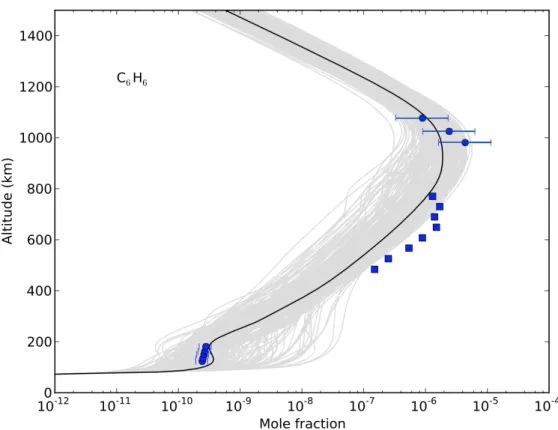
stellar occultation data acquired by the Cassini/UVIS instrument. Koskinen et al. (2011) analyzed such data from two flybys (T41 and T53). Using a new VUV absorption cross section for benzene, Capalbo et al. (2016) reanalyzed UVIS measurements acquired during these stellar occultations of Titan and also added analyses of measurements from the T21 and T41-II flybys. They obtained, around 1000 km, relative abundances in agreement with the values derived from INMS data. Most of these observations are depicted in Figure 6
and compared to our model results. We highlight the relatively good agree-ment between our model (taking model uncertainties into account) and the observations for benzene despite a slight underestimation of the benzene abun-dance in our model for the nominal model, not only in the lower atmosphere where the neutral formation mechanism controls benzene chemistry but also in the upper atmosphere where benzene is produced through ionic reactions. The agreement between model and observations is much better in the lower atmosphere when we consider that AROM photodissociation leads to some benzene production.
Our benzene abundance profile is relatively similar to the one of Vuitton et al. (2008) and Krasnopolsky (2009) in the ionosphere, the main reactions pro-ducing benzene being relatively similar, although we have introduced new re-actions. On the other hand, our profile is quite different in the region between 300 and 500 km.
Fig. 6. Mole fraction profiles of benzene in the nominal model (nominal run in black and 200 Monte-Carlo runs in grey, see section 3.6 for an explanation of these runs). Observations are given in blue for comparison. In the ionosphere: INMS data from Cui et al. (2009); In the lower stratosphere: CIRS data from Vinatier et al. (2015) and Coustenis et al. (2007); In the middle atmosphere: UVIS data from Koskinen et al. (2011)).
3.2 Toluene and ethylbenzene
Among the substituted benzene molecules, toluene (C6H5CH3) and
ethylben-zene (C6H5C2H5) are the most abundant in our model (see Figure 7). Toluene
and ethylbenzene are efficiently produced in Titan’s atmosphere because C6H5
is the main product of benzene photodissociation and C6H5 will react mainly
with the most abundant radicals, which are H atoms and CH3radicals. In fact,
considering the values of the k0 termolecular rate constant, the H + C6H5 and
CH3 + C6H5 reactions reach their k∞ values all over the atmosphere and
can be considered as bimolecular reactions (Vuitton 2008) (it should be noted that the CH3 + C6H5 → C6H5CH2 + H reaction is exothermic by 58 kJ/mol
without a TS for the exit channel which slightly decreases the low pressure association rate constant for this reaction). Toluene photodissociation leads mainly to the benzyl radical (C6H5CH2, (Frochtenicht, 1995)), which produces
ethylbenzene through reaction with CH3. The growth propagation stops there
because photodissociation of ethylbenzene is thought to lead almost exclu-sively to C6H5CH2 + CH3 and not to C6H5C2H4 + H (Tsai et al., 2001;
Huang et al., 2002). Toluene and ethylbenzene have not yet been detected in Titan’s lower atmosphere. Both have a small dipole moment around 0.4 De-bye and may be detectable with ALMA, and both have active IR transitions well separated from those of benzene. Considering the relative abundance of toluene, around 1/10 of the benzene one, it may be detectable through its IR transitions. An indirect way to estimate the toluene abundance in the upper atmosphere is through the C7H+9 ion. Indeed, C7H+9 is mainly produced from
toluene through proton transfer via reactions with HCNH+ and C
2H+5, and
then the C7H+9 mole fraction is proportional to the neutral toluene one.
Our toluene abundance is notably different from Vuitton et al. (2008) and Krasnopolsky (2009, 2012, 2014) mainly due to the fact we use very differ-ent rate constants for the reactions C6H5 + H and C6H5 + CH3. Moreover
the chemical description of toluene in Krasnopolsky (2009) is oversimplified. Ethylbenzene is neither described in Vuitton et al. (2008) nor in Krasnopolsky (2009, 2012, 2014).
3.3 Aniline (C6H5-NH2) and aniline-N-methyl (C6H5-NHCH3)
The first step of their formation is addition of NH2 to the phenyl radical.
How-ever, as NH2 is much less abundant than the methyl radical, aniline is much
less abundant than toluene. Aniline-N-methyl is formed through CH3 addition
to C6H5-NH produced by the photodissociation of aniline. Considering their
relatively low abundances in our model (see Figure 8), both molecules will be difficult to detect through IR spectroscopy. Protonated aniline, C6H5NH+3, is
Fig. 7. Top: Mole fraction profiles of toluene (C6H5CH3). Upper limits of C6H5CH3
from Cui et al. (2009) are given by blue arrows. Bottom: Mole fraction profiles of ethylbenzene (C6H5C2H5). The nominal run is in black and 200 Monte-Carlo runs
only produced from aniline in our model and could be used as a proxy for aniline.
Phenylethyne (C6H5-C2H) and benzonitrile (C6H5-CN) are produced through
direct bimolecular reactions between C2H and CN radicals with benzene. Their
production in the low atmosphere is weak since C2H and CN are very efficiently
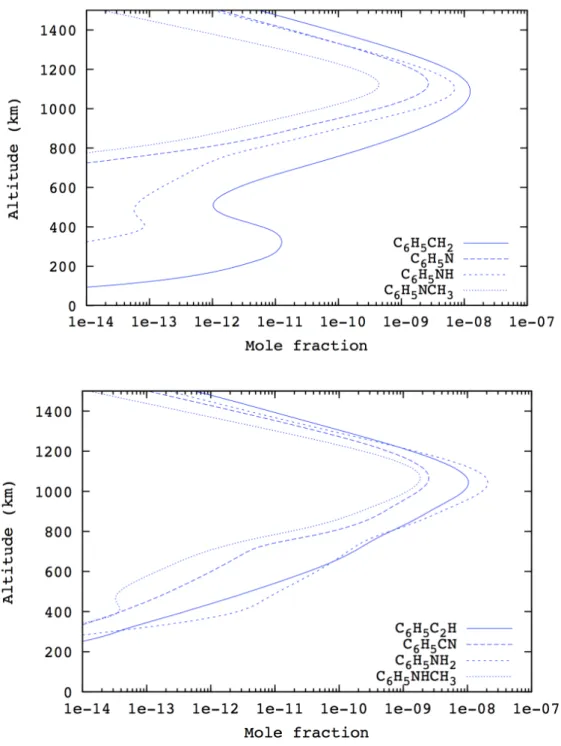
consumed through reaction with CH4. Their low abundances (see Figure 8)
will make their detection in Titan’s atmosphere very difficult even though benzonitrile possesses a strong dipole moment (4.7 D), which has allowed its detection in dense molecular cloud TMC-1 (McGuire et al., 2018).
Aniline, aniline-N-methyl, phenylethyne and benzonitrile are not included in previous studies (Vuitton et al., 2008; Krasnopolsky, 2009, 2012, 2014).
3.4 Polyaromatics
Polyaromatics are not included in our model but some production fluxes are taken into account (leading to AROM). Among them, we calculate the fluxes of reactions leading to poly-phenyls. Indeed, neutral reactions between aromatic radicals, mainly phenyl (C6H5) and benzyl (C6H5CH2), lead to the formation
of polyphenyls. Polyphenyls have been suggested to be efficient haze precursors by Delitsky and McKay (2010). In our model we produce some polyphenyls but since the rate constants for the reactions of phenyl and benzyl radicals with hydrogen atoms and methyl radicals are large even at low pressure (Vuitton et al., 2012), and since hydrogen atoms and methyl radicals are much more abundant than phenyl and benzyl radicals, polyphenyl production involves low fluxes. Other neutral reactions may also produce polyaromatics such as C6H+5 + C3H4 or C4H4, which are thought to lead to Polycyclic Aromatic
Hydrocarbon formation (PAHs) (Mebel et al., 2017). Another way to produce polyaromatics are ionic reactions between aromatic ions and unsaturated hy-drocarbons. Indeed, C6H5CH+2 (benzyl ion) reacts with C2H4 leading to C9H+11
(Ausloos et al., 1980; Anicich et al., 2006) involving a large flux, similar to the ones leading to benzene. The precise form and reactivity of C9H+11is unknown
but it is clear that ionic reactions could be the source of large ions includ-ing polyaromatics as already highlighted by many authors (Anicich et al., 2006; Krasnopolsky, 2009; Westlake et al., 2014). An alternative route for the growth of hydrocarbon molecules in Titan’s atmosphere may be the reactions of neutral aromatics with ions such as CH+3, C2H+5, l-C3H+3. Indeed, even if the
main channel of the C6H6 + C2H+5 reaction is proton transfer leading to C6H+7
+ C2H4, termolecular association producing protonated ethylbenzene is also
very likely to occur as shown by ˇZabka et al. (2009). Association could also be important for reactions such as CH+3 + C6H6, CH+3 + C6H5CH3, l-C3H+3 +
Fig. 8. Mole fraction profiles of aromatic radicals (upper plot) and molecules (lower plot) included in the nominal model (in addition to the ones presented before). They all condense below an altitude of approximately 100 km and have very low relative abundances in the lower atmosphere.
efficient way to increase the molecular complexity in Titan’s atmosphere but realistic modeling of such chemistry needs however further experimental and theoretical studies.
3.5 Aromatic related ions
Even if there are direct ionic production pathways of C6H+7 (the C6H+5 + H2
and C4H+5 + C2H4 reactions for example), benzene protonation through the
C6H6 + HCNH+ and C6H6 + C2H+5 reactions involve much higher fluxes.
Then, the C6H+7 mole fraction is proportional to the neutral C6H6 one. The
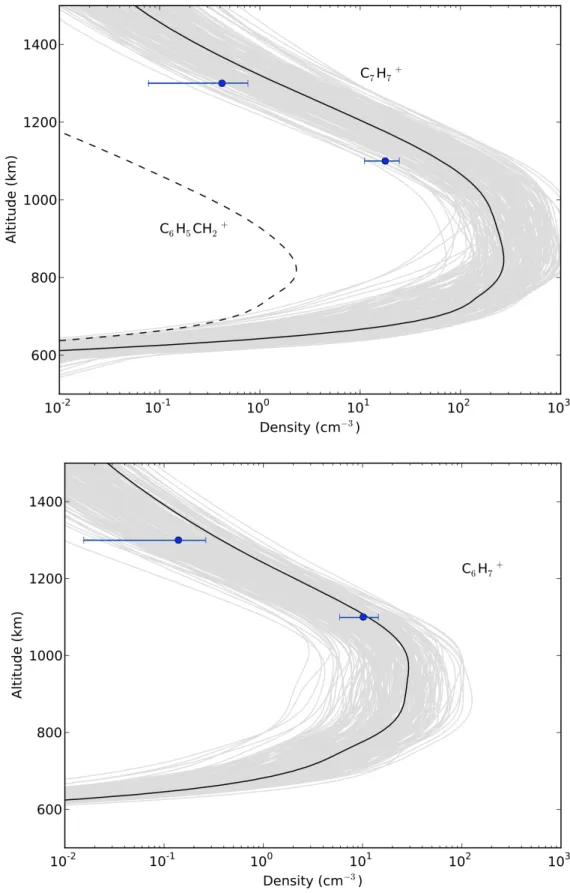
density profile of C6H+7 derived from INMS observation is depicted in Figure 9
and compared to our model results. The agreement between our model and ob-servations is very good indicating that the benzene and C2H+5/HCNH+/electron
abundances are likely to be well reproduced. The C7H+7 mole fraction is
how-ever not very well reproduced, the m/z = 91 ion (sum of the benzylium and tropylium ions) is overestimated compared to INMS observations. This could be due to an overestimation of C7H+7 production versus C6H5CH+2 and shows
that the chemistry of these species should be revisited (particularly the C5H+5
+ C2H2 and C6H+5 + CH4 reactions). The density profiles of C6H+7 and C7H+7
are in quite close agreement with Krasnopolsky (2012, 2014) except below an altitude of 600 km. This might be due to the fact that we do not consider mag-netospheric protons in our model. The density profiles of the other aromatic ions are depicted in Figure 10.
3.6 Uncertainty propagation and sensitivity analysis
It has been demonstrated in several studies that uncertainties on rate con-stants have noticeable effects on photochemical model results (see for instance H´ebrard et al. (2012); H´ebrard et al. (2013); Dobrijevic et al. (2014); Loison et al. (2015) for neutrals and Carrasco et al. (2007, 2008); Plessis et al. (2012) for ions). In the present study, we account for the coupling between neutrals and ions to study how uncertainties on rate constants propagate into the model through ion-neutral reactions. Details are given in Dobrijevic et al. (2016b). We performed 200 Monte-Carlo runs to obtain statistically significant results while limiting the computational time. In the following, results are restricted to the nominal model (for which the photolysis of AROM has been included with a branching ratio equal to 3%).
The propagation of uncertainties for C6H6 gives a large distribution of mole
fraction profiles (see Figure 6) with possible epistemic multi-modality in the lower atmosphere (see Figure 11), which are caused by uncertainties on some key rate coefficients. Such behaviour has already been observed in photochem-ical models for C2H2 and C2H4 in the atmosphere of Titan (Dobrijevic et al.,
2008), but uncertainties on the rate constants of the key reactions, which were responsible for this behaviour for these two compounds have been reviewed since then, and the earlier bimodalities are no longer present in our model.
Fig. 9. Top: Nominal model densities in the ionosphere of C7H+7 (plain line) and
C6H5CH+2 (dashed line). Bottom: C6H+7. Monte-Carlo density profiles are in grey
Fig. 10. Density profiles of aromatic related ions in the nominal model.
In the present model, the main key reactions for C6H6 are the reactions of
excited benzene (both C6H∗∗6 and C6H∗6): C6H∗∗6 → C6H5 + H, C6H∗∗6 + N2
→ C6H∗6 + N2 and the C6H∗6 + N2 → C6H6 + N2 reaction, a new reaction
we added in the model. These reactions are not well characterized and control the loss of benzene as the photodissociation of C6H∗6 is the only process which
can break open the aromatic ring. Uncertainties on these rate constants are responsible for the large distribution of profiles for C6H6.
Fig. 11. Histograms of the logarithm of the mole fractions of C6H6 at two different
For toluene (C6H5CH3), the distribution of mole fraction profiles is also quite
large at all altitudes (see Figures 7 and 12). This is also the case for ethyl-benzene (Figure 7). Our sensitivity analysis revealed many key reactions but the ones that contribute the most to the resulting uncertainties are the main reactions involved directly in its production: H + C6H5CH2 → C6H5CH3 and
CH3 + C6H5 → C6H5CH3 (in addition to C2H3 + C4H3 → C6H5 + H).
The complete lists of key reactions (reactions that have the strongest impact on the uncertainties of our model results) for three different altitudes are given in Appendix D.
4 Discussion
In our model, toluene could be as abundant as benzene or 10 times lower considering the uncertainties in the reaction rates. A signal at m/z = 92 has been detected by the Cassini/INMS instrument but Vuitton et al. (2008) found that, due to the time dependence of this signal, toluene is mostly formed in the
INMS chamber through CH3 + C6H5 recombination on the walls. Cui et al.
(2009) obtained an upper limit for C7H8 as a function of altitude: at 1025 km
for instance, the mixing ratio of C7H8 is lower than 8.73 × 10⁻⁸. This value is
lower than our nominal model toluene abundance. However, it is in agreement with some of the values we derived from our uncertainty propagation study. It should be noted that, in contrast to benzene, toluene is mainly produced by neutral reactions even at high altitude, namely through the C6H5 + CH3
and C6H5CH2 + H reactions, the rate of these two reactions being only poorly
known, particularly at low pressure. As a consequence, it is not clear whether our model might overestimate the production of toluene or INMS data should be re-analyzed considering the putative presence of toluene with a significant abundance.
In our nominal model, the integrated total production of aromatics above the condensation level is 2.6 × 109 cm−2s−1 (see Table 2). It is dominated by the production of benzene. Aromatics condense in the lower stratosphere. Their condensation level is around 70-90 km depending on the species. Considering the total production and loss rates of benzene, we infer a condensation rate equal to 18 gcm−2Gy−1, this would give a layer of ice of about 1 m accumulated over 4.5 Gy all over the planet.
As pointed out by Vuitton et al. (2008), the production of benzene in the iono-sphere is greatly enhanced by the coupled ion-neutral chemistry compared to the neutral chemistry alone. This is particularly noticeable in the ionosphere, whereas a neutral model can reproduce the observational IR data in the lower stratosphere (see Figure 13). As shown in Table 2, this is also the case for
Fig. 12. Histograms of the logarithm of the mole fractions of C6H5CH3 at two
Table 2
P : Integrated total production rate (cm−2s−1) - Value referred to the surface. w = column density (cm−2). The total production considered that C6H6, C6H5CH3 and
AROM are the main aromatics in Titan’s atmosphere. Results correspond to the nominal model.
Neutral model Coupled ions-neutral model Above tropopause Ionosphere Above tropopause Ionosphere
(z > 500 km) (z > 500 km) w P w P w P w P C6H6 7.3 × 10¹⁴ 2.9 × 10⁸ 8.1 × 10¹¹ 4.9 × 10⁶ 1.0 × 10¹⁵ 1.8 × 10⁹ 8.7 × 10¹³ 5.5 × 10⁸ C6H5CH3 6.2 × 10¹³ 2.2 × 10⁸ 3.0 × 10¹⁰ 3.8 × 10⁵ 1.2 × 10¹⁴ 7.4 × 10⁸ 6.0 × 10¹³ 8.0 × 10⁷ AROM 1.1 × 10¹⁵ 3.0 × 10⁷ 1.4 × 10¹⁰ 3.3 × 10³ 1.2 × 10¹⁵ 5.8 × 10⁷ 5.4 × 10¹² 2.3 × 10⁷ total 5.4 × 10⁸ 5.3 × 10⁶ 2.6 × 10⁹ 6.8 × 10⁸
toluene (and the other aromatics).
Fig. 13. Mole fraction profiles of benzene for two model results: (1) The coupled chemistry of ions and neutrals has been turned on, and (2) the chemistry of ions has been turned off. Comparison with various data (see Figure 6 for caption).
We have performed a local sensitivity analysis to study the effect of Galactic Cosmic Rays (GCR) on the production of benzene (and other aromatics). The results for benzene and AROM are presented in Figure 14. The effect for benzene is quite low (lower than the uncertainties on the abundances derived from observations). In contrast, the GCR induced chemistry has a noticeable effect on the generic species AROM, suggesting that some aromatics might be sensitive to GCR chemistry.
Finally, we also tested the importance of the photolysis of the generic species AROM. Considering that AROM photodissociation does not lead to any of the aromatic compounds present in our network (C6H4, C6H6, toluene,...), which
Fig. 14. Mole fraction profiles of C6H6 and AROM) and comparison with various
data Comparison of model results when the chemistry induced by Galactic Cosmic Rays has been turned on/off is shown.
seems very unlikely, the mole fraction of benzene in the lower atmosphere is too low by a factor of about 4. However, due to large uncertainties in the model results, our model is in agreement with observations. Adding a small production of benzene through AROM photodissociation (even with a branching ratio as low as 1%), leads to good agreement between the model results and the C6H6 abundance derived from IR observations (see Figure 15).
Heterogeneous chemistry is neglected in this study, but might play a role for benzene production in the lower atmosphere as proposed by Plane et al. (2018). In their model, the bulk of cosmic dust particles of 10 µm do not ablate in Titan’s atmosphere and might provide a significant surface for such heterogeneous chemistry. A precise quantification of such processes is very delicate and requires further studies.
5 Conclusion
We have updated the chemical scheme used in Titan’s atmospheric models to study the production of aromatic molecules. Due to the large number of potential aromatics, only 24 aromatic species (neutrals and ions) have been considered, which should be the most abundant aromatics in the atmosphere.
Fig. 15. Mole fraction profiles of C6H6 and AROM, and comparison with various
C6H6observations (in the ionosphere: INMS data from Cui et al. (2009); In the lower
stratosphere: CIRS data from Vinatier et al. (2015) and Coustenis et al. (2007); in the middle atmosphere: UVIS data from Koskinen et al. (2011)). Comparison of model results when the photolysis of AROM has been turned on (in black) or off (in blue) is shown.
In the ionosphere, the most abundant aromatic molecules in our model are benzene, toluene and ethylbenzene. In the stratosphere (around 200 km for instance), only benzene and toluene are relatively abundant. Considering its abundance, toluene might be detectable in the future. In contrast, other ni-triles like ethynylbenzene and benzonitrile are not abundant enough and are unlikely to be detectable either through IR or microwave spectroscopy with current instruments.
Our model results confirm previous studies: C6H6 is mainly produced in the
thermosphere by ion chemistry while neutral chemistry dominates in the lower stratosphere, both being of a comparable importance. The large abundance of C6H6 in the thermosphere is not due to efficient formation pathways, but
instead due to the fact that once produced, the aromatic ring is preserved
from photodissociation and from DR of protonated benzene. Then, C6H6
ac-cumulates in the upper atmosphere reaching a relative abundance as high as
10−6. The GCR related chemistry in the lower atmosphere has a moderate
impact on benzene production.
The model results currently have large uncertainties and a wide range of ex-perimental and theoretical studies are required to reduce the rate constant
uncertainties for those reactions leading to aromatic production (and loss) and to determine the main reaction products and their branching ratios. Ionic chemistry is an important way to produce benzene and consequently leads to relatively high abundances for some aromatic ions, particularly C6H+6,
C6H+7 and C7H+7 (tropylium). A key point for polyaromatic formation is the
reactivity of aromatic ions with unsaturated hydrocarbons as noted by Ani-cich et al. (2006); Westlake et al. (2014). These reactions, particularly the association reactions, are not well characterized and may be an efficient way to increase molecular complexity in Titan’s atmosphere. Further theoretical and experimental studies are clearly needed.
Supplementary material
A List of reactions and photodissociations
List of reactions (with rate constants) and references used in the present model.
B List of photodissociations
List of photodissociations and references used in the present model.
C Integrated column rates
For each reaction included in the model, the integrated column rate scaled to the surface (in cm−2s−1) and the mean altitude (in km) of the production are given.
D List of key reactions and photodissociations
In the three following files, we list the key reactions at 300 km, 500 km and 1000 km of altitude for all species in the present model.
Acknowledgements
We thank the ”Programme National de Plan´etologie” (PNP) of the ”Institut
National des Sciences de lUnivers” (INSU) for funding this work. Computer time was provided by the ”Pˆole Modlisation HPC” facilities of the ”Institut
des Sciences Mol´eculaires” UMR 5255 CNRS - Universit´e de Bordeaux,
References
Alkemade, U., Homann, K. H., 1989. Formation of C6H6 Isomers by
Recom-bination of Propynyl in the System Sodium Vapour/Propynylhalide. In-ternational journal of research in physical chemistry and chemical physics 161 (1-2), 19.
Anicich, V. G., 2003. An Index of the Literature for Bimolecular Gas Phase Cation-Molecule Reaction Kinetics. JPL Publication 2003, 03-19 NASA. Anicich, V. G., Wilson, P. F., McEwan, M. J., 2006. An ICR Study of
Ion-Molecules Reactions Relevant to Titan’s Atmosphere: An Investigation of Binary Hydrocarbon Mixtures up to 1 Micron. J Am. Soc. Mass. Spectr. 17 (4), 544–561.
Atkinson, D. B., Hudgens, J. W., 1999. Rate Coefficients for the Propargyl Radical Self-Reaction and Oxygen Addition Reaction Measured Using Ul-traviolet Cavity Ring-down Spectroscopy. Journal of Physical Chemistry A 103 (21), 4242–4252.
Ausloos, P., 1982. Structure and isomerization of C7H+7 ions formed in the
charge-transfer-induced fragmentation of ethylbenzene, toluene, and nor-bornadiene. Journal of the American Chemical Society 104 (20), 5259–5265. URL http://dx.doi.org/10.1021/ja00384a001
Ausloos, P., Jackson, J. A. A., Lias, S. G., 1980. Reactions of benzyl ions with alkanes, alkenes, and aromatic compounds. International Journal of Mass Spectrometry and Ion Physics 33 (3), 269–283.
Ausloos, P., Lias, S. G., Buckley, T. J., Rogers, E. E., 1989. Concerning the formation and the kinetics of phenylium ions. International Journal of Mass Spectrometry and Ion Processes 92 (0), 65–77.
Balucani, N., Pacifici, L., Skouteris, D., Caracciolo, A., Casavecchia, P., Rosi,
M., 2018. A Theoretical Investigation of the Reaction N(2D)+C6H6 and
Implications for the Upper Atmosphere of Titan. In: Gervasi, O., Murgante, B., Misra, S., Stankova, E., Torre, C. M., Rocha, A. M. A. C., Taniar, D., Apduhan, B. O., Tarantino, E., Ryu, Y. (Eds.), Computational Science and Its Applications ICCSA 2018. Springer International Publishing, pp. 763– 772.
Bergeat, A., Loison, J.-C., 2001. Reaction of carbon atoms, C(2p2, 3P) with C2H2, C2H4 and C6H6 : Overall rate constant and relative atomic hydrogen
production. PCCP 3, 2038.
Berman, M., Fleming, J., Harvey, A., Lin, M., 1982. Temperature Dependence of the Reactions of CH Radicals with Unsaturated Hydrocarbons. Chem. Phys. 73, 27.
Berteloite, C., Le Picard, S. D., Balucani, N., Canosa, A., Sims, I. R., 2010. Low temperature rate coefficients for reactions of the butadiynyl radical, C4H, with various hydrocarbons. Part II: reactions with alkenes (ethylene,
propene, 1-butene), dienes (allene, 1,3-butadiene) and alkynes (acetylene, propyne and 1-butyne). Phys. Chem. Chem. Phys. 12 (15), 3677–3689. URL http://dx.doi.org/10.1039/B923867K
Capalbo, F. J., B´enilan, Y., Fray, N., Schwell, M., Champion, N., Es-sebbar, E.-t., Koskinen, T. T., Lehocki, I., Yelle, R. V., 2016. New benzene absorp-tion cross secabsorp-tions in the VUV, relevance for Titan’s upper atmosphere. Icarus 265, 95–109.
Carrasco, N., Alcaraz, C., Dutuit, O., Plessis, S., Thissen, R., Vuitton, V., Yelle, R., Pernot, P., Nov. 2008. Sensitivity of a Titan ionospheric model to the ion-molecule reaction parameters. Planetary and Space Science 56, 1644–1657.
Carrasco, N., Dutuit, O., Thissen, R., Banaszkiewicz, M., Pernot, P., Jan. 2007. Uncertainty analysis of bimolecular reactions in Titan ionosphere chemistry model. Planetary and Space Science 55, 141–157.
Cool, T. A., Wang, J., Nakajima, K., Taatjes, C. A., McLlroy, A., 2005. Pho-toionization cross sections for reaction intermediates in hydrocarbon com-bustion. International Journal of Mass Spectrometry 247 (1), 18–27.
Coustenis, A., Achterberg, R. K., Conrath, B. J., Jennings, D. E., Marten, A., Gautier, D., Nixon, C. A., Flasar, F. M., Teanby, N. A., B´ezard, B., Samuel-son, R. E., CarlSamuel-son, R. C., Lellouch, E., Bjoraker, G. L., Romani, P. N., Tay-lor, F. W., Irwin, P. G. J., Fouchet, T., Hubert, A., Orton, G. S., Kunde, V. G., Vinatier, S., Mondellini, J., Abbas, M. M., Courtin, R., Jul. 2007. The composition of Titan’s stratosphere from Cassini/CIRS mid-infrared spectra. Icarus 189, 35–62.
Coustenis, A., Salama, A., Schulz, B., Ott, S., Lellouch, E., Encrenaz, T. h., Gautier, D., Feuchtgruber, H., Feb. 2003. Titan’s atmosphere from ISO mid-infrared spectroscopy. Icarus 161, 383–403.
Cremer, D., Kraka, E., Joo, H., Stearns, J. A., Zwier, T. S., 2006. Exploration of the potential energy surface of C4H4for rearrangement and decomposition
reactions of vinylacetylene: A computational study. Part I. Phys. Chem. Chem. Phys. 8 (45), 5304–5316.
Cui, J., Yelle, R. V., Vuitton, V., Waite, J. H., Kasprzak, W. T., Gell, D. A.,
Niemann, H. B., M¨uller-Wodarg, I. C. F., Borggren, N., Fletcher, G. G.,
Patrick, E. L., Raaen, E., Magee, B. A., Apr. 2009. Analysis of Titan’s neu-tral upper atmosphere from Cassini Ion Neuneu-tral Mass Spectrometer mea-surements. Icarus 200, 581–615.
Delitsky, M. L., McKay, C. P., May 2010. The photochemical products of benzene in Titan’s upper atmosphere. Icarus 207, 477–484.
Dheandhanoo, S., Forte, L., Fox, A., Bohme, D. K., 1986. Ion-molecule re-actions with carbon chain molecules: rere-actions with diacetylene and the diacetylene cation. Canadian Journal of Chemistry 64 (4), 641–648.
URL http://www.nrcresearchpress.com/doi/abs/10.1139/v86-104 Dobrijevic, M., Carrasco, N., H´ebrard, E., Pernot, P., Nov. 2008. Epistemic
bimodality and kinetic hypersensitivity in photochemical models of Titan’s atmosphere. Planetary and Space Science 56, 1630–1643.
Dobrijevic, M., H´ebrard, E., Loison, J. C., Hickson, K. M., Jan. 2014. Cou-pling of oxygen, nitrogen, and hydrocarbon species in the photochemistry of Titan’s atmosphere. Icarus 228, 324–346.
Dobrijevic, M., Loison, J. C., Hickson, K. M., 2016a. The eddy diffusion co-efficient in the atmosphere of Titan: models comparison. Non-peer review paper.
Dobrijevic, M., Loison, J. C., Hickson, K. M., 2018. The chemistry of CH2 in
the atmosphere of Titan in question. Non-peer review paper.
Dobrijevic, M., Loison, J. C., Hickson, K. M., Gronoff, G., 2016b. 1D-coupled photochemical model of neutrals, cations and anions in the atmosphere of Titan. Icarus 268, 313–339.
Douglas, K., Blitz, M. A., Feng, W., Heard, D. E., Plane, J. M. C., Slater, E., Willacy, K., Seakins, P. W., 2018. Low temperature studies of the removal reactions of 1CH
2 with particular relevance to the atmosphere of Titan.
Icarus 303, 10–21.
Douguet, N., Fonseca dos Santos, S., Raoult, M., Dulieu, O., Orel, A. E., Kokoouline, V., 2015. Theoretical study of radiative electron attachment to CN, C2H, and C4H radicals. The Journal of Chemical Physics 142 (23),
234309.
Duran, R. P., Amorebieta, V. T., Colussi, A. J., 1988. Is the homogeneous thermal dimerization of acetylene a free-radical chain reaction? Kinetic and thermochemical analysis. The Journal of Physical Chemistry 92 (3), 636– 640.
URL http://dx.doi.org/10.1021/j100314a014
Fahr, A., Nayak, A., 2000. Kinetics and products of propargyl (C3H3)
radi-cal self-reactions and propargyl-methyl cross-combination reactions. Int. J. Chem. Kinet. 32 (2), 118–124.
Fournier, J. A., Shuman, N. S., Melko, J. J., Ard, S. G., Viggiano, A. A., 2013. A novel technique for measurement of thermal rate constants and temper-ature dependences of dissociative recombination: CO+2, CF+3, N2O+, C7H+8,
C7H+7, C6H+6, C6H+5, C5H+6, C4H+4, and C3H+3. J. Chem. Phys. 138 (15),
154201–7.
URL http://dx.doi.org/10.1063/1.4801657
Frankland, V. L., James, A. D., S´anchez, J. D. C., Mangan, T. P., Willacy,
K., Poppe, A. R., Plane, J. M. C., Nov. 2016. Uptake of acetylene on cosmic dust and production of benzene in Titan’s atmosphere. Icarus 278, 88–99. Fridgen, T. D., Troe, J., Viggiano, A. A., Midey, A. J., Williams, S.,
McMahon, T. B., 2004. Experimental and Theoretical Studies of the Ben-zylium+/Tropylium+ Ratios after Charge Transfer to Ethylbenzene. The Journal of Physical Chemistry A 108 (26), 5600–5609.
URL http://dx.doi.org/10.1021/jp031328s
Frochtenicht, R., 1995. The photodissociation of toluene studied by forward photofragment translational spectroscopy. The Journal of Chemical Physics 102 (12), 4850–4859.
URL http://scitation.aip.org/content/aip/journal/jcp/102/12/10.1063/1.469533 Gautier, T., Sebree, J. A., Li, X., Pinnick, V. T., Grubisic, A., Loeffler, M. J.,
Getty, S. A., Trainer, M. G., Brinckerhoff, W. B., Jun. 2017. Influence of trace aromatics on the chemical growth mechanisms of Titan aerosol
ana-logues. Planet. Space Sci. 140, 27–34.
Georgievskii, Y., Miller, J. A., Klippenstein, S. J., 2007. Association rate con-stants for reactions between resonance-stabilized radicals: C3H3 + C3H3,
C3H3 + C3H5, and C3H5 + C3H5. Phys. Chem. Chem. Phys. 9 (31), 4259–
4268.
Ghibaudi, E., Colussi, A. J., 1988. Kinetics and thermochemistry of the equi-librium 2 C2H2 ↔ C4H4: direct evidence against a chain mechanism. J.
Phys. Chem. 92 (20), 5839–5842.
Goebbert, D., Liu, X., Wenthold, P., 2004. Reactions of diacetylene radical cation with ethylene. Journal of the American Society for Mass Spectrom-etry 15 (1), 114–120.
URL http://dx.doi.org/10.1016/j.jasms.2003.10.003
Hamberg, M., Vigren, E., Thomas, R., Zhaunerchyk, V., Zhang, M., Trippel, S., Kaminska, M., Kashperka, I., af Ugglas, M., Kellberg, A., Simonsson, A., Paal, A., Semaniak, J., Larsson, M., Geppert, W., 2011. Experimental studies of the dissociative recombination processes for the C6D+6 and C6D+7
ions. EAS Publications Series 46, 241–249.
URL http://dx.doi.org/10.1051/eas/1146026
H´ebrard, E., Dobrijevic, M., Loison, J., Bergeat, A., Hickson, K., F., C., 2013. Photochemistry of C3Hphydrocarbons in Titan’s stratosphere revisited.
As-tronomy and Astrophysics.
H´ebrard, E., Dobrijevic, M., Loison, J. C., Bergeat, A., Hickson, K. M.,
May 2012. Neutral production of hydrogen isocyanide (HNC) and hydrogen cyanide (HCN) in Titan’s upper atmosphere. Astronomy and Astrophysics 541, A21.
Hong, X.-P., Chen, W.-K., Cheng, P.-Y., 2001. Ultrafast photodissociation dynamics of cyanobenzene near the ionization threshold. Chemical Physics Letters 350 (5), 495–501.
Honjo, Y., Kinoshita, T., Yatsuhashi, T., Nakashima, N., 2005. Formation of 1,3-hexadiene-5-yne by two-photon chemistry of benzene via hot molecule. Journal of Photochemistry and Photobiology A: Chemistry 171 (3), 223– 229.
Howe, P.-T., Fahr, A., 2003. Pressure and Temperature Effects on Product
Channels of the Propargyl (HC:CCH2) Combination Reaction and the
For-mation of the ”First Ring”. The Journal of Physical Chemistry A 107 (45), 9603–9610.
URL http://dx.doi.org/10.1021/jp0307497
Hsu, T. C., Shu, J., Chen, Y., Lin, J. J., Lee, Y. T., Yang, X., 2001. Dissocia-tion rates of benzene at VUV excitaDissocia-tion. The Journal of Chemical Physics 115 (21), 9623–9626.
URL http://dx.doi.org/10.1063/1.1423945
Huang, C.-L., Jiang, J.-C., Lin, S. H., Lee, Y. T., Ni, C.-K., 2002. Photodis-sociation of ethylbenzene at 248 nm. The Journal of Chemical Physics 116 (18), 7779–7782.