HAL Id: cea-02434030
https://hal-cea.archives-ouvertes.fr/cea-02434030
Submitted on 9 Jan 2020
HAL is a multi-disciplinary open access archive for the deposit and dissemination of sci-entific research documents, whether they are pub-lished or not. The documents may come from teaching and research institutions in France or
L’archive ouverte pluridisciplinaire HAL, est destinée au dépôt et à la diffusion de documents scientifiques de niveau recherche, publiés ou non, émanant des établissements d’enseignement et de recherche français ou étrangers, des laboratoires
Design rules
F. Baqué, R. Marlier, J. Augem, G. Corneloup, Ma. Ploix, C. Gueudre, I.
Lillamand
To cite this version:
F. Baqué, R. Marlier, J. Augem, G. Corneloup, Ma. Ploix, et al.. Inspection specifications leading to extended ASTRID Design rules. International Conference on Fast Reactors and Related Fuel Cycles Next Generation Nuclear Systems for Sustainable Development (FR17), Jun 2017, Yekaterinburg, Russia. �cea-02434030�
Inspection specifications leading to extended ASTRID Design rules
F. Baqué1 (CEA), R. Marlier2 (AREVA NP), JM. Augem3 (EDF), G. Corneloup4 (AMU), M.A. Ploix4 (AMU), C. Gueudré4 (AMU), I. Lillamand4 (AMU)
1
French Atomic Commission (CEA), St Paul lez Durance Cedex, France 2
AREVA NP, Lyon, France 3
EDF SEPTEN, Villeurbanne, France 4
Aix-Marseille University, CNRS, Centrale Marseille, LMA, Aix-en-Provence, France
E-mail contact of main author:[email protected]
Abstract. CEA initiated a study in 2008 to improve the design rules of fast reactors with French utilities (EDF), French designers (AREVA) and non-destructive examination (NDE) specialists (Aix Marseille University), focusing on the specific issue of in-service inspection (ISI). Thus, at the end of 2012, the RCC-MRx specifications for NDEs was enlarged, orienting design and manufacturing choices and rules to account for future in service inspection. Due to the complexity of the links between design, materials, access, inspection techniques and tools, these rules cannot be considered as strict instructions, but rather as leading to fruitful dialogue between designers and inspectors. The links between in-service inspection and manufacturing processes and specifications are now being explored in further detail. This article describes the approach and R&D program in support of this specific work. This initiative should lead to better connections and compromise between design work, material specifications and in-service inspection, called RC-CND rules (Design rules taking into account NDE requirements).
1. Introduction
This paper discusses the work initiated following a series of preliminary discussions between Non-Destructive Examination (NDE) experts and fast reactor power plant designers, i.e. the CEA, EDF, AREVA and the LCND (Non Destructive Characterization Laboratory at the Aix-Marseille University). A Thematic Working Group (TWG) was set up for this purpose. It is known that all the rules and recommendations on non-destructive examinations in the RCC-MR codes ("Design and Construction Rules for Mechanical Components of FBR Nuclear Islands", before 2012) fall under the scope of manufacturing quality controls and not at all under in-service inspection.
Yet the ability to inspect and repair systems from Generation IV reactor concepts is becoming an increasingly important factor as it allows us to make sure the safety requirements are met while protecting the investment of this type of reactor technology [1] [2] [3].
It therefore appeared necessary to draft a document that could guide designers in their choices and decisions, taking into account all NDEs to be performed during the lifetime of such reactor components. This document could serve as a starting point for a future inspection and repair volume for an existing code (as an example, in France: the French in-service inspection rules for mechanical components of PWR nuclear islands, RSEM), comprising a specific part or a code specific to fast reactors.
Essentially two different approaches were considered for this work, leading to two proposals which are described hereafter.
The first approach involved establishing the conditions for implementing a "comprehensive" database so as to propose quantitative recommendation rules for inspections. Faced with the enormous difficulty of managing all input and output, it appeared more appropriate to report the quantitative recommendation rules after having read the RCC-MR code (version subsequent to 2012) and its "NDE expert" type analysis of NDEs on the basis of feedback from the LCND.
The second approach was based on a comprehensive review of the RCC-MR code (version prior to 2012) based on NDE expert analysis to identify each typical case capable of raising issues between design and the optimal performance of NDEs. This analysis was then followed up by recommendations for design, in order to improve inspectability.
2. Proposal for quantitative recommendation rules
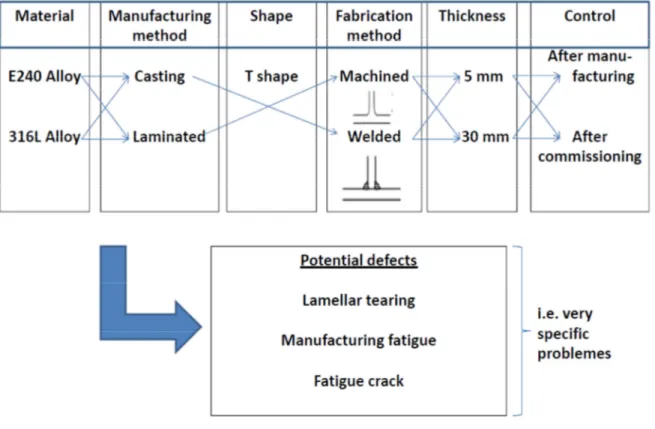
To provide the designer with a tool to design facilities while taking into account the knowledge of NDE experts, it first seemed appropriate to build a database including:
• All cases concerning parts, materials, manufactures, shapes, dimensions, etc.
• All types of potential manufacturing and in-service defects
• Required characteristics: detection, location, identification and dimensions
• Different NDE methods (ultrasonics, Eddy Currents, X-rays…) and their specific needs.
FIG. 1. Data base.
needs to be modified or not. It is already clear how difficult the task is, particularly with respect to the Graphic User Interface (GUI): how can we present operators with such a tool and what criteria will be used to establish the level of inspectability?
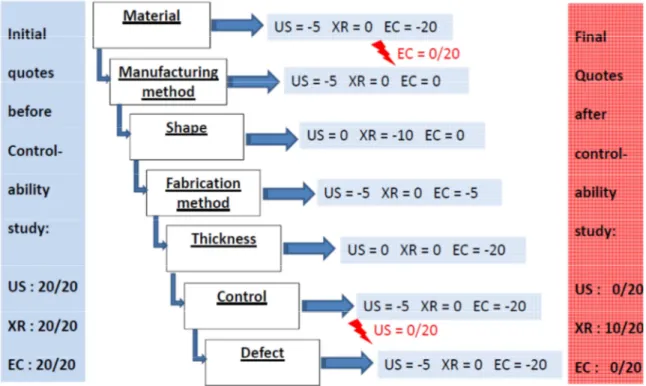
We considered a first method that involved integrating all influencing factors into the database which may modify the starting grade for inspectability initially defined as perfect (20 out of 20) for each NDE method.
At the end of the analysis, either the grade remained high (inspectability deemed acceptable with potential for one or two NDE methods) and the part did not require modification, or the grade was low, zero or below a threshold value and some design parameters had to be modified.
FIG. 2. Proposal for a decision tree leading to the inspectability grading.
This proposal to apply quantitative rules has been abandoned since it involved a rather subjective decision-making process, was too NDE-oriented and not focused enough on design.
An alternative solution could be to reach a potential decision with respect to inspectability in terms of the defect detection capacity in a given situation. In other words, we could establish a detectable defect size so the designer can choose new dimensions or even change the entire design in the case where the defect size is unacceptable.
This work is feasible but extremely time-consuming. This is why the potential of using qualitative rules was then checked.
3. Proposal for qualitative recommendation rules
A comprehensive review of the RCC-MR code (version prior to 2012) based on NDE expert criteria made it possible - after analysis - to identify each typical case capable of raising issues between design and the optimal performance of NDEs.
The analysis was then followed up by an explanation in understandable terms for an NDE non-expert and possible recommendations for design changes were drafted to improve inspectability.
3.1 Example 1 of an extract from the RCC-MR code: RB reference 3291.1 and 3334.2
"... the permissible stress in the welded joint is equal to the permissible stress in the weld multiplied by a weld joint efficiency factor. The higher this factor, the better the weld joint is non-destructively examined (volume and surface), with the maximum being equal to 1..."
3.2 Recommendation for example 1 resulting from the NDT rules
The main recommendation for example 1 is as follows:
"A welded volume can be entirely inspected when certain access conditions are met. And the necessary accessibility differs depending on the NDE method chosen."
And the explanations accessible to a NDE non-expert are of the type:
• The volume must be completely insonified when using NDE by ultrasounds. The type of transducer (acoustic beam perpendicular or at an angle) is chosen depending on the type of defect under investigating, particularly its orientation.
• When using a transducer with a perpendicular acoustic beam in direct contact, the weld must be levelled so the transducer can move above the weld. When a transducer with an acoustic beam on an angle is used, the beam must be able to inspect the entire volume by moving on each side of the weld.
• When the material is generally homogeneous and isotropic, geometric acoustics is used to establish the diagnosis. If this is not the case, beam deflections and divisions can occur.
• Care must be taken with residual stress (acousto-electric effect) which can modify interpretations.
• With X-ray or γ-ray the entire volume necessarily has to be projected. The source must be installed at the necessary distance with respect to the weld.
3.3 Example 2 of an extract from the RCC-MR code: RB reference 3334
"... rules concerning the design of welded assemblies. There are 4 types of authorised welded joints (a, b, c, d) and a limited number of authorised designs.”
3.4 Recommendation for example 2 resulting from the NDT rules
The two main recommendations are as follows:
"The choice of the best NDE method will depend on the shape of the welded joint". and
"In the case of multi-pass welds, the ultrasonic inspection parameters can be chosen more efficiently by simulating the inspection through modelling the weld solidification".
• The best-suited NDE method can be chosen by studying the different shapes of welded joints. Radiography can be used for flat-butt welds, which requires access from the two sides of the part. This is more difficult when a T-weld is involved and the orientation of the non-volumetric defect becomes a major issue (it must be parallel to the beam to be seen).
• It is possible to work backwards, i.e. to choose the shape of the welded joint to favour an NDE method in particular
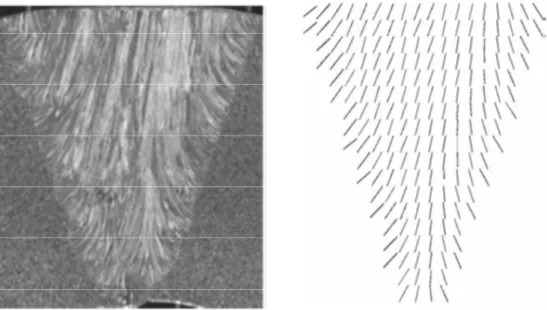
• In the case of multi-pass welds, deflections in the ultrasonic beam can be expected, which alters the diagnosis. The solution may be to model the weld (its microstructure) so as to predict deflection in the ultrasounds. The MINA code developed by the LCND for EDF can be used to model weld solidification based on data from the welding data package.
FIG. 3. Micrograph (destructive) of multi-pass welds (left) and its modelling (non destructive) using the EDF-LCND MINA code (right).
• It is also possible to exploit knowledge of these solidification laws to decide upstream of the process - at the time of manufacturing - to implement welds that are easier to inspect or go through. This therefore involves specifying a weld order (sequence of passes), for example, instead of letting the welder record the weld sequence once the work has been completed.
4. Request to amend the Appendix A20 of the RCC-MRx (2010) code
In late 2012, the thematic working group (TWG) produced a revised copy of Appendix A20 for the first version of the brand new RCC-MRx code ("Design and Construction Rules for mechanical components of nuclear installations applicable for high temperature structures and ITER vacuum vessel"), called “RC-CND rules” (Design Rules taking into account NDE requirements). The TWG believed it was essential to support this appendix with a document that explains the foundations of the recommendations (criteria) so it would be possible to
understand and substantiate the solutions provided by the current technical inspection means. Some aspects are also put into perspective.
4.1 Example of an unmodified extract
"General design considerations:
Design studies must take into account the requirements associated with volumetric examinations (radiographic and ultrasonic in particular) which are carried out for in-service inspection purposes. More specifically, the choice of weld positions on pipes must allow for sufficient accessibility to these welds (no welds in penetrations). The accessibility (platform, grating, scaffolding, handling means, etc.) and any special equipment needed for examinations (e.g. specific positioning of the gamma radiography source) should be taken into account in the design studies."
4.2 Example of a request of modification
The following information was added to the extract above:
"Whenever possible, the designer should preferably choose welded assemblies whose design simplifies in-service inspection. It should be remembered that the choice of the examination technique is determined by the inspectability of the defect to be monitored. The equipment specification may suggest manufacturing a reference sample for in-service inspection requirements".
5. Criteria
The TWG believed it was important to support Appendix A20 with a document that provides the foundations of the rules and recommendations, which we have called criteria. These criteria make it possible to understand and substantiate the solutions provided by the current technical inspection means. Some aspects are also put into perspective. It should be pointed out that not all the sections of Appendix A20 seemed to require substantiation; only sections that did require substantiation are mentioned in each section.
5.1 Example of substantiation
The following explanations were given to justify the request to modify Appendix A20 with respect to the "impact of accessibility":
"It is recalled that the volume of material inspected must be completely insonified, for instance, during the ultrasonic inspection of welds. The type of transducer (acoustic beam perpendicular or at an angle) is then chosen depending on the type of defect being investigated, particularly its orientation.
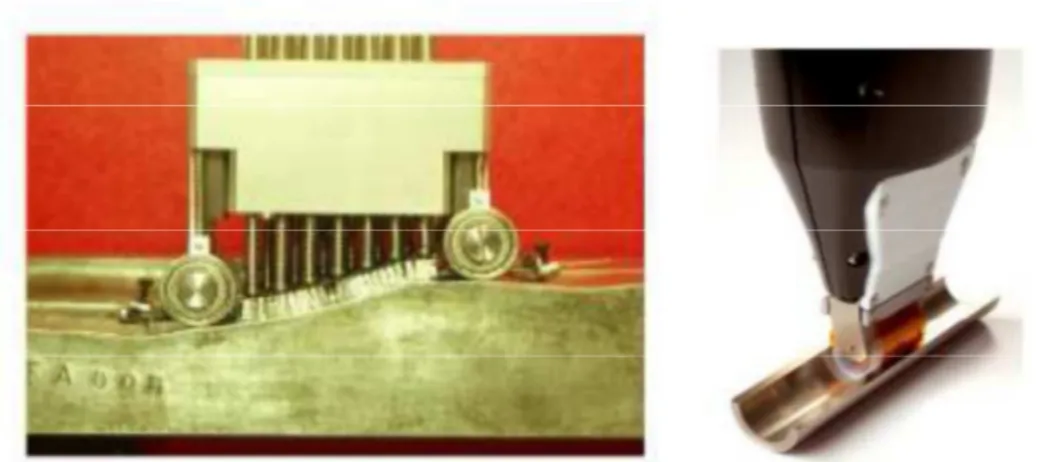
• When using a 'perpendicular' transducer in direct contact, the weld must be levelled so the transducer can move above the weld. When an 'angle' transducer is used, the beam must be able to inspect the entire volume by moving on each side of the weld. When the weld is not levelled, the technology using conformable sensors can be considered.
FIG. 4. Conformable sensors of CEA LIST 2009: ultrasonic (left) and right Eddy Currents (right)
With X-ray or γ-ray the entire volume necessarily has to be projected. The source must be installed at the necessary distance with respect to the weld.
This access also differs depending on whether we consider the manufacturing phase when the components are separated, or the operational period where the systems are assembled and there is fluid (e.g. sodium), temperature, and screens, etc."
6. From inspection recommendations for NDE to manufacturing recommendations for NDE
The revised version of Appendix A20 is deliberately a little prescriptive since the TWG showed that, faced with the complexity of the issues raised, discussions between the designer, manufacturer and inspector seem to offer the only solution for finding the best compromise between design and in-service inspection requirements. The criteria help to understand the proposals given in Appendix A20.
The drafting of the criteria also highlighted the fact that there is no document perfectly suited to provide all the explanations required, even though some standards come close to providing the expected responses. For instance, some standards define the different types of discontinuity well, but specify nothing about how they are obtained.
The potential complexity of future inspections will eventually require that notions such as the "inspectability of materials to be inspected" or even the "inspectability of defects to monitor" be taken into account (and defined and validated). The inspectability of the material (with respect to an NDE method) could be required from the metallurgist as early as the material procurement phase. This will involve specifying the quality of the material so it can be inspected, i.e. that its properties with respect to the different potential NDE methods (mechanical, physical, etc.) allow for their implementation and the repeatability of measurements, during the whole life of the plant.
Each material therefore has properties (physical, mechanical, etc.) that authorises or proscribes such or such NDE process (e.g.: conducting/ insulating, magnetic/ non-magnetic, etc.) but sometimes also limits the diagnosis (e.g.: 'ultrasonic' structural noise/ grain size, or 'eddy current' structural noise/ austenitic-to-ferritic ratio, etc.).
There currently is no suitable document that can help match a material with a suitable inspection process; the available standards remain vague for heterogeneous materials, e.g. it is only asked that a "similar" standard be used for measurement calibration in the case of ultrasonic inspections.
We therefore propose to define and study the notion of inspectability for each material, i.e. its ability to be able to be inspected using a given NDE method.
In addition to the recommendations to make the implementation of inspection processes possible (above mentioned RC-CND rules), we propose now to draft manufacturing recommendations for NDEs which specify which materials should be used: they are called “RE-CND rules”. To reach this objective, dialogue must be instigated between designers, metallurgists, welders and inspectors.
7. Project to draft manufacturing recommendations for NDE
The objective of these manufacturing recommendations established on the basis of NDEs is to anticipate inspectability, i.e. the response of materials to NDEs so as to avoid using parts that cannot be inspected during manufacturing (which are thus scrapped) and/ or to avoid using parts that cannot be inspected in service (which can lead to the abnormal damage of materials).
For this reason, specifications could be coupled with NDEs from the initial material manufacturing phase.
The approach first involves understanding the interaction mechanisms between the NDE waves used and the material to be inspected (with all its metallographic properties).
The systematic ultrasonic measurement of samples with various metallographic properties has been launched, with the first objective being to assess the impact of these properties on the propagation velocity and attenuation of ultrasounds.
8. References
[1] BAQUE, F., et al., “ASTRID In Service Inspection and Repair: review of R&D program and associated results”, Int. Conf. FR13, Paris, France, March 2013, ref. T1-CN-199/337.
[2] BAQUE, F., et al., “In Service Inspection and Repair of the Sodium Cooled ASTRID reactor prototype”, Int. Conf. ICAPP 2015, Nice, France, May 2015, Paper 15041. [3] BAQUE, F., et al., “In Service Inspection and Repair of Sodium cooled ASTRID
Prototype”, Int. Conf. ANIMMA 2015, Lisbon, Portugal, April 2015, invited lecture #44.
9. Acknowledgements
The authors of this paper would like to thank their colleagues of the Thematic Working Group (TWG): non-destructive examination (NDE) experts and fast reactor power plant designers, from the CEA, EDF, AREVA and the LCND (now become LMA).