HAL Id: hal-01896096
https://hal.archives-ouvertes.fr/hal-01896096
Submitted on 16 Oct 2018
HAL is a multi-disciplinary open access
archive for the deposit and dissemination of
sci-entific research documents, whether they are
pub-lished or not. The documents may come from
teaching and research institutions in France or
abroad, or from public or private research centers.
L’archive ouverte pluridisciplinaire HAL, est
destinée au dépôt et à la diffusion de documents
scientifiques de niveau recherche, publiés ou non,
émanant des établissements d’enseignement et de
recherche français ou étrangers, des laboratoires
publics ou privés.
overscreened regime of generalized multichannel SU(N)
Kondo models
Damien Bensimon, Andres Jerez, M. Lavagna
To cite this version:
Damien Bensimon, Andres Jerez, M. Lavagna. Intermediate coupling fixed point study in the
over-screened regime of generalized multichannel SU(N) Kondo models. Physical Review B: Condensed
Matter and Materials Physics (1998-2015), American Physical Society, 2006, 73 (22),
�10.1103/Phys-RevB.73.224445�. �hal-01896096�
Intermediate coupling fixed point study in the overscreened regime of generalized multichannel
SU
„N… Kondo models
Damien Bensimon,1,2Andrés Jerez,3,4 and Mireille Lavagna1,*
1Commissariat à l’Energie Atomique, DRFMC/SPSMS, 17 rue des Martyrs, 38054 Grenoble Cedex 9, France 2Max-Planck-Institut für Festkörperforschung, Heisenbergstrasse 1, D-70569 Stuttgart, Germany
3Institut Laue Langevin, 6 Rue Jules Horowitz, 38042 Grenoble Cedex 9, France 4Center for Materials Theory, Rutgers University, Piscataway, New Jersey 08854-8019, USA
共Received 9 January 2006; published 30 June 2006兲
We study a generalized multichannel single-impurity Kondo model, in which the impurity spin is described by a representation of the SU共N兲 group that combines bosonic and fermionic degrees of freedom. The impurity spin states are described by Abrikosov pseudofermions, and we make use of a method initiated by Popov and Fedotov that allows a proper handling of the fermionic constraint. The partition function is derived within a path integral approach. We use renormalization group techniques to calculate the scaling function perturba-tively in powers of the Kondo coupling constant, which is justified in the weak coupling limit. The truncated expansion is valid in the overscreened共Nozières-Blandin兲 regime, for an arbitrary SU共N兲 group and any value of the parameters characterizing the impurity spin representation. The intermediate coupling fixed point is identified. We derive the temperature dependence of various physical quantities at low T, controlled by a unique critical exponent, and show that the physics of the system in the overscreened regime governed by the intermediate coupling fixed point is characterized by a non-Fermi liquid behavior. Our results are in accordance with those obtained by other methods, as Bethe ansatz and boundary conformal field theory, in the case of various impurity spin symmetries. We establish in a unified way that the Kondo models in which the impurity spin is described successively by a fundamental, symmetric, antisymmetric, and mixed symmetry representa-tion yield all the same low-energy physics in the overscreened regime. Possible generalizarepresenta-tions of the analysis we present to the case of arbitrary impurity spin representations of SU共N兲 are also discussed.
DOI:10.1103/PhysRevB.73.224445 PACS number共s兲: 75.20.Hr, 71.27.⫹a, 71.10.Hf I. INTRODUCTION
In spite of its 25 years of history, the multichannel Kondo model1,2is still a subject of current interest in several fields
of study of condensed matter physics. Indeed, this simple impurity model exhibits a non-Fermi liquid共NFL兲 behavior. Originally introduced to describe metallic systems contain-ing dilute magnetic impurities, its applications have been considerably extended. For instance, it is related to two-level systems.3–5 It has been proposed6 that materials such as
Pb1−xGexTe and K1−xLixCl could be modeled using a
multi-channel version of the Coqblin-Schrieffer model,7 i.e., a
SU共N兲⫻SU共K兲 Kondo model. Here N indicates the number of spin degrees of freedom, and K is the number of channels for the conduction electrons. The multichannel Kondo model is also believed to be relevant to the problem of mesoscopic quantum dots.8,9Several additional possible realizations
con-cern the context of heavy-fermion compounds. Recent ex-periments in such systems have shown the existence of a quantum phase transition10from a magnetically disordered to
a long-range magnetic ordered phase, driven by a change in chemical composition, pressure, or magnetic field. One can cite the alloy CeCu5.9Au0.1,11 the behavior of which in the
disordered phase close to the quantum critical point is clearly of the NFL type: the specific heat C depends on T as
C / T⬃−ln共T/T0兲, the magnetic susceptibility as⬃1−␣
冑
T,and the T-dependent part of the resistivity as⌬⬃T instead of C / T⬃const, ⬃const, and ⌬⬃T2, as predicted by the
Fermi liquid theory.12 Similar types of behavior have been observed in other systems such as CePd2Si2 共Ref. 13兲 and
YbRh2Si2,14 among others 共for an extensive survey of the
experimental situation concerning heavy-fermion com-pounds, the reader is referred to the review article of Stewart15兲. The experimentally observed breakdown of the
Fermi liquid theory addresses fundamental questions about the possible formation of novel electronic states of matter with new types of elementary excitations resulting from the presence of strong correlations among electrons.
Since it has been proposed, the multichannel Kondo model has been studied intensively by a variety of theoretical methods, such as the numerical renormalization group 共RG兲,16,17Bethe ansatz,18,19conformal field theory,20–23and
perturbative RG.24,25 Detailed discusssions concerning the
various experimental applications and theoretical aspects of the multichannel Kondo model can be found in the book of Hewson,26and the review article of Cox and Zawadowski.27
Recent experiments performed in the heavy-fermion com-pound CeCu5.9Au0.1 by inelastic neutron scattering have shown the existence of an anomalous/ T scaling law for the dynamical spin suceptibility at the antiferromagnetic wave vector that persists over the entire Brillouin zone.28,29Such a
result indicates that the spin dynamics are critical, not only at large length scales, as studied in the traditional itinerant mag-netism picture,30–34 but also at atomic length scales. It
strongly suggests the presence of locally critical modes be-yond the standard spin-fluctuation theory. An approach that has been put forward to describe such a local quantum criti-cal point is based on extended dynamicriti-cal mean field theory, with encouraging results like the prediction of a scaling law for the dynamical spin suceptibility.35 Another theory is
based on the generalization of the spin operators symmetry, from SU共2兲 to SU共N兲, to describe the Kondo impurity spin in terms of a mixed fermionic-bosonic representation.36 The
idea behind this mixed formulation is to account for both the extended quasiparticle excitations and the locally critical modes using the fermionic and the bosonic part of the spin, respectively.
In order to fix ideas, let us start with the antiferromagnetic single-channel SU共2兲 Kondo impurity model. It is well known that within a RG analysis,37–40 the flow takes the
Kondo coupling JK all the way to strong coupling 共i.e., to
infinity兲. An important aspect in the discussion of the break-down of the Fermi liquid theory is related to the question of the stability of the strong coupling共SC兲 fixed point. In this case the system flows to a SC fixed point that is stable and the associated behavior of the system is that of a local Fermi liquid.41–43The situation is rather different when one
consid-ers several channels of conduction electrons. In the case of a spin S interacting antiferromagnetically with the spin of con-duction electrons belonging to K different channels, Nozières and Blandin1 have shown that the multichannel Kondo
model can lead to two very different situations depending on how K compares to 2S. Their calculation is based on a sec-ond order perturbation theory in the hopping amplitude of the conduction electrons, around the SC fixed point. They analyze their results by deriving an effective coupling be-tween the spin of the composite formed by the impurity dressed by the conduction electrons in the SC limit, and the spin of the conduction electrons on the neighboring sites. On the one hand in the underscreened regime, when K⬍2S, the effective coupling is found to be ferromagnetic and the SC fixed point is stable. In this regime an effective spin 共S − K / 2兲 is formed, resulting from the screening of the impu-rity spin by the conduction electrons located on the same site. The system, described by the SC fixed point, behaves as a local Fermi liquid. On the other hand, in the overscreened regime, when K⬎2S, the effective coupling is found to be antiferromagnetic and hence the SC fixed point is unstable. The instability of the SC fixed point in this regime consti-tutes a hint for the existence of an intermediate coupling共IC兲 fixed point, characterized by a finite critical value of the Kondo coupling and leading to a NFL excitation spectrum.
In a previous work44,45using a second order perturbation
theory similar to the analysis of Nozières and Blandin, we have considered an antiferromagnetic single-channel SU共N兲 Kondo model involving a generalized impurity spin, realized by a combination of 2S bosonic and q fermionic degrees of freedom. Preceding studies46 have shown that the SC fixed
point associated with this model includes two regimes, one of them characterized by an instability for a certain class of mixed symmetry impurity spins. More precisely in the
large-N limit,47 the SC fixed point is stable and describes the
low-energy physics of the one conduction channel model when
q⬍N/2, but becomes unstable for q⬎N/2. This result
sug-gests that the instability of the SC fixed point can arise from the symmetry properties of the impurity spin, without any introduction of additional degrees of freedom like conduc-tion electron channels, coupling anisotropy, or otherwise. We have investigated how the system behaves, in particular, when the number of conduction electrons 共filling兲 on the
neighboring site of the impurity located at the origin varies. We have expressed our results in terms of an effective Hamiltonian describing the interactions between the impurity dressed by the conduction electrons at the origin共as obtained in the SC limit兲, and the conduction electrons located on the neighboring site. By determining the effective couplings, we have shown that the SC instability, resulting from the change in sign of the effective spin interaction, is related to the change from repulsive to attractive of the effective charge interaction.
In the present work we consider the multichannel version of the model described previously, i.e., a SU共N兲⫻SU共K兲 Kondo model, in order to achieve an even richer situation. In the overscreened regime, the magnetic degrees of freedom of the impurity are completely quenched, and the SC fixed point is unstable.1We present a method allowing the
identi-fication and the characterization of the IC fixed point in the overscreened regime. Our study is based on a perturbative RG method pioneered by Anderson, the “poor man’s scaling” approach.26,37Its basic principle is to reduce the conduction
electron band width, D, by integrating out the high-energy intermediate states, and letting the low-energy physics prop-erties unchanged. The main difficulty for the description of spin systems is that spin operators obey neither Fermi nor Bose statistics, leading to the absence of a Wick’s decompo-sition theorem in this context. Consequently, conventional perturbative methods such as a Feynman’s diagram approach are prohibited. The Gaudin theorem48existing for SU共2兲 gen-erators does not allow the construction of simple diagram-matic techniques directly for spin operators. We tackle this problem by making use of a method initiated by Popov and Fedotov.49In the framework of a fermionic description of the
impurity spin states, this powerful approach allows a proper handling of the fermionic constraint. It introduces a set of auxiliary chemical potentials, which eliminates the unphysi-cal Hilbert subspace without removing the true spin states. The overscreened regime of the Kondo model has been stud-ied intensively by several methods, for various impurity spin representations in both the SU共2兲24,25,50–52 and SU共N兲9,53–56
spin groups. Our work considers several of these impurity spin representations as particular limits of the mixed symme-try formulation, enabling direct comparisons with the results obtained by other methods.
This paper is organized as follows. In Sec. II the model is introduced, and we present the formalism leading to the deri-vation of the partition function within a path integral ap-proach. We adopt the Abrikosov pseudofermion formulation to describe the impurity spin states. The handling of the fer-mionic constraint, performed by making use of the Popov-Fedotov method, is discussed. In Sec. III we use a diagram-matic method to derive the conduction electron self-energy perturbatively in powers of the Kondo coupling constant, i.e., in the weak coupling limit. The imaginary part of the conduction electron self-energy is proportional to the elec-tronic scattering rate, which is invariant under RG transfor-mation as any physical quantity. This invariance is exploited in Sec. IV to compute the scaling function by making use of perturbative RG arguments, including the Callan-Symanzik equation. This leads to the identification of the IC fixed point in the overscreened regime. The temperature
de-pendence of various physical quantities at low T, controlled by a unique critical exponent, is derived. The NFL nature of the physics governed by the IC fixed point is also discussed, and our results are compared with those of previous works. In Sec. V we give a summary of the method and main re-sults, and is devoted to conclusions.
The Appendices contain the technical details of the calcu-lations. In Appendix A we give some properties followed by the SU共N兲 group generators. In Appendix B we briefly ex-plain the principle of the method pioneered by Popov and Fedotov. This method requires a particular derivation of the conduction electron and impurity spin pseudofermion free propagators, which is performed in Appendix C. Appendix D contains the calculation of the first order term spin factors showing up in the conduction electron self-energy expansion. In Appendix E we show exhaustively how to compute the contribution to the electronic self-energy for a given example of the diagrams. The other diagrams can then be calculated in a similar way.
II. GENERALIZED KONDO MODEL AND FORMALISM
In this section we present the model and the methods used to derive the partition function that is obtained in the func-tional integration formalism. In the language of Young tab-leaux, the impurity spin is described by an L-shaped repre-sentation, as shown in Fig. 1. The bosonic degrees of freedom correspond to the horizontal line共the first row兲 con-taining 2S boxes, while the fermionic ones are included in the q boxes of the vertical line共the first column兲.
A. Generalized multichannel SU„N… single-impurity Kondo model
The Hamiltonian describing the Kondo model we con-sider is
HK=H0+VK, 共1兲
whereH0 is the free electronic part and VKgives the
inter-action between the generalized impurity spin and the con-duction electrons. A SU共N兲 共for N艌2兲 spin degeneracy is required for both the impurity and the conduction electron spins, and we suppose that there exists K 共艌1兲 electronic conduction channel共s兲: H0=
兺
k兺
=1 N兺
=1 K kck,†,ck,,, 共2兲where ck,†,is the creation operator of a conduction electron with momentum k and energyk,, and are the spin and
channel indices, respectively. The second term,
VK= JKSi· Se共0兲, 共3兲
corresponds to the antiferromagnetic Kondo interaction JK
共艌0兲 between the impurity spin Silocated at the origin共site
0兲 and the spin of the conduction electrons Se共0兲 located at
the same site.57
The impurity spin states corresponding to the irreducible representation 兵⌫其 can be expressed in terms of Abrikosov pseudofermions.58 We denote the dimension of 兵⌫其 by d
兵⌫其.
Its general expression is given in Appendix A. Each impurity spin state is described by a fermion. Therefore we have d兵⌫其 species of pseudofermions located at the origin that are, re-spectively, created and destroyed by the following operators:
f␥†, f␥, 1艋␥艋 d兵⌫其. 共4兲 The number of pseudofermions at the impurity site is subject to the standard constraint
nˆf=
兺
␥=1 d兵⌫其f␥†f␥= 1. 共5兲 According to the structure of the SU共N兲 Lie group,59 the
impurity spin operator owns共N2− 1兲 components,
Si=关Si A兴 1艋A艋N2−1, with Si A =
兺
␥,␥⬘=1 d兵⌫其 f␥†⬘⌫␥A⬘,␥f␥, 共6兲 where⌫Acorresponds to the共N2− 1兲 generators of the SU共N兲 spin group. A crucial technical aspect has to be pointed out here. Due to the shape of the generalized impurity spin that we consider that is not in the fundamental SU共N兲 represen-tation 共i.e., a single box representation in the language of Young tableaux兲, and to the Abrikosov pseudofermion for-malism that we adopt, the 兵⌫˜A其1艋A艋N2−1 SU共N兲 generatorsare not expanded as 共N⫻N兲 matrices as usual, but as 共d兵⌫其⫻d兵⌫其兲 ones. Such a situation already occurs in the
SU共2兲 group if instead of considering a spin 1/2 correspond-ing to the SU共2兲 fundamental representation, we work with a spin 1, 3 / 2 , . . . .60 The properties of the兵⌫˜A其 matrices that
we will need are given in Appendix A. It is to be noted that this way of writing the impurity spin states, although equiva-lent, is completely different from the method that we used in our previous work.44,45 In the latter case, the impurity spin
states were obtained as a combination of 共2S+q−1兲 par-ticles, each box of the L-shaped representation being de-scribed by either one boson or one fermion, and the SU共N兲 generators we had to consider corresponded to the funda-mental representation. However, the approach we now con-sider in terms of pure pseudofermions is much more appro-priate to the functional integration formalism we develop.
As shown in Fig. 2, each conduction electron is described by the fundamental representation of SU共N兲. The spin of the conduction electrons at the origin Se共0兲 is given by
FIG. 1. A Young tableau description of the L-shaped irreducible representation 兵⌫其 associated with the mixed symmetry impurity spin, realized by a combination of bosonic and fermionic degrees of freedom.
Se共0兲 = 关Se A共0兲兴
1艋A艋N2−1,
with the共N2− 1兲 spin components given by
Se A共0兲 =
兺
,⬘=1 N兺
=1 K c†⬘,共0兲A⬘,c,共0兲,where A corresponds to the 共N2− 1兲 generators of the
SU共N兲 spin group. In the previous expression c†⬘,共0兲 is the creation operator of a conduction electron of spin color
⬘
in the channel at the impurity site, which can be rewritten in the momentum space asc†⬘,共0兲 =
冑
1 Ns兺
kck,†⬘,, 共7兲 whereNsis the number of sites of the lattice. Using Eq.共7兲,
the different components of the conduction electron spin can be expressed as Se A共0兲 = 1 Nsk,k
兺
⬘,兺
⬘=1 N兺
=1 K ck†⬘,⬘,⬘, A ck,,. 共8兲 The SU共N兲兲 generators for the conduction electron spin respond to the fundamental representation, therefore the cor-responding traceless Hermitian matrices兵˜A其1艋A艋N2−1 have
共N⫻N兲 components and satisfy the following normalization equation:
Tr关˜A˜B兴 =1
2␦AB.
In the well known SU共2兲 and SU共3兲 groups, ˜A=˜A/ 2,
where 兵˜A其 are the Pauli and Gell-Mann matrices,
respec-tively.
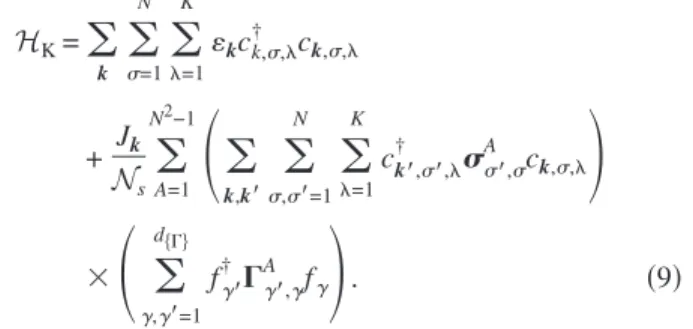
By making use of Eqs.共2兲, 共3兲, 共6兲, and 共8兲, we obtain the Hamiltonian related to the multichannel SU共N兲⫻SU共K兲 single-impurity Kondo model for an L-shaped Young tableau representation of the impurity spin
HK=
兺
k =1兺
N兺
=1 K kck,,† ck,, + Jk NsA=1兺
N2−1冉
兺
k,k⬘,兺
⬘=1 N兺
=1 K ck†⬘,⬘,⬘, A ck,,冊
⫻冉
兺
␥,␥⬘=1 d兵⌫其 f␥†⬘⌫␥A⬘,␥f␥冊
. 共9兲B. Functional integration method—Handling of the fermionic constraint
The partition function corresponding toHK共9兲 is
Z = Trspinexp关−HK兴, 共10兲
with= 1 / kBT. The difficulty in computing Z comes from
the constraint expressed in Eq.共5兲, which requires us to per-form the trace Trspin over the physical states involving one
pseudofermion at the impurity site only. However, the Pauli principle allows the number of pseudofermions at the origin to vary between 0 and d兵⌫其. More explicitly, the representa-tion of the impurity spin with pseudofermion operators en-larges the dimensionality of the Hilbert space in which these fields are acting, compared with the physical space appropri-ate for the true spin operators. The unphysical stappropri-ates dis-played in the pseudofermion formulation are then eliminated with the aid of the constraint. Therefore the evaluation of the trace in Eq.共10兲 cannot be simply performed using standard perturbation approaches, for instance, but requires the use of further techniques.
In order to settle this problem, we adopt a method pio-neered by Popov and Fedotov.49As explained in Appendix
B, one can introduce a set of auxiliary共imaginary兲 chemical potentials 兵in其1艋n艋d兵⌫其 governed by a discrete distribution
function P兵其, P兵其 = 1 d兵⌫其
兺
n=1 d兵⌫其 exp关in兴␦共+ in兲, in= i d兵⌫其共2n − 1兲. 共11兲A crucial property arising from Eq.共11兲 is that the imaginary chemical potentials depend on temperature. The partition function can be rewritten as
Z =
冕
DP兵其TrFockexp关−共HK−nˆf兲兴, 共12兲where the trace TrFock is performed over the entire Fock
space corresponding to the fermionic impurity spin operators without any constraint, namely including any number of pseudofermion共s兲 allowed by the Pauli principle. The contri-butions of the unphysical states共nf⫽1兲 to the partition
func-tion automatically cancel out one with the other by making use of the imaginary chemical potentials. With Eqs.共11兲 and 共12兲, we get
Z = 1 d兵⌫其
兺
n=1d兵⌫其
exp关in兴TrFockexp关−共HK+ innˆf兲兴.
共13兲 In the latter equation, in contrast with Eq.共10兲 of Z, the trace showing up in the calculation has to be performed in the grand canonical ensemble, which allows us to use standard techniques, namely the functional integration, Green’s func-tion method, and diagrammatic expansion. In a path integral formalism at finite temperature,61,62each Fock trace is given
by
FIG. 2. A Young tableau description of the fundamental 共irre-ducible兲 representation 兵其 associated with each conduction electron.
TrFockexp关−共HK+ innˆf兲兴 =
冕
Dc¯*Dc¯Df¯*Df¯ exp冉
−冕
0  d兵Ln共兲 + HK共兲其冊
, 共14兲 where c¯*, c¯, f¯*, f¯ are Grassmann variables associated withthe fermionic operators c†, c, f†, f, respectively, andL n共兲 is
the Lagrangian of free particles, expressed as
Ln共兲 =
兺
k =1兺
N兺
=1 K c ¯k,*,共兲¯ck,,共兲 +兺
␥=1 d兵⌫其 f¯␥*共兲共+ in兲f¯␥共兲. 共15兲One can notice from Eq.共15兲 that a direct consequence of the introduction of the auxiliary chemical potentials is a shift of the Matsubara frequencies related to the pseudofermions by a value of共−in兲.
Using Eqs.共14兲 and 共15兲, we finally obtain the expression of the partition function,
Z = 1 d兵⌫其n=1
兺
d兵⌫其 exp关in兴冕
Dc¯*Dc¯ Df¯*Df¯ ⫻exp冉
−冕
0  d兵Ln共兲 + HK共兲其冊
. 共16兲III. CALCULATION OF THE CONDUCTION ELECTRON SELF-ENERGY
In this section, we expand the conduction electron self-energy perturbatively in powers of the Kondo coupling con-stant JK. This means that we consider the weak coupling
limit. We closely follow the method developed by Gan
et al.24,25 in the special case of the SU共2兲⫻SU共K兲 Kondo
model, involving an impurity of spin 1 / 2. We use diagram-matic techniques.63,64
A. Construction of the electronic self-energy diagrams
Here we summarize the rules allowing us to derive the self-energy of the conduction electron, using a diagrammatic perturbative expansion of the partition function in JK. A de-tailed method to build the diagrams associated with the elec-tronic self-energy in the framework of the Kondo model is given by Silverstein and Duke,65 following Abrikosov.58
Al-though the final results will be given at T = 0, we work in the space of 共fermionic兲 Matsubara frequencies for technical simplicity. The rules are the following.
共i兲 In order to get the contribution at the mth order in the Kondo interaction JK, i.e., O关共JK兲m兴, we draw all the
topo-logically distinct diagrams linking m vertices.
共ii兲 Each conduction electron propagator 共C12兲 is repre-sented by a solid line,
共iii兲 Each impurity spin pseudofermion propagator 共C13兲 is drawn as a dashed line
共iv兲 Each vertex
contributes by a factor − JK Ns ␦m 1 e+m 1 i,m 2 e+m 2 i
兺
A=1 N2−1 2,1 A ⌫ ␥2,␥1 A . 共17兲共v兲 The independent internal momentums, frequencies, and spin indices have to be summed over.
共vi兲 Each conduction electron loop gives a factor 共−K兲. 共vii兲 Each pseudofermion loop contributes by a factor 共−1兲.
共viii兲 Each diagram O关共JK兲m兴 exhibits a combinatorial
symmetry factor fsym. This factor results from the
noncom-pensation between the number of permutations of the vertex and the contribution 共1/m!兲 due to Wick’s theorem.66 We
show it explicitly in Figs. 3–5, when its value is not equal to 1.
B. Contributions of the leading order terms to the conduction electron self-energy
In Figs. 3–5 we show the diagrams that will allow us to compute the scaling function perturbatively. As discussed in Sec. IV, these digrams are sufficient to derive the critical exponent of the model. The two subscripts in each term of
FIG. 3. Feynman diagram for the conduction electron self-energy at the second order in a perturbation theory in JK.
FIG. 4. Feynman diagrams for the conduction electron self-energy at the third order in a perturbation theory in JK.
the self-energy expansion indicate the corresponding powers of JK and K, respectively. Each diagram is factorized along
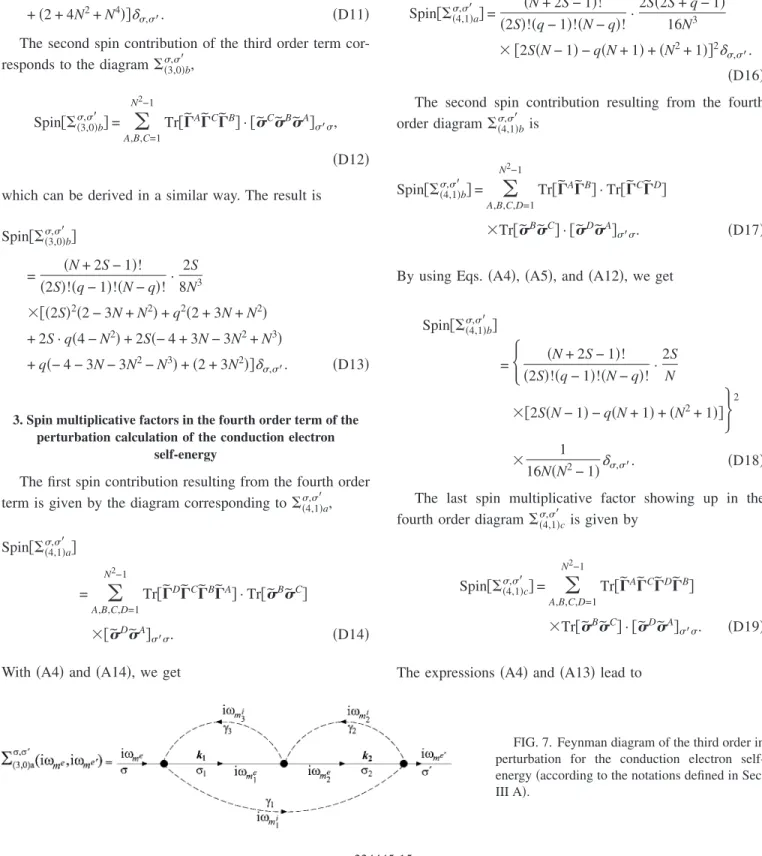
two main terms. The first one is the spin factor; it results from the summation over the internal spin degrees of free-dom. In Appendix D we present the method of calculation of these spin factors for all the diagrams we consider. It requires some knowledge about the properties共detailed in Appendix A兲 of the SU共N兲 generators 兵⌫˜其 and 兵˜其 associated with the impurity and the electronic spins, respectively. The second quantity is obtained by summing over the internal momen-tum and frequency degrees of freedom. Due to the presence of the imaginary chemical potentials 兵in其1ⱗnd兵⌫其, this part
has to be computed carefully. In particular, the free propaga-tors associated with the conduction electron and impurity
spins have to be redefined, which is done in Appendix C. In Appendix E, we detail the calculation of the third order dia-gram⌺共3,0兲a, displayed in Fig. 4. The other diagrams can be computed in the same way.
The single-impurity Kondo model can be used for the study of real systems of dilute 共low concentration兲 impuri-ties. For that purpose, we adopt the random impurity averaging,58 the principle of which is the following. A num-ber Niof impurity spins are randomly distributed in the
sys-tem. We only keep the linear contribution in the impurity density ni= Ni/Ns. Since the interactions between impurities
are completely neglected, we recover a single-impurity Kondo model. To summarize, each of the contributions⌺共j,l兲␣,⬘ to the conduction electron self-energy corresponding to a diagram of Figs. 3, 4, or 5 can be written as a factorized expression as follows:
⌺共j,l兲␣,⬘ =共− 1兲bpf·共− K兲l·共N
i兲 · fsym· Spin关⌺共j,l兲␣,⬘兴 · F共j,l兲␣,
共18兲 where bpf and l are the numbers of pseudofermion and
con-duction electron loop共s兲, respectively, Ni is the number of
impurities in the system, fsymis the combinatorial symmetry
factor of the diagram, Spin关⌺共j,l兲␣,⬘兴 is the spin term
corre-sponding to the contribution of the spin operators that in-volves the summation over the internal spin degrees of free-dom, and F共j,l兲␣ is the factor resulting from the contribution of the fermionic propagators which is obtained by perform-ing the summations over the internal momentum and Mat-subara frequencies.
We shall exclusively work at T = 0, allowing us to calcu-late the integrals in energy analytically as well as the sum-mations over imaginary chemical potentials included in the impurity spin free propagator共C13兲. We follow the conven-tional cutoff scheme: a cutoff in energy is introduced for the conduction electron band, i.e., −D艋k艋D, with a density of states per spin and per channel assumed to be constant.
At zero temperature after analytical continuation to the real axis, we obtain the contributions of the first perturbative order terms to the imaginary part of the electronic self-energy, Im关⌺共2,0兲,⬘共,
⬘
兲兴 = −冉
共N + 2S − 1兲! 共2S兲!共q − 1兲!共N − q兲!· 2S 4N2关2S共N − 1兲 − q共N + 1兲 + 共N 2+ 1兲兴冊
⫻ 共JK兲2· ni·冉
d兵⌫其− 1 关d兵⌫其兴2冊
· Im再
冕
−D +D d1 1 共−1+ i0+兲冎
·␦,⬘·␦共−⬘
兲, 共19兲Im关⌺共3,0兲a,⬘共,
⬘
兲兴 + Im关⌺共3,0兲b ,⬘共,
⬘
兲兴 = −冉
共N + 2S − 1兲! 共2S兲!共q − 1兲!共N − q兲!· 2S 4N关2S共N − 1兲 − q共N + 1兲 + 共N 2+ 1兲兴冊
共J K兲32· ni·冉
d兵⌫其− 1 关d兵⌫其兴2冊
⫻Im再
冕
−D +D d1d2 nFD共2兲 共−1+ i0+兲共1−2兲冎
·␦,⬘·␦共−⬘
兲, 共20兲FIG. 5. Feynman diagrams for the conduction electron self-energy at the fourth order in a perturbation theory in JK.
Im关⌺共4,1兲a,⬘共,
⬘
兲兴 + Im关⌺ 共4,1兲b ,⬘共,⬘
兲兴 + Im关⌺ 共4,1兲c ,⬘共,⬘
兲兴 =冉
共N + 2S − 1兲! 共2S兲!共q − 1兲!共N − q兲!· 2S 8N关2S共N − 1兲 − q共N + 1兲 + 共N 2+ 1兲兴冊
·共J K兲43· ni· K ·冉
d兵⌫其− 1 关d兵⌫其兴2冊
⫻Im再
冕
−D +D d1d2d3 nFD共− 1兲nFD共2兲nFD共− 3兲 + nFD共1兲nFD共− 2兲nFD共3兲 共−1+ i0+兲共−1+2−3+ i0+兲共2−3兲冎
·␦,⬘·␦共−⬘
兲, 共21兲where nFDis the Fermi-Dirac distribution function.
In a perturbative RG analysis, we are only interested in the energy range 0⬍ⰆD. Consequently in the previous expressions共19兲–共21兲 the terms in powers of 共/ D兲 are ne-glected, and we only keep the factors generating logarithmic contributions in ln共/ D兲, which are sufficient to derive the two leading order terms of the  scaling function, as dis-cussed in Sec. IV A. Whenever necessary, we keep only the principal part of the denominator exhibiting a pole. The in-tegrals in energy are computed in this limit following the method detailed by Gan,25 we get
Im
再
冕
−D +D d1 1 共−1+ i0+兲冎
= −, 共22兲 Im再
冕
−D +D d1d2 nFD共2兲 共−1+ i0+兲共1−2兲冎
=ln共/D兲, 共23兲 Im再
冕
−D +D d 1d2d3 共−1+ i0+兲共−1+2−3+ i0+兲 1 共2−3兲 ⫻关nFD共− 1兲nFD共2兲nFD共− 3兲 + nFD共1兲nFD共− 2兲nFD共3兲兴冎
=ln共/D兲. 共24兲By incorporating the integrals共22兲–共24兲 into Eqs. 共19兲–共21兲, we obtain Im关⌺兵⌫其,⬘共,
⬘
兲兴 =冉
共N + 2S − 1兲! 共2S兲!共q − 1兲!共N − q兲! ⫻关2S共N − 1兲 − q共N + 1兲 + 共N2+ 1兲兴 · 2S 4N冊
⫻冉
d关d兵⌫其− 1 兵⌫其兴2冊
共JK兲 2· n i·␦,⬘·␦共−⬘
兲 ·再
1 N−共JK兲ln共/D兲 +1 2共JK兲 2K · ln共/D兲冎
. 共25兲IV. PERTURBATIVE RENORMALIZATION GROUP APPROACH
In this section we use a perturbative RG method, the Anderson’s “poor man’s scaling” approach.26,37The
interme-diate coupling共IC兲 fixed point associated with the model is identified, for various limits characterized by the shape of the 兵⌫其 representation. We start by deriving the scaling func-tion, as a function of 共JK兲. A fixed point corresponds to a
zero of thefunction. A simple analysis of the scaling func-tion properties around a fixed point allows us also to deter-mine its stability.67 In the case of a stable IC fixed point, a
rich physics characterized by a non-Fermi liquid behavior of the system 共namely, anomalous temperature dependence of the specific heat, magnetic susceptibility,¼兲 can be expected.
A. Derivation of the scaling function from the conduction electron self-energy
In Sec. III B, we have calculated the first order terms of the conduction electron self-energy in a perturbative ap-proach. This yields the leading terms of the scaling func-tion,
共JK兲 =
d共JK兲
d共ln D兲. 共26兲
The connection between both results from RG arguments, more precisely the Callan-Symanzik equation,68,69 as
ex-plained later.
Without mentioning the spin dependence, we rename the imaginary part of the conduction electron self-energy Im关⌺兵⌫其,⬘兴, Eq. 共25兲, as ⌺兵⌫其
⬙
, to have shorter notation in what follows. Following Gan et al.,24,25⌺兵⌫其
⬙
can be expressed in the most general way up to the fourth order in perturbation theory as ⌺兵⬙
⌫其共,D,JK兲 = a 兵P0共JK兲2+ P1ln共/D兲共JK兲3 + P2· K · ln共/D兲共JK兲4+ P3· K ·共JK兲4 + P4ln2共/D兲共JK兲4+O关共JK兲5兴其, 共27兲where a , P0, . . . , P4are coefficients independent of, D, and
JK. ⌺兵⌫其
⬙
is the dimensionless scattering rate共i.e., inverseof the quasiparticle lifetime兲. The key point of the RG theory is that the underlying physics must be independent of the renormalization scheme, namely the cutoff D. Therefore the
scattering rate is invariant under RG transformation. The Callan-Symanzik equation resulting from this property is then
冉
共ln D兲+共JK兲 共JK兲冊
⌺兵⌫其⬙
共,D,JK兲 = 0. 共28兲Thescaling function is taken in its most general expansion up to the third order in powers of JK,
共JK兲 =1共JK兲2+2· K ·共JK兲3+3共JK兲3+O关共JK兲4兴.
共29兲 Equations共27兲 and 共29兲 incorporated into Eq. 共28兲 give
关21P0− P1兴共JK兲3+关22P0− P2兴K · 共JK兲4+ 23P0共JK兲4
+关31P1− 2P4兴ln共/D兲 · 共JK兲4+O关共JK兲5兴 = 0. 共30兲 Equation共30兲 generates logarithmic series valid for any cou-pling constant JK. Therefore the coefficients in front of the
terms of successive orders in JKare identically 0. The result
is 1= P1 2P0 , 共31兲 2= P2 2P0 , 共32兲 3= 0, 共33兲 P4= 3 21P1. 共34兲
The coefficients P0, P1, and P2are obtained from the
imagi-nary part of the conduction electron self-energy, Eq.共25兲,
P0= 1 N, 共35兲 P1= − 1, 共36兲 P2= 1 2. 共37兲
We point out here that the coefficients given by Eqs. 共35兲–共37兲 are exact at this stage for any value N, 2S, and q, without any restriction. As far as the consistency equation 共34兲 is concerned, it has been checked by Gan25 for an
im-purity spin in the fundamental representation of the SU共2兲 group. At each order of perturbation our study leads to the same integrals in energy displayed in Eqs. 共22兲–共24兲. The only difference between Gan’s work and our generalized ap-proach is contained in spin factors that depend on the con-sidered group and representation describing the impurity. Since we have calculated these spin factors in an exact way, we conclude that the previous consistency equation is auto-matically satisfied for any group and any impurity represen-tation we are interested in: the explicit calculation of P4for the generalized兵⌫其 representation is not required.
B. Analysis of the intermediate coupling fixed point
Following the results of Sec. IV A, thescaling function 共26兲 obtained in a perturbative theory calculation in JKup to
the third order is given by
共JK兲 = − N 2共JK兲 2+NK 4 共JK兲 3+O关共J K兲4兴. 共38兲
One of the main results of this work is that Eq.共38兲 is valid for any value of the parameters 2S and q characterizing the L-shaped representation of the impurity spin, provided that the perturbative expansion in JKis valid, as discussed in the
next paragraph.
The critical value J*taken by the Kondo coupling at the IC fixed point is obtained from the zero of the  function, i.e.,共J*兲=0. We get
J*= 2
K+O
冋
1
K2
册
. 共39兲The latter expression for J* allows one to determine the do-main of validity of the perturbative expansion. The RG per-turbative approach we use is valid in the weak coupling re-gime only. The IC fixed point has to be in the vicinity of the free electron fixed point of the system. Consequently, the perturbative expansion of the  function is trustworthy ex-clusively when J* is close to 0, which means by using Eq.
共39兲, KⰇ1. Since each conduction electron loop that gives a factor of共−K兲 contains two interacting vertices at least, and each term J* contributes by a factor of 1 / K, we conclude
that the diagrams displayed in Figs. 3–5 include all the con-tributions to the electronic self-energy up to the order
O关1/K3兴 at the IC fixed point. This argument allows one to
check the self-consistency of the calculation. Another restric-tion is due to the domain of validity of the perturbative ex-pansion. As previously noticed by Abrikosov-Migdal70 and Affleck-Ludwig,52the fourth order term in the expansion of
thefunction,O关共JK兲4兴, contains a coefficient proportional
to the eigenvalue of the quadratic Casimir operator 共A11兲 related to the impurity spin representation. In order that the latter contribution that has not been taken into account here remains negligible compared to the second and third order contributions, we must also suppose that N, 2S, and q are small compared to K. To summarize, the domain of validity of the scaling function perturbative expansion is given by
KⰇ 1, N Ⰶ K, 2S Ⰶ K, q Ⰶ K. 共40兲
Consequently, the IC fixed point describes an overscreened impurity, as discussed originally by Nozières and Blandin.1 The single-channel case turns out to be out of reach of the present study.
In addition to the value of J*, another key quantity that
can be drawn from the  function is its slope ⌬ at the IC fixed point, namely,
⌬ =
冉
d d共JK兲冊
JK=J* =N K+O冋
1 K2册
. 共41兲In the limit given by Eq. 共40兲 that we consider, ⌬ is auto-matically positive therefore the IC fixed point is stable.67The
slope⌬ determines the critical exponent of the model. It is a strong mark of the universality concept characteristic of the Kondo effect in the low-energy regime.71,72This regime
de-scribes the system at temperatures that are low compared to the bandwidth D. In that case the physics of the system is governed by a stable IC fixed point, and the temperature dependence of the various physical quantities at low T obeys a power law in T / TK that is entirely controlled by ⌬ 共TK
being the Kondo temperature兲.
The Kondo temperature is the only relevant energy scale in the problem; it is generated dynamically by the interac-tions with the impurity spin. It plays an essential role in the Kondo effect: TKcharacterizes a crossover between the weak
coupling regime and the low-energy regime. This tempera-ture scale is invariant under the scaling process. One can easily derive it by inverting and integrating the function expression.26 By using Eqs.共26兲 and 共38兲, we get
kBTK⬃ D共JK兲K/Nexp
冉
−2
N共JK兲
冊
. 共42兲
As mentioned previously, the results we have obtained are valid in the overscreened regime for any value of the param-eters N, 2S, and q, provided that Eq. 共40兲 is satisfied. The impurity spin representations that are adressed by the present study are displayed in Fig. 6. We conclude that all the Kondo models defined by these different impurity spin representa-tions belong to the same universality class in the over-screened regime, which is characterized by the following low-temperature behaviors:25 resistivity due to Kondo
scat-tering: ␦e共T兲 =e共T = 0兲 −␣
冉
T TK冊
⌬ ; impurity specific heat:Cimp共T兲 ⬃
冉
T TK冊
2⌬ ; magnetic susceptibility: imp共T兲 ⬃ 1 T冉
T TK冊
2⌬ .We can notice that the system described by an IC fixed point exhibits non-Fermi liquid properties. As in the original single-channel Kondo model characterized by an exactly screened spin 1 / 2 impurity, the resistivity increases when the temperature is lowered. Denoting by Sef fthe effective spin of
the impurity screened by the conduction electrons and具 典 the
thermal average, we have26 具共S
ef f兲2典⬃Timp共T兲⬃T2⌬→0 as
T→0, which indicates that the IC fixed point is associated
with a ground state corresponding to a spin singlet. In the overscreened regime the impurity spin is completely quenched by conduction electrons.
The value of the universal critical exponent ⌬ we have obtained in Eq.共41兲 is in agreement with the result of Gan
et al., who considered a spin 1 / 2 in the SU共2兲 group.24,25The
case of larger spins 共S⬎1/2兲 in the SU共2兲 group has also been studied,50,51 leading to similar results. Equation 共41兲
allows one to recover the overscreened limit of the exact solution of the multichannel Kondo model, obtained by using the Bethe ansatz for the symmetric impurity spin representa-tions of SU共N兲,9and boundary conformal field theory in the
case of an arbitrary impurity spin representation of the SU共2兲52and SU共N兲53groups. It also corroborates the large-N
studies of the SU共N兲⫻SU共K兲 Kondo model involving either the fundamental55 or the antisymmetric56 impurity spin
rep-resentations, although the K⬃N limit considered in these works is different from ours.
V. SUMMARY AND CONCLUSIONS
In this paper, we have studied a multichannel SU共N兲 Kondo model, involving a mixed symmetry impurity spin representation. Namely, the generalized impurity spin is re-alized by a combination of 2S bosonic and q fermionic de-grees of freedom, in the presence of K conduction electron channels. The study has been carried out by making use of a perturbative renormalization group technique, the Anderson “poor man’s scaling” approach. The main difficulty for the description of spin systems is that spin operators obey nei-ther Fermi nor Bose statistics, leading to the absence of Wick’s decomposition theorem in this context. Consequently, conventional perturbative methods are prohibited. We have used the Abrikosov pseudofermion formulation to describe the impurity spin states, and tackled the problem by making use of a method initiated by Popov and Fedotov. Its basic principle consists in introducing a set of auxiliary chemical potentials that eliminates the unphysical Hilbert subspace, keeping the physical spin states only, and therefore enables a proper handling of the fermionic constraint.
The partition function has been obtained within a path integral approach. The general expression of the conduction electron self-energy imaginary part has been derived pertur-batively in powers of the Kondo coupling constant, i.e., by considering the weak coupling limit. At each order of a per-turbative calculation the derivation involves two steps, namely, the calculation of the spin factor and the computa-tion of the fermionic propagator contribucomputa-tion, which includes the Popov-Fedotov auxiliary chemical potentials. The imagi-nary part of the conduction electron self-energy is propor-tional to the electronic scattering rate, which is a physical quantity and therefore is invariant under renormalization group transformation. The Callan-Symanzik equation can be applied, and yields the derivation of the two leading terms of thescaling function, i.e., up to the orderO关1/K2兴. We have
established that this truncated expansion of thefunction is valid in the overscreened共Nozières-Blandin兲 regime, for any
FIG. 6. Irreducible SU共N兲 representations of the impurity spin considered in the present work: 共a兲 L shaped; 共b兲 fundamental, 2S = q = 1;共c兲 symmetric, q=1; and 共d兲 antisymmetric, 2S=1.
value of N, 2S, and q, provided that these parameters remain small compared with K. The intermediate coupling共IC兲 fixed point describing the low-energy physics of the model has been identified in the overscreened regime. The critical ex-ponent⌬, corresponding to the slope of the  function to-wards JK at the IC fixed point, is given by
⌬ =N
K+O
冋
1
K2
册
.⌬ governs the temperature dependence of the various physi-cal quantities at low T that are of the non-Fermi liquid type, as discussed in Sec. IV. The IC fixed point describes the system in its ground state that is a spin singlet: in the over-screened regime the impurity spin is completely quenched by the conduction electrons located on its site.
Several types of impurity spin representations have been considered in previous works and can be viewed as special limits of the mixed symmetry formulation we have used. Hence direct comparisons with our study have been made possible. Our results are in agreement with those obtained by other methods, like Bethe ansatz and boundary conformal field theory. We have established that the Kondo models de-fined successively by fundamental, symmetric, antisymmet-ric, and mixed symmetry impurity spin representations yield exactly the same low-energy physics in the overscreened re-gime. To summarize, the present work gives a unified view of the overscreened Kondo regime, for a large set of repre-sentations of the impurity spin. It is also possible to consider arbitrary impurity spin representations, beyond the cases mentioned here. For example, one can think about represen-tations of the SU共N兲 group with rectangular-shaped Young tableaux, as discussed in Ref. 54. The method we present can be generalized to study the case of an arbitrary SU共N兲 rep-resentation. No additional conceptual difficulty has to be ex-pected. The spin factors associated with such a representa-tion, which are present in the conduction electron self-energy, have to be computed following the derivation displayed in Appendix D. The traces over ⌫˜ matrices we have to consider involve products of two or three generators in the impurity spin representation, and therefore the spin factors can be derived exactly for any irreducible represen-tation of SU共N兲.80,81,89 However the computation of these
spin factors as a function of the Young tableau parameters describing a completely arbitrary impurity spin representa-tion certainly requires extremely lengthy algebra, as the com-plexity of Eqs.共D9兲, 共D11兲, and 共D13兲, which are restricted to the L-shaped case we consider, suggests it easily.
Finally, we mention the case of the single-channel SU共N兲 Kondo model involving a mixed symmetry impurity spin, which we considered in a previous work.44,45In such a case,
the L-shaped impurity exhibits a rather surprising duality: it is exactly screened if one considers the fermionic compo-nent, but underscreened toward the bosonic one. An interest-ing problem remains. Namely, the understandinterest-ing of the low-energy physics in the regime characterized by an instability of the strong coupling fixed point turns out to be out of reach of the present work. This issue deserves further investiga-tions. It might have important future applications for the
Kondo lattice problem,73with potential implications for the
description of heavy-fermion compounds. In order to gain some insight it would be interesting to carry out a non-perturbative study. Unfortunately it is quite a difficult task. Indeed well-known methods usually efficient to study the Kondo problem, as numerical renormalization group or Be-the ansatz techniques, have severe limitations in Be-the context of the mixed symmetry representation. For example, the sim-plest impurity that displays an IC fixed point in the single-channel case implies a large Hilbert space which restricts the efficiency of a numerical renormalization group study. The difficulties encountered by the Bethe ansatz are of a different nature: due to the mixed symmetry properties of the impurity spin representation, the model with Kondo coupling only is not integrable.74
ACKNOWLEDGMENTS
We would like to thank Natan Andrei for highly valuable comments and discussions at several steps of this work. We are grateful to Marijana Kirćan for a careful reading of the manuscript. D.B. would like to acknowledge extremely fruit-ful discussions with Alex Hewson, Naoto Nagaosa, Philippe Nozières, and Roland Zeyher.
APPENDIX A: PROPERTIES OF THE SU„N… GENERATORS
In this appendix we give some properties of the genera-tors兵˜其 and 兵⌫˜其, in the case of the two types of irreducible
representations we have to consider in the SU共N兲 group. The first one concerns the conduction electron, it is the funda-mental共single-box兲 representation 兵其 displayed in Fig. 2. Its dimension is
d兵其= N, 共A1兲 and the eigenvalue of the quadratic Casimir operator corre-sponding to兵其 is
C2共兵其兲 =
N2− 1
2N , 共A2兲
which in the case of a spin S in SU共2兲 takes the usual value
S共S+1兲. The associated traceless Hermitian matrices
兵˜A其
1艋A艋N2−1 obey the following properties:60
– multiplication law: ˜A˜B= 1 2N␦ABI ˜ 兵其+ 1 2C=1
兺
N2−1共dABC+ ifABC兲˜C; 共A3兲
– normalization relation: Tr关˜A˜B兴 =1 2␦AB; 共A4兲 – completeness relation:
兺
A=1 N2−1 ␣,A ␥,A␦= 1 2冉
␦␣,␦␦,␥− 1 N␦␣,␦␥,␦冊
, 共A5兲where A, B, and C label the SU共N兲 generators matrices 共1艋A,B,C艋N2− 1兲, I˜
,␥, and ␦ label electronic spin colors 共1艋␣,,␥,␦艋N兲, and dABCand fABCare the structure constants related to the d˜
and f˜ Gell-Mann tensors, respectively.75 The structure
con-stants are characteristic of the underlying Lie algebra. These
tensors follow the rules:
– d˜ is totally symmetric:
dABC= dBAC; – f˜ is totally antisymmetric:
fABC= − fBAC; – d˜ and f˜ are traceless tensors:
兺
B
dABB=
兺
B
fABB= 0.
In SU共2兲, d˜=0 and f˜=˜, the totally antisymmetric⑀
共Levi-Civita兲 tensor of rank 3. In further calculations, we use the following identities:76,77
兺
B,C dACBdGBC=N 2− 4 N ␦AG, 共A6兲兺
B,C fACBfGBC= − N␦AG, 共A7兲兺
B,C dACBfGBC= 0. 共A8兲The second representation of interest deals with the impu-rity spin. It is an L-shaped representation denoted by 兵⌫其, and characterized by 2S boxes in the first row 共horizontal line兲 and q boxes in the first column 共vertical line兲, as dis-played in Fig. 1. Its dimension can be derived by the use of Robinson’s formula78 d兵⌫其= 2S 2S + q − 1CN+2S−1 2S C N−1 q−1, 共A9兲
and the eigenvalue of the quadratic Casimir operator associ-ated with兵⌫其 is given by79
C2共兵⌫其兲 = 1 2
再
共2S + q − 1兲关N2−共2S + q − 1兲兴 N +兺
j=1 N mj共mj+ 1 − 2j兲冎
, 共A10兲where mjis the number of boxes in the jth row共1艋 j艋N兲 of
the Young tableau describing兵⌫其. Finally
C2共兵⌫其兲 = 2S + q − 1 2
冉
2S − q + N − 2S + q − 1 N冊
. 共A11兲 We give now useful identities satisfied by the 共d兵⌫其⫻d兵⌫其兲 components of the兵⌫˜A其 matrices. The normalization relation is80 Tr关⌫˜A⌫˜B兴 =d兵⌫其C2共兵⌫其兲 d兵其C2共兵其兲 Tr关˜A˜B兴 =d兵⌫其C2共兵⌫其兲 d兵其C2共兵其兲 ␦AB 2 . 共A12兲 The generators in the兵⌫其 representation obey also some par-ticular multiplication laws for the contracted indices close to each other,81兺
B ⌫˜B⌫˜A⌫˜B =再
C2共兵⌫其兲 − C2共兵Adj其兲 2冎
⌫˜ A , 共A13兲兺
B ⌫˜C⌫˜B⌫˜B⌫˜A =C2共兵⌫其兲⌫˜C⌫˜A, 共A14兲whereC2共兵Adj其兲 is the eigenvalue of the quadratic Casimir
operator associated with the adjoint representation of SU共N兲. Due to the choice of normalization given by Eq.共A4兲, we haveC2共兵Adj其兲=N.
APPENDIX B: POPOV AND FEDOTOV METHOD
In this appendix we briefly explain a method pioneered by Popov and Fedotov,49 in order to handle the constraint 共5兲
fixing the number of pseudofermions on the impurity site. Originally formulated for spins 1 / 2 and 1 of the SU共2兲 group, this powerful method has been developed for arbitrary spin in SU共2兲82 and generalized to SU共N兲.83 It has already
been used to study the Heisenberg model,84 the Kondo
lattice,85 and disordered systems.86,87
The principle is to express the partition function of a spin system in terms of partition functions of a corresponding fermionic system, pseudofermions being used to describe the spin states. The problem is to incorporate the fermionic con-straint properly, namely to eliminate the unphysical Hilbert subspace without removing the true spin states. This can be done by noticing that the Kondo Hamiltonian 共9兲 without imposing any constraint is disconnected in the peudofermion charge sectors. Consequently, the trace over the full Fock space共i.e., without constraint兲 can be rewritten by applying the Pauli principle as
TrFockexp关−共HK−nˆf兲兴 =
兺
nf=0 d兵⌫其Trnfexp关−共HK−nˆf兲兴,
共B1兲 where Trnf is the local subtrace over the states with a fixed
number nf of pseudofermion共s兲 on the impurity site. The
physical partition functionZ 共10兲, which includes the fermi-onic constraint, is, together with Eq.共B1兲,
Z =␦共nf− 1兲 · TrFockexp关−共HK−nˆf兲兴. 共B2兲
By using the identity
␦共nf− 1兲 =
1
d兵⌫其n=1
兺
d兵⌫其
ei共2n−1兲/d兵⌫其ei共1−2n兲nf/d兵⌫其,
Z =
冕
DP兵其TrFockexp关−共HK−nˆf兲兴, 共B3兲 with P兵其 = 1 d兵⌫其兺
n=1 d兵⌫其 exp冉
i d兵⌫其共2n − 1兲冊
⫻␦冉
+ i d兵⌫其共2n − 1兲冊
, 共B4兲 which is exactly Eq.共11兲.APPENDIX C: DERIVATION OF THE FREE PROPAGATORS
In order to compute the conduction electron self-energy at the first orders in a perturbative theory in JK, the first step
consists in deriving the free propagators associated with the conduction electrons and the pseudofermions. It is performed in this appendix. Due to the presence of the imaginary chemical potentials共11兲 in the partition function Z 共16兲, we should determine the free propagators carefully. For that pur-pose we use the technique of the generating function.61,88
Let us denote by J*, J, and *, the external sources coupled to the conduction electron c¯, c¯* and impurity
fer-mion f¯, f¯*variables, respectively. These external sources are Grassmann numbers. The generating function is
ZG关J,J*,,*兴 =
冕
Dc¯*Dc¯ Df¯*Df¯冋
1 d兵⌫其兺
n=1 d兵⌫其 exp关in兴 · exp冉
−兺
imk,兺
, 兵c¯k,, * 共i m兲共− im+k兲c¯k,,共im兲− Jk,*,共im兲c¯k,,共im兲 − c¯k,*,共im兲Jk,,共im兲其
−
兺
im
兺
␥兵f¯␥*共im兲共− im+ in兲f¯␥共im兲 −␥*共im兲f¯␥共im兲 − f¯␥*共im兲␥共im兲其
冊
册
. 共C1兲If each source is put to 0, one can see immediately thatZGis identical to the free partition functionZ
0, describing the system
in the absence of the Kondo interaction. The free propagators are given by the thermal averages
具c¯k0,0,0共im0兲c¯k0,0,0 * 共i m0兲典0=
冋
1 Z0 2ZG关J,J*,,*兴 Jk0,0,0共im0兲Jk0,0,0 * 共i m0兲册
J=J*=0 =*=0 , 共C2兲 具f¯␥0共im0兲f¯␥0 * 共i m0兲典0=冋
1 Z0 2ZG关J,J*,,*兴 ␥0共im0兲␥0 * 共i m0兲册
J=J*=0 =*=0 . 共C3兲We use then the following identity for Gaussian integrals over Grassmann fields:
冕
Dc¯*Dc¯ Df¯*Df¯ exp冉
−兺
imk,兺
, 兵c¯k,, * 共i m兲共− im+k兲c¯k,,共im兲 − Jk,, * 共i m兲c¯k,,共im兲 − c¯k,, * 共i m兲Jk,,共im兲其 −兺
im兺
␥ 兵f¯␥*共im兲共− im+ in兲f¯␥共im兲 −␥*共im兲f¯␥共im兲 − f¯␥*共im兲␥共im兲其
冊
= exp