Can network coding bridge the digital divide in the pacific?
The MIT Faculty has made this article openly available.
Please share
how this access benefits you. Your story matters.
Citation
Speidel, Ulrich, et al. "Can Network Coding Bridge the Digital Divide
in the Pacific?", 2015 International Symposium on Network Coding
(NetCod), 22-24 June 2015, Sydney, Australia, IEEE, 2015, pp. 86–90.
As Published
http://dx.doi.org/10.1109/NETCOD.2015.7176795
Publisher
Institute of Electrical and Electronics Engineers (IEEE)
Version
Original manuscript
Citable link
http://hdl.handle.net/1721.1/113386
Terms of Use
Creative Commons Attribution-Noncommercial-Share Alike
Can network coding bridge the digital divide in the
Pacific?
Ulrich Speidel, ’Etuate Cocker
Dept. of Computer Science The University of Auckland {ulrich|ecoc005}@cs.auckland.ac.nz
P´eter Vingelmann, Janus Heide
Steinwurf ApS Aalborg, Denmark {peter|janus}@steinwurf.com
Muriel M´edard
EECS
Massachusetts Institute of Technology [email protected]
I. INTRODUCTION
The present study has its genesis in a longitudinal project aimed at determining long-term trends in jitter, packet loss and other observables on long-distance Internet paths [1]. The project also documents the challenges faced by users in remote locations with numerous nodes in various Pacific Island nations. This naturally poses the question how one might improve their connectivity.
Bandwidth upgrades can address the bandwidth bottleneck to an extent, but do not address latency issues unless an island simultaneously upgrades to a lower latency connection, i.e., from a geostationary (GEO) to a medium earth orbit (MEO) satellite [2] or to a fibre-optic submarine cable.
Latency is particularly problematic when accompanied by packet loss. Satellite links to Pacific islands usually have much lower bandwidth than the international fibre networks supplying them, making them prime candidates for packet queue formation and hence for packet loss associated with tail drops.
Moreover, packet loss causes TCP sessions to lowering their data rate. However, long latency prevents TCP from doing so in a timely fashion, which can lead to queue oscillation at the satellite gateway [3]. This can result in frequent idleness of the link, i.e., unused satellite bandwidth being observed even over short time intervals in the order of seconds.
Many small Pacific island states are developing nations with small populations (with similar numbers living overseas, mostly in New Zealand, Australia and the U.S.). Only a few, such as Hawaii, Fiji, and Guam, are the lucky transit points of international fibre routes. Others such as Tonga or Samoa are located close enough to such a transit point and populous enough to be able to afford a spur connection from a transit point. Many others simply do not have the population or budget for a fibre connection.
MEO satellites represent a lower cost/bandwidth alternative to fibre, with latencies roughly comparable to a fibre link from New Zealand to California. However, small islands often cannot muster the resources to install and maintain the required tracking antennas. At the time of writing, a small number of O3b MEO connections operate in Rarotonga, Samoa and East Timor [2].
This leaves in particular the smallest, poorest, and most remote island communities reliant on expensive low-bandwidth and very long latency GEO satellite links. In many cases,
thousands of people share an international link bandwidth equivalent to an average residential ADSL connection.
Various fast TCP variants such as H-TCP [4] and Hybla [5] attempt to establish a stable flow across long-latency connec-tions, but are generally aimed at large-bandwidth scenarios to transfer large amounts of data efficiently. Our results indicate that they do not perform significantly better than conventional TCP in low-bandwidth scenarios in the Pacific and do not routinely outperform the most widely deployed Linux TCP variant, Cubic [6].
Network coded TCP [7] (TCP/NC) is a forward error correction technique which may be used to hide packet losses between two hosts on a TCP network. This can mask tail drops at the satellite gateways, but an end-to-end TCP/NC so-lution requires both the sending and receiving host to “speak” TCP/NC. While this could conceivably be achieved for on-island hosts, it would be unrealistic to expect the rest of the Internet to follow suit.
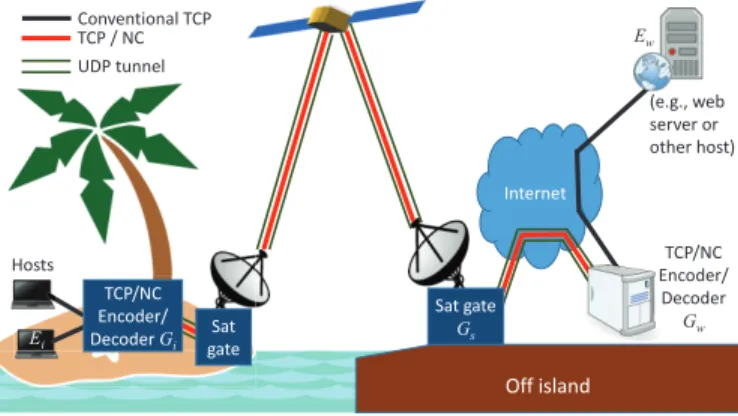
An alternative solution is to deploy a network-coded “tun-nel” between an off-island host with good connectivity to the Internet, and an island host acting as a gateway to an on-island network. This tunnel could mask satellite gateway losses and supply island end users with a low-loss connection to the Internet, avoiding the start-stop behaviour of their conventional TCP connections. But how well could this work in practice? This paper describes the initial results of a TCP/NC project in three Pacific Island locations with slightly different profiles.
We first give a brief birds-eye overview of TCP/NC and the basic network topology of our project, followed by an introduction to our deployment sites and initial observations from each.
II. NETWORK-CODEDTCP
Network coding has attracted considerable research interest in information theory and communication engineering over the last decade, with much of the focus on solutions for mobile and wireless, especially in broadcast and multicast settings and in cooperative networking. In recent years, a number of authors have also proposed its use in conjunction with conventional point-to-point TCP/IP networking [7], [8]. Network coding has also been investigated on the link layer of satellite links [9].
The fundamental idea of TCP/NC is to treat the original packets in a TCP connection as variables in a system of linear equations. As each packet is simply a binary string,
it also represents a binary number, which can be multiplied and added. From a set of packets p1, p2, . . . , pn, random
linear network coding (RLNC) generates a set of n + ω linear equations with random coefficients ci,j such that the
i-th equation in the set is:
n
X
j=1
ci,jpj= ri.
where 1 ≤ i ≤ n + ω. We refer to n as the generation size and to ω as the overhead and write n + ω to denote the size of the system. Instead of transmitting the original packets, TCP/NC transmits “equation” packets, i.e., the coded packet for the i-th equation encodes the ci,j for 1 ≤ j ≤ n and ri.
The receiving host can recover all of p1, p2, . . . , pn once it
has received n linearly independent coded “equation” packets. Note that as the sender generates n + ω coded packets, the communication can in principle tolerate the loss of possibly up to ω arbitrary packets (readers without a background in linear algebra will probably still remember the “at least n equations for n variables” rule from school). Moreover, the sender can start generating redundancy as soon as two of the original packets are available, it does not have to wait for all n packets like a block coder would have to.
The field from which one picks the ci,j, the sparseness of
the matrix ci,j, the choice of n and ω all influence robustness,
coding rate, and decoding delay and complexity. A detailed discussion of these topics is beyond the scope of this paper. We merely note here that this is an active research area, some aspects of which we will return to in the rest of this paper.
III. IPNETWORKING CONSIDERATIONS FORTCP/NC TUNNELS
The tunnel in our experiments transports coded packets in the payload of UDP packets. UDP packets heading to the island originate from an off-island gateway Gw and terminate
at a gateway Gi on the island. In this case, Gw acts as the
NC encoder and Gi as the decoder. In the opposite direction,
Gi generates coded packets and Gw is the decoder. Note
that Gw can be anywhere on the Internet: Rather than being
topologically close to the satellite gateway Gs facing the
island, it should be close to the source/destination of the data required on-island to minimise the latency of the connection links covered by conventional TCP only.
Off island Hosts Internet Conventional TCP TCP / NC UDP tunnel Sat gate TCP/NC Encoder/ Decoder *L Sat gate *V (L (Z TCP/NC Encoder/ Decoder *Z (e.g., web server or other host)
Fig. 1. TCP/NC network topology
The UDP headers of the tunnel packets contain only the IP addresses of Gw and Gi. The IP addresses of the actual
endpoints of each connection travelling through the tunnel travel inside the UDP payload as part of the NC header, i.e., they are not visible between Gw and Gi. We denote these
endpoints as Ei (on-island) and Ew (outside world).
For an IP packet from Ei to reach Gi for encoding, it
suffices to insert Gi as a “gateway router” for the on-island
subnet in which Ei resides. The tunnelled and decoded packet
then egresses from Gw enroute to Ew. N.B.: The network
within which Gw resides must allow egress of packets from
Ei’s subnet.
In the opposite direction, an IP packet from Ew to Ei
must find its way to Gw for encoding. This requires one of
the following two configurations to be implemented:
1) Ei must be part of the autonomous system (AS) of
Gw, and the AS must be configured internally to route
traffic to Ei via Gw once it enters the AS.
2) Alternatively, Gw may be one of the (at least)
two BGP gateway routers giving access to an on-island AS within which Ei resides. In this case,
all gateways for this AS also need to be TCP/NC encoders/decoders to ensure that only encoded traffic enters the AS.
Note that Eicannot simply use an address from the on-island
network for which the satellite gateway Gs acts as the IP
gateway. If it did, BGP would route packets from Ew to Ei
straight to Gs, bypassing the encoder Gw. In our experiments,
we opted for the first configuration as it only needs a single off-island gateway Gw. The drawback of this solution is that
the AS of Eistarts off the island, potentially leaving an island
ISP reliant on address blocks from the AS of a single offshore provider. Note also that the Gi’s IP address must be reachable
via the satellite gateway Gs, so cannot be part of the same AS
as Ei’s subnet.
Packet size also needs to be considered: As TCP/NC adds its own header to each encapsulated packet, the packet may exceed the MTU (maximum transmission unit) between Gw
and Gi, leading to IP fragmentation. While this does not affect
principal functionality, it adds undesirable overhead and can affect timing and performance. For unfragmented UDP transit, the tunnel must limit the MTU for unencoded IP packets at Gwand Gito the MTU of the path between Gwand Giminus
the size of the NC header.
In our experiment, we use a Gw with two Ethernet
inter-faces, eth0 and eth1, configured as follows:
• eth0 is the tunnel interface. Its single exclusive route points at the “normal” island IP address of Gi’s tunnel
interface only so it can reach it via Gs. eth0 connects
to its own router port in its own exclusive /30 subnet. The tunnel endpoint itself is a virtual network device supplied by Steinwurf ApS as a loadable Linux kernel module. This endpoint intercepts packets from Gi’s
tunnel interface arriving at eth0 and decodes them. Similarly, any unencoded packets sent to the virtual adapter are encoded and sent to Gi via eth0.
• eth1 is the default “world” interface. It also connects to its own router port in its own exclusive /30 subnet,
separate from eth0’s subnet. Any outgoing traffic not destined for eth0’s subnet or Gi egresses here.
Similarly, the outside world routes traffic destined for Gw and for Ei’s on-island subnet to eth1. Any IP
packets destined for the latter subnet are sent to the virtual network device for encoding.
The Gwin our study is a Dell PowerEdge R320 server with an
Intel Xeon E5-2420 v2 Processor running at 2.20 GHz based at the University of Auckland. A further Gwendpoint is planned
for California.
At the island ends, the respective Gi have three Ethernet
interfaces (say eth0, eth1 and eth2):
• As in Gw, eth0 is the tunnel interface with a single
exclusive route pointing at the IP of eth0 on Gw. The
tunnel endpoint is the same kernel module as in Gw,
configured to peer with eth0 on Gwto intercept UDP
from there for decoding. Any unencoded packets sent to the virtual adapter are encoded and sent to Gwvia
eth0.
• eth1 now serves as the interface to Ei’s on-island
subnet. Decoded traffic for Ei egresses here, and any
traffic arriving at this interface from the outside is sent to the kernel module for encoding.
• eth2acts as a “maintenance interface” for emergency remote access from off-island machines via Gsif eth0
is unavailable. eth2 and eth0 must be in different networks. Policy routes let Gi respond to incoming
standard TCP traffic on both eth0 and eth2.
Our Gi at each island end is a Stealth LPC-630F Little PC
industrial computer with an Intel i7-3520M Gen 3 processor. IV. DEPLOYMENT SITES
The study deployed Gi in the following locations:
Rarotonga, Cook Islands. Rarotonga has a permanent popu-lation of over 13,000, with an estimated 1000 to 3000 visitors at any time 1 Telecom Cook Islands (TCI), Rarotonga’s sole Internet provider, connects primarily via the O3b MEO satellite network. At time of deployment, TCI subscribed to 160 Mbps down- and 40 Mbps uplink, normally routed via O3b’s Hawaii teleport. Casual 802.11b/g/n Internet retailed for around US$ 0.06 - 0.08 per MB on Rarotonga; US$ 75 bought a month of ADSL connection limited to 4 Mbps with an 8 GB data cap. Niue. This single-island country has a permanent population of around 1,600 with only a small number of visitors but a large overseas diaspora: Over 20,000 Niueans live in New Zealand alone [11]. Niue’s only ISP is Internet Niue, with a GEO connection now providing 8 Mbps down- and 2 Mbps uplink after an upgrade. Niue has a free local public access 802.11 WiFi network covering most of the island. US$ 70 buys a month of ADSL limited to 384 kbps / 2 GB.
Funafuti Atoll, Tuvalu. Funafuti is the most populous atoll in Tuvalu with ≈4,500 inhabitants. The sole ISP, Tuvalu
1Authors’ estimate based on monthly government visitor arrival
statis-tics [10].
Telecommunication Corporation (TTC), uses a GEO link. Its satellite provider also manages some of TTC’s on-island network near the local satellite gateway for TTC. The GEO downlink rate into Funafuti was not available to us, but our measurements indicate a rate of 16 Mbps. US$100 buys 256 kbps ADSL with 3 GB data/month.
A somewhat unusual component of TTC’s network is a SilverPeak NX-3700 WAN Optimiser [13], which carries all production IP traffic. Details on the configuration of the device were not available. However, its functions include forward error correction in tunnels via parity packets that can be added automatically or at pre-set ratios to protect against sporadic packet loss. We also observed that the device had network memory activated. Other features include packet reordering, coalescing of smaller packets into larger ones, IP header / payload compression, and TCP and other protocol acceleration. Network memory in particular makes it challenging to compare TCP/NC and conventional TCP across a SilverPeak path, as some packets are served from local cache and never transit the link. We therefore positioned the TCP/NC encoder / decoder in Funafuti such that our traffic to it did not pass through the SilverPeak device. However, we measured conventional TCP goodput to a machine supplied through the NX-3700.
Both Niue and Tuvalu have signed up to the Kacific geostationary high-throughput broadband satellite system [12], with a ready-for-service date in 2017. This will increase the bandwidth into both countries to levels broadly comparable to the current Rarotonga connection and will provide direct-to-building services.
V. OBSERVATIONS TO DATE
Data from our IIBEX database, collected using VoIP-like UDP traffic with small packets transmitted at 50 packets/s, showed packet loss on both up- and downlink to and from Rarotonga of between 0 and 0.25% before deployment. To and from Niue, packet loss was below 0.1%. No recent data was available for Tuvalu, but data from 2013 suggested packet losses of up to 2.5%. At deployment time, we encountered similar values with significant variation over time.
As part of the deployment, we undertook extensive throughput measurements in all locations using both con-ventional TCP and TCP/NC. We found the following in the respective locations:
Rarotonga: Conventional TCP seemed unable to access more than around 75% of the available satellite bandwidth, even over short time intervals in the order of seconds. Most of the time, the observed utilisation was below 60%. As satellite uplinks are not subject to medium contention, the utilisation below 100% implies that the input queue to the satellite modem in Hawaii empties completely during those time periods.
However, we also observed regular burst packet losses in inbound traffic. These do not occur between the various offshore locations involved, indicating an association with the satellite link. Burst losses are characteristic for tail drops on overflowingqueues, in this case most likely the input queue to the satellite modem, where high bandwidth fibre or Ethernet
0 5 10 15 20 25 30 35 40 28/01/2015 29/01/2015 30/01/2015 31/01/2015 01/02/2015 02/02/2015 03/02/2015 0.01 0.1 1 10 100
Goodput [Mbit/s] Packet loss [%]
Date
TCP TCP/NC Packet loss [%] + 0.01%
Fig. 2. Comparison between TCP and TCP/NC goodput over time using a 30 + 6 TCP/NC tunnel between Auckland and Rarotonga. Note the comparatively stable performance of TCP/NC at times of low TCP goodput.
0 5 10 15 20 25 30 35 40 0.01 0.1 1 10 100 Goodput [Mbit/s] Packet loss [%] + 0.01% TCP TCP/NC
Fig. 3. TCP and TCP/NC goodput vs. packet loss using a 30 + 6 TCP/NC tunnel between Auckland and Rarotonga. TCP/NC almost always outperforms TCP, which always does worse when packet loss is high.
traffic feeds into the lower bandwidth of the satellite link, but can also be caused by the radio link itself.
Link underutilisation with this behaviour is a well-known effect called queue oscillation [3], which often occurs at Internet bottlenecks with multiple parallel flows. All satellite links under consideration here qualify as bottlenecks with bandwidths below those of the networks connected at either end. Queue oscillation can occur when multiple TCP flows try to “fill the pipe” through the bottleneck. Traffic banks up until the queue overflows, resulting in packet loss. The TCP senders cannot detect this until an ACK becomes overdue or a selective repeat request arrives. Neither of these events reduces the queue arrival rate for a full end-to-end round-trip-time (RTT) period, long enough to turn most connections’ packet losses into bursts. This causes all senders to slow down and the arrival rate at the queue now drops substantially below the satellite bandwidth; the queue drains and the link sits idle. Without further packet losses, the sending rates increase again. This cycle can repeat within only a few RTTs, explaining why the effect is seen even at small timescales of just a few seconds. Initially, we required n + ω = 60 + 30 (=50% redundancy) to mask the packet loss bursts for our TCP sender to sustain a higher packet rate. Between Ubuntu servers offshore and a Linux client on the island’s test network, goodput improved by up to a factor of 4 with the TCP/NC tunnel. Bandwidth utilisation increased to almost 90% for a single download via the tunnel. With a Windows 7 client, goodput improvement
was only ≈ 25%, which was sustainable for several parallel connections, however. Possible reasons may include fragmen-tation or packet reordering across the tunnel.
When revisiting the Rarotonga link in late January 2015, we found that (a) the total downlink bandwidth had increased to 200 Mbps, (b) conventional TCP now slightly outperformed the 60 + 30 tunnel, (c) the queue still seemed to be oscillating, with similar utilisation percentages, i.e., around 25% additional throughput, and (d) a 30 + 6 tunnel (constant 20% overhead) was now sufficient to mask losses in most cases and gave better goodput than TCP, especially at times of high packet loss (see Fig. 2). During periods of low or no packet loss, the 30 + 6 tunnel mostly yielded goodput comparable to conventional TCP. This suggests that an adaptive overhead scheme could replace most of the overhead by goodput during these times. Niue: The link into Niue sees sustained peak data rates of around 7.5 Mbps with >7 Mbps recorded for much of the day. Individual conventional TCP connections achieve around 0.3 Mbps. Packet loss into Niue is low but not zero. Closer inspection reveals that the link transports goodput without redundant retransmissions arriving at the Niue end. At the utilisation and data rates observed, the link can thus handle around 25 parallel connections.
Single TCP connections across a TCP/NC tunnel achieved around 2-2.4 Mbps goodput with very low overhead, i.e., the entire link capacity would be exhausted by 3-4 such TCP/NC connections. Given the high existing link utilisation, this additional performance of even a single connection comes at the expense of conventional TCP goodput. However, if these connections are downloads, the higher goodput rate also shortens the flow. This poses the question as to whether short wideband flows with TCP/NC are better from a user perspec-tive than long thin ones, given that the bulk of bandwidth use consists of flows that download something.
In Niue, we also investigated the potential of H-TCP and Hybla compared to the standard Cubic TCP used by Ubuntu. While there were considerable differences between them and Cubic at certain times, neither of the two presented a convincingly strong alternative on this narrowband path. Funafuti: No link utilisation data was available, but we were able to measure traffic directly between the sat gate and TTC’s local network with a line tap and nprobe/ntop [14]. Without TCP/NC, utilisation for total IP data traffic into Funafuti seldom exceeded 2-3 Mbps – less than 20% of available
bandwidth. Packet losses occurred as soon as a relatively modest load was offered. In combination, these observations once again suggest queue oscillation.
Conventional TCP to the Funafuti TCP/NC encoder/decoder (i.e., not through the NX-3700) did not exceed 1.6 Mbps at any time. During peak hours, rates were <0.4 Mbps and some connections timed out. Closer analysis revealed that peak time packet loss bursts during oscillation ran into the hundreds of packets – longer than the maximum overhead presently possible in our TCP/NC kernel module. Downloads into Funafuti via TCP/NC tunnel achieved a steady average goodput of around 4 Mbps for a single connection. Link utilisation with a 60 + 30 generation tunnel observed regularly reached short-term peak rates of over 15 Mbps, i.e., longer downloads may well reach average rates >4 Mbps. Conventional TCP throughput on the local network side of the NX-3700 reaches up to 13 Mbps. Given the comparatively low data rate observed as going into Funafuti, it is likely that a significant part of the 13 Mbps is supplied by the NX-3700 network memory function.
VI. CONCLUSIONS AND FUTURE WORK
This paper reported on preliminary observations from our three deployment sites. These show that TCP/NC can provide significantly higher goodput rates for individual connections than conventional TCP and that it can exploit spare capacity on satellite links left idle due to queue oscillation. On such links, TCP/NC can provide additional goodput. On links already carrying mostly goodput (Niue), it can merely replace long and more or less parallel data transfers by short and mostly successive ones. A possible benefit of this is that individual downloads complete faster, reducing user temptation to abort downloads (and hence waste partially downloaded data).
There are many obvious questions that we have not yet been able to investigate and many challenges to address. These include finding optimal generation sizes and overheads, adapting them to conditions, investigating the potential use of a performance-enhancing proxy (PEP) that breaks up the TCP connection into multiple sections, and the performance of TCP/NC if used in conjunction with network memory and other functions of a WAN optimiser. Also, we still expend a lot of TCP/NC overhead on a problem primarily caused by the conventional TCP traffic our TCP/NC streams mingle with. Would an all-TCP/NC link work with less overhead? That said, the pace at which these investigations will be able to proceed is limited by the very problem we are trying to solve: the long-latency, low-bandwidth satellite links into Pacific Islands.
ACKNOWLEDGEMENTS
This research was supported by the Information Society Innovation Fund Asia through the Pacific Island Chapter of the Internet Society (PICISOC) and by Internet New Zealand. We would also like to thank the many Internet users and staff of Telecom Cook Islands, Internet Niue, and the Tuvalu Telecommunication Corporation for their patience during this study and for sharing their precious bandwidth with us.
REFERENCES
[1] IIBEX home page, http://iibex.auckland.ac.nz/. Visited 15 February 2015.
[2] O3b Networks, home page, http://www.o3bnetworks.com/. Visited 15 February 2015.
[3] J. Kim, I. Yeom, Reducing Queue Oscillation at a Congested Link, IEEE Transactions on Parallel and Distrbuted Systems, 19(3), 394–407, 2008 [4] D. Leith, H-TCP: TCP Congestion Control for High Bandwidth-Delay Product Paths, Internet Draft, IETF, April 7, 2008, https://tools.ietf.org/ html/draft-leith-tcp-htcp-06
[5] C. Caini, R. Firrincieli, TCP Hybla: a TCP enhancement for heteroge-neous networks, Int. J. of Satellite Communications and Networks, 22, 2004
[6] S. Ha, I. Rhee, L. Xu, CUBIC: A New TCP-Friendly High-Speed TCP Variant, ACM SIGOPS Operating System Review, 42(5), 64–74, 2008 [7] J. K. Sundararajan, D. Shah, M. M´edard, S. Jakubczak, M. Mitzen-macher, J. Barros, Network Coding Meets TCP: Theory and Implemen-tation, Proc. IEEE, 99(3), 490–512, 2011
[8] J. Hansen, J. Krigslund, D.E. Lucani, F.H.P. Fitzek, Sub-Transport Layer Coding: A Simple Network Coding Shim for IP Traffic, IEEE VTS Vehicular Technology Conference (VTC), 2014
[9] H. Bischl, H. Brandt, F. Rossetto, An experimental demonstration of Network Coding for satellite networks, CEAS Space Journal 2.1-4 (2011): 75-83
[10] Ministry of Finance and Economic Management, Cook Islands: Tourism and Migration Statistics http://www.mfem.gov.ck/ population-and-social-statistics/tourism-migration-stats. Visited 15 February 2015.
[11] Statistics Niue: Niue at a Glance, http://www.spc.int/prism/niue/. Visited 1 January 2015.
[12] Kacific Broadband Satellite Home Page, http://kacific.com. Visited 15 February 2015.
[13] Silver Peak WAN Optimization Appliances, Appliance Manager Operators Guide, VXOA 6.2, December 2014, http://www.silver-peak.com/sites/default/files/userdocs/appliancemgr operators guide r6-2-5 revn december2014 0.pdf. Visited 15 February 2015.