Causal Effects of Monetary Shocks: Semiparametric Conditional
Independence Tests with a Multinomial Propensity Score
The MIT Faculty has made this article openly available. Please share how this access benefits you. Your story matters.
Citation Angrist, Joshua D., and Guido M. Kuersteiner. “Causal effects of
monetary shocks: Semiparametric conditional independence tests with a multinomial propensity score.” Forthcoming in Review of Economics and Statistics
As Published http://dx.doi.org/10.1162/REST_a_00109
Publisher MIT Press
Version Author's final manuscript
Citable link http://hdl.handle.net/1721.1/61874
Terms of Use Creative Commons Attribution-Noncommercial-Share Alike 3.0
Causal e¤ects of monetary shocks: Semiparametric conditional
independence tests with a multinomial propensity score
1
Joshua D. Angrist
MIT
Guido M. Kuersteiner
Georgetown University
This Revision: April 2010
1This paper is a revised version of NBER working paper 10975, December 2004. We thank the Romers’for
sharing their data, Alberto Abadie, Xiaohong Chen, Jordi Gali, Simon Gilchrist, Yanqin Fan, Stefan Hoderlein, Bernard Salanié and James Stock for helpful discussions and seminar and conference participants at ASSA 2006, Auckland, Berkeley, BU, Columbia, Harvard-MIT, Georgetown, Indiana, Illinois, Konstanz, LAMES 2006, the 2004 NSF/NBER Time Series Conference, CIREQ Monteral, Rochester, Rutgers, Stanford, St. Gallen, the Triangle Econometrics Workshop, UCLA, Wisconsin, Zurich and the 2nd conference on evaluation research in Mannheim for helpful comments. Thanks also go to the editor and referees for helpful suggestions and comments. Kuersteiner gratefully acknowledges support from NSF grants SES-0095132 and SES-0523186.
Abstract
We develop semiparametric tests for conditional independence in time series models of causal e¤ects. Our approach is motivated by empirical studies of monetary policy e¤ects. Our approach is semiparametric in the sense that we model the process determining the distribution of treatment –the policy propensity score – but leave the model for outcomes unspeci…ed. A conceptual innovation is that we adapt the cross-sectional potential outcomes framework to a time series setting. We also develop root-T consistent distribution-free inference methods for full conditional independence testing, appropriate for dependent data and allowing for …rst-step estimation of the (multinomial) propensity score.
Keywords: Potential outcomes, monetary policy, causality, conditional independence, functional
1
Introduction
The causal connection between monetary policy and real economic variables is one of the most important and widely studied questions in macroeconomics. Most of the evidence on this question comes from
regression-based statistical tests. That is, researchers regress an outcome variable such as industrial
production on measures of monetary policy, while controlling for lagged outcomes and contemporaneous and lagged covariates, with the statistical signi…cance of policy variables providing the test results of
interest. Two of the most in‡uential empirical studies in this spirit are by Sims (1972, 1980), who
discusses conceptual as well as empirical problems in the money-income nexus.
The foundation of regression-based causality tests is a simple conditional independence assumption. The core null hypothesis is that conditional on lagged outcomes and an appropriate set of control variables, the absence of a causal relationship should be manifest in a statistically insigni…cant connection between policy surprises and contemporaneous and future outcomes. In the language of cross-sectional program evaluation, policy variables are assumed to be “as good as randomly assigned”after appropriate regression
conditioning, so that conditional e¤ects have a causal interpretation. While this is obviously a strong
assumption, it seems like a natural place to begin empirical work, at least in the absence of a randomized trial or compelling exclusion restrictions. The conditional independence assumption is equivalent to postulating independent structural innovations in a structural vector autoregression (SVAR), a tool that has taken center stage in the analysis of monetary policy e¤ects. Recent contributions to this literature include Bernanke and Blinder (1992), Christiano, Eichenbaum and Evans (1996, 1999), Gordon and Leeper (1994), Sims and Zha (2006), and Strongin (1995).
regression-based conditional independence tests, including those based on SVAR’s, is the need for an array of auxiliary assumptions that are hard to assess and interpret, especially in a time series context. Speci…cally, regression tests rely on a model of the process determining GDP growth or other macro-economic outcomes. Much of the recent literature in monetary macromacro-economics has focused on dynamic stochastic general equilibrium (DSGE) models for this purpose. As discussed by Sims and Zha (2006), SVAR’s can be understood as …rst-order approximations to a potentially non-linear DSGE model. More-over, as a framework for hypothesis testing, the SVAR approach implicitly requires speci…cation of both a null and an alternative model.
The principal contribution of this paper is to develop an approach to time series causality testing that shifts the focus away from a model of the process determining outcomes towards a model of the process determining policy decisions. In particular, we develop causality tests that rely on a model for the conditional probability of a policy shift, which we call the “policy propensity score”, leaving the model for outcomes unspeci…ed. In the language of the SVAR literature, our approach reduces the modeling burden to the speci…cation, identi…cation, and estimation of the structural policy innovation while leaving the rest of the system unspeci…ed. This limited focus should increase robustness. For example, we do not need to specify functional form or lag length in a model for GDP growth. Rather, we need be concerned solely with the time horizon and variables relevant for Federal Open market Committee (FOMC) decision-making, issues about which there is some institutional knowledge. Moreover, the multinomial nature of policy variables such as the one we study provides a natural guide as to the choice of functional form for the policy model.
using time series data. In particular, we show that a generalized Sims-type de…nition of dynamic causality provides a coherent conceptual basis for time series causal inference analogous to the selection-on-observables assumption widely used in cross-section econometrics. The analogy between a time series causal inquiry and a cross-sectional selection-on-observables framework is even stronger when the policy
variable can be coded as a discrete treatment-type variable. In this paper, therefore, we focus on the
causal e¤ect of changes in the federal funds target rate, which tends to move up or down in quarter-point jumps. Our empirical work is motivated by Romer and Romer’s (2004) analysis of the FOMC decisions regarding the intended federal funds rate. This example is also used to make our theoretical framework concrete. In an earlier paper, Romer and Romer (1989) described monetary policy shocks using a dummy variable for monetary tightening. An application of our framework to this binary-treatment case appears in our working paper (Angrist and Kuersteiner, 2004). Here, we consider a more general model of the policy process where Federal Funds target rate changes are modeled as a dynamic multinomial process.
Propensity score methods, introduced by Rosenbaum and Rubin (1983), are now widely used for cross-sectional causal inference in applied econometrics. Important empirical examples include Dehejia and Wahba (1999) and Heckman, Ichimura and Todd(1998), both of which are concerned with evaluation of training programs. Heckman, Ichimura, and Todd (1997), Heckman, et al (1998), and Abadie (2005) develop propensity score strategies for di¤erences-in-di¤erences estimators. The di¤erences-in-di¤erences framework often has a dynamic element since these models typically involve intertemporal comparisons. Similarly, Robins, Greenland and Hu (1999), Lok et.al. (2004) and Lechner (2004) have considered panel-type settings with time-varying treatments and sequential randomized trials. At the same time, few, if any, studies have considered propensity score methods for a pure time series application. This in spite
of the fact that the dimension-reducing properties of propensity score estimators would seem especially attractive in a time series context. Finally, we note that Imbens (2000) and Lechner (2000) generalize the binary propensity score approach to allow for ordered treatments, though this work has not yet featured widely in applications.
Implementation of our semiparametric test for conditional independence in time series data generates
a number of inference problems. First, as in the cross-sectional and di¤erences-in-di¤erences settings
discussed by Hahn (1999), Heckman, Ichimura and Todd (1998), Hirano, Imbens, and Ridder (2003), Abadie (2005), and Abadie and Imbens (2009), inference should allow for the fact that in practice the propensity score is unknown and must be estimated. First-step estimation of the propensity score changes the limiting distribution of our Kolmogorov-Smirnov (KS) and von Mises (VM) test statistics.
A second and somewhat more challenging complication arises from the fact that non-parametric tests of distributional hypotheses such as conditional independence may have a non-standard limiting distrib-ution, even in a relatively simple cross-sectional setting. For example, in a paper closely related to ours, Linton and Gozalo (1999) consider KS- and VM-type statistics, as we do, but the limiting distributions
of their test statistics are not asymptotically distribution-free, and must therefore be bootstrapped.1
More recently, Su and White (2003) propose a nonparametric conditional independence test for time series data based on orthogonality conditions obtained from an empirical likelihood speci…cation. The Su and White procedure converges at a less-than-standard rate due to the need for nonparametric density estimation. In contrast, we present new Kolmogorov-Smirnov (KS) and von Mises (VM) statistics that provide distribution-free tests for full conditional independence, are suitable for dependent data, and
1See also Abadie (2002), who proposes a bootstrap procedure for nonparametric testing of hypotheses about the
which converge at the standard rate.
The key to our ability to improve on previous tests of conditional independence, and an added bene…t of the propensity score, is that we are able to reduce the problem of testing for conditional distributional independence to a problem of testing for a martingale di¤erence sequence (MDS) property of a certain functional of the data. This is related to the problem of testing for the MDS property of simple stochastic processes, which has been analyzed by, among others, Bierens (1982, 1990), Bierens and Ploberger (1997), Chen and Fan (1999), Stute, Thies and Zhu (1998) and Koul and Stute (1999). Our testing problem is more complicated because we simultaneously test for the MDS property of a continuum of processes indexed in a function space. Earlier contributions propose a variety of schemes to …nd critical values for the limiting distribution of the resulting test statistics but most of the existing procedures involve
nuisance parameters.2 Our work extends Koul and Stute (1999) by allowing for more general forms
of dependence, including mixing and conditional heteroskedasticity. These extensions are important in our application because even under the null hypothesis of no causal relationship, the observed time series are not Markovian and do not have a martingale di¤erence structure. Most importantly, direct application of the Khmaladze (1988,1993) method in a multivariate context appears to work poorly in practice. We therefore use a Rosenblatt (1952) transformation of the data in addition to the Khmaladze
transformation3. This combination of methods seems to perform well, at least for the low-dimensional
2In light of this di¢ culty, Bierens and Ploberger (1997) propose asymptotic bounds, Chen and Fan (1999) use a bootstrap
and Koul and Stute (1999) apply the Khmaladze transform to produce a statistic with a distribution-free limit. The univariate version of the Khmaladze transform was …rst used in econometrics by Bai (2003) and Koenker and Xiao (2002) .
3In recent work, independent of ours, Delgado and Stute (2008) discuss a speci…cation test that also combines the
multivariate systems explored here.
The paper is organized as follows. The next section outlines our conceptual framework, while Section 3 provides a heuristic derivation of the testing strategy. Section 4 discusses the construction of feasible critical values using the Khmaladze and Rosenblatt transforms as well as a bootstrap procedure. Finally, the empirical behavior of alternative causality concepts and test statistics is illustrated through a
re-analysis of the Romer and Romer (2004) data in Section 5.4 As an alternative to the Romers’approach,
and to illustrate the use of our framework for speci…cation testing, we also explore a model for monetary policy based on a simple Taylor rule. Appendix A extends the tests of Section 3 to a general testing framework. Appendix B provides detailed descriptions on how to implement the test statistics. Appendix
C summarizes theoretical results and technical assumptions.5 Appendices D and E contain model and
data de…nitions for the empirical work in Section 5.
2
Notation and Framework
Causal e¤ects are de…ned here using the Rubin (1974) notion of potential outcomes. The potential
outcomes concept originated in randomized trials, but is now widely used in observational studies. Our de…nition of causality relies on the distinction between potential outcomes that would be realized with
and without a change in policy. In the case of a binary treatment, these are denoted by Y1t and Y0t:The
test) of conditional independence using the Rosenblatt transform. In his setup, parameter estimation involving conditioning variables, unlike in our case for the propensity score, does not a¤ect the limiting distribution of test statistics. This eliminates the need for the Khmaladze transform.
4A small Monte Carlo study can be found in our NBER working paper Angrist and Kuersteiner (2004). 5Proofs are available in an Auxiliary Appendix published online.
observed outcome in period t can then be written Yt = Y1tDt+ (1 Dt) Y0t;where Dtis treatment status.
In the absence of serial correlation or covariates, the causal e¤ect of a treatment or policy action is de…ned
as Y1t Y0t: Since only one or the other potential outcome can ever be observed, researchers typically
focus on the average causal e¤ect E(Y1t Y0t);or the average e¤ect in treated periods, E(Y1t Y0tjDt = 1):
When Dt takes on more than two values, there are multiple incremental average treatment e¤ects, e.g.,
the e¤ect of going up or down. This is spelled out further below.
Time series data are valuable in that, by de…nition, a time series sample consists of repeated
ob-servations on the subject of interest (typically a country or economy). At the same time, time series
application pose special problems for causal inference. In a dynamic setting, the de…nition of causal
e¤ects is complicated by the fact that potential outcomes are determined not just by current policy ac-tions but also by past acac-tions, lagged outcomes, and covariates. To capture dynamics, we assume the
economy can be described by the observed vector stochastic process t = (Yt; Xt; Dt) ; de…ned on the
probability space ( ; F; P), where Yt is a vector of outcome variables, Dt is a vector of policy variables,
and Xt is a vector of other exogenous and (lagged) endogenous variables that are not part of the null
hypothesis of no causal e¤ect of Dt: Let Xt = (Xt; :::; Xt k; :::) denote the covariate path, with similar
de…nitions for Yt and Dt: Formally, the relevant information is assumed to be described by Ft = (zt)
where zt = t(Xt; Yt; Dt 1) is a sequence of …nite dimensional functions t : Ndim(i=1 t)R1 ! Rk2 of the
entire observable history of the joint process. For the purposes of empirical work, the mapping t and
zt are assumed to be known.
A key to identi…cation in our framework is the distinction between systematic and random components
determined in part by a possibly time-varying but non-stochastic function of observed random variables,
denoted D(zt; t). This function summarizes the role played by observable variables in the policy makers’
decision-making process. In addition, policy makers are assumed to react to idiosyncratic information,
represented by the scalar "t, that is not observed by researchers and therefore modeled as a stochastic
shock. The policy Dt is determined by both observed and unobserved variables according to Dt =
(D(zt; t); "t; t), where is a general mapping. Without loss of generality we can assume that "t has a
uniform distribution on [0; 1]. This is because (a; b; t) can always be de…ned as ~ (a; F 1(b); t) where F
is any parametric or non-parametric distribution function. We assume that takes values in the set of
functions t: A common speci…cation in the literature on monetary policy is a Taylor (1993) rule for the
nominal interest rate. In this literature, is usually linear while ztis lagged in‡ation and unemployment
(see, e.g., Rotemberg and Woodford (1997)). A linear rule implicitly determines the distribution of "t:
A second key assumption is that the stochastic component of the policy function, "t, is independent
of potential outcomes. This assumption is distinct from the policy model itself and therefore discussed
separately, below. Given this setup, we can de…ne potential outcomes as the possibly counterfactual
realizations of Ytthat would arise in response to a hypothetical change in policy as described by alternative
realizations for (D(zt; t); "t; t). The de…nition allows counterfactual outcomes to vary with changes in
policy realizations for a given policy rule, or for a changing policy rule:
De…nition 1 A potential outcome, Yt;j(d), is de…ned as the value assumed by Yt+jif Dt = (D(zt; t); "t; t) =
d, where d is a possible value of Dt and 2 t:
The random variable Yt;j(d) depends in part on future policy shocks such as "t+j 1, that is, random
outcomes, the sequence of intervening shocks is held …xed. This is consistent with the tradition of impulse response analysis in macroeconomics. Our setup is more general, however, in that it allows the
distributional properties of Yt;j(d) to depend on the policy parameter d in arbitrary ways. In contrast,
traditional impulse response analysis looks at the e¤ect of d on the mean of Yt;j(d) only.6
It also bears emphasizing that both the timing of policy adoption and the horizon matter for Yt;j(d).
For example, Yt;j(d) and Yt+1;j 1(d) may di¤er even though both describe outcomes in period t + j: In
particular, Yt;j(d) and Yt+1;j 1(d) may di¤er because Yt;j(d) measures the e¤ect of a policy change at
time t on the outcome in time t + j and Yt+1;j 1(d) measures the e¤ect of period t + 1 policy on an
outcome at time t + j.
Under the null hypothesis of no causal e¤ect, potential and realized outcomes coincide. This is formalized in the next de…nition.
Condition 1 The sharp null hypothesis of no causal e¤ects means that Yt;j 0(d0) = Y
t;j(d) ; j > 0 for all
d; d0 and for all possible policy functions ; 0 2 t: In addition, under the no-e¤ects null hypothesis,
Yt;j(d) = Yt+j for all d, , t, j:
In the simple situation studied by Rubin (1974), the no-e¤ects null hypothesis states that Y0t =
Y1t.7 Our approach to causality testing leaves Yt;j(d) unspeci…ed. In contrast, it is common practice
6White (2006, 2009) develops a potential outcomes model for causal e¤ects in a dynamic context. In contrast to our
approach, White is concerened with the causal e¤ect of policy sequences rather than individual policy shocks. White also discusses estimation of policy e¤ects (as opposed to a focus on testing), but imposes stronger assumptions on the model relating outcomes and policies than we do.
7In a study of sequential randomized trials, Robins, Greenland and Hu (1999) de…ne potential outcome Y(0) t as the
in econometrics to model the joint distribution of the vector of outcomes and policy variables ( t) as a
function of lagged and exogenous variables or innovations in variables. It is therefore worth thinking
about what potential outcomes would be in this case.
We begin with an example based on Bernanke and Blinder’s (1992) SVAR model of monetary trans-mission (see also Bernanke and Mihov (1998)). This example illustrates how potential outcomes can be computed explicitly in simple linear models, and the link between observed and potential outcomes under the no-e¤ects null.
Example 1 The economic environment is described by an SVAR of the form 0 t= (L) t+ ( 0t; "t)0
where 0 is a matrix of constants conformable to t and (L) = 1L + ::: + pLp is a lag polynomial such
that C (L) ( 0+ (L)) 1 = P1k=0CkLk exists. The policy innovations are denoted by "t and other
structural innovations are t: Then, t= C (L) ( 0t; "t)0 such that Yt has a moving average representation
Yt=P1k=0cy";k"t k+P1k=0cy ;k t k
where cy";k and cy ;k are blocks of Ck partitioned conformably to Yt; "t and t: In this setup, potential
outcomes are de…ned as
Yt;j(d) =P1k=0;k6=jcy";k"t+j k+
P1
k=0cy ;k t+j k+ cy";jd:
These potential outcomes answer the following question: assume that everything else equal, which in this
case means keeping "t+j k and t+j k …xed for k 6= j, how would the outcome variable Yt+j change if we
change the policy innovation from "t to d? The sharp null hypothesis of no causal e¤ect holds if and only
denote by Yt(1) the set of values that could have potentially been observed if for all i 0; Dt i= 1: This approach seems
if cy";j = 0 for all j: This is the familiar restriction that the impulse response function be identically equal
to zero.8
When economic theory provides a model for t; as is the case for DSGE models, there is a direct
relationship between potential outcomes and the solution of the model. As in Blanchard and Kahn
(1980) or Sims (2001) a solution ~t = ~t("t; t) is a representation of t as a function of past structural
innovations "t = ("t; "t 1; :::) in the policy function and structural innovations t = t; t 1; ::: in the
rest of the economy. Further assuming that (D(zt; t); "t; t) = dcan be solved for "t such that for some
function ; "t = (D(zt; t); d; t) we can then partition ~t = Y~t; ~Xt; ~Dt and focus on ~Yt = ~Yt("t; t) :
The potential outcome Yt;j(d) can now be written as Yt;j(d) = ~Yt+j "t+j; :::"t+1; ( ~Dt; d; t); "t 1; t 9:
It is worth pointing out that the solution ~t; and thus the potential outcome Yt;j(d) ; in general both
depends on D (:; :) and on the distribution of "t. With linear models, a closed form for ~tcan be derived.
Given such a functional relationship, Yt;j(d)can be computed in an obvious way.10.
De…nition 1 extends the conventional potential outcome framework in a number of important ways. A
8In this example, Y
t+1;j 1(d) typically di¤ers from Yt;j(d) ;except under the null hypothesis of no causal e¤ects. 9When D
t= D (zt; t) + "t; (D (zt; t) ; d) = d D (zt; t) : However, the function may not always exist. Then, it
may be more convenient to index potential outcomes directly as functions of "t rather than d. In that case, one could
de…ne Yt;j(e) = ~Yt+j("t+j; :::"t+1; e; "t 1; t) where we use e instead of d to emphasize the di¤erence in de…nition. This
distinction does not matter for our purposes and we focus on Yt;j(d) :
10New Keynesian monetary models have multiple equilibria under certain interest rate targeting rules. Lubik and
Schorfheide (2003) provide an algorithm to compute potential outcomes for linear rational expectations models with mul-tiple equilibira. Multiplicity of equilibria is compatible with Condition 1 as long as the multiplicity disappears under the null hypothesis of no causal e¤ects. Moreover, uniqueness of equilibria under the no-e¤ects null need hold only for the component ~Yt("t; t) of ~t= Y~t; ~Xt; ~Dt :
key assumption in the cross-sectional causal framework is non-interference between units, or what Rubin (1978) calls the Stable Unit Treatment Value Assumption (SUTVA). Thus, in a cross-sectional context, the treatment received by one subject is assumed to have no causal e¤ect on the outcomes of others. The overall proportion treated is also taken to be irrelevant. For a number of reasons, SUTVA may fail in a time series setup. First, because the units in a time series context are serially correlated, current outcomes depend on past policies. This problem is accounted for here by conditioning on the history of observed policies, covariates and outcomes, so that in practice potential outcomes reference alternative states of the world that might be realized for a given history. Second, and more importantly, since the outcomes of interest are often assumed to be equilibrium values, potential outcomes may depend on the
distribution – and hence all possible realizations – of the unobserved component of policy decisions, "t:
The dependence of potential outcomes on the distribution of "t is captured by . Finally, the fact that
potential outcomes depend on allows them to depend directly on the decision-making rule used by
policy makers even when policy realizations are …xed. Potential outcomes can therefore be de…ned in
a rational-expectations framework where both the distribution of shocks and policy makers’reaction to these shocks matter.
The framework up to this point de…nes causal e¤ect in terms of unrealized potential or counterfactual
outcomes. In practice, of course, we obtain only one realization each period, and therefore cannot
directly test the non-causality null. Our tests therefore rely on the identi…cation condition below,
referred to in the cross-section treatment e¤ects literature as “ignorability”or “selection-on-observables.” This condition allows us to establish a link between potential outcomes and the distribution of observed random variables.
Condition 2 Selection on observables:
Yt;1(d) ; Yt;2(d) ; :::?Dtjzt; for all d and 2 t:
The selection on observable assumption says that policies are independent of potential outcomes after
appropriate conditioning. Note also that Condition 2 implies that Yt;1(d) ; Yt;2(d) ; :::?"tjzt. This is
because Dt = (zt; "t; t) such that conditional on zt, randomness in Dt is due exclusively to randomness
in "t: We think of "t as shorthand for idiosyncratic factors such as those detailed for monetary policy
by Romer and Romer (2004). These factors include the variation over time in policy makers’ beliefs
about the workings of the economy, decision-makers’ tastes and goals, political factors, the temporary pursuit of objectives other than changes in the outcomes of interest (e.g., monetary policy that targets exchange rates instead of in‡ation or unemployment), and harder-to-quantify factors such as the mood and character of decision-makers. Conditional on observables, this idiosyncratic variation is taken to be independent of potential future outcomes.
The sharp null hypothesis in Condition 1 implies Yt;j 0(d0) = Yt;j(d) = Yt+j. Substituting observed for
potential outcomes in Condition 2 produces the key testable conditional independence assumption:
Yt+1; :::; Yt+j; :::? Dtjzt: (1)
In other words, conditional on observed covariates and lagged outcomes, there should be no relationship between treatment and outcomes.
Condition 2 plays a central role in the applied literature on testing the e¤ects of monetary policy. For example, Bernanke and Blinder (1992), Gordon and Leeper (1994), Christiano, Eichenbaum and Evans (1996, 1999), and Bernanke and Mihov (1998) assume a block recursive structure to identify policy
shocks. In terms of Example 1, this is equivalent to imposing zero restrictions on the coe¢ cients in
0 corresponding to the policy variables Dt in the equations for Yt and Xt (see Bernanke and Mihov,
1998, p 874). Together with the assumption that "t and t are independent of each other and over time
this implies Condition 2. To see this, note that conditional on zt, the distribution of Dt depends only
on "t, which is independent of the history of shocks that determine potential outcomes. Christiano,
Eichenbaum and Evans (1999) discuss a variety of SVAR speci…cations that use recursive identi…cation. The key assumption here is that an instantaneous response of conditioning variables to policy shocks can be ruled out a priori.
Tests based on Equation (1) can be seen as testing a restriction similar to the generalized version of Sims causality introduced by Chamberlain (1982). A natural question is how this relates to the Granger
causality tests widely used in empirical work. Note that if Xt can be subsumed into the vector Yt; Sims
non-causality simpli…es to Yt+1; :::; Yt+k; :::? DtjYt; Dt 1. Chamberlain (1982) and Florens and Mouchart
(1982, 1985) show that under plausible regularity conditions this is equivalent to generalized Granger non-causality, i.e.,
Yt+1 ? Dt; Dt 1jYt: (2)
In the more general case, however, Dt potentially causes Xt+1; so Xt can not be subsumed into Yt.
Therefore, (1) does not imply
Yt+1 ? Dt; Dt 1jXt; Yt: (3)
The fact that Sims and Granger causality are not generally equivalent was shown for the case of
linear processes by Dufour and Tessier (1993).11 We summarize the non-equivalence of Sims and Granger
causality in the following theorem:
Theorem 1 Let t be a stochastic process de…ned on a probability space ( ; F; P) as before, assuming
also that conditional probability measures Pr(Yt+1; Dtjzt) are well de…ned 8t except possibly on a set of
measure zero. Then (1) does not imply (3) and (3) does not imply (1).
The intuition for the Granger/Sims distinction is that while Sims causality looks forward only at outcomes, the Granger causality relation is de…ned by conditioning on potentially endogenous responses to policy shocks and other disturbances. Even if the conditional independence assumption holds, the Granger test can be systematically misleading for the same reason that control for endogenous variables
(i.e., other outcomes) complicates any kind of causal inference.12
Is the distinction between Granger and Sims causality empirically relevant in the money and income context? In research on monetary policy, Shapiro (1994) and Leeper (1997) argue that lagged in‡ation should be in the conditioning set when attempting to isolate the causal e¤ect of monetary policy
inno-vations. Suppose yt is output, xt is in‡ation, and Dt is a proxy for monetary policy. Suppose also that
in‡ation is the only reason money a¤ects output. In this case, Granger tests may fail to detect a causal link between monetary policy and output while Sims tests should detect this relationship. One way to understand this di¤erence is through the impulse response function, which shows that Sims looks for an
e¤ect of structural innovations in policy (i.e., "Dt). In contrast, Granger non-causality is formulated as
a restriction on the relation between output and all lagged variables, including covariates like in‡ation
Renault (1998) who consider a multi-step forward version of Granger causality testing, and Robins, Greenland, and Hu (1999) who state something like Theorem 1 without proof. Robins, Greenland and Hu also present restrictions on the joint process of wtunder which (1) implies (3) but these assumptions seem unrealistic for applications in macroeconomics.
that themselves have responded to the policy shock of interest. Granger causality tests therefore give the wrong answer to a question that Sims causality tests answer correctly: will output change in response to a random manipulation of monetary policy?
The nonequivalence between Granger and Sims causality has important operational consequences:
testing for (3) can be done easily with regression analysis by regressing Yt+1 on lags of Dt; Yt and Xt;
at least when additional distributional assumptions are imposed. While some implications of (1) can also be tested relatively easily with parametric models, testing the precise form of (1) is di¢ cult unless
Dt; Yt and Xt can be nested within a linear dynamic model such as an SVAR model.13 One of the main
contributions of this paper is to relax linearity assumptions implicitly imposed on Yt;j(d) by SVAR or
regression analysis and to allow for non-linearities in the policy function.
In the remainder of the paper, we assume the policy variable of interest is multinomial. This is in the spirit of research focusing on Federal Reserve decisions regarding changes in the federal funds rate, which are by nature discrete (e.g., Hamilton and Jorda (2002)). Typically changes come in widely-publicized movements up or down, usually in multiples of 25 basis points if nonzero. As noted in Romer and Romer (2004), the Federal Reserve actively sets interest rate targets for most of the period since 1969, even when targeting was not as explicit as it is today. The discrete nature of monetary policy decisions leads naturally to a focus on the propensity-score, the conditional probability of a rate change (or a change of
a certain magnitude or sign).14
13One example of a simple parametric test of (1) are our parametric Sims tests discussed in Section 5.
14Much of the empirical literature on the e¤ects of monetary policy has focused on developing policy models for the
federal funds rate. See, e.g., Bernanke and Blinder (1992), Christiano, Eichenbaum, and Evans (1996), and Romer and Romer (2004). In future work, we hope to develop an extension for continuous causal variables.
Under the non-causality null hypothesis it follows that Pr(Dtjzt; Yt+1; :::; Yt+j; :::) = Pr(Dtjzt):A
Sims-type test of the null hypothesis can therefore be obtained by augmenting the policy function p(zt; 0)with
future outcome variables. This test has correct size though it will not have power against all alternatives. Below, we explore simple parametric Sims-type tests constructed by augmenting the policy function with future outcomes. But our main objective is use of the propensity score to develop a ‡exible class of semiparametric conditional independence tests that can be used to direct power in speci…c directions or to construct tests with power against general alternatives.
A natural substantive question at this point is what should go in the conditioning set for the policy propensity score and how this should be modeled. In practice, Fed policy is commonly modeled as being driven by a few observed variables like in‡ation and lagged output growth. Examples include Romer
and Romer (1989, 2000, 2004) and others inspired by their work.15 The fact that D
t is multinomial
in our application also suggests that Multinomial Logit and Probit or similar models provide a natural functional form. A motivating example that seems especially relevant in this context is Shapiro (1994), who develops a parsimonious Probit model of Fed decision-making as a function of net present value
measures of in‡ation and unemployment.16 Importantly, while it is impossible to know for sure whether
a given set of conditioning variables is adequate, our framework suggests a simple diagnostic test that can be used to decide when the model for the policy propensity score is consistent with the data.
15Stock and Watson (2002a, 2002b) propose the use of factor analysis to construct a low-dimensional predictor of in‡ation
rates from a large dimensional data set. This approach has been used in the analysis of monetary policy by Bernanke and Boivin (2003) and Bernanke, Boivin and Eliasz (2005).
16Also related are Eichengreen, Watson and Grossman (1985), Hamilton and Jordà (2002) , and Genberg and Gerlach
3
Semiparametric Conditional Independence Tests Using the
Propensity Score
We are interested in testing the conditional independence restriction yt?Dtjzt; where yt takes values in
Rk1 and z
ttakes values in Rk2 with k1+k2 = k…nite. Typically, yt= (Yt+10 ; :::; Yt+m0 )0 but we can also focus
on particular future outcomes, say, yt= Yt+m, when causal e¤ects are thought to be delayed by m periods.
Let v 2 Rk where v = (v0
1; v02)
0 is partitioned conformingly with (y0
t; zt0)
0:We assume that D
t is a discrete
variable taking on M + 1 distinct values. Because PMi=01(Dt = i) = 1 and
PM
i=0Pr(Dt = ijzt) = 1
the conditional independence hypothesis can be written as a collection of the M non-redundant moment conditions
Pr(yt v1; Dt= ijzt) = Pr(yt v1jzt) Pr(Dt= ijzt)for i = f1; :::; Mg : (4)
We use the shorthand notation pi(zt) = Pr(Dt = ijzt) and assume that pi(zt) = pi(zt; ) is known up to
a parameter : This is the policy propensity score. We assume that p(zt; 0) does not depend on t (in
practice zt might include time dummies). In an SVAR framework, p(zt; 0) corresponds to the SVAR
policy-determination equation. In the recursive identi…cation schemes discussed earlier, this equation can be estimated separately from the system. Our method di¤ers in two important respects: We do not
assume a linear relationship between Dt and zt and we do not need to model the elements of zt as part
of a bigger system of simultaneous equations. This increases robustness and saves degrees of freedom relative to a conventional SVAR analysis.
the null,
Pr(yt v1; Dt = ijzt) Pr(yt v1jzt)pi(zt) = E [1 (yt v1) (1 (Dt= i) pi(zt))jzt] = 0: (5)
These moment conditions can be written compactly in vector notation. We de…ne M 1 vectors Dt =
(1 (Dt = 1) ; :::; 1 (Dt=M))0 and
p(zt) = (p1(zt) ; :::; pM(zt))0
so that the moment conditions (5) can be expressed as
E [1 (yt v1) (Dt p(zt))jzt] = 0: (6)
This leads to a simple interpretation of test statistics as looking for a relation between policy innovations,
Dt p(zt); and the distribution of future outcomes. Note also that, like the Hirano, Imbens and Ridder
(2003) and Abadie (2005) propensity-score-weighted estimators and the Robins, Mark, and Newey’s (1992) partially linear estimator, test statistics constructed from moment condition (5) work directly with the propensity score; no matching step or nonparametric smoothing is required once estimates of the score have been constructed.
We de…ne Ut = (y0t; zt0)
0 so that (6) can be expressed in terms of a collection of unconditional moment
conditions. Correct speci…cation of the policy model implies that E [(Dt p(zt))jzt] = 0: Thus, testing
(6) is equivalent to testing the unconditional moment condition E [1 (Ut v) (Dt p(zt))] = 0 over all
possible values of v: Appendix A presents a more general class of tests based on general test-functions,
(Ut; v) and not just indicators. In our empirical application, Dt indicates situations where the Fed
raises, lowers or leaves the interest rates unchanged. Note that in our framework, interest rate increases may have causal e¤ects while other sorts of movements do not. This possibility is explored by looking at
individual moment conditions
E [1 (yt v1) ((Dt = i) pi(zt))jzt] = 0
for speci…c choices of i.
An implication of (6) is that the average policy e¤ect is zero
E [E [1 (yt v1) (Dt p(zt))jzt]] = E [1 (yt v1) (Dt p(zt))] = 0: (7)
In practice, the unconditional moment restriction (7) may be of grater interest than full conditional independence. Tests based on an unconditional restriction may also be more powerful.
The framework outlined here produces a speci…cation test for the policy model. In particular, if the
speci…cation of p(zt)is correct, the conditional moment restriction E [(Dt p(zt))jzt] = 0 holds, implying
E [1 (zt v2) (Dt p(zt))] = 0: (8)
We use tests based on (8) to validate the empirical speci…cation of p (zt) :
Equation (5) shows that the hypothesis of conditional independence, whether formulated directly or for conditional moments, is equivalent to a martingale di¤erence sequence (MDS) hypothesis for a certain
empirical process. The moment condition in (5) implies that for any …xed v1; 1 (yt v1) (Dt p(zt)) is
a MDS. Our test is a joint test of whether the set of all processes indexed by v1 2 Rk1 have the MDS
property. We call this a functional martingale di¤erence hypothesis. The functional MDS hypothesis is an extension of Koul and Stute (1999). One way in which our more general null hypthesis di¤ers from their MDS test is that the dimension k of v is at least 2 while the simple MDS hypothesis is formulated
for scalar v.17
17Another important di¤erence is that in our setup, the process 1 (y
t y) (Dt p(zt)) is not Markovian even under the
To move from population moment conditions to the sample, we start by de…ning the empirical process Vn(v) Vn(v) = n 1=2 n X t=1 m(yt; Dt; zt; 0; v) with m(yt; Dt; zt; ; v) = 1fUt vg [Dt p(zt; )] :
Under regularity conditions that include stationarity of the observed process, we show in an Auxiliary
Appendix that Vn(v) converges weakly to a limiting mean-zero Gaussian process V (v) with covariance
function (v; )
(v; ) = lim
n!1E [Vn(v)Vn( ) 0]
where v; 2 Rk.18 Using the fact that under the null, E [Dtjzt; yt] = E [Dtjzt] = p (zt) and partitioning
u = (u0
1; u02)
0 with u
2 2 [ 1; 1]
k2
; we de…ne H(v) such that
H(v) =
Z v
1
diag (p(u2)) p(u2)p (u2)0 dFu(u) (9)
where diag (p(u2))is the diagonal matrix with diagonal elements pi(zt) ; Fu(u)is the cumulative marginal
distribution function of Ut: It follows that (v; ) = H(v^ ) where ^ denotes the element by element
18It seems likely that stationarity can be relaxed to allow for some distributional heterogeneity over time. But unit
root and trend nonstationarity cannot be handled in our framework because the martinagle transformations in Section 4.1 rely on Gaussian limit distributions. Park and Phillips (2000) develop a powerful limiting theory for the binary choice model when the explanatory variables have a unit root. Hu and Phillips (2002a, 2002b) extend Park and Phillips to the mulitnomial choice case and apply it to the fed funds target rate. The question of how to adapt these results to the problem of conditional independence testing is left for future work.
minimum. Let kmk2 = tr (mm0) be the usual Euclidean norm of a vector m: The statistic V
n(v) can be
used to test the null hypothesis of conditional independence by comparing the value of KS= supvkVn(v)k
or
VM = Z
kVn(v)k2dFu(v) (10)
with the limiting distribution of these statistics under the null hypothesis.
Implementation of statistics based on Vn(v)requires a set of appropriate critical values. Construction
of critical values is complicated by two factors a¤ecting the limiting distribution of Vn(v): One is the
dependence of the limiting distribution of Vn(v) on Fu(v), which induces data-dependent correlation in
the process Vn(v): Hence, the nuisance parameter (v; ) appears in the limiting distribution. This is
handled in two ways: …rst, critical values for the limiting distribution of Vn(v)are computed numerically
conditional on the sample in a way that accounts for the covariance structure (v; ) : We discuss this
procedure in Section 4.3. An alternative to numerical computation is to transform Vn(v) to a standard
Gaussian process on the k-dimensional unit cube, following Rosenblatt (1952). The advantage of this approach is that asymptotic critical values can be based on standardized tables that only depend on the
dimension k and the function , but not on the distribution of Utand thus not on the sample. We discuss
how to construct these tables numerically in Section 5.
The second factor that a¤ects the limiting distribution of Vn(v)is the fact that the unknown parameter
needs to be estimated. We use the notation ^Vn(v)to denote test statistics that are based on an estimate,
^: Section 4 discusses a martingale transform proposed by Khmaladze (1988, 1993) to remove the e¤ect
of variability in ^Vn(v) stemming from estimation of : The corrected test statistic then has the same
used to carry out tests based on the transformed version of ^Vn(v):
The combined application of the Rosenblatt and Khmaladze transforms leads to an asymptotically pivotal test. Pivotal statistics have the practical advantage of comparability across data-sets because the critical values for these statistics are not data-dependent. In addition to these practical advantages, bootstrapped pivotal statistics usually promise an asymptotic re…nement (see Hall, 1992).
4
Implementation
As a …rst step, let ^Vn(v)denote the empirical process of interest where p(zt; ) is replaced by p(zt; ^)and
the estimator ^ is assumed to satisfy the following asymptotic linearity property:
n1=2 ^ 0 = n 1=2
n
X
t=1
l (Dt; zt; 0) + op(1): (11)
More detailed assumptions for the propensity score model are contained in Conditions 7 and 8 in Appendix
C. In our context, l (Dt; zt; ) is the score for the maximum likelihood estimator of the propensity score
model. To develop a structure that can be used to account for the variability in ^Vn(v) induced by the
estimation of , de…ne the function m(v; ) = E [m(yt; Dt; zt; ; v)] and let
_
m(v; ) = @m(v; )
@ 0 :
It therefore follows that ^Vn(v) can be approximated by Vn(v) m(v;_ 0)n 1=2Pnt=1l (Dt; zt; 0). The
empirical process ^Vn(v)converges to a limiting process ^V (v)with covariance function
^(v; ) = (v; ) m(v;_ 0)L( 0) _m( ; 0)0;
with L ( 0) = E l (Dt; zt; 0) l (Dt; zt; 0)0 as shown in the Auxiliary Appendix. Next we turn to details
^
V (v)for the e¤ect of estimation of : Section 4.2 then discusses the problem of obtaining asymptotically
distribution free limits for the resulting process. This problem is straightforward when v is a scalar, but extensions to higher dimensions are somewhat more involved.
4.1
Khmaladze Transform
The object here is to de…ne a linear operator T with the property that the transformed process, W (v) =
T ^V (v), is a mean zero Gaussian process with covariance function (v; ): While ^V (v)has a complicated
data-dependent limiting distribution (because of the estimated ), the transformed process W (v) has the same distribution as V (v) and can be handled more easily in statistical applications. Khmaladze (1981, 1988, 1993) introduced the operator T in a series of papers exploring limiting distributions of empirical processes with possibly parametric means.
When v 2 R, the Khmaladze transform can be given some intuition. First, note that V (v) has
independent increments V (v) = V (v+ ) V (v)for any > 0. On the other hand, because ^V (v)depends
on the limit of n 1=2Pn
t=1l (Dt; zt; 0) this process does not have independent increments. De…ning
Fv = V (s); s^ v , we can understand the Khmaladze transform as being based on the insight that,
because ^V (v) is a Gaussian process, W (v) = V (v)^ E V (v)^ jFv has independent increments.
The Khmaladze transform thus removes the conditional mean of the innovation V :^ When v 2 Rk with
k > 1 as in our application, this simple construction cannot be trivially extended because increments of
V (v) in di¤erent directions of v are no longer independent. As explained in Khmaladze (1988), careful
speci…cation of the conditioning set Fv is necessary to overcome this problem.
2 [ 1; 1] such that A 1 = ?; A1 = [ 1; 1]k, 0 =) A A 0 and A 0nA ! ? as 0 # .
De…ne the projection f (v) = 1fv 2 A g f(v) and ? = 1 such that ?f (v) = 1fv =2 A g f(v):
We then de…ne the inner product
hf(:); g (:)i Z
f (u)0dH (u) g(u) (12)
and, for
l(v; ) = diag (p(v2)) p(v2)p (v2)0
1 @p(v2; )
@ 0 ;
de…ne the matrix
C = ?l(:; ); ?l(:; ) =
Z
?l(u; )0dH(u) ?l(u; ): (13)
We note that the process V (v) can be represented in terms of a vector of Gaussian processes b(v) with
covariance function H(v ^ ) as V (1 f: vg) = V (v) = R 1fu vg db(u) and similarly V (l (:; 0)) =
R
l(u; 0)db(u)such that ^V (f ) = V (f (:)) f (:); l(:; 0) 1V (l(:; 0)0):The transformed statistic W (v)
is then given by
W (v) T ^V (v) = ^V (v)
Z
1f: vg ; d l(:; ) C 1V (^ ?l(:; )0) (14)
where d l(:; ) is the total derivative of l(:; ) with respect to .
We show in the Auxiliary Appendix that the process W (v) is zero mean Gaussian and has covariance
function (v; ):
The transform above di¤ers from that in Khmaladze (1993) and Koul and Stute (1999) in that l(v; ) is di¤erent from the optimal score function that determines the estimator ^: The reason is that here H(v) is not a conventional cumulative distribution function as in these papers. It should also be emphasized
that unlike Koul and Stute (1999), we make no conditional homoskedasticity assumptions. 19
Khmaladze (1993, Lemma 2.5) shows that tests based on W (v) and V (v) have the same local power
against a certain class of local alternatives which are orthogonal to the score process l (:; 0). The reason
for this result is that T is a norm preserving mapping (see Khmaladze, 1993, Lemmas 3.4 and 3.10). The fact that local power is una¤ected by the transformation T also implies that the choice of fA g has no consequence for local power as long as A satis…es the regularity conditions outlined above.
To construct the test statistic proposed in the theoretical discussion we must deal with the fact that
the transformation T is unknown and needs to be replaced by an estimator Tn: This is obtained by
replacing p(u2) with p u2; ^ , H (u) with ^Hn(u) ; C with ^C and ^V with ^Vn in (14). Then Tn can be
written as ^ Wn(v) TnV^n(v) = ^Vn(v) Z d Z u v d ^Hn(u) l(u; ) C^ 1V^n( ?l(:; ^)0) (15) with ^Vn( ?l(:; ^)0) = n 1=2 Pn
s=1 ?l(Us; ^)0 Ds p(zs; ^) and the empirical distribution ^Hn(u)and ^C
are de…ned in Appendix B.
The transformed test statistic depends on the choice of the sets A although, as pointed out earlier, the choice of A does not a¤ect local power. Computational convenience thus becomes a key criterion in selecting A : Here we focus on sets
A = [ 1; ] [ 1; 1]k 1; (16)
19Stute, Thies and Zhu (1998) analyze a test of conditional mean speci…cation in an independent sample allowing for
heteroskedasticity by rescaling the equivalent of our m(yt; Dt; zt; 0; v) by the conditional variance. Here the relevant
condi-tional variance depends on the unknown parameter : Instead of correcting m(yt; Dt; zt; 0; v) we adjust the transformation
which lead to test statistics with simple closed form expressions. Denote the …rst element of yt by y1t:
Then (15) can be expressed more explicitly as ^ Wn(v) = ^Vn(v) n 1=2 n X t=1 " 1fUt vg @p(zt; ^) @ 0 ^ Cy1t1n 1 n X s=1 1fy1s > y1tg l(Us; ^)0 Ds p(zs; ^) # (17)
In Theorem 2 of Appendix C we show that ^Wn(v)converges weakly to W (v): In the next section we show
how a further transformation can be applied that leads to a distribution free limit for the test statistics.
4.2
Rosenblatt Transform
The implementation strategy discussed above has improved operational characteristics when the data are modi…ed using a transformation proposed by Rosenblatt (1952). This transformation produces a multivariate distribution that is i.i.d on the k-dimensional unit cube, and therefore leads to a test that
can be based on standardized tables. Let Ut = [Ut1; :::; Utk] and de…ne the transformation w = TR(v)
component wise by w1 = F1(v1) = Pr (Ut1 v1) ; w2 = F2(v2jv1) = Pr(Ut2 v2jU1t = v1); :::; wk =
Fk(vkjvk 1; :::; v1) where Fk(vkjvk 1; :::; v1) = Pr (Utk vkjUtk 1= vk 1; :::; Ut1= v1) : The inverse v =
TR1(w)of this transformation is obtained recursively as v1 = F1 1(u1) ;
v2 = F2 1 w2jF1 1(w1) ; ::::
Rosenblatt (1952) shows that the random vector wt = TR(Ut) has a joint marginal distribution which is
uniform and independent on [0; 1]k:
Using the Rosenblatt transformation we de…ne
mw(wt; Dt; jv) = 1 fwt wg Dt p TR1(wt) z;
The null hypothesis is now that E [1 fwt wg Dtjzt] = E [1fwt wg jzt] p(zt; ); or equivalently,
E [mw(wt; Dtjv)jzt] = 0:
Also, the test statistic Vn(v) becomes the marked process
Vw;n(w) = n 1=2Pnt=1mw(wt; Dt; jw):
Rosenblatt (1952) notes that tests using TR are generally not invariant to the ordering of the vector
wt because TR is not invariant under such permutations.20 21
We denote by Vw(v) the limit of Vw;n(v) and by ^Vw(v) the limit of ^Vw;n(v) which is the process
obtained by replacing with ^ in Vw;n(v) :De…ne the transform TwV^w(w) as before by22
Ww(w) TwV^w(w) = ^Vw(w)
Z
1f: wg ; d lw(:; ) C 1V^w( ?lw(:; )0): (18)
Finally, to convert Ww(w) to a process which is asymptotically distribution free we apply a modi…ed
version of the …nal transformation proposed by Khmaladze (1988, p. 1512) to the process W (v): In
particular, using the notation Ww(1f: wg) = Ww(w)to emphasize the dependence of W on 1 f: wg,
and de…ning hw(:) = diag p( TR1(:) z) p( T 1 R (:) z)p T 1 R (:) z 0
it follows from the previous discussion that
Bw(w) = Ww 1f: wg (hw(:)) 1=2
20In the working paper (Angrist and Kuersteiner, 2004) we discuss ways to resolve the problem of the ordering in w t: 21Of course, the general form of our test statistic also depends on the choice of (:; :); as outlined in Appendix A. This
sort of dependence on the details of implementation is a common feature of consistent speci…cation tests. From a practical point of view it seems natural to …x (:; :) using judgements about features of the data where deviations from conditional independence are likely to be easiest to detect (e.g., moments). In contrast, the wtordering is inherently arbitrary
is a Gaussian process with covariance function w ^ w0:
In practice, wt = TR(Ut) is unknown because TR depends on unknown conditional distribution
func-tions. In order to estimate TR we introduce the kernel function Kk(x) where Kk(x) is a higher order
kernel satisfying Conditions 10 in Appendix C. A simple way of constructing higher order kernels is given
in Bierens (1987). For ! 2 let Kk(x) = (2 ) k=2P!j=1 jj jj kexp 1=2x0x= 2j with
P!
j=1 j = 1
and P!j=1 jj jj
2`
= 0 for ` = 1; 2; :::; ! 1: Let mn = O(n (1 )=2k) for some with 0 < < 1 be a
bandwidth sequence and de…ne
^ F1(x1) = n 1 n X t=1 1fUt1 x1g .. . ^ Fk(xkjxk 1; :::; x1) = n 1Pn t=11fUtk xkg Kk 1((xk Utk ) =mn) n 1Pn t=1Kk 1((xk Utk ) =mn)
where xk = (xk 1; :::; x1)0 and Utk = (Utk 1; :::; Ut1)0: An estimate ^wt of wt is then obtained from the
recursions ^ wt1 = F^1(Ut1) .. . ^ wtk = F^k(UtkjUtk 1; :::; Ut1):
We de…ne ^Ww;n(w) = Tw;nV^w;n(w) where Tw;n is the empirical version of the Khmaladze transform
applied to the vector wt: Let ^Ww;n^ (w) denote the process ^Ww;n(w) where wt has been replaced with ^wt:
For a detailed formulation of this statistic see Appendix B. An estimate of hw(w)is de…ned as
^
hw(:) = diag p(:; ^) p(:; ^)p :; ^
0
The empirical version of the transformed statistic is ^ Bw;n^ (w) = W^w;n^ 1f: wg ^hw(:) 1=2 = n 1=2 n X t=1 1f ^wt wg ^h(zt) 1=2 h Dt p(zt; ^) A^n;t i (19) where ^An;s = n 1 Pn t=11f ^wt1 > ^ws1g @p(zs;^) @ 0 C^ 1 ^ w1sl(zt; ^) 0 D
t p(zt; ^) :Finally, Theorem 3 in Appendix
C formally establishes that the process ^Bw;n^ (v)converges to a Gaussian process with covariance function
equal to the uniform distribution on [0; 1]k:
Note that the convergence rate of ^Bw;n^ (v) to a limiting random variable does not depend on the
dimension k or the bandwidth sequence mn:Theorem 3 shows that ^Bw;n^ (w)) Bw(w)where Bw(w)is a
standard Gaussian process. The set [0;1] is de…ned as [0;1] =fw 2 "jw = xwgwhere " is a compact
subset of the interior of [0; 1]kwith volume 1 "for some " > 0, xw = 1 (w2 Ax) w for some …xed x 2 R
and Ax is the set de…ned in (16). The restriction to [0;1] is needed to avoid problems of invertibility
of ^C 1
w :It thus follows that transformed versions of the VM and KS statistics converge to functionals of
Bw(w): These results can be stated formally as
VMw = Z [0;1] ^ Bw;n^ (w) 2 dw) Z [0;1] kBw(w)k2dw (20) and KSw = sup w2 [0;1] ^ Bw;n^ (w) ) sup w2 [0;1] kBw(w)k : (21)
Here VMw and KSw are the VM and KS statistics after both the Khmaladze and Rosenblatt transforms
have been applied to ^Vn(v). In practice the integral in (20) and the supremum in (21) can be computed
over a discrete grid. The asymptotic representations (20) and (21) make it possible to use asymptotic statistical tables. For the purposes of the empirical application below, we computed critical values for
the VM statistic. These critical values depend only on the dimension k and are thus distribution free.
4.3
Bootstrap-Based Critical Values
In addition to tests using critical values computed using asymptotic formulas, we also experimented
with bootstrap critical values for the raw statistic, ^Vn(v) ; and the transformed statistic, ^Bw;n^ (w) :This
provides a check on the asymptotic formulas and gives some independent evidence on the advantages of the transformed statistic. Also, because the transformed statistic has a distribution free limit, we can expect an asymptotic re…nement: tests based on bootstrapped critical values for this statistic should have
more accurate size than bootstrap tests using ^Vn(v).
Our implementation of the bootstrap is similar to a procedure by Chen and Fan (1999) and Hansen (1996), a version of the wild bootstrap called conditional monte carlo. This procedure seems especially well-suited to time series data since it provides a simple strategy to preserve dependent data structures
under resampling. Following Mammen (1993), the wild bootstrap error distribution is constructed by
sampling "t;s for s = 1; :::; S bootstrap replications according to
"t;s = "t;s=p2 + "t;s 2 1 =2 (22)
where "t;s N (0; 1)is independent of the sample. Let the moment condition underlying the transformed
test statistic (19) be denoted by
mT;t v; ^ = 1f ^wt wg ^h(zt) 1=2 h Dt p(zt; ^) A^n;t i and write ^ Bw;n;s^ (w) = n 1=2 n X t=1 "t;s mT;t v; ^ mn;T v; ^ (23)
to denote the test statistic in a bootstrap replication, with mn;T v; ^ = n 1
Pn
t=1mT;t v; ^ : The
distribution of "t;s induced by (22) guarantees that the …rst three empirical moments of mT;t v; ^
mn;T v; ^ are preserved in bootstrap samples. Theorem 4 in Appendix C shows that the asymptotic
distribution of ^Bw;n^ (w)under the null hypothesis is the same as the asymptotic distribution of ^Bw;n^ (w)
conditional on the data. This implies that critical values for ^Bw;n^ (w) can be computed as follows:
1) Draw s = 1; :::S samples "1;s; :::; "n;s independently from the distribution (22); 2) compute VMs =
R
[0;1]
^
Bw;n;s^ (w)
2
dw for s = 1; :::; S; 3) obtain the desired empirical quantile from the distribution of
VMs; s = 1; :::; S:The empirical quantile then approximates the critical value for
R [0;1] ^ Bw;n^ (w) 2 dw: Bootstrap critical values for the untransformed statistic are based in an equivalent way on S bootstrap samples of ^ Vn;s(v) = n 1=2 n X t=1 "t;s m(yt; Dt; zt; ^; v) mn(v; ^) (24)
where mn(v; ^) = n 1Pnt=1m(yt; Dt; zt; ^; v) and "t;s is generated in the same way as before.
5
Causal E¤ects of Monetary Policy Shocks Revisited
We use the machinery developed here to test for the e¤ects of monetary policy with data from Romer and
Romer (2004). The key monetary policy variable in this study is the change in the FOMC’s intended
federal funds rate. This rate is derived from the narrative record of FOMC meetings and internal
Federal Reserve memos. The conditioning variables for selection-on-observables identi…cation are derived from Federal Reserve forecasts of the growth rate of real GNP/GDP, the GNP/GDP de‡ator, and the unemployment rate, as well as a few contemporaneous variables and lags. The relevant forecasts were prepared by Federal Reserve researchers and are called Greenbook forecasts.
The key identifying assumption in this context is that conditional on Greenbook forecasts and a hand-ful of other variables, including lagged policy variables, changes in the intended federal funds target rate are independent of potential outcomes (in this case, the monthly percent change in industrial produc-tion). The Romers’(2004) detailed economic and institutional analysis of the monetary policy-making process makes their data and framework an ideal candidate for an investigation of causal policy e¤ects
using the policy propensity score.23 In much of the period since the mid-1970s, and especially in the
Greenspan era, the FOMC targeted the funds rate explicitly. The Romers argue, however, that even in the pre-Greenspan era, when the FOMC targeted the funds rate less closely, the central bank’s intentions can be read from the documentary record. Moreover, the information used by the FOMC to make policy decisions is now available to researchers. The propensity-score approach begins with a statistical model predicting the intended federal funds rate as a function of the publicly available information used by the FOMC.
The propensity-score approach contrasts with SVAR-type identi…cation strategies of the sort used by (among others) Bernanke and Blinder (1992), Bernanke, Boivin and Eliasz (2005), Christiano,
Eichen-baum, and Evans (1996), Cochrane (1994), Leeper, Sims and Zha (1996). In this work, identi…cation
turns on a fully-articulated model of the macro economy, as well as a reasonably good approximation of the policy-making process. One key di¤erence between the propensity-score approach developed here and the SVAR literature is that in the latter, policy variables and covariates entering the policy equation may also be endogenous variables. Identifying assumptions about how policy innovations are transmitted
23Romer and Romer (2004) can be seen as a response to critiques of Romer and Romer (1989) by Leeper (1997) and
Shapiro (1994). These critics argued that monetary policy is forward-looking in a way that induces omitted variables bias in the Romers’(1989) regressions.
are then required to disentangle the causal e¤ects of monetary policy from other e¤ects.
Our approach is closer in spirit to the recursive identi…cation strategy used by Christiano, Eichenbaum, and Evans (1999), hereafter CEE. Like ours, the CEE study makes the central bank’s policy function a key element in an analysis of monetary policy e¤ects. Important di¤erences, however, are that CEE formulate a monetary policy equation in terms of the actual federal funds rate and non-borrowed reserves and that they include contemporaneous values of real GDP, the GDP de‡ator and commodity prices as covariates. These variables are determined in part by market forces and are therefore potentially endogenous. For example, Sims and Zha (2006) argue that monetary aggregates and the producer price index are endogenous because of an immediate e¤ect of monetary policy shocks on producer prices. In contrast, the intended funds rate used here is determined by forecasts of market conditions based on
predetermined variables, and is therefore sequentially exogenous by construction. Finally, the CEE
approach is parametric and relies on linear models for both outcomes and policy variables.
The substantive identifying assumption in our framework (as in Romer and Romer, 2004) is that, conditional on the information used by the FOMC and now available to outside researchers (such as Greenbook forecasts), changes in the intended funds rate are essentially idiosyncratic or “as good as randomly assigned.”At the same time, we don’t really know how best to model the policy propensity score - even maintaining the set of covariates, lag length is uncertain, for example. We therefore experiment
with variations on the Romers’ original speci…cation. We also consider an alternative somewhat less
institutionally grounded model based on a simple Taylor rule. Our Taylor speci…cation is motivated by Rotemberg and Woodford (1997).
rate. Speci…cally, to allow for asymmetric policy e¤ects while keeping the model parsimonious, we treat policy as having three values: up, down, or no change. The change in the intended federal funds rate is
denoted by d¤t, and the discretized change by dD¤t: For 29% of the monthly observations in our data,
the intended funds rate fell, for 32% it rose, and the rest of time the intended rate was unchanged.24
Following Hamilton and Jorda (2002), we …t ordered probit models with dD¤ tas the dependent variable;
this can be motivated by a linear latent-index model of central banker intentions.
The …rst speci…cation we report on, which we call the baseline Romer model (a), uses the variables from Romer and Romer’s (2004) policy model as controls, with the modi…cations that the lagged level of the intended funds rate is replaced by the lagged change in the intended federal funds rate and the
unemployment level is replaced by the unemployment innovation.25 Our modi…cations are motivated
in part by a concern that the lagged intended rate and the unemployment level are nonstationary. In
addition, the lagged change in the intended federal funds rate captures the fact that the FOMC often acts in a sequence of small steps. This results in higher predicted probabilities of a change in the same direction conditional on past changes. A modi…ed speci…cation, constructed by dropping regressors without signi…cant e¤ects, leads to the restricted Romer model (b). To allow for non-linear dynamic responses, the lag-quadratic Romer model (c) adds a quadratic function of past intended changes in the federal funds rate to the restricted Romer model (b). We also consider versions of (a)-(c) using a
24We use the data set available via the Romer and Romer (2004) AER posting. Our sample period starts in March 1969
and ends in December 1996. Data for estimation of the policy propensity score are organized by “meeting month”: only observations during months with Federal Open Market meetings are recorded. In the early part of the sample there are a few occasions when the committee met twice in a month. These instances are treated as separate observations.
25The unemployment innovation is the Romers’ ~u
m0, the Greenbook forecast for the unemployment rate in the current
discretized variable for the lagged change in the intended federal funds rate. Romer models with discrete baseline are labeled (d), (e), and (f).
As an alternative to the policy model based on Romer and Romer (2004) we consider a Taylor-type
model similar to the one used by Rotemberg and Woodford (1997). The Taylor models have dD¤ tas the
dependent variable in an ordered Probit model, as before. The covariates in this case consist of two lags
of d¤t; 9 lags of the growth rate of real GDP, and 9 lags of the monthly in‡ation rate.26 This baseline
Taylor speci…cation is labeled model (g). We also consider a modi…cation replacing d¤ t 2 with (d¤t 1)2
to capture nonlinearities in the lag-quadratic Taylor model (h). Finally, we look at Taylor models with
discrete baseline controls, replacing lags of d¤t with the corresponding lags of dD¤ t. These versions of
models (g) and (h) are labeled (i) and (j).
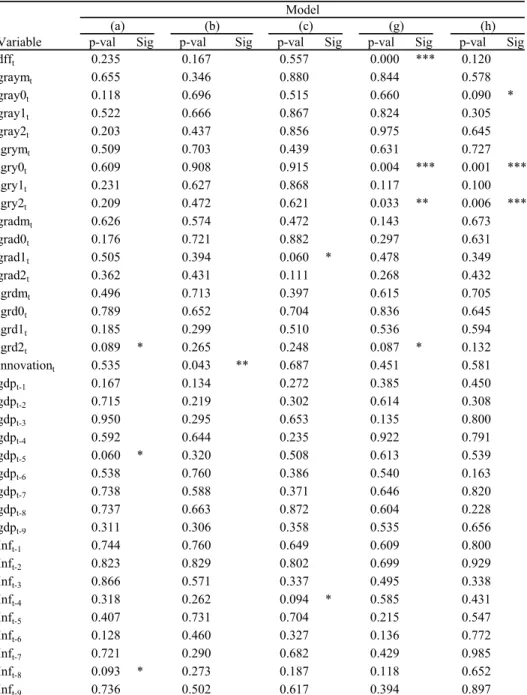
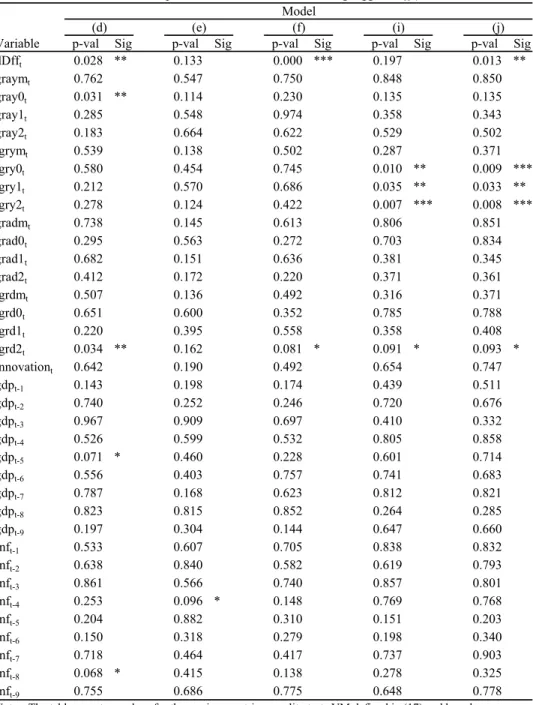
As a benchmark for our semiparametric analysis, we begin with parametric Sims-type causality tests. These are simple parametric tests of the null hypothesis of no causal e¤ect of monetary policy shocks on outcome variables, constructed by augmenting ordered Probit models for the propensity score with future outcome variables. Under the null hypothesis of no causal e¤ect, future outcome variables should have insigni…cant coe¢ cients in the policy model. This is the essence of Equation (1) and Condition 2.
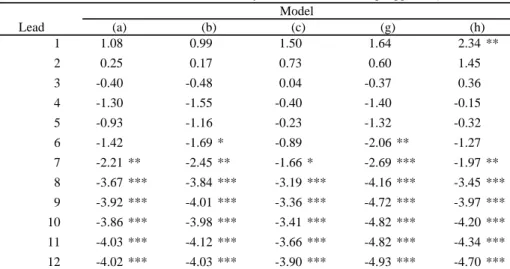
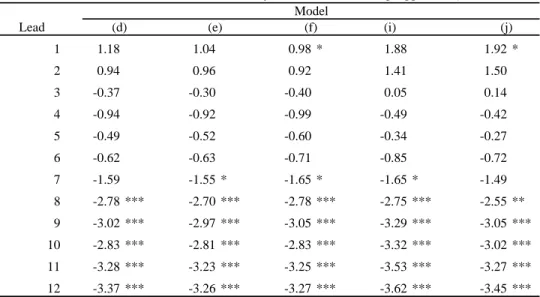
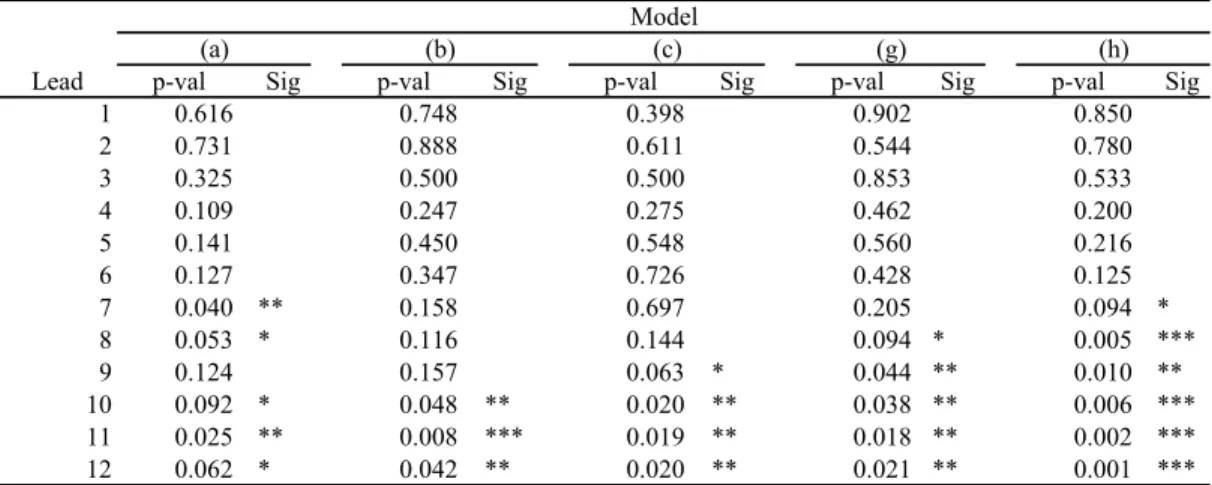
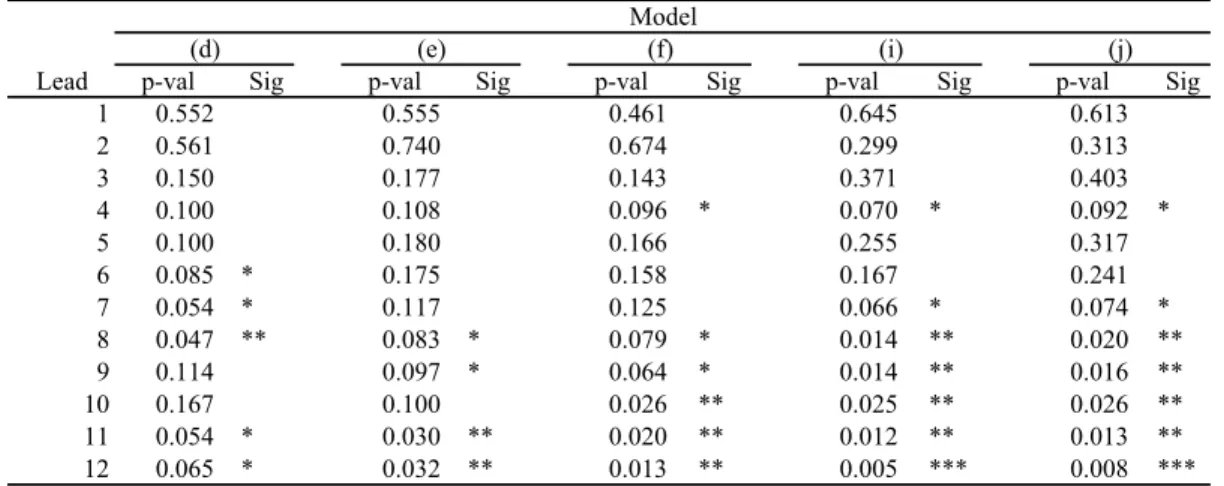
Tables 1a and 1b report results for parametric Sims tests for the e¤ect of policy on industrial pro-duction. The table shows t-statistics and signi…cance levels for the coe¢ cient on the cumulated change
in the log of the non-seasonally adjusted index of industrial production, cIPt+k; up to three years ahead.
More speci…cally, each row in Tables 1a and 1b corresponds to separately estimated augmented ordered
26Monthly GDP is interpolated from quarterly using a program developed by Mönch and Uhlig (2005). We thank Emanuel
Mönch and Harald Uhlig for providing the code for this. The in‡ation rate is calculated as the change in the log of the seasonally unadjusted CPI of urban consumers, less food and energy.