Benjamin PITCHERS
Hosting Research unit: UMR SYSTEM Financial support: INRA, GIS FRUIT
Apple tree growth and ramification in an agroforestry system
Master’s dissertation
Agricultural Engineering Course
Speciality: Sustainable crop production (PVD)
Master’s dissertation prepared under the supervision of: Pierre-Éric LAURI Submitted the: 15/09/2017
In front the examination board:
Aurélie METAY Jean-Luc REGNARD
Benjamin PITCHERS
Presentation year: 2017
Apple tree growth and ramification in an agroforestry system
Master’s dissertation
Agricultural Engineering Course
5
Abstract
Contemporary agriculture has to face new scientific and societal challenges (IAASTD 2009). Recent studies have shown that humanity will have to double agricultural production to meet the demand in 2050 (Ray et al. 2013). But agriculture needs to increase its production while addressing environmental concerns. Different solutions have been proposed in order to answer these challenges including new practices more resilient to external pressure (climatic disturbances, new diseases, economic crises) and more efficient (Foley et al. 2011).
Agroforestry is the association, on a plot, of perennial and annual crops and possibly animals (Dupraz & Liagre 2011). Agroforestry systems (AFS) in temperate climate are mainly composed of two layers: the tree layer and the herb layer. However, an original timber-tree-based AFS could be enriched with fruit-trees in an intermediate vertical stratum. In such context, the interest but also the challenges of timber- and fruit-tree based AFS lie in: (i) fruit production, (ii) microclimate and plant ecophysiology and (iii) biocontrol of pests and diseases (Lauri et al. 2016). The apple-agroforestry experiment (Growing AgroForestry systems with Apple, GAFA) was set in 2016, combining hybrid walnut trees planted in 1995, apple trees planted in March 2016 and 5-year-old Lucerne.
This work focuses on the effects of the distance between apple trees and walnuts, inducing presumably a gradient of competition, on various architectural and morphological aboveground features of the apple trees. The AFS reduced incoming light and global radiation but acted as a buffer on temperatures. These modification on the aboveground environment of the AFS induced a buffer effect on water potential daily evolution (Ψ) as well as different growth strategy of the apple tree in their second year. There was a difference in the AF apple trees stem geometry (higher slenderness and lesser tapering), architecture (less ramifications), and morphology (higher leaf area and specific leaf area).
KEYWORDS: Agroforestry, microclimate, apple trees, architecture.
Résumé
L’agriculture contemporaine doit faire face à de nouveaux défis scientifiques et sociétaux (IAASTD 2009). De récentes études ont montré qu’il sera nécessaire de doubler la production agricole mondiale pour répondre à la demande en 2050 (Ray et al. 2013). De plus, l’agriculture doit limiter ses externalités négatives. Le développement de nouveaux agrosystèmes plus résilients face aux pressions externes (réchauffement climatique, maladies, crise économique) et plus efficients dans leurs utilisations d’intrants fait partie des solutions avancées (Foley et al. 2011).
L’agroforesterie consiste en l’association, sur une même parcelle, d’essences végétales pérennes et annuelles et éventuellement d’animaux (Dupraz & Liagre 2011). Les systèmes agroforestiers (AFS) en climat tempéré sont majoritairement composés de deux strates : la strate arborée et la strate herbacée. Cependant, un système agroforestier à base de bois d’œuvre peut être enrichi d’une strate verticale intermédiaire composée d’arbre à fruits. Les intérêts et les défis d’un tel système réside dans : (i) la production de fruit, (ii) le microclimat et l’écophysiologie des plantes et (iii) le biocontrôle des ravageurs et maladies (Lauri et al. 2016). L’expérimentation a été mise en place en 2016 combinant des noyers hybrides plantés en 1995, des pommiers plantés en mars 2016 et une luzernière de 5 ans.
Ce rapport s’intéresse aux effets de la compétition aérienne avec les noyers sur l’architecture et la morphologie des pommiers. L’AFS réduit la lumière incidente et le rayonnement global en plus de tamponner les variations quotidiennes de températures. Ces modifications du microclimat induisent une moindre variation quotidienne du potentiel hydrique (Ψ) ainsi que différentes stratégie de croissance des pommiers. Je montre ici des effets du contexte agroforestier sur la géométrie des pousses du pommier (élancement plus important et conicité moins élevée en agroforesterie), sur son architecture (moins de ramification axillaire en agroforesterie) et sur sa morphologie foliaire (surface et surface foliaire spécifique plus grandes en agroforesterie).
6
Résumé étendu
Introduction
L’agriculture contemporaine doit faire face à des nouveaux défis scientifiques et sociétaux (IAASTD 2009). De récentes études ont montré qu’il sera nécessaire de doubler la production agricole mondiale pour répondre à la demande en 2050 (Ray et al. 2013). De plus, l’agriculture doit limiter ses externalités négatives (pollution, dégradation des sols…). Le développement de nouveaux agrosystèmes plus résilients face aux pressions externes (réchauffement climatique, maladies, crise économique) et plus efficients dans leurs utilisations d’intrants fait partie des solutions avancées (Foley et al. 2011).
L’agroforesterie consiste en l’association, sur une même parcelle, d’essences végétales pérennes et annuelles et éventuellement d’animaux (Dupraz & Liagre 2011). Les systèmes agroforestiers (AFS) en climat tempéré sont majoritairement composés de deux strates : la strate arborée et la strate herbacée. Cependant, un système agroforestier à base de bois d’œuvre peut être enrichi d’une strate verticale intermédiaire composée d’arbre à fruits. Les intérêts et les défis d’un tel système réside dans : (i) la production de fruit, (ii) le microclimat et l’écophysiologie des plantes et (iii) le biocontrôle des ravageurs et maladies (Lauri et al. 2016). L’expérimentation a été mise en place en 2016 combinant des noyers hybrides plantés en 1995, des pommiers plantés en mars 2016 et une luzernière de 5 ans.
Mon objectif était d’étudier les effets de la distance entre les noyers et les pommiers, qui induisent un gradient de compétition, sur l’architecture et la morphologie aérienne du pommier. Plus précisément j’ai analysé :
- l’architecture (distribution topologique des types de bourgeons latéraux le long de l’axe porteur) et la géométrie de la pousse du tronc développée l’année précédente, i.e. première année de croissance,
- la dynamique de croissance (longueur et nombre de feuilles) du tronc pendant sa deuxième année de croissance,
- la morphologie des feuilles (surface foliaire et surface foliaire spécifique).
État de l’art
Les systèmes agroforestiers, comme les systèmes plurispécifiques de façon générale, sont des agrosystèmes conçus pour optimiser, dans le temps et l’espace, l’utilisation des ressources (lumière, eau, minéraux) en maximisant les interactions positives et minimisant les interactions négatives entre les composants du système (Jose et al. 2004). Ainsi, en se basant sur différents indicateurs tel que le LER (Land Equivalent Ratio), il est possible de montrer que les agrosystèmes plurispécifiques peuvent avoir des rendements supérieurs aux agrosystèmes monospécifiques. Cependant la description et la compréhension des interactions prenant place au sein de l’agrosystème sont un préalable indispensable à sa conception et son optimisation. Ces interactions entre espèces peuvent être appréhendées dans un système agroforestier à partir des différents types de relations définies par l’écologie (Jose et al. 2004). Il s’agit donc de concevoir et piloter le système agroforestier de manière à maximiser les synergies entre les différentes espèces et de minimiser la compétition pour les ressources et de réguler les bioagresseurs. L’objectif recherché est que la compétition interspécifique soit moins importante que la compétition intraspécifique. Dans un système agroforestier, ces interactions vont évoluer au cours de la vie du système. Les plantes pérennes vont croitre au cours du temps et devenir de plus en plus
7
compétitives pour les plantes annuelles. Il est alors possible d’analyser les interactions en s’intéressant à deux compartiments distincts : les interactions aériennes et les interactions souterraines.
Au niveau aérien la seule ressource pour laquelle il y aura de la compétition est la lumière. De plus la compétition pour la lumière évoluera avec l’âge du système agroforestier. L’ombre portée des strates les plus hautes (relation d’amensalisme) réduira le rayonnement reçu par les strates inférieures mais aura également un effet sur la régulation du vent et des températures extrêmes sur ces mêmes strates. Enfin, la présence d’un linéaire arborée peut servir de refuge pour les auxiliaires mais également les ravageurs généralistes (Jose et al. 2004; Jose et al. 2006; Ong et al. 1991; Forey 2016).
Dans un environnement ombragé où l’interception de la lumière est essentielle les plantes auront de plus longs axes et entrenœuds (Kami et al. 2010), des feuilles avec une surface foliaire plus grande (Lambers & Poorter 1992), une surface foliaire plus grande et une réduction du rapport croissance souterraine/croissance aérienne (Grime 1977).
Les interactions souterraines entre les arbres et la culture en système agroforestier sont directement liées à l’occupation spatiale des racines. Dans un cas de complémentarité optimale, où les racines des deux cultures prospectent des volumes de sols différents, nous aurons moins de compétitions que dans le cas où les racines occupent des volumes de sol identique (Gliessman 1985). Ces interactions sont nombreuses et difficile à appréhender que ce soit la compétition pour le prélèvement de l’eau et des nutriments ou des facilitations (ascenseur hydraulique, exsudats racinaires).
NB : les possibles effets de la compétition souterraine n’ont pas pu être traités de manière satisfaisante en 6 mois.
Problématique et hypothèses scientifiques
La problématique à laquelle nous essayons de répondre n’est pas tant de savoir si il y a des différences dans la croissance aérienne entre des pommiers en système agroforestier et des pommiers en verger traditionnel que de voir où ces différences se situent.
Ayant considéré que l’intensité des interactions dans le système agroforestier peut être corrélé à la distance entre les plantes et surtout les noyers qui, nous supposons, seront à l’origine de la majorité des interactions aérienne nous avons formulé deux hypothèses,
- l’environnement aérien diffère dans un système agroforestier mature (noyers âgés) comparé à celui d’un verger traditionnel,
- les interactions aériennes (microclimat et ombre portée par le noyer dans la strate supérieure) peuvent influencer la croissance aérienne du pommier et sa ramification,
Afin de s’assurer que les différences que nous pourrions observer étaient dues aux interactions aérienne dans le système agroforestier nous avons fait en sorte de limiter au maximum les autres facteurs limitants. Pour cela les pommiers ont été irrigués et fertilisés et nous sommes intervenus sur les maladies et ravageurs qui auraient pu affecter la croissance aérienne du pommier.
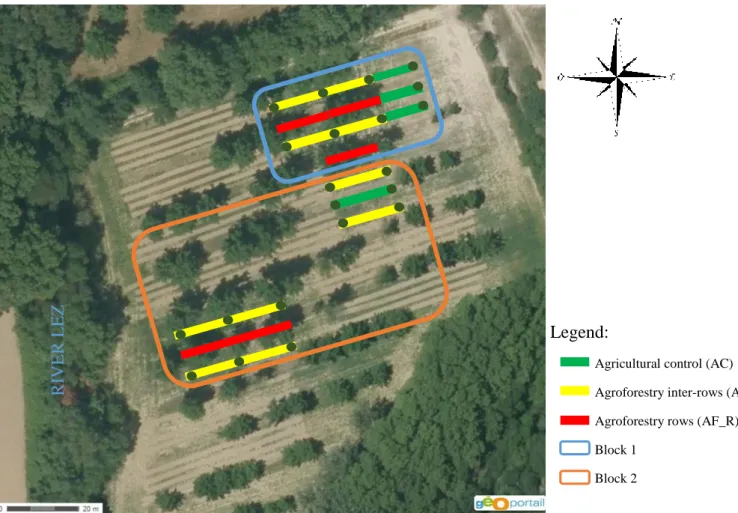
Nous avons réparties nos 148 pommiers dans deux blocs afin de capter l’hétérogénéité de la parcelle et trois modalités composés du témoin agricole (AC), l’inter-rang du système agroforestier (AF_IR) et le rang du système agroforestier (AF_R).
Matériels et méthodes
La parcelle agroforestière choisie pour l’expérimentation est la parcelle A1 du domaine de Restinclières situé dans le sud-est de la France sur la commune de Prades-le-Lez (34730).
8
Nous avons caractérisé l’environnement aérien et le microclimat dans chaque modalité à l’aide de photo hémisphérique (gap fraction), de capteurs d’humidité, de températures et d’hygrométrie (sonde HMP 155) ainsi que des pyranomètres (SP 110). Nous avons également mesuré l’effet de la modalité de croissance du pommier sur le potentiel hydrique des plantes à l’aube (Ψpd) et au midi solaire (Ψmd) à
l’aide de deux chambres à pression.
Les mesures de longueur et de diamètre du tronc âgé d’un an (1ère année de croissance, 2016) ont été
faites avec un pied à coulisse et un mètre à mesurer.
Sur ces mêmes troncs, l’analyse de la ramification axillaire a été réalisée en notant nœud à nœud la nature des axillaires (inflorescence, végétatif, latent, extinction) développés en 2017. Pour les inflorescences, le suivi phénologique a également été réalisé du stade débourrement au stade nouaison. Les surfaces foliaires ont été mesurées à l’aide du logiciel Winfolia sur quinze feuilles par modalités qui ont ensuite été mise à l’étuve pendant 48 heures à 60°C avant d’être pesées pour calculer la surface foliaire spécifique.
Résultats
Les résultats sont synthétisés dans le schéma suivant :
Variation T°C Variation Ψmd-pd Quantité de lumière Impact sur le pommier Distance au noyer E n vironn em en t aé rien Différence architecturale : Moins de ramification Différence géométrique : élancement / conicité Différence morphologique : LA / SLA supérieures Différente dynamique de croissance :
Plus d’arrêt de croissance
+ / -
-
+
- / +
+ / +
- / -
+
-
AC
AF rang
9
Discussion
Les résultats obtenus sont conformes à ce qui avait déjà été rapporté dans la littérature sur la croissance de plantes pérennes dans un environnement lumineux restreint. De plus, nous n’avons pas observé de différence dans le plastochrone entre les pommiers des différentes modalités. Quand les pommiers poussaient, ils poussaient de manières identiques. Nous faisons l’hypothèse que les différences de croissance relative et longueur du tronc étaient dues à la longueur des entrenœuds les premières semaines et dans la proportion d’arrêt de croissance environ un mois après le débourrement des noyers.
Un des résultats observés peu discuté dans la littérature concerne l’effet tampon du système agroforestier sur la variation quotidienne du potentiel hydrique. Nous voyons trois explications possibles à cet effet : (i) le système agroforestier limite le VPD (le pommier étant considéré comme isohydrique) (Lakso 2014), (ii) les pommiers en système agroforestier limite leur transpiration dès l’aube et (iii) il y a plus de mouvements hydrauliques dans le sol « sous les noyers » (ascenseur hydraulique) limitant la baisse du potentiel hydrique du sol pendant la journée.
Il y a donc différents effets du système agroforestier qui influent sur la stratégie de croissance des pommiers. Certains de ces effets ne sont apparentés qu’à un effet de l’ombrage du noyer. Cependant, il y a probablement également un effet des interactions racinaires sur la croissance du pommier. L’hypothèse formulée autour de l’idée d’ascenseur hydraulique qui influerait sur le potentiel hydrique du sol au midi solaire va dans ce sens.
D’un point de vue méthodologique il sera important pour les futures analyses de repenser le système de caractérisation du contexte de croissance des pommiers, actuellement limité à la « modalité », via l’utilisation d’un indicateur plus intégratif (Fichtner et al. 2017). En effet, la répartition des pommiers en différentes modalités nous semble trop simpliste. De plus, il n’a pas été possible de s’assurer qu’il n’y avait pas d’effet des interactions souterraines en particulier de compétition pour l’azote. La compétition souterraine a souvent des effets plus importants sur le développement des plantes que la compétition aérienne (Wilson & Tilman 1991).
N’oublions pas que l’objectif des arbres fruitiers reste la production, il sera donc intéressant de voir si il y a des différences au niveau de la production dans les années à venir et comment les différences de croissances vont impacter le rendement quantitativement et qualitativement.
10
Acknowledgements
This project has been funded by the GIS Fruit, I greatly appreciate the support, and trust that the knowledge we have gained from this work will more than adequately reward them for their investment.
My supervisor, Pierre-Éric Lauri, has been of great assistance during this six month work experience and his addition to this whole work is certainly far greater that I mention here. Thank you for letting me work on this project and your guidance.
The agroforestry system on which we worked in this project was situated in the domaine de Restinclière. As so I thank the department of Hérault for letting us use these lands and all the members of the team involved in the management of the plots. Thank you Lydie Dufour, Alain Sellier and Jean-françois Bourdoncle for your support and advice.
This work would not have been possible without the knowledge that was passed down to me by the teaching team of Montpellier SupAgro and more specifically of Sustainable Crop Production. Thank you Aurélie Metay, Jacques Wery, Hélène Marrou, Brigitte Brunel and all the others that helped me move forward.
A special thanks to François Warlop from the GRAB and Clélia Saubion from the Chambre d’Agriculture de l’Hérault for their time and shared knowledge of agroforestry systems. Thank you for opening up my mind on agroforestry.
This experience would not have been the same without all the others interns that shared this time with me. A special thank-you to Anaïs for all these shared long days in the field doing measurements.
My family, Isabelle, Jim, Ely, Martin and all the others. Thank you for your support and the interest you have always shown in my project.
11
Table of contents
Abstract ... 5 Résumé ... 5 Résumé étendu ... 6 Acknowledgements ... 10 Table of contents ... 11 Foreword ... 13 List of tables ... 14 List of figures ... 15 List of photographs ... 19 List of appendix ... 19 Acronym ... 19 Introduction ... 21 I. Context ... 23I.1 Agroforestry: characteristics and stakes ... 23
I.1.1 Interspecific interactions in a temperate agroforestry system ... 23
I.1.1.1 Above ground interactions in agroforestry ... 24
I.1.1.2 Belowground interactions in agroforestry... 25
I.2 The Apple tree: growth and ramification/branching under the dependence of which mechanism? ... 27
I.2.1 The apple tree (Malus domestica Borkh.) ... 27
I.2.2 Apple tree morphology ... 27
I.2.2.1 Shoots and buds ... 27
I.2.2.2 Annual growth cycle ... 28
I.2.3 Abiotic factors influencing apple tree development ... 28
I.3 Scientific question ... 30
II. Materials and methods ... 31
II.1 Description of the field experiment ... 31
II.1.1 Experimental design of the plot A1 of “domaine de Restinclières” ... 31
II.1.2 Plant materiel and plot management ... 32
II.1.3 Soil and climate conditions ... 33
II.1.3.1 Mediterranean climate... 33
II.1.3.2 Plot A1 soil characteristic ... 34
II.2 Characterisation of aboveground environment ... 35
12
II.2.2 Incoming light ... 36
II.3 Apple trees characterisation ... 37
II.3.1 Apple tree water status: water potential at pre-dawn and midday ... 37
II.3.2 One year old shoots ... 37
II.3.2.1 Geometry: Slenderness and taper ... 37
II.3.2.2 Architecture: Buds type and topology ... 38
II.3.2.3 Phenology: Flower buds ... 38
II.3.3 2017’s growth ... 38
II.3.3.1 Growth dynamics ... 38
II.3.3.2 Leaf area (LA) and specific leaf area (SLA) ... 38
II.4 Data analysis ... 38
III. Results ... 39
III.1 Characterisation of aboveground environment ... 39
III.1.1 A microclimate generated by the presence of walnut trees? ... 39
III.1.2 The Gap Fraction analysis ... 42
III.2 Aerial growth and ramification ... 42
III.2.1 Agroforestry limiting water potential? ... 42
III.2.2 One year old shoots ... 43
III.2.2.1 Analysing trees geometry: slenderness and taper ... 43
III.2.2.2 Analysing architecture: buds type and topology ... 45
III.2.2.3 Analysing phenology: flower buds ... 48
III.2.3 2017’s growth results ... 48
III.2.3.1 Apple trees growth dynamics ... 48
III.2.3.2 Shade influence on leaves ... 51
IV. Discussion ... 52
IV.1 Consequences of a modified environment on the apple tree architecture and growth 52 IV.2 Possible future improvement ... 53
Conclusion ... 56
Bibliography ... 57
13
Foreword
This work experiment was realised in the French national institute for agronomic research (INRA) at the end of my engineer’s course in Montpellier SupAgro. Three different partners are involved in this work, INRA and GIS Fruit for scientific supervision and financial support, respectively, and Montpellier SupAgro for tutoring.
I worked with the “Tropical and Mediterranean cropping system functioning and management” joint research unit (UMR System) located at Montpellier SupAgro campus. It aims to produce knowledge and tools to assess and design cropping systems combining economic efficiency and the production of environmental services. UMR system is composed of four scientific teams:
- Associated Biodiversity and Ecosystem Services topic – BASE - Transitions, Trajectories, Resilience topic – TTR
- Availability, sharing and use of resources (light, water and nitrogen) in multi-species systems – Resources
- Cropping Systems, Modelling and Testing team - Syme
The GIS Fruit is an association of scientific interest dedicated to the French fruit sector created in 2012. It is an original form of organization which draws together 22 French partners involved in research, extension and training, alongside with professional organizations in the fruit sector. GIS Fruits aims at developing a long term, joint strategy covering a range of activities in the sector, from research up to the transfer of innovations to economic actors.
14
List of tables
Table 1 : Different possible interactions between two species commonly described in ecology literature (Jose et al. 2004)... 24 Table 2: Above ground interactions between the trees and the annual crops in an agroforestry system: black = no impact ; red = negative impact ; green = positive impact ; arrows indicate the direction of the interaction (Jose et al. 2004; Jose et al. 2006; Ong et al. 1991; Forey 2016) ... 25
Table 3: Belowground interactions between the trees and the annual crops in an agroforestry system: black = no impact ; red = negative impact ; green = positive impact ; arrows indicate the direction of the interaction (Jose et al. 2004; Jose et al. 2006; Ong et al. 1991; Forey 2016) ... 26
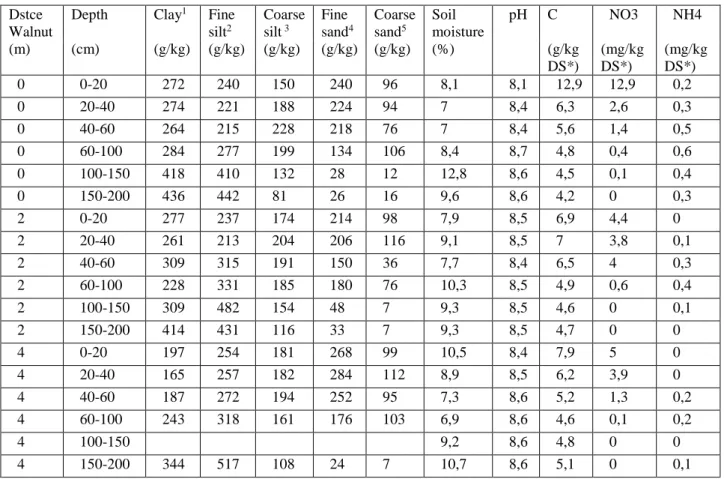
Table 4: Number of apple trees in each block per modality. AC: Agricultural control; AF_IR: Agroforestry inter-rows; AF_R: Agroforestry rows. ... 32 Table 5: Soil analysis of plot A1 from “domaine de Restinclières” done in 2013. ... 34 Table 6: Standardised major axis (SMA) regression between average stem diameter and stem length after one year growth of apple trees (Dalinette cultivar on G202 rootstocks) in a mature agroforestry system (walnut trees) from the experimental site of “domaine de Restinclières” among the different modalities (AF_IR: Agroforestry inter-row; AF_R: Agroforestry row; AC: Agricultural control). By convention, relationships are in the form Y vs. X. All analyses are on non-transformed data except for Pslope=1 where there are log10 transformed. In modalities characteristics, n: sample size; slope: slope of the relationship; r²: coefficient of
determination of the SMA regression; Pslope=1: probability associated to isometries (null hypothesis H0=1). In test results, we present each test that was made on our data and their associated p-value. Outputs of the SMA regression can be seen in appendix III. ... 44 Table 7: Ordered logit regression t and p values of flower bud phaenology for each week after bud burst. Measurements were made on young apple trees (Dalinette cultivar on G202 rootstocks) in a mature agroforestry system (walnut trees) from the experimental site of “domaine de Restinclières”. Agroforestry inter-rows (AF_IR) modality is compared to a reference, agricultural control (AC). Outputs of the ordered logit regression regression can be seen in appendix IV. ... 48
15
List of figures
Figure 1: Apple flower (fruit) bud in diagrammatic longitudinal section, showing foliar appendages and flower buds (Abbot 1970). ... 27
Figure 2: Effective spectrum of photoreceptors for activation and inactivation from (Kami et al. 2010). ... 29
Figure 3: Concept map of the aerial interactions in the agroforestry system studied. ... 30 Figure 4: Geographic localisation of the “domaine de Restinclières” and the plot on which is located the apple – agroforestry experiment (source: googlemaps, UMR System) ... 31
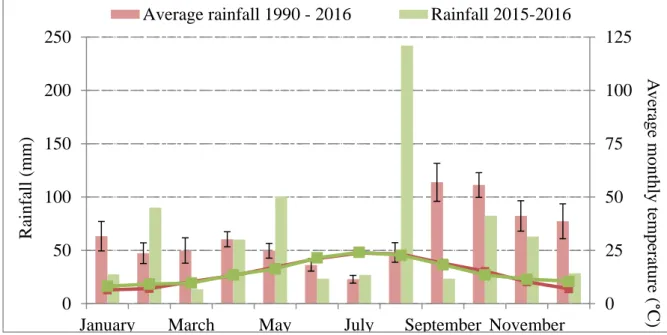
Figure 5: Representation of the apple trees experimental design of domaine de Restinclières. ... 32 Figure 6: Average rainfall/temperature diagram based on the data from the weather station on plot A2 from domaine de Restinclière experiment site. ... 33
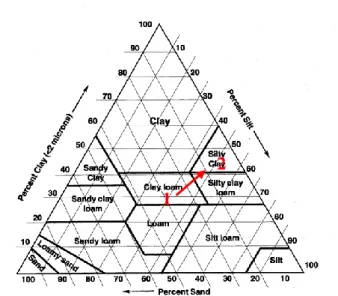
Figure 7: Representation of the texture evolution with depth of plot A1 soil from the “domaine de Restinclières” on a soil texture triangle. ... 35
Figure 8: Schematic representation of the stem diameter measurement methodology ... 37 Figure 9: Daily average temperature (mean±SD) recorded by HMP155 sensors on the plot A1 from the domaine de Restinclières recorded from the 1st of July 2017 to the 20th of August 2017. There are 5 sensors on the plot, one the open is the control (AC) and the four others are in each agroforestry modality and in the 2 different blocks (AFIR1/AFR1; AFIR2/AFR2) with AFIR: Agroforestry inter-row and AFR: Agroforestry row. ... 39
Figure 10: Daily average relative humidity (mean±SD) recorded by HMP155 sensors on the plot A1 from the domaine de Restinclières recorded from the 1st of July 2017 to the 20th of August 2017. There are 5 sensors on the plot, one the open is the control (AC) and the four others are in each agroforestry modality and in the 2 different blocks (AFIR1/AFR1; AFIR2/AFR2) with AFIR: Agroforestry inter-row and AFR: Agroforestry row. ... 40
Figure 11: Daily average global radiation (mean±SD) recorded by SP1110 pyranometers on the plot A1 from the domaine de Restinclières recorded from the 12th of July 2017 to the 20th of August 2017. There are 5 pyranometers on the plot, one the open is the control (AC) and the four others are in each agroforestry modality and in the 2 different blocks (AFIR1/AFR1; AFIR2/AFR2) with AFIR: Agroforestry inter-row and AFR: Agroforestry row. ... 40
Figure 12: Kruskal-Wallis rank test results on the data collected by the sensors and pyranometers from the A1 plot of domaine de Restinclières. ... 41
Figure 13: Gap fraction results on two different models used to estimate diffuse light using photographs taken with a fisheye lens. CO stands for uniform overcast sky and SOC standard overcast sky. The picturess were taken from experimental site of “domaine de Restinclières” from the ground next to the apple trees (Dalinette cultivar on G202 rootstocks) before walnut trees bud burst (April) and at full foliation (August). Approximately ten pictures in each modality were analysed (AF_IR: Agroforestry inter-row; AF_R: Agroforestry row; AC: Agricultural control). Significant differences between modalities were tested by a Kruskal-Wallis test (α = 0.01). ... 42
16
Figure 14: Water potential at pre-dawn and at midday of young apple trees (Dalinette cultivar on G202 rootstocks) in a mature agroforestry system (walnut trees) from the experimental site of “domaine de Restinclières” among the different modality (AF_IR: Agroforestry inter-row; AF_R: Agroforestry row; AC: Agricultural control). Fifteen fully grown leaves were measured for each modality. Significant differences between modalities were tested by a Kruskal-Wallis test (α = 0.01). ... 43
Figure 15: Average stem diameter in relation to stem length after one year growth of apple trees (Dalinette cultivar on G202 rootstocks) in a mature agroforestry system (walnut trees) from the experimental site of “domaine de Restinclières” among the different modality (AF_IR: Agroforestry inter-row; AF_R: Agroforestry row; AC: Agricultural control). We also represented an average tree using the average of each modality. Each symbol represents a tree. ... 43
Figure 16: Analyse of two indicators used in forestry, slenderness (cm of stem / cm in diameter) and taper (cm loss of diameter / cm of stem), of young apple trees (Dalinette cultivar on G202 rootstocks) in a mature agroforestry system (walnut trees) from the experimental site of “domaine de Restinclières” among the different modalities (AF_IR: Agroforestry inter-row; AF_R: Agroforestry row; AC: Agricultural control). Significant differences between modalities were tested by a Kruskal-Wallis test (α = 0.01). ... 44
Figure 17: Bud type distribution (E = Extinct; F = Flower; L = Latent; V = Vegetative) of young apple trees (Dalinette cultivar on G202 rootstocks) in a mature agroforestry system (walnut trees) from the experimental site of “domaine de Restinclières” among the different modality (AF_IR: Agroforestry inter-row; AF_R: Agroforestry row; AC: Agricultural control) ... 45 Figure 18: Analyse results on the number of nodes and the different type of buds of young apple trees (Dalinette cultivar on G202 rootstocks) in a mature agroforestry system (walnut trees) from the experimental site of “domaine de Restinclières” among the different modalities (AF_IR: Agroforestry inter-row; AF_R: Agroforestry row; AC: Agricultural control). We represented the standard deviation and the statistical group for each modality. Significant differences between modalities were tested by a Kruskal-Wallis test (α = 0.01). . 46
Figure 19: Topology of the different type of buds on the stem of apple trees in their second year growth (Dalinette cultivar on G202 rootstock). 0 represents the apex of the stem while 1 represents the base. We represented the relative position of buds and made 10 classes regrouping all buds by steps of 0.1.We only considered a modality when they were more than 5 buds of the same type. The apple trees are from the experimental site of “domaine de Restinclières” in which we studied three different modalities (AF_IR: Agroforestry inter-row; AF_R: Agroforestry row; AC: Agricultural control). ... 47
Figure 20: Proportion of growth arrest of two-year-old apple trees (Dalinette cultivar on G202 rootstocks) in a mature agroforestry system (walnut trees) from the experimental site of “domaine de Restinclières” among the different modalities (AF_IR: Agroforestry inter-row; AF_R: Agroforestry row; AC: Agricultural control). ... 48
17
Figure 21: Shoot length grown the second year (mean±SD) of two-year-old apple trees (Dalinette cultivar on G202 rootstocks) in a mature agroforestry system (walnut trees) from the experimental site of “domaine de Restinclières”. The stem length was measured each week for 18 weeks. We used an ANOVA when possible or a Kruskal-Wallis rank test (α = 0.01) to highlight significant differences between our three modalities: AF_IR: Agroforestry inter-row; AF_R: Agroforestry row; AC: Agricultural control. Statistical analysis are shown in appendix V.III. ... 49
Figure 22: Growth rate of the shoot (mean±SD) of two-year-old apple trees (Dalinette cultivar on G202 rootstocks) in a mature agroforestry system (walnut trees) from the experimental site of “domaine de Restinclières”. We used an ANOVA when possible or a Kruskal-Wallis rank test to highlight significant differences between our three modalities: AF_IR: Agroforestry inter-row; AF_R: Agroforestry row; AC: Agricultural control. Statistical analysis are shown in appendix V.III. ... 49
Figure 23: Relative growth rate of the shoot (mean±SD) of two-year-old apple trees (Dalinette cultivar on G202 rootstocks) in a mature agroforestry system (walnut trees) from the experimental site of “domaine de Restinclières”. We used an ANOVA when possible or a Kruskal-Wallis rank test to highlight significant differences between our three modalities: AF_IR: Agroforestry inter-row; AF_R: Agroforestry row; AC: Agricultural control. Statistical analysis are shown in appendix V.III. ... 50
Figure 24: Results of leaf area (a) and the specific leaf area (b) analysis of 2-year-old apple trees (Dalinette cultivar on G202 rootstocks) in a mature agroforestry system (walnut trees) from the experimental site of “domaine de Restinclières” among the different modalities (AF_IR: Agroforestry inter-row; AF_R: Agroforestry row; AC: Agricultural control). We represented the standard deviation and the statistical group for each modality. Significant differences between modalities were tested by a Kruskal-Wallis test (α = 0.01). ... 51
Figure 25: Scheme summarising the growth strategy of the apple tree in relation to its distance to the walnut tree based on the results of this study. ... 56
Figure 26: Daily variation of temperature recorded by HMP155 sensors on the plot A1 from the domaine de Restinclières recorded from the 1st of July 2017 to the 20th of August 2017. There are 5 sensors on the plot, one the open is the control (AC) and the four others are in each agroforestry modality and in the 2 different blocks (AFIR1/AFR1; AFIR2/AFR2) with AFIR: Agroforestry inter-row and AFR: Agroforestry row. ... 67
Figure 27 : Daily variation of RH recorded by HMP155 sensors on the plot A1 from the domaine de Restinclières recorded from the 1st of July 2017 to the 20th of August 2017. There are 5 sensors on the plot, one the open is the control (AC) and the four others are in each agroforestry modality and in the 2 different blocks (AFIR1/AFR1; AFIR2/AFR2) with AFIR: Agroforestry inter-row and AFR: Agroforestry row. ... 67
Figure 28: Evolution of the coefficient of variation on shoot length in relation to time of young apple trees (Dalinette cultivar on G202 rootstocks) in a mature agroforestry system (walnut trees) from the experimental site of “domaine de Restinclières” among the different modality (AF_IR: Agroforestry inter-row; AF_R: Agroforestry row; AC: Agricultural control). CV = /. ... 71
18
Figure 29: Number of leaves on the shoot grown during the second year of two-year-old apple trees (Dalinette cultivar on G202 rootstocks) in a mature agroforestry system (walnut trees) from the experimental site of “domaine de Restinclières”. The number of leaves was incremented each week for 18 weeks. We used an ANOVA when possible or a Kruskal-Wallis rank test (α = 0.01) to highlight significant differences between our three modalities: AF_IR: Agroforestry inter-row; AF_R: Agroforestry row; AC: Agricultural control. ... 71
Figure 30: Shoot length statistical results from week 1 (top left) to week 18 (bottom right). Modalities: Green = AC, Orange = AF_IR, Yellow = AF_R. The statistical analyse was made using a Kruskal-Wallis test rank (α = 0.01). ... 72
Figure 31: Number of leaves statistical results from week 1 (top left) to week 18 (bottom right). Modalities: Green = AC, Orange = AF_IR, Yellow = AF_R. The statistical analyse was made using a Kruskal-Wallis test rank (α = 0.01). ... 72
Figure 32: Growth rate statistical results from week 1 (top left) to week 18 (bottom right). Modalities: Green = AC, Orange = AF_IR, Yellow = AF_R. The statistical analyse was made using a Kruskal-Wallis test rank (α = 0.01). ... 73
Figure 33: Relative growth rate statistical results from week 1 (top left) to week 18 (bottom right). Modalities: Green = AC, Orange = AF_IR, Yellow = AF_R. The statistical analyse was made using a Kruskal-Wallis test rank (α = 0.01). ... 73
19
List of photographs
Photograph 1: SP1110 pyranometer (left) and HMP155 in weatherproof housing (right) .... 35
Photograph 2: 180° fisheye lens (left) and Sony camera (middle) used to take hemispheric photographs (right). The camera and lens were provided and calibrated by Regent Instruments Inc. ... 36
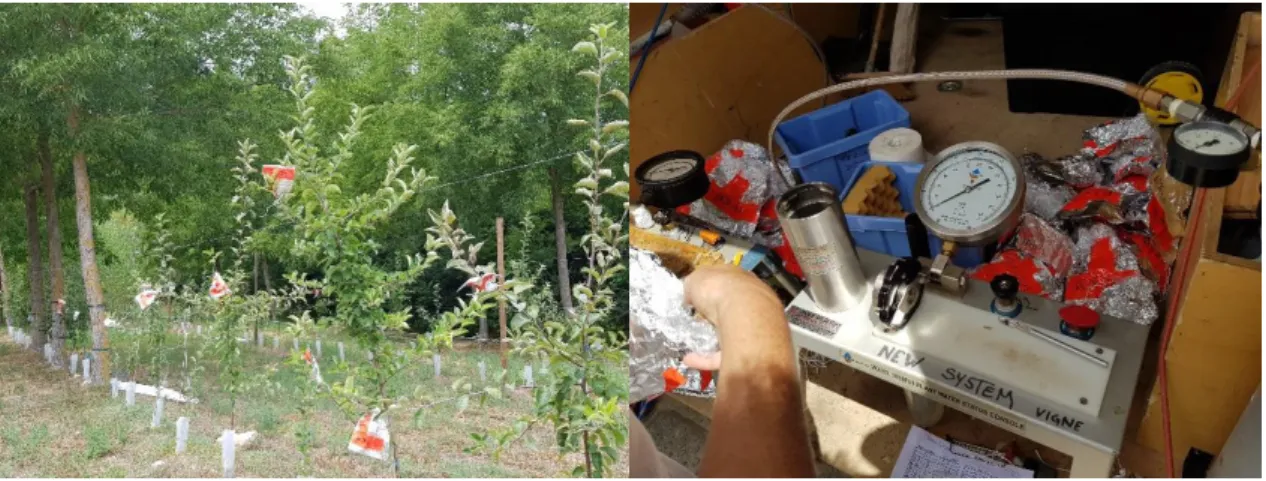
Photograph 3: Apple trees with the leaves for midday water potential inserted in the plastic bag covered in aluminium foil (left) and one of the two pressure chambers used for the measurement of water potential in the leaves (right). ... 37
Photograph 4: In situ rhizotron in the apple-agroforestry experiment on plot A1 of the “domaine de Restinclière” (picture by Benjamin Pitchers). ... 66
List of appendix
Appendix 0: Apple-Agroforestry Experiment ... 65Appendix I: In situ rhizotron methodology ... 66
Appendix II: Microclimate daily variation ... 67
I. Daily variation of temperature ... 67
II. Daily variation in relative humidity ... 67
Appendix III: Standardized Major Axis ... 68
I. Original data ... 68
II. Log10 transformed data ... 69
Appendix IV: Ordered logit regression ... 70
Appendix V: 2017’s growth ... 71
I. Stem length variation coefficient ... 71
II. Number of leaves ... 71
III. Statistical results on 2017’s growth ... 72
Acronym
GAFA: Growing AgroForestry systems with AppleGIEE: Groupements d'intérêt économique et environnemental GIS: Groupement d'intérêt scientifique
IFT: Indice de Fréquence de traitement UMR: Unité mixte de recherche
21
Introduction
Agriculture at a crossroads
Contemporary agriculture has to face new scientific and societal challenges (IAASTD 2009). Recent studies have shown that humanity will have to double agricultural production to meet the demand in 2050 (Ray et al. 2013). The demand increase will be caused by (i) demographic growth, the latest estimations situate us at roughly 8,9 billion human beings in 2050 (Cohen 2003), (ii) changes in diets (increase of meat consumption) and (iii) increase in bioenergy use (Cirera et al. 2010; Kearney 2010).
But agriculture needs to increase its production while addressing environmental concerns. Agriculture is behind many environmental problems such as climate change, biodiversity loss and degradation of land and freshwater (Foley et al. 2005). In fact, agriculture is one of the sectors driving the environment beyond the « planetary boundaries » (Rockström et al. 2009). Different solutions have been proposed in order to answer these challenges including new practices more resilient to external pressure (climatic disturbances, new diseases, economic crises) and more efficient (Foley et al. 2011).
To meet these stakes France adopted the « Loi d’Avenir pour l’Agriculture, l’Alimentation et la Forêt » in 2014 driven by the former minister of agriculture Stéphane LEFOLL. This law aims to develop agroecological practices by creating work groups (GIEE) and introducing agroecology lessons in agricultural schools. Looking at the practices, agroecology relies on ecological services to maximise production and manage of agrosystems. What agroecology is and should be is an endless controversy but everyone seems to agree that it should limit the use of inputs by diversifying agrosystems and crops (Altieri 1999; Vandermeer et al. 1998; Lin 2011).
Agroforestry is the association, on a plot, of perennial and annual crops and possibly animals (Dupraz & Liagre 2011). This agrosystem is considered agroecological since it aims to increase the efficiency of natural resources usage by diversifying the system and benefiting from the interactions between the different species (Gliessman 1985). Agroforestry systems in temperate climate are mainly composed of two layers: the tree layer and the herb layer. Even if these agrosystems are being studied, science has still many questions to answer before concluding on their agricultural interests.
Nowadays innovative agroforestry systems are being created on farms or in technical institutes, however, very few of them combine three layers: a high shrub layer, an orchard and an herbal layer. In this work we focus on the apple.
Integrating fruit-trees in temperate and Mediterranean agroforestry systems
Orchards, and especially apple orchards, are responsible for leaching of chemical products/pesticides in the environment and are subject to thermal stress during summer in the south of France. Moreover, apple is the first fruit France produces with 1 600 000 tonnes in 2015 (Agreste 2017) but also the most sprayed with a treatment frequency index (IFT) of 35.1 in 2011 at a national scale (Agreste 2017). But diversified agrosystems are known to have some advantages of which: (i) to limit pest, (ii) to limit disease and (iii) to reduce the
22
consequences of climatic disturbances (Lin 2011). An agroforestry system which combines woody perennials, fruit-trees and herbaceous plants (annual crop and/or nitrogen fixing plants) could reduce the negative externalities of the orchard as well as offering different sources of income for the farmers. However, such an agrosystem needs to be studied beforehand starting with the growth and the development of apple trees in contexts of above- and belowground competitions. In fact, when the environment is modified so is the growth dynamics of the plants (Cleland et al. 2007). Apple trees fruiting capacity is multifactorial but is also dependent on resource supply which is related to vegetative growth (Corelli Grappadelli et al. 1994; Lauri & Corelli Grappadelli 2014). It is then important to follow the establishment of the apple trees the first years.
Our experiment was set in the Restinclières domain, belonging to the Hérault department, located at Prades-le-Lez in the south east of France. This domain, have 53 ha of agroforestry plantations making it an important site of study (http://umr-system.cirad.fr/les-agrosystemes-etudies/systemes-agroforestiers-temperes-et-mediterraneens). To fathom the interactions between perennial and annual plants and the agronomic interest of this system, many studies and theses have been conducted.
The apple-agroforestry experiment was set in 2016, combining hybrid walnut trees planted in 1995, apple trees planted in March 2016 and 5-year-old lucerne, with the objective to study the impact of this association on the apple tree establishment in a first phase, and production in a second phase (Appendix 0).
We consider that, at any given stage, the apple tree architecture reflects internal competitions for photosynthetic assimilates (Aguirrezabal et al. 1993) that will potentially vary depending on the intensity and location of the trophic competition (above - belowground) between the apple and the others plants of the system, here walnut and lucerne. Therefore, our initial objectives were to decipher the respective effects on the apple architecture development during its second year of growth, of competitions for light with walnut, and for soil nutrient and water with both walnut and lucerne. However, due to technical problems, the root growth survey could not be realized satisfactorily all along the season and it was decided not to include this topic in my dissertation (see appendix I for description of the in situ rhizotron experiment). Therefore, in this dissertation I will only present and discuss my works on the aboveground development of apple.
My objective was to study the effects of the distance between apple trees and walnuts, inducing presumably a gradient of competition, on various architectural and morphological aboveground features of the apple trees. More precisely, I analysed,
- the shoot architecture (topological distribution of lateral bud types) and the geometry of the previous-year growth, i.e. first annual growth, of the trunk (2016),
- the growth dynamics (length and number of leaves) of the trunk in the second-year of growth (2017),
- the morphology of the leaves (area and Specific Leaf Area).
This document starts by presenting the context and the literature in relation to our work before announcing the scientific hypothesis that are made. The second part is dedicated to presenting the materials and methods used. Finally, the third part presents our results that are discussed in a fourth part.
23
I.
Context
I.1 Agroforestry: characteristics and stakes
Agroforestry has been present in European landscape since bronze Age (2500 BC) (Eichhorn et al. 2006). With the revolution of agricultural practices after the Second World War, agroforestry was soon abandoned and agriculture and forestry became distinct by their practices and their place in the landscape but also the institutions (Eichhorn et al. 2006). But agroforestry came back in the spotlight recently since it is seen as a possible answer to the environmental stakes that are facing agriculture. It remains a marginal agrosystem even if it is spread all over Europe from the Spanish “dehesa” to the meadow-orchard of north Europe (Eichhorn et al. 2006).
The World Agroforestry Centre defines agroforestry as so (Nair 1993):
« A land-use system in which woody perennials (trees, shrubs, palms, bamboos) are deliberately used on the same land management unit as agricultural crops (woody or not), animals or both, either in some form of spatial arrangement or temporal sequence. In agroforestry systems there are both ecological and economic interactions between the different components. »
This definition was then reworked by (Leakey 1996), whom introduced the landscape scale, and by (Noordwijk et al. 2016) whom gives a simpler and larger definition:
« Agroforestry, a contraction of the terms agriculture and forestry, is land use that combines aspects of both, including the agricultural use of trees. »
One of the hindrances identified to the adoption of agroforestry practices is the lack of knowledge (Gliessman 1985). Researchers took interest in these agrosystems only recently and studied a short part of their life span. Furthermore, these systems are hard to apprehend looking at the numerous trophic and ecological interactions that takes place.
We will first take a look at the different interactions that takes places in a temperate agroforestry system before looking at what mechanisms influence apple trees aerial growth.
I.1.1 Interspecific interactions in a temperate agroforestry system
Agroforestry systems, like other multi-species systems, are agrosystems designed to maximise resources (light, water, nutrients) usage in time and space by maximising positive interactions and minimising negative interactions (Jose et al. 2004). Therefore, using different indicators such as the land equivalent ratio (LER), it is possible to compare mono-specific agrosystems and multi-specific ones. Nevertheless, if we aim to achieve higher yields in an agroforestry system we need to understand what interactions take place and how they will influence plants growth. These interactions can be apprehended by using different types of interactions as defined by ecology (Table 1).
24
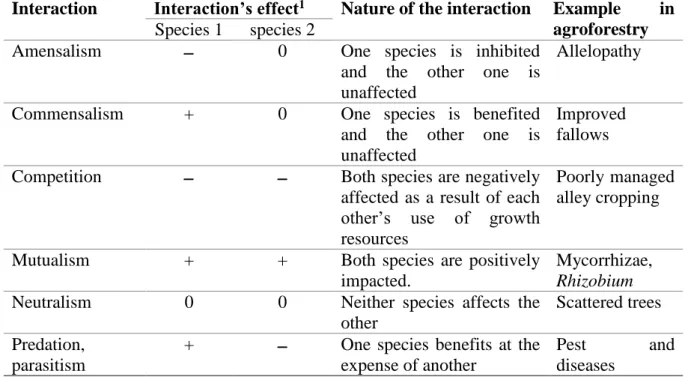
Table 1 : Different possible interactions between two species commonly described in ecology literature (Jose et al. 2004)
Interaction Interaction’s effect1 Nature of the interaction Example in
agroforestry
Species 1 species 2
Amensalism 0 One species is inhibited
and the other one is unaffected
Allelopathy
Commensalism + 0 One species is benefited
and the other one is unaffected
Improved fallows
Competition Both species are negatively
affected as a result of each other’s use of growth resources
Poorly managed alley cropping
Mutualism + + Both species are positively
impacted.
Mycorrhizae,
Rhizobium
Neutralism 0 0 Neither species affects the
other
Scattered trees Predation,
parasitism
+ One species benefits at the expense of another
Pest and
diseases 10 = no effect ; + = positive effect ; = negative effect
It is possible to achieve higher yields in an agroforestry system if the interspecific competition is lower that then intraspecific competition (Gliessman 1985). However, the relations between the different components of the agrosystems will be modified as the plants are aging. Perennial will grow and become more and more competitive for the annuals. To apprehend these complex systems, we can compartment interactions in aboveground and belowground interactions.
I.1.1.1 Aboveground interactions in agroforestry
Interactions in agroforestry systems depend of the species or the disposition of the trees. The interactions intensity will be different if the trees are on the border of the field or inter-cropped (Jose et al. 2004). The most noticeable aboveground interaction is the competition for light between the species (Jose et al. 2004). When the young perennial is still shorter than the annual crop there can be competition but after two or three years the perennial will dominate the annual crop and intercept solar radiations impacting negatively the annual crop. Still, this interaction can be limited by diminishing the density of trees, their disposition or precocity (Chirko et al. 1996). However, the shade provided by the trees can also benefit the annual crops by limiting thermal stress (Quinkenstein et al. 2009; Lin 2007; Lin 2011).
Trees will also impact the microclimate that can benefit the shaded plants depending on the climate. For example, the row of trees can act as a windbreaker that will affect the evapotranspiration demand and therefore improve the water use efficiency (Quinkenstein et al. 2009). But a humid microclimate is also going to favour cryptogamic diseases (Gliessman 1985) which can be a problem for apple trees because of Venturia inaequalis the pathogen responsible for apple scab.
25
The introduction of trees will create new ecological niches by modifying the landscape that can offer new habitat that can contribute to increase the number and the diversification of auxiliaries/natural enemies and pest (Jose et al. 2004; Quinkenstein et al. 2009). Above ground interaction are summed up in Table 2.
Table 2: Above ground interactions between the trees and the annual crops in an agroforestry system: black = no impact ; red = negative impact ; green = positive impact ; arrows indicate the direction of the interaction (Jose et al. 2004; Jose et al. 2006; Ong et al. 1991; Forey 2016)
Mechanism Interaction(s) Effect(s) Interaction
Shade Competition Both species intercept less sun radiation (young trees)
Trees Crops Amensalism Species under the canopy will
intercept less solar radiation (aged trees)
Trees Crops
Wind and temperature buffering
Commensalism Reducing wind speed and buffering temperatures (aged trees)
Trees Crops
New ecological niche
Mutualism Increases the number and diversity of auxiliaries
Trees Crops Predation,
parasitism
Increases pest Trees Crops
I.1.1.2 Belowground interactions in agroforestry
Belowground interactions between perennial and annual plants depend of the spatial location of their roots. In an ideal situation where the roots of each different species are present in different compartments of the soil, competition will be less important than where there are in the same (Gliessman 1985).
Perennial plants usually have the majority of their fine roots in the first thirty centimetres of the soil and so are in competition with the annual crop (Jose et al. 2006). However, most of the trees used in agroforestry have deep roots that will explore, if the depth of soil allows it, horizons of soils inaccessible to the annual plants (Rowe et al. 1998; Jose et al. 2001). Thereby, tree’s roots can act as an interception net for the leached nutrients (Allen et al. 2004). These nutrients will then be available to the annual plants after decomposition of the litter in the case of deciduous trees and if the leaves are left on the plot. In the same way, trees will also be able to absorb nutrients coming from the bedrock alteration (Schroth 1995).
Deep roots could also act as a hydraulic lift if the top horizons are dryer than the bottom (Caldwell et al. 1998; Jose et al. 2004). If the quantity of water moved by this phenomenon is important enough, it could limit competition for water in mixed species systems. Even small amount can have a positive impact such as (i) making available nutrients that are not in a dry soil, (ii) facilitate root exploration and (iii) keeping roots active in dry soils and allow a quick recovery of activity (Pierret et al. 2016). Furthermore, roots exploration can be improved thanks to the pores created by the tree's roots on one hand and biological activity improving soil structure on the other hand (Hulugalle & Lal 1986).
Usually, trees roots occupy every soil horizons and thus are in competition with other plants for water and nutrients when they become a limiting factor. Even if this interaction can favour the separation of root systems (Pierret et al. 2016), yield will be negatively impacted (Smith et
26
al. 1999) as the trees development especially when they are still young (Parker & Meyer 1996). Some species will also exudate allelochemicals in the rhizosphere that can harm the annual crop (Rizvi et al. 1999). This is particularly true in our design as walnut tree exudate juglone which has long been recognised as the principal chemical responsible for walnut allelopathy (Jose et al. 2004). Belowground interaction are summed up in Table 3.
Table 3: Belowground interactions between the trees and the annual crops in an agroforestry system: black = no impact ; red = negative impact ; green = positive impact ; arrows indicate the direction of the interaction (Jose et al. 2004; Jose et al. 2006; Ong et al. 1991; Forey 2016)
Mechanism Interaction(s) Effect(s) Interaction
Root absorption
Competition For water and nutrients in the top soil where the root of both species are present
Trees Crops Commensalism The trees can act as a hydraulic
and nutrient lift for the crop, and the crop fertilisation can profit the trees (interception net)
Trees Crops
Trees Crops Root exudates
and
decomposition
Commensalism Improvement of soil carbon and nutrients
Soil fauna stimulated
Trees Crops Trees Crops Trees Crops
Mutualism Mycorrhizal bridge Trees Crops
Predation, parasitism
Inhibiting growth through allelochemicals exudation Trees Crops Trees Crops Hydraulic lift and nutrient pump
Commensalism In dry soils, deep water soil is lifted up by the tree's roots. Leached nutrients are recycled through litter mineralisation
Trees Crops
New ecological niche
Mutualism Increases the number and diversity of auxiliaries (nematode predating on bacterium and fungal)
Trees Crops
Predation, parasitism
Increase in pest (phytophagous nematodes)
Trees Crops
All these interactions will impact the development of the different species in the agroforestry system. In our experimental design, the walnut trees are already aged so they won’t be much impacted by the presence of the apple trees but will be highly competitive for light, water and nutrients. The apple trees have to grow in environmental conditions that are radically different than in traditional orchards. It is interesting to analyse the aerial growth of the apple trees so we can understand the consequences of such conditions on their devlopment.
27
I.2 The Apple tree: influence of aboveground environment on growth and
ramification/branching
I.2.1 The apple tree (Malus domestica Borkh.)
Apples are among the oldest and most important fruit crops in the world (Harris et al. 2002). They have been cultivated since ancient times, in fact, archaeological studies have shown that they were cultivated already in 1000 BC (Juniper et al. 1998).
Cultivated apples are a result of extensive ancient hybridization of various species of the genus Malus Mill., a member of the Rosaceae Juss. family, subfamily Pomoideae (pome fruits) (Jackson 2003; Webster 2005). Over hundred botanical names have been published for the cultivated apple (Qian et al. 2010), however, Malus domestica Borkh. is now the correct binomial nomenclature for the cultivated apple (Qian et al. 2010). Some morphological characteristics shared by apple cultivars in the world are: woolly pubescence on young stems and on the lower surface of the leaves, dull green leaves, elliptic-ovate in shape, with irregularly saw toothed margins, woolly pubescence on flower stalks and calyx, and pome fruits indented at the base with persistent calyx (Webster 2005).
I.2.2 Apple tree morphology
I.2.2.1 Shoots and buds
Nowadays, apple trees are almost exclusively compound trees consisting of a scion grafted on a rootstock (Jackson 2003; Webster et al. 2005). Rootstocks are used to avoid juvenility, to control vegetative growth, to promote flower-bud formation, to improve cropping efficiency and quality of the fruits, and in some cases to provide winter hardiness and provide resistance or tolerance to some telluric diseases (Hanke et al. 2007; Webster et al. 2005).
The scion is the productive part of the tree that bears the different buds and three different type of shoots: (i) extension, (ii) non-extension and (iii) bourse shoots. Extension shoots are long and indeterminate in growth. Non-extension shoots are shorter, determinate in growth (Webster et al. 2005). Non-extension shoots can be classified depending on their length: (i) spurs (very short shoots), (ii) dards (5-10 centimetres) and (iii) brindles (10-20 centimetres). Bourse shoots originate from vegetative primordia at the axil of bourse leaves in spurs and may become extension shoots or remain
short as bourse shoots (Jackson 2003; Webster et al. 2005).
All shoots emerge from buds which have the potential to produce leaf primordia only or both leaf and flower primordia. If a bud produces leaf primordia only, it is considered a vegetative bud. On the contrary, if a bud produces flowers in addition to leaf primordia, it is considered a mixed (flower) bud (Figure 1). Flower buds are found terminally on all types of
shoots and terminally or axillary on longitudinal section, showing foliar appendages and flower Figure 1: Apple flower (fruit) bud in diagrammatic
28
extension shoots after vegetative growth has stopped (Jackson 2003; Webster et al. 2005).
I.2.2.2 Annual growth cycle
Apple trees are adapted to temperate climate in which they overcome large seasonal changes in environmental conditions. Such adaptation is the result of an annual growth cycle in which all developmental processes are synchronised with the annual course of the growing conditions (Hänninen & Kramer 2007). The growth cycle of an apple tree lasts for approximately one year from budburst, flowering, shoot growth, fruit set and development, to shoot growth cessation, flower bud formation, leaf abscission and winter dormancy.
Early in the spring a high proportion of buds emerges from dormancy after fulfilling their chilling and heat requirements (Luedeling 2012). There is a genotypic variation on both the amount of chilling required to break dormancy and the threshold temperature for bud-break and generally, in cultivars with a low chilling requirement, bud-break occurs at lower temperatures (Faust 1989; Jackson 2003; Webster et al. 2005).
Flower buds develop flower clusters that pass through a series of phenological stages. Vegetative buds produce a rosette of leaves with a “naked bud” in the centre (a bud without bud scales), or grow out to form a new shoot (Webster et al. 2005). New shoots continue to extend during the summer. By the end of the summer, extension growth stops in these shoots, and is followed by the formation of a terminal resting bud (Webster et al. 2005). From this point onwards, flower buds may be formed in terminal or axillary buds within the current year’s extension shoot.
Shoot growth and formation of flower buds are processes that occur in parallel to fruit development. Consequently, a strong competition for immediate available resources takes place between these developmental processes during summer (Hanke et al. 2007). It has been reported that the presence of fruit has a negative effect on shoot growth (Jackson 2003), mainly due to the strong sink effect of fruits (Webster et al. 2005). Inhibition of flower-bud formation by fruits has also been reported and explained as a result of the inhibitory effect that hormones from developing seeds impose on this process (Jackson 2003).
As autumn progresses, temperature and day length decreases, triggering a series of physiological changes in the trees that lead to leaf abscission and development of the endodormancy. Changes such as chlorophyll degradation, which causes decolouration of leaves, remobilization of leaf components to the woody parts of the tree, followed by degradation of cell walls causes leaves shedding (Faust 1989). By the time of leaf abscission, the tree is in a state of rest in which bud-break does not occur even if environmental conditions are conducive to do so (Jackson 2003).
I.2.3 Abiotic factors influencing apple tree development
The growth of woody plants has two components: increment of biomass and the architectural arrangement of this biomass in space. The first is due to the physiological processes that lead to net carbon, water and nutrient uptake, and the second is a result of branching patterns (Küppers 1989). Correlations between growth habit and environment have long been known (Slavík 1981), indicating that particular architectures and their fundamental branching patterns are advantageous in certain habitats. We will review how aboveground competition can influence the trees development.
29
Aboveground competition involves a single resource, light, and it is the light environment that primarily limits potential benefits and that demands specific canopy shapes (Küppers 1989). Higher plants not only transform solar energy into chemical energy through the process of photosynthesis but also use light as an informational signal to control a multitude of physiological responses throughout their life cycle. The light quality (spectral composition), quantity, direction, and duration change depending on the season, latitude (magnitude of day-length variable), and local condition (weather, position within plant communities). For instance, light under a plant canopy has a typical signature with a strong
reduction of blue and red light absorbed by the photosynthetic pigments while levels of green and in particular far red (FR) light (near infra-red λ = 700-750 nm) remain relatively high (Kami et al. 2010). To sense such a diversity of light conditions, higher plants possess multiple light sensors that can be activated or inactivated depending on the light quality (Chen et al. 2004). Four classes of photoreceptors have been identified in Arabidopsis. These photoreceptor families are present in all sampled higher plants although the number of members in each family is somewhat variable (Figure 2).
Depending on the photoreceptors that are activated different physiological response will be observed. Regarding vegetative growth light will affect a diversity of physiological traits as leaf expansion, movement, positioning, stomata development and opening, chloroplast accumulation, petiole growth, stem and internode elongation and even root development (Kami et al. 2010).
In a shaded environment where light capture is essential we can expect longer stem and internodes (Kami et al. 2010), leaves with high specific leaf area (SLA) (Lambers & Poorter 1992), increase in leaf area and reductions in root/shoot ratio (Grime 1977). However, these phenotypic adaptation are most apparent in competitive species characteristic of unshaded or lightly shaded environment (Grime 1977). Shade tolerant species tend to grow slowly and to show little morphogenetic response to shade treatment (Grime 1977).
Figure 2: Effective spectrum of photoreceptors for activation and inactivation from (Kami et al. 2010).
30
I.3 Scientific question
Agroforestry systems raise numerous questions that require to thoroughly study them at a scientific level as well as about their agronomic potential. It’s to answer to these questions that the UMR System created in spring 2016 an experimental design consisting of forestry trees (23-year-old walnut trees), fruit trees (2-year-old apple trees) and an herbaceous pant (5-year-old lucerne).
The scientific question we are trying to answer in this report is not so much as if there are differences in aerial growth between apple trees in an agroforestry system and apple trees in a traditional orchard as to where these differences are located.
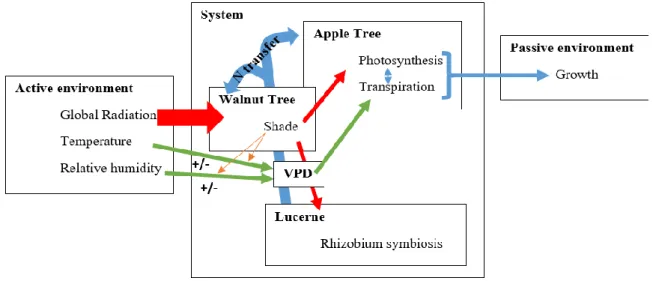
Figure 3: Concept map of the aerial interactions in the agroforestry system studied.
After realising a concept map (Figure 3) where we considered that the intensity of the interactions in the agroforestry system can be correlated to the distance between the plants and especially the distance to the walnut trees that, we suppose, will be responsible for most of the aerial interactions we made two hypotheses,
- the aerial environment differs in a mature agroforestry system (aged walnut tree) compared to a traditional orchard,
- the aerial interactions (microclimate and especially shade) can influence the apple tree growth (etiolation …) and ramification/branching,
NB: the possible effects of belowground competitions could not be explored satisfactorily in this 6-month experiment.
To make sure that the differences we would possibly observe were due to the aboveground interactions in the agroforestry system we made sure to reduce all limiting factors as well as we could. Therefore the apple trees were irrigated and fertilised and we avoided pests and disease that could influence aerial growth.
We divided our apple trees in two blocks to take into account the heterogeneity of the plot and three modalities consisting of the agricultural control (AC), the agroforestry inter-row (AF_IR) as to between the rows of walnut trees and agroforestry row (AF_R) when the apple trees were planted on the same row as the walnut trees.
31
II.
Materials and methods
II.1 Description of the field experiment
II.1.1 Experimental design of the plot A1 of “domaine de Restinclières”
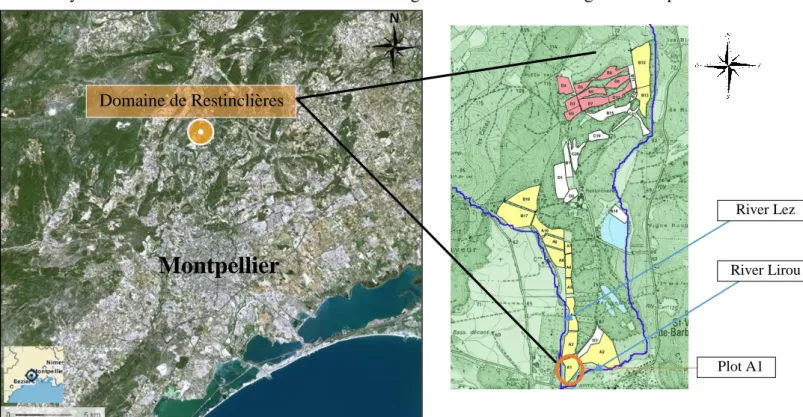
The “domaine de Restinclières” is located in the south-east of France fifteen kilometres north of Montpellier (Figure 4). It’s a regional domain of 220 ha with 54 ha of arable lands where an agroforestry experimentation was started twenty three years ago. The agroforestry layout chosen in the 90’s was conceived taking in account modern agricultural practices.
Therefore, the rows of forestry trees were planted to let the combine harvester pass between tree rows. Different forestry trees, whose wood is precious as Juglans (walnut tree) or Sorbus
domestica (sorb tree), were planted in association with other perennials (vine) or annual crops
(wheat, barley, rape) (Fournier 2002).
The lands are cultivated by a farmer who works with the research teams. Plot A1 was selected for the installation of the experiment because it is the only one that is not maintained or cultivated by the farmer. Therefore it was possible to plant apple trees and manage them as we wanted without any external disturbances. The walnut trees were planted in 1995 with a distance of thirteen metres between the rows and 4 metres on the row. In 2004, there was a thinning, half of the trees, unevenly distributed in the plot, were eliminated.
The experimental design is composed of two blocks in which we have the three modalities comprising 83 and 65 apple trees, respectively (Table 4).
Figure 4: Geographic localisation of the “domaine de Restinclières” and the plot on which is located the apple – agroforestry experiment (source: googlemaps, UMR System)
Montpellier
Domaine de Restinclières
Plot A1 River Lez