
HAL Id: tel-00965649
https://tel.archives-ouvertes.fr/tel-00965649
Submitted on 25 Mar 2014
HAL is a multi-disciplinary open access
archive for the deposit and dissemination of
sci-entific research documents, whether they are
pub-lished or not. The documents may come from
teaching and research institutions in France or
abroad, or from public or private research centers.
L’archive ouverte pluridisciplinaire HAL, est
destinée au dépôt et à la diffusion de documents
scientifiques de niveau recherche, publiés ou non,
émanant des établissements d’enseignement et de
recherche français ou étrangers, des laboratoires
publics ou privés.
Combinatorial surface-based electronic tongue
development : Analytical applications and conception of
2D and 3D biomimetic surfaces
Maria Genua
To cite this version:
Maria Genua. Combinatorial surface-based electronic tongue development : Analytical applications
and conception of 2D and 3D biomimetic surfaces. Other. Université de Grenoble, 2013. English.
�NNT : 2013GRENI044�. �tel-00965649�
THÈSE
Pour obtenir le grade de
DOCTEUR DE L’UNIVERSITÉ DE GRENOBLE
Spécialité : Matériaux, mécanique, génie civil, électrochimie
Arrêté ministériel : 7 août 2006
Présentée par
Maria GENUA
Thèse dirigée par Martial BILLON et
codirigée par Yanxia HOU-BROUTIN
préparée au sein du CEA Grenoble
Institut Nanosciences et Cryogénie (INAC)Service : Structures et Propriétés d’Architectures Moléculaires (SPrAM UMR 5819) Groupe : Chimie pour la Reconnaissance et l’Etude des Assemblages Biologiques (CREAB)
dans
l'École Doctorale I-(MEP)2Développement d’une langue électronique
sur des surfaces combinatoires :
Applications analytiques et conception de surfaces
biomimétiques 2D et 3D
Thèse soutenue publiquement le 24 Octobre 2013, devant le jury composé de :
M. Franz BRUCKERT
Professeur (INP-Grenoble), President
Mme. Edith PAJOT
Directrice de recherche INRA (INRA Jouy en Josas), Rapporteur
M. Yann CHEVOLOT
Chargé de recherche CNRS (Institut des nanotechnologies de Lyon), Rapporteur
M. Ralf RICHTER
Chargé de Recherche (CIC-Biomagune, San Sebastián), Membre
Mme. Yanxia HOU-BROUTIN
Chargée de recherche CNRS (CEA Grenoble), Membre
M. Martial BILLON
Combinatorial surface-based
electronic tongue development:
Analytical applications and conception of 2D
and 3D biomimetic surfaces.
PhD Thesis by
Maria GENUA
5
Remerciements
Une thèse est un projet scientifique que, durant trois ans, le thésard doit développer. Commencer avec un projet, découvrir les techniques nécessaires à cette étude, discuter avec des experts en la matière pour que ce projet devienne finalement ton projet, c’est à la fois un chemin extrêmement intéressant et enrichissant mais également un chemin plein de défis et de doutes. Si parcourir ce chemin a été, non seulement possible, mais aussi un grand plaisir pour moi, c’est grâce à toutes ces personnes que j’ai pu côtoyer pendant cette période, qui ont contribué dans ma vie scientifique ainsi que dans ma vie personnelle, et que je tiens à remercier en quelques mots (bien que ces quelques mots ne sembleront jamais assez pour certains cas).
Tout d’abord, je voudrais remercier les membres du jury qui ont accepté de juger mon travail et moi-même en ma qualité de chercheuse. Merci à madame Edith Pajot et à monsieur Yann Chevolot pour le temps qu’ils ont consacré à la lecture et correction détaillée de mon manuscrit de thèse et à leur appréciation pour ce travail. Merci au professeur Franz Bruckert d’avoir présidé le jury de soutenance ainsi qu’à monsieur Ralf Richter pour ses corrections et pour avoir participé activement dans la discussion scientifique lors des questions.
Dans un deuxième temps, je voudrais remercier tous les collaborateurs qui ont rendu ce travail possible. A Hugues Lortat-Jacob et aux membres de son laboratoire à l’IBS, pour nous avoir donné l’opportunité de travailler avec leurs produits, et pour m’avoir accueillie dans leur labo à l’occasion de mes manips ELISA. A David Bonnaffé et Christine Le Narvor, ainsi qu’à Maryline Macé et tout le reste de l’équipe ICMMO de l’Université de Paris Sud, pour la synthèse des sucres utilisés tout au long de ce travail et pour leur excellent accueil lors de ma semaine de manipulations RMN dans leur laboratoire. A Arnaud De Geyer, du laboratoire SGX à l’INAC, pour son expertise et ses explications extrêmement pédagogiques lors des expériences avec la technique SAXS, et à Arnaud Buhot, du GT, pour son important rôle dans ce projet, pour les analyses mathématiques des résultats et pour sa patience lors de l’explication des analyses faites.
Ensuite, je voudrais exprimer mon énorme reconnaissance à mes directeurs de thèse. A Martial Billon, pour sa patience, sa perpétuelle bonne humeur et pour avoir toujours trouvé une petite place dans son agenda pour moi. Et à Yanxia Hou-Broutin, bon, à Yanxia je la remercie pour tout. D’abord, de m’avoir donné l’opportunité de faire un stage de master avec elle, de m’avoir fait confiance pour continuer en thèse sur un projet très apprécié par elle-même, de m’avoir appris tellement de choses, et d’être toujours disponible pour discuter. Discuter non seulement du projet, mais de tout en général, car j’ai fini par apprécier Yanxia autant scientifiquement que personnellement.
A ces deux directeurs de thèse, on peut rajouter mon « troisième directeur de thèse » et accessoirement, directeur du laboratoire, Thierry Livache. Thierry n’était pas obligé de suivre mon travail de près, il l’a fait, et en plus il a apporté de précieuses idées et conseils. Il m’a de même appris des choses encore plus importantes, comme l’application du sens commun dans la vie
6
quotidienne d’un laboratoire. C’est grâce à sa façon particulière de gérer le laboratoire et à son grand sens de l’humour que Thierry a réussi à avoir un laboratoire comme le CREAB.
Le CREAB est un laboratoire spécial. Tous les matins, à 10h, au CREAB on prend le café. Tous les midis, au CREAB on va manger (après 13h, car le dessert ne coûte que 1 point !) Quand quelqu’un arrive ou s’en va du CREAB, on mange des croissants. Quand c’est l’anniversaire de quelqu’un, on mange des croissants. Bref, au CREAB, on fait tout ensemble (surtout manger). La petite famille du CREAB se maintient unie grâce à un groupe de permanents qui, en plus de donner de l’importance à la qualité scientifique de leurs travaux, donnent de l’importance aux personnes. Merci Yoann, André, Aurélie, Elodie, Loïc (aussi pour ton aide avec les manips electrochimiques), Yanxia, Arnaud, Thierry, Martial, Seb, Roberto, Raph, José et Pascal de m’avoir fait découvir que science et vie peuvent (et devraient) aller toujours ensemble. Spéciale mention pour Roberto, qui a beaucoup collaboré sur ce projet, et pour André et Aurélie, qui m’ont beaucoup aidée lors des corrections de la présentation de la soutenance. Aux secretaires du SPrAM, Catherine, Céline et specialement à Charlie, merci d’avoir fait les demarches administratives un peu plus faciles pour moi et de votre bonne humeur.
Merci aussi aux non-permanents que j’ai croisés au labo. Ceux qui ont travaillé avec moi : Damien, Laurie, Violette, Hillary, Benji, pour avoir contribué au projet et m’avoir supportée comme « chef d’esclaves » pendant un temps. Et les autres non-permanents, qui souvent ont aussi aidé avec mes manips, et parmi lesquels il y en a que je considère comme de vrais amis que j’espère conserver longtemps. Jie et Sami, les deux meilleurs co-bureaux du monde, les « frères » Laurent et Florian, les meilleurs conseillers, Loïc Leprince, toujours avec une idée plus bizarre que celle d’avant en tête mais que nous aimons tel qu’il est ☺, Feriel, la seule qui frappe à la porte avant
d’entrer et reine des boureks, Laurie, toujours dispo pour faire une faveur et bonne personne pathologique, Laure et Sandrine, les filles des soirées cocktail/potains, Cyril, grand curieux de la science, Radek, le polaco tropical, Radé, qui un jour racontera sa vie dans un livre, Seb, José et Raph, les McGuivers du laboratoire, Timothée et Isabel qui même s’ils ne sont pas du CREAB, le sont presque, et les filles que j’ai un peu moins croisées mais qui semblent être très aptes a garder l’esprit du labo, Vanessa, Yulia, Emilie, Diane et Stacie. Bien sûr, une ligne à part pour Camille, mon âme sœur longtemps ignorée. Elle sait bien tout ce qu’elle a fait pour moi ; Dieu le payera avec un bon mari.
Et hors du laboratoire j’ai aussi quelques personnes à remercier, surtout d’avoir fait que j’aie une vie hors du laboratoire. Aux amis, comme Olivier pour ses cours de russe et les diners chez lui où on n’est pas obligé de ramener quelque chose à manger, à Morgane, pour la « Morganisation » des visites à Grenoble et son super accueil chez elle à Paris, à Joni qui est parti en aventure, mais avec lequel j’ai bien rigolé avec ses petites histoires, à Dipankar et Priya, les indiens, à Marc, Florian, Tiphaine, Esther et Miguel, Fabien, Marcello etc. du CIRE, avec lesquels j’ai partagé un bon nombre de bières. Aux colocs de Camille, Paolo pour son accueil à Turin et pour nous avoir fait découvrir la bataille des oranges (et le poulet à l’orange), Max, et Nadège pour me laisser toujours rentrer chez eux.
7 Ensuite je remercie ma « famille » grenobloise pour lesquels je ne peux écrire qu’un énorme MERCI. Ma déjà présentée sœur, Camille (et a Guillaume le gladiator, mon… frère ?), ma maman, Christoph (et Carina !) et la tante qui est partie en Italie, Radek. A mes trois autres colocs Lucie Fer (et Aurélien), Nico Lamentable et Remy Nicerveau : ça a été compliqué de supporter votre connerie, mais vous allez vraiment, vraiment me manquer. Je n’aurais jamais pu imaginer une coloc plus agréable et amusante qu’avec vous. A Diego, mon copain d’aventures, avec lequel on a tout fait ensemble et sans lequel je n’aurais fait rien de tout ça. Merci Diego pour avoir été toujours là.
Et finalement, je voudrais remercier ma vrai famille et les amis que j’ai abandonés pour m’embarquer dans cette aventure, cette fois en espagnol/basque: Me gustaría gradecer a los aitas, a Ander y a las dos Idoias, por su apoyo, sus animos cuando han hecho falta y por venir a buscarme al aeropuerto de Biarritz siempre que he vuelto a casa (y por las altas dosis de pescado). Al resto de la familia, aitonas, primos, tios, amigos de los aitas, eskerrik asko por hacerme sentir que hago algo importante y por vuestro amor incondicional. A las amigas de la uni, Ainoha, Ane, Vero y Pauli (y a Oscar y Borjita). A la cuadrilla (Ander, Zuito, Imanol el Grande, Iñaki, Lierni, Leyre, Eli, Cris, Izas, Naitxu y la Esnaola), por hacerme sentir que aunque haga 6 meses que no nos veamos, parezca que nos hayamos visto el sábado pasado. Por vuestros ánimos y vuestra amistad que no tiene precio. Especialmente a Cristina, la tesis no me ha permitido estar contigo en un doloroso momento de tu vida y tú lo has comprendido, perdonado y además me has apoyado. Eres la mejor. Mila esker guztioi.
9
Contents
Abbreviations………….. ... 13
Chapter 1. Project Background and State of the Art ... 15
Résumé en français du chapitre 1 ... 17
Project Background and State of the Art ... 19
1.1. Human sense of smell: a source of inspiration... 20
1.1.1. Odorant Receptors... 21
1.1.2. Combinatorial Receptor Codes for Odors ... 22
1.2. Bioinspired arrays of sensors ... 24
1.2.1. Electronic noses and electronic tongues ... 24
1.2.2. Potential applications of electronic noses and tongues ... 27
1.2.3. Development perspectives for electronic noses and tongues ... 29
1.3. State of the art on electronic noses and tongues ... 30
1.3.1. Electronic noses and tongues based on electrochemical transduction ... 31
1.3.2. Electronic noses and tongues based on gravimetric transduction ... 35
1.3.3. Electronic noses and tongues based on optical transduction ... 37
1.4. Electronic noses and tongues based on optical detection for protein recognition ... 40
1.5. Presentation of the PhD project ... 45
Chapter 2. Construction of an Electronic Tongue Using Combinatorial Cross-Reactive Receptors ………47
Résumé en français du chapitre 2 ... 49
Construction of an Electronic Tongue Using Combinatorial Cross-Reactive Receptors ... 51
2.1. Preparation of the CoCRR array ... 51
2.1.1. Building blocks ... 51
2.1.2. Preparation of the CoCRR array ... 53
2.2. Detection method: surface plasmon resonance imaging ... 55
2.2.1. Surface plasmon resonance phenomenon ... 55
2.2.2. Surface Plasmon Resonance Imaging ... 56
2.2.3. SPR imaging instrumental set-up ... 58
2.3. Electronic tongue ... 60
2.3.1. Recognition patterns generated by the electronic tongue: CELs and CEPs ... 61
10
Chapter 3. Differentiation and Identification of Pure Proteins and Complex Mixtures
Using the Electronic Tongue ... 65
Résumé en français du chapitre 3 ... 67
Differentiation and Identification of Pure Proteins and Complex Mixtures Using the Electronic Tongue……… ... 69
3.1. Calibration of the electronic tongue ... 69
3.2. Differentiation and identification of pure proteins ... 71
3.2.1. Characteristics of the tested proteins ... 71
3.2.2. Analysis of pure proteins ... 73
3.3. Analysis of protein mixtures... 74
3.4. Analysis of complex mixtures ... 76
3.4.1. Differentiation and identification of complex samples ... 76
3.4.2. Classification of complex samples ... 78
3.4.3. Monitoring the spoilage of milk by the e-tongue ... 79
3.5. Repeatability and stability ... 81
3.5.1. Measurement to measurement and batch to batch repeatability ... 81
3.5.2. Long-term stability ... 82
3.6. Main conclusions of the chapter ... 83
Chapter 4. An Electronic Tongue With Biomimetic Properties ... 85
Résumé en français du chapitre 4 ... 87
An Electronic Tongue with Biomimetic Properties ... 89
4.1. Introduction to GAGs ... 89
4.1.1. Heparin and heparan sulfate ... 92
4.1.2. Heparan sulfate-protein interactions ... 93
4.1.3. Heparan sulfate mimetics ... 94
4.2. Structure and function of Interferon γ ... 94
4.2.1. The C-terminal region of IFNγ ... 95
4.3. Objective of the chapter ... 96
4.4. Study of the electronic tongue/interferon γ interactions ... 97
4.4.1. Electronic tongue/interferon γ interaction affinity ... 97
4.4.2. Electronic tongue/interferon γ interaction specificity ... 100
4.5. Analysis of IFNγ mutants with the electronic tongue ... 102
4.5.1. Presentation of the mutants ... 102
4.5.2. CEPs of IFNγ WT and mutants obtained by the electronic tongue ... 103
4.6. Study of the nature of the interactions between the electronic tongue and proteins...107
11
Chapter 5. Preparation of 3D Biomimetic Nanovectors Through Electronic Tongue
Based Approach ………..111
Résumé en français du chapitre 5 ... 113
Preparation of 3D Biomimetic Nanovectors through Electronic Tongue Based Approach ... 115
5.1. Nanotechnology in biomedical applications ... 115
5.2. Gold nanoparticles and nanoconjugates ... 116
1.2.1 Gold nanoparticles ... 116
1.2.2. Gold nanoconjugates ... 117
5.3. Objective of the chapter ... 125
5.4. Preparation of 3D biomimetic nanovectors ... 126
5.4.1. Choice of nanoparticles ... 127
5.4.2. Choice of building blocks used for the functionalization of Au NPs ... 128
5.4.3. Functionalization of Au NPs using new building blocks... 130
5.5. Characterization of functionalized NPs with new BBs ... 131
5.5.1. Direct visualization of the stability of functionalized Au NPs with new BBs... 131
5.5.2. UV-Visible Spectroscopy ... 132
5.5.3. Small Angle X-Ray Scattering ... 132
5.5.4. Determination of Ligand Density on Functionalized Nanoparticles ... 134
5.6. Bioactivity of the 3D biomimetic nanovectors ... 138
5.6.1. Evaluation of the bioactivity of the 3D biomimetic nanovectors by SPRi ... 138
5.6.2. Evaluation of the bioactivity of the 3D biomimetic nanovectors by ELISA ... 141
5.7. Main conclusions of the chapter ... 145
Conclusions and Perspectives ... 147
Appendices……… ... 149
13
Abbreviations
2D Two-Dimensional 3D Three-Dimensional ATIII Antithrombin III Au NP Gold Nanoparticle BB Building Block
CCD Charge-Coupled Device
CEL Continuous Evolution Landscape CEP Continuous Evolution Profile ChemFET Chemical Field-effect Transistor
CoCRR Combinatorial Cross-Reactive Receptor ConA Concanavalin A
CRR Cross-Reactive Receptor
Da Dalton
DLS Dynamic light scattering DMF Dimethylformamide DNA Deoxyribonucleic acid e-Nose Electronic Nose e-Tongue Electronic Tongue
ECL Erythrina Cristagalli Lectin
EPR Enhanced Permeability and Retention FBS Fetal Bovine Serum
FET Field-effect Transistor FGF Fibroblast Growth Factor
G-Protein Guanosine nucleotide binding Protein GAG Glycosaminoglycan
GFP Green Fluorescent Protein
HATU O-(7-azabenzotriazol-1-yl)-N,N,N’,N?-tetramethyluronium hexafluorophosphate HEPES 4-(2-hydroxyethyl)-1-piperazineethanesulfonic acid
HIV Human immunodeficiency virus
HP Heparin
14
HSA Human Serum Albumin
HSbp Heparan Sulphate Binding Protein IBS Institut de Biologie Structurale IFN Interferon
IgG Immunoglobulin G ISE Ion-selective Electrode KD Dissociation constant
MEMS Microelectromechanical System MIP Molecularly Imprinted Polymer MOS Metal Oxide Semiconductor
MOSFET Metal Oxide Semiconductor Field-effect Transistor MW Molecular Weight
NEMS Nanoelectromechanical System NMR Nuclear Magnetic Resonance NP Nanoparticle
OR Odorant Receptor
PCA Principal Component Analysis PEG Polyethylenglycol
PG Proteoglycan pI Isoelectric Point
PolFET Polymer Field-effect Transistor PPE Poly(p-phenyleneethynylene) QCM Quartz Crystal Microbalance R% Reflectivity percentage RNA Ribonucleic acid
RSV Respiratory Syncytial virus
RT-PCR Reverse Transcription Polymerase Chain Reaction SAM Self-Assembled Monolayer
SAW Surface Acoustic Wave SAXS Small Angle X-Ray Scattering SDF Stromal-Derived Factor SDS Sodium Dodecyl Sulfate SPR Surface Plasmon Resonance
SPRi Surface Plasmon Resonance imaging UHT Ultra High Temperature
UV Ultraviolet
15
CHAPTER 1.
Résumé en français du chapitre 1
Contexte du projet et état de l’art
Les travaux menés au cours de cette thèse trouvent leur fil conducteur dans le développement et l’exploration des applications d’une langue électronique innovante et performante. Il est donc pertinent de commencer par introduire les concepts de base liés à ce type de système d’analyse, ainsi que l’état de l’art actuel du domaine.
Basés sur le puissant système olfactif des vertébrés, les langues et nez électroniques sont des capteurs chimiques qui ne reposent pas sur le principe classique de reconnaissance spécifique sonde-cible, mais sur le concept d’utilisation des capteurs à réactivité croisée. Dans cette approche, la réponse individuelle de chaque récepteur n’est pas suffisante pour la reconnaissance d’un analyte, et c’est la réponse globale d’une collection de récepteurs proprement traitée qui permet d’identifier le, ou les, échantillons.
Avec cette approche, les propriétés de base que doivent respecter les récepteurs se simplifient énormément par rapport aux capteurs spécifiques, qui ont besoin d’être spécifiques et sélectifs de façon individuelle. En effet, les trois caractéristiques principales des récepteurs à réactivité croisée sont :
1- Chaque récepteur peut reconnaitre plusieurs analytes 2- Chaque analyte peut être détecté par plusieurs récepteurs
3- Différents analytes sont reconnus par différentes combinaisons de récepteurs
Ce design permet d’obtenir des motifs de reconnaissance pour des analytes contenant un ou plusieurs composants, y compris pour des analytes pour lesquels le système n’a pas été conçu initialement. Les échantillons peuvent être en phase gazeuse ou en phase liquide, ce qui fait la différence entre les nez électroniques et les langues électroniques.
Une infinité d’applications peuvent être trouvées pour ce type de système notamment dans les milieux où l’analyse en routine d’échantillons est nécessaire. Cela a suscité un intérêt croissant envers les langues et nez électroniques, de la part des chercheurs et des industries, durant les 20 dernières années. Cet intérêt a permis de faire progresser rapidement le développement de ces systèmes, auparavant mis de coté par rapport aux systèmes mimétiques d’autres sens comme la vision, l’audition ou le toucher.
18
Les différentes approches de fabrication de ce type de système sont détaillées dans la section 1.3 de ce chapitre. Elles varient principalement selon le système de transduction employé, ainsi que selon les matériaux sensibles utilisés pour l’obtention des récepteurs à réactivité croisée.
On prêtera un intérêt particulier aux langues et nez électroniques dédiés à la détection de protéines. Ces systèmes sont souvent limités par l’irréversibilité des réponses, les longs temps de récupération du système, dus à des interactions trop fortes entre analyte et récepteur, et la courte durée de vie de certaines puces, causée par le photoblanchiment des fluorophores employés.
Dans ce contexte, l’objectif de cette thèse est ainsi le développement et l’exploration des applications d’une langue électronique qui comporte des améliorations par rapport aux systèmes existants, et notamment, qui simplifie la création et l’obtention des récepteurs à réactivité croisée.
Il est en effet possible de réduire les efforts dédiés à la création d’une librairie de matériaux sensibles en mélangeant un nombre restreint de briques de base (BBs). Les briques de base sont définies comme des petites molécules, faciles à obtenir, ayant différentes propriétés physicochimiques. En mélangeant ces briques de base selon différents ratios et en les laissant s’auto-assembler, il est possible d’obtenir une collection de surfaces combinatoires appelées récepteurs combinatoires à réactivité croisée (CoCRRs). Les propriétés physicochimiques de ces récepteurs combinatoires dépendent bien sûr des propriétés physicochimiques des briques de base, ainsi que du ratio des mélanges à partir desquels ils sont réalisés. Cette approche permet l’obtention facile et rapide d’un grand nombre de CoCRRs, en ajoutant par exemple de nouvelles briques de base, ou en augmentant le nombre de ratios de mélange effectués. De plus, même si les CoCRRs ont des compositions variables, la différence entre deux CoCRRs successifs peut être très faible, aboutissant à une représentation continue des données obtenues sur chaque CoCRR, ce qui permet l’identification rapide des artefacts et données incohérentes. Cette dernière caractéristique établit une différence avantageuse par rapport aux langues électroniques actuelles, qui présentent leurs résultats de façon discrète et non corrélée.
La langue électronique « modèle » fabriquée était initialement conçue pour la différentiation de protéines interagissant avec les héparanes sulfates. Néanmoins, au cours de ces travaux, sa capacité de discrimination a été évaluée non seulement pour l’analyse de protéines pures ou des mélanges de protéines, mais également pour l’analyse de mélanges complexes. La langue électronique développée offre également d’autres fonctionnalités. D’un coté, elle peut mimer les capacités de reconnaissance des l’héparanes sulfates. Ceci peut être utile pour une meilleure compréhension de la nature des interactions héparane sulfate-protéine. D’un autre coté, elle peut être utilisée en tant qu’outil de criblage de surfaces combinatoires possédant des propriétés bioactives, utiles à la fabrication de nanovecteurs biomimétiques qui ciblent de manière spécifique des protéines d’intérêt thérapeutique.
Project Background and State of the Art
Sensory systems of living organisms are responsible for generating an internal representation of the outside world. They are capable of perceiving and analyzing stimuli, and hence, they can induce consequent reactions towards them. Taste and smell, the two chemical senses of the human being, enable people to interact with the chemistry around and contribute critically to their experience of the environment, from the pleasure of eating food to the formation of childhood memories. Despite this, research into chemical sensing historically took a back seat to vision, audition and touch, challenged by the complexities of indefinable stimuli that are often not even consciously processed, and by difficulties in understanding even basic mechanisms of transduction and representation. It was not before 1991, when Buck and Axel [1] identified the genes of odorant receptors (ORs), throwing some light on the issue and launching chemical sensing research to the forefront.
Nature has always been the principal source of inspiration for human technological research and development. Therefore, intelligent sensing machines acquire and process signals in a very similar way as living organisms (Figure 1.1). For this reason, understanding the mechanisms through which humans and other animals interact with the chemistry of the environment is highly interesting for the development of new generations of chemical sensors.
Analogue Circuit Sensory Nerve Brain Computer Sensory Receptor Sensing element + transducer Environment Environment Signal Conversion Amplification; preprocessing Information Processing Analogue Circuit Sensory Nerve Brain Computer Sensory Receptor Sensing element + transducer Environment Environment Signal Conversion Amplification; preprocessing Information Processing
Figure 1.1. Similarities between signal processing in living organisms and intelligent machines.
Human taste is made up just of a handful type of sensations that researchers have agreed on at least five: sweet, umami, bitter, salt and sour tastes [2]. Although this repertoire may seem modest, it has satisfactorily covered the evolutionary need for an effective and reliable platform to help recognize and distinguish key dietary components [3].
CHAPTER 1 Project Background and State of the Art
20
In the case of smell, odors are made up of mixtures of baic odorants. However, the olfactory system shows a much more impressive discrimination power than the gustatory. It is not only able to detect thousands of different odorants, but also participates in a large part of what we call flavour [4]. The sense of taste detects if the eaten substance is sweet, sour, bitter, umami or salty, but it is thanks to the complexity of the sense of smell that we are able to identify the combination of sensations that leads to flavour.
This introduction will reveal the way the sense of smell works in humans and what are the important features that have inspired the development of alternatives to classical sensing approaches. Afterwards, the work will be focused on smell sense-based sensors applied to liquid and gaseous sample analysis, making a special focus on their application to the analysis of proteins.
1.1.
Human sense of smell: a source of inspiration
The sense of smell is mediated by the olfactory system, a system that is characterized by exquisite sensitivity and discriminatory power. It is estimated that the humans can sense as many as 10.000 to 100.000 chemicals as having distinct odors. All of these odorants are small, volatile molecules. However, they have diverse structures and somehow those different structures are perceived as having different odors.Odorants are initially detected by olfactory sensory neurons, which are located in the olfactory epithelium lining the nasal cavity (Figure 1.2). These neurons transmit signals to the olfactory bulb of the brain, which then relays those signals to the olfactory cortex. From there, olfactory information is sent to a number of other brain areas [5]. These include higher cortical areas, thought to be involved in odor discrimination, as well as deep limbic areas of the brain which are thought to mediate emotional and physiological effects of odors.
1.1.Human sense of smell: a source of inspiration
21 Figure 1.2. Vertebrate olfactory system. Odorants reach the olfactory epithelium in the nasal cavity and interact with odorant receptors (ORs) in the fine cilia of olfactory sensory neurons. The axons of the olfactory
sensory neurons project to the olfactory bulb, where they synapse with the dendrites of the second-order neurons, which in turn project to the olfactory cortex. A schematic representation of 3 populations of olfactory
sensory neurons, each expressing 1 different type of OR, is shown in different colors. The axons in the olfactory sensory neurons expressing the same type of OR converge to the same glomerulus in the olfactory
bulb [6].
1.1.1. Odorant Receptors
In 2004, the Nobel Prize in Physiology or Medicine was awarded jointly to Richard Axel and Linda B. Buck (Figure 1.3) "for their discoveries of odorant receptors and the organization of the olfactory system". An overview of their work is reported in Linda Buck’s Nobel Lecture [5] whose reading I highly recommend. The objective of the present work not being to enter into details of history and chronology of the discoveries made in this field, I will just take advantage of the efforts to unravel the sense of smell made by these two, as well as many other scientists, to make a small recapitulation of the present knowledge in the field. Understanding the key features of olfaction mechanisms is essential for understanding the principle of bioinspired sensors developed in the last few decades.
Figure 1.3. The Nobel Prize laureates in Physiology or Medicine 2004: Richard Axel and Linda B. Buck for their discoveries on ORs and the organization of the olfactory system.
ORs are located at the membrane of cilia of olfactory sensory neurons. They belong to the superfamily of G protein-coupled receptors and have the same general structure with seven hydrophobic membrane-spanning regions. They differ in their amino acid sequence, especially in the third, fourth and fifth transmembrane regions, which may form the ligand-binding pocket of odorant molecules (Figure 1.4) [7, 8]. Studies indicate that humans have about 350 different ORs and mice have about 1000 [5].
CHAPTER 1 Project Background and State of the Art
22
The binding of odorants to ORs in the cilia causes, via G protein activation of adenyl cyclase, the production of a cyclic nucleotide, cAMP, which directly opens ionic channels in the plasma membrane (Figure 1.5) [6]. An inward transduction current is carried by Na+ and Ca2+ ions. Olfactory sensory neurons maintain an unusually high intracellular concentration of Cl- ions, and the increase in the internal concentration of Ca2+ causes the opening of Ca2+-activated Cl- channels that produce an efflux of Cl- from the cilia, contributing to the olfactory neuron depolarization. The depolarization spreads passively to the dendrite and soma of the olfactory neuron, triggering action potentials that propagate along the axon to the olfactory bulb [9].
Figure 1.5. Olfactory transduction takes place in the cilia of the olfactory sensory neurons. Odorant molecules bind to ORs and trigger the transduction of the signal. [6]
The discovery of ORs not only explains how the olfactory system detects a vast array of chemicals in the external world, but also provides a set of molecular tools to explore how the nervous system translates chemical structures into odor perception. The first thing studied was how information from different ORs is organized in the olfactory epithelium. The studies provided two important findings:
- First, input from one type of OR is highly distributed in the epithelium. Therefore, neurons with receptors for one odorant are interspersed with neurons that have receptors for another odorant.
- Second, each neuron expresses only one OR gene, thus, the information that each neuron transmits to the brain is derived from a single receptor type.
1.1.2. Combinatorial Receptor Codes for Odors
Later studies were devoted to understanding how the OR family encodes the identities of different odorants [10]. This was made by exposing mouse olfactory neurons to four different classes of linear aliphatic odorants (19 in total) with different functional groups and carbon chains ranging in length from four to nine carbon atoms. Each neuron was imaged as it was exposed sequentially to different odorants. In response to odorants; olfactory neurons exhibited transient increase in intracellular calcium that could be detected by calcium imaging. If a response was seen, the neuron was retested with a lower concentration of the same odorant. Figure 1.6 shows the
1.1.Human sense of smell: a source of inspiration
23 response profiles of 14 neurons, and therefore the recognition properties of the ORs expressed in those neurons.
Figure 1.6. ORs were used combinatorially to detect odorants and encode their identities. The recognition profiles of individual ORs to a series of odorants were determined by calcium imaging and single-cell RT-PCR.
The size of the circles reflects response intensity [5].
Based on the obtained data, three key conclusions were made: 1- Each OR can recognize multiple odorants.
2- Each odorant can be detected by multiple different ORs.
3- Different odorants are recognized by different combinations of ORs.
ORs are thus used combinatorially to encode odor identities. Different odors are detected and thereby encoded by different combinations of ORs, as illustrated in Figure 1.7. Given the number of combinations of 1000 different ORs, this combinatorial coding scheme should allow the discrimination of an almost unlimited number of odorants. Studies also showed that a change in the concentration of an odorant can also change its receptor code. This may explain why changing the concentration of an odorant can alter its perceived odor.
CHAPTER 1 Project Background and State of the Art
24
Figure 1.7. Combinatorial receptor codes for odorants. In this model proposed by Linda Buck [10], the receptors shown in color are those that recognize the odorant on the left. The identities of different odorants are encoded by different combinations of receptors. However, each receptor can serve as one component of
the combinatorial receptor code for many odorants.
1.2.
Bioinspired arrays of sensors
1.2.1. Electronic noses and electronic tongues
The superb performance of biological olfactory systems in odor detection, identification, tracking, and location tasks has inspired an alternative to traditional selective chemosensing techniques: the use of cross-reactive or differential sensor arrays. Named after their source of inspiration, these alternative systems are commonly designated as artificial or electronic noses (e-noses) and tongues (e-tongues), but can also be found under the appellation mechanical noses, odor sensors, cross-reactive sensor arrays, differential sensor arrays or pattern-based sensors.
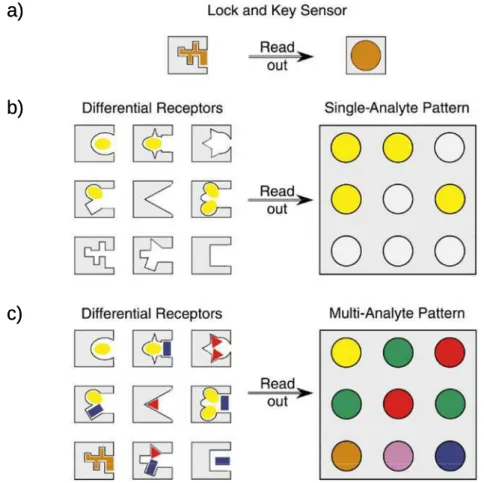
In this alternative sensor architecture, the strict “lock-and-key” design criterion of traditional sensing devices is abandoned. Instead, an array of differential receptors is used. In an analogue way to the previously described ORs (the source of inspiration of this approach) cross reactive sensors possess three key features:
1- Each receptor can recognize multiple analytes.
2- Each analyte can be detected by multiple different receptors.
3- Different analytes are recognized by different combinations of receptors.
As the elements of such an array do not need to be individually specific and highly selective toward any given analyte, sensor design becomes an easier task. Instead, sensors for e-noses/tongues should possess stable analytical behavior, the collection of sensors should contain as much chemical diversity as possible in order to target the largest possible cross-section of analytes, and sensors should have high cross-reactivity, which is considered as the reactivity towards several components of the solution analyzed at the time. There are many terms describing
1.2.Bioinspired arrays of sensors
25 the very same effect as reactivity that are used as synonyms, like unselectivity, cross-sensitivity, low selectivity, partial specificity and even global selectivity. [11].
In this design, as it happens for the olfactory system, identification of an analyte cannot be accomplished from the response of a single sensor element. Instead, the distinct pattern of responses produced over the collection of cross-reactive receptors (also called differential receptors) in the array allows classification and identification of the analyte, which is called pattern recognition. This can be applied both when the sample contains a single analyte and when it contains multiple analytes, see Figure 1.8. One of the main advantages of this approach is that it can yield responses to a variety of different analytes, including those for which the array was not necessarily originally designed to detect [12, 13].
a)
c)
b)
a)
c)
b)
Figure 1.8. Schematic representation of host-guest interactions. a) A specific binding event (lock-to-key paradigm) which exhibits a large degree of complementarity between the host and the guest. b) An array of cross-reactive/differential receptors interacting with one analyte. The identification results from the pattern of responses obtained from the entire array. c) An array of cross-reactive/differential receptors interacting with a
complex sample. The identification results from the pattern of responses obtained from the entire array [13].
The difference between electronic noses and electronic tongues
Although mainly inspired by the sense of smell, this approach can be applied both to the analysis of gaseous samples and liquid samples, differentiated by the terms “electronic nose” in the case of gaseous media analysis and “electronic tongue” in the case of liquid media analysis.
The e-tongue system can thus, be defined as an analytical device comprising an array/set of chemical sensors with not very high selectivities, exhibiting reactivity towards several components
CHAPTER 1 Project Background and State of the Art
26
of the analyzed solution simultaneously (cross-reactivity), in which the appropriate multivariate methods are used for processing of the data [14].
The e-nose, similarly, is defined as an instrument which comprises an array of chemical sensors with partial specificity and an appropriate pattern recognition system for processing the data [15].
Such systems, often associated with an adequate calibration/learning method are suitable for recognition (identification, classification) of various liquid and gaseous media and multicomponent quantitative analysis of organic and inorganic compounds.
The difference between electronic tongues and taste sensors
Sometimes in the literature the reader can find ambiguities with respect to the differences between an e-tongue and a taste sensor. The origin of this ambiguity is the existence of devices which are not clearly classified in one or the other class and the similarity of the samples studied with both devices. However, the fundamental concepts of the taste sensor and the e-tongue are different.
The taste sensor, also called taste system or taste chip, is designed in such a way that it responds to taste chemical substances and can be used to quantify the taste of foods on the basis of the five basic tastes of the tongue (see Figure 1.9). Toko’s group, for instance, works on the development of lipid/polymer membranes that respond specifically to sodium chloride (salty), hydrochloric acid (sour), monosodium glutamate (umami), and quinine hydrochloride (bitter) molecules to assess the taste of analyzed substances [16]. Taste sensors find, thus, applications in the cosmetic, perfume, pharmaceutical and food industries for instance, to quantify bitterness of drinks or dissolved compounds, or to quantify taste masking efficiency of formulations in the pharmacological domain.
Figure 1.9. Results issue of a taste sensor. The shape of the displayed data gives the user an idea of the taste of beer (in green) and soy sauce (in red). From reference [17]
On the other hand, e-tongues aim to discriminate and analyze samples using sensor arrays with different specificity properties coupled to a statistical analysis. The application domains of e-tongues are much broader than taste quantification based on the five basic tastes. They can be used for analysis of some other quality property of the sample, not necessarily applicable to the taste sensation of humans [18].
1.2.Bioinspired arrays of sensors
27
1.2.2. Potential applications of electronic noses and tongues
E-noses and e-tongues find potential applications in all the areas where routine analysis are needed and, thus, they attract the interest of experts in many fields; from biomedical and pharmaceutical industries, environment monitoring, food industry, and energy engineering, to artificial intelligence.
Monitoring industrial processes, for instance, controlling the quality of industrial waste water is one of the applications found for these devices. Gutes et al. employed a voltammetric e-tongue to the characterization of wastewater coming from the paper mill industry [19]. Kranz-Ruckler et al. were able to monitor the process of a drinking water production plant, see Figure 1.10 [20]. Concretely, they were able to differentiate the water at the different stages of the cleaning process.
Figure 1.10. Schematic of a drinking water production plant (arrows indicate sampling points) and principal component analysis showing different clusters for samples taken at different stages of the cleaning process.
The raw, untreated water was cleaned and transported to a filter where all the firm particles were removed. After, there was a slow filter, where the water was cleaned biologically from germs and flavors. Finally, chloride and sodium hydroxide were added to the water to kill germs and to adjust the pH value. The cleaned
water was stored in a reservoir before transported out to the distribution net for fresh water. From reference [20].
Along the same lines, several applications of e-noses and tongues are related to environmental protection, concretely to toxic and pollutant monitoring and air quality control [21]. Some companies propose commercial devices for air quality and odor control. Odowatch for instance, is a patented e-nose from Odotech, an American environmental company specialized in the measurement and monitoring of odors at waste water treatment plants, composting sites, landfills, rendering plants and industrial odor producing plants. The Odowatch devices are positioned near the odor sources on a site and they communicate with each other over a wireless network. The analysis of the obtained data and other parameters generates a map of the real-time odor plume, overlaid on a map of the site and the surrounding area (see Figure 1.11).
CHAPTER 1 Project Background and State of the Art
28
Figure 1.11. Odor map generated by the Odowatch device.
Due to their capacity to monitor air contaminants and control air quality, e-noses are also currently studied by the NASA as a way to ensure the health and safety of the astronauts, as well as equipment integrity inside the International Space Station (see Figure 1.12) [22, 23].
Figure 1.12. Illustration of the electronic nose (e-nose) device that was integrated in the International Space Station.
The use of e-nose/tongue devices for the systematic quality control of liquids could serve as a way to check batch to batch consistency, to detect contamination, spoilage or adulteration of products and to monitor storage conditions. This is interesting for biomedical applications such as haemodialysis control [24], and also for an enormous variety of applications in food processing and quality control. These include process monitoring (fermentation monitoring [25]), authenticity assessment, foodstuff recognition, quantitative analysis, or freshness evaluation and shelf-life investigation. [26-28]. For illustration, El Babri et al. employed a portable e-nose system to classify the states of freshness of Moroccan sardine samples stored at 4 °C, as it can be seen in the PCA score plot in Figure 1.13[29] .
1.2.Bioinspired arrays of sensors
29 Figure 1.13. Sardines from Morocco and PCA score plot on sardine data using a 6-element gas sensor
array.
The ability of the e-noses to detect not only odors but also odorless chemicals makes them ideal for use for crime prevention and security purposes, such as drug odor detection despite of the presence of other masking odors capable of confusing police dogs. It may also be used as a bomb detection method in airports. Through careful placement of several e-noses and effective computer systems, it is expected to locate bombs within a few meters of their position in less than a few seconds. Woodka et al. developed an e-tongue system consisting on a fluorescent polymer sensor array which showed an excellent ability to discriminate between explosives and explosive related compounds in aqueous solution with a low false alarm rate [30].
More recently, it has been demonstrated that the e-noses/tongues can be applied for medical diagnosis [31, 32]. Human exhaled breath consists of numerous volatile compounds, which can provide information on a patient’s physical condition, such as infections, intoxications, or metabolic diseases and can be used as biomarkers. Professor Haick has developed an e-nose by analyzing exhaled air of patients, which has been successfully used to diagnose different cancers including lung cancer at a very early stage with 95% reliability. In the future they expect to assess the exact stage of the disease during treatment and to adjust the treatment [33].
1.2.3.
Development perspectives for electronic noses and
tongues
The outlook for the development of e-nose and tongue devices is highly positive and promising. Important research centers like IBM have expert scientists working in computer development who predict that in five years, computers and smart phones will integrate the senses of smell and taste [34]. This, together with the interest that e-noses and e-tongues present for other multiple applications, has made these devices a subject of increasing interest in the scientific community, as it is reflected by the increasing number of publications in this area over the past 20 years (see Figure 1.14 and Figure 1.15) as well as by different important international conferences like ISOEN
CHAPTER 1 Project Background and State of the Art
30
(International Symposium on Olfaction and Electronic Nose) dedicated to the development of e-nose and tongue systems and ISOT (The International Symposium on Olfaction and Taste).
Figure 1.14. Publications found using the key word “electronic nose”. On the left, published items in each year since 1994 and on the right, citations in each year. Source: Web of Science ®, July 2013.
Figure 1.15. Publications found using the key word “electronic tongue”. On the left, published items in each year since 1994 and on the right, citations in each year. Source: Web of Science ®, July 2013.
1.3.
State of the art on electronic noses and tongues
In general, biosensors and chemical sensors are composed of three parts: a sensing element that interacts with the analyte, a transducer that is able to convert the interaction into a measurable signal, and a signal processing system; see Figure 1.16. In a similar way, e-noses and e-tongues are also composed of these three parts.1.3.State of the art on electronic noses and tongues
31 Herein we present a review of the literature on the principal research carried out in the domain of e-noses and e-tongues, classified by the transduction method employed. Some transduction methods have been mostly developed for e-nose applications while some others have been found more interesting for e-tongue applications.
1.3.1. Electronic noses and tongues based on electrochemical
transduction
Electrochemical is definitely the most developed transduction system both for e-noses and tongues. Most examples of e-noses classified in this section are based on conducting polymers and metal oxide semiconductors (MOS), as well as the small MOSFET devices. E-tongues, on the other hand, have been classically based on potentiometric sensor electrodes and find their miniaturized version in ChemFET devices.
a) Chemoresisitive/conductivity sensors
Chemoresistive/conductivity sensor-based devices have been developed mainly in the frame of gaseous analysis. They work on the principle that a change in some property of the material resulting from interaction with a gas/odor leads to a change in resistance in the sensor. The mechanisms that lead to resistance changes are different for each material type; however, the structure and layout of conductivity sensors prepared using these materials are essentially the same. A scheme of a typical conductivity sensor design is shown in Figure 1.17. Two types of materials have been mainly developed for such devices: conducting polymers and metal oxide semiconductors.
Figure 1.17. Typical structure of a chemoresistive/conductivity sensor. [35]
Conducting polymers are widely used for odor sensing in the form of arrays. The interaction with volatile compounds affects several properties of conducting polymers such as conductivity, work function, optical absorption spectra and others. Among these, conductivity variations, which can be easily detected, are a linear function of the analyte concentration and are therefore often used as actual signals in conducting polymer-based e-noses. Since all these changes are largely reversible, interactions between the polymer and the volatile chemical are supposed to be weak [36]. Main drawbacks of these sensors are their sensitivity to temperature changes, that result in expansion/contraction and thus in resistance changes and their chemical instability face to strong oxidizers such as chlorine and ozone.
Wilson et al. developed an e-nose which was able to characterize the aroma profiles of volatiles released from excised woody samples. The instrument measured electrical-resistance changes
CHAPTER 1 Project Background and State of the Art
32
generated by adsorption of volatiles to the surface of electroactive, polymer-coated sensors. Unique digital electronic fingerprints of wood aromas, derived from multisensor-responses to distinct mixtures of wood volatiles, were obtained from woods of individual tree species. A reference library containing aroma signature patterns for 23 tree species was constructed for identifications of unknown samples using pattern-recognition algorithms [37].
Another basic choice of sensors is metal-oxide semiconductor sensors (illustrated in Figure 1.18), which are the most commercially extended ones. Certain metal-oxides behave as semiconductors at high temperatures. MOS sensors are designed as having a heater element and a sensor element (sintered metal-oxide with or without catalyst). Both elements are separated by a very thin isolating membrane. Redox-reactions occurring at the sensor surface result in changes in resistance which can be measured. These redox-reactions depend on the nature of the metal-oxide/catalyst, the reacting gases, and the temperature.
Figure 1.18. Illustration of a MOS sensor.
The Odowatch commercial e-nose mentioned previously is based on the use of MOS. The gas sensors used in the gas detection chamber are differently doped SnO2-type sensors. Large number of sensors (15 for example) enable the device to sense given classes of odorant gases that are perceived by the human nose: alcohols, aldehydes and ketones (e.g. acetaldehyde), carboxylic acids and fatty acids (e.g. butyric acid), amines (including NH3, R•NH2, indole, methylamine, etc), sulfurous-compounds (including H2S, DMS, DMDS, Mercaptans, etc.), aromatics (BTEX, terpenes,
etc.) [17].
b) Potentiometric sensors
In 1985, the first system for liquid analysis based on a cross reactive receptor array, the first e-tongue, was presented by Otto and Thomas [38] and it was based on potentiometric sensors. Potentiometric sensors, and especially ion-selective electrodes (ISEs), see Figure 1.19, are the most commonly employed sensors for the development of e-tongues. The principle of operation of ion-selective electrodes is based on the measurement of their potential changes against a reference electrode in zero-current conditions. The potential of the ISE is a function of the activity of the ionic species in a sample solution and is formed in the ion-sensitive membrane, where the selective complexation (ion recognition) of the analyte molecule occurs. ISEs are considered good
1.3.State of the art on electronic noses and tongues
33 sensors for e-tongues since they can be considered broadly selective sensors; able to respond in varying degrees to other ions rather than specifically to a single ion. The main advantages of potentiometric sensors are a well-know working principle, the possibility of obtaining sensors selective to many various species, and the relative low cost. Nonetheless, they present some disadvantages like the temperature dependence and big size.
Most research in the field is devoted to the development of suitable electrodes. Semi-permeable membranes of various types have demonstrated varying degrees of selectivity and specificity suitable to be combined with pattern recognition techniques and have found an infinity of applications particularly in food analysis [39-41]. Solid-state potentiometric sensors have been reported for heavy metal ions [42], while chalcogenide glass membranes have been reported for food and environmental analysis [21, 43-45].
Figure 1.19. Photography of a potentiometric electronic tongue (e-tongue) composed of an array of ISEs. From reference [17].
c) Voltammetric Sensors
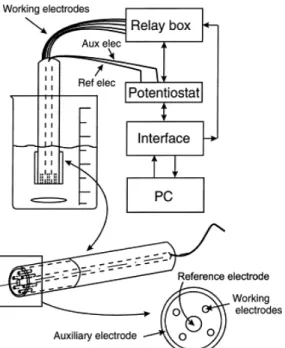
In contrast with potentiometric methods, voltammetric measurements are performed when equilibrium is not reached, and the signal obtained is the measure of the current as the potential is varied. The simplest measurement set-up employs three electrodes: reference, working and auxiliary electrodes, see Figure 1.20. The potential of the reference electrode is assumed to be constant and between the working and auxiliary electrodes the current flows. However, although very robust, as it happens for potentiometric electrodes, electrodes must be calibrated and cleaned regularly. Since 1997 [46], voltammetric e-tongues have been developed for several applications in industrial applications and in the food industry [47].
CHAPTER 1 Project Background and State of the Art
34
Figure 1.20. Common configuration of a voltammetric e-tongue with four working electrodes. From reference [47].
d) Field-effect transistors (FET)
Metal Oxide Semiconductor Field Effect Transistors (MOSFET) are also employed as sensors for e-noses. These transistors comprise three layers, a silicon semiconductor, a silicon oxide insulator and a catalytic metal (Pd, Pt, Ir, Rh) called the gate. This kind of transistors operates by means of three contacts, two of them allow the current in (source) and out (drain), and the third one acts as the gate and regulates the current through the transistor. The structure of a MOSFET sensor is given in Figure 1.21. Molecules interacting with the metal gate produce a change in the MOSFET signal that can then be interpreted by pattern recognition computer systems. Polymers have also been used as gate material for MOSFET devices, and are usually called PolFETs.
Figure 1.21. Schematic illustration of a MOSFET transistor.
The current leader in the area of MOSFET e-noses is the French company Alpha Mos, which develops e-noses like FOX or GEMINI, both based on MOSFET technology. They have also developed an e-tongue, called ASTREE. This e-tongue uses sensors based on the ChemFET (chemical field effect transistor) technology for liquid sample analysis; see Figure 1.22. ChemFET is a structural analogue of a MOSFET transistor, where the change on the gate electrode is produced by a chemical process. In this case, each sensor’s gate has a specific organic
1.3.State of the art on electronic noses and tongues
35 membrane, which interacts with ionic and neutral chemical compounds present in the liquid sample in a specific manner. Any interaction at the membrane interface is detected by the sensor and converted into an electronic signal.
Figure 1.22. The ASTREE e--tongue system fabricated by Alpha Mos and the ChemFET employed for the measurements.
More recently, nanomaterials have been used in combination with FET to fabricate more sensitive e-nose devices. Goldsmith et al. immobilized mouse ORs on carbon nanotubes and succeeded in detecting a number of odorants based on FET, as shown in Figure 1.23 [48]. The idea of immobilizing ORs as sensing materials is not new and has already been widely studied by Pajot et al [49-52]. Park’s group has integrated conducting polymer nanotubes, on which ORs were immobilized, into a FET platform and the field induced sensitivity derived from odorant recognition was observed even at a 10 fM concentration. [53, 54].
Figure 1.23. Scheme of a carbon nanotubes transistor functionalized with mouse ORs. From reference [48].
1.3.2. Electronic noses and tongues based on gravimetric
transduction
In 1880, Jacques and Pierre Curie discovered that certain crystals generate an electrical potential proportional to an applied mechanical stress, termed the piezoelectric effect. Inversely, the converse piezoelectric effect, which is the basis of piezoelectric sensors, is a phenomenon in which when a voltage is applied across the piezoelectric quartz crystal the material oscillates at its resonance frequency [31]. There are two principal types of piezoelectric sensors: the surface acoustic wave (SAW) device and the quartz crystal microbalance (QCM). The main difference between them is that SAW device produces a surface wave that travels along the surface of the sensor, while the QCM produces a wave that travels through the bulk of the sensor. Both types of
CHAPTER 1 Project Background and State of the Art
36
devices work on the principle that a change in the mass of the piezoelectric sensor coating due to analyte absorption results in a change in the resonant frequency.
a) Quartz Crystal Microbalance (QCM) Sensors
In a QCM, an increase on the mass of the sensitive material deposited on the surface of the crystal alters the resonant frequency of the quartz crystal and, this change in the resonant frequency, is therefore used for the detection of the analyte. The sensitive materials or chemically active surfaces employed for e-nose applications are usually polymers or modified polymers, see Figure 1.24. Micromachining is used to fabricate the QCM devices, which makes the fabrication of small sensor structures possible. [35] Arrays of this type of sensors can be used for both e-noses and tongues [55].
Figure 1.24. QCM sensor is composed of a quartz disc coated with the absorbing polymer layer and a set of gold electrodes evaporated onto either side of the polymer/quartz structure.
Di Natale et al. analyzed body odors by an e-nose composed of an array of seven quartz microbalance sensors, in which quartz was coated with different kinds of metalloporphyrins, used as sensing materials. To do that, they collected human body odors from a population of patients affected by different mental disorders and from a population of healthy people as reference controls. The response of the e-nose was detected in Hz when the surface of the sensor was exposed to body odors. The result of this experiment showed that body odor changes are so complex that none of the compounds could be regarded as a specific chemical marker of disease. Rather, a disease like schizophrenia could be diagnosed by analyzing their combination [56].
b) Surface Acoustic Wave Sensors
A SAW sensor also works on the principle of frequency shifts. The SAW device is composed of a piezoelectric substrate with an input (transmitting) and an output (receiving) transducer deposited on top of a substrate. The sensitive membrane is placed between the transducers (see Figure 1.25), and an electrical signal is applied across the input transducer creating an acoustic two-dimensional wave that propagates along the surface of the crystal. SAW e-noses and tongues have been applied in fields like food industry [57] or household appliance industry [58], amongst others.
1.3.State of the art on electronic noses and tongues
37 Figure 1.25. Structure of a SAW sensor [35].
c) Micromecanical Sensors
Alternative devices proposed for e-nose/tongue applications are microelectromechanical systems (MEMS) and nanoelectromechanical systems (NEMS) which find their application mainly in e-nose applications [59-61] although some examples of e-tongue applications can be found [62]. The classical design for these applications is the use of an array of cantilever sensors [63], see Figure 1.26a [59]. The cantilevers are individually coated, and transform the physical and chemical reactions of the analyte with the sensor layers to a mechanical response. The cantilevers are optically read out by recording the position of an incident light spot reflected off the cantilever’s apex by using a position-sensitive detector, as shown in Figure 1.26b.
a) b)
a) b)
Figure 1.26. E-nose developed by Lang et al. a) The cantilever sensor array. b) Beam deflection technique to read out the cantilever bending using a position-sensitive detector. [59]
Apix Technology, a start-up founded by Leti and Caltech in 2011, is developing multi-gas emissions analyzers based on combination of miniaturization of gas-phase chromatography and NEMS sensors. Targeted applications include gas analysis for industrial processing in the petrochemical and natural gas distribution industries, analysis of ambient air quality, as well as medical diagnosis through the analysis of biomarkers in a patient’s breath.
1.3.3. Electronic “noses” and “tongues” based on optical
transduction
Despite optical transduction is not very extended in the case of gas sensing, some examples can be found, for instance, the use of optical fiber sensors [35]. In contrast, optical transduction for e-tongue-type applications is quite extended and diverse. Even if these type of systems, also
CHAPTER 1 Project Background and State of the Art
38
known as cross-reactive sensor arrays, have not still been explored as much as electrochemical ones, they appear to be specially popular for biological sample analysis applications [64].
The most popular optical detection method is the colorimetry/fluorimetry. Professor Eric V. Anslyn is a pioneer in the field of cross-reactive receptor array development for molecular recognition coupled with optical transduction systems. In 1998, his group developed an e-tongue taking advantage of the advances in micromachining techniques at the time and efficient charge-coupled devices (CCDs) [65]. Poly-(ethylene glycol)-polystyrene resin beads derivatized with a variety of indicators were deposited in micromachined wells (see Figure 1.27) and the absorption property changes upon analyte exposure were measured with a CCD camera. A further improvement of this system was the addition of temporal dimension to the measurements to follow the kinetics of the binding [66]. They developed several resin-bound synthetic receptors with functionalities targeted toward certain analyte classes, leading to customizable differential sensor arrays. Studies made by this system include recognition and discrimination of nucleotide phosphates, tripeptides, tripeptide mixtures, proteins and glycoproteins. A variation of this system was the derivatization of the core of the beads with a colorimetric indicator and the periphery with metal ligands. This variation was used for making pattern responses of various metallic cations [67].
Figure 1.27. Multicomponent sensor array on a silicon chip used for e-tongue system by Anslyn’s group. [13]
Also for metal ion determination, arrays of unselective indicators arranged in a micro titer plate [68], and fluorescent self-assembled monolayers [69] have been used.
The response of a molecularly imprinted polymer (MIP) array can also be coupled to an optical, colorimetric response, using a dye displacement strategy. MIPs are highly crosslinked polymer matrices developed in the presence of a template analyte molecule. After templating, the analyte molecule is removed leaving a binding cavity functionally suitable to the target analyte [70, 71].
Moreover, porphyrins and metalloporphyrins can be used in both fluorescent and colorimetric signaling arrays by measuring fluorescence quenching of the receptors upon interaction with the analytes. Both are readily modifiable, stable and have large surface areas for binding. Kenneth S. Suslick has exploited these molecules, as well as other dyes, for making patterns of organic molecules in water, as well as common drinks [72-74]. In Figure 1.28, we show the results obtained by this group for beer discrimination. These sensing molecules were also employed by Hamilton et
1.3.State of the art on electronic noses and tongues
39 Figure 1.28. Patterns of 18 commercial beers for their discrimination obtained with the system developed
by Suslick. [74]
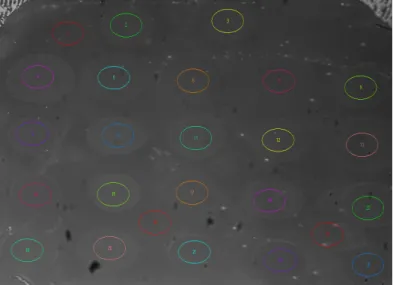
Other tailored biomolecules that have also been used as cross-reactive receptors in colorimetric/fluorescence devices include three-way junctions [77], gold nanoparticle-fluorophore complexes [78], aptamers [79, 80], metal-dye complexes [81, 82] and fluorescent dyes embedded in a hydrogel matrix [83]. One example is given here. By using a hydrogel-based fluorescent micro array containing different combinations of eight dyes, researchers succeeded in the differentiation of common alcoholic beverages like white wine, German and Indian beer, dry wine or vodka. The remarkable advantage of this design is the use of combination of dyes for obtaining a wider diversity of cross-reactive receptors in an easy way (see Figure 1.29).



![Figure 2.18. Classification of samples by PCA. Figure adapted from reference [26].](https://thumb-eu.123doks.com/thumbv2/123doknet/12883865.370188/64.892.186.835.463.653/figure-classification-samples-pca-figure-adapted-reference.webp)
