HAL Id: hal-02325923
https://hal.archives-ouvertes.fr/hal-02325923
Submitted on 22 Oct 2019
HAL is a multi-disciplinary open access archive for the deposit and dissemination of sci-entific research documents, whether they are pub-lished or not. The documents may come from teaching and research institutions in France or abroad, or from public or private research centers.
L’archive ouverte pluridisciplinaire HAL, est destinée au dépôt et à la diffusion de documents scientifiques de niveau recherche, publiés ou non, émanant des établissements d’enseignement et de recherche français ou étrangers, des laboratoires publics ou privés.
Ecosystem disservices matter: Towards their systematic
integration within ecosystem service research and policy
Julien Blanco, Nicolas Dendoncker, Cécile Barnaud, Clélia Sirami
To cite this version:
Julien Blanco, Nicolas Dendoncker, Cécile Barnaud, Clélia Sirami. Ecosystem disservices matter: Towards their systematic integration within ecosystem service research and policy. Ecosystem Services, Elsevier, 2019, 36, pp.100913. �10.1016/j.ecoser.2019.100913�. �hal-02325923�
This document is the author version of the following article:
Blanco, J., N. Dendoncker, C. Barnaud, and C. Sirami. 2019. Ecosystem disservices matter: Towards their systematic integration within ecosystem service research and policy. Ecosystem Services 36:100913. https://doi.org/10.1016/j.ecoser.2019.100913
Ecosystem disservices matter: towards their systematic integration within ecosystem service research and policy
Authors: Julien Blancoa,1,2, Nicolas Dendonckerb, Cécile Barnauda, Clélia Siramia.
a Dynafor, Université de Toulouse, INRA, INPT, INPT - EI PURPAN, Castanet-Tolosan, France b Department of Geography, Institute of Life, Earth, and Environment (ILEE), University of
Namur, Rue de Bruxelles 61, 5000 Namur, Belgium
1 Present address: UMR CNRS 6554 LETG-Angers, UFR Sciences, Université d’Angers, Angers,
France
2 Corresponding author: Dr. Julien BLANCO, LETG-Angers, UFR sciences, Université
d’Angers, 2 boulevard Lavoisier, 49045 Angers, France Email: [email protected]
Abstract
Ecosystem disservices (EDS) highlight the negative effects of nature on human well-being. Like ecosystem services (ES), EDS impact economic and non-economic aspects of human life within social-ecological systems (SES). The concept of EDS has been much debated, with strongly differing opinions regarding its utility and implications. In this opinion paper, we emphasize its relevance and complementarity to the ES concept for analyzing SES, and advocate applying EDS to SES research more systematically. Firstly, we highlight that though EDS are now sometimes studied, they remain neglected compared to ES. Secondly, we propose five reasons why EDS and ES are complementary concepts. Thirdly, we suggest that EDS are critical to understanding stakeholders’ behavior regarding ecosystems. Drawing on existing studies, we illustrate how stakeholders in SES simultaneously perceive and benefit or suffer from ES and EDS. We further suggest that, under certain conditions, EDS may influence people’s behavior more than ES. Such 'EDS-biased behavior' implies that, under certain circumstances, targeting EDS reduction may be more effective than targeting ES increase to encourage nature-friendly behaviors. Finally, we provide five recommendations to further integrate ES and EDS in research, as a pathway towards improving the understanding of SES and the effectiveness of sustainability policies.
Keywords
Human-nature relationships; decision-making; policy for sustainability; socio-cultural valuation; integrated valuation.
1. Ecosystem disservices: a debated concept
Ecosystem disservices (EDS) have been defined as “the ecosystem generated functions, processes and attributes that result in perceived or actual negative impacts on human wellbeing” (Shackleton et al., 2016). Like ES, EDS are co-produced by ecological and human factors within social-ecological systems (SES). Initially introduced in research on agricultural (O’Farrell et al., 2007; Swinton et al., 2007; Zhang et al., 2007) and urban systems (Lyytimäki and Sipilä, 2009), the EDS concept has since been strongly debated. On one hand, EDS were claimed to reinforce the tendency of human societies to pay too much attention to the negative impact of nature (Shapiro and Báldi, 2014) and to potentially undermine biodiversity conservation (Villa et al., 2014). In addition, some authors argued that the EDS concept promotes a black-and-white approach that ignores the possibility that every ecosystem may contribute to either ES or EDS, depending on the context (Saunders and Luck, 2016). On the other hand, the EDS concept was advocated as a way to better balance the positive and negative effects of nature on human well-being and to better assess its net contribution (Dunn, 2010; Schaubroeck, 2017). For some authors, studying EDS may help minimize them without compromising the resilience of ecosystems (Lyytimäki, 2015), and achieve more balanced policies for sustainability (Schaubroeck, 2017; Shackleton et al., 2016).
In this opinion paper, we argue that EDS are very likely to influence real-world SES. Thus, empirical research should test the relevance and utility of the EDS concept for putting ES into practice (see Special Issue “Putting ES into practice”, Ecosystem Services, Volume 26B, available August 2017). We first highlight that the EDS concept remains poorly investigated in the peer-reviewed literature. We then emphasize that EDS, in combination with ES, can help elucidate important dimensions of SES. Drawing on existing studies, we further suggest that EDS may have more influence than ES on stakeholders’ behavior toward ecosystems. Finally, we propose five recommendations for the better integration of EDS in ES research and policy.
2. An expanding, yet understudied, concept
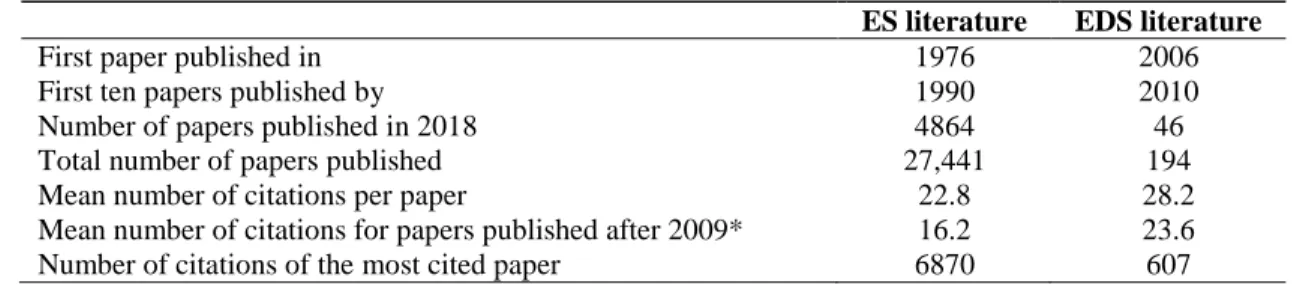
The number of papers and citations on EDS illustrates that this concept is gaining momentum in the literature (Table 1). Although the conceptual framework is not yet entirely stabilized (Campagne et al., 2018), the EDS concept has been applied to a diversity of SES (e.g. urban, Gómez-Baggethun and Barton, 2013; agricultural, Ango et al., 2014; forest, Agbenyega et al.,
2009; and aquatic, Limburg et al., 2010). It has also been used for a diversity of purposes, in particular to understand people’s perceptions (Teixeira et al., 2019), to identify bundles of ES and EDS (Campagne et al., 2018), to assess EDS-related financial costs (Mackenzie and Ahabyona, 2012) and to inform management in conservation areas (Hansen, 2014). Based on this empirical research, EDS conceptual frameworks and classifications have progressively gained substance (Lyytimäki and Sipilä, 2009; Shackleton et al., 2016; Von Döhren and Haase, 2015).
The consideration of EDS remains however extremely limited compared to the consideration of ES (Table 1). In particular, EDS are absent from most recent ES conceptual advances (Costanza et al., 2017; Haines-Young and Potschin, 2018), and are insufficiently taken into account in the framework of nature’s contributions to people (NCP, Díaz et al., 2018). Whereas NCP are acknowledged to be either positive or negative according to the context, none of the 18 NCP listed by Díaz et al. (2018) correspond to a negative NCP. This suggests that ES and EDS have yet to be integrated within a single and operational framework.
Table 1: Literature on ES and EDS between 1976 and 2018 in Web of Knowledge core collection [literature search performed on March 5th 2019 with the queries TS=(service* NEAR (ecosystem* OR landscape*)) for ES literature and TS=((disservice* OR dis-service* OR dys-service* OR disservice*) NEAR (ecosystem* OR landscape*)) for EDS literature]. Queries are meant to show the gap between ES and EDS literature. Yet we acknowledge that both ES and EDS have been the focus of research long before these terms were coined.
ES literature EDS literature
First paper published in First ten papers published by Number of papers published in 2018 Total number of papers published Mean number of citations per paper
Mean number of citations for papers published after 2009* Number of citations of the most cited paper
1976 1990 4864 27,441 22.8 16.2 6870 2006 2010 46 194 28.2 23.6 607
* This indicator suggests that EDS papers are more cited than ES papers not only because of the late emergence of EDS literature (and the continuous increase of publications and citations with time), but also because they address an important topic for SES research.
3. Integrating EDS within ES frameworks will help in understanding important social-ecological interactions
ES research has proven effective to elucidate important dimensions of SES, such as how people perceive and behave towards ecosystems (e.g. King et al., 2015; Martín-López et al., 2012). In particular, ES research has highlighted that different stakeholders value ES differently (Jacobs et al. 2016). Because of antagonisms between ES (one ES may increase at the expense of another,
Deng et al., 2016), a given management choice may therefore benefit certain stakeholders and be detrimental to others (Barnaud et al., 2018). However, ES research generally overlooks the negative impact of ecosystems with regard to human well-being, which was emphasized by the introduction of the EDS concept (Dunn, 2010). We here summarize the main reasons why EDS and ES are distinct from and complementary to each other, in order to better understand SES: 1. EDS encompass the diversity of the adverse impact of ecosystems. EDS have different
manifestations (Shackleton et al., 2016) and origins (Campagne et al., 2018). They may be manifested via a direct negative impact on human well-being (e.g. animal attacks on humans, Silwal et al., 2017), or via a negative impact on an ES supply (e.g. pests affecting crop production, Wielgoss et al., 2014). Moreover, EDS may be generated by ecosystem functioning (e.g. volatile organic compounds emitted by forests, Kesselmeier et al., 2000), or by the response of ecosystems to human practices (e.g. resistant weed invasion following pesticide spraying, Barot et al., 2017).
2. EDS and regulating ES are driven by distinct processes. In response to the claim that regulating ES already account for the EDS they regulate (Villa et al., 2014), we argue that studying drivers of EDS differs from studying drivers of ES. For example, crop pathogen dissemination and mutualism between crop-damaging species are governed by processes that are not necessarily the same as processes that govern species involved in the regulation of these crop-damaging species (Wielgoss et al., 2014). Furthermore, in some cases, EDS regulation seems to more effective through the implementation of adequate human infrastructures rather than through the promotion of regulating ES (e.g. fences to limit crop damage caused by large mammals, Harich et al., 2013). The joint understanding of EDS and of regulating ES is therefore necessary to identify the most suitable mitigation strategies. 3. EDS allow better integration of a multiplicity of values. ES research now emphasizes the
importance of integrating people’s subjectivity and different value systems in ES assessments (Dendoncker et al., 2018; Jacobs et al., 2016). Such inclusive valuations must acknowledge that some people perceive something as a service, while others see it as a disservice (e.g. wildlife, Rescia et al., 2008; Silwal et al., 2017). Coupling ES and EDS will enable better inclusion of different visions and understanding of associated social conflicts (Barnaud et al., 2018).
4. EDS are different from ES trade-offs. Because of antagonisms between ES, some ES may decline due to the increase of other ES. Such antagonisms result in a “we cannot have it all” situation where stakeholders may have to choose which ES to promote (Turkelboom et al., 2018). In addition, due to synergies between ecological processes, ES and EDS may simultaneously increase (or decrease). For example, pathogen transmission or attacks on humans may increase as wildlife spreads (Caron et al., 2013; Silwal et al., 2017). Such cases reflect an “everything has a cost” situation where stakeholders may have to choose whether to promote an ES or to mitigate an EDS. These trade-offs between ES and EDS differ from trade-offs between ES, and should be better accounted for in research and environmental policies (Shackleton et al., 2016).
5. EDS emphasize that adverse impact is co-produced by humans and ecosystems. ES result from a co-production process between human and ecological factors that allow them to flow towards the society (Costanza et al., 2017; Palomo et al., 2016). For example, timber production depends on ecological factors underlying tree growth, and on forest management practices such as tree planting, nursing, and harvesting. Similarly, and contrary to the claim that EDS mainly result from mismanagement (Villa et al., 2014), EDS are co-produced by humans and ecosystems (Lyytimäki et al., 2008). For example, cultural EDS (and ES) associated with birds depend on the abundance and richness in bird species populations as well as on human population density, which jointly influence human-avian interactions (Cox et al., 2018). It is only by understanding EDS co-production processes that we will identify ways to mitigate them.
4. Stakeholders’ actions may be more influenced by EDS than by ES
In addition to the five points mentioned above, we argue that it is critical to include EDS in ES research because, under some circumstances, EDS may influence people’s actions more than ES do. This 'EDS-biased behavior' hypothesis is supported by several studies and for different types of stakeholders. For instance, mangroves in Thailand were drained to limit diseases, despite the strong recognition of mangrove-related ES (Friess, 2016). In South-Africa, some transhumant herders’ movements were driven by the will to avoid EDS (such as poisonous plants and boggy areas), rather than to seek ES (O’Farrell et al., 2007). In Canada, residents listed more ES (N=11) than EDS (N=10) associated with urban trees (Conway and Yip, 2016). Yet, they started cutting
trees down after having experienced tree falls. In France, farmers similarly associated more ES (N=17) than EDS (N=6) with farm trees (Blanco et al., 2018). Yet they removed many trees partly because of EDS such as the extra labor required to manage hedgerows and impediments to mechanization that trees may represent.
These examples show that people value both ES and EDS. However, some of their actions are driven by their perceptions of EDS rather than by their perceptions of ES. Thus, people’s actions may be biased towards EDS reduction, though they realize this will impact the ES supply. Yet, because personal motivations, background, culture and experiences influence people’s decisions regarding environmental conservation (Amacher et al., 2003; Chouinard et al., 2008; Home et al., 2014), we may expect a wide variability in how EDS influence individual behavior patterns. While further research should test the generality of this phenomenon across a wide range of contexts, this could have significant impacts on ES research and policy. This 'EDS-biased behavior' hypothesis implies that the lack of awareness on ES may not be the main driver of nature-unfriendly behaviors, contrary to a widely accepted view (Buij et al., 2017; Shapiro and Báldi, 2014). To encourage nature-friendly societies, targeting EDS reduction may be more effective than targeting ES increase.
5. Five recommendations to reinforce the EDS concept in research and policy
We support the claim formulated by previous authors that an integrated assessment of ES and EDS will help towards a more holistic understanding of the role of nature with regard to human well-being, and towards more effective and innovative sustainability policies (Lyytimäki, 2015; Schaubroeck, 2017). We further argue that developing place-based research and building a grounded body of knowledge on EDS represents the main avenue towards operationalizing this concept. Building on knowledge gaps identified in the literature, we propose five recommendations for a better ES/EDS integration in research:
1. Build an operational and locally-adaptable EDS classification. ES classifications (Haines-Young and Potschin, 2018; Landers and Nahlik, 2013) have proven instrumental to develop place-based research and build a substantial body of knowledge. Despite several proposals (Gómez-Baggethun and Barton, 2013; Lyytimäki, 2014; Shackleton et al., 2016), we still lack an operational EDS classification that would fit to a broad range of SES. The pursuit of ES/EDS research in various SES will allow the development of robust EDS classifications.
2. Include EDS and ES in both biophysical and socio-cultural assessments. The combination of different disciplines and methods to represent multiple values of nature is increasingly advocated for formulating ad-hoc policies (Dendoncker et al., 2018; Jacobs et al., 2016). While EDS research has so far been dominated by qualitative approaches (Von Döhren and Haase, 2015), reinforcing quantitative assessments of EDS is necessary to achieve integrated ES/EDS valuations (e.g. Campagne et al., 2018; Dorresteijn et al., 2017).
3. Consider ES/EDS bundles, trade-offs among EDS, and between ES and EDS. Considering multiple ES and EDS is critical to identify ES/EDS bundles (Campagne et al., 2018), and potential antagonisms and synergies among EDS and between ES and EDS (Barot et al., 2017). Highlighting these relationships will improve our understanding of conflicting or shared interests among stakeholders, and will further help facilitate negotiations and provide a basis for the conception of ad-hoc management and policy instruments (Barnaud et al., 2018). 4. Consider spatial and temporal variations in EDS supply and demand. Changes in the supply and demand make ES and EDS spatially and temporally variable. For instance, crop raiding varies across seasons and in function of the distance to forests (Warren et al., 2007). Forests were associated with fear and anxiety in medieval times, whereas they now provide inspiration and recreation (Pilli, 2018). Similarly, ES and EDS are context-dependent as they depend on where people live (Dorresteijn et al., 2017), their livelihood, or their beliefs and traditions (Lyytimäki et al., 2008). Developing research on the spatial and temporal dimensions of ES/EDS will contribute to a better understanding of multi-scale SES dynamics. 5. Accounting for ES/EDS production processes in research and policy. ES and EDS are co-produced by ecosystems and human societies (Bennett et al., 2015; Palomo et al., 2016). Yet, operationalizing this co-production concept remains a critical challenge (Fischer and Eastwood, 2016). In particular, distinguishing the respective roles of human and ecological factors in the co-production of EDS may be difficult. For example, floods result from the interaction between rainfall events and inappropriately designed human infrastructures; wildfires depend on the interaction between human activities and ecosystem attributes. The multiple implications of ES/EDS co-production processes still need to be tackled in order to improve ES/EDS conceptual and operational frameworks.
To conclude, the ES concept is gaining momentum as an analytical research framework and as an operational tool for decision and policy making (Grêt-Regamey et al., 2017). Since the Millennium Ecosystem Assessment, its application to a diversity of contexts has triggered repeated and profound reworking of the initial framework (Costanza et al., 2017; Díaz et al., 2018; Haines-Young and Potschin, 2018). There is now growing evidence that EDS need to be equally considered to improve our understanding of people’s views and actions with regard to ecosystems. In addition, we believe that investigating who suffers from EDS, how people react to EDS and how this impacts ES opens up stimulating research avenues for the ES community. An integrated ES/EDS framework will not only contribute to achieving a more holistic understanding of SES, but will also contribute to the better integration of the perspectives of different stakeholders and practitioners. By including a wider range of different values, ES/EDS research will eventually provide valuable insights for rethinking policies for sustainability towards greater effectiveness and equitability.
References
Agbenyega, O., Burgess, P.J., Cook, M., Morris, J., 2009. Application of an ecosystem function framework to perceptions of community woodlands. Land use policy 26, 551–557.
https://doi.org/10.1016/j.landusepol.2008.08.011
Amacher, G.S., Conway, M.C., Sullivan, J., 2003. Econometric analyses of nonindustrial forest landowners: Is there anything left to study? J. For. Econ. 164, 137–164. https://doi.org/10.1078/1104-6899-00028
Ango, T.G., Börjeson, L., Senbeta, F., Hylander, K., 2014. Balancing ecosystem services and disservices: Smallholder farmers’ use and management of forest and trees in an agricultural landscape in southwestern Ethiopia. Ecol. Soc. 19. https://doi.org/10.5751/ES-06279-190130
Barnaud, C., Corbera, E., Muradian, R., Salliou, N., Sirami, C., Vialatte, A., Choisis, J.-P., Dendoncker, N., Mathevet, R., Moreau, C., Reyes-García, V., Boada, M., Deconchat, M., Cibien, C., Garnier, S., Maneja, R., Antona, M., 2018. Ecosystem services, social interdependencies, and collective action: a conceptual framework. Ecol. Soc. 23, art15. https://doi.org/10.5751/ES-09848-230115
Barot, S., Yé, L., Abbadie, L., Blouin, M., Frascaria, N., 2017. Ecosystem services must tackle anthropized
ecosystems and ecological engineering. Ecol. Eng. 99, 486–495. https://doi.org/10.1016/j.ecoleng.2016.11.071 Bennett, E.M., Cramer, W., Begossi, A., Cundill, G., Díaz, S., Egoh, B.N., Geijzendorffer, I.R., Krug, C.B., Lavorel,
S., Lazos, E., Lebel, L., Martín-López, B., Meyfroidt, P., Mooney, H. a, Nel, J.L., Pascual, U., Payet, K., Harguindeguy, N.P., Peterson, G.D., Prieur-Richard, A.-H., Reyers, B., Roebeling, P., Seppelt, R., Solan, M., Tschakert, P., Tscharntke, T., Turner, B., Verburg, P.H., Viglizzo, E.F., White, P.C., Woodward, G., 2015. Linking biodiversity, ecosystem services, and human well-being: three challenges for designing research for sustainability. Curr. Opin. Environ. Sustain. 14, 76–85. https://doi.org/10.1016/j.cosust.2015.03.007
Blanco, J., Sourdril, A., Deconchat, M., Ladet, S., Andrieu, E., 2018. Social drivers of rural forest dynamics: a multi-scale approach combining ethnography, geomatic and mental model analysis. Landsc. Urban Plan.
https://doi.org/https://doi.org/10.1016/j.landurbplan.2018.02.005
resulting from expanding goose populations. Ambio 46, 301–318. https://doi.org/10.1007/s13280-017-0902-1 Campagne, C.S., Roche, P.K., Salles, J.M., 2018. Looking into Pandora’s Box: Ecosystem disservices assessment
and correlations with ecosystem services. Ecosyst. Serv. 30, 126–136. https://doi.org/10.1016/j.ecoser.2018.02.005
Caron, A., Miguel, E., Gomo, C., Makaya, P., Pfukenyi, D.M., Foggin, C., Hove, T., De Garine-Wichatitsky, M., 2013. Relationship between burden of infection in ungulate populations and wildlife/livestock interfaces. Epidemiol. Infect. 141, 1522–1535. https://doi.org/10.1017/S0950268813000204
Chouinard, H.H., Paterson, T., Wandschneider, P.R., Ohler, A.M., 2008. Will Farmers Trade Profits for Stewardship? Heterogeneous Motivations for Farm Practice Selection. Land Econ. 84, 66–82. https://doi.org/10.3368/le.84.1.66
Conway, T.M., Yip, V., 2016. Assessing residents’ reactions to urban forest disservices: A case study of a major storm event. Landsc. Urban Plan. 153, 1–10. https://doi.org/10.1016/j.landurbplan.2016.04.016
Costanza, R., de Groot, R., Braat, L., Kubiszewski, I., Fioramonti, L., Sutton, P., Farber, S., Grasso, M., 2017. Twenty years of ecosystem services: How far have we come and how far do we still need to go? Ecosyst. Serv. 28, 1–16. https://doi.org/10.1016/j.ecoser.2017.09.008
Cox, D.T.C., Hudson, H.L., Plummer, K.E., Siriwardena, G.M., Anderson, K., Hancock, S., Devine-Wright, P., Gaston, K.J., 2018. Covariation in urban birds providing cultural services or disservices and people. J. Appl. Ecol. 55, 2308–2319. https://doi.org/10.1111/1365-2664.13146
Dendoncker, N., Turkelboom, F., Boeraeve, F., Boerema, A., Broekx, S., Fontaine, C., Demeyer, R., Vreese, R. De, Devillet, G., Keune, H., Janssens, L., Liekens, I., Lord-tarte, E., Popa, F., Simoens, I., Smeets, N., Ulenaers, P., Herzele, A. Van, Tichelen, K. Van, Jacobs, S., 2018. Integrating Ecosystem Services values for sustainability? Evidence from the Belgium Ecosystem Services community of practice. Ecosyst. Serv. 31, 68–76.
https://doi.org/10.1016/j.ecoser.2018.03.006
Deng, X., Li, Z., Gibson, J., 2016. A review on trade-off analysis of ecosystem services for sustainable land-use management. J. Geogr. Sci. 26, 953–968. https://doi.org/10.1007/s11442-016-1309-9
Díaz, S., Pascual, U., Stenseke, M., Martín-López, B., Watson, R.T., Molnár, Z., Hill, R., Chan, K.M.A., Baste, I.A., Brauman, K.A., Polasky, S., Church, A., Lonsdale, M., Larigauderie, A., Leadley, P.W., van Oudenhoven, A.P.E., van der Plaat, F., Schröter, M., Lavorel, S., Aumeeruddy-Thomas, Y., Bukvareva, E., Davies, K., Demissew, S., Erpul, G., Failler, P., Guerra, C.A., Hewitt, C.L., Keune, H., Lindley, S., Shirayama, Y., 2018. Assessing nature’s contributions to people. Science. 359, 270–272. https://doi.org/10.1126/science.aap8826 Dorresteijn, I., Schultner, J., Collier, N.F., Hylander, K., Senbeta, F., Fischer, J., 2017. Disaggregating ecosystem
services and disservices in the cultural landscapes of southwestern Ethiopia: a study of rural perceptions. Landsc. Ecol. 32, 1–15. https://doi.org/10.1007/s10980-017-0552-5
Dunn, R.R., 2010. Global Mapping of Ecosystem Disservices:The Unspoken Reality that Nature Sometimes Kills us. Biotropica 42, 555–557. https://doi.org/10.1098/rspb.2010.0340.F
Fischer, A., Eastwood, A., 2016. Coproduction of ecosystem services as human-nature interactions-An analytical framework. Land use policy 52, 41–50. https://doi.org/10.1016/j.landusepol.2015.12.004
Friess, D., 2016. Ecosystem Services and Disservices of Mangrove Forests: Insights from Historical Colonial Observations. Forests 7, 183. https://doi.org/10.3390/f7090183
Gómez-Baggethun, E., Barton, D.N., 2013. Classifying and valuing ecosystem services for urban planning. Ecol. Econ. 86, 235–245. https://doi.org/10.1016/j.ecolecon.2012.08.019
Grêt-Regamey, A., Sirén, E., Brunner, S.H., Weibel, B., 2017. Review of decision support tools to operationalize the ecosystem services concept. Ecosyst. Serv. 26, 306–315. https://doi.org/10.1016/j.ecoser.2016.10.012
Haines-Young, R., Potschin, M.B., 2018. Common International Classification of Ecosystem Services (CICES) V5.1 and Guidance on the Application of the Revised Structure.
Hansen, W.D., 2014. Generalizable principles for ecosystem stewardship-based management of social-ecological systems: lessons learned from Alaska. Ecol. Soc. 19, art13. https://doi.org/10.5751/ES-06907-190413
Harich, F.K., Treydte, A.C., Sauerborn, J., Owusu, E.H., 2013. People and wildlife: Conflicts arising around the Bia Conservation Area in Ghana. J. Nat. Conserv. 21, 342–349. https://doi.org/10.1016/j.jnc.2013.05.003
Home, R., Balmer, O., Jahrl, I., Stolze, M., Pfiffner, L., 2014. Motivations for implementation of ecological compensation areas on swiss lowland farms. J. Rural Stud. 34, 26–36.
https://doi.org/10.1016/j.jrurstud.2013.12.007
Jacobs, S., Dendoncker, N., Martín-López, B., Barton, D.N., Gomez-Baggethun, E., Boeraeve, F., McGrath, F.L., Vierikko, K., Geneletti, D., Sevecke, K.J., Pipart, N., Primmer, E., Mederly, P., Schmidt, S., Aragão, A., Baral, H., Bark, R.H., Briceno, T., Brogna, D., Cabral, P., De Vreese, R., Liquete, C., Mueller, H., Peh, K.S.H., Phelan, A., Rincón, A.R., Rogers, S.H., Turkelboom, F., Van Reeth, W., van Zanten, B.T., Wam, H.K., Washbourn, C.L., 2016. A new valuation school: Integrating diverse values of nature in resource and land use decisions. Ecosyst. Serv. 22, 213–220. https://doi.org/10.1016/j.ecoser.2016.11.007
Kesselmeier, J., Kuhn, U., Wolf, A., Andreae, M.O., Ciccioli, P., Brancaleoni, E., Frattoni, M., Guenther, A., Greenberg, J., De Castro Vasconcellos, P., De Oliva, T., Tavares, T., Artaxo, P., 2000. Atmospheric volatile organic compounds (VOC) at a remote tropical forest site in central Amazonia. Atmos. Environ. 34, 4063– 4072. https://doi.org/10.1016/S1352-2310(00)00186-2
King, E., Cavender-Bares, J., Balvanera, P., Mwampamba, T.H., Polasky, S., 2015. Trade-offs in ecosystem services and varying stakeholder preferences: Evaluating conflicts, obstacles, and opportunities. Ecol. Soc. 20.
https://doi.org/10.5751/ES-07822-200325
Landers, D.H., Nahlik, A.M., 2013. Final Ecosystem Goods and Services Classification System (FEGS-CS) 108. https://doi.org/EPA/600/R-13/ORD-004914
Limburg, K.E., Luzadis, V.A., Ramsey, M., Schulz, K.L., Mayer, C.M., 2010. The good, the bad, and the algae: Perceiving ecosystem services and disservices generated by zebra and quagga mussels. J. Great Lakes Res. 36, 86–92. https://doi.org/10.1016/j.jglr.2009.11.007
Lyytimäki, J., 2015. Ecosystem disservices: Embrace the catchword. Ecosyst. Serv. 12, 136. https://doi.org/10.1016/j.ecoser.2014.11.008
Lyytimäki, J., 2014. Bad nature: Newspaper representations of ecosystem disservices. Urban For. Urban Green. 13, 418–424. https://doi.org/10.1016/j.ufug.2014.04.005
Lyytimäki, J., Petersen, L.K., Normander, B., Bezák, P., 2008. Nature as a nuisance? Ecosystem services and disservices to urban lifestyle. Environ. Sci. 5, 161–172. https://doi.org/10.1080/15693430802055524 Lyytimäki, J., Sipilä, M., 2009. Hopping on one leg - The challenge of ecosystem disservices for urban green
management. Urban For. Urban Green. 8, 309–315. https://doi.org/10.1016/j.ufug.2009.09.003
Mackenzie, C.A., Ahabyona, P., 2012. Elephants in the garden: Financial and social costs of crop raiding. Ecol. Econ. 75, 72–82. https://doi.org/10.1016/j.ecolecon.2011.12.018
Martín-López, B., Iniesta-Arandia, I., García-Llorente, M., Palomo, I., Casado-Arzuaga, I., Del Amo, D.G., Gómez-Baggethun, E., Oteros-Rozas, E., Palacios-Agundez, I., Willaarts, B., González, J.A., Santos-Martín, F., Onaindia, M., López-Santiago, C., Montes, C., 2012. Uncovering ecosystem service bundles through social preferences. PLoS One 7. https://doi.org/10.1371/journal.pone.0038970
O’Farrell, P.J., Donaldson, J.S., Hoffman, M.T., 2007. The influence of ecosystem goods and services on livestock management practices on the Bokkeveld plateau, South Africa. Agric. Ecosyst. Environ. 122, 312–324. https://doi.org/10.1016/j.agee.2007.01.025
Palomo, I., Felipe-Lucia, M.R., Bennett, E.M., Martín-López, B., Pascual, U., 2016. Disentangling the Pathways and Effects of Ecosystem Service Co-Production, 1st ed, Advances in Ecological Research. Elsevier Ltd.
Pilli, R., 2018. Connecting time and space to assess nature’s contributions to people. An interdisciplinary example integrating forest science, geography and history. [WWW Document]. Science. URL
http://science.sciencemag.org/content/359/6373/270/tab-e-letters (accessed 6.14.18).
Rescia, A.J., Pons, A., Lomba, I., Esteban, C., Dover, J.W., 2008. Reformulating the social-ecological system in a cultural rural mountain landscape in the Picos de Europa region (northern Spain). Landsc. Urban Plan. 88, 23– 33. https://doi.org/10.1016/j.landurbplan.2008.08.001
Saunders, M.E., Luck, G.W., 2016. Limitations of the ecosystem services versus disservices dichotomy. Conserv. Biol. 30, 1363–1365. https://doi.org/10.1111/cobi.12740
Schaubroeck, T., 2017. A need for equal consideration of ecosystem disservices and services when valuing nature; countering arguments against disservices. Ecosyst. Serv. 26, 95–97.
https://doi.org/10.1016/J.ECOSER.2017.06.009
Shackleton, C.M., Ruwanza, S., Sinasson Sanni, G.K., Bennett, S., De Lacy, P., Modipa, R., Mtati, N., Sachikonye, M., Thondhlana, G., 2016. Unpacking Pandora’s Box: Understanding and Categorising Ecosystem Disservices for Environmental Management and Human Wellbeing. Ecosystems 19, 587–600.
https://doi.org/10.1007/s10021-015-9952-z
Shapiro, J., Báldi, A., 2014. Accurate accounting: How to balance ecosystem services and disservices. Ecosyst. Serv. 7, 201–202. https://doi.org/10.1016/j.ecoser.2014.01.002
Silwal, T., Kolejka, J., Bhatta, B.P., Rayamajhi, S., Sharma, R.P., Poudel, B.S., 2017. When, where and whom: assessing wildlife attacks on people in Chitwan National Park, Nepal. Oryx 51, 370–377.
https://doi.org/10.1017/S0030605315001489
Swinton, S.M., Lupi, F., Robertson, G.P., Hamilton, S.K., 2007. Ecosystem services and agriculture: Cultivating agricultural ecosystems for diverse benefits. Ecol. Econ. 64, 245–252.
https://doi.org/10.1016/j.ecolecon.2007.09.020
Teixeira, F.Z., Bachi, L., Blanco, J., Zimmermann, I., Welle, I., Carvalho-Ribeiro, S.M., 2019. Perceived ecosystem services (ES) and ecosystem disservices (EDS) from trees: insights from three case studies in Brazil and France. Landsc. Ecol. https://doi.org/10.1007/s10980-019-00778-y
Turkelboom, F., Leone, M., Jacobs, S., Kelemen, E., García-llorente, M., Baró, F., Termansen, M., Barton, D.N., Berry, P., Stange, E., Thoonen, M., Kalóczkai, Á., Vadineanu, A., Castro, A.J., Czúcz, B., Röckmann, C., Wurbs, D., Odee, D., Preda, E., Gómez-baggethun, E., Rusch, G.M., Martínez, G., Palomo, I., Dick, J., Casaer, J., Dijk, J. Van, Priess, J.A., Langemeyer, J., Mustajoki, J., Kopperoinen, L., Baptist, M.J., Luis, P.,
Mukhopadhyay, R., Aszalós, R., Roy, S.B., Luque, S., Rusch, V., 2018. When we cannot have it all: Ecosystem services trade-offs in the context of spatial planning. Ecosyst. Serv. 29, 566–578. https://doi.org/10.1016/j.ecoser.2017.10.011
Villa, F., Bagstad, K.J., Voigt, B., Johnson, G.W., Athanasiadis, I.N., Balbi, S., 2014. The misconception of ecosystem disservices: How a catchy term may yield the wrong messages for science and society. Ecosyst. Serv. 10, 52–53. https://doi.org/10.1016/j.ecoser.2014.09.003
Von Döhren, P., Haase, D., 2015. Ecosystem disservices research: A review of the state of the art with a focus on cities. Ecol. Indic. 52, 490–497. https://doi.org/10.1016/j.ecolind.2014.12.027
Warren, Y., Buba, B., Ross, C., 2007. Patterns of crop-raiding by wild and domestic animals near Gashaka Gumti National Park, Nigeria. Int. J. Pest Manag. 53, 207–216. https://doi.org/10.1080/09670870701288124 Wielgoss, A., Tscharntke, T., Rumede, A., Fiala, B., Seidel, H., Shahabuddin, S., Clough, Y., 2014. Interaction
complexity matters: disentangling services and disservices of ant communities driving yield in tropical agroecosystems. Proc. R. Soc. B Biol. Sci. 281, 20132144. https://doi.org/10.1098/rspb.2013.2144 Zhang, W., Ricketts, T.H., Kremen, C., Carney, K., Swinton, S.M., 2007. Ecosystem services and dis-services to