Droplet 10: Programmable Droplets for
Human-Material Interaction
by
Udayan Umapathi
M.S., Purdue University (2014)
Submitted to the Program in Media Arts and Sciences, School of
Architecture and Planning
in partial fulfillment of the requirements for the degree of
Master of Science
at the
MASSACHUSETTS INSTITUTE OF TECHNOLOGY
September 2017
@
Massachusetts Institute of Technology 2017. All rights reserved.
Signature redacted
A uthor ...
.
. . . .
Program in Media Arts and Sciences, School of Architecture and
Planning
Certified by. .
Signature redacted
August 11, 2017
Hiroshi Ishii
Jerome B. Wiesner Professor of Media Arts and Sciences
Thesis Supervisor
Accepted by ...
Signature redacted...
Pattie Maes MASSAC STTlSTITUTE OFT HNWLOGY
DEC
06017
00 C7)Academic Head
Program in Media Arts and Sciences
Droplet 10: Programmable Droplets for Human-Material
Interaction
by
Udayan Umapathi
Submitted to the Program in Media Arts and Sciences, School of Architecture and Planning
on August 11, 2017, in partial fulfillment of the requirements for the degree of
Master of Science
Abstract
In this thesis, I propose aqueous droplets as a form of programmable material that can
computationally transform its physical properties. Liquid matter can undergo physical
transformation through interfacial forces and surface tension. I introduce a system called DropletIO to regulate interfacial forces through a programmable electric field. The system can actuate and sense macro-scale (micro-liter to milli-liter) droplets on arbitrary planar and curved surfaces. The system can precisely move, merge, split, and change shape of droplets and thus enables a range of applications with human interactivity, information displays, parallelized programmable chemistry and dynamically tunable optics.
DropletIO system uses electrowetting on dielectric (EWOD) to manipulate droplets. EWOD is a physical phenomenon where a polar droplet on a dielectric surface is at-tracted to a charged electrode. I constructed EWOD arrays with integrated actuation and sensing on inexpensive printed circuit boards that can scale to arbitrarily large areas and different form factors. Additionally, in this thesis I discuss how semicon-ductor device scaling applies to electrowetting for smaller volume droplets and hence miniaturized programmable lab-on-a-chip.
Droplet based microfluidics is extensively used in biology and chemistry. In this thesis I describe two novel fluid manipulation mechanism for microfluidics. First, I show an approach for splitting aqueous droplets on an open digital microfluidic platform and thus a system capable of performing a complete set of microfluidic operations on an open surface. Second, I demonstrate how electrowetting platforms can handle large volume fluids, and hence enable a new direction in programmable fluid handling called digital millifluidics.
Thesis Supervisor: Hiroshi Ishii
Acknowledgments
First and foremost, I would like to thank Hiroshi Ishii for building such an incredible lab, the Tangible Media Group, and bringing me into the group of creatives. I enjoyed the friction we have had over the two years. My time here gave me the freedom to envision crazy ideas and bring them to life. It is our shared dream to build computer interfaces with liquids and I believe this thesis is a good first step in this direction.
I thank Neil Gershenfeld for seeding the idea of manipulating droplets in the PIT class, which then became the foundation for my current work. I also thank Neil for putting together a lab with fabrication machines for manipulating materials at many scales. The first prototypes for DropletIO and this entire body of work would not be possible without the tools and extraordinary people in CBA.
I thank Skylar Tibbits for all the discussions and unique perspectives. Your inputs on how to drop conventional wisdom, identify interesting things within any body of work, and striking a balance between fiction and practicality will go a long way.
The biggest critic of my work, Samantha, deserves a special acknowledgment. Her painstaking efforts in editing this thesis, her attentiveness to detail and pushing me to define even simple things will not go unmentioned. I am also grateful for having her by my side through the evolution of the entire thesis - the ideas we talked about on a boat between two Caribbean Islands, choreographing the motion of droplets for the demo, setting up the light for member's week and implementing capacitive sensing.
I thank Harpreet Sareen for being as excited as I was at the beginning of this work. The depth to every thought and the brainstorming process between us gave rise to really powerful ideas, some of which are part of this thesis. I will also not forget all the witty humour, drunk parties and foosball we did together.
I am grateful to my UROP and friend Patrick Shin for creating beautiful designs for DropletIO boards, for coming in on weekends, fixing prototypes, and for helping me at crucial times. The work we did together on inflatables, droplets, bamboo struc-tures, milling machine, paper folding and fixing motorcycles will never be forgotten. Special thanks to Daniel Leithinger for constantly encouraging my work and
help-ing me construct a framework for interaction design. I really appreciate you stayhelp-ing up late, skyping in from Mumbai and helping me until the last minute during UIST submission. I am also really grateful to have you as collaborator to extend this work into the Design community through CHI and other venues moving forward.
I also extend my gratitude to Ken Nakagaki, who has been a great friend and a collaborator at the lab. I sincerely thank Ken for helping me construct the framework for the thesis, working with me on multiple projects and being critical on constructing ideas. Our experiments with high voltage and hot food will always be remembered.
I appreciate Sam Calisch's help with the first DropletIO prototypes and many other discussion we have had on machine building. Working with Calisch showed me the importance of enjoying the process of making.
I thank Prashant Patil for helping me make the first electrodes on Glass. I am also very grateful for discussion collaboration on little things at multiple occasion.
I thank Joshua Spitzberg for all the Skype calls from Israel, for supporting my ideas and turning some of them into compelling ones.
I thank Jifei Ou for being excited when I proposed the initial ideas, for being critical when thinking and helping me refine my goal in more than one occasion.
I thank James Peletier for helping me structure my thoughts while solving the problems in physics, when I was lost in the wilderness of electrodynamics.
I thank Urs Gaudenz for his inputs and knowledge from OpenDrop. This really helped propel the thesis in the early stages.
Thrasyvoulos Karydis, Will Langford, Rui Qing, Chin-Yi, Daniel Levine, Amos Golan and many others at the lab made my stay at the lab enjoyable and I acknowl-edge them.
I also thank Dimitris Koutentakis, Abdel Balla, Deepti Ajjampore and Mary Mar-tin for their support as UROPs.
Finally, I want to thank my family, especially my dad and brother for encouraging me to be driven by intellectual curiosity, for giving me the freedom and support to do it.
Droplet 10: Programmable Droplets for Human-Material
Interaction
by
Udayan Umapathi
The following people served as readers for this thesis:
Signature redacted
Professor Neil Gershenfeld .
Droplet 10: Programmable Droplets for Human-Material
Interaction
by
Udayan Umapathi
The following people served as readers for this thesis:
Signature redacted
Professor Skylar Tibbits ...
Contents
1 Introduction 15
1.1 Programmable Materials to Programmable Droplets . . . . 15
1.2 Thesis Contribution . . . . 17
2 Related Work 19 2.1 Programmable Force Fields . . . . 19
2.2 Electrowetting . . . . 20
2.3 Microfluidics and Programmable Chemistry . . . . 21
2.4 Computing with fluids . . . . 21
2.5 Solid/Fluid Manipulation for Interaction Design . . . . 22
3 Electrowetting on Dielectric: Operation principle 25 3.1 Moving Droplets . . . . 26
3.2 Merging Droplets . . . . 26
3.3 Splitting Droplets . . . . 27
3.4 Spreading Droplets . . . . 28
3.5 Mixing Operation . . . . 28
4 Hardware Design and Construction 31 4.1 Substrate Property . . . . 32
4.2 Dielectric Film . . . . 33
4.3 Hydrophobic Coating . . . . 34
4.5 Construction . . . . 37
4.5.1 Electrodes . . . . 37
4.5.2 Preparing PCB Electrode Surface for Droplet Motion . . . . . 38
4.5.3 Hardware: Actuation and Sensing . . . . 39
5 Scaling Electrowetting and Digital Millifluidics 41 5.1 Tyranny of Numbers . . . . 41
5.2 Solution to Tyranny of Numbers . . . . 42
5.3 Scaling Electrowetting Arrays . . . . 44
5.3.1 Scaling to Large Arrays . . . . 44
5.3.2 Scaling to Dense Arrays . . . . 45
5.4 Digital Millifluidics . . . . 45
6 Technical Evaluation 47 6.1 Droplet Volume . . . . 47
6.2 Effects of gravity and Sliding Angle . . . . 48
6.3 M ixing . . . . 49
6.4 Evaporation . . . . 49
6.5 Capacitive sensing . . . . 50
6.6 Speed of Manipulation . . . . 50
7 Interaction Design Space 51 7.1 Background . . . . 51
7.2 Physical Interaction with Liquid Matter in the form of Droplets . . . 52
7.2.1 T ouch . . . . 53
7.2.2 Tilt and Blow . . . . 53
7.2.3 Add and Remove . . . . 55
7.3 Design Space . . . . 56
7.3.1 Droplet Actuation Operations . . . . 56
7.3.2 Programmable Properties and Dynamic Affordances . . . . 57
8 Interactive Applications 59
8.1 Example Applications . . . . 59
8.1.1 Interactive Information Display . . . . 59
8.1.2 Mixing Colors . . . . 60
8.1.3 Droplet Games . . . . 61
8.1.4 Aesthetics of droplets in Kinetic Art . . . . 62
8.1.5 Controlled Paper Folding . . . . 63
9 Limitations 65 9.1 Dielectric Film and Hydrophobic Coating . . . . 65
9.2 Effect of Droplet, Human Touch and Dust on Hydrophobic Coating . 66 9.3 High Actuation Voltage . . . . 66
9.4 Safety . . . . 67
10 Future work 69 10.1 Advancing Electrowetting . . . . 69
10.2 Droplets for Future Interaction Design . . . . 70
10.2.1 Van Gogh Palette . . . . 70
10.2.2 Multi-sensory Interactions and Shape Transformation . . . . . 71
10.2.3 Interactions based on Ambient physical materials . . . . 72
10.3 Wet Lab in a Box . . . . 72
10.4 Programmable Chemistry . . . . 72
10.4.1 Parallelization of Bio-Chemical Experimentation . . . . 73
10.4.2 High Throughput Screening with Pipetting Robots . . . . 73
10.4.3 DNA synthesis: Novel Construction Methods and Miniaturization 74 10.4.4 Single Cell Manipulation . . . . 74
10.5 Programmable Optofluidics . . . . 75
10.6 Micro-robots in Programmable Force Fields . . . . 75
10.7 Directed Programmable Assembly . . . . 77
Chapter 1
Introduction
1.1
Programmable Materials to Programmable Droplets
Programmable Matter
[82]
proposes the concept of physical matter transforming from one object to another through dynamic shape change and material property transformation. This idea has inspired research in many fields including modular robotics [16], self-assembly [62, 76], origami folding [20, 30], and multi-functional materials [60] (Fig. 1-1). And in the field of human-computer interaction, Radical Atoms [25], Claytronics [17], and The Ultimate Display [66] propose general-purpose programmable materials that reconfigure their physical properties to form dynamic, malleable user interfaces. Driven by this vision, researchers have been creating mate-rials and interfaces that change shape [14, 47, 59], texture [19, 78] and stiffness [13, 50].DropletIO extends this approach by harnessing a natural material already present in our everyday environment: aqueous droplets. Water in the form of droplets is ubiquitous in nature and integral to our daily life. It has the ability to glide on a lotus leaf without wetting the surface, bundle hairy structures, carry chemical and biological materials, undergo phase-transition, entrap physical entities and bend light (Fig. 1-2). By treating water droplets as discrete, computationally controlled entities, DropletIO brings programmability to some of these properties. Such programmable droplets bring novel affordances to interacting with digital information.
...
...
_A
o0o.o 00.04.2 B
MI
5V 5WLZ 35W =771
Figure 1-1: Programmable Matter Research. (a)Top Left: Modular Robots [16].
(b)Top Right: Self Reconfiguring Robots [62]. (c)Bottom Left: Programmable Mat-ter by Folding [20]. (d)Bottom Right: Printed MaMat-terials for self-evolving deforma-tions [60].
Figure 1-2: Natural phenomenon exhibited by droplets (left to right): bending of light rays, clumping of fibers, a droplet gliding on hydrophobic lotus leaf, ant trapped in a droplet.
r
applied across it. Through this phenomenon called Electrowetting, an aqueous droplet can be selectively pulled towards a positive electrode with increased wettability. By computationally controlling the electric field across an array of electrodes, a droplet can be repeatably moves across a surface. Based on this method, I develop a set of primitive operations, such as precisely translating, morphing, merging, and splitting multiple droplets.
To demonstrate how the DropletIO system can be integrated into everyday objects and spaces for a calm, ubiquitous display of information and interaction with com-puters [75], I fabricated electrodes on various rigid, flexible, transparent and opaque substrates. The backbone of DropletIO is a device made of an addressable array of elcctrodes, manufactured with standard PCB fabrication methods. I see Drople-tIO as a step towards the larger vision of pushing the paradigm of computationally
controlling physical materials by introducing the idea of programmable droplets for
human-material interaction.
1.2
Thesis Contribution
I summarize the thesis through the following contributions:
" The concept of droplets as versatile programmable materials.
" An electrowetting platform for high-speed actuation and sensing of macro-scale aqueous droplets that scales to arbitrarily sizes and form factors.
* An exploration of the design space in HCI and user interactions enabled by programmable droplets.
* A technical evaluation showing the challenges involved in up-scaling of elec-trowetting on Printed Circuit Boards.
" Two novel fluid manipulation mechanisms: splitting droplets on an open elec-trowetting platform and digital millifluidic droplet manipulation with electrowet-ting.
Chapter 2
Related Work
2.1
Programmable Force Fields
Programmable force fields for non-contact manipulation of physical objects has been somewhat explored in robotics and automation. Untethered micro-robots controlled with electric fields has been used as an approach for assembling micrometer scale objects [9, 10, 53]. SRI recently demonstrated tiny robots operated on circuit boards through magnetic fields [24] for automated assembly of millimeter objects. Since gravity dominates other forces at macro-scale, manipulation of physical material through force fields is not as straight forward. However, researchers have demon-strated use of holographic acoustic elements [42, 43] and arrays of air jets [5] for levitating lightweight objects such as tiny beads and sheets of paper. Other research groups have shown how acoustic fields can levitate and move macro-scale droplets in 3D space [1]. However, the nature of the acoustic field does not provide fine
gran-Figure 2-1: Programmable Force Fields. (a)Magnetically Levitated Microrobot [24]. (b)Holographic manipulation of particles [42]. (c)Planar manipulation of paper through airjet [5]. (d)Acoustic levitation of Macro-scale droplets [1].
ularity over precise control of droplets. Electrowetting is an established technique which provides fine control over manipulating droplets and provides versatile droplet operations. This is the method of choice for manipulating droplets per the goals set in this thesis.
2.2
Electrowetting
The process of electrically moving liquid has existed since 1875 - when Gabriel Lipp-man experimentally showed a change in mercury level in an electrolyte solution under an applied voltage (i.e. electro-capillarity [37]). The next major work using this prin-ciple occurred almost a century later: researchers actuated a droplet on an electrode for use in an information display [4]. This actuation came to be known as
electrowet-ting. This first iteration was limited by the direct contact between the droplet and
electrodes. Even at low voltages, water undergoes electrolysis and become gaseous. This problem was later solved by Berge when he added a thin dielectric film between the droplet and the metal electrodes [70]. The phenomenon called electrowetting
on dielectric (EWOD) propelled a whole field of research with first applications in
variable focus liquid-lenses [34, 71]. Additionally, significant work has been done on using liquid in liquid electrowetting for paper like displays [4, 38]. However, a larger interest in the technique came after pioneering work by Pollack and Fair at Duke Uni-versity [55]. They showed the applicability of EWOD for droplet microfluidics and popularized the term digital microftuidics [12]. The DropletIO platform is built on the same principles of Electrowetting on Dielectric (EWOD), where the wettability of any aqueous liquid can be modulated through an electric field across a dielectric film between the droplet and conducting electrode. This makes it possible for DropletIO to manipulate virtually any aqueous liquid.
2.3
Microfluidics and Programmable Chemistry
Using electrokinetic forces to handle small volume fluids is a very well studied subject matter in microfluidics, specifically for biochemical applications. Handling fluids in the form of discrete droplets through an external field is termed as digital
microflu-idics. Basic droplet operations such as dispensing, transport, and merging have been
demonstrated through techniques such as surface acoustic waves (SAW), thermocap-illarity and dielectrophoresis. Although, dielectrophoresis a technique which uses a spatially non-uniform electric field to manipulate polarizable materials is commonly used in cell separation [23] its suitability for digital microfluidics has been extensively studied [2]. A closely related phenomenon, electrowetting is more common in droplet microfluidics due to versatile droplet operations it offers and its suitability with many fluids.
The programmable nature of electrowetting makes it very attractive as a platform for many applications in chemistry and biology. Early work on electrowetting showed the promise of being the platform for a true lab-on-chip [65]. Since then, digital microfluidic devices have been shown to have wide variety of applications including automated assays [65], point of care diagnostics [65], library preparation for next gen sequencing [29], and more recently synthesis and cloning of cell-free DNA [81].
2.4
Computing with fluids
Analog fluidic devices and digital fluidic logic is an alternate approach to computation-ally manipulate fluids. Use of fluidics for computing has existed for several decades. The MONIAC is an early analogue computer built on fluidic logic to model problems in economics [6]. Preliminary work on building fluidic circuits [3], logic gates and computers [8] with inertial interactions was done in the 1960s. Cheow et al. [7] and Prakash et al. [58] demonstrated how universal logic can be performed with droplets in microfluidic chambers and bubbles in microfluidics, respectively. Furthermore, Mertaniemi et al. [44] showed how colliding droplets on a super hydrophobic
sur-face (liquid-air intersur-face) can be used for constructing logic gates and programmable chemistry.
2.5
Solid/Fluid Manipulation for Interaction Design
a
b
CFb~
Figure 2-2: Solid Manipulation in HCI.(a)Actuated workbench with Electromagnets. (b)Manipulating physical blocks on a Shape display. (c)Acoustic Haptics. (d)Acoustic mid-air 3D display.
In the field of HCI, various research groups have explored ways to manipulate physical objects for kinetic displays and tangible interactions. For example, re-searchers have been moving solid objects using electromagnets [51], pin-based shape displays [63], and ultrasonic acoustic manipulation [41, 48].
Manipulating fluid materials has been explored for enabling non-rigid interactions. For instance, HydroMorph presented a system for manipulating shapes of water mem-brane created under a stream of water as kinetic interactive display [46]. Ferrofluid has been often used for texture-changing organic surfaces or interactive kinetic sculp-tures [31, 32]. Heiner et al. presented an ambient display composed of air bubbles rising up tubes of water [22].
Util wo madc -hrrO 1 ng widgets wv ih a non ng d taclile input,
Figure 2-3: Fluid Manipulation in HCI. (a)Shape-changing Ferrofluid blob [72]. (b)Liquid Metal Interface [40]. (c)Kinetic Interactive Display [46].
Figure 2-4: Droplets as display.
Fluids in the form of droplets and blobs have been explored in HCI as a medium for interaction 2-4. Polka Dot utilized a hydrophobic fabric on top of a shape display for controlling the motion of droplets as a tangible interface [33]. Wakita et al. presented a series of interactive interfaces based on shape changing blobs of ferrofluid, actuated by an array of electro-magnets [72, 73]. LIME used liquid metal with an external electric field stimulus for visual and tangible interaction [40]. A number of artworks make use of the aesthetic and expressiveness of falling droplets as a display [28, 49, 57].
DropletIO, using the principle of electrowetting, focuses on the precise droplet manipulations on a planar surface, rather than relying on gravity. As the system works with water, the droplets are safe for users to have direct touch interactions.
Chapter 3
Electrowetting on Dielectric:
Operation principle
Wettability of a liquid refers to how a liquid deposited on a solid surface spreads. The wettability of a droplet on a solid surface surrounded by air is governed by interfacial tension between the solid, liquid and gas medium. For an immobile droplet, the wettability is measured in terms of the contact angle with the solid surface, which is governed by Young's equation (Eq. (3.1)),
YSL = YSG + - LG cOS Oe (3.1)
where 'YSL is the solid-liquid surface tension, -YLG is the liquid-air surface tension,
-YSG the solid-gas surface tension 0e is the contact angle under equilibrium.
Gabriel Lippman, in 1875, noticed electrocapillarity, where the capillary level of mercury in an electrolyte would change when a voltage is applied. This phenomenon is then described through Lippmann-Young's equation (Eq. (3.2)),
1 1
cos 0, = cos Oo + -c1V 2 (3.2)
'KLG 2
0o is the contact angle when the electric field is zero (i.e. no voltage applied) and
0, is the contact angle when a voltage V is applied, and c is the capacitance per unit area between the electrode and the droplet. As represented by Equation 3.2, the
U = 0
j~L
~--~ I
s
Figure 3-1: (a) Electrowetting operating principle. is applied (actual image will be placed later)
I
(b) Droplet wetting when a voltage
contact angle is a function of the applied voltage as is illustrated in Fig. 3-1
3.1
Moving Droplets
Figure 3-2: Droplet on an electrode array
Consider a droplet on an array of electrode as in Fig. 3-2. Applying a voltage to an electrode makes the surface hydrophilic and a droplet can then wet in. When no voltage is applied to the electrode, the surface returns to original hydrophobic state and the droplet is naturally repelled, as shown in Fig. 3-3. By sequentially controlling the voltage applied to an electrode grid (visualized in Fig. 3-2), a droplet's position on a surface can be precisely controlled.
3.2
Merging Droplets
Merging two droplets is an extended version of droplet motion. When two droplets are pulled towards the same electrode, they naturally coalesce due to surface tension
U# V
-.~~ ~
~ ~ . . .. ...
Figure 3-3: Droplet moving across two electrodes
U ti--I-I. 4.
j
-o~"ti
WI
rni
14
Figure 3-4: Droplet Merging(2Fig. 3-4). This principle can be applied to merge a number of droplets to create a larger volume droplet spreading across multiple electrodes.
3.3
Splitting Droplets
A droplet can be split into two smaller ones through a sequence of voltages, applied across multiple electrodes (at least three) as in Fig. 3-5. First, a single droplet is spread across three adjacent electrodes by applying equal voltage to all of them
-
m
++tt t.ti .++...+t...-~-
-~--
-
-ti-i-i-E~~II~:
simultaneously. Turning off the center electrode forces the droplet to move in either direction, due to neighboring active electrodes. The droplet then splits into two smaller ones. Splitting a droplet in to two smaller ones requires significantly larger force than what is required to move or merge, hence the voltages used to split the droplets are also significantly higher.
Dispensing fluids as droplets from a reservoir is another operation that is fre-quently useful in droplet based microfluidics. This is achieved by asymmetrically cleaving a droplet through the split operation.
3.4
Spreading Droplets
A droplet on an electrowetting surface shows increased wetting and makes smaller contact angle when a voltage is applied. Amongst many parameters, the applied voltage regulates the extent of wetting. This spreading behavior can be used in applications such as liquid lenses with variable focal length and information displays. The droplet can be spread and unspread at very high switching frequencies and thus
suitable for rapid focal changes and video-speed displays.
3.5
Mixing Operation
Figure 3-6: Homogeneous mixing by moving a droplet back and forth.
Mixing two droplets is a typical operation performed in digital microfluidics. In small volume fluids (microliters), viscous forces dominate inertial forces (low Reynolds number fluids) and at low velocities fluids usually do not mix well. Since diffusion due to thermal motion is also slow, mixing is typically achieved by introducing turbulence
With the large droplets (tens of microliters) in an unconstrained space as in DropletIO, mixing is rapid due to the surface waves introduced by collision of two droplets. Additionally, to ensure homogeneous mixing simple measures have to be taken such as moving the merged droplets back and forth across multiple electrodes as shwon in Fig. 3-6.
Chapter 4
Hardware Design and Construction
Droplet
Hydrophobic coating
Dielectric Layer
Electrodes
Figure 4-1: Droplet on an open single plate.
A typical DropletIO hardware consists of electrode array, a layer of dielectric, hydrophobic coating and electronics for actuation and sensing; see Fig. 4-1. In this chapter I will go in to the details of design choices for each element.
For electrowetting droplet manipulation, a droplet can either be placed on an open surface (single plate) or sandwiched between two plates (double plate); see Fig. 4-2. In DropletIO, I chose to work with single plate, since the open nature of the device enables touch interaction, and easy addition/removal of large volume fluids. Additionally, in this configuration, the droplet has a convex meniscus and thus can handle large volume droplets.
In the double plate configuration (Fig. 4-2), a droplet is sandwiched between two plates, typically separated by 100 pam - 300 Mm. The double plate configuration has
Top Plate (Grounded) Droplet
Hydrophobic coating Dielectric Layer
Electrodes
Figure 4-2: Droplet sandwiched between two plates.
electrodes on one side while the other acts as a ground plane. In contrast to single plate configuration, this configuration provides stronger force penetrating the droplet and hence robust control over droplets and the ability to split droplets at a lower actuation voltage.
4.1
Substrate Property
Substrate Rigidity Opacity Temperature Stability (0C)
Glass Rigid Transparent 550
PET Flexible Transparent 250
Kapton Flexible Opaque 400
FR4 Rigid Opaque 185
Table 4.1: Rigidity and Opacity of substrates
The substrate for constructing electrowetting arrays can have different mechan-ical and optmechan-ical properties; it is selected based on the application needs. Table 4.1 compares typical substrates used for fabricating DropletIO devices. A transparent
substrate is suitable for electrowetting based displays, programmable lenses and to
perform insitu optical measurement in analytical chemical applications. A rigid
sub-strate provides a solid and planar interaction surface for human interaction and for
robotic fluid handling systems that interface with electrowetting digital microfluidic devices. A flexible substrate such as PET (Polyethylene terephthalate) or Kapton (polyimide film developed by DuPont) is suitable for fabricating flexible displays and programmable optics.
Dielectric Thickness (pm) Dielectric Strength Surface Energy (mN/m)
Saran Wrap (PVDC) 10 160 - 280 kV/mm 45
Parafilm 12 10 kV/mm 65
PDMS 5 500 V/pm 19.3
Teflon (PTFE) 5 260 kV/mm 20
Table 4.2: Dielectric film and their properties
4.2
Dielectric Film
A droplet in direct contact with a positive electrode undergoes electrolysis, at rela-tively low voltages. However, a water droplet isolated from an electrode by a thin dielectric membrane is still under the influence of the electric field and undergoes polarization. The electric field intensity is a function of the distance from the charge and the it decays very rapidly (E = k * Q/d2, E is field intensity, d is the distance).
Hence the dielectric film separating the droplet from the electrode can not exceed a few micrometers. And at these thicknesses, the material should have sufficiently large dielectric constant to not breakdown under high voltages.
Typically dielectric materials tend to exhibit hysteresis in polarization and some-times the polarization can be irreversible. A local irreversible polarization of the dielectric film can keep a droplet permanently trapped at a location. Successful movement of a droplet from one electrode to another is dependent on the reversible polarization of the dielectric film. Typically for a dielectric reversible polarization is characterized by the parameter dielectric relaxation. Electrowetting literature re-view shows experimental results on reversibility of various dielectric materials. The most common used dielectric with reasonable reversibility include Teflon films, Sili-con Dioxide and Parylene. However, these materials were either expensive, difficult to procure, or would require specialized processes to apply on to PCB electrodes. Hence, I chose to work with readily available materials which provide acceptable re-sults for a prototype. Table 4.2 lists all the material that I experimented with and for most application demonstrated in DropletIO, stretched Parafilm and tensioned PTFE worked best.
4.3
Hydrophobic Coating
Figure 4-3: Droplet on (a) raw PTFE film and (b) Silicone Oil coated PTFE film. Droplet exhibits slightly increased contact angle. Although the contact angle change is small, Silicone Oil makes the PTFE film surface slippery.
The contact angle of a immobile droplet on a solid surface arises from the surface tension between the droplet and the solid surface. This tension is between surface forces in the droplet and the solid. As seen in Table 4.2, Teflon and PDMS have the least surface energy with resulting contact angles of 1070 and 1120 respectively for a water droplet; see Fig. 4-3. While previous research shows many different approaches to achieve hydrophobicity by modifying surface properties, within the timeframe of the thesis, I chose to use the simple method of applying Silicone Oil on the Teflon and the PDMS surfaces. Both approaches seem to provide reasonably good results for droplet manipulation. Further details on coating is discussed later in construction and evaluation section.
However, a robust hydrophobic coating for extended periods of use still remains a challenge. Considerations for engineering the bulk and surface properties of the dielectric material, and an approach to accomplish a robust coating will be discusses
in the performance evaluation section.
4.4
Fabrication Method
The smallest droplet size that can be manipulated is a function of the size of the elec-trode and the spacing between elecelec-trodes. This is essentially governed by the feature
size of the fabrication process. The feature size becomes crucial in the process of scal-ing electrowettscal-ing arrays for manipulatscal-ing nanoliter and picoliter droplets. Within the scope of the thesis, I narrowed down the investigation to two PCB manufacturing processes - dry laser etching and photolithography with wet etching.
Figure 4-4: Fiber Laser etched Electrode Grid.
The first prototypes with 40 gm feature size were made on the Fiber Laser machine (Trotec Speedy 100 Flexx). The process involves etching away copper on a regular Copper Clad board. Although this is a quick and easy way to make electrodes (PCBs in general), the process is restricted to single sided boards. This limits the complexity of routing and hence the electrode geometry is limited to linear arrays 4-4.
,~
I
Figure 4-5: Laser etched transparent electrode on ITO-Glass substrate.
Fully transparent electrodes were made on ITO coated glass (rigid) and ITO
P Feature size Electrode Geometry Fiber Laser etching 40 Am Linear Array Dry Laser Lithography 5 Am Linear Array
Commercial PCB 100 Am 2D Grid
Table 4.3: PCB processes and capabilities.
coated PET (flexible) as the substrate; see Fig.4-5. Dry Laser etching with ablation gives a feature size of 5 Am. The process suffers from the same limitation as the fiber laser process with copper; only linear arrays are possible.
Figure 4-6: Rigid (Left) and Flexible (Right) Electrodes fabricated with standard PCB manufacturing processes.
For fabricating the final DropletIO device, I used standard PCB manufacturing processes, which typically involves photolithography followed by wet chemical etch-ing. The electrodes were fabricated on standard FR4 (rigid) and Pyralux (flexible) substrate; see Fig. 4-6. The process provides a feature size of 100 Am. The method has the advantage of being a cheap and fast way to scale electrowetting. A standard PCB process uses copper of thickness at least 35 um (loz per foot). The isolation between two electrodes which is now 35 pm deep, introduces sufficiently large rough-ness to inhibit droplet motion. I solve this by modifying the surface with a dielectric film and hydrophobic coating.
4.5
Construction
Capacitve Sensing feedback Hi h Vnitlae M p Multiplexer drive logic Microcontroller 'IHigh Voltage Source
Figure 4-7: System overview.
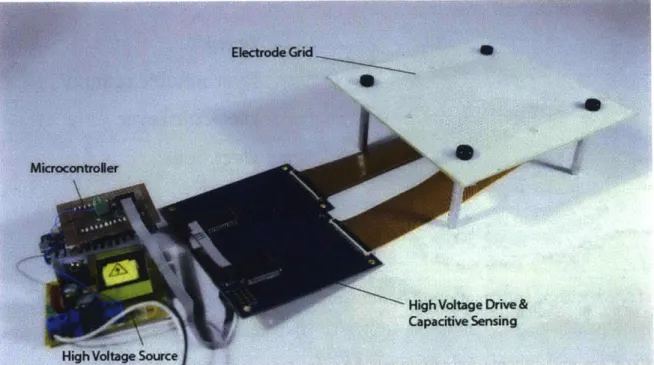
Fig. 4-7 shows the main components of the DropletIO hardware: Electrodes, a high voltage drive circuit, a capacitive sensing unit, and a microcontroller.
4.5.1
Electrodes
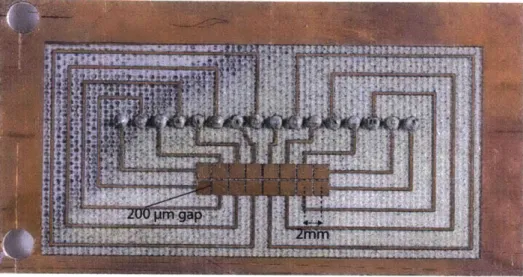
2.5 mm
100
pm---Figure 4-8: Left: Square electrode geometry. Right: Serrated electrode geometry.
DropletIO uses an electric force field generated on an electrode grid to regulate m * -* U Electrodes b a 8 02.5 mm
the wettability of droplets on a solid surface. The electrodes can be arranged in different shapes and layouts; for example linear arrays (Fig. 4-4, 4-5) and grids (Fig. 4-6). The geometry of the electrodes influence the electric field pattern and hence the manipulability of droplets. A thorough analysis of dynamics between the electric field and droplet arising from different geometry was studied in detail by Lienemann et al[36]. Based on their investigation, for this thesis I chose electrodes with simple square geometry (Fig. 4-8 (a)) and serrated square geometry (Fig. 4-8 (b)). Introducing small serrations at the edges introduces overlapping fields and a gradient in electric field that generates a force that propels the droplet when electrodes
are switched.
The dimensions of the electrode has a direct effect on smallest manipulable droplet size and the extent of control. A finer granularity of electrodes provide a higher resolution for the electric field and make a seamless transition of droplets possible, but also results in more complex PCBs and driving circuits. While it is possible to make electrowetting arrays with micron resolution electrodes and gaps, DropletIO uses millimeter-scale electrodes with a size of 2.5 mm x 2.5 mm each, and a 100 pm gap between each electrode; see Fig. 4-8. This size is straightforward to produce with standard PCB manufacturing methods, and the droplet size is well suited microliter droplet manipulation in digital microfluidics and for human interaction.
4.5.2
Preparing PCB Electrode Surface for Droplet Motion
Electrodes on a PCB from a typical fabrication facility are not fully ready for manip-ulating droplets. The etching process introduces valleys that are at least 35 Am. I apply a thin dielectric film to eliminate these valleys to smooth the droplet manipu-lation surface. The film must be carefully applied to achieve a uniformly flat surface without creating an air gap between the electrodes and the film.Fig. 4-9 a shows the different layers that makes up the finished electrode for droplet manipulation. The electrodes are first covered with a thin film of dielectric and then coated with hydrophobic material. Research literature shows a wide variety of dielectric and hydrophobic coating suitable for electrowetting. In DropletIO, I
Droplet
Hydrophobic coating
Dielectric Layer
Electrodes
Figure 4-9: Droplet on an open single plate.
started with a combination of Saran wrap [57] and Peanut oil as the dielectric and hydrophobic coating [30] respectively. Of the materials I tested, a combination of Parafilm and Silicone oil provided the most robust surface and smoothest droplet motion. I developed a specialized process for stretching and applying the Parafilm on to the PCB surface. Parafilm being a compliant material, it can mask the surface roughness of the electrodes and the gaps between them. The Parafilm with Silicone oil functions as a liquid-infused film providing a liquid-liquid interface for the droplet to glide gently.
4.5.3
Hardware: Actuation and Sensing
An AVR microcontroller performs all the logic to generate drive signals for the elec-trodes and to process feedback obtained from the capacitive sensing unit (Fig. 4-10). High Voltage Drive
The required actuation voltage for droplet motion is a function of the thickness of the dielectric. For a dielectric film of 12 pm thickness, the minimum actuation voltage is a 275 V DC, while it is 65 V for a 5 pm film. While stronger forces can be derived from AC signals on the electrode, to reduce complexity of drive circuitry I chose to use a simple DC drive. I re-purposed a Nixie Power Supply [11] as a high-voltage source. For driving the electrodes, I used a 64 bit Serial to Parallel Shift register HV507 and a 8 bit Serial to Parallel Shift register HV513, both from Microchip Technology
Electrode Grid
Microcontrofler
High Voltage Drive& Capacitive Sensing
High Voltage Source
Figure 4-10: DropletIO setup.
(Chandler, AZ, USA). Each electrode on the grid is driven individually by a high voltage pin on a Shift registers. Thus each electrode is uniquely addressable.
Droplet Sensing
A capacitive sensing unit was implemented on a Cypress PSoC4 device (Cypress Semiconductor Corp., San Jose, CA, USA) to probe every electrode individually. The implementation can sense partial and complete presence of a droplet on an electrode and allows for feedback and error correction in droplet motion. In addition, the capacitive sensing also enables to determine the size and contents of a droplets, as well as touching a droplet by a hand.
The sensors scan each electrode at 3kHz. With a 16 bit resolution on the signal, droplets differing in diameter by 0.5mm can be accurately distinguished. The sensing signal had sufficient range to detect a human hand approaching a droplet. When an electrode is scanned for capacitance, adjacent electrodes were grounded to prevent coupling between electrodes. Partial presence of a droplet on multiple pads is detected through individual signal levels.
Chapter 5
Scaling Electrowetting and Digital
Millifluidics
Microfluidics is beginning to see its use as a production tool in pharmaceuticals and synthetic biology. Many of these applications demand integration of multiple func-tionalities in to a single device. Programmable electrowetting arrays have the po-tential for achieving this kind of integration at large scale for versatile operations, parallelization, and miniaturization.
In this chapter, first, I describe how microfluidic systems suffer from tyranny of
numbers. Second, I discuss problems with scaling electrowetting arrays to denser and
larger arrays with DropletIO and their corresponding solutions. Finally I propose a framework for multi-scale fluid handling in a single system.
5.1
Tyranny of Numbers
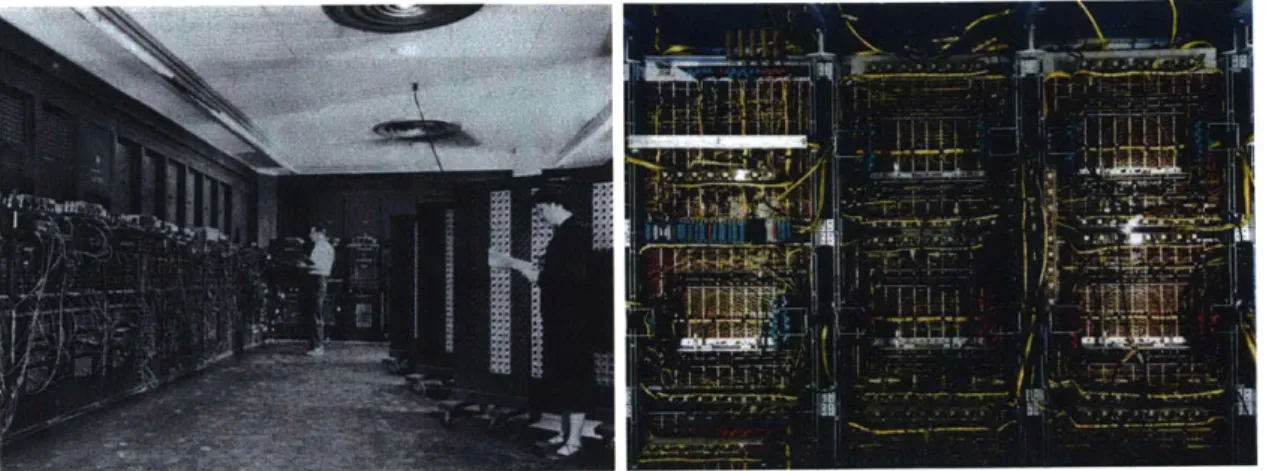
In the early part of the 20th century, the electronics industry faced a problem which is referred to as the "tyranny of numbers": there is a practical limit to how complex a circuit can be with discretely assembled macroscopic components [611. For example, the early computers such as ENIAC consisted of 17500 vacuum tubes, 5, 000, 000 hand-soldered joints, weighed about 30 tons, was roughly 2.4m x 0.9m x 30m in size, occupied 167m2 and consumed 150 kW of electricity. Even when large vacuum
Figure 5-1: Left: ENIAC computer with 17500 vacuum tubes and 5,000,000 hand soldered joints. Right: UNIVAC computer with 5000 vacuum tubes.
tubes were replaced with smaller transistors, manual soldering of individual external component was cumbersome and prone to errors.
Current microfluidic technologies require the integration of many complex func-tions in to a single device. This involves fabrication of the microfluidic chip for logic and control of fluids, their interfacing with external pressure source, storage elements, valves and tubes. Today, the most advanced systems in the industry and research labs integrate such systems manually. There is no scalable process for integrated assembly of such systems. This lack of scalability in microfluidics is analogous to the large scale integration of electronics - both suffer from the tyranny of numbers.
5.2
Solution to Tyranny of Numbers
Complex circuits with millions of transistors and interconnects was possible with the invention of Integrated Circuits by Kilby and Noyce. The tyranny of numbers problem for electronics was solved with this single integrated process for fabricating resistors, capacitors, transistors and interconnects in one package.
Thorsen et al. [67] attempted to create methods for Microfluidic Large Scale Inte-gration. They fabricated a microfluidic device with 2056 microvalves and 256 storage chamber in a single soft lithography process; see Fig. 5-2. Their architecture can run up to 256 distinct reactions in the chambers; this device was specifically targeted
A Purge input colisc~is In' sapeOut s "" Benrr2 swoomr 4, entr I bmdor 2 and 3I
Figure 5-2: Microfluidic Large Scale Integration by Thorsen et al. [67].
for applications such as automated chemical assays. Although this is a promising direction, their approach still relies on external pressures sources, tubes and valves. The manual assembly of the external components introduces complexity in very large scale integration. And most importantly, their approach does not show a path to achieve complete programmability.
Digital Microfluidics on electrowetting arrays eliminates the need for pressure sources, tubes and valves entirely, and, provides programmable control over droplet paths. The same programmable surface can be reconfigured for many different ap-plications. Since the device is entirely electronic it has the potential to scale to Very Large Scale Integration. In DropletIO, a programmable 2D grid provides a re-configurable routing for various experiments and direct addressing allows for parallel manipulation of large number of droplets. I chose to use standard PCB fabrication since it scales to large areas inexpensively. In the next section, I will discuss the scalability of this approach to larger and denser arrays.
5.3
Scaling Electrowetting Arrays
5.3.1
Scaling to Large Arrays
The most recent DropletIO device consists of 2048 electrodes (32 x 64 grid) driven by 32 discrete driver ICs, and measures 85mm x 170mm. With each electrode measuring 2.5mm x 2.5mm, the area occupied by electrodes collectively, is the same as that of all the electronic components. With this 1:1 size ratio, the device can scale to arbitrarily large areas without requiring additional space for the driving electronics. At this size ratio, the smallest droplet the device can handle is 2 microliters. Manipulating sub-microliter droplets requires reduction in size of the electrodes. A 100pm (feature size of PCB process) electrode for example can manipulate nanoliter droplets.
Scaling Electrowetting to Large Areas for various Pad Sizes/Electrode Densities
45000
40000
35000
300O0 Pad Size
(Density of electrodes) 25000 -2500 m (2.5 mm) 20000 -600 pm -300 pm 15000 10000 5000 0 -1 4 16 64
ACTUATION AREA (SQUARE INCHES)
Figure 5-3: Scaling Electrowetting to Large Areas for various Pad Sizes.
As the size of the electrode is reduced, the size ratio increases. The number of driver ICs required for a given actuation area increases. As the electrodes approach the 100 pm limit, the number of driver ICs increase by two orders of magnitude. A 16 square inch grid with 2.5 mm electrodes (current DropletIO device) costs ~$200. The same sized grid with 300 pm resolution requires 1024 discrete driver ICs and costs ~$ 10,000 (see Fig. 5-3).
5.3.2
Scaling to Dense Arrays
The present architecture with discrete external drivers, scales economically to large areas when the size of the electrodes are of the order of a millimeter. The architecture will not scale to larger areas cost effectively for dense electrode arrays (sub-millimeter electrodes); see Fig. 5-3. Scaling electrowetting architecture to dense arrays involves complex routing, interconnects and control electronics. The current DropletIO archi-tecture involves the use of a large number of discrete components; this is a cumber-some integration process and economically unviable. When scaling to dense arrays, electrowetting suffers from the same problem as electronics - the tyranny of numbers.
The electronics industry has solved similar scaling problems in the displays and data storage. One particularly relevant approach is a multiplexing scheme referred to as active matrix drive
[77].
In active matrix driving, each pixel has a capacitor that maintains state and a transistor that switches states. Similar approaches can be applied to solve the tyranny of numbers problem when scaling electrowetting to dense arrays.5.4
Digital Millifluidics
Historically automated liquid handling has relied on pressure differentials to trans-port liquid. In the 1990s, a new method for fluid handling called microfluidics was developed following DARPA's push for field-deployable liquid handling systems. Mi-crofluidics is the science and art of handling small volume fluids. Small volume fluid handling can be classified as nanofluidics, microfluidics or millifluidics (see Fig. 5-4), as the boundary is not defined clearly.
Millifluidics deals with fluid volumes in the microliter to milliliter volume flu-ids (Fig. 5-4). By discretizing fluflu-ids into blobs it is possible to manipulate them on an electrowetting platform like DropletIO. I have demonstrated the possibility of performing the following fluidic operations with milliliter volumes: transporting, merging, mixing and splitting. I propose a new direction in handling milliliter fluids called digital millifluidics.
_..itizing with Electrowetting
Nanofluidics Microfluidics Millifluidics Larger Volumes
1 aL 1 fl 1 pl 1 nL IpL 1mL 1L 1000 L Fluid Volume
10 "L 1015 L 1012L 109L 106L 10-3 L
10-'0 m 10-9 m 10-6 m 10-3 m 100 m
1 A 1 nm 1 pm 1 mm 1 m Length Scale
Atoms DNA Bacteria Human Cell Insects Human
Virus
Figure 5-4: Digitizing Millifluidics.
Liquid handling devices in pharmaceuticals and gene synthesis require multiscale fluid handling ability. The state-of-the art systems are almost entirely pressure driven systems; these systems use valves and tubes of different sizes to transition from mil-lifluidics to microfluidics. The lack of integration makes these systems cumbersome, expensive and unreliable. The DropletIO platform can solve this by being able to perform microfluidics and millifluidics digitally in a single system. Digital fluidics is more robust, scalable, and economical. Furthermore, the development of digital fluidics enables a number of additional applications in microbiology (Ex: Automated
Chapter 6
Technical Evaluation
In this chapter, I provide some of the preliminary results of evaluation of the platform for volume of droplet that can be manipulated, velocity of motion, sensing accuracy, effect of gravity and time taken for homogeneous mixing. The evaluation was carried out under the following condition: freshly applied Parafilm and Silicone Oil with deionized water at room temperature in an open environment.
6.1
Droplet Volume
I observed through experiments that for a consist droplet motion, it is desirable to have the droplet extend at least 4 electrodes (2X2). To evaluate motion of various droplet sizes, I deactivate two electrodes (1X2) and activate two adjacent ones which advances a droplet by one electrode length. The electrodes were switched at 2Hz, giving the droplets sufficient time to advance. In 500 trials, a droplet of volume 10ld to 1000pl succeeded moving 100% of the time. This is clearly within the regime of millifluidics. Droplets of volume lesser than 10pl succeeded 50% of the time in 500 trials. Droplets larger than 1000pl exceeded the width of the available actuation area and hence could not be evaluated. In addition, I also noticed that as the droplet size grew, gravity started to have an effect on the motion of the droplet. For example, a
6.2
Effects of gravity and Sliding Angle
In electrowetting, for droplets sandwiched between two plates, capillary forces domi-nate gravity and usually a droplet sliding away is not an issue. However, in DropletIO I chose to have droplets on an open surface, and, at macro-scale a dominant force on physical objects is gravity. To evaluate the effect of gravity I put a droplet on electrowetting surface to find out the minimal angle at which a droplet starts to slide.
SLIDING ANGLE AS A FUNCTION OF DROPLET VOLUME FOR TEFLON
100 90 -80 70 o 60 S50 4 40 90 90 79 30 32 --- ---20 22 10 0 11 - --- 8 6 3.5 2.5.
lul 2ul 4ul 16ul 32ul
Droplet Volume (ul)
- -With Silicone Oil
- -Without Silicone Oil
Figure 6-1: Sliding Angle as a function of droplet volume for Teflon Film.
SUDING ANGLE AS A FUNCTON OF DROPLET VOLUME 100 90 90 70 so 40 120 w mm 10 S 0 _
luA 2u1 4ul 6uId 32ul
DropIa Vokumw uL)
-vi Wtsaicoe.0M
Figure 6-2: Sliding Angle as a function of droplet volume for Parafilm.
I evaluated the sliding angle on two different dielectric films - Parafilm and Teflon. For each film the sliding angle test was performed under the two conditions -with and -without Silicone Oil on the top surface. As seen in Figure.6-1 and Figure.6-2 gravity seems to have a pronounced effect on larger volume droplets. And addition of Silicone Oil reduces the sliding angle significantly and this makes it possible for
electrowetting forces to actuate a droplet.
6.3
Mixing
MIXING TIME VS VELOCITY
'3
5 6.25 8.33 12.3 25 so
Vd*(nwr4e3
Figure 6-3: Mixing Time as a function of velocity of droplets.
Mixing is an important operation used in microfluidics; to prepare input sam-ples for analysis, to dilute concentrated substances, and to control reagent volumes. Achieving homogeneous mixture depends on the volume of the droplet, the velocity at which two droplets collide, the contents and the operation temperature. I noticed under a high-speed camera that collision of two droplets create surface waves and the extent of agitation and mixing is proportional to collision speeds and size of the droplets. I performed a preliminary test to understand the relationship between ve-locity of droplets and mixing time for a 10plO droplet volume at room temperature. As seen in Fig. 6-3, the time required for mixing reduces with increased velocity.
6.4
Evaporation
A droplet on an open surface tends to evaporate faster than one enclosed in capillaries. Figure. 6-4 shows the time taken for a droplet to fully evaporate when placed on
EVAPORATION TIME AS A FUNCTION OF DROPLET VOLUME
234 160 5
883 - - Without Silicone ONl
60 71 - -With Sikon. ON
lul 2u[ 4ul 16u 32ul
Droplet Volume (ul)
Figure 6-4: Evaporation time as a function of droplet volume.
Parafilm. It is important to notice that the rate of evaporation is reduced when Silicone Oil is applied. Air currents interacting with a droplet and hence evaporation can be reduced by enclosing the electrowetting platform. Further investigation on evaporation is left as future work.
6.5
Capacitive sensing
The capacitive sensors scan each electrode at 3kHz. The 16 bit resolution on the signal can differentiate droplet diameter difference of 0.5mm and has sufficient range to detect a hand. When an electrode is sensing, adjacent electrodes were grounded to prevent coupling between electrodes. Partial presence of a droplet on multiple pads is detected through individual signal levels.
6.6
Speed of Manipulation
For measuring droplet speeds I used the capacitive sensors which scan quicker (3kHz) than the fastest droplet transition between electrodes (50Hz). The speed increased proportionally to droplet size. The speed is independent of electrode size for a fixed actuation voltage. A maximum of 125 mm/s was achieved for droplets volumes 10pl to 1000/pl.
Chapter
7
Interaction Design Space
7.1
Background
We encounter liquid material in the form of droplets in our everyday life, while in rain, while cooking, painting and other scenarios. In these cases, not only do droplets have utility but also provide added context through sensations of touch and vision. Often the touch sensation itself is a multi-sensory experience giving the feeling of flow, viscosity and temperature. Tangible User Interfaces (TUIs) [21] such as Illuminating Clay [54] and Sandscape [74] showed how a user's familiarity to basic material forms such as sand and clay can be employed in computer interfaces. Building on the same principles, in this chapter of the thesis I explore how programmable droplets can be incorporated in interaction design.
Figure 7-1: Droplets in everyday life.
In the context of artistic expression, liquid materials (water and oil) are a powerful medium. Water in the form of droplets has inspired poets, painters, philosophers and
even scientists for centuries. More recently, artists have employed the aesthetics of moving droplets for animations [69] and kinetic installations. The rich set of dynamic operations and aesthetics provided by DropletIO system will enable new ways of expression. Rain droplets on a glass window invite one to touch and play; these playful interactions can be enriched with computational control of droplets. With droplets as a medium for dynamic artwork, play and interactivity, in the rest of the chapter I will elaborate on interaction primitives and the design space from a human
interaction standpoint.
7.2
Physical Interaction with Liquid Matter in the
form of Droplets
Researchers have argued for employing the user's understanding of naive physics in interaction design through the body's relationship with physical materials [26, 271. DropletIO lets users interact with the moving droplets in various ways by utilizing their familiarity and physicality. Examples of physical interaction that the DropletIO platform provides are:
Touch - Droplets can be touched by the users' fingers in order to manipulate their position and shape .
Tilt - Droplet motions can be controlled by users tilting the interaction surface.
Blow - Droplets can be blown to be dynamically moved across the surface.
Add - Droplets can be manually added by users using tools such as pipettes or simply by hand.
Remove - Droplets can be removed by users, for example by wiping them off. These interaction primitives are put to use in the example applications described later.
![Figure 1-1: Programmable Matter Research. (a)Top Left: Modular Robots [16].](https://thumb-eu.123doks.com/thumbv2/123doknet/14753449.581284/16.917.145.798.135.516/figure-programmable-matter-research-top-left-modular-robots.webp)
![Figure 2-3: Fluid Manipulation in HCI. (a)Shape-changing Ferrofluid blob [72].](https://thumb-eu.123doks.com/thumbv2/123doknet/14753449.581284/22.917.151.805.835.999/figure-fluid-manipulation-hci-shape-changing-ferrofluid-blob.webp)



![Figure 5-2: Microfluidic Large Scale Integration by Thorsen et al. [67].](https://thumb-eu.123doks.com/thumbv2/123doknet/14753449.581284/43.917.254.641.107.487/figure-microfluidic-large-scale-integration-thorsen-et-al.webp)