Self-selection of enrollers at the creation
of a managed care organization
JEAN-FRANCOIS ETTER, THOMAS V. PERNEGER, ANDRE ROUGEMONT *
Factors affecting choice between a managed care organization (MCO) and a fee-for-service insurance plan were examined when the University of Geneva health Insurance plan was transformed into an MCO, in October 1992. A case-control study using a mailed questionnaire (response rate 84%) was conducted to compare former members who joined the MCO (joiners, n=421) to former members who opted out in order to keep fee-for-service coverage (non-joiners, n=222). Non-joiners were more likely to be women (odds ratio (OR) from multivariate model was 1.15, p=0.50], to be bom in Switzerland (0R=2.04, p<0.01), to have an annual income >75,000 Swiss francs (0R=2.00, p<0.01), to have a personal physician (0R=1.96, p<0.01) and to have consulted a specialist (OR=1.69, p=0.02) or used unconventional medidne (0R=4.59, p<0.01) in the past year. During the previous year, non-joiners had more hearth care visits than joiners (14.6 versus 9.1, p=0.01). Non-joiners reported better mental health and fewer complained of persistent fatigue (OR=2.18, p=0.03). The choice of hearth plan was strongly influenced by socio-demographic characteristics, past patterns of hearth services utilization and health status. The self-selection process was paradoxical: MCO joiners had used fewer hearth care visits than non-joiners, but their self-reported hearth status was worse. The differences we have observed between self-selected populations have important implications for the financial performance of competing health care delivery systems.
Key words: managed care organizations, selection process, health status, health services utilization
M
anaged care is becoming increasingly popular. In the United States, enrolment in managed care organizations (MCOs) has grown rapidly over the past few decades1 and similar organizations have been recently created in Europe,2 including Switzerland. As a consequence, the health care consumer is now faced with a greater diversity in health care delivery systems. Both managed care and competition between delivery systems are expected to improve the efficiency of the health care sector. However, some health care plans may be able to attract healthier members than others. Such selection may provide a sub-stantial competitive advantage, over and beyond that derived from improved efficiency of health care.3 Thus, understanding the self-selection of enrollers for specific health care delivery systems is becoming increasingly important.Most studies conducted in the United States suggest that MCOs experience a favourable selection of enrollers: persons who choose managed care appear to be less costly to care for than persons who choose fee-for-service cov-erage/ These conclusions are based on the examination of socio-demographic characteristics,5"1'' pre-enrolment
* if. Etter, T.V. Pemeger, A. Rougemont, Institute of Social and Preventive Medidne, University of Geneva. Centre Medical Universftaire. Geneve, Switzerland
Correspondence: Jean-Francois Etter, OES pol sd. Institute of Social and Preventive Medidne, University of Geneva, Centre Medical Unlversltaire. Case Postale, CH-1211 Geneve 4, Switzerland, tel. +41 22 7025918, fax +41 22 7025912
use of health services,6"11 self-reported indicators of health or disease,8"14 usual source of care,8'9'1* health practices,10'12'15'16 health concerns8'14 and subsequent mortality.1 ^ The utility of published results regarding self-selection is limited by the fact that only 1 cultural context has been studied (United States) and that most studies include only few explanatory variables. Moreover, be-cause both MCOs and fee-for-service delivery systems are changing rapidly, some of the older results may be obsolete now.
The transformation of the group health insurance for University of Geneva students into an MCO provided a new opportunity of examining the consumer's choice between different health care delivery systems. We exam-ined whether former enrollers who opted for fee-for-service coverage differed from those who accepted the MCO, in terms of socio-demographic characteristics, economic status, use of health services in the previous year, self-reported health status, health-related lifestyles, health-related con-cerns and satisfaction with previous medical care. METHODS
Study setting
Traditionally, in Switzerland, ambulatory health care has been provided by independent private practitioners and reimbursed by insurance companies on a fee-for-service basis. Insurance premiums are paid by the plan members; the state grants subsidies to persons with low income. The state also subsidizes non-profit hospitals.18'19 In 1989, the
EUROPEAN JOURNAL OF PUBLIC HEALTH VOL. 5 1995 NO. 3
federal government authorized health insurance contracts 'with limited choice of physician', i.e. managed care or-ganizations.
Under this new provision, the group health insurance plan for students and teaching staff at the University of Geneva was transformed into an M C O in October 1992. In the MCO, patients have to consult a designated pri-mary care physician who regulates access to specialists and to hospital care. M C O premiums were approximately 25—40% lower than premiums in fee-for-service insurance plans available in Geneva; the annual deductible was maintained at 150 Swiss francs (the same as in fee-for-ser-vice plans), but the 10% co-payment for ambulatory care (used by all fee-for-service plans) was dropped. University insurance plan members were sent the M C O contract by mail and were automatically enrolled in the new plan. Those who did not want to join die MCO had to resign from the group insurance plan and select a fee-for-service insurance plan, which they could choose regardless of their healdi status.
Study population and sampling
The population consisted of all students and family mem-bers who had been enrolled in the group insurance for at least 1 year, who were 18-44 years old, lived in Geneva, spoke French and were eligible for group insurance in the next academic year. A total of 2,714 persons were identi-fied as potentially eligible from die insurance membership roll. Of diese, 2,353 joined the M C O (joiners) and 361 opted for a fee-for-service insurance plan (non-joiners). A random sample of 500 joiners and all 361 non-joiners were contacted. The final eligible sample consisted of 473 joiners and 293 non-joiners, after elimination of persons who had moved out of Geneva, mostly following comple-tion of dieir studies.
Study design and variables
A case-control study design was used to compare non-joiners ('cases') and M C O non-joiners ('controls'). Explana-tory variables included the following.
• Socio-demographic data: age, gender, place of birth, number of years living in Geneva, household composi-tion, professional activity and total annual household income (more or less dian 75,000 Swiss francs, equiva-lent to approximately $ 50,000).
• Utilization of healdi services during die year before the creation of the MCO: having a personal physician in Geneva, number of visits to physicians of different spe-cialities and other providers of care, treatments received for specific diseases and number of hospitalization days. • Health status was assessed by a translated version of die SF-36 healdi survey, which measures physical func-tioning, social funcfunc-tioning, role limitations due to phys-ical and to emotional problems, mental health, vitality, bodily pain and general health. Each dimension was summarized by a score between 0 (worst) and 100 (best). Participants were also asked about healdvrelated worries, such as stress, anxiety or fatigue and whether they would have liked more medical help to deal widi them.
• Health-related lifestyles: use of tobacco and alcohol, driving in a state of inebriation, use of seat belts, number of sexual partners, use of condoms and frequency of exercise.
• Satisfaction with medical care received during the year before the creation of the MCO was measured by ques-tions adapted from the patient satisfaction question-naire. Six dimensions of patient satisfaction were studied: physician's behaviour, access to health care, continuity in care, advice on prevention by physician, general satisfaction with medical care and coverage and cost of health insurance. Each dimension was summarized by a score between 0 (worst) and 100 (best).
• Reasons for giving up the group healdi insurance plan, in non-joiners only. Possible reasons were loss of free choice of physician, fear of a lower quality of care in the MCO and die fact diat die new healdi plan disallowed coverage of some ongoing treatments.
Data collection
Questionnaires were mailed 3 weeks after die opening of die MCO. Persons who had not answered were sent anodier questionnaire every 2 weeks (up to 5 question-naires). Two incentives to increase the response rate (the offer of 10 Swiss francs to respondents and a reminder 'diank you' postcard) were tested in die initial mailing and used in all follow-up mailings. In addition, 4 weeks after die beginning of the data collection, research assist-ants phoned subjects who had not yet answered and asked them to return the questionnaire. Data collection was stopped 2 mondis after the first mailing. A total of 643 eligible persons (84%) answered: 421 joiners (89%) and 222 non-joiners (76%).
Analysis
Cases and controls were compared using cross-tabulations for categorical variables and boxplots for continuous vari-ables.23 Chi-square tests and t-tests were used for
signi-ficance testing (p values <D.05 were considered statist-ically significant). Odds ratios and 95% confidence intervals were used to assess associations between ex-planatory and outcome variables. Logistic regression was used to model simultaneous effects of several explanatory variables. Successive models were compared using likeli-hood ratio tests. Data were processed with Epi Info,24
Systat25 and SPSS for Windows26 software.
RESULTS
Univariate analysis
Only 12% of all eligible persons chose to give up the University of Geneva group insurance plan in order to keep fee-fbr-service coverage. The mean age was 29 years in both joiners and non-joiners. However, the 2 groups differed according to socio-demographic variables and economic status (table I). Non-joiners were more likely to be women, to have a high household income and to have been born in Switzerland. Students born in Africa and Latin America were particularly likely to join the MCO.
3
o(log s d s rat is
1 0 -9 8 7 6 5 • 3 1 - • 0 ! i 1-10 11-20 21-30 >30Health care visits in past year
Figure 1 Odds ratios for choosing fee-for-service coverage over a
managed care organization, according to the number of health care visits in the year preceding enrolment, Geneva, Switzerland, 1992
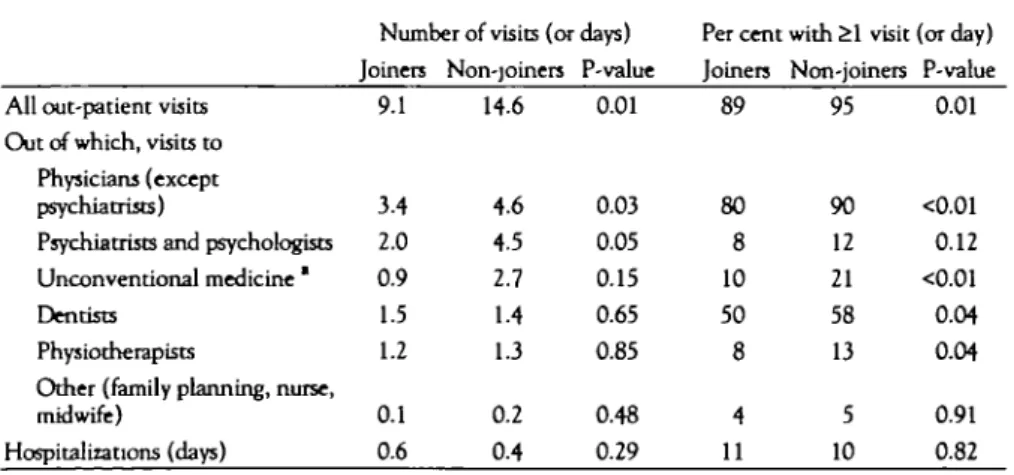
More non-joiners (69%) than joiners (48%, p<0.01) had a personal physician in Geneva before the creation of the MCO. During the year before the creation of the MCO, non-joiners had 60% more out-patient visits than joiners and 125% more visits to psychiatrists or psychologists
Table 1 Socio-demographic characteristics of managed care
organization enrollers (joiners) and fee-for-service enrollers (non-joiners), Geneva, Switzerland, 1992
Mean age (years) Women (%)
Born in Switzerland (%) Years spent in Geneva (mean) Living arrangements
Alone (%)
With husband/wife/partner (%) Other (%)
Has a professionnal activity (%) Annual family income >75,OOO Swiss francs (%) Joiners 29 48 27 9 27 36 37 57 17 Non-joiners 29 56 46 14 21 48 30 68 34 P-value 0.66 0.06 <0.01 <0.01 0.20 0.01 <0.01 BP GH VT SF RE PF RP-BP GH. Physio! Finctionfng. Rota-Physical Bodily Pun Genaral H«^m. VT SF RE MH VialJty Social FuicUoning Rato^moltnil MsnUIHa^th.
Table 2 Use of health services during die year before enrolment in a managed care organization,
Geneva, Switzerland, 1992
All out-patient visits Out of which, visits to
Physicians (except psychiatrists)
Psychiatrists and psychologists Unconventional medicine * Dentists
Physiotherapists
Other (family planning, nurse, midwife)
Hospitalizations (days) » Homeopathy, acupuncture, etc.
Number of visits (or days) Joiners 9.1 3.4 2.0 0.9 1.5 1.2 0.1 0.6 Non-joiners 14.6 4.6 4.5 2.7 1.4 1.3 0.2 0.4 P-value 0.01 0.03 0.05 0.15 0.65 0.85 0.48 0.29
Per cent widi £1 visit (or day) Joiners 89 80 8 10 50 8 4 11 Non-joiners 95 90 12 21 58 13 5 10 P-value 0.01 <0.01 0.12 <0.01 0.04 0.04 0.91 0.82
Figure 2 Self-reported health status, measured by the SF—36 health
survey, among enrollers in a managed care organization (joiners, solid line) and in a fee-for-service plan (non-joiners, dashed line), Geneva, Switzerland, 1992
(table 2). Visits to mental health specialists represented 34% of all refundable ambulatory visits among non-join-ers and 27% among joinnon-join-ers. Differences between joinnon-join-ers and non-joiners were especially important in the use of unconventional medicines, such as acupuncture or homeo-pathy. In contrast, non-joiners had fewer hospital days than joiners, but this result did not reach statistical signi-ficance.
The association between the number of health care visits in the past year and the odds of not joining the MCO was progressive, suggesting a dose-response relationship
(fig-terel).
Non-joiners had been treated in the past year for slightly more specified illnesses (136) than joiners (1.25, p=0.19). There were no substantial differences in the 1 year period prevalence of treatment for each of hay fever, asthma, hypertension, diabetes, lower back pain, acci-dents, urinary tract infection, sexually transmitted dis-ease, depression, dental cavities, dermatologic problems and flu syndrome.
Despite their higher use of ambulatory care, non-joiners reported a better health status than joiners (figure 2). In
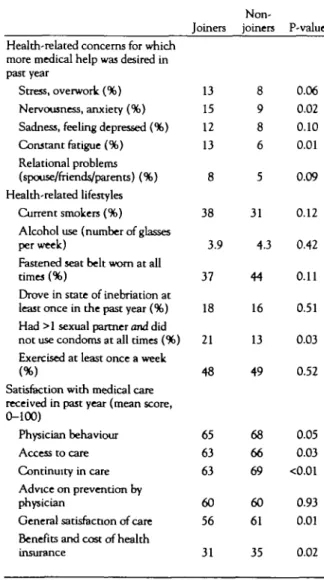
particular, they had better mental health scores and fewer role limitations due to emotional problems. They also reported fewer symp-toms related to mental well-being, notably stress, anxiety and constant fatigue (table 3).
Non-joiners also had health-ier lifestyles: they smoked less, fastened their seat belts more often and took fewer risks with respect to acquir-ing sexually transmitted dis-ease. The 2 groups were sim-ilar in terms of physical exercise and drinking and
EUROPEAN JOURNAL OF PUBLIC HEALTH VOL 5 1995 NO. 3
driving. Non-joiners drank half a glass of alcohol more per week than joiners (table 3).
Finally, non-joiners were more satisfied with the medical care diey had received during the year before the creation of the M C O (table 3). The greatest differences in satisfac-tion were seen with regard to the continuity in care, general satisfaction and insurance coverage, while joiners and non-joiners did not differ in dieir satisfaction with regard to the advice diey had received about prevention.
Miduvariate analysis
Explanatory variables which were significantly associated with being a non-joiner in univariate analyses were used to build multivariate logistic regression models. The final model, based on 574 persons with complete data (89% out of 643), was adjusted for sex despite a lack of statistical significance for die latter variable (table 4). Being born in Switzerland, having a household income over 75,000 Swiss francs (or $ 50,000) and having a personal physician in Geneva approximately doubled the odds of selecting fee-for-service coverage. The odds ratios were >4 for users of unconventional medicines and 1.6 for those who had consulted a specialist in the past year. Not having a Table 3 Other characteristics of managed care organization enrollers (joiners) and fee-for-service enrollers (non-joiners), Geneva, Switzerland, 1992
Non-Joiners joiners P-value Health-related concerns for which
more medical help was desired in past year
Stress, overwork (%) 13 8 0.06 Nervousness, anxiety (%) 15 9 0.02 Sadness, feeling depressed (%) 12 8 0.10 Constant fatigue (%) 13 6 0.01 Relational problems
(spouse/friends/parents) (%) 8 Health-related lifestyles
Current smokers (%) 38 Alcohol use (number of glasses
per week) 3.9 Fastened seat belt worn at all
times (%) 37 Drove in state of inebriation at least once in the past year (%) 18 Had >1 sexual partner and did not use condoms at all times (%) 21 Exercised at least once a week
(%) 48
Satisfaction widi medical care received in past year (mean score, 0-100) Physician behaviour 65 Access to care 63 Continuity in care 63 Advice on prevention by physician 60 60 0.93 General satisfaction of care 56 61 0.01 Benefits and cost of health
insurance 31 35 0.02 5 0.09 31 0.12 43 0.42 44 0.11 16 0.51 13 0.03 49 0.52 68 0.05 66 0.03 69 <0.01
complaint of chronic fatigue and reporting better mental health were also independently associated widi die like-lihood of selecting fee-for-service coverage. However, satisfaction widi health care and risk taking in sexual practices were not significantly associated with choice of health plan after adjustment for odier explanatory vari-ables and were dropped from the final model.
Reasons for not joining the MCO
A large majority (84%) of non-joiners said diat the loss of free choice of physician had influenced 'a lot' dieir decision not to join the MCO, 9% 'a little' and 7% 'not at all'. Four out of 5 said diey did not join the MCO because they feared (38% 'a lot' and 42% 'a little') a lower quality of care in the MCO. Forty-seven per cent said they opted out because the new health plan disallowed cover-age of some ongoing treatments.
DISCUSSION
This study indicated diat die choice of a particular health insurance plan is strongly influenced by socio-demo-graphic characteristics, past patterns of health services utilization and health status of the consumer. These vari-ables have substantial independent effects on the choice between a managed care organization and a fee-for-service health insurance plan. On the other hand, the consumer's satisfaction with past health care and healdi-related life-styles are less important in predicting health plan choice when die previous variables are known.
Our study confirms the global result of research on self-selection conducted in the United States over the past decades, namely diat self-selection does exist. In addition, it provides 2 new insights. Previous studies examined only j4,l6,l7,27or a few6"15predictor variables at a time. Thus, die first important contribution of this study is die demon-stration that socio-economic status, past utilization of services and health status are independent determinants of the choice of a health care plan. Secondly, findings of
Table 4 Odds ratios of choosing fee-for-service coverage over a managed care organization from a multivariate logistic regression model, Geneva, Switzerland, 1992
Predictor Odds ratio 95% CI
Bom in Switzerland 2.04 1.40-2.99 Family income >75,OOO Swiss francs 2.00 131-3.07 Woman 1.15 0.76-1.74 Mental health score (for 10 points
increase') 1.17 1.03-131 No complaint of chronic fatigue 2.19 1.07—447 Had a personal physician before
MCO creation 1.96 133-2.90 Consulted a specialist in past year 1.69 1.08—2.66 Used unconventional medicine in
past year 4-59 1.58-1332
a A higher score Is better (tcale 0-100) b Homeopathy, acupuncture, etc Cl: confidence interval
favourable or adverse selection are usually considered to be mutually exclusive. In our study the selection process could be interpreted as both favourable and adverse to the MCO: past use of services was lower in MCO joiners (favourable selection), but their self-reported health status was worse (adverse selection). Thus, apparent con-tradictions between previous findings may merely reflect the fact that different studies examined different vari-ables.
In contrast to other studies, fee-for-service enrollers in our sample reported a significantly better subjective health status, especially in the area of mental health. Until now, most studies which examined health status in relation to health plan selection have concluded that there was no significant difference,8"10'12'1^ found managed care en-rollers to be healthier.11'15 Inconclusive findings in some of the older studies may be due to their using crude measurement instruments (often a single question to as-sess health status). The more recent studies, which used more refined instruments, examined middle-aged11 and elderly15 populations, whereas our study included young adults only. Another reason for the discrepancy may be the lower participation rates in previous studies, ranging from 475'9 to 719b,11 as compared to 84% in our study. Paradoxically, despite lower self-reported health status, MCO joiners had used fewer health services in the past year than fee-for-service enrollers. Lower pre-enrolment utilization in managed care enrollers has been observed in most,6"8'10'13 but not all9'27 published studies. Our hypothesis to explain this paradoxical finding is that managed care enrollers have a different attitude towards health care, which induces them to use fewer health services for a given level of self-perceived health. The inverse association with hospital days (MCO enrollers having used more than fee-for-service enrollers) speaks in favour of this hypothesis, since hospitalization is usually not decided by the patient and is therefore a better reflec-tion of poor health than use of ambulatory services. The different socio-economic composition of the MCO join-ers and non-joinjoin-ers may contribute to different attitudes toward health care.
While in the short-term, the lower threshold for use of ambulatory care in MCO joiners seems favourable for the plan, this may be reversed in the long-term. The risk is that poor health status in the absence of health care use may reflect delays in care seeking, which may translate into higher health care costs in the future. An important question, which we cannot answer using our data, is whether MCO joiners had abstained from using necessary or superfluous health services.
Other findings from our study confirm previous reports. Compared to fee-for-service enrollers, managed care en-rollers have been reported to be less likely to have a personal physician,8'9'1''to have resided in the study area for shorter periods of time12 and to have lower income, in all studies5'9-11-13but I.8No differences in health-related habits, such as smoking, alcohol use, use of seat belts and exercise were noted in 2 studies1 • " which did not, how-ever, address sex-related behaviours.
Among reasons for preferring a fee-for-service plan, ability to freely choose physicians was given by 76% of respond-ents in 1 study,12 much as in our study, but by only 7% of respondents in another.9 This may reflect the very limited choice of primary care physicians in the Geneva MCO. Participants were asked to report their utilization of health services during the past 12 months. Not all of them may have remembered exactly the number of visits they had during such a long period. Imprecise measures generally attenuate and dilute the observed effects. Had we used more precise measures, we would probably have observed wider and more statistically significant between-group differences.
The generalizability of our findings is limited by the fact that study participants were young, urban residents and of high educational level, as well as by the practical tions of the creation of the Geneva MCO. These condi-tions were rather unusual: all former enrollers were auto-matically transferred into the MCO, only 1 month after having received the new contract. Persons who decided to opt out had to actively disenrol and select a private insurance plan. Thus, non-joiners have also been selected on their capacity to react rapidly and take an important decision without delay. These conditions, perhaps more than attractive monthly premiums, explain why 88% of group insurance members selected the MCO. In contrast, in the United States, typically only 5-25% of employees select managed care over fee-for-service coverage when givenachoice.6'7'9'10'13'15
The demonstration of substantial differences between enrollers in different health insurance plans underscores the importance of studying self-selection of enrollers in MOOs and other health care structures. In particular, self-selection must be taken into account when compar-ing the economic performance and quality of care of competing systems of health care delivery3 and when setting fair health insurance premiums.*
This work was presented at the Fifth European Health Services Conference, Maastricht, The Netherlands, 17 December 1993. This research was supported jointly by die Institute of Social and Preventive Medicine of the University of Geneva, the insurance company Avenirassurances and by grants 32—32609.91 and 3 2 -39692.93 from die Swiss National Science Foundation.
1 Hadley JP, Langwell K. Managed care in the United States: promises, evidence to date and future directions. Hrth Policy 1991:19:91-118.
2 Ovretveit J. Purchasing for health gain: the problems and prospects for purchasing for hearth gain in the 'managed markets' of the NHS and other European health systems. Eur J Public Hlth 1993:3:77-84.
3 Luft HS. How do hearth maintenance organizations achieve their 'savings'? N Engl J Med 1978:298:1336-43.
4 Wilensky GR, Rossiter LF. Patient self-selection in HMOs. Hrth Affairs 1986:5:66-80.
5 Siddhartan K. Evaluation of behavioral demand models of consumer choice in health care. Eval Rev 1991;15:455-70.
6 Jadcson-Beeck M, Kleinman JH. Evidence for serf-selection among health maintenance organization enrollees. JAMA 1983:250:2826-9.
EUROPEAN JOURNAL OF PUBLIC HEALTH VOL 5 1995 NO. 3
7 Strumwasser I, Paranjpe NV, Ronis DL The triple option choice: serf-selection bias in traditional coverage, HMOs, and PPOs. Inquiry 1989,26:432-41.
8 Berki SE, Penchansky R. Enrolment choices in different types of HMOs. A murtivariate analysis. Med Care 1978; 16:682-97.
9 Roghman KJ, Gavett WJ, Sorensen AA, Wells S, Wersinger R. Who choses prepaid medical care: survey results from two marketings of three new prepayment plans. Public HKh Rep 1975;90:516-27.
10 Lairson DR, Herd AJ. The role of health practices, health status, and prior health care daims in HMO selection bias. Inquiry 1987;24:276-84.
11 Kravitz RL, Greenfield S, Rogers W, et al. Differences in the mix of patients among medical specialities and systems of care. Results from the Medical Outcomes Study. JAMA
1992,267:1617-23.
12 ScitovskyAA, McCall N, Benham L Factors affecting the choice between two prepaid plans. Med Care 1978;16:660-81.
13 Buchanan JL, Cretin S. Risk selection of families electing HMO membership. Med Care 1986,2439-51.
14 Garfinkel SA, Schlenger WE, McLeroy KR, et al. Choice of payment plan in the Medicare capitation demonstration. Med Care 1986;24:628-40.
15 Lichtenstein R, Thomas WJ, Adams-Watson J, Lepkowski J, Simone B. Selection bias in TEFRA at-risk HMOs. Med Care
1991;29:318-31.
16 Feldman R, Finch M, Dowd B. The role of hearth practices in HMO selection bias: a confirmatory study. Inquiry
1989;26:381-7.
17 Riley G, Rabey E, Kasper J. Biased selection and regression toward the mean in three Medicare HMO demonstrations: a survival analysis of enrollees and disenrollees. Med Care 1989;27:337-51.
18 Lehmann P, Gutzwiller F, Martin JF. The Swiss hearth system, the paradox of ungovernability and efficacy. In: Field MG, editor. Success and crisis in national health systems: a comparative approach. London: Routledge, 1989:25-48.
19 Immergut EM. Hearth politics, interests and institutions in Western Europe. Cambridge: Cambridge University Press, 1992.
20 Pemeger TV, Leplege A, Etter JF, Rougemont A. Validation of a French-language version of the MOS 36-ftem short form health survey (SF-36) in young healthy adults. J Clin Epidemiol 1995;48:1051-60.
21 Ware JE, Snyder MK, Wright WR. Da vies AR. Defining and measuring patient satisfaction with medical care. Eval Prog Planning 1983;6:246-63.
22 Pemeger TV, Etter JF, Rougdntf^.tA. Randomized trial of a monetary incentive and » reminder card to increase the response rate to a mailed health survey. Am J Epidemiol 1993,-138:714-22.
23 Wilson APR. Box-plots for mlcrobiologists? Lancet 1993;341J82.
24 Dean AD, Dean JA, Burton JH, Dicker RC. Epl Info, Version 5.01a: a word processing, database and statistics program for epidemiology on micro-computers. Atlanta, GA; Centers for Disease Control, 1991.
25 Systat Inc. Systat, version 5.01. Evanston, IL: Systat Inc, 1990.
26 SPSS Inc. SPSS for Windows, version 5.01. Chicago, IL: SPSS Inc., 1992.
27 Broida JH, Lemer M, Lohrenz FN, Wenzel FJ. Impact of membership in an enrolled, prepaid population on utilization of health services in a group practice. N Engl J Med 1975;292:780-3.