ORIGINAL PAPER
Determining the rate of change in a mixed deciduous forest
monitored for 50 years
Annett Wolf
Received: 28 May 2010 / Accepted: 7 October 2010 / Published online: 4 May 2011 # INRA and Springer Science+Business Media B.V. 2011
Abstract
& Introduction Trees in two compartments of the mixed
deciduous forest Draved Forest have been monitored regularly for 50 years.
&Materials and methods This data set was used to study
the rate of change in forest structure and composition applying the Kolmogorov–Smirnov statistics, chi-square test for the goodness of fit, and principal component analysis. We also correlated the specific test statistics with other forest properties to elucidate the importance of various factors for the observed changes in forest structure.
&Results After 50 years, the still significant changes in the
forest structure and species composition indicate that the compartments have not reached the state of an old growth forest. Although some measures indicated that the compart-ments were approaching this stage, other showed the opposite response and even an increasing rate of change.
&Conclusion As the three statistical methods contributed
in different ways, we recommend the combination of several statistical methods to assess changes in the forest structure.
Keywords Long-term monitoring . Diameter distribution . Species composition . Kolmogorov–Smirnov test . Chi-square test for goodness of fit
1 Introduction
Almost all current European forest reserves were
man-aged in the past (Peterken 1996). To estimate how long
these anthropogenic influences will be important and at which point in time they can be negligible compared to natural disturbances, it is necessary to study the rates and directions of change in the forest structure over long time scales. The rates of change in natural forests depend on species composition, establishment, growth, and mortality rate of the different species. Moreover, the type, frequen-cy, and intensity of the disturbance, e.g., wind, fire, avalanches, or flooding and the sensitivity of the present trees to such disturbances influence the rate of change in forest structure and composition. As all of these factors are connected by complex interactions, large data sets are required for the adequate descriptions of these complex systems. Furthermore, if long-lived organisms like trees are involved, short-term studies may give detailed infor-mation, but extrapolation is often problematic and the long-term consequences can generally not be predicted
(Tilman1989; Magnuson1990). A detailed description of
forest structures will help understand natural forest processes and provide a scientific basis for the manage-ment of nature reserves and the justification of their status. It will also facilitate the development of tools for ecologically based management decisions (Christensen
and Emborg 1996; Bengtsson et al. 2000; Farrell et al.
2000; Führer2000).
Natural forests in Europe (Peterken 1996) are rare,
though significant studies have been carried out in
Bialowieza, Poland (Falinski 1986; Bernadzki et al.
1998), but the forest clearly showed evidence of past
Handling Editor: Matthias Dobbertin
A. Wolf (*)
Forest Ecology, ETH Zurich, ETH-Zentrum, CHN, G77, Universitätsstr. 16,
8092 Zurich, Switzerland e-mail: [email protected] DOI 10.1007/s13595-011-0066-2
human influence (Mitchell and Cole 1998). The Danish forest Suserup has been studied intensively (Christensen et
al.1993; Emborg et al. 2000), but also here, pollen and
macrofossil analyses clearly showed anthropogenic
influ-ences (Hannon et al.2000). Further interesting studies of
old growth forests in England (Peterken and Jones1987;
Mountford et al.1998; Mountford et al. 1999) and forests
reserves in Switzerland (Heiri et al. 2009) showed clear
signs of human influence. It becomes clear that history is of great importance for forest structure and development
(Woods2000), and it is therefore important to know after
which time human influences are not noticeable anymore. Although forest ecosystems have been described in many
studies (for example Leibundgut 1993; Korpel' 1995;
Peterken 1996; Commarmot et al. 2005), the temporal
aspect is often descriptive (illustrated by diagrams and figures) while statistical analysis of these changes are lacking.
Natural forests consist of a mosaic of sequential phases: gaps, regeneration stage, growth phases, mature
and aging phase (e.g., Korpel'1995; Emborg et al.2000;
Kimmins 2004), whereby the areas occupied by these
stages can have varying sizes depending on the forests and the disturbance regimes. If the forest area is large enough, so that all stages can be represented, the forest as a whole can reach an equilibrium stage, where fluctuations in, e.g., biomass or species composition are low and hence changes in these forest characteristics are slow. It is important to notice that the size of the dominant disturbances determine the area over which the forest can
be seen as stable (Korpel'1995); even a smaller forest can
maintain all phases of the forest mosaic if small-scale wind disturbances are dominating, as shown for the
Danish forest Suserup (Emborg et al.2000).
In the context of climatic change, it is important to quantify the rate of change of forest properties such as biomass and species composition as they have a direct influence on the forest carbon storage and hence determine whether we can expect that forests are carbon sources/sinks
or if little changes will occur (Wirth et al. 2009).
Additionally, if rates of change would be known for many decades or even centuries, current rates of change could help to assess whether forest ecosystems can cope with environmental changes and if ecosystem goods and services might still be provided in the future.
In this study, we aim to analyze statistically the temporal changes of a number of forest characteristics, such as diameter distribution, species composition, and biomass, whereas other descriptive parameters considering
biodiver-sity or spatial structure (Neumann and Starlinger2001) are
outside the scope of this study.
We will compare a number of statistical methods and test their similarities and differences when analyzing the rate of
change in forest structure in Draved Forest, a semi-natural
deciduous forest in Denmark (Møller 2000; Wolf 2003;
Bradshaw et al. 2005). We correlate the results with other
forest properties, such as the basal area, mean diameter increment, the number of new established or dead trees, and the change in tree numbers, to help in interpreting them. Finally, we quantify the speed of the development of the forest Draved Forest and compare the results of the different statistical methods.
2 Method 2.1 Draved Forest
Draved Forest (55°01′ N, 8°58′ E) is a mixed deciduous
forest in southwest Jutland, Denmark. Two parts of the forest have been left unmanaged since 1952 (Lime compartment, 4.4 ha) and 1948 (Carlsberg compartment, 5.3 ha). In the pollen diagrams of the Lime compartment, little pollen of grasses and light-demanding species were found, indicating uninterrupted tree cover and the absence or the low intensity of grazing before beech
arrived in the area (Iversen 1958; Bradshaw et al.2005).
It is therefore likely that the wetter areas of Draved Forest
remained largely unmanaged (Iversen1958). Additionally,
Iversen (1958) concluded that the Lime compartment has a
relict character as the pollen in the upper soil layer (around 1950) were identical with the older pollen layers, both for trees and ground vegetation. The few written accounts of the forests make it difficult to assess the past management
directly (Aaby 1983; Møller 2000; Wolf 2003). The
forest’s relative remote location within the wetlands and
mires until recent times (Iversen 1958) together with the
low number of written accounts indicate that forest
management was not intensive (Iversen 1958). Although
few reports of management exist before the eighteenth century, grazing in the forest, mainly by cows, but also by
horses and pigs (Møller 2000) was mentioned; however,
grazing ceased in 1784/85 (Møller2000; Wolf2003). The
forest management plans of 1839–1863 indicate that parts were managed in stripes and as coppice (35 years) with
standards (100–140 years) (Møller 2000; Wolf 2003).
Already in the management plans of 1886–1905, parts of the forests, e.g., the Lime compartment, were set aside to
allow for free forest development (Møller 2000; Wolf
2003). However, in the 1920s and 1930s, the removal of
dead wood and logs were allowed in these areas (Møller
2000; Wolf 2003), but the stands had still a protective
status, allowing only for moderate thinning to preserve the
forest composition (Møller2000; Wolf2003). From 1800
onward, ditches were built to drain the area, whereby some ditches were closed down until 2000, and the rest has not
been maintained after 2000 (Møller2000). For other parts of the forest, more intensive management has been reported as well, including planting of Picea abies (Aaby
1983). Taken together, it is suggested that in parts of
Draved Forest management was not intensive, especially in stands on the moist brown earth where species
composition hardly changed (Iversen 1958, 1969; Aaby
1983; Møller2000; Møller and Bradshaw2001).
2.2 Disturbances and mortality
In the two compartments, tree mortality is relatively low, with around 5% per decade for trees larger than 100 mm in
diameter at breast height (dbh) (Wolf et al.2004). Wind is
the most important external mortality agent in the forest, being responsible of 50–70% of the mortality (Wolf et al.
2004). Between the 1950s and 2003, about 80% of the
wind-created gaps were single tree gaps (Wolf et al.2004),
resulting in the dominance of small-scale disturbances. Even in the most intensive storm ever observed in Denmark
(DanmarksMeteorologiskeInstitut 1999; Wolf et al. 2004)
only 4–5% of the trees larger than 100 mm in dbh were
wind felled, whereby half of them were uprooted and half of them broken, creating relatively small gaps (Wolf et al.
2004). The remaining dead trees were standing dead trees,
for which the low growth rate and a small tree size prior to death indicated competition as an important mortality factor
for these trees (Wolf et al.2004).
2.3 Forest monitoring
Seven complete surveys were done in the none-growing season, six of them at approximately 10-year intervals, and an intermediate sampling in 1963 and 1968, respectively.
The sampling dates are summarize in Table 1. All trees
larger than 100 mm dbh were identified and measured to the closest millimeter, and their positions were mapped. New recruits, i.e., trees that established into the 100-mm
diameter class, were added to the maps, and dead trees were recorded.
2.4 Changes in species composition
We applied a principal component analysis (PCA) to describe the temporal change in species composition, using the statistic package R (version 2.8.1). The PCA was based on the proportion of the basal area each species contributed to the total basal area. All rare species (less than
0.5 m2 ha−1) were lumped into one class. The results of
the PCA based on the tree numbers per species instead of the basal area were similar and therefore not shown. 2.5 Chi-square test for goodness of fit
The chi-square test for goodness of fit (sometimes called Pearson’s statistics) compares two distributions with each
other (Sokal and Rohlf1995). We calculated the statistics of
the chi-square test using the statistic package R (version 2.8.1), whereby p values where estimated with the Monte Carlo approach (10,000 replicates). Within each compart-ment, we compared each observation with each other. As the chi-square test is based on distinct classes, we divided the data set in diameter classes. Due to the specifics of the chi-square test, all classes need to contain at least one tree,
we therefore defined a class of“reminding trees”, where all
trees were pooled where the size class contained no trees in a least one observation. As this was the case mainly for large trees (ca. 500 mm or larger, depending on species), this pooling means that information on the differences of the larger trees was lost. We rescaled the distributions because for the chi-square test both distributions have to contain the same numbers of trees. This means that the chi-square test compares the distribution, but does not consider differences in the number of trees. To show the dependence of the results on the choice of diameter classes, we present results for three diameter classes (10, 40, and 100 mm).
Table 1 Sampling dates for the observations
Observation Carlsberg Lime
Year After growing season Interval Year After growing season Interval 1 April 1948 and March–May 1950 1947–1949 May 1952 1951
2 April 1958 1957 8–10 March 1962 1961 10 3 April 1963 1962 5 March 1968 1967 6 4 October 1967 1967 5 April 1972 1971 4 5 April 1978 1977 10 October 1981 1981 10 6 November 1988 1988 11 October 1991 1991 10 7 February 2003 2002 14 February 2003 2002 11
2.6 Kolmogorov–Smirnov
The Kolmogorov–Smirnov statistics, D, compares the
good-ness of fit for two distributions (Sokal and Rohlf1995), i.e.,
whether they are significantly different from each other or not. We calculated the value of D using the statistic package R (version 2.8.1). To estimate the significance of the
observed value Dobs, we took random samples (see below)
and derived Drandom. For a p value of 0.05 (one-tailed), Dobs
is larger than Drandom in at least 95% of all such
comparisons. As numbers of trees differed between compart-ments, observations, and species, we applied the randomi-zation procedure for each pair of distributions and used the observed number of trees to constrain the random sampling (see below). We carried out 10,000 randomizations for each
observed pair and estimated the value D95, which is larger
than 95% of all Drandom. To be able to compare the D values
between observations, compartments and species, we
calcu-lated the difference diff.D=Dobs−D95. A value of diff.D
larger than zero indicates that both distributions are significantly different from each other (p≤0.05), whereas a value smaller than zero indicates that the distributions do not differ significantly at this level.
2.7 Sampling of two random distributions
To avoid p values depending on the exact distribution function, we assumed three different functions: uniform, normal, and negative exponential. For each function, we used two different parameter settings, this resulted in six different distribution function from which we sampled randomly. As no systematic differences in p values for the different functions or parameter settings were found,
Drandomfrom all functions were pooled. As the D value of
the Kolmogorov–Smirnov test was sensitive to the number of trees in the two distributions, we maintained the observed numbers of trees when drawing random values from the distribution functions.
3 Results
3.1 Forest properties
The basal area increased in both compartments with time
(Table2), whereby for the last decade the change in basal
area was minor in the Lime enclosure, and the basal area of
the Carlsberg enclosure still increased (Table2). Similarly,
the number of trees increased, and both the number of new trees and the number of dead trees increased through time
(Table 2). The rate of change in tree numbers varied
between observations, and no clear trend could be seen
(Table2).
3.2 Changes in the diameter distributions
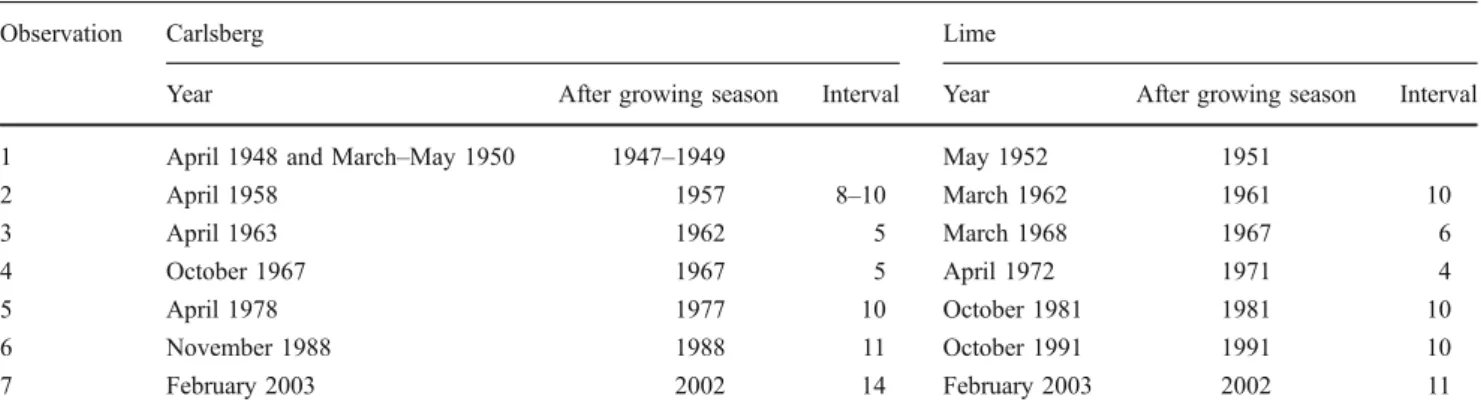
The diameter distributions and their changes through time
are shown in Fig. 1a, b. The distinct peak in the diameter
distribution of the first observations diminished through time and became closer to the negative exponential distribution expected for forests with continuous
recruit-ment (Peterken1996).
The Kolmogorov–Smirnov test was used to measure the rate of change in the diameter distribution, whereby larger values of the test statistic diff.D indicate a larger difference between the two distributions and hence a larger rate of change. This test showed that after about 10 years the diameter distribution has changed significantly in both compartments, independently of the time period considered
(Fig.1c, d). The change in distribution measured with diff.D
increases with the time between the observations; after around 5 years the distributions were not different, but after 10 years most were. In both compartments, the diff.D values increased even further with time, indicating that the differences in the diameter distribution between the two observations increased with increasing temporal distance between observations. In the Carlsberg compartment, the
decadal diff.D values became smaller with time (Table 3),
but four to five data points are too few to describe a trend, especially as the Lime compartment showed no clear
temporal trend of the decadal diff.D (Table3).
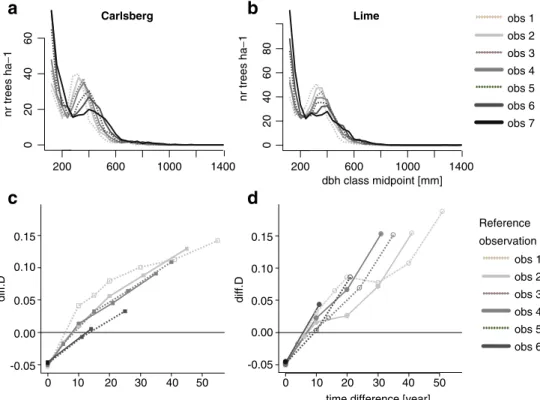
The chi-square test of the goodness of fit is another measure for the rate of change; the larger the test statistics (chi-square value), the larger the difference between the two distributions and consequently the larger the rate of change in the diameter distributions. The chi-square test of goodness of fit showed that all distributions were signifi-cantly different if there were at least 10 years between the
observations (Fig.2a, b). For the three observations that are
only 4–6 years apart, the result depended on the classifi-cation chosen. If the diameter classes were small (10 mm,
dotted lines in Fig. 2), the distributions were significantly
different from each other for all comparisons, except in 1962–1968 (p=0.06). Using larger diameter classes led more often to nonsignificant differences in the 5-year intervals. The more time had passed between the two observations, the more different were the diameter distri-butions, as indicated by the larger differences in the
chi-square values (Fig.2c, d).
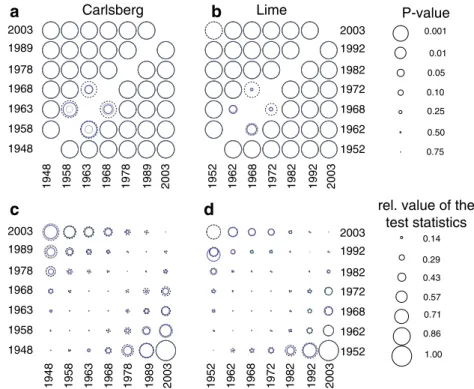
The diameter distribution of the species differed (Fig.3),
whereby species like Betula (Fig. 3a, g) and Quercus
(Fig.3b, h) showed a unimodal distribution with little or no
establishment of trees into the smallest diameter class,
whereas in other species like Fagus (Fig. 3f, l), Tilia
(Fig. 3e, k), and Fraxinus (Fig. 3d, j) trees grew into the
smallest measured diameter class, hence a continuous recruitment occurred. When analyzing the change in the
diameter distribution, communalities were found, but also differences were apparent both within species and
compart-ments (Fig. 3). After about 5 years, none of the species
showed significant changes in diameter distributions. Alnus was the species with the fastest and most consistent changes
in diameter distributions (Fig. 3o, u), as all diameter
distributions for which the observations were at least 10 years apart differed significantly. The notable exception was the last two observations in the Lime enclosure where the diameter distributions did not differ significantly
anymore (Fig.3u). For the other species, the rate of change
in the diameter distribution, as measured with diff.D, was lower, but significant differences were found in the
Carlsberg compartment for most species (Fig. 3m, n, p, q,
r) when at least 20 years had passed between the
observations. However, for the Lime compartment
(Fig.3s–x) the rates of change in the diameter distributions
were somewhat lower compared to the Carlsberg
compart-ment (Fig. 3m–r). The rate of change, as measured with
diff.D, had a clear temporal trend for Betula (Fig. 3m, s),
Quercus (Fig. 3n, t), and Alnus (Fig. 3o, u), resulting in
smaller differences between observations as time pro-gressed. Hence, the diameter distribution changed more between the first observations (higher rate of change) and less between the later ones. The other species did not show
a temporal trend in the diff.D value (Fig. 3p, q, r, v, w),
200 600 1000 1400 02 0 4 0 6 0
time difference [year]
diff.D 0 10 20 30 40 50 0.15 0.10 0.05 0.00 -0.05 200 600 1000 1400 0 2 04 06 08 0 dbh class midpoint [mm] nr trees ha − 1 nr trees ha − 1 Carlsberg Lime 0.15 0.10 0.05 0.00 -0.05 0 10 20 30 40 50 diff.D obs 1 obs 2 obs 3 obs 4 obs 5 obs 6 obs 7 Reference observation obs 1 obs 2 obs 3 obs 4 obs 5 obs 6
a
b
c
d
Fig. 1 Changes in diameter distribution a, b for the two compartments. Different shadings indicate different observations (dates given in Table1). The Kolmogorov– Smirnov statistic diff.D is shown in (c, d), whereby the shadings indicate the reference year. The larger the diff.D value, the larger is the difference in the diameter distribution, and hence the rate of changes between the two observations. The zero line is drawn in black, whereby diff.D values larger than zero indicate a significant difference between the two observations
Table 2 Basal area (square meters per hectare), in parenthesis the change in basal area (square meters per hectare) and number of trees (per hectare) and the change in number of trees in parenthesis (per
hectare) are presented for both compartments and the seven observations (dates are given in Table1)
Observation Basal area (change) [m2ha−1] Number trees (change) [ha−1] New trees [ha−1] Dead trees [ha−1] Carlsberg Lime Carlsberg Lime Carlsberg Lime Carlsberg Lime
1 18.7 (–) 23.5 (–) 240 (–) 314 (–) 2 21.8 (3.1) 27.8 (4.3) 255 (15) 343 (29) 20.0 31.5 4.4 2.3 3 23.5 (1.7) 29.1 (1.3) 270 (15) 340 (−3) 17.5 11.4 2.9 14.2 4 25.1 (1.6) 30.0 (0.9) 282 (12) 340 (0) 17.7 7.5 5.5 8.4 5 27.4 (2.3) 31.1 (1.1) 305 (23) 363 (23) 38.6 45.2 15.6 21.5 6 29.5 (2.1) 32.3 (1.2) 324 (19) 380 (17) 38.4 40.4 20.0 23.5 7 36.2 (6.7) 32.3 (0.0) 326 (2) 412 (32) 48.7 74.2 46.4 42.0
The values in parenthesis indicate the change compared to the previous observation. New trees and dead trees are trees that have reached the 100-mm class or died since the last observation
except for Fagus (Fig.3x) in the Lime compartment where the differences between the two consecutive observations increased with time.
For the diameter distributions of the six main species, the two measurements of the changes in diameter distributions, the chi-square test, and the Kolmogorov–
Smirnov test were well correlated (Fig. 4). This means
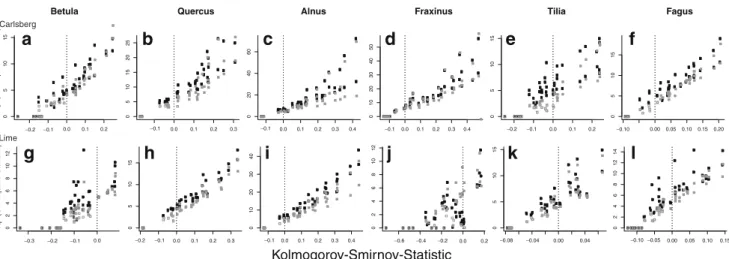
that the general features of the change in the diameter distribution were shown by both tests similarly. The chi-square test, however, resulted more often in significant differences between distributions compared with the
Kolmogorov–Smirnov test (Fig.4).
0.001 0.01 0.05 0.10 0.25 0.50 0.75 P-value
rel. value of the test statistics Carlsberg Lime 2003 1992 1982 1972 1968 1962 1952 2003 1992 1982 1972 1968 1962 1952 2003 1992 1982 1972 1968 1962 1952 2003 1992 1982 1972 1968 1962 1952 2003 1989 1978 1968 1963 1958 1948 2003 1989 1978 1968 1963 1958 1948 2003 1989 1978 1968 1963 1958 1948 2003 1989 1978 1968 1963 1958 1948
a
b
c
d
0.14 0.29 0.43 0.57 0.71 0.86 1.00Fig. 2 A comparison of the diameter distribution between the different observations using the chi-square test. Shadings indicate different assumptions about the size of the diameter classes: dotted black, 10 mm; gray, 40 mm; and black, 100 mm. For p values (a, b), a larger circle indicates a high significant difference, whereas a small circle indicates nonsignificant differences. For most comparisons, the
p values are so similar that the lines are drawn over each other. The relative values of the chi-square statistics (c, d) are presented, whereby the larger the circle is the large is the difference in the diameter distribution between the observations and hence the larger the rate of the change in diameter distribution. The sizes are comparable within one shading Compartment Observation 1–2 2–3 3–5 5–6 6–7 All Carlsberg 0.050 0.027 0.003 0.000 na Lime 0.034 0.018 0.026 0.017 0.055 Alnus Carlsberg 0.084 0.055 0.004 0.011 na Lime 0.090 0.076 −0.004 0.017 −0.003 Quercus Carlsberg 0.018 0.022 −0.043 −0.027 na Lime 0.018 0.005 −0.020 −0.045 −0.029 Betula Carlsberg 0.049 0.002 −0.014 −0.081 na Lime 0.007 −0.039 −0.116 −0.137 −0.144 Fagus Carlsberg 0.017 −0.016 0.024 0.008 na Lime −0.055 −0.060 −0.033 −0.027 −0.003 Fraxinus Carlsberg 0.006 0.006 0.091 −0.003 na Lime −0.331 −0.265 −0.187 −0.093 −0.013 Tilia Carlsberg 0.050 −0.056 −0.097 −0.081 na Lime −0.006 −0.020 −0.016 −0.041 −0.017
Table 3 Value diff.Dof the Kolmogorov–Smirnov compari-son of the diameter distributions for two observations
All comparison were made based on observations that were 10 or 11 years apart. The header indicates the two observations that were compared (for dates see Table1). Positive values of diff.D indicate a significant difference between two distri-butions, whereas negative values indicate that the difference was not significant. Values are given for all trees (all) and for indi-vidual tree species
na denotes that data was not available
3.3 Changes in species composition
The compartments showed a distinctive difference in
species composition (Fig. 5) along the first axis (93%
variation explained), whereby the amount of Tilia and Fraxinus distinguished the two compartments. Considering the temporal development, both compartments showed a
similar trend along the second axis of the PCA (Fig. 5),
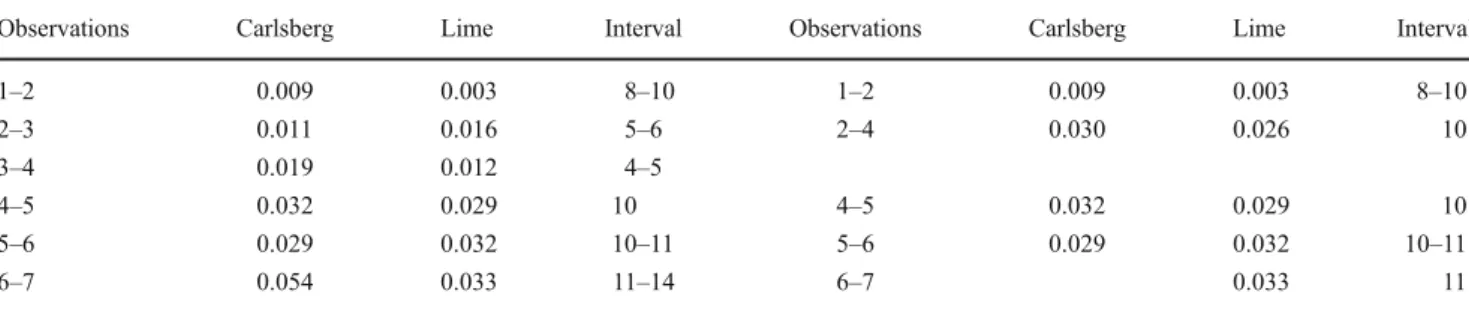
representing an increased importance of Fagus, Alnus, and Quercus and a parallel decrease of Betula. The rate of change in species composition, measured by the Euclidean distance in the PCA, was lower between the first two
observations (Table 4, observations 1–2) than later on
(Fig.5; Table4other observations).
3.4 Correlations between test statistics and forest properties Here, we compared two consecutive observation periods with each other and investigated whether the rate of change in forest attributes, as estimated with the three test statistics, correlated with other forest properties.
The rate of change in species composition (estimated with the Euclidean distance in the PCA) correlated with the number of dead trees, the number of new trees, and the basal area, but not with the average growth or the difference in tree numbers
(Table 5). The rate of change in the diameter distribution
estimated with the chi-square test correlated with the number of new trees and the average growth, but was not correlated with the number of dead trees. The Kolmogorov–Smirnov
200 300 400 500 600 024681 0 1 2 200 400600 800 1200 024 6 8 100 200 300 400 500 600 700 02 4 6 8 1 0 1 2 100 200 300 400 500 600 700 0 5 10 15 20 25 100 300 500 700 02 46 8 200 400 600 800 0 5 10 15 20 200 300 400 500 600 0246 200 400 600 800 1200 02 4 6 8 1 0 100 200 300 400 500 600 700 0 5 10 15 100 200 300 400 500 600 700 02 46 81 0 1 2 1 4 100 300 500 700 01 0 2 0 3 0 4 0 200 400 600 800 0 5 1 01 52 02 53 03 5 nr tr ees ha -1 nr tr ees ha -1 0 10 20 30 40 50 -0 .3 -0 .2 -0 .1 0 .0 0 .1 0 .2 0 10 20 30 40 50 -0 .2 -0 .1 0.0 0 .1 0.2 0 .3 0 10 20 30 40 50 -0 .1 0.0 0 .1 0.2 0 .3 0.4 0 10 20 30 40 50 -0 .6 -0 .4 -0 .2 0 .0 0 .2 0 .4 0 10 20 30 40 50 -0 .2 -0 .1 0.0 0 .1 0.2 0 10 20 30 40 50 -0 .1 0 0 .0 0 0 .10 0 .2 0 0 10 20 30 40 50 -0 .3 -0 .2 -0 .1 0 .0 0 .1 0 .2 0 10 20 30 40 50 -0 .2 -0 .1 0 .0 0 .1 0 .2 0 .3 0 10 20 30 40 50 -0 .1 0.0 0 .1 0.2 0 .3 0.4 0 10 20 30 40 50 -0 .6 -0 .4 -0 .2 0 .0 0 .2 0 .4 0 10 20 30 40 50 -0 .2 -0 .1 0.0 0 .1 0.2 0 10 20 30 40 50 -0.10 0.00 0.10 0.20 di fference in D-value di fference in D-value Quercus Alnus
Betula Fraxinus Tilia Fagus
Carlsberg Lime Carlsberg Lime a b c d e f g h i j k l m n o p q r s t u v w x
diameter class midpoint [mm]
time diff erence [years]
Fig. 3 Changes in diameter distribution for six tree species in the Carlsberg compartment (a–f) and the Lime compartment (g–l). Shadings indicate different observations; for code see Fig.1. Values of the Kolmogorov–Smirnov statistic diff.D for the six tree species for the Carlsberg compartment (m–r) and the Lime compartment (s–x).
The zero line is drawn in black, whereby diff.D values larger than zero indicate a significant difference between the two observations. Shadings indicate the reference year on which the statistic is based upon; for code see Fig.1
test, which also tested the rate of change in the diameter distribution, did not correlate with the number of dead trees, the number of new trees or the average growth in the respective period, but was correlated to the change in tree
numbers (Table5).
4 Discussion
4.1 Forest development
All indicators used here showed that both compartments had high rates of change in species composition and diameter distribution, which indicates that the forest is recovering from past anthropogenic influences after management ceased, even though management might never have been intensive. Strong changes in the diameter distributions were also found in other mixed deciduous forests, where former management was
important (Bernadzki et al. 1998; Mountford et al. 1999;
Heiri et al.2009). When measurements were about 10 years
or more apart, the diameter distributions of all the trees differed significantly in most cases, independent of the statistical method used, whereas after only 5 years, no significant changes in the diameter distribution could be shown when using the Kolmogorov–Smirnov test or the chi-square test with larger diameter classes.
The species composition on the other hand changed more slowly after abandonment, but the rate of change in species composition increased with time, indicating that species turnover increased. This could be mainly attrib-uted to the loss of Betula and an increase in Fagus (both in basal area and tree numbers), especially in the Lime compartment. The importance of Fagus in the species composition and hence the structure of natural deciduous forests are supported by studies throughout Europe (Koop
and Hilgen1987; Ellenberg1996; Peterken1996; Tabaku
1999; Tabaku and Meyer 1999; Emborg et al. 2000;
Meyer,2005). 0.2 0.1 -0.1 -0.2 0.0 0.2 0.1 -0.1 -0.2 0.0 Tilia Fraxinus Betula Fagus Alnus Quercus
temporal change Carlsberg temporal change Lime
axis 1
axis 2
Fig. 5 Temporal change of species composition using PCA. Black dots indicate different observations. The temporal development is indicated by an arrow for both compartments. The species contribu-tions to the different axes were scaled with factor 0.2. The first explains 93% and the second axis 6% of the variation
0.0 0.1 0.2 0 5 10 15 0.0 0.1 0.2 0.3 0 5 10 15 20 25 0.0 0.1 0.2 0.3 0.4 02 0 4 0 6 0 0.0 0.1 0.2 0.3 0.4 0 1 02 03 04 05 0 0.0 0.1 0.2 0 5 10 15 0.00 0.05 0.10 0.15 0.20 0 5 10 15 0.0 0 2 4 6 8 10 12 0.0 0.1 0.2 0.3 05 10 15 0.0 0.1 0.2 0.3 0.4 0 1 02 03 04 0 0.0 0.2 02468 1 0 1 2 0.00 0.04 0 5 10 15 0.00 0.05 0.10 −0.10 −0.10−0.05 −0.08 −0.04 −0.2 −0.1 −0.1 −0.1 −0.1 −0.2 −0.1 −0.1 −0.1 −0.2 −0.1 −0.2 −0.3 −0.6 −0.4 −0.2 0.15 02468 1 0 1 2 1 4 Kolmogorov-Smirnov-Statistic
Betula Quercus Alnus Fraxinus Tilia Fagus
sqr t(Chi-square statistic) sqr t(Chi-square statistic) Carlsberg Lime
a
b
c
d
e
f
g
h
i
j
k
l
Fig. 4 Comparisons of the Kolmogorov–Smirnov statistics with the square root of the chi-square statistic, whereby black dots indicate the chi-square statistic based on diameter classes of 40 mm and gray dots of 100 mm. Empty squares indicate that the chi-square test was not significant, whereas filled circles indicate significant differences. The
dotted line is the vertical zero line. If values for the Kolmogorov– Smirnov statistic (diff.D) are lower than zero, the difference was not significant, whereas values higher than zero indicate a significant difference
When looking at the diameter distribution of the different species, a clear pattern emerged. Some species showed a clear unimodal diameter distribution (Betula, Quercus, and to some degree Alnus) reflecting their
demands of light for establishment (Ellenberg, 1996).
Light-demanding species can only establish in sufficiently large gaps, created naturally (disturbances) or by manage-ment. The observed lack of establishment indicates that not enough areas with sufficient light conditions occurred in the compartments in the past 50 years. The unimodal distribu-tion indicates that such condidistribu-tions were found in the past, favoring the establishment of light-demanding species. Management is the most likely factor to have created these light conditions, as wind disturbances seem to create mainly
small gaps in these compartments (Wolf et al. 2004), and
some past management was reported. Additionally, the temporal development of the spatial pattern of trees also
indicated the influence of past management (Wolf2005). A
similar behavior of light-demanding species has been found
in other forests (Parker et al.1985; Bernadzki et al. 1998;
Mountford et al. 1999; Heiri et al. 2009). The rate of
change in diameter distributions and the variability between observations differed between species. For species with a unimodal diameter distribution (Betula, Quercus, and
Alnus) the rate of change in the distribution decreased continuously, indicating that the differences in the diameter distributions became less distinctive between observations or even disappeared. For Betula, this can be easily explained, as growth rate steadily decreased until the sixth
survey (Wolf, 2003), and hence shifts in diameter
distribu-tions should become less pronounced. Fagus showed the opposite pattern in the Lime compartment, where the continuous increase in number of trees in the smallest size classes was most likely responsible for the increase in the rate of change in the diameter distribution. Interestingly, Tilia had smaller rates of changes in diameter distribution compared to Fagus for example, as it had a lower growth
rate (Wolf2003) and a low mortality (Wolf et al.2004).
4.2 Comparing the different measures of the rates of change Depending on the measures used and the species or compartment analyzed, the rate of changes in diameter distribution differed. We would expect that the rate of change in the diameter distribution should slow down when it approaches the negative exponential distribution expected from natural forests with continuous
regenera-tion (Peterken 1996). There is some indication that the
Table 5 Significant values when the statistic measures (Kolmogorov– Smirnov test, chi-square test, PCA) were correlated (Kendall correlation) with five stand characteristics (number of dead trees,
number of new trees, mean diameter increment, basal area, and change in the number of trees)
Statistical measure Number dead trees Number new trees Mean diameter increment [mm] Basal area Change in tree numbers
Kolmogorov–Smirnov ns ns ns ns **
Chi-square (10) ns *** * ns **
Chi-square (40) ns ** *** ns +
Chi-square (100) ns * ** ns *
Euclidean distance *** ** ns * ns
For the chi-square test results were based on diameter classes of 10, 40, or 100 mm. Euclidean distance represent the distance of observations in the PCA, considering the first and second axis
ns nonsignificant
*p=0.05; **p=0.01; ***p=0.001; +p=0.1
Table 4 Euclidean distance between observations as derived from the first two axes of the PCA
Observations Carlsberg Lime Interval Observations Carlsberg Lime Interval
1–2 0.009 0.003 8–10 1–2 0.009 0.003 8–10 2–3 0.011 0.016 5–6 2–4 0.030 0.026 10 3–4 0.019 0.012 4–5 4–5 0.032 0.029 10 4–5 0.032 0.029 10 5–6 0.029 0.032 10–11 5–6 0.029 0.032 10–11 6–7 0.054 0.033 11–14 6–7 0.033 11
Observation dates given in Table1. Left side of table: values including all observations, right side: Euclidean distance if only observations with 10–11 years temporal difference where considered, i.e., without observation number 3
rate of change in the diameter distribution (measured with the Kolmogorov–Smirnov test) slowed down in the Carlsberg compartment, but not in the Lime compartment. Equally for some species, the rate of change in the diameter distribution declined (Betula, Quercus), but not for the other for which no clear temporal trend was detectable. The basal area still increased in both ments although at a decreasing rate in the Lime compart-ment, which indicates that it might come closer to the maximum basal area for this compartment. The Carlsberg compartment, however, showed a decreasing rate of basal area growth only until the sixth survey, whereas in the last survey the basal area increment was larger again. Whether this is within the natural variability or whether it is an indication that the maximum basal area is much higher can only be shown with additional (future) surveys.
In an old growth natural forest, we would expect the species composition to change only little, but in Draved Forest the species composition changed at an increasing rate in the last 50 years, indicating that the current species composition is not stable and further changes are expected. We cannot exclude that the climatic changes of the past 50 years have contributed to the changes in species composition, but as the change in species composition was highly correlated with mortality and establishment rather than with growth (which is temperature dependent), we conclude that past management might be the reason for the continuous shift in species composition.
4.3 Assessment of statistics used
Although the chi-square test rescales the distributions and therefore loses information on the differences in the total number of trees, its statistics correlated with the number of new trees and the mean growth of all trees, both factors influencing the shape of the diameter distribution. On the other hand, the Kolmogorov–Smirnov test only correlated with the difference in the number of trees between observations, but not with the mean growth rate, indicating that it overemphasized the changes in tree numbers. Still, the Kolmogorov–Smirnov test statistics
correlated well with the chi-square statistics (Fig. 5).
Using both, the tests compensated for the loss of information on tree numbers due to the demand of rescaling, when using the chi-square test.
The Euclidean distance calculated from the PCA was a complementary measure to the two former tests as it correlated well with the number of dead and new trees and with the basal area. This test reflected the changes in species composition, i.e., the differential mortality and establishment (i.e., trees reaching the measurement limit of 100 mm in dbh) of the tree species.
5 Conclusion
After 50 years, there were still significant changes in the forest structure, i.e., diameter distribution, and species composition, so the time since management ceased was clearly not long enough to reach the state of an old growth natural forest, for which we expect small changes if large enough areas were considered. Although some measures indicated that the compartments were approaching the equilibrium state, e.g., a stable mixture of the different phases of forest development, other measures (i.e., species composition) showed the opposite response and even an increasing rate of change.
Each of the three statistical methods used here contrib-uted to the assessment of the changes in the forests in a different way. Basing the interpretation on one measure alone might therefore be misleading. Depending on scientific questions asked, the combination of several statistical methods is recommended.
The statistical measures used here are easily calculated, which gives the possibility to use the rate of change for the verification of forest succession models. In addition, in mature ecosystems the analysis of the rate of change in structure could help assess the degree of ecosystem response to the anticipated climatic changes.
Acknowledgment I am thankful to Peter Friis Møller and Richard Bradshaw for the scientific support during my PhD, the Carlsberg Foundation for financing the long-term research at Draved Forest and two anonymous reviewers for their valuable comments on the manuscript.
References
Aaby B (1983) Forest development, soil genesis and human activity illustrated by pollen and hypha analysis of two neighbouring podzols in Draved Forest. Reitzels Forlag, Kopenhagen, Den-mark
Bengtsson J, Nilsson SG, Franc A, Menozzi P (2000) Biodiversity, disturbances, ecosystem function and management of European forests. Forest Ecol Manag 132:39–50
Bernadzki E, Bolibok L, Brzeziecki B, Zajaczkowski J, Zybura H (1998) Compositional dynamics of natural forests in the Bialowieza National Park, northeastern Poland. J Veg Sci 9:229–238
Bradshaw RHW, Wolf A, Møller PF (2005) Long-term succession in a Danish temperate deciduous forest. Ecography 28:157–164 Christensen M, Emborg J (1996) Biodiversity in natural versus
managed forest in Denmark. Forest Ecol Manag 85:47–51 Christensen M, Heilmann-Clausen J, Emborg J (1993) Suserup Skov
1992—Opmålning og strukturanalyse af en dansk naturskov. Skov- och Naturstyrelsen, Copenhagen
Commarmot B, Hamor FD (2005) Natural forests in the temperate zone of Europe - Values and utilization. Birmensdorf, Swiss Federal Research Institute WSL
Danmarks Meteorologiske Institut (1999) Rapport Orkanen over Danmark den 3. 4 December 1999. Danmarks Meteorologiske Institut, København
Ellenberg H (1996) Vegetation Mitteleuropas mit den Alpen in ökologischer, dynamischer und historischer Sicht, 5th edn. Ulmer, Stuttgart
Emborg J, Christensen M, Heilmann-Clausen J (2000) The structural dynamics of Suserup Skov, a near-natural temperate deciduous forest in Denmark. Forest Ecol Manag 126:173–189
Falinski JB (1986) Vegetation dynamics in temperate lowland primeval forests—ecological studies in Bialowieza forest. Dr W. Junk Publishers, Dordrecht
Farrell EP, Führer E, Ryan D, Andersson F, Hüttl R, Piussi P (2000) European forest ecosystems: building the future on the legacy of the past. Forest Ecol Manag 132:5–20
Führer E (2000) Forest functions, ecosystem stability and manage-ment. Forest Ecol Manag 132:29–38
Hannon GE, Bradshaw R, Emborg J (2000) 6,000 years of forest dynamics in Suserup Skov, a seminatural Danish woodland. Global Ecology and Biodiversity Letters 9:101–114
Heiri C, Wolf A, Rohrer L, Bugmann H (2009) Forty years of natural dynamics in Swiss beech forests: structure, composition, and the influence of former management. Ecol Appl 19:1920–1934 Iversen J (1958) Pollenanalytischer Nachweis des Reliktcharakters
eines jütischen Linden-Mischwaldes. Veröff Geobot Inst Rübel Zür 33:137–144
Iversen J (1969) Retrogressive development of a forest ecosystem demonstrated by pollen diagrams from fossil mor. Oikos Suppl 12:35–49
Kimmins JP (2004) Forest ecology—a foundation for sustainable forest management and environmental ethics in forestry, 3rd edn. Prentice Hall, New Jersey
Koop H, Hilgen P (1987) Forest dynamics and regeneration mosaic shifts in unexploited beech (Fagus sylvatica) stands at Fontaine-bleau (France). Forest Ecol Manag 20:135–150
Korpel' S (1995) Die Urwälder der Westkarpaten. Gustav Fischer Verlag, Stuttgart
Leibundgut H (1993) Europäische Urwälder. Verlag Paul Haupt, Bern Magnuson JJ (1990) Long-term ecological research and the invisible
present. Bioscience 40:495–501
Meyer P (2005) Network of Strict Forest Reserves as reference system for close to nature forestry in Lower Saxony. For Snow Landsc Res 79:33–44
Mitchell FJG, Cole E (1998) Reconstruction of long-term successional dynamics of temperate woodlands in Bialowieza Forest. Poland J Ecol 86:1042–1059
Møller PF (2000) Natur og forskning i Draved Skov i fortid, nutid og fremtid. Sønderjysk Månedsskr 4:81–93
Møller PF, Bradshaw RHW (2001) Temanummer Geologi i skoven. Geologi - nyt fra GEUS 4:1–16
Mountford EP, Peterken GF, Burton D (1998) Long-term monitoring and management of Langley Wood: a minimum-intervention National Nature Reserve. English Nature, Peterborough Mountford EP, Peterken GF, Edwards PJ, Manners JG (1999)
Long-term change in growth, mortality and regeneration of trees in Denny Wood, an old-growth wood-pasture in the New Forest (UK). Perspect Plant Ecol Evol Syst 2:223–272
Neumann M, Starlinger F (2001) The significance of different indices for stand structure and diversity in forests. Forest Ecol Manag 145:91–106
Parker GR, Leopold DJ, Eichenberger JK (1985) Tree dynamics in an old-growth, deciduous forest. Forest Ecol Manag 11:31–57
Peterken GF (1996) Natural woodlands. Cambridge University Press, Cambridge
Peterken GF, Jones EW (1987) Forty years of change in Lady Park Wood: the old-growth stands. J Ecol 75:477–512
Sokal RR, Rohlf FJ (1995) Biometry, 3rd edn. W. H. Freeman and Company, New York
Tabaku V (1999) Struktur von Buchen-Urwäldern in Albanien im Vergleich mit deutschen BuchenNaturwaldreservaten und -Wirtschaftswäldern. Cuvillier Verlag, Göttingen
Tabaku V, Meyer P (1999)“Lückenmuster albanischer und mitteleur-opäischer Buchenwälder unterschiedlicher Nutzungsintensität.” Forstarchiv 70:87–97
Tilman D (1989) Ecological experimentation: strengths and concep-tual problems. In: Likens GE (ed) Long-term studies in ecology—approaches and alternatives. Springer, New York, pp 136–157
Wirth C, Gleixner G, Heimann M (2009) Old-growth forests: function, fate and value—an overview. Springer, Heidelberg, pp 3–10
Wolf A (2003) Tree dynamics in Draved Forest—a long-term study of a temperate deciduous forest in Denmark. Ph.D. Thesis, The Royal Veterinary and Agricultural University
Wolf A (2005) Fifty year record of change in tree spatial patterns within a mixed deciduous forest. Forest Ecol Manag 215:212– 223
Wolf A, Møller PF, Bradshaw RHW, Bigler J (2004) Storm damage and long-term mortality in a semi-natural temperate deciduous forest. Forest Ecol Manag 188:197–210
Woods KD (2000) Dynamics in late-successional hemlock-hardwood forests over three decades. Ecology 81:110–126