Research Article
Benthic diatoms of an Alpine stream/lake network
in Switzerland
Christopher T. Robinson1,* and Barbara Kawecka2
1Swiss Federal Institute of Aquatic Science and Technology (Eawag), Department of Limnology, Ueberlandstrasse 133, CH-8600 Duebendorf, Switzerland
2Institute of Nature Conservation, Polish Academy of Sciences, Al. A. Mickiewicza 33, PL-31-120 Krakow, Poland; e-mail: [email protected]
Received: 3 November 2004; revised manuscript accepted: 11 March 2005
Abstract. We compared the benthic diatom composition
of lakes, and lake inlet and outlet streams in a high eleva-tion catchment (~2600 m a.s.l.) in the Swiss Alps. The catchment consisted of a southern basin mostly fed by glacial-melt water and a northern basin fed by snowmelt and groundwater. Streams in both basins flowed through a series of small lakes before converging into a lake with a primary outlet channel. The south basin had on average 4 °C cooler water temperatures and 2¥ higher nitrate-N
levels (up to 300 mg/L) than the north basin. In contrast, the
north basin had higher levels (2–4¥) of particulate-P,
par-ticulate-N, and particulate organic matter than the south basin. A total of 109 and 143 diatom species was identified in lakes and streams, respectively, with a similar number of species found in each basin. Aulacoseira alpigena and
Achnanthidium minutissimum were common benthic algae
in north basin lakes, whereas Achnanthes subatomoides,
Achnanthes marginulata, Pinnularia microstauron, and Psammothidium helveticum were most common in south
basin lakes. One disconnected lake in the north basin had an assemblage dominated by Tabellaria flocculosa (66 %) and Eunotia tenella (14 %). Principal components analysis
DOI 10.1007/s00027-005-0783-4 © Eawag, Dübendorf, 2005
showed a clear separation between the north and south basins in lotic diatoms. Of the 10 most common species, streams in the south basin had greater abundances of
Psammothidium helveticum, Achnanthes helvetica var. mi-nor, Achnanthes marginulata, Achnanthes subatomoides,
and Diatoma mesodon than the north basin, whereas north basin streams had higher abundances of Achnanthidium
minutissimum, Aulacoseira alpigena, and Luticola goep-pertiana. Lake outlet assemblages were similar to
respec-tive downstream lake inlet assemblages, and assemblages changed in composition along each basins longitudinal flow path. However, Aulacoseira alpigena had higher average abundances in north basin outlets than inlets, and Achnanthidium minutissimum, Psammothidium
hel-veticum, and Achnanthes helvetica var. minor had higher
average abundances in south basin outlets than inlets. In contrast, Diatoma mesodon, Fragilaria capucina, and
Gomphonema parvulum had higher average abundances
in south basin inlets than outlets. The spatial patterns in species composition reflected the hierarchical interaction of landscape features (geology, hydrology) on longitudinal gradients (lake position) in the stream/lake network.
Key words. Swiss National Park; lake outlet; acidophilus algae; lake order; fragmentation.
*Corresponding author e-mail: [email protected] Published Online First: August 22, 2005
Introduction
Freshwater systems in alpine environments comprise a variety of lotic and lentic waters. Sources of stream dis-charge range from glacial and snowmelt to groundwater (Ward, 1994) and mixtures of each (Tockner et al., 1997; Brown et al., 2003). Ephemeral and intermittent streams also are quite common in alpine environments (Robin-son et al., 2003; Rüegg and Robin(Robin-son, 2004). Alpine lakes range in size and degree of connectedness; some being isolated water bodies while others are inter-con-nected by streams forming lake chains. Many alpine lakes have outlet streams (Hieber et al., 2001) that also can be temporary (Donath and Robinson, 2001). The juxtaposition of lakes and streams in alpine catchments enhances overall habitat heterogeneity and potential bio-diversity. Likewise, the position of a lake(s) in the stream network has important implications regarding the struc-ture and functioning of downstream receiving waters (Cattaneo, 1996; Soranno et al., 1999; Kling et al., 2000) as well as instream flora and fauna (Schanz, 1984; Her-shey et al., 1999; Hieber et al., 2001). Knowledge of the complex linkages in lake/stream networks is needed to better understand the spatial and temporal dynamics in the distribution and abundance of organisms in the con-text of ecological constructs such as, for example, the River Continuum Concept (Vannote et al., 1980). This issue is particularly important in alpine systems where the present retreat of glaciers can cause the formation of new lakes.
The presence of lakes in a stream network causes fragmentation in the longitudinal continuity of streams. Lake chains, in fact, can have a major influence on longi-tudinal patterns in physical and chemical properties of streams and among lakes (Soranno et al., 1999; Kling et al., 2000; Quinlan et al., 2003). A clear example of a lake influence for stream systems in lake chains is the resulting formation of lake inlets and lake outlets. Lake outlets, in particular, are well-known for their character-istic benthic assemblages, especially macroinvertebrates (Robinson and Minshall, 1990; Richardson and Mackay, 1991). Algal assemblages, although rarely studied in lake outlets, are quite sensitive to environmental change (McCormick and Cairns, 1994) and would be expected to show distinct shifts in community composition associ-ated with physical/chemical variation in the lake water that feeds them (Kawecka et al., 1971; Cattaneo, 1996; Kawecka and Galas, 2003). An additional consideration in alpine environments is the effect of water source or stream type (sensu Brown et al., 2003) on algal assem-blages in streams and lakes of different lake chains. For example, how does water source (i.e., chemical and phys-ical differences) influence the development of algal as-semblages along a stream/lake network in high elevation alpine environments?
The present study examined diatom assemblages along two lake chains in the same alpine catchment, each having a different water source (glacial and snowmelt). Our objectives were threefold: 1) to test for differences in diatom assemblages in lakes and streams between the two basins; 2) to test for differences between lake inlet and lake outlet diatom assemblages in the two basins; and 3) to examine for longitudinal patterns in diatom assem-blages in the two lake chains. We expected that water source would have a significant effect on spatial distribu-tion patterns of diatoms between the two basins.
Study area description
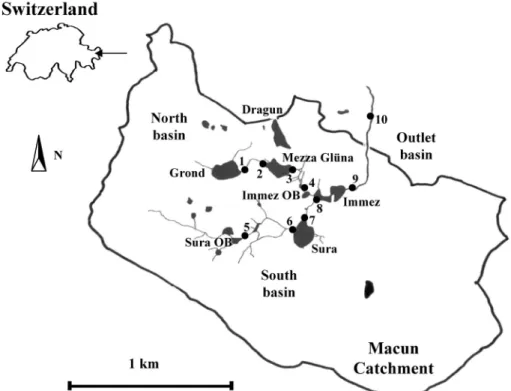
The Macun Lakes region (46°44¢ N, 10°08¢ E) is a high
alpine cirque (>2600 m a.s.l.) in the Canton Graubunden, Switzerland (Fig. 1). The 3.6 km2region was annexed with the Swiss National Park in 2000, and currently is an area designated for long-term monitoring of Alpine streams and lakes. The region comprises 26 small lakes with the 5 largest lakes interconnected by stream segments, each <500 m in length. The surrounding peaks reach eleva-tions between 2800 and 3000 m a.s.l., and the outlet stream (Zeznina) drains north to the Inn River near the village of Lavin, Switzerland, in the lower Engadine. Water sources in the basin originate from precipitation (mostly as snow in winter) and a number of rock glaciers, especially in the southern part of the basin. Precipitation is low, around 850 mm/y. Air temperatures range from >20 °C in summer to <–15 °C in winter based on records from the nearby climate station (Buffalora) ~14 km south-east of Macun. Bedrock geology is slow-weathering crys-talline (ortho-gneiss) rock (Bortolami, 1998). The area is above treeline, thus most terrestrial vegetation is typical Alpine grasses and low lying herbs (Körner, 2001); areas of bare rock are common.
The drainage network of Macun is represented by a northern and southern basin (Fig. 1). The north basin is primarily precipitation (mostly as snow) and groundwa-ter fed, whereas the south basin is fed mostly by glacial melt from rock glaciers. Consequently, the annual flow regime differs between basins with the south basin expe-riencing more extreme channel contraction from the freezing of glacial water in autumn. The stream network, as a whole, contracts by up to 60 % in winter (S. Matthaei, unpublished data). The water source in each basin also causes differences in water temperature, being warmer in the north basin, and water chemistry (as de-scribed below). We selected 10 stream sites and 7 lakes for assessment of diatom assemblage structure (Fig. 1). Four stream sites were located in the north basin, 4 sites in the south basin, and 2 sites in the outlet stream (called outlet basin in the remaining text). The sites were situ-ated at the inlets and outlets of the prominent lakes in
each basin along a longitudinal gradient. Melt-water from a large rock glacier enters the outlet stream be-tween stream sites 9 and 10. Of the sampled lakes, Dra-gun is disconnected from the other lakes in the north basin with a separate outlet channel that goes dry in sum-mer. Lake Immez is located at the confluence of the north and south drainage channels.
Methods
Water samples were collected monthly (June to Septem-ber) from each stream site from September 2001 to Sep-tember 2003 (n = 9). Lake chemistry was assumed to be similar to respective lake outlet samples. Samples were taken to the laboratory, filtered (Whatman GF/F), and analyzed for constituents of nitrogen (NO2, NO2+NO3, PN), phosphorus (PO4-P, PP), and silica (SiO2) using methods detailed in Tockner et al. (1997). Measures of total inorganic (TIC) and particulate organic carbon (POC) were derived from the filters using standard methods. On each visit, we measured water temperature and conduc-tivity (WTW LF 323, Germany), turbidity (Cosmos, Zül-lig AG, Switzerland), and pH (WTW pH 330, Germany) using portable field meters. Turbidity was expressed in nephelometric turbidity units (NTU).
Diatoms were sampled from each stream site on 7 September 2001, 16 July 2002 and 18 September 2002. Diatoms were sampled from each lake on 22 August 2003. From each stream site, five rocks were randomly collected along a 10 m reach. From each lake, 15–20 rocks were collected from the littoral zone around each lake. The peri-phyton layer on the surface of each rock was scrubbed with a brass brush and the slurry rinsed into a plastic container. A subsample (~4 ml) from each slurry was then combined in a 20 ml plastic vial, preserved with 2 % formalin, and taken to the laboratory. In the laboratory, each sample was macerated in a chromic acid cleaning solution (3:1 v/v of sulphuric acid and potassium dichromate) for 1–2 days, and then washed by centrifugation. Diatoms from each sample were embedded permanently on glass slides with the synthetic resin Pleurax, having a reflective index of 1.75. Slides for diatoms were examined using a Nikon mi-croscope (Eclipse 600) and, when necessary, by scanning electron microscopy (SEM; JEOL JSM 35 CF). A mini-mum of 250 diatom valves were identified and counted along random transects from each slide. Identifications were based on Krammer and Lange-Bertalot (1986; 1988; 1991a,b), Flower and Jones (1989), Round et al. (1990), Krammer (1992), Lange-Bertalot and Moser (1994), and Lange-Bertalot and Metzeltin (1996). A diatom species list with authorship is provided in Appendix A.
Figure 1. Schematic map of the Macun lakes region in eastern Switzerland. Numbers show the sample locations for diatoms and
corre-spond to site numbers in Table 1 and the appendix. Lake names correcorre-spond to lakes sampled in late August 2003. The Macun catchment can be separated into two distinct hydrologic basins (north and south) and an outlet basin that drains both upper basins into the Inn River in the lower Engadine valley. Lake Dragun is hydrologically disconnected from the other lakes in the north basin with a separate outlet stream. The sites are situated between 2600 and 2670 m a.s.l.
Data analysis
Physical and chemical measures collected from each stream site were summarized as means and standard de-viations (Table 1). Stream sites also were grouped and summarized by respective study basin, resulting in 4 sites in the north basin, 4 sites in the south basin, and 2 sites in the outlet basin (Fig. 1). Lake diatom samples were com-pared between basins using a paired t-test, excluding the lakes Dragun and Immez. For stream diatoms, two-way ANOVA was used to test for differences in species rich-ness between inlets and outlets among dates, and among basins and dates (Zar, 1984). Two-way ANOVA also was used to test for differences between inlets/outlets and basins for the 10 most abundant species after arcsine square-root transformation. In addition, principal compo-nents analysis (PCA, varimax rotation) was used to illus-trate assemblage differences among basins, and between inlets and outlets based on the relative abundances (arc-sine square-root transformed) of the 10 most abundant species. These PCA’s also were used to indicate any lon-gitudinal or gradient patterns in the lotic diatom assem-blages from the upper most sites to the most downstream site (Zeznina).
Results
Physical and chemical characteristics between basins
The north and south basin differed considerably in phys-ical and chemphys-ical characteristics of the water, clearly reflecting the source of water in each basin (Table 1). Although overall conductivity was generally low because of bedrock geology, the south basin had two-fold higher conductivity values than the north basin. The input from the rock glacier below site 9 also caused another two-fold increase in conductivity at site 10 (Zeznina). Water clar-ity was high, being <2 NTU at all sites except site 10. Water pH ranged between 6.4 and 7.4 for all sites. Water temperatures were around 4 °C cooler in the south basin because of the input of glacier water. Temperatures typi-cally increased along the longitudinal gradient within each basin, increasing from 10.7 to 13.4 °C in the north basin and from 7.3 to 11.6 °C in the south basin (Table 1). Dissolved nitrogen constituents were around twice as high in the south basin than the north basin with highest values at site 5, averaging >300 mg/L (NO2+NO3-N). In contrast, particulate N was 3¥ greater in the north basin
than the south basin and outlet basin. Phosphate-P (PO4-P) was always below analytical detection limits at all sites, whereas particulate-P was about two-fold higher in the north basin than the south basin. TIC was generally low, usually <0.8 mg/L, and silica was sufficient for algal growth. Lastly, POC was 4¥ higher in the north than the
south and outlet basins.
Ta b le 1 . A v erage (SD) ph
ysical-chemical characteristics of the study sites and for streams in each of the three basins. Site numbers cor
respond to numbers in f
igure 1. N
=
9
from samples
col-lected monthl
y from September 2001 to September 2003, e
xcluding winter (October to Ma
y). Site Num-T ype Ele v a- Con-T urbidity T em-pH NO 2 -N NO 2 +NO 3 PN PO 4 -P PP TIC POC SiO 2 ber tion ducti vity perature (m) (m S/cm) (NTU) (°C) (m g/l) (m g/l) (m g/l) (m g/l) (m g/l) (mg/l) (mg/l) (mg/l) Grond 1 outlet 2637 6.7 (0.5) 1.3 (0.7) 10.7 (3.0) 7.4 (0.4) 0.7 (0.5) < 100 94 (56) < 5 9.1 (3.5) 0.7 (0.2) 1.2 (0.8) 2.2 (0.2) Mezza-glüna 2 inlet 2634 6.7 (0.3) 1.4 (0.6) 11.4 (3.9) 6.8 (0.3) 0.6 (0.5) < 100 104 (69) < 5 8.9 (4.4) 0.5 (0.2) 1.0 (0.6) 2.3 (0.2) Mezza-glüna 3 outlet 2624 5.7 (0.4) 1.8 (0.8) 12.4 (4.2) 6.7 (0.4) 0.7 (0.5) < 100 102 (44) < 5 9.6 (4.3) 0.5 (0.2) 1.4 (0.7) 1.8 (0.2) Immez-nor th 4 inlet 2620 6.2 (0.5) 1.5 (0.6) 13.4 (4.5) 6.6 (0.3) 1.0 (0.0) < 100 113 (46) < 5 10.7 (3.8) 0.6 (0.3) 1.2 (0.6) 1.8 (0.3) Sura 5 outlet 2668 8.9 (4.5) 0.9 (0.4) 7.3 (3.0) 6.7 (0.7) 2.0 (1.3) 301 (82) 25 (17) < 5 3.2 (3.0) 0.3 (0.1) 0.2 (0.1) 2.1 (0.5) Sura 6 inlet 2650 11.2 (6.0) 0.7 (0.5) 7.4 (3.4) 6.4 (0.3) 0.7 (0.8) 246 (69) 13 (4) < 5 2.3 (1.3) 0.4 (0.0) 0.2 (0.1) 2.2 (0.6) Sura 7 outlet 2631 11.0 (5.0) 1.5 (0.9) 7.9 (3.1) 6.9 (0.6) 1.6 (0.7) 169 (61) 33 (11) < 5 4.4 (1.8) 0.4 (0.1) 0.3 (0.2) 2.1 (0.5) Immez-south 8 inlet 2620 14.0 (9.8) 1.5 (0.8) 11.6 (3.5) 6.9 (0.5) 1.6 (0.7) 200 (90) 33 (11) < 5 4.7 (1.8) 0.7 (0.2) 0.3 (0.2) 2.1 (0.5) Immez 9 outlet 2616 9.1 (1.7) 1.3 (0.4) 9.0 (3.0) 6.8 (0.4) 1.1 (0.4) 138 (34) 49 (22) < 5 9.7 (14.5) 0.5 (0.2) 0.4 (0.2) 2.1 (0.5) Zeznina 10 basin outlet 2552 26.9 (21.7) 4.4 (3.3) 6.3 (2.1) 7.2 (0.1) 0.9 (0.7) 241 (78) 29 (17) < 5 5.8 (3.0) 0.8 (0.3) 0.3 (0.1) 2.5 (0.6) Nor th basin 1–4 all 2630 6.3 1.5 12.0 6.9 0.8 < 100 103 < 5 9.6 0.6 1.2 2.0 South basin 5–8 all 2642 11.3 1.2 8.6 6.7 1.5 229 26 < 5 3.7 0.4 0.3 2.1 Outlet basin 9–10 all 2584 18.0 2.9 7.7 7.0 1.0 190 39 < 5 9.7 0.7 0.4 2.3
south, and 71 in the outlet basin (App. A). There was no significant difference in the average species richness of diatoms among basins (p = 0.61), although average richness was lowest in the outlet basin in the September samples (Fig. 3). ANOVA results indicated a significant difference in diatom richness among dates (p = 0.005),
Between-basin differences in lentic diatoms
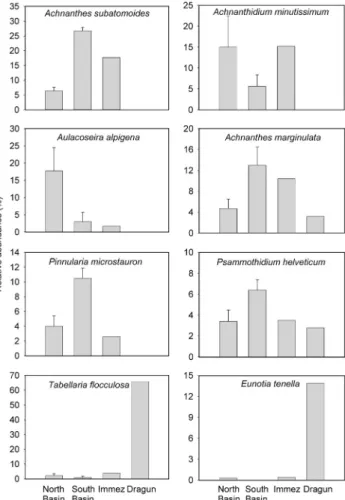
A total of 109 diatom species were identified from the lakes. Of the more common species, north basin lakes had higher abundances of Aulacoseira alpigena,
Achnan-thidium minutissimum and Aulacoseira distans than the
south basin (t-test, p < 0.05) and other lakes (Fig. 2, App. A). Achnanthes subatomoides, Achnanthes marginulata,
Pinnularia microstauron, and Psammothidium helveticum
were more common in the south basin lakes and lake Immez than in north basin lakes (t test, p < 0.05). Lake Dragun had an assemblage dominated by Tabellaria
floc-culosa (66 %) and Eunotia tenella (14 %) (Fig. 2). Lastly, Pinnularia sinistra (~2 %) was common in most lakes,
and Fragilaria capucina was found common (13 %) in Mezza Glüna (data not shown).
Between-basin differences in lotic diatoms
A total of 143 diatom species were identified from the stream samples, 109 species in the north basin, 108 in the
Figure 2. Average relative abundance (as %, +1 SE) of the top 8
most abundant diatom species in the major lakes of Macun with lakes from each basin combined (north basin, n = 3; south basin, n = 2) and Immez and Dragun presented as separate lakes. List of diatom species found in the lakes is given in Appendix A.
Figure 3. Average (+1 SE) diatom species richness in streams in
each basin on each collection date and for all dates combined (n = 3). North basin, n = 4 sites; South basin, n = 4 sites; Outlet basin, n = 2 sites.
Figure 4. Scatterplot of the PCA factor scores for the 10 stream
sites using the top 10 most abundant diatoms (as %) with all dates combined. Circles are north basin sites, triangles are south basin sites, and diamonds are outlet basin sites. Numbers inside symbols refer to site numbers from Figure 1. Some dates were not included for some sites in the analysis due to low numbers of diatoms in those samples (see methods). The first two axes explained 67 % of the variation among sites. PSHE = Psammothidium helveticum, ACHM = Achnanthes helvetica var. minor, ACMA = Achnanthes
marginulata, ACSU = Achnanthes subatomoides, GOPA = Gom-phonema parvulum, PISI = Pinnularia sinistra, and FRCA = Frag-ilaria capucina. Species were related positively with each
being lowest in September 2001 and highest in July 2002. Average species richness was around 30 when all dates were combined, but ranged from < 20 to ~ 40.
The PCA results showed a distinct difference in di-atom assemblage structure between the different basins based on the 10 most common species (Fig. 4). The south basin had greater abundances of Psammothidium
hel-veticum, Achnanthes helvetica var. minor, Achnanthes marginulata, and Achnanthes subatomoides than the
north and outlet basins, as depicted along axis-1 of the PCA scatterplot. Axis-1 factor scores of the PCA were significantly correlated with particulate organic carbon (r = – 0.64), particulate phosphorus (r = – 0.74), particulate nitrogen (r = – 0.63), and nitrate-N (r = 0.64). A
longitudi-Figure 5. Average relative abundance (as %, +1 SE) of the top 10 most abundant diatom species in the inlets (IL) and outlets (OL) in each
nal shift in diatoms was evident along PCA axis-2, with
Fragilaria capucina, Gomphonema parvulum, and Pin-nularia sinistra increasing in abundance downstream.
The outlet basin site (site 9) was placed intermediate to the north and south basins in the PCA, whereas site 10 (Zeznina) showed assemblage structure more similar to the north basin sites (Fig. 4).
Significant basin differences were found for 6 of the 10 most common species identified (2-way ANOVA, p < 0.05). Aulacoseira alpigena had greater abundances in the north basin, and those more common in the south basin were Diatoma mesodon, Psammothidium
hel-veticum, Achnanthes helvetica var. minor, Achnanthes marginulata, and Achnanthes subatomoides (Fig. 5).
Within the top 10 most abundant species common to both basins were Achnanthidium minutissimum, Gomphonema
parvulum, Fragilaria capucina and Pinnularia sinistra.
Three species dominated the lower outlet basin stream (site 10, Zeznina): Diatoma mesodon, Gomphonema
parvulum, and Achnanthes subatomoides (Fig. 5).
Differences between inlets and outlets
There was no significant difference in the species richness of diatoms between inlets and outlets (p = 0.43), although site 10 (Zeznina, n = 1 thus not included in the ANOVA) clearly had fewer species of diatoms than the inlets and outlets on all sample dates (Fig. 6). There was a signifi-cant date effect (p = 0.019) with September 2001 having lower average richness than July and September 2002. Average richness in the inlets and outlets ranged from ~20 to 30 with all dates combined, and from ~20 to 40 among dates excluding site 10. The lowest species rich-ness was found at site 10 with 14 species identified.
PCA results showed that adjacent inlet and outlet assemblages (i.e., outlet of upstream lake with inlet to next downstream lake) were quite similar, being plotted near each other on the PCA scatterplot (Fig. 7). This pat-tern was particularly evident in south basin streams. Site 3 (Mezza Glüna outlet) in the north was similar to site 1 (Grond outlet), and site 9 (Immez outlet) was similar to site 4 (Immez inlet north). Site 2 (Mezza Glüna inlet) could not be used in the PCA analysis because of an extremely depauperate sample of diatoms, although a sim-ilar taxonomic composition was evident for the species identified. Axis-1 explained 39 % of the variation in the data and primarily separated sites between the two basins (south basin on the right and north basin on the left side of the plot). Species contributing to axis-1 included
Di-atoma mesodon, Psammothidium helveticum, Achnan-thes helvetica var. minor, and Aulacoseira alpigena.
Axis-2 explained an additional Axis-20 % of the variation among sites and highlighted the longitudinal gradient of species abundances in the two basins (see below). Species asso-ciated with axis-2 included Gomphonema parvulum,
Tabellaria flocculosa, and Encyonema minutum. In this
analysis, site 10 (Zeznina) had a distinct assemblage of diatoms from the other sites.
Only one of the 10 most abundant species showed a significantly higher abundance in outlet streams than in inlet streams, this being Aulacoseira alpigena in the north basin (Fig. 4). High variances precluded additional
signif-Figure 7. Scatterplot of PCA factor scores for 9 stream sites based
on the top 10 most abundant diatom species (as %) from data col-lected in July 2002. Numbers represent site numbers in Figure 1 and Table 1. PCA was used to illustrate patterns between inlet and out-lets in each basin and whether a longitudinal gradient in the diatom assemblage was present. The first two axes explained 59 % of the variation among sites. DIHM = Diatoma mesodon, PSHE =
Psam-mothidium helveticum, ACHM = Achnanthes helvetica var. minor,
AUAL = Aulacoseira alpigena, GOPA = Gomphonema parvulum, TAFL = Tabellaria flocculosa, ENMI = Encyonema minutum. A minus sign before a diatom species in the figure indicates a nega-tive relationship along the axis. Circles represent outlet sites and squares inlet sites. Large ellipses simply group similar sites in re-spect to diatoms.
Figure 6. Average (+1 SE) diatom species richness in combined
in-lets, outin-lets, and Zeznina (site 10) for each date and for all dates combined (n = 3). Inlets, n = 4; Outlets, n = 5; Zeznina, n = 1.
icant differences between outlets and inlets in each basin, but Achnanthidium minutissimum, Psammothidium
hel-veticum and Achnanthes helvetica var. minor had higher
average abundances in the south basin outlets than inlets. In contrast, Diatoma mesodon, Fragilaria capucina, and
Gomphonema parvulum had higher average abundances
in south basin inlets than outlets.
Longitudinal gradients in lotic diatom assemblages
PCA, using only the July 2002 data to restrict seasonality, revealed a longitudinal gradient in species composition in the south basin with sites 5 and 6 being placed in the up-per right section of the PCA scatterplot, sites 7 and 8 in the upper central section of the plot, site 9 in the lower central section, and then site 10 in the lower right section of the plot (Fig. 7, also see Fig. 4). Further, sites 1 and 3 in the north basin were situated in upper left corner of the scatterplot, site 4 was near site 9 in the bottom central section, and site 10 again in the lower right of the scatter-plot.
Discussion
General features of the diatom assemblages in the catchment
Many of the identified 170 species inhabiting the streams and lakes in the Macun catchment are species ubiquitous in high elevation streams in the Alps (Kawecka, 1981; Kawecka and Galas, 2003). A similar number of species (>100) were identified in each basin, although substan-tially fewer species were found in the outlet basin streams (see Appendix A). Fewer species were found in lake sam-ples (~110) than in stream samsam-ples (~150), and 76 species were found in both kinds of habitats. Species assem-blages contained a few (~15-20) common species and a high number of rare species. The lower-most stream site had the fewest number of species in the catchment with only 14 species identified in the September 2001 sam-ples. In streams, on average more species were identified in July samples than in samples from either September collection. Average diatom richness across dates ranged from around 20 to 40 among the different sites. These values lie in the range of other studies on high elevation streams in the Swiss Alps (Wuthrich, 1975; Niederhauser, 1993) and throughout Europe (Kawecka, 1980; Tolotti, 2001; Kawecka and Galas, 2003; Negro et al., 2003).
Acidophilus species of Achnanthes (e.g., A. helvetica var. minor, A. subatomoides and A. marginulata) and
Aulacoseira alpigena were found in most samples in
lakes and streams (following Kawecka, 1981; Kawecka and Galas, 2003). However, more circumneutral species also were found and in relatively high abundances, e.g.,
Diatoma mesodon, Fragilaria capucina, Achnanthidium
minutissimum, and Psammothidium helveticum. However,
both A. subatomoides (south basin) and A. alpigena (north basin) were still quite common in the lakes, indicating acidophilus conditions are still present. The higher abun-dance of A. minutissimum in north basin lakes suggests basin differences in buffering capacities to acidification, and perhaps the effects of different water sources in each basin on diatom composition (discussed below).
Between-basin differences in lotic and lentic diatoms
We found clear differences in stream diatoms between the north and south basin that reflected basin differences in water chemistry. For example, there was significant correlations of the PCA axis-1 scores with particulates (N, P, and organic C), and basins were separated along this axis. There were also apparent differences in stream assemblages between the two basins and the outlet basin streams (sites 9 and 10). Outlet basin streams (sites 9 and 10) were dominated by Diatoma mesodon,
Achnanthid-ium minutissimum, and Gomphonema parvulum. Site 10
was lowest in elevation and had the highest conductivity of all the sites. This site also was more characteristically stream-like than sites in the north and south basin where sites were either lake inlets or lake outlets. Interestingly, the PCA also showed site 10 to be quite similar to north basin sites. North basin stream sites were dominated by A.
minutissimum, G. parvulum, Aulacoseira alpigena, and to
a lesser extent Achnanthes subatomoides. As mentioned, most of these species are common in waters with circum-neutral pH (Kawecka, 1981), and the north basin was snowmelt and groundwater-fed. In contrast, south basin streams were dominated by some acidophilus Achnanthes species, but also circumneutral Fragillaria capucina, and alkalophilus Psammothidium helveticum. The south basin was mostly fed by glacial meltwater from rock glaciers and tended to have lower conductivities and pH than the north basin.
Basin differences also were found for lake diatoms. Here, north basin lakes had higher abundances of
Aula-coseira alpigena, AuloAula-coseira distans and Fragilaria ca-pucina than south basin lakes, whereas south basin lakes
were dominated by Achnanthes subatomoides,
Achnan-thes marginulata, AchnanAchnan-thes helvetica var. minor, and Psammothidium helveticum. Pinnularia spp. (P. micro-stauran and P. sinistra) also seemed more common in
south basin lake samples than north basin lakes. Lake Dra-gun had an assemblage completely dominated by
Tabel-laria flocculosa (66 %), and is isolated from other lakes in
the catchment. Last, the confluence lake (Lake Immez) assemblage was more similar to assemblages in south basin lakes than north basin lakes, perhaps reflecting the greater amount of its water being derived from the south system (S. Matthaei, unpublished data).
Diatom differences between lake inlets and lake outlets
PCA revealed that lake outlet assemblages were quite similar to adjacent downstream inlet assemblages. This finding may simply be caused by the close proximity of adjacent outlet and inlet locations, as most outlets were within ~100–200 m of a downstream inlet. However, a number of species differed between outlet and inlet as-semblages when respective stream types were combined, suggesting a strong influence of the lake on outlet assem-blage structure. For example, Gomphonema parvulum and
Fragilaria capucina were more abundant in inlets than
outlets in both basins. In contrast, Aulacoseira alpigena was more common in outlets than inlets in the north basin, and A. alpigena also was common in north basin lakes. In the south basin, Achnanthes subatomoides, Achnanthes
marginulata and Psammothidium helveticum were on
average more common in outlets than inlets, and both species were found in south basin lakes. Lakes are well-known to influence habitat characteristics and macro-zoobenthos of outlet streams (Robinson and Minshall, 1990, Richardson and Mackay, 1991; Wotton, 1995). Fur-ther, zooplankton abundances are typically high in outlet streams, declining exponentially downstream (Robinson and Minshall, 1990), and many outlet streams contain high abundances of filter feeders that consume high qual-ity seston coming from the lake (Wotton, 1979). Our data suggest that diatoms in the respective lakes may colonize or be a continuous source of colonists to outlet streams, thereby influencing observed assemblage differences be-tween inlets and outlets in each basin.
Longitudinal patterns along lake chains
Both basins appeared to have a lake chain influence on the longitudinal gradient in diatom assemblage structure. For example, the abundances of Gomphonema parvulum,
Fragalaria capucina, and Pinnularia sinistra increased,
and Encyonema minutum decreased, along the longitudi-nal gradient in each basin. Physical and chemical charac-teristics of streams and lakes have been found to change longitudinally along lake chains (Soranno et al., 1999; Kling et al., 2000). In the Macun lake chains, streams ex-perienced increased temperatures and increased levels of particulate-N and -P along each lake chain. We suspect in-lake processing, as found by Kling et al. (2000), also occurred in the Macun lakes, thereby influencing down-stream changes in physical and chemical properties of streams. These longitudinal changes in environmental conditions probably affected the diatom assemblage struc-ture, as shown in many studies examining diatom-envi-ronment relationships (e.g., Moss, 1973; Chessman, 1986; Passy, 2001; Potapova and Charles, 2003; Rott et al., 2003). In closing, our results demonstrated a lake chain effect on diatom assemblages colonizing the inlets and
outlets of lakes in this high elevation Alpine catchment. However, water source, by influencing instream physical and chemical properties, resulted in major differences in assemblage composition in the lakes and streams of each basin. These findings suggest that lake chains interact with landscape features in a hierarchical sense in dictat-ing the distribution patterns of diatom assemblages in high alpine stream/lake networks.
Acknowledgments
We gratefully thank M. Hieber, C. Jolidon, J. B. Logue, S. Matthaei, J. Rüegg, L. Shama, and V. Wenzelides for assistance in the field collections of algae over the period of study. We thank R. Illi for the chemical analyses of wa-ter samples, and Prof. H. Lange-Bertalot for verification of diatom species. We appreciate the logistic support and introduction of the Macun Lakes by T. Scheurer and F. Filli from the Swiss National Park, and the community of Lavin for allowing road access to the Heidi Hut. Two anonymous reviewers provided constructive comments that improved the paper. The senior author expresses his sincere appreciation to Prof. G. Wayne Minshall for many years of guidance and friendship.
References
Bortolami, G., 1998. Geology of the Khumbu Region, Mt. Everest, Nepal. Memorie dell’ Istituto Italiano di Idrobiologia 57: 41–49. Brown, L. E., D. M. Hannah and A. M. Milner, 2003. Alpine stream habitat classification: an alternative approach incorporating the role of dynamic water source contributions. Arctic, Antarctic, and Alpine Research 35: 313–322.
Cattaneo, A., 1996. Algal seston and periphyton distribution along a stream linking a chain of lakes on the Canadian Shield. Hy-drobiologia 325: 183–192.
Chessman, B. C., 1986. Diatom flora of an Australian rive system: spatial patterns and environmental relationships. Freshwat. Biol.
16: 805–819.
Donath, U. and C. T. Robinson, 2001. Ecological characteristics of lake outlets in Alpine environments of the Swiss Alps. Arch. Hydrobiol. 150: 207–225.
Flower, R. J. and V. J. Jones, 1989. Taxonomic descriptions and oc-currences of new Achnanthidium taxa in acid lakes in the U.K. Diatom Research 4: 227–239.
Hershey, A. E., G. M. Gettel, M. E. McDonald, M. C. Miller, H. Moors, W. J. O’Brien, J. Pastor, C. Richards and J. A. Schuldt, 1999. A geomorphic-trophic model for landscape control of arctic food webs. Bioscience 49: 887–897.
Hieber, M., C. T. Robinson, S. R. Rushforth and U. Uehlinger, 2001. Algal communities associated with different alpine stream types. Arctic, Antarctic, and Alpine Research 33: 447–456. Kawecka, B., 1980. Sessile algae in European mountain streams. 1.
The ecological characteristics of communities. Acta Hydrobiol.
22: 361–420.
Kawecka, B., 1981. Sessile algae in European mountain streams. 2. Taxonomy and autecology. Acta Hydrobiol. 23: 17–46. Kawecka, B. and J. Galas, 2003. Diversity of epilithic diatoms in
high mountain lakes under the stress of acidification (Tatra Mts, Poland). Int. J. Limnology 39: 239–253.
Kawecka, B., M. Kownacka and A. Kownacki, 1971. General char-acteristics of the biocoenosis in the streams of the Polish High Tatras. Acta Hydrobiol. 13: 465–476.
Kling, G. W., G. W. Kipphut, M. M. Miller and W. J. O’Brien, 2000. Integration of lakes and streams in a landscape perspective: the importance of material processing on spatial patterns and tem-poral coherence. Freshwat. Biol. 43: 477–497.
Körner, C., 1999. Alpine plant life. Springer, Berlin, 345 pp. Krammer, K., 1992. Pinnularia. Bibliotheca Diatomologica, 26,
Berlin-Stuttgart, 353 pp.
Krammer, K. and H. Lange-Bertalot, 1986. Bacillariophyceae. Naviculaceae. In: H. Ettl, J. Gerloff and H. Heynig (eds.), Süss-wasserflora von Mitteleuropa, VEB G. Fischer Verlag, Jena, 876 pp.
Krammer, K. and H. Lange-Bertalot, 1988. Bacillariophyceae.
Ep-ithemiaceae, Surirellaceae. In: H. Ettl, J. Gerloff, H. Heynig
and D. Mollenhauer (eds.), Süsswasserflora von Mitteleuropa, VEB G. Fischer Verlag, Jena, 596 pp.
Krammer, K. and H. Lange-Bertalot, 1991a. Bacillariophyceae.
Centrales, Fragilariaceae, Eunotiaceae. In: H. Ettl, J. Gerloff,
H. Heynig and D. Mollenhauer (eds.), Süsswasserflora von Mitteleuropa, VEB G. Fischer Verlag, Jena, 576 pp.
Krammer, K. and H. Lange-Bertalot, 1991b. Bacillariophyceae.
Achnanthaceae. In: H. Ettl, G. G™rtner, J. Gerloff, H. Heynig
and D. Mollenhauer (eds.), S¸sswasserflora von Mitteleuropa, VEB G. Fischer Verlag, Jena, 436 pp.
Lange-Bertalot, H. and G. Moser, 1994. Brachysira, Monographie der Gattung. Bibliotheca Diatomologica vol. 29, J. Cramer, Berlin- Stuttgart, 212 pp.
Lange-Bertalot, H. and D. Metzeltin, 1996. Indicators of Oligo-trophy. Iconographia Diatomologica vol. 2, Koeltz Scientific Books, 390 pp.
McCormick, P.V. and J. Cairns, 1994. Algae as indicators of envi-ronmental change. J Appl. Phycol. 6: 509–526.
Moss, B., 1973. The influence of environmental factors on the dis-tribution of freshwater algae: an experimental study. II. The role of pH and the carbon dioxide-bicarbonate system. J. Ecol. 61: 157–177.
Negro, A. I., C. De Hoyos and J. J. Aldasoro, 2003. Diatom and desmid relationships with the environment in mountain lakes and mires of NW Spain. Hydrobiologia 505: 1–13.
Niederhauser, P., 1993. Diatomeen als Bioindikatoren zur Beurteilung der Belastung elektrolytarmer Hochgebirgsseen durch Säuren and Nährstoffe. ETHZ dissertation, Zurich, Switzerland, 110 pp. Passy, S. I., 2001. Spatial paradigms of lotic diatom distribution: a
landscape ecology perspective. J. Phycol. 37: 370–378. Potapova, M. and D. F. Charles, 2003. Distribution of benthic
diatoms in U.S. rivers in relation to conductivity and ionic com-position. Freshwat. Biol. 48: 1311–1328.
Quinlan, R., A. M. Paterson, R. I. Hall, P. J. Dillon, A. N. Wilkin-son, B. F. Cumming, M. S. V. Douglas and J. P. Smol, 2003. A landscape approach to examining spatial patterns of limnologi-cal variables and long-term environmental change in a southern Canadian lake district. Freshwat. Biol. 48: 1676–1697.
Richardson, J. S. and R. J. Mackay, 1991. Lake outlets and the dis-tribution of filter feeders: an assessment of hypotheses. Oikos
62: 370–380.
Robinson, C. T. and G. W. Minshall, 1990. Longitudinal develop-ment of macroinvertebrate communities below oligotrophic lake outlets. The Great Basin Naturalist 50: 303–311. Robinson, C. T., P. Burgherr, F. Malard, K. Tockner and U.
Uehlinger, 2003. Synthesis and perspectives. – In: J. V. Ward and U. Uehlinger (eds.), Ecology of a glacial flood plain. Kluwer, pp. 257–269.
Round, F. E., R. M. Crawford and D. G. Mann, 1990. The diatoms: Biology and morphology of the genera. Cambridge University Press, Cambridge.
Rott, E., E. Pipp and P. Pfister, 2003. Diatom methods developed for river quality assessment in Austria and a cross-check against numerical trophic indication methods used in Europe. Arch. Hydrobiol. Suppl. 149: 91–115.
Rüegg, J. and C.T. Robinson, 2004. Comparison of macroinver-tebrate assemblages of permanent and temporary streams in an Alpine flood plain, Switzerland. Arch. Hydrobiol. 161: 489–510.
Schanz, F., 1984. Chemical and algological characteristics of five high mountain lakes near the Swiss National Park. Verh. Inter-nat. Verein. Limnol. 22: 1066–1070.
Soranno, P. A., K. E. Webster, J. L. Riera, T. K. Kratz, J. S. Baron, P. A. Bukaveckas, G. W. Kling, D. S. White, N. Caine, R. C. Lathrop and P. R. Leavitt, 1999. Spatial variation among lakes within landscapes: Ecological organization along lake chains. Ecosystems 2: 395–410.
Tockner, K., F. Malard, P. Burgherr, C. T. Robinson, U. Uehlinger, R. Zah and J. V. Ward, 1997. Physico-chemical characteriza-tion of channel types in a glacial floodplain ecosystem (Val Roseg, Switzerland). Arch. Hydrobiol. 140: 433–463. Tolotti, M., 2001. Phytoplankton and littoral epilithic diatoms in
high mountain lakes of the Adamello-Brenta Regional Park (Trentino, Italy) and their relation to trophic status and acidifi-cation risk. J. Limnol. 60: 171–188.
Vannote, R. L., G. W. Minshall, K. W. Cummins, J. R. Sedell and C. E. Cushing, 1980. The river continuum concept. Can. J. Fish. Aq. Sci. 37: 130–137.
Ward, J. V., 1994. Ecology of alpine streams. Freshwat. Biol. 32: 277–294.
Wotton, R. S., 1979. The influence of a lake on the distribution of blackfly species (Diptera: Simuliidae) along a river. Oikos 32: 368–372.
Wotton, R. S., 1995. Temperature and lake-outlet communities. J. Therm. Biol. 20:121–125.
Wuthrich, M., 1975. Les Diatomées: contribution à la connaissance de la flore algologique du Parc National Suisse. Druck Lüdin AG, Liestal, Switzerland, 369 pp.
Zar, J. H., 1984. Biostatistical analysis. Prentice hall Inc., Engle-wood Cliffs, New York, 718 pp.
A
ppendix A.
Complete list of all benthic diatoms identif
ied from the stream and lak
es with relati
v
e abundances a
v
eraged across the three da
tes (streams) or lak
es in a basin. Stream site number
cor
responds to numbers on map (see F
ig. 1).
Abundances ma
y not sum to 100 because of depauperate samples from some sites and da
tes. Site name Grond M-Glüna M-Glüna Immez
Sura Sura Sura Immez
Immez Zeznina All All Immez Dragun IL OL IL OB IL OL IL OL Site number 1 2 3 456789 1 0 N A N A N A N A Basin Nor th Nor th Nor th Nor th South South South South Outlet Outlet South Nor th Immez Dragun Stream type Outlet Inlet Outlet Inlet Outlet Inlet Outlet Inlet Outlet Stream Lak e L ak e Lak e Lak e Ac hnanthidium biasolettianum (Gr un.) L.-Ber talot 0.2 0.3 0.1 0.2 0.7 0.2 0.4 0.1 0.3 0.3 0.4 0.4 A. minutissimum ( Kütz.) Czar necki 25.9 18.3 2.1 30.7 3.2 1.6 21.1 0.6 35.0 4.2 5.6 15.0 15.2 Ac hnanthes bior etii Ger main 1.3 0.3 1.7 Ac hnanthes curtissima Car ter 0.1 0.1 0.1 0.3 0.1 0.1 0.4 2.2 3.9 A. daonensis L.-Ber talot 0.2 0.2 A. helvetica va r. minor Flo w er & Jones 0.1 0.5 0.0 1.0 24.7 14.3 4.0 2.0 1.4 1.1 4.5 1.5 2.2 A. lanceolata (Bréb .) Gr un. 0.3 A. later ostr ata Hust. 0.1 A. le vanderi Hust. 0.2 A. mar ginulata Gr un. 0.1 0.1 1.1 10.7 6.6 5.1 4.5 2.1 13.0 4.7 10.4 3.2 A. subatomoides L.-Ber talot & Archibald 0.4 1.3 1.9 5.3 14.4 11.3 11.7 4.1 3.2 7.7 26.7 6.4 17.7 A. scotica Flo w er & Jones 0.1 0.1 0.4 0.4 0.2 A. valida (Gr un.) Krammer 0.6 Ac hnanthes sp. 0.5 0.1 1.1 0.4 0.7 Amphor a o valis (Kütz) Kütz 0.1 A. pediculus (Kütz.) Gr un. 0.1 0.1 0.1 Anomoeonis br ac h ysir a (Bréb .) Gr un. 0.5 Asterionella sp. 0.1 A ulacoseir a alpig ena (Gr un.) Krammer 9.6 0.8 6.1 6.6 0.2 0.3 0.1 1.9 0.5 3.0 17.7 1.7 A. distans (Ehr .) Simonsen 1.3 0.1 0.7 0.5 0.1 0.2 5.1 0.4 1.8 A. distans va r. nivalis (W . Smith) Ha w o rt h 0.2 0.5 0.1 0.2 1.3 0.4 A. italica (Ehr .) Simonsen 0.2 A. pfaf fi ana (Reinsch) Krammer 0.4 0.7 A ulacoseir a sp. 0.1 0.1 0.1 0.1 Br ac h ysir a br ebissonii L.-Ber
talot & Moser
0.4 0.2 Caloneis aer ophila Bock 0.4 Caloneis bacillum (Gr un.) Cl. 0.3 0.1 0.1 0.2 0.1 0.6 0.4 Caloneis sp. 0.4 0.2 0.4 C. molaris (Gr un.) Krammer 0.1 C. silicula (Ehr .) Cl. 0.1 0.1 Chamaepinnularia soehr ensis va r. hassiaca (Krassk e) L.-Ber talot 0.1 Cocconeis pediculus Ehr . 0.1 0.4 Cocconeis placentula va r. eugl ypta Ehr . 0.1 0.1 0.7 0.4 0.1 0.1 0.5 0.2 0.1 0.9 Cr aticula submolesta (Hust.) L.-Ber talot 0.2 0.1 0.1 0.3 Cyc lotella mene ghiniana Kütz. 0.1 0.1 0.1 Cyc lotella sp. 0.1 Cyc lotella sp. (small) 0.1 Cymbella af finis Kütz. 0.8 0.1 0.2 C. descripta
(Hust.) Krammer & L.-Ber
talot 0.1 C. g aeumannii Meister 0.2 0.1 0.1 0.9 0.6 0.2 0.1
C. gr acilis (Ehr .) Kütz. 0.1 0.8 0.6 0.3 0.2 0.6 0.4 C. hebridica (Gr un.) Cl. 0.5 0.1 0.1 0.1 0.4 0.3 0.4 0.7 C. helvetica Kütz. 0.1 C. mesiana Cholnok y 0.1 C. micr ocephala Gr un. 0.1 C. naviculif ormis (Auers w ald) Cl. 0.2 0.1 0.1 C. perpusilla Cle v e-Euler 0.2 0.2 0.4 C. sinuata Gre g. 0.2 C. subaequalis Gr un. 0.1 0.1 Cymbella sp. 0.1 Denticula cr assula Kütz. 0.1 Diadesmis contenta (Gr un.) D .G. Mann 0.1 0.1 D . g allica va r. perpusilla (Gr un.) L.-Ber talot 0.2 0.5 0.5 Diatoma ehr enber gii Kütz. 0.1 0.4 D . h yemalis (Roth) Heiber g 0.1 1.9 0.3 2.2 D . mesodon (Ehr .) K tz. 0.3 0.2 0.6 0.4 4.9 24.4 9.3 5.1 4.0 29.3 D . tenuis Agardh. 0.1 0.2 D . vulg aris Bor y 0.1 Didymosphenia g eminata (L yngb y e) M. Schmidt 0.1 0.2 0.1 1.7 0.4 Encyonema minutum ( Hilse) D .G. Mann 0.3 0.6 0.4 0.2 1.5 1.0 0.8 0.5 2.1 1.0 0.4 0.5 1.3 E. silesiacum ( Bleisch) D .G. Mann 0.1 0.1 Eolimna minima (Gr un.) L.-Ber talot 0.1 E. subminuscula (Manguin) Moser , L.-Ber
talot & Metzeltin
0 .2 0 .1 Eunotia ar cus Ehr . 0.4 E. bilunaris (Ehr .) Mills 0.1 0.2 1.5 0.4 0.8 0.3 0.1 1.5 0.7 0.2 2.1 E. bilunaris va r. mucophila L.-Ber talot & Nör pel 0.2 E. cir cumbor ealis L.-Ber talot & Nör pel 0.1 0.2 E. diodon Ehr . 0.1 0.5 0.4 E. diodon Ehr . (sensu lato) 0.9 0.8 0.1 0.1 E. exiqua (Bréb .) Rabenh. 0.3 0.2 0.5 1.2 1.7 0.5 0.4 0.4 0.3 0.5 0.4 0.9 0.4 E. fallax A. Cl. 0.2 1.5 0.2 0.4 0.3 E. glacialis Meister 0.2 0.4 0.4 E. implicata Nör pel et al. 0.1 E. minor (Kütz.) Gr un. 0.1 0.4 E. pectinalis (Dill wyn) Rabenh. 0.1 E. pr aerupta Ehr . 0.1 0.1 0.1 0.7 0.1 0.1 0.4 0.1 0.4 E. pr aerupta sensu lato 0.4 0.7 0.1 0.4 0.2 0.3 0.1 0.1 0.1 1.8 0.3 0.4 E. pr aerupta va r. bigibba (Kütz.) Gr un. 0.1 E. rhomboidea Hust. 0.5 1.1 E. subar cuatoides Alles, Nör
pel & L.-Ber
talot 0.5 0.7 E. tenella (Gr un.) Hust. 0.1 0.4 13.9 Eunotia side vie w 0.3 0.1 0.4 1.1 0.2 1.3 0.7 0.1 0.1 0.4 0.1 F ra gilaria ar cus (Ehr .) Cl. 0.1 0.1 0.1 0.4 F. bicapitata Ma y er 0.1 F. br evistriata Gr un. 0.1 0.1 0.5 F. capucina Desm. 0.6 7.9 1.2 0.1 3.9 11.2 4.3 0.4 0.4 5.9 5.6 F. capucina va r. amphicephala (Gr un.) L.-Ber talot 0.2 F. capucina va r. austriaca (Gr un.) L.-Ber talot 0.4 0.6 0.1 0.3 0.1 0.3 0.4 0.7 0.1
A ppendix A. (continued) Site name Grond M-Glüna M-Glüna Immez
Sura Sura Sura Immez
Immez Zeznina All All Immez Dragun IL OL IL OB IL OL IL OL Site number 1 2 3 4 5 6 7 8 9 10 N A N A N A N A Basin Nor th Nor th Nor th Nor th South South South South Outlet Outlet South Nor th Immez Dragun Stream type Outlet Inlet Outlet Inlet Outlet Inlet Outlet Inlet Outlet Stream Lak e Lak e Lak e Lak e F. capucina cf. austriaca 0.1 0.5 F. capucina va r. gr acilis (Oestr up) Hust. 0.1 0.1 0.1 F. capucina va r. perminuta Gr un. 0.2 0.2 0.3 0.1 0.5 0.8 0.3 F. capucina va r. rumpens (Kütz.) L.-Ber talot 0.5 F. capucina va r. vauc heriae (Kütz.) L.-Ber talot 0.7 0.1 0.4 0.1 0.1 0.6 0.1 0.3 0.2 0.1 F ra gilaria construens va r. venter (Ehr .) Gr un. 0.0 0.1 F. exigua Gr un. 0.7 0.1 0.1 1.7 F. famelica (Kütz.) L.-Ber talot 0.1 F. par asitica (W . Smith) Gr un. 0.1 0.1 F. vir escens Ralfs 0.1 0.6 0.8 0.6 0.1 0.4 0.1 0.3 0.5 0.2 1.0 F. vir escens va r. mesolepta Schönfeld 0.4 F ra gilaria sp. 0.1 0.1 0.1 0.4 0.2 0.1 F rustulia rhomboides (Ehr .) De T oni 0.1 0.5 0.1 0.1 0.1 0.3 0.9 0.9 1.1 F. rhomboides va r. saxonica (Rabenh.) De T oni 0.1 0.1 0.2 0.3 0.9 0.5 0.2 0.4 0.7 F. rhomboides va r. cr assinervia (Bréb .) Ross 0.1 0.3 0.1 Gomphonema angustatum (Kütz.) Rabenh. 0.4 0.2 0.1 0.1 0.1 G . gr acile Ehr . 0.1 0.1 G . olivaceum Ehr . 0.1 0.1 0.1 0.2 0.1 G . parvulum (Kütz.) Kütz. 0.5 7.7 2.5 16.4 1.6 0.7 4.2 24.6 21.0 9.0 0.4 1.1 2.6 Gomphonema sp. 0.1 0.6 Hantzsc hia amphio xys (Ehr .) Gr un. 0.1 0.4 0.1 0.1 0.2 0.1 Luticola g oeppertiana (Bleisch) D . G. Mann 13.0 0.9 0.1 0.4 L. mutica (Kütz.) D .G. Mann 0.1 L. nivalis (Ehr .) D .G. Mann 0.1 0.4 Mayamaea atomus L.-Ber talot 0.1 0.3 0.1 0.1 0.3 Meridion cir cular e (Gre ville) Ag. 0.1 0.1 0.1 Navicula cf. br ekkaensis P etersen 0.2 0.4 0.4 Navicula capitator adiata Ger main 0.1 0.3 N . cincta (Ehr .) Ralfs 1.2 0.4 0.1 0.1 0.1 N . cryptocephala Kütz. 0.1 N . cryptotenella L.-Ber talot 0.2 0.1 0.1 0.2 0.1 0.1 0.1 0.9 0.1 0.4 N . f onticola Gr un. 0.2 N . g allica va r. perpusilla (Gr un.) L.-Ber talot 0.2 0.2 1.3 N . gr eg aria Donkin 0.1 0.1 N . kr asskei Hust. 0.1 0.1 0.4 0.1 1.1 N . lanceolata (Ag.) Ehrenb . 0.5 0.4 0.2 0.8 0.2 0.1 N . le vanderi Hust. 0.1 N . rh ync hocephala Kütz. 0.1 N . seminulum Gr un. 0.3 N . tripunctata (O . F . Müller) Bor y 0.1 N . variostr ata Krassk e 0.1
N . veneta Kütz. 0.1 0.2 0.2 0.1 Navicula cf. s plendicula V an Landingham 0.1 Navicula sp. 0.1 0.3 0.1 0.7 1.3 0.5 0.8 0.4 0.2 1.3 0.9 Naviculodicta sc hmassmannii (Hust.) L.-Ber talot 0.2 0.1 0.4 0.1 0.1 0.2 0.1 Neidium af fine (Ehr .) Pf itzer 0.1 0.1 0.3 0.4 0.3 N . af finae va r. longiceps (Gre g.) Cl. 0.1 0.3 0.1 N . alpinum Hust. 0.1 0.1 0.1 0.1 0.4 0.5 N . bisulcatum (Lagerst.) Cl. 0.1 0.2 0.2 N . iridis (Ehr .) Cl. 0.1 0.1 N . septentrionale Cle v e-Euler 0.3 0.1 0.1 0.2 0.1 Neidium sp. 0.0 0.1 0.1 0.4 Nitzsc hia dissipata (Kütz.) Gr un. 0.1 0.1 0.3 0.1 0.1 0.1 N . frustulum (Kütz.) Gr un. 0.1 N . gr acilis Hantzsch. 0.3 0.7 0.1 0.3 0.1 0.1 0.7 0.2 N . halophila (Gr un.) Cl. 0.2 0.4 N . hantzsc hiana Rabenh. 0.3 2.1 0.1 0.3 0.1 0.1 0.2 0.9 N . iridis (Ehr .) Cl. 0.2 0.3 0.4 N . palea (K utz.) W . Smith 0.2 N . perminuta (Gr un.) M. P eragallo 0.2 0.2 0.6 0.1 0.1 0.5 0.2 0.1 N . pseudoscutif ormis Hust. 0.2 0.3 0.4 N . pseudo ventr alis Hust. 0.2 0.1 N . sc hmassmannii Hust. 0.5 1.7 N . sub linearis Hust. 0.1 0.1 N . submolesta Hust. 0.7 0.1 Nitzsc hia sp. 0.1 0.1 0.1 0.7 0.1 0.2 0.3 Orthoseir a r oeseana (Rabenh.) O’Meara 0.3 Pinnularia appendiculata (Ag.) Cl. 0.1 0.1 P. biceps Gre g. 3.0 0.1 0.5 0.1 P. bor ealis Ehr . 0.1 0.4 0.1 0.2 0.2 0.4 0.4 P. gibba Ehr . 0.1 0.1 0.1 0.2 0.1 P. hemipter a (K utz.) Cl. 0.2 0.1 P. ignobilis (Krassk e) Cle v e-Euler 0.1 0.2 P. interrupta W . Smith 0.2 0.3 P. micr ostaur on (Ehr .) Cl. 0.8 0.4 1.8 1.7 3.5 2.8 1.5 0.1 1.2 0.4 6.4 3.4 3.5 2.8 P. molaris (Gr un.) Krammer 0.1 0.2 P. obscur a Krassk e 0.1 0.2 0.2 0.1 0.2 0.4 P. sinistr a Krammer 0.3 0.7 1.0 1.8 0.7 1.3 4.9 3.7 1.5 0.9 P. subcapitata Gre g. 1.6 2.3 2.6 P. sudetica (Hilse) Hilse 0.1 0.1 0.1 P. viridis (Nitzsch.) Ehr . 0.1 0.4 0.1 Pinnularia sp. 0.1 0.3 0.1 0.2 0.1 0.1 0.3 0.5 0.6 0.4 0.7 Planothidium delicatulum
(Kütz.) Round & Bukht.
0.5
0.1
P.
lanceolatum
(Bréb
.) Round & Bukht.
0.1 0.1 0.5 0.4 0.1 0.1 0.4 Psammothidium bior etti (Ger
main) Bukht. & Round
0.1 0.2 0.1 0.1 P. helveticum
(Hust.) Bukht. & Round
0.2 0.2 0.7 1.9 24.7 17.8 13.4 2.8 5.3 0.4 10.5 4.0 2.6 Reimeria sinuata (Gre g.) K
ociolek & Stoer
mer 0.1 0.2 0.1 0.1 0.2 Rhoicosphenia a bbr eviata (Ag.) L.-Ber talot 0.1 Sellaphor a pupula (Kütz.) Mereschk o wsk y 0.2 0.1 0.2
A ppendix A. (continued) Site name Grond M-Glüna M-Glüna Immez
Sura Sura Sura Immez
Immez Zeznina All All Immez Dragun IL OL IL OB IL OL IL OL Site number 1 2 3 4 5 6 7 8 9 10 N A N A N A N A Basin Nor th Nor th Nor th Nor th South South South South Outlet Outlet South Nor th Immez Dragun Stream type Outlet Inlet Outlet Inlet Outlet Inlet Outlet Inlet Outlet Stream Lak e Lak e Lak e Lak e Staur oneis a g restis P etersen 0.1 S. anceps Ehr . 0.1 0.4 0.1 1.5 0.2 0.3 0.1 0.9 0.3 0.4 Staur oneis sp. 0.1 0.1 Staur osir ella pinnata (Ehr .) W
illiams & Round
2.1 0.2 0.1 0.1 1.5 1.5 0.2 1.2 0.4 0.2 3.1 0.9 Stephanodiscus alpinus Hust. 0.1 0.1 0.2 Stenopter obia delicatissima (Le wis) Bréb . 0.1 Surir ella minuta Bréb . 0.1 S. r oba Leclercq 0.4 0.1 0.4 0.8 0.4 1.2 0.1 0.1 S. terricola L.-Ber talot 0.4 0.1 0.1 0.3 0.2 0.5 S. linearis W . Smith 1.4 1.1 0.4 Surir ella sp. 0.1 0.1 0.1 0.1 0.3 T a bellaria flocculosa (Roth) Kütz. 0.1 0.1 1.9 8.1 0.1 0.2 0.1 1.9 4.1 0.9 1.4 3.9 65.8