HAL Id: hal-02739494
https://hal.inrae.fr/hal-02739494
Submitted on 2 Jun 2020HAL is a multi-disciplinary open access archive for the deposit and dissemination of sci-entific research documents, whether they are pub-lished or not. The documents may come from teaching and research institutions in France or abroad, or from public or private research centers.
L’archive ouverte pluridisciplinaire HAL, est destinée au dépôt et à la diffusion de documents scientifiques de niveau recherche, publiés ou non, émanant des établissements d’enseignement et de recherche français ou étrangers, des laboratoires publics ou privés.
Dry ham with a reduced salt content: minimizing the
proteolysis risks by processing and formulation
Emilie Parafita, André Lebert, Pierre-Sylvain Mirade
To cite this version:
Emilie Parafita, André Lebert, Pierre-Sylvain Mirade. Dry ham with a reduced salt content: minimiz-ing the proteolysis risks by processminimiz-ing and formulation. 61. International Congress of Meat Science and Technology (ICoMST), Aug 2015, Clermont-Ferrand, France. �hal-02739494�
61st International Congress of Meat Science and Technology, 23-28th August 2015, Clermont-Ferrand, France
Dry ham with a reduced salt content: minimizing the proteolysis risks by
processing and formulation
E. Parafita
1, A. Lebert
2and PS. Mirade
31 ADIV, 63039 Clermont-Ferrand Cedex 2, France 2 INSTITUT PASCAL, 63170 Aubière, France
3 QuaPA UR 370, INRA, 63122 Saint Genes Champanelle, France
Abstract – The reduction of salt content in cured meat products is an important and hazardous issue as salt plays a key role. The reduction of NaCl content in dry ham intensifies enzymatic proteolysis which may lead to unpleasant flavor, pasty texture and therefore, damages the cutting quality and consumer acceptability. The work aims to manufacture dry hams with a reduced salt level by either reducing the salting step time or by a substituing partially NaCl by KCl. A mathematical model which can predict proteolysis evolution, was used to establish the additional cold tempering step time necessary to prevent risks of excessive proteolysis. After seven months of manufacturing, the mean water activity of hams whose salt content was reduced by about 22%, is slightly higher than aw of control (0.93 vs 0.91). A reduction of NaCl of 18% obtained by partial substitution with KCl results in an aw slightly lower than that of the control.
Key Words – dry ham, sodium decrease, proteolysis.
I. INTRODUCTION
Reducing the NaCl levels in dry cured ham is an important nutritional challenge which can also be risky due to its technological and microbiological functions. In addition to its obvious impact on taste, the NaCl heightened proteolytic activity which can lead to an unpleasant taste and a pasty texture and therefore affects the cutting quality and consumers’ acceptability. The proteolytic activity increases with temperature but decreases with the water activity (aw) drop which kinetics depends on the salt and water levels in the product. A rest time at low-temperature is practiced by French manufacturers after salting period to induce a sufficient low aw before the drying phase at 22°C, necessary to develop the nitrite coloration mechanism. The production
conditions are specific to each manufacture. Moreover, the NaCl content reduction trials are difficult to conduct by the industries because the superior quality ham manufacturing lasts at least 7 months. In this study, dry hams have been manufactured on industrial site with a lower content of NaCl using two different methods: lowering NaCl level in the ham formulation or, partial substitution of NaCl with KCI. In the first technique, a model of water and salt diffusions and another of proteolysis evolution have been exploited (1) (2) to determine the additional rest time needed at a low temperature to prevent an excessive proteolysis.
II. MATERIALS AND METHODS
The study was carried out on 160 pork hams from the same slaughter group with an average weight of 9,820kg ± 0.22 and pH of 5.79 ± 0.12. The hams were salted with a limited salt intake of about 600g per ham, at first during 8 days then during 11 days. In our “reduction NaCl level” method, usual salting time (Control) was decreased to 3/4 (tsal1) and 2/3 (tsal2). For both of them, we applied two resting time: classic and stretched duration. On the other hand, for the “partial substitution with KCI” method, two levels (KCI1 and KCI2) were tested for a targeted NaCl reduction of 25 %.
At each manufacturing stage (end of salting, end of resting and after 5, 7 and 9 months of processing), three hams of each essay were boned. Chemical (ions, sodium and potassium contents) and physico-chemical (aw and pH) analyses were performed on the Semimembranosus (SM) and on the hams’ deep part of the Biceps femoris (BF)
61st International Congress of Meat Science and Technology, 23-28th August 2015, Clermont-Ferrand, France
muscle, area known for its sensitivity to proteolysis. Those analyses were completed by texture (TPA method with Texturometer TaTX2) and sensory analyses (12 experts’ jury) which were realized on full slices at 9 months of manufacturing.
III. RESULTS AND DISCUSSION
This study allowed to decrease the NaCl up to 22 % by reduction method and 18 % by substitution method after 7 months of manufacturing comparing to control hams salted at 5.12 %. Aw at the end of the resting period and excessive proteolysis risk: Additional rest time, defined for the tsal1 and tsal2 essays, allowed to reach an aw level equivalent to the control at the end of its resting time. This means that the essays proteolysis levels and texture could possibly be similar to the indicator (Figure 1). Both partial substitutions NaCl by KCl also allowed to reach aw close to the indicator at the end of its resting time for the hams’ deep areas (Biceps femoris).
Figure 1. Aw evolution at the end of the resting time (reduction salting time method)
Impact of reducing salting content and its substitution by KCl on hams’ taste and texture at the end of manufacturing: rheologic analyses pointed a softer texture for the tsal1 and tsal2 hams without stretched resting duration. This observation has also been made for the tsal2 hams even with a stretched resting time. However, the experts’ jury did not notice a defect in taste or texture for all essays.
Salt reduction and substitution impact on microbiological risks: After 7 months of
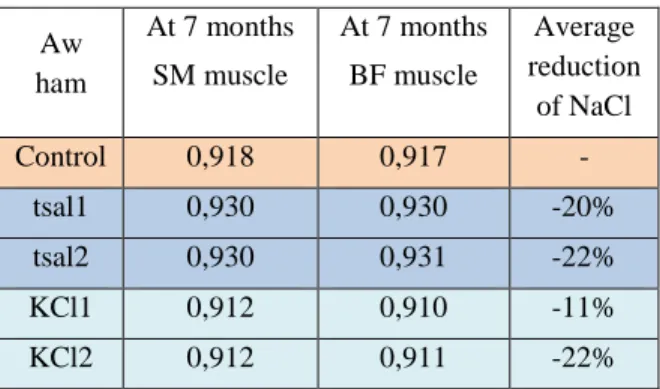
manufacturing, tsal1 and tsal2 hams showed higher aw levels than the indicator (table 1) and superior (0.93 surface and core) to the growth limit of Listeria monocytogenes, which is 0.92. On the other hand, partial substitution of NaCl by KCl allowed to reach slightly lower aw (0,91 at the core of the product). This statement is also valid for the highest substitution which allowed reaching NaCl reduction of 18 %.
Table 1. Aw of hams after 7 months of manufacturing Aw ham At 7 months SM muscle At 7 months BF muscle Average reduction of NaCl Control 0,918 0,917 - tsal1 0,930 0,930 -20% tsal2 0,930 0,931 -22% KCl1 0,912 0,910 -11% KCl2 0,912 0,911 -22%
The prediction model of the proteolysis evolution allowed determining the additional rest time needed to get to an aw reduction able to limit the risks of excessive proteolysis in the deep areas of dry hams reduced in salting content. Therefore the control of a simulator able to predict the evolution of the proteolysis depending on the amount of mixed salt and temperature, ventilation and hygrometrical conditions sustained by the production will allow adjusting the manufacturing process (length and temperature of the different stages) in particular the resting period, to limit the proteolysis and thus texture defects on dry hams. Nevertheless, after seven months of manufacturing, the aw of the products, which were 22 % salt content reduced without substitution, is higher than the indicator’s aw (0,93 vs 0,91) and do not constitute the growth limits condition of Listeria monocyteogenes. On the other hand, the reduction of the NaCl content reached by the partial substitution with KCl allows reaching, at 7 months, aw equivalent and even lower than the indicator. Besides the effects on the proteolysis intensity and so the texture, it is relevant to keep in mind the sanitary incidence of salt reduction on the dry hams in particular in sliced products.
61st International Congress of Meat Science and Technology, 23-28th August 2015, Clermont-Ferrand, France
IV. CONCLUSION
Those results validate an approach allying simulation and experimentation calculations which allow bringing solutions to professionals wishing to decrease the salt content in their dry hams with minimum risks and experimentation. The using of the prediction model of the proteolysis allowed to define the additional rest time needed to reach an aw low enough before storing and therefore avoid the proteolysis risk in the ham’s core. This approach could also been used in order to master the homogeneity of the salting and optimize the hams’ salting speed.
ACKNOWLEDGEMENTS
This study was partially funded by Agence Nationale de la Recherche (ANR) as part of the ANR-09-ALIA-013-01 “Na-” project. It was carried out as part of UMT 11-02 APROCEL (ACTIA).
REFERENCES
1. Harkouss, R., Chevarin, C., Daudin, J. D., Mirade, P., S. (2014). Development of a “Numerical Ham” mode l that couples water and salt transfers to proteolysis during the dry-cured ham process. In Proceedings 13th International Conference on
Modeling and Applied Simulation, MAS 2014, (pp. 1-6). 10-12 September, Bordeaux, France.
2. Harkouss, R., Safa, H., Gatellier, P., Lebert, A., Mirade, P.S. (2014). Building phenomenological models that relate proteolysis in pork muscles to temperature, water and salt content. Food Chemistry, 151: 7-14.