Digitized
by
the
Internet
Archive
in2011
with
funding
from
Boston
Library
Consortium
Member
Libraries
working
paper
department
of
economics
DELAY IN REPORTING
ACQUIRED IMMUNE DEFICIENCY SYNDROME (AIDS)
Jeffrey E. Harris No. 452 May 1987
massachusetts
institute
of
technology
...memorial
drive
Cambridge, mass.
02139
DELAY IN REPORTING
ACQUIRED IMMUNE DEFICIENCY SYNDROME (AIDS)
Jeffrey E. Harris
May 1987
Delay in Reporting
Acquired Immune Deficiency Syndrome (AIDS)
by
Jeffrey E. Harris*
ABSTRACT
As of March 31, 1987, the U.S. Centers for Disease Control had reported 33,350 cases of acquired immune deficiency syndrome. Yet by that date, physicians
had actually diagnosed 42,670 cases. The difference arises from significant delays in the reporting of AIDS cases to public health authorities. An
estimated 70% of cases are reported two or more months after diagnosis; about
23% are reported seven or more months later; and about 5% take more than three years to come in. Moreover, the probability distribution of delays has been shifting to the right, with the median delay increasing by 0.6 months since mid-1986. From the data on reported cases and the estimated probability distribution of reporting delays, I reconstruct the actual incidence of AIDS from January 1982 through March 1987. The doubling time of the epidemic fell
from about 6 months in 1982 to 15-16 months in 1986.
KEYWORDS: empirical distribution; truncated data; EM algorithm;
non-parametric models; semi-parametric models; epidemic; incidence.
*Massachusetts Institute of Technology and Massachusetts General Hospital. Address reprint requests to the author at Massachusetts Institute of
Technology, Department of Economics, E52-252g, Cambridge, Massachusetts
02139. I gratefully acknowledge the assistance of the AIDS Program at the
Centers for Disease Control, especially Dr. V. Meade Morgan and Kathy Winter. The contents this paper are my sole responsibility.
-2-1. INTRODUCTION
As of March 31, 1987, the U.S. Centers for Disease Control (CDC) had reported 33,550 cases of acquired immune deficiency syndrome (AIDS). Yet by that date, I estimate, physicians had actually diagnosed 42,670 cases.
The difference arises from significant delays in the reporting of AIDS cases to public health authorities. Some 9,120 additional persons had already been stricken with the disease, but they were not yet part of the CDC's
official tally.
In this paper, I derive the empirical distribution of AIDS reporting delays and test its stationarity. From my results on reporting delays and the
data on reported cases, I then estimate the actual incidence of the disease. While CDC reported about 4,500 new AIDS cases during the first calendar quarter of 1987, I find the incidence to be about 5,600.
Reporting delays are not the only reason why CDC's listings may fall short of the actual counts. Some cases of AIDS may never be reported. Doctors may be loath to inform public health authorities about certain patients. Also, the CDC's case definition of AIDS has not included all
serious consequences of infection by the human immunodeficiency virus. These forms of underreporting, which can be viewed as reporting delays of infinite length, have been studied elsewhere (Chamberland et al. 1985; CDC 1986ab) and will not be my main focus here.
While researchers have attempted to adjust for reporting delays (Curran
et al. 1985; Morgan and Curran 1986), the present paper appears to be the
first formal analysis of the problem. Some of this paper's findings have been noted in an earlier report (Harris 1987).
2. THE PROBLEM
Once an individual is stricken with AIDS, the fact of his or her diagnosis is not instantly known to the CDC. Two more events need to take place. First, the attending physician or hospital reports the case to the
local or state health department. Second, the health department transmits the
information to the CDC.
The first step relies upon a surveillance system that is essentially passive. Although health departments in a few states actively review hospital and clinic records, most merely wait for the reports to come in. The second step entails periodic mailings by the health departments to the CDC. Starting
in April 1986, the health departments switched from typewritten case reports
to floppy diskettes, which were computer-encoded at the departments. By August 1986, most departments were mailing the diskettes.
• For each reported case, the CDC lists both the date of diagnosis and the
date of report. Up to March 1983, the date of report meant the time the
health department received the information. Thereafter, the reporting date meant the time when the CDC received the data, that is, when both steps had been completed.
Among the 33,350 cases reported through March 1987, 336 were diagnosed during 1981. Of these, only 201 were actually reported during that year. Another 74 were reported in 1982, and 15 were not reported until 1986 or
later.
For the 336 cases diagnosed in 1981, the records do not show the specific month of diagnosis. I shall therefore analyze the remaining 33,214 cases
-4-reported from January lr 1982 through March 31, 1987
—
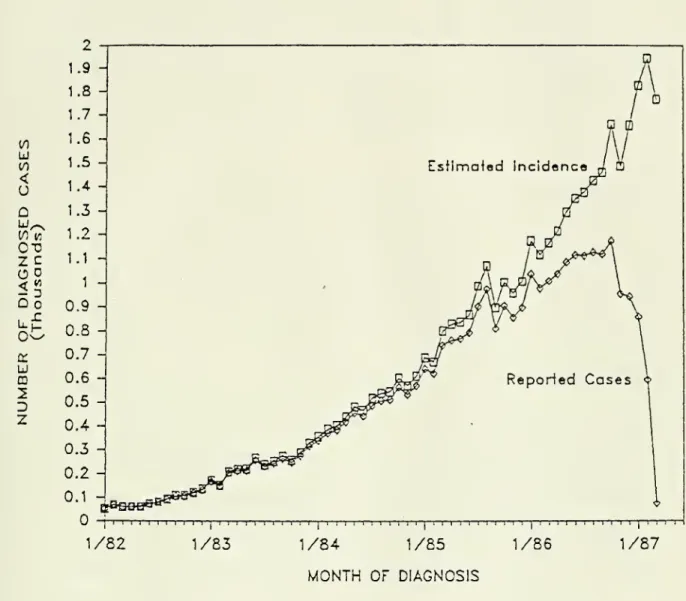
for which the records do provide both the month and year of diagnosis.Figure 1 shows the frequency distribution of these cases according to
their date of diagnosis. The number of diagnosed cases falls off sharply
after October 1986. But this does not mean that the incidence of the AIDS has
been falling. Many cases diagnosed in late 1986 or early 1987 may not have been reported by March 1987.
In order to estimate the actual incidence of AIDS, we need to recover the
unreported cases, and that requires estimating the distribution of reporting
delays. In particular, we need to know the distribution of delays among all
diagnosed cases, not just among the ones reported so far. This is because the
delays observed for the reported cases constitute a truncated sample from the actual distribution. The question then becomes: What minimum assumptions are
required to estimate the distribution of reporting delays?
3. STATISTICAL METHODS
3.1. Notation. Divide the time axis into intervals of equal length, called "periods," indexed by the positive integers. A new case of AIDS
diagnosed during period t may not be reported until period t+u, where the non-negative integer u denotes the duration of the reporting delay. For short hand, I use the phrase "at t" to mean "during period t," while "by t" means
"at any time up to the end of period t."
Let T be a known, nonrandom positive integer. Among all cases diagnosed
by T, we observe only those reported by T. That is, for any case in which t+u
(0
u
V)<
o
Q
•-S°5
0. °*o
U.-C LU CDD
Z
1/82 1/831/84
1/85 1/86MONTH
OF DIAGNOSISFIGURE 1. Distribution of 33,214 AIDS Cases Reported to the CDC through March 31, 1987 According to Month of Diagnosis. (Not shown in the
•5-cases for which t £ T but t+u > T. From such truncated data, we wish to
estimate the actual number of cases diagnosed at each t £ T.
Let yt (u) signify the number of cases diagnosed at t and reported at
t-t
t+u. Define yt =
X
yt (u) as the number of cases diagnosed at t and reportedU
-T-U
by T. Let y(u) = 21 yt (u) be the number reported with delay u, and define
t= o
_ T
y = 21 yt as the total number of reported cases. Let Y denote the set of all
yt (u) , and y the set of all yt .
Let
m
(u) denote the probability that a case of AIDS, diagnosed at t,t-t
will be reported with delay u. Define 6t = 21
m
(u) to be the probability thatU =
a case of AIDS, which has been diagnosed at t, will be reported by T. The symbol n will denote all
m
(u) and, by implication, all St.3.2. Basic Model. Denote by xt the number of cases diagnosed at t,
whether or not they are reported by T. The counts xt are unobserved.
Assumption I (Non-Parametric Model of AIDS Incidence): For all t, the
counts xt of diagnosed cases are independently Poisson distributed, with
respective means At . Each At is termed the "incidence at t." Let A represent
the set of all At
.
If a case of AIDS is diagnosed at t and reported by T, then it will be
reported at t+u with probability nt(u)/6t . Therefore, given the marginal
sums yt and the parameters
m
(u) and 9t , the joint distribution of the counts
-6-yt!
^r
yt(u)(Y|y,n) = i
f ] j tm(u)/et]
t=1 yt(0)! ••• yt(T-t)! u=0
Moreover, given xt and 6t for each t, the counts yt are independently
binomially distributed as b(yt|xt,8t). By Assumption I, each xt is Poisson distributed with mean At. Hence, given At and 8t , each yt is Poisson
distributed with mean 6t At . Given parameters
m
(u) and At, the jointdistribution of the marginal sums yt is
yt
h(y|n,A) = j |
[GtAt] exp[-8t At]/yt
t=i
The likelihood of the parameters rr and A is thus the product of expressions
g(Y|yfn) and h(y|n,A). Up to an additive constant, the log-likelihood
function is
T
T-t
T
L(tt,A) = 51 51 yt (u)ioo-(nt (u)/8t) + :£ [yt logiBiAt ) - 8tAt] (1) .
t=1 u= ' t=l
Now consider the concentrated log-likelihood L* (rr) . That is, for arbitrarily fixed tt, we choose A = A*(rr) to maximize L(n,A) and then define
L*(n) = L(tt, A* (n) ) . From (1), it is apparent that At*(n) = yt /8t . Up to an
additive constant, the concentrated log-likelihood is therefore
L*(TT) = 21
T
±
Vt (u)ioer(TTt (u)/8t)
-7-Assumptiop II (Stationarity of Reporting Delay Distribution): The
probability distribution of reporting delays is independent of the date of
diagnosis. That is,
m
(u) = tt(u) for all t,u.M
It will prove convenient to define S(v) = IE rr(u) , the right-hand tail
U=V
of the reporting delay distribution. If we permit n to be a defective
distribution, then the tail s(v) equals the probability of finite reporting
delays of v or more periods plus the probability that a case may never be
reported. The concentrated log-likelihood function is now
T-l T
L*(n) =
X
y(u)iogr tt(u) -H
ytlogBt
(2),u= o t=1
which is homogeneous of degree zero in the arguments n(0) , tt(T-I). That is, from Assumptions I and II alone, we can identify the probabilities
n(0),
—
,n(T-l) only up to a proportionality constant. To solve this problem,we could impose a parametric form of the entire distribution n(u) . Instead, I shall assume that we have prior information on S(T), the proportion of
diagnosed cases that will go unreported for T or more periods.
Constrained maximization of L* (n) in (2) can be achieved by the following
iterative procedure, analogous to the EM algorithm (Dempster, Laird and Rubin 1977). Consider estimates n(K) (u) obtained at the Nth stage in the iteration
t- t
and define 6t<N
> = 11 n(K>(u) for each t. Given 6t (
N
)
, the maximum likelihood
u =
estimate of Xt is Xt <K> = yt/Gt<N >. To obtain n (K+1) (u) at the N+ls t stage,
-8-p(u) = y(u)/ Je Xt<"> (3),
for each u, and then normalize the values of p(u) in (3) to sum to l-S(T)
n<N+i>{u
) = [i-s(T)]p(u) /
r
£: p(p) (4)
V=
An appropriate starting value is tt(1> (u) = (l-S(T) )y(u)/y.
3.3. Variants of the Basic Model. Consider the following alternative to
Assumption I.
Assumption IA (Parametric Model of AIDS Incidence): For all t, the
counts xt are independently Poisson distributed with respective means
/(t,E)/g, where a is a scale parameter and & is a vector of other parameters. Conditional upon 8t , a and (5, the counts yt are now independently Poisson
distributed with means 8t/(t,|S)/a. Under Assumptions IA and II, the log-likelihood function becomes
L(n,a,p) =
T
il y(u)Jog [n(u)/a] +
£
yxlofffit,}) -Z*
[n(u)/a]z"
/(t,p) (5)u=0 t=l u=0 t=l
L(n,a,P) is homogeneous of degree zero in the arguments a,n(0) , . . .n(T-l) .
Hence, we still need an identifying restriction on either the scale a of the
epidemic or the proportion £(T) of cases reported with delays of T or more. When we have prior information on £(T), we can maximize L(n,a,p) by an
interative procedure analogous to (3) and (4). Consider estimates n<N>(u)
obtained at the Nth stage of the iteration. Given rr(K) (u), we estimate a(K>
and p<K> by maximization
-9-T-u
obtain the N+lsl values of n(u) by computing p(u) = y(u)a< N>/:E /(t,p<K >)
t=
for each u, and then (given S(T)) applying the normalization (4).
Let T' be a known positive integer for which T' < T, and consider the
following alternative to Assumption II.
Assumption IIA (Non-Stationarity of Reporting Delay Distribution) : All cases of AIDS diagnosed by T' have an identical probability distribution n(u) of reporting delays. Those cases diagnosed after T' also have an identical,
but possibly different distribution n'
(u) of reporting delays.
Under Assumptions I and IIA, we obtain a concentrated log-likelihood
function that is a generalization of (2). In that case, L(tt,tt') is
homogeneous of degree zero in the arguments n(0) , . . . ,n(T-l) and separately in
the arguments TT
1
(0) , .. .,TT' (T-T'-l) . Hence, we need two restrictions to
identify the parameters: one on S(T), the right-hand tail of it; and
another-on S'(T-T'), the right-hand tail of rr'.
Alternatively, under Assumptions IA and IIA, we obtain a log-likelihood function that is a generalization of (5). In that case, L(n,n',a,P) is
homogeneous of degree zero in the combined arguments n(0) ,
—
,n(T-l) ,n' (0) ,... ,n' (T-T'-l)., and a. Only a single restriction (such as on a, S(T) or
S'(T-T') ) is sufficient to identify the parameters.
Assumption IIA is only the simplest case of non-stationarity. In
principle, we could partition the time axis into more than two intervals, with boundaries T', T", etc., and specify a different reporting delay distribution
(rr, tt', TT", etc.) for each interval. If we continue to maintain Assumption I,
-10-corresponding tail probabilities S(T), S'(T-T'), S"(T-T"), etc. In
particular, in the computations reported below, I shall assume that £(T) = 0;
and further that the tails of successive distributions are "matching," that
is, S'(T-T') = S(T-T'), S"(T-T") = 8' (T-T"), etc. In practice, this means
that we first compute the estimates ft(0) , . . . ,ft(T-l) under the restriction
that S(T) = 0. Ve then compute ft' (0) , . . . ,fr* (T-T 1
) under the restriction
S'(T-T') = ft(T-T') + ••• + ft(T-l); then estimate ft"(0) , .. . ,ft" (T-T")
under the restriction S"(T-T") = ft' (T-T") + ••• + ft' (T-T'+l) + S'(T-T');
and so forth.
Under Assumptions IA and
HA,
however, we still require only a single identifying restriction. In particular, in the results below, I shall assume that min I S(T) ,S
' (T-T' ) ,S" (T-T") , . . . I = 0.
3.4. Remarks. In the basic model (Assumptions I and II), the
concentrated log-likelihood L* (n) in (2) has T unknown parameters.
Alternatively, under Assumptions IA and II, the full log-likelihood L(n,a,p)
in (5) entails at least T+2 unknown parameters, and under Assumptions IA and
HA,
the generalization L(n,n',a,P) entails at least 2T+T'+2 parameters. Ineach case, the maximum likelihood estimates of the parameters are consistent
and asymtotically efficient as the number of reported cases y grows large,
provided that the counts yt grow faster than T.
Under Assumption I, we have posited what amounts to a null model of the
AIDS epidemic. Hence, we can estimate the reporting delay parameters n (at
least up to a proportionality factor) from the concentrated log-likelihood
L*(tt) in (2). Under Assumption IA, by contrast, the parametric model of AIDS
-11-case, the log-likelihood L(u,a,f>) in (5) cannot always be concentrated in a
simple way, and the delay distribution n and the incidence model /(t,P)/a thus have to be estimated jointly.
Even when we have a specific model for AIDS incidence, the function L* (n) can still be interpreted as a partial likelihood in the sense of Cox (1975).
Suppose that each count xt has unspecified probability distribution k(xt|t,<t>),
which depends on the set <t> of parameters and which is not necessarily Poisson.
The log-likelihood function can be written
L(TT,<t>) = L*(tt) + i: log [i: b(yt |x,6t) -kUlt,*)] ,
t=1 X =
where b(yt|x,6t) is the binomial distribution. Even if we were informed about
the AIDS epidemic model k(xt|t,0), the dimensionality of could be so large that we might want to treat <D essentially as a set of
nuismce
parameters andestimate tt from L*(n) alone.
4. RESULTS
4.1. Non-Parametric Model of AIDS Incidence. Figure 2 compares the
distribution of reported cases with the estimated incidence of AIDS. The curve denoted Reported Cases, reproduced from Figure 1, corresponds to the
counts yt . The curve denoted Estimated Incidence corresponds to the estimates
of Xt under Assumption I, where we posit no parametric model of the epidemic.
As Figure 2 shows, a significant fraction of AIDS cases had not been reported by March 31, 1987, even among those diagnosed in early 1986. For example, 1,037 AIDS cases were reported as diagnosed in January 1986. Yet
V)
u
10 < uQ
CO M 0-0 Z Co
o<3
, .cu
m
2
D
2
1/82
1/831/84
1/85MONTH
OF DIAGNOSIS 1/861/87
FIGURE 2. Estimated Incidence of AIDS Compared to Number of Diagnosed
Cases Reported through March 31, 1987. (The curve of "Reported Cases"
is duplicated from Figure 1. The "Estimated Incidence" curve was
-12-Figure 2 gives an estimated incidence of 1,175 in that month, with the
approximate lower and upper 95% confidence bounds (not given in the Figure) of
1,120 and 1,242. Similarly, 855 AIDS cases were reported as diagnosed in
January 1987, yet the estimated incidence is 1,829 with 95% confidence bounds
of 1,730 and 1,959. (I computed the confidence bounds by the bootstrap method
of Efron (1979) , where repeated draws were made from the empirical
distribution of the counts yt(u).)
In the computations of Figure 2, I allowed for non-stationarity in the
reporting delay distribution n (that is, Assumption IIA) . In doing so, I
partitioned the observation period (January 1982-March 1987) into four
intervals: (1) January 1982-March 1983, when the encoded date of report was
actually the date of receipt by the health department; (2) April 1983-March
1986, when the date of report was changed to the date received by CDC; (3)
April-August 1986, when the health departments switched to computer-encoded
diskettes; and (4) September 1986-March 1987, when the current reporting
system was in place. Numbering successive months from January 1982 to March
1987 as t = 1, ,63, we thus have T' = 15, T" = 51 and T"' = 56. There
are four potentially different reporting delay distributions, n, n' , tt" and
n"\
identified by restrictions on S (63) , S'(48), S"(12) and £'"(7).The "matching tails" restrictions, in particular, mean that S(63) = 0, £'(48) =
SUB),
£"(12) = £'(12) and £'"(7) = £"(7).Significant non-stationarity in the reporting delay distribution was found. The estimated proportions of cases reported within the same month
were: fr(0) = 0.287; fr' (0) = 0.059; fr"(0) = 0.088; and fi'"(0) =
-13-subsequent month (that is, n(0)+n(l) ) were respectively: 0.491, 0.350, 0.367,
and 0.305. Allowing for n # n' (but retaining the restrictions n' = n" =
n'") added 48 parameters but increased the log-likelihood by 422.0 (P <
0.0001 by the chi-squared test). Allowing for n # n' and n1
/ n" (but
retaining n" = n'") added 12 more parameters but increased the
log-likelihood by 14.8 (P < 0.005). The completely unconstrained model added 7 more parameters with a further log-likelihood increase of 68.6 (P < 0.0001).
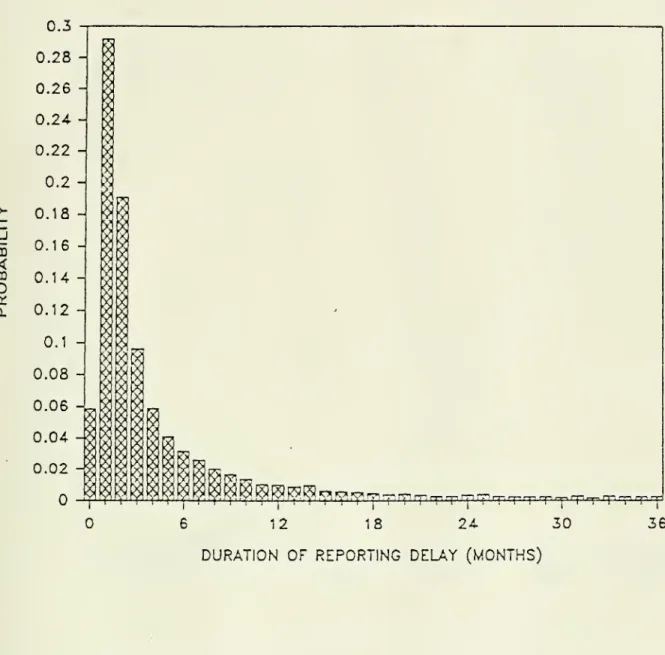
Figure 3 shows the estimated distribution ft' for cases diagnosed during
April 1982-March 1986 (interval 2). The distribution fits neither a Poisson nor a negative binomial. Up to about 18 months, ft' approximately follows a
Pareto rule (that is, the probability of reporting delays in excess of u
months is approximately proportional to u-0 - 85 ).
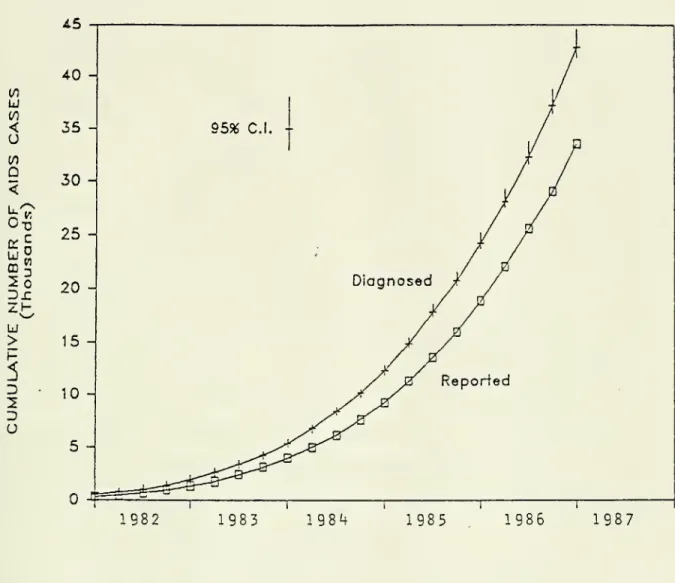
Figure 4 shows the cumulative number of diagnosed and reported AIDS cases by calendar quarter, based upon the results given in Figure 2. A total of
33,350 cases had been reported by March 31, 1987 (including those reported in
1981). Yet by that date, an estimated 42,670 had been diagnosed (95%
confidence bounds 41,736 and 44,399). While the CDC had reported 4,523 new cases during the first quarter of 1987, I estimate that 5,542 were actually diagnosed (95% confidence bounds 5,180 and 6,044).
4.2. Parametric Models of the Epidemic. The estimated incidence curve
in Figure 2 is not exponential. The doubling time of the epidemic, which appears to have been about 6 months in 1982, fell to about 9-10 months in 1984
and 15-16 months in 1986. While a subexponential epidemic may be plausible,
the validity of the doubling-time estimates hinges on the "matching tails" restrictions on S(T), S'(T-T'), s"(T-T") and S"'(T-T"'). Since
0.3
>-H
_J CD<
m
o
tx. 0. Mr^rf^^r^rprp,^p,rprprr,T
:rrrrrpiT
irr,nprrqnn! -6 12 18 24 30DURATION OF REPORTING DELAY (MONTHS)
36
FIGURE 3. Estimated Probability Distribution of Reporting Delays for
AIDS Cases Diagnosed During April 1983-March 1986. (The estimated
CO
u
CO <o
COQ
PIU
m
Dl
ZH->
D
U
1982 19831984
1985
1986
1987
FIGURE 4. Estimated Cumulative Incidence of AIDS Compared to Cumulative
Reported Cases, First Quarter of 1982 through First Quarter of 1987.
(Approximate 95 percent confidence intervals are given for the
-14-these restrictions remain untested, the confidence intervals in Figure 4 understate the degree of uncertainty in the estimated size of the epidemic.
For instance, the "matching tail" assumption meant that £'(48) = 0.032,
S"(12) = 0.146, and S'"{7) = 0.233. The last restriction means that
among cases diagnosed during September 1986-March 1987, 76.7 percent would be the reported within 6 months of diagnosis. But if we arbitrarily changed
S'"(7) to 0.5, then the estimated incidence in the first quarter of 1987
would jump from 5,600 to 8,500 cases, while the total number of diagnosed
cases would stand at 49,000.
As a means of validating the results of Figures 2, 3 and 4, I tested a
flexible parametric model of the epidemic (Assumption IA) . Specifically, I assumed that the counts xt were independently Poisson distributed with respective means equal to exp [$o + pit + ($2t2 + f.3
1
3
] . Such a functional form was used not for any theoretical appeal, but simply as a means of
smoothly approximating the path of the epidemic thus far. The resulting
estimates of n, tt
1
, tt" and rr"' (and the corresponding tails) were
virtually identical to those in Section 4.1. The fitted incidence model was exp [3.723 + 0.118t - 1.44xl0-3t2 + 8
.28xl0"6t3]
.
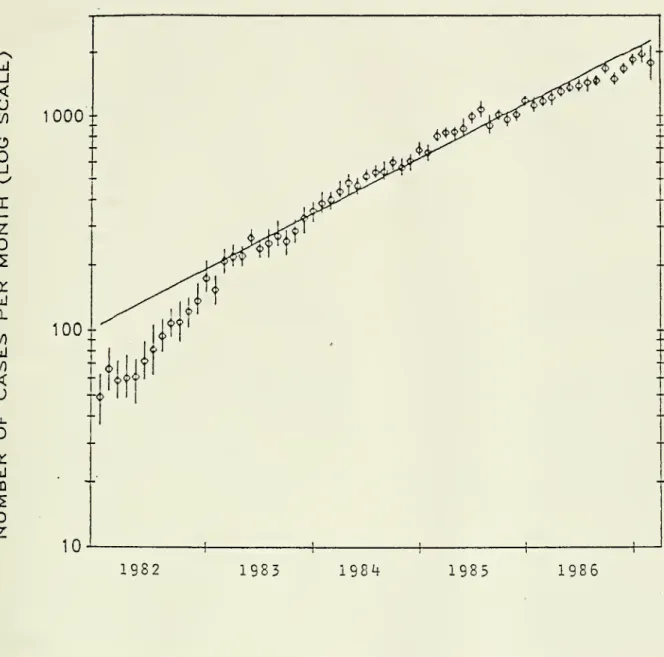
Figure 5 compares the non-parametric model of AIDS incidence to a
strictly exponential model. In contrast to earlier figures, the ordinate has
a logarithmic scale. The individual data points reflect the non-parametric
estimates, along with their approximate 95% confidence intervals. The fitted exponential model has an estimated slope of 0.0492, which means a doubling
u
_J<
U
\no
O
_jI
Z
q: Q. 00u
<
u
Llo
tru
m
D
Z
1000
100-1982 19831984
19851986
FIGURE 5. Estimated Incidence Under a Non-Parametric Model and an
Exponential Model of the AIDS Epidemic. (The incidence data are plotted
on a logarithmic scale. Approximate 95 percent confidence intervals are given for the non-parametric estimates.)
-15-Under the exponential model, the estimated tails of the reporting delay
distributions were: S(63) = 0.331; S* (48) = 0; S" (12) = 0.215; and
£"'(7) = 0.328. An exponential model would thus require 33.1 percent
underreporting of AIDS cases during January 1982-March 1983 (interval 1) .
After August 1986 (interval 4) , the proportion of reporting delays in excess
of 6 months would be 32.8 percent. For the four intervals, the estimated proportion of cases reported in the same or the subsequent month (that is,
tt(0)+TT(1) ) were respectively: 0.330, 0.362, 0.337, and 0.267.
In all models analyzed, the duration of reporting delays was found to be
increasing over the course of the epidemic, especially after August 1986 (interval 4). If we convert ft, ft', ft" and ft"' into continuous
distibutions by linear interpolation, then in the non-parametric case, the
estimated median reporting delays (in months) would be, respectively: 1.10
(95% confidence interval 0.92 to 1.49); 1.79 (95% conf. int. 1.72 to 1.91);
1.73 (95% conf. int. 1.64 to 1.84); and 2.33 (95%% conf. int. 2.20 to 2.53).
5. CONCLUSIONS
By March 31, 1987, the CDC had reported 79 percent of all AIDS cases
diagnosed by that date. This divergence between reported and incident cases grew larger as the epidemic progressed (Figure 4) . If we projected the smoothed incidence model exp [p~o + Pit + ^>zt2 + (ht3
] out of sample, and if we
assumed that the reporting delay distribution ft'" remained unchanged,
then by December 31, 1990, only 285,000 (74 percent) of a cumulative total of
383,000 cases would be reported. While projections based upon purely
-16-1986), there are compelling epidemiological reasons to expect the incidence of
AIDS to continue to rise for at least the next five years (Brookmeyer and Gail
1986; May and Anderson 1987; Rees 1987; Harris 1987). Accordingly, the
difference between reported and diagnosed cases is likely to grow larger. I tentatively conclude that the distribution n has been shifting to the right. Since September 1986, about 70 percent of cases remain unreported two or months after diagnosis. This increase in the duration of reporting delays
has occurred in spite of (or perhaps as a result of) the partial automation of
the case surveillance system. I found the same trend toward increasing
reporting delays in separate analyses of AIDS cases in homosexual and bisexual men and in intravenous drug users. The same conclusion applied to separate analyses of AIDS cases first presenting with Pneumocystis carinii pneumonia,
with Kaposi's sarcoma, and with other conditions. In fact, the changing mix
of AIDS cases appears to go against the trend in reporting delays. Cases with Kaposi's sarcoma took significantly longer to report, with 78 percent now going unreported two or more months after diagnosis. Yet they comprise a
declining fraction of newly diagnosed cases (from 28 percent of cases
diagnosed in the first quarter of 1982 to 14 percent in the first quarter of
1987).
The CDC encoded the dates of diagnosis and case report by calendar month. Accordingly, I modeled the reporting delay phenomenon in discrete time. It is
unlikely, however, that a continuous-time model would have yielded markedly
different conclusions. In particular, in a continuous-time exponential
epidemic with a stationary reporting delay distribution, the discrete
-17-with stationary reporting delays, n(0) would fall. Yet we observed n(0)
increasing.
There are two untested explanations for the trend toward longer delays. First, doctors and hospitals are taking longer to report cases to the health departments. Second, the health departments are taking longer to send the
reports to the CDC. While the latter explanation cannot be excluded from the
data at hand, the former deserves our serious attention.
Perhaps increasing case loads have overburdened treating physicians. In the early years of the epidemic, doctors may have had more incentive to report
a novel disease. Initially, infectious disease specialists made the diagnosis
of AIDS. Now, a different type of physician may be the first contact with an
AIDS patient. Successive changes in the official definition of AIDS may have created increasing confusion about which patients were to be reported.
In the non-parametric model, I found the doubling time of the epidemic to
have increased from about 6 months in 1982 to 15-16 months in 1986. As Figure
5 suggests, most of the deceleration occurred in 1982. If there was substantial underreporting during that period, the epidemic may not have
decelerated as much as it appears. Still, the conclusion that the epidemic is
decelerating to some degree appears reasonably robust.
REFERENCES
BROOKMEYER, R. and GAIL, M.H. (1986), "Minimum Size of the Acquired
Immunodeficiency Syndrome (AIDS) Epidemic in the United States," Lancet,
-18-CENTERS FOR DISEASE CONTROL (1986a), "Revision of the Case Definition of
Acquired Immunodeficiency Syndrome for National Reporting-- United States," Morbidity and Mortality Weekly Report , 34, 721-726, 731-732.
CENTERS FOR DISEASE CONTROL (1986b) , "CDC Classification System for HIV
Infections," Morbidity and Mortality Weekly Report, 35, 334-339. CHAMBERLAND, M.E., ALLEN, J.R., and MONROE, J.M. (1985), "Acquired
Immunodeficiency Syndrome, New York City: Evaluation of an Active
Surveillance System," Journal of the American Medical Association, 254, 383-387.
COX, D.R. (1975), "Partial Likelihood," Biometrika, 62, 269-276.
CURRAN, J.W., MORGAN, V.M., HARDY, A.M., JAFFE, H.W., DARROW, V.W., and
DOVDLE, V.R. (1985), "The Epidemiology of AIDS: Current Status and Future Prospects," Science, 229, 1352-1357.
DEMSTER, A.M., LAIRD, N.M. , and RUBIN, D.B. (1977), "Maximum Likelihood from Incomplete Data via the EM Algorithm," Journal of the Royal Statistical Society, Series B, 39, 1-22.
EFRON, B. (1979), "Bootstrap Methods: Another Look at the Jackknife," Annals
of Statistics, 7, 1-26.
HARRIS, J.E. (1987), "The AIDS Epidemic: Looking into the 1990s," Technology
Review, in press.
MAY, R.M. and ANDERSON, R.M. (1987), "Transmission Dynamics of HIV Infection," Nature, 326, 137-142.
MORGAN, V.M. and CURRAN, J.V. (1986), "Acquired Immunodeficiency Syndrome: Current and Future Trends," Public Health Reports, 101, 459-465.
REES, M. (1987), "The Sombre View of AIDS," Nature, 326, 343-345.
Date
Due
MIT LIBRARIES
3