HAL Id: hal-01898736
https://hal.archives-ouvertes.fr/hal-01898736
Submitted on 18 Oct 2018
HAL is a multi-disciplinary open access
archive for the deposit and dissemination of
sci-entific research documents, whether they are
pub-lished or not. The documents may come from
teaching and research institutions in France or
abroad, or from public or private research centers.
L’archive ouverte pluridisciplinaire HAL, est
destinée au dépôt et à la diffusion de documents
scientifiques de niveau recherche, publiés ou non,
émanant des établissements d’enseignement et de
recherche français ou étrangers, des laboratoires
publics ou privés.
VIRAPOPS: a Forward Simulator Dedicated to Rapidly
Evolved Viral Populations
Michel Petitjean, Anne Vanet
To cite this version:
Michel Petitjean, Anne Vanet. VIRAPOPS: a Forward Simulator Dedicated to Rapidly Evolved Viral
Populations. Bioinformatics, Oxford University Press (OUP), 2014. �hal-01898736�
1
Applications note
VIRAPOPS: a Forward Simulator Dedicated to Rapidly Evolved
Vi-ral Populations
Michel Petitjean
1,2and Anne Vanet
1,3,4,* 1Univ Paris Diderot, Sorbonne Paris Cité, F-75013, Paris, France 2
MTI, INSERM UMR-S 973, F-75013Paris, France 3
CNRS, UMR7592, Institut Jacques Monod, F-75013, Paris, France 4
Atelier de Bio Informatique, F-75005, Paris, France
ABSTRACT
Summary : Daily, mutability and recombination of RNA viruses re-sult in the production of million variants. All these rapid genomic changes directly influence the functional sites of the protein, its 3D structure or its drug resistances. It is therefore important to simulate these drastic switches to determine their effects on virus popula-tions. Many computer programs are able to simulate specific varia-tions in DNA genomes, but are generally non adapted to RNA virus-es. Indeed, they simulate site-specific selection pressures, but rarely pressures on covariant or on higher order correlated sites and no at all on synthetic lethal groups. That is why we felt it important to cre-ate VIRAPOPS, a forward simulator that models specific RNA virus functions. It was designed for computational biologists, biologists and virologists.
Availability and implementation : Free binaries are available
through a software repository at
http://petitjeanmichel.free.fr/itoweb.petitjean.freeware.html.
Contact : [email protected]
1
INTRODUCTION
RNA viruses have very different characteristics from other popula-tions. Their high mutability rate, 100 times higher than those of bacteria or eukaryotes, allows the production of daily million mu-tations. These multiple mutants, under selective pressure, permit the emergence of new viral variants. Several population simulators, called "forward" are able to impose a selective pressure on muta-tions: CDPOP (Landguth and Cushman, 2010) Nemo2.2 (Guillaume and Rougemont, 2006) SimuPop (Peng and Kimmel, 2005) SFS_Code (Hernandez, 2008), Vortex (Lacy R.C., 2009). These software solutions associate a fitness to an allele and can combine several allele fitnesses. Unfortunately this is done by adding or multiplying individual fitness that does not fit all situa-tions. Indeed, the covariation of two sites can define compensatory mutations (CM: the first mutation decreases the fitness of the or-ganism and the second compensates the fitness lack of the first), or synthetic lethal (SL: mutations that are non lethal when they are alone but become when they are combined into a single genome). If pair of CMs are treated by existing simulator (Mostowy, et al., 2011), SLs are not. Indeed, in the SL case both mutations taken
*To whom correspondence should be addressed.
separately does not change the fitness of the virus, it is only when they appear together that the fitness is changed. Then we cannot add neither multiply fitness associated with each mutation or either used the calculation done for CM. However, the synthetic lethals are used for therapy developments (Brouillet, et al., 2010; Dahirel, et al., 2011) and viral vaccines. It therefore becomes crucial to be able to simulate them. In addition, the higher order correlated mu-tations (involving covariation of CM or SL type, but with a number greater than 2 sites) are not covered either by conventional simula-tors.
Software programs dedicated to viral studies are able to predict drug resistances as HIVdb program from Stanford university (Liu and Shafer, 2006), to store clinical data related to HIV and HCV treatment and subtyping tools as REGA (Pineda-Pena, et al., 2013) to calculate their pharmacokinetics and pharmacodynamics as Simcyp (Jamei, et al., 2009), or to make epidemic model as FluTE (Chao, et al., 2010), but do not allow large group of mutations simulation as described above.
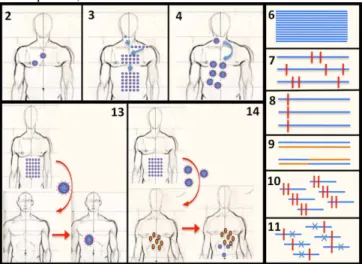
On one hand,Vortex, SimuPop, SFS_Code, CDPOP software de-dicated to population genetics does not take into account the essen-tial tools to treat high mutability of RNA viruses. On the other hand software more directly dedicated to virus handle databases related to drugs, geographic spread or drug resistances (SimCYP, REGA, HIVdb). But none of these two types of family simulator is able to handle viral populations at high rates mutability. Yet it is now essential to use such tools to meet the ever greater emergence of new mutations including those related to drug resistances. However, under selection pressure, new genomes appear very quickly and increase the difficulty of treatment developments and stable vaccine design. In addition, du to high genome plasticity, the protein 3D structure becomes plural, making very difficult docking work, and study of the active sites. Thus, it becomes necessary to simulate a RNA virus sequence population. We present in this manuscript an understandable useful and easy-to-use RNA virus population simulator, designed to model a real situation such as virus population in a naïve or infected patient (Figure 1).
2
OVERVIEW OF VIRAPOPS
2.1 Input
The input sequences must be in nucleotide Fasta format, or text format (one sequence per line). The output format will be the same than the selected input format.
© The Author (2013). Published by Oxford University Press. All rights reserved. For Permissions, please email: [email protected]
Associate Editor: Dr. Jeffrey Barrett
Bioinformatics Advance Access published December 12, 2013
by guest on December 13, 2013
http://bioinformatics.oxfordjournals.org/
2
2.1.1 Specific options related to RNA virus
Large genomic changes induced by high mutation rate require to strengthen this pole. VIRAPOPS implements selective pressures at one or multiple sites, can force mutation in a particular amino acid and can generate compensatory mutations or synthetic lethal pairs or groups. A complex multivariant network composed of CMs and SLs groups can also be generated.
2.1.2 Specific options related to the infection type
The data may concern a seronegative patient infected by a single virus or more. In the case of surinfection of an already RNA virus-positive patient, an option of gene flow may be used. To deal with a cascade of infection cycle, a genetic drift option has been created. By selected generations on which genetic drifts and/or gene flows occurred, multiple cycles of infection and surinfection can be simulated on the same run. Outputs per generation are detailed tools for studying each infection step described previously.
2.1.3 Other options
Extra options have been added to help biologists. Indeed, it is pos-sible to stop the simulator if an average percentage of mutations is reached. It is also possible to attain a maximum number of se-quences and impose this number for future generations. Thus the Hardy-Weinberg model can be followed if necessary. Hotspot option was created to deal with the fact that certain positions on certain genes are known to mutate more frequently than others (this is not due to selection pressure but because polymerase incor-porates a wrong nucleotide at this place more easily than else-where). Finally a redundancy option was created more specifically for computer biologists because for special purposes, they prefer to work on a unique sequence set (option available on DNA or pro-tein sequences).
Fig. 1. Some VIRAPOPS options. 2. Sequence input. 3. Number of generations. 4.
Number of budding virions per infection cycle. 6. Max number of sequences. 7. Pol-ymerase mutation rate. 8. Hotspots and their mutation rates. 9. Recombination rate. 10. Compensatory mutation groups and their mutation rate.11. Synthetic lethal groups and their mutation rate. 13. Genetic drift (Naive patient infection). 14. Gene flow (surinfection).
2.2 Ouput
Each generation produces a sequence set. The outputs are used to determine the impact of an infectious event occurring specifically in either generation. Its format shall be the same as the input. Re-garding the HIV sequence, a Fasta output format will allow to determine the drug resistance status of each output sequences using the Sierra site at Stanford University (Liu and Shafer, 2006).
2.3
Example of use
2.3.1 HIV multitherapy and resistant mutation apparition
Anti-HIV treatments are composed of several molecules against which resistance mutations can be selected. It could generate a conflict between a group of mutations needed to counteract drug A and another group of mutations needed to counteract the drug B. By simulating the appearance of mutations needed for both re-sistances, two scenarios can appear:
- The population will increase because of resistance mutation accumulation, showing no drug interaction issues. This result could reveal a potential future inactive treatment. The number of generations needed to get an inactive treatment may also be calculated using VIRAPOPS.
- The population remains undeveloped. Then, this therapy may be used because the resistance mutations against drugs A and B could not occur together.
To simulate this scenario, we propose to use a single sequence representing a virus that infects a seronegative patient. If it is an RNA virus, the mutation rate of the polymerase will be adjusted to 10-4. The following variables must be entered in option 10: varia-bility at each position, the covariavaria-bility per positions couple both inferred from sequence alignment of untreated patients. Option 12 was created to enter selection pressures due to treatments (e.g. Nelfinavir D30N, I84A / V, N88S / D and L90M). The simulator will be launched on 50 generations for example (option 3) with, if desired 60 budding virions per cycle (option 4). If the resistance mutations are viable i.e. compatible with the variance and covari-ance which were previously entered, the sequence number will increase over time. Otherwise, the number of sequences will be stable or reduced.
2.3.2 Treatment interruption and consequences
Some patients stop their treatment without informing their doctor (usually this latter noticing it when the patient's viral load increases again). These treatment stops can be simulated to evaluate what treatment would be most appropriate after such situation. This scenario will be coded in two stages. The first will be equivalent to that described in the previous paragraph. It will be the first part of the scenario in which the patient takes treatment. The batch of sequences generated will serve as input to simulate the cessation of treatment. In the second part, the same options are used with the exception of those corresponding to the treatment (Option 12). The new generated batch of sequences corresponds to the viral se-quences of patient who has interrupted his treatment. It is im-portant to note that the time of treatment interruption may be de-creased or inde-creased by changing the number of viral generations (option 3).
2.3.3 Using SL
Oncology and virology are two areas where drugs that bind SLs are developed. Prior to the production stage, it would be advisable to see the possible interaction between these SL groups and neces-sary positions for the proper functioning of drugs already devel-oped (especially in the case of HIV where multitherapies are gen-erally necessary). So the docked drug on SL groups could avoid a resistance to another existing drug that would greatly strengthening the effect of this multiple therapy. To compute this simulation, two scenarios should be compared. The first one, similar to that of section 2.3.1, simulates a patient with treatment. The second sce-nario retains the same options except those corresponding to the treatment selection pressure (this scenario is similar to the interrup-tion processing part 2.3.2). Both simulainterrup-tions generate sets of se-quences for which the synthetic lethal couples will be determined
by guest on December 13, 2013
http://bioinformatics.oxfordjournals.org/
3 (Brouillet, et al., 2010). SL couples belonging to the "treated
pa-tient" scenario and not to the "untreated patients" scenario should be used as a therapeutic target for the development of new treat-ments.
2.3.4 Change treatment
We would like to determine whether a patient treatment generates a resistance to a second treatment, which be administered to the same patient in addition to or instead of the first treatment. Indeed, it would be inappropriate to change therapy to a new less effective one. So after programming the simulator as explained above with the data for the current treatment, it is sufficient to determine whether the first treatment revealed mutations responsible for re-sistance to a future second treatment.
3
CONCLUSION
We developed VIRAPOPS the first software dedicated to RNA virus population simulation. It allows virus variability representa-tion, as variation site, covariation pair or higher order correlation in CM and SL. Moreover, it allows simulation of primary, secondary infections and cascade infections. It aims to be an easy-to-use tool and meet the most important needs of virologists and computation-al biologists.
ACKNOWLEDGEMENTS
We thank P. Le Chien for his encouragements since 1993. This work is dedicated to Lou, 5 years old, who died of AIDS in 1997.
REFERENCES
Brouillet, S., Valere, T., Ollivier, E., Marsan, L. and Vanet, A. (2010) Co-lethality studied as an asset against viral drug escape: the HIV protease case, Biol Direct, 5, 40. Chao, D.L., Halloran, M.E., Obenchain, V.J. and Longini, I.M., Jr. (2010) FluTE, a publicly available stochastic influenza epidemic simulation model, PLoS Comput Biol,
6, e1000656.
Dahirel, V., Shekhar, K., Pereyra, F., Miura, T., Artyomov, M., Talsania, S., Allen, T.M., Altfeld, M., Carrington, M., Irvine, D.J., Walker, B.D. and Chakraborty, A.K. (2011) Coordinate linkage of HIV evolution reveals regions of immunological vulnerability, Proc Natl Acad Sci U S A, 108, 11530-11535.
Guillaume, F. and Rougemont, J. (2006) Nemo: an evolutionary and population genetics programming framework, Bioinformatics, 22, 2556-2557.
Hernandez, R.D. (2008) A flexible forward simulator for populations subject to selection and demography, Bioinformatics, 24, 2786-2787.
Jamei, M., Marciniak, S., Feng, K., Barnett, A., Tucker, G. and Rostami-Hodjegan, A. (2009) The Simcyp population-based ADME simulator, Expert Opin Drug Metab
Toxicol, 5, 211-223.
Lacy R.C., B.M., Pollak J.P. (2009) Vortex: A stochastic simulation of the extinction process. In Society, C.Z. (ed). Brookfield, Illinois, USA.
Landguth, E.L. and Cushman, S.A. (2010) cdpop: A spatially explicit cost distance population genetics program, Mol Ecol Resour, 10, 156-161.
Liu, T.F. and Shafer, R.W. (2006) Web resources for HIV type 1 genotypic-resistance test interpretation, Clin Infect Dis, 42, 1608-1618.
Mostowy, R., Kouyos, R.D., Fouchet, D. and Bonhoeffer, S. (2011) The role of recombination for the coevolutionary dynamics of HIV and the immune response,
PLoS One, 6, e16052.
Peng, B. and Kimmel, M. (2005) simuPOP: a forward-time population genetics simulation environment, Bioinformatics, 21, 3686-3687.
Pineda-Pena, A.C., Faria, N.R., Imbrechts, S., Libin, P., Abecasis, A.B., Deforche, K., Gomez-Lopez, A., Camacho, R.J., de Oliveira, T. and Vandamme, A.M. (2013) Automated subtyping of HIV-1 genetic sequences for clinical and surveillance purposes: Performance evaluation of the new REGA version 3 and seven other tools,
Infect Genet Evol.
by guest on December 13, 2013
http://bioinformatics.oxfordjournals.org/