HAL Id: insu-01527674
https://hal-insu.archives-ouvertes.fr/insu-01527674
Submitted on 31 May 2017HAL is a multi-disciplinary open access archive for the deposit and dissemination of sci-entific research documents, whether they are pub-lished or not. The documents may come from teaching and research institutions in France or abroad, or from public or private research centers.
L’archive ouverte pluridisciplinaire HAL, est destinée au dépôt et à la diffusion de documents scientifiques de niveau recherche, publiés ou non, émanant des établissements d’enseignement et de recherche français ou étrangers, des laboratoires publics ou privés.
Status of the IPSL Venus global climate model
Sébastien Lebonnois, Itziar Garate-Lopez, Gabriella Gilli, Sabrina Guilbon,
Franck Lefèvre, Anni Määttänen, Thomas Navarro, Aurélien Stolzenbach
To cite this version:
Sébastien Lebonnois, Itziar Garate-Lopez, Gabriella Gilli, Sabrina Guilbon, Franck Lefèvre, et al.. Status of the IPSL Venus global climate model. Venus Modeling Workshop, May 2017, Cleveland, OH, United States. �insu-01527674�
STATUS OF THE IPSL VENUS GLOBAL CLIMATE MODEL. Sébastien Lebonnois1, Itziar Garate-Lopez1,
Gabriella Gilli2, Sabrina Guilbon3, Franck Lefèvre3, Anni Määttänen3, Thomas Navarro4 and Aurélien
Stolzen-bach3, 1 Laboratoire de Météorologie Dynamique (LMD/IPSL), Sorbonne Universités, UPMC Univ Paris 06,
CNRS/INSU, France, 2 Instituto de Astrofisica e Ciencias do Espaço (IA), Lisbon, Portugal, 3LATMOS/IPSL,
CNRS/INSU, UVSQ, Sorbonne Universités, UPMC Univ Paris 06, France, 4Department of Earth, Planet. and
Space Sci., UCLA, CA, USA.
Introduction: Based on our experience of Earth
and Mars Global Climate Models, a model for Venus's climate system has been developed within Institute Pierre-Simon Laplace (LMD, LATMOS) for twelve years. Thermal radiation scheme is based on Net-Exchange Rate (NER) matrices, with look-up ta-bles for solar heating rate forcing.
Latest developments: The IPSL Venus GCM is
described in details in [1]. Some recent improve-ments, as well as a description of the capabilities that have been under development for several years are presented in this Section.
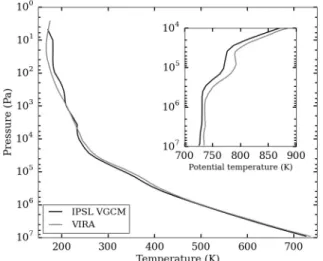
Radiative transfer. Our latest version of the radia-tive scheme includes a new cloud model [2,3], used both for solar heating rates and for the NER matrices. Both take into account the latitudinal variation of the cloud structure. In the computation of the new NER matrices, updated spectral dataset and collision-in-duced absorptions were used. To get as close as pos-sible to Venus thermal structure (Fig. 1), some tuning involves the properties of the haze below the clouds and its impact on solar heating rates and infrared opacities.
Photochemical model. Composition is now fully coupled [4]. The chemical module provides a com-prehensive description of the CO2, sulfur, chlorine,
oxygen and hydrogen chemistries with 31 chemical species and state-of-the-art kinetics data.
Fig. 1. Globally-averaged temperature and potential
temperature vertical profiles.
Cloud microphysics. To allow a correct descrip-tion of the sulfur and water cycle on Venus, photo-chemistry needs to be coupled with microphysical modeling of the cloud layer. A parameterized treat-ment of cloud microphysics was developed for the GCM [4]. This model computes the composition, number density, and sedimentation rates of sulfuric acid aerosols based on observed altitude-dependant size distributions.
In parallel, a full microphysical module based on the moment method is being developed for a compre-hensive description of the cloud layers [5]. The geo-metric standard deviation of the particle size distribu-tion is fixed. The composidistribu-tion of the binary H2O-H2
-SO4 solution, which composes the cloud droplets, is
computed at each time-step. Only mode 1 and mode 2, for small and medium sized particles, are repre-sented because of the uncertain nature of the ob-served mode 3. The model accounts for nucleation, condensation/evaporation and coagulation. Coupling with the IPSL Venus GCM is on-going.
Upper atmosphere. The vertical extension of the model from above the clouds up to the thermosphere (100-150 km) was completed recently [6]. In particu-lar, the role of non-LTE processes, EUV heating and thermal conduction was considered at those altitudes, and proper parameterization for GCMs implemented, following the scheme developed for the Mars GCM [7]. The model takes into account the full distribution of composition, with coupling to the photochemistry, together with the inclusion of molecular viscosity and molecular diffusion. In addition, a parameteriza-tion of non-orographic gravity waves, following the formalism developed for the Earth GCM [8], was also implemented in the IPSL Venus GCM. Those gravity waves, emitted above the convective cloud region, are believed to play a major role in Venus up-per atmosphere dynamics, and their impact is still un-der investigation.
Reference simulation: Using the new radiative
tuning, a reference simulation was run for 200 Venus days, with a horizontal resolution of 96x96 and 50 vertical levels, similar to [1], without the latitudinal variation of the cloud structure taken into account. Then 100 additional Venus days were computed with and without this variation, to study its impact.
8007.pdf Venus Modeling Workshop (2017)
Results with variation of the latitudinal cloud structure. Taking this feature into account has a re-markable impact on the temperature structure, on the wave activity in the lower cloud region and just be-low the cloud, and on the vertical profile of the zonal wind. Cold collar is now very nicely represented (Fig. 2), though a wave number one feature is visible at some times.
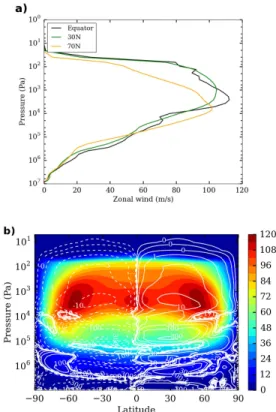
The zonal wind distribution is remarkably close to observations, though the high-latitude cloud jets are still too strong and located at higher latitude than ob-served (Fig. 3). The significant enhancement of the zonal wind in the lower cloud region, compared to the uniform cloud distribution simulation, is due to a mid-latitude wave activity that transport efficiently angular momentum equatorward in this area. This feature is currently under analysis.
This reference simulation is now running in sev-eral configurations, to explore all its capabilities: with the photochemistry (and simplified cloud mod-el), and with the extension to the upper atmosphere.
Fig. 2. (a) Zonally-averaged latitudinal temperature
pro-files; (b) temperature map at ~70mbar.
Perspectives: The current configuration still has
troubles with the angular momentum budget, as dis-cussed in [1]. In addition, the grid and the associated polar filter may affect processes occurring in the po-lar region.
An icosaedral dynamical core. A major improve-ment is foreseen in the very near future with the im-plementation of a new dynamical core, DYNAMICO, based on an icosaedral grid. In addition to a better description of the polar regions and a better behavior
in terms of angular momentum conservation, the per-formances of this new core will also allow to increase the resolution and explore in more details the wave activity taking place in Venus's polar regions.
A hierarchy of models. The physics of the IPSL Venus GCM is also now coupled with a new mesoscale/LES model developed at LMD. This mod-el allows to explore the fine structure of small-scale gravity waves and convective activity [9], and has a lot of potential in exploring atmospheric processes at very high resolution.
Towards data assimilation. The reference simula-tion presented here will be used to develop data as-similation techniques.
Fig. 3. (a) Zonally-averaged vertical profiles of zonal wind;
(b) zonally-averaged zonal wind distribution, with mean stream function (white contours, 109 kg/s).
References: [1] Lebonnois S., Sugimoto N. and
Gilli G. (2016) Icarus, 278, 38–51. [2] Haus R., Kap-pel D. and Arnold G. (2014) Icarus, 232, 232–248. [3] Haus R., Kappel D. and Arnold G. (2015) Planet. & Space Sci., 117, 262–294. [4] Stolzenbach A. (2016) PhD thesis, UPMC. [5] Burgalat et al. (2014) Icarus, 231, 310-322. [6] Gilli G. et al. (2017) Icarus, 281, 55–72. [7] Gonzalez-Galindo et al. (2013) JGR Planets, 118, 2105–2123. [8] Lott F., Guez L. and Maury P. (2012) GRL, 39, 6807. [9] Lefèvre M., Spi-ga A. and Lebonnois S. (2017) JGR Planets, 122, 134–149.
8007.pdf Venus Modeling Workshop (2017)