HAL Id: hal-03185884
https://hal.inrae.fr/hal-03185884
Preprint submitted on 30 Mar 2021HAL is a multi-disciplinary open access archive for the deposit and dissemination of sci-entific research documents, whether they are pub-lished or not. The documents may come from teaching and research institutions in France or abroad, or from public or private research centers.
L’archive ouverte pluridisciplinaire HAL, est destinée au dépôt et à la diffusion de documents scientifiques de niveau recherche, publiés ou non, émanant des établissements d’enseignement et de recherche français ou étrangers, des laboratoires publics ou privés.
Platforms of Palaeolithic knappers reveal complex
linguistic abilities
Cédric Gaucherel, Camille Noûs
To cite this version:
Cédric Gaucherel, Camille Noûs. Platforms of Palaeolithic knappers reveal complex linguistic abilities. 2021. �hal-03185884�
PEER COMMUNITY IN ARCHAEOLOGY
1
RESEARCH ARTICLE
Cite as: Gaucherel C, Noûs C (2020)
Platforms of Palaeolithic knappers reveal complex linguistic abilities. Paleorxiv, wn5za, ver. 6 peer-reviewed and recommended by PCI Archaeology. doi:
10.31233/osf.io/wn5za
Posted:Submitted: December 28, 2019 | Last edited: June 19, 2020
Recommender: Marta Arzarello
Reviewers: Antonin Borel and an
anonymous reviewer
Correspondence:
Platforms of Palaeolithic knappers
reveal complex linguistic abilities
Cédric Gaucherel *(1), Camille Noûs (2)
1 AMAP - INRAE, CIRAD, CNRS, IRD, Université Montpellier, Montpellier, France 2 Cogitamus Laboratory, France
This article has been peer-reviewed and recommended by
Peer Community in Archaeology
doi: 10.24072/pci.archaeo.100002
ABSTRACT
Recent studies in cognitive neurosciences have postulated a possible link between manual praxis such as tool-making and human languages. If confirmed, such a link opens significant avenues towards the study of the evolution of natural languages. Yet, archaeologists would need the development of a rigorous methodology to formalize language appearance. We propose a ‘formal grammar of action’ to help formalizing some early aspects of lithic chaînes opératoires, and simultaneously question the link with human cognitive abilities. The approach, based on the foundations of Chomsky’s minimalist program and the grammar of action theory, focuses on the development of components and syntax suggested by some aspects of knapping during early phases and simple (Oldowan and early Acheulean) technologies. In this theoretical study, we rigorously analyse terminals and non-terminals (vocabulary), production rules and syntax (grammar) of idealized stone technologies and then provide possible productions (tools and handaxes). More specifically, issues related to platform preparation and cognitive strategies required during knapping are discussed. Formal grammars proposed here for interpreting knapping contribute to a greater systematization in classifying chaînes opératoires and in exploring complexity in lithic reduction sequences. As a central result, these grammars are theoretically able to rigorously demonstrate syntax presence and central recursion, thus helping us to study early linguistic abilities.
1. Introduction
A considerable volume of research has focused on correlations between tool-making and the origins and development of language. Recent studies in the field of cognitive neurosciences have renewed interest in the analysis of manual praxis, such as tool-making, in the study of languages and the possible coevolution between both (Arbib 2011; Balzeau et al. 2014; Corballis 2010; Gowlett et al. 2014; Pelegrin 2009; Roche 2005; Steele et al. 2011; Stout and Chaminade 2012; Thaïs and Meyer 2013). This research on coevolution supports evidence in the way the brain regulates sequential and complex behaviours related to tool-making. In particular, some studies highlights key points of technological changes, and studies cases where material evidence or conceptual approaches were often sparse (Greenfield 1991; Moore 2010). Meanwhile, other studies develop relevant models to identify and quantify the complexity of stone technologies (Mahaney 2014; Muller et al. 2017). In this theoretical paper, we draw on this body of extensive research and propose a formal grammar of knapping as a rigorous method to study its possible syntactical organization.
Biologists have long discussed similarities between the hierarchically structured serial ordering of manual praxis and linguistic syntax (Greenfield 1998; Holloway 1969; Lashley 1951; Wynn 1991). Some have argued that tool-making behaviour is not syntactical in the linguistic sense, as much of its structure depends on external physical constraints rather than internal rules (Noble and Davidson 1996; Wynn 1995). However, studies of cognitive neuroscience have recently demonstrated substantial functional and anatomical overlaps in modern humans between these two behaviours (Stout and Chaminade 2012; Stout et al. 2011), although this hypothesis remains debatable (Putt et al. 2017). The foundations of this conceptual analogy rely mainly on deep structural similarities and on brain functioning similarities. Here, we do not elaborate on this debate, but assume that procedures in tool-making such as shaping a handaxe and language skills require similar cognitive abilities. In this theoretical study, we intend to propose, for the first time to our knowledge, a formal and rigorous model to study linguistic abilities from knapping, if any. For this purpose, we mainly focus on the literature and on our own experience of knapping in Mode 1, i.e. Oldowan (Harmand et al. 2015), and other simpler and more intuitive reduction sequences (Forestier 1993), i.e. early Acheulean (de la Torre 2011). Indeed, these two methods of the Lower Palaeolithic persist for a long time then (e.g. in the discoid debitage, Boëda 1993). The objective is not to provide new data or calibrate the new model on experiment or ground-truth knapping sequences (e.g. Stout et al. 2018), rather than to develop a rigorous method for detecting certain cognitive (syntactic) abilities on the basis of (idealized) tool-making sequences.
There is a striking correspondence between tool-making and language development, which has been used as a window to the study of origins of language (Dessalles 2007; Leroi-Gourhan 1993). The earliest studied Lower Palaeolithic (~2.6 Myr) with Oldowan technology, although relatively simple in comparison with later technologies, exhibits a clear understanding of conchoidal fractures and the basics of stone tool knapping (Moore 2010; Semaw et al. 1997). It draws on some procedures to establish ‘specific spatial relationships’ between sequential detachment of flakes, adapting to changing core topologies (Delagnes and Roche 2005; Hovers 2012). Recent discoveries indicate even earlier lithic assemblages preceding this phase and reflect mastery over the main gestures to remove isolated flakes (Harmand et al. 2015). The succeeding Acheulean (~1.8 Ma-200 ka) (Beyene et al. 2013; Lepre et al. 2011; Pappu et al. 2011), combines these action sets into
more complex procedures with a focus on shaping large flakes or other blanks into a range of artefacts. Such later artefacts highlight increasingly symmetrical, predominantly bifacial flaked tools such as handaxes and cleavers (Beyene et al. 2013; Goren-Inbar 2011; Gowlett et al. 2014; Moore 2010; Pappu et al. 2011; Pelegrin 1990; Sharon and Goren Inbar 1999; Texier 1996). This progression of abilities strongly suggests that formalizing the sequence of actions in knapping, to produce flakes or shape bifaces, would greatly help in understanding structural and temporal (i.e. sequential and syntactical) aspects of how primitive (i.e. atomic or unitarian) motor actions combine to produce complex tool types.
Only a few models have been developed for this purpose. Among them, grammars of actions have been proposed in the past, from abstract ‘design space’ (Greenfield 1991; Moore 2010; Muller et al. 2017), to more formal grammars inspired from linguistics (Chomsky 1995; Mahaney 2014; Pastra and Aloimonos 2012). The ‘Minimalist Grammar of Action (MGA) possibly provides the most powerful formalization framework for goal-directed actions. Such formal systems belong to the large body of discrete-event models (Gaucherel et al. 2012; Gaucherel and Pommereau 2019), models handling discrete components and events that seem better adapted than continuous equation-based models for such human activities. Such a formalism inheriting from the Chomskyan minimalist program, not confined to the idiosyncrasies of human language, would thus benefit from long experience and an expanded toolbox. The closest study to the present paper (Mahaney 2014) differs in three main aspects: first, it builds on an earlier Chomskyan program (Chomsky 1956); secondly, it focuses mainly on a highly complex (Acheulean) lithic technology on the basis of observed assemblages; thirdly and above all, it sets out to demonstrate the homology between the knapping process and natural language (on the basis of an informational Shannon measure), which this study does not. Here, we draw on the theoretical foundations of the MGA following Pastra and Aloimonos (2012) to define a rigorous grammar of action dedicated to understanding strategies of flaking patterns noted in the Lower Palaeolithic technologies. In a more conservative way, we use this grammar to identify the cognitive strategies responsible for the knapping actions. We intend to address two interlinked questions: i) examining actions and action ordering required for knapping flakes; and ii) exploring cognitive strategies in these tool reduction sequences. The central hypothesis is that high-order syntax and cognitive abilities possibly exist as early on as the Oldowan epoch (Harmand et al. 2015). Although reasonable, it seems that this hypothesis has never been “demonstrated”, i.e. tested with a formal model. Finally, we will discuss the heuristic abilities of such formalization of Palaeolithic reduction sequences in terms of semantic (and evolutionary) perspectives.
2. Materials - Lithic Reduction Sequences
Numerous studies testify to the relationship between knapping methods and tool form, in the sense that certain strategies, such as shaping bifaces, require a complex sequence of actions (Belfer-Cohen and Goren-Inbar 1994; Bradley and Sampson 1986; Goren-Goren-Inbar et al. 2011; Moore 2010; Newcomer 1971; Roche and Texier 1991; Sharon and Goren Inbar 1999; Texier 1996). The main objective of action grammars should be to help in interpreting this development of knapping complexity in terms of the properties used in grammar. The ultimate issue for the model would be to discriminate between various hierarchical organizations of
knapping still debated in the literature (Haidle 2009; Mahaney 2014; Muller et al. 2017). In this study, the proposed model is based on Moore’s hierarchy, in close agreement with our experience and that of others (J. Pelegrin, K. Akhilesh and M. Moore, pers. comm.), but using other sets of knapping actions. Starting with the less complex Mode 1/Oldowan technological strategies, and some primitive actions of the early Acheulean, we intend to rigorously formalize them using four MGA strategies (Pastra and Aloimonos 2012). Hence, to discuss how widespread the following technologies are among observed assemblages and to comment on their exact dates of appearance is out of the scope of this study.
One of the simplest lithic knapping involves detachment of a ‘basic flake unit’ (terminology after Moore 2010) accomplished by striking sharp stone flakes from a pebble/cobble/slab, a ‘core’, held in the non-dominant hand (hereafter considered to be the left one) through direct percussion with a ‘hammerstone’ supposedly held in the right hand (Fig. 1a). Even this simple knapping by freehand percussion relies on the organization of several motor actions and geometrical identifications (Faisal et al. 2010; Moore 2010; Pelegrin 1990). Indeed, some studies have shown that low-order know-how is necessary to accomplish higher-order tasks (Roux and David 2005), although the former have been much less studied than the latter (Greenfield 1991; Moore 2010). From our point of view, most of the actions studied in the literature appear to us already as a high-order set of action primitives that should be segmented for a rigorous analysis (Mahaney 2014; Muller et al. 2017). This explains why this study first modeled an action even simpler than a ‘basic flake unit’, without any geometrical identification. Such action could be considered similar to the random striking of a stone (therefore without knapping), or to a monkey nut-cracking. The action grammar of this simplest Stone Technology is here named ST1.
Figure 1. (a) Examples of Oldowan artefacts (courtesy Dr Kathy Kuman), (b) and Acheulean artefacts (courtesy Kumar Akhilesh, inset scale is 10 cm).
Striking a core with a hammerstone not only supposes actions involving direct percussion, but also requires knowledge of the geometry of the core (i.e. for producing a flake or for producing a tool). This includes rotation (around a horizontal axis) of the core, followed by turning (vertical axis) to determine the correct surface to strike, or the ‘platform’, and lastly by tilting to adjust for the angle at which the platform is to be struck at the point of impact. This action is almost instantaneous (and unconscious) for expert knappers, and the entire process should thus be considered as one complex striking action. Geometrical identification leading to the striking of a flake thus occurs. The specificities of the grammar of action for this sequence are named ST2. At this stage, we should differentiate the debitage, for which the aim is to produce
flakes, to the façonnage, producing a tool from the core and for which flakes are waste products only. Hence, these knapping methods show sharp conceptual differences by the aim or the intent of a single strike.
Contrary to flakes, handaxes are shaped by successive flake detachments (Bradley and Sampson 1986; Kumar and Pappu 2015) primarily designed to create a suitable working edge (Fig. 1b). Platform is a general term, sometimes termed bevelling, which indicates the presence on a blank of a surface that was intentionally struck for knapping activities, be it prepared or not; therefore, if a “stone” is identified as a core, it should have at least one striking platform. Although platforms on cores are noted even at Oldowan sites (de la Torre 2011; Hovers 2012; Toth 1985), early Acheulean assemblages do not always display evidence of the presence of faceting (Kumar and Pappu 2015). Here, we will focus on chaînes operatoires of handaxes shaping only, involving the intentional preparation of a striking platform through faceting, not to be confused with multifaceted butts in other knapping methods (de la Torre 2011). Detachment of these ‘anticipatory flakes’ on the faceted platform (Moore 2010), a priori requires the same set of actions as in the case of flake detachment strategies, possibly with a preliminary assessment of the geometry of the blank/handaxe preform and its positioning prior to flaking. The blank/preform may be flipped between platform preparations and removing the objective flake, which is included hereafter in the ‘move core’ action (Fig. 1b). This preform is already correctly positioned in most instances, prior to application of a combined action set to tilt and strike at finer scales in order to facet the platform. This sequence is formalized as ST3.
In addition to faceting a platform, the knapper may repeatedly abrade (i.e. grind) the surface to create a suitable platform; this sequence of actions differs from that involved in faceting (Stout et al. 2014). This step concerns artefacts from late Acheulean and possibly earlier. This sequence requires estimating platform angularity, a kind of platform strength proxy, instead of estimating the high-mass distribution of the core (Young and Bonnichsen 1984). In addition, platform abrasion involves rubbing and shearing the core, instead of striking it, although similar geometry identification also takes place in this process. Moore used the term, ‘elaborated flake unit’, to define the combination of platform abrasion and detachment of the ‘objective flake’ terminating the process (Moore 2010; Young and Bonnichsen 1984). This fourth stone technology requiring a platform of another kind (any action different to that of faceting, such as abrasion with hard or organic soft hammers) is named ST3′.
Other elaborated flake units occur in modern human assemblages from the Late Pleistocene onwards. However, with the four above-mentioned technological strategies, we already have sufficient action diversity to explore grammatical syntax of knapping, if any. In order to shape a complete handaxe, sequences ST2 to ST3 and ST3′, should then be combined in specific ways. As regards handaxes, ways in which flake units are combined into assemblies and higher-order units appear even more complicated (Mahaney 2014; Muller et al. 2017), and will not be analysed in this study.
3. Methods - Grammars of action
Here, we draw on the ‘Minimalist Grammar of Action’ (MGA) (Pastra and Aloimonos 2012) inspired by the latest formulation of the Chomskyan tradition of generative grammar (Chomsky 1995), and apply it to the study of lithic technological strategies. Generative grammars initially developed to analyse natural (human) languages, and are composed of a set of elements and a set of production (or rewriting) rules that predict acceptable combinations of elements (i.e. phrases). The latest version of generative grammars provides a mathematical framework that concentrates a grammar into a powerful computational mechanism imbued with the principle of economy/minimalism in both the production of phrases (derivation) and representation of syntactic structures (Chomsky 1995). Hence, we will use concepts of Recursion, Merge and Move of this grammar (Pastra and Aloimonos 2012), to build a dedicated grammar of action. These three operations are central and allow reiterating into, combining with and shifting some structures into others, respectively.
Pastra and Aloimonos (2012) observe that the generative grammar of such a language is a set of sentences made up of words and of intermediate structures. Hence, it requires: i) a set of terminals (T) consisting in lexical units (tip or primitive elements) in a parse tree combining them and representing the analysed structure; and ii) a finite set of non-terminals (NT) or phrase types combining the terminals and non-terminals. As such, NTs are syntactic categories recursively producing an infinite number of grammatical structures. This recursion is a central principle for repeating a process, i.e. a rule rewrites as a previous rule or as itself (Pastra and Aloimonos 2012), examples are given in the following section. A recursion may be terminal if made at the end of a sequence (a phrase), or central if it temporarily interrupts a sequence. The derivation of a syntactic structure, i.e. a phrase construction, starts as a bottom-up approach. A ‘Merge’ function checks the features of a terminal ‘T’ and for those features with un-attributed values (i.e. variables), it initiates a ‘Search’ for another unit whose feature-values can be unified with the variables (Chomsky 1995; Lasnik 2002). This merging is applied recursively until all features are ‘interpreted’ (have a value). The additional ‘Move’ operator is the merging of a syntactic element with itself, and is frequently used (Pastra and Aloimonos 2012). Additional details may be found the previously cited papers as well as in the figure captions.
In this context, the sensorimotor domain is associated with a set of terminals (action primitives, i.e. which may not be decomposed), non-terminals (‘phrases’ of actions, combining the previous ones) and production rules (merging) for its generative grammar. The MGA proposes a human action to be defined as: ‘a serial or parallel conjunction of perceptible movements carried out by one or more actors with a certain goal’ (Pastra and Aloimonos 2012). These authors show that simpler models, such as finite automata, would not be appropriate to formalize such complex actions. This leads to three specific rules dedicated to actions and later applied to knapping: the ‘tool complement’ of an action, the ‘affected-object’ complement, and the ‘goal’ of the whole action structure (Pastra and Aloimonos 2012). These syntactic features go beyond (mostly quantitative) movement execution features such as direction, velocity, etc. in that they distinguish one action type from another (see Pastra and Aloimonos 2012: 106, for more details). The tool complement (tc) is the effector of a movement, such as a body part, a combination of body parts or the extension of a body part with a graspable object used as a tool. The object complement (Oc) is any object affected by a tool use
action. The goal (g) is the final purpose of an action sequence of any length or complexity (Fogassi et al. 2005), yet predicted from the very first action primitives of the sequence. Here, note that the present model differs from Mahaney’s model in that it assumes that the knapper has a goal, irrespective the stone technology, an assumption incompatible with Mahaney’s blind Markov model (Mahaney 2014). A goal might be conscious or unconscious, as to shape a tool or to simply produce a flake, respectively. Finally, a modifier (m) may be added to this list to denote the location/scene an action takes place at.
The vocabulary of MGA is composed of action terminals (A), action non-terminals (A′) and action grammar rules based on entities (i.e. perceptible objects participating in any motor program) and on the three main previous syntactic features (see Pastra and Aloimonos 2012: 108, figure 1). The former defines primitive and combined actions (in a certain temporal sequence) that are perceptible movements carried out by an agent to achieve a goal, which have one or more body part tool-complements and no object complements. The latter define the action grammar production rules (Pastra and Aloimonos 2012): [4) A′′ g, A′; 3) A′ (m), A′; 2) A′ A′, Oc;1) A′ A, tc], with the previous notations and where A′′ is the maximal (last) action structure. These rules state that any set of actions has a compulsory goal specifier and a compulsory tool complement, whereas modifier and object complement are optional only (in parentheses). Concerning the motor program mentioned, the ongoing debated about the exact definition an action is out of the scope of this work (e.g. Biryukova and Bril 2008). Hereafter, we will thus assume for the sake of simplicity that any action is associated to a specific movement (i.e. into a bijective relationship).
So, any action tree, such as those shown in the following section, can now be rigorously derived bottom-up through recursive application of the grammar rules, from 1 (A) to 4 (A′′) (Pastra and Aloimonos 2012). E′′ is the maximal projection of an entity structure. Triangles in the tree denote that the corresponding part of the tree is not fully analysed for keeping the figure simple. Parentheses present the morphological features of the corresponding tree nodes, in an ‘attribute:value’ format; the plus sign denotes the presence of such features, while a minus denotes the absence of a feature. The exact type of relation between branches of the tree is clearly denoted for clarification purposes; ‘action-tool’ and ‘action-object’ are complements of an action and as such they are inherently related to the corresponding action structure. Sub-actions of a complex action are sequential or parallel in time, i.e. they are related through the corresponding ‘temporal conjunction’ type (tempConj:sequ, or tempConj:par). All other features are specific to each action tree (see fig. captions). The proposed grammar of knapping has been built manually, but Pastra and Aloimonos (2012) have developed a parser that could theoretically allow the automatic application of MGA to stone technologies.
4. Results - A grammar of knapping
Here, we present and explain the successive action trees and production rules corresponding to Lower Palaeolithic sequences (ST1 to ST3′). The sequences used in this theoretical work have been idealized on the basis of (my) knapping experience, and do not correspond to any specific artefact.
4.1 First Stone Technology. ST1
The action parse tree related to the first stone technology (ST1) shows action-tool binary branches (Fig. 2a). This part of an action tree for ‘grasp with handL core to be struck’ is produced bottom-up by successive merging and checking, in a very similar way to the first example ‘grasp [apple] with hand knife to slice’ of MGA (Pastra and Aloimonos 2012). The action sequentially develops rightward, meaning that actions come successively (not to be confused to the action geometry). A similar action tree for ‘grasping the hammerstone with handR to strike’ can be drawn (not shown). Then, a maximum action tree can be built for ‘striking a core with hammerstone’ by sequentially combining the two previous trees (i.e. to grasp core and to grasp hammerstone) and checking their compatibility (Fig. 2b). Action A′3a shares the same tool complement with A′1a (handR) and its object complement (hammerstone) is referred to as A′1a. Therefore, its expected position is semantically exactly after A′1a in position A′1b. However, owing to the disruption by other actions (with handL), this position is empty; the action is in position A′3a. Thus, a ‘trace’ of the action is left in position A′1b, which is linked with the action in position A′3a. The two structures A′1 and A′3 are not temporally combined, they are discontinuous; the actions A′2 that intervene here are part of the same action structure (Pastra and Aloimonos 2012). After linking the discontinuous sub-action constituents, structure A′2 is found to share an object complement with constituents of the action structure A′3 (i.e. the core). Importantly, we slightly modified the MGA pattern to handle fine scale binary branches only, except in implicit terminal actions (Fig. 2b).
Figure 2. Action trees related to ST1 stone technology. Part of an action tree for ‘grasping with handL core to be struck’ (a), maximum action tree for ‘strike core (handR) with hammerstone (handL)’ (b), and display of the corresponding struck core (insert). The second action tree (b) duplicates the first one (a), as to strike first supposes to grasp core and to
grasp hammer. In (a), we assume that: i) the core is fixed to examine it, ii) the hammer may be chosen earlier but used sequentially later, and iii) the core size is small enough so that it is held in the hand. In (b), the trace (linguistic terminology of Chomsky) states that the object to be held in the left hand is the same as that the one to be struck by
Thus, based on Figures 2a and 2b, the three independent action structures identified are combined into a common structure with a common final goal. At this stage, it is possible to list terminal and non-terminal actions as well as the production rules concerned by ST1. Starting from terminal entities such as left/right hand, core, hammerstone, action terminals, non-terminals, and maximal action structure can be listed alongside the corresponding production rules (Table 1). Rule number one uses a tool complement (to grasp tools), rule two an (affected) object complement (struck core), and rule three a goal (to strike a tool with the other one). Interestingly, there is no need here for any rule with a modifier, as the movement of the core (e.g. turning, tilting, etc.) is a property of the object itself and thus no other movement need be considered here. This final action tree corresponds to the simplest possible striking action between two objects grasped in two hands (ST1). It does not necessarily presuppose any complex knowledge of the geometry of the core to adjust for the correct angle of striking the same and therefore does not usually produce any real flakes. ST1 involves the same gestures as nut cracking but applied to stone; it is not a knapping strategy in that it does not yet presuppose intentional core reduction.
Stone Techn ology Main characteristic Associated vocabulary (T or primitive, NT or intermediate, MA or latest ones)
Grammatical rules Associated
cognitive strategy ST1 Simple strike
(Fig. 2)
T = {extend, enclose, reach, strike}, NT = {extend hand, enclose with hand, grasp with hand, strike with tool}, MA = {strike core with hammerstone}
3) A’’ → striking, A’ 2) A’ → A’, (core)
1) A’ → A, hammerstone Pairing (Fig. 6a) ST2 With geometrical identification (Fig. 3)
T = {grasp with hand, rotate, turn, tilt, strike}, NT = {move, position, correctly strike}, MA = {flake}
3) A’’ → flake, A’ 2) A’ → A’, (positioned core) 1) A’ → A, hammerstone Pot (Fig. 6b) ST3 Platform facet (Fig. 4) Same as ST2 + NT = {platform facet}, MA = {elaborated flake}
3) A’’ → flake, A’ 2) A’ → A’, (platform facet) 1) A’ → A, hammerstone Subassemb ly (Fig. 6c) ST3′ Platform abrasion (Fig. 5) Same as ST3 + T = {rub, shear}, NT = {platform abrasion}, MA = {objective flake, elaborated flake}
4) A’’ → elaborated flake, A’
3) A’ → (platform abrasion), A’
2) A’ → A’, (platform facet)
1) A’ → A,
hammerstone.
Interrupted (Fig. 6d)
Table 1. List of the main properties of the four stone technologies (STs) studied (first column). Their main knapping characteristic (2), grammar entities such as action terminals T, non-terminals NT and maximal action MA (3), grammatical rules with A, action terminal; A′, intermediate action structure; A′′, maximal action structure (4), and
4.2 ST2
In ST2, several movements involve spatial relationships of the two same objects being struck, and the proposed sequence draws closely on Moore’s model for the architecture of stone flaking (Moore 2010). As the core must first be rotated until the platform surface is correctly positioned for striking, a first tree action for ‘rotate with handL core’ is defined (Fig. 3a). In a similar way as for ST1, the successive sub-actions ‘grasp with handL core’ (A′1) and ‘rotate with handL core’ (A′2) must be combined into the maximal goal-directed action for this positioning. Here again, the action develops rightward. The presence of a common object complement (the core) in both sub-actions enables us to associate them with an additional intermediate action level (A′1a and A′2a) required into the same action structure. The turn and tilt actions have exactly the same action trees as that for the positioning action (not shown).
Figure 3. Action trees related to ST2 stone technology. Part of an action tree for ‘rotate with handL core’ (a), maximum action tree for a flake, i.e. ‘strike core with hammerstone after correct positioning’ (b), and illustration of the corresponding struck core (insert, the left hand handles the core while the right hand strikes it with a hammerstone
These actions can now be combined into a higher level action intending to ‘strike core with hammerstone after correct positioning’ (Fig. 3b). Our maximal action tree revisits the ‘basic flake unit’ described in detail by Moore, yet with slight changes in the process (Moore 2010). From our personal lithic knapping experience and additional discussions (J. Pelegrin, K. Akhilesh and M. Moore, pers. comm.), the identification of core geometry continues simultaneously with changing orientations. This leads to intermediate (not maximal) goals in the tree action, possibly with parallel temporal conjunctions (to be discussed). We also admit here that most modern knappers adjust core angles prior to striking the platform, not at the same time as the strike is delivered. This observation suggests considering the tilt action as a separate gesture in the sequential positioning of the core. The same logic and notation lead to the maximal tree action of a basic flake unit (Fig. 3b), and to the corresponding grammar vocabulary and production rules (Table 1). Here again, the three ST1 rules used do not need any modifier. This final action tree corresponds to an already complex flake including the concepts of geometrical identification and modifications (ST2). As noted above, the knapping strategies considered here have an angle of flaking lower than 90°.
4.3 ST3
The same tree action is used to describe the anticipatory flakes concerned in the faceting of the striking platform (Fig. 3b). A stage ST2, the final ST3 tree action is not yet available, as it requires combining the faceted platform, moving the core and finally striking the desired or objective flake (Moore 2010; Stout et al. 2014). These three successive sub-actions build the maximal tree for the objective flake (Fig. 4). The action terminals, action non-terminals and production rules of ST3 are the same as those of ST2, in addition to the platform facet related elements (Table 1). It is possible – and indeed this often occurs – to use some of the previous sub-actions separately, as well as to repeat this complex action several times with the same tool to shape the object (Moore 2010). Here probably comes the transition between making flakes (as in Olduwan technologies) and shaping a handaxe (as in Late Acheulean technologies). Yet, it is not necessary to accurately date this technology for providing a relevant faceting grammar. The action order and the exact action sequence has been shown as critical in longer and higher-order actions such as handaxe knapping (Mahaney 2014; Muller et al. 2017).
Figure 4. Maximum action trees related to ST3 stone technology (a) and its display (b, c). Maximum action tree for an ‘objective flake’ involving a platform facet (i.e. the action tree grows rightwards, a). The dashed connector highlights the
fact that several other strikes may combine to create a faceted platform). Illustration of the corresponding platform preparation (b, the left hand handles the experimental core while the right hand strikes it with a hammerstone pebble,
and c, the platform showing multiple facets on an experimentally knapped flake using a hard stone hammer, photo: K. Akhilesh).
4.4 ST3′
Then, it is rather straightforward to formalize the ST3′ action tree, as it consists in including a platform abrasion (rubbing) before the last strike. The platform abrasion is known to correspond to an action similar to the basic unit flake, except that the strike sub-action is exchanged (not shown) into a rub and/or shear action (Stout et al. 2014). This difference is profound, as it involves changing the tool and often taking a more abrasive one, as the right hand movement is not the same, and as it apparently has no precedent in the stone technology gestures (Moore 2010; Young and Bonnichsen 1984). The final ST3′ tree action then sequentially combines the previously mentioned sub-actions into what is usually called an ‘elaborated flake’ to shape the tool (Fig. 5). Action terminals, action non terminals and production rules of ST3′ are the same than ST3, in addition to the platform abrasion related elements (Table 1). The corresponding production rules are of the same types of rules than for previous stone technologies, except the optional abrasion action (rule n°3, Table 1). This additional rule is similar to the modifier rule n°3 of MGA, as it implies identifying the location (here, to prepare the platform) of the action before executing it. Hence, this rule develops leftwards (rule complement located on the left hand side, not to be confused with the action geometry), and the ST3′ action tree, unlike the others, possibly develops leftwards with non-successive actions. It precisely highlights a kind of interruption, to be discussed later.
Figure 5. Maximum action trees related to ST3′ stone technology (a) and displays (b, c). Maximum action tree for an ‘elaborated flake’ involving a platform abrasion (here a, the action tree may grow leftwards, in red). Illustrations of the corresponding platform preparations: images of a platform generated by abrasion (b) and, as a comparison, by faceting (c) using a hard stone hammer on an experimentally knapped quartzite flake). (Note that micro-abrasions may not be
With this ST1-ST3′ grammar, it becomes easy to describe an observed or collected knapping sequence, as well as to produce a virtually new one as in Upper Palaeolithic and late Acheulean (Mahaney 2014; Stout et al. 2014). Again, it was not our intention here to accurately date ST3′ technology, although it may be questioned how early it is. Indeed, it is not necessary to shape a whole handaxe to use the ST3′ technology, as intermediate actions for making simpler product such as a single edge. This explains why we should postpone this schedule to a later date. For example, a possible sequence of MGA actions using the complex ST3′ realization may be written as (to be read retrograde): [ST2b, flake → ST2b, flake → ST2a, tilt → ST3′, abrade platform → ST2b, flake → ST3, strike platform → ST2b, flake → ST2a, tilt → ST2a, turn → ST2b, flake → ST1b, strike → ST2a, tilt → ST2a, turn → ST2a, rotate → ST1a, hammerstone → ST1a, core].
5. Discussion
5.1 A rigorous grammar for knapping actions
Here, we propose several Grammars of Action for describing and formalizing stone technologies (STs) observed during the Lower Palaeolithic. This work is based on recent results derived from deconstructing knapping sequences (Faisal et al. 2010; Greenfield 1991; Moore 2010; Pelegrin 1990), from our own experience of knappers, and from Grammars of Actions recently developed (Chomsky 1995; Juhola 1995; Pastra and Aloimonos 2012). The lithic technologies analysed here, be they for debitage and subsequently for façonnage, exhibit dominant characteristics: ST1–striking of a core with a hammerstone; ST2 – detaching the basic unit comprising the intended flake; ST3 – faceting of the platform in order to shape a tool; and ST3′ – detachment of the flake following abrasion of the platform. These formalizations merely constitute a bare outline for one proposed Grammar of Action, keeping in mind the variability arising from raw materials, knapping skills and blank types selected. This study is in no way claiming to have developed the grammar of Lower Palaeolithic knapping. As a perspective, careful calibration and validation stages should be performed from empirical knapping and observed assemblages (Moore and Perston 2016; Tennie et al. 2017). However, the approach and these schemes can easily be modified depending on the assemblage being studied and the conceptual action hierarchy assumed (Mahaney 2014; Muller et al. 2017).
In terms of action terminals and non-terminals, i.e. primitive and intermediate actions respectively, the proposed grammars clearly demonstrate an increasing complexity. The transition between ST1 and ST2 was characterized by a change in sub-action types, although roughly with the same number of actions. Indeed, ST2 terminals were clearly based on ST1 non terminals: ST2 terminals were no more using concrete entities (hands, hammerstone), rather than primitive actions earlier formalized (grasp, enclose) in ST1. Further, this replacement of nth ST terminals by (n-1)th ST non terminals is confirmed. The transition to deliberate tool-making certainly occurs in the transition from ST1 to ST2, while tool-shaping certainly occurs from ST2 to ST3. In terms of production rules, most action grammars need similar rule types, namely tool complement, object complement, and goal oriented rules (STa = ST1 to ST3). The last technology (ST3′) shows a profound difference with others, although the only difference relies on an additional rule, for allowing different sub-actions on the tool (ST3′ rule n°3, Table 1). This observation has been made possible only due to the fine
analysis of Oldowan stone technologies and their associated primitive actions, a step circumvented by other models found in the literature (Mahaney 2014; Muller et al. 2017). This central observation comes only from the rigorous grammar developed here.
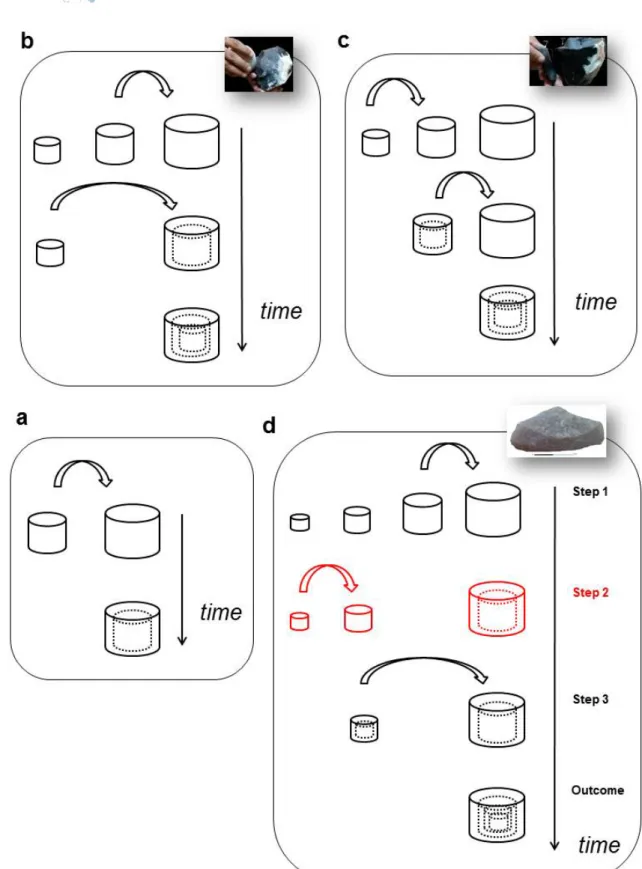
The cognitive strategies related to each stone technology are critical to inferring the cognitive abilities of the hominins who used them. To explain actions of human infants, primates and hominins, it has been proposed several strategies of increasing complexity: pairing (a single active object acts on a single static one to create a final structure), pot (multiple active objects act on a single static one), and subassembly (multiple active objects are combined to form a subassembly, which is in turn combined with a static object) strategies (Conway and Christianson 2001; Greenfield 1998; Moore 2010). In this regard, ST1 is a clear pairing strategy (a strike, Fig. 6a), while ST2 is pot strategy, as successive sub-actions are modifying the static core (e.g. some moves, Fig. 6b). ST3 is a subassembly strategy, as it requires the assemblage of several successive flakes, yet of the same nature than the last ‘correctly struck’ of the set (Fig. 6c and 5). These examples clearly demonstrate the need for syntax to interpret early knapping (Stout and Chaminade 2012; Stout et al. 2011; Wynn 1991).
5.2 Emergence of a more complex cognition
Interestingly, the action grammar proposition suggests that the procedures for platform abrasion do not require the same cognitive abilities as the previous and following (future) sub-actions. Indeed, it suggests an interruption in the procedures for the linear succession of flakes, in order to enable a different action to prepare the platform (Fig. 5, in red) prior to striking the next flake (Moore 2010; Stout et al. 2014). Conversely, platform faceting still requires similar procedures for striking flakes, thus not interrupting the nature of the action sequences. To abrade (grind or rub) a platform is a clear disruption of the edge shaping, sometimes requiring even to change the nature of the hammerstone/abrader being used. This interruption is clearly illustrated by the need of a left-located complement (Table 1, rule n°3, last line) in actions, and a potentially leftward developing action tree (Fig. 5, red action(s), or to be confused with the action geometry). For these serial actions, a specific and new strategy is required (Conway and Christianson 2001; Greenfield 1998), here termed ‘interrupted’ strategy (Fig. 6d, Table 1, last column). As soon as multiple active objects are combined, it is possible and necessary to differentiate the way they are combined. This interrupted strategy explicitly shows how successive pot or subassembly strategy chain-like of actions (Fig. 6b, c) may be disrupted by a radically new action (Fig. 6d, step 2 in red) to create the final structure. This is clearly what happens in any platform abrasion (Fig. 5, in red), and could never be produced with the previous actions/strategies.
Figure 6. Cognitive strategies associated with a more or less complex set of actions (with their previous illustrations in inserts). The pairing (a), pot (b), subassembly (c) and interrupted (d) strategies are displayed with downward time in two to four steps, while arrows indicate pairwise associations (modified from (Conway and Christianson 2001; Moore 2010)). The second step of the most complex strategy (in red) highlights the specific action of platform abrasion discussed in the
This ‘interrupted’ strategy fits well with what linguists have called a central recursion, i.e. a possibly iterative operation locating any sub-sentence into a larger sentence. It has long been debated whether such a grammatical rule is the exclusive prerogative of human languages or not (Hauser et al. 2015; Jackendoff and Pinker 2005; Noble and Davidson 1996). To address this question is far beyond the scope of this paper, but it is noticeable to find its presence in a relatively early (although not the very earliest) stone technology (ST3′). In this sense, the successive actions of knapping are no longer commutative (i.e. permutable), and platform preparations and choices appear critical in the final product. In our opinion, this would unequivocally demonstrate a change in cognitive abilities for knapping, and the presence of syntax. If confirmed with observed assemblages, the knapping grammar proposed here would provide a clear demonstration that early hominids were already using complex (and human-like) syntax in Lower palaeolithic (Hiscock 2004; Tennie et al. 2017). By the way, it would also contribute to the theme of co-evolution of language and manual praxis of tool-making, a complex question which remains here out-of-scope.
The stone technologies studied here do not yet result in production of more complex tools such as handaxes. These actions may be skillfully repeated to progressively shape a tool but, as such, are not sufficient to result in a complete handaxe. The reason is that without a deep understanding of the location of the topology and mass of the core faces and edges (Moore, 2010), and without substantial planning and intent, hominins would probably not have been able to detach appropriate flakes to create a usable and symmetrical tool. It therefore needs a further detailed study to formalize the process of handaxe shaping as those observed in Late Acheulean, hopefully on the basis of this early grammar of action. The present work therefore acts as a preliminary stage towards a kind of metalanguage to be applied to late lithic. Then only, contrary to some claims (Mahaney 2014; Muller et al. 2017), we will be able to model a much more complex set of actions leading to an object as complex as an Acheulean handaxe.
In addition to the previous insights, many additional implications can be drawn from this first formal attempt. For example, the present model highlights the critical role of goals in stone shaping, a feature unknown in hominid knapping. How do the goals themselves affect the way the action trees are constructed? As another track, we may wager that to explore alternative tree structures would help in discussing knapping 'styles' between present day expert knappers or even between novice and expert hominin knappers. Similarly, it is probable that our notions of early hominin stone-flaking in our experience and in the literature are real caricatures of knapping sequences (e.g. platform abrading), because knapping methods are drawn entirely from modern knapping rather than from direct observations (Hiscock 2004; Moore and Perston 2016; Tennie et al. 2017). We now have avenues to understand how to apply action trees to an actual assemblage, rather than a caricature of a time period? Finally, such a grammar also opens the way to model-checking, a traditional procedure in computer sciences to check that an observed (knapping) sequence (Gaucherel et al. 2012; Gaucherel and Pommereau 2019) belongs to the proposed grammar or not. Hence, this procedure would help in identifying modeler flaws or possibly, in our case, new stone technologies.
Although the increasing complexity of knapping is accepted by all, the stone technologies studied here (ST2 to ST3′) are not necessarily associated with cultural phases. For example, ST1, which is not yet a knapping strategy, probably emerged as, ~3.3 Ma in Africa, or older, and continued through time (Harmand
et al. 2015). During this period too, successive strikes similar to ST1 may have combined to build a rough edge on the same side of a core (Toth 1985), thus progressively shifting the technology from a pairing to a pot strategy. During this period, more complex flake detachment strategies (ST2, e.g. debitage) are also observed involving identification of core geometries (de la Torre 2011; Hovers 2012; Toth 1985). Acheulean technologies do display platform preparation of varied types for handaxes shaping processes (ST3, e.g. façonnage), be it faceting or abrading (de la Torre 2011; Goren-Inbar 2011; Sharon et al. 2011; Stout et al. 2014), but not in some regions where platform abrasion/faceting of platforms is documented at Early Acheulian sites such as Attirampakkam, India (Kumar and Pappu 2015). Since the knapper recognized that platform faceting (ST3) and platform abrasion (ST3′) were necessary to achieve objective and elaborated flakes, it is probable that hominins applied both subassembly and interrupted strategies from various phases of the Acheulean onwards (Hiscock 2004; Moore 2010). Although faceting and abrading in Acheulean (or earlier) assemblages have been discussed in archaeological studies, this work highlights the urgent need for discussions on the correct identification of an intentional preparation on the basis of formal and rigorous models. In early assemblages (Oldowan) mainly characterized by debitage (Boëda 1993), no intentional preparation of the striking platforms seems to be documented (Toth 1985).
This example illustrates how such formal grammars, once confirmed, would help classifying stone technologies and outline probable trajectories of the development of complexity in knapping. Simultaneously, they would help archaeologists to infer ‘intent’ from stone tools and more exact ways in which they were knapped and/or shaped. In conclusion, the formal grammar proposed for interpreting knapping, appears critical for intending one day demonstrating the presence of syntax in this behaviour, and would help in studying its properties. Here, our aim was not to identify linguistic properties in the knapping process, although some logically appeared, rather than providing a method for detecting any change in cognitive abilities for this task. As a central result, if built on observed assemblages, the proposed formalization would clearly confirm the working hypothesis that the platform preparation is interrupting a sequence of actions, thus requiring a more complex cognition than flake striking. Such an ‘interrupted’ strategy appears similar to the central recursion still debated in linguistics to form the prerogative of human languages. This link with linguistic characteristics is yet to be explored in depth, but we hope that this study opens an avenue to rigorously study subtle knapping variations across time, space and materials.
Data accessibility
No data used in this paper.Supplementary material
No supplementary material.Acknowledgements
We warmly thank Jean-Louis Dessalles, Jérémy Sauvage and Jean-Louis Giavitto for their advices on formal grammar on the one hand, and Jacques Pelegrin, Mark Moore and anonymous reviewers for their inputs regarding lithic technology on the other hand. We thank Shanti Pappu, Kumar Akhilesh and the Sharma Centre for Heritage Education for the deep discussions, many knapping lessons and logistic support which happened as early as 2011. Finally, we thank Kathleen Kuman, Shanti Pappu & Kumar Akhilesh for providing photographs and some diagrams on bifaces.
Version 6 of this preprint has been peer-reviewed and recommended by Peer Community In Archaeology (https://doi.org/10.24072/pci.archaeo.100002).
Conflict of interest disclosure
The authors of this preprint declare that they have no financial conflict of interest with the content of this article.
References
Arbib, M. A. 2011. From Mirror Neurons to Complex Imitation in the Evolution of Language and Tool Use. Annual Review of Anthropology 40:257-273.
Balzeau, A., E. Gilissen, R. L. Holloway, S. Prima, and D. Grimaud-Hervé. 2014. Variations in size, shape and asymmetries of the third frontal convolution in hominids: Paleoneurological implications for hominin evolution and the origin of language. Journal of Human Evolution 76:116-128.
Belfer-Cohen, A., and N. Goren-Inbar. 1994. Cognition and Communication in the Levantine Lower Palaeolithic. World Archaeology 26:144-157.
Beyene, Y., S. Katoh, G. WoldeGabriel, W. K. Hart, K. Uto, M. Sudo, M. Kondo et al. 2013. The characteristics and chronology of the earliest Acheulean at Konso, Ethiopia. Proceedings of the National Academy of Sciences 110:1584-1591.
Biryukova, E. V., and B. Bril. 2008. Organization of goal-directed action at a high level of motor skill: the case of stone knapping in India. Motor Control 12:181-209.
Boëda, E. 1993. Le débitage discoide et le débitage Levallois récurrent centripète. Bull. la Société Préhistorique Française 90:392-404.
Bradley, B. A., and C. G. Sampson. 1986. Analysis by Replication of Two Acheulean Artifact Assemblages, Pages 29-45 in G. N. Bailey, and P. Callow, eds. Stone Age Prehistory: Studies in Memory of Charles McBurney. Cambridge, UK, Cambridge University Press.
Chomsky, N. 1956. Three models for the description of language. Information Theory, IRE Transactions 2:113-124.
—. 1995, The minimalist program. Cambridge, MA: MIT Press.
Conway, C. M., and M. H. Christianson. 2001. Sequential Learning in Non-Human Primates. Trends in Cognitive Sciences 5:539-546.
Corballis, M. C. 2010. Mirror neurons and the evolution of language. Brain and Language 112:25-35.
de la Torre, I. 2011. The Early Stone Age lithic assemblages of Gadeb (Ethiopia) and the Developed Oldowan/early Acheulean in East Africa. Journal of Human Evolution 60:768-812.
Delagnes, A., and H. Roche. 2005. Late Pliocene hominid knapping skills: The case of Lokalalei 2C, West Turkana, Kenya. Journal of Human Evolution 48:435-472.
Dessalles, J. L. 2007, Why We Talk. The Evolutionary Origins of Language. Oxford, UK, Oxford University Press.
Faisal, A., D. Stout, J. Apel, and B. Bradley. 2010. The Manipulative Complexity of Lower Paleolithic Stone Toolmaking. PLoS ONE:journal.pone.0013718.
Fogassi, L., P. Ferrari, B. Gesierich, S. Rozzi, F. Chersi, and G. Rizzolatti. 2005. Parietal lobe: from action organization to intention understanding. Science 308:662-667.
Forestier, H. 1993. Le Clactonien: Mise en application d’une nouvelle méthode de débitage s’inscrivant dans la variabilité des systèmes de production lithique du Paléolithique ancien. Paleo 5:53-82.
Gaucherel, C., F. Boudon, T. Houet, M. Castets, and C. Godin. 2012. Understanding Patchy Landscape Dynamics: Towards a Landscape Language. PLoS ONE:10.1371/journal.pone.0046064.
Gaucherel, C., and F. Pommereau. 2019. Using discrete systems to exhaustively characterize the dynamics of an integrated ecosystem. Methods in Ecology and Evolution 00:1–13.
Goren-Inbar, N. 2011. Culture and cognition in the Acheulian industry: a case study from Gesher Benot Ya'aqov. Philosophical Transactions of the Royal Society B: Biological Sciences 366 1038-1049.
Goren-Inbar, N., L. Grosman, and G. Sharon. 2011. The technology and significance of the Acheulian giant cores of Gesher Benot Ya'aqov, Israel. Journal of Archaeological Science 38:1901-1917.
Gowlett, J. A. J., N. Goren-Inbar, G. Sharon, and L. Equinox. 2014. The Elements of Design Form in Acheulean Bifaces: Modes, Modalities, Rules, and Language. Lucy to Language: The Benchmark Papers:409. Greenfield, P. 1991. Language, Tools and Brain: The Ontogeny and Phylogeny of Hierarchically Organized
Sequential Behavior. Behavioral and Brain Sciences 14:531-595.
Greenfield, P. 1998. Language, Tools, and Brain Revisited. Behavioral and Brain Sciences 21:159-163.
Haidle, M. N. 2009. How to think a simple spear, Pages 57–73 in S. A. de Beaune, Coolidge, F.L.,, and T. E. Wynn, eds. Cognitive Archaeology and Human Evolution. Cambridge, Cambridge University Press. Harmand, Sonia, J. E. Lewis, C. S. Feibel, C. J. Lepre, S. Prat, A. Lenoble, X. Boës et al. 2015.
3.3-million-year-old stone tools from Lomekwi 3, West Turkana, Kenya. Nature 521:310-315.
Hauser, M. D., C. Yang, R. C. Berwick, I. Tattersal, M. Ryan, J. Watumull, N. Chomsky et al. 2015. The mystery of language evolution. Frontiers in Psychology 5:in press.
Hiscock, P. 2004. Slippery and Billy: Intention, Selection and Equifinality in Lithic Artefacts. Cambridge Archaeological Journal 14:71-77.
Holloway, R. L. 1969. Culture: A Human Domain. Current Anthropology 10:395-412.
Hovers, E. 2012. Invention, Reinvention and Innovation: The Makings of Oldowan Lithic Technology, Pages 51–68 in J. J. M. van der Meer, ed. Origins of Human Innovation and Creativity, Elsevier.
Jackendoff, R., and S. Pinker. 2005. The nature of the language faculty and its implications for evolution of language (Reply to Fitch, Hauser, and Chomsky). Cognition 97:211-225.
Juhola, M. 1995. A syntactic analysis method for eye movements of vestibule-ocular reflex. Comput. Methods Programs Biomed. 46:59-65.
Kumar, A., and S. Pappu. 2015. Bits and pieces: Lithic waste products as indicators of Acheulean behaviour at Attirampakkam, India. Journal of Archaeological Science-Reports 4:226-241.
Lashley, K. 1951. The problem of serial order in behaviour, Pages 112-137 in L. Jefress, ed. Cerebral mechanisms in behaviour. New York, NY, Wiley.
Lasnik, H. 2002. The minimalist program in syntax. Trends Cognitive Sciences 6:432-437.
Lepre, C., H. Roche, D. V. Kent, S. Harmand, R. L. Quinn, J. P. Brugal, J. P. Texier et al. 2011. An earlier origin for the Acheulian. Nature 477:82-85.
Leroi-Gourhan, A. 1993, Gesture and Speech. Cambridge, MA: MIT Press.
Mahaney, R. A. 2014. Exploring the Complexity and Structure of Acheulean Stoneknapping in Relation to Natural Language. PaleoAnthropology:586-606.
Moore, M. W. 2010. 'Grammars of action' and stone flaking desing space, Pages 13-43 in A. Nowell, and I. Davidson, eds. Stone tool and the Evolution of Human Cognition.
Moore, M. W., and Y. Perston. 2016. Experimental Insights into the Cognitive Significance of Early Stone Tools. PLOS ONE 11:e0158803.
Muller, A., C. Clarkson, and C. Shipton. 2017. Measuring behavioural and cognitive complexity in lithic technology throughout human evolution. Journal of Anthropological Archaeology 48 166-180.
Newcomer, M. H. 1971. Some Quantitative Experiments in Handaxe Manufacture. World Archaeology 3:85-104.
Noble, W., and I. Davidson. 1996, Human evolution, language and mind. Cambridge, UK, Cambridge University Press.
Pappu, S., Y. Gunnell, K. Akhilesh, R. Braucher, M. Taieb, F. Demory, and N. Thouveny. 2011. Early Pleistocene Presence of Acheulian Hominins in South India. Science 331:1596-1599.
Pastra, K., and Y. Aloimonos. 2012. The minimalist grammar of action. Philosophical Transactions of the Royal Society B 367:103-117.
Pelegrin, J. 1990. Prehistoric Lithic Technology-Some Aspects of Research. Archaeological Review from Cambridge 9:116-125.
Pelegrin, J. 2009. Cognition and the emergence of language: a contribution from lithic technology, Pages 95-108 Cognitive Archaeology and Human Evolution. Cambridge, Cambridge University Press.
Putt, S. S., S. Wijeakumar, R. G. Franciscus, and J. P. Spencer. 2017. The functional brain networks that underlie Early Stone Age tool manufacture. Nature Human Behaviour 1:0102.
Roche, H. 2005. From simple flaking to shaping: stone-knapping evolution among early Hominins, Pages 35-48 in V. Roux, and B. Bril, eds. Stone Knapping. The Necessary Conditions for a uniquely Hominin Behaviour. Cambridge, McDonald Institute Monographs.
Roche, H., and P.-J. Texier. 1991. La notion de complexité dans un ensemble lithique. Application aux séries acheuléennes d'Isenya (Kenya), Pages 99-108 25 ans d'Etudes technologiques en Préhistoire. Juan-les-Pins, XIèmes Rencontres Internationales d'Archéologie et d'Histoire d'Antibes, Ed. ADPCA.
Roux, V., and E. David. 2005. Planning Abilities as a Dynamic Perceptual-Motor Skill: An Actualist Study of Different Levels of Expertise Involved in Stone Knapping, Pages 91–108 in V. Roux, and B. Bril, eds. Stone Knapping: The Necessary Conditions for a Uniquely Hominin Behaviour. Cambridge, McDonald Institute for Archaeological Research.
Semaw, S., P. Renne, J. W. K. Harris, C. S. Feibel, R. L. Bernor, N. Fesseha, and K. Mowbray. 1997. 2.5-million-year-old stone tools from Gona, Ethiopia. Nature 385:333-336.
Sharon, G., N. Alperson-Afil, and N. Goren-Inbar. 2011. Cultural conservatism and variability in the Acheulian sequence of Gesher Benot Ya`aqov. Journal of Human Evolution 60:387-397.
Sharon, G., and N. Goren Inbar. 1999. Soft Percussor Use at the Gesher Benot Ya'aqov Acheulian Site? Journal of The Israel Prehistoric Society 28 55-79.
Steele, J., P. F. Ferrari, and L. e. Fogassi. 2011, From action to language: comparative perspectives on primate tool use, gesture and the evolution of human language. London, Royal Society.
Stout, D., J. Apel, J. Commander, and M. Roberts. 2014. Late Acheulean technology and cognition at Boxgrove (UK). Journal of Archaeological Science 41 576-590.
Stout, D., and T. Chaminade. 2012. Stone tools, language and the brain in human evolution. Philosophical Transactions of the Royal Society B 367:75-87.
Stout, D., T. Chaminade, A. Thomik, J. Apel, and A. A. Faisal. 2018. Grammars of action in human behavior and evolution. bioRxiv:281543.
Stout, D., R. Passingham, C. Frith, J. Apel, and T. Chaminade. 2011. Technology, expertise and social cognition in human evolution. European Journal of Neuroscience 33:1328-1338.
Tennie, C., L. S. Premo, D. R. Braun, and S. P. McPherron. 2017. Early Stone Tools and Cultural Transmission: Resetting the Null Hypothesis. Current Anthropology 58:000-000.
Texier, P.-J. 1996. Evolution and diversity in flaking techniques and methods in the Palaeolithic, Pages 281-321 Oltre la pietra - Modelli e tecnologie per capire la preistoria. Forlí, XIII UISPP Congress, A.B.A.C.O. Ed. .
Thaïs, U. N., and G. F. Meyer. 2013. Shared Brain Lateralization Patterns in Language and Acheulean Stone Tool Production: A Functional Transcranial Doppler Ultrasound Study. PLoS ONE 8(8): e72693.
Toth, N. 1985. The Oldowan Reassessed: A Close Look at Early Stone Artifacts. Journal of Archaeological Science 12:101-120.
Wynn, T. 1991. Tools, grammar and the archaeology of cognition. Cambridge Archaeological Journal 1:191-206.
—. 1995. Handaxe enigmas. World Archaeology 27:10-24.
Young, D. E., and R. Bonnichsen. 1984. Understanding Stone Tools: A Cognitive Approach. People of the Americas Process Series, Center for the Study of Early Man, University of Maine, Orono 1.