Data-Race Detection in
Transactions-Everywhere Parallel Programming
by
Kai Huang
B.S. Computer Science and Engineering, B.S. Mathematics Massachusetts Institute of Technology, June 2002
Submitted to the Department of Electrical Engineering and Computer Science in partial fulfillment of the requirements for the degree of
Master of Engineering
in Electrical Engineering and Computer Science
at the Massachusetts Institute of Technology June 2003
c
°2003 Massachusetts Institute of Technology. All rights reserved.
Signature of Author
Department of Electrical Engineering and Computer Science May 21, 2003
Certified by
Charles E. Leiserson Professor of Computer Science and Engineering Thesis Supervisor Accepted by
Arthur C. Smith Chairman, Department Committee on Graduate Theses
Data-Race Detection in
Transactions-Everywhere Parallel Programming
by
Kai Huang
Submitted to the Department of Electrical Engineering and Computer Science on May 21, 2003 in partial fulfillment
of the requirements for the degree of Master of Engineering in Electrical Engineering and Computer Science
ABSTRACT
This thesis studies how to perform dynamic data-race detection in programs using “transactions everywhere”, a new methodology for shared-memory parallel programming. Since the conventional definition of a data race does not make sense in the transactions-everywhere methodology, this thesis develops a new definition based on a weak assumption about the correctness of the target program’s parallel-control flow, which is made in the same spirit as the assumption underlying the conventional definition.
This thesis proves, via a reduction from the problem of 3cnf-formula satisfiability, that data-race detection in the transactions-everywhere methodology is an NP-complete problem. In view of this result, it presents an algorithm that approximately detects data races. The algorithm never reports false negatives. When a possible data race is detected, the algorithm outputs simple information that allows the programmer to efficiently resolve the root of the problem. The algorithm requires running time that is worst-case quadratic in the size of a graph representing all the scheduling constraints in the target program.
Thesis Supervisor: Charles E. Leiserson
Contents
1 Introduction 7
2 Constraints in Transaction Scheduling 15
2.1 Serialization Constraints . . . 15
2.2 Access Constraints . . . 17
2.3 Access Interactions and Access Assignments . . . 21
3 The Definition of a Data Race 25 3.1 Discussion and Definition . . . 25
3.2 Race Assignments . . . 27
4 NP-Completeness of Data-Race Detection 33 4.1 Proof Outline . . . 33
4.2 Reduction Function . . . 35
4.3 Forward Direction . . . 40
4.4 Backward Direction . . . 41
5 An Algorithm for Approximately Detecting Data Races 45 5.1 Part A : Serialization Structure and Shared-Memory Accesses . . . 45
5.2 Part B : LCA and Access Interactions . . . 53
5.3 Part C : Searching for a Possible Data Race . . . 57
5.4 Correctness and Analysis . . . 60
6 Conclusion 65
Related Work 67
Chapter 1
Introduction
This thesis considers the problem of data-race detection in parallel programs using “transactions everywhere”, a new methodology for shared-memory parallel programming suggested by Charles E. Leiserson [26]. Transactions everywhere reduces the amount of thinking required of the programmer concerning concurrent shared-memory accesses. This type of thinking is often unintuitive and error-prone, and represents a main obstacle to the widespread adoption of shared-memory parallel programming.
This introduction first describes Cilk, the parallel-programming language in which we conduct our study. Then, it presents transactions as an alternative system to conventional locks for creat-ing atomic sections and eliminatcreat-ing data races. Finally, it describes the transactions-everywhere methodology for parallel programming with transactions.
The Cilk Language. The results in this thesis apply to parallel programming using transactions everywhere, irrespective of the implementation language. For concreteness, however, we conduct our study in the context of Cilk [2, 3, 22, 13, 39], a shared-memory parallel-programming language developed by Charles E. Leiserson’s research group. Cilk is faithful extension of C, which means that if all Cilk keywords are elided from a Cilk program, then a semantically correct serial C program, called the serial elision, is obtained. The three most basic Cilk keywords are cilk, spawn, and sync. This thesis considers programs that contain only these three extensions.
We illustrate the usage of the three Cilk keywords by an example, which we shall reuse through-out this introduction. Consider the common scenario of concurrent linked-list update, such as might arise from insertions into a shared hash table that resolves collisions using linked lists. The fol-lowing is a Cilk function for inserting new data at the head of a shared singly linked list. The keyword cilk is placed before a function declaration or definition (in this case the definition of list_insert) to indicate a Cilk function. The shared variable head points to the head of the list, and each node of type Node has a data field and a next pointer.
cilk void list_insert( double new_data ) {
Node *pnode = malloc( sizeof(Node) ); pnode->data = process(new_data); pnode->next = head;
head = pnode; }
name. A Cilk function call spawns a new thread of computation to execute the new function instance, while the parent function instance continues to execute in parallel. The keyword sync is used as a standalone statement to synchronize all the threads spawned by a Cilk function. All Cilk function instances that have been previously spawned by the current function are guaranteed to have returned before execution continues on to the statement after the sync. The following segment of code demonstrates spawn and sync. It inserts two pieces of data into the shared linked list in parallel, and then prints the length of the list.
. . . spawn list_insert(23.118); spawn list_insert(23.170); sync;
printf( "The list has length %d.", list_length() ); .
. .
The sync statement guarantees that the printf statement only executes after both spawn calls have returned. Without the sync statement, the action of list_length would be unpredictably intertwined with the actions of the two calls to list_insert, thus causing an error. Note that the function list_length for counting the length of the list is a regular C function.
Cilk functions may call other Cilk functions or C functions, but C functions cannot call Cilk functions. Thus, the function main in a Cilk program must be a Cilk function. Also, all Cilk functions implicitly sync1 their spawned children before returning.
In an execution of a Cilk program, a Cilk thread is defined as a maximal sequence of instruc-tions without any parallel-control constructs, which in our case are spawn and sync. Thus, the segment of code above is divided into four serially ordered Cilk threads by the three parallel con-trol constructs (two spawns and a sync). Also, each spawned instance of list_insert comprises a thread that executes in parallel with some of the threads in the parent function instance. Figure 1.1 is a graphical view of the serial relationships among these threads.
before
1st spawn betweenspawns
after sync between 2nd and spawn sync list_insert 2nd instance list_insert 1st instance
Figure 1.1: A graphical view of the threads in our code segment.
Chapter 2 gives formal terminology and notation for these serial relationships, so that we can work with them mathematically. Henceforth in this thesis, when we talk about programs, functions, and threads, we shall mean Cilk programs, Cilk functions, and Cilk threads, respectively.
Now, a note about the programs and graphs that we study in this thesis is in order. First, since different inputs to a program can cause the program to behave differently in its execution, we consider detecting data races in programs that are run on fixed given inputs. This assumption is common in dynamic data-race detection. Furthermore, we assume that the control flow of a program stays the same even though its threads and transactions may be scheduled nondeterministically, because it has been proven by Robert H. B. Netzer and Barton P. Miller [32] that it is otherwise NP-hard to determine all possible executions of a parallel program. This assumption means that although a data-race detector can only build a graph from a particular execution trace, we may assume that such a graph is representative of all possible executions with respect to its control flow. Also, we are allowed to define and analyze graphs that represent programs in addition to graphs that represent executions.
Transactions versus Conventional Locks. The function list_insert is not correct as defined above. It contains a data race on the variable head. Between the two accesses to head made by a given instance of list_insert, the value of head could be changed by a concurrent thread (possibly another instance of list_insert).
The conventional solution for eliminating data-race errors is to use locks. (Throughout this thesis, we shall use the word “conventional” only to describe items related to programming using locks.) In the Cilk library, the functions for acquiring and releasing a lock are Cilk_lock and Cilk_unlock, respectively. If we use a lock list_lock to protect the shared linked list, then the following code is a correct version of list_insert using conventional locks.
cilk void list_insert( double new_data ) {
Node *pnode = malloc( sizeof(Node) ); pnode->data = process(new_data); Cilk_lock(list_lock); pnode->next = head; head = pnode; Cilk_unlock(list_lock); }
The holding of list_lock during the two accesses to head guarantees that no other thread can concurrently access head while holding list_lock. Thus, if all parallel threads follow a common contract of only accessing head while holding list_lock, then the data race is eliminated.
For parallel programmers, keeping track of all the locks in use and deciding which locks should be held at any one time often becomes confusing and error-prone as the size of the program increases. This reasoning about concurrency may be simplified if a programmer uses a single global lock to protect all shared data, but programmers typically cannot just use one lock because of efficiency concerns. Locks are a preventive measure against data races, and as such, only one thread can hold a lock at any one time, while other concurrent threads that need the lock wait idly.
The concept of transactional memory [19] enables parallel programming under the logic of using a single global lock, but without a debilitating loss of efficiency. A transaction is a section of code that must be executed atomically within a single thread of computation, meaning that there can be no intervening shared-memory accesses by concurrent threads during the execution of the
transaction. Transactional-memory support guarantees that the result of running a program looks as if all transactions happened atomically. For example, if we assume that the keyword atomic is used to indicate an atomic block to be implemented by a transaction, then the following code is a correct version of list_insert using transactions.
cilk void list_insert( double new_data ) {
Node *pnode = malloc( sizeof(Node) ); pnode->data = process(new_data); atomic { pnode->next = head; head = pnode; } }
Transactional-memory support can be provided in the form of new machine instructions for defining transactions, which would minimally include transaction_begin and transaction_end for defining the beginning and end of a transaction. This support can be provided in hardware or simulated by software. Hardware transactional memory [19, 20] can be implemented on top of cache-consistency mechanisms already used in shared-memory computers. The rough idea is that each processor uses its own cache to store changes from transactional writes, and those changes are propagated to main memory when the transaction ends and successfully commits. Multiple processors can be attempting different transactions at the same time, and if there are no memory conflicts, then all the transactions should successfully commit. If two concurrent transactions experience a memory conflict (they both access the same shared-memory location, and at least one of the accesses is a write), then one of the transactions is aborted and retried at some later time. Software transactional memory [36, 18] simulates this mechanism in software, but the overhead per transaction is higher, making it less practical for high-performance applications.
From the programmer’s point of view, using transactions is logically equivalent to using a single global lock, because all shared-memory accesses within a transaction happen without interruption from other concurrent transactions. This property eliminates many problems that arise when using multiple locks, such as priority inversion and deadlock. At the same time, transactional memory avoids the debilitating loss of efficiency that comes with using a single global lock, because the strategy of transactional memory is to greedily attempt to process multiple atomic sections concurrently, only aborting a transaction when an actual memory conflict occurs.
Transactions Everywhere. As its name suggests, transactions everywhere [26] is a method-ology for parallel programming in which every instruction becomes part of a transaction. A working assumption is that hardware transactional memory provides low enough overhead per transaction to make this strategy a viable option.
Let us define some terminology for the transactions-everywhere methodology. The division points between transactions in the same thread are called cutpoints. Cutpoints can be manually inserted by the programmer or automatically inserted by the compiler. To atomize a program is to divide a program up into transactions everywhere by inserting cutpoints, resulting in an atomized program, also known as an atomization of the program. An atomization strategy is a method that defines where to insert cutpoints into a program, such as that used by a compiler to automatically generate transactions everywhere.
We first go over the process when transactions everywhere are defined manually by the program-mer. In this case, the starting point is the original program with no cutpoints. This starting point is in fact a valid atomization of the program itself, with each thread consisting of one transaction that spans the whole thread. Since each thread is an atomic section, we call this most conservative atomization the atomic-threads atomization of the original program.
From the atomic-threads starting point, the programmer looks to reduce potential inefficiency by cutting up large transactions, but only if doing so does not compromise correctness. For example, the function list_insert remains correct as long as the two accesses to head are in the same transaction. Since list_insert is a small function, the programmer may choose to leave it as one transaction. On the other hand, if the call to process takes a long time, then potential inefficiency exists because one instance of list_insert may make both of its accesses to head while another instance is calling process. This situation does not produce an error, but is nevertheless disallowed by the atomic-threads atomization. Thus, if the call to process takes a long time, the programmer may choose to add a cutpoint after this call to reduce inefficiency. If we assume that the keyword cutis used to indicate a cutpoint, then the following code is a more efficient form of list_insert using transactions everywhere.
cilk void list_insert( double new_data ) {
Node *pnode = malloc( sizeof(Node) ); pnode->data = process(new_data); cut;
pnode->next = head; head = pnode;
}
To illustrate this atomization, we redraw Figure 1.1 with transactions instead of threads as vertices. This new graph is shown in Figure 1.2. We use dashed lines for the edges connecting consecutive transactions within the same thread.
before
1st spawn betweenspawns
after sync between 2nd and spawn sync before cut
before cut after cut
after cut
Figure 1.2: A revised version of Figure 1.1 with transactions as vertices.
Chapter 2 gives formal terminology and notation for these serial relationships, so that we can work with them mathematically.
We now consider the process when transactions everywhere are generated automatically by the compiler. In this case, the compiler uses an atomization strategy that consists of a set of heuristic rules describing where to insert cutpoints. For example, Cl´ement M´enier has experimented with one such set of heuristic rules [28], which we shall call the M´enier atomization strategy. This strategy produces cutpoints at the following places:
• Parallel-programming constructs (spawn, sync). • Calling and returning from a C function.
• The end of a loop iteration (for, while, do loops).
• Some other language constructs (label, goto, break, continue, case, default).
If the cutpoints inserted by the compiler produce a correct atomization (see Chapter 3 for a rigorous definition), then the programmer is spared from much thinking about concurrency issues. Thus, parallel programming becomes easier and more accessible from the average programmer’s point of view. For example, applying the M´enier atomization strategy to list_insert produces cutpoints at the following places, marked by comments beginning with the symbol “B”.
cilk void list_insert( double new_data ) {
Bcutpoint: C function call
Node *pnode = malloc( sizeof(Node) ); Bcutpoint: C function return
Bcutpoint: C function call
pnode->data = process(new_data); Bcutpoint: C function return
pnode->next = head; head = pnode;
}
This atomization is correct because the two accesses to head appear in the same transaction. In general, we expect that good heuristic rules should produce correct atomizations for most functions. In some cases, however, the granularity of the automatically generated transactions is too fine to preclude all data races. For example, if list_insert were rewritten so that the statement that sets pnode->next precedes the statement that sets pnode->data, then applying the M´enier atomization strategy produces cutpoints at the following places, once again marked by comments beginning with the symbol “B”.
cilk void list_insert( double new_data ) {
Bcutpoint: C function call
Node *pnode = malloc( sizeof(Node) ); Bcutpoint: C function return
pnode->next = head; Bcutpoint: C function call
pnode->data = process(new_data); Bcutpoint: C function return
head = pnode; }
This atomization is incorrect because the call to process causes the two accesses to head to be placed in different transactions, thus resulting in a data-race error.
The above example shows that when the compiler automatically generates transactions every-where, the atomization strategy used may be inaccurate for the particular situation. Likewise, when the programmer manually defines transactions everywhere, human error can lead to an incorrect atomization. In both cases, the programmer needs to use a data-race detector to find possible error locations, and then to adjust the transaction cutpoints if necessary. This thesis studies how to perform this task of detecting data races.
Chapter 2
Constraints in Transaction Scheduling
This chapter introduces some terminology for discussing the constraints that define the “schedules” (i.e. legal executions) of an atomized program. It also proves some preparatory lemmas about these constraints. This background material allows us in Chapters 3–4 to develop a definition for a data race in the transactions-everywhere setting, and to prove properties about data-race detection.
Section 2.1 lists the “thread constraints” and “transaction constraints” on program scheduling imposed by the serial control flow of the program, and formally defines a schedule of an atomized program. Section 2.2 gives a notion of equivalence for schedules, and defines “access constraints”, which determine whether two schedules are equivalent. Section 2.3 then defines “access interactions” for atomized programs, which are the counterpart to access constraints for schedules, and “access assignments”, which are the links between access constraints and access interactions.
Throughout our analysis of data-race detection, we shall use P to denote a Cilk program that has not yet been atomized, Q to denote an atomized program, and R to denote a schedule of an atomized program. Also, we shall use e to denote a thread and t to denote a transaction.
2.1
Serialization Constraints
This section formally defines the “thread constraints” and “transaction constraints” on the legal schedules of an atomized program, which are imposed by the serial control flow of the program. It also defines a “serialization graph” for visualizing these constraints. Finally, the formal definition of a schedule is derived in terms of these constraints.
Consider an atomized program Q. Since Q has a fixed control flow, we can view it as being composed of a set of n transactions, with certain serialization constraints between them. These constraints are determined by the serial order of transactions in the same thread, the serial order of threads in the same function instance, and the spawn and sync parallelization structure of the control flow. We now give names to these constraints.
A “thread constraint” of an atomized program Q is a constraint on schedules R of Q imposed by a serial relationship between two threads in the control flow of Q.
Definition 1. In an atomized program Q, a thread constraint exists from transaction t1 to
transaction t2, denoted t1
E
→ t2, if
1. t1 is the last transaction of a thread e1 and t2 is the first transaction of a thread e2, and
2. the relationship between e1 and e2 is one of the following:
a. e1 immediately precedes e2 in the same function instance, or
c. e2 directly follows the sync point of the function instance whose final thread is e1.
A “transaction constraint” of an atomized program Q is a constraint on schedules R of Q imposed by a serial relationship between two transactions in the control flow of Q.
Definition 2. In an atomized program Q, a transaction constraint exists from transaction t1
to transaction t2, denoted t1
T
→ t2, if t1 immediately precedes t2 in the same thread.
We can view these serialization constraints as edges in a graph with transactions as vertices. Definition 3. The serialization graph of an atomized program Q is the graph G = (V, EE, ET),
where V is the set of transactions, and the two types of edges are thread edges EE = {(t1, t2) | t1 E
→ t2} and transaction edges ET= {(t1, t2) | t1
T
→ t2}.
Example. The following example program will be used throughout Chapters 2–3 to illustrate our definitions. The symbol “B” denotes a comment.
int x1, Blocation `1
x2; Blocation `2
cilk void fun1() { int a; B t1 . . . x1 = a; Bwrite `1 . . . Bcutpoint B t2 . . . Bcutpoint B t3 . . . a = x2; Bread `2 . . . }
cilk void fun2() { int a; B t6 . . . x2 = a; Bwrite `2 . . . }
cilk int main() { int a; B t0 . . . spawn fun1(); B t4 . . . a = x1; Bread `1 . . . Bcutpoint B t5 . . . a = x2; Bread `2 . . . spawn fun2(); B t7 . . . Bcutpoint B t8 . . . x1 = a; Bwrite `1 . . . sync; B t9 . . . return 0; }
This program uses two shared variables x1 and x2, whose values are stored in shared-memory locations `1 and `2, respectively. The main function spawns two function instances (the first is an
instance of fun1, and the second is an instance of fun2), and then syncs them at a later point. The cutpoints in this program are marked by comments, because they could very well be automatically generated. The transactions are t0, . . . , t9, also marked by comments.
Figure 2.1 shows the serialization graph of our example program. The solid lines are thread edges and the dashed lines are transaction edges. The vertices of this graph are the transactions t0, . . . , t9. This diagram only labels the vertices with their transaction subscripts, for ease of reading.
We shall maintain this practice throughout the remainder of this thesis.
0
1 2 3
4 5 7
6
8 9
Figure 2.1: The serialization graph of our example program.
Our example program generates this runtime graph as follows. For now, ignore the accesses to shared-memory locations. The three function instances are represented by the three rows of vertices (the middle row has only one transaction). The top row is the program’s main function. It first spawns function fun1 consisting of transactions t1, t2, and t3, and then spawns function fun2
consisting of the single transaction t6. The spawned functions are synced before transaction t9. ♦
Now that we have specified the constraints in scheduling the transactions of Q, we can formalize our understanding of a schedule.
Definition 4. A schedule R of an atomized program Q is a total (linear) ordering ≺R on the
transactions of Q that satisfies all the thread and transaction constraints of Q. That is, for any two transactions t1 and t2, if t1
E
→ t2 or t1
T
→ t2, then t1 ≺Rt2.
Example. Figure 2.2 shows one possible schedule Rex of our example program from Figure 2.1.
The diagram is drawn with time moving from left to right (earlier transactions appear to the left of later transactions). Once again, this diagram labels the vertices with their transaction subscripts. The ordering of the transactions in this schedule is t0 ≺Rex t1≺Rex t4 ≺Rex t2 ≺Rex t5 ≺Rex t7≺Rex
t8 ≺Rex t6≺Rex t3 ≺Rex t9. ♦
2.2
Access Constraints
This section addresses the question of which schedules of an atomized program are equivalent in the sense of exhibiting the same behavior. We first define a notion of equivalence for schedules derived from the same program. This definition suggests a new type of constraint, called an
0
1 2 3
4 5 7
6
8 9
Figure 2.2: One possible schedule of our example program.
“access constraint”. We prove that access constraints accurately determine when two schedules are equivalent. Finally, we define a “schedule graph” for visualizing all the constraints in a schedule.
Our first step is to define a precise notion of equivalence.
Definition 5. Let Q and Q0 be (possibly identical) atomizations of a program P , and let R and
R0 be schedules of Q and Q0, respectively. We say that R and R0 are equivalent if for each
shared-memory location `,
1. corresponding writes of ` in R and R0 occur in the same order, and
2. corresponding reads of ` in R and R0 receive values written by corresponding writes.
We should note two subtleties of Definition 5. One point is that it is not enough for corre-sponding reads to receive the same value; they must in fact receive the value written by the same corresponding writes. The other point is that whole sets of accesses consisting of a write and all its subsequent reads cannot be reordered. These subtleties exist because we want a definition of equivalence that facilitates dynamic data-race detection.
The following theorem shows that our notion of equivalence gives strong guarantees for identical behavior between two equivalent schedules.
Theorem 1. Let Q and Q0 be (possibly identical) atomizations of a program P , and let R and R0
be schedules of Q and Q0, respectively. If R and R0 are equivalent, then for each instruction I in
P, the following invariants hold: Before and after the corresponding executions of I in R and R0,
1. all local variables whose scopes include I have the same values in R and R0, and
2. all shared-memory locations accessed by I (if any) have the same values in R and R0.
Proof. Let hI0, . . . , Ik−1i be the instructions of P in the order that they occur in R. We shall prove
the invariants by strong induction on this ordering of the instructions.
First, observe that if the invariants are met before an instruction I executes, then they continue to hold true after I executes. Consequently, we only need to concentrate on proving that the invariants hold before an instruction executes.
For the base case, we note that the first instruction in any schedule must necessarily be the first instruction of the main function instance of P . Therefore, I0 is the first instruction in both R and
R0. Before I
0 executes, all the local variables and shared-memory locations are identical, since no
instructions have been executed yet.
For the inductive step, assume that the invariants hold for all instructions before some instruc-tion Ii in R. The value of a local variable created before Ii was written by the same previous
instruction I that serially precedes Ii in both schedules, because the serial control flow is
deter-mined by P and is identical in both schedules. By the inductive hypothesis, we know that the value of this local variable is the same in R and R0 after I executes.
Now, consider the value of a shared-memory location ` accessed by Ii. If Ii writes `, then
condition 1 in Definition 5 dictates that the previous instruction I to write ` must be the same in both schedules. Similarly, if Ii reads `, then condition 2 in Definition 5 guarantees that the previous
instruction I to write ` is the same in both schedules. Applying the inductive hypothesis to I tells us that the value in ` was the same in both R and R0 after I executed.
We now introduce a third type of constraint called an “access constraint”, which is imposed by parallel accesses to shared memory. Access constraints determine how a schedule R may be reordered into an equivalent schedule R0, or alternatively, whether two schedules R and R0 are
equivalent. Unlike thread and transaction constraints, access constraints are defined for a particular schedule R as opposed to an atomized program Q.
Definition 6. In a schedule R of an atomized program Q, an access constraint exists from transaction t1 to transaction t2, denoted t1
A
→ t2, if 1. t1 and t2 are in parallel in the control flow of Q,
2. there exists a shared-memory location ` such that t1 and t2 both access `, and at least one
of them writes `, and
3. t1 appears before t2 in R (i.e. t1 ≺Rt2).
We can think about the constraints on how a schedule R can be reordered in terms of a graph with transactions as vertices and constraints as edges.
Definition 7. The schedule graph of a schedule R of an atomized program Q is the graph G = (V, EE, ET, EA), where V is the set of transactions, and the three types of edges are thread
edges EE= {(t1, t2) | t1
E
→ t2}, transaction edges ET= {(t1, t2) | t1
T
→ t2}, and access constraint
edges EA= {(t1, t2) | t1 A
→ t2}.
Example. Figure 2.3 shows the schedule graph of our example schedule from Figure 2.2. The access constraint edges are drawn with dotted lines.
0
1 2 3
4 5 7
6
8 9
Figure 2.3: The schedule graph of our example schedule from Figure 2.2. The shared-memory accesses in our example program are as follows:
• location `1 is written by transactions t1 and t8, and read by transaction t4;
The accesses to `1 generate the two access constraints t1
A
→ t4 and t1
A
→ t8. There is no access
constraint from t4 to t8 even though they both access `1, because they are not in parallel in the
control flow of our example program. The multiple accesses to `2 only generate the single access
constraint t6
A
→ t3. There is no access constraint from t5 to t6 even though they both access `2,
because they are not in parallel, and there is no access constraint from t5 to t3 even though they
both access `2, because neither of them writes `2. ♦
The following lemma proves that access constraints accurately determine equivalence.
Lemma 2. Two schedules R and R0 of an atomized program Q are equivalent if and only if they
have the same set of access constraints. Proof. Forward direction. Let t1
A
→ t2be an arbitrary access constraint of R. We shall show that R0
also has this access constraint. Conditions 1 and 2 in Definition 6 do not depend on the particular schedule, so they apply to R0 as well. All that remains to be shown is condition 3, which requires
that t1 ≺R0 t2. We consider three cases.
Case 1: t1 and t2 both write `. Since t1 and t2 both write `, condition 1 in Definition 5 dictates
that if t1 ≺Rt2, then it must be that t1 ≺R0 t2 as well.
Case 2: t1 writes ` and t2 only reads `. Let t3 be the last transaction before t2 to write `. It must
be the same transaction in both R and R0 because they are equivalent. If t
1 = t3, then certainly
t1 ≺R0 t2. If t1 6= t3, then t1 ≺R t3, since t1 also writes ` but is not the last transaction to do
so before t2. Thus, the ordering of the three transactions in R is t1 ≺R t3 ≺R t2. Condition 1 in
Definition 5 dictates that t1 ≺R0 t3 as well, and condition 2 dictates that t3 ≺R0 t2 as well, so we
conclude that t1≺R0 t2.
Case 3: t1 only reads ` and t2 writes `. Let t3 be the last transaction before t1 that writes `. It
must be the same transaction in both R and R0 because they are equivalent. Thus, the ordering of
the three transactions in R is t3 ≺Rt1≺Rt2. Now, if t2 ≺R0 t1, then we must also have t2 ≺R0 t3,
because t3 is the last transaction to write ` before t1. But, having t2 ≺R0 t3 contradicts condition
1 in Definition 5, so we conclude that t1 ≺R0 t2.
Since the preceding arguments apply to any access constraint t1
A
→ t2 of R, we see that R0 has
all the access constraints of R. By a symmetrical argument, R also has all the access constraints of R0. Thus, R and R0 must have the same set of access constraints.
Backward direction. We shall prove the contrapositive, which says that if R and R0 are not
equiv-alent, then they do not have the same set of access constraints.
If R and R0 are not equivalent due to condition 1 in Definition 5 not being satisfied, then let
t1 and t2 be transactions that both write a shared-memory location `, and such that t1≺Rt2 and
t2 ≺R0 t1. Then, the access constraint t1 A
→ t2 exists for R but not for R0, so R and R0 do not have
the same set of access constraints.
If R and R0 are not equivalent due to condition 2 in Definition 5 not being satisfied, then let t 1
be a transaction that reads a shared-memory location `, but for which the previous transaction to write ` was t2 in R and t3 in R0. We consider three possibilities. First, if t1≺Rt3, then the access
constraint t1
A
→ t3 exists for R but not for R0. Second, if t1 ≺R0 t2, then the access constraint
t1
A
→ t2 exists for R0 but not for R. Finally, if both t2 and t3 appear before t1 in both R and R0,
then the ordering of the three transactions in R must be t3 ≺R t2 ≺R t1 (because t2 is the last
transaction to write ` before t1), while the ordering in R0 must be t2 ≺R0 t3 ≺R0 t1. But then,
t3
A
→ t2 is an access constraint that exists for R but not for R0. Thus, in all cases, R and R0 do not
2.3
Access Interactions and Access Assignments
Ultimately, we wish to prove properties about atomized programs as a whole, and not just particular schedules. In preparation for doing so, this section defines “access interactions”, which are the counterpart for an atomized program Q to what access constraints are for a schedule of Q, and the “interaction graph”, which is the counterpart to the schedule graph. Finally, this section answers the question of which subsets of all possible access constraints of an atomized program Q can be extended to a scheduling of Q. In doing so, it introduces “access assignments”, which represent the link between access interactions and access constraints.
An “access interaction” of an atomized program Q is a bidirectional (symmetric) relation be-tween two transactions of Q that share an access constraint in any schedule.
Definition 8. In an atomized program Q, an access interaction exists between transaction t1
and transaction t2, denoted t1
A
↔ t2 (or t2 ↔ tA 1), if
1. t1 and t2 are in parallel in the control flow of Q, and
2. there exists a shared-memory location ` such that t1 and t2 both access `, and at least one
of them writes `.
Conditions 1 and 2 in Definition 8 are the same as conditions 1 and 2 in Definition 6. If there is an access interaction between two transactions t1 and t2, then in any schedule R of Q, there is an
access constraint of either t1
A
→ t2 or t2
A
→ t1, depending on how t1 and t2 are ordered with respect
to each other in R.
We can view all the serialization constraints and access interactions of Q in one graph.
Definition 9. The interaction graph of an atomized program Q is the graph G = (V, EE, ET, EA),
where V is the set of transactions of Q, and the three types of edges are thread edges EE =
{(t1, t2) | t1
E
→ t2}, transaction edges ET = {(t1, t2) | t1
T
→ t2}, and access interaction edges
EA= {{t1, t2} | t1 A
↔ t2}.
In this thesis, we shall sometimes refer simply to an “access edge” when it is clear by context whether we mean an access constraint edge or an access interaction edge.
Example. Figure 2.4 shows the interaction graph of our example program.
0
1 2 3
4 5 7
6
8 9
Figure 2.4: The interaction graph of our example program. The access interaction edges t1
A
↔ t4, t1
A
↔ t8, and t3
A
↔ t6 are drawn as dotted lines without arrow
heads. The reader should refer to the text following Figure 2.3 for a discussion of the shared-memory accesses in our example program, and why certain pairs generate access edges.
Comparing this diagram with Figure 2.3, even though the transactions are named and positioned differently, we can see that the access constraints in Figure 2.3 are simply the access interactions
in this diagram with directions selected based on the particular schedule. ♦
Although each bidirectional access interaction of Q corresponds to an access constraint in one direction or the other in a schedule R, not every assignment of directions to access interactions (thus turning them into access constraints) produces a legal schedule. The final question we address in this section is that of which subsets of all the possible access constraints can be extended to a schedule.
Definition 10. An access assignment A of an atomized program Q is a subset of all the possible access constraints, as indicated by the access interactions of Q. For example, if Q has an access interaction t1
A
↔ t2, then A may contain neither, either, or both of the access constraints t1
A
→ t2
and t2
A
→ t1. We say that an access assignment A is realizable if there exists a schedule R of Q
such that A is a subset of the access constraints of R. In such a case, we say that R realizes A. We can view an access assignment A of an atomized program Q, along with the serialization constraints of Q, as a graph.
Definition 11. The assignment graph of an access assignment A of an atomized program Q is the graph G = (V, EE, ET, A), where V is the set of transactions, and the three types of edges
are thread edges EE = {(t1, t2) | t1
E
→ t2}, transaction edges ET = {(t1, t2) | t1
T
→ t2}, and access
interaction edges from A.
Example. According to Figure 2.4, the set of all possible access constraints for our example pro-gram is {(t1, t4), (t4, t1), (t1, t8), (t8, t1), (t3, t6), (t6, t3)}. Any subset of this set constitutes an access
assignment of our example program. One particular access assignment is {(t1, t4), (t6, t3)}. Its
assignment graph is shown in Figure 2.5. ♦
0
1 2 3
4 5 7
6
8 9
Figure 2.5: The assignment graph of one particular access assignment. Now we may answer the question of which access assignments are realizable.
Lemma 3. An access assignment A of an atomized program Q is realizable if and only if its assignment graph G does not contain any cycles.
Proof. Forward direction. We shall prove the contrapositive, which says that if G contains a cycle, then A is not realizable. Let the cycle in G be t0
?
→ t1
?
pair of consecutive transactions has a constraint between them of one of the three types (thread, transaction, access). Since G is a subgraph of the schedule graph of any schedule R that realizes A, any such schedule R must also satisfy all the constraints in the cycle. In particular, we must have t0≺Rt1≺R· · · ≺Rtk−1 ≺Rt0, which is impossible since t0 cannot precede itself in R.
Backward direction. If G does not contain any cycles, then we can construct a schedule R that realizes A using a topological-sort algorithm (for example, see [6], pages 549–551).
Chapter 3
The Definition of a Data Race
This chapter defines a data race in the transactions-everywhere environment and proves conditions for the existence of a data race. Section 3.1 first discusses the difference between data-race detection in the transactions-everywhere setting and in the conventional locks setting. This discussion leads us to the definition of a data race in the transactions-everywhere methodology. The definition is based on the basic assumption of “correct parallelization”, which informally says that the target program’s spawn-and-sync structure is correct. This assumption is made in the same spirit as the assumption that underlies the conventional definition of a data race. Section 3.2 proceeds to determine necessary and sufficient conditions (collectively called a “race assignment”) for an atomized program to contain a data race. These conditions are easier to work with than the primitive definition of a data race, and they find their application in Chapters 4–5.
3.1
Discussion and Definition
This section establishes the definition of a data race in the transactions-everywhere methodology. We begin by discussing why the conventional definition of a data race does not make sense when using transactions everywhere, especially when the transactions are automatically generated. We then explore the primary assumption behind the conventional definition, and develop an assump-tion, called “correct parallelization”, that can be made in the same spirit (albeit weaker) when using transactions everywhere. It turns out that this assumption is difficult to apply directly, so this section uses it to prove that the atomic-threads atomization of the target program is guaranteed to be correct. This last fact serves as the basis for the definition of a data race.
Detecting data races in the transactions-everywhere setting is much different than the corre-sponding task in the conventional locks setting. Conventional data-race detectors find places in a parallel program where two concurrent threads access the same memory location without holding a common lock, and at least one of the accesses is a write. If the same algorithm were used on an atomized program, it would report no data races. The reason is that using transactions is logically equivalent to using a single global lock, and using transactions everywhere is analogous to executing all instructions, in particular all memory accesses, while holding the common global lock.
The absence of conventional data races does not ensure that an atomization is guaranteed to be accurate. From the point of view of data-race detection, the key difference between locks and transactions everywhere is that locks carry the programmer’s certification of correctness. Locks do not actually eliminate data races, because the locked sections can still be scheduled in different ways that lead to different answers. Rather, locks carry the assertion that the programmer has thought
about all the possible orderings of the sections protected by the same lock, and has concluded that there is no error, even though the possibility for nondeterminism exists.
Since transactions everywhere do not carry any certification by the programmer (especially when they are automatically generated), it would seem that all potential data-race errors must still be reported, leading to the same amount of thinking required of the programmer as when using locks. This reasoning is incorrect, however. If we make just one basic assumption about the programmer’s understanding of the program, then we can avoid reporting many data races, because they most likely do not lead to errors.
The basic assumption we make is that the program has “correct parallelization”, which infor-mally says that the program’s spawn-and-sync structure, as the programmer has written it, does not need to be changed to make the program correct. The only thing that may need to be adjusted is the atomization.
Definition 12. We say a program has correct parallelization if there exists some atomization of the program such that all of its possible schedules exhibit correct behavior, as determined by the programmer’s intent.
Because our definition is based on the programmer’s intent, it does not require the atomized program to behave deterministically, either internally or externally (see [33] for definitions of these terms). However, we do restrict the meaning of correct behavior to eliminate efficiency concerns due to differences in atomization or schedule.
The assumption that a program has correct parallelization is made in the same spirit as the assumption made by conventional data-race detectors that concurrent memory accesses with a com-mon lock are safe. In the locks environment, the assumption is that the programmer thought about correctness when he or she used the functions Cilk_lock and Cilk_unlock. In the transactions-everywhere environment, the assumption is that the programmer thought about correctness when he or she used the keywords spawn and sync.
The assumption of correct parallelization is difficult to use directly, because while it promises the existence of a correct atomization, it gives us no information about what that atomization may be. In order to check whether a given atomization is correct, we wish to be able to compare it against something concrete that we know to be correct. Such a standard is provided by the following theorem.
Theorem 4. If a program P has correct parallelization, then the atomic-threads atomization Q∗ of
P is guaranteed to be correct.
Proof. Since P has correct parallelization, there exists some atomized version Q of P such that all schedules of Q exhibit correct behavior. It suffices for us to show that every schedule of Q∗ is
equivalent to some schedule of Q, because then the possible behaviors of Q∗ would be a subset of
the possible behaviors of Q, all of which we know to be correct.
We map a schedule R∗ of Q∗ into an equivalent schedule R of Q simply by dividing each thread
in R∗ into its constituent transactions in Q, while keeping all the instructions in their original
order. Since R∗ and R represent executions of the same instructions in the same order, they are
equivalent. We also need to check that R is a legal schedule of Q. Since R∗is a legal schedule of Q∗,
it satisfies all the thread constraints of Q∗, which are the same as those of Q, so R satisfies the thread
constraints of Q. Also, since each thread of R∗ is divided into transactions of Q without changing
the order of those constituent transactions in Q, we see that R also satisfies all the transaction constraints of Q.
Theorem 4 gives us an important tool with which to build a race detector. Given a program with correct parallelization, we always know of one concrete atomization that is guaranteed to be correct (albeit possibly inefficient). Our strategy shall be to have the data-race detector check whether all the possible behaviors of a given atomization of a program are also possible behaviors of the atomic-threads atomization of the same program.
Definition 13. In the transactions-everywhere methodology, let P be a program with correct parallelization, let Q be an atomized program derived from P , and let Q∗ be the atomic-threads
atomization of P . We say Q contains a data race if there exists a schedule of Q that is not equivalent to any schedule of Q∗.
Just as data races in the conventional locks setting are not necessarily errors, data races in the transactions-everywhere setting are also not always errors. Instead, we can consider Definition 13 to be a good heuristic for when to report a possible data-race error.
3.2
Race Assignments
This section identifies conditions under which an atomized program contains a data race, in hopes of developing efficient algorithms to search for these conditions. We first determine conditions (collectively named a “thread cycle”) for when a particular schedule of an atomized program causes a data race. Then, we extend this result to find conditions (collectively named a “race assignment”) for when an atomized program contains a data race.
Our first step is to determine conditions for when a particular schedule causes a data race. Consider a schedule R of an atomization Q of a program P , whose atomic-threads atomization is Q∗. Since we want to know whether R is equivalent to some schedule of Q∗, we can think of the
access constraints of R as inducing an access assignment A on Q∗. Remember that the transactions
of Q∗ are just the threads of P .
Definition 14. The induced access assignment by R on Q∗ is the access assignment A of Q∗
that contains an access constraint e1
A
→ e2 whenever there exists an access constraint t1
A
→ t2 in R
from some transaction t1 in thread e1 to some transaction t2 in thread e2.
Example. Recall our example schedule from the Figure 2.2 and its schedule graph from Figure 2.3. The induced access assignment by this schedule on the atomic-threads version of our example program is shown in Figure 3.1.
1-2-3 0
6
9
4-5 7-8
The transactions of the atomic-threads atomization are simply the threads of the program. Each access constraint edge between two transactions in Figure 2.3 translates into an access constraint edge between those transactions’ respective threads in Figure 3.1. Although our example does not show it, the reader should note that if a schedule graph were to contain multiple access constraint edges from transactions belonging to one thread to transactions belonging to another thread, then all those access constraint edges would collapse into one access constraint edge between the two
threads in the assignment graph of the induced access assignment. ♦
The following lemma ties the concept of the induced access assignment to our problem. In the following proof, we extend our “≺R” notation for transaction precedence in a schedule R in the
natural way to denote instruction precedence in R as well.
Lemma 5. Let R be a schedule of an atomization Q of a program P , whose atomic-threads at-omization is Q∗. Then, R is equivalent to some schedule of Q∗ if and only if the induced access
assignment A by R on Q∗ is realizable.
Proof. Forward direction. Let R∗ be a schedule of Q∗ that is equivalent to R. We shall prove that
R∗ realizes A. Let e 1
A
→ e2 be any access constraint in A. We need to show that e1 ≺R∗ e2, so
that R∗ also has e 1
A
→ e2 as an access constraint. Definition 14 implies that an access constraint
t1
A
→ t2 exists in R from some transaction t1 in thread e1 to some transaction t2 in thread e2.
Then, Definition 6 implies that t1 and t2 both access a shared-memory location `, and at least one
of them writes `. We consider three cases.
Case 1: t1 and t2 both write `. Let I1 and I2 be instructions in t1 and t2, respectively, that write
`. We know that I1 ≺R I2. Now, if e2 ≺R∗ e1, then we would have I2 ≺R∗ I1, causing R and R∗
not to be equivalent, which is a contradiction. Thus, we must have e1 ≺R∗e2.
Case 2: t1 writes ` and t2 only reads `. Let I1 be an instruction in t1 that writes `, and let I2 be
an instruction in t2 that reads `. Furthermore, let I be the last instruction before I2 that writes `.
We know that I1 ≺R I because I1 also writes ` but is not the last instruction before I2 to do so.
Now, if e2 ≺R∗ e1, then we would have I ≺R∗ I1, causing R and R∗ not to be equivalent, which is
a contradiction. Thus, we must have e1≺R∗e2.
Case 3: t1 only reads ` and t2 writes `. Let I1 be an instruction in t1 that reads `, and let I2 be
an instruction in t2 that writes `. Furthermore, let I be the last instruction before I1 that writes
`. We know that I ≺R I2 because I ≺RI1 and I1 ≺R I2. Now, if e2 ≺R∗ e1, then we would have
I2 ≺R∗ I, causing R and R∗ not to be equivalent, which is a contradiction. Thus, we must have
e1≺R∗e2.
Since the preceding arguments apply to any access constraint t1
A
→ t2 in A, we conclude that
R∗ has all the access constraints of A, which proves that R∗ indeed realizes A.
Backward direction. Let R∗ be a schedule of Q∗that realizes A. We shall prove that R is equivalent
to R∗. First, construct a schedule R0 of Q by dividing up the threads of R∗ into their constituent
transactions in Q, while maintaining the same order for all the instructions. Then, R0 satisfies the
thread constraints of Q because they are the same as those for Q∗, and R0 satisfies the transaction
constraints of Q because the threads in R∗are divided up without any reordering of the transactions.
Thus, R0 is a legal schedule of Q.
Now, we show that R is equivalent to R0, which in turn is equivalent to R∗. That R0 and R∗
are equivalent follows from the fact that both represent executions of the same instructions in the same order. To show that R and R0 are equivalent, consider any access constraint t
1
A
→ t2of R. Let
t1 belong to thread e1 and t2 belong to thread e2. By Definition 14, R∗ must have e1
A
access constraint, which means that we must have e1≺R∗e2. Then, because R0 is derived from R∗
without any reordering of instructions, it must be true that in R0, all the transactions of e
1 appear
consecutively before all the transactions of e2 appear consecutively. In particular, t1 ≺R0 t2, so that
R0 also has t 1
A
→ t2 as an access constraint. Since this reasoning applies to any access constraint of
R, we see that R0 must have all the access constraints of R. In addition, R0 cannot have any other
access constraints, because the number of access constraints for a schedule of Q is constant (equal to the number of access interactions of Q). Thus, R and R0 have the same set of access constraints,
and by Lemma 2, they must therefore be equivalent.
The following definition and lemma restate the result in Lemma 5 without reference to the induced access assignment.
Definition 15. A thread cycle in a schedule graph, interaction graph, or assignment graph is a series of pairs of transactions(t0, t01), (t1, t02), . . . , (tk−2, t0k−1), (tk−1, t00)® such that
1. for each i ∈ {0, . . . , k − 1}, there is a thread or access edge from ti to t0i+1, where index
arithmetic is performed modulo k, and 2. for each i ∈ {0, . . . , k − 1}, t0
i and ti belong to the same thread (and may be the same
transaction).
Example. Recall the example access assignment {(t1, t4), (t6, t3)} of our example program, and its
assignment graph from Figure 2.5. This assignment graph contains the thread cycle h(t1, t4), (t5, t6),
(t6, t3)i, which is shown in Figure 3.2. Note that each pair of transactions in the thread cycle
represents either a thread or access constraint edge (t1
A
→ t4, t5
E
→ t6, t6
A
→ t3). Also, note that
the second transaction of one pair and the first transaction of the next pair are in the same thread
(t4 and t5, t6 and t6, t3 and t1). ♦
0
1 2 3
4 5 7
6
8 9
Figure 3.2: A thread cycle in the assignment graph from Figure 2.5.
Lemma 6. Let G be the schedule graph of a schedule R of an atomization Q of a program P . Then, R is equivalent to some schedule of the atomic-threads atomization of P if and only if G does not contain any thread cycles.
Proof. Let Q∗ be the atomic-threads atomization of P . Lemma 5 tells us that R is equivalent
to some schedule of Q∗ if and only if the induced access assignment A by R on Q∗ is realizable.
Furthermore, by Lemma 3, we know that A is realizable if and only if its assignment graph GA
and only if G does not contain any thread cycles, or equivalently, that GA contains a cycle if and
only if G contains a thread cycle.
Below, we prove that GA contains a cycle if and only if G contains a thread cycle.
Forward direction. If GAcontains a cycle c, then c is of the form e0
?
→ e1
?
→ · · ·→ e? k−1→ e? 0, where
any two consecutive threads are connected by either a thread constraint or an access constraint (there are no transaction constraints in the atomic-threads atomization). For every thread edge ei
E
→ ei+1 in c, there is a corresponding thread edge ti
E
→ t0
i+1 in G, where ti is the last transaction
of eiand t0i+1is the first transaction of ei+1. The reason is that Q and Q∗, both being atomizations
of the same program P , have the same thread constraints. Also, for every access constraint edge ei
A
→ ei+1 in c, Definition 14 guarantees the existence of an access constraint edge ti
A
→ t0 i+1
in G such that ti belongs to ei and t0i+1 belongs to ei+1. Thus, G contains the thread cycle
C=(t0, t01), (t1, t20), . . . , (tk−2, t0k−1), (tk−1, t00)®.
Backward direction. If G contains a thread cycle C, then let C = h(t0, t01), (t1, t02), . . . , (tk−2, t0k−1),
(tk−1, t0
0)i, and furthermore, let ei denote the thread containing t0i and ti for each i. For every
thread edge ti
E
→ t0
i+1 in c, there is a corresponding thread edge ei
E
→ ei+1 in GA. The reason is
that Q and Q∗, both being atomizations of the same program P , have the same thread constraints.
Also, for every access constraint edge ti
A
→ t0
i+1 in C, Definition 14 tells us that there is a resulting
access constraint edge ei
A
→ ei+1 in GA. Thus, GAcontains a cycle c of the form e0
?
→ e1
?
→ · · ·→? ek−1 → e? 0, where any two consecutive threads are connected by either a thread constraint or an
access constraint.
With Lemma 6, we are ready to extend our analysis from schedules to atomized programs. We can now derive exact conditions for when an atomized program contains a data race.
Definition 16. A race assignment A of an atomized program Q is an access assignment of Q whose assignment graph contains a thread cycle but does not contain any cycles.
Example. Once again, recall the example access assignment {(t1, t4), (t6, t3)} of our example
pro-gram, and its assignment graph from Figure 2.5. The previous example showed that this assignment graph contains a thread cycle. When we examine Figure 2.5, however, we find that it does not contain any cycles. Therefore, the example access assignment {(t1, t4), (t6, t3)} is in fact a race
assignment of our example program. ♦
The following theorem shows that the existence of a race assignment is a necessary and sufficient condition for the existence of a data race in an atomized program.
Theorem 7. An atomized program contains a data race if and only if it has a race assignment. Proof. Throughout this proof, let Q be the atomized program referred to by the theorem, and let Q∗ be the atomic-threads atomization of the program that Q is derived from.
Forward direction. If Q contains a data race, then by Definition 13, there exists a schedule R of Q that is not equivalent to any schedule of Q∗. Then by Lemma 6, the schedule graph G of R must
contain a thread cycle. Let A be the set of access constraint edges appearing in one thread cycle. I claim that A is a race assignment of Q. The condition that the assignment graph GA of A contain
a thread cycle is satisfied by construction (we picked the elements of A to make the cycle). Also, we know that A is realizable (by R), which by Lemma 3 tells us that GA does not contain any
Backward direction. Let A be a race assignment of Q, and let GA be its assignment graph. Since
A does not contain any cycles, we know by Lemma 3 that it is realizable. Let R be a schedule of Q that realizes A, and let G be the schedule graph of R. Since R realizes A, we know that G is a supergraph of GA, which implies that G also contains the thread cycle that exists in GA. Finally,
by Lemma 6, we deduce that R is not equivalent to any schedule of Q∗, from which we conclude
Chapter 4
NP-Completeness of Data-Race
Detection
This chapter gives strong evidence that dynamic data-race detection in the transactions-everywhere methodology is intractable in general. It proves that even given the interaction graph of the target atomized program, searching for data races is an NP-complete problem in general1. In particular, the NP-hardness of data-race detection is proved via a polynomial-time reduction from the problem of 3cnf-formula satisfiability (3SAT ) to the problem of data-race detection.
Since the proof is long, it is divided up into four sections. The presentation follows a top-down approach. Section 4.1 is an outline of the complete proof. It references definitions and lemmas in Sections 4.2–4.4 to fill in major parts of the proof.
In order to understand this chapter, the reader should be familiar with the theory of NP-completeness and the problem of 3cnf-formula satisfiability. For a good treatment of these topics, see [37], Sections 7.1–7.4 (pages 225–260).
4.1
Proof Outline
There are two parts to proving the NP-completeness of data-race detection. The first part, proving that the problem of data-race detection belongs in NP, is done in this section. The second part, proving that all problems in NP are polynomial-time reducible to the problem of data-race detection, is outlined in this section, with the bulk of the work to be filled in by Sections 4.2–4.4.
Following standard practice, we first state our problem as a “language” in the computability and complexity sense. The language for our problem is
DATARACE = { G | G is the interaction graph of an atomized program Q that contains a data race.}
We do not worry about the exact details of how G is encoded, as any reasonable encoding (having length polynomial in the number of vertices and edges of G) suffices for the purpose of proving NP-completeness.
Here is the main theorem of this chapter and its proof outline.
1This chapter does not discuss the obvious problem of a given target program never halting, and thus the dynamic
data-race detector never halting. This problem is shared by all data-race detectors that need to run the target program to completion. It is a well documented fact that the halting problem is undecidable (for example, see [37], pages 172–173), and so dynamic data-race detection is indeed intractable in this sense.
Theorem 8. DATARACE is NP-complete.
Proof. First, we apply Theorem 7 from the previous chapter to redescribe the set DATARACE in a form that is easier to work with. Theorem 7 tells us that an atomized program Q contains a data race if and only if it has a race assignment. Consequently, we can write
DATARACE = { G | G is the interaction graph of an atomized program Q that has a race assignment.}
Recall that a race assignment A is an access assignment whose assignment graph GA (which is a
subgraph of G) contains a thread cycle but does not contain any cycles. We shall use this definition of DATARACE for the remainder of this proof. We shall talk in terms of the existence of a race assignment instead of the existence of a data race.
Now, there are two required conditions for DATARACE to be NP-complete. Part 1: DATARACE ∈ NP.
We shall describe a verifier V for checking that a given graph G belongs in DATARACE . If G∈ DATARACE , then its program Q has a race assignment. Let A be a minimal race assignment of Q, by which we mean that no proper subset of A constitutes a race assignment. Furthermore, let the assignment graph of A be GA. By Definition 16, GA must contain a thread cycle. Let C
be a shortest thread cycle in GA. We shall use this thread cycle C as the certificate for G in the
input to V . Note that if A is minimal, then any thread cycle in the assignment graph of A must contain all the elements of A as access constraint edges, for otherwise, only those access constraint edges that appear in one thread cycle would constitute a race assignment smaller than A. Thus, A is simply the set of all access constraint edges in C, meaning that when we provide C to V , we are also implicitly providing A to V .
The thread cycle C cannot visit the same thread twice, because if it did visit some thread e twice, then we can obtain a shorter thread cycle by removing the portion of C from the first occurrence of e to the last occurrence of e, which would contradict the fact that C is a shortest thread cycle in GA. Consequently, the size of our certificate C is polynomial (in fact at most linear)
in the size of G.
The verifier V checks whether G ∈ DATARACE using the following steps2: 1. Extract A from C by selecting all the access constraint edges.
2. Check that A is a subset of the possible access constraint edges, as defined by the access interaction edges in G.
3. Combine A and G to compute GA.
4. Check that all the edges of C are contained in GA.
5. Check that C is a thread cycle.
6. Check that GA does not contain any cycles (for example, by running a depth-first search
from the first vertex of GA).
If all the checks pass, then V declares G ∈ DATARACE . Note that each of these steps can be completed in polynomial time in the sizes of G and C.
If the interaction graph G of an atomized program Q indeed belongs in DATARACE , then by the reasoning in the first paragraph, we see that there exists a certificate C which would prove to V that G ∈ DATARACE . On the other hand, if V accepts an input G and C, then there must
2In our problem context, the verifier V does not need to check that G is a valid interaction graph (although this
can be done in polynomial time if desired), because we are only concerned with graphs G that are generated from the completed execution of some atomized program Q.
exist a race assignment A of Q (V actually computes it and checks that it meets the conditions for a race assignment), and so G ∈ DATARACE . This reasoning shows that V is a valid verifier for DATARACE .
Since there exists a verifier that checks membership in DATARACE in polynomial time using a polynomial-size certificate, we conclude that DATARACE ∈ NP.
Part 2: All languages in NP are polynomial-time reducible to DATARACE .
We shall exhibit a polynomial-time reduction from 3SAT to DATARACE . Such a reduction suffices to prove that all languages in NP are polynomial-time reducible to DATARACE because it is already known that the same fact is true for 3SAT .
The mapping reduction that we use is the function F to be defined in Section 4.2. This function can be computed in polynomial time in the size of the input using the steps laid out in Section 4.2. Now let φ be any 3cnf boolean formula, let G = F (φ), and let Q be any atomized program having Gas its interaction graph. In order to show that F is a mapping reduction, we need to prove that φhas a satisfying assignment if and only if Q has a race assignment.
Forward direction. This direction is proved by Theorem 9 of Section 4.3. Backward direction. This direction is proved by Theorem 13 of Section 4.4.
4.2
Reduction Function
This section defines a function F from the set of 3cnf boolean formulas to the set of interaction graphs of atomized programs. We define F by describing a procedure for taking a 3cnf formula φ and constructing the corresponding interaction graph G = F (φ).
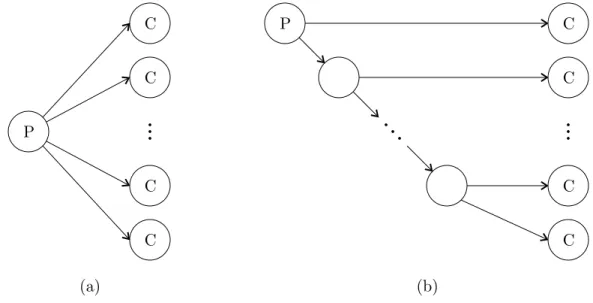
At various points in our construction, we shall be spawning an arbitrary number of paths (function instances) from a single vertex (transaction), as illustrated in Figure 4.1(a), where a parent vertex labeled “P” spawns multiple child vertices labeled “C”.
(a) (b) P C C C C P C C C C
Figure 4.1: The meaning of having one parent vertex spawn multiple child vertices.
However, Cilk allows only one function instance to be spawned at a time. Thus, when our construction calls for the behavior in Figure 4.1(a), what we shall mean is that a loop is used