HAL Id: hal-03045782
https://hal.archives-ouvertes.fr/hal-03045782
Submitted on 8 Dec 2020
HAL is a multi-disciplinary open access
archive for the deposit and dissemination of sci-entific research documents, whether they are pub-lished or not. The documents may come from teaching and research institutions in France or abroad, or from public or private research centers.
L’archive ouverte pluridisciplinaire HAL, est destinée au dépôt et à la diffusion de documents scientifiques de niveau recherche, publiés ou non, émanant des établissements d’enseignement et de recherche français ou étrangers, des laboratoires publics ou privés.
Sperm cryostorage in a dry tank: An accurate
alternative
Stéphanie Mestres, Hanae Pons-Rejraji, Bruno Pereira, Cyril Bouche, Aurelie
Vega, Laure Chaput, Solène Vorilhon, Laurent Janny, Florence Brugnon
To cite this version:
Stéphanie Mestres, Hanae Pons-Rejraji, Bruno Pereira, Cyril Bouche, Aurelie Vega, et al.. Sperm cryostorage in a dry tank: An accurate alternative. Cryobiology, Elsevier, 2020, 94, pp.32-39. �10.1016/j.cryobiol.2020.05.002�. �hal-03045782�
Sperm cryostorage in a dry tank: An accurate alternative
1
Stéphanie Mestresa, Hanae Pons-Rejrajia,b, Bruno Pereirac, Cyril Bouchea, Aurélie
2
Vegaa, Laure Chaputa, Solène Vorilhona, Laurent Jannya, Florence Brugnon a,b.
3
a CHU Clermont Ferrand, CHU Estaing, Assistance Médicale à la Procréation, CECOS, 1
4
place Aubrac, F-63000 Clermont-Ferrand, France
5
b Université Clermont Auvergne, IMoST, INSERM 1240, Faculté de Médecine, place Henri
6
Dunant, F-63000 Clermont-Ferrand, France
7
c CHU Clermont Ferrand, DRCI, « Délégation Recherche Clinique et Innovation »,
8
Biostatistics, place Henri Dunant F-63000 Clermont-Ferrand, France
9 10 [email protected] 11 [email protected] 12 [email protected] 13 [email protected] 14 [email protected] 15 [email protected] 16 [email protected] 17 [email protected] 18 [email protected] 19 20 Corresponding author: 21 Pr Florence Brugnon, 22
[email protected], OrCID iD: 0000-0002-8402-8734
23 24 25
Highlights:
26
Post-thawing sperm parameters, acrosome reacted and DNA fragmentation sperm are similar
27
after storage in dry or liquid nitrogen tank for normozoospermia and altered sperm samples.
28
Dry nitrogen tank conserves a stable temperature at -194°C despite repeated opening whatever
29
the storage floor level.
30
Sperm storage in dry tank is safety for samples and operators.
31 32
Abstract
33
This prospective study aimed to determine the effects of dry nitrogen cryostorage on human
34
sperm characteristics in comparison with liquid nitrogen cryostorage. For this purpose, 42 men
35
undergoing routine semen analysis (21 normozoospermia and 21 with altered semen
36
parameters) were analyzed. After slow freezing, half of the straws of each sample were
37
randomly stored in liquid and dry tanks, at the top and bottom levels of the latter. After 6
38
months storage, thawed samples were treated by density gradient centrifugation and sperm
39
characteristics were compared. There was no difference in sperm progressive motility
40
(15.1%±14.2 % vs. 15.1%±12.7%; p=0.76), sperm vitality (25.5% ± 17.7 % vs. 26.2% ± 19%;
41
p=0.71), percentages of acrosome-reacted spermatozoa (38% ± 8.5% vs. 38.5% ± 7.4 %;
42
p=0.53) and DNA fragmentation spermatozoa (27.3% ± 12.4% vs. 28.5% ± 12.9%, p=0.47)
43
after cryostorage in the dry or the liquid nitrogen tank. Moreover, we did not observe
44
differences between either cryostorage system for normal and altered sperm samples. This
45
lack of difference was also observed whatever the floor level of cryostorage in the dry tank.
46
The temperature measurement of the dry tank showed a stable temperature at -194°C
47
throughout storage whatever the storage floor level, guaranteeing the stability of the low
48
temperatures suitable for human sperm storage. Because of its greater safety, dry storage
49
without contact with the liquid phase should be preferred and can be a useful alternative for
50
the cryostorage of human sperm samples.
52
Key words: cryostorage, human sperm, dry tank, liquid nitrogen tank, motility, vitality,
53
acrosome integrity, DNA fragmentation.
54 55
1. Introduction
56
Sperm cryopreservation is widely used for fertility preservation and sperm donation. Usually,
57
the storage method used is liquid nitrogen to avoid temperature variation and guarantee a
58
constant low storage temperature (- 196° C) necessary to preserve sperm motility [16,27],
59
DNA integrity [10,11] and fertilizing ability [1,12]. However, it has been reported that
60
infectious pathogens such as hepatitis B virus, bacteria and different fungi cannot only survive
61
but can also cross-contaminate cryopreserved samples in liquid nitrogen [5,14]. Therefore,
62
storage in systems that do not require the immersion of the materials in liquid nitrogen was
63
developed. Previous studies reported cryostorage systems in the vapor phase of nitrogen
64
[2,25]. Although storage in nitrogen vapor may represent an alternative for the cryostorage of
65
human sperm samples [17,22], this type of storage method is prone to the difficulties of
66
maintaining temperatures below -150°C between the high and low storage levels. Frequent
67
opening may also cause ice formation and frosting on lids and walls, and can thus attract
68
environmental microorganisms. To avoid these deleterious effects, cryostorage systems using
69
dry nitrogen tanks have been developed by manufacturers. Dry tanks permit storing samples
70
and liquid nitrogen in separate compartments. As the liquid nitrogen surrounds the dry
71
compartment containing the samples, the latter are maintained at a stable temperature close to
72
that obtained with a direct storage in liquid nitrogen. Nevertheless, the efficiency of this new
73
type of cryopreservation must to be evaluated for human sperm samples.
74
In the present study, to evaluate the efficiency of this new type of dry storage, we compared
75
the motility, vitality, acrosome integrity and DNA integrity of post-thaw sperm samples, after
76
sperm selection by density gradient that had been stored in dry and liquid nitrogen tanks. We
analyzed the stability of cryostorage after 6 months for the top and low level positions of the
78
samples in the dry tank.
79 80
2. Material and methods
81
2.1 Experimental study design
82
This prospective study was performed with 42 men (33.3 ± 4.4 years-old) undergoing routine
83
semen analysis for infertility at the center for reproductive medicine of the University Hospital
84
of Clermont-Ferrand, France. Written informed consent was obtained for inclusion of the
85
semen samples from these patients in the GERMETHEQUE biobank with the approval of the
86
local committee (Committee for Personal Protection DC 2008 558, Trial registration number:
87
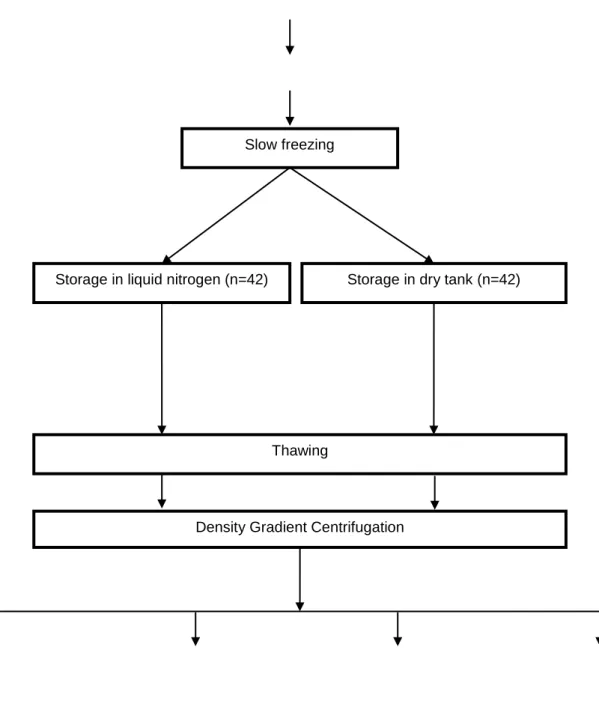
NCT03734120). The flowchart of the experimental design is summarized in Figure 1. After
88
semen analysis according to the World Health Organization guidelines [28], the semen
89
samples were frozen by slow freezing. For each semen sample, the frozen straws were split in
90
two; one half was stored in the liquid nitrogen tank and second half in the dry tank. For the dry
91
tank storage, 18 of the 42 samples were stored at the top of the tank and 24 at the bottom. For
92
the both localization, we stored equal numbers of samples with altered and normal parameters.
93
The straws were thawed for evaluation of sperm motility, vitality, DNA integrity and
94
acrosomal integrity after 6 months storage.
95 96
2.2. Semen collection
97
Sperm samples were collected by masturbation into sterile plastic jars after 3-5 days of sexual
98
abstinence. After liquefaction at 37°C for 30min., they were analyzed according to the WHO
99
criteria [28] for routine semen analysis. The surplus semen was cryopreserved and analyzed
100
for this study.
101 102
2.3. Sperm Cryopreservation methodology
2.3.1. Conventional slow freezing
104
Each semen sample was mixed in a 1:1 ratio (v;v) with cryoprotectant medium (Cryosperm,
105
Origio®, France). The samples were maintained for 15 min at room temperature with
106
cryoprotectant medium and sealed in high security straws (Cryobiosystem®, L’Aigle, France).
107
Sperm freezing was performed, as described before (Brugnon et al., 2013), using a
108
NanoDigitcool® programmable freezer (Cryobiosystem®, France).
109 110
2.3.2. Sperm cryostorage
111
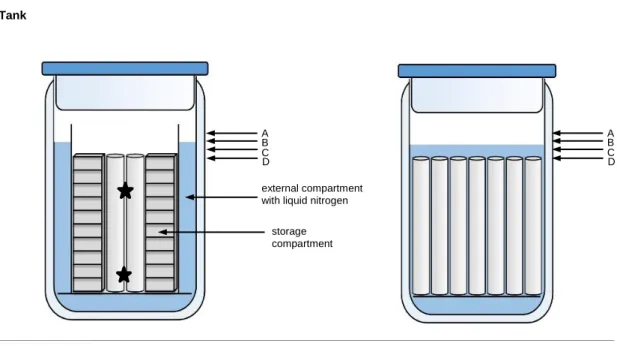
After freezing, the straws, for each sample, were randomly stored in the dry tank (LO 2200
112
“dry”, Cryodiffusion®, France, Figure 2) and the liquid nitrogen tank (CF250M,
113
Cryodiffusion®, France) for 6 months. The straws were never in contact with liquid nitrogen
114
in the dry tank, since this type of tank is equipped with a separate compartment for liquid
115
nitrogen and another for sample storage. The specific external compartment of liquid nitrogen
116
surrounding the sample storage chamber allow maintaining a stable low temperature for
117
storage. As shown in Figure 2, the nitrogen level is managed by 4 temperature probes for both
118
types of tank with a high level detection probe (probe A), a stop filling detection probe (probe
119
B), a filling detection probe (probe C) and a low level detection probe (probe D). For both
120
tanks, automatic liquid nitrogen distribution occurs when temperatures higher than -196°C are
121
measured by probe C. When probe B detects -196°C, the automatic liquid nitrogen supply is
122
stopped automatically. In the dry storage unit, the 4 probes were localized in the specific
123
external compartment of the tank. Straws with normal and altered standard semen parameters
124
were stored both at the top and bottom of the dry tank. In the set of experiments, the real
125
temperature was measured in the storage compartment of the dry tank for 3 days with frequent
126
opening. The temperature measurements were performed with an external electric
127
thermometer (PT100 class A, precision of +/ – 1.71°C for a temperature of -195.8°C,
Cryobiosystem®, France) at the same storage location of the sperm straws at the top and the
129
bottom of the tank (represented by stars in Figure2).
130 131
2.3.3. Sperm thawing
132
The straws were thawed at 37°C for 3 min. After the multi-step addition of an equal volume of
133
Sperm Preparation Medium (Origio®, France), the cryoprotectant was removed by density
134
gradient centrifugation with a two-step (95-47.5%) discontinuous Puresperm gradient
135
(Nidacon International®, Sweden) diluted in Sperm Preparation Medium. One ml of the
136
thawed sperm suspension was layered at the top of the gradient. After centrifugation (600g,
137
20min.), the purified sperm population was recovered from the 95% layer and washed in
138
Sperm Preparation Medium (750g, 8min.). The different sperm analyses were performed on
139
this sperm suspension.
140 141
2.4. Analysis of sperm characteristics
142
2.4.1. Sperm motility and viability
143
To evaluate sperm motility, 20µl of fresh and thawed semen was placed on the glass slide and
144
examined with phase contrast optics at x400 magnification. Two hundred spermatozoa were
145
assessed per duplicate to determine the percentage of progressive, non-progressive and
146
immotile spermatozoa [28]. The sperm vitality of fresh and thawed aliquots was estimated by
147
assessing sperm membrane integrity with eosin staining [28]. The sperm sample was mixed
148
(v/v) with eosin (Vital Screen, Fertipro®, Belgique) and examined by observation on glass
149
slides under a microscope at x400 magnification in duplicate to determine the percentage of
150
viable spermatozoa. Two hundred spermatozoa were assessed per duplicate.
151 152
2.4.2. Sperm TUNEL assay
As previously reported [7] DNA fragmentation in spermatozoa was detected by the TUNEL
154
assay (In Situ Cell Death Detection kit, Roche®, France). Briefly 1.5 106 washed sperm cells
155
were fixed with 2% paraformaldehyde for 30 min. at room temperature. Afterwards, the cells
156
were washed in PBS followed by permeabilization in 100µl of a solution containing 0.1%
157
Triton X 100 in 0.1% sodium citrate for 3 min on ice. Labeling was performed following a
158
washing procedure in PBS 1% BSA (500g, 5 min). Counterstaining with Propidium Iodide
159
(PI) allowed checking sperm permeabilization. For each sample, a negative control was
160
carried out by removing the TdT enzyme from the reaction mixture. The positive control was
161
obtained by incubating the spermatozoa with 2UI DNAse for 15 min at 37°C in Tris HCl
162
buffer before labeling. Flow cytometry was performed using the flow cytometer LSRII (BD
163
Biosciences®, France). The sperm population was gated using the forward scatter signal and
164
the side scatter signal to exclude debris and aggregates. The excitation wavelength of 488nm
165
was supplied by an argon laser. Green fluorescence (FITC- derived fluorescence) and red
166
fluorescence (PI) were detected with FL1 (530/30nm) and FL3 (610/20nm) channels,
167
respectively. A minimum of 20 000 spermatozoa were examined for each assay.
168 169
2.4.3. Sperm acrosome integrity
170
Acrosome integrity was estimated as described previously [21]. Briefly, sperm cells were
171
fixed, permeabilized in methanol 98% (30min, -20°C) and labeled with a freshly prepared
172
solution of Pisum Sativum Agglutinin conjugated to fluorescein isothiocyanate (PSA-FITC,
173
Sigma-Aldrich®, France) (60µg /mL) in PBS. Sperm cells were observed blindly using
174
epifluorescence microscopy (x400). Sperm cells with intact acrosome membranes showed
175
marked fluorescence in the acrosome region (A pattern), while those having lost their
176
acrosome membrane were devoid of fluorescence or displayed marked fluorescence along the
177
equatorial segment (AR pattern). Two hundred spermatozoa were assessed per duplicate.
178
2.5. Statistical analysis
180
Sample size was determined according to Cohen’s recommendations concerning effect-size (=
181
difference between two means divided by standard-deviation) bounds [9]. With 42 infertile
182
patients, an effect-size greater than a moderate value of 0.5 can be highlighted for paired
183
comparisons for a two-sided type I error at 5%, a power equal to 90% and an intra-individual
184
correlation coefficient at 0.5. With 24 and 18 patients for the top and bottom floor,
185
respectively, and 21 patients for each normozoospermia group, the expected effect-size was
186
around 0.8 for a power higher than 80%.
187
The statistical analysis was conducted using Stata software (version 13, StataCorp, US). The
188
tests were two-sided with a type I error set at 5%. Continuous data (progressive motility,
189
sperm vitality, percentages of acrosome-reacted sperm, sperm DNA fragmentation) were
190
presented as mean ± standard-deviation. The comparisons between groups (top vs. bottom
191
floor, normal vs altered sperm parameters) were performed using the Student t-test or the
192
Mann-Whitney test. The paired comparisons (at 6 months of cryostorage, dry vs. liquid
193
nitrogen tank) were performed using the Student paired t-test or the Wilcoxon test. A Sidak
194
type I error correction was applied to take into account the multiple comparisons. Finally,
195
linear mixed models were carried out to evaluate the following effects – top/bottom, fresh /
196
dry / liquid, normal / altered sperm parameters, time and their interactions – taking into
197
account between and within subject variability as random-effect. When appropriate, a
198
logarithmic transformation was proposed to obtain the normality of the endpoint.
199 200
3. Results
201
3.1. Sperm characteristics after cryostorage in dry and liquid nitrogen tanks
202
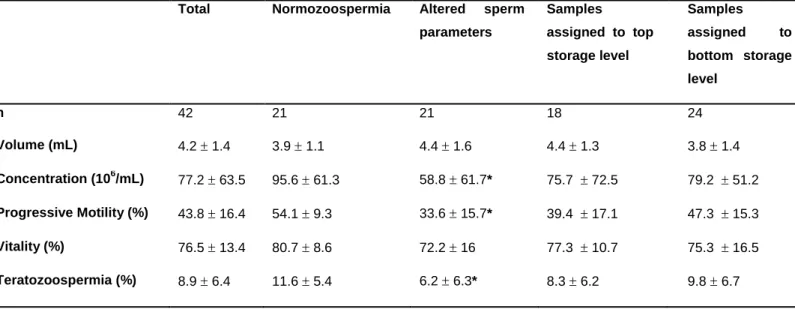
The initial sperm parameters of the samples before freezing are presented in table 1. The
203
sperm concentration was 77.2 ± 63.5 x 10⁶/mL, progressive motility 43.8 ± 16.4%, sperm
204
vitality 76.5 ± 13.4% and the percentage of atypical sperm 8.9 ± 6.4%. Normozoospermia was
observed in 21 samples and 21 samples showed altered semen parameters according to the
206
WHO criteria. Initial sperm parameters were not significantly different between samples
207
assigned to the bottom and top storage levels of the dry tank.
208
Figure 3 shows the characteristics of post-thaw human samples after 6 months’ cryostorage in
209
dry and liquid nitrogen. After thawing, the sperm samples were treated by density migration
210
density as it is recommended to use sperm samples for assisted reproductive technology.
Post-211
thawed sperm progressive motility and vitality were significantly decreased for the both
212
storage types and whatever the initial sperm quality (p < 0.001, Figure 3A). There was no
213
difference in sperm progressive motility (15.1 ± 14.2 % for dry vs. 15.1 ± 12.7% for liquid
214
tank; p=0.76, Figure 3A) or sperm vitality (25.5 ± 17.7 % vs. 26.2 ± 19%; p = 0.71, Figure
215
3A). Moreover, there was no difference between the percentages of acrosome-reacted
216
spermatozoa (38 ± 8.5% vs. 38.5 ± 7.4 %; p = 0.53 Figure 3B) and DNA fragmentation
217
spermatozoa (27.3 ± 12.4% vs. 28.5 ± 12.9%, p=0.47, Figure 3C) in dry or liquid nitrogen.
218
There was also no statistical difference for any of the parameters measured between
219
cryostorage in dry or liquid nitrogen whatever the quality of the initial sperm
220
(normozoospermia and altered sperm samples represented by triangles and dots, respectively
221
in Figure 3).
222 223
3.2. External temperature measurement of the dry tank
224
The temperature of the storage compartment in the dry tank was measured using an external
225
probe for 3 days at the top and the bottom floor alternatively (the two positions are represented
226
by stars in Figure 2). During this period, the tank was opened frequently and filled daily. The
227
external probe showed stables temperatures of -194 -193 ° C for both positions
228
(supplementary figure).
229 230
3.3. Comparison of sperm characteristics of samples stored at the top and low levels of
231
the dry tank with samples stored in the liquid nitrogen tank
232
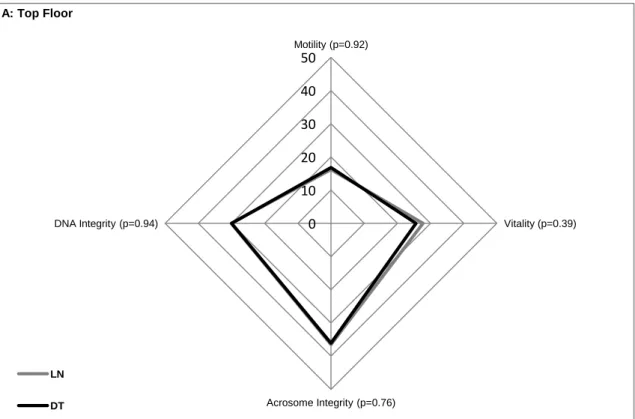
Figure 4 compares the characteristics of post-thaw human samples cryostorage during 6
233
months in the top and bottom floors of the dry vs. liquid nitrogen tank for the same sperm
234
samples. We did not observe any difference for sperm vitality (25.6 ± 17.8 % vs. 27.7 ±
235
19.4%, p = 0.39) nor progressive motility (16.8 ± 15.2 % vs. 16.2 ± 13.2%, p = 0.92) between
236
the samples stored at the top floor of dry tank in comparison with liquid tank. Similarly, we
237
measured any difference in bottom floor of the dry tank vs. liquid nitrogen tank for sperm
238
vitality (25.4 ± 18 % vs. 24.3 ± 18.8%, p = 0.67) and progressive motility (12.9 ± 12.6 % vs.
239
13.6 ± 12.3%, p = 0.68). Moreover, there was no difference between the percentages of
240
acrosome-reacted sperm samples stored in the top floor of the dry tank (36.1 ± 7 % vs. 36.5 ±
241
6.1% for N2 liquid storage, p = 0.76) and in the bottom floor (40.4 ± 9.7 % vs. 41.2 ± 8.32% 242
N2 liquid storage, p = 0.55) and in the percentage of spermatozoa with DNA fragmentation of 243
samples stored in the top floor (30 ±13.5 % vs. 30.1 ± 13.8% N2 liquid storage; p = 0.94) and 244
in the bottom floor (26.4 ± 12.5 % vs. 23.2 ± 9.2% N2 liquid storage, p = 0.28) in comparison 245
with liquid nitrogen tank. This lack of difference was observed not only in normozoospermia
246
but also in altered sperm samples (p > 0.05).
247 248
4. Discussion
249
As an alternative to the standard method of human sperm storage in liquid nitrogen at a
250
temperature of -196°C, storage in a dry tank reduces the risks of cross-contamination and
251
avoids the risks incurred by manipulations of liquid nitrogen [20]. In our study, we
252
cryopreserved human sperm samples and stored them in dry and liquid nitrogen tanks for six
253
months, and evaluated the characteristics of post-thaw spermatozoa. We obtained similar
254
results for sperm motility, vitality, acrosome integrity and DNA fragmentation in both
255
cryostorage conditions. Moreover, there was no impact of the position of sperm samples in
either of the tanks on the sperm characteristics we measured, likewise for the
257
normozoospermia and altered sperm samples.
258
One of the disadvantages of using liquid nitrogen is that certain infectious agents not only may
259
survive but can also cross contaminate other samples stored in the same dewar unit during
260
long storage periods [6,26]. Indeed, contamination is possible if a contaminated sample is
261
stored in liquid nitrogen [13]. There was no report of cross-contamination in semen samples in
262
dry shippers [4]. Although the volume of the tank we evaluated in our study is larger, storage
263
in this type of tank should be done to ensure greater safety [6]. The separation wall between
264
the locations of the samples and the liquid nitrogen of the dry tank we tested guarantees the
265
absence of contact between liquid nitrogen and samples. To ensure security, different rules
266
should be applied along with the screening of patients for infectious diseases and the
267
application of the appropriate sanitary and cryoprocedures. Moreover, the periodic
268
disinfection of the tanks and the use of sterile liquid nitrogen is advisable [20].
269
In order to prevent all biological activity [19], the biological samples must be stored below the
270
glass transition temperature of water. Liquid nitrogen permits maintaining the temperature at
-271
196°C. The risk of thermal instability of the stored samples must be considered when using a
272
system with nitrogen in vapor phase. The dry tank we used in our experiment always
273
guaranteed a stable temperature of -194°C for the top and bottom floors of the tank despite
274
repeated openings. The location of the liquid nitrogen surrounding the location of the stored
275
samples permits high stability without nitrogen vapor in the sample storage compartment.
276
Moreover, the tank is connected for the detection of low-level filling and temperature
277
thresholds. With the development of vitrification cryoprocedures, particularly for oocyte and
278
embryo cryopreservation in reproductive medicine, it has been clearly demonstrated that it is
279
necessary to maintain vitrification by remaining at temperatures lower than -126°C [24].
280
Moreover, if a semi-open device is used for vitrification, using a dry tank avoids the risks of
281
cross-contamination.
283
Although cryopreserved semen is routinely used in assisted reproductive techniques,
284
freezing/thawing procedures induce alterations of sperm structures and functions. Sperm
285
motility is the most sensitive indicator of cryodamage. In our study, similar alterations of
286
sperm motility and vitality were measured after thawing sperm samples stored in dry and
287
liquid nitrogen tanks after 6 months storage whatever the level of storage in the tank. Several
288
groups reported similar results with vapor phase tanks [15,17,22]. The motile sperm recovery
289
rate after thawing may be improved by density gradient centrifugation performed before
290
freezing [7] and/or supplementation of the media by an antioxidant [3,18]. Indeed, sperm
291
treatment by density gradient centrifugation before freezing allows the removal of round cells
292
and the selection of mature and motile spermatozoa which seem more resistant to cryoinjury.
293
We performed density gradient centrifugation after thawing in our study because it is the
294
procedure applied most routinely in assisted reproductive techniques when using
295
frozen/thawed sperm samples.
296 297
In addition, it has been reported that sperm acrosome reaction [10] and DNA fragmentation
298
[8,29] could be modified by cryoprocedures. Indeed, cryopreservation procedures may induce
299
the phenomenon of capacitation and acrosome reaction. When this occurs, the spermatozoa
300
lose their fertility since the acrosome reaction is an irreversible phenomenon which normally
301
occurs during fertilization. In our study, the acrosome integrity of the thawed spermatozoa was
302
similar when storage was performed in both dry and liquid nitrogen tanks after 6 months’
303
storage, whatever the level of storage in the tanks (top or bottom). We performed TUNEL
304
assays to evaluate sperm DNA fragmentation. This technique permits the detection of double
305
strand DNA fragmentation which can be attributed to oxidative stress [29], apoptosis and/or
306
defective chromatin packaging [23]. We showed similar percentages of spermatozoa with
307
DNA fragmentation in semen samples stored in dry and liquid nitrogen with no impact of
storage duration or level in the tanks. Due to the large amount of spermatozoa necessary to
309
perform all these measurements, it was not possible to evaluate sperm acrosome integrity and
310
DNA fragmentation before freezing. The lack of difference for all the sperm characteristics
311
measured for the normozoospermia and altered sperm samples, guarantees efficient storage for
312
male fertility preservation and sperm donation in dry tanks.
313 314
5. Conclusion
315
The characteristics of the cryopreserved human semen samples in dry and liquid nitrogen
316
tanks were similar for sperm motility, vitality, acrosome integrity and DNA fragmentation
317
after 6 months’ storage in the top and bottom floors of the tanks. Storage in a dry tank
318
guarantees the stability of the low temperatures suitable for human sperm storage. Because of
319
its greater safety, dry storage without contact with the liquid phase should be preferred and
320
can be a useful alternative for the storage of human sperm samples. In future, it could be
321
interesting to evaluate the impact of this type of storage on ART outcomes, particularly
322
fertilization, embryo development and pregnancy rates.
323 324 325
Declaration of Competing Interest
326
There was no external funding for this study and all the authors declare no competing interests
327 328 329
Acknowledgments
330
The authors would like to thank the technicians of the CECOS laboratory, CHU
Clermont-331
Ferrand, France, for their technical assistance, Lambert Celine for its bio-statistical assistance
332
during the course of the study and of the Cryodiffusion (France) company for their answers to
333
their technical questions about the tanks. The authors would like to thank the support of the
University Hospital of Clermont-Ferrand for performing this study.
335 336
Reference
337
[1] Agca Y, Critser JK. Cryopreservation of spermatozoa in assisted reproduction. Semin
338
Reprod Med 2002; 20:15–23.
339
[2] Amesse LS, Srivastava G, Uddin D, Pfaff-Amesse T. Comparison of cryopreserved sperm
340
in vaporous and liquid nitrogen. J Reprod Med 2003; 48:319–324.
341
[3] Amidi F, Pazhohan A, Shabani Nashtaei M, Khodarahmian M, Nekoonam S. The role of
342
antioxidants in sperm freezing: a review. Cell Tissue Bank 2016; 17:745–756.
343
[4] Bielanski A. A review of the risk of contamination of semen and embryos during
344
cryopreservation and measures to limit cross-contamination during banking to prevent
345
disease transmission in ET practices. Theriogenology 2012; 77:467–482.
346
[5] Bielanski A, Bergeron H, Lau PCK, Devenish J. Microbial contamination of embryos and
347
semen during long term banking in liquid nitrogen. Cryobiology 2003; 46:146–152.
348
[6] Bielanski A, Vajta G. Risk of contamination of germplasm during cryopreservation and
349
cryobanking in IVF units. Hum Reprod Oxf Engl 2009; 24:2457–2467.
350
[7] Brugnon F, Ouchchane L, Pons-Rejraji H, Artonne C, Farigoule M, Janny L. Density
351
gradient centrifugation prior to cryopreservation and hypotaurine supplementation
352
improve post-thaw quality of sperm from infertile men with
353
oligoasthenoteratozoospermia. Hum Reprod Oxf Engl 2013; 28:2045–2057.
354
[8] Cocuzza M, Sikka SC, Athayde KS, Agarwal A. Clinical relevance of oxidative stress and
355
sperm chromatin damage in male infertility: an evidence based analysis. Int Braz J Urol
356
Off J Braz Soc Urol 2007; 33:603–621.
357
[9] Cohen, J. Statistical power analysis for the behavioral sciences (2nd ed.). 2nd ed.
358
Lawrence Earlbaum Associates, Hillsdale, NJ; 1988.
359
[10] Cross NL, Hanks SE. Effects of cryopreservation on human sperm acrosomes. Hum
360
Reprod Oxf Engl 1991; 6:1279–1283.
361
[11] Donnelly ET, McClure N, Lewis SE. Cryopreservation of human semen and prepared
362
sperm: effects on motility parameters and DNA integrity. Fertil Steril 2001; 76:892–900.
363
[12] Duru NK, Morshedi M, Schuffner A, Oehninger S. Cryopreservation-thawing of
364
fractionated human spermatozoa and plasma membrane translocation of
365
phosphatidylserine. Fertil Steril 2001; 75:263–268.
366
[13] Fountain D, Ralston M, Higgins N, Gorlin JB, Uhl L, Wheeler C, Antin JH, Churchill
367
WH, Benjamin RJ. Liquid nitrogen freezers: a potential source of microbial
368
contamination of hematopoietic stem cell components. Transfusion (Paris) 1997; 37:585–
369
591.
370
[14] Hawkins AE, Zuckerman MA, Briggs M, Gilson RJ, Goldstone AH, Brink NS, Tedder
371
RS. Hepatitis B nucleotide sequence analysis: linking an outbreak of acute hepatitis B to
372
contamination of a cryopreservation tank. J Virol Methods 1996; 60:81–88.
373
[15] Hu J, Zhao S, Xu C, Zhang L, Lu S, Cui L, Ma J, Chen Z-J. Liquid nitrogen vapor is
374
comparable to liquid nitrogen for storage of cryopreserved human sperm: evidence from
375
the characteristics of post-thaw human sperm. Fertil Steril 2015; 104:1253-1257.e1–2.
376
[16] Keel BA, Webster BW, Roberts DK. Effects of cryopreservation on the motility
377
characteristics of human spermatozoa. J Reprod Fertil 1987; 81:213–220.
378
[17] Lim JJ, Shin TE, Song S-H, Bak CW, Yoon TK, Lee DR. Effect of liquid nitrogen vapor
379
storage on the motility, viability, morphology, deoxyribonucleic acid integrity, and
380
mitochondrial potential of frozen-thawed human spermatozoa. Fertil Steril 2010;
381
94:2736–2741.
[18] Lu X, Zhang Y, Bai H, Liu J, Li J, Wu B. Mitochondria-targeted antioxidant
383
MitoTEMPO improves the post-thaw sperm quality. Cryobiology 2018; 80:26–29.
384
[19] Mazur P. Freezing of living cells: mechanisms and implications. Am J Physiol 1984;
385
247:C125-142.
386
[20] Mortimer D. Current and future concepts and practices in human sperm cryobanking.
387
Reprod Biomed Online 2004; 9:134–151.
388
[21] Pons-Rejraji H, Brugnon F, Sion B, Maqdasy S, Gouby G, Pereira B, Marceau G,
389
Gremeau A-S, Drevet J, Grizard G, Janny L, Tauveron I. Evaluation of atorvastatin
390
efficacy and toxicity on spermatozoa, accessory glands and gonadal hormones of healthy
391
men: a pilot prospective clinical trial. Reprod Biol Endocrinol RBE 2014; 12:65.
392
[22] Punyatanasakchai P, Sophonsritsuk A, Weerakiet S, Wansumrit S, Chompurat D.
393
Comparison of cryopreserved human sperm in vapor and liquid phases of liquid nitrogen:
394
effect on motility parameters, morphology, and sperm function. Fertil Steril 2008;
395
90:1978–1982.
396
[23] Said TM, Gaglani A, Agarwal A. Implication of apoptosis in sperm cryoinjury. Reprod
397
Biomed Online 2010; 21:456–462.
398
[24] Sansinena M, Santos MV, Taminelli G, Zaritky N. Implications of storage and handling
399
conditions on glass transition and potential devitrification of oocytes and embryos.
400
Theriogenology 2014; 82:373–378.
401
[25] Saritha KR, Bongso A. Comparative evaluation of fresh and washed human sperm
402
cryopreserved in vapor and liquid phases of liquid nitrogen. J Androl 2001; 22:857–862.
403
[26] Tedder RS, Zuckerman MA, Goldstone AH, Hawkins AE, Fielding A, Briggs EM, Irwin
404
D, Blair S, Gorman AM, Patterson KG. Hepatitis B transmission from contaminated
405
cryopreservation tank. Lancet Lond Engl 1995; 346:137–140.
406
[27] Watson PF. Recent developments and concepts in the cryopreservation of spermatozoa
407
and the assessment of their post-thawing function. Reprod Fertil Dev 1995; 7:871–891.
408
[28] World Health Organization, Department of Reproductive Health and Research. WHO
409
laboratory manual for the examination and processing of human semen. Fifth edition.
410
2010.
411
[29] Zribi N, Feki Chakroun N, El Euch H, Gargouri J, Bahloul A, Ammar Keskes L. Effects
412
of cryopreservation on human sperm deoxyribonucleic acid integrity. Fertil Steril 2010;
413
93:159–166.
414 415
Table 1: Characteristics of non-frozen semen samples assigned to the top and bottom storage
levels
Total Normozoospermia Altered sperm parameters Samples assigned to top storage level Samples assigned to bottom storage level n 42 21 21 18 24 Volume (mL) 4.2 1.4 3.9 1.1 4.4 1.6 4.4 1.3 3.8 1.4 Concentration (106/mL) 77.2 63.5 95.6 61.3 58.8 61.7* 75.7 72.5 79.2 51.2 Progressive Motility (%) 43.8 16.4 54.1 9.3 33.6 15.7* 39.4 17.1 47.3 15.3 Vitality (%) 76.5 13.4 80.7 8.6 72.2 16 77.3 10.7 75.3 16.5 Teratozoospermia (%) 8.9 6.4 11.6 5.4 6.2 6.3* 8.3 6.2 9.8 6.7
Data are presented as mean (± standard deviation). Paired comparisons were performed using
the Student paired t-test and the Wilcoxon test (p-value). “Top floor stored samples” and “Bottom floor stored samples” columns correspond to sperm parameters before freezing of
samples stored at the top and the bottom floor of the dry tank. * indicates significantly different
Figure 1: Experimental design and flow chart of the study.
Slow freezing
Storage in liquid nitrogen (n=42)
Thawing
Storage in dry tank (n=42)
Figure 2: Characteristics of probes of the dry and liquid tanks.
The nitrogen level is managed by 4 temperature probes for dry (LO2200) and liquid (CF 250M)
tanks: probe A: High level detection (61 cm from the bottom); probe B: Stop filling detection
(56 cm from the bottom), probe C: Filling detection (48 cm from the bottom), D: Low level
detection (45 cm from the bottom). In the dry storage unit, the 4 probes were localized in the
specific external compartment of the tank.
Straws with normal and OAT semen were stored both at the top and bottom of the dry tank. In
the set of experiments, the real temperature was measured in the storage compartment of the dry
tank for 3 days with frequent opening. The temperature measurements were performed with an
external electric thermometer (PT100 Cryobiosystem®, France) at the same storage location as
that of the sperm straws at the top and the bottom of the tank (represented by stars).
Dry tank Liquid tank
Reference LO2200 « Dry », Cryo Diffusion®,France CF 250M, Cryo Diffusion®,France
Tank
external compartment with liquid nitrogen B A C D B A C D storage compartment
Figure 3: Post-thaw characteristics of sperm stored in a dry tank (DT) and liquid nitrogen (LN)
after 6 months cryostorage.
Mean Percentages (line) of sperm progressive motility and vitality (in A, n=42 for both)
acrosome integrity (in B, n=42) and DNA fragmentation (in C, n=22) are shown after 6 months’
cryostorage in dry (dark gray dots and triangles) and liquid nitrogen (black dots and triangles).
Parameters measured for normozoospermia and altered sperm patients are represented by
triangles and dots, respectively. In A, sperm vitality and progressive motility were shown for
fresh samples before freezing (light grey). Paired comparisons between DT and LN storage
were performed using the Student paired t-test and the Wilcoxon test (p). *** indicates a
significant difference with p < 0.001 in comparison with fresh samples.
Figure 4: Post-thaw characteristics of sperm after cryostorage during 6 months on the top floor
(A) and bottom floor (B) of the dry tank (DT) versus liquid nitrogen tank (LN)
A: Average percentages of sperm vitality (n=24), progressive motility (n=24), acrosome
integrity (n=24) and DNA fragmentation (n=13) of samples stored at the top (A) floor of the dry
tank are shown in comparison with the liquid tank. The straws issue from the same sperm
sample patient were compared in the two type of tanks (dry and liquid nitrogen).
B: Average percentages of sperm progressive motility (n=18), vitality (n=18), acrosome
integrity (n=18) and DNA fragmentation (n=9) of samples stored at the bottom (B) floor of the
dry tank are shown in comparison with the respective straws (from the same samples) stored in
the liquid tank.
Paired comparisons were performed using the Student paired t-test and the Wilcoxon test (p).
0 10 20 30 40 50 Motility (p=0.92) Vitality (p=0.39) Acrosome Integrity (p=0.76) DNA Integrity (p=0.94) A: Top Floor LN DT
0 10 20 30 40 50 Motility (p=0.68) Vitality (p=0.67) Acrosome Integrity (p=0.55) DNA Integrity (p=0.28) B: Bottom Floor LN DT
Supplemental Figure: Temperature measurement of the dry tank
The temperature of the storage compartment in the dry tank was measured using an external
probe (black line) for 3 days at the top and the bottom floor alternatively. During this period,
the tank was opened frequently and filled daily. The temperature measured by the high level
detection probe (probe A, grey line) and automatic liquid nitrogen distribution (grey arrow)