Discovering Entity Correlations between Data Schema via
Structural Analysis
by
Ashish Mishra
Submitted to the Department of Electrical Engineering and Computer Science in partial fulfillment of the requirements for the degrees of
Bachelor of Science in Computer Science and Engineering and
Master of Engineering in Electrical Engineering and Computer Science
ASCHUSETS INSTITUTE
at the OF TECHNOLOGY
MASSACHUSETTS INSTITUTE OF TECHNOLOGY JUL 3 1 2002
June 2002 LIBRARIES
@
Massachusetts Institute of Technology 2002. All rights reserved. BARKRA uthor ...
Department of Electrical E ring and Computer Science May 24, 2002
Certified B y ... ...
Dr. Amar Gupta Co-Director, Productivity From Information Technology (PROFIT) Initiative Thesis Supervisor
Accepted by ... .... ...
Arthur C. Smith Chairman, Department Committee on Graduate Students
Discovering Entity Correlations between Data Schema via Structural
Analysis
by
Ashish Mishra
Submitted to the Department of Electrical Engineering and Computer Science on May 24, 2002, in partial fulfillment of the
requirements for the degrees of
Bachelor of Science in Computer Science and Engineering
and
Master of Engineering in Electrical Engineering and Computer Science
Abstract
At the forefront of data interoperability is the issue of semantic translation; that is, inter-pretation of the elements, attributes, and values contained in data. Systems which do not adhere to pre-defined semantics in their data representations need to dynamically mediate communication between each other, and an essential part of this mediation is structural analysis of data representations in the respective data domains. When mediating XML data between domains, one cannot rely solely on semantic similarities of tags and/or the data content of elements to establish associations between related elements. To complement these associations one can build on relationships based on the respective domain structures, and the position and relationships of evaluated elements within these structures. A struc-tural analysis algorithm uses associations discovered by other analysis, discovering further links which could not have been found by purely static examination of the elements and their aggregate content. A number of methodologies are presented by which the algorithm maximizes the number of relevant mappings or associations derived from XML structures. The paper concludes with comparative results obtained using these methodologies.
Thesis Supervisor: Dr. Amar Gupta
Acknowledgments
My supervisor at MITRE, Michael Ripley, was a huge contributor throughout this project
- he was a voice for suggestions and criticism, an ear to bounce ideas off, and a push at the right times when the going got slow. Additionally, my thesis supervisor, Dr. Amar Gupta, gave both direction and support in all phases of my research. Much of this thesis draws from a paper the three of us co-authored in 2002.
The foundation for the X-Map project was laid by David Wang, whose thesis was also a source for much of my work. My colleague, Eddie Byon, was a major contributor to the coding process, as well as helpful in discussing ideas and more mundane matters such as transportation.
Other helpers and motivators included Doug Norman at MITRE; Brian Purville, Danny Lai, and Andrew Chen at MIT; and Anne Hunter, the wonderful department administrator. Most of all, I owe this to my parents, without whom none of this would have been remotely possible.
Contents
1 Context for Structural Analysis
1.1 X -M ap . . . .
1.2 The Association Engine . . . .
2 Internal Representation of Data Structures
2.1 XML Schema . . . .
2.2 Scoring Mechanism . . . .
3 Means of Analysis
3.1 X-Map Design and Rationale . . . .
3.1.1 Enumeration of Relation Classes .
3.1.2 Discovering Relations . . . . . . 28 . . . 31 35 11 12 15 21 21 24 27
3.1.3 X-Map's Strategies . . . .3
3.1.4 Regenerative Association Engine . . . .
3.2 Heuristics . . . .
3.3 Graph Theory Analysis . . . .
3.4 Other Techniques . . . .
4 Heuristics Based Approach
4.1 Reasoning from Associations . . . .
4.2 Associations in Cycles . . . .
4.3 Chaining Associations across Domains . . . .
5 Discovering Mappings using Graph Theory
5.1 Relation to Graph Problems . . . .
5.2 Solving Isomorphism via Adjacency Matrices . . . .
5.3 Other Avenues . . . .
5.4 Definitions and Notation . . . .
5.5 A Related Theorem . . . .
5.6 The Hybrid Approach . . . . 41 42 43 45 47 49 50 50 53 53 54 56 59 59 61 37
6 Artificial Intelligence Based Analysis - Neural Nets 6.1 Neural Nets . . . . 6.2 NNs in X-Map. . . . . 6.3 Implementation . . . . 7 Results 7.1 Technique Performances . . . . 7.2 Conclusion . . . . A Source Code 65 65 67 68 71 71 74 75
Chapter
1
Context for Structural Analysis
For effective transfer of information between diverse processes in a networked environ-ment, it is necessary that there be a known and agreed-upon protocol for interconversion between the "languages" they speak. In other words, the data structures they incorporate must agree on how they map between each other. Explicitly requiring the systems to agree on a data format for exchange is not always desirable as it forces constraints on their data structures and induces interdependencies between the systems involved. Enabling interop-erability via a static mediator has various drawbacks, as either the mediator or the systems will constantly need to be updated as one of the processes' internal structure changes or new data domains are added. An alternate approach involves more sophisticated mediators that dynamically or statically adapt translations between systems, without interfering with their internal data formats.
A data communication language assumed for the domains is the eXtensible Markup Lan-guage (XML) [33]. XML is a flexible meta-lanLan-guage useful as a framework for interop-erability: it immediately resolves several issues, such as parsing and character encoding
recognition. Documents conforming to valid XMIL immediately reveal the logical struc-ture of the data they contain, freeing a designer to focus on the analysis itself. XML also incorporates several technologies that can be leveraged in mediating interoperability: these include the XML Linking Language (XLink) [42], which aids in drawing arbitrary asso-ciations between resources; XML Schema, a schema description language for XML doc-uments [58, 59, 60]; and XML Stylesheet Language Transforms (XSLT), a language for specifying transformations between XML documents [61]. These tools are very useful in describing and carrying out the process of conversion or translation. What is significantly lacking [34], however, is a process of actually discovering associations between documents and semi-automatically generating the transform scripts which can rearrange and modify the associated data. Requiring constant human intervention at this stage nullifies much of the advantage of having a dynamic, sophisticated mediator.
1.1
X-Map
Our research [5] has concluded that in order to effectively mediate between heterogeneous domains in XML, the following architecture is needed. Given two non-identical domains, two types of applications are required to meet these goals. The first application, the map-per, interrogates the data structures of the source and destination and creates the mappings between them. This application requires some user interaction, since all semantic differ-ences in data cannot be automatically discovered. The second application, the mediator, operates on instance data to create a tailored product using the mapping rules. The beauty of this design is that once the mapping rules are found, the mediator applications can use the same set of mappings to process the instance data over again, as long as the structures are not changed. And, when the structures do change, the mapper can update the mappings before the mediator begins processing, thus providing current mappings to the mediator for
the new instance data. Lastly, since the mediator simply reads in the mapping files, no code changes are necessary to operate on the new data structures. This architecture is depicted in Figure 1-1 [5].
DD& interactiomuL
(as required)
System A
'~pping Rue System B
DTD A LatLong Latitude + Lat~emis +
Longitude + Longe DTD B Latitude' = atLongtER-51 Latlewis = LatLong[6] Longitude = LatLong(7-13] Long~emis = LatLoug{141 X1HL f iles Lfie <Latitvde> 422000 </Latitude> ~
Logituea 071050 Logitude> ationg> 4220E0710500E </LatLong
cLong~emis> E c/LougRenis> E t a
Figure 1-1: Mapping and Transformation Architecture
The X-Map system for semi-automated semantic correlation seeks to mediate XML data interoperability between multiple heterogenous systems. X-Map would play a significant role in the Joint Battle InfoSphere (JBI), which aims to provide information superiority to US Armed Forces. The JBI adheres to a publish and subscribe mechanism, which facil-itates the sharing of information between interested parties, manipulation of information to create knowledge, and dissemination of that new knowledge to other interested parties upon creation. the interested parties send information via messages asynchronously back and forth. The role that fuselets play in the JBI amounts to enhancing and automating all three functionalities of the JBI; Information Input, Information Manipulation, and Knowl-edge Output and Interaction. That is, fuselets fuse information from several subscribed
X-Map's essential design was developed as part of the 'Fuselet Architecture for Adaptive Information Structures' project at MITRE corporation. The goal of the X-Map project is to enable adaptive data interoperability between participating systems through a transparent mediator. Among the key information components required for this task are (a) knowledge of possible mappings between elements in data structures, (b) a semi-automated means to derive these mappings, as well as to represent and store them so they can be reused by other applications, (c) transform functions to facilitate the mediation of data between systems, given knowledge of mappings between them, as well as to represent the transformations done by the mediation so they can be easily reused. X-Map's role is in the the first two tasks; semi-automatically discovering mappings and relationships, as well as storing information about them.
Key information components required by X-Map are:
1. Knowledge of possible mappings between elements in data structures,
2. The means to represent mappings and store them so they can be reused by other applications, and
3. Transformation functions that perform the specific operations required to transform an XML document from one domain to another.
As part of our research [5], the following components were developed:
1. An XLink based association language for representing the mappings,
2. An XSLT based language for representing the transformation functions, and
3. The specification of several different types of mediators that perform various media-tion tasks.
This work has been described in [34, 35] and will not be further detailed here.
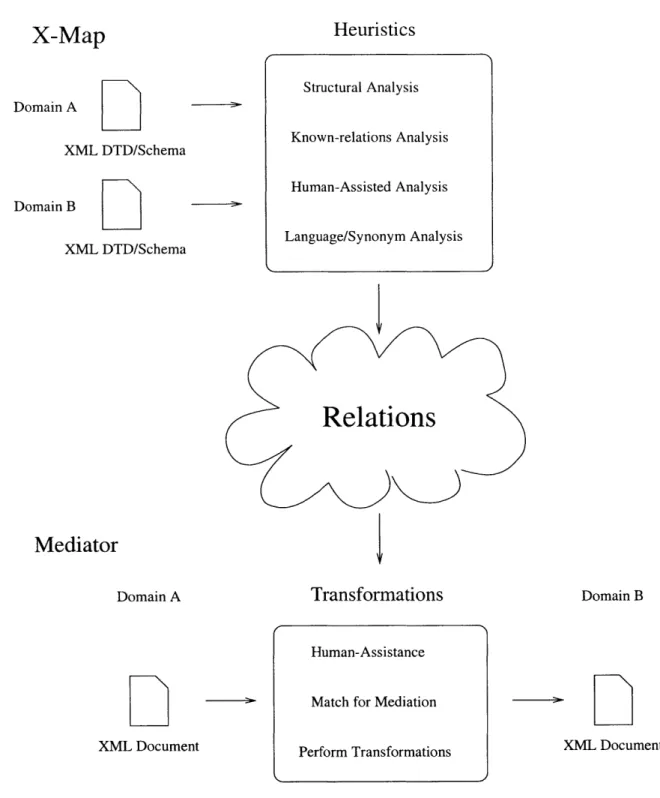
In X-Map, data about two XML domains are read in, analyzed, and the resulting mappings and transformation functions are generated as output. This design segmented the process of discovering mappings into two separate parts: equivalence analysis, which examines the tags, attributes, and data for similarities in form and content, and structural analysis, which looks at the structures of the XML files for similarities. After analyzing for potential mappings, X-Map displays to the user a graphical representation of the nominations it has made. As part of the User Interface (UI), the user can interrogate the system for information about the nominations, and can then accept or reject any of them. Afterwards, the UI allows the user to add mappings that may have been missed by X-Map. The user also needs to confirm the type of mapping nominated so the proper transformation functions can be created. After all user input is entered, X-Map outputs an X-Map Linkbase (the name given to a linkbase that contains mappings as opposed to hypertext linkings) of the mappings that exist and a set of transformation functions that encode how the mappings are performed. A diagram of the design developed for X-Map is shown in Figure 1-2 [5].
1.2
The Association Engine
The technical backbone of X-Map is the automated engine through which associations are discovered and nominated. This is the mechanism via which associations are discovered and captured by the association language. The general case of automatic association is very hard and implies the solving of consistent semantic matching of elements between two data-domains. The goal here is less ambitious: it is the use of semi-automated meth-ods to make consistent semantic matches in suitably constrained cases, and to provide an approach that can make these matches within a specified margin of error with minimal
re-xML instance fes XML S schenms Xalink finkhws direrWe graph A 0, Y XSLTAMathML transform functions
Figure 1-2: X-Map design
quirement of human intervention. The system will try its best to come up with appropriate semantic matches, and when it cannot provide a match or has serious doubts, or for ultimate validation, it will ask a human operator for assistance. Obviously we would like to mini-mize the work that has to be performed by the human operator; this implies nominating as many genuine mappings as possible while keeping to a minimum the incidence of "false positives" which require an operator to invalidate nominated associations.
Table 1.1 [5] illustrates some of the common types of associations that may occur, and examples of these. Although some of these use the "equivalence" relationship (defined in [34] as expressing essentially the same physical object or concept, and differing only in representation) as a fundamental building block, others do not. Note that not all of these relationships need be two-way: sometimes a one-way relationship implies an entirely different relationship (or no relationship) in the opposite direction.
Relation Type XML Example Description
Equals <EmpNo> <EmpNo> both the tag names and data are the same Synonym <SSN> <SocialSecNo> the tag names are not the
same, but the data is Conversion <Weight <Weight data domain is the same,
units="kg"> units="lbs"> but a conversion is re-quired
LookUp <CountryCode> <CountryName> data domain is the same,
but some type of code is used
Reordering <Date for- <Date for- data domain is the same,
mat="1ddmyy"> mat="mmddyy"> but reordering is re-quired
IsLike <Title> <JobDescription> data from one domain is "good enough" for the other
Generalization/Specialization
- SuperType <TechnicalPaper> data from one domain is a superset of the other
- SubType <ConferencePaper> data from one domain is a subset of data from the other
Abstraction <DailySales> <MonthlySales> data from one domain combined into a single value in the other Aggregation/Decomposition
- PartOf <FName> data from one domain
<MName> is concatenated in the
<LName> other domain
- Composite <Name> data from one domain
takes multiple fields the other
Defaults No element exists, <Quantity> default values needed in
always enter "1" the other domain
In many cases, the nature of the relationship(s) can be read off simply by observing the names and attributes of elements in the disparate domains. The most obvious instance arises when precisely the same element occurs in both domains. Alternately, it may be possible to establish a relationship by scanning for element names in a lookup table: for instance, the X-Map prototype supports using a lexicon of abbreviations, jargon or even inter-language translations. In cases where both of the above approaches fail, the algorithm tries simple string manipulations to compare element names: checking whether one is an acronym for the other, or simply differently spelled. As the scope of possible nominations increases, one eventually arrives at a point of trade-off between false positives and misses. The notion of a "score" describing a degree of confidence in the nominated association, as illustrated later in this paper, provides an elegant way of handling this trade-off.
The next step up involves examining instances of data in elements being compared. As before, the algorithm uses lookup tables, or scans the data instances for some of the rela-tionships described earlier: precision differences, scaling factors (indicating different units being used), acronyms and abbreviations. There will again exist a trade-off between false positives and misses, depending on the scope of the analysis.
The above two techniques are termed "Equivalence Analysis" and "Data Analysis" re-spectively. This kind of static analysis is invaluable, especially initially when no other possibility is open. However there will invariably exist relationships which cannot pos-sibly be picked up by the earlier techniques. An instance of this is the
"Employee-SalesPerson" association described earlier in Table 1.1. To a human, it is clear that these are related: a SalesPerson is an example of an Employee. However, there is no semantic relationship between these element names for an automated agent to pick up. It is likely that the data immediately stored under this tag (as opposed to under child tags) are either unrelated, or the relationship does not get picked up by data analysis for whatever reason (e.g. sufficiently different formats). This would be a case where analysis of the data
structures comes into play in nominating associations.
It follows that structural analysis and comparison of data domains is a key component in semi-automated detection of semantic mappings. The remainder of this paper describes implementations of this analysis, as tested in the X-Map prototype. The analysis depends heavily on our internal representation of the structure of these domains, so to begin with, this representation is described in greater detail. Subsequent sections describe different modes of resolution of this problem. The fundamental question under study may be ap-proached from several different directions, as follows:
1. As a straightforward problem of developing heuristics for speculating on associa-tions;
2. As a graph theoretic labeling problem: discovering isomorphisms between graphs representing the data structures; or
3. As a search space/optimization problem: minimizing the deviance between specu-lated and genuine mappings.
These different ways of looking at the problem shape different approaches toward solving it. Instances of several different types of techniques were implemented to compare and contrast their respective performances on sample data.
Chapter 2
Internal Representation of Data
Structures
2.1
XML Schema
The formulation of the data representation is important in order to maximize information that can be derived from it. XML Schemas normally have a highly hierarchical tree-like formation. For the purposes of XML Interoperability, data structure is synonymous with schema since a valid XML document (itself a data receptacle) must conform to some XML Schema. Thus its structure must be known - just parse the schema. Structural information-wise, the two are synonymous. Internal representation of the schema is faithful to its tree structure, additionally storing tag data in child nodes of the nodes corresponding to that tag, and attributes likewise in child nodes of the appropriate tag nodes. Hierarchy edges express hierarchy relationships within data domains; Association edges express rela-tionships between elements across data domains. Formally, the representation X consists
of a tuple of components.
X = {EA, D1,D2 ... Dns
Where the components are defined as follows:
* EA is the set of association edges, added by the engine in the course of its execution; as described they express relationships across domains.
EA
c
U
X
x,
* D1, D2, ... are domains, comprising a set of vertices V and hierarchy edges EHI
Di = (V, EH) = (VTi, VD, VA), i EH)
where VT represents the set of tags, VD, the tag data, and VA, the attributes. The vertices are linked by directed edges in EH .
E H% c (VTj X VD) U (VD X VA)
* The scoring function s : EA -+ R or EA -+ [0, 1] is described later.
Both association and hierarchy edges are implicitly asymmetric, (v1, v2) # (v2, v1). For hierarchy edges, this is immediate since direction of the edge is encapsulated in the seman-tic structure of the schema. For association edges, this captures the earlier observation that not all associations need be two-way and that some are manifestly not so.
Adhering to the tree structure of a valid XML specification imposes a stronger condition. Within each domain Di there must exist a partial ordering < such that (v, v') E EHI => v <
described on it and is, therefore, not a valid domain description.
The above constraint is inherent to XML but may actually be relaxed to our advantage. Notably, the X-Map prototype design does not preclude a "flattening" of the hierarchi-cal tree structure with consolidation of identihierarchi-cal nodes. The data structure used (a tagged directed graph) is built to handle any arbitrary graph of tagged nodes. The rationale be-hind potentially recasting the tree is that for particular structures, a flattened graph will be more computationally palatable. A problem with structural analysis on an open tree is the bias it builds against correlating aggregation and generalization conflicts. In non-trivial cases, these conflicts result in completely different tree structures, which confuse attempts to frame resolutions based on hierarchies. Thus, for our purposes, the schema's "tree" is compacted into a more useful representation.
In either event, this structure manages to preserve the structural information of the XML input, while casting it into a form amenable to analysis. Besides elementary heuristics and more complex Al techniques, casting the data structure into a directed graph as described allows us to leverage the body of existing graph theory work on isomorphism of graphs. Finally, making the distinction between graph edges representing hierarchical associations within domains, as opposed to edges representing mapping-type associations across do-mains (EA/EH), allows us to represent multiple data dodo-mains D1, D2, D3... within a
sin-gle directed graph. This is important because it enables the association engine to leverage knowledge of mappings between two domains in discovering associations linking them with a third.
Association edges use scores to represent degrees of confidence in nominated associations, rather than a simple on-off distinction. Besides being conceptually simple, this idea is significant in incrementally enhancing understanding of the relationship graph. When aug-menting information from previous analyses about a speculative relationship, one needs
flexibility in the degree to which current knowledge is changed. A regenerative association engine repeatedly iterates through loops of such analyses to further strengthen the scores. As the final step, all that needs to be done is to compare edge scores against a (predeter-mined) threshold and take appropriate action for edges that cross that threshold. This is in accordance with the notion that one should never discard information, even uncertain information, when trying to establish associations: one never knows when one will need
that information again. Confidence level on edges is retained until those edges are proved to not be associations.
Other modes of execution are being explored. Analysis engines can be run "in parallel", and subsequent generated edge scores combined according to a heuristic of choice. The further extension to this concept is to retain separate scores for each of the analysis tech-niques applied to the schema, and combine and recombine the scores arbitrarily as per valid
criteria.
2.2
Scoring Mechanism
Interpreting the scores as degrees of confidence (probabilities) has the advantage of being conceptually consistent and well-defined. Technically, the more accurate term is "confi-dence level": the edge definitely is either an association or not, and we are describing the probability of seeing a particular set of sample data given that an association exists there. Scores are thereby restricted to the closed [0, 1] interval, and we draw on probability theory for ideas on how to manipulate them. When applying multiple atomic analysis techniques, the weighted average of returned scores is taken for each edge.
The combination of confidence estimates from independent sources was considered in de-tail. For example, when using the definite-association-vicinity heuristic described in the
next section, what needs to be done for a nomination that lies in the vicinity of two or more known associations? Taking any kind of average in this case is inappropriate since it im-plies that adding a further measure of certainty sometimes decreases the level of confidence in the association. A measure is needed that incorporates information from both sources but still retains all properties desired by the scoring mechanism.
Formally, the requirement is for a probability combination function a : [0, 1]2 -+ [0, 1] that satisfies the following conditions:
* Probabilities must lie between 0 and 1, obviously.
0 a(x, y) 1 for 0 < x, y < 1
" Order should not be relevant, so a should be both associative and commutative. a(x, y) = a(y, x) and a(x, a(y, z)) = a(a(x, y), z)
" Adding confidence levels never decreases the level of confidence.
a(x, y) > max(x, y)
" Adding confidence 0 has no effect.
a(x, 0) = x
* Adding confidence 1 indicates complete confidence in the mapping, unaffected by other estimations.
a(x, 1) = 1
A little inspection shows that any function of the form
a(x, y) = f-1(#(x) + 0(y))
example, using an exponential function like a sigmoid, /(x) = ex/(1 - ex) gives
a(x, y) = (x + y - 2xy)/(1 - xy)
However, using the probability notion and regarding the two influencing associations as 'events' each of which can independently affect the edge in question yields the even simpler formula OW(x) a (x, y) - log(1 - x) - 1-(-x)(1-y) = x+y-xy
Chapter 3
Means of Analysis
3.0.1
Discovering Relations
The previous section focused on identifying the relations that interest X-Map. This section will focus on how to identify those relations in XML documents, as well as some back-ground preparation, which will then pave way for the discussion of algorithmic strategies in Section 3.1.3 that discovers these relations.
Like COIN's axiomatic approach toward mediating queries [6], the following set defines X-Map's operational "axioms". This approach is feasible due to its emphasis on document structure, which directly leverages specific domain knowledge and will be discussed in Section 3.1.3.
Algorithm Execution Decision
Basically, X-Map performs an optimization step between loading the XML schema into memory and processing it with its algorithms - X-Map pre-processes the schema and tries to compile a processing strategy on the fly, which X-Map then executes.
X-Map presently employs a simple heuristic to determine which of its algorithms to run on input XML schema. In this case, X-Map uses a computationally cheap circularity check, which, as we will shortly discuss in Section 3.1.3, is a good indicator of aggregation con-flicts. Other cheap heuristics can be performed at this stage, each relevant to the algorithm it precedes, which will ultimately drive down computational costs while increasing relevant matchings.
However, this is purely an exercise in optimization to finding the right set of algorithms to run, not interoperability, so X-Map may, for simplicity, run all of its heuristics such as the circularity check.
Structural Analysis Background
The major realization underlying X-Map's structural analysis approach is the formulation of the data structure. This is important because it determines the types and number of analyses that can be run.
Due to the highly hierarchical and tree-like structure of XML schemas, the importance to recast this tree into a more computationally palatable form cannot be underestimated. The fundamental problem with structural analysis on a tree is the bias it builds against correlat-ing aggregation and generalization conflicts. In non-trivial cases, these conflicts typically result in completely different tree structures which confound any attempts to frame any
resolutions based on hierarchies. Thus, for XML Interoperability purposes, the schema's "tree" must be altered into a better representation.
This realization leads X-Map to propose a non-traditional view of a tree - as a directed graph - for XML Interoperability, as shown in the next chapter in Figure 4-2. Basically, tree nodes map to graph vertices, tree edges map to graph edges, and the edge direction goes from the root node to the child node.
This view transformation dramatically increases the number of interesting properties (of graphs) and also the analysis options one can perform on a tree hierarchy, and as Section 3.1.3 will show, this transformation can be done quickly.
Thus, the following list represents somel of the interesting features of a directed graph which X-Map will take advantage of, and they will be discussed in Section 3.1.3. Basically, each represents an embodiment of schematic or semantic conflicts mentioned earlier, and shows how X-Map uses the information.
* Associations in Hierarchies
" Associations in Cycles
" Associations through Contradiction
3.0.2
X-Map's Strategies
As briefly mentioned in Section 3.1, X-Map's strategy employs a number of analysis algo-rithms on structure and language, aided with specific knowledge of the project's problem domain, to meet and resolve the XML Interoperability problem.
'By no means is this list all inclusive. Additional graph features to exploit can easily be the topic of future
A key feature of X-Map is its regenerative association engine (see Section 3.1.4), which not only validates known associations but also keeps track of uncertain associations so that they can be ascertained when new future information becomes available to X-Map.
Equally critical to X-Map's strategy is the idea of recasting a hierarchical data structure like XML into a directed graph and leveraging the body of graph theory work on it.
Finally, at all times, human intervention may prove more fruitful in resolving the final outstanding issues after each sub-analysis has finished weeding through the complexity. This proves to be a benefit to both the operator and the algorithm since the algorithm is ultimately not sentient and may require suggestions only a human can make, so the algorithm will go through the complexity which overwhelms most humans to extract the basic conflict in question.
Thus, the following sections will explain the process and rationale behind the graph analy-ses that X-Map uanaly-ses along with how the regenerative association engine "does its magic".
How to Collapse a Tree Hierarchy
The process of converting XML into a directed graph and vice versa proves deceptively simple due to existing software for another project at MITRE. The basic concept behind the "Bags" concept is that a hierarchy is simply a collection of nodes whose edges represent some attribute or containment relationship between the appropriate parent and child node.
[34]
However, instead of focusing on how the relations stack together to form a tree-like hier-archy, if one focuses on the nodes and the relations they contain or participate, the graph formulation immediately leaps forth. Thus, "XML-2-Bags" embodies this realization to
fruition. "XML-2-Bags", in pseudo-code, simply:
Also, one must realize that in addition to "flattening" the tree into a directed graph, X-Map will keep the hierarchical information around to aid its graph algorithms in determining relations.
Finally, as explained earlier in Section 3.1.2, viewing a tree as a directed graph holds much potential, as the following sections will show.
Discovering Associations in Hierarchies
Discovering associations between elements in a hierarchy can be tricky because the hierar-chy is not guaranteed to contain any "meaning" for the associated elements. Fortunately, in this project, it is often the case that hierarchy embeds information about its constituent elements. This is domain knowledge specific to this project that will be exploited.
The typical example (with A, B, C, D, E as elements and arrows pointing in the to part of the relation) would be: A contains B; B contains C; and D contains E. If C and E are related, does that say anything about B and D? What about A and D?
For this project, it often turns out that if C and E are related, then either A or B are related to D. However, even if the relation cannot be immediately drawn from A or B to D, one can still speculate on its existence. Future processes may discover that B and D are related without the presence of C and E, in which case X-Map now has a more complete picture than either processes alone.
Furthermore, if a correlation is drawn both between C and E and an encompassing parent such as A and D, that more than likely sheds more light about the correlation of elements in between. Perhaps the intervening elements in one schema correspond to additional and
yet discovered detail for the other schema.
Deriving Associations in Cycles
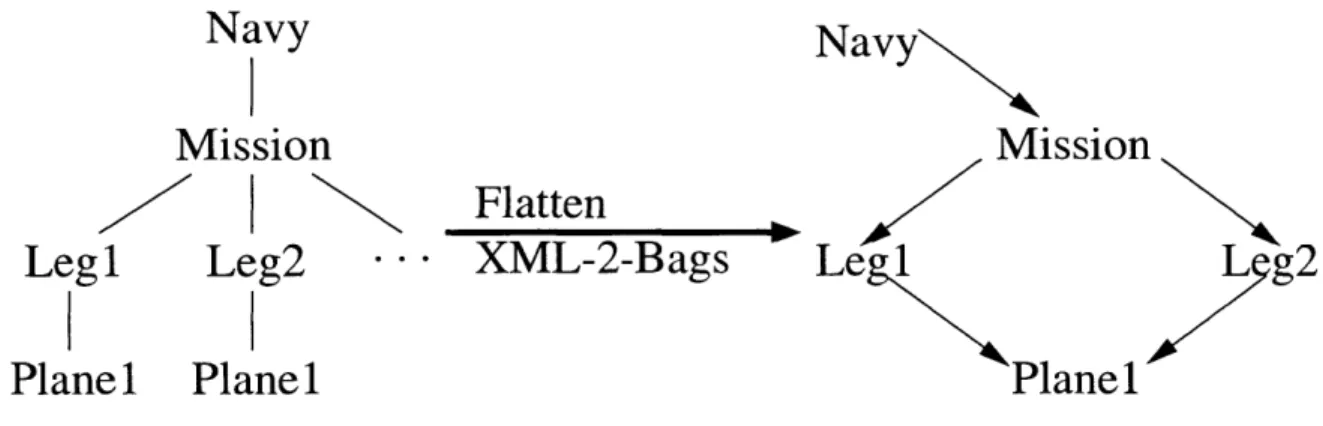
Other times, an association can be made that is cyclic - that is, there is an association between an encompassing element and the contained element between the schemas. An example of this would be: A contains B; C contains D. A is related to D and C is related to B.
Directed cycles often indicate the presence of aggregation and generalization conflict due to similar "sorts" of information organized or aggregated differently for different data-domains. The resolution of this conflict shows the advantages of the graph over the tree -a tree will ste-ad-f-astly m-aint-ain such hier-archic-al conflicts during -an-alysis -and frustr-ate its resolution while a graph does not.
As noted in Section 3.1.3, this situation potentially allows X-Map to speculate on the mean-ing of intervenmean-ing elements, too. Perhaps element E represents details from schema 1 that schema 2 does not yet exhibit and can be confirmed in the future through speculation.
Dealing with Conflicting Associations
Clearly, it is possible to derive contradictory associations such as "A implies B and A does not imply B" or one-sided associations such as "A implies B but B does not imply '. The latter situation possibly implies a substitutable relation while the former is slightly thornier. In general, situations like this can be handled by having a persistent body of knowledge that either affirmatively says "yes, A implies B", or "no, A does not imply B". The fully qualified means of building this knowledge is an active area of research.
X-Map builds this body of knowledge through its relations linkbase in a couple of ways.
* Some schemas may be more trusted than others; thus, relations drawn from them may have higher weight to break contradictory associations.
" X-Map can fully speculate on this result and wait for future schemas to resolve this issue via the regenerative association engine.
3.0.3
Regenerative Association Engine
The regenerative association engine embodies a simple logical concept extremely applica-ble toward XML Interoperability:
One should never throw away information, even uncertain ones, when trying to reason out and associate things - one never knows when one will need that information again.
Hence, The engine's design is surprisingly simple since its tasks basically entail the fol-lowing:
1. Keep track of the speculative relations and what association algorithm produced each.
2. Rerun the associated algorithm on the speculative relations when new schemas are introduced into X-Map.
3. Record whether a speculative relation's conflict is resolved affirmatively or nega-tively and act accordingly.
3.1
Heuristics
Discovering associations between elements in a hierarchy can be tricky because the hier-archy is not guaranteed to contain any "meaning" for associated elements. Fortunately, in this project, it is typically the case that hierarchy embeds information about its constituent elements. This is domain knowledge specific to this project that will be exploited. In the case of heuristics, we use fairly simple patterns and functions to derive information from structural associations. Many of these actually depend on prior known mappings - they need to be "bootstrapped" by first running Equivalence Analysis or Data Analysis on the domains in question, or reading off a set of known associations from a Linkbase.
The simplest case involves direct hierarchical associations. Thus if A -+ B -+ C and D -+ E -+ F are pieces of the hierarchy in two distinct domains, and a strong mapping exists between B and E, we can speculate with some (initially low) degree of confidence that C and F are related. We also acquire (slightly higher, but still low) confidence that A
and D are related, or their parents.
The next step is noting that the converse is somewhat stronger: If both A - D and C - F are related, we have a relatively higher degree of confidence that B and E are related. In some sense, the nearby associations at the same points in the hierarchy reinforce our confidence in the association currently being examined. If the known associations are fairly distant, however, our level of confidence in these two elements being related drops off rapidly.
The score-combining function from the previous section comes in useful in implementing this heuristic. Under this scheme, potential edges are rated based on the proximity of their end nodes to the end nodes of known associations. The more such known associations lie in the vicinity of the speculated edge, the more the edge score gets reinforced. We score nodes based on both proximity and direction with respect to known associations. Thus for
instance in the example above, if B - E is a mapping, then A - D should be rated more highly than A - F. The latter is still possible however, if there was at some stage ambiguity in which node is the parent and which one the child. Similarly, A's other child - D's other child will be rated more highly, and so on. Associations of the form A - F are not ignored, but acquire lower scores: we have this flexibility in how their relationship is affected.
Other heuristics which could be used include deriving associations in cycles (this would ne-cessitate having run the graph through theflattening step described in the previous section: obviously a tree has no cycles). Directed cycles often indicate the presence of aggregation and generalization conflict due to similar "sorts" of information organized or aggregated differently for different data-domains. The resolution of these cycles can frequently indi-cate to us such associations that we might not have otherwise detected. Finally, we can often usefully "chain" associations. The concept is highly intuitive: given three elements A, B, C in distinct domains, a mapping relationship between A and B, as well as one be-tween B and C, is strongly indicative of a potential relationship bebe-tween A and C. If the intermediate associations are not definite but speculative, the idea becomes cloudier, but we can still use probability-combination type formulae such as described in the preceding section. What makes this possible is our mode of storing multiple data domains in a single graph representation.
3.2 Graph Theory Analysis
The base problem we're dealing with - finding equivalencies in (unlabeled) graphs - has been fairly deeply analyzed computationally. For certain classes of graphs, solving graph isomorphism is provably NP-complete. There are known randomized algorithms for graph isomorphism, however, (mostly due to Babai and Erdos) that run in 0(n2) time on "almost
all" pairs of graphs, i.e., pathological instances for which these algorithms fail are highly unlikely to turn up in real-world situations. The algorithms still need to be tweaked to apply to our problem, for the following reasons:
1. We aren't trying to determine perfect isomorphism, just "likely" links.
2. During analysis we'll already have some of the nodes 'labeled' in the sense that we'll already know how some of them correspond to each other.
3. What makes the problem much harder, however, is the fact that the graphs in our problems are not even perfectly isomorphic, but merely "similar". There will always be some nodes with no correspondencies in the other domain, as well as nodes for which the hierarchy, parenthood structure is not matched by its analogue on the other side.
A logical way to try to attack the problem, aided by definite knowledge of some associa-tions, is to guess the identity of some k vertices in one domain with k in the other, and see what the assumption of these implies. Depending on the intial assignment of k nodes, if we look at powers of the adjacency matrix whose rows are the nodes we have fixed, they give a classification of the columns that will break them up enough to distinguish them. or to make the ones possibly similar to one another much smaller than before.
How efficient will this procedure be? In the worst case, we have to worry about graphs that look like projective planes, for which it would be prohibitively unlikely to choose the correct k nodes in a reasonable number of tries. in the practical case we can possibly use a probabilistic argument averaging over the class of graph problems we derive from XML trees. There is some subjectivity in describing our general data structures in this numerical fashion, but it should not be excessive.
3.3
Other Techniques
My thesis finally focuses on other potential techniques to use for structural analysis, drawn from artificial intelligence. The use of continuous scores opens up a vast number of math-ematical operations that can be performed on sets of edges. When we bring into play feedback loops that repeatedly update the scores of edges over several cycles, we make possible the application of neural nets, Bayesian analysis and other techniques which will also take into account existing data and requisite domain knowledge. Essentially, the thesis will provide a set of comparisons of these various analyses to determine which ones work best in the context of the project.
Chapter 4
Heuristics Based Approach
Discovering mappings between elements in an XMIL environment can be tricky because the hierarchy is not guaranteed to contain any "meaning" for associated elements. Fortunately, in this environment, the hierarchy does usually embed information about its constituent ele-ments. This is domain knowledge specific to our purpose that will be exploited. In the case of heuristics, the engine uses patterns and functions to derive information from structural associations. Many of these actually depend on prior known mappings - they need to be "bootstrapped" by first running Equivalence Analysis and Data Analysis on the domains in question, or reading off a set of known associations from an X-Map Linkbase [34]. Heuris-tics, like most of the techniques used in structural analysis, serve a complementary rather than a stand-alone role. Figure 4-1 [34] shows an example of where heuristic analysis
X-Map
HeuristicsStructural Analysis Domain A
XML DTD/Schema Known-relations Analysis
Human-Assisted Analysis Domain B
XML DTD/Schema Language/Synonym Analysis
Relations
Mediator
Domain A Transformations Domain B
Human-Assistance
Match for Mediation
XML Document Perform Transformations XML Document
4.1
Reasoning from Associations
The simplest case involves direct hierarchical associations. Thus if A -+ B -+ C and D -+ E -+ F are pieces of the hierarchy in two distinct domains, and a strong mapping exists between B and E, one can speculate with some (perhaps low) degree of confidence that C and F are related. One also acquires (slightly higher, but still low) confidence that A and D are related, or their parents.
Next, note that the converse is somewhat stronger: If both A - D and C - F are related, there is a relatively higher degree of confidence that B and E are related. In some sense, the nearby associations at the same points in the hierarchy reinforce confidence in the association currently being examined. If the known associations are fairly distant, however, the level of confidence in these two elements being related drops off rapidly. Based on experiments with sample data, this drop-off was found to be roughly exponential, with best results coming from a discount factor of around 0.65 for the dataset that was analyzed. Of course, the set of actual bests will depend on the precise nature of the data domains being examined. A good avenue for further exploration would be to dynamically increase or decrease this factor based on the characteristics of the domain graphs.
The score-combining function from the previous section turns out to be useful in imple-menting this heuristic. Under this scheme, potential edges are rated based on the proximity of their end nodes to the end nodes of known associations. The greater the incidence that such known associations lie within the vicinity of the speculated edge, the more the edge score gets reinforced. Nodes are scored based on both proximity and direction with respect to known associations. Thus for instance in the example above, if B - E is a mapping, then A - D should be rated more highly than A - F. The latter is still possible however. There might have been ambiguity at some stage in which node is the parent and which one the child. Similarly, A's other child - D's other child will be rated more highly, and so on.
Associations of the form A - F are not ignored, but acquire lower scores; this flexibility is provided in evaluating how their relationship is affected.
4.2
Associations in Cycles
Navy
Mission
Legi
Leg2
...Planel
Planel
Navy
Mission
Flatten
XML-2-Bags
Le 1
L g2
Planel
Figure 4-2: Deriving Associations in Cycles
Other methods used include deriving associations in cycles, as in Figure 4-2 [34]. This ne-cessitates having run the graph through theflattening step described in the previous section - obviously a tree has no cycles. Directed cycles often indicate the presence of aggrega-tion and generalizaaggrega-tion conflict due to similar "sorts" of informaaggrega-tion organized or aggre-gated differently for different data-domains. The resolution of these cycles can frequently indicate associations that would not otherwise have been detected.
4.3 Chaining Associations across Domains
The concept of "chaining" associations is highly intuitive: given three elements A, B, C in distinct domains, a mapping relationship between A and B, as well as one between B and C, is strongly indicative of a potential relationship between A and C. If intermediate
associations are not definite but speculative, the idea becomes cloudier, but one can still use probability-combination type formulae of the type described in the preceding section. What makes this possible is the utilized mode for storing multiple data domains in a single graph representation.
Chapter
5
Discovering Mappings using Graph
Theory
5.1
Relation to Graph Problems
In order to identify and analyze semantic interdependencies in a complex XML environ-ment, one powerful approach is to cast the structural analysis problem in terms of graph theory. The underlying problem of finding equivalencies in (unlabeled) graphs has been deeply analyzed computationally [45], and we build upon that research with reference to our particular operational environment. For certain classes of graphs, solving graph isomor-phism is provably NP-complete [52, 47]. Subgraph isomorphism, i.e. finding the largest isomorphic subgraphs of given graphs, is also a famous NP-complete problem [46]. There are known randomized algorithms [44, 43] for graph isomorphism that run faster; while these take less time, typically O(n2), they only work on a subset of the cases. The
1. One is not trying to determine perfect isomorphism, just "likely" links.
2. During analysis, some of the nodes will already be labeled in the sense that some of their mutual correspondences are already known.
3. Our problem is much harder, because the graphs in XML problems are not perfectly isomorphic, but merely "similar". There will always be some nodes with no corre-spondences in the other domain, as well as nodes for which the hierarchy and the parenthood structure are not matched by their analogs on the other side.
We describe a domain (i.e. a graph G) as a set V of vertices and a set E of edges. Given two domains G1 = (VI, E1) and G2 = (V2, E2), the problem is to find V1' C V and V2 C V2 such that the graphs induced by V1' and V on G1 and G2 are isomorphic. Also 1V1| or |V| is to be as large as possible. The bijection
f
: V1' -+ V is simply to be expressed in theassociation edges: our X-Map structure X contains EA such that f (vi) v2 < (vi, v2) E EA. For isomorphism, one must also have (vI, v2) E E1 m (f (vi), f (v2)) E E2.
The maximum bounded common induced subgraph problem (MAX-CIS) is the same prob-lem with restricted space of input instances; so now G1, G2 are constrained to have degree at most B for some constant B [45]. Bounding degrees by a constant factor is a realistic assumption for human-usable XMIL files, so it is worthwhile to also consider the (perhaps easier) problem of MAX-CIS. Unfortunately, MAX-CIS is also provably NP-complete; [45] gives a reduction to the well-known MAX-CLIQUE problem.
5.2
Solving Isomorphism via Adjacency Matrices
Approaches proposed by other researchers to attack this problem include NAUTY [48], the Graph Matching Toolkit [49], and Combinatorica [50]. Based on our target application, a
different approach was implemented as described in the following paragraphs.
A logical way to address the problem, aided by definite knowledge of some associations, is to guess the correspondence of some k vertices in one domain with k in the other, and see what the assumption of these correspondences implies. (Of course corresponding vertices would need to have the same or "nearly the same" degree). Depending on the initial assign-ment of k nodes, if one looks at powers of the adjacency matrix whose rows are the nodes that have been fixed, these matrices provide a classification of the columns that will help decompose them adequately to distinguish them, or make groups of possibly similar nodes much smaller than before. The higher the power of the adjacency matrix, the more "dis-tanced" the classification is from the original nodes and in the non-identical approximation case, the less reliable it will be.
Evaluating the efficiency of the above procedure is not easy. In the worst case, one needs to deal with graphs that look like projective planes, for which it would be very unlikely to choose the correct k nodes in a reasonable number of tries. In the practical case one could use a probabilistic argument averaging over the class of graph problems derived from XML trees. While there would be some subjectivity in describing our general data structures in this numerical fashion, this would not be excessive as XML graphs are characterized by a restricted structure.
The X-Map prototype currently incorporates an implementation of the algorithm described above.
5.3
Other Avenues
Although not used in the prototype, one alternative strategy was analyzed in detail. Erd6s and Gallai's classic extremal function [53] gives the size of the smallest maximum match-ing, over all graphs with n vertices and m edges. This is the exact lower bound on -Y(G), the size of the smallest matching that a O(m
+-n)
time greedy matching procedure may find for a given graph G with n vertices and m edges. Thus the greedy procedure is asymptotically optimal: when only n and m are specified, no algorithm can be guaranteed to find a larger matching than the greedy procedure. The greedy procedure is in fact complementary to the augmenting path algorithms described in [29]. The greedy procedure finds a large match-ing for dense graphs, while augmentmatch-ing path algorithms are fast for sparse graphs. Well known hybrid algorithms consisting of the greedy procedure followed by an augmentingpath algorithm execute faster than the augmenting path algorithm alone [54].
We can prove an exact lower bound on 7(G), the size of the smallest matching that a certain O(m + n) time greedy matching procedure may find for a given graph G with n vertices and m edges. The bound is precisely Erdbs and Gallai's extremal function that gives the size of the smallest maximum matching, over all graphs with n vertices and m edges. Thus the greedy procedure is optimal in the sense that when only n and m are specified, no algo-rithm can be guaranteed to find a larger matching than the greedy procedure. The greedy procedure and augmenting path algorithms are seen to be complementary: the greedy pro-cedure finds a large matching for dense graphs, while augmenting path algorithms are fast for sparse graphs. Well known hybrid algorithms consisting of the greedy procedure fol-lowed by an augmenting path algorithm are shown to be faster than the augmenting path algorithm alone. The lower bound on ^y(G) is a stronger version of Erd6s and Gallai's result, and so the proof of the lower bound is a new way of proving of Erd6s and Gallai's result.
The following procedure is sometimes recommended for finding a matching that is used as an initial matching by a maximum cardinality matching algorithm [29]. Start with the empty matching, and repeat the following step until the graph has no edges: remove all isolated vertices, select a vertex v of minimum degree, select a neighbor w of v that has minimum degree among v's neighbors, add {v, w} to the current matching, and remove v and w from the graph. This procedure is referred to in this paper as "the greedy matching procedure" or "the greedy procedure."
In the worst case, the greedy procedure performs poorly. For all r > 3, a graph D, of order 4r + 6 can be constructed such that the greedy procedure finds a matching for Dr that is only about half the size of a maximum matching [32]. This performance is as poor as that of any procedure that finds a maximal matching.
On the other hand, there are classes of graphs for which the greedy procedure always finds a maximum matching [32]. Furthermore, using a straightforward kind of priority queue that has one bucket for each of the n possible vertex degrees, the greedy procedure can be made to run in O(m + n) time and storage for a given graph with n vertices and m edges [55]. The O(m + n) running time is asymptotically faster than the fastest known maximum matching algorithm for general graphs or bipartite graphs [21, 23, 24, 25, 26, 27, 28, 30]. The greedy procedure's success on some graphs, O(m + n) time and storage requirements, low overhead, and simplicity motivate the investigation of its performance.
The matching found by the greedy procedure may depend on how ties are broken. Let y(G) be the size of the smallest matching that can be found for a given graph G by the
greedy procedure, i.e., -y(G) is the worst case matching size, taken over all possible ways of breaking ties.
We will show that each graph G with n vertices and m > 1 edges satisfies
1n
/,
9 3 m5 .1-y(G) > min(n+ 2
\2-r-2m+
4 4j,
ji j).
(5.1)It will become clear that this bound is the best possible - when only n and m are given, no algorithm can be guaranteed to find a matching larger than that found by the greedy procedure.
The simpler but looser bound of -y(G) > m/n is proved in [55].
The bound in (5.1) can be considered alone, or in conjunction with augmenting path al-gorithms - the fastest known algorithms for finding a maximum matching. All known worst-case time bounds for augmenting path algorithms are w(m + n). It is traditional to use a hybrid algorithm: first, use the greedy procedure (or one like it) to find a matching M in O(m + n) time; then, run an augmenting path algorithm with M as the initial matching. We will see that (5.1) supports the use of such hybrid algorithms. Intuitively, if the input graph is dense, then the greedy procedure finds a large matching, and the augmenting path algorithm needs only a few augmentation phases; if the input graph is sparse, then each augmentation phase is fast.
We can abstract the following technique for solving maximum cardinality matching prob-lems: use one kind of method (perhaps the greedy procedure) for handling dense graphs, and another kind of method (perhaps an augmenting path algorithm) for handling other graphs. It may be interesting to investigate whether existing matching algorithms can be improved upon by explicitly using this technique.
Chapter 6
Artificial Intelligence Based Analysis
-Neural Nets
If one looks at the problem as a search space question, there are a number of relevant Al techniques which can be brought into play to handle it. The use of continuous scores opens up a vast number of mathematical operations that can be performed on sets of edges. When one brings into play feedback loops that repeatedly update the scores of edges over several cycles, one can apply neural nets, Bayesian analysis and other technologies which will also take into account existing data and requisite domain knowledge.
6.1
Neural Nets
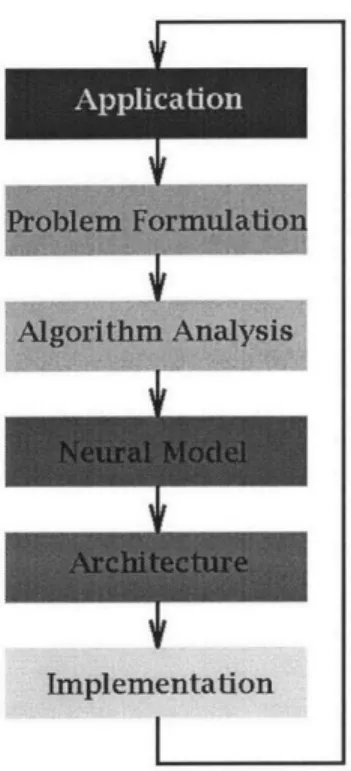
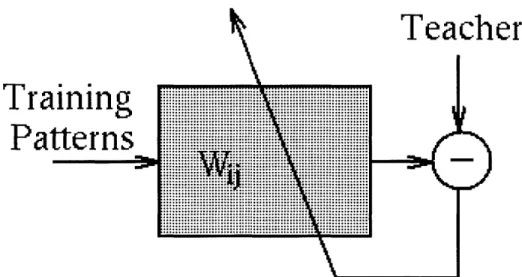
Neural Networks (NNs) fit into the fourth layer of a top-down algorithm architecture (Fig-ure 6-1). NNs learn from past performance to determine candidates for the current session [57]. In the case of NNs, a description of the subgraph around a potential edge serves as
I-ii~
*
Figure 6-1: Algorithmic Approach
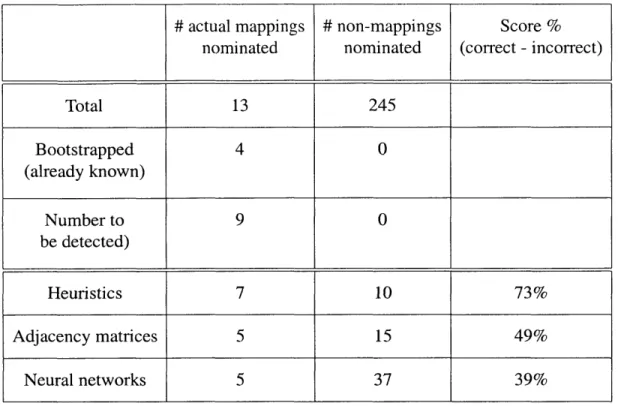
input to the NN. An interesting feature/weakness of techniques of this type is the degree to which they use the "past to predict the future". They need to be trained on test data before being used on fresh domains; this means that if the training data are significantly different from the actual data in target domains, the results posses little relevance. The use of these techniques thus makes some assumptions about the validity of past training data with respect to current resources.
Arguably, the greatest value of neural networks lies in their pattern recognition capabilities. Neural networks have advantages over other artificial intelligence techniques in that they allow continuous, partial and analog representations. This makes them a good choice in recognizing mappings, wherein one needs to exploit complex configurations of features and values.