HAL Id: hal-01206705
https://hal.archives-ouvertes.fr/hal-01206705
Submitted on 18 May 2017
HAL is a multi-disciplinary open access
archive for the deposit and dissemination of
sci-entific research documents, whether they are
pub-lished or not. The documents may come from
teaching and research institutions in France or
abroad, or from public or private research centers.
L’archive ouverte pluridisciplinaire HAL, est
destinée au dépôt et à la diffusion de documents
scientifiques de niveau recherche, publiés ou non,
émanant des établissements d’enseignement et de
recherche français ou étrangers, des laboratoires
publics ou privés.
in a cloud simulation chamber.
Pierre Amato, M. Joly, C. Schaupp, Eléonore Attard, Ottmar Möhler, Cindy
E. Morris, Y. Brunet, A.-M. Delort
To cite this version:
Pierre Amato, M. Joly, C. Schaupp, Eléonore Attard, Ottmar Möhler, et al.. Survival and ice
nu-cleation activity of bacteria as aerosol in a cloud simulation chamber.. Atmospheric Chemistry and
Physics, European Geosciences Union, 2015, 15 (11), pp.6455-6465. �10.5194/acp-15-6455-2015�.
�hal-01206705�
www.atmos-chem-phys.net/15/6455/2015/ doi:10.5194/acp-15-6455-2015
© Author(s) 2015. CC Attribution 3.0 License.
Survival and ice nucleation activity of bacteria as aerosols in a cloud
simulation chamber
P. Amato1,2, M. Joly1,2,3,4, C. Schaupp5, E. Attard1,2,*, O. Möhler5, C. E. Morris6, Y. Brunet7, and A.-M. Delort1,2
1CNRS, UMR 6296, ICCF, BP 80026, 63171 Aubière, France
2Clermont University, Blaise Pascal University, Institute of Chemistry of Clermont-Ferrand (ICCF), BP 10448,
63000 Clermont-Ferrand, France
3Clermont University, Blaise Pascal University, Observatory of Physics of the Globe of Clermont-Ferrand (OPGC),
Laboratory of Physical Meteorology (LaMP), BP 10448, 63000 Clermont-Ferrand, France
4CNRS, UMR 6016, LaMP/OPGC, BP 80026, 63171 Aubière, France
5Karlsruhe Institute of Technology (KIT), Institute for Meteorology and Climate Research, 76021 Karlsruhe, Germany
6INRA, UR 407 Plant Pathology Research Unit, 84143 Montfavet, France
7INRA, UMR 1391, ISPA, CS 20032, F-33882 Villenave d’Ornon CEDEX, France
*now at: Equipe Environnement et Microbiologie, UMR CNRS-IPREM 5254, Université de Pau et des Pays de l’Adour,
IBEAS, BP 1155, 64013 Pau CEDEX, France
Correspondence to: P. Amato ([email protected])
Received: 23 December 2014 – Published in Atmos. Chem. Phys. Discuss.: 12 February 2015 Revised: 18 May 2015 – Accepted: 28 May 2015 – Published: 12 June 2015
Abstract. The residence time of bacterial cells in the
atmo-sphere is predictable by numerical models. However, estima-tions of their aerial dispersion as living entities are limited by a lack of information concerning survival rates and behavior in relation to atmospheric water. Here we investigate the via-bility and ice nucleation (IN) activity of typical atmospheric ice nucleation active bacteria (Pseudomonas syringae and P. fluorescens) when airborne in a cloud simulation chamber (AIDA, Karlsruhe, Germany). Cell suspensions were sprayed into the chamber and aerosol samples were collected by im-pingement at designated times over a total duration of up to 18 h, and at some occasions after dissipation of a cloud formed by depressurization. Aerosol concentration was mon-itored simultaneously by online instruments. The cultivabil-ity of airborne cells decreased exponentially over time with a half-life time of 250 ± 30 min (about 3.5 to 4.5 h). In con-trast, IN activity remained unchanged for several hours af-ter aerosolization, demonstrating that IN activity was main-tained after cell death. Interestingly, the relative abundance of IN active cells still airborne in the chamber was strongly de-creased after cloud formation and dissipation. This illustrates the preferential precipitation of IN active cells by wet
pro-cesses. Our results indicate that from 106 cells aerosolized
from a surface, one would survive the average duration of its atmospheric journey estimated at 3.4 days. Statistically, this corresponds to the emission of 1 cell that achieves
dissemi-nation every ∼ 33 min m−2of cultivated crops fields, a strong
source of airborne bacteria. Based on the observed survival rates, depending on wind speed, the trajectory endpoint could be situated several hundreds to thousands of kilometers from the emission source. These results should improve the repre-sentation of the aerial dissemination of bacteria in numeric models.
1 Introduction
Microorganisms are known to be dispersed into the atmo-sphere and disseminated over long distances (e.g., Bovallius et al., 1978; Brodie et al., 2007; Griffin et al., 2001; Smith et al., 2013, and review by Morris et al., 2013). This has ob-vious implications for human, animal and plant epidemiol-ogy as well as microbial ecolepidemiol-ogy (Monteil et al., 2014; Mor-ris et al., 2007, 2008; Šantl-Temkiv et al., 2013). Moreover, some particular bacteria notably found in the atmosphere and clouds can induce heterogeneous ice formation (Cochet and
Widehem, 2000; Joly et al., 2013; Lindemann et al., 1982), which probably affects cloud physics and potentially triggers precipitation (Möhler et al., 2007). All of these aspects mo-tivated the development of numerical models intended to de-scribe and predict the aerial dispersion of microorganisms. For instance, Burrows et al. (2009a, b) constrained a general atmospheric circulation model using data from the literature and estimates of concentrations and vertical fluxes of
air-borne microorganisms. They estimated that ∼ 1024 bacteria
are emitted into the atmosphere each year at the global scale, with a residence time aloft between 2 and 10 days (∼ 3 days on average) depending on emission sources and on meteoro-logical conditions. Such a time span should allow microbial cells (i.e. particles of ∼ 1 µm) to travel over hundreds or thou-sands of kilometers. However, it is not clear what fraction of the aerosolized microorganisms survive over this timescale, and if they maintain properties allowing interactions with at-mospheric water.
Most studies aiming at predicting the death rate of airborne bacteria were carried out in the late 1960’s and early 70’s, with particular emphasis on the influence of temperature and relative humidity (Cox and Goldberg, 1972; Ehrlich et al., 1970; Lighthart, 1973; Wright et al., 1969). The ability of bacteria to survive as aerosols and the influence of abiotic parameters on survival were shown to strongly depend on the microorganism (Marthi et al., 1990). In experiments at
constant temperature ranging from −18◦C to 49◦C, the
sur-vival rate of Mycoplasma pneumoniae, Serratia marcescens and Escherichia coli decreased with increasing temperature, while this had little or no effect on the survival of Bacil-lus subtilis (Ehrlich et al., 1970; Wright et al., 1969). The highest survival rates were invariably observed at extreme low and high levels of humidity (Cox and Goldberg, 1972; Wright et al., 1969). Finally, carbon monoxide concentra-tion was shown to have variable impacts on the viability of airborne bacteria, with protective or deleterious effects de-pending on humidity and on the species (Lighthart, 1973). Lighthart (1989) compiled these data and others to build sta-tistical models describing the death rate of airborne bacteria based on aerosol age, temperature, Gram reaction and hu-midity. Survival rate was resolved by aerosol age, i.e. time after aerosolization, at more than 90 %.
In a scientific context motivated by interrogations about cloud-microbes interactions, we studied bacteria originating from atmospheric samples and selected for their relevance to atmospheric questions, Pseudomonas syringae and P. fluo-rescens. Indeed, these bacteria are among the most frequent species recovered from natural clouds (Vaïtilingom et al., 2012), some strains are known plant pathogens (Berge et al., 2014) and some, including those investigated here, are ice nucleation (IN) active and have potential impacts on cloud microphysics and precipitation (e.g., Attard et al., 2012; Co-chet and Widehem, 2000; Joly et al., 2013; Möhler et al., 2007; Sands et al., 1982). IN active bacteria were shown earlier to induce the formation of ice crystals within
sim-ulated clouds (Maki and Willoughby, 1978; Möhler et al., 2008). Here we aimed at examining the survival and IN ac-tivity of such typical bacterial aerosols in the atmosphere, using the AIDA (Aerosol Interactions and Dynamics in the Atmosphere) cloud chamber. Cell suspensions were sprayed in the chamber and the concentrations of airborne micron-sized particles, total and cultivable cells and ice nucleating particles (INP) were measured over time for up to several hours after aerosolization. The influence of cloud formation, and the presence of sulfates as surrogates for the presence of anthropogenic aerosols were briefly approached and seemed to deeply alter cell survival and IN activity. The data pre-sented could be used for improving the parameterization of numerical models describing the atmospheric dispersion of bacteria.
2 Material and methods
2.1 Experimental setup and particle concentration measurements
The AIDA 84-m3chamber at the Karlsruhe Institute of
Tech-nology was used in this study both as a static aerosol cham-ber in order to store and age the bacterial cell aerosols, and as an expansion cloud chamber in order to simulate cloud ac-tivation events and investigate the impact of fresh and aged IN active bacterial aerosols on cloud microphysics. The ex-periments were conducted during the BIO06 campaign in May 2011. Cell suspensions (see Sect. 2.2) were sprayed into the chamber at the beginning of the experiments. The initial relative humidity inside the chamber was around 90 to 95 % with respect to ice, thus the sprayed droplets quickly evap-orated upon entering the chamber. The dried bacterial cell aerosols were then aged for up to 18 h at the given chamber pressure, temperature and relative humidity, as summarized in Table 1. Aerosol samples were collected (see Sect. 2.3) during this step of aerosol ageing in order to measure the air-borne concentrations of total cells, the cultivable cell number fraction (Sect. 2.4), and the IN activity of the material col-lected (Sect. 2.5). Samples were systematically taken 30 min after spraying, and also after 120 min (2 h), 300 min (5 h), 420 min (7 h), 1020 min (17 h), and 1080 min (18 h).
During three experiments, aerosol samples for microbio-logical analyses were also taken after a cloud activation and evaporation cycle in the AIDA chamber. Such a cloud cycle in AIDA is initiated by reducing the chamber pressure within a few minutes from about 1000 to 800 hPa by strong pump-ing. This pressure change simulates the conditions of an air parcel rising in the atmosphere at a vertical updraft
veloc-ity of up to a few m s−1, which induces a respective cooling
of the air and an increase in the relative humidity. The ex-pansion run starts at a relative humidity of about 90 to 95 %
with respect to ice, so that at start temperatures below 0◦C
re-T able 1. Detailed cell concentrations and culti v ability for the dif ferent experiments carried out in the chamber , expre ssed as the mean of triplicate analyses ± standard error from the mean whene v er av ailable. (P .s .: Pseudomonas syringae ; P .f .: Pseudomonas fluor escens ). Exp # AID A BIO-06 Strain Initial characteristics a T ime after Initial temperature Airborne in the cloud chamber b Exp # Cells SUSP CFU SUSP % culti v able spraying and conditions Cells APS Cells IMP CFU IMP % culti v able cm − 3 cm − 3 cells SUSP (min) of experiment cm − 3 cm − 3 cm − 3 cells IMP 1 c 2 P .s . 32b-74 684 ± 64 3522 ± 2138 515 ± 316 % 30 − 5.2 ◦C, no cloud 138 293 ± 5 123 ± 63 42 ± 21 % 2 c 4 P .s . 32b-74 530 ± 59 1091 ± 169 206 ± 39 % 30 0.1 ◦C, no cloud 173 279 ± 232 328 ± 34 118 ± 99 % 3 c 6 P .s . 13b-2 474 ± 19 694 ± 172 147 ± 37 % 30 − 2.3 ◦C, no cloud 216 382 ± 8 314 ± 10 82 ± 3 % 4 c 8 P .s . 13b-2 474 ± 19 694 ± 172 147 ± 37 % 30 − 17.8 ◦C, no cloud 204 448 ± 5 217 ± 61 49 ± 14 % 5 c 10 P .f .CGina-01 217 ± 34 1339 ± 107 616 ± 108 % 30 − 2.3 ◦C, no cloud 269 361 ± 49 249 ± 24 69 ± 11 % 13 c 29 P .s . 32b-74 491 ± 80 13591 ± 13980 2770 ± 2884 % 30 − 7.2 ◦C, no cloud 180 387 ± 22 227 ± 26 59 ± 8 % 14 c 32 P .s . 32b-74 491 ± 80 13591 ± 13980 2770 ± 2884 % 30 − 13.7 ◦C, no cloud 178 306 ± 19 195 ± 37 64 ± 13 % 7 d 15 P .s . 32b-74 437 ± 82 754 ± 96 173 ± 39 % 30 − 1.4 ◦C, no cloud 214 436 ± 74 128 ± 21 29 ± 7 % 120 184 291 ± 35 79 ± 11 27 ± 5 % 300 155 171 ± 27 42 ± 4 25 ± 4 % 420 141 143 ± 19 26 ± 3 18 ± 3 % 8 d 17 P .s . 32b-74 525 ± 48 1349 ± 326 257 ± 67 % 30 − 2 ◦C to − 20 ◦C, no cloud 185 349 ± 24 237 ± 69 68 ± 20 % 120 ND 261 ± 11 128 ± 15 49 ± 6 % 300 ND 185 ± 13 69 ± 6 37 ± 4 % 420 139 154 ± 15 46 ± 2 30 ± 3 % 10 d 22 P .s . 32b-74 473 ± 90 1567 ± 757 332 ± 172 % 30 − 1.3 ◦C, no cloud 172 451 ± 59 276 ± 31 61 ± 11 % 1020 92 101 ± 11 6 ± 1 6 ± 1 % 11 d 24 P .f .CGina-01 303 ± 22 10700 ± 12584 3529 ± 4158 % 30 − 1.3 ◦C, no cloud 289 321 ± 36 242 ± 43 75 ± 16 % 1080 121 82 ± 2 2 ± 0 3 ± 0 % 6 e 12 P .f .CGina-01 217 ± 34 1339 ± 107 616 ± 108 % 30 − 16.7 ◦C, before cloud formed 186 282 ± 36 264 ± 92 94 ± 35 % 150 After cloud dissipation ND 221 ± 19 83 ± 29 38 ± 13 % 9 e 19 P .s . 32b-74 529 ± 103 13026 ± 12101 2464 ± 2339 % 30 − 19 ◦C, before cloud formed 158 258 ± 24 124 ± 7 48 ± 5 % 150 After cloud dissipation ND 139 ± 19 8 ± 4 6 ± 3 % 12 e 26 P .s . 32b-74 340 ± 107 11161 ± 10312 3285 ± 3207 % 30 − 16.7 ◦C, in the presence of ND 318 ± 24 10 ± 3 3 ± 1 % ammonium sulf ate aAs inferred from the cell suspensions sprayed. bAs measured by aerosol particle sizer and from impinger samples. cExperiments intended to in v estig ate the impact of fresh IN acti v e bacterial aerosols on the microph ysics of clouds generated in the AID A chamber by expansion cooling; no sample for microbiological analyses w as collected after cloud dissipation. dExperiments intended to in v estig ate the impact of ageing on the survi v al and IN acti vity of bacteria as aerosols; clouds were generated afterw ard for in v estig ating their impacts on microph ysics; no sample for microbiological analyses w as collected after cloud dissipation. eExperiments intended to in v estig ate the impact of clouds or sulf ate coating on the survi v al and IN acti vity of bacterial aerosols.
spect to ice, and then saturation with respect to liquid water. Depending on the temperature and the ice nucleation activ-ity of the bacterial cells, some ice particles may already be formed in the regime between ice and water saturation. In all the experiments discussed here, water saturation was ex-ceeded, so all bacterial cells acted as cloud condensation nu-clei and were first immersed in supercooled cloud droplets before eventually targeting ice formation. After the pump-ing stopped at a pressure of about 800 hPa, the temperature started to increase due to heat flow from the warmer cham-ber walls, and the cloud droplets started to evaporate. After full evaporation of the cloud droplets, the chamber was re-pressurized using particle free synthetic air to atmospheric pressure. Aerosol samples were collected once the pressure inside the chamber was returned to ambient pressure. In one of the three experiments during which aerosol samples were collected for microbiological analyses after cloud
evapora-tion, bacteria were sprayed as a suspension in (NH4)2SO4
(50 g L−1, or 0.38 M) (Exp. 12, Table 1), rather than
deion-ized water, in order to generate sulfate aerosols and examine competition effects between sulfates and bacteria on cloud formation and ice nucleation. This also produced preliminary results about the potential impact of anthropogenic aerosols on the survival of airborne bacteria.
After each experiment, the chamber was cleaned by deep depressurization, and refilled with particle free air, so that the chamber was particle free at the beginning of the next experiment.
Aerosol concentration and size in the chamber were moni-tored during the experiments using a combination of a Scan-ning Mobility Particle Spectrometer (SMPS) and an Aero-dynamic Particle Sizer (APS), both from TSI Incorporated, USA. The concentration of particles in the size mode around
0.6 µm to about 5 µm is referred to here as CellsAPS; it
corre-sponds to single intact bacterial cells and small agglomerates of cells.
2.2 Bacterial strains and preparation of cell suspensions
The following bacterial strains were used: Pseudomonas sy-ringae 13b-2 and P. sysy-ringae 32b-74, both isolated from cloud water samples collected from the puy de Dôme Moun-tain in France (GenBank accession numbers of the 16S rRNA gene sequences: DQ512785 and HQ256872, respectively; Amato et al., 2007; Vaïtilingom et al., 2012), and P. fluo-rescens CGina-01 isolated from Cotton Glacier in Antarc-tica (GenBank accession number FJ152549; Foreman et al., 2013). These were all previously demonstrated to be IN ac-tive by droplet-freezing assays (Attard et al., 2012; Joly et al., 2013). P. syringae 32b-74 in suspension in deionized
wa-ter at the concentration of ∼ 109cells mL−1nucleated ice at
−3◦C; the frequency of IN active cells was > 2 % at −4◦C
and > 4 % at −6◦C, which ranks this strain among the most
efficient IN active bacteria described so far. The onset
freez-ing temperature of P. fluorescens CGina-01 at similar cell
concentration was −4◦C, with a frequency of IN active cells
3 to 4 orders of magnitude lower than that of 32b-74. P. syringae 13b-2 nucleated ice at −4 to −5◦C, with a much
lower activity (∼ 10−7IN active cells per cell at −6◦C).
Bacteria from stock suspensions were grown on King’s medium B agar (King et al., 1954) for two days at
am-bient room temperature (i.e. 22–25◦C). Cells were then
scrapped off agar using sterile plastic loops, suspended in sterile deionized water at a concentration of approximatively
∼109mL−1, and incubated overnight at 4◦C. In one
ex-periment, cells were suspended in a solution of (NH4)2SO4
(50 g L−1, or 0.38 M) in order to examine the influence of
sulfate coating. In each experiment, a volume of ∼ 50 mL of the cell suspension was sprayed into the cloud simulation chamber (for details see Möhler et al., 2008). The actual cell concentration in the initial suspensions was later determined by flow cytometry (total cells) and standard dilution platting (colony forming units; CFU), as described in Sect. 2.4. These were used for inferring the initial concentrations of total and cultivable cells airborne in the AIDA chamber, considering
a volume of 84 m3; these are referred to as CellsSUSP and
CFUSUSP, respectively.
2.3 Sampling from the cloud simulation chamber for microbiological analyses
Sampling for microbiological analyses was performed using an ethanol-washed impinger (SKC Biosampler; Lin et al., 1999) rinsed several times with sterile deionized water and filled with ∼ 20 mL of sterile deionized water just prior to use. Unexposed aliquots of the water used as the impinge-ment liquid served as negative controls for ice nucleation assays and cell counts. In those controls, no ice nucleation event was detected within the temperature range investigated, and cell count was < 0.005 % of the cell counts in samples. Sampling operations were performed at a constant air flow
of 12.5 L min−1for 10 min periods using a membrane
vac-uum pump (KFC), with the inlet of the impinger connected to the inside of the chamber via a stainless steel sampling tube of 4 mm inner diameter. The exact volume of water con-tained in the sampler (∼ 20 mL) before and after sampling was determined by weighting. It was used to relate the to-tal and cultivable cell concentrations in the impingement liq-uid to their respective concentrations in the air in the AIDA chamber when equilibrated with atmospheric pressure, con-sidering the volume of the impingement liquid and the sam-pling rate and time, and assuming 100 % collection efficiency
(Jensen et al., 1992). These are referred to as CellsIMP and
CFUIMPthroughout the manuscript.
2.4 Total cells and colony counts
The concentrations of cultivable and total cells in the im-pingement liquid were determined by two complementary
methods. Cultivable cells were counted as colony forming units (CFU). Twenty µL of 10-fold serial dilutions of the im-pingement liquid were spread on R2A medium (Reasoner
and Geldreich, 1985) and incubated at 22–25◦C for 2 to
3 days before counting the colonies formed. Total cells were counted by flow cytometry on triplicate samples of 450 µL of the impingement liquid mixed with 50 µL of 5 % glu-taraldehyde (Sigma) (0.5 % final concentration) and stored
at −20◦C. These were then mixed with one volume (500 µL)
of Tris-EDTA buffer at pH 8.0 (10 mM Tris; 1 mM EDTA, fi-nal concentrations) and diluted in deionized water to a range of cell concentrations compatible with the analysis. Finally, 10 µL of the DNA specific fluorochrome SYBR-Green (100X concentration; Invitrogen) were added to the samples before incubation in the dark for at least 20 min then injected into the flow cytometer (Becton-Dickinson FACScalibur). Par-ticles fluorescing at 530 nm when excited at 488 nm, i.e. labeled with SYBR-Green, were detected and counted by the cytometer. Counts were performed for 2 min or 100 000
events at a flow rate of about 90 µL min−1. The exact flow
rate was then measured for each series of measurements by weighting a water sample before and after a 20 to 30 min run in the instrument. All solutions used for flow cytome-try analyses were freshly filtered through polycarbonate sy-ringe filters (0.22 µm porosity, Whatman) before use in order to prevent the presence of contaminating particles. In each sample, a population of particles unambiguously attributed to bacterial cells based on their intensity of fluorescence and side-scattering was detected. Finally, cultivability was calcu-lated as the ratio between CFU and total cells counts.
2.5 IN assays
The concentration of ice nucleating particles (CINP) in the
collection liquid was assayed by the drop-freezing method described previously (Vali, 1971). A series of sixteen 0.2 mL microtubes containing 20 µL of the impingement liquid, undiluted or diluted 10-fold in distilled water, were placed in a cooling bath (Ecoline Staredition Lauda E200) and
ex-posed to decreasing temperatures from −2 to −10◦C with
1◦C steps. The number of tubes containing aliquots still in
the liquid phase was counted after exposition for 8 min at
each temperature step, and CINPwas calculated as:
CINP= [ln(Ntotal) −ln(Nliquid)]T V × 1 Df , (1)
where Ntotalis the total number of tubes tested in a given
di-lution series (16), Nliquidthe corresponding number of tubes
still liquid after 8 min at temperature T , V the volume of
liq-uid in each tube (0.02 mL) and Dfthe dilution factor (1 or
10). CINPwere finally normalized to the corresponding total
cell concentrations measured by flow cytometry.
2.6 Data analyses
Exponential regression curves of the type y = a ×e(−bt)were
fitted to the data. As all the data were normalized to the first time point measured in the corresponding experiment (i.e. 30 min after spraying, time set as the time zero for data analy-sis), a was equal to 1 and the concentration had its maximum value at t = 30 (time t being expressed in minutes). The time constant of this first-order decay equation is τ = 1/b, b being
the decay rate constant, and the half-life time t1/2, at which
the concentration has decreased to half the start value, can be
calculated as t1/2=ln(2)/b.
All statistical analyses were performed using PAST ver-sion 2.04 (Hammer et al., 2001).
3 Results and discussion
3.1 Initial total and cultivable airborne cell concentrations
A total of nine, three and two experiments were carried out in the cloud simulation chamber with the strains Pseu-domonas syringae 32b-74, P. fluorescens CGina-01 and P. syringae 13b-2, respectively. The initial airborne total and cultivable cell concentrations inferred from in the initial cell suspensions (SUSP subscript), and the concentrations mea-sured with the APS (APS subscript) and from impinger sam-ples (IMP subscript) 30 min and up to 1080 min (18 h) af-ter aerosolization are presented in Table 1. Fifty mL of cell
suspensions at concentrations ranging from 3.65 × 10⁸ to
1.15 × 10⁹cells mL−1 were sprayed in the chamber,
corre-sponding to theoretical initial total airborne cell
concentra-tions (CellsSUSP) of 217 to 684 cells cm−3 in the 84 m3
-chamber. The concentrations actually measured 30 min later
by the APS (CellsAPS)and from impinger samples (CellsIMP)
were both significantly lower (t test; p < 10−6and p = 0.02,
respectively; n = 13) and ranged in average between 138 and
289 cells cm−3and between 258 and 451 cells cm−3,
respec-tively. At this time point, CellsIMP was significantly higher
than CellsAPS by a factor of 1.82 ± 0.40 in average (t test;
p< 0.01; n = 13), indicating the presence of cell aggregates
in the ∼ 1 µm aerosol population (it extended to about 5 µm at the beginning of the experiments). These were disrupted in the impinger during sampling and counted later as indi-vidual cells by flow cytometry (Terzieva et al., 1996). The presence of aggregates was also evidenced in the suspensions sprayed by the fact that the concentration of cultivable cell
(CFUSUSP)exceeded that of total cells (CellsSUSP)(t test;
p< 0.01; n = 13), with particularly large deviations on CFU
counts between technical replicates, and resulting in cul-tivability > 100 %, and at some occasions > 1000 % (see Ta-ble 1). Cell suspensions were prepared by scratching colonies from the surface of agar plates. Even though care was taken for homogenizing them, some heterogeneity probably
per-sisted and resulted in the presence of cell clusters. However, it unintentionally mimicked bacterial aerosols in natural con-text, as most cultivable bacteria in the atmosphere were found associated with particles (Shaffer and Lighthart, 1997).
3.2 Survival rate time dependence
With the intention to take only into account cells already air-borne and avoid any possible impact of the spraying process on cultivability, data analysis was restricted to t ≥ 30 min af-ter aerosolization and data were normalized to the values measured at this experimental time point. This normaliza-tion also allowed the data to be cleaned by avoiding the large deviations on cultivable cell concentration and on
cul-tivability rate in the initial suspensions (CFUSUSP). Each
individual absolute value of cultivability (i.e. not normal-ized by the cultivability measured at this time point) is plot-ted in Fig. S1 in the Supplement. The normalized
tempo-ral decay of airborne micron-sized particles (CellsAPS),
to-tal cells (CellsIMP) and cultivable cells (CFUIMP)
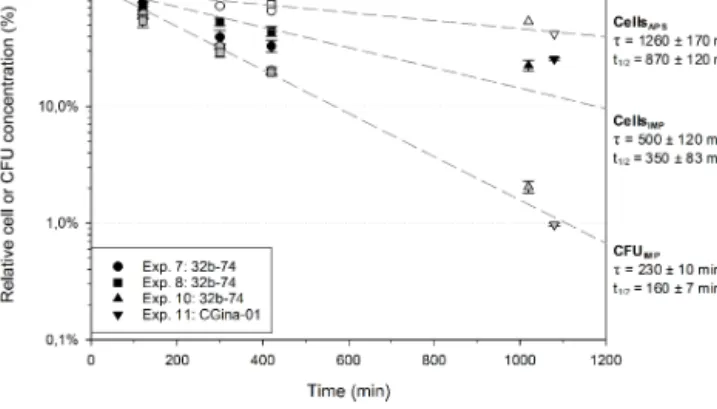
concen-trations was determined from experiments #7, #8, #10 and #11 (Fig. 1). The concentration of particles in the 1
µm-mode (CellsAPS) decreased exponentially over time with a
time constant τ = 1260 ± 170 min (Pearson’s r = 0.992; n =
7). The concentration of airborne cells (CellsIMP)decreased
faster with a time constant τ = 500 ± 120 min (Pearson’s
r =0.937; n = 9). The upper bound diameter of the CellsAPS
size mode, extending to approximately 5 µm at the begin-ning of the experiments, decreased to around 3 µm after 7 h,
and the cell-to-particle ratio (CellsIMP/CellsAPS)decreased
from 1.82 ± 0.40 (n = 13) to 1.06 ± 0.06 (n = 2). These in-dicated that the cell clusters were progressively removed from the aerosol population by sedimentation. Cultivable
cell concentration (CFUIMP) decreased with a time constant
τ =230 ± 10 min (Pearson’s r = 0.990; n = 9). This
con-centration therefore decreased about twice as fast as that
of the concentration of total cells CellsIMP due to
addi-tional temporal loss of cultivability. The decay rate
con-stant b for cultivability was ∼ 0.28 % min−1,
correspond-ing to a time constant τ = 360 ± 40 min and a half-life
t1/2=250 ± 30 min (3.5 to 4.5 h) (Pearson’s r = 0.911; n =
9) (Fig. 2). This has to be regarded as the most conservative estimate (lower bound) for viability, as viable but non cul-tivable (VBNC) state is common in aerosolized cells (Hei-delberg et al., 1997).
Despite the fact that the bacteria investigated here are non-spore-formers, they lost cultivability only 1.5 to 3 times faster than spores of Bacillus subtilis within the same temperature range, which decayed at rates of 0.19 % and
0.10 % min−1 at −29 and 4◦C, respectively (Ehrlich et al.,
1970). Lighthart (1989) proposed a general time-dependent model of biological decay (decrease of survival rate) for air-borne bacteria by mixing experimental data from several bac-terial strains, including Pseudomonas species (Fig. 2). This fits our data with a Pearson’s r of only 0.517 (n = 9), and
Figure 1. Temporal evolution of total airborne cell concentration measured with the APS (CellsAPS, open symbols) and total and cultivable cells concentrations measured from impinger samples (CellsIMP, black symbols, and CFUIMP, grey symbols,
respec-tively) of P. syringae 32b-74 and P. fluorescens CGina-01 in the chamber, relative to the concentrations measured 30 min after spray-ing cell suspensions. Error bars are standard deviations from the mean of triplicate samples. The curves show fitted exponential tem-poral decays. For total particles: Pearson’s r = 0.992, n = 7; for total cells: Pearson’s r = 0.937, n = 9; for cultivable cells: Pear-son’s r = 0.990, n = 9. Corresponding calculated time constants (τ ) and half-life times (t1/2) are indicated on the right of the
fig-ure (mean ± standard deviation).
we observed a much higher cultivability than what would have been expected from this model, at least for the first 10 h following aerosolization. This implies that the Pseudomonas strains investigated here, which were originally isolated from atmospheric samples, are more resistant as airborne than the average bacterium considered in this model; it could indicate that these strains are to some extent adapted to atmospheric transport (e.g., Šantl-Temkiv et al., 2012).
3.3 Implications for airborne bacteria dissemination
Assuming that bacteria have an aerodynamic diameter of about 1 µm, they have a low sedimentation velocity on the
order of 10−4m s−1(Malcolm and Raupach, 1991). In
addi-tion, such particles fall into the so-called “scavenging gap”, and they have a particularly long residence time in the at-mosphere (Hobbs, 1993). Indeed, residence time was esti-mated to be 2.3 to 9.6 days in the case of single bacterial cells depending on the source ecosystem, with a global mean of 3.4 days (Burrows et al., 2009a). Under our conditions, af-ter 1 day airborne, 1.7 % of the cells would still be cultivable. Based on these extreme and mean residence times, between
0.009 and 1.22 × 10⁻¹⁵% of aerosolized cells (0.0001 % in
average, i.e. 1/106) would survive the duration of their
at-mospheric journey until deposition. Statistically, this implies
that the emission of at least 11 000 cells is necessary, 106on
average, to assure that one survives the residence time and arrives at its endpoint by atmospheric dissemination.
Figure 2. Temporal evolution after aerosolization of the proportion of cultivable cells (cultivability) in impinger samples in P. syringae 32b-74 and P. fluorescens CGina-01, relative to the cultivability measured 30 min after spraying cell suspensions, in the absence of cloud (black symbols) or after cloud formation and dissipation (open symbols). Error bars are standard deviations from the mean of triplicate samples. The black dashed curve shows fitted expo-nential temporal decay of cultivability in the absence of a cloud (Pearson’s r = 0.911, n = 9). The corresponding calculated time constant (τ ) and half-life time (t1/2) are indicated on the right of
the figure (mean ± standard deviation). Data using the Eq. (5) from Lighthart (1989) are also plotted for comparison (dashed grey line); this model valid for an “average” bacterial strain fits our data with a Pearson’s r of 0.517 (n = 9).
Aerosolization, i.e. the transfer of cells from a solid sur-face or from a liquid to the air, is a critical step. In nature, the drag forces created by wind on surfaces generate aerosols by saltation/blasting phenomena (Grini et al., 2002) and re-sult in increased amounts of airborne microorganisms during high wind speed events (e.g., Lindemann and Upper, 1985). Splashing raindrops on surfaces colonized by microorgan-isms like plant leaves also lead to the aerosolization of liv-ing bacteria (Graham et al., 1977). From liquids, a well-known process of aerosolization is bubble-bursting (Blan-chard and Syzdek, 1982). This is actually a phenomenon by which certain types of cells in a community are preferentially aerosolized, thus adding a new layer of complexity in the pro-cess of bacterial aerosolization as it results in dissimilarities between the microbial composition in the bulk liquid source and in the air above (Agogué et al., 2005; Fahlgren et al., 2015). The complexity of this phenomenon was probably not reflected in our experimental setup, with bacterial cells being sprayed from liquid suspensions. However, the results pre-sented here only considered bacteria already aerosolized and avoided taking into account the aerosolization step. Hence, considering that the process of aerosolization did not affect subsequent survival rates as aerosol, we can place our re-sults in natural atmospheric context. Plants are among the strongest natural sources of airborne bacteria identified, with
emission fluxes around 500 CFU m−2s−1 measured above
bean and alfalfa fields (Lindemann et al., 1982). At such a
rate, each m2of crop field would emit 1 cell capable of
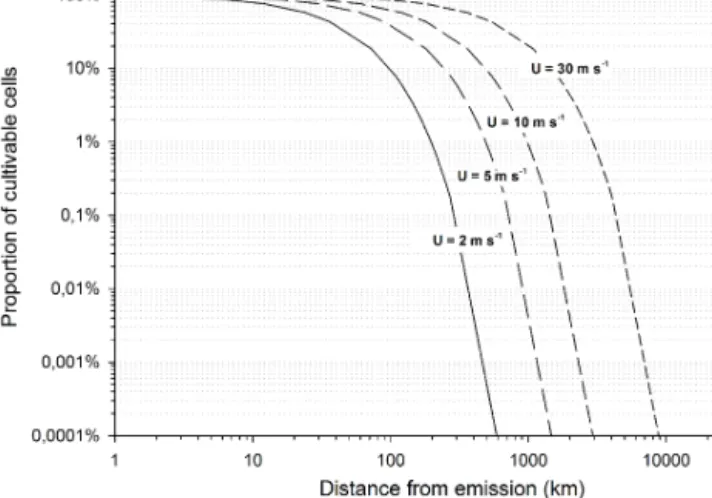
sur-Figure 3. Proportion of cultivable airborne cells associated with the distance reached from their emission source for typical hor-izontal wind velocities (2. 5. 10 and 30 m s−1, i.e. 7.2, 18, 36 and 108 km h−1, respectively), relative to the respective initial cul-tivability, as inferred from the data presented in Fig. 2. The propor-tion of 0.0001 % is reached in 3.4 days, the mean residence time of bacteria in the atmosphere estimated by Burrows et al. (2009a).
viving its atmospheric transport every 33 min. In other words, 1 cell capable of disseminating alive would be emitted every
second by a field of ∼ 2000 m2.
Once airborne, as a first approximation bacteria are pas-sively transported horizontally at the speed of horizontal wind. So, for typical horizontal winds in the troposphere, i.e.
∼2 to ∼ 30 m s−1(not considering extreme events such as
storms or cyclones), at the survival rate measured here, 50 % of the cells emitted alive from a source would be transported about 30 to 600 km away, and 1 % would reach the ground up to 4000 km away (Fig. 3). There are indeed many obser-vations of such long distance transport of living bacteria be-tween distant ecosystems in nature (Bovallius et al., 1978; Hervàs et al., 2009; Hervàs and Casamayor, 2009; Comte et al., 2014).
3.4 Impact of cloud processing
The conditions investigated here (temperature between −20
and 0◦C and absence of light) can be considered relatively
close to the conditions encountered in the high atmosphere during the night. It is probable that in nature, during the day, UV light has deleterious effect and increases mortality rates (Tong and Lighthart, 1997). In addition, cloud formation can alter viability, as shown in samples collected after expansion cooling (i.e. depressurization) experiments (experiments #6 and #9). Even though it is not statistically testable here, we noticed a strong decrease in the cultivability of P .s. 32b-74 and CGina-01 cells exposed to a cloud (see Table 1, Figs. 2 and S1). Fractions of only about ∼ 12 and ∼ 40 % of the cells cultivable before expansion cooling remained cultivable af-ter cloud dissipation for 32b-74 and CGina-01, respectively,
compared to ∼ 70 % when the pressure was maintained con-stant. For cloud formation in the AIDA chamber, pressure
was typically decreased at rates of 30 to 50 hPa min−1
dur-ing expansion, and the associated cooldur-ing rates were
typi-cally 2 K min−1 at the beginning of an expansion and
be-low 0.5 K min−1towards the end of the expansion.
Consider-ing pressure and temperature changes with altitude of 10 hPa and 1 K every 100 m, these roughly correspond to uplifts of
air masses of around 100 to 500 m min−1(1.7 to 8.3 m s−1),
which falls within the range of observations for convective precipitating clouds (Balsley et al., 1988). Our results sug-gest that the shifts in environmental conditions encountered by living cells transported upward, along with the osmotic shock and free radicals generated by water condensation and freezing (e.g., Stead and Park, 2000; Tanghe et al., 2003) probably alter airborne cell survival in clouds to a larger ex-tent compared with non-convective situations.
3.5 Ice nucleation activity
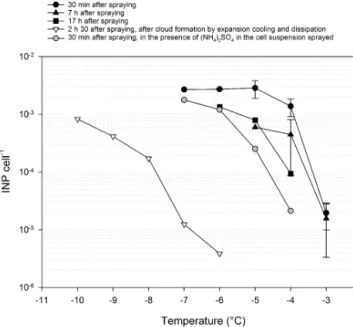
Figure 4 shows freezing profiles of air samples col-lected by impingement from the cloud chamber at different times after injection of P. syringae 32b-74 suspensions. Thirty minutes after aerosolization, there
were ∼2 × 10⁻⁵INP cell−1 at −3◦C (1 INP every
∼50 000 cells) and ∼ 3 × 10⁻³INP cell−1 at −5◦C (1 INP
every ∼ 333 cells) on a per-total-cells (CellsIMP)basis. This
is about one tenth the IN activity of cells in suspension for this strain (Joly et al., 2013). Decreased IN activity in airborne bacteria compared with suspension was expected from previous observations in cloud simulation chamber involving P. syringae (Maki and Willoughby, 1978). No further significant loss of activity over time was observed
at temperatures ≤ −4◦C in aerosolized cells (ANOVA, 5 %
confidence level), i.e. the frequency of INP cell−1 did not
vary with time after aerosolization. This confirmed that non-viable cells retained IN activity, as previously reported (Kozloff et al., 1991).
In the natural atmosphere, phenomena such as coating may affect bacterial IN activity. For example coating with sulfate was reported to decrease the IN activity of soot or Arizona Test Dust particles, a material widely used in laboratory ice nucleation studies as a surrogate for natural mineral aerosols (Cziczo et al., 2009; Möhler et al., 2005). However, sulfate coating had no detectable impact on the IN activity of the commercial powder of lyophilized IN active P. syringae cells Snomax (Chernoff and Bertram, 2010). In order to further investigate the influence of sulfate coating, cells were sus-pended in a solution of ammonium sulfate instead of water before being sprayed into the chamber (experiment #12, Ta-ble 1). Thirty minutes after spraying, we found that the fre-quency of INP per cell had decreased markedly compared to cells sprayed from water suspensions, especially at the warmest temperatures of activity: the frequency of INP per cell was decreased by about 98.5, 91 and 34 % at −4, −5,
Figure 4. Cumulative frequencies of INP per airborne cell in P.
sy-ringae 32b-74 within the AIDA chamber 30 min, 7 h and 17 h after
aerosolization in the absence of cloud (black symbols), 30 min after aerosolization in the presence of ammonium sulfate (grey symbols), and when the pressure inside the chamber was returned to ambient after cloud formation by expansion cooling (open triangles). Error bars are standard deviations from the mean of independent experi-ments, when available.
and −7◦C, respectively (Fig. 4). In this particular bacterial
strain, pH at values typical for cloud water influenced by anthropogenic emissions (pH ∼ 4) were also shown to be responsible for a significant decrease in INA (Attard et al., 2012). Such observations show that the IN activity of bacte-ria is clearly modulated by abiotic factors, and this must be kept in mind when replacing experimentations into environ-mental context.
The capacity of cells of nucleating ice in the atmosphere is particularly relevant where condensed water is present, i.e. in clouds. Using the AIDA chamber, it was shown previ-ously that some strains of P. viridiflava and P. syringae can
act as INP in clouds at temperatures around −10◦C in the
immersion-freezing mode (Möhler et al., 2008). Here, clouds were formed in the chamber by expansion cooling in two experiments (experiments #6 and #9), and aerosol samples were collected by impingement after cloud dissipation, when the pressure inside the chamber was back to ambient pressure (Table 1). The onset ice formation temperature of the
im-pingement liquid was −6◦C, compared to −3◦C in samples
not exposed to cloud, and the frequency of INP per cell was decreased by three orders of magnitude (Fig. 4). A possible deactivation effect of the IN activity of bacteria was already suggested from equivalent experiments (Möhler et al., 2008). However, our results expressed on a per-cell basis suggest that, more likely, IN active cells among a population of air-borne bacteria were more efficiently precipitated than others.
This could explain the observed distribution of IN active bac-teria in natural air, clouds and precipitation: Stephanie and Waturangi (2011) observed that the proportion of IN active bacterial strains was higher in falling rain water than in the air at the same location. In addition, whereas only 50 % of the P. syringae strains isolated from non-precipitating cloud water were IN active (eight strains) (Joly et al., 2013), those isolated from freshly fallen snow by Morris et al. (2008) all had this capacity (47 strains).
4 Conclusions
In this work, we observed that the concentration and cul-tivability of cells aerosolized in the AIDA cloud chamber decreased exponentially over time at constant rates. Aggre-gation seemed to favor cell survival, but this was of course at the cost of the time span as airborne and so, in nature, of the potential distance of dispersion. Hence, for bacteria, aerial dissemination is clearly a compromise between the distance traveled (which decreases for large aggregates) and the chances of successful dissemination (which increases for large aggregates).
The survival rate determined here should provide a basis to the existing numerical models describing the aerial disper-sion of bacteria (Burrows et al., 2009a; Sesartic et al., 2012), in order to better predict their atmospheric transport as living entities. By focusing on time as the only explicative variable, we were able to explain quite well (Pearson’s r = 0.911) the decrease of cultivability observed for Pseudomonas sy-ringae and P. fluorescens in the AIDA chamber, although adjustments of the predictions in an environmental context could be made by integrating viability parameters as needed, like temperature, humidity, UV, or phenotypic traits. Some work in this direction has already been carried out (Attard et al., 2012; Lighthart, 1973; Lighthart et al., 1971; Smith et al., 2011; Tong and Lighthart, 1997), but more experiments would help build a more mechanistic viability model. In ad-dition, these models are still weakened by the large uncer-tainties that remain concerning the input to be used, as there are still very few data available about the sources of airborne bacteria and the associated emission fluxes (e.g. Lindemann et al., 1982). These need to be documented for different sur-face types and meteorological situations.
Numerical simulations demonstrated that the impact of IN active bacteria on precipitation is probably negligible at the scale of the planet (Hoose et al., 2010; Sesartic et al., 2012). However, precipitation patterns at regional scales have important socio-economic impacts and the underlying pro-cesses still need to be elucidated. We observed that the IN activity of airborne bacteria did not change over time for at least several hours after aerosolization. In nature, this is enough time for an IN active cell to be transported to high al-titudes and get incorporated into a cloud. Then, as suggested by others (Constantinidou et al., 1990; Möhler et al., 2008;
Morris et al., 2008, 2014), they can induce freezing of su-percooled droplets, trigger precipitation and thus selectively prime their own redeposition. For a complete and accurate description of the transport of bacteria in the atmosphere, the partitioning of cells and in particular of IN active cells, be-tween air, clouds and precipitation should be determined.
The Supplement related to this article is available online at doi:10.5194/acp-15-6455-2015-supplement.
Acknowledgements. This research was funded by the joint
DFG-CNRS project “BIOCLOUDS” (DFG contract MO 668/2-1) and by the international program EUROCHAMP (Integration of European Simulation Chambers for Investigating Atmospheric Processes). We particularly thank Martine Sancelme, Catherine Glaux, and Jonathan Colombet for technical assistance with microbiology and flow cytometry. E. Attard acknowledges Blaise Pascal University and CNRS for postdoctoral fellowships. M. Joly is grateful to the Auvergne Region for PhD scholarship. Continuous support by the AIDA technical team is gratefully acknowledged. We also thank Thomas Schwartz from the KIT Institute for Functional Surfaces for kind material support to microbiological manipulations. The AIDA part is also funded by the Helmholtz Association through its program “Atmosphere and Climate (ATMO)”.
Edited by: B. Ervens
References
Agogué, H., Joux, F., Obernosterer, I., and Lebaron, P.: Resis-tance of marine bacterioneuston to solar radiation, Appl. Env-iron. Microbiol., 71, 5282–5289, doi:10.1128/AEM.71.9.5282-5289.2005, 2005.
Amato, P., Parazols, M., Sancelme, M., Laj, P., Mailhot, G., and De-lort, A.-M.: Microorganisms isolated from the water phase of tro-pospheric clouds at the Puy de Dôme: major groups and growth abilities at low temperatures, FEMS Microbiol. Ecol., 59, 242– 254, doi:10.1111/j.1574-6941.2006.00199.x, 2007.
Attard, E., Yang, H., Delort, A.-M., Amato, P., Pöschl, U., Glaux, C., Koop, T., and Morris, C. E.: Effects of atmospheric conditions on ice nucleation activity of Pseudomonas, Atmos. Chem. Phys., 12, 10667–10677, doi:10.5194/acp-12-10667-2012, 2012. Balsley, B. B., Ecklund, W. L., Carter, D. A., Riddle, A. C.,
and Gage, K. S.: Average vertical motions in the tropical atmosphere observed by a radar wind profiler on Pohnpei (7◦N latitude, 157◦E longitude), J. Atmos. Sci., 45, 396–405, doi:10.1175/1520-0469(1988)045<0396:AVMITT>2.0.CO;2, 1988.
Berge, O., Monteil, C. L., Bartoli, C., Chandeysson, C., Guilbaud, C., Sands, D. C., and Morris, C. E.: A user’s guide to a data base of the diversity of Pseudomonas syringae and its application to classifying strains in this phylogenetic complex, PLoS ONE, 9, e105547, doi:10.1371/journal.pone.0105547, 2014.
Blanchard, D. C. and Syzdek, L. D.: Water-to-Air transfer and en-richment of bacteria in drops from bursting bubbles, Appl. Envi-ron. Microbiol., 43, 1001–1005, 1982.
Bovallius, A., Bucht, B., Roffey, R., and Anas, P.: Long-range air transmission of bacteria, Appl. Environ. Microbiol., 35, 1231– 1232, 1978.
Brodie, E. L., DeSantis, T. Z., Parker, J. P. M., Zubietta, I. X., Pi-ceno, Y. M., and Andersen, G. L.: Urban aerosols harbor diverse and dynamic bacterial populations, P. Natl. Acad. Sci., 104, 299– 304, doi:10.1073/pnas.0608255104, 2007.
Burrows, S. M., Butler, T., Jöckel, P., Tost, H., Kerkweg, A., Pöschl, U., and Lawrence, M. G.: Bacteria in the global at-mosphere – Part 2: Modeling of emissions and transport be-tween different ecosystems, Atmos. Chem. Phys., 9, 9281–9297, doi:10.5194/acp-9-9281-2009, 2009a.
Burrows, S. M., Elbert, W., Lawrence, M. G., and Pöschl, U.: Bac-teria in the global atmosphere – Part 1: Review and synthesis of literature data for different ecosystems, Atmos. Chem. Phys., 9, 9263–9280, doi:10.5194/acp-9-9263-2009, 2009b.
Chernoff, D. I. and Bertram, A. K.: Effects of sulfate coatings on the ice nucleation properties of a biological ice nucleus and sev-eral types of minsev-erals, J. Geophys. Res.-Atmos., 115, D20205, doi:10.1029/2010JD014254, 2010.
Cochet, N. and Widehem, P.: Ice crystallization by Pseudomonas
syringae, Appl. Microbiol. Biotechnol., 54, 153–161, 2000.
Comte, J., Lindström, E. S., Eiler, A., and Langenheder, S.: Can marine bacteria be recruited from freshwater sources and the air?, ISME J., 8, 2423–2430, doi:10.1038/ismej.2014.89, 2014. Constantinidou, H. A., Hirano, S. S., Baker, L. S., and Upper, C. D.:
Atmospheric dispersal of ice nucleation-active bacteria: the role of rain, Phytopathology, 80, 934–937, 1990.
Cox, C. S. and Goldberg, L. J.: Aerosol survival of Pasteurella
tu-larensis and the influence of relative humidity, Appl. Microbiol.,
23, 1–3, 1972.
Cziczo, D. J., Froyd, K. D., Gallavardin, S. J., Moehler, O., Benz, S., Saathoff, H., and Murphy, D. M.: Deactivation of ice nuclei due to atmospherically relevant surface coatings, Environ. Res. Lett., 4, 044013, doi:10.1088/1748-9326/4/4/044013, 2009. Ehrlich, R., Miller, S., and Walker, R. L.: Relationship between
at-mospheric temperature and survival of airborne bacteria, Appl. Microbiol., 19, 245–249, 1970.
Fahlgren, C., Gómez-Consarnau, L., Zábori, J., Lindh, M. V., Kre-jci, R., Mårtensson, E. M., Nilsson, D., and Pinhassi, J.: Sea-water mesocosm experiments in the Arctic uncover differential transfer of marine bacteria to aerosols, Environ. Microbiol. Rep., 460–470, doi:10.1111/1758-2229.12273, 2015.
Foreman, C. M., Cory, R. M., Morris, C. E., SanClements, M. D., Smith, H. J., Lisle, J. T., Miller, P. L., Chin, Y.-P., and McKnight, D. M.: Microbial growth under humic-free condi-tions in a supraglacial stream system on the Cotton Glacier, Antarctica, Environ. Res. Lett., 8, 035022, doi:10.1088/1748-9326/8/3/035022, 2013.
Graham, D. C., Quinn, C. E., and Bradley, L. F.: Quantitative studies on the generation of aerosols of Erwinia carotovora var.
atrosep-tica by simulated raindrop impaction on blackleg-infected potato
stems, J. Appl. Bacteriol., 43, 413–424, doi:10.1111/j.1365-2672.1977.tb00768.x, 1977.
Griffin, D. W., Garrison, V. H., Herman, J. R., and Shinn, E. A.: African desert dust in the Caribbean atmosphere:
Microbiology and public health, Aerobiologia, 17, 203–213, doi:10.1023/A:1011868218901, 2001.
Grini, A., Zender, C. S., and Colarco, P. R.: Saltation Sandblasting behavior during mineral dust aerosol production, Geophys. Res. Lett., 29, 1868, doi:10.1029/2002GL015248, 2002.
Hammer, Ø., Ryan, P., and Harper, D.: PAST: Paleontological Statistics software package for education and data analysis, Palaeontol. Electron., 4, 9, 2001.
Heidelberg, J. F., Shahamat, M., Levin, M., Rahman, I., Stelma, G., Grim, C., and Colwell, R. R.: Effect of aerosolization on cultur-ability and vicultur-ability of Gram-negative bacteria., Appl. Environ. Microbiol., 63, 3585–3588, 1997.
Hervas, A. and Casamayor, E. O.: High similarity between bacte-rioneuston and airborne bacterial community compositions in a high mountain lake area, FEMS Microbiol. Ecol., 67, 219–228, doi:10.1111/j.1574-6941.2008.00617.x, 2009.
Hervàs, A., Camarero, L., Reche, I., and Casamayor, E. O.: Viability and potential for immigration of airborne bacteria from Africa that reach high mountain lakes in Europe, Environ. Microbiol., 11, 1612–1623, doi:10.1111/j.1462-2920.2009.01926.x, 2009. Hobbs, P. V.: Aerosol-Cloud-Climate Interactions Vol. 54,
Aca-demic Press, San Diego, 235 pp., 1993.
Hoose, C., Kristjánsson, J. E., and Burrows, S. M.: How important is biological ice nucleation in clouds on a global scale?, Environ. Res. Lett., 5, 024009, doi:10.1088/1748-9326/5/2/024009, 2010. Jensen, P. A., Todd, W. F., Davis, G. N., and Scarpino, P. V.: Eval-uation of Eight Bioaerosol Samplers Challenged with Aerosols of Free Bacteria, Am. Ind. Hyg. Assoc. J., 53, 660–667, doi:10.1080/15298669291360319, 1992.
Joly, M., Attard, E., Sancelme, M., Deguillaume, L., Guilbaud, C., Morris, C. E., Amato, P., and Delort, A.-M.: Ice nucleation ac-tivity of bacteria isolated from cloud water, Atmos. Environ., 70, 392–400, doi:10.1016/j.atmosenv.2013.01.027, 2013.
King, E. O., Ward, M. K., and Raney, D. E.: Two simple media for the demonstration of pyocyanin and fluorescin, J. Lab. Clin. Med., 44, 301–307, 1954.
Kozloff, L. M., Turner, M. A., and Arellano, F.: Formation of bac-terial membrane ice-nucleating lipoglycoprotein complexes, J. Bacteriol., 173, 6528–6536, 1991.
Lighthart, B.: Survival of airborne bacteria in a high urban concen-tration of carbon monoxide, Appl. Microbiol., 25, 86–91, 1973. Lighthart, B.: A statistical model of laboratory death rate
mea-surements for airborne bacteria, Aerobiologia, 5, 138–144, doi:10.1007/BF02486511, 1989.
Lighthart, B., Hiatt, V. E., and Rossano Jr., A. T.: The survival of airborne Serratia marcescens in urban concentrations of sulfur dioxide, J. Air Pollut. Control Assoc., 21, 639–642, 1971. Lin, X., A. Reponen, T., Willeke, K., Grinshpun, S. A., Foarde, K.
K., and Ensor, D. S.: Long-term sampling of airborne bacteria and fungi into a non-evaporating liquid, Atmos. Environ., 33, 4291–4298, doi:10.1016/S1352-2310(99)00169-7, 1999. Lindemann, J. and Upper, C. D.: Aerial dispersal of epiphytic
bacte-ria over bean plants, Appl. Environ. Microbiol., 50, 1229–1232, 1985.
Lindemann, J., Constantinidou, H. A., Barchet, W. R., and Up-per, C. D.: Plants as sources of airborne bacteria, including ice nucleation-active bacteria, Appl. Environ. Microbiol., 44, 1059– 1063, 1982.
Maki, L. R. and Willoughby, K. J.: Bacteria as biogenic sources of freezing nuclei., J. Appl. Meteorol., 17, 1049–1053, 1978. Malcolm, L. P. and Raupach, M. R.: Measurements in an air settling
tube of the terminal velocity distribution of soil material, J. Geo-phys. Res.-Atmos., 96, 15275–15286, doi:10.1029/91JD01198, 1991.
Marthi, B., Fieland, V. P., Walter, M., and Seidler, R. J.: Survival of bacteria during aerosolization., Appl. Environ. Microbiol., 56, 3463–3467, 1990.
Möhler, O., Büttner, S., Linke, C., Schnaiter, M., Saathoff, H., Stet-zer, O., Wagner, R., Krämer, M., Mangold, A., Ebert, V., and Schurath, U.: Effect of sulfuric acid coating on heterogeneous ice nucleation by soot aerosol particles, J. Geophys. Res.-Atmos., 110, D11210, doi:10.1029/2004JD005169, 2005.
Möhler, O., DeMott, P. J., Vali, G., and Levin, Z.: Microbiology and atmospheric processes: the role of biological particles in cloud physics, Biogeosciences, 4, 1059–1071, doi:10.5194/bg-4-1059-2007, 2007.
Möhler, O., Georgakopoulos, D. G., Morris, C. E., Benz, S., Ebert, V., Hunsmann, S., Saathoff, H., Schnaiter, M., and Wagner, R.: Heterogeneous ice nucleation activity of bacteria: new labora-tory experiments at simulated cloud conditions, Biogeosciences, 5, 1425–1435, doi:10.5194/bg-5-1425-2008, 2008.
Monteil, C. L., Bardin, M., and Morris, C. E.: Features of air masses associated with the deposition of Pseudomonas syringae and
Botrytis cinerea by rain and snowfall, ISME J., 8, 2290–2304,
doi:10.1038/ismej.2014.55, 2014.
Morris, C. E., Kinkel, L. L., Xiao, K., Prior, P., and Sands, D. C.: Surprising niche for the plant pathogen
Pseudomonas syringae, Infect. Genet. Evol., 7, 84–92, doi:10.1016/j.meegid.2006.05.002, 2007.
Morris, C. E., Sands, D. C., Vinatzer, B. A., Glaux, C., Guil-baud, C., Buffière, A., Yan, S., Dominguez, H., and Thomp-son, B. M.: The life history of the plant pathogen Pseudomonas
syringae is linked to the water cycle, ISME J., 2, 321–334,
doi:10.1038/ismej.2007.113, 2008.
Morris, C. E., Conen, F., Huffman, J. A., Phillips, V., Pöschl, U., and Sands, D. C.: Bioprecipitation: a feedback cycle linking Earth history, ecosystem dynamics and land use through biological ice nucleators in the atmosphere, Glob. Change Biol., 20, 341–351, doi:10.1111/gcb.12447, 2014.
Morris, C. E., Leyronas, C. and Nicot, P. C.: Movement of Bioaerosols in the Atmosphere and the Consequences for Cli-mate and Microbial Evolution, in Aerosol Science, edited by: Colbeck, I. and Lazaridis, M., 393–415, John Wiley & Sons, Ltd, Chichester, UK, doi:10.1002/9781118682555.ch16, 2013. Reasoner, D. J. and Geldreich, E. E.: A new medium for the
enu-meration and subculture of bacteria from potable water., Appl. Environ. Microbiol., 49, 1–7, 1985.
Sands, D. C., Langhans, V. E., Scharen, A. L., and de Smet, G.: The association between bacteria and rain and possible resultant me-teorological implications, Journal of the Hungarian Meteorology Service, 86, 148–152, 1982.
Šantl-Temkiv, T., Finster, K., Hansen, B. M., Nielsen, N. W., and Karlson, U. G.: The microbial diversity of a storm cloud as assessed by hailstones, FEMS Microbiol. Ecol., 81, 684–695, 2012.
Šantl-Temkiv, T., Finster, K., Dittmar, T., Hansen, B. M., Thyrhaug, R., Nielsen, N. W., and Karlson, U. G.: Hailstones: A window into the microbial and chemical inventory of a storm cloud, PloS one, 8, e53550, doi:10.1371/journal.pone.0053550, 2013. Sesartic, A., Lohmann, U., and Storelvmo, T.: Bacteria in the
ECHAM5-HAM global climate model, Atmos. Chem. Phys., 12, 8645–8661, doi:10.5194/acp-12-8645-2012, 2012.
Shaffer, B. T. and Lighthart, B.: Survey of culturable airborne bac-teria at four diverse locations in Oregon: urban, rural, forest, and coastal, Microb. Ecol., 34, 167–177, 1997.
Smith, D. J., Griffin, D. W., McPeters, R. D., Ward, P. D., and Schuerger, A. C.: Microbial survival in the stratosphere and implications for global dispersal, Aerobiologia, 27, 319–332, doi:10.1007/s10453-011-9203-5, 2011.
Smith, D. J., Timonen, H. J., Jaffe, D. A., Griffin, D. W., Birmele, M. N., Perry, K. D., Ward, P. D., and Roberts, M. S.: Intercontinental dispersal of Bacteria and Archaea by transpacific winds, Appl. Environ. Microbiol., 79, 1134–1139, doi:10.1128/AEM.03029-12, 2013.
Stead, D. and Park, S. F.: Roles of Fe superoxide dismutase and catalase in resistance of Campylobacter coli to freeze-thaw stress, Appl. Environ. Microbiol., 66, 3110–3112, 2000. Stephanie and Waturangi, D. E.: Distribution of ice
nucleation-active (INA) bacteria from rain-water and air, J. Biosciences, 18, 108, doi:10.4308/hjb.18.3.108, 2011.
Tanghe, A., Van Dijck, P., and Thevelein, J. M.: Determinants of freeze tolerance in microorganisms, physiological importance, and biotechnological applications, Adv. Appl. Microbiol., 53, 129–176, 2003.
Terzieva, S., Donnelly, J., Ulevicius, V., Grinshpun, S. A., Willeke, K., Stelma, G. N., and Brenner, K. P.: Comparison of methods for detection and enumeration of airborne microorganisms collected by liquid impingement., Appl. Environ. Microbiol., 62, 2264– 2272, 1996.
Tong, Y. and Lighthart, B.: Solar radiation has a lethal effect on natural populations of culturable outdoor atmospheric bacteria, Atmos. Environ., 31, 897–900, 1997.
Vaïtilingom, M., Attard, E., Gaiani, N., Sancelme, M., Deguillaume, L., Flossmann, A. I., Amato, P., and Delort, A.-M.: Long-term features of cloud microbiology at the puy de Dôme (France), At-mos. Environ., 56, 88–100, doi:10.1016/j.atmosenv.2012.03.072, 2012.
Vali, G.: Quantitative Evaluation of Experimental Results on the Heterogeneous Freezing Nucleation of Supercooled Liquids, J. Atmos. Sci., 28, 402–409, 1971.
Wright, D. N., Bailey, G. D., and Goldberg, L. J.: Effect of Temper-ature on Survival of Airborne Mycoplasma pneumoniae, J. Bac-teriol., 99, 491–495, 1969.