HAL Id: hal-00301309
https://hal.archives-ouvertes.fr/hal-00301309
Submitted on 22 Jun 2004HAL is a multi-disciplinary open access
archive for the deposit and dissemination of sci-entific research documents, whether they are pub-lished or not. The documents may come from teaching and research institutions in France or abroad, or from public or private research centers.
L’archive ouverte pluridisciplinaire HAL, est destinée au dépôt et à la diffusion de documents scientifiques de niveau recherche, publiés ou non, émanant des établissements d’enseignement et de recherche français ou étrangers, des laboratoires publics ou privés.
Mass balance inverse modelling of methane in the 1990s
using a Chemistry Transport Model
T. M. Butler, I. Simmonds, P. J. Rayner
To cite this version:
T. M. Butler, I. Simmonds, P. J. Rayner. Mass balance inverse modelling of methane in the 1990s using a Chemistry Transport Model. Atmospheric Chemistry and Physics Discussions, European Geosciences Union, 2004, 4 (3), pp.3419-3483. �hal-00301309�
ACPD
4, 3419–3483, 2004
Mass balance inverse modelling of methane T. M. Butler et al. Title Page Abstract Introduction Conclusions References Tables Figures J I J I Back Close Full Screen / Esc
Print Version Interactive Discussion
© EGU 2004
Atmos. Chem. Phys. Discuss., 4, 3419–3483, 2004 www.atmos-chem-phys.org/acpd/4/3419/
SRef-ID: 1680-7375/acpd/2004-4-3419 © European Geosciences Union 2004
Atmospheric Chemistry and Physics Discussions
Mass balance inverse modelling of
methane in the 1990s using a Chemistry
Transport Model
T. M. Butler1, *, I. Simmonds1, and P. J. Rayner2
1
School of Earth Sciences, Melbourne University, Australia
2
CSIRO Atmospheric Research, Melbourne, Australia
*
Present affiliation: Max Planck Institute for Chemistry, Mainz, Germany Received: 7 April 2004 – Accepted: 24 May 2004 – Published: 22 June 2004 Correspondence to: T. M. Butler ([email protected])
ACPD
4, 3419–3483, 2004
Mass balance inverse modelling of methane T. M. Butler et al. Title Page Abstract Introduction Conclusions References Tables Figures J I J I Back Close Full Screen / Esc
Print Version Interactive Discussion
© EGU 2004
Abstract
A mass balance inverse modelling procedure is applied with a time-dependent methane concentration boundary condition and a chemical transport model to relate observed changes in the surface distribution of methane mixing ratios during the 1990s to changes in its surface sources. This work serves as an important starting point for 5
future inverse modelling work examining changes in both the source and sink terms in the methane budget together. The model reproduces essential features of the global methane cycle, such as the latitudinal distribution and seasonal cycle of fluxes, without using a priori knowledge of methane fluxes. A detailed description of the temporal and spatial variability of the fluxes diagnosed by the inverse procedure is presented, and 10
compared with previously hypothesised changes in the methane budget, and previ-ous inverse modelling studies. The sensitivity of the inverse results to the forcing data supplied by surface measurements of methane from the NOAA CMDL cooperative air sampling network is also examined.
1. Introduction
15
Methane (CH4) is a potent greenhouse gas which is about two and a half times more concentrated in the present day atmosphere than it was in pre-industrial times, and presently contributes to about 22% of the enhanced greenhouse effect (Lelieveld et al.,
1998). Although its concentration in the atmosphere is growing, the rate of that growth is slowing, and has fluctuated during the 1990s. In order to understand better the 20
processes which control the concentration of methane in the atmosphere and to enable better prediction of methane trends into the future, it is important to understand the reasons for these fluctuations. This work will study the reasons for these observed fluctuations in the growth rate by using mass balance inverse modelling techniques with a chemical transport model.
25
ACPD
4, 3419–3483, 2004
Mass balance inverse modelling of methane T. M. Butler et al. Title Page Abstract Introduction Conclusions References Tables Figures J I J I Back Close Full Screen / Esc
Print Version Interactive Discussion
© EGU 2004
mostly natural wetland emissions, with the remaining two thirds due to anthropogenic processes (Houweling et al.,1999). Most anthropogenic sources tend to be located around regions of high population density, such as the northern midlatitudes. There is also a large tropical methane source from wetlands and biomass burning. The wetland source is particularly sensitive to temperature (Walter et al.,2001), and the biomass 5
burning source can also show interannual variability (Lowe et al.,1997). Sources in the low latitudes generally show a large seasonal variation, with biomass burning sources peaking in the dry (winter) season and emissions from wetlands and rice cultivation peaking in the wet (summer) season. Boreal wetland emissions also show a sea-sonal peak in summer. The midlatitude anthropogenic sources of landfills, domestic 10
ruminants, and emissions associated with fossil fuel production and use are generally assumed to have no seasonal variation (Fung et al.,1991;Hein et al.,1997).
The major sink (∼90%) for methane in the atmosphere is reaction with hydroxyl rad-ical (OH) in the troposphere, with the remainder being oxidised in the stratosphere by reaction with OH, O(1D) and Cl radicals (Lelieveld et al.,1998). Changing emissions 15
of NOx, CO and CH4itself during industrial times may be leading to changes in the ox-idising capacity of the atmosphere through a number of chemical feedback processes, and thus to changes in the lifetime of CH4(Crutzen and Zimmerman,1991).
Figure 1 shows the year to year molar mixing ratio and trend of CH4 through the 1990s, derived from the concentration boundary condition to be shown in Fig.6, which 20
was obtained using the measurement network and constructed using the methodology described in Sect.5. The interannual variability of CH4in the 1990s exhibits three high-growth “events”, in 1991–1992, 1994–1995 and 1997–1998, separated by periods of low growth.
The increase in the growth rate during 1991 has been attributed to the June eruption 25
of Mount Pinatubo in the Phillipines. Dlugokencky et al.(1996) suggest that the injec-tion of volcanic dust and sulphur dioxide into the stratosphere following the erupinjec-tion would have increased the scattering and absorption of UV light in the stratosphere, with the effects of scattering aerosols persisting into 1992. This would have reduced
ACPD
4, 3419–3483, 2004
Mass balance inverse modelling of methane T. M. Butler et al. Title Page Abstract Introduction Conclusions References Tables Figures J I J I Back Close Full Screen / Esc
Print Version Interactive Discussion
© EGU 2004
the flux of UV light into the troposphere, and led to a fall in the tropospheric OH con-centration, thus reducing the sink and leading to the increased CH4growth observed in 1991. Lowe et al.(1997) suggest that there may have been an increased source from biomass burning in the Amazon in 1991 as well.
Bekki et al.(1994) suggest that up to half of the reduced growth in CH4(and CO) ob-5
served in 1992 was due to an increased sink from the increased tropospheric OH con-centration resulting from stratospheric ozone depletion following the eruption leading to an increased flux of UV light into the troposphere. It is not clear whetherBekki et al.
(1994) accounted for the disproportionate role of tropospheric O3 as a filter against solar UV radiation (Br ¨uhl and Crutzen,1989). Tropospheric O3 is more efficient at ab-10
sorbing UV light than stratospheric O3due to the increased path length from multiple scattering (the troposphere being more dense than the stratosphere). Neglecting the effects of multiple scattering would have led to too much UV radiation reaching the moist lower troposphere, and thus too much photochemical production of OH.
Granier et al.(1996) investigated the effects of stratospheric O3depletion in 1992 on 15
the tropospheric OH concentrations using a model which did not include the effects of multiple scattering (M ¨uller and Brasseur,1995) or the enhanced stratospheric aerosol loading, and found a smaller increase in the OH than didBekki et al.(1994). Granier
et al. (1996) found that other factors, such as reduced temperatures observed globally in 1992, and reduced emissions from biomass burning were also important in explain-20
ing the observed changes in CO mixing ratio. Both of those factors would also have affected the CH4mixing ratio.
Lowe et al. (1997) point out that, based on δ13C data, a reduction in the tropical biomass burning source in 1992, again from the Amazon, was probably more likely than a change in the sink due to OH. Additionally,Walter et al.(2001) suggest that reduced 25
emissions from boreal wetlands due to large negative temperature and precipitation anomalies may have played a role in the 1992 event, although the results are highly sensitive to the input data used.Dlugokencky et al. (1994) has also proposed that the reduction in growth observed in 1992 may be due to a reduction in fossil CH4emissions
ACPD
4, 3419–3483, 2004
Mass balance inverse modelling of methane T. M. Butler et al. Title Page Abstract Introduction Conclusions References Tables Figures J I J I Back Close Full Screen / Esc
Print Version Interactive Discussion
© EGU 2004
associated with the breakup of the Soviet Union. Figure1 shows that the low growth rate observed in 1992 was not unique. Recent low growth in 2000 has occurred without being preceded by a major volcanic eruption.
Using multiple species measurements from a global sampling network and vertical profile measurements above Cape Grim, Langenfelds et al. (2002) identified major 5
biomass burning events in both 1994–1995 and 1997–1998, occurring in both tropical and boreal regions, which they characterised by 1 year emissions pulses centred on August 1994 and February 1998. They were however unable to say how much of the trace gas emissions were due to covarying factors such as CH4 emissions from wetlands or rice paddies. They noticed much larger emissions of CO from the 1997– 10
1998 event than they did from the 1994–1995 event. Large CO emissions in late 1997 were also noticed byLevine(1999), using satellite measurements of burnt area, and
Taguchi et al.(2002), using upper tropospheric CO measurements from aircraft. To explain the high growth of CH4 observed in 1998, Dlugokencky et al.(2001) di-vided the globe into four semi hemispheres and translated the observed changes in 15
surface mixing ratio for 1998 in each region into a growth of the CH4burden in those regions which they attempted to explain by a change in the surface source in each region. They used a wetland model forced by observed temperature and precipitation anomalies, and found that the mixing ratio increase observed in 1998 could be ex-plained by a rise in emissions from tropical and boreal wetlands due to the warmer and 20
wetter conditions observed in 1998, as well as an extra source from boreal biomass burning. This approach takes no account of the influence of changes in the chemi-cal sink and transport between semi hemispheres on the observed changes in mixing ratio.
In this paper we start by explaining the experimental setup and then briefly describ-25
ing the climatological CH4 fluxes from the mass balance inverse runs, this paper will then comment in detail on the interannual variability of those CH4fluxes. Results will be presented for a control model run done with fully interactive chemistry, as well as two runs performed with annually repeating seasonal cycles of OH, which explore the effect
ACPD
4, 3419–3483, 2004
Mass balance inverse modelling of methane T. M. Butler et al. Title Page Abstract Introduction Conclusions References Tables Figures J I J I Back Close Full Screen / Esc
Print Version Interactive Discussion
© EGU 2004
of feedbacks CH4 on its own sink, and two more runs performed with boundary con-ditions derived from the different measurement networks discussed in Sect. 5, which explore the sensitivity of the inverse result to the choice of network, which previous studies have found to be an important effect (Sect.2).
There will be brief discussion of the climatological flux and seasonal cycle, but em-5
phasis will be placed on interpreting the anomalous interannual variability in terms of the hypothesised causes of that interannual variability. Results will also be interpreted in terms of the response of the CTM (Chemistry Transport Model) to the forcing sup-plied by the concentration boundary condition, which can have a large effect on the deduced flux. Where appropriate, these results will be compared with the three other 10
time-dependent CH4inverse modelling studies ofSaeki et al.(1998),Law and Vohralik
(2001) andDentener et al.(2003). Comparisons with these studies are not always pos-sible due to the different analysis periods involved (1984–1994 forSaeki et al.(1998), 1985–1997 for Law and Vohralik (2001), and 1979–1993 for Dentener et al. (2003), while this study covers 1990–2000), but they overlap around the time of the Mount 15
Pinatubo eruption, so comparisons of the handling of that event will be made. Results are also compared with some of the published methane budget related non inverse modelling studies, such as those ofDlugokencky et al.(2001) and Langenfelds et al.
(2002).
2. Inverse modelling
20
In this study a mass balance inverse study is performed with a 3-D CTM. This method involves applying a concentration boundary condition to a CTM run of the species of interest. At each timestep the model corrects the predicted surface mixing ratio back to the imposed mixing ratio, thus diagnosing the flux required to maintain that mixing ratio.
25
Mass balance inverse studies have been performed for CO2 with both two dimen-sional (Enting and Mansbridge, 1989) and three dimensional (Law and Simmonds,
ACPD
4, 3419–3483, 2004
Mass balance inverse modelling of methane T. M. Butler et al. Title Page Abstract Introduction Conclusions References Tables Figures J I J I Back Close Full Screen / Esc
Print Version Interactive Discussion
© EGU 2004 1996) CTMs, and have shown that the surface boundary condition itself is a major
source of uncertainty in the inverse result. Weaknesses of the mass balance tech-nique are that the method itself provides no uncertainty analysis, and that the method can not distinguish between different source processes. To obtain an estimate of the variability in the inverse result, a number of sensitivity studies must be performed. In 5
this respect the approach differs from the synthesis inverse technique (e.g.Fung et al.,
1991; Brown, 1993; Hein et al., 1997; Houweling et al., 1999) which can provide a rigorous uncertainty analysis and distinguish between different source processes, al-though a weakness of the synthesis technique is that the chemistry must be linearised, thus removing the potential for the chemical feedbacks to occur. Since the focus of 10
this study is the potential importance of chemical and radiative processes in controlling growth rates, the mass balance inverse method is chosen for this study because it is capable of preserving the complexity of the atmospheric chemistry system.
Saeki et al.(1998) performed a mass balance inversion study using a 2-D CTM and a prescribed annually repeating OH field. Due to the small number of measurements 15
available over their analysis period (1983–1994) and their use of non-continuous sta-tion data they applied statistical techniques to combine a derived seasonal cycle and long-term trend of CH4surface mixing ratio with interannual variability to produce their boundary condition. They compared their diagnosed emissions distribution and sea-sonality with the geographical distribution of emissions from process based synthesis 20
inverse studies such asFung et al.(1991), and found that they were generally consis-tent.
Law and Vohralik(2001) performed a mass balance inverse modelling study with a 3-D CTM using a zonally averaged seasonal cycle of prescribed annually repeating OH concentrations. They performed a number of studies to test the sensitivity of a 25
number of aspects of their diagnosed CH4fluxes to the choice of CTM and the choice of measurement network used to construct their boundary condition. They found that the use of interannually varying winds contributed little to the interannual variability of the diagnosed global CH4flux or the latitudinal distribution of those sources. The actual
ACPD
4, 3419–3483, 2004
Mass balance inverse modelling of methane T. M. Butler et al. Title Page Abstract Introduction Conclusions References Tables Figures J I J I Back Close Full Screen / Esc
Print Version Interactive Discussion
© EGU 2004
origin of the winds – the GCM from which they were calculated – had a much greater impact on these results. In terms of the interannual variability of the diagnosed fluxes, the major difference between runs done with different sources of winds were to the magnitude of the interannual variability, not the timing of events.
The choice of measurement network used to construct the concentration boundary 5
condition was found byLaw and Vohralik (2001) to make more of a difference to the interannual variability of the global CH4 flux than the CTM used or the source of the dynamics data used to drive the CTM. They found, for example, that a network of 10 stations gave very similar interannual variability of diagnosed fluxes on the global scale to a network of 20 stations. The smaller network did however make more of a di ffer-10
ence to interannual variability on regional scales. They found that an important factor in the sensitivity of the diagnosed interannual variability was the number of temporal gaps in the measurement record used to construct the boundary condition, which could lead to spurious interannual variability in the diagnosed fluxes. For example,Law and
Vohralik (2001) pointed out that the observed growth in CH4 mixing ratio in 1991 may 15
be exaggerated if data from stations which came online around the time of the Mount Pinatubo eruption (which tended to measure higher mixing ratios than the previously existing stations) are used to construct a concentration boundary condition. The exag-gerated growth in mixing ratio is translated into an exagexag-gerated diagnosed flux by the mass balance inverse procedure.Law and Vohralik(2001) showed that this effect can 20
be avoided by using a network of stations which remains constant in size over the time period being studied. The boundary condition used in this study will be described in Sect.5.
Dentener et al. (2003) performed a mass balance inverse modelling study using a 3-D CTM with interactive chemistry. Their concentration boundary condition was 25
constructed by taking the zonal average mixing ratio for a single year, and then su-perimposing on this the observed global mean annual trend. This method may have been necessary due to the inability of the small number (12) of observing stations operating during their analysis period (1979–1993) to determine the full zonal
variabil-ACPD
4, 3419–3483, 2004
Mass balance inverse modelling of methane T. M. Butler et al. Title Page Abstract Introduction Conclusions References Tables Figures J I J I Back Close Full Screen / Esc
Print Version Interactive Discussion
© EGU 2004
ity. Unfortunately the use of this method does not allow the regional variability of CH4 measurements to drive regional variability in their diagnosed fluxes. As well as using a concentration boundary condition for CH4, they also applied a flux boundary condition which included CH4 emissions fromHouweling et al. (1999). The fluxes deduced by the mass balance inverse procedure therefore represent the interannual variability of 5
the fluxes fromHouweling et al.(1999).
As well as a fully interactive chemistry run, Dentener et al. (2003) performed two additional studies using monthly averaged OH fields from the interactive chemistry run to test the relative sensitivity of the deduced emissions to transport and chemistry. In one simulation they used an annual cycle of dynamics with OH from the full time period, 10
and in another simulation they used an annual cycle of OH with dynamics from the full time period. They found that the deduced emissions were all quite similar, showing that the emissions are most sensitive to the concentration boundary condition, but that the annually varying OH with annually repeating dynamics was most similar to the fully interannual run, showing that deduced emissions are more sensitive to OH than to 15
transport. It is not clear however to what extent the OH fields are influenced by the interannually varying meteorology used in the initial run.
Their treatment of the 1991–1992 anomaly is noteworthy. They mention the de-creased growth rate in 1992 along with possible mechanisms, but not the inde-creased growth rate in 1991, seen in Fig. 1 and discussed in the literature as mentioned in 20
Sect.1. Their boundary condition (their Fig. 2) does not seem to include such a strong perturbation in the growth rate as observed in Fig.1or by others such asDlugokencky
et al. (1996) andLowe et al.(1997). They did deduce a reduced source in 1992–1993 which they attributed to the effects of the Pinatubo eruption.
3. The CRC-MATCH CTM
25
The model used in this work is CRC-MATCH, the Cooperative Research Centre (for Southern Hemisphere Meteorology) Model of Atmospheric Chemistry and Transport,
ACPD
4, 3419–3483, 2004
Mass balance inverse modelling of methane T. M. Butler et al. Title Page Abstract Introduction Conclusions References Tables Figures J I J I Back Close Full Screen / Esc
Print Version Interactive Discussion
© EGU 2004
a three dimensional chemical transport model developed at the CRC-SHM and based on the NCAR Community Climate Model (version 2)(Hack et al.,1994). It has previ-ously been used for simulations of long-lived stratospheric trace species (Waugh et al.,
1997) and tropospheric CO2 (Law and Rayner, 1999). The model is run at a res-olution of 32 longitudes by 64 latitudes (11.25◦×2.81◦) with 44 levels in the vertical. 5
The vertical coordinate system used is the hybrid pressure-sigma system. The verti-cal coordinates extend to the mesopause, at an altitude of about 70 km, with increased vertical resolution in the planetary boundary layer and the tropopause. The model uses the semi-Lagrangian advection scheme ofWilliamson and Rasch(1989). To conserve mass, a mass fixer is also used. Vertical diffusion is fromKiehl et al.(1998) and moist 10
convection is fromHack (1994), which only allows tracer mass to be exchanged be-tween adjacent model layers, and so does not represent deep convection very well. In tropical regions where deep convection is common the model does not produce a realistic amount of vertical mixing of short-lived trace gas species. The distributions of species such as O3, NOx and CO are described in detail inButler(2003).
15
The chemical scheme is also described fully in Butler (2003). It includes “back-ground” tropospheric reactions of the CH4-CO-O3-NOxsystem as well as “background” stratospheric reactions including catalytic O3destruction cycles, and oxidation of CH4 by O(1D) and Cl.
The emissions of NOx and CO used in CRC-MATCH are summarised in Tables 1
20
and 2 respectively. NOx emissions from industry and soils are taken from the GEIA inventory (Graedel et al., 1993), as are emissions from lightning which are scaled to a global rate of 2 Tg(N)/yr after Lawrence et al. (1999) and distributed vertically ac-cording toPickering et al. (1998). NOx emissions due to biomass burning are from
Galanter et al. (2000). Anthropogenic emissions of CO from industry and fossil fuel 25
combustion are from the EDGAR inventory (Olivier et al.,1996), along with a source from the oxidation of anthropogenically emitted NMHC, which is parameterised here as a direct release of CO due to the lack of reactions involving NMHC in CRC-MATCH. Also treated this way are emissions of natural NMHCs from the GEIA inventory, which
ACPD
4, 3419–3483, 2004
Mass balance inverse modelling of methane T. M. Butler et al. Title Page Abstract Introduction Conclusions References Tables Figures J I J I Back Close Full Screen / Esc
Print Version Interactive Discussion
© EGU 2004
are scaled to 300 Tg(CO)/yr after Lawrence et al.(1999). Oceanic emissions of CO follow the pattern of Bates et al. (1995) and are scaled afterLawrence et al. (1999). Biomass burning emissions of CO are fromGalanter et al.(2000).
The NMHCs accounted for in this study are of both natural (e.g. isoprene and monoterpenes;Graedel et al.,1993) and anthropogenic origin (e.g. aromatic and un-5
saturated compounds as well as longer lived alkanes such as ethane; Olivier et al.,
1996) generally have lifetimes in the atmosphere ranging from hours to several days. Accounting for these emissions as direct emissions of the longer lived CO will tend to delocalise their effect away from the source regions, so the OH fields calculated in this study can be expected to be higher over continents than they would have been if the 10
NMHCs were included directly in the model (e.g.Houweling et al.,1998).
CRC-MATCH is an “offline” chemical transport model, meaning that it uses archived dynamics data (e.g. wind, pressure, temperature, humidity, diffusion and convection) instead of calculating these quantities. CRC-MATCH is driven by an annual cycle of archived dynamics from the NCAR Middle Atmosphere Community Climate Model (ver-15
sion 2)(Boville, 1995), which are stored at a 6 hourly interval and interpolated to the model timestep of one hour. The use of annually repeating dynamics means that the effect of interannual variability in the transport can’t be explored. The mass balance inverse results ofLaw and Simmonds(1996) for CO2were less sensitive to this than they were to the concentration boundary condition, and the results ofDentener et al.
20
(2003) for CH4 were more sensitive to interannual variations in OH than in the trans-port (see Sect.2). However the forward modelling study of Warwick et al.(2002) has shown that interannual variability in transport can be important in effecting the interan-nual variability in the CH4 growth rate. Also concerning is the sensitivity to the GCM used to produce the dynamics data noted by Law and Vohralik (2001) as described 25
in Sect. 2. Since the CRC-MATCH CTM used in this study is only capable of using annually repeating dynamics data from a single source, these sensitivities cannot be explored in this study, and are an important topic for future work.
ACPD
4, 3419–3483, 2004
Mass balance inverse modelling of methane T. M. Butler et al. Title Page Abstract Introduction Conclusions References Tables Figures J I J I Back Close Full Screen / Esc
Print Version Interactive Discussion
© EGU 2004
4. Hydroxyl radical
The average CH4lifetime due to destruction by OH in the troposphere from this run is 7.86 years. The average CH4lifetime due to all chemical destruction processes through the entire model domain is 8.68 years. This is consistent with the figure of 90% of CH4 being destroyed by reaction with OH in the troposphere, mentioned in Sect.1. The def-5
inition of “troposphere” used in these calculations is taken fromLawrence et al.(2001), who themselves compare a number of OH distributions. The tropospheric CH4 life-time from a number of different OH distributions calculated by their version of MATCH ranges between 7.79 and 10.25 years, while they report the tropospheric CH4lifetime from theSpivakovsky et al.(2000) OH distribution as 8.23 years.
10
Comparing the MATCH OH distribution (shown in Fig.2) with other distributions from the literature, we look at the tropospheric airmass-weighted average and the tropo-spheric CH4 reaction weighted average. Lawrence et al. (2001) in their Table 2 give the value of these parameters for a number of their own OH distributions, along with the distribution fromSpivakovsky et al.(2000). These numbers are reproduced here in Ta-15
ble3as OH-S, OH-1, OH-2 and OH-3. The OH-S distribution is fromSpivakovsky et al.
(2000). The OH-1 and OH-2 distributions are from two different versions of the MATCH-MPIC model using different emissions data and physical parameterisations (Lawrence
et al.,1999), although neither includes NMHC chemistry. The OH-3 distribution is from a later version of MATCH-MPIC which does include NMHC chemistry. Also in Table3
20
is the OH field computed by the version of MATCH used in this study (MATCH) and the Spivakovsky OH field regridded onto the MATCH grid (SMATCH). Both averages of the MATCH OH are within the range of the other distributions. Interestingly, the averages of the Spivakovsky OH regridded onto the MATCH grid are somewhat higher than the values reported byLawrence et al.(2001), and also higher than the airmass-weighted 25
average reported bySpivakovsky et al.(2000) themselves (albeit over a different tro-pospheric domain). It is suspected that the process of vertically interpolating the OH number density between pressure levels used in this study is to blame for the
discrep-ACPD
4, 3419–3483, 2004
Mass balance inverse modelling of methane T. M. Butler et al. Title Page Abstract Introduction Conclusions References Tables Figures J I J I Back Close Full Screen / Esc
Print Version Interactive Discussion
© EGU 2004
ancy, because OH is conserved during the horizontal regridding process, but not during the vertical regridding process. The CH4 lifetime from the regridded Spivakovsky OH distribution is 7.66 years.
Lawrence et al.(2001) also analyse OH distributions by dividing the atmosphere into a number of subdomains and reporting the percentage of CH4 oxidised in each. The 5
same analysis is performed here, and the results for the MATCH OH distribution are presented in Table4a and for the Spivakovsky OH in Table4b. The MATCH OH is very similar to the OH from the three other versions of MATCH presented byLawrence et al.
(2001). The percentage of CH4oxidised in each latitude band decreases with height, is larger in the tropics than the extratropics and larger in the NH than the SH. Comparing 10
our version of the Spivakovsky OH with the analysis byLawrence et al. (2001), there is more CH4being oxidised in the tropics between 750 hPa and 500 hPa. There is no significant interannual variability in the distribution of CH4 oxidation from the MATCH OH field.
Another measure of OH concentration is the MCF (Methyl Chloroform, CH3CCl3) 15
lifetime. The tropospheric MCF lifetime, calculated assuming a constant distribution of MCF in the troposphere, from the MATCH OH field is 4.81 years. This agrees well with the value of 4.6±0.3 years reported byPrinn et al. (1995) and Krol et al. (1998) for the period 1978–1994. Lawrence et al. (2001) report MCF lifetimes in the range 4.66–6.16 years for their OH fields, and 4.95 years for the Spivakovsky OH field. Using 20
our analysis software and the Spivakovsky OH field regridded onto the MATCH grid, the MCF lifetime obtained is 4.63 years, which is only 94% of the lifetime reported byLawrence et al. (2001). The difference could be due to the regridding process as mentioned above.
ACPD
4, 3419–3483, 2004
Mass balance inverse modelling of methane T. M. Butler et al. Title Page Abstract Introduction Conclusions References Tables Figures J I J I Back Close Full Screen / Esc
Print Version Interactive Discussion
© EGU 2004
5. Methane concentration boundary condition
5.1. Selection of data
All concentration boundary conditions used in this study are derived using monthly mean methane mixing ratio measurements from the NOAA CMDL cooperative air sampling network (Dlugokencky et al.,1994). The data is available from the internet 5
via www.cmdl.noaa.gov. Sensitivity runs are performed using concentration boundary conditions derived from different subsets of the NOAA CMDL cooperative air sampling network in order to examine the sensitivity of the inverse results to temporal and phys-ical gaps in the network, which were found byLaw and Vohralik(2001) to be important (Sect.2).
10
The three different subsets of the NOAA CMDL cooperative air sampling network used to construct the CH4 concentration boundary conditions used in this study are referred to hereafter as the “full”, “selected”, and “half” networks. The full network uses all of the available data from all measuring stations. To derive the selected network, stations with more than 12 months of missing data at the start or end of the period were 15
not used, in order to try and minimise the number of temporal gaps in the measurement record. The half network case uses every second station (starting from the South Pole) from the selected network case. The half network case is run to examine the sensitivity of the inverse result to geographical gaps in the measurement network.
Station locations are shown in Fig.3, and explained in more detail inButler(2003). 20
Blue markers show the location of stations in the half network. Green markers refer to stations in the selected network which are not in the half network (i.e. the selected network consists of stations represented by both blue and green markers). Likewise, red markers refer to stations in the full network which are not in the selected network (i.e. the full network consists of stations represented by all markers).
25
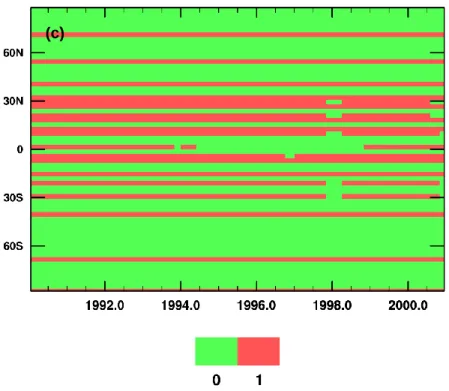
A graphical representation of the “density” of measurements from the full, selected and half networks is given in Fig.4. This figure was produced by counting the number of measurements available for each month in each of the 64 latitude bands used by the
ACPD
4, 3419–3483, 2004
Mass balance inverse modelling of methane T. M. Butler et al. Title Page Abstract Introduction Conclusions References Tables Figures J I J I Back Close Full Screen / Esc
Print Version Interactive Discussion
© EGU 2004
CTM for each of the three networks. It shows the geographical coverage and length of the measurement record from the stations shown in Fig. 3. Comparing Figs. 4a, b and c the full network contains stations in the northern midlatitudes which came online in the mid 1990s. Based onLaw and Vohralik(2001) this could be expected to influence the inverse results by introducing spurious interannual variability or trends into 5
the boundary condition. All three figures show a substantial gap in the measurements around 1997–1998. This may also have some influence on the inverse result. These effects will be examined later in this study.
5.2. Construction of the boundary condition
Each station is assumed to be zonally representative, and a cubic smoothing spline is 10
fitted through the data in sine latitude for each month to yield a zonal average CH4 mix-ing ratio for each month from 1989–2000. Cubic smoothmix-ing splines have been shown to be particularly suitable for interpolating irregularly spaced atmospheric constituent data (Enting,1987). The assumption that each station is zonally representative is not ideal, as stations at similar latitudes which are otherwise far apart can measure di ffer-15
ent mixing ratios (Law,1999). It is possible to account for longitudinal variations in trace gas mixing ratios by using the measurements to adjust a previously calculated distri-bution of trace gas (Law,1999), but this requires “a priori” knowledge of the sources of that trace gas.
Figure 5 shows the station data and smoothing splines for the three networks in 20
February of 1990 and 1998 (the color scheme used is the same as for Fig.3). The new stations measure higher mixing ratios than the stations which operated continuously through the 1990s, and these new measurements lead to higher mixing ratio values in the smoothing spline for the half network. This could be expected to lead to an increas-ing trend in diagnosed emissions from the mass balance inverse procedure for the full 25
network case. It may be that the extra measurements from the new stations in the northern midlatitudes provide a more zonally representative concentration boundary condition, but the fact that these stations were not measuring during the early 1990s
ACPD
4, 3419–3483, 2004
Mass balance inverse modelling of methane T. M. Butler et al. Title Page Abstract Introduction Conclusions References Tables Figures J I J I Back Close Full Screen / Esc
Print Version Interactive Discussion
© EGU 2004
means that any increasing trend observed in these latitudes may not be real.
The effect of the gap in the measurement record for stations in low southern latitudes observed in Fig.4 can also be seen by comparing Figs. 5a and b. The absence of measurements between about 15◦–30◦S in 1998 leads to lower mixing ratio values in the smoothing spline around those latitudes in 1998 compared with 1990. This could 5
be expected to lead to lower diagnosed emissions anomalies for those latitudes in 1998 compared with 1990.
The concentration boundary condition for the CTM is constructed by appending all smoothing splines together in time to produce a latitude/time distribution of CH4 sur-face mixing ratio. Figure 6 shows the resulting boundary condition calculated from 10
the full network. Data were extrapolated backwards one year in time (assuming a lin-ear trend) so that 1988 and 1989 can be used as spinup ylin-ears for the model. The boundary conditions derived from the selected and half measurement networks both appear very similar to the boundary condition derived from the full network (Fig.6). All boundary conditions are dominated by the long term trend and seasonal cycle of CH4 15
mixing ratio. The anomalies in the concentration boundary conditions from the full and selected networks, calculated by removing the long term trend and seasonal cycles are presented in Figs.14 and15 where they are compared with the anomalies in the diagnosed fluxes from the mass balance inverse model runs.
From Fig.3one notices that there are numerous sites contributing measurements in 20
the Pacific Ocean. This has the effect of making the boundary condition more represen-tative of the Pacific than of other sites at similar latitudes, especially in the Southern Hemisphere where most of the measurements that make up the boundary condition come from the Pacific. This effect can be seen by comparing the CH4 timeseries at 5◦S in the Pacific Ocean with the timeseries from Ascension Island which is located 25
at 7◦S in the Atlantic Ocean (Fig. 7). In the Pacific, the boundary condition agrees quite well with the shipboard measurements, but is actually out of phase with the mea-surements from Ascension Island. This is not ideal but it is best to have a boundary condition which represents the largest possible area. SeeButler(2003) for a more
de-ACPD
4, 3419–3483, 2004
Mass balance inverse modelling of methane T. M. Butler et al. Title Page Abstract Introduction Conclusions References Tables Figures J I J I Back Close Full Screen / Esc
Print Version Interactive Discussion
© EGU 2004
tailed comparison of the concentration boundary condition with observed mixing ratios.
6. Diagnosed CH4fluxes
Table 5 presents a summary of the specifications in each of the model runs. The average CH4sources from all five runs are within the range of 569–573 Tg/yr, which is well within the uncertainty range given byHouweling et al.(1999). This is despite the 5
differing treatments of CH4oxidation used in these runs, and the different measurement networks used to construct the boundary condition.
6.1. Latitudinal structure
Figure8a shows the zonal average of the deduced CH4fluxes from the three inverse runs. The zonal distribution of fluxes from all three runs is virtually identical, and cor-10
responds well with the zonal structure of the previous mass balance inverse studies ofSaeki et al. (1998) and Law and Vohralik (2001). Figure 8b shows the sensitivity of the latitudinal structure of fluxes to the measurement network used to construct the boundary condition. The fluxes are much more sensitive to the network than they are to the OH field used.
15
The structure of the sources from Fig. 8 also corresponds well with the methane sources as described in Sect. 1, and synthesis inverse studies such as Fung et al.
(1991). The large peak in the northern midlatitudes corresponds with the anthro-pogenic emissions associated with fossil fuel production and use, as well as emissions from domestic ruminants and landfills. There is also a peak in the tropics which cor-20
responds with the location of emissions from tropical wetlands and biomass burning. The latitudes between the two peaks correspond with the location of emissions from rice cultivation. The absence of substantial emissions from the southern hemisphere corresponds with the mostly oceanic character of this hemisphere and hence the lack of significant sources of CH4. Considering the different techniques used in constructing 25
ACPD
4, 3419–3483, 2004
Mass balance inverse modelling of methane T. M. Butler et al. Title Page Abstract Introduction Conclusions References Tables Figures J I J I Back Close Full Screen / Esc
Print Version Interactive Discussion
© EGU 2004
the concentration boundary condition and the different treatments of the chemical sink in all of these simulations, the degree of agreement between the studies on the basic latitudinal structure of the diagnosed CH4flux indicates that the method is quite robust at describing this aspect of the global CH4budget.
6.2. Seasonal cycle 5
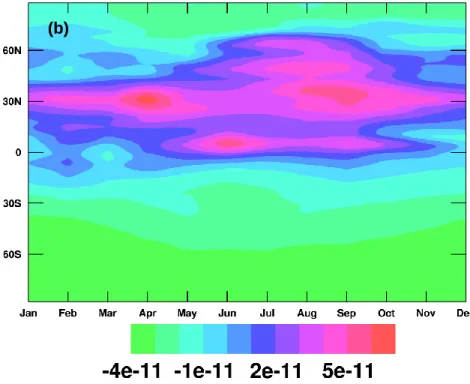
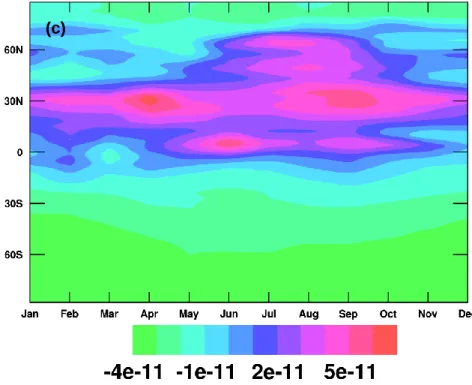
Figure 9 shows the climatological seasonal cycle of CH4 fluxes from runs performed with the three networks, obtained by averaging the flux from each month. The most striking feature of Fig.9a is the large peak in the flux in northern midlatitudes between about June–September, which corresponds with the northern midlatitude peak seen in Fig.8. The summer timing of this peak corresponds well with the timing of emissions 10
from rice cultivation and boreal wetlands, although it is located in between the latitudes at which these sources would be expected. There is also another distinct peak in the seasonal cycle of the deduced flux at 30◦N in April. None of the CH4 sources listed in Sect.1can account for this diagnosed seasonal variability in the CH4flux. As mentioned in Sect.1the northern midlatitude sources are generally assumed to have 15
no seasonal variation.
Figures9b and c are more similar to each other than either is to Fig.9a, showing that the deduced seasonal cycle of fluxes is more sensitive to the addition of new stations into the network than it is to the size of the network. The new midlatitude stations coming online can be seen by comparing Figs. 5a and b. The fixed network cases 20
also produce a seasonal cycle of fluxes which is more consistent with the CH4sources discussed in Sect.1. The midlatitude source shows less seasonal variation in the fixed network runs, and there is a more distinct peak from boreal wetlands.
All network cases show a seasonal peak in the flux from the northern tropics be-tween June–October, which corresponds with seasonal emissions from low northern 25
hemisphere wetlands. There are no distinct signatures of emissions from low south-ern hemisphere wetlands or biomass burning in either hemisphere in this climatological
ACPD
4, 3419–3483, 2004
Mass balance inverse modelling of methane T. M. Butler et al. Title Page Abstract Introduction Conclusions References Tables Figures J I J I Back Close Full Screen / Esc
Print Version Interactive Discussion
© EGU 2004
seasonal cycle of fluxes. The timing of these tropical sources was discussed in Sect.1. 6.3. Interannual variability
Figure 10 shows the year to year global CH4 flux deduced from the decadal inverse run with full chemistry, as well as the chemical sink from all reactions which remove CH4. Also shown is the global growth rate, calculated from the surface mixing ratio 5
trend which was previously shown in Fig.1by converting the volume mixing ratio to a mass mixing ratio and multiplying by the mass of the atmosphere. It appears that the diagnosed flux is being driven by the concentration boundary condition, which is what one would expect given that the boundary condition is the only part of the run with any interannual variability. The chemical sink shows a gradual increase with time because 10
the CH4sink is proportional to the concentration of CH4itself.
All the events mentioned in Sect.1are present in Fig.10, namely the peaks in 1991, 1994, 1998, and the low growth event in 1992. BothSaeki et al.(1998) andLaw and
Vohralik (2001) also diagnose a large increase in the CH4 flux in 1991 to account for the large increase observed in their boundary condition, and a decrease in the flux in 15
1992 corresponding to the decreased trend. Dentener et al.(2003), whose boundary condition did not include such an increase in the trend in 1991, did not diagnose a large source, but they did diagnose a reduced source in 1992. This shows again that the forcing supplied by the concentration boundary condition can have a large effect on the fluxes diagnosed by the mass balance inverse method.
20
The high growth event in 1998 is interesting as it appears to be different from the events in 1991 and 1994. In the two earlier events there appears to be a close corre-spondence between the peaks in the growth rate and the flux, but in 1998 the peak in the flux is less pronounced and broader than the peak in the growth rate. The di ffer-ences between the 1997–1998 event and the other events will be explored further in 25
Sect.7.
Figure11compares the global CH4flux deduced from the inverse runs with season-ally repeating OH with the flux deduced from the full chemistry run previously shown
ACPD
4, 3419–3483, 2004
Mass balance inverse modelling of methane T. M. Butler et al. Title Page Abstract Introduction Conclusions References Tables Figures J I J I Back Close Full Screen / Esc
Print Version Interactive Discussion
© EGU 2004
in Fig.10. The two seasonally repeating OH runs are again more similar to each other than to the full chemistry run, from which they diverge over time, showing that the methane-hydroxyl feedback becomes more important over longer timescales. The dif-ference in the annual flux of CH4at the end of the model run is only about 1%. These differences are not important for this study as results are generally presented as the 5
interannual variability of anomalies, from which the mean source and long term trend has been subtracted.
Something else to note about Fig.11is the similarity of the interannual variability of the full chemistry and seasonally repeating OH runs. These similarities should not be interpreted as showing that interannual variability in the chemistry is not important for 10
CH4inversions, as there was no interannual variability in any of the inputs to the model which could cause significant interannual variability in the OH concentrations. The only source of interannual variability in the run was the CH4 boundary condition, which is driving the interannual variability in the diagnosed CH4flux.
As seen in Fig. 10 the interannual changes in the CH4 mixing ratio do not cause 15
significant interannual changes in the size of the CH4 sink because they occur on timescales significantly shorter than the CH4 lifetime. Interannual variability in the chemical sink will be introduced in future work with an optical depth perturbation cor-responding to an injection of aerosols into the stratosphere from the eruption of Mount Pinatubo, and an inverse run performed with a concentration boundary condition for 20
CO, which due to its much shorter lifetime than CH4has more of an influence on OH concentrations.
Figure 12 compares the CH4 flux deduced from inverse runs with the boundary conditions from different measurement networks performed with annually repeating MATCH OH. Comparing Fig.12with Figs.11and10, one sees that the inverse result 25
is more sensitive to the choice of measurement network than to the representation of the CH4 sink. The two cases run with a relatively constant network (the selected and half network cases) are more similar to each other than to the full network case. This is due to the addition of spurious interannual variability into the boundary condition when
ACPD
4, 3419–3483, 2004
Mass balance inverse modelling of methane T. M. Butler et al. Title Page Abstract Introduction Conclusions References Tables Figures J I J I Back Close Full Screen / Esc
Print Version Interactive Discussion
© EGU 2004
new stations come online, as described byLaw and Vohralik (2001). Interestingly, the cases run with constant networks appear to be diagnosing a more pronounced peak in the flux in 1998 than the case run with the full network, which as commented on earlier produces a peak in the flux in 1998 which does not match the peak in the 1998 growth rate as well as it does for other years. This is despite the growth rate being calculated 5
from the full network.
7. Anomalous interannual variability
7.1. Global scale
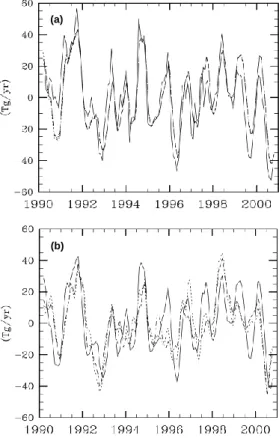
Figure 13a shows again the global scale inverse results from the full chemistry con-trol run and annually repeating OH runs, but here we have takehere we have taken a 10
five month running average of the monthly anomalies expressed as Tg(CH4)/yr. The solid line is the global scale growth rate anomaly. It is obtained from the concentration boundary condition by removing the global trend and the climatological seasonal cycle at each grid point, then differentiating the resulting global monthly mixing ratio anoma-lies and expressing the result as a burden of CH4 over the whole atmosphere. The 15
dashed line is the flux anomaly, obtained similarly to the mixing ratio anomaly. The flux anomalies from the repeating OH runs are virtually identical to the flux anomalies from the full chemistry run. This is consistent with the fact that the three runs possessed virtually identical interannual variability (Fig.11).
The model behaviour is largely driven by the trend in the mixing ratio supplied by the 20
concentration boundary condition, as seen by the quite close agreement between the solid and dashed lines in Fig. 13. In terms of the three major events previously dis-cussed, the 1991 and 1994 high growth events correspond closely with large positive flux anomalies, and again the 1998 event is different. The peak in the growth in 1998 does not seem to correspond with a particularly large peak in the flux.
25
ACPD
4, 3419–3483, 2004
Mass balance inverse modelling of methane T. M. Butler et al. Title Page Abstract Introduction Conclusions References Tables Figures J I J I Back Close Full Screen / Esc
Print Version Interactive Discussion
© EGU 2004
the measurement network used to construct the boundary condition. The annually repeating MATCH OH was used in these runs due to the insensitivity of the interannual variability of the anomalies to the OH field used (Fig. 13a). All three flux anomaly curves from Fig.13b show very similar structure, with the major differences being in the magnitude of the variability, which is consistent withLaw and Vohralik(2001). The 5
two cases run with constant networks show a more pronounced peak in the flux in 1998 than the case run with the full network.
7.2. Latitudinal structure
We now examine the latitudinal variability in the fluxes and explore how that variability is influenced by the boundary condition. Figure 14a shows the anomaly in the con-10
centration boundary condition from the full network. This is calculated by subtracting the climatological seasonal cycle and a linear fit to the long term trend from the con-centration boundary condition shown in Fig.6. Figure15a is calculated similarly from the selected network boundary condition. Figure 14b shows the anomaly in the flux of CH4from the control run. The anomaly is calculated by subtracting the climatolog-15
ical seasonal cycle of fluxes (Fig. 9) and a linear fit to the long term trend from the fluxes. Figure 15b is calculated similarly from the selected network model run. The three events from Figs.10 and 13 are all present in Figs.14 and 15. Results for the half network case (not shown) are again very similar to the selected network case.
In general, mixing ratio anomalies are associated with flux anomalies. For example, 20
the positive mixing ratio anomalies in low latitudes in 1991 are associated with positive flux anomalies. This is due to the mass balance inverse procedure supplying a flux to account for the increased mixing ratio. Not all changes in the mixing ratio anomaly in Figs.14a and15a can be directly related to respective flux anomalies in Figs.14b and
15b however. For example there is a positive mixing ratio anomaly observed in high 25
southern latitudes in 1992, with no corresponding flux anomaly. This is probably due to atmospheric transport of the CH4 emissions associated with the tropical flux anomaly in 1991. This highlights the danger of simply diagnosing flux anomalies directly from
ACPD
4, 3419–3483, 2004
Mass balance inverse modelling of methane T. M. Butler et al. Title Page Abstract Introduction Conclusions References Tables Figures J I J I Back Close Full Screen / Esc
Print Version Interactive Discussion
© EGU 2004
growth rate anomalies: those growth rate anomalies may be due to atmospheric trans-port of a remote flux anomaly. This result is highly encouraging for our admittedly simple inverse technique. We did not specify, “a priori”, that there must not be a flux anomaly in high southern latitudes even though we knew this to be implausible. The inverse procedure correctly diagnosed the flux anomaly as occurring elsewhere. 5
Figure 16shows the interannual variability of the flux anomalies from the four semi hemispheres from the three different network cases (note the different scales on each graph). As seen in Fig. 14b, the variability in high southern latitudes is quite small. This is also apparent in Fig. 16a, and is consistent with the lack of any significant sources or sinks of CH4 in these latitudes. The differences between the fluxes from 10
runs performed with boundary conditions derived from different measurement networks is greater at the semi hemispheric scale than at the global scale (Fig. 13b). Again, however, the selected and half network cases are more similar to each other than to the full network case. Figure 16c (d) shows a decreasing (increasing) trend in the low northern hemisphere (high northern hemisphere) which is not seen in the fixed 15
network cases. These emissions trends can also be seen in in Fig.14b and are likely to be caused by the addition of new stations into the network.
8. The major growth events in the 1990s
In the following sections, the major growth events mentioned in Sect.1, and referred to briefly above are examined in more detail. The flux anomalies from the runs performed 20
with the different networks are integrated in time and space to allow further examination of the sensitivity of these results to the boundary condition, and comparison of the events with the literature. For each latitude band examined below, the linear trend present in each network for that band is first subtracted from the timeseries before the integration is performed, allowing better comparison between networks with different 25
long term trends, as was observed, for example, in Fig.16c. The removal of the long term trend from each band means that the sum of the flux anomalies from each semi
ACPD
4, 3419–3483, 2004
Mass balance inverse modelling of methane T. M. Butler et al. Title Page Abstract Introduction Conclusions References Tables Figures J I J I Back Close Full Screen / Esc
Print Version Interactive Discussion
© EGU 2004
hemisphere is not always equal to the global flux anomaly.
Quantitative comparison of the anomalies presented here with those presented in other studies is difficult due to differing methods of calculating anomalies. For example, if the anomalies are created with a low-pass filter (e.g.Dlugokencky et al.,1998) then the frequency cut-offs will affect the results. Similarly, choices of the averaging period 5
for the running means used in this study will affect the results. 8.1. Flux anomalies in 1991
Table6a shows the integrated flux anomalies for the globe and the four semi hemi-spheres for 1991 in Tg for each of the three networks. The selected and half networks show very similar global flux anomalies, while the full network shows a global flux 10
anomaly which is about 7 Tg larger, and a flux anomaly from the 0◦–30◦N region which is 10 Tg larger than the other networks. This is consistent with the suggestion byLaw
and Vohralik (2001) that measuring stations which came online around the time of the Mount Pinatubo eruption may have artificially inflated the measured global mixing ratio increase around this time. These new stations coming online can be seen in Fig.4a. 15
The use of a fixed measurement network removes this influence (Figs.4a and b). As mentioned in Sect. 1, a contributing factor to the large CH4 growth observed in 1991 may have been an anomalously large source from biomass burning in the Ama-zon. Table 6a shows a consistent positive flux anomaly of 7–10 Tg in the 0◦–30◦S region across all networks, indicating that this anomaly is a robust feature of the in-20
version. This region includes the Amazon, so the results here are consistent with increased biomass burning there, but since the flux anomalies are zonal averages, the results may be affected by flux anomalies elsewhere in the semi hemisphere. In-terestingly, Table 6a shows an anomalous emission of 7 Tg deduced from both fixed networks in the 30◦–90◦N region which is not deduced from the full network.
25
In Sect. 1 we also mentioned a reduction in the CH4 sink resulting from the erup-tion of Mount Pinatubo as another suggested explanaerup-tion of the mixing ratio increase observed in 1991. Since the model runs presented here do not include any such
reduc-ACPD
4, 3419–3483, 2004
Mass balance inverse modelling of methane T. M. Butler et al. Title Page Abstract Introduction Conclusions References Tables Figures J I J I Back Close Full Screen / Esc
Print Version Interactive Discussion
© EGU 2004
tion in the sink it is possible that the model is responding erroneously with increased sources. The effect of the eruption on the deduced sources will be explored in future work.
Saeki et al.(1998) also noticed an increase in the global CH4flux during 1991, but their increase was observed in the 30◦N–90◦N latitude band. They actually diagnose 5
a decrease in the low latitude flux in 1991. Unfortunately they only report year to year changes in the flux, so it is not clear how their flux anomaly evolved during 1991.
Law and Vohralik(2001) diagnose the increased flux in 1991 as coming entirely from the 15◦S–15◦N latitude band, with a decrease in the flux from the 15◦N–50◦N band.
Dentener et al.(2003) do not diagnose an increased flux in 1991 at all. The differences 10
betweenSaeki et al.(1998),Law and Vohralik(2001),Dentener et al.(2003) and this study would appear to be due to the differing methods of constructing the concentration boundary condition, which has been seen above to have a large effect on the inverse results.
8.2. Flux anomalies in 1992 15
Table6b shows the integrated flux anomalies for the globe and the four semi hemi-spheres for 1992 in Tg for each of the three networks. The results for all regions in Ta-ble6b are consistent across all three networks, showing that the inverse procedure is not particularly sensitive to the choice of network during 1992. Comparison of Figs.4a and b shows that the full network has gaps in the measurement record north of 30◦N 20
during 1992, but these gaps do not appear to be affecting the deduced fluxes from this region. The results here are reasonably in accord with the suggestion byLowe et al.
(1997) that the reduced growth observed in 1992 can be explained by an imbalance between sources and sinks of 20 Tg.
As mentioned in Sect.1reduced biomass burning in the Amazon is a hypothesised 25
mechanism for the low growth observed in 1992. The results from all networks in Table6b for the region 0◦–30◦S show an anomalously low flux, although it is short of the 20 Tg suggested byLowe et al. (1997). Both the 0◦–30◦N and 30◦–90◦N regions
ACPD
4, 3419–3483, 2004
Mass balance inverse modelling of methane T. M. Butler et al. Title Page Abstract Introduction Conclusions References Tables Figures J I J I Back Close Full Screen / Esc
Print Version Interactive Discussion
© EGU 2004
also show negative emissions anomalies.
Walter et al. (2001) proposed anomalously low emissions from boreal wetlands to explain the low growth observed in 1992. Boreal wetland emissions are concentrated between 45◦–75◦N (Fung et al.,1991), and all three network cases show a negative emissions anomaly of 4–6 Tg between these latitudes in 1992, which is consistent with 5
a negative emissions anomaly from boreal wetlands. Other sources between 45◦N and 75◦N are sources associated with fossil fuel production and use, domestic ruminant animals, landfills and termites (Fung et al.,1991). Van Aardenne et al. (2001) report long term increasing trends in the fossil fuel and to a lesser extent the landfill source up to 1990, but it is unclear how much interannual variability these sources show. 10
As discussed in Sect. 1, there may have also been a change in the atmospheric solar radiation budget during 1992 resulting from the Mount Pinatubo eruption. The presence of scattering aerosols in the stratosphere (Dlugokencky et al., 1996) and stratospheric O3depletion (Bekki et al.,1994) may have altered the OH concentration in the troposphere and thus changed the sink of CH4.Bekki et al.(1994) suggested that 15
the stratospheric O3depletion could account for up to half of the observed decrease in the CH4growth rate in 1992, which from Table6b would translate to an increase in the global source of about 10 Tg. This should be considered an upper limit on the source increase due to the effects of stratospheric O3depletion, for the reasons discussed in Sect.1. The effects of the Mount Pinatubo eruption are not included in the control run 20
or the network sensitivity runs, but will be explored in future work. 8.3. Flux anomalies in 1994–1995
Table 6c shows the integrated flux anomalies for the globe and the four semi hemi-spheres between March 1994 and February 1995 in Tg for each of the three networks.
Langenfelds et al.(2002) suggested the CH4 growth anomaly in 1994–1995 could be 25
explained by a 12 month pulse of 26 Tg from biomass burning centred on August 1994. The results from the three networks are again quite consistent, showing that the inverse results are not particularly sensitive to the choice of measurement network.
ACPD
4, 3419–3483, 2004
Mass balance inverse modelling of methane T. M. Butler et al. Title Page Abstract Introduction Conclusions References Tables Figures J I J I Back Close Full Screen / Esc
Print Version Interactive Discussion
© EGU 2004
Interestingly, the 1994–1995 event is different to the 1991 and 1992 events in that it appears to have a clear spatial structure, with positive emissions anomalies in the 0◦– 30◦N region, with no positive emissions anomalies in any other semi hemisphere. This structure can also be seen in Fig.14.
Neither the global flux anomaly of 6–9 Tg nor the flux anomaly of 12–16 Tg from 0◦– 5
30◦N seen in Table6c are consistent with the 26 Tg of anomalous emissions suggested byLangenfelds et al.(2002) to explain the 1994–1995 event. This inconsistency may not be due to the different measurement networks used by Langenfelds et al.(2002) and this study, as the half network with its 12 measuring stations and the 10 station network ofLangenfelds et al. (2002) have a similar size, andLaw and Vohralik(2001) 10
found that such small fixed networks are capable of resolving similar global CH4 mix-ing ratio anomalies to larger fixed networks such as the selected network used here. Perhaps the different network geometry used by Langenfelds et al. (2002) (including use of vertical profile data above Cape Grim) could be contributing extra information to their study which is leading to the different emissions estimates between that study 15
and this one. Cunnold et al. (2002), as evidenced from their Fig. 5 do not seem to diagnose any significant emissions anomaly in 1994–1995 either. They do not use vertical profile data. Law and Vohralik(2001) did notice a positive emissions anomaly in 1994–5, occurring between 15◦S–15◦N, but do not report an integrated flux for the period examined here. They do not use vertical profile data either. The results ofLaw
20
and Vohralik (2001) for the 1994–1995 event show more sensitivity to the source of the dynamics data used to drive their CTM than the other events do. Perhaps anomalous CH4 mixing ratios observed in 1994–1995 are related to anomalous transport around that time. The differences in the treatment of transport between Langenfelds et al.
(2002) and this study (single box model compared with 3-D CTM) may possibly be 25
contributing to the differences observed here. 8.4. Flux anomalies in 1997–1998
ACPD
4, 3419–3483, 2004
Mass balance inverse modelling of methane T. M. Butler et al. Title Page Abstract Introduction Conclusions References Tables Figures J I J I Back Close Full Screen / Esc
Print Version Interactive Discussion
© EGU 2004
explained by a 12 month pulse of 33 Tg from biomass burning centred on February 1998. Table6d shows the integrated flux anomalies for the globe and the four semi hemispheres between September 1997 and August 1998 in Tg for each of the three networks.
The results from the three networks show some large differences. The two fixed 5
size networks show similar global flux anomalies compared with the full network, but show large differences between the two in both northern semi hemispheres. This is consistent with the observation byLaw and Vohralik (2001) that small fixed networks are capable of resolving global but not regional flux anomalies. It was noted in Sect.5
that there were many gaps in the measurement record around 1997–1998. These 10
gaps affect all three networks, as seen in Fig. 4, so for the 1997–1998 event, none of the three networks used here can be regarded as “fixed”. As noted by Law and
Vohralik (2001), and seen here for the 1991 event in Sect. 8.1, a changing network can introduce spurious variability into the results of an inversion, so the results for this event for all networks should be treated with suspicion.
15
None of the networks in Table 6d produce a global flux anomaly which is close to the 33 Tg estimated by Langenfelds et al. (2002) obtained using a network with no gaps. Interestingly, all three networks agree on a negative flux anomaly of 6–8 Tg for the 0◦–30◦S semi hemisphere. Closer examination of Fig. 4 reveals that the gap in the measurement record during this period for the southern hemisphere spans a 20
particularly large latitude range. Figure16b also shows an extremely pronounced dip in the flux anomaly for the 0◦–30◦S region. It appears that the lack of measurements in the low southern hemisphere may be causing the smoothing spline procedure which constructs the boundary condition to assign measurements more appropriate to the high southern hemisphere to the low southern hemisphere. This was seen in Fig.5b, 25
and examination of Figs.14 and 15 would appear to confirm this. It is not clear why there is such a large spread of flux anomalies between the networks in the 30◦–90◦N region when there are no gaps in any of the networks north of about 30◦N. Given these concerns, it appears that all that can be said about the 1997–1998 event based on the
ACPD
4, 3419–3483, 2004
Mass balance inverse modelling of methane T. M. Butler et al. Title Page Abstract Introduction Conclusions References Tables Figures J I J I Back Close Full Screen / Esc
Print Version Interactive Discussion
© EGU 2004
results shown here is that there was a positive global flux anomaly which was primarily located in the 0◦–30◦N region.
Using a satellite measurements of burnt areas,Levine(1999) estimated a lower limit of 3 Tg(CH4) of emissions (with an uncertainty of 50%) from Kalimantan and Sumatra during the 8 month period from August 1997 to March 1998. The full, selected and half 5
network cases diagnose emissions anomalies of 11, 5, and 6 Tg respectivley for this 8 month period. The selected and half network cases are more consistent with Levine
(1999) than the full network case, which is interesting, given that the half network does not appear to be affected by the gaps in the measurements from this region as the other two networks are (Fig.4). It should also be noted that these flux anomalies are 10
zonal averages and may be affected by emissions from elsewhere around that latitude band.
8.5. Flux anomalies in 1998
The detrended global and semi hemispheric flux anomalies for the calendar year 1998 are also presented here (Table6e) to allow comparison with the study ofDlugokencky
15
et al. (2001), who suggested that the growth observed in 1998 corresponded to an anomalous increase in the imbalance between sources and sinks of 24 Tg. They used a wetland model to estimate anomalous emissions from the 0◦–30◦S and 30◦–90◦N semi hemispheres of about 12 Tg each, but acknowledge that these model derived wetland emissions should be treated with caution. Dlugokencky et al. (2001) also 20
pointed out that there were also an estimated 6 Tg released from boreal biomass burn-ing in 1998, and noted a qualitative agreement between the location of these emis-sions anomalies and the observed growth in CH4mixing ratio. The direct comparison between the physical locations of the observed mixing ratio increases and the emis-sions anomalies from the wetland model and biomass burning estimates used by
Dlu-25
gokencky et al. (2001) is different from the inverse modelling methodology employed here, as it does not include the effects of atmospheric transport.