HAL Id: hal-00972814
https://hal-sciencespo.archives-ouvertes.fr/hal-00972814
Submitted on 22 May 2014
HAL is a multi-disciplinary open access archive for the deposit and dissemination of sci-entific research documents, whether they are pub-lished or not. The documents may come from
L’archive ouverte pluridisciplinaire HAL, est destinée au dépôt et à la diffusion de documents scientifiques de niveau recherche, publiés ou non, émanant des établissements d’enseignement et de
Patrick Messerlin
To cite this version:
14
The European Community
Patrick A. Messerlin
Liberalization of services in the European Community national product (GNP) of the EC-the equivalent of the
(EC) sends three clear messages to the current and future, GNPS of all the developing economies together. In the
multilateral negotiations on services. mid-1980s EC banking and insurance represented one-1. As predicted by economic theory, unilateral liberal- third and one-fourth, respectively, of world business in ization pays. Three or four EC states undertook unilateral those sectors. The EC fleet accounted for one-fourth of liberalization of services during the 1970s and 1980s, world shipping capacity, EC transport for one-fourth of more than ten years before the EC initiated its 1992 the air traffic of the countries of the Organisation for program. Because these liberalizations were trade ori- Economic Co-operation and Development (OECD), and ented (they opened national markets to foreign competi- EC investment in telecommunications equipment for tion), they have yielded large gains to the consumers of more than 40 percent of OECD investment.
these "liberal" EC states.
2. Unilateral liberalizations are fragile. A host of do- Unilateral Liberalizations as a Driving Force mestic and international factors have joined forces to
close markets that had been liberalized. Monopolies that Only the United Kingdom and, more marginally, the provided many services before liberalization have re- Federal Republic of Germany, Ireland, and the Nether-tained considerable influence in the small national mar- lands have been able to undertake unilateral liberaliza-kets. Nonliberal EC states have inhibited competition by tion in airlines, banking, securities, and telecom-keeping their own markets closed. As a result it has munications.1 All of these moves share three features. proved difficult to maintain a substantial level of compe- They have followed common time sequences, and the tition in liberalized service markets in the long run. resulting convergences have considerably eased the 3. Reinforcing and expanding unilateral liberalizations 1992 program. They offer alternative solutions to the inside the EC has required a multilateral liberalization- delicate balance between competition and privatization the 1992 program, which was nurtured by the unilateral that may be of some interest for developing countries. liberalizations and is consolidating them by diluting for- Last, and of the utmost importance, they all include a mer dominant firms in larger markets. The program also crucial trade component that qualifies them as genuine makes liberalization attractive to EC states unable to trade liberalizations.
undertake unilateral liberalizations in that it decreases
the political costs of implementing liberal policies. Common Liberalization Sequences
These three messages suggest that the Community's
experience can be a driving force in the Uruguay Round Financial services provide the most complete illustration negotiations on services. The 1992 program, however, is of common time sequences in unilateral liberalizations. merely domestic liberalization. It does not contain an During the 1970s and 1980s public policies and regula-explicit foreign trade policy in services, and this missing tions have been a crucial engine of innovation in finan-aspect has nurtured fears of a "Fortress Europe." If the cial services. In banking, macroeconomic policies have 1992 program is implemented behind high barriers, it been accompanied by an endless flow of new financial will generate huge distortions that will be detrimental to products-Eurobonds, fixedrate Euronotes, floating rate the welfare of the Community and the world. The huge notes, note issuance facilities (NIFs), revolving
under-2
size of the EC service sectors has fueled these fears. wridng facilities (RUFs), and swaps of all kinds. In Services account for roughly 60 percent of the gross insurance, innovations have been fueled by domestic
policies, in health care, for example, and by intemational were well adapted to provide standardized services with policies such as freer trade in goods, which gives rise to the use of traditional technology-transport of small larger risks. These innovations have required easier ac- numbers of air travelers between a few important towns, cess to increasingly large capital markets. In such an basic phone calls, and so on. But protected flag carriers environment some financial operators-such as the "uni- and post and telecommunications operators (PTos) have versal" banks or insurers that provide most of the finan- not been able to provide efficiently the "new" services cial products-have exhibited comparative advantages. made possible by modem technology. Examples of such All unilateral liberalizations in financial services have services are "charter" air transport of large crowds of sought to favor the emergence of these new types of tourists to a host of exotic places and "electronic high-operators and their access to large and flexible stock ways" that provide a wide range of services-from data markets by following a three-step pattem: removal of transmissions to "chatlines" and telephone games-to the barriers between the various parts of the banking individuals or firms who hook their computers to their industry to facilitate the move toward universal banks; telephones (Feketekuty 1989). Monopolies could not abolition of foreign exchange controls to provide the cope with such a rate of innovation. Market competition large amounts of funds needed by financial operators; was necessary.
and the introduction of stiff competition in the stock The capacity of public firms to discriminate and cross-market-the key market for an industry increasingly subsidize between the markets of traditional services dominated by securitization. reinforced the complexity of the problems raised by Germany has long had universal banks and no ex- diversity. The best illustration is provided by PTos. More change controls. By contrast, British financial services profitable than flag carriers (their average net income were heavily regulated at the end of the 1960s. Starting represented 10-20 percent of their revenue, as against in 1971, however, the interest rate cartel operated by the 5-7 percent for flag carriers), PTOs were able to subsidize principal British clearing banks was dismantled and the equipment manufacturers massively. For instance, direct markets serviced by the banks and the building societies subsidies from French Telecoms to French equipment (the main savings and mortgage institutions in Britain) producers have amounted to more than ECU 1 billion a were integrated. In 1979 Britain abolished foreign ex- year since 1983, and roughly 65 percent of the costs of change controls, finally catching up with Germany. In the videotext Minitel are subsidized by French Telecoms the mid-1980s the balance between the two countries (OECD 1988, p. 30;LeMonde, June 30, 1989 andJuly 17, changed. German financial services, although liberal- 1989). Despite this strong grip on their sector, PTOS have ized, remained protected from foreign competition, been unable to forecast the demands with the highest whereas Britain, starting in 1986, was the first to open growth (for instance, mobile phones in the French case) the stock market to stiff foreign competition. The new and to raise the financial and human resources necessary regulations aimedatcreating one market (by merging the to match competition-driven markets in providing the Euromarket and the London StRck Exchange) and one "new" services.
type of operator (by merging brokers and jobbers into Privatization of public monopolies was seen as the market makers); giving the Bank of England a decisive natural way to create the competitive markets required role in the crucial market of gilts (British government by the "new" services. Unilateral liberalizations, how-securities); and introducing a drastic trade component. ever, show that there can be a conflict between competi-The admission of corponate members to the stock exchange tion and privatization, especially as the latter is rarely a regardless of nadionality and with no preset limit on the constraint-free choice. The privatization of British numberof seatsavailablehasbeenatthecoreof theincreasing Telecoms was an unexpected consequence of British importance of the London Stock Market since then. rules on the public budget,3and the German constitution
Financial services elsewhere in the EC have followed has prevented privatization of the Bundespost.
Govern-the same pattern of evolution. Most EC states have taken ments that are obliged to privatize may want to make the the first step by now, and nearly half have reached the step more attractive by selling firms with a flow of future second step (the exceptions are Greece, Ireland, Portugal, potential rents-that is, by selling monopolies. Private and Spain). Only Britain has fully achieved the third step. buyers of such public monopolies are likely to oppose any future move toward competition that might erode the
Competition and Privatization rents expected or paid.
A sound liberalization sequence can overcome the po-A powerful force behind liberalization in services was tential conflicts between competition and privatization.
the brake on the potential growth of many service sectors If new services-those that public monopolies are un-exerted by the existing public monopolies. Public firms able to provide-are opened up long enough before
Patrick A. Messerlin
traditional ones, competitive markets can evolve that are to make liberalization credible.6 In a single year (1989), large enough to reduce the potential anticompetitive several drastic measures were taken: the Bundespost impact of privatization. This is be illustrated by three was split into three corporations (post, bank, and tele-examples. communications); its monopoly in customer equipment In Britain, the liberalization of charter air transport (a was ended; competition from private firns in data and new" service) in the 1960s and 1970s gave birth to mobile telecommunications was introduced; the markets that by 1984 represented one-third of all British Bundespost's ability to cross-subsidize was reduced by air transporL In that year Britain began to liberalize the requiring that German Telecoms use flat-rate charges traditional scheduled services by privatizing the flag (easier than the former usage-sensitive tariff for compet-carrier, British Airways, and by tacitly setting up a du- itors to match) in some data services; and the first net-opoly with a private carrier, British Caledonian (Vickers work of mobile phones was licensed to a private group and Yarrow 1988).4 In 1988 the duopoly collapsed with led by Mannesmann.7 Large competitors have been the takeover of British Caledonian by British Airways, convinced and have begun large-scale operations. but the negative effects of the collapse on competition Meganet (a subsidiary of German insurance firms) has were limited because the large charter carriers were started leasing lines in bulk from German Telecoms and powerful enough to buy half of the route licenses and of selling capacity on them for data traffic. Volkswagen, the 5,000 airport slots owned by British Caledonian and IBM, and EDS (General Motors), among others, have submitted to bids by the Civil Aviation Authority. begun to provide a wide spectrum of value added ser-British telecommunications offers a different story. vices. But in the absence ofprivatization, the competitive Britain began to liberalize traditional and new services fringeofsmalleroperatorsthatmaybecrucialforreaping almost simultaneously, in 1982, when Mercury was li- all the potential gains from liberalization remains cau-censed to offer the traditional voice services and to tious.
operate a network of the new value added services. At
that time value added services represented only 1 percent Domestic Liberalizations as Trade Liberalizations
of telecommunications revenues in Britain. As a result,
the prospects for competition did not look very encour- All the unilateral lieralizations undertaken by the EC states, aging, especially since the government explicitly estab- although domestic in nature, rapidly incorporated a trade lished a duopoly consisting of British Telecom and component and became authentic trade liberalizations. Mercury (both privatized firms) for the first phase of First, liberal EC states felt it necessary to set up bilateral liberalization, 198489. It was feared that the two finns agreements among themselves and with the United would share a reason to oppose further liberalization- States to strengthen their liberalizations. Air transport the need to undertake huge investments to modemize an provides an illustration: multiple designation (licensing old network, in the case of British Telecom, or to create more than one domestic carrier for a given route), re-a new one, in Mercury's cre-ase (Vickers re-and Yre-arrow, moval of restrictions on capacity and frequency, and the 1988; Beesley and Laidlaw 1989).5 The new regulatory automatic approval of airline fares (except in case of environment, however, was liberal enough to allow Brit- disapproval by both countries) were introduced in bilat-ish consumers to take full advantage of a wave of tech- eral air agreements between liberal EC states (Britain-nological progress and to generate an explosive growth Netherlands, Britain-Ireland, and so on) after 1984. of demand for private telecommunications networks, Second, unilateral liberalizations offered consumers basic services (mobile phones), and value added ser- new opportunities for substituting services produced in vices. In less than five years the size of the markets under different EC states, including nonliberal states. Because competition has become so large that the British govern- of this larger set of potential "arbitrages," the prices ment can contemplate a huge injection of new competi- charged in all EC states were driven by the prices emerg-tion: at least one firm, British Railways, with its huge ing in the more competitive markets of the liberal states. and modern telecommunications network, can compete Telecommunications is a good illustration of the power on equal terms with British Telecoms and with Mercury; of arbitrage. In 1985-86 the tariff reductions that AT&T
three more licensees (in addition to the two initial ones) introduced on transatlantic calls made phone calls from in mobile phones; and, possibly, authorization for firms France to the United States 30 percent more expensive to resell part of their private telecommunications net- in relative terms and obliged French Telecoms to lower works to third parties. its own tariff by 20 percent. Heavy additional pressure The German experience in telecommunications sug- was imposed by the new tariffs of British Telecom, gests that when privatization is ruled out, a quicker and which made calls to the United States from eight of the more massive introduction of competition is necessary EC states 15 percent cheaper (on average) if they were
routed through Britain. Modem technology increased the scheduled fares and were similar to those in the deregu-role of arbitrage. Since British Telecoms and AT&T were lated U.S. markets (McGowan and Trengrove 1986, p. able to offer large multinational clients a better service 78). In 1987 scheduled fares on European routes with a and to persuade them to locate their telecommunications significant charter presence were estimated to be 40 hubs outside nonliberal countries, the PTOs concerned percent lower than fares on routes with little or no charter have been forced to take a more liberal attitude with their competition (Financial Times, December 24, 1987). In largest clients in order not to lose them. 1985 Mercury's phone tariffs were, on average, 15 per-Arbitrage seems to have played a more important role cent lower than those of British Telecom; in 1989 they than bilateralism. For example, in banking EC states were were 30 percent lower (Beesley and Laidlaw 1989, p.29). concerned that their markets might lose business to more The impact on tariff structures has been even greater. open financial markets in other EC members. Indeed, the Average price changes underestimate the impact from failure of some EC states to liberalize their stock ex- competition because liberalizations tend to increase the changes has benefited the stock markets of the most prices of costly services and to compensate by huge liberal EC states. The London Stock Market reform trig- decreases in less costly services. For instance, commis-gered a general movement away from the Continental sion rates on the London Stock Market increased by 5-25 stock exchanges, which obliged other EC states to begin percentfor transactions of less than 50,000, decreasedby to liberalize their own regulations, and the liberalization 20-35 percent for bargains of 50,000-500,000 (the larg-of some Continental stock exchanges in turn induced the est part of the market), and remained stable for larger London markettorelax some of its stringentregulations. purchases (Price Waterhouse 1988, p. 133). Tariffs on The opening of domestic markets to foreign producers the London-Amsterdam route increased by 5-15 percent of services has been the most important feature of the for the most expensive seats, whereas inexpensive fares unilateral liberalizations. Vested interests understood (late bookings in economy class) were offered at a 60 this point well and tried to stop arbitrage and bilateralism. percent discount.
In telecommunications the PTOS of the nonliberal Ec These new tariff structures reflect the reduction or states (France and Germany) have refused to conclude elimination of the cross-subsidization policies of domes-operating agreements with Mercury, which was obliged tic monopolies. Following liberalization in Britain, price to enter into market-sharing agreements with British structures in telecommunications have diverged from Telecom.8 In airlines the International Air Transport those in Continental Europe. In 1987 local calls were Association (IATA) deliberately designed complex rules twice as expensive in Britain as in France or Germany, for air fares to ensure that travelers from nonliberal EC whereas long-distance trunk calls were 50 to 70 percent states could not take advantage of the proximity (by more expensive in France and Germany than in Britain. road or rail) of European airports to one another to In the few niches that have seen stiffer competition, price benefit from the few existing liberal policies (Kasper changes have been larger. In 1987 intemational leased 1988, p. 77). lines were 30 to 100 percent more expensive in France and Germany than in Britain (Muller 1988, p. 139). The The Gains from Unilateral Liberalizations most recent prices for private lines are considered roughly in line with costs in Britain (although long-dis-Britain's unilateral liberalizations of the early 1980s tance traffic is still subsidizing short-distance circuits) were profitable enough to induce a few other Ec states whereas in Continental Europe they are, on average, four (Germany, Ireland, and the Netherlands) to undertake times costs (Financial Times, May 10, 1989).9 similar policies. Gains from liberalizations come from
three sources: lower prices for consumers, larger mar- LargerMarkets
kets, and new comparative advantages revealed by more
competitive firms. Lower prices brought about by domestic liberalization are a sure way of increasing the size of domestic markets
Lower Prices and thus the probability that domestic exports will become internationally competitive-a goal that in-Liberalized airlines, banking, and telecommunications dustrial policies often fail to achieve at a reasonable have all experienced price decreases. A few months after cost.
the introduction of the 1986 regulations, commission The number of stocks traded in the London Stock rates on the London Stock Market had decreased by 20 Market grew by 20 percent in the first six months after percent on average. In 1986 average British air charter the introduction of the new 1986 regulations. This fares were lower by 10 to 30 percent than the comparable growth was mainly attributable to the competitive
"beta-Patrick A. Messerlin
type" stock markets, defined as those with six or more charter company, Britannia, has been responsible for market makers (or four quoting firm prices). roughly as many passenger-kilometers as Air France on Air charter markets-now more or less liberalized in the intra-European routes, the second largest EC flag most EC states-represented more than 60 percent of carrier after British Airways. In the second half of the total European air markets in 1987. The British liberal- 1980s two charter airlines, Britannia and Dan-Air, ac-ization was the first and has been the most far-reaching counted for more passenger-kilometers than Swissair. In up to now, as can be seen in the fact that in 1987 British telecommunications the experience acquired in the lib-charter services represented 60 percent of independent eralized cellular phone market in Britain has allowed intra-European charter air traffic and more than twice the British Telecom to buy 20 percent of McCaw Cellular, share of Germany (the second largest in the EC). one of the largest U.S. firms in this booming niche and In telecommunications the ratio of calls as a share of the first truly national cellular network in the United British gross domestic product (GDP) or to exports in- States.
creased in relation to the coiresponding ratios for
Ger-many and France by 15 percent and 25 percent, The Limits of Unilateral Liberalizations: Toward a
respectively, between 1980 and 1986. During the same Multilateral Effort
period calls from Britain to the United States as a share
of total calls between the two countries increased by 8 Despite these large gains, unilateral trade liberalizations percent, reflecting decreased relative prices. Meanwhile, have proved fragile, and their political costs can be high. the corresponding proportion decreased by 7 percent for Voters may find it easy to accept that cheaper air tickets Germany and by 13 percent for France. In some niches for holidays improve their welfare, but-as users of changes were more dramatic. The British market for subsidized short-distance phone calls-they are harder value added network services is estimated to represent to convince that loss of these subsidies might be offset 80 percent of the total European value in the late 1980s. by the increased efficiency in the economy brought about The British mobile phone market-operated by two by cheaper long-distance calls. Firms-the direct bene-(soon, five) firms under competition-had five times ficiaries of telecommunications liberalizations-have more subscribers than the German or French markets, little incentive to lobby for liberalization if they are able which are run or dominated by PTos. to pass through their telephone bills to consumers, as most European firms did during the 1970s and early
Revealing New Comparative Advantages 1980s, when telecommunications still accounted for less than 10 percent of their costs. As a result, the late 1980s New comparative advantages are revealed by firms saw some erosion of the unilateral liberalizations in two working under the strict discipline of high competition ways.
and minimal rents. It is currently estimated that at least First, unilateral liberalizations have been under strong one-fourth of the existing market makers in the London pressures in the liberal EC states. The competitive forces Stock Market will leave in the near future. In the gilts introduced in domestic markets have been eroded by market alone ten market makers of the initial twenty- former, but still powerful, monopolies. Flag carriers have eight have retreated since 1986, and the current leading reacted to lower profits brought about by increased com-four account for roughly 50 percent of the market. (Prior petition by buying substantial shares in the emerging to liberalization, however, the two leaders in a field of competitors, as KLM did on the London-Amsterdam only eight firms accounted for 75 percent of the market.) route. This vulnerability to old vested interests has also Over the past ten years the number of tour operators been observed in the United States; in the early 1980s the licensed in Britain increased from 473 to 703, and the U.S.governmentrenouncedamorecomprehensivecom-profit margins of the top thirty slumped from 4 percent petition policy in air transport under the double pressure in 1983 to roughly zero in 1987-88, leading to difficul- of foreign governments and of European and U.S. carri-ties for the charter airlines (such as British Island Air- ers (Kasper 1988, p. 80). In telecommunications duopo-ways) that depend on them. lies complain bitterly about being excluded from new Benefits from such disciplines are most visible in the licenses-an example is British Telecom in mobile sectors that have been liberalized for the longest time, phones-and lobby heavily for them.
such as charter air transport. Massive entry in air charter Second, gains from unilateral liberalizations have led markets has selected the most successful tour operators the nonliberal EC states, initially hostile to liberalization, to build large low-cost charter carriers able to compete to introduce quasi-liberalizations-"quasi" because the with and become credible alternatives to foreign-flag sectors concerned are still sheltered from foreign com-carriers. Since the mid-1980s the largest British (and EC) petition. Air transport offers good examples of
quasi-lib-eralizations. Flag carriers have created their own charter The 1992 Program carriers behind high barriers, as Lufthansa did with
Con-dorandAirFrance with AirCharter. "Flag charters" were This section reviews the part of the 1992 program de-conceived by their owners largely as a deterrent to the voted to internal trade liberalization in services and the entry of domestic independent air carriers, which as a corresponding economic gains that can be expected. It result have had a difficult time growing. In 1987 the then examines the competition rules embodied in the average size of the French and German independent Treaty of Rome, which have been the engine of the carriers was 7 percent and 40 percent that of the British intra-Ec liberalization and have made the Court ofJustice ones. The 35 percent stake that Air France was able to the cornerstone of that liberalization, and the elements of buy in TAT (the fourth largest French air carrier) in 1989 an EC foreign trade policy on services that might emerge led to increased dominance by the flag carrier. In such in the wake of the 1992 program.
closed markets, domestic competition is easily inhibited.
For instance, a recent attempt by Aero-Lloyd, the fourth The 1992 "Single Market" in Services
biggest German charter airline, to compete on domestic
scheduled routes with Lufthansa failed because a large The part of the 1992 program that deals with services proportion of Lufthansa's passengers use internal flights consists of fifty-one directives to be drafted and adopted only to connect with international flights and enjoy al- between 1986 and 1992.10 As of January 1990 more than most free internal flights. Finally, quasi-liberalized mar- half have been adopted and the rest tabled. The program kets remained under political control. In 1988 a proposal has adopted the broadest definition of services: it deals to merge two small (by British standards) French and with trade in services related to factor movements-in-Belgian charter carriers, Point Air and Trans European, cluding labor movement-and to cross-border move-was blocked by the French govemment (this move-was in sharp ments of consumers as well as of services. Its sectoral contrast with the govemment's blessing of the takeover scope is wide, covering previously untouched services of UTA-the only large independent French carrier-by such as insurance, shipping, road transport, and profes-Air France). Similar experiences can be observed in sional services. Finally, the 1992 program interprets telecommunications and posts (express freight); most progressive liberalization essentially as meaning that the European PTOs have created private subsidiaries-for less developed EC states will be granted longer time instance, French Telecom created Chronopost (express periods for adopting common rules. Appendix 14-A mail) and Transpac (data traffic). focuses on the most important directives in each service
Having kept foreign competition at bay can be a source sector. of future difficulties, as French banking illustrates. In the
1980s the French govemment actively pursued a policy The Gains to Be Expected
of "universal" banks, and France has some of the largest
world conglomerates of banks-insurers-brokerage The 1992 program aims at dismantling intra-EC barriers. houses. But because these giant "universal" banks were Despite previous unilateral liberalizations, these barriers consolidated through state ownership and regulations in remain substantial, as indicated by the low ratio of intra-noncompetitive markets, it is difficult for them to attain EC to extra-EC trade in services, which is 25 to 30 percent, the Cooke Committee standard for capital adequacy (a or half of the corresponding ratio for goods. As a result, minimum ratio of capital to assets of 8 percent), which price reductions and welfare gains can be expected to be will become the standard in the post-1992 Community. large. Studies done under the auspices of the Commis-To improve their competitive situation in post-1992 sion (the Cecchini report) estimate that price reductions Europe, French banks might have to acquire foreign will be 21 percent (in Spain) to 4 percent (in the Nether-firms. But that would require capital and would increase lands) in financial services, about 10 percent in air trans-assets, causing further deterioration of the Cooke ratios. port, 5 percent in road transport, and 3 percent in In air transport the increasing dominance of Air France professional services, for total estimated savings to con-has inhibited a necessary decrease in wage costs; pilots' sumers of roughly 2 percent of the GDP of the EC (Emer-wageshaveabsorbed70peicentofthedecreasein laborcosts son and others 1988).
allowedbythenew747 400aiicraftboughtbytheflag acrier These studies give to scale economies a large role that
(Le Monde, September 3, 1989). Under these circum- some have found excessive. In a substantial range of stances, European liberalization is an attractive solu- services, such as retailbankingand insurance, economies tion. of scale are likely to be small (Neven 1989), and the
Patrick A. Messerlin
"single" European marketcould offer more opportunities if they abused a dominant position. Moreover, airlines for differentiating products in diversified markets than carrying out a task of "general interest" (flag carriers) for homogenizing them to make possible massive econ- were also subject to competition rules insofar as the omies of scale (Centre for Business Strategy 1989). application of such rules did not obstruct the perfor-Others, however, have argued that adding dynamic ef- mance of theseparticular tasks-areminder of the article fects to the static effects measured by Emerson greatly 90 philosophy.
increase the gains to be expected (Baldwin 1989).
De-spite these controversies on the extent of the gains, there FINANCIAL SERVICES. Through a growing number of is a consensus that the 1992 program will bring substan- cases looking at national banking associations and com-tial benefits to the Community. mission rates in commodity markets, the Court is exert-ing increasexert-ing pressures for a strict enforcement of
The Engine of the 1992 Program: Competition competition rules in banking (Commission of the
Euro-Rules pean Community, Reports on Competition Policy,
vari-ous years). The main contribution of the Court, however, EC competition rules are embodied in three articles of has concerned the definition of the mutual recognition the Treaty of Rome: article 85, on collusive practices; principle governing cross-border trade in insurance ac-article 86, on abuses of dominant power; and ac-article cording to which each EC state will recognize the licens-90, which states that public firms are not exempt from ing rules of the others and will apply its own operating competition rules embodied in articles 85 and 86 ex- rules on a nondiscriminatory basis to EC firm affiliates cept as necessary for their "general interest" tasks. (see appendix 14-A, "Banking"). In four recent rulings Until the mid-1980s these rules were barely used in the Court extended to this trade two basic concepts services because existing service providers, benefiting elaborated for trade in goods in the Cassis de Dijon case: from noncompetitive markets, had no motive for in- the obligation that EC states not erect trade barriers be-voking them. Competition-oriented markets shaped by tween themselves and the relevance of the public interest unilateral liberalizations since then have generated test as a restriction on freedom to provide services. firms and people that are eager to see their rights to According to the Court, existing Community law does competition enforced and to take cases to the Euro- not provide sufficient harmonization to justify a claim pean Court of Justice. that the public interest is already protected by the home state of the exporters of insurance services. Small
poli-AIR TRANSPORT. In a 1986 ruling on a case examining cyholders ("mass" risks, in Community jargon) could Air France's allegations of price undercutting by the thus be confused about the real coverage offered by French tour operator Nouvelles Frontieres, the Court insurance products imported from other EC states. In stated that EC competition rules apply to scheduled air other words, "imperative reasons relating to the public transport. That ruling has definitively brought the sec- interest" may justify restrictions on the freedom to pro-tor-which since 1962 was exempted from the enforce- vide cross-border insurance services for small policy-mentof articles 85 and 86-back undercompetition rules holders.
(van Bael and Bellis 1987). This ruling on insurance has been criticizedas a setback In April 1989 a second ruling extended, de facto, the to intra-EC liberalization (Hindley 1988). If greater har-scope of competition rules to routes between the EC and monization in "mass" risks is difficult to achieve in the the rest of the world. The case concerned the Frankfurt- near future, the Court's ruling would de facto limit the Tokyo route. Two German travel agents discovered that, 1992 program to large policyholders ("large risks")-the because of the difference between the market exchange only ones supposed to be capable of mastering the prob-rates and the exchange prob-rates used by the IATA when lems arising from "imported" insurance contracts.
setting theglobal network ofEuropean fares, theLisbon- The "general interest" principle, however, is suffi-Frankfurt-Tokyo fare was much less expensive than the ciently complex to have a positive impact on liberaliza-simple Frankfurt-Tokyo fare. An association "for the tion. First, it has obliged the Commission to definitively campaign against unfair competition," backed by flag abandon the harmonization route in insurance and to airlines, lodged a complaint of unfair competition and adopt the much less heavily regulatory approach of mu-price undercutting against the two travel agents. The tual recognition through branching. This is the meaning Court stated that price-fixing agreements for flights be- of the proposal by the vice-president of the EC Commis-tween EC and non-EC airports were under the scrutiny of sion, Leon Brittan, to allow insurers to sell the full range article 86 if they induced competitors to charge exces- of their products on the basis of a single license (see sively high or low prices fares on a single route-that is, appendix 14-A, "Insurance"). Second, the principle wilt
be useful for solving the disputes likely to emerge when The 1992 program has indirectly led to the emergence enforcement of mutual recognition requires a precise of the first elements of the EC foreign trade policy in border between licensing and operating rules. Finally, services, as illustrated by the debate on reciprocity in the principle can be apowerful argumentagainst monop- banling and the Commission's desire that it (instead of the oly power. For instance, if the basic telecommunications EC states) negotiate bilateral air agreements after 1992. network is of "general interest" and could, under the Rome The most elaborate elements concern the shipping sec-Treaty, be entrusted by EC states to a single operator tor. Two directives of the four on shipping in the 1992
(Financial Times, June 29,1989), the result may be a program specify rules involving non-EC states. The first stronger enforcement of article 90 than under the present directive deals with "noncommercial" advantages en-circumstances. joyed by foreign fleets in markets in which EC fleets are operating. The directive introduces regulations and pro-TELECOMMUNICATIONS. In telecommunications the cedures that, except fora few points related to the respec-Court launched the 1992 program by reaffirming that tive roles of the Council and the Commission in trade article 90 of the Treaty of Rome subordinates public policy in services, are similar to those of the EC anti-firms to competition. A first ruling (on telex forwarding, dumping law, which is an instrument with a well-estab-in 1985) stated that government-sanctioned monopoly lished protectionist and anticompetitive impact. This practices could conflict with article 86 of the treaty. In first directive has already been enforced, in 1988. A
1987 the Commission used the procedure for the first Korean shipping firm, Hyundai, was accused of noncom-time under article 90 in the 1992 program as the legal mercial advantages by European liners operating in the basis for the directive liberalizing telecommunications European-Australian Conference and was subjected to a terminal equipment. Such a procedure (which can be "redressive" duty of approximately 25 percent. As a applied only if public firms that enjoy exclusive rights result, Hyundai has stopped its operations on the route. use them in a way that restrains competition) authorizes The seconddirectiveprovides forcoordinated Commu-the Commission to act without a vote by Commu-the EC states. nity action with diplomatic initiatives or countermea-Because of this procedure, the directive on terminals has sures in cases in which third countries restrict access of been enforced and continues to be valid, although four EC shipping companies to ocean trade. The threat of
EC states (Belgium, France, Germany, and Italy) have Community action-which makes this directive similar asked the Court to examine the legitimacy of the toaU.S. Section 301 case, but limited to shipping-cov-Commission's use of article 90. Since then, the Commis- ers bulk and liner cargoes, tramp services, passenger sion has used the article 90 procedure twice: as a basis transport, and movement of people or goods to or be-for liberalizing the Community's ECU 65 billion market tween offshore installations. The first case under this of value added services and to request regulatory changes directive, which concerned the routes between Europe in the Dutch express mail regulations (Financial Times, and the United States, was lodged in 1987 and was January 9, 1990). renewed in September 1989.
The concept of "fair" trade is not ignored in other
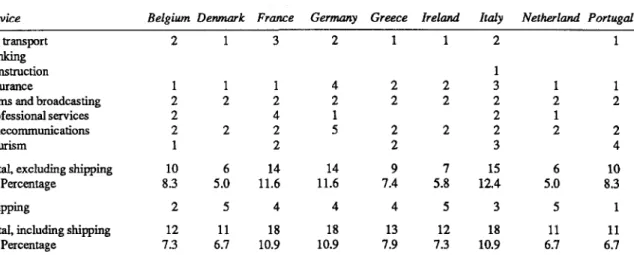
The Emerging EC Foreign Trade Policy in Services services, even if it has not been embodied in directives so far. As shown below, it has surfaced in the banking The 1992 program deals exclusively with intra-EC mat- dispute between the EC and United States. In air transport ters. The number and force of the trade barriers to be the unfair advantages allegedly enjoyed by "low-wage" dismantled if the EC opens its borders to foreign services air carriers have been cited. In telecommunications the indicate how deeply entrenched is protection of some first liberalizations in services are not, at this stage, sectors (table 14-1). Whatever the borderline between giving rise to actions such as those against Hyundai in the Commission's and the EC states' powers in trade shipping, but they have triggered increased imports of policy in services turns out to be, the EC states will retain telecommunications equipment, which have already many ways of influencing trade in services in the near been under antidumping actions. In July 1987 and March future. (For instance, airports and air control are still 1988 the ad hoc office of the EC Commission initiated an under the jurisdiction of the EC states, and restrictive antidumping case against exports of mobile cellular practices in this domain may create substantial barriers phones from Canada, Hong Kong, and Japan. This action to freer air transport.) The figures confirm the leading was echoed in the warning by Oftel, the British watchdog role of Britain and the foot-dragging of France, Italy, in telecommunications, against service providers that
Spain (and, at this time, Germany). It also suggests that the lure users with cheap, low-quality mobile phones but smaller EC states may be more open than the larger ones. impose high call charges.
Patrick A. Messerlin
Table 14-1. Main EC Barriers, as Reported by U.S. Firms, 1985
Service Belgium Denmark France Germany Greece Ireland Italy Netherland Portugal
Air transport 2 1 3 2 1 1 2 1
Banking
Construction 1
Insurance 1 1 1 4 2 2 3 1 1
Films and broadcasting 2 2 2 2 2 2 2 2 2
Professional services 2 4 1 2 1
Telecommunications 2 2 2 5 2 2 2 2 2
Tourism 1 2 2 3 4
Total, excluding shipping 10 6 14 14 9 7 15 6 10 Percentage 8.3 5.0 11.6 11.6 7.4 5.8 12.4 5.0 8.3
Shipping 2 5 4 4 4 5 3 5 1
Total, including shipping 12 11 18 18 13 12 18 11 11 Percentage 73 6.7 10.9 10.9 7.9 7.3 10.9 6.7 6.7
Note: The U.S. Trade Representative study is based on reports by U.S. exporters of services about "selected problems" they encounter. As a result, it tends to mirror the capacities of the United States to export-that is, it overestimates barriers in relatively open states or sectors and underestimates
the others. This is why another source has been considered for shipping (White 1988).
Sources: For all services except shipping; ussR (1985). For shipping; White (1988).
The EC 1992 Program and the Uruguay Round workers from developing countries; some will be re-on Services cruited by Ec firms, as in the case of the flagging-out
shipping policies examined above. But it will undoubt-What implications and lessons does a successful 1992 edly hamper many firms from developin~ countries in program have for the Uruguay Round negotiations? The exploiting their comparative advantages.
implications concem the impact on the EC's negotiating
position of the crucial choice made by the 1992 pro- The Impact on the EC Negotiating Attitude
gram-to adopt the widest scope of trade in services.
Lessons follow from the fact that the 1992 program has That no service sector is a priori excluded from the already begun to test many of the main concepts to be agreement has allowed the EC to balance as much as embodied in the Uruguay Round, as best illustrated by possible the interests of its potential exporters and im-the rules on market access and competition. porters in the Uruguay Round negotiations. To this ex-tent, the 1992 program has decreased the likelihood of a
Scope "Fortress Europe"-a combination of intra-EC liberaliza-tion with high extemal protecliberaliza-tion.
The 1992 program embraces the widest scope the Uru- Trade balances are an indicator of the likely reactions guay Round agreement on services could consider: it of EC service industries to a world liberalization under covers movement of consumers and of the factors of Uruguay Round auspices. Negative or deteriorating bal-production required for producing and selling services as ances are likely to be used as an argument for protection; well as cross-border trade in services, and it includes increasingly positive balances could support protrade future as well as existing services. The scope of the arguments. Table 14-2 shows the trade balances between program has influenced the Community's responseto the the EC and the rest of the world for fourteen service invitation in the Montreal ministerial declaration to sub- sectors. There may be active lobbies for protection mit an indicative list of service sectors of interest; the EC against the rest of the world in four industries: telecom-was one of only three Contracting Parties to table such a munications, advertising, films and broadcasting, and list, and its list covers all internationally tradable service sea freight. Three industries-banking, insurance, and sectors. There is, however, a significant difference be- travel-might favor a freer EC trade policy. The attitude tween the 1992 program and the EC approach in the of the other sectors is more difficult to predict, either Uruguay Round: the EC opposes coverage by the Round because trade balances are positive but deteriorating or agreement of trade in services that requires labor move- because no clear trend has emerged. Table 14-2 is con-ment other than that of "skilled and key personnel and firmed by table 14-1, which also suggests that telecom-for a limited duration." This limit will not harm all munications, films and broadcasting, shipping, and air
liberalize within a multilateral framework. That raises a question: will the 1992 program, which aims at creating
United EC a customs union in services (or, to use the current
word-Spain Kingdom Total (percentage) ing of the Uruguay Round, a regional integration ar-2 3 18 10.9 rangement) increase trade distortions by facilitating 3 3 1.8 trade between the constituent territories and raising bar-1 2 1.2 riers to the trade of other contracting parties with such
1 1 18 10.9 territories-as most of the custom unions in goods did? 2 2 22 13.3 Or might regional agreements in services differ from
3 2 15 9.1
2 2 25 15.2 custom unions in goods in that they generate more forces 4 2 18 10.9 able to inhibit trade distortions than do customs unions? 1 7 13 121 The second alternative seems the more plausible be-14.0 10.7 1l0.0 cause prior to regional agreement services are regulated by a host of international agreements that make it diffi-8 3 44 26.7 cult to increase the barriers between the members of the 25 16 165 regional integration agreement and the rest of the world. 15.2 9.7 100.0 These agreements were necessary because service pro-ducers put much more emphasis on establishment for market access than did producers of goods. The follow-ing list gives a flavor of this extensive pre- 1992 network of agreements and their impact on the EC.
transport are good candidates for supporting protection- In banking the rules adopted under the aegis of the Bank ist policies, whereas banking should be more supportive for International Settlements have been incorporated in of freer trade because it is more open. the EC directives, and bilateral agreements on coopera-The sectors in which protectionist pressures are likely tion between agencies in charge of monitoring securities to be the highest (telecommunications and air and sea markets have been signed between non-EC and EC coun-transport) are also likely to be the most difficult to tries. In insurance the directive on motor insurance must Table 14-2. EC Trade Balances in Services, 1980-86
(billions of ECUS) Service 1980 1981 1982 1983 1984 1985 1986 Banking 0.89 0.95 0.80 1.77 2.32 2.88 3.12 Insurance 0.31 1.26 1.05 1.22 1.08 2.65 4.08 Telecommunications -0.11 -0.31 -0.47 -0.58 -0.47 -0.36 -0.33 Air freight 0.51 0.50 0.48 0.53 0.69 0.92 1.08 Air passenger 2.14 2.12 2.38 2.82 3.33 3.20 1.60 Seafreight 1.15 0.15 0.07 -1.14 -2.08 -2.32 -1.61 Sea passenger 0.25 0.28 0.42 0.41 0.41 0.54 0.53 Other transport 0.04 -0.28 -0.72 -1.37 -0.73 0.46 -0.47 Advertising -0.36 -0.37 -0.57 -0.83 -0.87 -1.02 -1.16
Films and broadcasting -0.12 -0.21 -0.21 -0.24 -0.30 -0.28 -0.46
Trade 0.05 -0.39 -0.20 0.39 0.08 -1.27 0.19
Other business services 1.92 2.53 2.56 2.82 2.76 2.79 2.70
Construction 2.61 3.50 3.57 3.00 3.58 3.15 2.62 Travel -0.58 0.23 2.38 6.49 10.47 11.86 5.76 Property incomes -1.53 -1.56 -1.89 -1.81 -2.31 -2.42 -2.60 Other services 2.14 3.48 3.56 3.88 2.61 5.28 6.33 Unallocated 3.07 3.31 3.38 3.52 4.25 4.39 4.30 Total 12.35 15.18 16.61 20.87 24.82 30.46 25.67
Note: There are no doubt many problems with these data. The main one is that they capture cross-border trade flows and not sales of services related to foreign presence-a cacial point for such sectors as banking.
Patrick A. Messerlin
remain compatible with the green card system that covers of "effective market access," defined as the situation in non-EC countries. A U.S. life insurer can do business in which service providers of the two countries enjoy "com-Britain under the 1986 Financial Services Act if its home parable competitive opportunities" (to use the wording state is considered a "designated territory" under the of the Second Banking Directive) in the two markets. act-like, for example, Pennsylvania is. In airlines the This concept sheds some light on reciprocity and pro-66 air agreements between EC states are intertwined with gressive liberalization.
the 218 agreements involving the 22 European members
of the European Civil Aviation Conference (ECAC). That RECIPROCrrY. Reciprocity is the threshold of mutual Norway and Sweden are part of the SAS airline network concessions that trade partners consider satisfactory with Denmark has necessitated special adjustments to EC enough to sign a trade agreement. It is a concept used in rules to grant the Community's passport to SAS. In tele- negotiations, not in economics. In cross-border services, communications the technical rules adopted by the Inter- national treatment links reciprocity to host country rules, national Telecommunication Union (lTU) are enforced as it does in trade in goods. That financial services by the European PTOs. EC rules are compatible with exported by EC banks are subject to U.S. regulations in regional agreements involving non-EC countries, such as the United States and the other way around seems to be the future MDNS (Managed DataNetwork Services) elab- an acceptable bargain for the two partners and is gener-orated by Europe's twenty-two PTOs. ally the equilibrium point of the negotiation. By contrast, that suppliers of services are subject to host country rules
Market Access Rules does not lead to such an acceptable bargain: producers in the most liberal country are seen as disadvantaged in Market access clauses, which are harder to define in the comparison with producers in the less liberal country. context of services than of goods, have already been Although there is no economic rationale for this propo-tested in actual situations in the Ec. The 1992 program has sition consumers may prefer the more stringent rules.
had to find operational ways of using such concepts as The "comparable competitive opportunities" concept national treatment,reciprocity,andprogressiveliberalization. makes assessing reciprocity more complex because it compares host and home country rules. The rule of the
NATIONAL TREATMENT, AND MORE. The Montreal decla- most regulated home country could be chosen as the ration defines national treatment by the "no less favor- internationally agreed standard for reciprocity. In this able" provision. For cross-border services, the concept restrictive option U.S. banks would operate in the EC of treatment "no less favorable" in respect of all regula- under U.S. rules-that is, they would not be able to tions than that accorded domestic services in the same engage in securities activities in the EC or to enter simul-market has a clear meaning, similar to the accepted one taneously into all the EC states. (Such an option is close for trade in goods. But this definition is plagued by many to the 1988 position of former EC Commissioner de problems when services are "traded" through the estab- Clercq.) Conversely, the rule of the most liberal home lishmentofsuppliersin "importing" countries.Forinstance, country could be chosen as the international standard. it may exclude situations in which the domestic provider in Then EC banks would operate in the United States under the importing country is a monopoly, as in air transport or rules similar to those of the EC; that is, they would be able telecommunications in many developing countries. to conduct securities business in the United States, to This first source of problems is modest compared with branch freely, and to provide cross-border services the second: what does the Montreal definition mean throughout the country (which U.S. banks are not al-when one trade partner imposes stricter regulations on its lowed to do). This option is close to mutual recognition domestic firms than another partner-a situation that is and to the principle adopteA in July 1989 by the BC and likely to be very frequent, if not the rule? The EC faced Switzerland in an agreement on nonlife insurance that this problem in the specific context of the banking sector opens EC markets to Swiss firms on condition that Switz-in a (sometimes acrimonious) debate with the United erland adapt its insurance laws to those of the EC.
States and Japan.13 Similar cases are likely to emerge in In the mercantilist approach to trade negotiations, this other service sectors if the 1992 program succeeds. For wide range of options leaves no equilibrium point that is instance, in air transport the fifth freedom between two easily acceptable by both partners. As a result, the EC has EC states will become close to a cabotage right after 1993. chosen to leave the task of finding such an equilibrium Such situations have led the EC to expand the definition point to procedures (internal consultations and negotia-of national treatment (the "no less favorable" clause) by tions with the trade partner) that are applied case by case. a provision that takes into account the mode of delivery Such an approach seems to be plagued by an opportunis-of services in foreign markets. The EC forged the concept tic attitude and could endanger the multilateral trading
system, as illustrated by the acrimonious banking debate Competition Rules
between the EC, Japan, and the United States, which has
been summarized as follows: "Reciprocity is a missile Competition rules have been crucial to the Ec internal aimed at Tokyo which will land in New York and ex- liberalization. Lessons to be drawn for the Uruguay plode on Capitol Hill" (Financial Times October 28, Round can be grouped around the three types of compe-1988). Although there may be some basis for this fear, tition rules: "antimerger" (antitrust) rules, rules against two points are worth noting. the "abuse of a dominant position," and rules against
First, countries that take the mercantilist approach to "collusive practices."
multilateral negotiations tend "involuntarily" to favor There is one crucial motive-in addition to the usual solutions that are the most economically sound for the one of promoting competition-for including competi-trading partners. Country A tries to get country B's tion rules in the Uruguay Round: such rules are an markets as open as possible-a policy beneficial to the extremely economical way of regulating an economy. consumers of country B-and the other way around. There are three reasons for this. First, competition rules Second, reciprocity is not only a conflict between trading do not require lengthy provisions: the Treaty of Rome partners but it is also a conflict of interests within each devotes 3 articles (out of 246) and fewer than 60 lines to domestic industry of the two trading partners. For in- these rules. Second, since they concern only real prob-stance, the restrictive option described above would lems revealed by the functioning of the markets, they favor U.S. banks that already have a subsidiary in one EC minimize the need for reregulation and thus the risk of state (and are thus able to branch through the Community premature or excessive reregulation-a danger in multi-and reap all the benefits from the 1992 program) over lateral negotiations, which are always quick to consider U.S. banks that are not already established in the EC. By all possible problems. Third, they maximize the effi-contrast, the large influx of foreign securities firms into ciency of the minimal set of reregulations really neces-the EC brought about by neces-the liberal option could be sary by offeringasure way of enforcing theseregulations beneficial to Continental stock exchanges-in which if they are consistent with the interests of consumers. there are a lot of niches to be exploited-in relation to
London. ANTLMERGER RULES. Antimerger rules are unlikely to be
part of the Uruguay Round agreement because in many
PROGRESSIVE LIBERALIZATION. The concept of progres- countries many services areprovided by public orprivate
sive liberalization is essential in the context of the par- monopolies or duopolies, as in telecommunications. The ticipation of the developing countries in the Uruguay experience of the Community suggests, however, that Round. The concept of "comparable competitive oppor- the absence of antimerger rules will not impede the world tunities" can take progressive liberalization into account liberalization; such rules at the EC level have played no in two ways. First, it suggests that developing countries role in the intra-EC liberalization, since they were need to create competitive structures in their own ser- adopted only in December 1989.
vices sectors in order to open them. It thus recognizes More interestingly, the EC experience even suggests that developing countries may face the heavy task of that mergers-apart from their economic pros and building new, competition-oriented, domestic regula- cons-can be a positive force for adopting a trade liber-tions-a point often emphasized by developing country alization program. Mergers offer to each member firm a negotiators. Such a perspective is present in the 1992 share in the comparative advantages of the other suppli-program: the Community's less developed countries ers and in other national markets that may have larger or have often been granted a longer time period for opening more dynamic demands. National monopolies or domi-their sectors so as not to put them at risk. nant firms can thus reduce the risks associated with trade Second, industrial countries may agree to give firms liberalization through mergers, which become a crucial from developing countries advantages greater than those instrument for dissolving the "national champions" in-granted by these countries to firms from industrial coun- herited from the 1970s. For instance, the emerging Eu-tries. They can do so by defining what they judge as ropean "megacarrier" consisting of British Airways, "comparable" to the competitive opportunities they KLM, and Sabena offers an unique opportunity for im-offer. Industrial countries may be eager to graduate their proving the efficiency of Sabena by linking it to two reciprocity threshold to the level of development of their efficient and wealthy firms and for achieving a partial trade partners, especially if they do not feel trapped by a privatization of Sabena at the same time. (British Air-rigid rule of "special and differentiated" treatment. ways and KLM will each own 20 percent of the shares of
Patrick A. Messerlin
the new Sabena World Airlines.) Both effects can only services will be liberalized, but networks will not, lead-make Belgium's air transport policy more liberal. ing to the risk that the network owners will abuse their There are similar recent examples involving firms from dominant position if they provide services and compete developing countries. For instance, Singapore Airlines with mere suppliers of services.
and Swissair have signed a cooperation agreement with Rules against abuses of a dominant position allow the exchanges of equity. This agreement indirectly rein- solution to potential competition to be shifted from ex forces the links between Singapore Airlines and Delta ante general regulations to ex post specific cases, as
Airlines (aU.S. company), and opens the way forsimilar shown by telecommunications value added services. deals with SAS, Finnair, and a few other airlines. It Under the 1992 program PTos will keep their monopoly generates a "global aviation system" that reduces the on networks but will make them accessible to competi-risks of changes associated with world liberalization for tors in value added services. Preventing network-owner each member firm and thus lessens the fears of the PTOs from abusing their privileged position to eliminate govemments concemed. competitors has led to special rules of conduct (see This role of mergers can also be observed in the equip- appendix 14-A, "Telecommunications"). In other words, ment industries linked to service sectors. This is best liberalizing cross-border services-such as value added illustrated by the telecommunications equipment pro- services-has led to thereregulation of the providers (the ducers, which have constituted consortia for definite PTOs) of equipment (networks) and services (basic ser-tasks.t4 For instance, the recent German bid for a mobile vices) that are not yet liberalized. Such a situation gen-phone license was granted to a Mannesmann-led consor- erates complex questions. Should reregulation be applied tium that included British, French, and U.S. firms. Four to the PTos alone, or should the regulatory activities of the other offers also involved British firms, including cover newcomers as well? A satisfactory solution is British Telecom itself. In the short run, such mergers, unlikely to reside in static and detailed regulations; it is which are now frequent in telecommunications and con- more likely to emerge from the analysis of a concrete struction, are a partial substitute for liberalization of the situation in which a given service provider perceives that public procurement procedures. They lay the ground for it faces abuse of a dominant position, in the light of the the still rare successes of individual firms (Ericsson in economically sound criterion of competition rules: the the United States, AT&T in Italy, Sony in Britain, and interests of the consumers.
Fujitsu in Britain and Germany). In the long run, they Rules against abuses of a dominant position are neces-ease the introduction of more competition-oriented rules sary for effective enforcement of codes of conduct and in public tenders. similar regulations, as illustrated by the computerized
There is a point, however, at which the costs of such reservation systems. The two emerging EC megacarriers mergers or consortia become higher than the gains. are organized around two CRss, with, so far, no future Mergers may reach sizes that will hinder the emergence competitors in the EC, and with international connec-and survival of otherwise efficient mavericks connec-and will tions.15 As CRss are extremely expensive (both in phys-thus make competitive markets impossible. In airlines, ical and human capital), they are operated by joint for instance, the coalition between British Airways, KLM, ventures of airlines that have been exempted from com-and Sabena com-and the one between Air France, Lufthansa, petition rules (another example of limited use of antimer-and Iberia would in 1985 have represented 50 to 55 ger rules). The Commission is well aware of the risks of percent of the air services operated by all the EC airlines. such an exemption, and the exemption has been subject In sum, the absence of antimerger rules is an easily to conditions that ensure free access to the systems, acceptable risk only if there are competition rulesagainst elimination of biases between air carriers, and more abuse of a dominant position. flexibility for the contracts offered to travel agents. It has also been complemented by the adoption of a mandatory
RULES AGAINST ABUSE OF A DOMINANT POSMON. Dom- code of conduct insisting on nondiscriminatory and inant positions are likely to be frequent in many service transparent use of the CRS. But the credibility of the sectors because a successful Uruguay Round will merely exemption and of the code relies on the threat imposed open the legal possibility for obtaining better access to by the existence of rules against abuses of a dominant networks run by dominant firms (monopolies). These position and on the ability of firms to complain on a networks include telephone lines run by PTos, computer- case-by-case basis.
ized reservation systems, or cRss-the electronic net- All these considerations are of special interest for the works that allow travel agents to book flights and Uruguay Round. Many bN;ieve that "sectoral annota-facilities-run by airlines; slots run by airport authori- tions"-that is, additional provisions interpreting and ties; roads controlledby governments; and soon. In sum, clarifying frameworkprovisions for each individual
sec-tor-will be necessary. That could represent a great based inside or outside the Ec states. The implied risk in danger for the Round: interminable negotiations and terms of extraterritoriality may inhibit enforcement of increasingly ambiguous, inconsistent or useless clauses, the code. The adoption of rules against collusive actions offering a back door for protection. One can argue that in the Uruguay Round would offer a way of solving this many "sectoral annotations" could be avoided by com- type of problem.
petition rules. Third, the Uruguay Round will adopt safeguards and Two final remarks are necessary. First, competition is provisions that have a similar economic impact, such as often stiffer than initially expected. In telecommunica- antidumping and antisubsidy regulations (Hoekman and tions, private networks are only stating up. Public firms Leidy 1990). The GATT experience in such matters is in similar services can generate competition pressures; crystal clear either provisions are designed with eco-for example, SNCF, the French railways company, has nomically sound constraints (nondiscriminatory mea-decided to create its own worldwide reservation system sure, compensation, and so on) and are rarely used, as based on the technology of Sabre, the CRS developed by illustrated by the GATT article xIx, or they rely on am-American Airlines (Le Monde, November 30, 1989). biguous concepts ("unfair" competition, domestic indus-Second, a balance between the regulations to be applied try, and injury thatare rapidly captured by domestic firms to dominant private or public firms should be main- looking for protection and are used as devices for enforc-tained. These two types of firms have different ways of ing collusive practices with public sponsorship abusing a dominant position, and the Uruguay Round (Messerlin 1990a). The concepts embodied in competi-framework should take this difference into account, as tion rules against collusive practices offer a way of the Treaty of Rome did by supplementing article 86 limiting this phenomenon of capture.
(focusing on private firms) with article 90 dealing with
public firms. A Brave New World: Competition in Regulations
RULES AGAINST COLLUSIVE PRACTICES. The EC experi- Services are regulation-intensive. As a result, compara-ence shows that competition rules against collusive prac- tive advantages in services are determined by the ability tices are a crucial ingredient in the initiation of of states to generate the best rules: states that open their liberalization in services. Including such rules in the service sectors will compete in regulations. The more Uruguay Round framework would be useful for three market access is granted, the stiffer is the competition. main reasons. This is best illustrated by the mutual recognition
princi-First, Uruguay Round provisions are unlikely to lead to ple, which can mean better treatment of foreign firms an immediate application of essential provisions to some than does national treatment. For example, if British service sectors. For instance, the most favored nation licensing or operating rules are better designed than clause is unlikely to be applied in air transport because French rules, French branches of the British banks will
this sector relies on a host of bilateral arrangements. As enjoy better treatment than French banks.
a result, it is likely that there will be a "freeze" in this Developing countries may be afraid to compete on sector. The danger is that the freeze in liberalization of these terms because they may feel "disadvantaged" and some sectors will continue forever and become a de facto "unprepared." But there are good reasons for them to permanent exception, as in the case of textiles in goods. accept the challenge and to participate in the "uneasy" Accepting a freeze is a risk that can be taken only if there free market revival (Henderson 1988).
are provisions that permit market forces to reveal a desire First, competition in regulations will induce developing to move toward more competition. In the EC experience countries to elaborate their own regulations. Far from
the enforcement of rules against collusive practices has inhibiting their capacity to regulate-a fear often ex-started the liberalizations in air transport and telecommu- pressed by developing countries-an economically nications equipment, in particular. sound Uruguay Round will be a stimulus for them to Second, many industrial and developing countries al- adopt better regulations. The EC experience in the past ready have active competition rules. When applied to decade can be best described as a continuous effort to service sectors, these national rules can easily lead to move from a set of inefficient regulations to a new set of problems of extraterritoriality, which are political and rules that are more efficient because they support a legal nightmares. In such circumstances, actions can take higher level of competition. There is no better illustration decades or be abandoned, to the detriment of an econom- than the ongoing competition between the London and ically sound procompetitive solution. For instance, the Continental stock exchanges. The 1987 crash revealed EC code on cRss applies notjust to Amadeus and Galileo the weaknesses of some of the new regulations in the but to aU CRSs operating in the Community, whether liberalized London International Stock Exchange, from