Publisher’s version / Version de l'éditeur:
Journal of Power Sources, 54, April 2, pp. 232-235, 1995
READ THESE TERMS AND CONDITIONS CAREFULLY BEFORE USING THIS WEBSITE.
https://nrc-publications.canada.ca/eng/copyright
Vous avez des questions? Nous pouvons vous aider. Pour communiquer directement avec un auteur, consultez la première page de la revue dans laquelle son article a été publié afin de trouver ses coordonnées. Si vous n’arrivez pas à les repérer, communiquez avec nous à [email protected].
Questions? Contact the NRC Publications Archive team at
[email protected]. If you wish to email the authors directly, please see the first page of the publication for their contact information.
NRC Publications Archive
Archives des publications du CNRC
This publication could be one of several versions: author’s original, accepted manuscript or the publisher’s version. / La version de cette publication peut être l’une des suivantes : la version prépublication de l’auteur, la version acceptée du manuscrit ou la version de l’éditeur.
For the publisher’s version, please access the DOI link below./ Pour consulter la version de l’éditeur, utilisez le lien DOI ci-dessous.
https://doi.org/10.1016/0378-7753(94)02074-D
Access and use of this website and the material on it are subject to the Terms and Conditions set forth at
Lithium-ion cell based on orthorhombic LiMnO2
Davidson, Isobel; McMillan, Roderick; Murray, J. J.; Greedan, J. E.
https://publications-cnrc.canada.ca/fra/droits
L’accès à ce site Web et l’utilisation de son contenu sont assujettis aux conditions présentées dans le site
LISEZ CES CONDITIONS ATTENTIVEMENT AVANT D’UTILISER CE SITE WEB.
NRC Publications Record / Notice d'Archives des publications de CNRC:
https://nrc-publications.canada.ca/eng/view/object/?id=abf65e0c-d4d4-4bcc-b075-752aa597acaa https://publications-cnrc.canada.ca/fra/voir/objet/?id=abf65e0c-d4d4-4bcc-b075-752aa597acaa
. ~ • . ; .
ELSEVIER Journal of Power Sources 54 (1995) 232-235
J l l l i l l A t U l
POWER
SOURCES
Lithium-ion cell based on orthorhombic LiMn02
I.J. D a v i d s o n
a , *R.S. M c M i l l a n
aj . j . M u r r a y a, J.E. G r e e d a n b
a Institute for Environmental Research and Technology, National Research Council Canada, Ottawa, Ont., K1A OR6, Canada b Institute for Materials Research, McMaster University, Hamilton, Ont., Canada
Abstract
This paper will demonstrate that cathodes based on the high temperature form of orthorhombic LiMnO2, with the structure described by Hoppe, Brachtel and Jansen, have good capacity and cycle life. X-ray diffraction studies have revealed that cathodes prepared from orthorhombic LiMnO2 undergo a structural change on being charged beyond a certain potential in which the original structure is converted to spinel Lil-xMn204. Orthorhombic LiMnO2 has been found to have long-term stability in ambient conditions and is easily prepared in a one-step reaction.
Keywords: Lithium-ion cells; Lithium; Manganese dioxide; Crystal structure
1. Introduction
LiMnO2 is known to exist in several phases. Two phases, whose crystal structures have been well char- acterized, are a high temperature orthorhombic phase
(Pmnm)
and a tetragonal phase(I41/amd).
Both struc- tures involve cubic close packing but they differ in the arrangement of the ordering of the lithium and man- ganese cations. The tetragonal form, A-Li2Mn204, is prepared by electrochemically, or chemically, interca- lating lithium into the LiMn204 spinel structure. It has an atacamite-type structure which is often referred to as being spinel related. Both LiMn204 and A-Li2Mn204 have been used as cathodes in lithium-ion cells [1,2]. The structure of the high temperature orthorhombic phase of LiMnO2 was determined in detail by Hoppe et al. [3]. To our knowledge, the use of LiMnO2, having this structure, as the active material in the cathode of a reversible electrochemical cell has never, previously, been demonstrated.Ohzuku et al. [4] have demonstrated the use of a low temperature form of orthorhombic LiMnO2, pre- pared by reacting an equimolar mixture of y-MnOOH
and LiOH. H 2 0 at 450 °C, as the active cathode material
in a reversible lithium-ion cell. More recently, Reimers et al. [5] developed improvements on Ohzuku's synthesis and found that low temperature LiMnO2 can be pre- pared at very low temperature (100 °C) by ion exchange. However, they found that well-crystallized LiMnO2
* Corresponding author.
© Government of Canada 1994
SSD1 0378-7753(94)02074-D
prepared at 450 °C had much poorer electrochemical behaviour than more disordered material prepared at 350 °C. Gummow et al. [6] studied LiMnO2 prepared at moderate (600620 °C) temperatures from y-MnO2 and LiOH in argon with carbon added as a reducing agent. Both Reimers and Gummow state, without giving direct evidence, that orthorhombic LiMnO2, which is conventionally synthesized at high temperatures, does not show good electrochemical activity.
2. Experimental
We have prepared orthorhombic LiMnO2 by a clas- sical high temperature solid-state reaction, verified Hoppe's structure by neutron diffraction, and have evaluated this material in cathodes of lithium-ion cells. High temperature orthorhombic LiMnO2 was prepared by intimately mixing and pelletizing a 2:1 mole mixture of /3-MnO2 (Fisher Scientific Certified) and Li2CO3 (Aldrich 99.997% pure). The pellets were first calcined at 600 to 650 °C for several hours to remove the CO2, and then baked at 800 to 1000 °C for 1 to 3 days in a horizontal tube furnace under a flow of argon gas. Generally, one or two more grindings and firings were required to achieve a well-crystallized product. The progress of the reaction was followed by X-ray powder diffraction.
Neutron powder diffraction data of LiMnO2, prepared as described, were collected at the McMaster Nuclear Reactor using 1.3913/~ neutrons obtained from a [200]
l.J. Davidson et al. / Journal of Power Sources 54 (1995) 232-235
copper monochromator and a spectrometer described previously [7]. The raw data, collected with a position- sensitive detector, were corrected for the detector ge- ometry according to the procedures of Ref. [8].
Lithium-ion cells were assembled in a 2325 coin cell format with pressed pellet cathodes containing ortho- rhombic LiMnO2 mixed with 10 wt.% Super S carbon black (Chemetals Inc.) and 2 wt.% ethylene/propylene/ diene monomer (EPDM) (Polysar), and pelletized an- odes containing petroleum coke (premium needle coke) combined with 7.5 wt.% Super S carbon balck and 2 wt.% EPDM binder. The cells were assembled, with polypropylene felt separators (Web Dynamics) and electrolyte containing 1 M (CF3SO2)2N-Li + (3M Com- pany) in a 50/50 mixture by volume of propylene car- bonate and dimethoxyethane, in a helium atmosphere glove box.
3. Results and discussion
Fig. 1 is the X-ray diffraction trace of a typical product of this reaction, with stick diagrams of the diffraction patterns of orthorhombic LiMnO2, spinel LiMn204 and spinel-related A-Li2Mn204 from the pow- der diffraction file of the International Centre for Diffraction Data plotted below for comparison. This particular sample was calcined at 600 °C followed by two intervals of three days each at 800 °C. The diffraction pattern shown was taken after eleven months of storage under ambient conditions, and serves to demonstrate that, unlike A-Li2Mn204, the orthorhombic form of LiMnO2 is air stable.
I ] / I _ _ . 10 20 30 40 50 60 70 80 90 100 2O LiMn02 l I i,t, , I,. LiMn204 35-0749 35-0782 Li2Mn204 38-0299
Fig. 1. Diffraction pattern o f o r t h o r h o m b i c LiMnO2, after eleven
month's storage in air, with stick diagrams of the diffraction patterns
of o r t h o r h o m b i c LiMnO2, spinel LiMn204 a n d spinel-related A- Li2Mn204 from the powder diffraction file o f the International Centre for Diffraction D a t a plotted below for comparison.
233
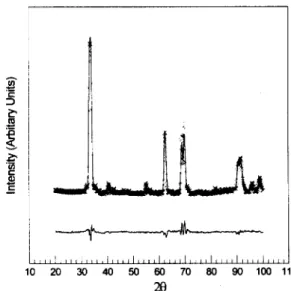
The LiMnO2 structure was refined from the neutron powder diffraction pattern with a Rietveld profile re- finement program, 'Rietan' [9]. The refinement was initiated with the atomic positions of Hoppe et al. [3]. Twenty parameters were allowed to refine: three lattice parameters, four atomic z-coordinates, four isotropic thermal parameters, a scale factor, a detector zero- point offset, six background parameters and the half- width parameter, w. The observed (symbols) and cal- culated (line) neutron diffraction patterns are plotted in Fig. 2. The difference is plotted below on the same scale. The refined structure, tabulated in Table 1, agrees well with Hoppe's refinement from single crystal X-ray diffraction data.
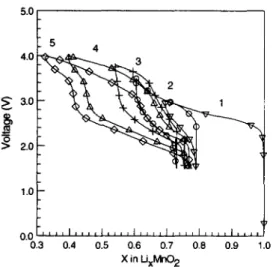
Lithium-ion cells with orthorhombic LiMnO2 cath- odes were evaluated by constant current cycling. Fig. 3 shows the first five cycles for a cell cycled at 1.37 mA/g of LiMnO2 between voltage limits of 1.5 and 4.0 V. The anomalies in the first discharge and in the third charge are due to brief, accidental, power interruptions. The low rate is necessary for the rather thick (--1 mm) electrodes used in this experiment. Except for the lower upper voltage limit, the voltage curves are very similar to those shown in Fig. 6 of Ref. [2] for cells containing A-Li2Mn204 cathodes. Reimers et al. [5] and Gummow et al. [6] have found that LiMnO2 prepared at lower temperatures undergoes an irrever- sible conversion to a spinel-type form on cycling. X- ray diffraction studies on materials recovered from cycled cells also reveal that the orthorhombic LiMnO2 prepared at high temperature converts to Lil_xMn204 on being charged to greater than about 50% of its theoretical capacity (285 mAh/g).
Another coke/LiMnO2 cell was cycled between 1.5 V and a progressively increasing upper voltage limit. The first two cycles, to voltage limits of 3.0 and 3.5 V, respectively, showed very high irreversible capacities.
e -
e -
10 20 30 40 50 60 70 80 90 100 110
20
Fig. 2. Observed (symbols) and calculated (line) n e u t r o n powder diffraction patterns for o r t h o r h o m b i c LiMnO2. The difference in the patterns is plotted below on the s a m e scale.
234 LJ. Davidson et al. / Journal of Power Sources 54 (1995) 232-235
Table 1
Rietveld refinement of r o o m te~:'perature n e u t r o n diffraction data for LiMnO2
A t o m Site x y z Occupancy B (,~2)
Mn 2a 0.25 0.25 0.632(5) 1.0 0.5(4)
Li 2a 0.25 0.25 0.100(9) 1.0 0.2(7)
O 2b 0.25 0.75 0.142(4) 1.0 0.5(3)
O 2b 0.25 0.75 0.602(4) 1.0 0.5(3)
Space group: P m m n (D2a13). Wavelength: 1.391 ~ .
Lattice parameters: a = 2.8048(3) /~; b =4.5755(6) /~; c = 5.7494(7) /~,. Halfwidth parameters: U = 1.50; V = - 1.20; W=0.779(8).
Scattering lengths: Li ( - 0 . 1 9 0 ) ; M n ( - 0 . 3 7 3 ) ; O (0.5803).
Weighted profile R = 7 . 4 0 ; Profile R = 5 . 6 1 ; Bragg R = 4 . 4 7 ; Expected R = 3 . 4 2 .
5.0 4.0 3.0 .~ 2.0 5 4 3 2 1.0 0,0 , , , , l , , , , l , J , , l , , , , l , , , , l , , J , l , , , , 0.3 0.4 0.5 0.6 0.7 0.8 0.9 1.0 X in UxMnO 2
Fig. 3. First five charge/discharge cycles of a coke/LiMnO2 cell between voltage limits of 4.0 a n d 1.5 V. T h e anomalies in the first discharge and in the third charge are due to brief, accidental, power inter- ruptions.
50 I
4.0 3.0 2.0 1.0 5 4 0.0 ' ' ' ' 1 ' ' ' 1 1 . . . . I , , , + l + , J + l ~ , , t l , , J 0.3 0.4 0.5 0.6 0.7 0.8 0.9 X in I.JxMnO 2 1.0Fig. 4. First five cycles of a cokeFLiMnO~ cell cycled to progressively higher voltage limits: (~7) first cycle to 3.0 V; (O) second cycle to 3.5 V; ( + ) third cycle to 3.8 V, and (z~) fourth and ( ~ ) fifth cycles to 4.0 V.
As shown in Fig. 4, the second charge pushed the cathode to 40% of its theoretical capacity. The third charge to a voltage limit of 3.8 V, indicated by the plus symbols in Fig. 4, took the cathode to 46% of its nominal capacity. The subsequent discharge, however, provided 12% more capacity than the charge had con- sumed. The fourth and fifth cycles to 4.0 V provided further small gains in discharge capacity relative to the prior charge. The first two discharges show no evidence of the higher voltage plateau (above 3.6 V) associated with lithium occupation of tetrahedral sites. Although it is difficult to see in Fig. 4, the third discharge shows a small amount of the high voltage plateau indicating that the conversion to spinel Lil_xMn204 began on the third charge. The coincidence of the phase conversion with increased reversible capacity suggests that it is critical to the functioning of LiMnO2-based cathodes, and may explain previous negative reports regarding the electrochemical activity of high temperature LiMnO2.
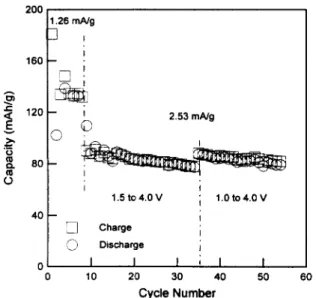
Cells built with high temperature orthorhombic LiMnO2 cathodes have been cycled to more than 50 cycles without serious reduction in their reversible capacity. Fig. 5 is a plot of capacity, in mAh/g of LiMnO2, versus cycle number for a typical coin cell with relatively thick electrodes ( ~ 1 mm). This cell was cycled at 1.26 mA/g for the first eight cycles and then at 2.53 mA/g to the 55th cycle. The cell was cycled at constant current to 4.0 V. On the 35th discharge the lower voltage limit was reduced from 1.5 to 1.0 V, resulting in a modest increase in capacity. The large reduction in capacity on increasing the rate from 1.26 to 2.53 mA/g reflects the fact that the coin cell format uses rather thick electrodes, approximately 1 mm. The first cycle had an irreversible capacity loss of 79 mAh/ g, which is believed to be due to lithium being consumed in the formation of a passivation film on the coke anode. At 1.26 mA/g, the cycleable capacity of this coin cell is about 132 mAh/g of LiMnO2, which when summed with the irreversible capacity loss on the first cycle, 211 mAh/g, is still much less than the theoretical
LJ. Davidson et al. / Journal o f Power Sources 54 (1995) 232-235 235 r - > , Q. 0 200 1.26 mA/g 3 I 160 - 120 - i (3 8 0 - 4 0 - 0 0 2.53 mA/g © I 1.5 to 4.0 V 1.0 to 4.0 v Charge Discharge I I I I I 10 20 30 40 50 Cycle N u m b e r 60
Fig. 5. Charge and discharge capacities as a function of cycle number
for a thick electrode coin cell with an orthorhombic LiMnO2 cathode
and a petroleum coke anode.
160 120 I 4O , I 0 50 100 150 200 250 Current (rnA/g)
Fig. 6. Discharge capacities as a function o f cycling rate for lithium- ion cells with LiMnO2 cathodes of 0.5 and 0.2 mm thickness and petroleum coke anodes 66% thicker than the cathodes.
capacity of LiMnO2, 28.5 mAh/g, but comparable with the capacity to 4.0 V in a lithium-ion cell with a A- Li2Mn204 cathode and a coke anode [2]. The upper voltage limit, of 4.0 V, is required to prevent decom- position of the electrolyte. Presumably, more capacity would be attainable with orthorhombic LiMnO2 cath- odes if the electrolyte had a greater stability range.
Fig. 6 illustrates the variation in discharge capacity between 4.0 and 1.5 V as a function of cycling rate, charge and discharge, for coin cells with cathodes of 0.5 and 0.2 mm thickness, respectively. To achieve a
proper cell balance, the anodes in these cells were 66%
thicker than the cathodes, and the excess volumes of
the 2325 coin cells were filled with stainless-steel discs inserted between the anodes and the cell cases. At low rates, the capacity does not change much with electrode
thickness, however, at high rates, the use of thinner
electrodes dramatically improves the cycleable capacity
of cells with high temperature orthorhombic LiMnO2
cathodes.
4. Summary
We have demonstrated that cathodes based on the high temperature orthorhombic form of LiMnO2 have good capacity and cycle life. X-ray diffraction and electrochemical studies have revealed that cathodes prepared from orthorhombic LiMnO2 undergo a struc- tural change on being charged beyond a certain potential in which the original structure is converted to spinel Lil_xMn204. High temperature orthorhombic LiMnO2 has long-term stability in ambient conditions, is easily prepared in a one-step reaction, and consequently, proves to be a practical and convenient precursor to
A-Li2Mn204
in lithium-ion cells.Acknowledgements
The authors gratefully acknowledged the technical assistance of Martin Larabie, Gerald Pleizier, Paul Helm and Roopa Ganapathy.
References
[1] D. Guyomard and J.M. Tarascon, J. Electrochem. Soc., 139 (1992) 937-948.
[2] J.M. Tarascon and D. Guyomard, J. Electrochem. Soc., 138 (1991) 2864-2868.
[3] R. Hoppe, G. Brachtel and M. Jansen, Z. Anorg. Alig. Chem.,
417 (1975) 1-10.
[4] T. Ohzuku, A. U e d a and T. Hirai, Chem. Express, 7 (1992) 193-196.
[5] J.N. Reimers, E.W. Fuller, E. Rossen and J.R. Dahn, J. Elec-
tochem. Soc., submitted for publication.
[6] R.J. Gummow, D.C. Liles and M.M. Thackeray, Mater. Res.
Bull., 28 (1993) 1249-1256.
[7] J.E. Greedan and A.H. O'Reilly, Phys. Rev. B, 35 (1987) 8870--8873.
[8] C.W. Tompson, D.F.R. Mildner, M. Mehregang, J. Sudoi, R. Berliner and W.B. Yelon, J. AppL Co,stallogr., 17 (1984) 385-394.
[9] F. Izumi, Rietan--Rietveld Anatysis System, National Institute for