HAL Id: cea-01439762
https://hal-cea.archives-ouvertes.fr/cea-01439762
Submitted on 18 Jan 2017
HAL is a multi-disciplinary open access
archive for the deposit and dissemination of sci-entific research documents, whether they are pub-lished or not. The documents may come from teaching and research institutions in France or
L’archive ouverte pluridisciplinaire HAL, est destinée au dépôt et à la diffusion de documents scientifiques de niveau recherche, publiés ou non, émanant des établissements d’enseignement et de recherche français ou étrangers, des laboratoires
Electronic transitions in strained SmNiO 3 thin films
S. Catalano, M. Gibert, V. Bisogni, O. E. Peil, F. He, R. Sutarto, M. Viret, P.
Zubko, R. Scherwitzl, A. Georges, et al.
To cite this version:
S. Catalano, M. Gibert, V. Bisogni, O. E. Peil, F. He, et al.. Electronic transitions in strained SmNiO 3 thin films. APL Materials, AIP Publishing 2014, 2 (11), pp.116110. �10.1063/1.4902138�. �cea-01439762�
Electronic Transitions in Strained SmNiO3 Thin Films
S. Catalano,1,a) M. Gibert,1 V. Bisogni,2,b) O. Peil,1 F. He,3 R. Sutarto,3 M. Viret,1,4 P. Zubko,1,c) R. Scherwitzl,1 A. Georges,1,5 G. A. Sawatzky,6 T. Schmitt,2 J.-M. Triscone1
1Department de Physique de la Matière Condensée, Université de Genève, Genève, 1211,
Switzerland
2Swiss Light Source, Paul Scherrer Institut, CH-5232, Villigen, Switzerland
3Canadian Light Source, Saskatoon, Saskatchewan, S7N 2V3, Canada
4Service de Physique de l'Etat Condensé (CNRS URA 2464), CEA Saclay, 91191,
Gif-sur-Yvette, France
5Centre de Physique Théorique (CPHT), École Polytechnique, Palaiseau, Cedex, 91128,
France
6Department of Physics and Astronomy, University of British Columbia, Vancouver, British
Columbia, V6T 1Z1, Canada
Nickelates are known for their metal to insulator transition (MIT) and an unusual magnetic ordering, occurring at T=TNéel. Here, we investigate thin films of SmNiO3 subjected to
different levels of epitaxial strain. We find that the original bulk behavior (TNéel<TMI) is
strongly affected by applying compressive strain to the films. For small compressive strains, a regime where TNéel=TMI is achieved, the paramagnetic insulating phase characteristic of the
bulk compound is suppressed and the MIT becomes 1st order. Further increasing the in-plane
compression of the SmNiO3 lattice leads to the stabilization of a single metallic paramagnetic
phase.
a) Author to whom correspondence should be addressed. Electronic mail:
b) Currently at National Synchrotron Light Source II, Brookhaven National Laboratory,
Upton, New York, 11973, USA.
c) Currently at London Centre for Nanotechnology and Department of Physics and
Transition metal oxides (TMO) constitute the essential building blocks of novel functional devices due to their unique physical properties, which arise from the interplay of the TM orbitals and the surrounding oxygen network.1
In the case of perovskite nickelates (RE-NiO3, RE=Rare Earth), except for RE=La, a metal to
insulator transition (MIT) is observed as the temperature is reduced below T=TMI.2,3 The MIT
is controlled by the distortion of the unit cell (u.c.) with respect to an ideal cubic structure. The Ni-O-Ni angle (Φ) deviates from 180° and therefore tunes the hopping integral between the O 2p and Ni 3d orbitals, which in turn governs the effective bandwidth (W) of the system.4 Φ depends on the R radius or, equivalently, on the perovskite tolerance factor t.4,5
Exploiting a variety of tools, such as chemical substitution,2,3,4 hydrostatic pressure5-7 and, in the case of thin films, epitaxial strain,8-10 it has been shown that TMI monotonically decreases
as Φ approaches 180°, and eventually only the metallic phase is observed for sufficiently small structural distortion.5,7,10-12
Concomitant to the MIT, a change of symmetry from the orthorhombic Pbnm to the monoclinic P21/n space group is reported.13 This symmetry lowering has been associated with the occurrence of a breathing distortion of the oxygen octahedra, establishing two inequivalent nickel sites.13,14,15,16 Finally, RE-NiO3 (RNOs) undergo a paramagnetic (PM) to
antiferromagnetic (AFM) transition at T=TNéel. The AFM structure gives rise to a magnetic
diffraction peak with the Bragg vector qBragg=(¼ ¼ ¼), in pseudo-cubic (pc) notation.2,3,17,18
The magnetic phase seems to arise from the bond disproportionated insulating phase. Depending on R, the temperature of the Néel transition reveals two distinct regimes in the nickelate phase diagram. The members with R smaller than Nd display a 2nd order magnetic transition at TNéel<TMI, where the Néel temperature increases slightly with R.18 In contrast, for
Nd and larger R, TNéel=TMI and the magnetic ordering shares the R dependence of the MIT
and its 1st order character.2,17
Most of the experimental work performed on thin films has been focused on the properties of RNO with TNéel=TMI, partly due to the difficulties in synthesizing compounds with a more
distorted (R<Nd) structure.19 However, interest in more distorted RNO has been renewed by recent results,19-22 confirming their potential for both fundamental physics21 and applied research.22 Here, we investigate the properties of thin films of SmNiO
3 (SNO), which in its
bulk form has TMI=400 K and TNéel=225 K,3 and is representative of the RNO with TNéel<TMI.
By selecting a variety of single crystal substrates, we impose different levels of epitaxial strain (εxx) to the films. We use transport measurements and Resonant Soft X-Ray Diffraction
(XRD) to determine the onset of the MI and Néel transitions in the samples, as a function of the applied in-plane strain. A crossover from the TNéel<TMI to TNéel=TMI regime is observed as
compressive strain is increased, eventually stabilizing a unique PM metallic phase. These findings are compared to the case of epitaxially strained thin films of NdNiO3 (NNO), which
is representative of the RNO with TNéel=TMI, and summarized on a strain-temperature phase
diagram.
Coherently strained SNO epitaxial thin films were grown by off-axis radio frequency magnetron sputtering on a variety of [001]pc-oriented single crystal substrates, providing strain ranging from εxx=+1.9% to εxx=-2.3%. Optimal deposition conditions were found to be
at a total pressure of 0.18 mbar with an oxygen/argon mixture of 1:3, and a substrate temperature of 460° C. Prior to deposition, all substrates were thermally treated to ensure atomically flat terraces and step-like morphology. The thickness of the films was about 25-30u.c. in order to preserve the strain across the entire layer. Details of the structural parameters of the films are reported in Ref. 23.
FIG. 1 Structural characterization of 30 u.c. strained SNO films. (a) Symmetric θ/2θ scans for films grown under
different strains, demonstrating high crystallinity of the samples. (b) Reciprocal space map around the (-103)pc
reflection for a film grown on LSAT: the intensity of the film reflection is mainly concentrated at the Qx
coordinate of the substrate, showing that the films are fully strained to the substrate lattice even for high strain
level (εxx = +1.9%). The axes correspond, respectively, to the h (Qx) and l (Qy) directions of reciprocal space.
(c),(d) Typical atomic force microscopy images of SNO grown on top of (c) YAlO3, and (d) LaAlO3.
Figure 1 presents a typical ex situ characterization of the SNO films, exemplifying the quality of the samples. X-ray diffraction scans, reciprocal space mapping (Q-map) and topography images attest to the monocrytsalline and coherently strained structure of the films and their atomically flat surfaces. High quality NNO films were deposited and characterized with analogous methods, as reported in Refs. 12 and 23.
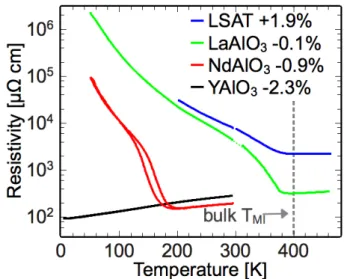
The resistivity (ρ) of the strained SNO films is plotted as a function of temperature in Figure 2. The film deposited on top of LaAlO3, which provides a negligible compressive strain
(εxx=-0.1%), displays a MIT at 380 K. As in the bulk, no hysteresis is observed as the
temperature is cycled back and forth between 4 K and 400 K. However, applying larger compressive strains dramatically affects the MIT. For εxx=-0.9 % (SNO/NdAlO3), TMI drops
well below room temperature (TMI≈144 K) and ρ exhibits a hysteresis loop typical of a 1st
order transition, with resistivity changes of over two orders of magnitude. For εxx=-2.3%
(SNO/YAlO3), the insulating phase is completely suppressed and the film shows metallic
behavior down to the lowest measured temperature (T=4 K).
The gradual decrease of TMI for increasing negative strain indicates that the in-plane
compression results in a broadening of the bandwidth of the system,24 suggesting that the SNO lattice accommodates the epitaxial constraint by reducing the Ni-O-Ni bending. Indeed, DFT calculations performed in order to determine the crystal structure of coherently strained SNO reveal that imposing a reduced in-plane lattice constant induces a straightening of the out-of-plane Ni-O-Ni angle (Φz) and leaves the in-plane Ni-O-Ni angle (Φxy) almost
unaffected.23 Such behavior is reminiscent of the response of epitaxial NNO films to compressive strain8-10, 23 and of the bulk compounds to hydrostatic pressure,5-7 which also
exhibit a gradual reduction of TMI as a consequence of a decreased degree of structural
distortion. Thus, epitaxial strain is an efficient tool for tuning the RNO bandwidth, also for a member with R<Nd. Remarkably, the observed shift of the MIT is much larger than has been achieved by applying hydrostatic pressure on bulk SNO,6 highlighting the advantage of synthesizing RNO films for tuning of their functional properties. The crossover from a 2nd order to a 1st order MIT is even more striking, as no analogous change of the MIT character
has been reported by applying epitaxial strain to NNO. Here, for a relatively small amount of compression, SNO films suddenly display the transport properties of RNOs with R≥Nd. It is interesting to note that the room temperature resistivity of the most compressively strained SNO films (SNO/YAlO3) is unexpectedly larger than the resistivity of the metallic phase of
the films subjected to smaller strain levels (Fig. 2). This result, that may apparently contradict the increase of the bandwidth predicted through DFT calculations, reveal that other more subtle effects should be taken into account. For example, a significant role can be played by the symmetry of the substrate, as the discrepancy is observed between the resistivity of the metallic phase of SNO films grown on LaAlO3, NdAlO3 (both rhombohedral) and films
grown on YlAlO3 (orthorhombic). In addition, we suggest that other experimental factors,
such as the quality of the substrates, could lead to different scattering rates at the film/substrate interface, therefore affecting the resistivity of the films. Finally, it is important to mention that LaNiO3 (only RNO with TMI=0 in bulk) is also the only member of the RNO
family having a rhombohedral structure (space group R3c). Therefore, it would be interesting to study the structure of strained SNO and NNO films with TMI=0, and verify whether their
structure is rhombohedral too.
FIG. 2Temperature dependence of resistivity for SNO films subjected to different degrees of strain. The dashed
line indicates the TMI reported for bulk SNO.3
By depositing SNO on LSAT (εxx=+1.9%, blue curve in Figure 2) we also investigate the
impact of strain in the tensile regime. The MIT occurs at TMI=390K and is non-hysteretic,
just as for SNO on LaAlO3. However, compared to other compressively strained SNO films,
the transition is broader and the resistivity of the metallic phase is almost an order of magnitude higher. These observations can be ascribed to the creation of oxygen vacancies in the films as a mechanism to release the tensile strain, which has been extensively discussed in Ref. 25 and Ref. 26. This interpretation is supported by the anomalously large increase of the unit cell volume observed for the SNO film under tensile strain.23
In order to inspect the magnetic properties of the films, we performed resonant soft x-ray diffraction measurements at the RSXS endstation of the REIXS beamline at the Canadian Light Source (CLS).27 For a description of the experimental set-up see Ref. 23. We probed the presence of the (¼ ¼ ¼) Bragg reflection, corresponding to the AFM phase of the bulk compounds, in strained SNO and NNO films as the temperature was varied from 20K to
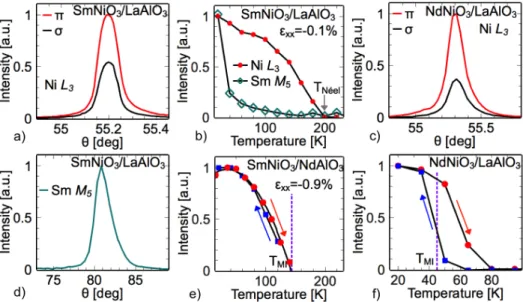
300K. Figure 3(a) illustrates the strong sharp peak detected in SNO/LaAlO3 at T=20K,
corresponding to the mentioned qBragg, pointing to a 4 u.c periodic superstructure oriented
along the [111]-axis in the low temperature phase of the sample. The diffraction peak resonates when the incoming beam energy is tuned to the Ni L2,3 and RE M4,5 edges, confirming that the signal originates from the RNO lattice. By changing the polarization of the incident beam, a strong dichroism between the σ and π component (black and red line in Figure 3(a)) is observed, as expected for diffraction of magnetic origin, where the σ-σ scattering channel is prohibited.28 Taking into account the resonant nature of the peak, the observed dichroic effect and the clear similarity to the bulk case, we can reasonably state that the detected Bragg reflection is of magnetic origin and is due to the AFM ground state of the SNO film. An analogous resonant peak was present in the low temperature insulating phase of SNO/NdAlO323 and NNO/LaAlO3 (Figure 3(c)). In contrast, no (¼ ¼ ¼) Bragg reflection
was detected in the films showing only a metallic phase (SNO/YAlO3; NNO/NdAlO3),
indicating that they remain paramagnetic over the considered temperature range.
FIG. 3 Magnetic properties of the films characterized by resonant X-ray diffraction. (a)Rocking curve of the
SNO/LaAlO3 film about qBragg=(¼ ¼ ¼), at T=20K, measured with π (red line) and σ (black line) linearly
polarized light. (b) Temperature dependence of the peak intensity measured at the Ni L3 (red circles) and at the
Sm M5 (pink diamonds) edge. (c)Rocking curve of NNO/LaAlO3 film around qBragg=(¼ ¼ ¼), at T=20K. (d)
Rocking curve about qBragg=(¼ ¼ ¼) measured at the Sm M5 resonance. Bragg peak intensity of (e)
SNO/NdAlO3, and (f) NNO/LaAlO3, measured at the Ni L3 edge, as the temperature was cycled up (red circles )
and down (blue squares). The vertical dashed lines indicate the TMI of the corresponding films.
Figures 3(b),(e) show the evolution of the magnetic diffraction peak intensity as a function of temperature in the SNO films, as the photon energy was tuned to the Ni L3 edge. The intensity versus temperature curves were obtained by integrating rocking curve scans acquired at different temperatures, the blue (red) symbols corresponding to the cooling (heating) leg of the cycle. We define TNéel of the films as the temperature at which the
diffraction intensity vanishes, determined by extrapolation. The temperature dependence of the magnetic peak intensity of SNO/LaAlO3 (Figure 3(b)) displays the typical behavior of
the order parameter of a system with a 2nd order transition, developing at TNéel ≈ 200 K, fairly
close to the value reported for bulk SNO.3 In the case of SNO/NdAlO3 (Figure3(e)), the
intensity increases abruptly at TNéel≈140 K, matching the above reported TMI of the film. The
cycle, reproducing the corresponding ρ versus temperature curve (Figure 2) and pointing to a 1st order character of the Néel transition. The 1st order character of the AFM ordering was observed in the NNO films as well (Figure 3(f)), confirming previously reported results.2,4,29,30 Figures 3(b),(d) present the temperature dependence of the (¼ ¼ ¼) reflection
detected at the Sm M5 edge of SNO/LaAlO3. This measurement reveals that the ordering of
the RE magnetic sublattice follows the polarization of the Ni moments (Figure 3(b)), bearing out its induced nature, as already observed in the bulk nickelate4 and in NNO thin films.29 The same behavior at the RE resonance was reproduced in all the SNO and NNO films investigated.23
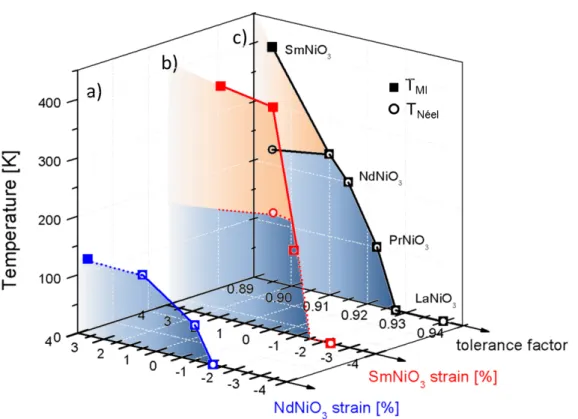
FIG. 4 Phase diagram of nickelates summarizing the evolution of TMI and TNéel of strained (a) NNO and (b) SNO films, compared to the bulk compounds (c). Solid lines are guides to the eye, and dashed lines represent the
expected behavior for TNéel of SNO/LSAT (εxx= +1.9%) and NNO/DyScO3 (εxx=+3.6%). The x-axis of panel (a)
and (b) goes from positive to negative values in order to facilitate the comparison with panel (c). The data for the bulk RNOs have been extracted from Ref. 3 and Ref. 12.
From our observations, we can draw the following conclusions. First, the AFM phase only develops if an insulating phase of the RNO layer exists, that is, if electronic localization occurs. Compressive strain suppresses the PM insulating phase of SNO, suggesting that the Néel and MI transitions couple once the bandwidth is sufficiently broad to drive TMI below
the intrinsic TNéel of the compound. Second, the 1st order behavior of the MIT occurs when
TMI=TNéel, showing that the dynamic of the transitions is affected by the interplay of magnetic
and charge fluctuations. Furthermore, the absence of any signature of magnetic ordering in the metallic phase of the samples, down to the lowest T measured (T=4 K), demonstrates that the magnetic coupling is effectively screened by the charges in this itinerant regime resulting in too weak magnetic interactions to allow for long range spin ordering.
Figure 4 summarizes the evolution of the MI and Néel transitions of NNOand SNO films (first and second panel) as a function of strain, compared to the dependence on tolerance factor t observed for the bulk compounds. The phase diagram clearly illustrates that epitaxial
strain allows tuning the electronic properties of SNO films from the regime with TNéel<TMI to
the case of TNéel=TMI, including the extreme case of TMI=TNéel=0 K. Thus the phase diagram
of epitaxially strained SNO films is qualitatively the same as that of the bulk nickelates with different compositions, with biaxial strain playing the same role as the tolerance factor t. By contrast, the NNO films show a single electronic regime with TNéel=TMI.
In conclusion, we have investigated the evolution of the electronic phases of strained nickelate thin films as a function of temperature and shown that, by exploiting epitaxial strain, we can control the MI and Néel transitions of SNO films. Our theoretical calculations show that compressive strain is accommodated by straightening the Ni-O-Ni angle, whereas tensile strain has been associated with an increased content of oxygen defects. By changing Φ, the bandwidth of the system is modified, leading to a continuous shift of the MIT from TMI=400 K down to TMI=0 K. Noticeably, the MIT of SNO films can be reduced by over 200
K by applying just εxx=-0.9%. From resonant X-ray diffraction measurements, we have direct
evidence of the as yet unreported AFM ordering in epitaxially strained SNO films, with an AFM structure akin to that of the bulk. The measurements reveal that the AFM transition only takes place in the insulating phase of the system, i.e. the detected TNéel is never above
TMI, as already observed for the bulk compounds. The use of resonant excitation with soft
X-rays also allows us to distinguish the role played by the Ni and R magnetic moments in the evolution of the AFM phase, showing that the ordering is triggered by the polarization of the Ni spins.
ACKNOWLEDGMENTS
We thank Marco Lopes and Sebastian Muller for their precious support to the experiments. We also acknowledge Siobhan McKeown Walker and Jennifer Fowlie for proofreading the manuscript. This work was supported by the Swiss National Science Foundation through the National Center of Competence in Research, Materials with Novel Electronic Properties, ‘MaNEP’ and division II. The research leading to these results has received funding from the European Research Council under the European Union's Seventh Framework Programme (FP7/2007-2013) / ERC Grant Agreement n° 319286 and under grant agreement Nr. 290605 (COFUND: PSI-FELLOW). Part of the research described in this paper was performed at the Canadian Light Source, which is funded by the CFI, NSERC, NRC, CIHR, the Government of Saskatchewan, WD Canada and the University of Saskatchewan.
REFERENCES
1E. Dagotto, Science 309, 257 (2005); J. W. Reiner, F. J. Walker, C. H. Ahn, Science 323,
1018 (2009); H. Takagi, H. I. Hwang, Science 327, 1601 (2010).
2P. Lacorre, J. B. Torrance, J. Pannetier, A.I. Nazzal, P.W. Wang, T.C. Huang, J. Solid State
Chem. 91, 225 (1991).
3J. B. Torrance, P. Lacorre, A.I. Nazzal, E. J. Ansaldo, Ch. Niedermayer, Phys. Rev. B 45,
8209(R) (1992).
4García-Muñoz, J. Rodríguez-Carvajal, P. Lacorre, J. B. Torrance, Phys. Rev. B 46, 4414
(1992).
5P. C. Canfield, J. D. Thompson, S-W. Cheong, L. W. Rupp, Phys. Rev. B 47, 357(R)
(1993).
6J.-S. Zhou, J. B. Goodenough, B. Dabrowski, Phys. Rev. Lett. 95, 127204 (2005).
7X. Obradors, L. M. Paulius, M. B. Maple, J. B. Torrance, A. I. Nazzal, J. Fontcuberta, X.
Granados, Phys. Rev. B 47, 12353 (1993).
8R. Scherwitzl, P. Zubko, I. G. Lezama, S. Ono, A. F. Morpurgo, G. Catalan, J.-M. Triscone,
Adv. Mater. 22, 5517 (2010).
9J. Liu, M. Kareev, B. Gray, J. W. Kim, P. Ryan, B. Dabrowski, J. W. Freeland, J.
Chakhalian, Appl. Phys. Lett. 96, 233110 (2010); Y. Kumar, R. J. Choudhary, S. K. Sharma, M. Knobel, Ravi Kumar App. Phys. Lett. 101, 132101 (2012); J. Liu, M. Kargarian, M. Kareev, B. Gray, P. J. Ryan, A. Cruz, N. Tahir, Y.-D. Chuang, J. Guo, J. M. Rondinelli, J. W. Freeland, G. A. Fiete, J. Chakhalian, Nat. Commun. 4, 2714 (2013); A. S. Disa, D. P. Kumah, J. H. Ngai, E. D. Specht, D. A. Arena, F. J. Walker, C. H. Ahn, APL Mater. 1, 032110 (2013); D. P. Kumah, A. S. Disa, J. H. Ngai, H. Chen, A. Malashevich, J. W. Reiner, S. Ismail-Beigi, F. J. Walker, C. H. Ahn, Adv. Mater 26, 1935 (2014).
10P.-H. Xiang , N. Zhong , C.-G. Duan , X. D. Tang , Z. G. Hu , P. X. Yang , Z. Q. Zhu , and
J. H. Chu, J. Appl. Phys. 114 , 243713 (2013).
11M. L. Medarde, J. Phys.: Condens. Matter 9, 1679 (1997). 12G. Catalan, Phase Transitions 81, 729 (2008).
13J. A. Alonso, J. L. García-Muñoz, M. T. Fernández-Díaz, M. A. G. Aranda, M. J.
Martínez-Lope, M. T. Casais, Phys. Rev. Lett. 82, 3871 (1999); J. A. Alonso, M. J. Martinez-Martínez-Lope, M. T. Casais, J. L. Garcia-Munoz, M. T. Fernández-Díaz, Phys. Rev. B 61, 1756 (2000); M. Zaghrioui, A. Bulou, P. Lacorre, P. Laffez, Phys. Rev. B 64, 081102(R) (2001) ; e) U. Staub, G. I. Meijer, F. Fauth, R. Allenspach, J. G. Bednorz, J. Karpinski, S. M. Kazakov, L. Paolasini, F. d’Acapito, Phys. Rev. Lett. 88, 126402 (2002); M. Medarde, C. Dallera, M.
Grioni, B. Delley, F. Vernay, J. Mesot, M. Sikora, J. A. Alonso, M. J. Martínez-Lope, Phys.
Rev. B 80, 245105 (2009); S. Johnston, A. Mukherjee, I. Elfimov, M. Berciu, G. A.
Sawatzky,Phys. Rev. Lett. 112, 106404 (2014).
14I. I. Mazin, D. I. Khomskii, R. Lengsdorf, J. A. Alonso, W. G. Marshall, R. M. Ibberson, A.
Podlesnyak, M. J. Martinez-Lope, M. M. Abd-Elmeguid, Phys. Rev. Lett. 98, 176406 (2007).
15H. Park, A. J. Millis, and C. A. Marianetti, Phys. Rev. Lett. 109, 156402 (2012). 16T. Mizokawa, D. I. Khomskii, G. A. Sawatzky, Phys. Rev. B 61, 263 (2000)
17J. L. García-Muñoz, J. Rodríguez-Carvajal, P. Lacorre, Phys. Rev. B 50, 978 (1994).
18J. Rodríguez-Carvajal, S. Rosenkranz, M. Medarde, P. Lacorre, M. T. Fernández-Díaz, F.
Fauth, V. Trounov, Phys. Rev. B 57, 456 (1998).
17I. Vobornik, L. Perfetti, M. Zacchigna, M. Grioni, G. Margaritondo, J. Mesot, M. Medarde,
P. Lacorre, Phys. Rev. B 60, 8426(R) (1999).
18C. Girardot, J. Kreisel, S. Pignard, N. Caillault, and F. Weiss, Phys. Rev. B 78, 104101
(2008).
19J. A. Alonso, M. J. Martínez-Lope, M. T. Casais, M. A. G. Aranda, M. T. Fernández-Díaz,
J. Am. Chem. Soc. 121, 4754 (1999).
20D. Meyers, E. J. Moon, M. Kareev, I. C. Tung, B. A. Gray, J. Liu, M. J. Bedzyk, J. W.
Freeland, J. Chakhalian, J. Phys. D: Appl. Phys. 46, 385303 (2013);S. D. Han, M. Otaki, R. Jaramillo, A. Podpirka,S. Ramanathan, J. Solid State Chem. 190, 233 (2012).
21F. Y. Bruno, K. Z. Rushchanskii, S. Valencia, Y. Dumont, C. Carrétéro, E. Jacquet, R.
Abrudan, S. Blügel, M. Ležaić, M. Bibes, A. Barthélémy, Phys. Rev. B 88, 195108 (2013); R. Jaramillo, S. D. Ha, D. M. Silevitch, S. Ramanathan, Nat. Phys. 10, 304 (2014).
22S. D. Ha, B. Viswanath, S. Ramanathan, J. App. Phys. 111, 124501 (2012); N. Shukla, T.
Joshi, S. Dasgupta, P. Borisov , D. Lederman, S. Datta, Appl. Phys. Lett. 105, 012108 (2014).
23See supplemental material at [URL will be inserted by AIP] for a detailed description of the
structural characterization of the samples, of the experimental methods and calculations.
24M. Imada, A. Fujimori, Y. Tokura, Rev. Mod. Phys. 70, 1039 (1998).
25F. Conchon, A. Boulle, R. Guinebretière, C. Girardot, S. Pignard, J. Kreisel, F. Weiss, E.
Dooryhée, J-L. Hodeau, App. Phys. Lett. 91, 192110 (2007); F. Conchon, A. Boulle, R. Guinebretiere, E. Dooryhee, J-L. Hodeau, C. Girardot, S. Pignard, J. Kreisel, F. Weiss, J.
Phys.: Condens. Matter 20 ,145216, (2008); F. Conchon, A. Boulle, R. Guinebretière, E.
Dooryhée, J.-L. Hodeau, C. Girardot, S. Pignard, J. Kreisel, F. Weiss, L. Libralesso, T. L. Lee, J. App. Phys. 103, 123501 (2008).
26G. H. Aydogdu, S. D. Ha, B. Viswanath, S. Ramanathan, J. App. Phys. 109, 124110 (2011). 27D. G. Hawthorn, F. He, L. Venema, H. Davis, A. J. Achkar, J. Zhang, R. Sutarto, H.
Wadati, A. Radi, T. Wilson, G. Wright, K. M. Shen, J. Geck, H. Zhang, V. Novák, G. A. Sawatzky, Rev. of Sci. Instr. 82, 073104 (2011).
28J. P. Hill, D. F. McMorrow, Acta Crystallogr., Sect. A: Found. Crystallogr. 52, 236 (1996). 29V. Scagnoli, U. Staub, Y. Bodenthin, M. García-Fernández, A. M. Mulders, G. I. Meijer, G.
Hammerl, Phys. Rev. B 77, 115138 (2008).
30V. Scagnoli, U. Staub, A. M. Mulders, M. Janousch, G. I. Meijer, G. Hammerl, J. M.