HAL Id: hal-03235347
https://hal.archives-ouvertes.fr/hal-03235347
Submitted on 27 May 2021
HAL is a multi-disciplinary open access
archive for the deposit and dissemination of
sci-entific research documents, whether they are
pub-lished or not. The documents may come from
teaching and research institutions in France or
abroad, or from public or private research centers.
L’archive ouverte pluridisciplinaire HAL, est
destinée au dépôt et à la diffusion de documents
scientifiques de niveau recherche, publiés ou non,
émanant des établissements d’enseignement et de
recherche français ou étrangers, des laboratoires
publics ou privés.
Wireless communication using ultrasonic guided waves
in healthy and defected plates
Rudy Bahouth, Farouk Benmeddour, Emmanuel Moulin, Jamal Assaad
To cite this version:
Rudy Bahouth, Farouk Benmeddour, Emmanuel Moulin, Jamal Assaad. Wireless communication
using ultrasonic guided waves in healthy and defected plates. Forum Acusticum, Dec 2020, Lyon,
France. pp.23-29, �10.48465/fa.2020.0313�. �hal-03235347�
WIRELESS COMMUNICATION USING ULTRASONIC GUIDED WAVES
IN HEALTHY AND DEFECTED PLATES.
R.Bahouth
1F.Benmeddour
1E.Moulin
1J.Assaad
11
OAE Department, IEMN, Universit´e Polytechnique Hauts-de-France, F-59313 Valenciennes
Cedex 9
[email protected], [email protected], [email protected], [email protected]
ABSTRACT
Transmission of digital data in solid structures is effective in many industrial applications such as nuclear, aerospace and smart vehicles. Traditional wireless communication using electromagnetic waves becomes ineffective in the presence of metals due to Faraday shielding. Ultrasonic guided waves, such as Lamb waves, may be an alterna-tive solution for communicating through metallic struc-tures and may provide also useful information about the health of the structure itself. The objective of this work is to give a proper analogy scheme between telecommunica-tion and ultrasound domains by doing experimental tests on healthy and damaged aluminum plates. To ensure this analogy, an experimental platform for ultrasonic guided wave communication is built and an automated application using Matlab Graphical User Interface (GUI) is developed for modulation and demodulation. Different experimental tests on healthy plates are realized at first for Amplitude Shift Keying (ASK), On-Off Keying (OOK) and Binary Phase Shift Keying (BPSK) to chose the best modulation technique at optimal bit rate. After this, a demodulation algorithm based on cross-correlation concept from signal processing is developed and tested to ensure communica-tion in damaged plates. Results show that digital data can be recovered even in the presence of a large damage in the transmission channel.
1. INTRODUCTION
The use of ultrasonic signals as an information carrier is widely known in medical and non-destructive testing fields. Using ultrasound in some environments like un-derwater, underground [1] and inside the human body is beneficial since no other option is proposed. Using those waves for communicating through solid structures is effec-tive also in many industrial applications, such as nuclear, aerospace [2] and smart vehicles. Applying ultrasonic sig-nals for communication is limited due to dispersion, atten-uation and reverberation phenomenons [3] inside the chan-nel. Contrariwise, the ability of ultrasonic waves to prop-agate in channels made of gas, liquid or solid gives them some advantages over electromagnetic waves that propa-gate only in vacuum or air. The use of electromagnetic
waves as a carrier for data transmission in metallic envi-ronments becomes ineffective due to Faraday shielding ef-fect. Therefore, the need of an alternative wave to ensure communication in solid metallic structures is required.
Guided waves, such as Lamb waves, are a particular ul-trasonic wave type generated in plates and used in non-destructive testing for damage detection. This wave type can be a good candidate to replace the electromagnetic one since it can propagate through long distances in solid chan-nels (cylinders or plates) [4]. In addition to that, using Lamb waves for communicating through metallic struc-tures may provide useful information about the health of the structure itself.
Few works has been published concerning wireless communication using ultrasonic guided waves in solid structures. Primerano et al. [5] developed an echo can-cellation algorithm based on Pulse Amplitude Modulation (PAM) for coding the desired information for communi-cation across metallic barriers. Jin et al. [6, 7] proposed a method based on Time Reversal Pulse Position Modu-lation (TRPPM) to solve channel dispersion problem and to deliver information through steel pipes. Trane et al. [8] uses also PPM for guided waves communication in a cor-rosion resistant multi-wire. Chakraborty et al. [9] studied a low power and low rate ultrasound communication scheme using On-Off Keying (OOK) along cylindrical pipes us-ing transverse waves. Moll et al. [10] and De Marchi et al. [11] discussed the use of Code Division Multiple Ac-cess (CDMA) technique for data communication in alu-minum plates based on dispersion compensation using Bi-nary Phase Shift Keying (BPSK) modulation. After this, Wang et al. [12] explored the feasibility of building dif-ferent experimental platforms for wireless data communi-cation while using In-Phase and Quadrature (IQ) modula-tion and demodulamodula-tion through solid metallic bars. Finally, Kexel et al. [13] and Moll et al. [14] studied dispersion compensation using cross-correlation algorithm combined with OOK modulation in aluminum plates.
The objective of this work is to present a proper anal-ogy scheme between telecommunication and ultrasound domains by doing experimental tests on healthy and dam-aged aluminum plates and to compare between different modulation techniques to chose the most powerful one. To ensure this analogy, an experimental platform for Lamb
waves communication is built and automated using Mat-lab Graphical User Interface (GUI). Different experimen-tal tests are realized on a healthy plate using Amplitude Shift Keying (ASK), On-Off Keying (OOK) and Binary Phase Shift Keying (BPSK) modulation techniques. Those experimental tests are used to chose the best modulation technique at optimal bit rate. After this, a set of experi-ments is realized on damaged plates with different depths. This paper is decomposed into five sections. Section 2 describes the experimental platform and list the parameters used during the series of tests. Furthermore, it explains the demodulation algorithm used to compensate the dispersion in the solid channel. Section 3 presents the results of the healthy plate with all the modulation techniques to chose the most powerful one. Section 4 shows the results for the damaged plates with different depths. Finally, Section 5 draws a general conclusion and perspectives to this work.
2. EXPERIMENTAL PLATFORM 2.1 Experimental device
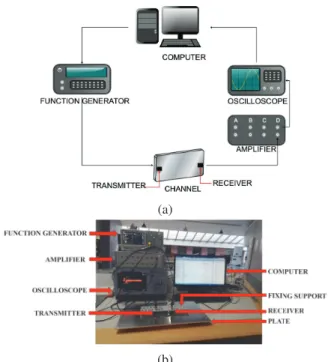
The experimental platform for wireless data transmission in solid plates is used for modulation, transmission and de-modulation of the desired information. Figure 1a shows a schematic drawing of the experimental setup and 1b its photo. This device is composed of a computer where a program is built using Matlab GUI to implement the mod-ulation and demodmod-ulation algorithms. The computer com-municates with an arbitrary waveform generator (RIGOL DG4162) that receives the appropriate values for frequency and amplitude. The signal is then sent and received using two ultrasonic transducers respectively (Panametrics) via an aluminum plate that represents the transmission chan-nel. The transducers are connected to a fixing support to ensure a stable distance between the emitter and the receiver. Furthermore, a couplant gel is used to maxi-mize the transducers/plate acoustic power transfer. The ac-quired signal is amplified (Mistras) and sent to an oscillo-scope (Lecroy Wavepro 960) for signal average calculation and visualization. Finally, the acquired signal reaches the computer via a GPIB bus for storage and signal process-ing. [15]
All the experimental sets for ASK, OOK and BPSK are performed on an aluminum plate (500 x 300 x 6 mm3). The amplitude of the carrier wave is 20 V peak-to-peak and a Hamming window is applied on the signal. A distance of 8 cm edge-to-edge between the transducers is fixed at the center of the plate to avoid boundary reflections. Ten bits binary message “1101001110” is used since it con-tains all possible transitions between the ones and zeros. A frequency of 200 kHz is chosen allowing the excitation of Anti-symmetrical mode A0 only. For the bit rate, the shorter a burst in terms of cycles per bit, the higher is the sent bit rate. In addition to this, the higher is the frequency of the carrier wave, the higher becomes the bit rate. In all experiments, the number of cycles is decreased from 4 to 1 with a step of 0.1. Therefore, the bit rate will increase from 50 to 200 kbits/s.
(a)
(b)
Figure 1: (a) Schematic drawing of the experimental plat-form and (b) the setup photo.
2.2 Cross-correlation demodulation algorithm
The demodulation algorithm used in this work is based on cross-correlation. This method helps to compensate the dispersion, reverberations, scattering and boundary reflec-tions of the guided waves inside the transmission channel. Furthermore, using cross-correlation for demodulation in the case of damaged plates will compensate also the mode conversions that exists due to the presence of asymmetri-cal discontinuities [16]. The cross-correlation between two functions y1(t) and y2(t) is calculated from the equation 1 as follow:
g(t) = y1(−t) ∗ y2(t) (1)
with g(t) representing the cross-correlated function and
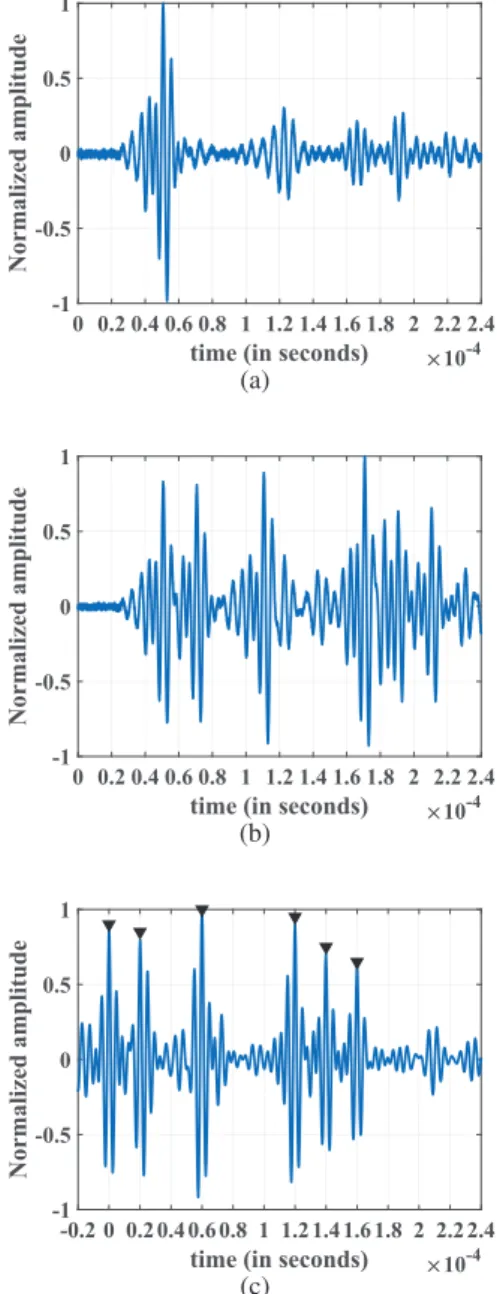
y1(−t) the back propagated complex conjugate function. At first, a signal corresponding to a binary one is sent to measure the acoustic response of the transmission chan-nel as shown in figure 2a. Then, a multi-bit sequence that corresponds to an information containing binary ones and zeros is driven through the channel. Figure 2b shows the acquired signal from the bit sequence at the receiver us-ing OOK modulation. A cross-correlation is applied while considering the same sampling points between the signal measuring the acoustic channel response and the multi-bit sequence signal as shown in figure 2c. Peaks in the cross-correlation represent a matching between both sig-nals, and, therefore, a binary one value. All obtained val-ues below a certain threshold are considered as binary ze-ros. A minimum time distance between two consecutive bits (bit length) should exist for peaks detection. The same steps are used for demodulation using ASK.
2.3 Threshold choice
The threshold choice is critical in ASK and OOK since it is the decision making parameter between binary ones and zeros. To optimize this choice, the amplitude of the cross-correlated signal is normalized at first. A fine increase of 0.01 for the amplitude from 0 to 0.7 is applied for each bit rate. The threshold corresponding to the minimum error can be picked.
For BPSK, the choice of the threshold is more simple since a total matching will give a positive peak value and a total dis-matching a negative one. Positive peaks in the cross-correlation correspond to a binary one and negative peaks to a binary zero. In this case, the choice of the thresh-old is fixed at zero.
0 0.2 0.4 0.6 0.8 1 1.2 1.4 1.6 1.8 2 2.2 2.4
time (in seconds) 10-4
-1 -0.5 0 0.5 1 Normalized amplitude (a) 0 0.2 0.4 0.6 0.8 1 1.2 1.4 1.6 1.8 2 2.2 2.4
time (in seconds) 10-4
-1 -0.5 0 0.5 1 Normalized amplitude (b) -0.2 0 0.2 0.4 0.6 0.8 1 1.2 1.4 1.6 1.8 2 2.2 2.4
time (in seconds) 10-4
-1 -0.5 0 0.5 1 Normalized amplitude (c)
Figure 2: (a) Channel response of binary one signal, (b) Acquired signal of the message “1101001110” using OOK modulation and (c) Cross-correlation between (a) and (b) with the same sampling points.
3. RESULTS FOR HEALTHY PLATE 3.1 Experimental results for ASK and OOK
The scope of these tests is to find the most suitable modu-lation technique at the highest bit rate. The comparison of these tests will be based on the calculation of the Bit Error Rate (BER). It is calculated as the number of bit errors di-vided by the total number of transferred bits during a fixed interval as given in equation 2:
BER(%) = NNe
t · 100 (2) With Nerepresenting the number of bit errors and Ntthe total number of bits. A set of experiments for ASK and OOK are carried out for different bit rates and different threshold values. For each number of cycles which cor-responds to a fixed bit rate, the threshold value varies as mentioned in section 2.3. The number of cycles are then decreased from 4 to 1 allowing the bit rate to increase from 50 to 200 kbits/s. The same experimental parameters men-tioned in section 2.2 are used on the same plate and under the same experimental conditions.
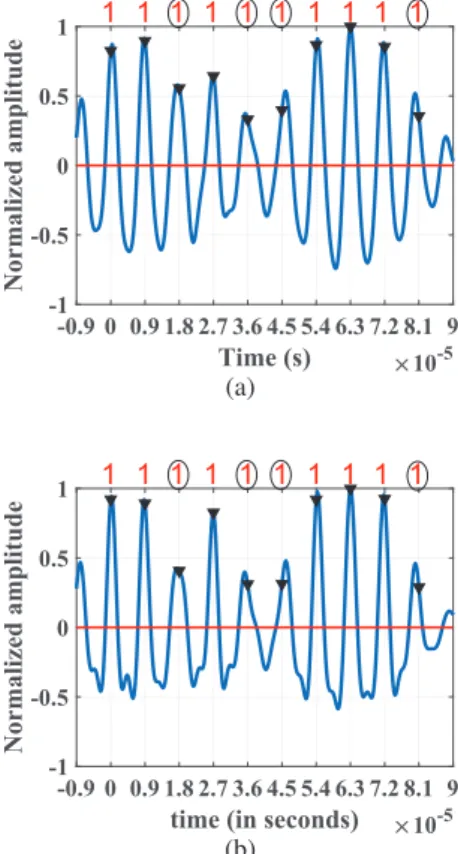
Figure 3a and b show all the results of the experimental sets for ASK and OOK, respectively. The graphs show the BER represented by the colors in function of the thresh-old and the bit rate. The blue regions color correspond to the values where the BER=0% and the yellow ones to BER=70%. The lower left and right corners represent low threshold-low bit rate and high threshold-low bit rate, the upper left and right corners represent low threshold-high bit rate and high threshold-high bit rate, respectively, and the middle as the moderated values for both. The regions showing high BER are the upper left and right corners for both modulation techniques. This means that choosing very low or very high thresholds at high bit rates are not favorable. An example for low threshold is given in figures 4a and b for ASK and OOK, respecitvely, at 111.11 kbits/s and a zero threshold value. It can be noticed that both mod-ulation techniques gives a BER=40%. For the lower right and left corners OOK shows lower BER than ASK espe-cially at the extreme left edge. Having bad results for ASK at low thresholds was expected even while working at low bit rates. The bad values exists due to the presence of a second low amplitude representing binary “0”. This can be shown in figures 5a and b showing the demodulated signals of ASK and OOK, respectively, at 111.11 kbits/s and a threshold value of 0.5. A BER of 10% is obtained for ASK allowing three bits out of four to be recovered. For OOK, the BER=0% and all the bits are recovered. The middle-moderated region is stable for both techniques hav-ing a BER=0%. It can be noticed that the area of the blue middle region in OOK is larger than ASK.
The graphs show for both cases that high bit rates can be reached while choosing the appropriate threshold. The highest bit rates for ASK and OOK reached are respec-tively 181.82 and 200 kbits/s. Furthermore, results show that regions with no error (blue regions) dominates in OOK more than ASK.
0.1 0.2 0.3 0.4 0.5 0.6 0.7 Threshold 200 100 66.67 50
Bit rate (kbits/s)
0 10 20 30 40 50 60 70 (a) 0.1 0.2 0.3 0.4 0.5 0.6 0.7 Threshold 200 100 66.67 50
Bit rate (kbits/s)
0 10 20 30 40 50 60 70 (b)
Figure 3: (a) Results for ASK and (b) OOK.
3.2 Results for BPSK
For the BPSK modulation, the threshold is fixed at 0 and the number of cycles is decreased from 4 to 1 allowing to increase the bit rate from 50 to 200 kbits/s. The same experimental parameters from section 2.2 are used on the same plate and under the same experimental conditions.
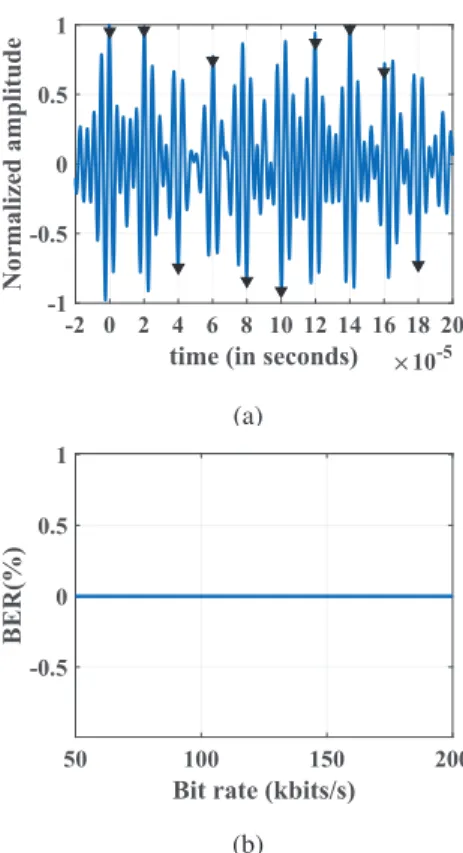
Figure 6a shows the demodulated signal using cross-correlation at 50 kbits/s. The positive peaks correspond to a binary “1” value and negative peaks to binary “0” value. While using BPSK technique, the choice of the threshold is fixed at 0 and therefore, no further actions are needed for bit rate optimization. Figure 6b shows the BER in function of the bit rate for all sets of experiments. It can be noticed from the results that the BER=0% for all bit rates even at the maximum one for 200 kHz which is 200 kbits/s. 3.3 Conclusion
Experimental results show that OOK have better BER than ASK at different thresholds and bit rates. The advantage of using OOK over ASK is shown especially while working with low threshold and low bit rates. Furthermore, in the regions with moderated bit rates, OOK shows more BER stability than ASK. In addition to this, the highest bit rate reached in OOK is 200 kbits/s which is higher than the one reached in ASK which is 181.82 kbits/s. All those results prove that OOK gives better results than ASK while using the cross-correlation algorithm for information transmis-sion using guided waves in solid plates.
For BPSK, tha maximum bit rate which is 200 kbits/s is reached with BER=0%. Furthermore, experimental
re--0.9 0 0.9 1.8 2.7 3.6 4.5 5.4 6.3 7.2 8.1 9 Time (s) 10-5 -1 -0.5 0 0.5 1 Normalized amplitude 1 1 1 1 1 1 1 1 1 1 (a) -0.9 0 0.9 1.8 2.7 3.6 4.5 5.4 6.3 7.2 8.1 9 time (in seconds) 10-5 -1 -0.5 0 0.5 1 Normalized amplitude 1 1 1 1 1 1 1 1 1 1 (b)
Figure 4: (a) ASK and (b) OOK demodulated signals at 111.11 kbits/s for threshold=0.
sults prove that the BER keeps its zero value for all bit rates which is not the case for ASK and OOK. As a con-sequence, the threshold is constant and equal to zero for BPSK which is not also the case for ASK and OOK. As a conclusion, BPSK gives the best results over ASK and OOK while using cross-correlation algorithm to communi-cate in solid channels using Lamb waves and will be used in experimental tests on damaged plates.
4. EXPERIMENTAL TESTS AND RESULTS ON DAMAGED PLATES
4.1 Experimental tests on damaged plates
To study the presence of notches in the transmission chan-nel for wireless communication using guided ultrasonic waves, several experiments were carried out using the dis-continuities presented in figure 7a and b. The depth of the damage is defined by “w”. The transducers are spaced equally from the edges of the notch and an 8 cm distance is conserved between them.
Five series of experiments are done while varying the depth of the discontinuity “w” from 1 to 5 cm. The same demodulation algorithm of BPSK with cross-correlation is used. For each depth, the same process with the same parameters from section 2.2 are repeated. Results for the healthy plate show that the cross-correlation algorithm combined with BPSK has compensated the effect of dis-persion, reverberation and scattering of the guided waves. The tests on damaged plates are used to check if this
al--0.9 0 0.9 1.8 2.7 3.6 4.5 5.4 6.3 7.2 8.1 9 Time (s) 10-5 -1 -0.5 0 0.5 1 Normalized amplitude 1 1 1 1 0 0 1 1 1 0 (a) -0.9 0 0.9 1.8 2.7 3.6 4.5 5.4 6.3 7.2 8.1 9 time (in seconds) 10-5 -1 -0.5 0 0.5 1 Normalized amplitude 1 1 0 1 0 0 1 1 1 0 (b)
Figure 5: (a) ASK and (b) OOK demodulated signals at 111.11 kbits/s for threshold=0.5.
gorithm is able to compensate also the mode conversions effect caused by those discontinuities.
(a)
(b)
Figure 7: (a) Geometry of discontinuities and (b) their photo.
4.2 Results for damaged plates
Figure 8a show the demodulated signal for the healthy plate at the highest bit rate 200 kbits/s corresponding to 1 cycle, and figures 8b to f show the same for the notches with depths 1 to 5 mm, respectively. The positive peaks represent a binary one detection and the negative ones a binary zero. It can be noticed from the demodulated
sig--2 0 2 4 6 8 10 12 14 16 18 20 time (in seconds) 10-5 -1 -0.5 0 0.5 1 Normalized amplitude (a) 50 100 150 200
Bit rate (kbits/s) -0.5 0 0.5 1 BER(%) (b)
Figure 6: (a) Demodulated signal for 50 kbits/s and (b) BER vs Bit rate for BPSK tests.
nals for all notches depths that the cross-correlated demod-ulated signals have similar results but not identical.
After realizing all the series of experiments, figure 9 shows the curve representing the BER in function of the bit rate for the notches varying from 1 to 5 mm .It can be noticed that the BER=0% for all the bit rates for all depths. A small experimental error of 10% occurs for the 5 mm depth due to gel thickness. Even at the highest bit rate which is 200 kbits/s, the message is fully recovered without any error for all the cases. Adding a discontinuity inside the transmission channel will allow mode conversions [17]. Since the BER=0% for all the bit rates, the demodulation algorithm based on cross-correlation has compensated this mode conversion and multiple reflections even at high bit rates
5. CONCLUSION
This work discusses the feasibility of wireless communica-tion using ultrasonic guided waves in healthy and damaged plates. At first, an experimental platform is built, used, described and tested to ensure a powerful tool for exper-imental tests. Then, a demodulation algorithm based on cross-correlation is described for ASK, OOK and BPSK. This modulation technique allows the dispersion, reverber-ation, scattering and reflections compensation in the trans-mission channel. To prove this concept, a comparison be-tween different modulation technique is carried out on a healthy plate.
-0.5 0 0.5 1 1.5 2 2.5 3 3.5 4 4.5 5 time (in seconds) 10-5 -1.5 -1 -0.5 0 0.5 1 Normalized amplitude 1 1 0 1 0 0 1 1 1 0 (a) -0.5 0 0.5 1 1.5 2 2.5 3 3.5 4 4.5 5 time (in seconds) 10-5 -1 -0.5 0 0.5 1 Normalized amplitude 1 1 0 1 0 0 1 1 1 0 (b) -0.5 0 0.5 1 1.5 2 2.5 3 3.5 4 4.5 5 time (in seconds) 10-5 -1 -0.5 0 0.5 1 Normalized amplitude 1 1 0 1 0 0 1 1 1 0 (c) -0.5 0 0.5 1 1.5 2 2.5 3 3.5 4 4.5 5 time (in seconds) 10-5 -1.5 -1 -0.5 0 0.5 1 Normalized amplitude 1 1 0 1 0 0 1 1 1 0 (d) -0.5 0 0.5 1 1.5 2 2.5 3 3.5 4 4.5 5 time (in seconds) 10-5 -1.5 -1 -0.5 0 0.5 1 Normalized amplitude 1 1 0 1 0 0 1 1 1 0 (e) -0.5 0 0.5 1 1.5 2 2.5 3 3.5 4 4.5 5 time (in seconds) 10-5 -1 -0.5 0 0.5 1 Nomalized amplitude 1 1 0 1 0 0 1 1 1 0 (f)
Figure 8: (a) Healthy plate, (b) 1 mm, (c) 2 mm, (d) 3 mm, (e) 4 mm and (f) 5 mm notches demodulated signal at 200 kbits/s.
50 100 150 200
Bit rate (kbits/s)
0 2 4 6 8 10 BER (%) 5 mm 4 mm 3 mm 2 mm 1 mm
Figure 9: Experimental results BER versus bit rate for plates with 1 to 5 mm notches depths.
A series of experiments are carried out for ASK and OOK modulations at first. The effect of threshold choice is studied in function of the bit rate and Bit Error Rate (BER). Results show that OOK modulation technique gives a bet-ter BER than ASK especially at low threshold regions. Fur-thermore, the highest bit rate reached for ASK is 181.82 kbits/s which is lower than the highest one reached in OOK which is 200 kbits/s. For BPSK, the threshold is fixed at
0 and the same experiments are carried out. Results show a total demodulation stability since the BER=0% for all bit rates. The highest bit rate reached is 200 kbits/s for BPSK technique. The demodulation algorithm based on cross correlation has proved it’s ability to compensate the effect of dispersion and multiple reflection in the transmis-sion channel.
After this, since the BPSK shows the best results in the healthy plate, it is used to test the communication feasibil-ity in the presence of a damage in the transmission channel. Asymmetrical discontinuities varied from 1 to 5 mm are used since it causes mode conversions inside the channel. Results has shown also that the BER=0% for all bit rates and for all notches depths with a small 10% error for the 5 mm depth due to gel thickness. The highest bit rate reached also for all depths is 200 kbits/s. Therefore, algorithm based on cross-correlation combined with BPSK modula-tion technique has also compensated the modes conversion and reflections effects caused by the damage. For the fu-ture, the authors are seeking to study the effect of adding different notches geometries in the transmission channel and to reach higher bit rates for communication.
6. ACKNOWLEDGMENT
This work is funded and supported by Univerist´e Polytech-nique Hauts-de-France and the region Hauts-de-France.
7. REFERENCES
[1] W. Jiang and W. M. Wright, “Indoor wireless com-munication using airborne ultrasound and ofdm meth-ods,” in 2016 IEEE International Ultrasonics
Sympo-sium (IUS), pp. 1–4, IEEE, 2016.
[2] S. Chakraborty, K. R. Wilt, G. J. Saulnier, H. A. Scar-ton, and P. K. Das, “Estimating channel capacity and power transfer efficiency of a multi-layer acoustic-electric channel,” in Wireless Sensing, Localization,
and Processing VIII, vol. 8753, p. 87530F,
Interna-tional Society for Optics and Photonics, 2013. [3] J. Saniie, B. Wang, and X. Huang, “Information
trans-mission through solids using ultrasound invited paper,” in 2018 IEEE International Ultrasonics Symposium
(IUS), pp. 1–10, IEEE, 2018.
[4] F. Benmeddour, ´Etude exp´erimentale et num´erique de l’interaction des ondes de Lamb en pr´esence d’endommagements dans des structures d’aluminium, Experimental and numerical study of the interaction of Lamb waves in the presence of damage in aluminum structures. PhD thesis, 2006.
[5] R. Primerano, M. Kam, and K. Dandekar, “High bit rate ultrasonic communication through metal chan-nels,” in 2009 43rd Annual Conference on Information
Sciences and Systems, pp. 902–906, IEEE, 2009.
[6] Y. Jin, D. Zhao, and Y. Ying, “Time reversal data com-munications on pipes using guided elastic waves: Part i. basic principles,” in Health Monitoring of Structural
and Biological Systems 2011, vol. 7984, p. 79840B,
International Society for Optics and Photonics, 2011. [7] Y. Jin, Y. Ying, and D. Zhao, “Time reversal data
communications on pipes using guided elastic waves: Part II. Experimental studies,” in Health Monitoring
of Structural and Biological Systems 2011 (T. Kundu,
ed.), vol. 7984, pp. 104 – 114, International Society for Optics and Photonics, SPIE, 2011.
[8] G. Trane, R. Mijarez, R. Guevara, and D. Pascacio, “Ppm-based system for guided waves communication through corrosion resistant multi-wire cables,” Physics
Procedia, vol. 70, pp. 672–675, 2015.
[9] S. Chakraborty, G. J. Saulnier, K. W. Wilt, E. Curt, H. A. Scarton, and R. B. Litman, “Low-power, low-rate ultrasonic communications system transmitting axially along a cylindrical pipe using transverse waves,” IEEE
transactions on ultrasonics, ferroelectrics, and fre-quency control, vol. 62, no. 10, pp. 1788–1796, 2015.
[10] J. Moll, L. De Marchi, and A. Marzani, “Transducer-to-transducer communication in guided wave based structural health monitoring,” in Non-Destructive
Test-ing], 19th World Conf., pp. 1–8, 2016.
[11] L. De Marchi, A. Marzani, and J. Moll, “Ultrasonic guided waves communications in smart materials: the case of tapered waveguides,” in Structural Health
Mon-itoring], 8th European Workshop, pp. 1–8, 2016.
[12] B. Wang, J. Saniie, S. Bakhtiari, and A. Heifetz, “Architecture of an ultrasonic experimental platform for information transmission through solids,” in 2017
IEEE International Ultrasonics Symposium (IUS),
pp. 1–4, IEEE, 2017.
[13] C. Kexel, M. M¨alzer, and J. Moll, “Guided wave based acoustic communications in structural health monitor-ing systems in the presence of structural defects,” in
2018 IEEE International Symposium on Circuits and Systems (ISCAS), pp. 1–4, IEEE, 2018.
[14] J. Moll, C. Kexel, and M. M¨alzer, “Complex intelligent structures with data communication capabilities,” in
Proceedings of the 9th European Workshop on Struc-tural Health Monitoring, Manchester, UK, pp. 10–13,
2018.
[15] R. Bahouth, F. Benmeddour, E. Moulin, and J. As-saad, “Transmission of digital data using guided ultra-sonic waves in solid plates,” Proceedings of Meetings
on Acoustics, vol. 38, no. 1, p. 055008, 2019.
[16] F. Benmeddour, S. Grondel, J. Assaad, and E. Moulin, “Study of the fundamental lamb modes interaction with asymmetrical discontinuities,” NDT & e International, vol. 41, no. 5, pp. 330–340, 2008.
[17] F. Benmeddour, S. Grondel, J. Assaad, and E. Moulin, “Study of the fundamental lamb modes interaction with symmetrical notches,” Ndt & E International, vol. 41, no. 1, pp. 1–9, 2008.