
The Development and Application of Metal-Catalyzed Processes
for Organic Synthesis
by
Edward J. Hennessy
B.A. Chemistry
Northwestern University, 2000
Submitted to the Department of Chemistry in Partial Fulfillment of the Requirements for the Degree of
DOCTOR OF PHILOSOPHY IN ORGANIC CHEMISTRY
at the
Massachusetts Institute of Technology June 2005
© 2005 Massachusetts Institute of Technology All Rights Reserved
Signature of Author:
.Da-uirnt of Chemistry May 19, 2005
Certified by:
Stephen L. Buchwald Camille Dreyfus Professor of Chemistry Thesis Supervisor Accepted by:
Robert W. Field " - - 1_"'
This doctoral thesis has been examined by a committee of the Department of Chemistry as follows:
-/
Professor Gregory C. Fu: " Ch
Chair
Professor Stephen L. Buchwald
Professor Timothy M. Swager:
Thesis Supervisor
i
\ OThe Development and Application of Metal-Catalyzed Processes
for Organic Synthesis
by
Edward J. Hennessy
Submitted to the Department of Chemistry on May 19, 2005
in Partial Fulfillment of the Requirements for the Degree of Doctor of Philosophy at the Massachusetts Institute of Technology
ABSTRACT
Chapter 1. Copper-Catalyzed Arylation of Stabilized Carbanions
A mild, general catalytic system for the synthesis of a-aryl malonates has been developed. Aryl iodides bearing a variety of functional groups can be effectively coupled to diethyl malonate in high yields using inexpensive and widely available reagents, making this a superior method to those previously described that employ copper reagents or catalysts. The functional group tolerance of the process developed makes it complementary to analogous palladium-catalyzed couplings. Importantly, a set of mild reaction conditions has been developed that minimize product decomposition, a problem that had not been addressed previously in the literature. In addition, the utilization of aryl bromides as coupling partners has been investigated, as well as the use of other classes of
nucleophilic stabilized carbanions.
Chapter 2. Synthesis of Oxindoles from a-Haloacetanilides via Palladium-Catalyzed
C-H Functionalization
We have discovered a palladium-catalyzed reaction that efficiently produces oxindoles from a-haloacetanilides through a net functionalization of an arene C-H bond. The high levels of regioselectivity observed in this cyclization obviate the need for highly functionalized aromatic substrates to effect desired ring closure. Moreover, the breadth of functional groups compatible with the reaction conditions is vastly greater than that of analogous Lewis acid-mediated processes. Extensive mechanistic work has been conducted, including kinetic isotope effect and linear free energy relationship studies. A number of plausible pathways are consistent with our data and with previously published
Chapter 3. Synthesis of DAPHAnalogs via Palladium-Catalyzed Amination
DAPH (4,5-dianilinophthalimide) has previously been shown to reverse the formation of neurotoxic fibrils associated with Alzheimer's disease. We have developed a synthetic route to DAPH and structurally-related analogs that employs palladium-catalyzed amination as the key bond-forming step. The requisite substrates are easily obtained, and their coupling with substituted anilines proceeds in generally high yields. Thus, a variety of DAPH analogs can be quickly accessed in a modular fashion. In addition, the route described herein should also be amenable to the incorporation of other classes of nucleophiles into the molecular framework. The results of biological assays conducted thus far will serve as a guide for further lead optimization.
Thesis Supervisor: Professor Stephen L. Buchwald Title: Camille Dreyfus Professor of Chemistry
ACKNOWLEDGMENTS
Despite this section appearing only a few pages after the title page, it is the last component of the entire thesis to be written. Perhaps this is because in my mind it is the most important part. There are many people who are responsible in some way for helping me to get this point in my life, and I hope this section aptly expresses my gratitude.
I would not be at MIT if not for my undergraduate advisor, Professor SonBinh Nguyen, and his guidance and assistance during my time at Northwestern. Despite my overwhelming lack of knowledge and experience when I first joined his lab, I was encouraged to pursue my own interests in research and was given the chance to explore new areas. I am lucky to have worked with him and am incredibly grateful for the advice and direction I was given.
I am indebted to my graduate advisor, Professor Stephen Buchwald, for the opportunities I have had during my studies at MIT. Steve has given me incredible freedom in deciding the direction of my research since the very first day. He has let me work on difficult problems (often my own ideas) that have had marginal chance for success, and has charitably allowed me to move on without recourse when such projects haven't worked out as planned. I was admittedly naive when I first came to MIT, and Steve has taught me to be a more critical thinker and a more efficient experimentalist. I am grateful to him for an experience that I will carry with me throughout my life.
Of course, there are many people at MIT who have contributed to my development as a scientist. My thesis committee chair, Professor Greg Fu, has been a valuable source of advice and direction in scientific and career-related matters both before and throughout my graduate studies. Likewise, working with Professor Vernon Ingram of the MIT Biology Department has been a refreshing experience, and I am grateful for his assistance in the preparation of pertinent sections of this thesis and for the opportunity to work on a project with the potential for a beneficial impact on society.
I have been fortunate to work with a number of talented graduate students and postdocs during my tenure in the Buchwald group. It would be a disservice to try to
mistakenly leave somebody out. However, I would be remiss if I didn't specifically thank my classmates Matt Rainka and Eric Strieter. We all first met during the visitation weekend for prospective graduate students, and thus we have literally been in the same boat since day one. Looking back at the past five years, I realize that I likely would not have gotten to this point if not for their loyal friendship.
It would be an understatement to say that I would not be the person I am today without my family. My brother Andrew has always been there for me, whether it be consistently finding the Nintendo system that had been hidden somewhere in the house by our mother (because we had been grounded), playing baseball or football in the backyard, or serving as the best man in my wedding. I am extremely fortunate to have him as a brother. My parents, Ed and Helene, have been the biggest influences in my life. They have always given me everything I could have ever possibly wanted, and continue to do so to this very day. They consistently put the needs of family above their own, and their values and ideals serve as a model for my own life. It is an honor to be their son, and I hope that someday I will be able to earn a mere fraction of what they've done for me.
Lastly, I would like to thank my wife Portia. We've endured a lot together throughout our relationship, from going to college in cities 800 miles apart to the long hours and stress of graduate school and the recent difficulty and uncertainty of finding a job. Still, through it all, she has been a loving companion and my best friend. I would not have been able to get to the point of writing this thesis without her, and she has earned everything this represents more than I have.
PREFACE
Parts of this thesis have been adapted from the following articles co-written by the author.
"A General and Mild Copper-Catalyzed Arylation of Diethyl Malonate." Hennessy, E. J.; Buchwald, S. L. Org. Lett. 2002, 4, 269-272.
"Synthesis of Oxindoles from a-Chloroacetanilides via Palladium-Catalyzed C-H Functionalization." Hennessy, E. J.; Buchwald, S. L. J. Am. Chem. Soc. 2003, 125,
TABLE OF CONTENTS
Introduction
Chapter 1. Copper-Catalyzed Arylation of Stabilized Carbanions
1.1 Introduction
1.2 Results and Discussion
1.2.1 Arylation of Malonic Acid Esters
1.2.2 Coupling of Diethyl Malonate with Aryl Bromides 1.2.3 Arylation of Other Stabilized Carbanions
1.3 Conclusions
1.4 Experimental Procedures
1.5 References and Notes
Chapter 2. Synthesis of Oxindoles from a-Haloacetanilides via
Palladium-Catalyzed C-HFunctionalization
2.1 Introduction
2.2 Results and Discussion
2.2.1 Discovery of the Palladium-Catalyzed Oxindole Cyclization
2.2.2 Reaction Development 2.2.3 Mechanistic Studies 2.3 Conclusions
2.4 Experimental Procedures 2.5 References and Notes
10 15 20 28 29 32 33 42 48 52 55 66 77 78 133
Chapter 3. 3.1 3.2 3.3 3.4 3.5
Synthesis of DAPHAnalogs via Palladium-Catalyzed Amination
Introduction
Results and Discussion
3.2.1 Amination on 4,5-Dichlorophthalic Acid Dimethyl Ester
3.2.2 Amination on 4,5-Dichlorophthalimide Derivatives 3.2.3 Efficacy of DAPH Analogs in Reversal of 1-Sheet
Formation Conclusions
Experimental Procedures References and Notes
Curriculum Vitae 141 144 147 152 153 154 172 174
INTRODUCTION
The use of transition metal catalysts and reagents has had a profound impact on the field of organic synthesis. The "toolbox" of reactions available to a synthetic chemist is replete with bond-forming and bond-breaking processes that involve the use of a metal. Moreover, given the extensive research conducted in the field of metal-based synthetic methodology in both academic and industrial laboratories, refinements and improvements to these reactions are occurring on a seemingly daily basis. As a result, the construction of complex natural products, pharmaceuti-cally active compounds, and industrially important materials all increasingly rely on these rea-gents.1
Of the metals commonly employed in organic synthesis, palladium has arguably stood alone as the most versatile for the formation of carbon-carbon and carbon-heteroatom bonds.2 Both readily accessible oxidation states of palladium (Pd°and Pd2+) have extensive and differing reactivity towards a variety of organic groups, and this serves as the basis for the many catalytic cycles known for this metal. For example, Pd(O) undergoes oxidative addition to a number of functional groups, allowing for the initiation of a catalytic cycle, while reductive elimination from Pd(II) intermediates occurs readily to form a new bond between the organic ligands bound to the metal. These steps in particular, in conjunction with transmetalation (the exchange of a ligand covalently bound to palladium for a different group that is bound to another metal) con-stitute the catalytic cycle of the various cross-coupling processes widely used in organic synthe-sis (Scheme 1). Specifically, oxidative addition of an aryl, alkenyl, alkyl, or acyl halide to palla-dium (0) affords a pallapalla-dium (II) intermediate. Transmetalation between this complex and some
nucleophilic group (which, depending on the reaction, can be carbon- or heteroatom-based) af-fords a new palladium (II) intermediate. Reductive elimination regenerates the active palladium (0) catalyst while forming the desired bond of the product.
I_.llI
aQ
IY
L.nPd°
reductive elimination
I I-I
= aryl, alkenyl, alkyl, acyl
)xidative addition LnPd-Nuc LnPd-X R R = carbon- or heteroatom-based nucleophile M-X M-Nuc transmetalation
Scheme 1. Generalized Mechanism for Pd-Catalyzed Cross-Coupling Reactions
Another metal that has had a significant impact on the synthesis of organic molecules is copper. The construction of carbon-carbon and carbon-heteroatom bonds using copper-catalyzed or copper-mediated reactions was initially developed many decades ago, and these reactions have found widespread use in numerous synthetic applications.3 Unfortunately, these classical processes typically employ stoichiometric amounts of copper in conjunction with comparatively
known reaction protocols have been recently revisited by a number of research groups and sig-nificant improvements to a variety of the reactions have been made, allowing for the use of catalytic quantities of copper and considerably milder reaction conditions.4
Interestingly, it seems that the palladium- and copper-catalyzed cross-coupling method-ologies are complementary in many respects. While palladium can activate a variety of aryl halides (including aryl chlorides) and aryl sulfonates towards coupling in such reactions, sub-strates containing certain polar functional groups tend to be problematic in palladium catalysis. Copper, on the other hand, in general only induces coupling reactions with aryl iodides and aryl bromides, although many of the processes exhibit much higher levels of functional group com-patibility relative to palladium. The complementary nature of these two metals is further exem-plified by the chemoselectivity of reactions involving substrates that contain more than one po-tentially reactive functional group; it has been demonstrated that changing the metal catalyst from palladium to copper can affect the site at which the coupling occurs.5
In this thesis, the continued development of metal-catalyzed processes for carbon-carbon bond formation are described, as is the application of a well-known cross-coupling methodology to the synthesis of a unique class of biologically active compounds. In particular, Chapter 1 dis-cusses our efforts in the modification of the copper-catalyzed coupling of enolates derived from acidic carbonyl compounds with aryl halides, a process that was initially reported in 1929. Sig-nificant improvements to previously published processes have been made, resulting in a mild arylation protocol with high levels of functional group compatibility. In Chapter 2, we outline the discovery, development, and mechanistic studies of a novel reaction that generates highly substituted oxindoles from easily accessible substrates employing palladium catalysis. This synthetically useful cyclization features high levels of regioselectivity and functional group
tol-erance. Chapter 3 discusses our efforts in the synthesis of a class of compounds with potential anti-Alzheimer's activity using palladium-catalyzed carbon-nitrogen bond formation. In com-parison to the previously described route to these structures, we have found that the use of palla-dium catalysis allows for systematic modifications in the molecular architecture at a minimal synthetic cost.
References
(1) For recent reviews of metal-catalyzed cross-coupling reactions, see: (a) Metal-Catalyzed
Cross-Coupling Reactions, 2nd ed.; de Meijere, A., Diedrich, F., Eds.; Wiley-VCH: Weinheim,
2004. (b) Hassan, J.; Sevignon, M.; Gozzi, C.; Schulz, E.; Lemaire, M. Chem. Rev. 2002, 102, 1359. (c) Miyaura, N. Top. Curr. Chem. 2002, 219, 1.
(2) For very thorough treatments of the many reactions catalyzed by palladium, see: (a) Tsuji, J.
Palladium Reagents and Catalysts, 2nd ed.; Wiley: Chichester, 2004. (b) Handbook of
Or-ganopalladium Chemistryfor Organic Synthesis; Negishi, E., de Meijere, A., Eds.; Wiley:
Chichester, 2002.
(3) For a review of these "classical" processes, please see: Lindley, J. Tetrahedron 1984, 40, 1433.
(4) For recent reviews of the advancements made in copper-catalyzed cross-coupling, see: (a) Ley, S. V.; Thomas, A. W. Angew. Chem., Int. Ed. 2003, 42, 5400. (b) Beletskya, I.; Cheprakov, A. V. Coord. Chem. Rev. 2004, 248, 2337.
(5) For a relevant example, see: Huang, X.; Anderson, K, W.; Zim, D.; Jiang, L.; Klapars, A.; Buchwald, S. L. J. Am. Chem. Soc. 2003, 125, 6653.
CHAPTER 1
COPPER-CATALYZED ARYLATION OF STABILIZED
1.1 Introduction
a-Aryl carboxylic acids and acid derivatives comprise an important class of organic mole-cules. For example, compounds containing a-aryl carboxylic acids are prevalent in nature, such as polymastiamide A, lucuminic acid, vulculic acid, and dictyodendrin A (Figure 1).1 Moreover, com-pounds containing such motifs have been widely used in pharmaceutical applications. Indeed, a-aryl acetic acids (e.g., indomethacin, sulindac, ibufenac, diclofenac) and a-a-aryl propionic acids (e.g., ibuprofen, naproxen, ketoprofen) comprise two of the main classes of non-steroidal antiinflamma-tory drugs (NSAIDs).2
HO
HO
HOHO C02H
HO
HO
Lucuminic Acid
isolated from seeds of Calocarpum sapota
CO2H Ibuprofen antiinflammatory agent N CC0 2H H3CO Naproxen antiinflammatory agent
-0
3SO Polymastiamide Aantimicrobial metabolite from Polymastia boletformis
OH
HO NCOCH 3
H3 CO CO2H
Vulculic Acid inhibitor of pollen germination
Dictyodendrin A telomerase inhibitor
a-Substituted carbonyl derivatives can be accessed by a number of synthetic methods, one of the most common being the functionalization of the corresponding enolate (formed by deprotonation a to the carbonyl group). In particular, the enolates of f3-dicarbonyl compounds, which can be gen-erated using relatively weak bases due to the increased acidity of the a-protons, have been used for decades in the synthesis of organic molecules. For example, alkylation of a 15-ketoester or a 0-diester is typically followed by hydrolysis of the ester group(s) to the corresponding carboxylic acid. Decarboxylation of this intermediate reveals the a-substituted monocarbonyl compound. The utility of this chemistry has been particularly applicable to large-scale syntheses (e.g., the synthesis of cy-clobutanecarboxylic acid,3 Scheme 1). While the advent of very strong, hindered bases (such as lithium diisopropylamide and potassium hexamethyldisilazide) has allowed for the direct deprotona-tion of essentially any conceivable carbonyl compound, the classical malonate alkyladeprotona-tion is still an important tool that finds widespread use in a variety of synthetic applications.
° °r "0 Br NaOEt (2 equiv) ° ° KOH, EtOH, A CO2H
FEtO vOBt 1 B EtOH, 60 °C EtO OEt then
1.05 equiv HCI,
18-21%
Scheme 1. Synthesis of Cyclobutanecarboxylic Acid3
The arylation of malonates is, however, less straightforward. Indeed, the direct substitution
of aryl halides by malonate esters only occurs with very electron-deficient arenes that are prone to nucleophilic aromatic substitution, although processes employing hypervalent aryl iodides4and n-coordinated metal-aryl halide complexes5have been developed. a-Aryl malonates have enormous
(Scheme 2). For example, alkylation and hydrolysis followed by decarboxylation would afford a-aryl carboxylic acids (such as ibuprofen and naproxen). Condensation with nucleophiles such as hydrazine or hydroxylamine would generate the heterocyclic aryl-3,5-dihydroxypyrazoles or 4-,aryl-3,5-dihydroxyisoxazoles, respectively, both of which have demonstrated interesting reactivity towards carbonyl compounds to form paraionic complexes.6 Alternatively, reduction of the ester fimctional groups would afford the corresponding 2-aryl-1,3-diols, which have found numerous ap-plications in organic synthesis as well as in materials chemistry.7 It is also noteworthy that some a-aryl malonates have demonstrated biological activity. For example, molecules containing this moi-ety have been reported to be potent tyrosine kinase inhibitors8as well as effective modulators of Ca2+-activated K+channels in mammalian cell membranes.9 Therefore, effective and reliable methods for their synthesis are desirable.
0 0
RO OR alkylation/
2-aryl-1,3-diols -- reduction decaboxylation . a-arylcarboxylic
_I
-R'
acids
decarboxylation
heterocycles arylacetic
acids
Scheme 2. Synthetic Potential of a-Aryl Malonates
Among the many methods available for the synthesis of a-aryl carbonyl compounds, a great deal of recent attention has focused on the development of the metal-catalyzed coupling of enolates with aryl halides. Research efforts in several laboratories (including our own) have led to effective
methods for the synthesis of a-aryl ketones,'0 amides,1 and esters.'2 In particular, there have been a
number of reports of palladium-catalyzed couplings of aryl halides with enolates of stabilized car-banions. Early work demonstrated that aryl iodides react with malononitrile and cyanoacetates in the presence of a palladium catalyst.13 Other nucleophiles, such as [5-ketoesters, [5-diketones, and malonates were initially found to be reactive only in intramolecular cyclizatons.14 More recently, however, bimolecular couplings with these classes of enolates have been reported.'0g-i'15 In particu-lar, Hartwig and coworkers have systematically explored the scope and mechanism of the palladium-catalyzed arylation of malonates, cyanoacetates, and acetylacetone with a variety of aryl bromides and aryl chlorides.l° g' 15c-d However, none of the published couplings employing palladium catalysts have been demonstrated to work in the presence of certain aromatic moieties (e.g., ArNH2, ArOH, ArN(H)COR). Indeed, these types of functional groups are often problematic in other types of
pal-ladium-catalyzed reactions, whether by inhibiting the reaction by coordination to the metal center or by participating in potentially competitive coupling pathways (i.e., C-N or C-O bond formation).
While recent advances in the field of palladium chemistry have led to new, reliable reactions fbr the formation of carbon-carbon and carbon-heteroatom bonds, many of the cross-coupling reac-tions that are associated with modem palladium catalysis have long been known to be promoted or catalyzed by copper salts (such as the Ullman diaryl ether synthesis and the Goldberg amide aryla-tion).6 These reactions are typically conducted under comparatively harsh conditions (relative to the analogous palladium-catalyzed couplings), commonly using stoichiometric or superstoichiomet-ric amounts of copper. In recent years, however, there has been an explosion of reports detailing vast improvements to these classical processes, allowing for the reactions to occur under signifi-cantly milder conditions using only catalytic quantities of copper. Key to the success of these im-provements was the realization that inclusion of the appropriate ligand or additive into the reaction
mixture greatly accelerates the rate (presumably due to an increase in solubility of the active cata-lyst). Effective methods for the arylation of a broad scope of nitrogen, oxygen, carbon, sulfur, and phosphorous (among others) nucleophiles have been disclosed.'7 Interestingly, a significant en-hancement in functional group compatibility is generally seen in these copper-catalyzed coupling reactions relative to the analogous palladium-catalyzed processes.
NaOEt (2 equiv) COMe
Br
0
0EtOH,
~
reflux
COMe
CO2H cat. Cu° tCO2H
yield not reported Scheme 3. An Example from Hurtley's 1929 Publication8
The arylation of activated methylene compounds mediated by copper salts is a
well-established process, dating back to the development of the Hurtley reaction in 1929, in which ortho-bromobenzoic acid could be coupled to a variety of stabilized carbanions in the presence of copper powder or Cu(OAc)2 (Scheme 3).18 There have since been numerous reports of variants of this process,19but in general high yields are only obtained with aryl halides bearing
electron-withdrawing groups or ortho-substituents capable of coordinating to copper. Another limitation of many of these reactions is the need to use non-volatile and/or highly toxic solvents such as DMSO or HMPA. Furthermore, it is often necessary to prepare the enolate (typically using sodium hydride or a sodium alkoxide) prior to coupling. Perhaps least attractive is that in nearly all cases
At the onset of our studies, some progress had been made in the development of
copper-,catalyzed arylation of stabilized enolates. In 1993, Miura and coworkers reported a copper-catalyzed arylation of malononitrile, ethyl cyanoacetate, and acetylacetone using unhindered aryl iodides.20 Unfortunately, their system requires forcing conditions (DMSO, 120 °C) under which malonate esters are prone to decomposition (via ester hydrolysis and subsequent rapid decarboxyla-tion, vide infra). Konopelski and coworkers have recently disclosed a copper-catalyzed malonate
aylation protocol,21but the substrate scope is limited (only ortho-halophenols are reactive) and the relatively air-sensitive CuBr must be used. Therefore, at the time of our investigations, there were no generally applicable methods for the arylation of malonate esters that employed catalytic amounts
of copper.22
Because of the potential of a-aryl malonates as synthetic intermediates and therapeutic agents, a general and mild catalytic method for their assembly would be valuable to synthetic chem-ists. Given the fimctional group tolerance observed in many copper-catalyzed reactions, we set out to develop a process complementary to palladium-catalyzed methodologies that would provide ac-cess to a wide variety of a-aryl diesters. In addition, the identification of reaction conditions that would allow for the arylation of other -dicarbonyl compounds and stabilized carbanions was ex-plored.
1.2 Results and Discussion
1.2.1 Arylation of Malonic Acid Esters
We initially chose the coupling of 4-iodoanisole and dimethyl malonate as a model system upon which reaction conditions could be optimized (Scheme 4). An important early goal of our
in-desired reaction. We found that soluble organic bases such as triethylamine, N-ethyldiisopropyl-amine (Hunig's base), and DBU (diazabicyclo[5.4.0]undec-7-ene) completely inhibited the reaction, likely by saturating the coordination sphere of copper.23 Upon screening commonly used inorganic bases, it was found that the use of Cs2CO3 is crucial to the success of the reaction. K3PO4was con-siderably less effective, while K2CO3 and Na2CO3did not afford any reaction at all. This may be due to differences in solubility of these reagents, or possibly due to counterion effects. For example, the facilitation of nucleophilic displacements by cesium reagents (the "cesium effect") is well
documented.2 4 5 mol% Cul 1.4 equiv Cs2CO3
+
Me0
2CvCO
2Me
_____________ 1.2 equiv dioxane, 110 °C OCH3 24 h OCH3Scheme 4. Coupling of 4-Iodoanisole and Dimethyl Malonate
Using 5 mol% Cul and in the absence of any additives, the coupling reaction does proceed to a small extent in refluxing dioxane (17% conversion of aryl iodide). This is not surprising, given the literature precedence for analogous processes stoichiometric in copper. A number of ligands com-monly used in copper chemistry were screened for their ability to provide enhanced reaction rates, and in general most additives resulted in faster reactions. Of the compounds examined, 1,10-phenanthroline (Figure 2a) seemed to be optimal (interestingly, the 1,2-diaminocyclohexane-based ligands that are effective for many copper-catalyzed bond-forming processes17were less effective). Early on, however, we found that the use of phenanthroline resulted in issues of reproducibility;
(a) (b)
~~N OH
1,10-phenanthroline 2-phenylphenol
Figure 2. Effective Ligands for Copper-Catalyzed Malonate Arylation
Concurrent with these observations, we had serendipitously discovered that the inclusion of a phenol into the reaction mixture expedites the coupling significantly, even in the absence of a
"ligand" for copper. The use of phenol itself resulted in a significant amount of diaryl ether forma-tion,2 5while phenols bearing large ortho- substituents (tBu, 'Pr) slowed the malonate arylation
reac-tion considerably. It was found that 2-phenylphenol (o-hydroxybiphenyl, Figure 2b) does not hinder the desired coupling reaction from proceeding, but carbon-oxygen bond formation occurs to only a
very small extent. Furthermore, from a practical standpoint, 2-phenylphenol is a practically odor-less, crystalline solid that is considerably less toxic than most other phenols. In fact, its sodium salt has been used as a preservative for citrus fruits for decades,26 and thus it is inexpensive and available from a plethora of commercial sources.
A significant problem that was encountered in our initial work was the apparent instability of the a-aryl malonate products to the reaction conditions being employed. As has been observed in the literature,5Sf the reaction products undergo a decarboxylation process to generate the corre-sponding a-aryl acetate. This most likely occurs via ester hydrolysis (with any water that may be present in the reaction) to give a malonic acid monoester intermediate (Scheme 5). Decarboxylation
0 0
OR
RO
OH
hydrolysis decarboxylation
R'
Scheme 5. Decomposition of Reaction Products
An alternative explanation could be that the cesium iodide that is produced as the reaction proceeds can induce a Krapcho decarboxylation, by which iodide ion would attack the methyl ester, releasing methyl iodide, carbon dioxide, and the a-aryl acetate.27 It should be pointed out that such a process generally requires considerably higher temperatures and a more polar medium, and so this may not be the dominant pathway for a-aryl acetate formation. In either case, we reasoned that the products containing ethyl esters should be less prone to these decomposition processes than the corresponding methyl esters and yet still be synthetically useful compounds. Thus, we shifted the focus of our studies to the coupling of aryl iodides with diethyl malonate.
Gratifyingly, reactions employing diethyl malonate as the nucleophile proceed smoothly in refluxing toluene to afford the corresponding a-aryl diesters. However, product decomposition is still problematic under these conditions, with 5-10% decarboxylated product being isolated in cases of electron-neutral aryl iodides. Even more troubling was that this decomposition was considerably more severe in couplings of electron-deficient aryl iodides, likely due to an increase in the electro-philicity of the ester carbonyl groups in these cases. We surmised that for the malonate arylation process to be synthetically useful, further modifications to the reaction needed to be made.
After some brief optimization studies, we found that by simply conducting the reaction at lower temperatures, excessive product decomposition can be circumvented. However, due to the
lower reaction rates that naturally result from this modification, we found it necessary to use two full equivalents of diethyl malonate for the reaction to reach completion in an acceptable time period.
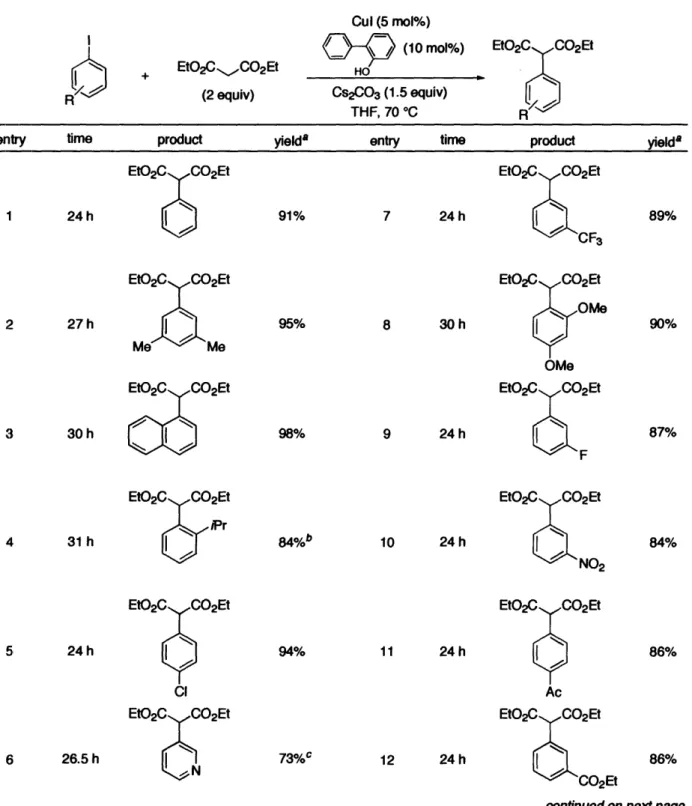
Thus, by heating a mixture of aryl iodide, Cs2CO3(1.5 equivalents), and diethyl malonate (2 equivalents) in THF (70 °C) in the presence of catalytic amounts of copper (I) iodide and
2-phenylphenol under an inert atmosphere, the corresponding a-aryl malonate can be obtained in good to excellent yields (Table 1). Interestingly, using dimethyl malonate as the nucleophile under these optimized conditions resulted in slower reaction rates, presumably due to a decrease in the solubility
of the copper enolate species that may be catalytically active. Moreover, we found that the use of
di-tert-butyl malonate also resulted in slower reactions, an observation that may be attributable to steric
Table 1. Arylation of Diethyl Malonate EtO2CCO 2Et (2 equiv) Cul (5 mol%) /_-__IO (10 mol%) HO Cs2CO3 (1.5 equiv) THF, 70 °C EtO2C CO2Et R
entry time product yielda entry time product yielda
1 24 h EtO2C C02Et
6
91% 7 24 h EtO2C C02Et CF3 2 27h EtO2C CO2Et 3 30 h 95% 98% 8 30h 9 24 h EtO2C CO2Et NOMe OMe EtO2C CO2Et N 4 31 h EtO2C CO2EtNiPr
10 24 h EtO2C CO2Et NO2 5 24 h EtO2C CO2Et CI EtO2C CO2Et N 94% 11 24 h EtO2C CO2Et Ac 6 26.5 h 12 24 hcontinued on next page...
a Isolated yields are the average of two runs and are estimated to be >95% pure by H NMR and GC analysis. All previously unknown
compounds gave satisfactory H NMR, 3C NMR, IR, and combustion analysis data. b Using 10 mold % Cul and 15 mol % 2-phenylphenol
c Reaction went to only 90% conversion in indicated time
+ 89% 90% 87% 84% 86% 86% R
Table 1 (continued)
Cul (5 mol%)
EtOE /_ _(10 mol%) EtO2C CO2Et
+ EtO2C>,CO2Et HO
R (2 equiv) Cs2C03 (1.5 equiv)
THF, 70 °C R
entry time product yielda entry time product yielda
continued from previous page
EtO2C CO2Et EtO2C CO2Et 13 29h 80%d 15 29 h 75%e OH N(H)Ac EtO2C CO2Et EtO2C CO2Et 14 24 h
N
61% 16 29 h I 70% CN NH2a Isolated yields are the average of two runs and are estimated to be >95% pure by H NMR and GC analysis. All previously unknown compounds gave satisfactory H NMR, 13C NMR, IR, and combustion analysis data.
d Using 3 equiv diethyl malonate and 3.5 equiv Cs2CO3
·Using 3 equiv diethyl malonate and 2.5 equiv Cs2C03
The malonate arylation proceeds smoothly using a diverse array of aryl iodides, including heterocyclic (Entry 6) and electron-rich (Entry 8) iodides. Even the sterically hindered
2-iodoisopropylbenzene (Entry 4) can be converted to the desired product, although 10 mol% CuI and 15 mol% 2-phenylphenol are required to facilitate complete conversion. Importantly, we have found that functional groups expected to be problematic under palladium catalysis (when using basic reac-tion condireac-tions such as these) are in general well-tolerated using this catalyst system (Entries 13, 15,
16); it would be expected to be difficult to access such products using palladium without appropriate protecting groups. We found that the yields were slightly higher in the cases of Entries 13 and 15 when 3 equivalents of diethyl malonate were used to suppress competing processes, presumably
car-The method is not without its drawbacks, however. For example, aryl bromides are essen-tially unreactive under these conditions (the use of bromobenzene in place of iodobenzene afforded < 2% of the a-aryl malonate). Additionally, substrates containing certain functional groups in the
,ortho- position (e.g., -NO2, -OH, -NH2) are problematic, possibly because an unreactive copper complex is formed. This is in stark contrast to related processes that require these types of substitu-tion patterns. Furthermore, in select cases, ligand arylasubstitu-tion (i.e., carbon-oxygen bond formasubstitu-tion) competes with the desired reaction thereby decreasing the overall yield. Lastly, despite the pains taken to avoid product decomposition, ct-aryl acetate formation is not completely inhibited; as men-tioned above, products having electron-withdrawing substituents on the aromatic ring are more prone to decarboxylation.2 8
It is unclear as to exactly what role the phenol additive plays in the reaction.2 9 While it is likely that the catalytically active species is a copper (I) enolate, as proposed by Setsune,19 a b eit is
debatable as to whether or not a copper phenoxide species is involved in the chemistry. An alterna-tive explanation is that the phenol acts as a soluble "proton shuttle," i.e., the phenoxide anion serves as the actual base involved in enolate formation. It should be pointed out that when the optimized reaction conditions were applied to the attempted arylation of the cyclic isopropylidene malonate (Meldrum's acid, Scheme 6), 1,3-cyclopentanedione, and 1,3-cyclohexanedione, no desired products were observed. These observations suggest that a bidentate binding of the enolate through the oxy-g;en atoms to copper may be required.
0
0
//
'
°
0
1.2.2 Coupling ofMalonate Esters with Aryl Bromides
It is a generally accepted premise that in the direct displacement of electron-deficient aryl halides with nucleophiles (nucleophilic aromatic substitution), the reactivity of the aryl halide com-ponent decreases as the halogen atom becomes heavier (i.e., ArF > ArCI > ArBr > ArI). This trend has been attributed to an increase of electron density at the site of attack due to the decreasing elec-tronegativity of the halogen.30 In contrast, most metal-catalyzed arylation reactions exhibit the op-posite trend in reactivity (ArI > ArBr > ArCl >> ArF), mirroring the increasing strengths of the car-bon-halogen bonds.31 Indeed, with the exception of a few reported reactions of aryl chlorides,32 arylation reactions employing copper reagents or catalysts are in general only applicable to aryl io-dides and, to a lesser extent, aryl bromides. Given that aryl bromides are in general more readily available from commercial sources than the corresponding iodides, we explored the possibility of using aryl bromides in malonate arylation reactions.
As mentioned earlier, under the optimized conditions developed for the reaction of aryl io-dides with diethyl malonate we observed no conversions of aryl bromides to the desired products. The use of phenols other than 2-phenylphenol afforded the same result. Employing ligands such as
1,1 O-phenanthroline or aliphatic 1,2-diamines afforded only small conversions (< 10%) of the aryl bromide substrates examined.
In studies subsequent to our work with aryl iodides, we discovered that 8-hydroxyquinoline, a ligand previously found to be effective for copper-catalyzed carbon-oxygen bond formation,33 promoted the coupling of dimethyl malonate with 4-bromoanisole in refluxing toluene, albeit to a limited extent (Scheme 7). The reaction could be pushed to complete conversion using more elec-tron-deficient aryl bromides, although product decarboxylation is rampant at these temperatures
aryl iodides with diethyl malonate. Unfortunately, beyond these initial results, no further work was done to optimize conditions for couplings with aryl bromides.
Cul (5 mol%)
Br[ (8 mol%) M 2CC2Me
+ MeO2CCO 2Me OH ,
C s2C03 (1.5 equiv)
OCH3 1.3 equiv dioxane, 110 °C
20 h
43% GC yield
Scheme 7. Coupling Reaction of Malonate Esters and Aryl Bromides
1.2.3 Arylation of Other Stabilized Carbanions
In addition to the arylation of malonate esters, we also briefly explored arylations of other
fS-dicarbonyl compounds as well as some simple ketones. An effective route to the products derived from these couplings would add to the potential diversity of heterocycles and synthetic intermediates available to a synthetic chemist and thus would be extremely useful. As mentioned in the introduc-tion, examples of these types of couplings abound in the literature. However, a lack of overall gen-erality leaves room for significant improvements in this field.While our efforts in these types of couplings were relatively perfunctory, we did obtain some promising results. For example, we found that the use of 1,1 0-phenanthroline as a ligand allows for the use of ethyl cyanoacetate as a nucleophile in a copper-catalyzed arylation reaction (Scheme 8).
5 mol% Cul NC CO2Et
7 mol%
+ NC,,CO 2Et X A 61%
Cs2C03 (1.4 equiv)
OCH3 1.2 equiv dioxane, 110 C OCH3
24 h
Scheme 8. Arylation of Ethyl Cyanoacetate
We also conducted preliminary studies on the copper-catalyzed arylation of phosphinyl-stabilized enolates. These carbanions have been previously utilized in similar coupling reactions, although stoichiometric amounts of copper are typically required.34 We found that the use of trans-1 ,2-diaminocyclohexane as a ligand allows for the catalytic arylation of triethyl phosphonoacetate (Scheme 9), a nucleophile commonly used in Horner-Wadsworth-Emmons olefination reactions.3 5 One can envision the reaction of arylated products such as these with aldehydes to access highly substituted styrene derivatives.3 6
5 mol% Cul
I 10 mol%
+ EtO-.FP' CO2Et H2N NH2
EtO Cs2C03 (2.5 equiv)
OCH3 1.5 equiv toluene, 80 °C
24 h
;02Et
78%
-I
Scheme 9. Arylation of Triethyl Phosphonoacetate
An interesting observation was made when we attempted to employ -ketoesters as nucleo-philes in coupling reactions. Instead of the expected a-arylated product, the dominant species
pro-duced was the a-aryl acetate (Scheme 10). Apparently, the initially-formed coupling product under-goes a retro-Claisen deacylation under the reaction conditions.
5 mol% Cul
QO 6 mol%
CS2C03 (1.5 equiv) OCH3 1.2 equiv dioxane, 110 °C
24 h
C02Et
" 56%
OCH3
Scheme 10. Formation of a-Aryl Acetates in the Arylation of Ethyl Acetoacetate
Such a phenomenon has been observed in the literature. 15b, 18,37 Continued optimization of this
process revealed that ligands seem to be unnecessary for this coupling, with no variation in GC yields observed between reactions run using only CuI and reactions employing CuI in concert with an additive. Moreover, we found that this process could be conducted under more mild conditions than those used initially. For example, conducting the coupling in refluxing alcohols (tert-butanol in particular, due to minimal transesterification) resulted in faster reactions. However, continued work on this process was discontinued before a synthetically useful method could be developed.
In contrast to the smooth a-arylation of simple ketones (i.e., pKa > 20) that takes place in the presence of palladium catalysts, copper salts have been to date ineffective at promoting this process. This may be explained by considering the postulated mechanisms for these reactions. It is accepted that in palladium-catalyzed cross-coupling reactions, oxidative addition of the aryl halide substrate affords an arylpalladium (II) intermediate. This process is for all intents and purposes irreversible, giving a relatively stable species that is in many cases isolable.3 8 In the ketone arylation reaction, this palladium (II) species reacts with a ketone enolate to give an arylpalladium enolate; subsequent
process, coordination of the ketone to the arylpalladium (II) halide species likely facilitates deproto-nation. While the mechanisms of copper-catalyzed coupling reactions are less well-understood, a common hypothesis is that oxidative addition of an aryl halide to a copper (I)-nucleophile complex affords an unstable copper (III) intermediate, followed by reductive elimination of the coupled prod-uct.16 Since copper (I) is a poor Lewis acid, ketone enolate formation is likely not assisted by coor-dination (as in the palladium chemistry) and thus only very low concentrations of the requisite cop-per (I) enolate would be expected to result.
Indeed, all of our attempts to couple ketones such as acetophenone and cyclohexanone with alyl halides were unsuccessful. However, if ketones that are considerably more acidic are used, un-assisted enolate formation should occur to a greater extent, thus making the coupling reaction more feasible. We found that 2-phenylacetophenone (deoxybenzoin, pKa (DMSO) = 17.739) reacts with aryl iodides in the presence of CuI and trans-i 1,2-diaminocyclohexane to afford a small amount of the desired product (Scheme 11). While the reaction proceeds very slowly in the presence of cata-lytic copper, this result demonstrates the feasibility of the arylation of other enolates.
i mnOL/_ t ml 10 molb% e H2N NH K3PO4 (2 equiv) 4to1..B. 4 4 Or% 21% yield 45% conversion) OCH 3 LUIUlIl , I v 1.5 equiv 42 h
Scheme 11. Arylation of Deoxybenzoin
1.3 Conclusions
We have developed a mild, general catalytic system for the synthesis of a-aryl malonates.
I
+high yields using inexpensive and widely available reagents, making this a superior method to those previously described that employ copper reagents or catalysts. The functional group tolerance of the
process described makes it complementary to the analogous palladium-catalyzed couplings. Impor-tantly, a set of mild reaction conditions has been developed that minimize product decomposition, a
problem that had not been addressed previously in the literature.
The use of aryl bromides as coupling partners has also been investigated, although consider-able work remains in this case to achieve synthetic utility. We have identified a promising lead (8-hydroxyquinoline) for ligands effective for this class of reaction.
We have also surveyed the arylation of other classes of stabilized carbanions, such as P-keto, 13-phosphono, and -cyano esters, as well as acidic "simple" ketones. While reaction conditions for these classes of nucleophiles have not been fully optimized, promising results have been obtained in all cases.
1.4 Experimental Procedures
General Considerations: All reactions were carried out in oven-dried glassware that was cooled
tmder argon. THF and toluene were purchased from J. T. Baker in CYCLE-TAINER® solvent de-livery kegs, which were vigorously purged with argon for two hours and further purified by passing through two packed columns of neutral alumina (THF) or one column of neutral alumina and one column of copper (II) oxide (toluene) under argon pressure. Anhydrous 1,4-dioxane was purchased from Aldrich and was used as received. Copper (I) iodide (98%) was purchased from Strem Chemi-cal Company. Cesium carbonate was purchased from both Chemetall and Strem, and the bulk of the reagent was stored under nitrogen in a Vacuum Atmospheres glovebox. Small portions (5-10 g) were removed from the glovebox as needed and stored in a benchtop dessicator in glass vials.
Po-tassium phosphate was purchased from Fluka and was used as received. 2-Phenylphenol was pur-chased from Fluka and was recrystallized from hexanes prior to use. 4-Iodoaniline (Table 1, Entry
16) was purchased from Aldrich and was recrystallized from hexanes prior to use. 4-Iodoacetanilide (Table 1, Entry 15) was prepared by treatment of a CH2C12solution of4-iodoaniline with acetyl chloride in the presence of triethylamine. All other reagents were obtained from commercial sources and were used as received. Thin layer chromatography was performed using EM Science silica gel 60 F2 54plates; after development, the plates were stained using a solution prepared from 2 g KMnO4 and 12g Na2CO3in 200 mL H20. Column chromatography was done using either Silicycle or EM Science silica gel (230-400 mesh). Melting points were obtained using a Mel-Temp apparatus (Laboratory Devices) and are uncorrected. IR spectra for all previously unreported compounds were obtained by placing the neat sample on the DiComp probe of an ASI ReactIR 1000 instrument. Elemental analyses were performed by Atlantic Microlabs, Inc., Norcross, GA. H NMR and 3C NMR were obtained using a Varian 300 MHz spectrometer, with chemical shifts referenced to tetramethylsilane (TMS, internal standard) or to residual protons in the deuterated solvent. Gas chromatographic analysis was performed on a Hewlett Packard 6890 instrument equipped with a FID detector and a Hewlett Packard HP-1 (10 m x 0.2 mm i.d.) capillary column. Mass spectra were obtained using a Hewlett Packard Model G1 800B GCD. All yields reported in Table 1 refer to iso-lated yields (average of two runs) of products estimated to be >95% pure as determined by H NMR and GC analysis. The yields reported below may differ from those in Table 1, as they refer to the isolated yields of the single runs whose products were submitted for elemental analysis. In addition to 'H NMR and :13C NMR, all previously unreported compounds were further characterized by ele-mental analysis and IR. Those compounds described in the literature were positively identified by comparing their 'H NMR spectra to previously reported data.
General Procedure for Malonate Arylation: An oven-dried Schlenk tube equipped with a
mag-netic stirbar and a Teflon stopcock was evacuated while hot and allowed to cool under argon. The tube was charged sequentially with CuI (9.6 mg, 5.0 mol %), 2-phenylphenol (17.1 mg, 10.0 mol
%), Cs2CO3(0.490 g, 1.50 mmol), and the aryl iodide (1.00 mmol), if a solid. The tube was evacu-ated and backfilled with argon (3 times), and the Teflon stopcock was replaced with a rubber sep-tum. The aryl iodide (if a liquid) was added volumetrically (1.00 mmol), followed by diethyl malonate (304 [tL, 2.00 mmol) and anhydrous THF (1.0 mL). The septum was replaced by the Tef-lon stopcock under a positive pressure of argon, and the sealed tube was placed in an oil bath pre-heated to 70 °C. After the designated time period, the reaction was allowed to cool to room tem-perature and was then partitioned between ethyl acetate (20 mL) and saturated aqueous NH4Cl (10 mL). The organic portion was dried (Na2SO4), filtered through a plug of Celite, and concentrated on a rotary evaporator. The material thus obtained was purified by silica gel chromatography to give the product a-aryl malonate.
I)iethyl phenylmalonate (Table 1, Entry 1):40 Reaction time 24 h; silica gel chromatography (60:40 toluene:CH2Cl2; Rf = 0.29) afforded a colorless oil (92%).
I)iethyl (3,5-dimethylphenyl)malonate (Table 1, Entry 2): Reaction time 27 h; silica gel
chroma-tography (60:40 toluene:CH2Cl2; Rf = 0.29) afforded a colorless oil (96%). H NMR (CDC13) b 1.28
(t, J= 7.2 Hz, 6H), 2.32 (s, 6H), 4.22 (m, 4H), 4.55 (s, H), 6.98 (s, 1H), 7.01 (s, 2H). '3C NMR
(CDC13) b 14.14, 21.39, 57.93, 61.83, 127.09, 130.05, 132.67, 138.24, 168.47. Calc. For C15H2 004:
C 68.16, H 7.63; Found: C 68.45, H 7.80. IR (neat) v (cm' l) 1733, 1754.
Diethyl (1-napthyl)malonate (Table 1, Entry 3):4 1Reaction time 30 h; silica gel chromatography
Diethyl (2-isopropylphenyl)malonate (Table 1, Entry 4): Reaction time 31 h, using 10 mol% CuI
and 15 mol% 2-phenylphenol; silica gel chromatography (80:20 hexanes:ethyl acetate; Rf = 0.43) afforded a pale yellow oil (86%). 'H NMR (CDCl3) 6 1.26 (d, J= 6.9 Hz, 6H), 1.27 (t, J= 7.2 Hz,
6H), 3.13 (septet, J= 6.9 Hz, 1H), 4.23 (m, 4H), 5.01 (s, 1H), 7.19-7.42 (m, 5H aromatic). 13C NMR (CDC13) 14.19, 23.87, 29.49, 53.69, 61.91, 125.69, 126.11, 128.59, 129.44, 130.40, 146.95,
168.85. Calc. For C16H2204: C 69.04, H 7.97; Found: C 69.25, H 8.05. IR (neat) v (cm'l) 1733,
1754.
Diethyl (4-chlorophenyl)malonate (Table 1, Entry 5):4' Reaction time 24 h; silica gel
chromatog-raphy (60:35:5 toluene:hexanes:acetone; Rf = 0.53) afforded a colorless oil (97%).
Diethyl (3-pyridyl)malonate (Table 1, Entry 6): Reaction time 26.5 h; GC analysis indicated that
in this time the reaction had only proceeded to 90% conversion. Silica gel chromatography (1:1 hexanes:ethyl acetate; Rf = 0.27) afforded a pale yellow oil (71%). Note: chromatography and analysis should be performed as quickly as possible following reaction workup, as the product slowly decomposes. H NMR (CDCl3) 8 1.28 (t, J= 7.2 Hz, 6H), 4.24 (m, 4H), 4.63 (s, 1H), 7.33
(m, 1H, aromatic), 7.86 (m, 1H aromatic), 8.59 (m, 2H, aromatic). 13C NMR (CDC1
3) 8 14.10, 55.57, 62.33, 123.63, 129.05, 137.00, 149.66, 150.40, 167.57. Calc. For C12H15N04: C 60.75, H.
6.37; Found: C 60.51, H: 6.35. IR (neat) v (cm'l) 1731.
I)iethyl (3-trifluoromethylphenyl)malonate (Table 1, Entry 7): Reaction time 24 h; silica gel
chromatography (1:1:0.03 toluene:hexanes:acetone; Rf = 0.39) afforded a colorless oil (88%). 'H NMR (CDC13) 8 1.28 (t, J= 7.2 Hz, 6H), 4.24 (m, 4H), 4.67 (s, H), 7.48-7.68 (m, 5H aromatic). 13C
NMR (CDC13) 6 14.01, 57.74, 62.23, 124.08 (q, J= 272.3 Hz), 125.22 (q, J= 3.8 Hz), 126.42 (q, J=
Diethyl (2,4-dimethoxyphenyl)malonate (Table 1, Entry 8): Reaction time 30 h; silica gel
chro-matography (75:25 hexanes:ethyl acetate; Rf = 0.38) afforded a pale yellow solid (91%), mp = 58.5-59.5 C. 'H NMR (CDCl3) 6 1.27 (t, J= 7.2 Hz, 6H), 3.797 (s, 3H), 3.804 (s, 3H), 4.22 (dq, J=
2.1Hz, 7.2 Hz, 4H), 5.02 (s, H), 6.46 - 6.52 (dt, J= 2.4 Hz, 8.1 Hz, 2H aromatic), 7.26 (d, J= 8.1 Hz, IH aromatic). 13C NMR (CDCl3) 8 14.21, 50.73, 55.48, 55.75, 61.66, 98.70, 104.63, 114.44,
130.17, 158.05, 160.85, 169.01. Calc. For C15H2 006: C 60.80, H 6.80; Found: C 60.86, H 6.81. IR
I(neat) v (cm- ) 1513, 1725, 1748.
Diethyl (3-fluorophenyl)malonate (Table 1, Entry 9): Reaction time 24 h; silica gel
chromatogra-phy (1:1:0.03 toluene:hexanes:acetone; Rf = 0.38) afforded a colorless oil (89%). 'H NMR (CDCl3) iS 1.28 (t, J= 7.2 Hz, 6H), 4.23 (dq, J= 3.3 Hz, 7.2 Hz, 4H), 4.61 (s, 1H), 7.01-7.08 (m, 1H aro-matic), 7.16-7.20 (m, 2H aroaro-matic), 7.30-7.37 (m, 1H aromatic). 13C NMR (CDCl3) 6 14.14, 57.70, 62.16, 115.42 (d, J= 21.3 Hz), 116.59 (d, J= 22.7 Hz), 125.26 (d, J= 3.0 Hz), 130.16 (d, J= 8.4 Hz), 135.07 (d, J= 8.1 Hz), 162.84 (d, J= 246.3 Hz), 167.82. Calc. For C13H1504F: C 61.41, H 5.95,
F 7.47; Found: C 61.18, H 5.91, F 7.28. IR (neat) v (cm'') 1731.
Diethyl (3-nitrophenyl)malonate (Table 1, Entry 10): Reaction time 24 h; silica gel
chromatogra-phy (80:20 hexanes:ethyl acetate; Rf = 0.26) afforded a pale yellow oil (83%). H NMR (CDC13) 6 1.29 (t, J= 7.2 Hz, 6H), 4.25 (m, 4H), 4.73 (s, 1H), 7.57 (m, 1H aromatic), 7.79 (m, 1H aromatic), 8.22 (m, 1H aromatic), 8.31 (m, 1H aromatic). 13C NMR (CDCl3) b 14.12, 57.49, 62.50, 123.44,
124.76, 129.66, 134.80, 135.75, 148.38, 167.32. Calc. For C13H1 5NO6: C 55.51, H 5.38; Found: C
5;5.56, H 5.46. IR (neat) v (cm'l) 1530, 1733.
Diethyl (4-acetylphenyl)malonate (Table 1, Entry 11):4 ° Reaction time 24 h; silica gel chromatog-raphy (70:30 hexanes:EtOAc; Rf = 0.35) afforded a yellow oil (87%).
Diethyl (3-carboethoxyphenyl)malonate (Table 1, Entry 12): Reaction time 24 h; silica gel
chro-matography (7:3 hexanes:diethyl ether; Rf = 0.34) afforded a colorless oil (86%). 'H NMR (CDCl3)
6 1.28 (t, J= 7.2 Hz, 6H), 1.40 (t, J= 7.2 Hz, 3H), 4.23 (dq, J= 3.0 Hz, 7.2 Hz, 4H), 4.38 (q, J= 7.2 Hz, 2H), 4.68 (s, 1H), 7.46 (m, 1H aromatic), 7.65 (m, 1H aromatic), 8.0-8.1 (m, 2H aromatic). 13C NMR (CDC13) 6 14.09, 14.42, 57.81, 61.19, 62.08, 128.77, 129.52, 130.66, 130.97, 133.30, 133.76,
166.25, 167.90. Calc. For C16H2006: C 62.33, H 6.54; Found: C 62.12, H 6.53. IR (neat) v (cm')
1719.
Diethyl (4-hydroxyphenyl)malonate (Table 1, Entry 13): Reaction time 29 h, using 3 equivalents
of diethyl malonate and 3.5 equivalents of cesium carbonate; silica gel chromatography (65:35 hex-anes:ethyl acetate; Rf = 0.30) afforded a colorless oil which crystallized upon standing (76%), mp = 66-68 °C. 'H NMR (CDC13) 6 1.27 (t, J= 7.2 Hz, 6H), 4.22 (m, 4H), 4.56 (s, 1H), 5.71 (s, 1H,
chemical shift dependent upon NMR sample concentration), 6.76 (AB, JAB = 2.1 Hz, 8.4 Hz, 2H aromatic), 7.24 (AB, JAB = 2.1 Hz, 8.4 Hz, 2H aromatic). '3C NMR (CDCl3) 6 14.19, 57.35, 62.12,
1115.81, 124.78, 130.69, 156.03, 168.95. Calc. For Cl3H,605: C 61.90, H 6.39; Found: C 61.84, H
6.36. IR (neat) v (cm' l) 1519, 1698, 1737, 3379.
DI)ethyl (3-cyanophenyl)malonate (Table 1, Entry 14): Reaction time 24 h; silica gel
chromatog-raphy (80:20 hexanes:ethyl acetate;Rf = 0.29) afforded a colorless oil (61%). H NMR (CDC13) 6 1.28 (t, J= 7.2 Hz, 6H), 4.24 (m, 4H), 4.64 (s, 1H), 7.46-7.52 (m, 1H aromatic), 7.63-7.69 (m, 1H aromatic), 7.73-7.75 (m, 1H aromatic). 3C NMR (CDC13) 14.04, 57.34, 62.35, 112.82, 118.48,
129.48, 131.97, 133.10, 134.03, 134.31, 167.30. Calc. For Cl4Hl5NO4: C 64.36, H 5.79; Found C
64.19, H 5.76. IR (neat) v (cm-) 1731, 2232.
(crude product loaded onto column as solution in CH2C12, column eluted with diethyl ether; Rf = 0.24) afforded a colorless solid (78%), mp = 141-144 C. H NMR (CDC13) 6 1.26 (t, J= 7.2 Hz,
6H), 2.15 (s, 3H), 4.21 (m, 4H), 4.58 (s, 1H), 7.31 (s, 1H, chemical shift dependent upon NMR sam-ple concentration), 7.33 (AB, JAB = 7.2 Hz, 2H aromatic), 7.48 (AB, JAB = 7.2 Hz, 2H aromatic). '3C NMR (CDC13) 8 14.21, 16.60, 57.56, 62.08, 120.09, 128.60, 130.07, 138.15, 168.46, 172.64.
Calc. For C15Hl9NOs: C 61.42, H 6.53; Found: C 61.39, H 6.53. IR (neat) v (cm-') 1663, 1725,
1744, 3263, 3298.
Diethyl (4-aminophenyl)malonate (Table 1, Entry 16): Reaction time 29 h; silica gel
chromatog-raphy (3:1 ether:hexanes;Rf = 0.30) afforded a pale yellow oil (69%). Note: chromatogchromatog-raphy and analysis should be performed as quickly as possible following reaction workup, as the product slowly decomposes. 'H NMR (CDC13) 6 1.26 (t, J= 7.2 Hz, 6H), 3.70 (s, 2H, chemical shift
de-pends on NMR sample concentration), 4.21 (m, 4H), 4.50 (s, 1H), 6.67 (AB, JAB = 2.1 Hz, 6.5 Hz, 2H aromatic), 7.19 (AB, JAB 2.1 Hz, 6.5 Hz). 13C NMR (CDC13) b 14.17, 57.30, 61.77, 115.20,
1122.60, 130.31, 146.62, 168.85. Calc. For C13H,7N04: C 62.14, H 6.82; Found C 62.17, H 6.88. IR
(neat) n (cm l') 1519, 1625, 1723, 3228, 3379, 3469.
Procedure for the Coupling of Malonate Esters to Aryl Bromides (Scheme 7): An oven-dried
Schlenk tube was charged with CuI (10.8 mg, 5.5 mol%), 8-hydroxyquinoline (12.1 mg, 8.0 mol%), and Cs2CO3 (460 mg, 1.41 mmol). The tube was evacuated and backfilled with argon (3 times), and 4-bromoanisole (0.13 mL, 1.0 mmol), dimethyl malonate (0.15 mL, 1.3 mmol), and anhydrous di-oxane (1.0 mL) were added. The tube was sealed under argon and was placed in an oil bath pre-heated to 110 °C. After heating for 19.5 h, the mixture was allowed to cool, was treated with n-undecane (106 ptL, 0.50 mmol, as an internal GC standard), and was partitioned between EtOAc and saturated NH Cl (aq). GC analysis indicated a 43% yield of the coupled product.
Ethyl (4-methoxyphenyl)cyanoacetate (Scheme 8):42An oven-dried Schlenk tube was charged
with CuI (9.6 mg, 5.1 mol%), 1,10-phenanthroline (11.8 mg, 6.7 mol%), Cs2CO3 (465 mg, 1.43
mmol), and 4-iodoanisole (230 mg, 0.98 mmol). The tube was evacuated and backfilled with argon (3 times), and ethyl cyanoacetate (0.13 mL, 1.2 mmol) and anhydrous dioxane (1.0 mL) were added. The tube was sealed under argon and was placed in an oil bath preheated to 110 °C. After heating for 20 h, the reaction mixture was allowed to cool and was partitioned between EtOAc and saturated :NH4C1 (aq). The organic layer was dried (MgSO4), filtered, and concentrated via rotary evaporator. The crude material was purified by silica gel chromatography (60:40 hexanes:EtOAc, Rf = 0.47) to give the product as a yellow oil (132 mg, 61%).
Triethyl (4-methoxyphenyl)phosphonoacetate (Scheme 9):34a A screw-cap test tube was charged with CuI (9.6 mg, 5.0 mol%), 4-iodoanisole (234 mg, 1.00 mmol), and Cs2CO3 (813 mg, 2.50
rnmol). A Teflon septum cap was applied, and the tube was evacuated and backfilled with argon (3 times). trans-i 1,2-Diaminocyclohexane (12 tL, 10.0 mol%, filtered through a plug of alumina im-mediately prior to use), triethyl phosphonoacetate (298 [tL, 1.50 mmol), and anhydrous toluene (2.0 rnL) were added. The resulting mixture was placed in an oil bath preheated to 80 °C. After 24 h, the reaction was allowed to cool and was partitioned between diethyl ether (-20 mL) and 1 N HC1 (aq). The aqueous layer was extracted with ether, and the combined organics were washed with brine, dried (MgSO4), filtered, and concentrated via rotary evaporator. The crude oil was purified by silica gel chromatography (ether as eluent; Rf = 0.31) to give the product as a colorless oil (257 mg,
78%).
Ethyl (4-methyoxyphenyl)acetate (Scheme 10):4 3 An oven-dried Schlenk tube was charged with CuII (9.2 mg, 5.0 mol%), 1,10-phenanthroline (9.8 mg, 5.6 mol%), Cs2CO3 (474 mg, 1.45 mmol),
times), and ethyl acetoacetate (0.15 mL, 1.2 mmol) and anhydrous dioxane (1.0 mL) were added. The tube was sealed under argon and was placed in an oil bath preheated to 110 °C. After heating for 18 h, the reaction mixture was allowed to cool and was partitioned between EtOAc and saturated NH4C1 (aq). The organic layer was dried (MgSO4), filtered, and concentrated via rotary evaporator. 'The crude material was purified by silica gel chromatography (85:15 hexanes:EtOAc, Rf = 0.49) to give the product as a colorless oil (106 mg, 56%).
2-Phenyl-2-(4-methoxyphenyl)acetophenone (Scheme 11):44An oven-dried Schlenk tube was charged with Cul (9.4 mg, 4.9 mol%), K3PO4 (435 mg, 2.05 mmol), 4-iodoanisole (235 mg, 1.00
nmmol), and deoxybenzoin (295 mg, 1.50 mmol). The tube was evacuated and backfilled with argon (3 times), and trans-1 ,2-diaminocyclohexane (12 tL, 10.0 mol%) was added, followed by anhydrous toluene (1.0 mL) were added. The tube was sealed under argon and was placed in an oil bath pre-heated to 110 °C. After heating for 42 h, the reaction mixture was allowed to cool and was treated with n-undecane (106 [tL, 0.50 mmol, as an internal GC standard). The mixture was partitioned between EtOAc and saturated NH4Cl (aq). GC analysis indicated a 45% conversion of the aryl
io-dcide. The organic layer was dried (MgSO4), filtered, and concentrated via rotary evaporator. The crude material was purified by silica gel chromatography (90:10 hexanes:EtOAc, Rf = 0.25) to give the product as a pale yellow oil (64 mg, 21%).
1.5 References and Notes
(1) (a) Polymastiamide A: Kong, F.; Andersen, R. J.; J. Org. Chem. 1993, 58, 6924. (b) Lucuminic Acid: Takeda, T.; Gonda, R.; Hatano, K. Chem. Pharm. Bull. 1997, 45, 697. (c) Vulculic Acid: Ki-mura, Y.; Nishibe, M.; Nakajima, H.; Hamasaki, T. Agric. Biol. Chem. 1991, 55, 1137. (d) Dictyo-dendrin A: Warabi, K.; Matsunaga, S.; van Soest, R. W. M.; Fusetani, N. J. Org. Chem. 2003, 68,
:2765.
(2) Rieu, J.-P.; Boucherle, A.; Cousse, H.; Mouzin, G. Tetrahedron 1986, 42, 4095. (3) Heisig, G. B.; Stodola, F. H. Org. Synth. Coll. Vol III, 1955, 213.
(4) Examples: (a) Beringer, F. M.; Forgione, P. S. J. Org. Chem. 1963, 28, 714. (b) Oh, C. H.; Kim, J. S.; Jung, H. H. J. Org. Chem. 1999, 64, 1338.
(5) Examples: (a) Moriarty, R. M.; Gill, U. S. Organometallics 1986, 5, 253. (b) Abd-El-Aziz, A. S.; Lee, C. C.; Pi6rko, A.; Sutherland, R. G. Synth. Commun. 1988, 18, 291.
(6) Examples: (a) Zvilichovsky, G.; Fotadar, U. J. Org. Chem. 1973, 38, 1782. (b) Zvilichovsky, G.; I)avid, M. J. Org. Chem. 1982, 47, 295.
(7) For example, see: Sun, G.-X.; Chen, B.; Tang, H.; Xu, S.-Y. J. Mater. Chem. 2003, 13, 742. (8) Gao, Y.; Luo, J.; Yao, Z.-J.; Guo, R.; Zou, H.; Kelley, J.; Voigt, J. H.; Yang, D.; Burke, Jr., T. R.
jr. Med. Chem. 2000, 43, 911.
(9) Beyer, J.; Jensen, B. S.; Str0obk, D.; Christophersen, P.; Teuber, L. WO Patent 00/37422, 2000. (10) (a) Palucki, M.; Buchwald, S. L. J. Am. Chem. Soc. 1997, 119, 11108. (b) Hamann, B. C.; Hartwig, J. F. J. Am. Chem. Soc. 1997, 119, 12382. (c) Satoh, T.; Kawamura, Y.; Miura, M.; No-mura, M. Angew. Chem. Int. Ed. Engl. 1997, 36, 1740. (d) Muratake, H.; Natsume, M. Tetrahedron
Am. Chem. Soc. 1998, 120, 1918. (f) Satoh, T.; Kametani, Y.; Terao, Y.; Miura, M.; Nomura, M.
Tetrahedron Lett. 1999, 40, 5345. (g) Kawatsura, M.; Hartwig, J. F. J. Am. Chem. Soc. 1999, 121,
1473. (h) Fox, J. M.; Huang, X.; Chieffi, A.; Buchwald, S. L. J. Am. Chem. Soc. 2000, 122, 1360. (i) Nguyen, H. N.; Huang, X.; Buchwald, S. L. J. Am. Chem. Soc. 2003, 125, 11818.
(11) (a) Shaughnessy, K. H.; Hamann, B. C.; Hartwig, J. F. J. Org. Chem. 1998, 63, 6546. (b) Honda, T.; Namiki, H.; Satoh, F. Org. Lett. 2001, 3, 631. (c) Lee, S.; Hartwig, J. F. J. Org. Chem.
2001, 66, 3402. (d) Hama, T.; Liu, X.; Culin, D. A.; Hartwig, J. F. J. Am. Chem. Soc. 2003, 125, 11176.
(12) (a) Fauvarque, J. F.; Jutand, A. J. Organomet. Chem. 1979, 177, 273. (b) Carfagna, C.; Musco, A.; Sallese, G.; Santi, R.; Fiorani, T. J. Org. Chem. 1991, 56, 261. (c) Galarini, R.; Musco, A.; Pon-lellini, R.; Santi, R. J. Mol. Catal. 1992, 72, LI 1. (d) Sakamoto, T.; Kondo, Y.; Masumoto, K.; Yamanaka, H. Heterocycles 1993, 36, 2509. (e) Sakamoto, T.; Kondo, Y.; Masumoto, K.; Yama-naka, H. J. Chem. Soc. Perkin Trans. I 1994, 235. (f) Terao, Y.; Satoh, T.; Miura, M.; Nomura, M.
Tetrahedron Lett. 1998, 39, 6203. (g) Agnelli, F.; Sulikowski, G. A. Tetrahedron Lett. 1998, 39,
8807. (h) Moradi, W. A.; Buchwald, S. L. J. Am. Chem. Soc., 2001, 123, 7996. (i) Lee, S.; Beare, N. A.; Hartwig, J. F. J. Am. Chem. Soc. 2001, 123, 8410. (j) Spielvogel, D. J.; Buchwald, S. L. J. Am.
(7hem. Soc. 2002, 124, 3500.
(13) (a) Uno, M.; Seto, K.; Takahashi, S. J. Chem. Soc., Chem. Commun. 1984, 932. (b) Uno, M.; Seto, K.; Ueda, W.; Masuda, M.; Takahashi, S. Synthesis 1985, 506.
(14) Ciufolini, M. A.; Qi, H.-B.; Browne, M. E. J. Org. Chem. 1988, 53, 4151.
(15) (a) Ozdemir, I.; Yigit, M.; Cetinkaya, E.; Cetinkaya, B. Tetrahedron Lett. 2004, 45, 5823. (b) 2:eevaart, J. G.; Parkinson, C. J.; de Koning, C. B. Tetrahedron Lett. 2004, 45, 4261. (c)
Wolk-owski, J. P.; Hartwig, J. F. Angew. Chem., Int. Ed. 2002, 41, 4289. (d) Beare, N. A.; Hartwig, J. F.
J. Org. Chem. 2002, 67, 541. (e) Aramendia, M. A.; Borau, V.; Jim6nez, C.; Marinas, J. M.; Ruiz, J.
R.; Urbano, F. J. Tetrahedron Lett. 2002, 43, 2847. (f) Kondo, Y.; Inamoto, K.; Uchiyama, M.; Sa-kamoto, T. Chem. Commun. 2001, 2704. (g) Djakovitch, L.; K/ihler, K. J. Organomet. Chem. 2000,
606, 101.
(16) For a review, see: Lindley, J. Tetrahedron 1984, 40, 1433, and references therein.
(17) For recent reviews, see: (a) Ley, S. V.; Thomas, A. W. Angew. Chem., Int. Ed. Engl. 2003, 42, :5400. (b) Beletskaya, I. P.; Cheprakov, A. V. Coord. Chem. Rev. 2004, 248, 2337.
(18) Hurtley, W. R. H. J. Chem. Soc. 1929, 1870.
(1 9) (a) Setsune, J.; Matsukawa, K.; Wakemoto, H.; Kitao, T. Chem. Lett. 1981, 367. (b) Setsune, J.; Matsukawa, K.; Kitao, T. Tetrahedron Lett., 1982, 23, 663. (c) Osuka, A.; Kobayashi, T.; Suzuki, H.
Synthesis, 1983, 67. (d) Osuka, A.; Kobayashi, T.; Suzuki, H. Synthesis 1983, 67. (e) Setsune, J.;
Ueda, T.; Shikata, K.; Matsukawa, K.; Iida, T.; Kitao, T. Tetrahedron 1986, 42, 2647. (f) Ugo, R.; Nardi, P.; Psaro, R.; Roberto, D. Gazz. Chim. Ital. 1992, 122, 511. (g) Pivsa-Art, S.; Fukui, Y.; Mi-ura, M.; NomMi-ura, M. Bull. Chem. Soc. Jpn., 1996, 69, 2039.
(20) Okuro, K.; Furuune, M.; Miura, M.; Nomura, M. J. Org. Chem., 1993, 58, 7606.
(21) (a) Konopelski, J. P.; Hottenroth, J. M.; Oltra, H. M.; Vl1iz, E. A.; Yang, Z.-C. Synlett 1996, 609. (b) Hang, H. C.; Drotleff, E.; Elliott, G. I.; Ritsema, T. A.; Konopelski, J. P. Synthesis 1999, 398..
(2.2) Over two years subsequent to the publication of the work described herein, another report of a copper-catalyzed malonate arylation was published: Cristau, H.-J.; Cellier, P. P.; Spindler, J.-F.; Taillefer, M. Chem. Eur. J. 2004, 10, 5607.



![[PDF] Cours sur les fonctionnalités de base d Excel pdf | Cours informatique](data:image/gif;base64,R0lGODlhAQABAIAAAP///wAAACH5BAEAAAAALAAAAAABAAEAAAICRAEAOw==)