The Development and Analysis of Intrusion
Detection Algorithms
by
Seth E. Webster
Submitted to the Department of Electrical Engineering and Computer
Science
in partial fulfillment of the requirements for the degree of
Master of Engineering in Electrical Engineering and Computer Science
at the
MASSACHUSETTS INSTITUTE OF TECHNOLOGY
June 1998
@ Seth E. Webster, MCMXCVIII. All rights reserved.
The author hereby grants to MIT permission to reproduce and
distribute publicly paper and electronic copies of this thesis document
in whole or in part.
A u th or ...
Department of Electrical Engineering and Computer Science
May 27, 1998
C ertified by ...
...
Dr. Richard P. Lippmann
Accepted by ...
Senior Staff MIT Lincoln Laboratory
1Thesis
Supervisor
Arthur C. mith
Chairman, Department Committee on Graduate S
tudentsj.
I
J 11- 1415-W
The Development and Analysis of Intrusion Detection
Algorithms
by
Seth E. Webster
Submitted to the Department of Electrical Engineering and Computer Science on May 27, 1998, in partial fulfillment of the
requirements for the degree of
Master of Engineering in Electrical Engineering and Computer Science
Abstract
This thesis presents three new low-complexity intrusion detection algorithms tested on sniffing data from 80,000 real Internet sessions. A Password Guessing Detector scans telnet connections containing only failed logins and identifies password guessing attacks based on the number of connection between each host pair and the usernames and passwords tried. By extracting the plaintext password, this algorithm is able to run much faster than conventional cracking programs, which must encrypt each guess. A neural network based keyword weighting system substantially improves the performance of a baseline intrusion detection system. It uses counts of forty keywords, also found in the sniffing data, to identify attacks in telnet connections. Finally, a real-time Shell Tracker monitors BSM audit data and finds users who illegally become root and start a command shell regardless of the attack or back door used. Two intrusion prevention algorithms, a Banner Finder and a Password Checker, were also developed. The Banner Finder uses a binary decision tree and five keyword counts to identify the presence of a valid warning banner in telnet sessions. The Password Checker extracts usernames and passwords from network sniffing data and scores the passwords based on how succeptable they would be to a password guessing attack.
Thesis Supervisor: Dr. Richard P. Lippmann Title: Senior Staff MIT Lincoln Laboratory
Acknowledgments
First and foremost, I would like to thank Rich Lippmann, my supervisor, for con-tinually pointing me in the right direction and keeping track of the big picture. I would also like to thank Dan Wsychograd for the extensive work he did analyzing and classifying the data. Dan Weber, and his attack scripts, were invaluable for test-ing many of the algorithms. Rich, Dan Wsychograd, Dan Weber, Sam Gorton, and all the other Lincoln Lab folks working on the intrusion detection project provided hours advice, ideas, discussion, and feedback which, more than once, kept me from heading down the wrong path. Finally, I would like to thank Teresa Lunt at DARPA and the Department of Defense.
Contents
1 Introduction 9
2 Background
2.1 Overview of Computer Intrusions . . . . 2.2 Current Intrusion Detection Research . . . . . 2.2.1 Anomaly Detection . . . .. 2.2.2 Misuse Detection . . . . 2.2.3 Intrusion Prevention . . . . 2.3 Input Data Sources for Intrusion Detection . .
2.3.1 Audit Data ... ... .... 2.3.1.1 Overview ... ... 2.3.1.2 Solaris Basic Security Module 2.3.2 Sniffer Data ... ... ...
2.3.2.1 Overview ... ... 2.3.2.2 TCP Sessions . . . .. 2.3.2.3 Transcript Creation . . . . . 2.3.2.4 Attacks in Data ...
2.3.2.5 Problems With Transcripts 2.4 The Baseline System . . . . . . . . .... 2.5 ROC Curves and Purity ...
3 Password Guessing Detector
3.1 Dictionary and Doorknob Rattling Attacks
11 . . . . 11 . . . . . . . 13 . . . . . 13 . . . . . 16 .. . . . . 17 . . . . . 17 . . . . . . .. . 18 . .. . . . . 18 . . . . . 19 ... 21 . . . . . . . . 2 1 . . . . . . . . 22 .. . . . . 23 . . . . 25 . . . . . 28 . . . . . 29 . . . . 33
3.2 The Password Guessing Detector ... . 38
3.3 Password Guessing Detector Results . ... 40
4 Keyword Reweighting System 43 4.1 The Neural Network ... ... 43
4.2 Results ... ... 44
5 Bottleneck Verification Prototype 47 5.1 Bottleneck Verification Overview ... ... 47
5.2 The Shell Tracking Algorithm ... ... 48
6 Intrusion Prevention Algorithms 51 6.1 Warning Banner Finder ... ... 51
6.1.1 Description of a Valid Warning Banner . ... 51
6.1.2 The Warning Banner Finder Algorithm . ... 52
6.1.3 Warning Banner Finder Results . ... 53
6.2 Password Checker ... ... . 54
6.2.1 Password Extraction Algorithm ... . ... 55
6.2.2 Password Checking Algorithm ... ... 58
6.2.3 Password Checker Results ... ... 59
7 Conclusions 60 7.1 The Password Guessing Detector ... . 60
7.2 New Keyword Weighting System ... . 61
7.3 Shell Tracking Algorithm ... ... 62
7.4 Intrusion Prevention Algorithms ... .. 62
8 Future Work 63 8.1 Password Guessing Detector ... ... 63
8.2 New Keyword Weighting System ... . . 64
8.3 Bottleneck Verification Algorithm ... ... 64
A Tcptrans Transcript Generation Utility 67
A.1 Current Functionality . ... ... 67 A.2 Future Plans ... ... ... . . 68
List of Figures
2-1 The Different Sources of Data For Intrusion Detection Systems . . .. 18
2-2 Example of Multiple Connections Between Two Hosts ... 23
2-3 Init File For a Transcript Generated by the Baseline System .... . 24
2-4 Dest File For a Transcript Generated by the Baseline System .... . 25
2-5 Breakdown of Telnet Transcripts ... . 26
2-6 Examples of Character Doubling in Transcripts . ... 29
2-7 Normal Operation of the Baseline System . ... 30
2-8 Sample ROC Plot ... ... 34
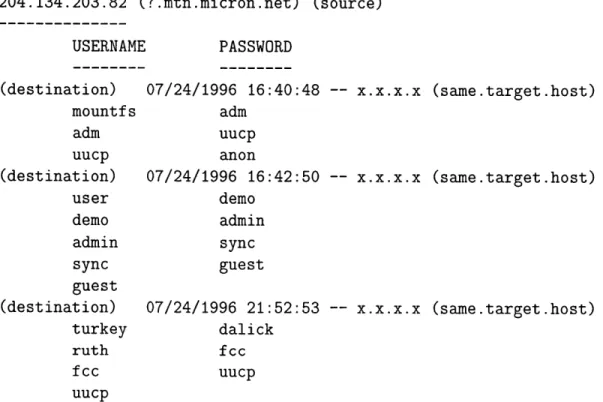
3-1 Sample Output of the Password Guessing Detector for a Series of Sus-picious Connections ... ... . 42
4-1 Neural Network Used to Score Connection ... ... 45
4-2 Performance of Baseline System and Neural Network . ... 46
5-1 Example of a Bottleneck Between Two Groups of States ... 48
6-1 Decision Tree for Warning Banner Finder . ... 54
6-2 Logic Used to Locate a Password . ... . 57
A-1 The Tcptrans Transcript Generation Utility . . ... 69
A-2 Sample Init File Generated by the Tcptrans Utility . ... 69
A-3 Sample Dest File Generated by the Tcptrans Utility ... 70
List of Tables
2.1 Different Types of Intrusion Detection Systems . ... 14 2.2 Basic Security Module Token Types . ... 20 2.3 Day/Weight Pairs ... ... .. . . ... . . . . 32 2.4 Sample ROC Data . ...
3.1 Names of Commonly Attacked Accounts . 3.2 Password Guessing Algorithm Results. ..
6.1 Permutations Used By Password Checker .
A.1 Currently Supported Options for Tcptrans
. . . . . 41
. . . . . 59
Chapter 1
Introduction
More computers are connected to the Internet today than ever before. Unfortunately, system security has not kept up with the increase in connectivity. The expansion of the Internet has thus enabled a corresponding rise in computer crime. With the realization of electronic banking and commerce over the Internet, the stakes are even higher. Many businesses would experience crippling financial losses if the information on their computers was lost or stolen.
Unfortunately, it is unlikely that systems in the near future will be more secure than those of today. Operating systems and applications continue grown, becoming not only more powerful, but also more complex. This complexity makes these systems more likely to contain bugs, some of which will be exploitable by attackers to gain access to the system and its data. Thus, a relatively serious problem exists and it is growing worse. As a greater volume of sensitive data is accessible over the Internet, the potential rewards hackers can receive also increases. External monitoring of systems to detect attacks is thus becoming increasingly important.
Intrusion detection systems are systems designed to monitor a computer or net-work of computers for malicious activity. They offer some important benefits. One benefit is the deterrent value of making it known to users that the systems they are on are being monitored. This warning may be enough to cause "joy riders" (high school attackers who are breaking into systems simply for fun) to look for potential victims elsewhere.
A second benefit is that even a network which is secure against all known threats may be vulnerable to as-yet-undiscovered attacks. Without monitoring, the first sign a company may see of an attacker is system failures or corrupted data. A good intrusion detection system would report to system administrators the presence of an attack soon after it happens (or as it is happening in the case of real-time systems). Thus, attacks can possibly be shut down before any damage occurs.
Log files kept by an intrusion detection system often contain a record of the attack itself as well as the actions the intruder took once he/she broke in. This information can be used to close a security hole before it is exploited again, to undo any changes made by the attacker, and even as evidence to confront or prosecute a malicious employee outside attacker.
The focus of this thesis is on intrusion detection in UNIX environments. It presents some new intrusion detection algorithms as well as lessons learned while developing those algorithms. The next chapter contains some background information, includ-ing a description of various intrusion techniques, an overview of current intrusion detection research, the data sources used as inputs to the new intrusion detection algorithms, a description of the baseline system which the new algorithms are com-pared to, and an explanation of the metrics used to compare the different algorithms. Chapter 3 gives an overview of the Password Guessing Detector. Chapter 4 presents a system which uses a neural network to improve the performance of the baseline sys-tem. Chapter 5 describes the bottleneck verification approach and the Shell Tracker, a prototype system which uses this approach to find illegal transitions to root. Chap-ter 6 presents two intrusion prevention algorithms which identifies potential security problems before they are exploited. Chapter 7 is a discussions of the conclusions drawn from this work about the algorithms themselves and about designing intru-sion detection algorithms in general. Finally, chapter 8 lists some ideas for future improvements to the various algorithms presented in this thesis.
Chapter 2
Background
2.1
Overview of Computer Intrusions
For the purpose of this thesis, an intrusion is defined as an interaction with a computer system in which, at any time during that interaction, an individual operates with privileges higher than he/she should legitimately have. Under a UNIX operating system, this could include a user exploiting a bug in an operating system to gain root privileges (the highest level of permissions and exempt from all of the operating system's security policies) as well as an outsider logging in to a legitimate user's account using a stolen password. Intrusions are a subset of computer attacks, where an attack is defined as any malicious activity directed towards a computer system or the services it provides. Some examples of computer attacks are viruses, physical damage, and denial-of-service attacks. Since this thesis focuses on intrusions and intrusion detection, the terms "intrusion" and "attack" will often be used interchangeably to mean "intrusion" as it is defined above.
There are many ways for an intruder to gain illegal access to a system. A few examples are:
Software bug Typically, either the operating system or an application running as
root is subverted into running arbitrary code of the attacker's choosing. What code the attacker will have the operating system or application run varies, but
some common actions are to return a command shell running as root or to add a user to the system with a specific password and root permissions.
System misconfiguration This category includes attacks exploiting accounts with no passwords or files with the wrong permissions. For example, the default setup for some systems includes an account named "guest" which will accept any password. In addition, an application, such as a web server, could be misconfigured to allow outside users access to sensitive areas of the file system, like the password file.
Social engineering Social engineering refers to attacks in which people with
legit-imate access to the system are fooled into giving access to an attacker. Two examples are calling company personnel while pretending to be an administrator and asking for a password, or mailing a company a piece of software, apparently from the vendor, which claims to be an upgrade. This software will actually have a back door giving an attacker access to the system once installed.
Password sniffing This attack generally involves a machine on the local network
which the attacker has already broken into. This machine is used to monitor all network traffic and capture usernames and passwords as other users log in remotely.
Password guessing/cracking A brute force strategy in which an attacker attempts
to guess a user's password. The attacker can either repeatedly try to log in as the user with different passwords (referred to as a dictionary attack), or copy the password file to their own machine and run a password cracking program (such as CRACK[14]) on it.
These categories in this list are not mutually exclusive, and the list is not meant to be exhaustive. It is meant to show the variety of attacks a secure system must defend against (or a good intrusion detection system must be able to detect).
2.2
Current Intrusion Detection Research
Intrusion detection is the field of research concerned with building systems to detect and/or defend against intrusions. Most systems focus on intrusions as they are defined in the previous section, however some systems also look for other kinds of attacks, such as viruses or denial-of-service attacks. Generally speaking, current intrusion detection systems can be classified as either anomaly detectors or misuse detectors (or both). Anomaly detectors model normal behavior and try to detect attacks by looking for unusual, though not necessarily illegal, usage patterns. Misuse detection systems look for illegal behavior with respect to the operating guidelines of a system. Unlike anomaly detection systems which can only model normal behavior, misuse detection systems can model both legal behavior and illegal behavior (attacks) directly. The difference is that attacks are relatively well defined (especially known attacks) and can be looked for directly while user behavior can only be defined as anomalous when compared to normal behavior for that user. Within the categories of anomaly detection and misuse detection, most current systems either use an expert system with a fixed set of rules or some statistical or learning algorithms to model the target behavior. Table 2.1 shows where some current systems, including the Shell Tracker and Keyword Reweighting System (presented later in this thesis), fit into the above classification. The columns indicate the type of behavior being modeled and the rows give the mechanism used to generate the models. Systems which model more than one type of behavior or use a combination of techniques to represent the models are listed in all appropriate places in the table.
The following sections describe both the systems listed in Table 2.1 as well as intrusion prevention systems, which do not fit well in the above classification.
2.2.1
Anomaly Detection
Anomaly detection systems attempt to detect intrusions by building models of normal system activity and flagging any actions which deviate significantly from those models. These models may describe the actions of each user individually, or groups of users
Modeling
Technicue
Type of Behavior Modeled By System Normal Legal Illegal Behavior Behavior Behavior Haystack
Statistical NIDES Keyword Keyword or Learning Neural Reweighting Reweighting
Algorithms Network system System Systems
Shell Model-Based Rule Based Tracker Intrusion
Expert GrIDS Haystack Detection
System Specificaton NSM
Based STAT
NIDES
Table 2.1: Different Types of Intrusion Detection Systems
(such as administrators, software developers, secretaries, etc.).
NIDES (Next-Generation Intrusion Detection Expert System) has both an anom-oly detection component and a misuse detection component. The anomaly detector builds models of individual users and then compares those models to current behavior using a statistical approach. It constructs short- and long-term profiles for each user from a variety of measures extracted from audit data (described in section 2.3.1) and periodically monitors statistics for the two profiles to determine if current activity is within normal limits. Both the short and long term profiles are built by combining all recent audit records such that newer records have more influence on the profile than older records. The half-life of a profile describes how much weight the contribution of a given record has based on the age of that record. For example, a half-life of 200 records indicates that the 2 0 0th record contributes only half as much as the current record and the 4 0 0th record only 1/4 as much. The half-life of the short term profile
is usually described in terms of audit records while the half-life of the long term profile is usually described in days. The misuse detection component detects known attacks by scanning the audit data for sequences of events described by a rule in the rule base. Each rule has a rulebase of facts which are updated based on the audit records
seen by the system. A rule can fire when it has all the necessary facts and all other external conditions for that rule are met [10].
Haystack, another combined anomaly detection/misuse detection system, uses both user and group models. It has static templates designed by the security officer which are used as initial profiles for new users based on the types of actions these users are expected to perform. Over time, a user's initial profile is modified to reflect his or her actual behavior. These profiles can be periodically monitored by the security officer to detect attackers attempting to train the system into considering attacks as normal behavior. The audit data used to train the user profiles is also scanned for patterns corresponding to known attacks [17].
GrIDS (Graph-Based Intrusion Detection System) differs from the other anomaly detection systems discussed so far in that, instead of modeling the activity of an individual user or host, it monitors the activity of an entire network. User-specified rules describe how to construct different graphs and when to raise an alarm based on the graph structure [15].
Finally, neural networks have also been used in anomaly detection systems. Some preliminary results have been obtained training a neural network to predict the next command a user will issue based on previous commands [2]. In addition, a Neural Network Intrusion Detector (NNID) uses a neural network to learn the behavior of a particular user and distinguish that user from an attacker logging in to the same account [16].
Anomaly detection systems have the advantage of being able to detect masquerad-ing and novel attacks. For example, it would be very difficult for misuse detection systems to catch an intruder logging in with a stolen password and reading or modi-fying files owned by that account, since the login and all commands issued would be perfectly legitimate. An anomaly detection system, however, may be able to notice the difference between the actions the attacker takes once logged in and the expected actions based on a model of that user. Likewise, a system which searches for known attack signatures will miss any new attack which was not explicitly included in its database. If the attack or the attacker's actions are different enough from normal
activity, an anomaly detection system will catch them.
Their main disadvantage, however, is that an anomaly detection system will only work if normal user or system activity is sufficiently stable over time and does not overlap with attacker activity. A user with very regular habits will be much easier to model and intruders using such an account will typically exhibit activity which deviates significantly from normal. However, if users have very erratic habits or perform actions similar to those of intruders (such as an administrator who looks around the system and modifies system files), then an anomaly detection system will have a difficult time distinguishing an intruder from a legitimate user.
2.2.2
Misuse Detection
Misuse detection systems attempt to detect intrusions by modeling legal system be-havior and flagging all actions which fall outside this model or by searching for the actual abuses of the system directly. These abuses include actions such as exploiting a bug in the operating system or taking advantage of a system misconfiguration to gain root access.
STAT (State Transition Analysis Tool) is an example of a misuse detection sys-tem which uses attack signatures to recognize intrusions. Intrusions are represented as a series of state changes from some secure state to a compromised state. The system analyzes audit data for evidence of attack transitions, issuing an alert if the compromised state is reached [8].
NSM (Network Security Monitor) is a rule-based system which analyzes network data (described in section 2.3.2) for attacks or suspicious behavior. The system has a set of keywords which it looks for in TCP packets. A rule based expert system combines the counts of all the keywords found in a particular connection to come up with an overall score [6].
Model-based intrusion detection is another idea for detecting system abuses. It is an extension to IDES (Intrusion Detection Expert System) [13] in which intrusions are described as high level models. These models are then converted into sequences of audit records which correspond to a particular attack. The attack sequences are
used to anticipate what a user would do next if they were carrying out one of the modeled attacks. Thus the system must only search for those audit records which would come next in one of the currently active attack sequences [5].
The specification-based approach finds attacks by modeling legal system behavior and flagging anything which falls outside the model. It attempts to define the legal running state of all setuid programs owned by root on a system. It can then find buffer overflows or other exploits of these programs by following the states a program enters and flagging an illegal state (one not included in the model) [11].
2.2.3
Intrusion Prevention
Intrusion prevention systems are systems which actively search a computer or network of computers for known security flaws. These systems can alert administrators about security problems before those problems are exploited by an attacker. However, as new bugs are found and new attack methods discovered, they must be updated with the information about the attacks. COPS (Computer Oracle and Password System) is one example of an intrusion prevention system. It is a collection of shell scripts which check for a variety of security flaws, including checking that files have the correct permissions and scanning the system for any files with the setuid bit set [3].
SATAN is another intrusion prevention system. It scans a network of hosts looking at the network services running on each. It then checks these services to see if they are versions with known bugs in them (such as an old version of sendmail) or if they are misconfigured (such as allowing telnet guest logins or ftp anonymous logins with access to a writable directory) [19].
2.3
Input Data Sources for Intrusion Detection
The two main sources of data analyzed by current intrusion detection systems are network sniffing data, and host-based audit data. Figure 2-1 shows a typical network with sniffer data being collected by a single dedicated machine passively listening on the network and audit data being collected on a variety of different servers and
HOST
I 3
vulb~
p
lu
Y
I
L
.
n AUDITDATA
NETWORK DATAAUDIT DATA
COLLECTION
S POINSNIFFERPOINT
Figure 2-1: The Different Sources of Data For Intrusion Detection Systems
workstations and then exported to a central location. These different mechanisms for collection, as well as the type of information found in the different data sources, give each type of data an advantage in detection certain types of intrusions. This chapter gives a general overview of the two types of data as well as a description of the specific data used for algorithm development in this research.
2.3.1
Audit Data
2.3.1.1 Overview
Audit data refers to the log files produced by the operating system on a particular machine. These logs contain detailed information about the activities of all the pro-cesses running on a host. Generally, the logs are formatted as a list of events, called records, ranging in scale from a simple system call to a reboot or hard disk partition filling up.
Audit data provides specific details on the operation of each host, but it can be difficult to use. In a typical network environment, data will be collected on a number of machines. Logs from different machines must either be processed on those machines or exported to a central location. If the logs are processed on the machines where they are created, then the host must support the overhead of both the auditing process, and
the intrusion detection system itself. Furthermore, if a machine is compromised, an intruder could not only kill the auditing process (stopping logs from being produced), but also destroy records of previous actions. Instances of intrusion detection systems running on the hosts will either have to communicate with each other or lose the ability to correlate attacks across multiple machines.
A better approach to managing log files is to perform some prefiltering on each host and then immediately export the filtered logs to a central location for processing. This has the advantages of securing the logs, reducing computation overhead on individual machines, and allowing the data from all the logs to be merged for a more complete analysis. The log files need not be large if prefiltering is done correctly, and the primary network can be used as the transport medium without degrading network performance.
2.3.1.2 Solaris Basic Security Module
The algorithms presented in this thesis which operate on audit data all use logs pro-duced by the Basic Security Module of the Solaris operating system. This is a kernel module which logs up to 243 different events, although the Solaris 2.5 version seems to have a bug which causes at least nine events not to be logged. These nine un-logged events are the events corresponding to the following nine system calls: fcntl(), setreuid(), setregud(), read(), getdents(), lseek(), write(), writev(), and readv().
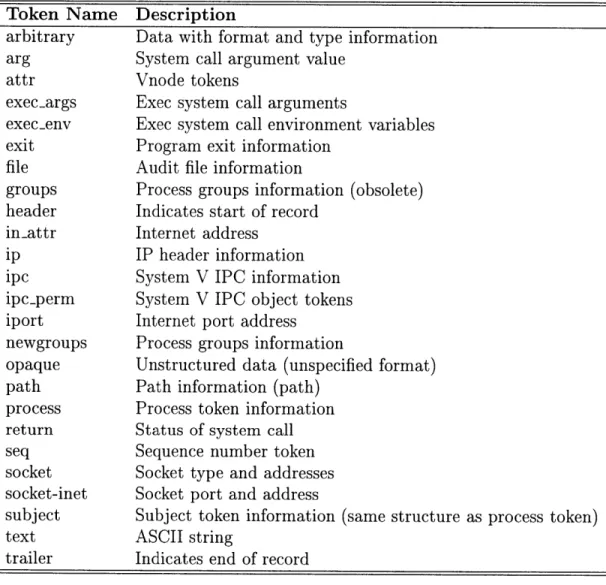
Each event generates a record, where the record is comprised of different types of tokens depending on the event and the type of data needs to be included in the record. For example, a fork() system call (which requests that the kernel make a copy of the calling process such that two copies will be running simultaneously) has a record with a header token, an argument token, a subject token, and a return token. Table 2.2 out of the SunSHIELD Basic Security Module Guide [9] lists each type of token with a short description.
The user audit ID is a useful piece of information included in the audit records of all events which can be attributed to a specific user. It is a unique identification number assigned to every user when they login and inherited by all processes descended from
Token Name Description
arbitrary Data with format and type information arg System call argument value
attr Vnode tokens
exec_args Exec system call arguments
exec_env Exec system call environment variables exit Program exit information
file Audit file information
groups Process groups information (obsolete) header Indicates start of record
inattr Internet address ip IP header information ipc System V IPC information ipc_perm System V IPC object tokens iport Internet port address
newgroups Process groups information
opaque Unstructured data (unspecified format) path Path information (path)
process Process token information return Status of system call seq Sequence number token socket Socket type and addresses socket-inet Socket port and address
subject Subject token information (same structure as process token) text ASCII string
trailer Indicates end of record
the login shell. This number allows an intrusion detection system to easily identify which user caused a specific event, even if that user has changed identities (through the su command, for example).
The log files are initially written in a binary format by the auditing process. Sun provides a tool, named praudit, which reads the binary log files and produce a human readable ASCII equivalent. This ASCII representation is what the algorithms working with the BSM data use. While having to convert to ASCII text slows the algorithms down somewhat, it makes coding and debugging much easier. Furthermore, once an algorithm has been prototyped and found promising, extending it to directly read the binary files would eliminate the praudit text conversion overhead.
2.3.2
Sniffer Data
2.3.2.1 Overview
Sniffer data refers to the information obtained from sniffing (passively listening on) a network. This approach to data collection has some definite advantages over using audit data. As shown in Figure 2-1, a single machine can gather information for an entire network (assuming it is fast enough to keep up with the network's data rate), so all the logs start off in a central location, and the overhead of collecting the data is confined to that machine. Also, since the logs are not being collected on individual machines, there is no risk of loosing information if a machine is compromised. One exception is the sniffing machine itself. If it is compromised, the logs for the entire network could be modified or destroyed. However, the sniffer can be made relatively secure since it only needs to monitor the network and not support any network services such as telnet or ftp. In fact, people have been known to cut the transmit wire in the ethernet cable attaching the sniffing machine to the network, making any network interaction with the machine virtually impossible.
Collecting data with a sniffer has one very big drawback, though. Hiding from a sniffer-based intrusion detection system can be done by simply scrambling the data before transmitting it across the network and then unscrambling it at the other end.
The scrambling could be accomplished any number of ways, such as using an en-cryption algorithm, a compression utility, or simply rearranging the letters using the UNIX tr command. The output of commands can also be scrambled and sent back to the attacker. Thus, regardless of how good the intrusion detection system is, it will have no information to work with. Furthermore, a sniffer based intrusion detection system will never be able to monitor certain services, such as ssh, which encrypt their data by default.
2.3.2.2 TCP Sessions
All network data used for algorithm development comes from TCP/IP packets [9, 18]; all other types of network traffic are ignored. Furthermore, instead of using the raw packets, the algorithms operate on ASCII transcripts, which are text representations of the data transferred between the two hosts in a TCP connection, augmented by some information from the headers of the actual packets. Finally, only data from telnet connections is used because this is the service used most frequently on UNIX system to launch real attacks. The rest of this section describes the TCP protocol and how transcripts are generated from the TCP packets.
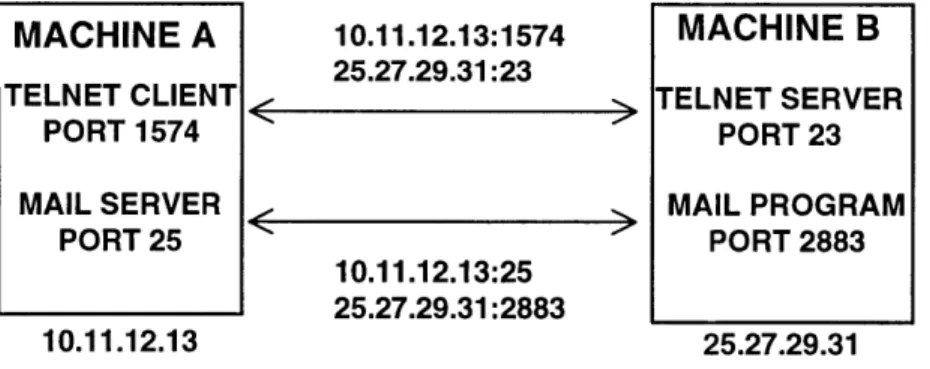
TCP (or Transmission Control Protocol) is one of the most common Internet protocols. It provides reliable communication between two hosts over a potentially unreliable network. It is organized into connections, or sessions, where a connection can be uniquely identified by the IP addresses and ports of the machines involved. A port is simply a number associated with a process. Each host will have a process which is actively producing data it wants sent to the process on the other machine. The destination port identifies to the operating system of the machine receiving that packet the processes to which the data in the packet should be sent. The source port identifies which process the packet was sent from in case the destination processes has multiple connections open to the same machine. Figure 2-2 shows how the IP addresses and ports of the processes involved in a connection uniquely determine that connection. In this figure, a telnet client on machine A is communicating with a telnet server on port 23 on machine B. Another process on machine B, in this case a mail
MACHINE A TELNET CLIENT PORT 1574 MAIL SERVER PORT 25 10.11.12.13:1574 25.27.29.31:23 MACHINE B TELNET SERVER PORT 23 MAIL PROGRAM PORT 2883 10.11.12.13:25 25.27.29.31:2883 10.11.12.13 25.27.29.31
A telnet client on machine A has connected to the telnet server
(PORT 23) on machine B. A mail program on machine B has connected to the mail server (port 25) on machine A. The connections can be distinguished by the IP ADDRESES and PORTS of the machines and processes involved.
Figure 2-2: Example of Multiple Connections Between Two Hosts
program, is communicating with a mail server on port 25 on machine A. The hosts can tell which process inbound packets should be sent to by checking the port number the packet is being sent to. The source and destination IP addresses and TCP ports can distinguish a particular TCP/IP connection from all other TCP/IP connection on the network at that time.
Certain-commonly used application level protocols which use TCP as their com-munication medium have been assigned dedicated port numbers exclusively for use with that protocol. These protocols (such as telnet or ftp) are often called services. Thus, if one wanted to start a telnet connection to a machine, they would connect to port 23 where, by convention, that machine's telnet server would be listening (as the telnet server was in figure 2-2).
2.3.2.3 Transcript Creation
As mentioned previously, the sniffer data available is in the form of text transcripts, which are ASCII representations of the data in the TCP packets. These transcripts were collected by a baseline system running on about 50 computer networks over a period of about 13 weeks. This section gives a brief description of how the baseline system works and where the transcripts came from. See section 2.4 for a more detailed
}{{{ {! {"{'}{#zPpI $zXTERMpz#plato:Opz'DISPLAYplato:Op$} Imary mary12
Is -a pwd exit
Figure 2-3: Init File For a Transcript Generated by the Baseline System
explanation of the baseline system.
Each transcript corresponds to one TCP connection, and is made up of two files. The init file contains all the information the initiating host (the client) transmitted over the course of the connection. For a telnet connection, this corresponds to every-thing a user types. The dest file contains all the data that was transmitted by the destination host (the server). This is the data displayed on a user's screen. Any non-printable characters (ASCII characters not between 32 and 126) are ignored, except for the escape character (ASCII 27) which is represented by "^ [". The header of the transcript gives the source and destination ports and IP addresses, the names of the machines (or "unknown" if they could not be ascertained), the times the connection started and ended, and the keywords found by the baseline system. Figure 2-3 shows the body of the init file of a sample transcript from a session in which the user mary
logs in with the password maryl2 , executes an is command and a pwd command in her home directory, and then logs out. Figure 2-4 shows the body of the dest file. The strange sequence of characters on the first line in each file and the braces before the login prompt and the tilde after it in the dest file are what is left of the negoti-ations between the telnet client and server when the connection was set up after the non-printable characters have been stripped out.
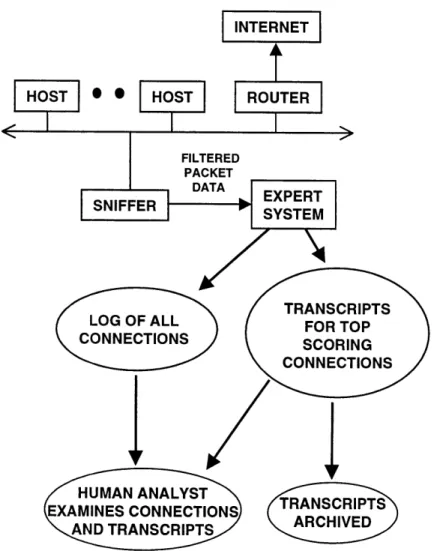
Figure 2-7 shows how transcripts are generated. The sniffer module of the baseline system captures all network traffic and then filters it, only keeping data for the services the system is configured to monitor. Every day the expert system module processes all data collected. This system assigns a warning level from zero to ten to each connection. Transcripts are then generated for a certain percentage of the high scoring connections and sent to human analysts to check for attacks. Transcripts are
}}}#}'}${ -!~"I-$zpz#pz'p
UNIX(r) System V Release 4.0 (pascal) {}login: -mary
Password:
Last login: Mon May 25 00:49:02 from plato.eyrie.af.m Sun Microsystems Inc. SunOS 5.5.1 Generic May 1996 mary@pascal: is -a ./ ../ .cshrc mary@pascal: pwd /. sim/home/mary mary@pascal: exit mary@pascal: logout
Figure 2-4: Dest File For a Transcript Generated by the Baseline System
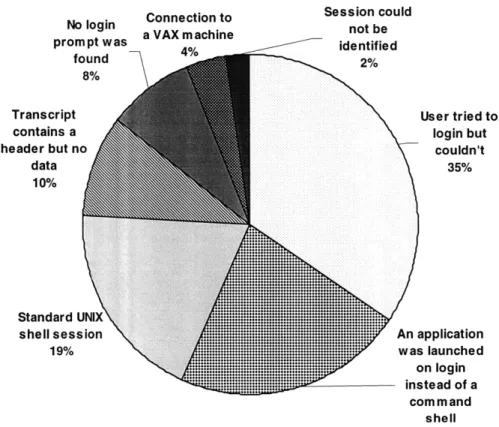
also archived for a certain period of time. The data used for testing and developing algorithms in this thesis consists of all high scoring transcripts in a 13 week period. Figure 2-5 gives a breakdown of types of telnet transcripts seen during this time. This figure shows that transcripts containing nothing but failed login attempts make up the biggest section of the data at 35%.
2.3.2.4 Attacks in Data
This data is valuable because it contains a large volume of normal user activity as well as real attacks. Normal activity is important for both training algorithms and analyzing their false alarm rates. Real attacks are useful both for the actual break-in techniques used as well as all the actions the intruders take once they have compromised a system. Since some intrusion detection systems look not only for the attacks themselves, but also for the kinds of actions intruders normally perform, it is important to have real examples of these actions for testing.
A total of seventeen apparently illegal transitions to root were found in this data by other researchers at MIT Lincoln Laboratory using a combination of automatic
No login prompt was found 8% Connection to a VAX machine 4% , Transcript contains a header but no data 10% Standard UNIX shell session 19% Session could not be identified 2% User tried to login but couldn't 35% An application was launched on login instead of a com m and shell
search and hand analysis [20]. Five of these transitions were actual attacks while the remaining 12 appear to be instances of system administrators using a setuid root shell to get root permissions without entering a password. While these setuid root shell transitions are technically illegal, they were not used as attacks when training or testing the algorithms because the actions performed after obtaining root privileges are legal system administration activities. In addition to the five attacker transitions to root, two other instances of malicious activity were found by prior analysis of this data. These seven attacks found in the sniffer data (six different types in all) are the attacks used to train and test the algorithms presented in this thesis. The following is a brief description of each attack:
loadmodule A user exploits a bug in the loadmodule binary related to the internal
file separator (IFS) variable to gain root access.
PERL(2) This attack was actually used twice on two different hosts. It consists of
an attacker exploiting a bug in the PERL interpreter to set the user ID of a shell to root, thereby giving the attacker access to all files on the system.
sniffer A user logs in and becomes root legally by using the su command and entering the root password. However, once he/she becomes root, the attacker proceeds to check the log files produced by a packet sniffer apparently running covertly on the system.
custom system library This attack actually has two parts. Exploiting the fact
that the system has an anonymous FTP server with a writable directory, an at-tacker uploads a corrupted version of the libr.so system library to this directory. Next he/she telnets to the machine with an option telling the telnet server to link to the corrupted version of the library. This version causes the telnet server to bypass the login and password prompt and immediately give the attacker a root shell.
setuid root ksh In this session, the attacker doesn't actually exploit a vulnerability
from a previous connection. Hidden in the .netscape directory is a copy of the ksh shell but owned by root and with the setuid bit set. Executing this binary launches a new k-shell running with root permissions.
HP remsh This attack uses remsh to exploit a bug in usr/etc/vhe/vhe_u_mnt on an
HP computer. On completion, it gives the attacker a root command shell.
2.3.2.5 Problems With Transcripts
Two problems inherent in the data made analysis difficult. The first is that this data is not a valid cross section of all network traffic. Only transcripts which were scored highly by the baseline system were available, corresponding to roughly 1 out of every 100 telnet connections. Without access to the remaining 99% of the data, it is impossible to determine how many attacks were missed by the baseline system and how many of those missed attacks would be found by other algorithms.
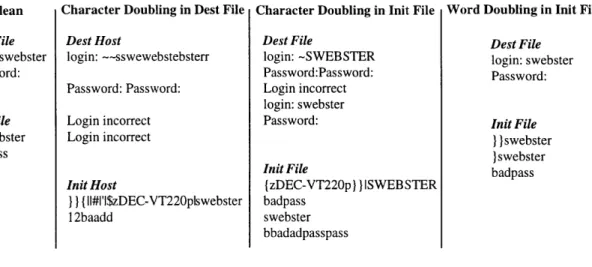
A second problem has to do with an apparent bug in the code used by the baseline system to generate transcripts. Specifically, transcripts often contain characters or groups of characters repeated multiple times. Often a word in both the init and the dest file (such as a command typed on the client and echoed back by the server) which should be the same will have characters doubled in one file but not the other. Figure 2-6 shows an example of some of the different ways the character doubling can manifest itself. The first column shows the lines corresponding to a login if no characters were doubled. In the second column, individual and groups of letters are doubled in the login name in the dest file. This kind of doubling makes it difficult for algorithms to match words in the two files. The third column shows letters in the password from the init file doubled. Detecting doubling in the password is very difficult because, by definition, a password is an arbitrary arrangement of characters. Finally, the fourth column shows a transcript in which the entire username in the init file, including the newline character at the end of the line, has been doubled. If an algorithm were looking for the password on the line directly below the username, it would mistake the username for the password.
Clean Character Doubling in Dest File Character Doubling in Init File Word Doubling in Init File
Dest File Dest Host Dest File Dest File
login: swebster login: -- sswewebstebsterr login: -SWEBSTER login: swebster Password: Password:Password: Password:
Password: Password: Login incorrect login: swebster
Init File Login incorrect Password: Init File
} }swebster Login incorrect } }swebster
badpass }swebster
Init File badpass Init Host {zDEC-VT220p}) ISWEBSTER
} } { II#1'$zDEC-VT220plswebster badpass 12baadd swebster
bbadadpasspass
Figure 2-6: Examples of Character Doubling in Transcripts
One possible explanation for the doubling is that retransmitted packets are not discarded when the transcripts are created. In a few cases, characters are reversed, indicating that packet reordering is not performed either. Other times, however, every character in one file appears to be doubled. This phenomenon can not be explained well by the theory that retransmitted packets are not dropped. Whatever the reason, character doubling adds a lot of complexity and detracts from algorithm performance. Fuzzy string matches must be performed, and often a word is so corrupted in one file that a fuzzy match fails. Appendix A discusses a transcript generation utility developed as part of this research named tcptrans. This utility produces transcripts free from any character doubling.
2.4
The Baseline System
Figure 2-7 shows how the baseline system collects and processes data. This system, used as a standard for performance, is a sniffer-based expert system which scores connections based on keyword counts. It is derived from NSM[6] and has three main phases of operation: sniffing, packet sorting, and scoring. In the first phase, a sniffer collects raw packet data. Typically, the sniffer is run continuously, with a brief break to score the data every day. While running, the sniffer filters the network traffic writing all packets which pass the filter to temporary files. The filter is determined
INTERNET
SHOST ROUTE
Figure 2-7: Normal Operation of the Baseline System
by a configuration file that specifies which TCP services the system should monitor. All TCP packets not corresponding to one of these services and all non-TCP packets are ignored.
When an administrator wants to analyze the collected data, he/she starts the sorting and scoring program. The sorting program arranges packets in the tempo-rary files into their respective connections. The data from each connection is then searched for instances of certain keywords. These keywords (40 in all) are used by an expert system to determine its component of the total score. Some of the key-words correspond to known attacks, such as system binaries which are rarely used
by legitimate users, but older versions of which have known bugs ("loadmodule" for example). Other keywords, such as "daemon:", are aimed at catching attackers as they explore the system. This keyword corresponds to an entry usually found in the /etc./passwd file and would show up if the attacker viewed that file on his or her screen.
The total score for a connection is obtained by combining the scores from three different components. These are the expert system, the profile component, and the attack model component. Each of these components produces a score from 0 to 10. The scores are then combined using the following formula:
total score = (1/4 x profile) + (1/8 x model) + (5/8 x expert)
where profile is the profile score, model is the attack model score, and expert is the expert system score.
The expert system is a rule-based system which takes as input keyword counts and produces a score indicating how dangerous the corresponding connection is. For some services, the expert system will use other information in addition to the keyword counts when assigning a score. One example is that a finger connection will receive a high score if the finger query is over 500 bytes long, regardless of the content (this rule is designed to detect attackers attempting to overflow a buffer in the finger daemon).
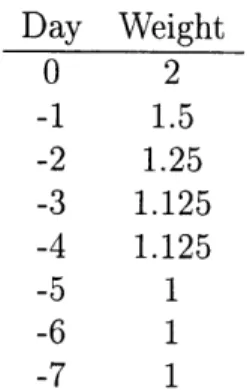
The profile component looks at the IP addresses of the two machines in the current connection and the service they are using and assigns a score based on how often these two computers have communicated in the past seven days. Specifically, the score starts at 10 and, depending on how many days ago a connection was made,
a fixed amount is subtracted from the score. Table 2.3 gives the weights which are subtracted from the score for a connection on that day. This table shows, for example, that if a connection was made using a given service yesterday, the profile score for a connection between the same two machines on the same service today will be 1.5 less than if yesterday's connection had not been made. Thus, a connection from a computer not seen before is considered more dangerous than one from a well known
Day Weight 0 2 -1 1.5 -2 1.25 -3 1.125 -4 1.125 -5 1 -6 1 -7 1
Table 2.3: Day/Weight Pairs
machine.
Finally, the attack model component assigns a value to this attack based on the hosts and service involved. The first part of this score is based on the level of trust for each machine. A file of known hosts lists host IP addresses and a security rating between one and ten, where a ten indicates that host is very highly trusted. An untrusted host gets a rating of zero. If the initiating host has a higher rating than the destination host then this part of attack model score is zero. Otherwise it is 4/9 times the difference between the destination host's and the initiating host's security ratings. The second part of the score is based on the threat capability of the service used. The third and final part of the score is based on the authentication strength of the service. These last two values both range between one and ten and are static values stored in a file of known services. Telnet, for example, has a threat capability score of 10 and an authentication score of 7. The equation for calculating the overall attack model score is:
attack model score = (4/9 x security) + (3/9 x threat) + (2/9 x (10 - auth))
where security is the host security score, threat is the service threat capability score, and auth is the service authentication strength score.
2.5
ROC Curves and Purity
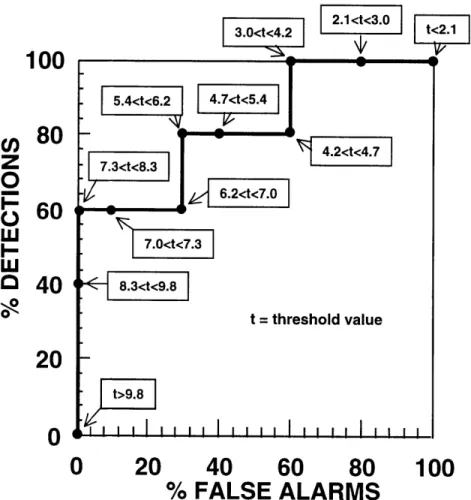
An ROC (receiver operating characteristic) curve is a graph which shows how the false alarm and detection rates of a system vary. The graph has the detection rate (as a percentage) on the vertical axis and the false alarm rate (as a percentage) on the horizontal axis. To generate an ROC curve for an intrusion detection system, the system must first assign scores to a set of transcripts containing both attacks and normal behavior. These scores are then divided into two lists such that all the attacks are in one list and all the normal connections in the other. The lists are then sorted with the higher scores first (assuming that the intrusion detection system tries to give attacks high values and normal connection low values). The curve is constructed by selecting different threshold, or cutoff, values. For a given threshold, all transcripts with a score above that value are the transcripts the intrusion detection system labels as attacks. Thus, given a threshold, the number of detections (attacks with a score above the threshold) and the number of false alarms (normal connections with a score above the threshold) can both be determined. These two values are converted into percentages and plotted as one point on the ROC. After the points for all possible threshold values have been plotted, they are connected to form the ROC curve itself. Table 2.4 shows some sample data with the scores sorted into the two lists "attack" and "normal". Figure 2-8 shows a sample ROC. The labels at each point in the form of "#<t<#" show the threshold values which correspond to that point.
A system which randomly scores all connections should have an ROC with a diagonal line from 0% detection and 0% false alarm rate in the lower left corner to 100% detection and 100% false alarm rate in the upper right corner. A good system which gives most attacks a high score and most normal connections a low score have an ROC which climbs very sharply to a point with a high detection rate and a low false alarm rate and then levels out. One metric derived from an ROC plot is the area under the curve, where 100% area is a perfect system and 50% is random guessing.
Since the detection and false alarm rates are given as percentages, the actual number of detections and false alarms are hidden. The metric of purity is used to
Attacks 9.8 9.8 8.3 6.2 4.2 Normal 7.3 7.0 7.0 5.4 4.7 4.7 3.0 3.0 2.1 2.1
Table 2.4: Sample ROC Data
100
80
60
40
20
0
0
20
40
60
80
% FALSE ALARMS
Figure 2-8: Sample ROC Plot
C)
z
0
U
I-100
give an indication of these numbers. It is computed as the ratio of the actual number of attacks detected to the number of false alarms for a given threshold value. Typically the threshold is chosen to be the value which gives a certain detection rate (such as 80% detection). If a human analyst has to look over all high scoring connections to separate the attacks from the false alarms, the purity gives an indication of the workload associated with finding each attack. For example, a system may have a 10% false alarm rate at 100% detection. However, if that system sees 100,000 connection a week and only ten of them are attacks, then the purity is only 1/1000. This means that every week an analyst will have to look through 1000 transcripts to find each attack. One goal of the work presented in this thesis is to develop systems which increase the purity of the baseline system to the 1/10 to 1/100 range for large amounts of data and realistic attacks.
Chapter 3
Password Guessing Detector
In looking at the different kinds of telnet connections which were scored highly by the baseline system over 13 weeks, a surprising number of them are sessions without a valid login (see figure 2-5). Upon further investigation, it was found that the string "Password incorrect" is weighted very highly by the baseline system (expert system score of 8.5 for one occurrence) in the absence of the string "Last login", which would indicate a valid login. Even with a valid login, one occurrence of "Password incorrect" will still score 6.5. This behavior is an attempt to sensitize the baseline system to password guessing attacks, either at login or elsewhere in the session (the 'SU' prompt for example). However, in looking over a few transcripts without valid logins, all of them seemed to be the result of legitimate users forgetting their passwords. Thus, the question was raised of whether or not there were actually any large scale dictionary or doorknob rattling attacks in the current data to justify the high weighting of the "Password incorrect" string.
A new algorithm, called the Password Guessing Detector, was developed to iden-tify dictionary and doorknob rattling attacks across multiple connections with a low false alarm rate. The algorithm was developed both for its own sake, and to use in analyzing the data at hand to see if these attacks actually occur in the real world. One side effect of the "Password incorrect" string being weighted so heavily is that the data is almost guaranteed to contain all connections in which a password was mistyped for the 13 week period, making this analysis reasonably complete. This
chapter gives an overview of doorknob rattling and dictionary attacks, describes the algorithm and how it tries to spot these attacks, and then presents the results found when the algorithm was used to analyze the 13 weeks of data.
3.1
Dictionary and Doorknob Rattling Attacks
Dictionary and doorknob rattling attacks are both attacks in which an intruder is trying to gain access to the system by finding a valid username and password. This type of attack can be applied to any network service which requires a username and password, such as telnet, rlogin, ftp, or pop mail servers. Dictionary attacks are large-scale attacks in which hundreds or thousands of passwords are tried with one or more usernames in an attempt to exploit the fact that people will often choose simple, easy to remember passwords. Thus, instead of trying all valid passwords (about 6 x 10¹⁵ assuming that passwords can contain any of the 94 printable ASCII characters and are up to eight characters long), the attack can focus on common words, such as "wizard" or "pyramid", or easily typed character sequences, such as "asdfjkl;". Considering that, even at three attempts a second, trying all passwords would take about 64 million years, dictionary attacks have no choice but to limit themselves to guessing simple passwords. However, given no a priori knowledge about a password except that it is a common word, the attack still must try on the order of thousands of passwords before it is likely to find the correct one. Thus, these attacks would be carried out by automated scripts which repeatedly log into a machine and try username/password pairs until a match is found. A variation on this attack is to download the password file to a local machine and then run a password cracking program on it, such as CRACK [14]. These programs guess passwords by encrypting trial words and seeing if the encrypted test strings match any encrypted passwords from the password file. This approach has the advantage of being much faster (orders of magnitude) as well as not leaving failed login messages in system logs. However, the password file must be obtained before this variation of the attack can be carried out.
find-open help games guest demo maint mail finger uucp bin toor system who ingres lp nuucp visitor manager telnet
Table 3.1: Names of Commonly Attacked Accounts
ing accounts present by default that have not been removed or accounts which are misconfigured. Examples of this include looking for a "guest" account which will allow anyone to log on, but with reduced permissions, or a "root" account with no password. Table 3.1 lists some common account names which attackers often try [4]. Once an attacker has gained access to the system, even with reduced permissions, the security of the system is seriously compromised.
The difference between doorknob rattling and dictionary attacks is that doorknob rattling attacks require many fewer connections to a single host. Since there are only about 20 common account names for the attackers to try, it is possible for the attack to be carried out by hand if only a few hosts are to be checked. The tradeoff is that, while it is quite likely that at least a few passwords on any given system will be simple, there is no guarantee that any default or misconfigured accounts will exist. An attacker may have to try tens or hundreds of different hosts before a doorknob rattling attack is successful.
3.2
The Password Guessing Detector
This algorithm looks at usernames and passwords typed at the login prompt and attempts to differentiate between valid users who have forgotten or mistyped their password and attackers trying to guess the password for an account. The algorithm could be extended to also look for password guessing at the su prompt or in other TCP services besides telnet.
The Password Guessing Detector operates by making a few assumptions about the nature of dictionary and doorknob rattling attacks. First of all, it assumes the probability of a dictionary attack succeeding on its first attempt is almost zero. The algorithm thus ignores connections which contain a successful login, even though the user may have entered a few incorrect passwords or usernames. This eliminates all the sessions in which a legitimate user mistypes a password once or twice. Even though the actual login of a successful attack may be lost, all the other connections in which the attack fails to find a valid password will still be considered.
The algorithm also assumes that the passwords being guessed will be simple pass-words (as defined below). As discussed in the previous section, an exhaustive search of all possible passwords is impossible due to the size of the search space.
The final assumption is that an automated script would not try the same password more than once. When a legitimate user tries to log in with the wrong password, they generally try the password a few times to make sure that they are not mistyping it. An automated script will not make these kinds of mistakes (unless intentionally programmed to do so).
A separate algorithm is used to check the integrity of the password (see section 6.2 for a full description). This program takes as its inputs a password and a username, and outputs a value from zero to six indicating how difficult the password would be to guess. A value of 3 or less indicates that the password matched or was very similar to either the username or a dictionary word.
Based on the above assumptions and the password scoring algorithm, the password guessing detector selects connections to consider for possible attacks as follows:
* Only telnet connections in which a successful login never occurred were consid-ered.
* Connections in which the same username and all strong passwords are tried are ignored.
* Connections in which the same username and password is tried two or more times are ignored, regardless of the strength of the password.