Discriminative, Generative and Imitative
Learning
by Tony Jebara
B.Eng., Electrical Engineering McGill University, 1996 M.Sc., Media Arts and Sciences, MIT, 1998 Submitted to the Program in Media Arts and Sciences,
School of Architecture and Planning,
in partial fulfillment of the requirerments for the degree of DOCTOR OF PHILOSOPHY IN MEDIA ARTS AND SCIENCES
at the
Massachusetts Institute of Technology February 2002
@Massachusetts
Institute of Technology, 2002 All Rights ReservedMASSAC HUS HS IN TITUTE
FMAR
0 4 2002LIBRARIES
Signature of Author
Program in Media Arts and Sciences December 18, 2001
Certified by
Alex P. Pentland Toshiba Professor of Media Arts and Sciences Program in Media Arts and Sciences Thesis Supervisor
Accepted by .V
Andrew B. Lippman Chair Departmental Committee on Graduate Students Program in Media Arts and Sciences
Discriminative, Generative and Imitative Learning
by Tony Jebara
Submitted to the Program in Media Arts and Sciences, School of Architecture and Planning,
in partial fulfillment of the requirements for the degree of Doctor of Philosophy in Media Arts and Sciences
Abstract
I propose a common framework that combines three different paradigms in machine learning: gen-erative, discriminative and imitative learning. A generative probabilistic distribution is a principled way to model many machine learning and machine perception problems. Therein, one provides do-main specific knowledge in terms of structure and parameter priors over the joint space of variables. Bayesian networks and Bayesian statistics provide a rich and flexible language for specifying this knowledge and subsequently refining it with data and observations. The final result is a distribution that is a good generator of novel exemplars.
Conversely, discriminative algorithms adjust a possibly non-distributional model to data optimizing for a specific task, such as classification or prediction. This typically leads to superior performance yet compromises the flexibility of generative modeling. I present Maximum Entropy Discrimination (MED) as a framework to combine both discriminative estimation and generative probability den-sities. Calculations involve distributions over parameters, margins, and priors and are provably and uniquely solvable for the exponential family. Extensions include regression, feature selection, and transduction. SVMs are also naturally subsumed and can be augmented with, for example, feature selection, to obtain substantial improvements.
To extend to mixtures of exponential families, I derive a discriminative variant of the Expectation-Maximization (EM) algorithm for latent discriminative learning (or latent MED). While EM and Jensen lower bound log-likelihood, a dual upper bound is made possible via a novel reverse-Jensen inequality. The variational upper bound on latent log-likelihood has the same form as-EM bounds, is computable efficiently and is globally guaranteed. It permits powerful discriminative learning with the wide range of contemporary probabilistic mixture models (mixtures of Gaussians, mixtures of multinomials and hidden Markov models). We provide empirical results on standardized data sets that demonstrate the viability of the hybrid discriminative-generative approaches of MED and reverse-Jensen bounds over state of the art discriminative techniques or generative approaches. Subsequently, imitative learning is presented as another variation on generative modeling which also learns from exemplars from an observed data source. However, the distinction is that the generative model is an agent that is interacting in a much more complex surrounding external world. It is not efficient to model the aggregate space in a generative setting. I demonstrate that imitative learning (under appropriate conditions) can be adequately addressed as a discriminative prediction task which outperforms the usual generative approach. This discriminative-imitative learning approach is applied with a generative perceptual system to synthesize a real-time agent that learns to engage in social interactive behavior.
Thesis Supervisor: Alex Pentland
Title: Toshiba Professor of Media Arts and Sciences, MIT Media Lab p C5 00MON Ow 00, 6
Discriminative, Generative and Imitative Learning
by Tony Jebara Thesis committee: Advisor: S z VA % vo N I Toshiba Professor Alex P. Pentland of Media Arts and Sciences MIT Media Laboratoryt. (I Co-Advisor:
Tommi S. Jaakkola Assistant Professor of Electrical Engineering and Computer Science MIT Artificial Intelligence Laboratory
Reader:
V David C. Hogg
Professor of Computing and Pro-Vice-Chancellor School of Computer Studies, University of Leeds
Reader: I k-1 L-1 )
Tomaso A. Poggio Uncas and Helen Whitaker Professor MIT Brain Sciences Department and MIT Artificial Intelligence Lab
IL-Acknowledgments
I extend warm thanks to Alex Pentland for sharing with me his wealth of brilliant creative ideas, his ground-breaking visions for computer-human collaboration, and his ability to combine the strengths of so many different fields and applications. I extend warm thanks to Tommi Jaakkola for shar-ing with me his masterful knowledge of machine learnshar-ing, his pioneershar-ing ideas on discriminative-generative estimation and his excellent statistical and mathematical abilities. I extend warm thanks to David Hogg for sharing with me his will to tackle great challenging problems, his visionary ideas on behavior learning, and his ability to span the panorama of perception, learning and behavior. I extend warm thanks to Tomaso Poggio for sharing with me his extensive understanding of so many aspects of intelligence: biological, psychological, statistical, mathematical and computational and his enthusiasm towards science in general. As members of my committee, they have all profoundly shaped the ideas in this thesis as well as helped me formalize them into this document.
I would like to thank the Pentlandians group who has been a great team to work with: Karen Navarro, Elizabeth Farley, Tanzeem Choudhury, Brian Clarkson, Sumit Basu, Yuri Ivanov, Nitin Sawhney, Vikram Kumar, Ali Rahimi, Steve Schwartz, Rich DeVaul, Dave Berger, Josh Weaver and Nathan Eagle. I would also like to thank the TRG who have been a great source of readings and brainstorming: Jayney Yu, Jason Rennie, Adrian Corduneanu, Neel Master, Martin Szummer, Romer Rosales, Chen-Hsiang, Nati Srebro, and so many others. My thanks to all the other Media Lab folks who are still around like Deb Roy, Joe Paradiso, Bruce Blumberg, Roz Picard, Irene Pepperberg, Claudia Urrea, Yuan Qi, Raul Fernandez, Push Singh, Bill Butera, Mike Johnson and Bill Tomlinson for sharing bold ideas and deep thoughts. Thanks also to great Media Lab friends who have moved to other places but had a profound influence on me: Baback Moghaddam, Bernt Schiele, Nuria Oliver, Ali Azarbayejani, Thad Starner, Kris Popat, Chris Wren, Jim Davis, Tom Minka, Francois Berard, Andy Wilson, Nuno Vasconcelos, Janet Cahn, Lee Campbell, Marina Bers, and my UROPs Martin Wagner, Cyrus Eyster and Ken Russell. Thanks to so many folks outside the lab like Sayan Mukherjee, Marina Meila, Yann LeCun, Michael Jordan, Andrew McCallum, Andrew Ng, Thomas Hoffman, John Weng, and many others for great conversations and valuable insight.
And thanks to my family, my father, my mother and my sister, Carine. They made every possible sacrifice and effort so that I could do this PhD and supported me cheerfully throughout the whole endeavor.
Contents
1 Introduction
1.1 Learning and Generative Modeling . . . . 1.1.1 Learning and Generative Models in Al 1.1.2 Learning and Generative Models in 1.1.3 Learning and Generative Models in Why a Probability of Everything? . . . . Generative versus Discriminative Learning Imitative Learning... . . ... Objective... . . . .. Scope... . . . . . . ... Organization... . . . . . . . . .. Perception . . . . . Temporal Behavior
2 Generative vs. Discriminative Learning
2.1 Two Schools of Thought . . . . 2.1.1 Generative Probabilistic Models .
2.1.2 Discriminative Classifiers and Regressors 2.2 Generative Learning ...
2.2.1 Bayesian Inference . . . .... 2.2.2 Maximum Likelihood ...
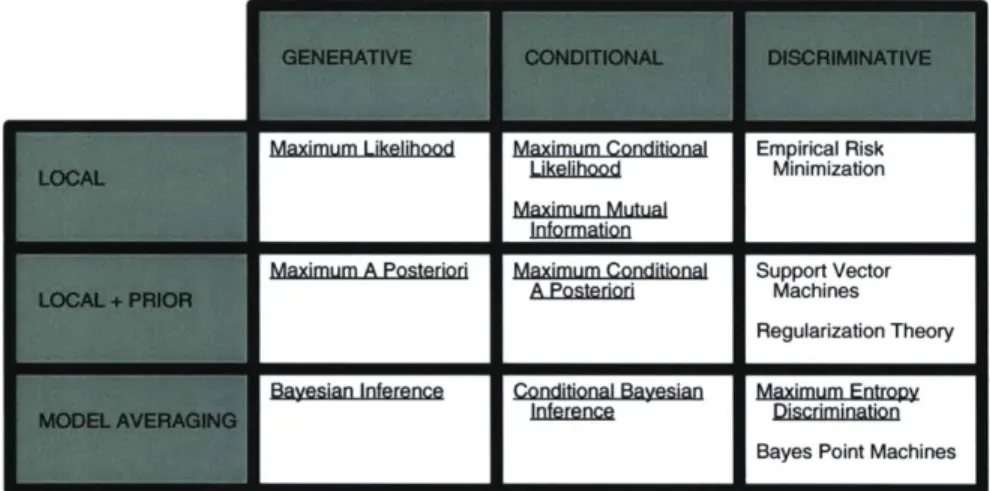
2.3 Conditional Learning.... . . . . . . . . 2.3.1 Conditional Bayesian Inference . . . . . 2.3.2 Maximum Conditional Likelihood . ..
2.3.3 Logistic Regression . . . . 2.4 Discriminative Learning . . . . 2.4.1 Empirical Risk Minimization. . . ..
2.4.2 Structural Risk Minimization and Large Margin Estimation ...
. . . . . 16 . . . . . 17 . . . . . 18 . . . . . 18 . . . . . 20 . . . . . 22 . . . . . 24 . . . . . 24 26 . . . . . 27 . . . . . 27 . . . . . 29 . . . . . 30 . . . . . 30 . . . . . 31 . . - . . 32 . . . . . 32 . . . . . 35 . . . . . 36 36 . . . . . 36 . ... . . . . . . . .... . . . 16
CONTENTS
2.4.3 Bayes Point M achines ...
2.5 Joint Generative-Discriminative Learning... . . . . . . .
3 Maximum Entropy Discrimination
3.1 Regularization Theory and Support Vector Machines . ...
3.1.1 Solvability . . . . 3.1.2 Support Vector Machines and Kernels . . . . 3.2 MED -Distribution over Solutions.. . . . .. 3.3 MED -Augmented Distributions... . . . . . . . .. 3.4 Information Theoretic and Geometric Interpretation... . .. 3.5 Computing the Partition Function . . . . 3.6 M argin Priors . . . . 3.7 B ias Priors . . . . 3.7.1 Gaussian Bias Priors . . . . 3.7.2 Non-Informative Bias Priors.... . . . . . . . . . . . .. 3.8 Support Vector M achines . . . .
3.8.1 Single Axis SVM Optimization ... . . . . . .. 3.8.2 K ernels . . . . 3.9 Generative Models ... . . . . . ..
3.9.1 Exponential Family Models . . . . 3.9.2 Em pirical Bayes Priors . . . . 3.9.3 Full Covariance Gaussians . . . . 3.9.4 Multinomials... . . . . . .. 3.10 Generalization Guarantees . . . .
3.10.1 VC Dim ension . . . . 3.10.2 Sparsity . . . . 3.10.3 PAC-Bayes Bounds . . . . 3.11 Summary and Extensions . . . .
4 Extensions to Maximum Entropy Discrimination
4.1 MED Regression. . ... ... . . . . . .. 4.1.1 SVM Regression . . . . 4.1.2 Generative Model Regression. ... . . . . . .. 4.2 Feature Selection and Structure Learning . . . .
4.2.1 Feature Selection in Classification . . . . 40 41 42 43 44 46 48 49 50 52 53 53 54 54 55 55 56 57 59 63 64 64 65 66 67 68 69 71 71 72
CONTENTS 7
4.2.2 Feature Selection in Regression . . . . 77
4.2.3 Feature Selection in Generative Models... . . . .. 78
4.3 Transduction . . . . 79
4.3.1 Transductive Classification. . ... . .. 79
4.3.2 Transductive Regression... . . . . . . . . .. 83
4.4 Other Extensions . . . . . . . . 85
4.5 Mixture Models and Latent Variables . . . . 86
5 Latent Discrimination and CEM 88 5.1 The Exponential Family and Mixtures . . . . 89
5.1.1 Mixtures of the Exponential Family. ... . . . . .. 90
5.2 Mixtures in Product and Logarithmic Space . . . . 91
5.3 Expectation Maximization: Divide and Conquer . . . . 93
5.4 Latency in Conditional and Discriminative Criteria.. . . . . . . . 94
5.5 Bounding Mixture Models . . . . 96
5.5.1 Jensen Bounds . . . . 97
5.5.2 Reverse-Jensen Bounds . . . . 99
5.6 Mixing Proportions Bounds . . . . 100
5.7 The CEM Algorithm . . . . 103
5.7.1 Deterministic Annealing ... . . . . . . .. 106
5.8 Latent Maximum Entropy Discrimination... . . .. 107
5.8.1 Experiments... . . . . . . .. 108
5.9 Beyond Simple Mixtures . . . . 110
6 Structured Mixture Models 111 6.1 Hidden M arkov M odels . . . . 112
6.2 M ixture of M ixtures . . . . 114
6.2.1 Jensen Bounds . . . . 114
6.2.2 Reverse Jensen Bounds . . . 115
6.3 Reverse Jensen Inequality for Hidden Markov Models . . . 118
6.3.1 Bounding the HMM Gaussians . . . 119
6.3.2 Bounding the HMM Multinomials... . . . .. 122
6.4 Conditional Hidden Markov Models . . . . 124
6.4.1 Experiments... . . . . . . . . .. 125
CONTENTS
6.6 Latent Bayesian Networks . . . . 130
6.7 Data Set Bounds . . . . 130
6.8 Applications... . . . . . . . . 134
7 The Reverse Jensen Inequality 135 7.1 Background in Inequalities and Reversals... . . . .. 135
7.2 Derivation of the Reverse Jensen Inequality... . . . . . . . 136
7.3 Mapping to Quadratics ... . . . . . . . 137
7.4 An Important Condition on the E-Family... . . . . . . . .. 138
7.5 Applying the Mapping... . . . . . . . 142
7.6 Invoking Constraints on Virtual Data... . . . . . . . . .. 142
7.7 A Simple yet Loose Bound . . . . 144
7.8 A Tighter Bound . . . . 146
7.8.1 Bounding a One Dimensional Ray.... . . . . . . . 147
7.8.2 Scaling Up to the Multidimensional Formulation... . . . .. 151
7.9 Analytically Avoiding Lookup Tables... . . . . .. 155
7.10 A Final Appeal to Convex Duality . . . . . ... . . . 159
8 Imitative Learning 162 8.1 An Imitation Framework... . . . . . . . 163
8.1.1 A Sim ple Exam ple . . . . 164
8.1.2 Limitations... . . . . . . .. 165
8.2 Long Term Behavior Data Collection... . . . . . . . . 168
8.2.1 Data and Processing... . . . .. 168
8.2.2 The Task... . . . . . . . .. 170
8.3 Generative Modeling for Perception... . . . . . . . 171
8.3.1 A Generative Model on Images... . . . . . . . 173
8.3.2 A Generative Model on Spectrograms . . . . 174
8.4 Hidden Markov Models for Temporal Signals . . . . 175
8.5 Conditional Hidden Markov Models for Imitation . . . . 175
8.6 Experiments... . . . . . . . 177
8.6.1 Training and Testing Likelihoods... . . . . . . . . 178
8.7 Resynthesis Results... . . . . . . . 180
8.7.1 Resynthesis on Training Data... . . . . . . . . 181
CONTENTS
8.8 Discussion ... 185
9 Conclusion 188 9.1 Contributions ... 188
9.2 Future Theoretical Work ... 191
9.3 Future Applied W ork . . . 192
10 Appendix 194 10.1 Optimization in the MED Framework... . . . . . . . .. 194
10.1.1 Constrained Gradient Ascent . . . . 194
10.1.2 Axis-Parallel Optimization... . . . .. 195
10.1.3 Learning Axis Transitions... . . . .. 197
10.2 A Note on Convex Duality . . . 198
10.3 Numerical Procedures in the Reverse-Jensen Inequality... . . .. 199
J11-List of Figures
1.1 Examples of Generative Models... . . ... 15
1.2 Probabilistic Perception Systems... . . ... 17
1.3 Example of a Discriminative Classifier... . . . ... 19
1.4 Imitative Learning through Discrimination and Probabilistic Perception... . ... 20
1.5 The AIM mapping from action to perception. . . . . 22
2.1 Scales of Discrimination and Integration in Learning... . . . . . . . . 27
2.2 Directed Graphical Models... . . ... 28
2.3 The Graphical M odels . . . . 33
2.4 Conditioned Bayesian inference vs. conditional Bayesian inference... . . ... 34
3.1 Convex cost functions and convex constraints... . . . . . . 42
3.2 MED Convex Program Problem Formulation. . . . . 45
3.3 MED as an Information Projection Operation... . ... 48
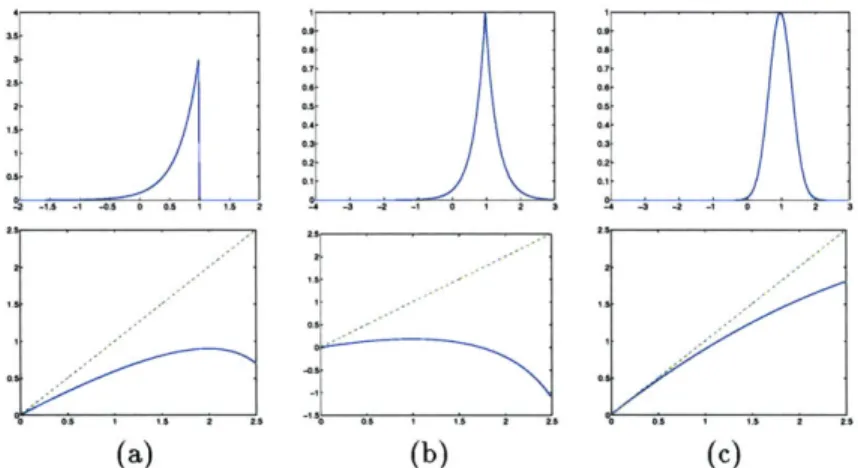
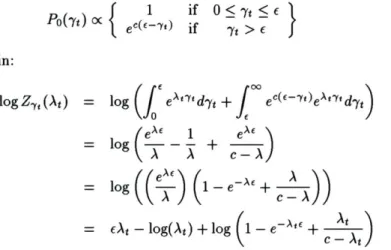
3.4 Margin prior distributions and associated potential functions... . ... 52
3.5 Discriminative Generative Models... . . . . . ... 56
3.6 Information Projection Operation of the Bayesian Generative Estimate... . ... 58
3.7 Classification visualization for Gaussian discrimination... . . ... 61
4.1 Formulating extensions to MED... . . . . . . . ... 68
4.2 Various extensions to binary classification... . . ... 69
4.3 Margin prior distributions and associated potential functions... . ... 70
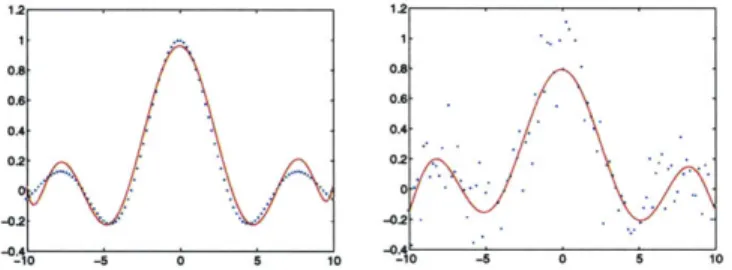
4.4 MED approximation to the sinc function... . . . . . . . ... 71
4.5 ROC curves on the splice site problem with feature selection. . . . . 74
4.6 Cumulative distribution functions for the resulting effective linear coefficients. . . . . 75
4.7 ROC curves corresponding to a quadratic expansion of the features with feature selection 75 4.8 Varying Regularization and Feature Selection Levels for Protein Classification. . . . 76
LIST OF FIGURES
4.9 Sparsification of the Linear Model... . . ... 76
4.10 Cumulative distribution functions for the linear regression coefficients... . .. 78
4.11 Transductive Regression vs. Labeled Regression Illustration... . . ... 84
4.12 Transductive Regression vs. Labeled Regression for F16 Flight Control... . ... 85
4.13 Tree Structure Estimation... . . . . . . ... 86
5.1 Graph of a Standard Mixture Model . . . . 90
5.2 Expectation-Maximization as Iterated Bound Maximization... . . ... 94
5.3 Maximum Likelihood versus Maximum Conditional Likelihood... . ... 94
5.4 Dual-Sided Bounding of Latent Likelihood... . . . . . ... 97
5.5 Jensen and Reverse-Jensen Bounds on the Log-Sum... . . . . . . . . ... 101
5.6 CEM Data Weighting and Translation... . . . ... 104
5.7 CEM vs. EM Performance on Gaussian Mixture Model. . . . . 105
5.8 Gradient Ascent on Conditional and Joint Likelihood... . . . ... 106
5.9 CEM vs. EM Performance on the Yeast UCI Dataset. . . . . 107
5.10 Iterated Latent MED Projection with Jensen and Reverse-Jensen Bounds. . . . . 109
6.1 Graph of a Structured Mixture Model... . . . . . . . .... 111
6.2 Jensen and Reverse-Jensen Bounds on the Mixture of Mixtures (Gaussian case). . 117 6.3 Jensen and Reverse-Jensen Bounds on the Mixture of Mixtures (Poisson case). . . 118
6.4 Jensen and Reverse-Jensen Bounds on the Mixture of Mixtures (Exponential case). 118 6.5 Conditional HMM Estimation... . . . . . . . ... 125
6.6 Training data from the San Francisco Data Set... . . . . ... 126
6.7 Test predictions for the San Francisco Data Set... . . . . . . . .. 127
7.1 Convexity-Preserving Map... . . . . . . . . . .. 139
7.2 Lemma Bound for Gaussian Mean... . . . . . . . . . ... 140
7.3 Lemma Bound for Gaussian Covariance... . . . . . ... 140
7.4 Lemma Bound for the Multinomial Distribution... . . ... 140
7.5 Lemma Bound for the Gamma Distribution... . . . . . ... 141
7.6 Lemma Bound for the Poisson Distribution... . . . . . . ... 141
7.7 Lemma Bound for the Exponential Distribution... . . . . . . ... 141
7.8 One Dimensional Log Gibbs Partition Functions... . . . . . . ... 148
7.9 Intermediate Bound on Log Gibbs Partition Functions. . . . . 149
. . . . 150 7.10
f(7,
w) . . . .max fy, w). . .... ...
Linear Upper Bounds on max,
f(y,
w). . . . . Quadratic Bound on Log Gibbs Partition Functions. . . Bounding Separate Components.. . . . . . . . . .. Bounding the Numerical g(7) with Analytic G(7). . . .. 150 . 151 . 151 . 157 . 160 7.11 7.12 7.13 7.14 7.15 8.1 8.2 8.3 8.4 8.5 8.6 8.7 8.8 8.9 8.10 8.11 8.12 8.13 8.14 8.15 8.16 8.17 8.18 10.1 10.2 10.3 10.4 10.5 LIST OF FIGURES
Dialog Interaction and Analysis W indow . . . 163
A Gestural Imitation Learning Framework... . . . . . . . ... 165
Online Interaction with the Learned Synthetic Agent. . . . 166
Two channel audio-visual imitation learning platform... . . . ... 168
Wearable Interaction Data... . . . ... 169
The Audio-Visual Prediction Task... . . .. 170
A Bayesian Network Description of PCA... . . . . . . . . . . . . 172
Bayesian Network Representing a PCA Variant for Collections of Vectors. . . . . 172
Reconstruction of Facial Images with PCA and Variant... . . . . . . ... 174
Reconstruction error for images of self and world... . . . . . ... 174
Reconstruction error for spectrograms of self and world... . . ... 175
Audio and Video Prediction HMMs... . . . . . . . 176
Conditional HMM Estimation... . . . . . . . . . . ... 177
Training Log-Likelihoods for Audio Prediction HMM... . . . . . . .. 178
Training Log-Likelihoods for Video Prediction HMM... . . . . . . . . . 179
HMM Resynthesis on Training Data... . . . . . . . . . . . . 182
HMM Resynthesis on Training Data Continued... . . . . . . . . . . 184
HMM Resynthesis on Testing Data... . . ... 186
Constrained Gradient Ascent Optimization in the MED framework. . . . ... 195
Axis Parallel Optimization in the MED framework... . . . ... 196
Approximating the decay rate in the change of the objective function.. . . ... 198
Axis-Parallel MED Maximization with Learned Axis Transitions... . . ... 198
List of Tables
3.1 Margin prior distributions and associated potential functions... . ... 52
3.2 Leptograpsus Crabs... . . . . . . . . . . ... 62
3.3 Brest Cancer Classification... . . . ... 62
4.1 Prediction Test Results on Boston Housing Data. . . . . 78
4.2 Prediction Test Results on Gene Expression Level Data. . . . . 78
5.1 Sample exponential family distributions... . . . . . . . . . . . . . 90
5.2 Jensen and Reverse-Jensen Bound Parameters... . ... 98
5.3 CEM & EM Performance for Yeast Data Set... . . . . . . ... 106
5.4 EM and latent MED Performance on the Pima Indians Data Set.... . . . ... 109
5.5 SVM with Polynomial Kernel Performance on the Pima Indians Data Set. . . . . 110
6.1 CEM & EM Performance for HMM Precipitation Prediction... . . . ... 126
8.1 Testing Log-Likelihoods for Audio Prediction HMM... . . ... 179
8.2 Testing Log-Likelihoods for Video Prediction HMM... . . ... 180
Chapter 1
Introduction
It Zs not knowledge, but the act of learning,... which grants the greatest enjoyment.
Karl Friedrich Gauss, 1808.
The objective of this thesis is to propose a common framework that combines three different paradigms in machine learning: generative, discriminative and imitative learning. The resulting mathematically principled framework 1 suggests that combined or hybrid approaches provide supe-rior performance and flexibility over the individual learning schemes in isolation. Generative learning is at the heart of many approaches to pattern recognition, artificial intelligence, and perception and provides a rich framework for imposing structure and prior knowledge on a given problem. Yet recent progress in discriminative learning has demonstrated that superior performance can be obtained by avoiding generative modeling and focusing on the given task. A powerful connection will be pro-posed between generative and discriminative learning to combine the complementary strengths of the two schools of thought. Subsequently, we propose a connection between discriminative learning and imitative learning. Imitative learning is an automatic method for learning behavior in an inter-active autonomous agent. This process will be cast and augmented with a discriminative learning formalism.
In this chapter, we begin by discussing motivation for machine learning in general. There we draw upon applied examples from pattern recognition, various Al domains and machine perception. These communities have identified various generative models specifically designed and honed to reflect the prior knowledge in their respective domains. Yet these generative models must often be discarded when one considers a discriminative approach which ironically provides superior performance despite its naive models. This motivates the need to find common formalisms that synergistically combine the different schools of thought in the community. We then describe an ambitious instance of ma-chine learning, namely imitative learning which attempts to learn autonomous interactive agents directly from data. This form of agent learning can also benefit from being cast into a discrimina-tive/generative paradigm. We end the chapter with a summary of the objectives and scope of this work and provide a brief overview of the rest of the chapters in this document.
1
In the process of constructing such a framework we will expose important mathematical tools which are valuable
in their own right. These include a powerful reversal of the celebrated Jensen inequality, projection approaches to learning and more.
...
CHAPTER 1. INTRODUCTION
1.1
Learning and Generative Modeling
While science can sometimes provide exact deterministic models of phenomena (i.e. in domains such as Newtonian physics), the mathematical relationships governing more complex systems are often only (if at all) partially specifiable. Furthermore, aspects of the model may have uncertainty and incomplete information. Machine learning and statistics provide a formal approach for manipulating nondeterministic models by describing or estimating a probability density over the variables in question. Within this generative density, one can specify a priori partial knowledge and refine the partially specified model using empirical observations and data. Thus, given a system with variables
X1, ... , XT, a system can be specified through a joint probability distribution over all the significant variables within it p(Xi, ... , XT). This is known as a generative model since given this probability distribution, we can generate samples of various configurations of the system. Furthermore, given a full generative model, it is straightforward to condition and marginalize over the joint density to make inferences and predictions.
In many domains, greater sophistication and more ambitious tasks have made problems so intricate that complete models, theories and quantitative approaches are difficult to construct manually. This, combined with the greater availability of data and computational power have encourage many of these domains to migrate away from rule-based and manually specified models to probabilistic data-driven models. However, whatever partial amounts of domain knowledge are available are still used to seed a generative model. Developments in machine learning and Bayesian statistics have provided a more rigorous formalism for representing prior knowledge and combining it with observed data. Recent progress in graphical generative models or Bayesian networks [149] [118] [98] [104] has permitted prior knowledge to be specified structurally by identifying conditional independencies between the variables as well as parametrically by providing prior distributions over them. This partial domain knowledge 2 is then combined with observed data resulting in a more precise posterior generative model.
TO1 T-2 T. T-
-(a) (b) (c)
Figure 1.1: Examples of Generative Models.
In Figure 1.1, we can see two different examples of generative models. A hidden Markov model [104] [156][13] is depicted in Figure 1.1(a) as a directed graph which identifies high level conditional independence properties. These specify a Markov structure where states only depend on their predecessors and outputs only depend on the current state. A hierarchical mixture of experts [105] is portrayed in Figure 1.1(b). Similarly, a mixture model [20] is shown in Figure 1.1(c) which can also be seen as a graphical model where are parent node selects between two possible Gaussian emission distributions. The details and formalism underlying generative models will be presented in the next chapter. For now, we provide background motivation through examples from multiple
2
A further caveat will be addressed in the following sections which warns that even the partially specified aspects of a model will often be inaccurate and suspect.
CHAPTER 1. INTRODUCTION
applied fields where these generative models have become increasingly popular. 3
In the area of natural language processing, for instance, traditional rule-based or boolean logic sys-tems (such as Dialog and Lexis-Nexis) are giving way to statistical approaches [37] [33] [122] such as Markov models which establish independencies in a chain of successive events. In medical diagnos-tics, the Quick Medical Reference knowledge base, initially a heuristic expert system for reasoning about diseases and symptoms has been augmented with a statistical, decision-theoretic formulation [175] [80]. This new formulation structures a diagnostics problem with a two layer bipartite graph where diseases are parents of symptoms. Another recent success of generative probabilistic models lies in genomics and bioinformatics. Once again, traditional approaches for modeling genetic regula-tory networks used boolean approaches or differential equation-based dynamic models which are now being challenged by statistical graphical models [67]. Here, a model selection criterion identifies the best graph structure that matches training data. In addition, for visualization of interdependencies between variables graphical models have given a principled formalism which has proven superior to their heuristic counterparts [70] [69].
1.1.1
Learning and Generative Models in AI
In the artificial intelligence (Al) area in general, we see a similar migration from rule-based expert systems to probabilistic generative models. For example, in robotics, traditional dynamics and control systems, path planning, potential functions and navigation models are now complemented with probabilistic models for localization, mapping and control [106] [186]. Multi-robot control has also been demonstrated using a probabilistic reinforcement learning approach [193]. Autonomous agents or virtual interactive characters are another example of Al systems. From the early days of interaction and gaming, simple rule-based schemes were used, such as in in Weizenbaum's Eliza [200] program, where natural language rules were used to emulate a therapy session. Similarly, graphical virtual worlds and characters have been generated by rules, cognitive models, physical simulation, kinematics and dynamics [205] [176] [60] [11] [7] [184] [51] [36]. These traditional approaches are currently being combined with statistical machine learning techniques [23] [210] [27].
1.1.2
Learning and Generative Models in Perception
In machine perception, generative models and machine learning have become prominent tools in particular because of the complexity of the domain and sensors. In speech recognition, hidden Markov models are [156] are the method of choice due to their probabilistic treatment of acoustic coefficients and the Markov assumptions necessary for time varying signals. Even auditory scene analysis and sound texture modeling has been cast into a probabilistic learning framework with independent component analysis [14] [15]. Word distributions have also been modeled using bigrams, trigrams or Markov models and topic modeling often uses multinomial distributions. A topic spotting system is shown in Figure 1.2(c) which tracks the conversation of multiple speakers and displays related material for the users to read [89].
A similar emergence of generative models can also be found in the computer vision domain. Tech-niques such as physics based modeling [42], structure from motion and epipolar geometry [54] ap-proaches have been complemented with probabilistic models such as Kalman filters [4] [87] to prevent instability and provide robustness to sensor noise. Figure 1.2(a) depicts a system that probabilisti-cally fuses 2D motion estimates into an extended Kalman filter to obtain a rigid 3D face structure
3
This is just a small collection examples of generative models in the various fields and is by no means a complete survey.
CHAPTER 1. INTRODUCTION
and pose estimate [91]. Multiple hypothesis filtering and tracking in vision have also used a genera-tive model and Markov chain Monte Carlo via the Condensation algorithm [79]. More sophisticated probabilistic formulations in computer vision include the use of Markov random fields and loopy belief networks to perform super-resolution [56]. Generative models and structured latent mixtures are used to compute transformations and invariants in a face tracking applications [59]. Other dis-tributions, such as eigenspaces [137] and mixture models have also been used for skin color modeling [172] and image manifold modeling [30]. For instance, in Figure 1.2(b) an eigenspace over 2D photos and 3D face scans is formed and then a generative model between the two spaces can regress 3D face shapes from 2D images in real-time [95]. Color modeling can be done with a mixture of Gaussian models to permit billiards tracking for augmented reality applications as in Figure 1.2(c) [88]. Ob-ject recognition and feature extraction has also benefited greatly from a probabilistic interpretation [171]. For example, in Figure 1.2(e), histograms of convolution operations on images provide reliable recognition for, eg. real-time augmented reality [96].
H
IA7 --H
si . i.FGENSPACE
E
L
2D FeanusEXTE.NDED
KALMA iX
X
FILTER L
(a) (b)
(c) (d)
(e)
Figure 1.2: Probabilistic Perception Systems.
1.1.3
Learning and Generative Models in Temporal Behavior
Simultaneously, an evolution has been proceeding in the field as vision techniques transition from low level static image analysis to dynamic and high level video interpretation. These temporal aspects of vision (and other domains) have relied extensively on generative models, and dynamic Bayesian net-works in particular. Temporal tracking has also benefited from generative models such as extended Kalman filters [5]. In tracking applications, hidden Markov models are frequently used to recognize gesture [204] [179] as well as spatiotemporal activity [61]. The richness of graphical models permit
CHAPTER 1. INTRODUCTION
straightforward combinations of hidden Markov models with Kalman filters for switching between linear dynamical systems in modeling gaits [29] or driving maneuvers [151]. Further variations in the graphical models include coupled hidden Markov models which are appropriate for modeling inter-acting processes such as vehicle or pedestrian in traffic [145] [139] [141]. Bayesian networks have also been used in multi-person interaction modeling, eg. in classifying football plays [78]. Forecasting temporal activity has also been reviewed in the Santa Fe competition [62] where various approaches including hidden Markov models are compared.
1.2
Why a Probability of Everything?
Is it efficient to create a probability distribution over all variables in this 'generative' way? The previous systems make no distinction between the roles of different variables and are merely trying to model the whole phenomenon. This can be inefficient if we are simply trying to learn one (or a few) particular tasks that need to be solved and are not interested in characterizing the behavior of the complete system.
An additional caveat is the generative density estimation is formally an ill-posed problem. Density estimation, under many circumstances, can be a cumbersome intermediate step to forming a mapping between variables (i.e. from input to output). This dilemma will be further explicated in Chapter 2. Moreover, another issue is the difficulty of density estimation in terms of sample complexity and that a large amount of data may be necessary to obtain a good generative model of a system as a whole but we may only need a small sample to learn the required input-output sub-task discriminatively. Furthermore, all the above Al and perceptual systems work well because of the structures, priors, representations, invariants and background knowledge designed into the system by a domain expert. This is not just due to the learning power of the estimation algorithms but that they are also seeded with the right framework and a priori structures for learning. Can we alleviate the amount of manual effort in this process and take some of the human knowledge engineering out of the loop? One way is to not require a very accurate generative model to be designed and not require as much domain expertise up-front. If we had discriminative learning algorithms that were more powerful, the learning would be robust to more errors in the design process and remain effective despite incorrect modeling assumptions.
1.3
Generative versus Discriminative Learning
The previous applications we described present compelling evidence and strong arguments for using generative models where a joint distribution is estimated over all variables. Ironically, though, these flexible models have been recently outperformed in many cases by relatively simpler models estimated with discriminative algorithms.
Unlike a generative modeling approach where modeling tools are available for combining structure, priors, invariants, latent variables and data to form a good joint density tailored to the domain at hand, discriminative algorithms directly optimize a relatively less domain-specific model for the classification or regression task at hand. For example, support vector machines [196] [35] directly maximize the margin of a linear separator between two sets of points in a Euclidean space. While the model is simple (linear), the maximum margin criterion is more appropriate than maximum likelihood or other generative model criteria.
CHAPTER 1. INTRODUCTION
state of the art classification performance [196] [197]. In regression [178] and time series prediction [140], SVMs improved upon generative approaches, maximum likelihood and logistic regression. In text classification and information retrieval support vector machines [48] [161] and transductive support vector machines [100] surpassed the popular naive Bayes and generative text models. In computer vision, person detection/recognition [148] [52] [142] [71] and gender classification have been dominated by SVM frameworks which surpass maximum likelihood generative models and approach human performance [138]. In genomics and bioinformatics, discriminative systems play a crucial role [202] [208] [81]. Furthermore, in speech recognition, discriminative variants of hidden Markov models have recently demonstrated superior large corpus classification performance [158] [159] [207]. Despite the more ambiguous models used in these systems, the discriminative estimation process yields improvements over the sophisticated4 models that have been tailored for the domain in generative frameworks.
Figure 1.3: Examples of a Discriminative Classifier.
There are deeply complementary advantages in both the generative and discriminative approaches yet, algorithmically, they are not directly compatible. Within the community, one could go so far as to say that there exist two somewhat disconnected camps: the 'generative modelers' and the 'discriminative estimators' [167] [83]. We now quickly discuss the general aspects of these two schools of thought (Chapter 2 further details the two approaches and previous efforts to bridge them in the machine learning literature). Generative models provide the user with the ability to seed the learning algorithm with knowledge about the problem at hand. This is given in terms of structured models, independence graphs, Markov assumptions, prior distributions, latent variables, and probabilistic reasoning [25] [149]. The focus of generative models is to describe a phenomenon and to try to resynthesize or generate configurations from it. In the context of building classifiers, predictors, regressors and other task-driven systems, density estimation over all variables or a full generative description of the system can often be an inefficient intermediate goal. Clearly, therefore, the estimation frameworks in probabilistic generative models do not optimize parameters for a given specific task. These models are marred by generic optimization criteria such as maximum
likelihood which are oblivious to the particular classification, prediction, or regression task at hand.
Meanwhile, discriminative techniques such as support vector machines have little to offer in terms of structure and modeling power yet achieve superb performance on many test cases. This is due to their inherent and direct optimization of a task-related criterion. For example, Figure 1.3 shows an appropriate criterion for binary classification: the largest margin separation boundary (for a 3rd order polynomial model). The focus here is on classification as opposed to generation thus properly allocating computational resources directly for the task required.
Nevertheless, as previously mentioned, there are some fundamental differences in the two approaches 4
Here, we are using the term 'sophisticated' to refer to the extra tailoring that the generative model traditionally obtains from the user to incorporate domain-specific knowledge about the problem at hand (in terms of priors, structures, etc.). Therefore, this is not a claim about the relative mathematical sophistication between generative and discriminative models.
CHAPTER 1. INTRODUCTION
making it awkward to combine their strengths in a principled way. It would be of considerable value to propose an elegant framework which would subsume and unite both schools of thought and thus will be one challenge undertaken in this thesis.
1.4
Imitative Learning
So far, we have provided motivation using multiple instantiations of machine learning and generative models in the applied domains of perception, temporal modeling and autonomous agents. Due to the common probabilistic platform threading across these domains, it is natural to consider combinations and couplings between these systems. One of the platforms we will investigate for combining these synergistic approaches to learning is imitative learning. The imitative learning will be used to learn an autonomous agent which exhibits interactive behavior. Imitative learning provides an easy approach ' for learning agent behavior by providing real examples of agents interacting in a world that can be learned from and generalized. The two components of this process, passively perceiving real world behavior and learning from it are portrayed in Figure 1.4. The basic notion is to have a generative model at the perceptual level to be able to regenerate or resynthesize virtual characters while keeping a discriminative model on the temporal learning to focus resources on the prediction task necessary for action selection. This conceptual loop and its implementation will be elaborated in Chapter 8. For now, we will briefly situate imitative learning in the context of other agent learning approaches and motivate it with background and related work.
Discriminative
Learning
/
Prediction
Imitation
Generative
Perception
/
Synthesis
Figure 1.4: Imitative Learning through Discrimination and Probabilistic Perception.
Various approaches have been proposed for learning autonomous agents in domains such as robotics and interactive graphics. While some utilize rule-based, discriminative, or generative models, we can also distinguish among them in the manner in which the learning process is cast within the overall agent behavior model. For example, how will data be acquired, how will data be organized, how will it be labeled, what will be the task(s) of the agent, how will it generalize, and so forth. Traditional, rule-based systems for agent modeling require a cumbersome enumeration of decisions [36]. A simpler alternative is supervised learning where a teacher provides a few exemplars of the optimal behavior for a given context and a learning algorithm generalizes from the samples [160] [181] [20] [187]. Even less supervision is required in reinforcement learning [107]. This remains one of the most popular approaches to agent learning in part due to its strong ethological and cognitive science roots. Therein, an agent explores its action space and is rewarded for performing
5
As Confucius says, there are 3 types of learning, "by reflection, which is noblest; Second, by imitation, which is
CHAPTER 1. INTRODUCTION
appropriate actions in the appropriate context. Thus, supervision is minimized due to the simplicity in providing only a reward signal and the supervision process can be done in an active online setting. Imitative learning [169] is in a sense a combination of supervised and unsupervised (i.e. no teacher) learning. While we collect data of real people interacting with the real world, we are shown many exemplars of appropriate reactionary behavior in response to the current context. Thus, the data is already labeled and needs no teaching effort for the supervision. This, of course, assumes that perceptual techniques can record and represent natural real-world activity automatically. In such an incarnation, imitative learning only involves data collection and avoids manual supervision. It is for this reason that we will investigate it further and implement it with the discriminative and generative models we will propose. While ideally, an agent would utilize a mixture of all learning methodologies and use multiple learning scenarios to introspect and bootstrap each other in a meta-learning approach [187], such an undertaking would be too ambitious. We leave the meta-learning to learn aspect of agent behavior as an interesting topic for future research. At this point, we quickly motivate some background in imitation learning which spans multiple fields (cognitive sciences, philosophy, psychology, neuroscience, robotics, etc.) and a full survey of which would be beyond the scope of this thesis.
Early research in behavior and cognitive sciences exhibited strong interest in the role of imitative learning. However, ground breaking works of Thorndike [185] and Piaget [153] were followed by a lull in the area of movement imitation. This was in part due to the presumption that imitation or mimicry in an entity was not necessarily the sign of higher intelligence and therefore not critical to development. This prejudice slowly faded with the arrival of several studies by Meltzoff and Moore that indicated infants' ability to perform facial/manual gesture imitation from ages 12-21 days old and in some cases at an hour old [130] [131] [132] [133]. Imitative learning began to be seen as an almost innate mechanism to help the development of humans and certain species [192]. Furthermore, it was demonstrated to be absent in other, lower-order animals [191], or very limited in others [190]. In addition, through recent discoveries of mirror neurons, action-perception pathways and functional magnetic resonance imaging results [2] [157] [77] [165], a neural basis for imitative learning has been recently hypothesized 6. Certain experiments indicated consistent firings in a mirror neuron either when an action was performed by a subject or when another individual was perceived performing the same action. In addition, imitation has also been suggested as a possible basis for language learning [164]. These results have spurred applied efforts in imitative approaches to robotics by Mataric [123], Brooks [31], etc. where imitation has gained visibility and complemented reinforcement learning [107]. Further arguments for imitation based learning include improved acquisition of complex visual gestures in human subjects [39].
However, these domains have predominantly focused on uncovering direct mappings between action and perception [169] [123]. It is through such a mapping that the imitation learning problem can be translated into a direct supervised learning one. This complex mapping is to a certain extent the Achilles' heel of imitation learning. Much of the effort of humanoid robot imitation rests in resolving Meltzoff and Moore's 'Active Intermodal Mapping' (AIM) problem. That is, the creation of a mapping of the visual perception of a teacher's movement to high-level representations that can then be matched to other high-level representations of the learner's action space and proprioceptive senses (see Figure 1.5). Effectively, the AIM problem is a change-of-coordinates task where intermediate representations allow a mapping of the learner's action space to various perceived situations and various teachers. This key challenge has driven a substantial effort in the area of humanoid robotics. Various simplifications to the AIM problem can be made to permit implementation of faster learning of robot behavior, however, many of these result in over-simplification of action and perception spaces 6 The discovery of imitation neurons has recently generated extreme enthusiasm in psychology and has been
pre-dicted to provide that field with a leap forward equivalent to the progress in biology obtained from work in DNA [157]. It is also suggested that dysfunctional mirror neurons may explain certain phenomena such as autism.
CHAPTER 1. INTRODUCTION
and consequently generate uninteresting robot behavior. For example, Billard [19] over-simplifies action spaces and perception spaces into a low-dimensional discrete representation and then has a simple learning mechanism (not much more than a rote learner) to resolve the one-to-one mapping.
Higher-Order Higher-Order
Representation MAPPING Representation
Perceptual Action
Space Space
Figure 1.5: The AIM mapping from action to perception.
An alternative approach is to do away with the AIM problem altogether by either providing the teacher's perceptual data in terms of the action-space of the learner [201] [124] or by only considering virtual characters [74] [61] [101] [93] whose action space is in the perceptual space. For example, Weng [201] describes a human pushing a robot down a hallway while the robot collects images of its context. The actuators in the robot (not its cameras) measure the human's displacement and therefore to imitate the human, the displacement values need only be regurgitated (under the appropriate visual context). Hogg [101] alternatively describes a vision system which obtains perceptual measurements and needs only resynthesize behavior in the visual space to generate an action virtually. Both methods cleverly avoid a direct mapping of the perception of a teacher's activity into the learner's action-space.
Clearly, the lack of a higher-order representation of the perception and action requires some extra care. Changes in the coordinate system are not abstracted away and must be dealt with up front. Thus, the actuators in Weng's robot can not be replaced by a totally different motor system and the vision system in Hogg's virtual characters can not be pointed to a radically new scene. One way to side-step the lack of an abstraction layer is to lock the perceptual (or action) coordinate system. This may seem difficult if the learner has to acquire lessons from multiple teachers in multiple contexts and therefore prevents many types of long-term training (or developmental [126]) data scenarios. Furthermore, in a long-term training scenario, it is important to weed out irrelevant data and outliers in the behavioral data and to focus resources discriminatively on the defining exemplars in the training data.
Thus, the second challenge of this thesis is to implement imitative learning and show that it can be cast into the discriminative and generative formalisms described previously. This extends the theoretical combination of discriminative and generative learning to a practical applied task of imitation-based learning.
1.5
Objective
Therefore, we pose the following two main challenges. We will seek a combined discriminative and generative framework which extends the powerful generative models that are popular in the machine learning community into discriminative frameworks such as those present in support vector machines. We will also seek an imitative learning approach that casts interactive behavior acquisition into the discriminative and generative framework we propose. There are many features and subgoals within goo, - No _-,..*,, I , 1111 11 1 M 1
CHAPTER 1. INTRODUCTION
these two large contributions which we will also strive for. The following list enumerates some of these in further detail.
" Combined Generative and Discriminative Learning
Ideally, the combination of generative and discriminative learning should be done at a formal level so that it is easily extensible and can be related to other domains and approaches. We will provide a discriminative classification framework that retains much of the formalism of Bayesian generative modeling via an appeal to maximum entropy which already has many connections to Bayesian approaches. The formalism also has powerful connections to regular-ization theory and support vector machines, two important and principled approaches in the
discriminative school of thought. " Formal Generalization Guarantees
While empirical validation can support the combined generative-discriminative framework, we will also refer the reader to formal generalization guarantees from different perspectives. Various arguments from the literature such as sparsity, VC-dimension and PAC-Bayes
gener-alization bounds will be compatible with the framework. " Applicability to a Spectrum of Bayesian Generative Models
To span a wide variety generative models we will focus on the exponential family which is central to much of statistics and maximum likelihood estimation. The discriminative methods will be consistently applicable to this large family of distributions.
" Ability to Handle Latent Variables
While the strength of most generative models lies in the their ability to handle latent variables and mixture models, we will ensure that the discriminative method can also span these higher order multimodal distributions. Through novel bounds, we will extend beyond the classical Jensen inequality that permits much of generative modeling to apply to mixtures.
" Analytic Reversal of Jensen's Inequality
We will present an analytic reversal of Jensen's inequality which is useful in statistics and pro-vides a new mathematical tool. This reversal will permit various important manipulations in particular the use of discriminative estimation on latent generative models. The mathematical tool also permits dual sided bounds on many probabilistic quantities which otherwise only had a single bound.
" Computational Efficiency
Throughout the development of the discriminative, generative and imitative learning pro-cedures, we will consistently discuss issues of computational efficiency and implementation. These frameworks will be shown to be viable in large data scenarios and computationally as tractable as their traditional counterparts.
" Extensibility
Many extensions will be demonstrated in the hybrid generative discriminative approach which will justify its usefulness. These include the ability to handle regression, multiclass classi-fication, transduction, feature selection, structure learning, exponential family models and mixtures of the exponential family.
CHAPTER 1. INTRODUCTION
We will bring imitative learning into a generative/discriminative setting by describing gen-erative models over the perceptual domain and over the temporal domain. These will be augmented by discriminatively learning a prediction model to synthesize interactive behavior in an autonomous agent.
9 Combining Perception, Learning and Behavior Acquisition
We will demonstrate a real-time system that performs perception, learning and acquires and synthesizes real-time behavior. This closes the loop we proposed and shows how a common discriminative and probabilistic framework can be extended throughout the multiple facets of a large system.
1.6
Scope
This thesis focuses on computational and statistical aspects of machine learning and machine per-ception. Therein, discussions of different types of learning (discriminative, generative, conditional, imitative, reinforcement, supervised, unsupervised, etc.) refer primarily to the computational and mathematical aspects of these terms. Connections to the large bodies of work in the cognitive sci-ences, psychology, neuroscience, philosophy, ethology, and so forth will invariably arise however these are brought in for motivation and implementation purposes and should not necessarily be taken as a direct challenge to the conventional wisdoms in those fields.
1.7
Organization
The thesis is organized as follows:
" Chapter 2
The complementary advantages of discriminative and generative learning are discussed. We for-malize the many models and methods of inference in generative, conditional and discriminative learning. The various advantages and disadvantages of each are enumerated and motivation for methods for fusing them is given.
" Chapter 3
The Maximum Entropy Discrimination formalism is introduced as the method of choice for combining generative models in a discriminative estimation setting. The formalism is presented as an extension to regularization theory and shown to subsume support vector machines. A discussion of margins, bias and model priors is presented. The MED framework is then ex-tended to handle generative models in the exponential family. Comparisons are made with sate of the art support vector machines and other learning algorithms. Generalization guarantees on MED are then provided by appealing to recent results in the literature.
" Chapter 4
Various extensions to the Maximum Entropy Discrimination formalism are proposed and elab-orated. These include multiclass classification, regression and feature selection. Furthermore, transduction is discussed as well as optimization issues. The chapter then motivates the need for latent models in MED and for mixtures of the exponential family. Comparisons are made with sate of the art support vector machines and other learning algorithms.
CHAPTER 1. INTRODUCTION
" Chapter 5
Latent learning is motivated in a discriminative setting via reverse-Jensen bounds. The so-called Conditional Expectation Maximization framework is then proposed for latent condi-tional and discriminative (MED) problems. Bounds are given for exponential family mixture models and mixing coefficients. Comparisons are made with the state of the art Expectation-Maximization approaches.
" Chapter 6
We consider the case of discriminative learning of structured mixture models where the mixture is not flat but has some additional complications that generate an intractable number of latent configurations. This is the case for many Bayesian networks and generally prevents a tractable computation of the reverse-Jensen bounds. We show how the reverse-Jensen bounds can be computed efficiently in some of these circumstances and therefore extend the applicability of latent discrimination and CEM to structured mixture models such as hidden Markov models and mixture models over an aggregated data set.
" Chapter 7
This chapter begins with a brief discussion of work in the mathematical inequalities community including prior reversals and converses of Jensen's inequality. Then, a derivation of the reverse-Jensen inequality for use in discriminative learning is performed to justify its form and give global guarantees on the bounds.
" Chapter 8
Imitative learning is cast as a discriminative temporal prediction problem where an agent's next action is predicted from his previous state and the world state. The implementation details for the hardware and the perceptual systems are discussed. A generative model for the audio, images and temporal structure is then presented and provides the representations for the discriminative prediction problem. Synthesized behavior is then demonstrated as well as some quantitative measurement of performance.
" Chapter 9
The advantage of a joint framework for generative, discriminative and imitative learning is reiterated. The various contributions of the thesis are summarized. Future extensions and elaborations are proposed.
" Chapter 10
This appendix gives a few standard derivations that are called upon in the main body of the thesis. This includes a brief discussion of convex duality as well as details of numerical procedures mentioned in Chapter 7.