
Compilation of a Materials Cost Database for a WEB-Based Composites Cost Estimator by
John R. Boyer
Submitted to the Department of Mechanical Engineering in Partial Fulfillment of the Requirements for the Degree of
Bachelor of Science at the
Massachusetts Institute of Technology June 2001 MASSACHUSETTS INSTITUTE OF TECHNOLOGY JUN 2 8 2001 LIBRARIES ©2001 John R. Boyer
All rights reserved. ARCHIV=S
The author hereby grants to MIT permission to reproduce and to distribute publicly paper and electronic copies of this thesis document in whole or in part.
Signature of Author ... ,... ... ...
Department of Mechanical Engineering May 17, 2001
Certified
by .
... ...
... ...
Timothy G. Gutowski Professor of Mechanical Engineering Thesis Supervisor
Accepted
by ... . .. ... ...
...
Ernest G. Cravalho Chairman of the Undergraduate Thesis Committee
J1
_ _ __ _·__
- -__
-___
COMPILATION OF A MATERIALS COST DATABASE FOR A WEB-BASED COMPOSITES COST ESTIMATOR
by John R. Boyer
Submitted to the Department of Mechanical Engineering on May 17, 2001 in partial fulfillment of the requirements for the
Degree of Bachelor of Science in Mechanical Engineering
ABSTRACT
The production of composite materials continues to be an expensive process. The WEB-Based Cost Estimation Model enables one to approximate the cost of
manufacturing composites, so as to assist the user in making sound economic decisions. An extensive, up-to-date materials database is an essential part of such a cost estimator. This paper presents a list of materials to be added to the existing database and also derives a materials selection chart for six manufacturing processes.
Thesis Supervisor: Timothy G. Gutowski Title: Professor of Mechanical Engineering
Table of Contents Title Page ... 1
Abstract
...
2
Table of Contents ... 3 List of Figures ... 4Introduction
...
5
1. Background and Approach ... 6
2. Composites Overview ... 8 3. Material Descriptions ... 10 3.1 Material Forms ... 10 3.1.1 Continuous Roving ... 10 3.1.2 Fabric ... 11 3.1.3 Tape ... 12 3.1.4 Prepreg ... 13 3.2 Material Properties ... 14 3.2.1 Carbon Fiber ... ... 14 3.2.2 Glass Fiber ... 15 3.2.3 Aramid Fiber ... 15 3.2.4 Thermoset Resins ... 16 3.2.5 Thermoplastic Resins ... 17 4. Materials Database ... 18 4.1 Trademarked Materials ... ... 18 4.1.1 Carbon Fiber ... 18 4.1.2 Glass Fiber ... 19 4.1.3 Aramid Fiber ... 20 4.1.4 Thermoset Resins ... 20 4.1.5 Thermoplastic Resins ... 21 4.1.6 Prepregs ... 22 4.2 Database Compilation ... 23
4.2.1 Sources of Price Information ... 23
4.2.2 Price/Volume Relationship ... 24
4.2.3 Price/Material Property Relationship ... 28
5. Manufacturing Processes ... 30
5.1 Overview of Processes ... 30
5.2 Material Selection Chart ... 35
5.3.1 Reinforcement Selection ... 37
5.3.2 Matrix Selection ... 37
Appendix ... 39
References
...
...
... ...
44
List of Figures
Figure 1: Impact of Decisions on Composites Cost Figure 2: Continuous-Tow Carbon Fiber
Figure 3: Glass Fiber Roving Figure 4: Fabric Weave Styles
Figure 5: Carbon-Epoxy Prepreg Tape
Figure 6: Price of BP Amoco Polyamide-imide Resin vs. Purchase Volume Figure 7: Price of Victrex PEEKTM Resin vs. Purchase Volume
Figure 8: Price of Hexcel Carbon Fiber vs. Elastic Modulus
Figure 9: Price of Dow DERAKANE® Epoxy Vinyl Ester Resin vs. Heat Deflection Temperature
Figure 10: Hand Lay-Up Figure 11: Wet Lay-up
Figure 12: Automated Tow Placement Figure 13: 2D Braiding
Figure 14: Diaphragm Forming Figure 15: Pultrusion Process Figure 16: RTM Process
Introduction
The manufacture of composite materials has increased significantly in the past few years. High-strength, light-weight components are no longer coveted by the aerospace industry alone. Rather, as the cost of raw materials such as fibers has
steadily decreased, the prevalence of composites in consumer products has been on the rise. Two such examples are the automobile and sports products industries.
The valuable properties of composites have been recognized for years, yet the cost of raw materials has kept composites from widespread application. Although costs are still high compared to their metal counterparts, they are on the decline due to better raw material production methods and a greater volume of production.
The first section of this paper describes the background of the thesis and the motivation for this research. The second section gives a broad explanation of composites. Composite materials, including their properties and physical forms, are discussed in detail in the following section. The actual materials included in the new database are presented in the fourth section. The final section of this paper describes six manufacturing processes for composites, and includes a materials selection chart for these processes.
1. Background and Approach
The goal of this research is the update and expansion of an existing materials cost database for a WEB-Based Composites Cost Estimation Model. This composites cost estimator has been under development for several years now by he Advanced
Composites Group of the MIT Laboratory for Manufacturing and Productivity (LMP). The cost estimator is essentially an on-line program which can be used to estimate the manufacturing cost of a composite structure, given a set of inputs. These inputs include the type of raw material, the size and shape of the final product, and the manufacturing process. In order for the estimator to produce a reasonably accurate price figure, the cost database for the raw materials themselves must be as up-to-date as possible. Although materials costs have declined over the past two decades, they are still one of the primary cost drivers in composites manufacturing, as shown in Figure 1.
A - . T I EE
i
Coat Cos impact of decision Number Sdo Of decisions 4IPreproposal Design phas PlanningtoolIng phase Menudacteng
and proposal
ime on Composites Cost [6]
Figure 1: Impact of Decisions on Composites Cost [6]
P\ ormance requirnts Product decisions
ateria selection
\
Major components Design-to-cost
System integrtion \ Avionic
Support requirements Production decisions Make or buy
Production plan F\cllityl/quipment
Producibitity pan Tooling policy
Program controls MAneeNt controls
Lot
ii
Producin Olnnog coA du co w l Tool dasignfmdbrlalmon
While the existing database lists materials by generic names, this thesis presents a database consisting of recognizable manufacturer trade names. This move will result in a more user-friendly system for those industry-oriented individuals who are expected to use the cost estimator. This database of trademarked materials with year 2001 prices will be a valuable addition to the WEB-Based Cost Estimator.
2. Composites Overview
A composite is composed of at least two types of materials, a reinforcement and a matrix. The reinforcements, or fibers, provide the strength to the composite. The matrix, or resin, holds the fibers together and works to distribute loads throughout the composite. Carbon fiber, glass fiber, and aramid fiber are the predominant reinforcements found in composites today.
Carbon fibers are renowned for providing the strongest of all composites, yet they are also notorious for their exceedingly high price compared to other reinforcements. Carbon fiber can be produced from a variety of precursors. The most common precursors are rayon, polyacrylonitrile (PAN), and pitch. PAN has the best conversion yield and results in fibers with the highest tensile strength. PAN carbon fibers are the most widely used despite their high cost relative to rayon and pitch carbon fibers [6].
Glass fibers provide the reinforcement in 90 percent of all composites. This is primarily due to their very low cost compared to carbon and aramid fibers. The two most common types of glass fiber are E-glass (electrical grade) and S-glass (high strength) [6]. Aramid fibers are the most abundant organic reinforcements. The term "aramid" describes the substance from which the fibers are formed, aromatic polyamides. Aramid fibers are widely known commercially by the DuPontM trademark name Kevlar® [6]. They fall between carbon and glass fibers in terms of cost.
Resins are classified as either thermosets or thermoplastics. Thermosets are polymers which cannot be reformed upon heating once they have hardened. Their properties result from the amount of cross-linking at the molecular level [18]. The three most common thermosets include epoxy, polyester, and vinyl ester. Epoxies cost more
than polyesters and vinyl esters, and have higher strength. Polyesters are the least expensive of these three thermosets [6].
Thermoplastics are polymers which can be softened (or melted) and reformed upon heating. They are linearly polymerized and do not exhibit cross-linking [18]. Examples of thermoplastics include polyamide-imide (PAI), polyetheretherketone (PEEK), and polyethylene (PE). PEEK has the highest cost of these three, followed relatively closely by polyamide-imide. Comparatively speaking, polyethylene is a very inexpensive polymer.
3. Material Descriptions
3.1 Material Forms
3.1.1 Continuous Roving
The most common dry fiber form used in composites is continuous strand, or roving. Roving is essentially continuous fiber wound on a spool, resembling thread on a bobbin. Continuous carbon fiber is normally referred to as continuous tow rather than roving, but both terms describe the same fiber form. A fiber tow consists of a certain number of filaments, typically in the thousands. Continuous tow carbon fiber with 1,000 filaments is referred to as 1K fiber, while that with 3,000 filaments is known as 3K fiber, and so on. The most widely-used fiber sizes are 3K, 6K and 12K. Others sizes include 1K, 48K, 160K and 320K, which are less common. In general, as the number of filaments per tow increases, so does the weight of the fiber and its tensile strength. The fewer the filaments per tow, the higher the cost [6].
Figure 2: Continuous-Tow Carbon Fiber [9]
Glass and aramid fiber are also produced in continuous filament, or roving form. Various rovings can differ in tow size, denier, and filament diameter. The denier is a
weight-per-unit-length measure for fiber in filament form (1 denier = 1.111 *107 kg/m)
[1]. Each denier size corresponds to a different number of filaments, and therefore a different strength. As carbon fiber is typically referred to by its tow size, aramid fiber is referred to by its denier, and glass fiber is differentiated by its TEX (weight-per-unit-length in grams per kilometer). Typical glass fiber TEX sizes can range from 250 to 8860, while aramid fiber deniers range from about 55 to 15,000.
Figure 3: Glass Fiber Roving [15]
3.1.2 Fabric
Carbon, glass, and aramid continuous fiber are also produced in dry fabric form, or woven roving. Glass fiber is also available as continuous strand mat. Continuous fiber can be woven into fabric in a number of styles, each with its own inherent structural properties. Woven fabric is typically sold in rolls which are 38 to 50 inches wide (0.965
to 1.27 meters). The most common two-directional weave styles are the plain weave and satin weave. The plain weave exhibits the most interlacing, resists in-plain shear, and has high tensile strength. The satin weave is less resistant to shear, has high tear strength, and can be draped over curved molds. This workability has made satin weave fabric
popular in aerospace composites. Unidirectional fabric exhibits high strength in one direction and is reserved for special applications where such axial strength is required [6].
(a) (b) Ic)
- rI - A
- LJ u
(d) (e) (f)
Fabric construction forms. (a) Plain weave. (b) Basket weave. (c) Twill. (d) Crowfoot satin. (e) 8-end satin. (f) 5-end satin
Figure 4: Fabric Weave Styles [6]
3.1.3 Tape
Another common fiber form is unidirectional (UD) tape. UD tape consists of collimated fiber tows which run in the length-wise direction of the tape [13]. It is most commonly used as a prepreg material and is usually produced in a width of 12 inches (305 mm). For tape widths which are not industry standard, the cost is significantly higher.
UD tape does a much better job in translating fiber properties than two-M a II ml I 1 -1,14 _ (I i ' " '' i I I F=== N - . .. .. .A! Q I I 11 11 !' "' ' ' ' S
dimensional fabrics. This is due to the inherent anisotropic (single-direction) reinforcing characteristics of continuous fibers. By placing fibers in the 0°orientation, the tape form
is taking full advantage of their strength properties [6]. Carbon, glass, and aramid fiber can all be produced as unidirectional tapes.
3.1.4 Prepreg
Prepregs are woven fabrics, tapes, or tows which have been impregnated with resin. Because the resin is in an uncured or semi-cured state, most prepregs have a "tacky" feel at room temperature which has both positive effects (e.g., adhesion) and negative effects (e.g., alignment) in a manufacturing process like hand lay-up. Today, prepregs are made-to-order products which the end user can specifically formulate to suit his or her application. Prepregs differ primarily in fiber form, fiber type, resin type, and resin content. Resin content is usually expressed as a percentage of the total weight of the prepreg.
Figure 5: Carbon-Epoxy Prepreg Tape [61
There are essentially two broad grades of prepregs: those used in
high-performance aerospace applications, and those used in lower-high-performance consumer-good applications. The most common aerospace prepregs are carbon fiber/epoxy resin
systems. The lower-performance prepregs are bulk-molding (BMC) and sheet-molding compounds (SMC) [6]. BMC and SMC are typically glass fiber/polyester resin
combinations.
In terms of cost, the high performance prepregs are much more expensive than the molding compounds. Within the category of high performance, for a given fiber type, the higher the cure temperature of the resin, the higher the cost of the prepreg. For a given fiber and resin combination, as the width of the prepreg tape or fabric increases, the price per pound decreases. Prepreg tapes are typically less expensive than woven fabric
prepregs [6].
3.2 Material Properties
3.2.1 Carbon Fiber
The reinforcement of choice for high-strength composites is carbon fiber. Carbon fiber is derived from three different precursors: rayon, polyacrylonitrile (PAN), and isotropic and liquid crystalline pitches. Rayon and isotropic pitch result in carbon fiber with a relatively low elastic modulus, typically less than 5*1010 Pascal (50 GPa). PAN and liquid crystalline pitch fibers have much higher moduli, usually greater than 200 GPa. PAN carbon fiber, due to its high strength and relatively high conversion yield (at least 50%), is the most common type of carbon fiber available today. With its low conversion yield (25%), carbon fiber derived from rayon is the most expensive [6]. Carbon fiber has a lower density than glass fiber and a much higher elastic modulus. Its tensile strength is nearly always superior to that of E-glass, which is not necessarily the case with S-glass. Although aramid fiber is less dense than carbon fiber, it is not as strong. Carbon fiber's high strength and light weight make it ideal for those
composites with aircraft and space applications.
3.2.2 Glass Fiber
Glass fiber is the most abundant reinforcement found in composites, primarily due to its low cost. It is derived from the same materials (silica, etc.) as bulk glass and is formed by extruding molten glass through an orifice. Compared to carbon and aramid fiber, glass fiber has high density and low elastic modulus. Glass fiber is available in a number of different types, each with slightly different chemical make-ups. The most common types are E-glass and S-glass. E-glass, or electrical-grade glass, has high electrical resistivity and average strength properties. It is primarily used as a
reinforcement in plastics. With its high tensile strength, S-glass, or high-strength glass, has a high cost and is typically reserved for aerospace applications [6].
3.2.3 Aramid Fiber
Aramid fibers are the primary organic fibers found in composites today. Their low density and relatively high strength make them good candidates for a wide variety of composite applications. The commercial name for aramid fiber is Kevlar®, which was invented by the Dupont Chemical Company in the early 1970s.
The two most common grades of aramid fiber are Kevlar® 29 and Kevlar® 49. Kevlar® 49 has the higher tensile strength and modulus, and typically higher cost. Both types come in a number of different sizes, denoted by their denier. As the denier
increases, the number of filaments increases and the tensile strength decreases. Due to their lower strength, the higher deniers have lower prices. Kevlar® 49 is available in deniers ranging from 55 (25 filaments) to 7100 (5000 filaments), while Kevlar® 29
deniers range from 200 (134 filaments) to 15,000 (10,000 filaments) [6].
3.2.4 Thermoset Resins
Thermosets are polymers which, once cured, cannot be reheated and reformed. They are the most common matrix materials used in composites due to their low initial viscosity which eases the wetting-out of the reinforcing fibers. Once a thermoset is heated past its glass transition temperature (Tg), the temperature at which its coefficient of thermal expansion changes, it begins to degrade and may eventually decompose [19]. Temperature performance is one of the primary criteria for choosing a particular resin over another for a certain application. In general, the lower the temperature performance of the resin, the lower the cost [6].
When it comes to composite matrices, thermoset resins are rarely used in pure form. Different chemicals can be added to achieve better properties, in terms of higher strength, higher temperature resistance, or better corrosion resistance. Thus, a more accurate term for matrix is actually "resin system." Catalysts can be used with a resin to control the rate of cure. A hardener, or curing agent, can also be added to enhance physical properties of the resin in cured state [6].
Three primary thermoset resins are epoxy, polyester, and vinyl ester. Epoxy is the highest performance resin in terms of strength and thermal resistance. It also has the highest cost and is typically used in aerospace applications. Polyester resins, or unsaturated polyesters, are classified according to their chemical constituents. The two types of polyesters listed in the new database contain either isophthalic acid or bisphenol A (BPA) fumarate. Both polyesters have good mechanical strength, and good thermal and chemical resistance. Vinyl esters exhibit all three of these properties to a slightly
higher degree than polyesters. Despite their higher cost than polyesters, vinyl esters find themselves used in similar applications [6].
3.2.5 Thermoplastic Resins
Thermoplastics are polymers which can be reformed after curing. They become "rubbery" after being heated past their glass transition temperature, and will eventually melt if heating continues [ 19]. Their use in composites has lagged significantly behind that of thermosets for many years. Two of the problems are processability, in relation to high viscosity, and cost. Thermoplastics are typically limited to manufacturing processes such as injection molding and compression molding where discontinuous fibers are required. In terms of cost, thermoplastics with composites applications are generally much more expensive than thermosets, sometimes by a factor of !0.
Three common thermoplastics used as matrices in composites are
polyamide-imide (PAI), polyetheretherketone (PEEK), and polyethylene (PE). PAI and PEEK are both high-temperature engineering thermoplastics. PE is actually a
"commodity" plastic, but due to its rubbery nature at room temperature, it can be used to produce very tough composites. PAI has the highest modulus, tensile strength, and glass transition temperature of these three polymers.
4. Materials Database
4.1 Trademarked Materials
4.1.1 Carbon Fiber
* "A sizing is any surface coating applied to a reinforcement to protect from processing damage, aid in
processing, or improve mechanical properties" [6].
Continuous Rovina
Product Manufacturer Description/Applications Price
Source
PAN-based fiber used in weaving, braiding,
Hexcel® AS4C, AS4, Hexcel pultrusion, and prepregging; fiber has been Hexcel
IM4, IM6 Corporation sized* and can be surface treated [9] Fibers
Hexcer IM7, IM8, Hexcel PAN-based fiber used mainly in Hexcel
IM9, UHM Corporation prepregging; fiber has been sized and can Fibers
be surface treated [9]
Thornelr T-300, BP Amoco PAN-based fiber, certified aircraft grade [3] BP Amoco
T-650/35 Chemicals
PAN-based fiber, commercial grade;
Thornel T-300C, BP Amoco surface has been treated; used in weaving, BP Amoco
T-650/35C pultrusion, prepregging [3] Chemicals
Mesophase pitch-based fiber; higher
Thornel® P-25 BP Amoco density and higher thermal conductivity BP Amoco
than PAN-based [3] Chemicals
Zoltek Panexw 33 Zoltek Low-cost PAN-based fiber
48K Companies, Zoltek
Inc.
Woven Fabric
Hexcel Schwebel Hexcel PAN-based carbon fabric used in Hexcel
130, 282, 433, 584 Corporation low-pressure composites and aircraft Schwebel
Fabric advanced composites [10]
ThermalGraph' Pitched-based carbon fabric; certified BP Amoco
EWC-300x BP Amoco aircraft grade [3] Chemicals
Unidirectional Tape
Zoltek Panex 33 Zoltek
UD21 48K Companies, Low-cost PAN-based carbon tape Zoltek
Inc.
4.1.2 Glass Fiber
Continuous Roving
Product Manufacturer Description/Applications Price Source
Owens Advantex®E-glass for use with Ashland 366 Type 30 ® Owens epoxy, polyester, and vinyl ester resins; Chemical/FRP
Fiberglas ® Corning treated with silane-based sizing; used in Supply
pultrusion and weaving [15]
High-strength glass for use with epoxy Ashland
449 S-2 Owens resins; treated with an epoxy-compatible Chemical/FRP
Glass ® Corning sizing; used in weaving and unidirectional Supply
prepregs [15]
E-glass fiber designed for use with epoxy
PPG 1062 PPG resin systems; treated with silane sizing; PPG
Industries, Inc. applications which require high mechanical strength and corrosion resistance [16]
E-glass fiber for use with epoxy, polyester,
PPG 1712, PPG or vinyl ester resins; treated with silane PPG
1764 Industries, Inc sizing; designed for pultrusion [16] Multi-End
PPG E-glass designed for use in laminating
PPG 7065 Industries, Inc clear/high performance acrylic modified PPG
panels; treated with silane sizing [16]
Hybonw 2006 PPG E-glass designed for use with epoxy resin;
Direct-Draw Industries, Inc designed for pultrusion; treated with silane PPG sizing [16]
PPG E-glass designed for use with epoxy, vinyl
Hybons 2022 Industries, Inc ester, or polyester resin; treated with silane PPG sizing; used in pultrusion [16]
Woven Fabric
Hexcele E-glass fabric used in low-pressure
Schwebel 106 Hexcel composites, aircraft advanced composites, Hexcel
Corporation coated and laminated fabrics, electrical Schwebel
laminate [10]
Hexcel' Hexcel E-glass fabric used in low-pressure Hexcel
Schwebel 112 Corporation composites, aircraft advanced composites Schwebel
[10]
Hexcel' Hexcel E-glass fabric used in aircraft advanced Hexcel
Schwebel 120, Corporation composites [10] Schwebel
4543
Hexcelw Hexcel E-glass fabric used in aircraft advanced Hexcel
Schwebel Corporation composites, coated and laminated fabrics Schwebel
1527 [10]
Hybonw PPG E-glass fabric used in aircraft and
Woven Industries, Inc automotive parts [16] PPG
4.1.3 Aramid Fiber
4.1.4 Thermoset Resins
Epoxy
Product Manufacturer Description/Applications Price
Source
Araldite" GY 507, High-performance resins for aerospace
GY 6010/GY Vantico applications; used in hand lay-up, RTM, Vantico
6010CSR, GY pultrusion [22]
6020 Liquid
DERAKANE Low-viscosity, good thermal properties, and
D.E.R.® 329 Dow Chemical excellent fatigue behavior; designed for use Dow
Liquid in RTM [7]
Polyester
AROPOLT M
Ashland Low-viscosity; used hand lay-up, RTM,
7241T-15, Specialty pultrusion [1] Ashland
7334T-15 Chemical
Ashland Excellent corrosion resistance; used in hand
HETRON® 700 Specialty lay-up, RTM, pultrusion [1] Ashland
Chemical
Vinyl Ester
HETRON®922, Ashland Good corrosion resistance; used in hand
lay-942/35, 980/35 Specialty up, RTM, pultrusion [1] Ashland
Chemical
DERAKANEw Good chemical resistance, mechanical
411-350 Dow Chemical strength, and impact resistance; used in Dow
hand lay-up, RTM, pultrusion [7]
DERAKANE; Excellent chemical resistance; excellent
470-300 Dow Chemical high-temperature properties; used in hand Dow
lay-up, RTM, pultrusion [7]
Good impact resistance; exceptional tensile
DERAKANE Dow Chemical elongation (at break); very good Dow
8090 processability; used in hand lay-up, RTM,
pultrusion [7]
Continuous Roving.
Product Manufacturer Description/Applications Price
Source Kevlarv 29, 49 DuPont Used in weaving, pultrusion, prepregging DuPont
Woven Fabric
Hexcel
Schwebel Hexcel Used in hand lay-up, RTM; used in aircraft Hexcel
328, 345, 348, Corporation advanced composites [10] Schwebel
351,352
Kevlar 49 Fabric
---4.1.5 Thermoplastic Resins
Polvamide-imide (PAI)
Product Manufacturer Description/Applications Price
Source
Exceptional wear resistance, thermal
Torlone 4301 BP Amoco performance and chemical resistance; used in BP Amoco military aircraft wear pads; used primarily in Chemicals injection molding, extrusion and compression
molding [4]
Exceptional strength at high temperatures; used in air-return grills on commercial aircraft;
Torlon®5030 BP Amoco used in shrouds for directing airflow in jet BP Amoco engines; used in connectors and brackets that Chemicals support electrical wiring; used primarily in
injection molding, extrusion and compression
molding [4]
Exceptional wear resistance, thermal
Torlon®7130 BP Amoco performance and chemical resistance; used in BP Amoco military aircraft wear pads; used primarily in Chemicals injection molding, extrusion and compression
molding [4]
Polyetheretherketone (PEEK)
Excellent high-temperature performance;
PEEKTM 381G, excellent mechanical strength, creep and
450G, Victrex fatigue resistance; Used primarily in injection Victrex
450FC30 molding and extrusion; used in engine, aircraft
Pellets exterior and interior components [23]
Polyethylene (PE)
Marlexw C579 Chevron Outstanding impact resistance and chemical
High-Density Phillips resistance; used in Chevron
Chemical multi-layer and mono-layer fuel tanks; Phillips automotive applications [5]
Marlex" K605 Chevron Used in a number of applications including Chevron Phillips automotive parts, piping, and industrial films Phillips
4.1.6 Prepregs
Carbon/Epoxy
Product Manufacturer Description/Applications Price
Source
NB-1122 Newport PAN-based woven fabric prepreg Northern
Adhesives and designed for laminated structures Fiber Glass Composites, Inc. and one-step assembly of sandwich Sales, Inc.
panels [14]
NB-1450 Newport Flame-retardant, PAN-based woven Northern
Adhesives and fabric prepreg designed for laminated Fiber Glass Composites, Inc. structures and one-step assembly of Sales, Inc.
sandwich panels [14]
AW370-5H/3501-6*, Hexcel
AW370-8H/3501-6*, Corporation PAN-based woven fabric prepregs Hexcel AW193-PW/3501-6*
NCT-303, Newport Northern
NCT-1122 Adhesives and PAN-based UD tape prepegs Fiber Glass
Composites, Inc. Sales, Inc.
AS4/3501-6 Hexcel PAN-based UD tape prepreg Hexcel
Corporation
Glass/Epoxy
NB-1100 TIP Newport E-glass woven fabric prepreg designed Northern
Adhesives and for the manufacture of laminates [14] Fiber Glass
Composites, Inc. Sales, inc.
NCT-106/8 Newport Flame-retardant, E-glass UD tape Northern
Adhesives and prepreg recommended for lightweight Fiber Glass
Composites, Inc. sandwich parts [141 Sales, Inc.
NCT-306 Newport Flame-retardant, E-glass UD tape Northern
Adhesives and prepreg [14] Fiber Glass
Composites, Inc. Sales, Inc.
Aramid/Epoxy
NB-1109 Newport Flame-retardant, Kevlar' woven fabric Northern
Adhesives and prepreg designed for laminated Fiber Glass
Composites, Inc. structures and one-step assembly of Sales, Inc.
sandwich panels [14]
NB-1122 Newport Kevlarw woven fabric prepreg designed Northern
Adhesives and for laminated structures and one-step Fiber Glass Composites, Inc. assembly of sandwich panels [14] Sales, Inc.
NCT-321 Newport Kevlarw UD tape prepreg designed for Northern
Adhesives and laminated structures and one-step Fiber Glass Composites, Inc. assembly of sandwich panels [14] Sales, Inc.
* Price is from 1995. Product name has since changed.
--4.2 Database Compilation
Due to the prevalence of composites manufacturing in the aerospace industry, it is most likely that the WEB-Based Cost Estimator will benefit engineers within this field. Thus, the types and grades of materials which have been chosen to be included in the database are typically those with aircraft/aerospace applications.
4.2.1 Sources of Price Information
A high priority in compiling cost data for this estimator is the collection of
reliable information. The most reliable cost data can be obtained from the manufacturers themselves (e.g., Hexcel, DuPont). All of the prices in the new database, with the
exception of those for the Owens Coming glass fibers, have been garnered directly from the manufacturer. The prices for the Owens rovings have been obtained from Ashland Chemical/FRP Supply, one of their distributors in the northeastern United States. Phone calls and e-mails to sales and technical representatives have been the primary methods for gathering price information. Most product technical data are from the company websites. There are a number of small businesses which sell composite materials, and their pricing information is much more readily available than that of any manufacturer. Most of these companies have websites with downloadable catalogs which contain all of the prices for their products, be it Kevlar® fibers or carbon/epoxy prepregs. While they sell much of the same products as the manufacturers themselves, the intended customers are low-volume users such as hobbyists or small research groups. The result is a price markup on these materials as high as 100% or more [2].
Obtaining cost information from manufacturers is not always an easy task, especially when they are told that the price inquiry will not be leading to a potential
purchase, as is the case in this project. The manufacturers do not post their product prices publicly and generally require a request for a quote. While gathering prices from a manufacturer is much more difficult than browsing a small composite retailer's catalog, it is absolutely necessary in order to compile an accurate cost database. In the case of distributors, pricing information is also tough to come by if one is not intending to make a purchase. Nonetheless, price numbers obtained from distributors are generally as reliable as those from the manufacturer, but they may differ slightly based on geographic location and manufacturer/distributor transaction volume.
Obtaining prices for prepregs is the most difficult of all the materials listed in the database. Prepregs are highly-specialized products which manufacturers typically build-to-order based on the customer's specific application. Thus, it is often difficult to get exact cost figures as opposed to "ballpark" numbers. The prepreg prices obtained from Northern Fiber Glass Sales, Inc., a distributor in New Hampshire, are considered estimates. However, according to their sales representative, they should not be off by more than 10% [17]. The Hexcel prepreg prices listed in the database are from the past records of an individual who has made purchases from the company [11]. These cost figures may be considered out-of-date (1995) in comparison to all of the other prices in the new database, but, nonetheless, they give a general clue as to the cost of prepregs.
4.2.2 Price/Volume Relationship
Nearly all of the prices included in the materials database are volume-dependent. The decision was made to list prices for low-volume purchases of the composite
materials. For instance, in the case of dry fibers, prices are quoted for purchases of one to 100 pounds. In the case of resins, prices are quoted for purchases of one to four
containers. For thermoset resins, which come in liquid form, the container is a 55-gallon drum. For thermoplastic resins, which come in solid form, the container is a 55-pound box.
The only exceptions to the 100-pound rule for fiber are the prices for the PPG glass rovings and fabrics. These prices are quoted for a "truck-load" volume, or approximately 40,000 pounds. This is a huge volume, but the price difference between 1,000 pounds and 40,000 pounds is most likely very small (less than $0.50 per pound). A much larger price increase ($1 to $2 per pound) can be expected when volume decreases from 1,000 pounds to under 100. Consequently, although a 40,000-pound volume seems as if it would result in an extremely low price, the cost is comparable to a 1,000-pound volume. Thus, the error in the PPG prices listed in the database is essentially the price difference between 100- and 1,000-pound volumes.
There exists valid reasoning behind the choice for low-volume pricing. First of all, it is impossible to know exactly what volumes the typical user of the WEB-Based Cost Estimator will be using. Although one can be certain it will usually be more than one-hundred pounds, just how high the volume will go is unclear. With a database of mostly low-volume prices, it is certain that the cost model will rarely underestimate material cost. In other words, the higher prices for the low volumes adds a small safety factor onto the material cost estimate.
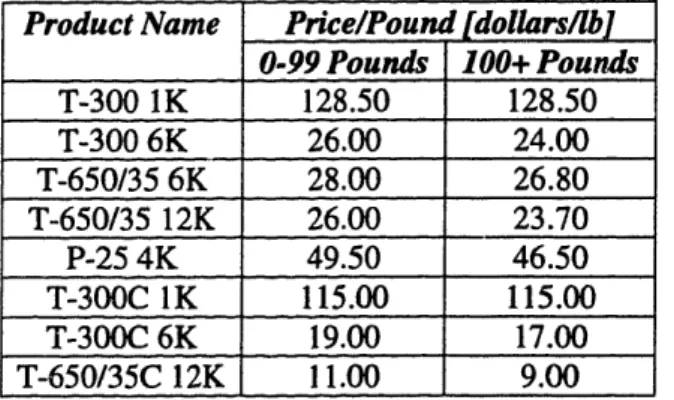
To illustrate how the price of carbon fiber differs based on purchase volume, Table I is shown on the following page. The average difference in price between
volumes below 100 pounds and those above 100 pounds is between $2 and $3 per pound. So, if an individual using the cost estimator plans for a volume of 500 pounds, the
materials cost will be overestimated by an average of less than 10%. This is not a bad estimate, given that a 10-percent figure is normally considered a reasonable level of error for most scientific analyses.
Product Name Price/Pound [dollars/lb]
0-99 Pounds 100+ Pounds T-300 1K 128.50 128.50 T-300 6K 26.00 24.00 T-650/35 6K 28.00 26.80 T-650/35 12K 26.00 23.70 P-25 4K 49.50 46.50 T-300C K 115.00 115.00 T-300C 6K 19.00 17.00 T-650/35C 12K 11.00 9.00
Table 1: Pricing for BP Amoco Thornele Carbon Fibers
In the case of resins, two different types of price behavior are witnessed for increasing volumes. Figure 6 on the following page shows how the price of polyamide-imide resin from BP Amoco changes with volume. The behaviors of the plots are typical for volume-dependent pricing. Such prices can be expected to decrease until they reach an asymptotic value close to the cost of production plus profit at some high volume.
The second type of price behavior is shown in Figure 7 for Victrex PEEKT resin. In this case, one price covers a particular range of volumes, and once a certain threshold is reached, the price drops. For instance, 381G PEEKTM pellets cost $47 per pound for one to 11 boxes, $43.75 per pound for 12 to 23 boxes, and $40 per pound for 24 or more.
a
a.
0 500 1000 1500 2000
Volume [pounds]
2500
Figure 6: Price of BP Amoco Polyamide-imide Resin vs. Purchase Volume [4]
E---A---
0-l I -- e-- PEEK 381G -- -- PEEK 450G ---- PEEK 450FC30 s ii At 1 i , i i i16=
i i I II---1000 1200 1400 ---. 0 200 400 600 800 1600 1800 2000 Volume [pounds]
Figure 7: Price of Victrex PEEKTM Resin vs. Purchase Volume [23]
40 46 44 42 40 38 '6 C c C z a, e .50 a-~"'~""~~' ..-·IU1·. 7-! I I ! ! - - : At I\ L 34
4.2.3 Price/Material-Property Relationship
In addition to purchase volume, material properties can also dictate the behavior of raw-material pricing. As mentioned earlier, the price of reinforcements tends to increase as elastic modulus increases. Figure 8 shows how the price of Hexcel carbon-fiber roving increases with modulus, for each of three different tow sizes. Another point illustrated by Figure 8 is the fact that, for a given modulus, the price per pound increases as the tow size decreases. Although this plot is for carbon fiber, similar behavior can be expected for both glass and aramid fiber.
(U c a a tn 0 :o . 13. 200 250 300 350 400
Elastic Modulus [GPa]
Figure 8: Price of Hexcel Carbon Fiber vs. Elastic M
450
odulus [9]
In the case of resins, temperature performance plays a large role in determining price. Figure 9 shows that customers are willing to pay more for those polymers with higher use-temperatures. In this case, the price is plotted versus the heat deflection
temperature (DT), a value which is determined by an ASTM standard, aI tL .t-o .. 1 0 Heat Deflection Temperature [deg C]
Figure 9: Price of Dow DERAKANE ®Epoxy Vinyl Ester Resin Temperature [7]
vs. Heat Deflection
S. Manufacturing Processes 5.1 Overview of Processes
HandLay-Ul
Hand lay-up, or contact molding, is one of the most labor-intensive forms of composites manufacturing. It is an open-mold process in which an operator deposits thin layers of composite material on top of one another, a single ply at a time. The work is performed on a tool, or mold, which has the shape of the final product, as shown in Figure 10 [12].
Figure 10: Hand Lay-Up [12]
Since the operator is responsible for placing each layer in the correct orientation and removing any disparities, hand lay-up is not a very repeatable process. It is appropriate for large, high-strength, low-volume composites. The type of hand lay-up operation shown in Figure 10 normally uses woven fiber prepreg or unidirectional tape prepreg [12]. Another type of hand lay-up is wet lay-up. In this process, dry fiber fabric or tape is placed into a mold one layer at a time, and resin is poured on top of each layer and spread by the operator [20].
CWy rlnhtrmM r
Figure 11: Wet Lay-Up [201
Automated Tow Placement/Automated Tape Laying
Automated tow placement (ATP) and tape laying (ATL) are processes used to produce laminated composite parts. A computer numerically-controlled machine is used to lay prepreg tapes or tows onto a mandrel to form the desired part. The tapes or tows are carried on spools which are unrolled as the fiber placement head is moving.
Figure 12: Automated Tow Placement [12]
Due to its high degree of automation, ATP provides both accuracy and repeatability. It is typically used to produce large, low-volume products [12].
Braiding
Braiding is an automated textile process which can weave fiber roving into two-dimensional (2D) or three-dimensional (3D) shapes. Dry fiber tow can be braided into a number of forms with different fiber orientations [6]. The resulting dry fiber preform is then ready for resin impregnation and subsequent processing. Figure 13 shows a two-dimensional braider which can produce tubular preforms.
Figure 13: 2D Braiding [12]
Diaphragm Forming
In diaphragm forming, a flat prepreg preform is drawn into vacuum between two thermoplastic diaphragms and clamped onto a mold. After the material is heated to its glass-transition temperature, a hydrostatic pressure difference is produced in order to force the preform into the mold [21]. Diaphragm forming is used for high-volume production of curved parts. The process is much less time-consuming than hand lay-up, and therefore much more economical [12].
diaphragms preform
i
L
~
tool // I Ki [A ILI
Li9]
Figure 14: Diaphragm Forming [12]
Pultrusion
Pultrusion is a continuous process for producing linear parts with a constant cross section. Dry reinforcement is spun off creels, impregnated with resin, and then pulled through a heated die which gives the part its cross-sectional shape. Pultrusion is one of the most versatile composites manufacturing processes due to the large 'variety of raw
Fiber Creel Preform Pla
Resin Bath
4
4,af
B:ites
Saw
Figure 15: Pultrusion Process [20]
material forms which can be used. Some of the products of pultrusion include rod stock, beams, and tubing.
- /
I ' iwi
.FICULCU -l1C ill lrs Tu,,,. T,
Resin Transfer Molding
Resin transfer molding (RTM) is a process in which a pre-shaped dry fiber preform is placed within a matched die mold and then impregnated with low-viscosity resin. The resin is injected into the mold under pressure and heat is later applied to cure the part 20]. Injection glte
""
resin
a _
_-iO M N ' ana cunng Figure 16: RTM Process [201Dry fiber forms typically used include woven roving, continuous-strand mat, and
unidirectional tape. Due to their low viscosity, thermoset resins are most commonly used in RTM. This manufacturing process produces composites with a good surface finish and close tolerances. It is typically used for medium to high-volume production [12].
5.2 Material Selection Chart
A goal of this paper is to provide a material selection chart for manufacturing processes as an addition to the WEB-Based Cost Estimator. This chart will enable the user to see what materials are typically used in six common manufacturing processes.
Table 2: Material Selection Chart for Composites Manufacturing Processes · if material can be used in process: X
· if material is commonly used in process: XX · if material is not likely used in process: O
Automated Resin
Hand Tow Braiding Diaphragm Transfer
Process/Material Lay-Up Placement/ (2D/3D) Forming Pultrusion Molding
Tape Laying (RTM)
(ATP) _ ___ _
Carbon Fiber X I x
I.I
xXII
xI
[x '~lContinuous roving [ o
IF
-'
3
I
iIIi
III
IWoven fbric x J[ sX
I.
i07
x
I
Unidirectional tape r JI
Jf
XXxx / . Ix
I0
Woven fabric prepreg xx . 0... I II o i
Prepreg tow
I
II
xx o II o II x II oIGlassFiber .xx x
X
iili
x
xx IContinuous roving end) o,'x '(single/multiple 0 0 01_____ o
II
IWoven
fabric
I xx
1
0o
Iio
II o
I
xx
Continuous-strand mat 11 xx o II o Ii o I x II xX
Chopped-strand mat I XX 0 II o II II 0 I
Unidirectional ape prpreg II xxi XX II II X
IF
x I__0Woven fabric prepreg I XX II II xx X
IL
oPrepregtow I o I II o II o II x II I
Aramnid Fiber
I
X[
x X II x II x iContinuous roving
Jf0
[
0I
XXII
I
Woven fabric XX 0. II . 0 X II XX
Unidirectional tape prepreg XX I XX II O ii I X II I
Woven fabric prepreg XX 0XX
if
x
0
Prepregtow t
ll
XXI
1 10 II .II X iolThernoset XX II "0' ii i IX X ii
IEpoxy II II xx II X II i
IPolyester
I
ZLZ
x
IIx
IZIIIo
II
xx
Z
L
I
,Vinyl
ester
I
x xix
I
Iix
IIxx
Ii
Thermoplastic X X 0 X X
Resin*
Polyamide-imide
(PA)
i
XII
ix II
i
III
II
Ii
iII
x
:o
II
I
Polyetheretherketone (PEEK)lsic [0I IX X X I I
Polyethylene (PE)
IoII
II
II
x II
xx II o
I
Polyethylen(E
[,
0,
DEl
..
5.3 Description of Selection Chart
This material selection chart lists only those manufacturing processes for which the WEB-Based Cost Estimator is capable of performing a cost-model. The materials are listed in general terms (carbon fiber, glass fiber, thermostat resin, etc.) and further
delineated based on material form in the case of reinforcements and particular resin type in the case of matrices. The specificity of the fiber material form is important to show how a particular form may be more widely used in a certain manufacturing process as opposed to another form. For example, although continuous roving glass fiber is commonly used in the pultrusion process, glass fiber woven roving is only occasionally used. Although resins within the category of thermosets exhibit similar properties in general, the process-selection chart shows that they also display their own special characteristics based on their use in different manufacturing processes. For instance, epoxy resins are used more frequently in automated tow placement (ATP) and diaphragm forming than polyesters and vinyl esters.
5.3.1 Reinforcement Selection
The choice of a particular reinforcement for use in a composite is typically based on the strength and stiffness of the fiber. In some cases, conductivity and corrosion resistance are also considered. In order to ease processability, the fiber material form does need to change according to the manufacturing process.
5.3.2 Matrix Selection
Choosing which resin to use in a particular composite is not always an easy task. The strength properties of the composite are much more dependent on the selection of the
reinforcement. For this reason, it is possible to choose from a number of different resins which are essentially equally-capable of performing at a high level within the composite. Nonetheless, the choice of resin for a particular application depends in large part on the required properties of the final product. Resin selection also depends slightly on the manufacturing process which will be used to produce the composite [6]. For instance, certain processes require resins with low viscosities or fast cure cycles. Table 3 lists the
three common thermoset resins and those properties which have the greatest influence on manufacturing process selection.
Resin Tensile Strength Continuous Use Temperature Viscosi Reaction Shrinkage
Polyester 3.4 - 90 MPa Up to 120°C Low Fast High
Vinyl ester 60- 90 MPa Up to 120° C Low fast Intermediate
Epoxy 55 - 130 MPa Up to 175°C Hi h Intermediate Low
O O7 O O7 O OL Ot ~ O Q D OQ U) CYi _ CMl _- N N Nv N CJ- Ci T- C\J ci 1- _- C _
-.
i
oz .
N
'
_
00.
m~~~~~~o.
V
o o . . .
0
Lo U) o) o ac0
0°
U)
- 000
0 (00C0rao-8LOO°9)foltec
o, oV C. oc o4 o,-I S ,o o ,e t o . - X o o- 0 .V V At lq L Le Z U) LI) coU) UV) CV) Cl C Ne CD v@
88000<0000LO88'080CDC0008
U) U U) o LO 0USNO i-C -NNNN NC'J9
N
MMMNNNNrNC'C -NNNm-000000000000 0 0 0 0O 0 C Cq 0 C Cq0 CD 0 00 t) 0 OJ N w ~ 1m 1<1 as 0 06 0 C0 * 0 * C' C' O 000c6 )U h OtU 6 N N N CMN C C C C C o o **CCO _ r N - r N N N aD C O CR O 0 - C C - - - - - - - - - -_u ~ _ ____. _____
<00i00
8qCO
N N N2C
o O tDq CiJ Cil N) N(V CV o 1 _1 C O CV CY CM OD )- Ol r-: _ _ _CCQ,
q lacncNc1
CYCM N l I ,0P
an r
CU
L. Y Y C 0 C<D< m~ Xe ax1 ZD I. CO co000
. I-TItI
a- XX a 0 0 0 Ix :Z : M 0.CL8 8
S0C Lo C, C J Cm cm cm' cm c YO Y C Y N N N CD x x x. x x x 1: 'r 3 Xr Xr X X .)Q 00000000@aDGD IIIII 0 Y Y cou CD cn 0y~~(
Cmo 8 ° °
X-
O O Qy
I' NNq CO)' 0 LO U)c ~LO to
C D cD OC)CDN 0D 0D x Qx x zD O o EP OE .c . .- FP o2 .~E . .fc
I) I, :1 1
F,,>,;F C~ RD I 0 E 0 100
-,c$ 0 0 I o~ zDau
irdac 0CLO EEk Cnoo0 (010 o 0 N 00 c iZi '08-
A,. 0, M*L0
CtY C C w wN a. L a. L CL at0oo6666
ctD
t
C Cl0 5
o
P
I, Nr CMJ -(0 N 0 NJ CM CO c C) 0) c c) c0 f, -cC0) C'r r- r- ll~ ) I,- P- l0
"el _ W0' OA 0 O0 0010
w O Qn x CM X X w t c W- 5 a. . a. ._ eo _ a 0 0 X .C
0
0
X C X W x'- t t
CM CM - o No N N ~00000 U)0 0 0 0 a. I. a. a.I I Q e QCL Oe CL -Q Q. 0 o
cNcj a *- .2 .* D cD a 'a O 'OCD0
U) 0)~-(D
(0CLL
, o0 o0 oa cL a.t . c cE°°
,= = =a c a- iria(000
i·IT
.5 . E 2 O0 O O C; i C O V- - c,o L m 1 "-I Ic
C;8
o
; Il 0 oooo
0
0
cmc qu," LO In I O 0 g g": , IV Cm <R, (6 6 3: c m N ::~gC N~$~: :
0 a 0 C6 C C6od dUi C CV CY F CY C C14C0 0
ca
oo
0oo
0 O) 0)0()0() 0 1- - - w- N 1-: -: 1-: 1: C o .Co C'-( O C , _ CIL 0
0
Z
OIII
CO,m Y co > , (ox Cl)C0 COii-
C Fr8
a 6
(D3
CL,r
CU)' e 'a D ED D , I F Ch aq C 10 LO . CD - -0 c c c co Cf #) U) CY) U) c o Q CM C C\j CM CQ (c C ) *C0 00 0 'Ot LL ffi D (D . ay
y
BBe
C, a00
Dc)Cf) tAC m c-gB
s CONN
Dx.
o o (a 0a. a
a
D @ g -1s -1s1 o a I I I a C oCy -0 c CN 0 4) 0 A Q40o
*0..L0 -EN ML UD la -h0 L. C8 8
ao co , X'o a
0
'o
8 a.-8 -8 -8 -8 -8
cm C CM CM C _- _- _ -U-: 1- 1- _: 18 8 $
_ _ _ -a 4.'S 6 IC X .C -C: (D. _) C) s 0n 0 _ *0 Wc
0
Cl) Ci) Coo Cl) CO)C) x : l Y OD a. a. LO C MtI',
0 cn.) C 40 (D CD CL M X Cx mZD Z @ Q 3c 3 o- C,) Q XF~ cn 0 ID G @ X X X 8 @D qI I 8:
0 orD0
C. 0.1 4 4 *-w Lo L W o i fl. IV-I-
9 8
T- e C CO 0 ~z-l~
i~,
- PA V. . ¶,-,& Y-o _- CQ o o _ M < t o m g Z Z Z I I -SaC) 00§ O 6 O o q @5 *
<<°0
~~ ~~ ~~~ cq0
M C8JNN 8-C s N6
gc
C m C q'0OW888
00 0 8888 8 8 Ir- 0 0 00
Lo-
0 °v 0- 0 0 ttO O7 C! °: lp CJ CY CJ _ CM _. _ _ . _ I._-0 cO888
) LO _ I.: I N CO Co C) cO O, '8 8
C9 C T c8cvj 11,"- NOo~o ) o a: C C/ a .c c It 8 0 E 0O > CD- >-C 0 0~~~~( r U 0 0 z 2- E* Nc
> >- >-O u0·
20
C crm*m E u W Ez
w a:a.
w0 1I
- >%
oC r C O0co-0 co-0
- NO0
0
, , o o a. o-.2 .2 - d J r "O 'O 'O0 0 g C c 0 0 0E-o o
0 C~~~~ cc c u S .D F C, 0 r~~mb~ 0 CL 3: C;I a 0 0 00rx-
;' ' E
} § t g -
I
B
'
I a It, CL 0.2
0 9 I X 0 'I, 1 ,V- v1v-0o0
3 oX000
'o o 0 -'U & ,8 ;
zz
r-000
_- N N> 0 C ¶ . . V. _ _ c 0 0. a OO 0~ 0jo CO) S cuJ 't. 4.* Ire~~~~~~~~~~e " v " q-q "9 9--g , - -. A L f- C v N cmr N -
5
- r r _ _ ~Ecf.
:
8
a 9-1 g P! <0 CIJ (ta
Cy (O (O Ia l- CY = E IL . U) I w U) 0 0 c cmi 0rc'- C- NC C'u V-Y Y D c CDCQ a:
Co
z 0
CO) CO CO) ) C) C i s cca
w o~ w CO AI I III
10(
0
.
m cDc"
8:
8
iiB$
C @ 8 o g5 o L°o IL s - v--A.
LUlNzzzzz<<4Z
ooo~ W ,a ILz z z z
) C 80
N e CM Ou - U) 4 C Ol, . C l CZ -0 o Z0 IX L XZ5 A
Q i L- co c o c o 3 coo 0 0 'v CA Oc o -0 ' r-o
I i-z a (L0
o
(3rI I 00 1ie CUi co 0 z zC z <CO 9z z z
9 9 9 '-10 1l U '999988
r4 IL L-4
v, CM CY v _- v * * 9 * 4 tD 8 A g I4t I t CF)References
[1.] Ashland Specialty Chemical Company, HETROQN and AROPOLTM
Resin Selection Guide, http://www,hetron.com.
[2.] Berenberg, Barry, E-mail Correspondence, http://composite.about.com,
[3.] BP Amoco Chemicals, Carbon Fibers, http://www.bpamococarbonfibers.com. [4.] BP Amoco Chemicals, Engineering Polymers,
http://www.bpamocoengpolymers.com/.
[5.] Chevron Phillips Chemical Company, http://www.chevronphillips.matweb.conm/.
[6.] COMPOSITES, Volume 1: Engineered Materials Handbook,
ASM International, 1987.
[7.] Dow Chemical Company, DERAKANE, http://www.dow.com/derakane/. [8.] DuPont, KEVLAR®, http://www.dupont.com/kevlar/index.html.
[9.] Hexcel Corporation, Inc., Hexcel Fibers, http://www.hexcelfibers.com. [10.] Hexcel Corporation, Inc., Hexcel Schwebel, http://www.hexcelschwebel.com. [ 11.] Kane, John, Research Specialist, M1T Aeronautics/Astronautics.
[12.] MIT Advanced Composites, http://web.mit.edu/lmp/www/composites/. [13.] NASA Goddard Space Flight Center, Fiber-Reinforced Polymer Composite
Material Selection, http://arioch.gsfc.nasa.gov/302/pdf/22 1 0.pdf, 1996.
[14.] Northern Fiber Glass Sales, Newport Adhesives and Composites, Inc. Catalog, http://www.nfgsales.com/data%20sheets/Newport.pdf.
[15.] Owens Coming, Composites Solutions, http:/,/www.owens-coming.com/composites/.
[16.] PPG Industries, Inc., Fiber Glass, http://www.ppg.com.
[17.] Sousa, David, Phone Interview. Northern Fiber Glass Sales, Inc.
[18.] Swann, Deon, The Production and Use of Plastic, Morgan State University, http://www.eng.morgan.edu/-dswann/IEGR363/herm.htm.
[20.] University of Delaware, Center for Composite Materials, http://www.ccm.udel.edu. [21,1 Van Wittenhorst, K., Diaphragm Forming with Thermoset Resins, Delft University of Technology, Thesis Abstract,
http://www.sml.lrtudelftnl/publications/composites/diagraph.html, 1996. [22.] Vantico, Aerospace Composites, http://www.vantico.com.
THESIS PROCESSING SLIP
FIXED FIELD: III.
inc IICOPIES: (Archive LlndgrE TITLE VARIES: Aero Music Dewey Rotch name biblio Barker Science Hum e Sche-Plough
NAME VARIES: (COP YR
IMPRINT: (COPYRIGHT)_
, COLLATION:
, ADD: DEGREE: . DEPT.:
* ADD: DEGREE: DEPT.:
SUPERVISORS: NOTES: cat'r: · DEPT: _~~~' _ . If' date: page: YEAR: - :- $ ,' DEGREE:
-NAME: 'r L F .I
II__ __~_ ~·j_ ~~~-1·1·_n1-~ I -X-~--~-~F- I-X· ... --~--·I--_111-···11-·· ·^) L-l·· i_ ^-· I_·..-.i.·-I· ·III·.1· ·1(1.-_ -^.-I----1_ -1-·1 ·- II-.··r i· I·_ 1-^-_1_·_ -111_1__--_---·11
-, I 1-_ -LZ; 'b ·
![Figure 1: Impact of Decisions on Composites Cost [6]](https://thumb-eu.123doks.com/thumbv2/123doknet/14415800.512633/6.880.165.706.613.971/figure-impact-decisions-composites-cost.webp)
![Figure 2: Continuous-Tow Carbon Fiber [9]](https://thumb-eu.123doks.com/thumbv2/123doknet/14415800.512633/10.880.312.578.645.868/figure-continuous-tow-carbon-fiber.webp)
![Figure 3: Glass Fiber Roving [15]](https://thumb-eu.123doks.com/thumbv2/123doknet/14415800.512633/11.880.293.585.360.578/figure-glass-fiber-roving.webp)
![Figure 4: Fabric Weave Styles [6]](https://thumb-eu.123doks.com/thumbv2/123doknet/14415800.512633/12.889.140.722.193.588/figure-fabric-weave-styles.webp)

![Figure 6: Price of BP Amoco Polyamide-imide Resin vs. Purchase Volume [4]](https://thumb-eu.123doks.com/thumbv2/123doknet/14415800.512633/27.880.201.679.102.487/figure-price-amoco-polyamide-imide-resin-purchase-volume.webp)

![Figure 9: Price of Dow DERAKANE ® Epoxy Vinyl Ester Resin Temperature [7]](https://thumb-eu.123doks.com/thumbv2/123doknet/14415800.512633/29.889.193.683.156.548/figure-price-derakane-epoxy-vinyl-ester-resin-temperature.webp)
![Figure 10: Hand Lay-Up [12]](https://thumb-eu.123doks.com/thumbv2/123doknet/14415800.512633/30.898.358.551.429.685/figure-hand-lay.webp)
